






Abstract
As writing instruction expands beyond the language arts classroom, students with disabilities, English language learners, and others who struggle with writing continue to need support with written expression. A timely practice to support student writing is the use of technology. This study used a quasi-experimental group design to examine the effects of a mobile-based graphic organizer (MBGO) with embedded self-regulated learning strategies and strategy instruction on the persuasive writing of middle school students in an inclusive classroom. After given opportunities to practice writing in the content areas, students with and without disabilities who used the MBGO on an iPad to compose persuasive essays significantly outperformed students with and without disabilities in the control group for number of transition words and writing quality. Limitations of the study and future research suggestions are discussed.
Keywords
Today’s inclusive classroom is becoming increasingly diverse, populated by English language learners (ELLs) and students with disabilities. Thirteen percent of all public school students receive special education services and approximately 62% of students between the ages of 6 and 21, who receive services under the Individuals with Disabilities Education Act, spend at least 80% or more of their day in the general inclusive environment (Kena et al., 2016). Furthermore, public school students in the United States identified as ELLs were estimated to be 9.3% during the 2013–2014 school year (Kena et al., 2016). This percentage will likely increase, given that ELLs are the fastest growing student demographic in elementary and middle schools (Sheng, Sheng, & Anderson, 2011). Providing opportunities for a full range of diverse learners in an inclusive classroom is a daunting task for any teacher. One curricular area that may be particularly challenging to teach is writing.
Writing Across the Curriculum
Expectations of writing skills have increasingly become an integral part of the curriculum (e.g., Common Core State Standards [CCSS]; National Governors Association Center for Best Practices [NGA] & Council of Chief State School Officers [CCSSO], 2010). The CCSS, adopted in 42 states and the District of Columbia, indicates that upper elementary and middle school students who are able to compose multiple paragraph essays have a command of sequence and detail, use technology to produce writing, and effectively write to inform and persuade others (NGA & CCSSO, 2010). Composing a multiple paragraph essay or even a well-developed paragraph can be an arduous task for many students with and without disabilities (Graham, Collins, & Rigby-Wills, 2016). Graham, Collins, and Rigby-Wills’ (2016) comprehensive meta-analysis of writing challenges for students with learning disabilities (LDs) identified that students with LDs in grades 1–12 scored lower on the following writing outcomes compared to their typically achieving peers: writing quality, organization, vocabulary, sentence fluency, conventions of spelling, grammar, handwriting, and genre elements. Similarly, some ELLs may struggle with the complexity of writing, a limited vocabulary, and English grammar. In fact, the National Assessment of Educational Progress (NAEP) indicated that the writing performance of ELLs across all grades was below all other students, including students with disabilities (National Center for Educational Statistics, 2011). As students progress through school and writing demands increase, teachers may find it complex to address the varying needs of all students in inclusive classrooms.
As evidenced in the CCSS and in the NAEP’s writing framework, there are increased demands to intensively incorporate writing into the curriculum. When Graham, Capizzi, Harris, Hebert, and Morphy (2014) queried middle school teachers via a survey, the teachers reported that writing should be taught across the curriculum. The teachers reported that they frequently incorporated journaling in language arts, social studies, and science classes and note-taking in social studies and science classes. However, the CCSS encourages writing to extend past this scope of writing and for students to produce more formal text formats such as persuasive compositions across different subject areas. As writing instruction expands beyond the language arts classrooms, students with disabilities, ELLs, and others who struggle with writing continue to need support with written expression. Technology can support student writing.
Writing With Technology
In addition to integrating writing across the core content areas, the CCSS and the NAEP have called for an increase in the use of technology when writing. For example, in 2012, the NAEP piloted a computer-based writing exam for 8th and 12th graders. Therefore, there is a critical need to integrate technology with writing instruction.
Goldberg, Russell, and Cook’s (2003) meta-analysis of technology use for writing revealed that, in general, technology seems to have small-to-moderate impacts on the quality and quantity of writing (e.g., number of words, number of paragraphs, number of transition words). In 2007, Graham and Perrin identified that giving adolescent students access to and instruction in word processing supports student writing. Word processing has been used to increase, maintain, or improve a student’s writing quality performance (MacArthur, 2009; Morphy & Graham, 2012).
For example, when typically achieving eighth-grade students used a computer-based concept map as a prewriting strategy, they generated more ideas of quality for a persuasive writing task (Lin, Strickland, Ray, & Denner, 2004). Students in the experimental group used Inspiration® software to generate their concept maps and then wrote their final essays on computers, while students in the control group used a paper–pencil concept map and wrote their final essays by hand. The results revealed a statistically significant effect for the concept mapping method. Those students who developed computer-based concept maps not only generated more ideas than the paper–pencil group but also scored higher for the total quality of the students’ concept maps including the quality of the thesis statement, the attention getters, and the total argument quality. Lin, Strickland, Ray, and Denner (2004) also found that students’ concept maps in both conditions were influenced by the teacher’s instruction, as well. Specifically, students in the computer-based concept mapping condition benefited when the teachers provided a specific template for students to develop their persuasive writing. The prewriting strategy and the template supported typical eighth-grade students’ writing.
More recently, middle school students with LDs, emotional and behavioral disabilities, and autism in self-contained English classrooms improved their persuasive writing when taught by researchers to use a computer-based graphic organizer (CBGO) with embedded self-regulated learning strategies and strategy instruction in Microsoft Word® (Evmenova et al., 2016). The CBGO was not only a prewriting strategy but scaffolded students through both the planning and writing phases. The students also continued to use transition words and performed higher than in baseline for writing quality and number of words during the maintenance phase when the CBGO was removed and students were just asked to write in a blank Word document. When the same CBGO was taught by teachers and used by middle school students in urban inclusive classrooms of students with and without disabilities, similar results were observed (Regan et al., 2016a). The CBGO was responsive to the varied ability levels in a classroom, as it was easily differentiated and modified for students with diverse learning needs. Despite these positive findings for students with and without disabilities, the CBGO has yet to be examined within a flexible mobile technology platform that can be used across the curriculum.
The Current Study
The current study seeks to extend the work of Author et al. (2016) and Author et al. (2016a) by utilizing a quasi-experimental group design to examine the effects of a mobile-based graphic organizer (MBGO) on the persuasive writing of middle school students in an inclusive classroom. This study extends the previous studies in two ways. First, although the features of the MBGO are similar to the CBGO, this investigation involved students using the iPad platform. Second, following MBGO instruction from their English teachers, the students were given opportunities to practice persuasive writing with the MBGO in their science and/or social studies classrooms. Science and social studies teachers provided persuasive writing prompts that aligned with their content area curriculum. The specific research questions included the following: Does the use of an MBGO with embedded self-regulated learning strategies and strategy instruction increase the (a) number of words, (b) number of sentences, (c) number of transition words, and (d) writing quality of persuasive paragraphs composed by middle school students in an inclusive classroom? How do middle school students in inclusive classrooms and their teachers perceive using the MBGO with embedded self-regulated learning strategies and strategy instruction for improving persuasive writing performance across the curriculum?
Method
Following university and school district approvals, a quasi-experimental study was conducted to investigate how the use of an MBGO with embedded self-regulated learning strategies impacted the quantity and quality of persuasive writing. Seventh graders in 10 inclusive classrooms participated, including students with and without disabilities (i.e., other health impairment, speech and language impairment, LD, autism) and ELLs. A pretest/posttest design was used. The seventh-grade teaching teams were randomly assigned to either the experimental or control condition. Five classrooms of one team were part of the experimental condition and the other five classrooms were part of the control condition. Only students who provided consent were included in the analysis. Additionally, we conducted interviews with participants in the experimental condition to determine how students and teachers perceived the MBGO with embedded self-regulated learning strategies and strategy instruction as used across the curriculum.
Participants and Setting
Data from 94 middle school students were used in this study. The school was a sixth to eighth grade middle school in the mid-Atlantic region serving approximately 900 students including 48.1% Hispanic, 24.7% White, 12.8% Black, 9.3 Asian, and 4.7% Other. Approximately 53.24% of students received free or reduced lunch. More than 23% of students in the school had disabilities and received special education services. In addition, almost 30% of students in the school were identified as ELLs. The school identified themselves as having an arts and communications technology focus where arts and technology are integrated into the curriculum. At the time of the study, a 1:1 student to iPad initiative was beginning its launch with a goal by 2017 for every student to have a personalized device. Specific demographic data of student groups by condition are presented in Table 1. Before the study was conducted, students were asked to touch-type a 1-min passage on an iPad to determine their average typing rate as well as to participate in the Woodcock–Johnson III (WJIII) Writing Fluency subtest to determine their writing rate. There were no statistically significant differences between the groups on the typing test, t(92) = .828; p = .410, or WJIII Writing Fluency subtest, t(92) = –1.556; p = .124.
Demographics of Students Across Control and Experimental Groups.
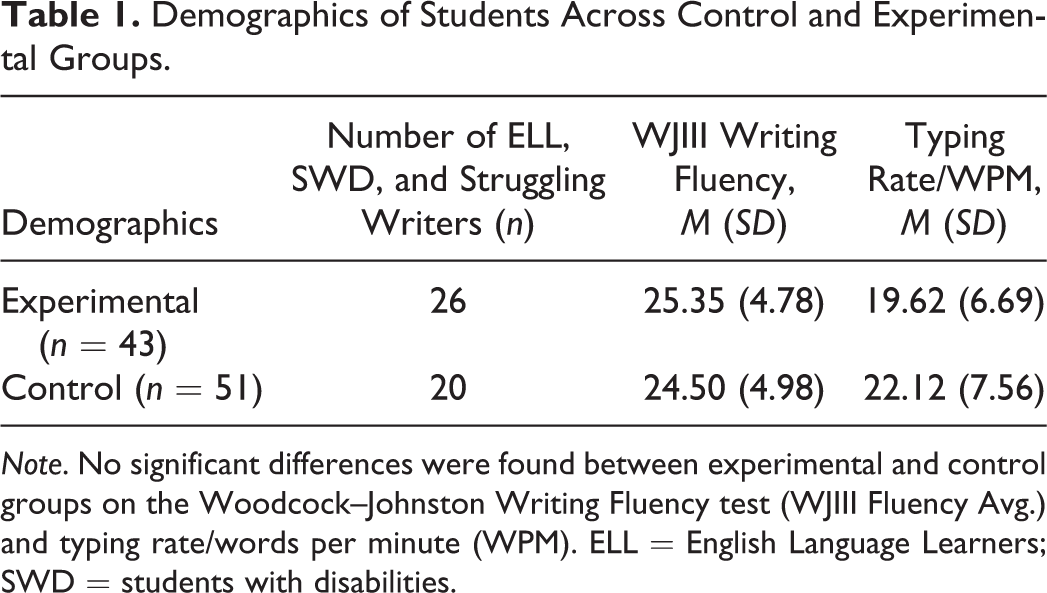
Note. No significant differences were found between experimental and control groups on the Woodcock–Johnston Writing Fluency test (WJIII Fluency Avg.) and typing rate/words per minute (WPM). ELL = English Language Learners; SWD = students with disabilities.
Experimental group
The experimental group consisted of 43 participants (18 males and 25 females), including 17 Hispanic, 21 White, 2 African American, and 3 Asian. The average age of participants was 11.9 years. Twelve students in the experimental group were identified with disabilities. In addition, 11 students were identified as ELLs (the majority Spanish speaking and other languages included Arabic, Tagalog, Indonesian, and Vietnamese) and 3 as struggling writers. Struggling writers were those identified by their teachers, based on writing samples, as consistently performing less than average on written assignments when compared to peers. The average typing rate in the experimental group was 19.62 (SD = 6.69) words per minute.
Control group
The control group consisted of 51 participants (22 males and 29 females), including 20 Hispanic, 19 White, 5 African American, and 7 Asian. The average age of participants was 12.3 years. Five students in the control group were identified with disabilities. In addition, 1 student was identified as ELL and 14 as struggling writers. Before the start of the study, students were asked to touch-type a 1-min passage on an iPad to determine their average typing rate. The average typing rate in the control group was 22.12 (7.56) words per minute.
Teacher participants
One male and five female seventh-grade teachers participated in the study. Teacher A, a female language arts teacher, taught the experimental group. She held a bachelor’s degree in psychology and a master’s degree in middle education and curriculum instruction. She was licensed to teach middle school, fourth–eighth grade students. Teacher B, a female language arts teacher, taught the control group. She held a bachelor’s degree in English and creative writing and a master’s degree in special education and creative writing. She was licensed to teach both general and special education at the secondary level. Teachers C and D were content area teachers who provided opportunities for the students in the experimental condition to practice using the MBGO either in science class or social studies. Teacher C was a male who taught general education social studies. He held a bachelor’s degree in history and East Asian Studies and a master’s degree in educational transformation. He was licensed to teach social studies at the secondary level. Teacher D was a female who taught general education science. She held a bachelor’s degree in agricultural education and a master’s degree in K-12, LD. She was licensed to teach secondary science, biology, and LD. Teachers E and F were content area teachers who provided opportunities for the students in the control condition to practice writing in their classrooms. Teacher E was a female who taught social studies. She held a bachelor’s degree in history and a master’s degree in curriculum and instruction. She was licensed to teach social studies at the secondary level. Teacher F was a female who taught general education science. She held a bachelor’s degree in biology and a master’s degree as a K-12, reading specialist. She was licensed to teach science and reading. The teachers’ average age was 38 years, with an average of 16 years’ teaching experience.
Support team
One White male doctoral student and one Black female doctoral student were at the research site during all student assessments, instructional delivery, and practice sessions. They provided technical assistance, made observational notes, and ensured lesson completion. During the instructional lessons and writing practice, the support team circulated to pass out materials or provided help to students who may have needed technical assistance. Feedback to students was provided if students asked the support team any questions. During instruction, the support team clarified any questions posed by the teachers (e.g., I show the video clip now, right?), monitored the video recording of the lessons, and provided instructional guidance, if needed. Guidance from the support team was minimal.
Teacher Training
Prior to the beginning of the study, the teachers of students in the experimental condition attended a two-day, professional development session, totaling 10 hr. The professional development included a project overview including project strategies, self-regulated learning strategies, the MBGO features, modeling of the instructional lessons, and an overview of the research procedures. Furthermore, teachers took part in a lesson study (see Author et al., 2016b) in which they received guidance and feedback when delivering parts of the instructional lessons to a small group of their peers. The lesson study allowed the teachers to practice the lessons and to gain confidence with the MBGO and to receive feedback from the research team.
Independent Variable and Materials
The MBGO with embedded self-regulated learning strategies and strategy instruction was the independent variable. The students in the experimental group were taught how to use the MBGO with embedded self-regulated learning strategies and strategy instruction (hereon referred to as MBGO). The MBGO was designed to operate on Apple iPads with a software version of 7 or higher. The MBGO was organized into five parts: (a) pick your goal, (b) fill in the chart/table below based on your goal, (c) copy, (d) read, and edit, and (e) self-evaluate (see Figure 1). A complete description of the graphic organizer within a computer-based format can be found in Authors et al. (2016). Within the MBGO, students utilized a strategy/mnemonic, IDEAS, which stood for Identify your opinion, Describe three reasons, elaborate on your reasons with Examples, Add transition words as you go, and Summarize. The mnemonic device supported student recall of the steps of persuasive writing. The embedded self-regulated learning strategies supported students to be motivated throughout the writing process in order to successfully write a quality paragraph. The self-regulated learning strategies included goal setting prior to starting the writing process, self-monitoring during the writing process, and self-evaluation after the writing was complete. Support features built into the app-based MBGO included color coding, drop-down menus, and a copy feature that when selected automatically lifted the text from the completed rows in the table and displayed them as one cohesive essay. The app also included an automated self-monitoring feature. A check was automatically placed in the self-monitoring checklist when the student completed each essay part that matched the selected goal (e.g., I will include three reasons and two examples), included a capital letter, and finished with ending punctuation. If the student did not complete an essay part, they were prompted to go back and correct. However, students were not forced to go back and could bypass this prompt to proceed to the next screen.
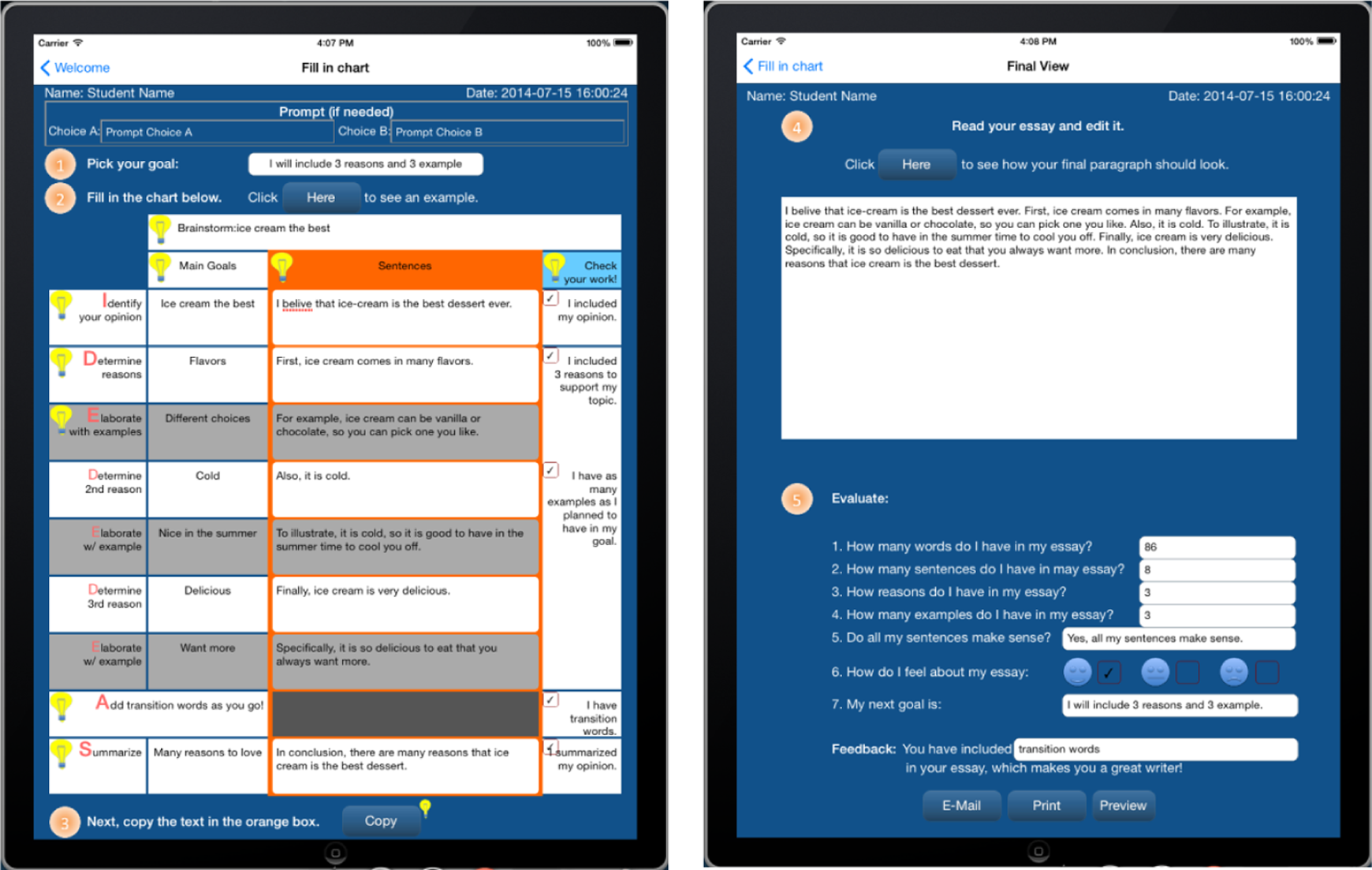
Mobile-based graphic organizer with embedded self-regulated learning strategies (e.g., goal setting, self-monitoring, self-evaluation) and technology-based supports (e.g., text hints, audio comments, color coding, pop-up menus, text-to-speech).
Instructional materials for the experimental group
A total of five instructional lesson plans were provided to teachers during training. Four lessons were delivered in eight 30- to 40-min sessions and were designed to teach the MBGO with embedded self-regulated learning strategies. Lesson 1 introduced the importance of writing, the parts included in the IDEAS mnemonic, and how persuasive writing parts are presented in the MBGO. Explicit instruction was provided to identify the parts of IDEAS in an anchor paragraph. The lesson also included discussions about the importance of strategy use and planning to help students become better writers. Lesson 2 focused on how to use the MBGO. The teacher showed a model video including students’ interactions with the MBGO. The video modeled features, such as choosing transition words from the drop-down menu, completing the brainstorm and sentence columns, and copying sentences. Students were provided with an opportunity to explore the MBGO on their own. Lesson 3 included explicit modeling of all five steps of the MBGO, including the importance of the self-monitoring checklist and the self-evaluation component. Afterward, students were provided with an opportunity for guided practice with the MBGO. Finally, Lesson 4 provided independent practice. At the beginning of the lesson, the instructor provided students with a choice of prompts, orally brainstormed some potential responses and reasons with the students, and then allowed them to complete the MBGO independently.
Instructor materials
The experimental classroom instructor (Teacher A) had a notebook containing the student roster, directions for testing and data collection sessions, scripted lesson plans, and printouts of the PowerPoint presentations for each lesson accompanied by notes and fidelity of implementation checklists. All student data were maintained in the notebook. PowerPoint presentations, student materials, and the lessons were also available to the experimental teacher on her own individual flash drive. Additionally, the teacher utilized technology (e.g., iPads, computer, smart boards, etc.) to teach the content to the students.
Student materials
Student folders contained all student materials used throughout the project. These paper-based materials included agenda for each lesson, a warm-up activity to match the parts of a light bulb with the IDEAS strategy, a scavenger hunt to explore the MBGO, and a strategy review checklist. In addition, each student had electronic materials available on their iPad for Lesson 2 and blank MBGOs for both guided and independent practices. Students used the same assigned iPad for the duration of the study.
Instructional materials for the control group
Teacher B was not provided with the instructional lesson plans used by Teacher A. However, instruction in the control condition was similar to that of the experimental group in that strategy instruction, a graphic organizer, and components of self-regulation were addressed. Teacher B also mirrored the experimental condition in terms of focus of instruction, number of lessons, and built-in practice opportunities. The four lessons were designed by the teacher and delivered in eight 30- to 40-min sessions. The four instructional lessons covered the following: (a) writing a paragraph and elements of strong writers, (b) discussed what opinions are and how to support those opinions, (c) practiced identifying the parts of good persuasive writing, and (d) wrote, edited, and revised a persuasive essay. In each lesson, the control teacher prompted students to think about their writing, their opinion, and their reasons for the opinion. Lessons 1 and 2 focused on developing a persuasive essay and how to identify strong and weak opinions. The teacher scaffolded students’ identification of quality reasons for responding to Should dogs be allowed on public beaches? and Should students at this school be allowed to chew gum? Within Lesson 3, the teacher modeled how to move from planning to writing. She reviewed the parts of a persuasive essay, including questioning the prompt, forming an opinion, brainstorming reasons (at least eight), choosing supports and details, explaining supports and details, and connecting the supports to the main idea. While brainstorming for ideas, the teacher guided the students to self-question, “Why do I support this opinion?” The parts of an essay were structured in a planning sheet with spaces allotted for the topic sentence, first support and explanation of the first support, second support and explanation, third support and explanation, and the concluding sentence. The teacher modeled the use of the planning sheet with the same prompt from Lesson 2, Should dogs be allowed on public beaches? The students were then given the opportunity to work independently on their own planning sheet with the second prompt from Lesson 2, Should students at this school be allowed to chew gum in school? After the completion of the planning sheet, the teacher modeled how to use the planning sheet to draft the essay into a paragraph. During modeling, the teacher demonstrated the use of indentation, of leaving spaces between each line (for further editing), and selecting transition words from a list. The students were then given time to draft their first essay. In Lesson 4, the students were instructed to edit the essay for grammar, punctuation, and overall unity of the paragraph. The teacher first began the lesson by showing an example of an essay that had not yet been edited. She used the essay to start a class discussion on what tools a writer must use to create a coherent paragraph. The following were mentioned in this discussion: topic sentence (main idea), sentence in support of the topic (details and explanation), concluding sentence (concludes main idea), transition words (link sentences within the paragraph), and word selection (clear, specific meaning). The students were then introduced to and received demonstration of a self-monitoring, editing checklist. The checklist items included all essay parts, mechanics (e.g., grammar, punctuation, words to avoid, etc.), and spelling. After the demonstration of the checklist, the students were given their own paragraph to edit their first draft. After editing their first draft, with marked changes and using their checklist, the students wrote their second draft. This draft was then typed to a computer as their final product. At the conclusion of Lesson 4, the students were asked to hand in their planning sheet, first draft with edited marks, and a second draft with the completed checklist.
Instructor materials
The control teacher (Teacher B) developed her own materials for the class including her own lesson plans, student handouts, and supporting materials. Additionally, the teacher required that students use their own personal notebooks to keep copies of her handouts. The teacher used PowerPoint on a SMART board to present instruction for all lessons; however, students did not use computers or iPads until Lesson 4 when they used a computer to compose the final draft.
Student materials
Students in the control condition were given a writing planning sheet during lessons and practice sessions. This writing planning sheet included a space for students to organize and write topic sentences, reasons and explanations, and concluding sentences. During practice sessions, students were given a choice of whether they wanted to use a planning sheet along with the iPad. However, planning sheets were not available to students during pretest and posttest.
Materials for testing and practice sessions
In both the experimental and control conditions, students used iPads for all testing and practice sessions. Thus, during pretest, all students regardless of the condition used Pages application to type in their essay in response to one of two prompts provided by the teacher. During practice sessions and posttest, students in the control condition continued to use Pages, while students in the experimental condition used the MBGO with embedded self-regulated learning strategies to type in the essay. In both conditions, students used their given iPads.
Dependent Measures
Measures common to writing performance were used including number of words, number of sentences, number of transition words, and holistic writing quality. Number of words was measured using the word count feature in Microsoft Word after essays were transferred from the iPads to the Word. Number of sentences was also counted in each essay. A complete sentence included a noun, verb, end punctuation, and a complete thought. Transition words were also measured. The transition words available from the pull-down menus in the MBGO as well as any other student-generated transition words were counted, as long as they demonstrated transition from one thought to another. A holistic writing quality rubric slightly modified from earlier studies (e.g., Cuenca-Sanchez, Mastropieri, Scruggs, & Kidd, 2012) and validated from previous research (Author et al., 2016, Author et al., 2016a) was used to measure the quality of essays. The rubric evaluated each essay with a score from 0 to 8. For example, an essay was scored as 1 if it included a topic sentence, one reason, and an ending sentence. An essay was scored as 5 if it included a discrete topic sentence, three reasons that could be repetitive but not necessarily discrete, one example, and a discrete ending sentence. Discrete was defined as a sentence exclusive to one part. An essay was scored as an 8 if it included a discrete topic sentence, three discrete reasons, at least two examples, a discrete ending sentence, appropriate transition words, and was written in a logical sequence that strengthened the writer’s opinion.
Procedures
Preinterviews and typing assessment
After returning signed informed assent and parental consent forms, students participated in focus group preinterviews. The preinterviews determined students’ perceptions toward writing and their experiences with technology. All small group interviews of 3–5 followed a script and were conducted by the researchers. Specifically, students were asked questions regarding (a) their experiences, attitudes, and preferences for writing; (b) their process for writing, including planning and use of graphic organizers; and (c) their experiences, attitudes, and preferences for writing on the computer. After that, they were asked to touch-type a 1-min passage to determine their average typing rate.
Pretest
Following preinterviews, students were provided iPads and asked to type an essay in response to a persuasive writing prompt in their English class. Students were presented with two randomly selected persuasive prompts and were asked to write in response to one of them on an iPad for no longer than 30 min. Prompts were selected from a pool of 38 prompts drawn from practice standardized assessments of persuasive writing and/or from previous research (e.g., Mastropieri et al., 2012). Participating teachers reviewed all prompts for interest and readability prior to the study (e.g., Write an essay on whether or not students should wear school uniforms).
Instructional lessons
After the pretest, all students in both the control and experimental conditions were introduced to the instructional lessons. Each group of students received four lessons, which lasted eight totaling 30- to 40-min sessions, as described earlier. All lessons were video recorded. For the experimental condition, fidelity of implementation checklists was independently completed by both the teacher and a member of the support team. For each lesson, there were 10–12 items listed on the checklist. The items were checked as completed or not completed by the instructor. Fidelity of treatment was calculated by dividing the number of steps completed by the number of steps planned. All lessons were consistent across observers identifying 100% instructional fidelity. For the control condition, a video recording was observed and the teacher was asked to complete a writing lesson fidelity checklist. Using the checklist, the teacher identified (a) the teaching objective, (b) if the lesson included technology, (c) any student materials, (d) any elements of direct instruction, guided practice, and independent practice (e.g., Teacher provides direct instruction about _______), and (e) if the video camera was recording. All lessons were consistent across observers, identifying 100% instructional fidelity for the control condition.
Practice sessions
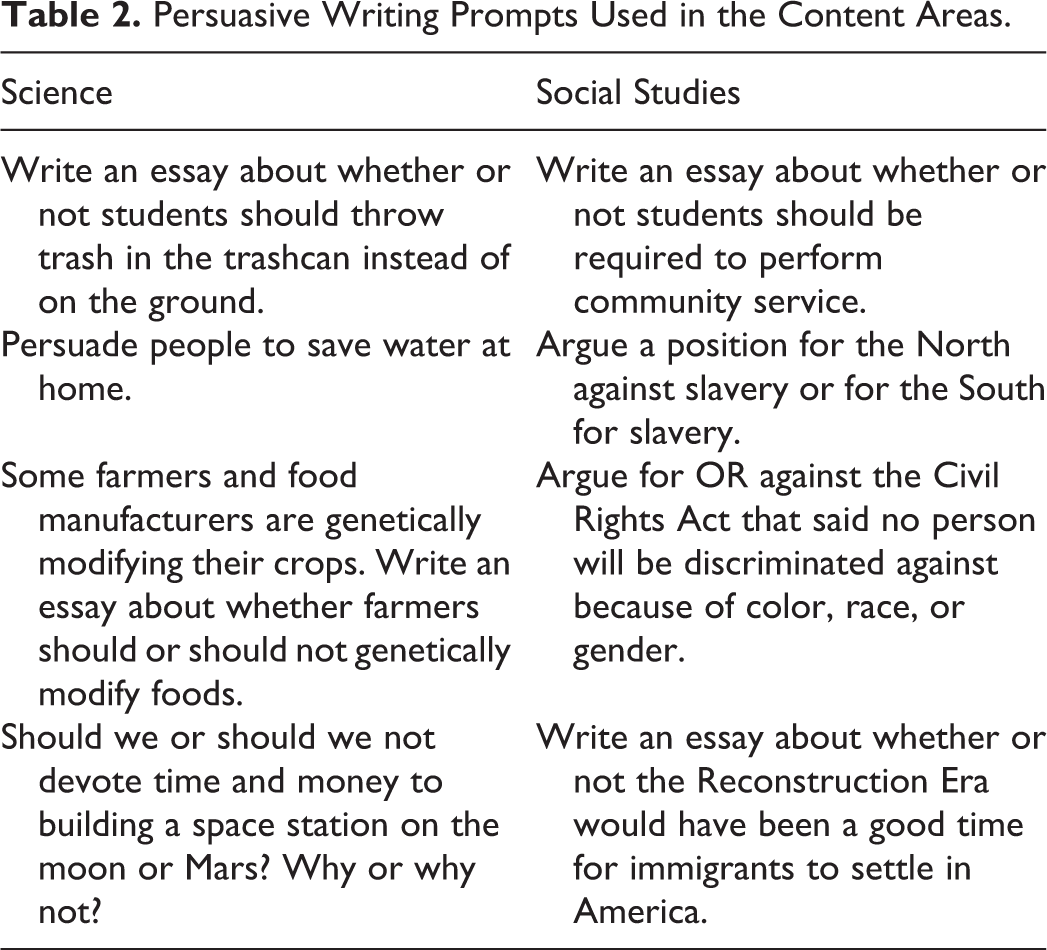
After four lessons, students were given the opportunity to practice their persuasive essay writing using MGBOs (in the experimental condition) or Pages (in the control condition) on their iPads. Five total practice sessions were conducted across science and social studies classrooms over a 2-week period based on teachers’ schedules. Science and social studies teachers provided their own persuasive prompts based on their curriculum. The prompts were vetted by the research team prior to use and were the same for both control and experimental conditions (see Table 2 for practice prompts). The practice sessions followed the same protocol as the pretest and posttest procedures following scripted directions.
Persuasive Writing Prompts Used in the Content Areas.
Mastery checks for the experimental group
After approximately two practice sessions, each student in the experimental condition was evaluated on mastery of the MBGO use via a mastery checklist (see Figure 2). The checklist included items to be observed during a students’ think-aloud interview completed while they used the MBGO. Specific skills to be observed included the following: (a) choose the goal, (b) successfully complete the table in full, (c) use the additional supports if needed (e.g., text-to-speech), and (e) complete the self-evaluation portion of the MBGO. In addition, students were asked to verbally explain any items on the MBGO that were not completed or easily observable. The support team documented observations and student explanations as well as used the observational rubric to measure students’ mastery. Students met criteria if they were able to demonstrate full use of the MBGO. The observations lasted on average 10–15 min.
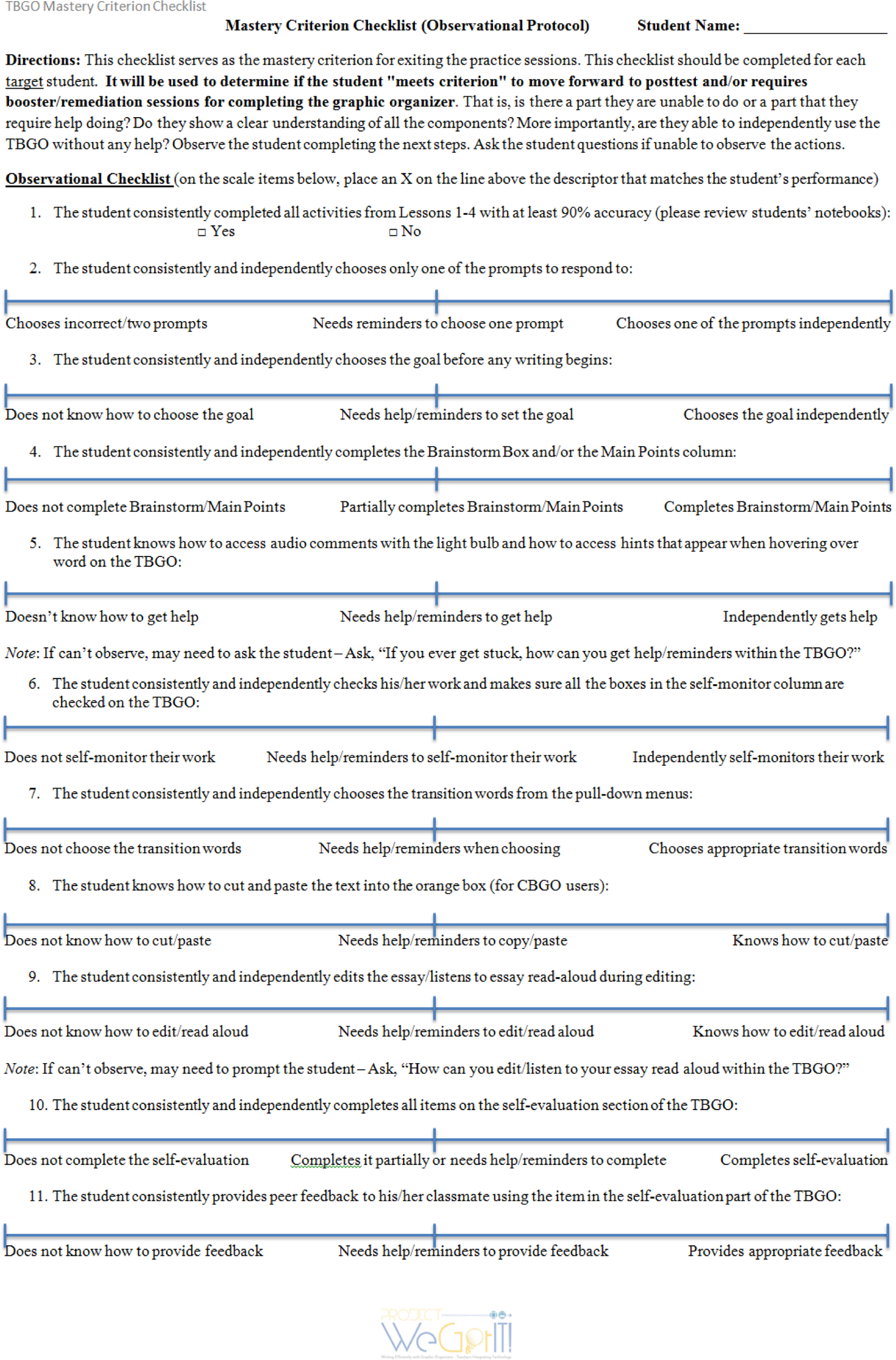
Mastery checklist for students in the experimental group to demonstrate after practice.
Posttest
Following the MBGO practice sessions, students were asked to independently respond to one persuasive writing prompt using the MBGO (in the experimental condition) or Pages (in the control condition) on an iPad. The instructor followed a prescribed script for directions during this phase, which included reading the prompt out loud to students and keeping the posttest session no longer than 30 min.
Poststudy interviews
Focus groups of approximately 2–7 students from the experimental condition were interviewed by the researchers following the posttest. Students were asked to (a) recall and evaluate the strategy, (b) explain how they used the MBGO and share their opinions about each MBGO part, (c) provide suggestions on how to improve the MBGO, and (d) share opinions about the lesson plans. In addition to the students’ interviews, the teacher who provided instruction and those who facilitated the practice sessions for students in the experimental condition (Teachers A, C, and D) were interviewed at the end of the study. The teachers were asked about why they chose to be involved in the study and what their perceptions were of both the technology tool and the instructional materials. All interviews were audio recorded and transcribed for analysis.
Writing Performance Results
All students were administered writing pretests and posttests, which were scored for the number of words, sentences, transition words, and the holistic writing quality. Since pretest differences were obtained, analyses of covariance (ANCOVAs) were employed, using the respective pretests as covariates. Findings are presented on (a) ANCOVAs on posttesting measures, (b) adjusted means, (c) performance of special education students and struggling writers, and (d) qualitative findings from interviews of teachers and students in the experimental condition.
ANCOVAs
Data on each measure at posttest on number of words, transition words, sentences, and overall holistic essay quality on students’ essay writing were entered into separate one-way (experimental versus control condition) ANCOVA using the respective pretests as covariates. At posttesting, significant findings favoring the experimental condition were found on holistic quality, F(1, 91 = 6.13, p = .015, and transition words, F(1, 91) = 190.87, p = .000, but not on number of words, F(1, 91) = 2.47, p = .120 or sentences, F(1, 91) = .97, p = .327.
Adjusted Means
Adjusted means, standard errors, and partial η2 by condition (experimental vs. control) across the dependent measures, holistic (quality), sentences, transition words, and words for post testing are presented in Table 3. As can be seen, experimental condition students significantly outperformed control students at posttesting on holistic quality and transition words, but not on sentences or number of words.
Adjusted Means, Standard Error, and Partial η2.
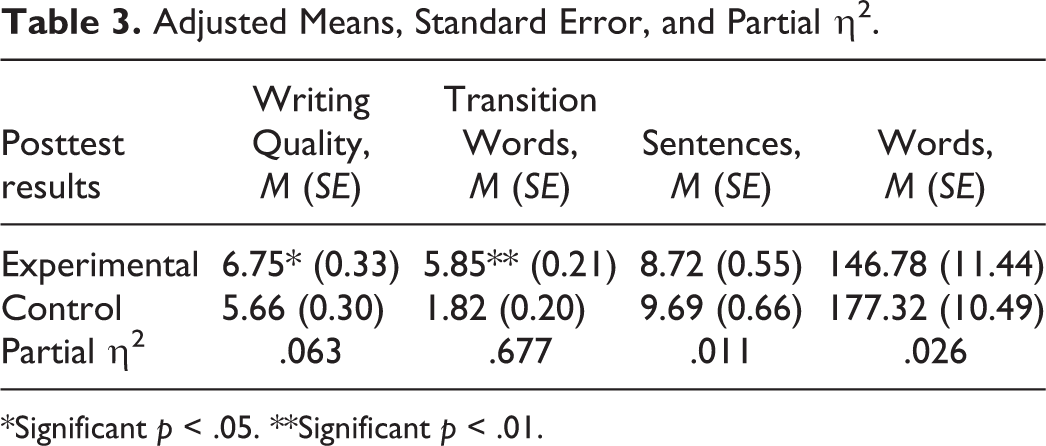
*Significant p < .05. **Significant p < .01.
Supplemental Analyses
Since there were relatively fewer students with disabilities and struggling writers enrolled in the inclusive classes and the numbers were not balanced across conditions, it was deemed inappropriate to use those categories as separate levels in the analyses. However, supplemental independent ANCOVAs using pretests as the covariates were analyzed using the combined special education and struggling writers. Statistically significant findings favoring the experimental condition were found at posttesting on transition words, posttesting F(1, 43) = 171.90, p = .000, but no other significant differences favoring either condition were obtained. However, descriptive differences favoring the experimental condition were obtained on holistic quality scores. Table 4 presents the means, standard errors, and partial η2 for the special education plus struggling writers of the experimental and control conditions. These supplemental analyses demonstrate that the special needs students all apparently performed fairly similarly to the sample as whole and benefitted from the strategy instruction.
Special Needs/Struggling Writers: Adjusted Means, Standard Error, and Partial η2.
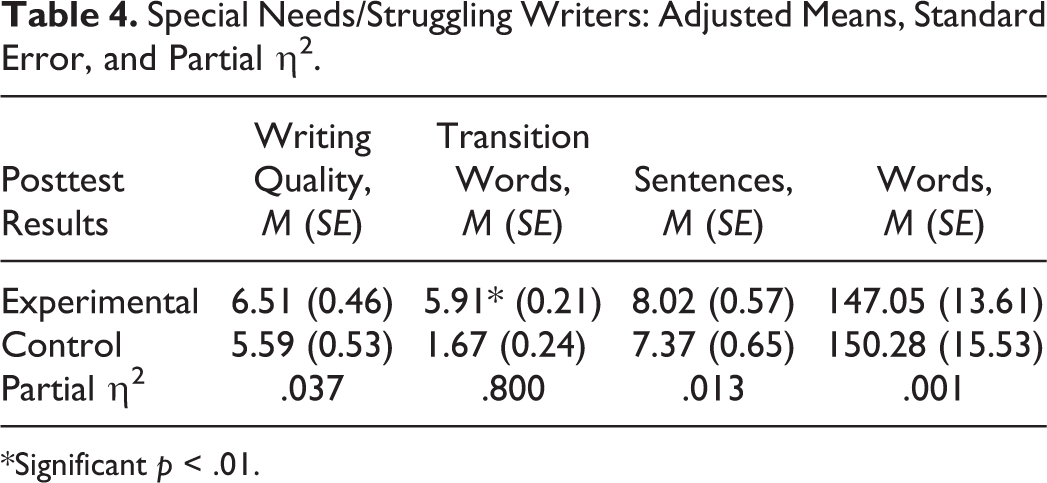
*Significant p < .01.
Qualitative Analysis Findings
Students’ Interviews Findings
During preinterviews, most students considered themselves to be good writers. However, many of them noted that writing presented difficulties. One student Katie (pseudonym) stated during her interview, I like writing. I think the hardest part is kind of just like sticking with an idea once you’ve started. Not like getting to a point where you’re kind of bored because you just don’t like the idea anymore and just never go back to it…
During the postinterviews following the study, students responded favorably to using the MBGO. According to one student with a speech and language impairment who struggled with writing, Juan (pseudonym), the graphic organizer and strategy were helpful in becoming a better writer because “it lets you stay on topic and brainstorm about it” and “…other people should use it [the MBGO] because it makes it easier to write.” A Spanish-speaking student, Anita, commented, “I think it’s easier to type on the iPad or write on the iPad because you can just go back and correct it if you forget something.” Two other students with LD reported, “…it [MBGO] helps me get organized” and another shared, “…it helps me like go through the steps that I’m writing about.” The majority of students also indicated that they preferred using technology to complete writing assignments. A student shared, “It was like so easy and simple to use.” A peer elaborated, It was simple because you didn’t have to retype it [sentences] anywhere else. You could just hold your finger down and you would hear I guess I think it was Siri that would say you’re allowed to move it now and you could move it to the box.
Teachers’ Interviews Findings
During the interview, the three teachers of the experimental condition explained their initial interest in the writing project and its use of technology. Teacher A stated, “I thought it would be a good way to help struggling writers and students with IEPs with their writing. I used some similar strategies before and I wanted to see if the use of technology would have a benefit.” A content teacher added, “Also they [students] like technology in general so using technology to help them do that I thought was a step forward”.
Teachers also reflected on how students responded to the use of technology when writing. Teacher A noted that, …they liked working on the iPad, which I was interested to see and they worked really well on it. I actually gave them the same prompts…for the final writing…and they were like oh, we’re not getting iPads? We have to hand write it? I said yeah, so they gave me a little bit of push back…
Teachers expressed the ease of using the given lessons and technology to teach writing. Teacher D noted, “…it seemed pretty easy to use and teacher friendly and I liked the idea that although it [the lessons] was scripted…that there was room for a little bit of modification depending on the students.” Teacher A added, …I think it [MBGO] keeps them focused as to what they need to do…it’s a writing tool that is available to them on an instrument that they normally use…if they’re used to using it [the technology] and they have it available to them…I think some of them are more inclined to make sure that they have all the pieces that they’re supposed to have in their writing.
Discussion
The primary purpose of this study was to determine whether the use of an MBGO with embedded self-regulated learning strategies and strategy instruction presented on an iPad would improve the persuasive writing of students in an inclusive setting compared to use of an iPad without an MBGO. The number of words, number of sentences, number of transition words, and holistic writing quality were measured to determine students’ writing improvement. Students who used the MBGO with embedded self-regulated learning strategies and strategy instruction to compose persuasive essays significantly outperformed students in the control group for number of transition words and writing quality. The fact that statistically significant differences for writing quality emerged in favor of students composing persuasive essays with the MBGO supports similar results found for students with disabilities in self-contained settings (Author et al., 2016) and students in inclusive settings (Author et al., 2016a). Although the writing quality was higher for students in the present study, there were no significant differences for the number of sentences or words between students’ writing in the experimental group who used the organizer and the control group who did not. One explanation is that students in the experimental group stayed within the limits of the organizer, which may have forced them to spend time planning their writing and subsequently limited the length of their writing. Although students can certainly write more sentences within each section of the mnemonic on the MBGO, the lessons used by the teacher in the experimental condition modeled one sentence for each part of the persuasive essay resulting in the maximum of 8 sentences (see Figure 1). Given more instructional time, teachers could consider differentiating the MBGO instruction by encouraging and modeling how to expand beyond one sentence for each reason and/or each example within the MBGO. Another explanation may be that students who generate lots of ideas, as seen among students in the control group, may spend less time planning and organizing those ideas, effectively. This lack of organization and planning of ideas, in turn, may negatively affect the quality of writing. For example, when students with emotional and behavioral disabilities used a strategy to write persuasive essays, their writing performance increased when they spent more time planning writing (Hauth, Mastropieri, Scruggs, & Regan, 2013). For those students in the experimental condition of this investigation, an MBGO supported the needs of varied learners to first plan and organize their ideas when writing to persuade their audience.
Teachers and students in this study reported that the use of iPads for writing provided them with little, if any, challenges. Teachers and students expressed positive or neutral thoughts toward using the iPads. The science and social studies teachers in this study were receptive to participating because using the technology and persuasive writing fit within the curriculum. The school culture supported not only the integration of technology but reinforced writing across the curriculum. Teachers developed specific writing prompts that aligned with their curriculum (e.g., Reconstruction Era), so that students could practice writing with or without the MBGO. Teachers recognized that the opportunity for writing in the content areas allowed students to better understand learned information and that this practice was consistent with the CCSS. There is a growing body of research on content area writing for students with disabilities (e.g., Benedek-Wood, Mason, Wood, Hoffman, & McGuire, 2014; De La Paz & Wissinger, 2016; Hauth et al., 2013), but more research is needed in this area.
Teacher and students’ receptive attitude toward use of the iPad for writing may also be explained by their familiarity with mobile-based technologies and/or the unique nature of the school site, which heavily focused on integrating technology into the curriculum. Although educational technology use in today’s schools is increasing, implementation of a technology-based tool like the MBGO on an iPad may be more challenging for class-wide instruction without the technological supports provided by an accompanying research team. Planning for class-wide mobile technology implementation in the classroom should not be underestimated. Implementation requires first learning the technology and learning how to evaluate its use (Rodriguez, Strnadova, & Cumming, 2014). Maich and Hall (2016) also recommend that teachers plan for ongoing maintenance, use proximity to ensure students are on task and not distracted by the iPads built-in features, explicitly teach students how to use the technology and configure the iPads carefully.
Research investigating use of mobile technologies in the classroom is scarce, but the majority involves the use of applications on the iPad. For example, investigations have included the educational use of applications in math for students with autism (Burton, Anderson, Prater, & Dyches, 2013), the use of video modeling for students with language-based disabilities (Cumming & Draper Rodriguez, 2013), and the use of a portable dictionary and the voice memo application for ELLs (Demski, 2011). The research base for using mobile technology for students with disabilities during writing instruction is particularly sparse (e.g., Sessions, Kang, & Womack, 2016). However, the findings of this investigation support the notion that the use of iPads for writing may prove to be particularly promising to meet the diverse skills and abilities of students in an inclusive classroom (Maich & Hall, 2016). Use of the MBGOs with embedded self-regulated learning strategies on the iPad enables several technology-based features that can support students with various abilities and needs. For example, the MBGO incorporated such features as text hints, audio hints, color coding, and text-to-speech. Thus, students were able to choose the level of supports needed to successfully use the tool. Future research should explore students’ use of various technology features and examine whether aforementioned supports result in bigger improvements in students’ writing performance.
Limitations
This study has limitations. First, the classes for each condition that participated in the study were intact classrooms. Therefore, the conditions were unbalanced in the number of students with disabilities, ELLs, and struggling writers, causing the sample sizes for these subgroups to be too small to analyze separately across experimental and control conditions. Future research should control more for the special needs sample size to be able to include them in the entire model as a separate level during analyses. Second, the teacher was a confounding variable. Although the instruction in the experimental and control conditions was similar apart from the MBGO, different instructors taught each condition. Third, individuals must be cautious to generalize these results, given that the middle school was already actively integrating technology in their instruction. This study should be replicated in schools that may have less emphasis on the integration of technology or access to technology.
Footnotes
Declaration of Conflicting Interests
The author(s) declared no potential conflicts of interest with respect to the research, authorship, and/or publication of this article.
Funding
The author(s) received no financial support for the research, authorship, and/or publication of this article.