







Abstract
Mobile technology provides increasingly accessible and normative tools for communication that does not require intelligible oral expression. For adolescents with autism spectrum disorders (ASD) and complex communication needs, mobile technology presents opportunities for inclusive social experiences and additional modalities for communicating with communicative partners (e.g., making a request to a partner who may or may not be within close proximity). This study examines using video prompting to teach four adolescent males with ASD, intellectual disability, and limited verbal expression of how to emit pictures to communication partners using text messaging technology. Results indicate acquisition was achieved and maintained when presented under the same conditions for three of the four participants. Attentional concerns were observed in the intervention sessions and warrant future investigation.
Keywords
Increased use of mobile technology in mainstream culture has made a new type of communication device highly accessible to people with autism spectrum disorders (ASD) and/or complex communication needs (CCN). People who rely on assistive and augmentative communication (AAC) have the right to the same range of communication options as everyone else (Rehabilitation Engineering Research Center on Communication Enhancement, 2011). Although mobile technology is an exciting and relatively new communicative prospect for people with ASD, the technology and its accessibility are moving more rapidly than the ability to research the intricacies of using mobile devices as a common means for communication (McNaughton & Light, 2013; Rehabilitation Engineering Research Center on Communication Enhancement, 2011). Effective practices for teaching people with disabilities how to use the iPad and iPod for multiple purposes is an area that continues to be explored (Cumming & Drape Rodriguez, 2017). Much of the work in this area utilizes applied behavior analytic techniques to teach people with ASD and/or CCN how to use these devices (see Kagohara et al., 2013). When investigating the multiple uses and effective teaching approaches, researchers and practitioners are encouraged to seek the most efficient and socially valid approaches (Adkins, 1997; Wolf, 1978). For example, literature detailing the investigation of the most effective teaching approaches offered within the evidence base (Wong et al., 2014) contains conflicting results that require further investigation (cf., Alberto, Cihak, & Gama, 2005; Mechling, Ayres, Bryant, & Foster, 2014). Researchers of the present study investigated the effectiveness of video prompting to teach youth with ASD how to use mobile technology (i.e., text messaging) to make a request to a communication partner who may not be within close proximity. This skill may be advantageous for youth who seek to communicate with trusted communication partners who are not within visible range.
Teaching Students to Use Mobile Technologies
Video modeling, task analysis, and technology-aided instruction and interventions are all recognized as evidence-based practices for youth with ASD (Wong et al., 2014). Much of the literature base investigating how to teach people to use mobile technologies (i.e., any handheld electronic computing devices such as a tablet, smartphone, and MP3 players) has outlined the use of video modeling, prompting, or a combination of both (Cumming & Drape Rodriguez, 2017; Kagohara, 2011; Kagohara et al., 2011; Kagohara et al., 2013; van der Meer et al., 2011). Only two studies exist that meet quality indicators (Council for Exceptional Children, 2014) for using an iPhone as a tool for people with disabilities and, although it did not meet quality indicators, there is only one study specifically where researchers investigate text messaging as a communication strategy for people with CCN (Cumming & Drape Rodriguez, 2017; Lancioni et al., 2012). Although there is a wealth of empirical work in which researchers investigate the multiple uses of mobile technologies in education and special education (Cumming & Draper Rodriguez, 2017), a gap exists in this research on the utility of teaching text messaging as another form of communication for people with CCN.
The case for text messaging
Text messaging using mobile technology can provide a simple form of communication that is highly accessible to parents and people with CCN. Accessing mobile technology is often much more affordable for family members than purchasing larger voice output devices. In addition, the use of mobile technology is a common and normalized behavior in Western and industrialized cultures (Gerpott & Thomas, 2014). Therefore, the use of mobile technology to communicate with others in the current age of technology meets the criteria to be considered a pivotal behavior (Koegel & Koegel, 2006; Koegel, Koegel, & Carter, 1999). Mastering the use of an internal operating system for the purposes of sending or posting text or a picture from a mobile phone opens up the possibility of participating in social media and other group activities (e.g., group text thread) that are such a critical part of social communication in today’s society.
Video Prompting
Video-based interventions (VBI) have become a widely accepted practice for teaching many skills to people with ASD (Banda, Dogoe, & Matuszny, 2011; Bellini & Akullian, 2007; Mechling et al., 2014). Video prompting is a form of video modeling that incorporates modeling and verbal prompting. When recording a video-prompting video, each step will be shown from the student’s point of view. Often, a verbal prompt stating the next step serves as the stimulus for hands in the video to begin performing the prompted step. Research about video prompting for people with developmental disabilities indicates that this method of shortened segments of video directives assists with decreasing the cognitive load sometimes imposed by longer videos (Sigafoos et al., 2007).
Banda, Dogoe, and Matuszny (2011) completed a systematic review of studies utilizing video prompting for people with developmental disabilities. According to Banda et al., video prompting was used to successfully teach many functional and independent living skills (e.g., cooking, laundry). Studies reviewed included participants ranging in age from 8 to 41 years. Overall effectiveness was evident in nearly all of the participants across all of the studies included in the review. In many of the studies, researchers combined video prompting with other instructional strategies (e.g., constant time delay, error correction). Least-to-most prompting systems were also used in quite a few of the studies reviewed to teach prerequisite skills before using video prompts by themselves. Fading of video prompting was also discussed. To avoid prompt dependency, many of the researchers explicitly designed prompt-fading procedures following the initial intervention phase (see Mechling, Gast, & Fields, 2008; Sigafoos et al., 2005; Sigafoos et al., 2007; Van Laarhoven & Van Laarhoven-Myers, 2006). In a more recent review, Aljehany and Bennett (2018) found no significant differences in moderators (e.g., levels of prompting, use of narration). That said, video prompting could be useful for teaching a new skill, particularly to youth who are vulnerable to prompt dependency (i.e., youth who look to a facilitator to prompt their responses). Moreover, the use of video prompting allows youth to learn new skills under similar learning conditions without the potentially variable discriminant stimulus or distractions that may be present when prompting strategies that require a teacher present are used during acquisition (e.g., physical prompts, gestural prompts). There are several effective teaching strategies, but with the increasing rate of “how-to” videos posted and accessible on the internet, video prompting is a commonly accessible learning tool for all learners. Teaching people with ASD and/or intellectual disability (ID) to attend to and learn from video prompts may lead to more inclusive and independent learning opportunities.
Many people with ASD use AAC to communicate with the world around them. Unfortunately, many AAC devices are expensive, inaccessible to family members, and unable to adequately communicate with people who are not within an audible distance. Mobile technology is currently incorporated into many individualized educational programs without assessment data or adequate empirical support on instructional strategies for teaching effective and fluent use of the device(s). In this study, researchers investigated the effectiveness of video prompting for teaching youth with ASD how to make a request using mobile technology (i.e., text messaging).
Method
Participants and Setting
After obtaining permission to conduct the study from the school’s board of directors and the university institutional review board, potential participants were nominated by various specialists who (a) worked at the school; (b) were familiar with the students, their abilities, and who may benefit from the study; and (c) knew the inclusion and exclusion criteria for the study. Informed consent forms were sent home to potential participants who had been nominated. Of the 14 informed consents that were sent out, 11 respondents granted permission. Four participants who met the inclusion and exclusion criteria received the intervention.
Inclusion and exclusion criteria
To be considered for the study, participants had to be (a) identified with a primary diagnosis of ASD, (b) limited in expressive verbal communication skills, (c) proficient in the first two stages of picture exchange communication system (PECS; Bondy & Frost, 1994), and (d) using an iPad as the primary mode for expressive communication. For the purposes of this study, limited expressive verbal communication was operationalized as having a documented speech impairment or communication disorder in the area of expressive language as evidenced by scoring two or more standard deviations from the norm of validated formal language assessments completed by a licensed speech-language pathologist. The main purpose of only including participants with limited expressive verbal communication skills, yet the ability to make requests and fluently use an iPad for communicating, was to justify the social validity of teaching participants an additional way to communicate expressively when the desired communication partner or the participant’s AAC device is not within close proximity to the participant.
Demographic characteristics
Participants for this study were four White, adolescent males with ASD and IDs. The Peabody Picture Vocabulary Test–4th Edition (PPVT-4; Dunn & Dunn, 2007) and Expressive Vocabulary Test–2nd Edition (EVT-2; Williams, 2007) were administered to each of the participants and all four scored in the “extremely low” range on each test (see Table 1). Scores on the Stanford Binet Intelligence Scales–5th Edition (SB-5; Roid, 2003) for each participant indicated that all four participants also had an ID. Kevin was able to make some vocalizations, but very few were considered expressive words used to communicate (e.g., “bye”). Leo, Tom, and Jaden were able to make some intelligible vocalizations that were considered expressive words, but none of them used vocalizations to communicate functionally (e.g., make requests). All four participants used an iPad and an application (i.e., Proloquo2go) as a voice output device to make requests and communicate with others.
Participant Demographics.
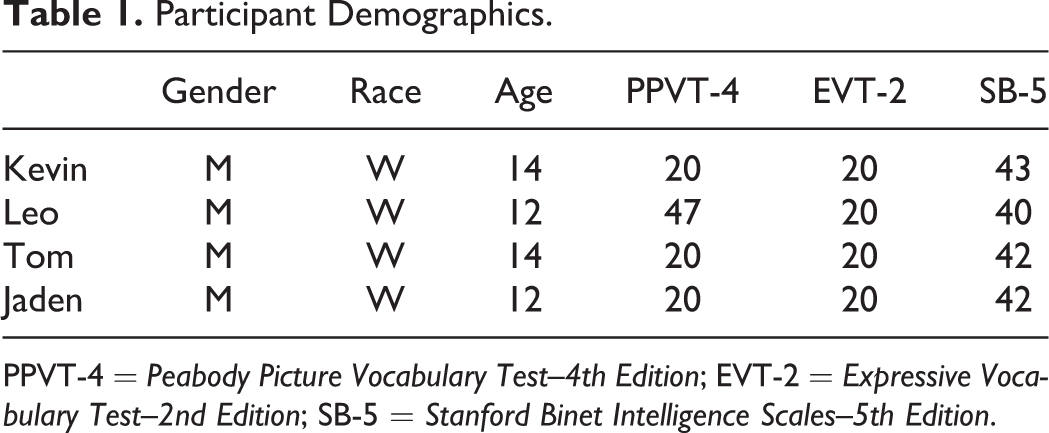
PPVT-4 = Peabody Picture Vocabulary Test–4th Edition; EVT-2 = Expressive Vocabulary Test–2nd Edition; SB-5 = Stanford Binet Intelligence Scales–5th Edition.
Setting
The study site was located in the northeast region of the United States at a private school for students with ASD in grades K–12. Intervention sessions lasted approximately 5 min and took place in the participants’ classrooms. Each classroom had approximately six or seven students and an assigned team of specialists including the special education teacher, behavioral consultant, occupational therapist, speech/language pathologist, and a classroom coordinator. In addition to the specialists, each classroom had five or six support staff assigned to implement and support each student’s programming. Students were on individual schedules for most of the day and had assigned staff (i.e., special education teacher or paraeducator) to accompany them to each of their scheduled activities. There were two research team members: (a) a doctoral-level university professor with over 15 years of experience working with youth with ASD in applied settings and (b) a graduate student in a special education program with approximately 5 years of experience working with youth, some with disabilities. During intervention sessions, a research team member implemented the intervention, and the staff member assigned to the target participants was present to ensure the participant was receiving the necessary supports delineated in their individualized education programs. Room arrangement varied across classrooms, but classrooms typically had two group tables for instruction and individual desks for each student to participate in individualized instruction. Intervention sessions were completed at whatever table or area the student was scheduled to be in during the time of the intervention session (i.e., typically at a one-to-one teacher table).
Materials
Materials for this study included (a) an iPhone 4, (b) a laptop computer, (c) a video demonstrating and verbalizing each step within the text messaging sequence, (d) and preferred items for each of the participants. Although all of the participants were fluent in using an iPad for communicating, the iPhone 4 was chosen because (a) it is small enough to fit in their pocket, (b) it is affordable, (c) its Apple Inc. operating system (iOS) changes less frequently than its mobile counterparts (e.g., Android), and (d) it has the same operating system and interface as the iPad. The home screen only displayed the iMessages application in the dock (i.e., the row of icons along the bottom of the iPhone that do not change when you swipe between screens). All other applications were housed in folders located on the third home screen from the primary home screen to prevent the participants from selecting an application other than iMessages. The iMessages and camera applications were used during this study. Only one contact, “SR+,” was stored in the phone.
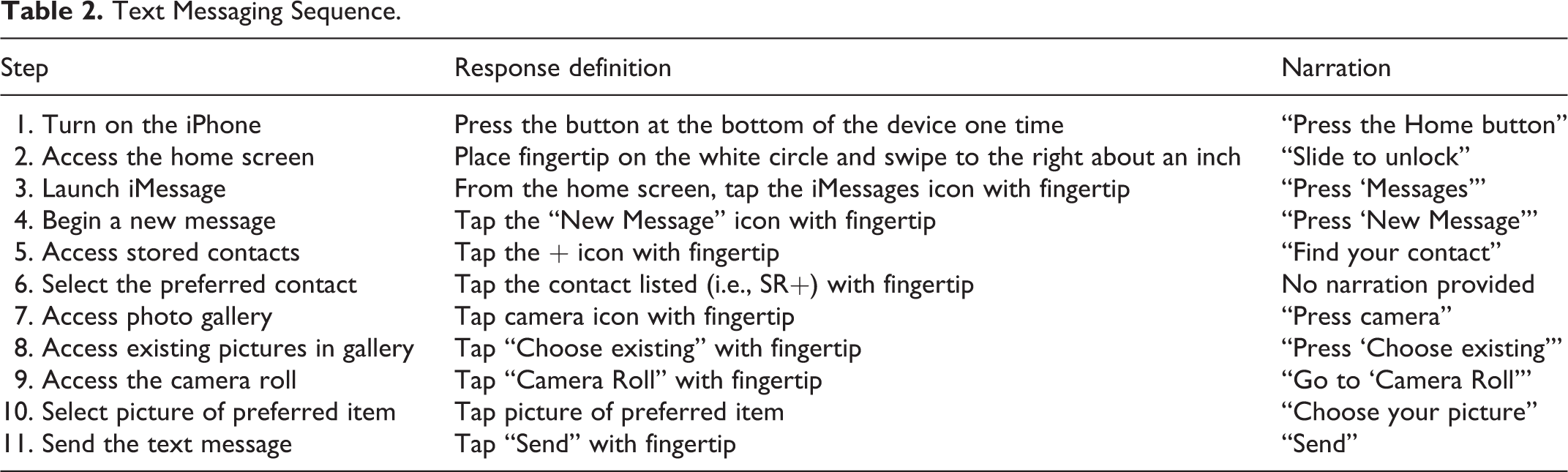
The 55-s video verbally prompted and modeled the 11 steps of the text messaging sequence (see Table 2). The first author used a Samsung Note II to record the video prompting sequence prior to the beginning of the study. To validate the video, the recorded sequence was followed by a nonresearcher who was unfamiliar with project goals and able to follow basic instructions. Once the video was validated, it was saved to Google Drive and played on a Dell Latitude E5440 laptop during intervention sessions. Prior to each baseline and intervention session, the staff member assigned to the participant brought at least 3 known highly preferred items for the participant. Items were identified by staff and were based on frequent preference assessments administered by the staff with the students. Using the 3 known preferred items, the lead investigator would place all 3 items on the table and ask the participant what he wanted to work for. After the participant selected the preferred item, the lead investigator took a photo of the item using the camera application. The photo was stored in the gallery for the participant to find during the text messaging sequence. Only one item, the item chosen by the participant prior to the initiation of the text messaging sequence, was photographed and stored for each session—this was to prevent the need for the students to visually scan and discriminate in order to be effectively taught the skill.
Text Messaging Sequence.
Dependent Variable
The dependent variable for the study was completing all of the steps in the text messaging sequence independently to send a photo via text messaging. Making requests was chosen for three reasons: Participants were fluent in PECS and this design utilized a similar sequence of events. Providing a prenegotiated, self-selected reinforcer at the conclusion of the behavior chain increased the probability of the participant engaging in the behavior chain in the future when presented with an analogous discriminant stimulus (i.e., a cellphone). Teaching a mode of communication that allowed the participant an additional way to make requests to communicative partners who are not within direct physical proximity was a socially valid behavior.
The target behavior was independently completing each of the steps in the text messaging sequence. The number of correct responses was counted, and percentages of accuracy were calculated. Correct responses (i.e., one of the steps listed in the task analysis; see Table 2) are defined as independently performing a step within 5 s of the verbal stimulus of “Text me what you want” or the completion of the previous step in the behavioral chain. Baseline sessions were discontinued after the participant made incorrect attempts or stopped making attempts after 10 s of the previous discriminant stimulus (i.e., “Text me what you want” or the completion of the previous step in the behavioral chain).
Visual analysis (Figure 1) of level, trend, and variability in performance (Horner et al., 2005) was used to analyze the functional relationship between video prompting and steps completed within the text messaging sequence. In conjunction with traditional visual analysis for single-case research (i.e., mean scores and range), Tau-U was calculated to determine effect size and to facilitate comparisons of results from this study to other studies in the literature. While other models exist to determine effect size in single-case research (i.e., hierarchical linear modeling, Kendall’s rank correlation, and Mann–Whitney U test), Tau-U uses guided selection of individual participant contrasts across phrases that are later combined to form omnibus effects for the entire design. Parker and Vannest (2012) provided reasoning for using this “bottom-up” analysis, as well as added benefits for using a distribution-free effect size such as Tau-U. By using Tau-U, one can interpret data across phases and the entire design. Practitioners can understand Tau-U analyses without high levels of statistical training, making it an accessible option. In addition, Tau-U scores were calculated to determine the effect size. Tau-U scores is a measurement of assessing nonoverlapping points between two phases baseline and intervention phases or baseline and withdrawal phases. Small data sets are most common for this index, typically collected from single-case research designs. Following the “S” sampling distribution, Tau-U utilizes p values and confidence intervals (CIs) to interpret effect sizes (Parker, Vannest, Davis, & Sauber, 2011).
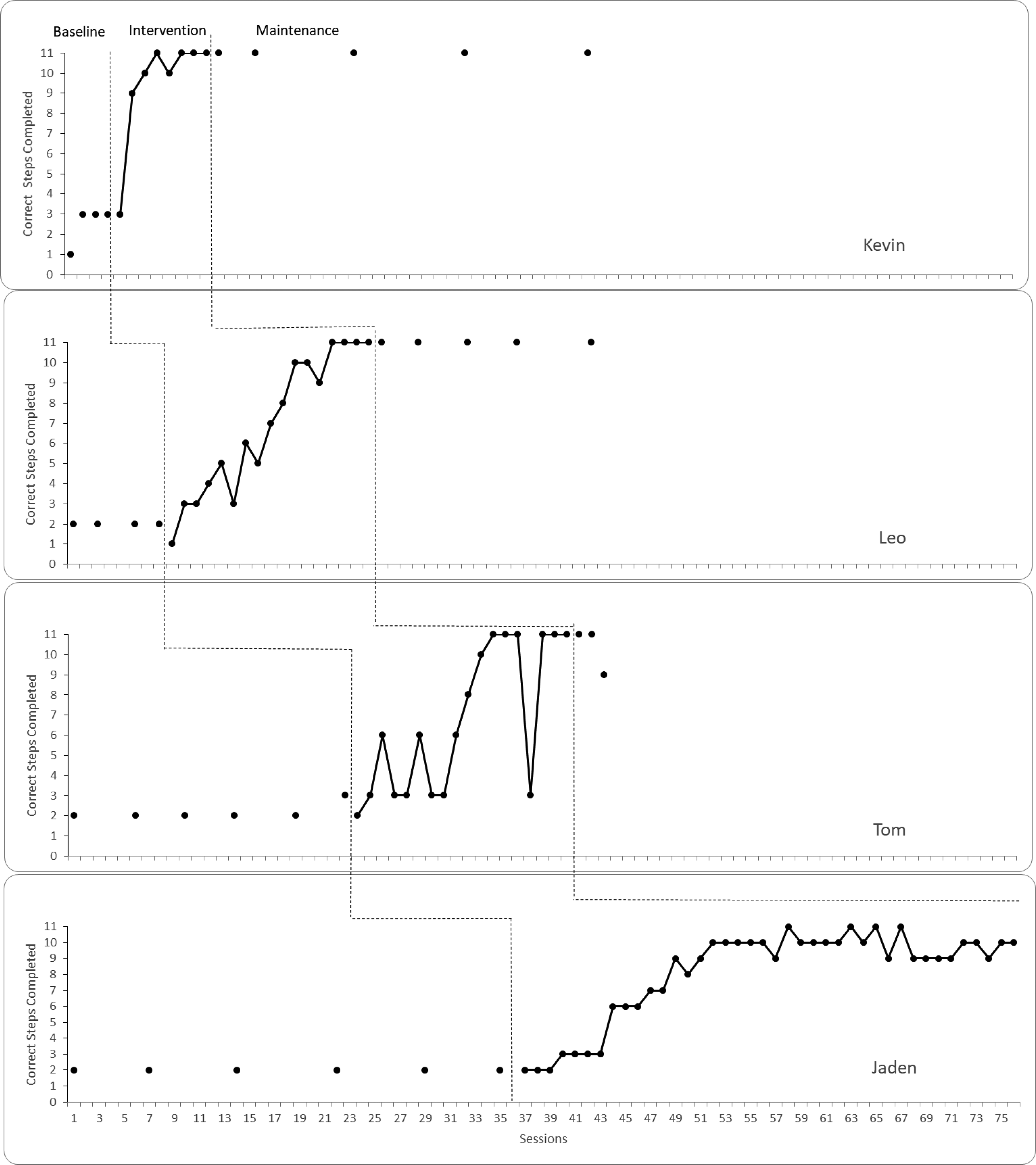
Number of correct steps completed within the text messaging sequence across four participants.
Social validity
The researchers interviewed the specialists (i.e., speech-language pathologist, behavior specialist, and lead curriculum coach) who worked at the school and were familiar with the participants to obtain social validity data (Wolf, 1978). Questions asked related to both the social importance of the outcome (i.e., ability to send a picture via text message to make requests) and the effectiveness of teaching the skill through video prompting. All of the stakeholders were interviewed separately by the lead investigator, and they all indicated text messaging was a socially valid behavior (i.e., acceptable and relevant for adolescents) and video prompting was a socially valid intervention (i.e., effective for teaching the participants and easy for other educators to implement).
Procedure
Experimental Design
Researchers conducting this study employed a delayed multiple probe across participants design. Video prompting (i.e., the independent variable) was sequentially introduced across participants. It was hypothesized that a functional relationship would be demonstrated if the introduction of video prompting changes participant behavior of completing the steps in the text messaging sequence (i.e., the dependent variable). For those who have not yet been exposed to the intervention, the response behavior should have remained stable.
In order for the intervention to be introduced to the first participant, his data must have demonstrated a steady baseline. The predetermined criteria established for each successive participant to be introduced to the intervention was the previous participant’s performance accuracy of 90% (i.e., independently complete 10 of the 11 steps). After each participant performed the entire text messaging sequence at 100% accuracy for three consecutive sessions (only one intervention session was presented per day), the participant was considered to have mastered the text messaging sequence and was no longer exposed to the intervention. Data were collected at least 1 day after the withdrawal of the intervention to measure how well the participants maintained the skills to perform the steps in the text messaging sequence.
Baseline condition
All sessions started with the researcher presenting three preferred stimuli to the participant and asking the participant, “What do you want to work for?” The participant chose the reinforcer, and the researcher took a picture of it with the iPhone. The photo taken by the researcher was the only photo on the iPhone 4 gallery to prevent the potential confounding issues of competent visual scanning, discrimination, and visual acuity. Then, the researcher restored the iPhone to the home screen and turned the screen off. All stimuli were removed from the table except for the iPhone. The researcher placed the iPhone in front of the participant and said, “Text me what you want.” Since the participants were all fluent with Apple iOS, it was assumed that they would have some experience with the iPhone when presented to them; therefore, there were no prior introductions to the text messaging application.
Intervention condition
Each intervention session started in the same way the baseline sessions started. The researcher presented the iPhone to the participant and said, “Text me what you want” and then the researcher pressed “Play” on the video-prompting video. Each session employed total task presentation in conjunction with video prompting. The video had a 5-s delay between each step modeled and prompted within the video. When a participant did not initiate a response within 3 s, the researcher provided an additional prompt by pointing to the area on the video that specifically showed the icon or option the participant was to touch in the step. If the participant did not initiate a response after the 5 s and pointing prompt, the researcher would pause the video-prompting video and point to the icon on the phone that the participant was to touch. After the completion of the total sequence, the participant would receive the prenegotiated reinforcer (even if additional prompting was required). Intervention sessions were terminated when the participant responded incorrectly by clicking on icons and/or options that led him to an unfamiliar and incorrect screen. When intervention sessions were terminated, the researcher would make a simple request (e.g., “Give me a high five” and “Touch your nose”) and then would deliver the prenegotiated reinforcer.
Maintenance
After participants demonstrated mastery of all steps in the text messaging sequence for 3 consecutive data points, the video-prompting video was withdrawn and baseline procedures were reintroduced.
Reliability
Trained observers collected interobserver agreement (IOA) and procedural fidelity data for all sessions run on designated days, resulting in more baseline sessions being measured (i.e., 50% of baseline sessions and 34% of intervention sessions). For IOA, data collected by the trained observer and researcher were compared on a step-by-step basis. Exact agreement IOA was calculated and 100% agreement was achieved in both conditions (i.e., baseline and intervention sessions) across all participants. To obtain IOA, a trained observer used a data collection sheet that was an exact replica of the data collection sheet used by the research team member who was serving as the researcher. Data were collected on the number of steps completed independently using the same criteria as the researcher.
Trained observers measured procedural fidelity using a checklist describing each of the steps within the procedures: (a) gain assent from the participant; (b) present the three highly preferred objects on the table in front of the participant; (c) ask the participant what he would like to work for; (d) remove the two nonselected objects and take a photo of the selected reinforcer using the iPhone 4; (e) save the photo of the selected reinforcer, return to the home screen, and press the button on the top of the iPhone 4 to put the screen to “sleep”; (f) place the iPhone 4 in front of the participant, press play on the video-prompting video, and say, “Text me what you want”; (g) collect observational data on participant responses; and (h) deliver prenegotiated reinforcer paired with a generic statement to indicate the session was finished (e.g., “All done.”). Procedural fidelity was achieved for both baseline and intervention conditions (i.e., 96% and 98%, respectively).
Results
At baseline, all four participants demonstrated some proficiency with the first two steps in the text messaging sequence (18%). After Kevin demonstrated a steady baseline measure, the intervention was introduced. Kevin performed 90% of the steps in the text messaging sequence in his third intervention session. As soon as Kevin was consistently performing 95% of the steps in the text messaging sequence (i.e., met 95% or above over 3 consistent data points in his fifth intervention session), the intervention was introduced to Leo. The video-prompting video was withdrawn for Kevin after he performed the text messaging sequence at 100% accuracy over 3 consecutive data points. He demonstrated mastery of the text message sequence (i.e., demonstrated 100% accuracy over 3 consecutive sessions) in his eighth intervention session. In the five follow-up maintenance probes, Kevin performed 100% of the steps in the text messaging sequence at each maintenance session. Visual analysis of Kevin’s performance from baseline to intervention presented a positive trend that is maintained in the withdrawal phase (see Figure 1). There was a significant change in performance from baseline (M = 2.5) to intervention (M = 9.5). This positive trend continued during the withdrawal phase (M = 11). Kevin’s scores ranged from 1 to 3 during baseline and 3–11 during intervention. Kevin scored 11 for each trial during the withdrawal phase. Calculating the Tau-U score using the corrected baseline for the intervention phase produced a Tau-U of 0.81, 90% CI [0.21, 1]; this was a large effect size (Vannest & Ninci, 2015).
Leo maintained a steady baseline for all four of his baseline probes and performed 90% of the steps in the text messaging sequence in his 11th intervention session. Leo was considered to be consistently performing 95% or more of the steps in the text messaging sequence by his 15th intervention session. By the 16th intervention session, Leo met mastery and the intervention was withdrawn. Leo performed 100% of the steps within the text messaging sequence in all six of his follow-up maintenance probes. Leo’s performance produced a positive trend (see Figure 1). Averages within the baseline phase, intervention phase, and withdrawal phase were M = 2, M = 6.9, and M = 11, respectively. Leo scored 2 on each baseline trial; scores ranged from 1 to 11 during intervention trials. All withdrawal scores were 11. The corrected baseline Tau-U score for intervention phase was 0.88, 90% CI [0.34, 1], representing a very large change.
Tom maintained a steady baseline for seven probes before the intervention was introduced. Like Leo, Tom performed 90% of the steps in the text messaging sequence in his 11th intervention session. Mastery was met in the 14th intervention session and the intervention was withdrawn. Tom performed 3 of the 11 steps in the text messaging sequence when the intervention was withdrawn. The intervention was reintroduced in the next session, and Tom immediately performed 100% of the steps in the text messaging sequence and achieved mastery again. The intervention was withdrawn for a second time, and Tom performed 11 of the 11 steps for two maintenance probes and 10 of the 11 steps in the third follow-up probe. Data from Tom’s performance depicted a positive trend when comparing the baseline to intervention phase; withdrawal phase maintained a positive trend (Figure 1). During the baseline phase, Tom’s scores ranged from 2 to 3 with a mean score of 2.17. During the intervention phase, Tom’s scores ranged from 2 to 11 with a mean score of 6.78. During the withdrawal phase, scores ranged from 9 to 11 with a mean score of 10.34. Tau-U scores for Tom’s intervention, after correcting for baseline was 0.83, 90% CI [0.21, 3], illustrating a large effect size (Vannest & Ninci, 2015).
Jaden performed 10 of the 11 steps on the 16th intervention session. Although Jaden did perform 100% of the steps on the 17th intervention session, he did not consistently perform the sequence to mastery (i.e., three consecutive sessions of 100% of steps completed) during the study. Therefore, the intervention was not withdrawn, and sessions concluded without Jaden meeting reliable mastery performance. Jaden appeared to learn the target skills after intervention was introduced (see Figure 1). In baseline, Jaden maintained a score of 2. In intervention, scores ranged from 2 to 11 with a mean score of 8.08. Corrected baseline Tau-U scores for Jaden’s intervention phase resulted in a very large effect size of 0.93, 90% CI [0.53, 1]. Intervention sessions were stopped after the delivery of 40 intervention sessions. Data were not collected after the intervention sessions ceased.
Overall, the visual analysis of the data for all four participants indicated an increasing trend from baseline to intervention. There was a significant change in the number of steps performed from baseline (M = 2.14) to intervention (M = 7.70). During the baseline phase, scores ranged from 1–3 steps performed correctly to 1–11 steps performed correctly during the intervention phase, across all participants. The Tau-U score describing the overall intervention effect size across all participants is 0.874, 90% CI [0.634, 1.00]. Correcting for trend, the Tau-U score decreases slightly to 0.869, 90% CI [0.616, 1.00]. Scores represent a very large change (Vannest & Ninci, 2015).
Tau-U scores reported utilized a method of overlapping points between Phase A and Phase B. Effect size of the withdrawal phase was not conducted because the response behavior in this study (i.e., completing the steps of the text messaging sequence) resulted in a learned behavior that would likely be maintained after the intervention was withdrawn. Therefore, the effect size, or Tau-U score, ranged from 0.5 to 0.9 but did not accurately portray the behavior being maintained during the maintenance phase. Visual analysis of the data using range and means was used because only three of the four participants completed the withdrawal phase. Mean scores across participants within the withdrawal phase were M = 10.85. Scores ranged from 9 to 11 during this phase.
Discussion
Smartphone technology as an AAC device has many advantages. McNaughton and Light (2013) cited four potential benefits to using mobile technologies as AAC devices for individuals with communication disorders: (a) greater social acceptance, (b) increased accessibility and affordability, (c) increased use of AAC technologies, (d) greater functionality and interconnectivity, and (e) greater dissemination of AAC research and development. Consistent with previous studies in which researchers investigated the effectiveness of video prompting for teaching new skills (Aljehany & Bennett, 2018; Banda et al., 2011), a functional relationship was established between video prompting and the acquisition of steps within the text messaging sequence. Learning multiple methods of expressive communication is a critical skill for people with CCN. Moreover, teaching people with ASD and/or CCN to fluently navigate highly accessible and inclusive technology, like an iPhone or iPad, to communicate to people close by or far away could improve their overall quality of life and possibly expand their social spheres. Video prompting and other VBI may assist educators and interventionists who are working with people who may become overly dependent on the interventionist for cues and prompts learn more independently. Finally, learning skills from videos is a common means of learning new skills for all people and investigating its effectiveness for people with ASD may expand their learning opportunities through commonly accessible videos on the internet (e.g., YouTube).
All four participants clearly learned the steps within the text messaging sequence, as they were presented in the video prompts. There were two potentially important response behaviors that were not captured by the formal data collection. First, all four participants were observed independently self-correcting when they made mistakes throughout the text messaging sequence. Specifically, when a participant recognized that he had made an error and it self-corrected, it was counted as incorrect, but the next step may have been correct because the participant had gotten himself to the correct part of the sequence. It was possible that because all four participants had extensive histories using Apple iOS, they had learned the pivotal skills necessary to independently navigate the interface.
Second, during the initial intervention sessions, all four participants required prompting to view the video and often additional prompts to interact with the iPhone after watching the video prompt. Many times, the participants were observed scanning the iPhone appearing to be unsure which part of the iPhone to interact with; therefore, it is not clear what part of the video prompt the participants were attending to. This observed dissonance without further data to draw conclusions was a limitation of this study. Steps within the text messaging sequence that required any kind of prompting other than video prompting (e.g., pointing to the video so the participant would attend to the video prompt, pointing to the part on the iPhone so the participant was to attend to in order to complete the step) were counted as incorrect. Therefore, it was unclear whether acquisition was slowed due to learning how to attend to video prompts or transferring observation into action (i.e., observing the video prompt and completing the action with the actual stimulus).
Future work examining participant attention to target stimuli and/or necessary aspects of target stimuli in the video prompt (e.g., discriminating to press the + instead of the other areas on the iPhone screen) may inform the video-prompting literature base. Moreover, an error analysis of the type of additional prompts used and at what step for each participant to achieve success could assist with identifying the most efficacious video modeling programming for text messaging and possibly other sequences in future research and practice.
Limitations
One limitation of this study was that it only addressed initial stages of text messaging skill acquisition. Participants demonstrated maintenance of the response behaviors within the text messaging sequence, but generalization of the skills was not trained or assessed. In the first few intervention sessions, each participant required prompting to attend to the video-prompting video and then when they would return to the iPhone, they were often unsure of what to do with it. This observed dissonance without further data from which to draw conclusions was a limitation of this study.
Although not a clear limitation, it should also be noted that the predetermined criteria of participants responding with 90% independence before introducing the treatment to the next participant were likely higher criteria than necessary. In a multiple probe design, it is best to limit the number of baseline sessions, so with a reduced criteria for mastery of one participant before introducing the treatment to the next participant would have likely reduced the number of baseline sessions for participants. Additionally, the researchers did not always conduct a baseline session on the first day of an intervention session (i.e., intervention is implemented for Kevin in session 5, but baseline probes were not conducted until Session 6 with Leo and Tom and Session 7 with Jaden) or on the day that a treatment effect was first demonstrated (i.e., Tom shows a treatment effect in Session 26, but baseline probes for Jaden were conducted on Sessions 22 and 29). School-based researchers understand that sometimes students are absent or unavailable or unwilling to participate in a session. When this happens, the researcher must decide if they can proceed with the other planned participant session and how grave of an effect the timings may have on the overall demonstration of treatment effects. Best practice states when the intervention is introduced for one tier (in this case, participant), the remaining tiers should undergo a baseline session to demonstrate a higher likelihood that increased responding by the participant for whom the intervention was implemented due to the intervention (What Works Clearinghouse, 2017).
Implications for Future Studies
Additional investigation is encouraged to ascertain which features of a stimulus people with ASD are attending to when presented with a video for teaching. Although researchers of the present study only captured anecdotal evidence that suggests the participants were not attending to the target features of a stimulus presented in a video, this possibility warrants further examination. Little attention has been given to the specific feature of a stimulus used to demonstrate a sequence or skill via video-based instruction, although comparisons between features of a presentation format (e.g., video instruction viewed on small screens vs. large screens) have been examined (Bennett, Aljehany, & Altaf, 2017). It is well established that people with ASD show stimulus overselectivity and attentional issues that may prevent them from shifting focus between sensory mediums and may attend to extraneous features of a stimulus rather than its main focal point (Haist, Adamo, Westerfield, Courchesne, & Townsend, 2005; Lovaas, Koegel, & Schreibman, 1979; Lovaas, Schreibman, Koegal, & Rehm, 1971; Renner, Klinger, & Klinger, 2006). Issues related to stimulus overselectivity, such as attending to limited aspects of a prompt or performing specific sequences when presented with an iPhone, should be further investigated. Reviews investigating component analyses like Bennett, Aljehany, and Altaf (2017) provide an excellent model for this kind of inquiry; however, it is unclear if researchers are reporting rich data that would reveal issues associated with stimulus overselectivity. Therefore, future work in VBI should seek to investigate attentional issues and how they may affect acquisition and performance for learners with ASD.
In this study, researchers intended to begin teaching people with ASD and CCN how to communicate with communicative partners who are not within close proximity. This study represents the first step in a series of necessary steps to teach this pivotal skill. In future studies, researchers should investigate teaching the text messaging sequence to people with ASD and CCN who are not within close proximity to their communicative partner but gets an immediate response for their text messaging behavior. Future studies should include assessing and teaching social skills and safety behaviors when practitioners and families teaching people with ASD how to use text messaging must also consider teaching safe uses of mobile technology and digital citizenship (e.g., Bissonette, 2009).
Footnotes
Declaration of Conflicting Interests
The author(s) declared no potential conflicts of interest with respect to the research, authorship, and/or publication of this article.
Funding
The author(s) received no financial support for the research, authorship, and/or publication of this article.
