







Abstract
The purpose of this study was to explore the efficacy of an electronic check-in, check-out (eCICO) intervention. The district’s case manager (i.e., guidance counselor) implemented the eCICO intervention remotely via FaceTime on an iPad in collaboration with the bus driver who facilitated student wireless internet access to a mobile hot spot. Results of the single-case multiple baseline across behaviors study suggest a functional relation between eCICO and the target bus behaviors of two rural students with emotional and behavioral disabilities. Further, low rates of target behaviors were maintained after eCICO was withdrawn. Implications for implementing eCICO interventions, limitations, and future research directions are discussed. Results of the study are reported using visual analysis, Tau-U, and percentage of non-overlapping data points.
According to the National Safety Council (NSC, 2021), approximately 25 million students rely on a school bus to transport them to and from school. Although school buses are the safest and often the most reliable option for transporting students, in 2018 alone school bus accidents resulted in 117 deaths and 13,000 injuries (NSC, 2021). As with other school settings, bus behaviors range from minor (e.g., talking loudly, out of seat) to major offenses (e.g., fighting, bullying). Due to potential dangers resulting from even minor unsafe bus behaviors, school bus referrals are commonly issued (Goldin & McDaniel, 2018; Putnam et al., 2003). These referrals typically lead to students’ removal from the bus and do not include provisions for teaching alternative appropriate, behaviors for bus riding; thus, creating a barrier to accessing education. This is especially problematic for students with disabilities who have a right to transportation to and from school as outlined in the Individuals with Disabilities Improvement Act (IDEA, 2004, 34 C.F.R. § 300.34[c][16][iii]) and are suspended more frequently than peers without disabilities (Gage et al., 2020).
Behavioral Interventions on the Bus
The research base on bus intervention is limited. King et al. (2019) synthesized the bus intervention literature published from 1970 and 2016. The authors identified only 18 studies related to bus intervention. Most of the studies were completed several decades ago (M = 24.5 years) and few incorporated technology (n = 4, 22%) with the most recent technology-based study being conducted over two decades ago. Only one study included students with Emotional and Behavioral Disabilities (EBD). The technology-based interventions included music interventions, video monitoring of student bus behavior, and videotaped feedback. Ritschl and colleagues (1972) evaluated the use of a timeout from rock and roll music and out of seat behaviors of students with disabilities. Use of timeout procedure decreased out of seat behavior. McCarthy et al. (1978) later evaluated the use of contingent background music on out-of-seat and fighting behaviors of students with EBD attending a center based school. A functional relation between contingent music and a decrease in student maladaptive behavior was established.
Videotaping bus behavior and verbal and video feedback interventions show promise for decreasing students’ inappropriate bus behavior. Slavinsky (1994) evaluated the use of videotaping students riding 282 buses in a large district in Virginia and found that videotaping student bus behavior led to a decrease in bus driver-observed maladaptive behaviors compared to bus driver-observed maladaptive behaviors on buses that did not have video recording. Fields (1996) evaluated the use of videotaped and verbal feedback on elementary student bus behavior using a researcher created instrument, Bus Offense Observation Instrument. Disruptive behaviors were video recorded during afternoon bus rides. Verbal and video feedback provided to the students decreased disruptive bus behaviors compared to the control condition which included no feedback. Additional bus behavioral interventions and consequences included training and coaching, peer-mediation, group reinforcement, negative punishment, group punishment, video modeling, and explicit instruction. All of the studies included limited setting and demographic information and none of the studies addressed unique needs of students attending rural schools or students with disabilities.
Rural Bus Transportation
Rural communities face many challenges but also have unique strengths which impact schools, the buses that transport students to rural schools, and students. Strengths include community ties (sometimes for generations of students and families) and teacher job satisfaction (Berry & Gravelle, 2013). Challenges include a large geographic area, isolation, and lack of access to quality professional development (PD). Although rural educators address fewer student disciplinary infractions, they may also not have access to training focused on supporting positive student behavior and addressing behavioral challenges that do occur (Berry et al., 2011; Rude & Miller, 2018). In remote areas, the travel period can be over an hour for some students, depending on their location in proximity to the nearest school. Additionally, the age range of students on the bus is quite varied in remote areas, where students from ages 5–18 (or older) ride the bus together, unlike the clustering of age ranges seen in suburban and urban elementary, intermediate, and senior high schools. Because of the aforementioned differences, rural students face greater challenges that have the potential to impact bus behavior.
Positive Behavioral Interventions and Supports
Positive behavioral interventions and supports (PBIS) can be used to teach appropriate bus behavior and avoid referrals and suspensions. PBIS is characterized by identifying and teaching clear behavioral expectations while reinforcing expectations and enacting pre-established consequences, and is used during the school day in the physical school building within a multi-tiered system (Sugai & Horner, 2006). In Tier I, student adherence to expectations is monitored and consequences (i.e., reinforcement and punishment) are implemented when needed. Students who demonstrate a greater need for support are served via Tier II interventions, which are more intensive. Students who demonstrate the most significant needs for supports are served via Tier III individualized interventions. PBIS is a research-based practice that has resulted in positive outcomes for students at all levels of need (Bradshaw et al., 2015).
PBIS is not typically extended beyond the physical school building, although some studies have investigated the effects of school-based PBIS on school bus behavior, where a PBIS framework was extended to the bus setting, resulting in fewer bus referrals. Collins and Ryan (2016) investigated a Tier 1 intervention included training all students bus behavioral expectations and reinforcing appropriate targeted bus behaviors using a group contingency contract. An additional Tier 2 individual contingency contract was provided for those students who demonstrated more significant problem behavior on the bus. Although PBIS has shown promise for unstructured parts of the school day, there are several challenges of integrating PBIS on the bus. The bus setting is unique; students engage with one adult, the driver, who is responsible for monitoring students for the travel period while safely transporting students from home to school and back. Bus drivers are not typically trained in effective student and behavior management skills, which often results in punitive consequences (e.g., removal from the bus, suspensions).
To effectively implement PBIS on the school bus, Goldin and McDaniel (2018) created a bus-PBIS (B-PBIS) framework that considers the challenges of school bus behavior and lack of bus driver training. An extension of the school-wide PBIS model, B-PBIS is built on a foundation of school and district leadership where training opportunities are provided for school leaders and transportation coordinators. They recommend that school district trainers teach bus drivers using a training module or by obtaining assistance from a local PBIS technical assistance center. This training should include how to appropriately use a reinforcement system (i.e., token system), provide contingent behavior specific praise to students acknowledging appropriate bus behavior, and outline major versus minor infractions to determine which infractions can be handled by the bus driver, and those that are severe enough to be handled by a school administrator. The B-PBIS intervention was designed using the following steps: (1) a set of behavioral expectations are developed and aligned with varying levels of reinforcement (i.e., physical and verbal) and associated lesson plans developed; (2) logical consequences (i.e., positive and negative) are established; and (3) bus drivers are trained in B-PBIS prior to implementation and provided ongoing support and professional development (Goldin & McDaniel, 2018).
CICO Overview
Check-in check-out (CICO) is an empirically validated, low-intensity Tier 2 intervention used to address challenging behaviors (e.g., Maggin et al., 2015; Wolfe et al., 2016). CICO has been described generally across the literature as involving (a) checking-in with an adult at the beginning of the monitoring period to review behavioral expectations for the day, (b) providing the student with a daily monitoring/report card to carry with them throughout the day, and (c) checking-out with an adult at the end of the day to review the daily card (MacSuga-Gage et al., 2012). CICO emphasizes the expected behavior in each environment throughout the monitored time period and gives frequent reminders of the expectations throughout the student’s day. CICO requires little training and can be implemented immediately. CICO can also be electronically implemented using various forms of technology to allow for more inconspicuous monitoring of student behavior (see Klingbeil et al., 2019).
The purpose of this study was to evaluate the efficacy of an electronic CICO (eCICO) intervention with students who displayed frequent challenging and disruptive behaviors on the bus. The researchers sought to answer the following questions: Is there a functional relation between the eCICO intervention and target bus behaviors? Do students maintain low rates of target behavior after the eCICO intervention is withdrawn? What are stakeholder perceptions of the eCICO intervention?
Method
Participants
Study participants included two white male middle school students with EBD and the district’s guidance counselor who also served as the special education case manager. The students, cousins, attended a rural middle school in the southeast. At the time of the study, Ken was a 13-year-old 7th grader who received special education and related services as a student with EBD. Ken’s diagnoses included a mood disorder. At the time of the study, Rick was a 15-year-old, 8th grade student and also received special education services as a student with EBD. Rick’s diagnoses included depression, anxiety, and conduct disorders.
The study was initiated by the school principal, who contacted the first author. The principal identified the students and detailed the extent of behaviors they were displaying on the bus, along with the impact of those behaviors on other bus riders and the school bus driver. According to the principal, the students were at significant risk of permanent bus removal due to serious continuous behavioral infractions, thus potentially creating a barrier to education for the students.
Setting
The rural independent school district, located in the southeast, has a population of about 200 students in grades Pre-K to 12. The entire independent school district was served by one bus, with an average one-way route lasting approximately 1 hr. The study was conducted remotely from the case manager’s office via the Facetime app. The case manager could speak to each student remotely while they were on the bus without being obtrusive.
Materials
Study materials included two iPads with school security features blocking games and internet content, one iPhone, a mobile hotspot, researcher-created self-monitoring checklist (i.e., a Google Form), and wired headphones with a built-in microphone. The school owned the iPads, mobile hotspot, and headphones. The case manager used her personal iPhone.
Measures
Independent variable
The eCICO intervention included a short virtual meeting with the case manager at the beginning and end of each bus ride, to and from school daily, via FaceTime. Before the checkout portions of the ride to school and from school, participants completed a self-monitoring checklist through a Google Form at the conclusion of the morning and afternoon bus ride.
Dependent variables
The dependent variables of this study included three targeted behaviors for each student. Ken’s three target behaviors were spitting, cursing, and being out of seat. Rick’s three target behaviors were touching peers, being out of seat, and throwing objects. The first behavior, spitting, was defined to include spitting into a cup, spitting pieces of paper through a straw, or spitting directly at property or other individuals. Cursing was defined as emitting vocal curse (i.e., swear) words which were identified by school personnel on a predetermined list. Out of seat behavior was defined for both students as any time that the student’s rear end lost contact with the bus seat, and included switching seats, standing, or jumping back and forth in the seat. Touching peers was defined as coming in contact with a peer using a body part or object. Objects included a pen/pencil, book, or clothing item. Throwing objects included any object (e.g., pen/pencil, large balled up pieces of paper, socks, shoes).
Procedures
The first author met with the school principal, bus driver, and case manager. During the meeting, two students were identified as in danger of being permanently removed from the bus due to their behavior. The bus driver described common behavioral issues experienced during bus rides. Three problematic disruptive behaviors were identified for each student participant and the behaviors identified were ranked from most severe to least. Behaviors were identified by the bus driver, confirmed by the researcher by viewing two videos during the initial meetings, and then operationalized by the researcher upon confirmation. The team collaboratively determined that the results of the eCICO would be clinically significant if student maladaptive behaviors decreased by at least 50%. As the first, most severe behavior decreased, the next most severe behavior was assessed.
The eCICO intervention was discussed and developed during this meeting. The intervention included the following steps (1) say good morning/good afternoon, (2) discuss any challenges that the student faced at home or during the school day, (3) set goal for bus ride, (4) review self-monitoring checklist and provide behavior specific praise, and (5) discuss importance of respecting technology.
The first author trained the case manager on the eCICO intervention. Two 1-hr practice sessions were conducted between the first author and the case manager prior to implementing the intervention. The case manager then reviewed responsibilities with the school team.
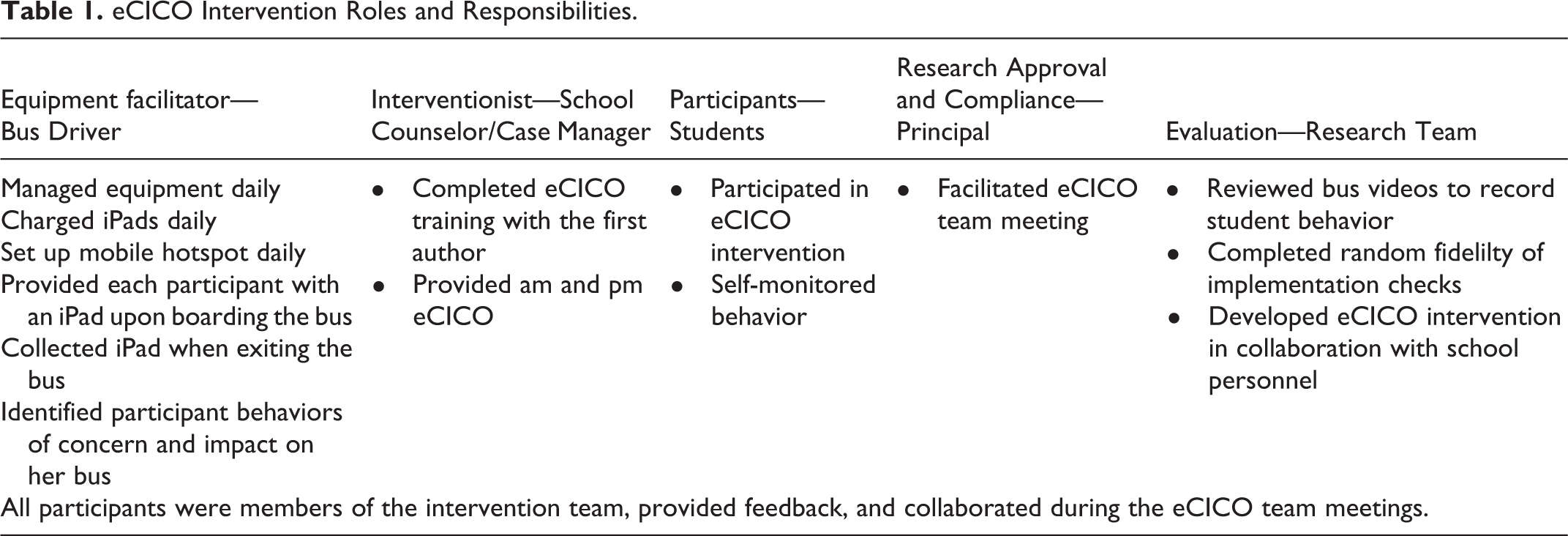
The case manager met with both students, shared the eCICO intervention procedures, and again stressed that riding the bus was a privilege, which they were both in danger of losing. eCICO was then implemented with both of the students. The case manager used her personal iPhone to connect to the students via the FaceTime video app. The bus driver was given a mobile hotspot and iPads that included school security features (e.g., no student access to games), and headphones with internal microphones were provided to students as they boarded the bus at the beginning and end of each bus ride. The bus driver facilitated the process by charging the equipment ahead of each bus trip, providing students with the equipment (i.e., iPad and headphones) as they got onto the bus, and ensuring the wireless hot spot was turned on so that the students could access the FaceTime video call with the case manager. The bus driver handed the target students the iPad when they got on the bus and collected them at the end of the bus ride. Students completed a check-in with the case manager and then returned the iPad to the bus driver at the first bus stop (approximately 6 min after boarding the bus). The students obtained the iPads at the last bus stop before arrival to school and completed the self-monitoring checklist and checkout. The case manager conducted the FaceTime eCICO session at the beginning and of each bus ride from home to school, and school to home. Roles and responsibilities are defined in Table 1.
eCICO Intervention Roles and Responsibilities.
The school district provided access to the bus videos (which included audio) to the research team that were recorded during all bus rides. Ken’s average one-way (from home to school or school to home) bus ride was 64 min (range = 58–73 min per bus ride) and Rick’s average one-way (from home to school or school to home) bus ride was 57 min (range = 55–68 min). The average eCICO session was less than 5 min for each student (M = 4 min, 33 s; Range = 4 min, 8 s–6 min, 43 s). Research assistants viewed the videos and collected data for each bus ride for the duration of the study using a researcher-created Excel template.
Experimental Design
A multiple baseline across behaviors design was used to assess if a functional relation could be established between eCICO and identified target behaviors of two students with EBD. The studies were conducted simultaneously with each student, which also allowed data collection to also occur simultaneously. The researchers used baseline logic (prediction, replication, verification) to determine if a functional relation could be established between the application of the intervention (i.e., eCICO) and a reduction of identified maladaptive behaviors (i.e., change in behavior were observed when eCICO was applied; see Cooper et al., 2020, p. 222).
Interobserver Agreement and Procedural Fidelity
The first author trained the case manager to implement the eCICO intervention via FaceTime with students. She had been a special education professor for 7 years at the time of the study and previously served as a special education teacher and administrator. Graduate research assistants were special education or school psychology majors and each had at least 3 years of middle school teaching experience.
Interobserver agreement was calculated for about 30% of baseline, intervention, and maintenance sessions, which is higher than the recommended 20% of sessions (Kratochwill et al., 2013). Total count IOA was used to determine agreement, where the smaller number of agreements was divided by the larger number of agreements and multiplied by 100 to get IOA percentage (Cooper et al., 2020). Videos were reviewed by two graduate assistants and the first author completed interobserver agreement (IOA). An agreements plus disagreements formula was used. The smaller number was divided by the larger number and multiplied by 100 to obtain IOA percentage (Cooper et al., 2020).
Procedural fidelity was checked by the first author through Facetime for about 30% of treatment sessions using a five step checklist, which aligned with the established intervention steps. The case manager retained a copy of the checklist and was able to reference the checklist during the intervention. Procedural fidelity for both students was 100%.
Social Validity
Social validity data was collected via Facetime with the bus driver, case manager, and participants following the last day of the eCICO intervention. Each participant was asked to share their perceptions of the eCICO intervention (e.g., What did you think of this intervention?) and the first author took notes.
Analyses
Rate (Kennedy, 2005) was used to evaluate the frequency of target behaviors, where the number of occurrences of the target behavior was divided by the total number of minutes (i.e., duration) of each bus ride. Rate of maladaptive behaviors was calculated by dividing the total number of instances of each maladaptive behavior by total minutes each student rode the bus daily for two trips per day (i.e., from home to school and school to home). Minutes on the bus included the minute each student participant boarded the bus until the minute he exited the bus in the morning and in the afternoon. Specifically, rate was used because the duration of bus rides varied for each student depending on location and road conditions, which allowed for comparison of different bus ride lengths.
Visual analysis (level, trend, variability) was used to evaluate student progress during the study (Cooper et al., 2020). Percent of Nonoverlapping data (PND) was used as an additional tool to determine if a functional relation between eCICO and a reduction in target behaviors could be established. PND is calculated by determining the number of intervention phase data points exceeding the highest baseline data point and dividing by number of intervention phase data points and multiplying by 100 (Scruggs et al., 1987). Scores less than 50% indicate an unreliable treatment, 51%–70% a questionable treatment, 71% to 89% fairly effective treatment, and 90% or above a highly effective treatment.
Post hoc treatment effects were determined using Tau-U. Tau-U is a non-parametric procedure that compares each baseline data point to each data point in the treatment phase (Parker et al., 2011). The researchers used an online calculator to determine Tau-U (see http://www.singlecaseresearch.org/calculators; Vannest et al., 2016). Tau-U measures agreement between two variables. Tau-U ranges from −1 (i.e., lack of agreement between two variables) to 1 (i.e., strong agreement between two variables). Lack of agreement (i.e., disagreement) between two variables is indicated by data approaching zero (Brossart et al., 2018).
Results
Ken
Spitting, cursing, and out of seat behaviors were identified as target behaviors and addressed through the eCICO intervention. Figure 1 represents the rate of targeted behaviors before, during, and after eCICO implementation addressing each behavior. Results from the visual analysis, as detailed in the following section, suggest a tentative functional relation between eCICO and target behaviors. The weighted Tau-U average for Ken was .96 suggesting a strong agreement between the e-CICO and decreases in target behavior.

Rate of Ken’s target behaviors.
Spitting
During the baseline phase, spitting ranged from .6 to .7/min (M = .64/min) for Ken. Baseline data for spitting remained high and stable. A slight downward trend beginning on day two of the eCICO intervention (rate = .5/min) was observed followed by a sharp decrease in spitting behavior on day 8 of the eCICO intervention (rate = .2/min). On day 11 of the intervention, a sharp increase in spitting behavior was observed (rate = .8/min), followed by a sharp decrease in spitting behavior on days 14 to 23, with spitting behaviors reduced to 0 during days 19 to 23. Ken’s rate of spitting remained at zero for the duration of the maintenance observations.
Cursing
Prior to intervention, Ken’s cursing ranged from .55 to .90/min (M = .68/min). At the onset of eCICO addressing cursing an immediate decrease in cursing behaviors occurred. This decrease remained relatively consistent throughout the phase and was reduced to zero by the third day of intervention. Following slight increases in cursing rate, Ken’s cursing behavior decreased to zero and remained at zero during the maintenance observations.
Out of seat
Ken’s baseline out of seat behaviors remained relatively high and consistent for the first 14 observations. Then, the behaviors decreased from baseline day 15 to 24 (range = .45/min to .85/min, M = .61/min). An immediate decrease in out of seat behaviors was observed following addressing out of seat behaviors during the eCICO intervention. After the sixth session, out of seat behaviors were reduced to zero. Although some out of seat behaviors were observed during maintenance observations, occurrences were significantly reduced as compared to baseline (M = .13/min, range = 0/min to .25/min).
Rick
Touching peers, out of seat, and throwing objects were identified as Rick’s target behaviors and addressed through the eCICO intervention. Figure 2 represents the target behavior rate before, during, and after eCICO implementation addressing each behavior. The weighted Tau-U average was 1.0 suggesting strong agreement between e-CICO and decreases in target behavior.
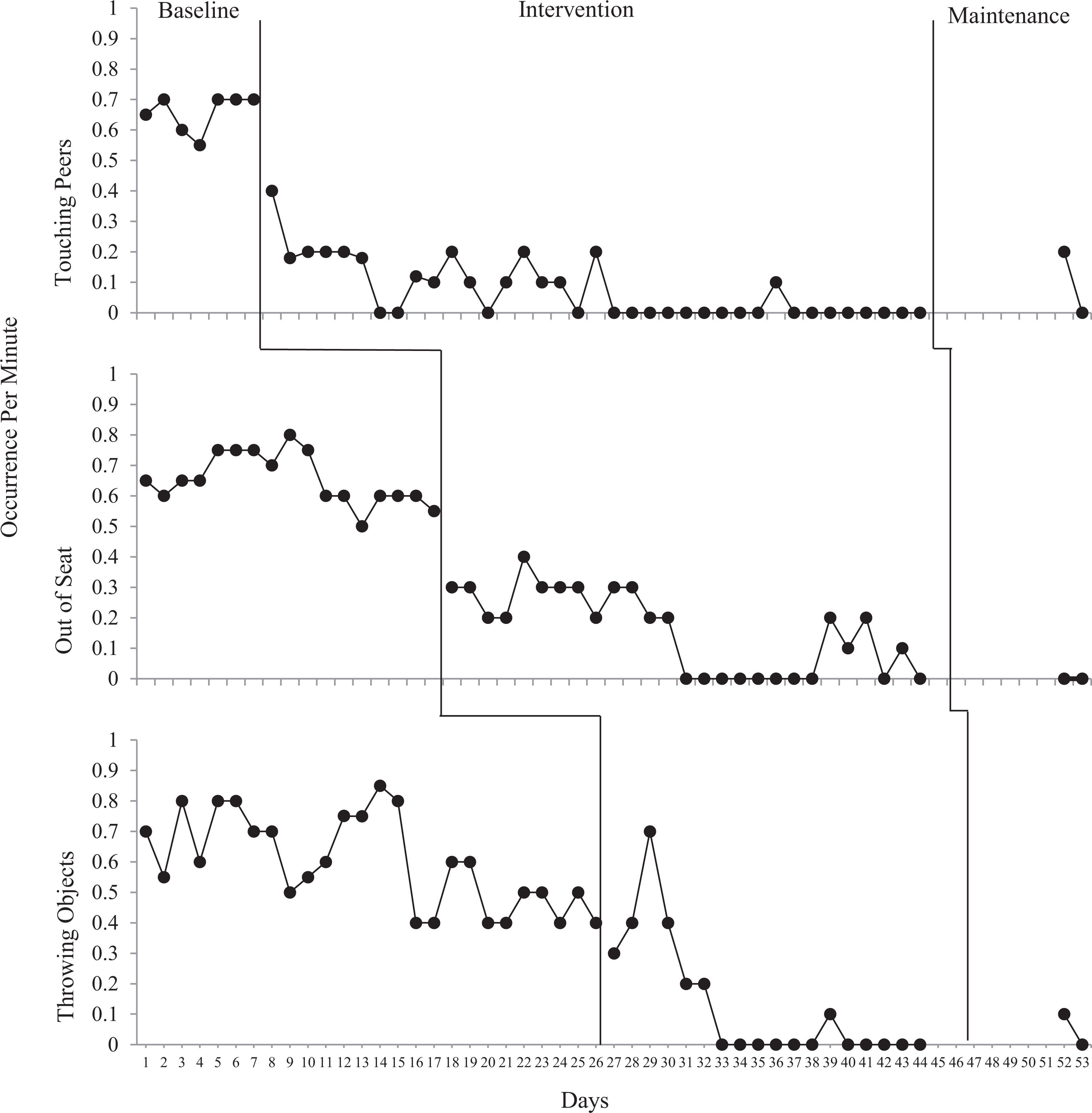
Rate of Rick’s target behaviors.
Touching peers
During the baseline phase, touching peers ranged from .55 to .70/min (M = .66/min). Baseline data for touching remained high and relatively stable. Following implementation of the eCICO intervention, rate of touching peers immediately decreased and remained low for the duration of the intervention phase (M = .07/min, range = .4/min–0/min). Although touching peer behaviors were observed during subsequent observations and during maintenance observations, occurrences were significantly reduced as compared to baseline (M = .05/min, range = 0/min–.10/min).
Out of seat
Rick’s baseline out of seat behaviors remained relatively high and consistent for the first 10 observations. Then, the behaviors decreased with a decreasing baseline trend from baseline day 11 to 17 (range = .50/min to .75/min, M = .65/min) that aligned with the beginning of eCICO addressing spitting behaviors. An immediate decrease in out of seat behaviors was observed following addressing out of seat behaviors during the eCICO intervention. By day 14, out of seat behaviors were reduced to zero and remained at zero for eight consecutive observations.
Throwing objects
Prior to intervention, throwing objects ranged from .40 to .80/min (M = .60/min) with moderate variability in baseline data. At the onset of eCICO, an initial decrease in throwing objects occurred (rate = .3/min), followed by a sharp increase in throwing objects on day three of the intervention phase, and finally a decreasing trend from day four until day 7 of the intervention phase. This decrease remained consistent throughout the remainder of the intervention phase and was reduced during the maintenance phase (M = .05/min, range = 0–.10 /min) when compared to baseline. See Table 2 for a summary of results.
Summary of Results.

Interobserver Agreement
IOA for Ken’s target behaviors during baseline was 96.42% initially and reconciled to 100% during a research team meeting including graduate assistants and the first author. IOA for Ken’s intervention phase was 97.22% and reconciled to 100% during a team meeting including the graduate assistants and first author. Initial IOA for Rick’s baseline phase was 92.64% and intervention phase was 95.63%. Both were reconciled to 100% during a research team meeting. Maintenance data IOA for both students was 100% so no follow up meeting was required.
Social Validity
Both Ken and Rick shared that they liked talking to their case manager before and after school via Facetime and noted that the monitoring charts were helpful. Rick shared that it was not a good choice to endanger the safety of the little kids on the bus and apologized for “causing such a ruckus.” The case manager shared that eCICO was easy to implement and that the time invested was “less [sic, hearing the] principal complain.” The principal shared that eCICO is a “life saver” because he “did not know what to do if this [Ken and Rick’s target behavior] kept up.” The bus driver expressed similar sentiments, noting that eCICO allowed her to transport kids safely.
Discussion
Results of the study indicate clinically significant reductions in behavior and a functional relation between eCICO intervention and targeted bus behaviors for the student participants (i.e., research question 1). Students maintained low rates of targeted behaviors after the eCICO intervention was withdrawn during the maintenance phase (i.e., research question 2). Stakeholders involved indicated that the eCICO intervention resulted in a reduction in targeted behaviors, found the study to be socially valid (i.e., research question 3), and after the study, the students were used as peer tutors for younger students on the bus.
eCICO is a promising intervention to decrease maladaptive bus behavior. The study met What Works Clearinghouse quality indicators for single-case design standards at the time of the study and provides some evidence that the intervention can be implemented on bus routes with minimal support. For example, participants were described in detail, process for participant selection was described, and features of the setting were provided to support replication (IES, 2017). This study extends the literature base by adding an electronic component to the traditional CICO intervention, which is done in-person. The possibilities when technology is added to a traditional paper and pencil intervention are endless. Technology promotes accessibility, uses items that are readily available (i.e., smartphones and tablets), and removes geographic barriers for rural settings. The ease of iPad distribution and collection within the short time frame of eCICO procedure also contributes to the feasibility of the intervention. Additionally, using the bus for the eCICO intervention allows for an additional unstructured setting where students with disabilities can receive low-intensity, low-cost (i.e., free) support in the least restrictive environment. Additional research should be done to add technology tools to the literature that can be used in a rural setting to support student behavior during bus rides, and can be extended to other unstructured parts of the school day.
In the current study, eCICO was effective in decreasing several target behaviors. eCICO enhanced the safety of those riding the bus, the bus driver, and other individuals on the road. eCICO can be implemented quickly with minimal training. Study results suggest that behavior change is sustainable using technology that is readily available in many schools. After the completion of the study, students maintained low levels of maladaptive behavior after completion of the eCICO intervention. Although it wasn’t part of the formal study, once the study ended, the bus driver shared that both participants helped elementary students complete their homework on the bus. To date, both Ken and Rick are serving as bus tutors by reading books with the elementary students and assisting with homework on the bus.
This study supports CICO implementation by providing an electronic delivery option that ameliorates challenges with bus implementation. Further, eCICO, along with remote delivery of other evidence-based practices, helps remove geographic barriers, and provides access to services students may not have otherwise leveraging resources available. Findings align with Collins and Ryan (2016) and with recommendations from the Center on PBIS (2020). The incorporation of technology removes many common barriers associated with rural practice.
Limitations and Future Research
One limitation to the study was the reliance on the availability of the case manager who also served as the guidance counselor. A guidance counselor’s (i.e., case manager) availability to conduct the CICO/eCICO intervention may be unlikely in schools where caseloads are higher and responsibilities differ. In this study, the guidance counselor previously developed rapport with the two participants due to the small rural school setting. Familiarity with students to this degree is less likely in more populated settings. Future research should investigate the efficacy of cross-age peer training in the CICO/eCICO intervention to address this limitation, by capitalizing on existing specialized personnel (e.g., special education teacher) with an existing positive relationship with the students. Future studies may explore the roles and responsibilities of interventionists.
The results from this study can only be used to evaluate the two participants’ behaviors and should be generalized cautiously. Replication of single case studies as well as larger group design studies are needed to test feasibility across settings.
As with all multiple baseline across behaviors studies, there is a potential for carryover effects. Ken’s baseline data trend decreased for out of seat behavior, while Rick’s baseline data showed a slight decreasing trend for both his out of seat and throwing objects behaviors. Rick’s decreasing baseline trends align respectively with the start of the intervention for touching peers and out of seat behaviors. Behaviors addressed second and third may have declined due to eCICO’s influence on the first behavior (i.e., carryover effect). For example, the reduction in spitting behavior may have led to a decrease in cursing behavior.
Another limitation is the use of an iPad. Although both participants routinely used an iPad during the school day, security features were in place (restricted internet access, no games), and target behaviors remained high in Tiers 2 and 3 after the introduction of an iPad in Tier 1, it is possible that the tool influenced intervention results. The use of an iPad facilitated implementation in a rural area and maintained the safety of students as the bus driver did not have to complete CICO procedures other than providing equipment. Additional CICO interventions using various technology applications could be evaluated along with self-monitoring and goal setting interventions to support bus behaviors, and often overlooked and under studied area of school.
Implications for Practice
The eCICO intervention is a promising option for supporting students in rural and remote areas. Support individuals who serve as the student’s mentor can be easily trained to implement the intervention with fidelity. With the availability of tools such as FaceTime and other video conference platforms (e.g., Zoom or Skype), the student and mentor can conduct electronic check-ins and check-outs regardless of the physical distance limitations that are characteristics of rural and remote communities.
The eCICO intervention is a low-cost (i.e., using available tools), low-intensity (i.e., two contacts per day) Tier II intervention. By using technology (i.e. smartphone, data plan, etc.) the student and mentor already have to conduct eCICO, there are little to no additional costs associated with the intervention implementation. Additionally, the use of a mentor as interventionist is an advantage of the eCICO intervention as many Tier II interventions place additional requirements on the classroom teacher/ bus driver.
Footnotes
Declaration of Conflicting Interests
The author(s) declared no potential conflicts of interest with respect to the research, authorship, and/or publication of this article.
Funding
The author(s) received no financial support for the research, authorship, and/or publication of this article.
