






Abstract
Job interviews are a critical step to obtaining employment. However, the social demands of job interviews are often difficult for individuals with intellectual disabilities (ID). Both the use of technology (e.g., mixed reality simulation, video modeling, virtual reality) and attending postsecondary education programs that teach employment skills have been effective in improving job interview skills and employment outcomes. This study examined the effectiveness of mixed-reality simulation technology for improving job interview skills for individuals with ID. Using an underpowered randomized-controlled trial with a matched pair design, this study compared the effectiveness of using mixed-reality simulation technology with traditional face-to-face practice sessions to promote job interview skills acquisition for young adults with ID. The study also collected pre-test and post-test data on participant job interview-related anxiety. Data were analyzed using two separate repeated measures ANOVAs, as well as matched paired samples t-test on the difference-of-differences scores. While both forms of practice were effective for increasing interview performance and reducing levels of anxiety, no significant differences were found between the two groups regarding job interview skill acquisition. Implications for practice and directions for future research are discussed.
Introduction
While the unemployment rate for non-disabled individuals broaches historic lows, (2.3%.) individuals with intellectual disabilities (ID) continue to be historically underemployed within the United States, with only about 15% gaining paid community jobs (National Core Indicators, 2023). Furthermore, for individuals with ID who maintain competitive employment, their average hourly wage ranges from $10.07 - $12.15 per hour (National Core Indicators, 2023), while that of non-disabled employees was nearly three times that at $33.36 per hour (Bureau of Labor Statistics, 2023). In addition to much lower hourly pay rates, individuals with ID, on average, only worked 13.75 hours per week (National Core Indicators, 2023), compared to 34.4 hours per week for non-disabled employees (Bureau of Labor Statistics, 2023). These limited work hours mean that employees with ID make significantly less money, and typically do not receive benefits such as retirement or health care. This limited income also makes it difficult for individuals with ID to afford housing (Tanis, 2022), a correlate with competitive employment and higher self-reported quality of life (Nota et al., 2010; Ryan et al., 2019).
Importance of Job Interviews
Job interviews are often the final barrier between a potential employee and the job they hope to obtain. Job interviews are a unique social interaction that requires the interviewee to engage in several overt and subtle social behaviors to “sell” themselves as the most qualified candidate. A study conducted by Mutua et al. (2023) sought to determine which job interview skills displayed by individuals with ID were most crucial for subsequent employment. Fifty-six participants with ID enrolled in a multi-tiered postsecondary education program participated in mock interviews as a part of the study. Following each mock interview, the interviewer would score the participants on a number of different variables and whether or not they would hire the participant following the interview. Using this data, the authors used structural equation modeling to identify which variables significantly impacted subsequent employment. Those identified as most influential included: (a) sitting still and straight, (b) understandable speech, (c) good posture, (d) appropriate voice, and (e) appropriate handshake (Mutua et al., 2023). For many individuals with ID, acting on these overt and subtle social cues during interviews may prove especially difficult (Smith & Matson, 2010) due to limitations in social skills which are a characteristic of ID (American Association on Intellectual and Developmental Disabilities, 2023). To be successful in a job interview, it is also important for candidates to be adept at small talk, non-verbal communication (e.g., posture, eye contact), and openly sharing relevant information about themselves with or without prompting, to help make a good first impression (Shipley & Wood, 1996). To account for these skill deficits, individuals with ID must receive quality instruction on improving their job interview skills. Given the importance of job interview skills for job seekers with ID, it has become a common practice to provide opportunities to practice these skills during mock interviews within programming focused on transitioning individuals with ID from school to the work force (Grigal et al., 2021).
Barriers to Employment
Intellectual disability is characterized by deficits in intellectual functioning (e.g., learning, judgment, problem-solving) and adaptive behavior. Adaptive behavior is further broken down into: (a) conceptual skills (e.g., self-direction, concepts of money, time, and numbers); (b) social skills (e.g., interpersonal communication, self-esteem, following rules); and (c) practical skills (e.g., money management, keeping a schedule, using transportation; [American Association on Intellectual and Developmental Disabilities, 2023]).
These deficits which are inherent in ID can create barriers to earning and maintaining competitive employment. For example, individuals with ID may fail to understand the “unwritten rules” of social interaction (Smith & Matson, 2010). These internal barriers stemming from ID can keep individuals from meeting their employment goals if adequate supports and training are not provided (Scheef et al., 2018). In addition to the internal barriers for individuals with ID seeking employment, they must also overcome external barriers. Individuals with ID often face issues regarding transportation, fear of loss of disability benefits, or employer perceptions regarding their abilities (Scheef et al., 2018). Barriers such as difficulties understanding social cues and exhibiting social norms (e.g., adjust communication for different people or situations) come to a head for individuals with ID when they participate in a job interview with prospective employers (Walker et al., 2016). Therefore, it is essential that individuals with ID receive targeted instruction on job interview related skills.
Postsecondary Education Programs
One transition program type that has demonstrated improved employment outcomes for individuals with ID is postsecondary education (PSE) programs (Grigal et al., 2022). The passage of the Higher Education Opportunity Act (HEOA) in 2008 opened the door for individuals with ID to pursue postsecondary education with a focus on employment by providing financial aid. According to Think College there are currently 362 PSE programs serving approximately 6000 students with ID across the country. PSE programs frequently provide instruction on key employment skills (Prohn et al., 2018), and as a result a recent report showed that nearly two-thirds (64%) of students from PSE programs were employed one year after exiting (Grigal et al., 2019). Furthermore, some individual PSE programs have provided outcome data as well. For example, Ryan et al. (2019) reported that 84% of graduates of a PSE program were gainfully employed upon completion. One increasing popular approach PSE programs have begun to adopt to help prepare individuals with intellectual disabilities for employment is to infuse technology into their curriculum (Fisseler & Seale, 2025).
Using Technology to Teach Interview Skills
To date, limited research has examined how technology has improved social skills related to job interviews for individuals with ID. Two recent reviews have sought to summarize the literature on using technology to teach social skills to individuals with ID. First, Walker et al. (2019) conducted a literature review to provide transition professionals with an idea of what technologies could address skill deficits for individuals with ID related to employment preparation. As such, the authors note that the review is not comprehensive. Within this review, Walker and colleagues (2019) specifically identified innovative technologies including virtual reality and mixed-reality simulation (MRS) that providers of transition services should explore with their students. The authors noted that despite a limited but promising evidence base, transition service providers may miss out on a dynamic teaching method by not utilizing these technologies. Just as iPads were widely used in classrooms prior to the establishment of an evidence base, so too should educators seek to incorporate cutting-edge technology if educators use their best judgment to determine they will not do harm (Walker et al., 2019). To that point, it is imperative that researchers continue to study the efficacy of this technology to educate students with ID.
MRS uses a combination of mixed reality technologies to create a variety of simulated environments (e.g., classroom, office space) to help students build practical experience in a low-stakes environment. MRS provides students with an opportunity to engage with virtual avatars over Zoom. Each avatar has a unique personality, and their actions and responses are controlled by an actor located off-site who responds to each student based on their unique actions or responses.
Currently, only several studies (Burke et al., 2021; Walker et al., 2016) have been conducted using technologies such as MRS and VR to teach job interview skills to young adults with ID and Autism. In a 2021 study Burke et al. used a pretest-posttest design to provide a MRS intervention to a group of 153 participants with disabilities that included a variety of disabilities of which 40% had ID. Following the 22-week-long curriculum, researchers found statistically significant increases in the average score on measures of self-efficacy, strengths, and career decisions (Burke et al., 2021). All the increases were still statistically significant but slightly smaller after controlling for age, the number of disabilities, sex, and ethnicity.
Prior to this, Walker et al. (2016) also used MRS to teach job interview skills to young adults with ID, and positive findings were reported following the intervention. After implementing the MRS intervention using a multiple-baseline design, the researchers found that all participants improved their live interview performance as measured by a researcher-created job interview skills rubric, with growth ranging from 18 to 46 points (Walker et al., 2016). These findings highlight that there is still a need within this area of research to explore how young adults with different disabilities respond to these technologies, as well as how effective these technologies are for individuals with ID.
Purpose
Therefore, this study aims to examine the effectiveness of mixed-reality simulation technology for improving job interview skills for individuals with ID. Specifically, this study utilized a randomized controlled trial design to compare the use of MRS to traditional classroom face-to-face practice. The present study focused on developing job interview skills for participants aged 18–26 enrolled in a postsecondary education program. To our knowledge, this study is one of the first to specifically examine the use of MRS technology to teach interviewing skills to young adults with ID. Therefore, the results will help guide PSE programs in determining whether the technology is worth the investment, and provide future research into how to use it best.
Research Questions
1. Does practice in a mixed-reality simulation environment improve job interview skill acquisition for young adults with ID compared to business-as-usual peer practice? 2. Does practice in a mixed-reality simulation environment lower participant self-reported anxiety related to completing job interviews? 3. Do participants and their teachers view mixed-reality simulation as a socially valid and feasible intervention for job interview skill acquisition?
Methods
Participants and Setting
Participants included a convenience sample of 12 young adults with ID attending a 4-year PSE program housed in a large public university in the southeastern United States. At the time of the study, the program enrolled 53 students with ID. Within the program, students take an integrated course of study to cultivate their independent living and employment skills. To be included in the study, participants must have (a) a diagnosis of mild or moderate ID (i.e., IQ of 36–69, (b) been enrolled as a Freshman in the Basic Certificate track of the PSE program, and (c) concurrently taken the Employment I course. The 12 participants comprised the entirety of the Freshmen class within the PSE program. University-approved institutional review board (IRB) consent was obtained from all students before the beginning of the study. For students without self-guardianship, assent to participate in the study was obtained along with consent from their legal guardians (e.g., parents). All participants received instruction in a classroom at the institute in which the PSE program is housed. This space included a large, high-definition flat-screen monitor located on one wall. During the simulations, participants sat at a table approximately six feet away from the monitor when interacting with the avatar. Speakers from the connected computer allowed participants to hear the avatar’s questions and responses. A webcam and microphone allowed the avatar and the researchers to see and hear the participant throughout all simulation sessions.
Dependent Measures
Two dependent measures were used in the study. The first was a researcher-created job interview response rubric, and the other was an adapted version of the Measure of Anxiety in Selection Interviews (MASI; McCarthy & Goffin, 2004).
Interview Response Rubric
The primary dependent measure was a researcher-created interview response rubric. The rubric consists of 10 questions (or criterion) and a 3-point rating scale (3 = Good, 2 = Fair, 1 = Poor) with indicators for each performance level and criterion. This measure was developed in collaboration with the employment instructor to align with the curriculum delivered to the students in the class, and to specifically highlight the types of responses that they would like their students to make to the interview questions that are asked of them during their mock interviews at the end of the semester. Therefore, although each item is rated on a scale of 1–3, what the participants must do in order to earn each of those scores differs from question to question. The employment instructor’s goal for each student is to obtain a score of 3 (“good”) on each question in the interview protocol. Additionally, this measure was piloted the year prior to the present study with a group of students who met the same inclusion criteria as this study. Within the pilot study, there were no major issues related to the student’s understanding of the questions and therefore, the originally developed measure was kept as is. A copy of the interview rubric and rating scale is shown in Figure 1. Interview practice sessions script.
Job Interview Anxiety Measure
The Measure of Anxiety in Selection Interviews (MASI; McCarthy & Goffin, 2004), designed for college-level students to measure self-reported anxiety about job interviews, was used to assess participant anxiety before and after the administration of the intervention. The MASI includes 30 questions divided equally across five domains of interview anxiety: (a) communication, (b) appearance, (c) social, (d) performance, and (e) behavioral. Participants answered the questions using a 5-point Likert-type scale, where 5 = strongly agree, 4 = agree, 3 = feel neutral, 2 = disagree, and 1 = strongly disagree. The MASI has been psychometrically validated and is a reliable assessment (McCarthy & Goffin, 2004). In order to ensure that the MASI was appropriate to use for the participants in the study, the words used within each question of the MASI were reviewed by the author and a special education faculty member who specializes in research related to young adults with ID. If deemed necessary, the wording of the question was simplified. For example, one question of the MASI (McCarthy & Goffin, 2004) reads, “I become so apprehensive in job interviews that I am unable to express my thoughts clearly.” This was then simplified to “I get so nervous during job interviews that I can’t say what I am thinking.” To further ensure that the participants were able to give valid responses to each question, this study implemented a pictorial scale based on a similar measure developed used by Cummins et al. (2010) that was used to measure the subjective quality of life of individuals with ID. Cummins et al. (2010) developed a scale that used pictures ranging from a very sad face to a very happy face to assist individuals with ID in understanding the scale. As this study was not examining how satisfied or dissatisfied the participants were with job interviews, and rather sought to understand their level of agreement with statements about job interview anxiety, a pictorial scale of five different thumbs ranging from thumbs down to thumbs up was used in this study.
Data Collection
Prior to the four-week interview unit, all participants individually participated in a pretest interview probe with the lead researcher. During this probe, each participant was read a mock-interviewing script outlining the session’s purpose and what to expect. All probe interviews were recorded, and all data was stored in a secure data file.
Experimental Design
Due to the small sample size, the study used an underpowered randomized control trial (RCT) with a matched pair design where participants were paired based on their pre-intervention interview response rubric scores. The best way to match is to form pairs based on their baseline probe value from highest to lowest (Bloom, 2005). One participant from each pair was randomly assigned to the MRS group, starting with the pair that scored the highest on the baseline probe. In contrast, the other participant was assigned to the face-to-face group. Matching ensures that the treatment and control groups are as similar as possible. This design is often used to reduce bias and with smaller sample sizes, provides a very high predictive power (Bloom, 2005). Given the novelty of this area of study, it was determined that an underpowered RCT was appropriate as (a) there is no ethical concern as the research is exempt and poses no risk to the participants, and (b) to explore whether the findings indicate a proof of concept that the use of MRS to teach job interview skills to young adults with ID warrants further research (Rosoff, 2004).
Interventionists and Materials
The primary interventionist was a doctoral student with seven years’ experience working with individuals with ID. Using a researcher-created prompting sheet, the researcher provided participants feedback on their performance between MRS and face-to-face sessions. The lead researcher has experience using MRS technology from previous research studies. Treatment fidelity data were collected by the lead researcher with the help of a PhD-level special educator. The study used the MRS program licensed and provided by Kennesaw State University.
Social Validity
Upon completion of the study all participants completed a social validity survey consisting of a five-question 5-point Likert-type scale with picture symbols of various faces ranging from sad (score of 1 = strongly disagree) to happy (score of 5 = strongly agree). Smiley face Likert-type scales are often used with adults who may struggle with being able to read (Reynolds-Keefer et al., 2009) and are frequently used in health care for individuals with intellectual disabilities due to their simplicity (e.g., Faces Pain Scale). The researcher converted Likert-type faces into numeric scores and analyzed the results to determine the mean and standard deviation for the overall social validity of the intervention.
Given that the focus of this study was to examine the effectiveness and feasibility of using MRS to teach job interview skills to young adults with ID, after the study, participants in the MRS group completed a focus group interview and questionnaire to gather social validity data on what they thought of the experience of using MRS. The focus group interview consisted of five semi-structured questions (e.g., What did you think about interviewing with the avatar? Do you think it helped you get ready for an actual interview? If yes – how/why? If no – how/why?). Focus groups were conducted to allow for natural responses between the researchers and the participants as well as between participants; this format permitted follow-up questions as needed for clarification (Glesne, 2016). The focus group protocol intentionally included simple language, broad items, and specific follow-up prompts to give participants opportunities to respond with personal experiences and examples. The questions asked in the focus group were exploratory in nature to help provide brief quotes to supplement the responses on the quantitative social validity survey.
Independent Variable
The implementation of additional instruction and practice on job interview skills served as the independent variable for this study. Participants received this practice in one of two mediums depending on which group they were assigned to. All participants, regardless of their assigned group, received the same number of opportunities to practice their interview skills and followed the same procedures as is described in the following sections.
Face-To-Face Condition
Participants in the control condition received additional practice opportunities and feedback from an in-person meeting with the lead researcher once per week for approximately 15–20 minutes over the course of the four-week instructional plan.
Mixed-Reality Simulation Condition
Participants in the mixed-reality simulation (MRS) condition received additional practice with an avatar interviewer and feedback from the lead researcher following MRS sessions that occurred once per week for approximately 15–20 minutes over the course of the four-week instructional plan.
Procedures
Preparation for Mixed-Reality Simulation
Prior to the participants practicing in the mixed-reality simulation environment, the lead researcher met with the simulation specialist at the Kennesaw State Avatar Lab. During the first meeting the lead researcher provided a scenario for the simulation specialists to review, and provided them with the overall goals of the study. In this case, the goal for this study was for students to practice and acquire job interview skills. Next, a script for the simulation scenario was shared with the simulation specialist. A script was provided to ensure consistency across students participating in the job interview simulations. During this time, the simulation specialist was able to ask clarifying questions about the script to confirm how they should respond if various scenarios arise (e.g., a participant repeatedly gives off-topic answers to job interview questions). Once the script was determined for the simulation scenario, the researcher and simulation specialist continued to meet 5–10 minutes prior to the scheduled simulation time with participants to ensure ongoing fidelity to the scenario. Please see Figure 2 for the full interview script for both interview practice methods along with sample participant responses. Interview skills rubric/probe: MRS and face-to-face.
Instructional Phases
All 12 participants received the same instruction on each interview question as part of their weekly, 60-min Employment Class, a course designed to build employment-related skills such as résumé development, soft skills (e.g., problem-solving, asking for help), and interviewing. The interviewing unit occurred over a four-week period and culminated in mock interviews with local business owners and managers who partner with the PSE program to provide paid employment opportunities for students. During this unit, the employment instructor, who held a bachelor’s degree in special education and had six years of teaching experience, taught participants how to conduct themselves during interviews (e.g., eye contact, body language) and how to answer different types of interview questions. Each lesson focused only on the interview questions being taught that day. The instructor introduced the day’s questions, guided participants in completing a brief outline graphic organizer to brainstorm potential responses and then paired students to practice asking and answering the questions. While participants engaged in paired practice, the instructor circulated and provided feedback as needed. Importantly, participants did not practice questions taught in previous weeks; each session concentrated solely on the newly introduced questions.
Shared Procedures Across Conditions
Following weekly instruction on the designated interview questions, all participants completed two practice opportunities each week to rehearse their responses. Across both conditions, students practiced only the interview questions taught that week and those introduced during previous weeks. Practice sessions lasted approximately 15–20 minutes, and participants received individualized feedback based on the researcher-created interview response rubric. Over the four-week instructional unit, students spent approximately 60 minutes engaged in guided role-play or simulation-based practice.
Face-To-Face Condition
Participants assigned to the Face-to-Face condition met individually with the interventionist each week for approximately 15 minutes to role-play the interview process. During these sessions, the interventionist served as the interviewer, asked the relevant interview questions, and monitored student performance using the interview response rubric. Scores from the rubric were used to provide immediate, individualized feedback while students practiced their responses. Across the four-week unit, students completed a total of four face-to-face practice sessions.
Mixed-Reality Simulation Group
Participants in the Mixed-Reality Simulation condition completed four simulation sessions, each lasting 15–20 minutes, for a total of 60–80 minutes in the MRS environment over the four-week unit. Before each session, the interventionist met briefly with the trained interactor (i.e., the person controlling the avatar) to ensure procedural fidelity. During the simulation, participants practiced answering interview questions posed by a computer-generated avatar acting as a hiring manager. The avatar asked only the questions taught during that week and those introduced in prior weeks. For example, during the first session, participants answered questions 1 and 2; during the second session, they answered questions 1–4, and so on.
Each weekly simulation included two rounds of the interview: after the first attempt, the interventionist provided performance-based feedback, and participants completed a second attempt. Following the second round, the interventionist offered one positive comment and one targeted area for improvement to guide future practice. Across the intervention, each participant completed four MRS sessions consisting of eight total mock interviews.
Post-Test Interview
Following the completion of the four-week interview skills unit, all twelve of the participants participated in a post-test interview probe. The post-test interview probe followed the same procedures as the pretest interview probe. Prior to the beginning of the probe, the interventionist explained the purpose of the session and the expectations for the participant during that session. Then the interventionist role-played as the interviewer and the participant as the interviewee. The interventionist used the researcher-created interview skills rubric to score the participants’ performance.
Treatment Fidelity
To ensure treatment fidelity during the baseline and intervention phases, each session was video recorded on the author’s laptop and a doctoral level special education teacher reviewed the recordings and completed fidelity checklists for 30% of the intervention sessions. Watching the recorded sessions, the observer completed an intervention integrity checklist to ensure that the participants received the same instruction and that the interventionist provided the intervention as outlined in the script. Overall, the treatment fidelity of the sessions was 100%.
Data Analysis
Each participant’s interview performance was scored using the interview skills rubric shown in Figure 1. Scores for each rubric were entered into a Microsoft Excel spreadsheet, and the scores were de-identified for each participant through random assignment of participant numbers. JMP® (SAS Institute Inc., 2023) was used to complete all data analyses. Descriptive statistics (e.g., M, SD) were calculated for the mean total interview rubric scores for each group and the scores on the MASI.
To examine differences in the changes in the participants’ scores on the interview skills rubric and the MASI from pretest to post-test, two separate one-between, one-within repeated measures ANOVAs were used. Prior to conducting the ANOVAs, the author examined the data in JMP® to assess whether the normality assumption was met. As the groups were approximately equal, any potential violation of the equal covariances matrices assumption were not serious. Additionally, as the groups were approximately the same size, the homogeneity of variance assumption was not at significant risk of being violated (Pituch & Stevens, 2016). Both groups were assessed on the same measures at two different times. In the first analysis, the mean score on the interview skills rubric served as the one variable between groups. The time of each assessment (i.e., pretest and post-test) served as the within-subjects variable. In the second analysis, the mean score on the MASI served as the one variable between groups, and the time of each assessment (i.e., pretest and post-test) served as the within-subjects variable. As students were paired on their pretest performance and then randomly assigned within each pair, treatment effects were evaluated using a paired samples t-test on the difference-of-differences scores. This approach accounts for the matched-pairs randomization and allows for a direct comparison of improvement within each pair. Interobserver agreement (IOA) was conducted for all numerical data. Counts were independently reviewed, discrepancies were discussed and resolved, and final values were confirmed at 100% accuracy.
The responses to the social validity questionnaire were analyzed by calculating descriptive statistics (i.e., M, SD) for both groups. Furthermore, the responses to the social validity questionnaire were compared using a t-test.
Results
Impact of Intervention on Job Interview Skill Acquisition Findings
Change in Participant Interview Rubric Scores by Pairs and Group
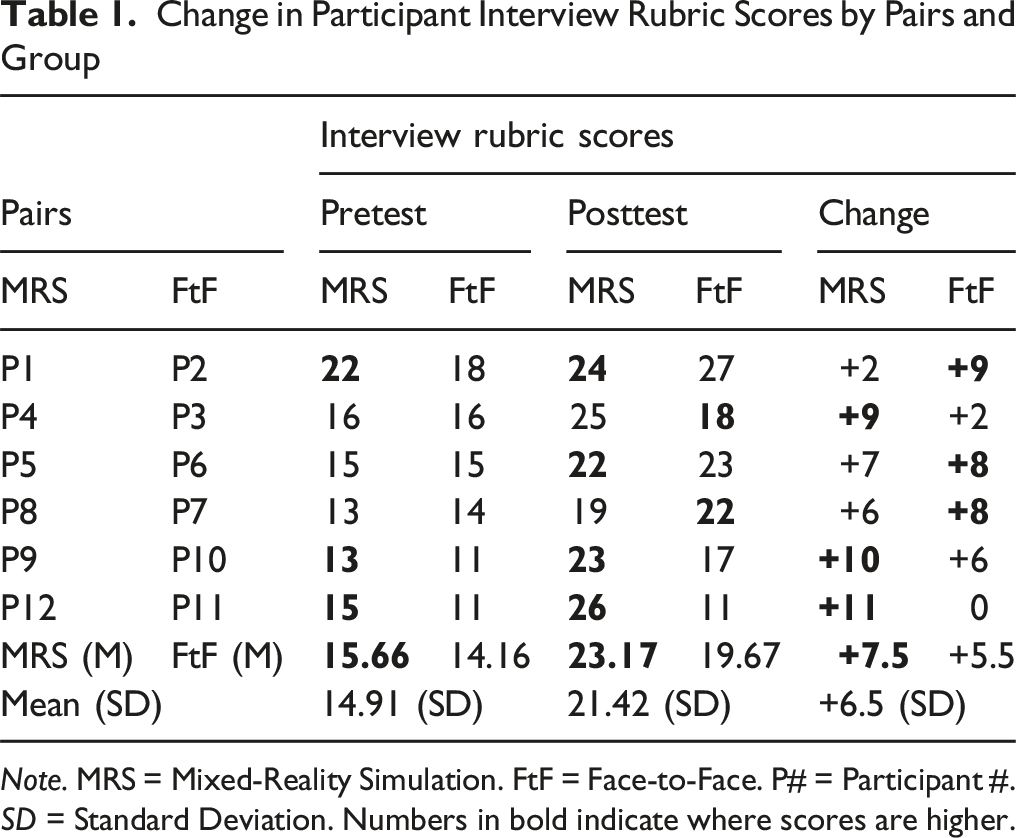
Note. MRS = Mixed-Reality Simulation. FtF = Face-to-Face. P# = Participant #. SD = Standard Deviation. Numbers in bold indicate where scores are higher.
To determine whether there were statistically significant differences on the job interview skills probe scores between the two groups, a one-between, one-within subjects, repeated measures ANOVA was conducted. In this analysis, the score on the job interview skills probe served as the dependent variable. The time that the participant took the probe (i.e., pretest, posttest) served as the within subjects’ variable and the method of practice (i.e., MRS, face-to-face) served as the between subjects’ independent variable. The analysis indicated that no statistically significant differences at the p < .05 level existed between the two groups for the method of practice (F[1,9] = 1.44, p = .26) or for the interaction between the method of practice and time in which the participant took the probe (F[1,9] = 2.76, p = .13). However, a statistically significant difference between group scores was detected for the time variable (F[1,9] = 8.20, p < .02). To further study this difference, the author used t-tests to compare the scores of the two groups over time. This analysis indicated a statistically significant change in both the face-to-face group’s job interview skills probe scores over time (p = .015) and the MRS group’s job interview skills probe scores over time (p = .002). Given that both the MRS and face-to-face groups’ mean scores on the job interview skills probe increased from pretest to posttest, t-tests indicate that both groups had statistically significantly higher scores on the job interview skills probe at posttest.
Impact of Intervention on MASI Scores Findings
Change in Participant MASI Scores by Pairs and Group
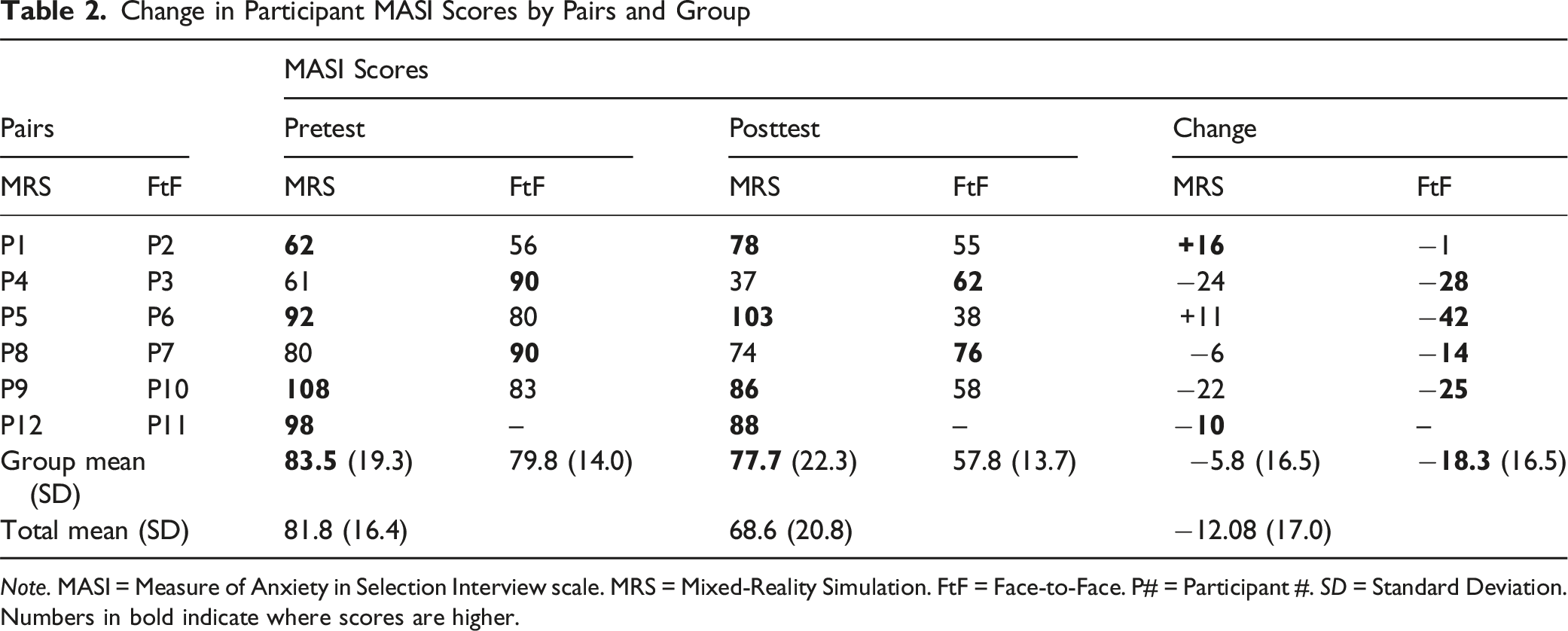
Note. MASI = Measure of Anxiety in Selection Interview scale. MRS = Mixed-Reality Simulation. FtF = Face-to-Face. P# = Participant #. SD = Standard Deviation. Numbers in bold indicate where scores are higher.
Within the sample for this study, the author observed increases of self-reported anxiety for two participants (i.e., participant 1 and participant 5). To investigate specific areas of increase and decrease, the author examined these participants’ scores at the MASI anxiety domain level. Examining the participant pretest and posttest scores at the domain level indicated that participant 1 had increased levels of self-reported job interview anxiety within the appearance anxiety and performance anxiety domains. Despite also having decreased self-reported levels of behavioral anxiety, the increases in the two previously mentioned domains resulted in an overall score increase from pretest to posttest.
For participant 5, examining the participant pretest and posttest scores at the domain level indicated that they had increased levels of self-reported job interview anxiety within the communication anxiety, social anxiety, and behavioral anxiety domains. Despite also having decreased self-reported levels of anxiety in both appearance anxiety and performance anxiety, the increases in the previously mentioned domains resulted in an overall score increase from pretest to posttest.
To determine whether there were statistically significant differences on the job interview skills probe scores between the two groups, a one-between, one-within subjects, repeated measures ANOVA was conducted. In the analysis, the score on the MASI served as the dependent variable. The time that the participant took the probe (i.e., pretest, posttest) served as the within subjects’ variable and the method of practice (i.e., MRS, face-to-face) served as the between subjects’ independent variable. The analysis indicated that no statistically significant differences at the p < .05 level existed between the two groups for the method of practice (F[1,9] = 1.81, p = .21) or for the interaction between the method of practice and time in which the participant took the probe (F[1,9] = 2.22, p = .17). However, a statistically significant difference between group scores was detected for the time variable (F[1,9] = 8.28, p = .018). To determine where this difference existed, the author completed a pairwise t-test comparison of the MASI scores of the two groups over time. This analysis indicated a statistically significant change in the face-to-face group’s MASI scores over time (p = .031), but did not find a statistically significant change in the MASI scores of the MRS group over time (p = .38). The p-value of 0.031 means that it is 96.9% likely that the mean MASI score either increasing or decreasing from pretest to posttest was not due to chance alone. Given that the mean MASI score for the face-to-face group decreased from pretest to posttest, the pairwise comparison indicates that the face-to-face group’s MASI scores were statistically significantly lower at the time of the posttest assessment.
To examine whether the treatment produced greater improvement than the control condition within matched pairs, a paired samples t-test was conducted on the difference scores for each pair (i.e., Treatment change – Control change). Results indicated that the treatment group’s improvement did not differ significantly from that of the control group, t(4) = 1.82, p = .1426.
Social Validity Questionnaire
Responses to Social Validity Questionnaire by Group.
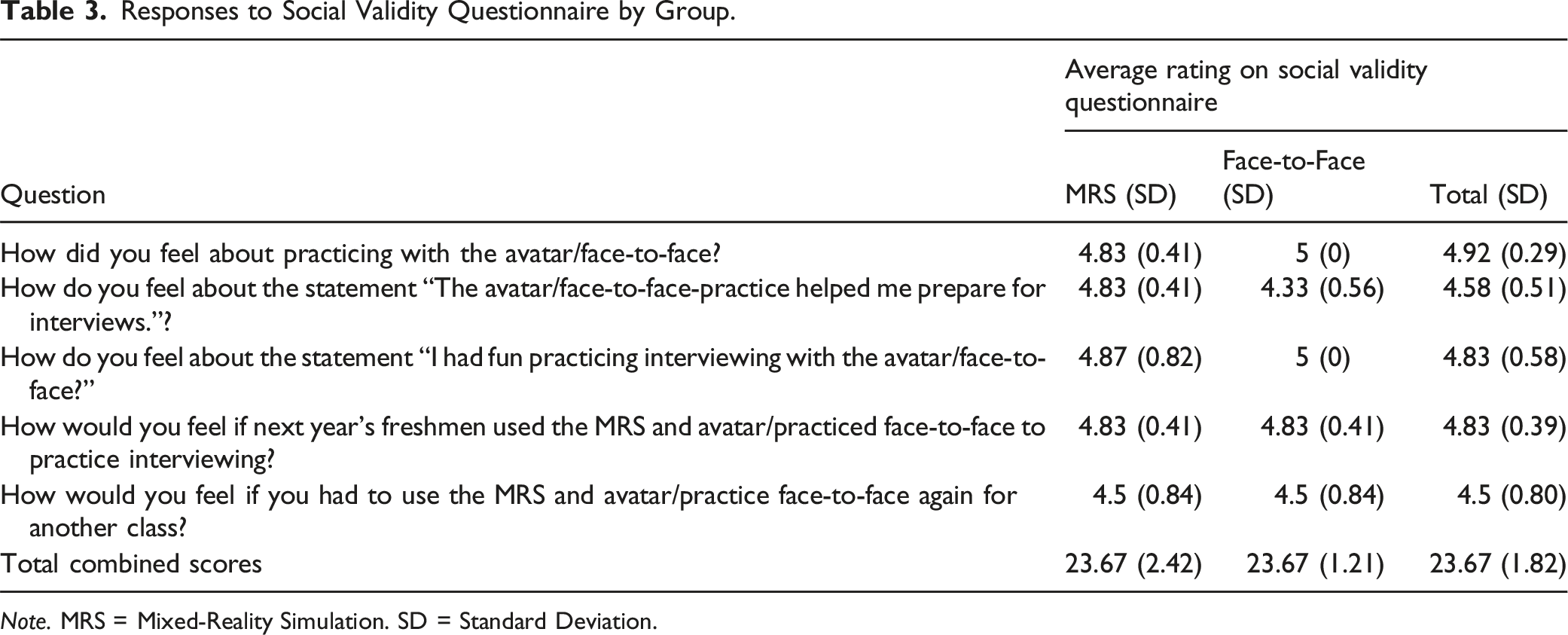
Note. MRS = Mixed-Reality Simulation. SD = Standard Deviation.
The author used a t-test in order to determine if there were differences in the social validity scores between the two groups. Although the scores of the MRS group were slightly more variable (SD = 2.42) than those of the face-to-face group (SD = 1.21), because the group means were identical, no significant difference existed between social validity scores of the two groups.
Discussion
Effectiveness of MRS Intervention
Although not statistically significant, the findings from this study add to the literature base that has found that technology interventions can be effective in improving skills for individuals with ID (e.g., Park et al., 2019; Randall et al., 2019; Stierle et al., 2023; Walters et al., 2021). In the present study, although the MRS group (M = 23.17) finished with a larger group mean on the job interview skills probe than the face-to-face group (M = 19.67), and on average improved by a larger number of points (MRS group improved by an average of 7.5 points, whereas the face-to-face group improved by an average of +5.51), no statistically significant differences were found between the two groups. Findings from the present study were similar to the two previous studies (Burke et al., 2021; Walker et al., 2016) using mixed-reality simulation given to the participants improved their job interview skills. Furthermore, similar to Walker et al., study while participants improved their scores on their job interview skills assessment following the intervention, there was not a significant effect sizes to constitute a functional relation between the two variables.
On the other hand, Burke et al. (2021) did report a statistically significant, and potentially clinically significant improvement in participant scores on the job interview skills assessment. It is important to note that Burke et al. (2021) had 153 participants, which provided them with greater statistical power to detect differences in comparison to the 12 participants in this current study. There are other differences that could account for the findings in the present study and the Walker et al. (2016) study. For example, Walker et al. (2016) used a single case research design. Given the demands of that design, participants in that study were exposed to the intervention a total of 6 times for between 5- and 15-min per session (i.e., between 30- and 90-min total), and in Burke et al. (2021), although the length of each session was not reported, participants engaged in a 22-week long curriculum. Given these differences, it is possible that with a larger sample size and additional time practicing within the MRS environment, statistically and/or clinically significant differences may be observed as they were in Burke et al. (2021). In summary, despite the lack of statistically significant findings, none of the findings of this study, as it relates to participant acquisition of job interview skills, suggests that using an MRS environment to practice job interview skills is an ineffective or detrimental intervention.
Impact of Intervention on Job Interview Anxiety
Both the MRS group (pretest M = 83.45; posttest M = 77.67) and the face-to-face group (pretest M = 81.4; posttest M = 57.8), decreased their average MASI score over the course of the intervention, indicating that after the intervention their level of anxiety had decreased. This is similar to the findings of Smith et al. (2021) who explored the effect of a virtual reality intervention on the acquisition of job interview skills for sample of 71 young adults with Autism. Smith et al. (2021) assessed their participants for job interview anxiety and found that the group that received the virtual reality intervention reported statistically significantly lower job interview anxiety at posttest than at pretest. Although the job interview anxiety findings in present study are similar to those of Smith et al. (2021) in the sense that the groups decreased their job interview anxiety from pretest to posttest, there was no statistical significance found in the present study between the two groups or in the interaction between the intervention and the time variable. The present study also differs from Smith et al. (2021) in the sense that the face-to-face group, and not the group that received the technology intervention was found to have statistically significantly lower self-reported anxiety scores from pretest to posttest. This is an interesting finding, however, perhaps not surprising. The MRS group only interacted with the avatar eight times (two practice interviews per session) and none of the individual practice interviews lasted longer than 7 minutes. This did not allow for much interaction outside of the interview setting, similar to what a real job interview would be like. This is in comparison to the face-to-face group, which completed their practice interviews with the author of this study each week in a consistent manner. Despite both groups following the same procedures, answering the same interview questions each week, and coordinating meeting times with the author each week, participants in the face-to-face group received additional social interaction by completing practice interviews with the author, potentially making the participants feel more comfortable with what they conceive job interviews to be. In all, this may account for why the face-to-face group had statistically significantly lower self-reported job interview anxiety levels and the MRS group did not. There are a number of other factors that could explain the difference in findings from this study and Smith et al. (2021) including this study having: (a) a much smaller sample size (12 participants vs. 71 participants) which impacts statistical power and decreases the ability of statistical tests to detect differences, (b) participants with ID vs those with Autism, (c) the avatar and simulation was more lifelike and therefore felt more stressful to the participants, and (d) this study used a different measure of job interview anxiety than Smith et al. (2021) which could have impacted the results as well.
The findings related to job interview anxiety in this study are somewhat at odds with the suggestion of Walker et al. (2019) that mixed-reality technologies may be able to address anxieties due to safe and support exposure to the object of the anxiety, which in this case would be job interviews. Furthermore, the self-reported job interview anxiety scores decreased from pretest to posttest for 10 of the 12 participants in the study. Both participants for which the self-reported job interview anxiety scores increased were in the MRS group. Therefore, it is important to consider that similar to the findings related to the impact of practicing in the MRS environment on job interview skills performance, it may be possible that given a larger sample size and additional opportunities for exposure to the MRS environment, that the self-reported job interview anxiety scores may have changed more significantly.
Social Validity
Despite a lack of statistically significant findings related to the two primary dependent variables in this study, the use of MRS technology to support the job interview skill acquisition of young adults with ID may still be a helpful tool to PSE programs and transition service providers. In one of the groundbreaking articles on social validity, it is argued that “whether or not the program is helpful can be evaluated only by the consumer.” (Wolf, 1978, p. 210). In the present study, participants in the MRS group rated the intervention highly across all measured questions (M = 4.73). Given that the social validity scores across all questions for the face-to-face group were the same as the MRS group (M = 4.73), transition programs such as PSEs and their teachers should assess their available resources (e.g., time, equipment, staff) to make an informed decision on how to best practice job interview skills. This is a positive addition to the research base as the two studies conducted with this type of technology previously (i.e., Burke et al., 2021; Walker et al., 2016) did not report social validity findings from their participants.
Implications for Practice
One of the reasons for this study was to explore whether research related to using MRS technology to teach job interview skills to young adults with ID is warranted. An additional purpose was to determine whether it would be worth it for PSE programs to invest in this type of technology to support the employment goals of their students. In the present study, on average, both groups of participants improved their job interview skills and also decreased their job interview anxiety. Furthermore, both the MRS and face-to-face groups received the same opportunities for practice and feedback that supplemented the instruction the participants were already receiving in the classroom and indicated they found both methods of extra practice socially valid. In sum, despite positive outcomes for these participants, there were no significant differences between the two groups in either job interview skill acquisition or changes in job interview-related anxiety. As such, stakeholders within PSE programs should conduct a careful cost-benefit analysis of using MRS technology to teach job interview skills. For example, some of the benefits of mixed-reality simulation include being a flexible, low-stakes practice environment for those who use it. It can be a wonderful technology to use to replicate scenarios that cannot be safely or ethically replicated for novice learners in everyday life (e.g., flying a plane, attending to a patient, teaching children with disabilities). However, it is very expensive to use this technology. Given the cost of using MRS and the complexities related to scheduling sessions (e.g., simulation time blocks are limited depending on availability), and participants (e.g., busy schedules between classes, clubs, and independent living needs) findings from this study indicate that it would be more cost effective to provide additional practice in a face-to-face format.
Limitations and Future Research
The findings of this study should be interpreted in light of the limitations that exist. First, the results of this study do not generalize to the broader population as this study used a convenience sample of participants enrolled in a PSE at a large southeastern university. Additionally, the sample size itself is another limitation. Only 12 individuals participated in this study, which greatly limited the statistical power available to detect potentially significant results, especially since the research design further divided the participants into two groups of six. Future research should continue to strive to use larger sample sizes in order to improve the generalizability and reliability of the findings. Given the expansion of PSE programs across the country, future researchers from different universities housing similar programs should consider a collaborative approach to increasing sample size within this population.
Second, due to the dearth of research in this subject area, this study served as an exploration to determine whether future research is warranted. To expand on this work, researchers should look to further examine the relationship between participant demographic variables (e.g., age, gender, IQ, adaptive skills) and response to the intervention. Furthermore, future researchers should seek to examine the effects of relationship building with the avatar serving as the interviewer to see if additional social interactions with the avatar improve participant performance.
Conclusion
There remains a great need to identify interventions that effectively prepare young adults with ID to be successful in job interviews to help obtain gainful employment. Despite the widespread use of technological interventions in other areas of education, there remains a lack of research related to how technologies such as VR, MRS, and augmented reality can be used to teach job interview skills to young adults with ID. The dearth of research becomes greater when specifically looking at the effectiveness of MRS technology. The two studies that have used MRS technology for this purpose have found that it is beneficial for improving the job interview skills of young adults with ID. The current study also found that practice in an MRS environment, in addition to performance feedback increases participant scores on job interview skills assessments, however, these findings were not statistically significant. Despite the lack of statistical significance, the improvement in job interview skills, decrease in self-reported job interview anxiety, the high levels of social validity expressed by the students, and potential limiting factors of the present study (e.g., sample size), this line of research warrants further investigation into the feasibility of using this technology.
Footnotes

Funding
The authors received no financial support for the research, authorship, and/or publication of this article.
Declaration of Conflicting Interests
The authors declared no potential conflicts of interest with respect to the research, authorship, and/or publication of this article.