






Abstract
WEGO is a technology-based writing intervention package to support the composition of high-quality essays by students with and without high-incidence disabilities struggling with writing. While existing evidence shows that WEGO can significantly improve students' organization of ideas for a more cohesive opinion-based final product, the challenge to generate those ideas remains. Thus, the WEGO team developed an AI-based brainstorming feature to integrate into the existing intervention. In collaboration with partnering school systems and following their policies and guidelines around artificial intelligence, a retrieval-based chatbot, named Ask Boris AI was developed. It supports idea generation during the brainstorming phase of the writing process. Ask Boris AI addresses teachers’ and school districts’ concern for using open generative chatbots by providing a conversational AI system using a predefined set of responses stored in a knowledge base. While Ask Boris AI does not generate new content, it stimulates users to identify possible ideas related to a writing prompt based on their need in a controlled environment as desired by many practitioners. This article describes how multiple data sources were used to make design decisions and generate a curated knowledge base using existing WEGO essays.
Keywords
Writing plays a critical role in how students show what they know in school assignments and beyond. The Common Core State Standards (CCSS) outline clear expectations for how students should develop essay writing skills from kindergarten through grade 12. These standards focus on different essay genres including opinion writing. By sixth grade, students are expected to state an opinion, provide clear reasons and relevant details to support it, organize ideas logically, and compose cohesive conclusions (National Governors Association Center for Best Practices & Council of Chief State School Officers, 2010). In addition, the CCSS emphasize that digital literacy is expected throughout Language Arts and Literacy standards, highlighting the need to purposefully use digital tools to create and share writing across grade levels. These broad digital literacy skills align naturally with the competencies required for Artificial Intelligence (AI) literacy today.
Regardless of whether technology is involved, writing is a demanding cognitive process that requires learners to generate ideas, plan, draft, revise, and edit (Evmenova & Regan, 2019). Students with high-incidence disabilities face considerable difficulties with this cognitive process, and as a result, many of them do not develop the level of writing proficiency necessary for academic success (Graham et al., 2012, 2020). They perform significantly below their typically achieving classmates on multiple aspects of writing (Graham et al., 2017). These areas include overall writing quality, organization, vocabulary use, sentence construction, spelling, grammar, handwriting, and incorporation of genre-specific elements. Students lack skill and ability to sustain engagement in complex, multistep writing tasks (Garwood et al., 2018). Evidence consistently shows that students with high-incidence disabilities possess weaker text production skills and often display lower motivation to write compared to their peers (Asaro-Saddler, 2016; Baixauli et al., 2021; Graham et al., 2016).
Opinion-based persuasive writing presents additional challenges. In addition to being able to articulate an opinion, students also need to select strong reasons appealing to reader’s emotions (Jonsen et al., 2018). Thus, successful opinion writing depends less on retrieving factual knowledge and more on locating personal, relevant ideas that support one’s stance adding to the cognitive demand (Hayes & Berninger, 2014).
Writing Efficiently With Graphic Organizers (WEGO)
To address persistent writing difficulties, especially in opinion-based persuasive genre, we created WEGO, an innovative technology-enhanced writing intervention package including technology tools for students and instructional resources for teachers to improve the quantity and quality of essay production for students with and without high-incidence disabilities struggling with writing (Evmenova & Regan, 2012; Evmenova et al., 2018; Evmenova & Regan, 2023). The student interface of the intervention features a series of Chrome-based technology-based graphic organizers, one of those dedicated to an opinion-based persuasive essay genre. It guides students through five steps: choosing a prompt and writing goals; brainstorming and organizing ideas; generating sentences to represent an opinion, reasons, details, and summary; reviewing and revising; and evaluating the final product (see Figure 1). WEGO technology-based graphic organizer for opinion-based persuasive essay writing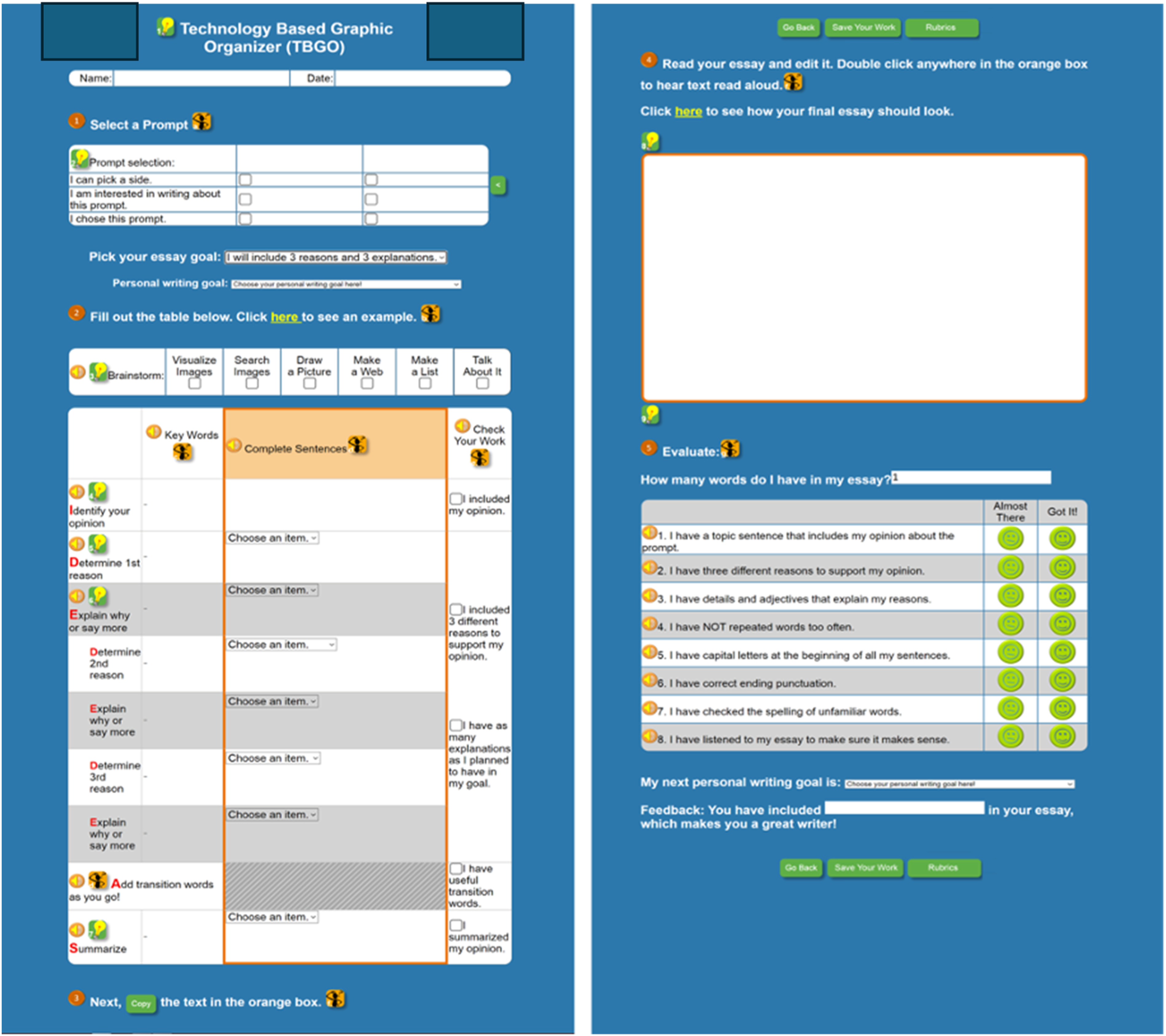
Numerous evidence-based strategies are embedded into the graphic organizer to support students and guide them through the process of opinion writing. For example, self-regulated learning strategies are incorporated throughout: goal setting, self-monitoring, self-evaluation. Students begin by selecting a prompt and identifying both an essay goal (e.g., number of reasons and explanations) and one of the nine possible personal writing goals (e.g., I will use a variety of words without repeating them too often). They then brainstorm outside the organizer using one of six strategies (e.g., visualizing, drawing, listing). Ideas are then arranged using another evidence-based strategy – an IDEAS mnemonic (I = Identify your opinion, D = Determine three reasons, E = Explain why or say more, Add = Add transition words as you go; and S = Summarize). After writing sentences for each essay part, beginning with a transition word they can select from a drop-down menu, students use a self-monitoring checklist and then export their work into a complete paragraph with one click. The tool provides flexibility to compose a robust one-paragraph essay consisting of up to eight sentences or a multi-paragraph essay consisting of up to eight paragraphs depending on how much user writes in each cell under the Complete Sentences column (see Figure 1). Universal Design for Learning (UDL) features provide personalized supports. They include audio comments, text hints, transition words drop-down menus, text-to-speech, and video models introducing students to high-quality essay parts, and most recently educational games to provide remedial practice on specific writing skills.
Two specific features of the graphic organizer need to be emphasized as they are used in the data analysis described later. First, when assigning an essay for a class or individual students, teachers have an option to select from a pool of prompts validated by previous research and embedded into WEGO’s teacher dashboard or to create their own opinion-based persuasive prompt that aligns with the focus of the classroom instruction (see Figure 2). An example of a validated WEGO prompt is, “Some believe 10-year-old kids should be able to stay home by themselves. Using specific details and examples to support your position, argue whether or not 10-year-old kids should be able to stay home by themselves.” An example of a teacher-generated prompt is, “Some people argue that college should be free to all Americans. Write a persuasive essay where you argue whether or not college should be free.” As can be seen, both example prompts followed the same structure. Another feature that is important for this study is the Key Words column of the graphic organizer. After brainstorming the ideas, students are asked to organize their brief ideas (1–3 words) according to the IDEAS mnemonic in the Key Words column (see Figure 1) before writing complete sentences representing those ideas in the Sentences column. As explained later, the ideas included in the Key Words column were included in this study’s data analysis. Prompt assignment in the WEGO’s teacher dashboard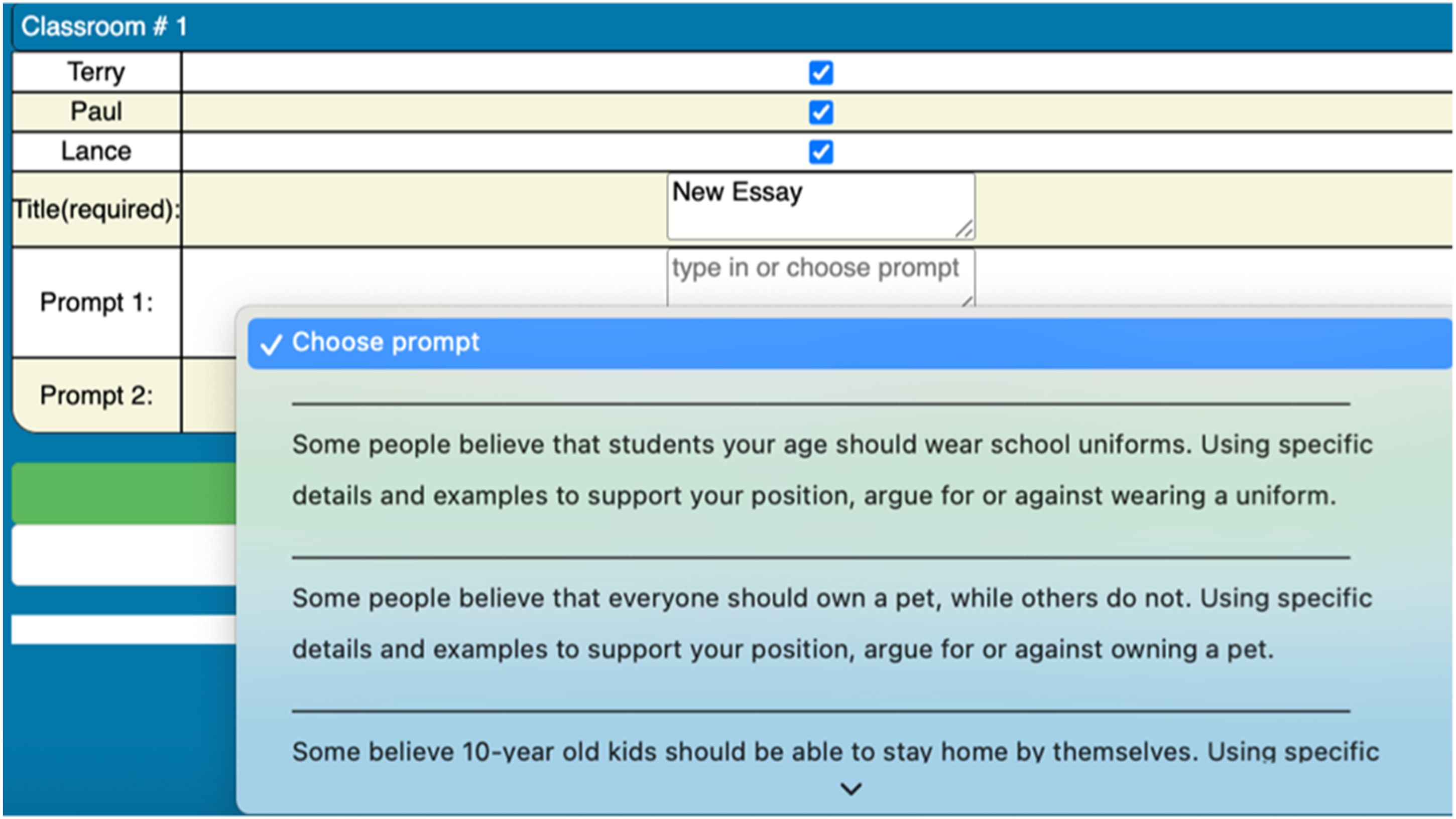
WEGO Research
Across multiple studies, WEGO has benefited students with and without high-incidence disabilities in grades 3–12 (Boykin et al., 2019; Brady et al., 2022; Day et al., 2022; Evmenova et al., 2016, 2020; Regan et al., 2017, 2018, 2024) using various research methods (e.g., single-subject/case designs, quasi-experimental, randomized control trials). In all studies, students’ writing performance using a word processor at baseline/pretest was compared to their essay writing with WEGO at treatment/posttest on a number of common measures: the total number of words written, the number of complete sentences, the number of transition words, and the score on a holistic writing quality rubric. In general, students received an average of five lessons about how to use WEGO, followed by 3–5 opportunities for independent writing practice between the baseline/pretest and the treatment/posttest. When using WEGO, more than 1,500 students with various abilities and needs improved the organizational quality of their opinion-based writing, while more than 800 students with high-incidence disabilities improved both the quality and quantity of their writing. Furthermore, after just one additional lesson modeling how to write without WEGO, most students were able to maintain improvements in their writing after WEGO was removed. Overall, teachers and students reported high satisfaction and believed the tool meaningfully improved students’ writing.
Continuous Need to Support Idea Generation
WEGO has been shown to be effective as a scaffold for the writing process, supporting the composition and organization of a high-quality, cohesive opinion-based persuasive essays in inclusive, co-taught, and self-contained settings in elementary, middle, and high schools. However, while WEGO structure supports all aspects of writing, one persistent area of difficulty remains - idea generation during brainstorming. Despite providing six brainstorming options, checklists, and video models illustrating how to use those brainstorming strategies, students across our studies frequently continued to struggle with generating ideas to start their essay. The current version of the tool effectively helps students organize their ideas but provides limited support to those students who struggle to come up with ideas to organize.
Just like WEGO, many other existing interventions focusing on opinion writing have proven to provide useful organizational supports (e.g., mnemonics, genre-specific goals, scaffolds for composing sentences) to ensure that students include the essential genre elements in their persuasive writing. These interventions include Self-Regulated Strategy Development (e.g., Harris et al., 2019), graphic organizers (e.g., Ciullo & Reutebuch, 2013), elaborated goal setting (e.g., Ferretti & Lewis, 2019), and peer review (e.g., Cramer & Mason, 2014). Idea generation, which involves the intentional retrieval of relevant knowledge from long-term memory, plays a critical role in the writing process (Chen et al., 2016). Thus, writing interventions should consider ways to scaffold the process of accessing and activating that knowledge, especially for students with and without high-incidence disabilities struggling with writing.
Several studies have examined strategies for supporting idea generation, particularly through source-based writing and explicit strategy instruction. Source-based writing, emphasized in the Common Core State Standards, positions students to draw on texts, multimedia, and prior content knowledge as a means of generating and refining ideas, thereby reducing the cognitive demands associated with composing from a blank slate (Graham et al., 2019; Shanahan, 2016). In addition, research on SRSD has consistently demonstrated that teaching structured planning and ideation strategies (e.g., goal setting, self-questioning) significantly improves students’ ability to generate, elaborate, and organize ideas, including for struggling writers (Harris et al., 2019). Process-oriented writing research further highlights the importance of prewriting activities (e.g., brainstorming, listing, and clustering) as mechanisms for externalizing and developing ideas (Flower & Hayes, 1981). Prewriting activities might include the Alternative Uses method when writers are prompted to write down as many ideas as they can within a time limit (Taft & Marszalek, 2019) or relying on assistive technology tools to generate ideas (Smith et al., 2020). All these studies demonstrate that idea generation can be effectively scaffolded, but those with identified disabilities might require additional supports.
Indeed, writers with rich long-term memory resources (e.g., background knowledge, vocabulary, discourse structures) write more efficiently and with higher quality than peers who struggle to store and retrieve that knowledge (Fayol et al., 2012). More skilled writers likely have stronger idea-generation capacities than struggling writers, making these cognitive processes important to surface and teach (Eysenck & Keane, 2020; MacArthur & Graham, 2016; Taft & Marszalek, 2019). With the rapid advancement of the Generative Artificial Intelligence (GenAI) technology, the opportunities to support students in generating ideas, suggesting reasons, and offering different points of view on a topic are greatly expanded (Goldman et al., 2025). The present study extends the existing literature by exploring ways to use GenAI to provide flexible, on-demand scaffolding for idea generation. This work complements existing strategies by addressing a persistent need for additional supports that help struggling writers initiate and develop ideas independently and fluently.
Research on GenAI to Support Idea Generation
Generative AI (GenAI) is quickly transforming many aspects of society, including special education. When applied thoughtfully, GenAI can strengthen existing high-leverage practices and enhance research-based strategies that support differentiated instruction in inclusive settings (Marino et al., 2023). Its integration across grade levels and subject areas offers opportunities to enrich instruction and personalize learning for students with diverse strengths and needs. Emerging evidence also indicates that GenAI tools can help struggling writers improve the organization of their ideas (Marzuki et al., 2023). Within the writing process, brainstorming is a particularly promising area for leveraging AI-based support. Existing studies demonstrate strong potential for AI to enhance brainstorming for learners with and without disabilities by supporting idea generation, providing structured guidance, and reducing emotional barriers.
The brainstorming phase is an essential part of the writing process but can pose significant cognitive and affective challenges such as idea fixation (tendency for writers to generate a narrow set of ideas; La Scala et al., 2005), difficulties with elaboration, and blank page anxiety (Libertino, 2024). The existing research highlights the potential for generative and retrieval-based AI systems to support writers by offering nudges, prompts, examples, and/or structured expansions of their ideas. For example, Chia and Frattarola (2025) introduced Nudgy, a brainstorming chatbot built with pre-engineered prompts aligned to course rubrics. Rather than producing full answers, Nudgy “nudges” students toward deeper thinking by suggesting research directions, analyzing observations, synthesizing sources, and challenging assumptions. Its deliberately constrained design offers fewer opportunities for personalization than free-form GenAI models but strengthens self-regulated learning, encouraging writers to explore ideas independently. Similarly, English and colleagues (2025) found that postgraduate researchers in the UK use generative AI as a brainstorming tool that is “always available” to help refine research questions, generate alternative perspectives, or summarize complex texts.
Several studies explore how AI can enhance mind mapping and visual brainstorming processes. For example, Fang et al. (2024) evaluated Mindomo, an AI-enabled digital mind-mapping tool, with university students, including 28 students with neurodevelopmental disorders. Mindomo provides prompts and examples to expand ideas, helping users organize concepts, establish relationships, and elaborate existing thoughts. Results show positive impacts on fluency, elaboration, and originality within brainstorming discussions. Furthermore, Goldman et al. (2025) reviewed how various AI tools can assist writers with disabilities in K-12 across phases of the writing process including brainstorming. Tools like Book Creator, TextBuddy, and Ahrefs provide idea generation prompts, organizational support, and suggestions for elaboration and refinement. Such tools can reduce the cognitive load associated with producing ideas, help writers move from disorganized thoughts to structured outlines, and provide a starting point for students who struggle with initiating writing tasks. The authors emphasize that these tools should augment but never replace evidence-based writing instruction. When paired with existing strategies such as graphic organizers, AI can serve as a bridge that helps students articulate emerging ideas more clearly.
Libertino (2024) discussed the use of ChatGPT as a literacy intervention tool that supports struggling writers during brainstorming. Examples included personalized writing outlines, idea-expansion prompts, and structured organizers that help students move from vague thoughts to concrete writing plans. AI reduces the barrier of “starting at a blank page” by providing starter ideas that students can refine (p. 19). This support is especially beneficial for students with disabilities or those who need help initiating the writing process. Several researchers also explored how GenAI can reduce anxiety and promote confidence during early writing stages. Tsufim and Pomerleau (2024) found that when students compare their own ideas to AI-generated lists, they gain new perspectives that expand and enrich their thinking. These findings were corroborated by Zhao and colleagues’ (2025) study involving students with disabilities in higher education. Respondents reported using AI to help them get started on writing and organize ideas. Thus, AI was seen as a resource that reduced anxiety, supported comprehension of complex information, and generated initial pathways for thinking.
It is important to note that in all of the mentioned studies, the importance of safeguards, curated knowledge sources, critical human engagement, and explicit instruction in AI literacy is emphasized in order to implement GenAI thoughtfully. GenAI tools should function as a partner rather than a substitute for human thought process and/or for writing instruction (Chia & Frattarola, 2025; Goldman et al., 2025). The topics of unreliability, hallucinations, potential for bias, ethical use and over-reliance (English et al., 2025; La Scala et al., 2025; Libertino, 2024; Tsufim & Pomerleau, 2024) have to be addressed when relying on AI-supported features. The most ideal support should be just a scaffold offering structure while allowing students to control what they choose to use and how (Chia & Frattarola, 2025; Fang et al., 2024; Zhao et al., 2025).
Purpose & Research Questions
Recognizing that many students, especially those with high-incidence disabilities, often face persistent challenges during the brainstorming phase to generate well-developed ideas, we conceptualized an AI-based enhancement to the existing research-based WEGO intervention. This new feature is intended to support the earliest phase of the writing process by offering targeted, personalized scaffolds within a controlled and structured environment. The purpose of this paper is to describe the initial micro-cycles of a larger design research study focused on identifying the underlying design principles and creating the foundation for an AI-based brainstorming feature within WEGO. The specific research questions guiding this work were: • How do existing AI-related policies and guidelines in partnering school systems inform and constrain the design of the proposed WEGO’s AI-based brainstorming feature? • How do the design principles shape the enactment of the WEGO’s AI-based brainstorming feature?
Method
The WEGO project has always been grounded in an iterative design research methodology, involving repeated cycles of field-based development, refinement, and improvement of each component, including the AI-enhanced brainstorming feature (McKenney & Reeves, 2012). Specifically, the Integrative Learning Design Framework (ILDF; Bannan-Ritland, 2003) provided guiding structure for this work. ILDF is used to advance isolated design efforts by proposing a logical sequence of design phases that support continuous iterations informed by empirical evidence across a series of research studies. The framework includes interrelated cycles of exploration, enactment, evaluation, and revision, enabling the gradual development and testing of educational interventions. Within this structure, WEGO progressed through ILDF’s phases of Informed Exploration, Enactment, Local Impact, and Broader Impact, allowing the intervention to evolve responsively based on data, stakeholder feedback, and iterative field testing. In this paper we describe the procedures of the initial micro-cycles within Informed Exploration and Enactment phases related to the development of the AI-based brainstorming feature within WEGO. We then present the results.
Informed Exploration: Perceptions of Teachers & Caregivers
The very first informed exploration qualitative micro-cycle involved focus group interviews with exemplary writing teachers and caregivers who have previously participated in WEGO research. While this study focused on other elements to be incorporated into WEGO, specifically educational games, we also engaged the 21 participants in discussions about the effective use of AI for writing, weighing in the risks and benefits. The participants, procedures and findings of that study are presented elsewhere (Evmenova et al., 2025) and are not the focus of this paper. To summarize, the overarching themes emphasized the need for safeguards to avoid any issues with content and bias, common for open GenAI tools, and the ability to enable and disable AI supports for individual students.
Informed Exploration: AI-Related Policies
As we learned about the perceptions of writing teachers and caregivers related to the potential of the new AI-based brainstorming feature to be incorporated into WEGO, the need to explore the AI-related policies and guidelines in the partnering school districts and/or participating private schools became apparent. The focus was on all educational entities that have been involved in WEGO research and development in the past, as well as our future partners. To do so, we collected 14 separate policies published on each educational organization’s website as of September 2025. Those included four large and one medium suburban school districts; one urban school district; four medium sized rural school districts; one private school for students with disabilities; two private schools; and one state department.
After collecting all the documents, we conducted a thematic analysis of the policies and guidelines (Guest et al., 2012). Policies were read and re-read to identify the initial codes grouping similar ideas, which then were condensed into broader themes. The theme codes and themes were reviewed by two authors to ensure credibility and trustworthiness of the data analysis (Brantlinger et al., 2005). The overarching themes were used to identify the design principles guiding the development of the WEGO’s AI-based brainstorming feature prototype by reflecting of the meaning of the themes and framing those as design guidelines. These design principles will be shared in the forthcoming results.
Enactment: AI-Based Brainstorming Feature Prototype
Following the establishment of the design principles, a structured database of ideas for opinion writing was created to serve as the foundation for WEGO’s AI-based brainstorming feature. Primarily, we relied on the plethora of existing persuasive essays generated by WEGO users throughout the years. Specifically, we used the essays generated by students from seven separate general and special education teachers. There was a total of 166 students, ranging from 3rd to 8th grade including 38% boys, 56% girls, and 6% other. The average age was 9.9 (SD = 3.4). The majority of students did not have an identified disability reported (69%) but were identified by the teacher as struggling writers. In addition, 18% were reported as having a learning disability, 7% as ADHD, 6% as EBD, as well as 10% were identified as English Language Learners. WEGO was used in general education classrooms (75%), co-taught (14%), self-contained (6%), and pull-out (5%) educational settings.
After collecting 1,106 essays generated by the students, they were analyzed to ensure that they fit the definition of opinion-based persuasive genre. As a result, 123 essays were excluded as they were either written in response to the expository teacher-generated prompt or were aligned with a very specific reading/classroom activity. Overall, 983 essays were included in the final analysis in effort to generate a curated database of ideas to support the WEGO’s AI-based brainstorming feature. These essays were written in response to 96 unique prompts, including 30 validated prompts built-into WEGO (out of 35 possible) as well as 66 teacher-generated prompts that met the criteria for an opinion-based persuasive genre. These teacher-generated prompts will be reviewed in future usability testing and incorporated into the next version of WEGO, pending teachers’ approval.
From each of the 983 essays, key word ideas representing three reasons were extracted and analyzed. Repeated and irrelevant reasons were eliminated, similar reasons were collapsed, while wordy reasons were rephrased to match key word format. For example, in response to the prompt “While some people believe that students your age should wear school uniforms, others believe that students should be able to wear what they want to school. Using specific details and examples to support your position, argue for or against no dress code.”, some key reasons included “express our own style in school,” “not be able to express yourself,” “wear what we want,” “be yourself without any judging,” “wear clothes related to their culture,” “everyone unique and special.” All these key reasons were collapsed into one: “express yourself.” Three researchers reviewed the final database of reasons and reached consensus on their quality and relevance. Triangulation of data occurred with comparing ideas generated by students with various characteristics in response to the same prompt (Brantlinger et al., 2005). Descriptive statistics were used to summarize the forthcoming results.
In addition, GPT-5 was used to generate reasons for the remaining five WEGO prompts (out of 35 total) that were not represented in the selected essays. The following prompt was used, “I am a 5th grade student. I am writing a persuasive opinion-based essay in response to the prompt: “ENTER PROMPT HERE.” My opinion about the prompt is: “ENTER OPINION HERE]. Generate reasons to support my opinion. Reasons need to be brief words/phrases (1–3 words long). Reasons should be distinct and not repetitive.” Two opposite opinions (for and against) were used. The cookies/history were cleared between prompts to eliminate bias in connecting reasons from other prompts. Once again, three researchers reviewed the generated ideas and reached consensus, selecting the most relevant and prominent reasons for the database.
Results
AI Policies in Partnering Schools
As of September 2025, the state department of education, ten partnering school districts and three private schools published individualized policies and guidelines related to the integration, governance, and instructional use of GenAI in K–12 education. Although the specificity and maturity of policies varied widely (e.g., from comprehensive frameworks shared by larger school districts to somewhat minimal guidance shared by individual private schools), three overarching themes emerged from a thematic analysis to guide the design and development of WEGO’s AI-based brainstorming feature. These themes reflect a recognition that AI must be integrated in ways that encourage safety, ethics, equity, and instructional integrity, while promoting innovation and preparing students for the future world of AI technologies. Each theme is discussed below.
Commitment to Ethical, Responsible, and Safe Use of AI
All districts referenced the importance of responsible AI use that protects students from harm. That included privacy, security, and data protection; avoidance of biases, discriminatory algorithms, and harmful outputs; as well as safeguards against misuse such as plagiarism, cheating, cyberbullying, or the use of AI tools not approved by the school/district. The policies expressed that users must obtain permissions before using AI and must cite AI contributions. While some school districts relied on honor codes, others outlined explicit disciplinary consequences to inappropriate use of AI. Overall, most school districts established an expectation that students and teachers must exercise digital literacy and citizenship, critically evaluate AI outputs, and be transparent about AI use.
AI as a Supplement Not a Substitute
Across policies, AI was consistently presented as a tool that should enhance rather than replace human judgement. This human-centered, responsible use is a cornerstone of ethical AI integration. Some common language referred to AI as augmenting teacher expertise and student thinking or AI supplementing learning rather than replacing core academic skills. Policies also encouraged teachers to check AI-generated content for age appropriateness and alignment with their instructional plans and to urge students to check outputs for accuracy. Specifically, students needed to maintain originality and critical thinking even when AI assists with such tasks as brainstorming, generating outlines, or asking for feedback or revisions.
Equity, Accessibility, and Inclusivity of AI Tools
Most districts explicitly expressed commitments to ensuring that approved AI tools will benefit all learners. Most districts had identified approved AI tools and/or limited the use of some AI tools on school-issued devices. The approved tools should be used to offer personalized and adaptive learning opportunities. Districts emphasized the importance of accessibility for approved technologies for students with disabilities, multilingual learners, and economically disadvantaged students. AI-generated content was expected to meet accessibility standards.
It is important to note that additional themes were related to teacher professional development and capacity building; the need for ongoing review and adaptation of AI guidelines as technologies evolve; and the need for further state-level guidance to address wide variation in policy development and implementation across various school districts were also observed. However, these themes were outside of the scope of this study.
Design Principles
Considering the perspectives from writing teachers and caregivers (Evmenova et al., 2025) as well as the analysis of the existing AI-related policies and guidelines in the partnering school systems, we developed a set of design principles to guide the development of the proposed feature prototype. Those included: • Design Principle 1: Prioritize a retrieval-based AI system built on a curated, validated database of ideas rather than an open-ended generative model. • Design Principle 2: Minimize the use of available AI tools/large language models (LLMs), recognizing that approved technologies vary widely across school systems. • Design Principle 3: Ensure that AI-generated ideas function solely as scaffolds within the broader writing process, rather than replacements for student thinking. • Design Principle 4: Allow flexibility in both the type and number of ideas offered, tailoring the level of support to individual learner characteristics and needs. • Design Principle 5: Allow teachers to enable and disable the AI-based brainstorming feature for specific students or assignments indicating teacher’s permission to use AI support in specific contexts. • Design Principle 6: Ensure equitable and inclusive design based on the continuous feedback loop from stakeholders.
Ask Boris AI Prototype
As a result, a retrieval-based chatbot, named Ask Boris AI was developed to enhance the existing WEGO intervention, specifically supporting idea generation during the brainstorming phase of the writing process. Boris AI is a robot-like character in the existing WEGO educational games who guides users through learning and practicing various writing skills. So, it seems logical to integrate this familiar character into the digital graphic organizer to offer scaffolds and supports. Addressing teachers’ and caregivers’ concern about using open generative chatbots and following Design Principles 1 and 2, we chose to build a conversational AI system using a predefined set of responses stored in a knowledge base. While Ask Boris AI does not generate new content, it stimulates users to identify possible ideas related to a writing prompt based on their need in a controlled environment, as desired by many school districts. More importantly, Ask Boris AI offers ideas in the key words format only, requiring students to first organize those ideas according to the IDEAS mnemonic and then write complete sentences representing those ideas. Thus, Ask Boris AI serves as a supplement rather than a replacement of student’s engagement in the writing process (Design Principle 3).
Retrieval-based chatbots are gaining popularity in education to improve accuracy, reduce hallucinations, and support personalized learning. Unlike LLMs, retrieval chatbots rely on information from a curated, trusted, and domain-specific knowledge database. According to recent research in higher education language learning settings, retrieval-based chatbots demonstrate greater factual reliability, improved student engagement, and more targeted instructional support (Guo & Li, 2024; Swacha & Gracel, 2025; Tufino, 2025). As mentioned earlier, retrieval-based chatbots have been successfully used to guide students in brainstorming tasks (Chia & Frattarola, 2025; La Scala et al., 2025). WEGO database for the retrieval-based chatbot, Ask Boris AI, was developed using existing essays written by student participants in previous WEGO research, with and without high-incidence disabilities who struggled with writing.
As a result of the enactment phase, an Alpha prototype of the database was developed to support 30 persuasive opinion-based prompts already embedded into the current version of the WEGO intervention as well as 66 additional teacher-created prompts validated in previous studies. The number of available essays in response to each of 96 unique prompts ranged from 1 to 82 (M = 9.83; SD = 13.80). The number of unique ideas generated in response to each prompt ranged from 2 to 28 (M = 9.25; SD = 8.14). These ideas could be in support of or not in support of a particular opinion ensuring numerous options. If/when enabled by the teacher (as described later), up to five ideas will be randomly selected from the database for each prompt and presented to students. As described earlier, GPT-5 was used to generate reasons for five WEGO prompts that were not represented in the existing essays drawn from former research participants. The final set of prompts and ideas will be reviewed and revised based on the feedback from writing teachers during the future usability testing study (Design Principle 6). These will also be tested by students with and without high-incidence disabilities who struggle with writing to examine how effective the provided ideas support students’ brainstorming and writing of an opinion-based persuasive essay.
As of now, the alpha prototype of Ask Boris AI is incorporated into the existing WEGO intervention as one of the six brainstorming strategies students can opt to choose during pre-writing (see Figure 3). If enabled by the teacher or caregiver, a student can choose the Ask Boris AI strategy to see the suggestions for ideas that could be used in response to the prompt they have selected. This option is especially helpful in the pre-writing phase when a peer is not available to serve as a thought partner to engage in the Talk About It strategy, for example. Data from our earlier informed exploration study with teachers and caregivers revealed the need for flexibility in the design of Ask Boris AI. This need of flexibility was corroborated by the existing policies on personalized and adaptive learning opportunities that guide the Design Principles 4 and 5. As a result, the WEGO teacher dashboard now includes the function to enable and disable Ask Boris AI strategy. If enabled, teachers can choose to (1) use all five ideas randomly retrieved from the database, (2) unselect certain options; or (3) add (up to five) their own brainstorming ideas for students to use, allowing for further customization and personalization based on students’ characteristics. Figure 3 shows how the ideas from Ask Boris AI are presented in the student interface of WEGO. Alpha prototype of the Ask Boris AI brainstorming strategy embedded into WEGO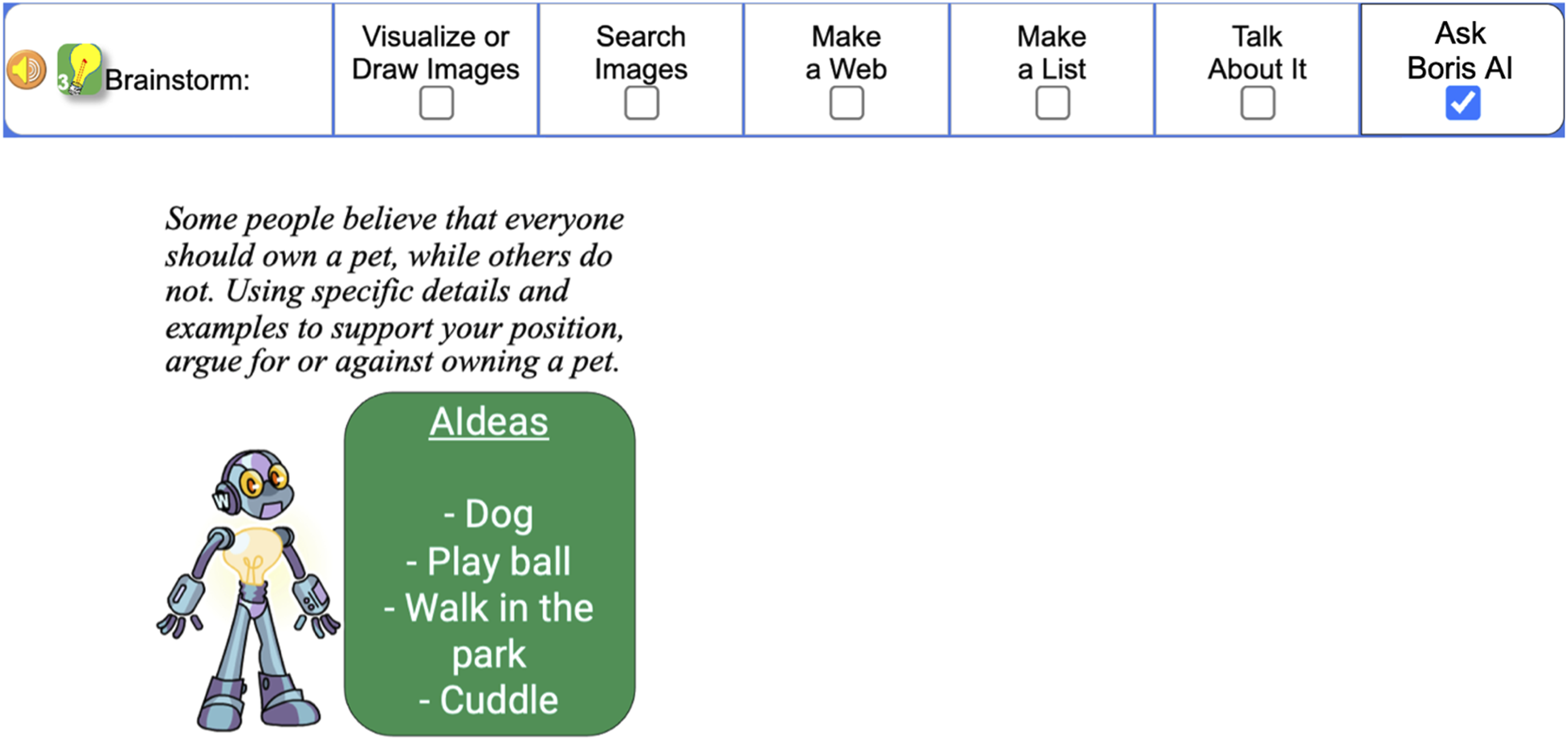
Discussion
Overall, this article describes how multiple data sources were used to make design decisions and create an AI-based brainstorming feature to enhance the existing WEGO writing intervention. In an effort to further support idea generation during the brainstorming phase of the writing process for students with and without high-incidence disabilities who struggle with opinion-based persuasive essay composition, we created Ask Boris AI, a retrieval-based chatbot, and integrated it into the existing technology tool, WEGO. While this article describes just the first two phases of the larger design research study, Informed Exploration and Enactment, we hypothesize that Ask Boris AI will result in improved brainstorming of prompt-related ideas and as a result, students will produce higher-quality essays in our future Local and Broader Impact studies. The improved version of WEGO, including the new AI-based brainstorming feature, supports the Common Core State Standards in both writing and digital literacy (National Governors Association Center for Best Practices & Council of Chief State School Officers, 2010). As we know from our previous research, students are able to internalize supports built into WEGO and maintain their writing improvements when the tool is removed (e.g., Evmenova et al., 2016; Evmenova et al., 2020; Regan et al., 2017; Regan et al., 2024). For example, students are able to recall the varied transition words from WEGO’s drop-down menus and continue to use those transition words in their writing outside of WEGO. We hope that the same transfer of skill will be true when students need to effectively generate ideas during brainstorming. The repeated exposure to Ask Boris AI’s idea options while composing a persuasive essay will offer modeling and practice to students in thinking through a variety of opinion prompts. This concept of matching prompts to relevant ideas is further reinforced in one of the six educational games to be embedded into the next version of WEGO (Evmenova et al., 2025).
When developing Ask Boris AI, it was important to use feedback from our stakeholders (writing teachers and caregivers) and to consider the AI-related policies, guidelines, and procedures adopted by our partnering school systems. The thematic analysis of those data allowed us to generate overarching themes which then informed the design principles for the Ask Boris AI prototype. The six design principles aligned with school’s existing policies on commitment to ethical, responsible, and safe use of AI; using AI as a supplement not a substitute; and equity, accessibility, and inclusivity of AI tools. There is a common belief that AI can meaningfully enhance teaching and learning when applied thoughtfully and ethically.
The Ask Boris AI prototype aligns well with existing research on the retrieval-based chatbots for brainstorming. It features similar characteristics of pre-determined, structured, idea-expansion outputs or nudges to avoid idea fixation and blank page anxiety (La Scala et al., 2025; Libertino, 2024). The prototype also incorporates the necessary safeguards emphasized by existing research such as using curated knowledge sources to avoid hallucinations and bias (Chia & Frattarola, 2025; English et al., 2025; Tsufim & Pomerleau, 2024). Indeed, open-source GenAI chatbots’ performance has been criticized especially in areas that require precision such as science (Tufino, 2025). While we could easily generate ideas for such database using open-source GenAI tools, it was important for us to use authentic data generated by students from our targeted audience. Thus, we relied primarily on the data available from our existing WEGO essays to create a curated and vetted knowledge database (except for ideas generated by GPT-5 for a handful of prompts not represented in our database of essays). One reason we used an authentic database of ideas generated by school-age peers with and without disabilities, rather than artificially generated outputs, was because we thought the ideas would be more relevant if shared by similar aged peers who have common interests. We do realize however that a retrieval-based chatbot, like this, offers less flexibility for personalization when compared to open-source LLMs (Marino et al., 2023). In turn, Ask Boris AI will never replace the writing process taught within WEGO. Ask Boris AI is one of six possible brainstorming strategies and is limited to supporting the pre-writing portion of the writing process. It will help students elaborate on any initial thoughts evoking additional details and examples and make brainstorming more accessible for learners with diverse needs (Goldman et al., 2025). However, the brainstorming support does not give away full answers, serving as a scaffold rather than an automated essay generator (Chia & Frattarola, 2025). In addition, the ability to customize ideas shared with students and/or disable the use of the Ask Boris AI feature will allow flexibility to further personalize learning opportunities depending on students’ needs and/or the types of assignments (e.g., practice vs. test). Overall, this prototype contributes to the overall mission of WEGO to develop great student writers.
AI technology is clearly here to stay (Marino et al., 2023). It has a strong potential to enhance existing research-based educational products. We hope that this example of how AI can be integrated into a technology-based intervention to enhance opinion writing by students with and without high-incidence disabilities will inspire educators and technology developers to use a purposeful and iterative design process to create, test, and refine new features. We believe that Ask Boris AI will improve the usability, effectiveness, and efficiency of WEGO and we look forward to the next design research cycles to test this hypothesis.
Footnotes

Funding
This document was produced under U.S. Department of Education, Office of Special Education Programs No. H327S120011, No. H327S180004, No. H327R230014. The views expressed herein do not necessarily represent the positions or policies of the Department of Education. No official endorsement by the U.S. Department of Education of any product, commodity, service or enterprise mentioned in this publication is intended or should be inferred. This product is public domain. Authorization to reproduce it in whole or in part is granted with proper citation.
Declaration of Conflicting Interests
The authors declared no potential conflicts of interest with respect to the research, authorship, and/or publication of this article.