






Abstract
This study employs an exploratory netnographic research approach to explore how educators in K-12 and higher education settings publicly engage with artificial intelligence (AI) on TikTok as a professional learning network, with an emphasis on supporting students with disabilities. Using deidentified, publicly accessible video data, 209 videos were qualitatively coded, and statistical analysis of thematic coding frequencies identified five overarching themes. These included: (1) AI as a Pedagogical and Productivity Tool for Educators, (2) AI for Personalization, Inclusion, Access, and Student Support, (3) AI Literacy, Ethics, and Societal Implications, (4) AI in the Workforce and Skill Development, and (5) AI Tool Demonstrations. The findings explore ways in which educators and students, especially those in secondary and higher education environments, are using TikTok as an informal professional learning network where AI tools, ethical considerations, and inclusive practices are shared and debated, contributing to emerging scholarship at the intersection of AI, special education, and digital educator culture. These insights and findings aim to better understand how educators and students develop shared knowledge in AI in algorithmically mediated public spaces.
Keywords
Prior to the pandemic, 49% or 3.8 billion of the total world population used some form of social media platform, with evidence suggesting that social media can be used to communicate with students and colleagues, collaborate on research, share knowledge, create, exchange, and disseminate information, and solve real-world problems, improving overall job performance (Landers & Schmidt, 2016; Liu & Bakici, 2019). This is achieved through platforms such as Facebook, Pinterest, YouTube, WhatsApp, Instagram, TikTok, WeChat, Snapchat, and LinkedIn (Kozinets, 2020; Mardiana, 2016; Pekkala & Van Zoonen, 2022; Primack, 2021; Wallace et al., 2018). Growing evidence also shows that social media and digital spaces now have educational and professional potential beyond entertainment and can supplement limited formal preparation through collaborative and supportive professional learning networks (Greenhow, 2020; Heubeck, 2023; Mercado & Shin, 2025; Staudt Willet, 2024). Recent systematic reviews and empirical work of teachers’ social media use also show that short form video, image, and text-based platforms such as Facebook, Instagram, and TikTok communities (i.e., #tiktokeducators, #teachersoftiktok) now support ongoing professional learning, collaboration, resource sharing, and reflection, particularly for educators working with limited local support (McKoy, 2023; Mercado & Shin, 2025; Staudt Willet, 2024). Emerging scholarship on “teacher influencers” also suggests that TikTok and similar platforms enable educators to build visibility, model classroom practices, and engage in distributed forms of teacher leadership and entrepreneurship that shape peers’ conceptualizations of classroom management and instructional innovations (Carpenter et al., 2023; Preece, 2024; Sun et al., 2025). Studies of early-career and preservice teachers also highlight how social media-based networks support their transition into the profession by offering access to practical ideas, time-management strategies, and support for instructional and behavior management practices (Preece, 2024; Staudt Willet, 2024). This often includes discovering, analyzing, evaluating, and adopting resources from social media platforms to visualize procedures and routines and finding strategies to support student behavior, instruction, and environmental adaptation (McKoy, 2023).
Echo Chambers in Social Media
Despite the benefits of social media for professional learning, research also points to challenges such as context collapse, echo chambers, and credibility issues driven by platform algorithms or paid promotions that can lead to frustration among teachers (Carpenter et al., 2023; Carpenter & Harvey, 2019; Keskin, 2018; McKoy & Jordan, 2022; Van Dijck, 2013). Educators and students do not need to know every technical detail of how these platforms work but do need to understand the core feature that helps them better navigate what they see (Lee et al., 2023; Schreurs et al., 2022; Schreurs & Vandenbosch, 2021). Echo chambers occur when engagement metrics like likes, shares, and follows feed personal algorithms that prioritize content aligned with a user’s existing interests or beliefs (McKoy & Jordan, 2022). As a result, educators may repeatedly encounter the same teaching styles or classroom “hacks,” even when these ideas are not evidence-based, while alternative or diverse perspectives may be pushed out of view. Over time, these digital patterns can shape how educators view themselves, make instructional decisions, or influence what they consider best practice. Students are also affected by algorithmic content that shapes the content they view. For example, a student with dyslexia who frequently searches for reading help on TikTok may be shown multiple quick “reading hacks” or trendy AI tools that simplify text, while a more comprehensive, evidence-based literacy intervention was not presented. Over time, this narrow stream of content can potentially shape what the student believes is the “right” way to learn.
Since algorithms tend to promote content that is catchy or familiar rather than accurate, educators need strong critical literacy skills to evaluate the quality of what they encounter online (Carpenter & Harvey, 2019; McKoy, 2023; Sawyer et al., 2020; Shelton et al., 2024). Analyzing these dynamics through a netnographic lens helps reveal how algorithms, user habits, and social acceptance shape beliefs and norms within student and educator communities. This perspective shows that while social media can connect educators and support collaborative learning, it also poses risks when the same ideas circulate without being questioned or supported by broader evidence (Bailey, 2018; Carpenter & Harvey, 2019; McKoy & Jordan, 2022).
AI Conversations in Education
Educators must stay updated on technological advances and continuously enhance their professional skills, acting as facilitators of knowledge and digital mentors who can navigate and use emerging technologies, including Artificial Intelligence (AI) (Greenhow & Askari, 2017). Contemporary research highlights the rapid adoption of AI-assisted tools in education, but their connection to theory and practice remains inconsistent. Chen et al. (2020) reviewed 20 years of Artificial Intelligence in Education (AIEd) research and found that, while machine learning, data mining, and natural language processing drive innovation, many studies focus more on technology than on pedagogy or the interpretive contexts in which educators and learners encounter these technologies. This potential “application-theory gap” hampers educators’ ability to effectively implement AI in classrooms. McGehee’s (2024) meta-analysis of educators’ acceptance of AI shows that self-efficacy and perceived usefulness are key factors in adoption; however, challenges such as ethical transparency and workload fairness still exist. Educator adoption of AI is also noted to be influenced by contextual and cultural factors or elements reflected in social media environments, which are often overlooked by traditional research (McGehee, 2024). Despite the expanding research on artificial intelligence (AI) in education, limited empirical work has examined how educators naturally engage with AI tools and discussions on social media platforms.
Research Question
To explore discussion and integration methods for using AI in school-age or higher education classrooms to support educators or students with disabilities, the following research question was developed, focusing on TikTok as a social media platform and content dissemination tool for educators: What topics, tools, or strategies are being shared publicly on TikTok related to AI use to support educators or their students with disabilities in education? This question responds directly to calls for a qualitative, community-based understanding of how educators interpret and operationalize AI within inclusive education contexts (Al-Zahrani, 2024; Al-Zahrani & Alasmari, 2024; Chen et al., 2020) to identify content themes and pedagogical purposes. This question also helps situate the study at the intersection of AI-in-education research and digital ethnography to capture human discourse (educators’ sharing and meaning-making) that may be impacted by a non-human agency (algorithmic amplification).
Methodology
Research Design
We used netnography, or a qualitative digital ethnography, as a foundational framework to examine how individuals create meaning, identity, and community within digital settings, particularly within education communities on TikTok. Netnography originated in marketing and consumer research and blends “Internet” (or “net”) and “ethnography,” reflecting digital cultures and communities by observing, participating in, or interpreting online interactions and artifacts (Kozinets, 2010, 2015, 2020). This approach includes social media platforms, discussion forums, and digital learning spaces (Kozinets, 2019; Costello et al., 2017). While systematic, this approach uses flexible, ethically grounded procedures that rely on researcher involvement and attention to context, which continues to evolve alongside new technologies such as AI (Kozinets & Gretzel, 2022; Kozinets, 2020; Kozinets & Gretzel, 2024). Netnography helps reveal how platform architectures, algorithms, and affordances shape identity, credibility, and community formation in educator Professional Learning Networks (PLNs) (Carpenter et al., 2023; Wallace et al., 2018; Xie-Carson et al., 2023), offering insight into how online spaces influence emerging norms in pedagogy and inclusive practice (Naatz & Ruppar, 2025). In education-focused PLNs, it is especially effective for examining how norms and credible knowledge are co-constructed across hashtags and comment cultures (McKoy & Jordan, 2022; Trust, Krutka, & Carpenter, 2016; Wallace et al., 2018) and for understanding how educators use social media as informal hubs to make sense of AI tools, ethics, and classroom applications (Naatz & Ruppar, 2025; Xie-Carson et al., 2023).
Stages of Netnography
Data collection for netnography is divided into four stages: (1) Focusing the Research, (2) Data Collection, (3) Analyzing and Interpreting the Data, and (4) Communicating the Research. Within these stages, there are six distinct “movements” that are characterized by unique research procedures that guide the researcher. These six movements across the stages include Initiation, Immersion, Investigation or Interaction, Integration, and Incarnation (Kozinets & Gretzel, 2022; Kozinets, 2020; Kozinets & Gretzel, 2024). Stage 1 focuses on the research’s focus and includes the movement called “Initiation.” This stage also includes developing a research design to guide data type and source selection, ethical considerations, and the researcher’s positionality. This involves accounting for the researcher’s social context, background, and other identity factors that may influence data evaluation, interpretation, and the identification of perceptual blind spots, thereby impacting the study’s conduct and conclusions (Sherry & Kozinets, 2001).
While data in netnography can be archival or publicly accessible, ethical considerations, including institutional approvals or informed consent procedures, are essential in order to allow researchers to observe community behaviors without disruption (Costello et al., 2017). It is also essential to seek institutional guidance to ensure anonymity, respect community norms, and meet data privacy standards (Kozinets, 2019). Stage 2 includes “Immersion” in the online community, followed by a transition to either “Investigation” or “Interaction.” Investigation includes interaction with the social media or online community through observation, while “Interaction” includes direct interaction with human participants through interviews or surveys. For this study, the transition from Immersion to Integration used the Investigative method rather than the direct interaction method. Stage 3 includes analyzing and interpreting the findings, or the movement “Integration,” which involves qualitatively analyzing the data to identify patterns or themes. Netnography also uses iterative coding processes in this stage, with reflexivity playing a vital role, requiring the researcher to recognize personal biases, positionality, and interpretations that may influence meaning-making (Kozinets, 2020). Stage 4 focuses on communicating the findings, also known as the “Incarnation.” This stage involves writing that combines rich, detailed descriptions with thoughtful interpretation, helping connect what was observed in individual posts to broader insights about the community (Kozinets, 2020).
Researcher Positionality
In alignment with Stage 1, researcher positionality statements are provided. Author 1 is a Lecturer of Special Education with over 17 years of combined experience in higher education and secondary special and general education. She holds a PhD in Curriculum and Instruction with an emphasis in special education, with a background in qualitative research, including NVivo, peer debriefing in netnographic research, virtual schools, and online communities. Her expertise emphasizes instructional and accessible technologies.
Author 2 is a full-time secondary educator and an Adjunct Professor of Curriculum & Instruction and Gifted Education. She holds a PhD in Curriculum and Instruction with an emphasis in gifted education and has over 15 years of experience in elementary and secondary education, including special education. Her research focuses on qualitative and digital ethnographic methods, trauma-informed practice, differentiated instruction, and the experiences of diverse and vulnerable learners. These roles particularly inform her interpretation of online interactions, particularly regarding student agency, teacher-student dynamics, and issues of access and representation.
Author 3 holds a Bachelor of Liberal Studies with a minor in Management Information Systems and is pursuing graduate study in business and data analytics. He has training in technology applications, including AI, data analysis, cybersecurity, risk management, and cloud computing. His background is shaped by humanitarian and ministry work, with a strong commitment to serving marginalized communities and promoting equity in educational and workplace settings, including for students and young adults with disabilities.
Ethical Considerations
To meet ethical standards, data collection in this study was (a) anonymized by removing all potential identifiable information (i.e., public profile data, video comments); (b) publicly accessible without requiring personal or institutional login credentials; (c) not conducted in closed (i.e., private) or semi-private online groups; and (d) not based on sensitive topics that could directly harm any platform, person, or social media group. For added assurance, the institution’s research and assessment office was consulted, and it was confirmed that publicly accessible social media data would not be considered human-subject research within this study’s scope. Institutional assistance was also provided to review the Terms of Service to ensure compliance with ethical research standards during the data collection process.
Data Collection
In order to collect data that was not directly affected by the researcher’s personal algorithms, data were gathered using Apify, an online cloud-based data extraction and automation tool that scans publicly available data, including video URLs, descriptions, engagement metrics (likes, comments, shares, views), and hashtags on social media platforms such as TikTok. Apify is more commonly known to developers, marketers, and businesses for analyzing competitor data through “Actors,” which can interact with websites just like a human would, but based on internal coding sequences developed by Apify or Community Actors. The data collection tool does not give access to private accounts, direct messages, or personal identifiable information such as email addresses or location data (Apify, 2021). TikTok allows users to set post-level privacy controls regardless of account type, including public, friends-only, or private visibility, with the option to modify settings. Default restrictions may apply based on age and location, limiting visibility changes until eligibility criteria are met (Tiktok, 2026a, Tiktok, 2026b). Many users do set their settings to public to increase followers, participate in trends, grow a brand or business, or make their content shareable.
Using Apify's TikTok template (Apify, 2021), rather than logging in directly to a social media account to search for videos, was primarily used to help minimize the impact of personal algorithms, cookies, or website personalization that customize experiences for the researcher’s user account. Two manual scans were conducted in August and September of 2025, using the United States (US) as a proxy country. This enhanced applicability across the US educational landscape and helped ensure that data privacy was maintained for content that may fall outside the US. Scan 1 included four hashtag searches #aisped, #spedai, #aispecialeducation, and #artificialintelligencespecialeducation, along with two additional search terms “AI in Special Education” and “Artificial Intelligence in Special Education.” This scan collected 303 videos. Scan 2 in September of 2025 was added after review of Scan 1 to elicit additional video and increase overall saturation and validity of the findings. This scan included four hashtag searches: #aidisability, #disabilityai, #aiaccessibility, and #accessibilityai, and four search terms that included “AI and disability,” “Artificial intelligence and disability,” “AI and accessibility,” and “Artificial intelligence and accessibility.” This scan elicited an additional 694 videos due to the additional search terms.
Screening Process
A total of 997 potential videos were identified and exported to an Excel spreadsheet. Once exported, all potentially identifiable or searchable data was redacted, provided a code, or deleted. The initial redacted spreadsheet listed the public video URL, video description, diggs (likes), comments, shares, plays, collections (saves), and creation dates from 2023 to 2025. All URLs for each TikTok video were reviewed (n = 997). To be included in the study, videos must have an AI tool or component and a direct or indirect educational application for educators, students, or young adults with disabilities in any school-age or higher education environment or content area. Exclusionary criteria included videos that were fully AI-generated videos (TikTok, 2024), whether in person or verbally through an audio overlay (n = 85), duplicates (n = 66), no longer active or working (n = 9), or not relevant to educators or students with disabilities (n = 628). For example, one video may have featured a person with Down Syndrome speaking broadly to the TikTok community about their disability; however, there was no explicit connection to education in the school, home, or community setting. A visual of the screening and identification process is shown in Figure 1, which is an adapted PRISMA design specifically for media screening (Page et al., 2021). Screening process and identification of videos. Note: Adapted from the PRISMA (Page et al., 2021).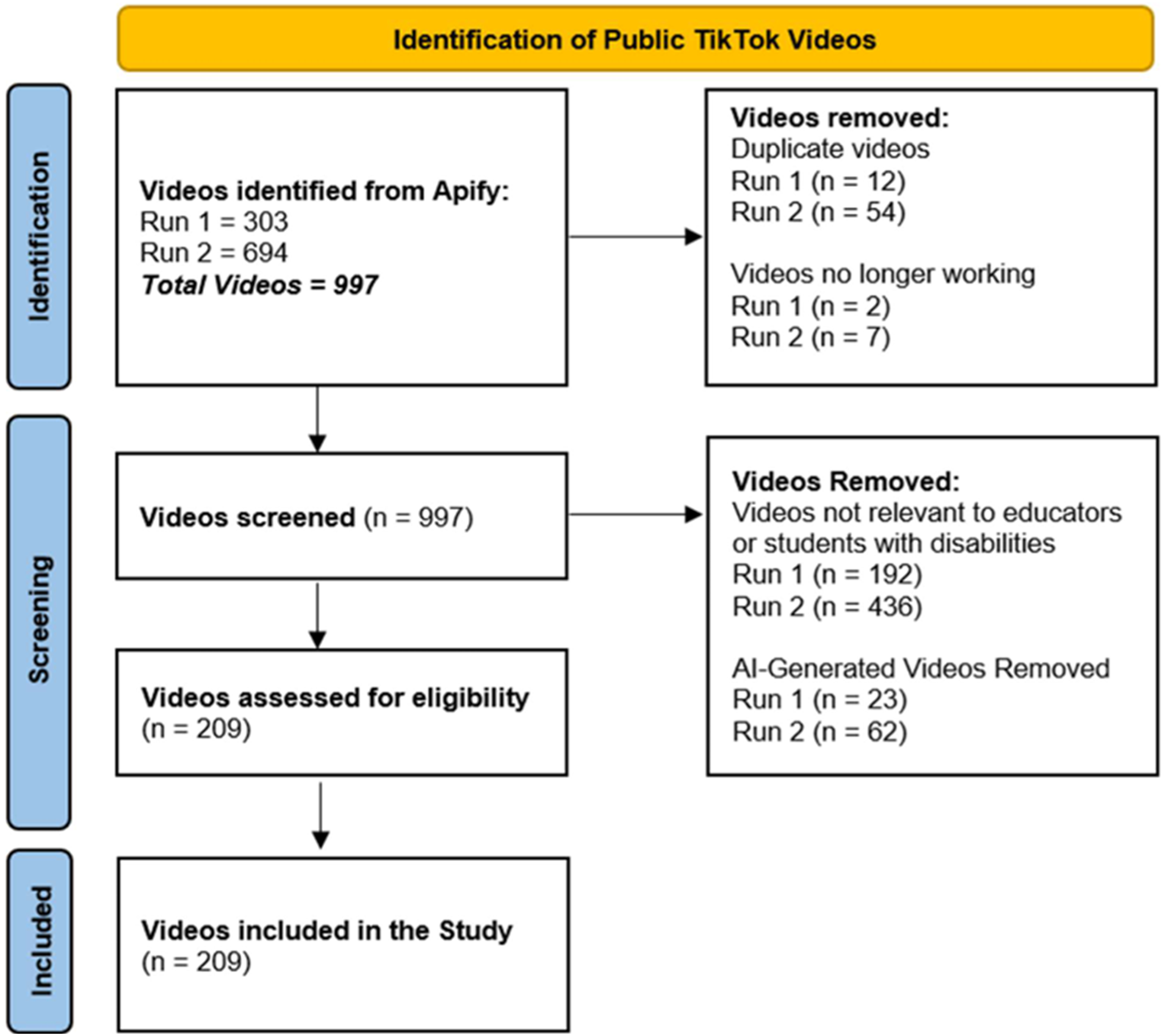
During the screening process, if the video met the inclusion criteria, a detailed video descriptor was added, and code 1 was entered. If a video did not meet the inclusion criteria, a code of 0 was added. The authors provided detailed descriptors for those who met the criteria in two separate reviews, with each video viewed at least twice. If additional information or context were needed to add to a descriptor, the researcher in the second review would add it. For example, one descriptor originally stated, “Details the capabilities of Limitless AI, a wearable, hands-free, live assistant that listens, observes, and provides real-time support such as note-taking, task management, and contextual guidance.” After a second review, “AI assistant that can integrate into the daily activities of people with disabilities” was added to the same descriptor. Once the final descriptors were added for each public video URL, the links, descriptors, and engagement metrics were deleted in line with ethical practices for social media reserach to ensure confidentiality. After screening, 209 (21%) videos met the inclusion criteria and included descriptors for coding.
Trustworthiness and Rigor
To improve validity, this study integrated audit trails, memos, peer debriefing, and detailed contextual descriptions of the videos. Audit trails for data extraction were saved per run in Apify, along with manual notes taken in the online journaling program Penzu, both of which are password-protected. Peer debriefing occurred in virtual and text-based settings, with all data stored securely in the university cloud system, protected by passwords and restricted to authors. Interobserver agreement (IOA) on the video descriptors was calculated through the peer-debriefing process in Excel until a rate of 92% was reached across three manual video review phases. Disagreements mainly involved the implied context or relevance, such as educational application across different contexts, grades, ages, or disability types. There was 100% agreement on inclusion of AI content, such as an AI tool demonstration or an AI use case. For instance, many of the AI tools demonstrated did not explicitly state that they were for special education teachers or students with disabilities; however, they could be used to support students through a Universal Design for Learning (UDL) lens. This prompted the researchers to hypothesize about the educator’s intent for the video, as the educator or person in the video was not directly interviewed, which also is a limitation in the study.
Data Analysis
The Excel spreadsheet, which included video descriptors and peer-debriefing annotations or memos for each video, was uploaded to NVivo (Lumivero, 2025) and qualitatively coded by Author 1 for each video using the video descriptions. Each video was assigned one or multiple references or codes, depending on the content. For example, the video descriptor “Pika AI is an AI video generator being used to show elementary students what they will look like as their future preferred career” was coded under “AI Use in Elementary Education,” “AI for Video or Image Generation,” “AI Tool for Teachers,” and “AI Impact on Future Employment or Career.” When questions arose about placement within the codes for individual videos, peer debriefing continued. IOA was not conducted directly in NVivo during the coding process due to limited access to the institutional software; therefore, IOA of video descriptors and annotations in Excel, as potential coding references per video, was vital before uploading to NVivo. The NVivo Codebook, which summarizes the coding descriptors and the number of references per code, is available in the Supplemental Materials A.
Significance of Parent Codes Based on Number of References and Thematic Connections.
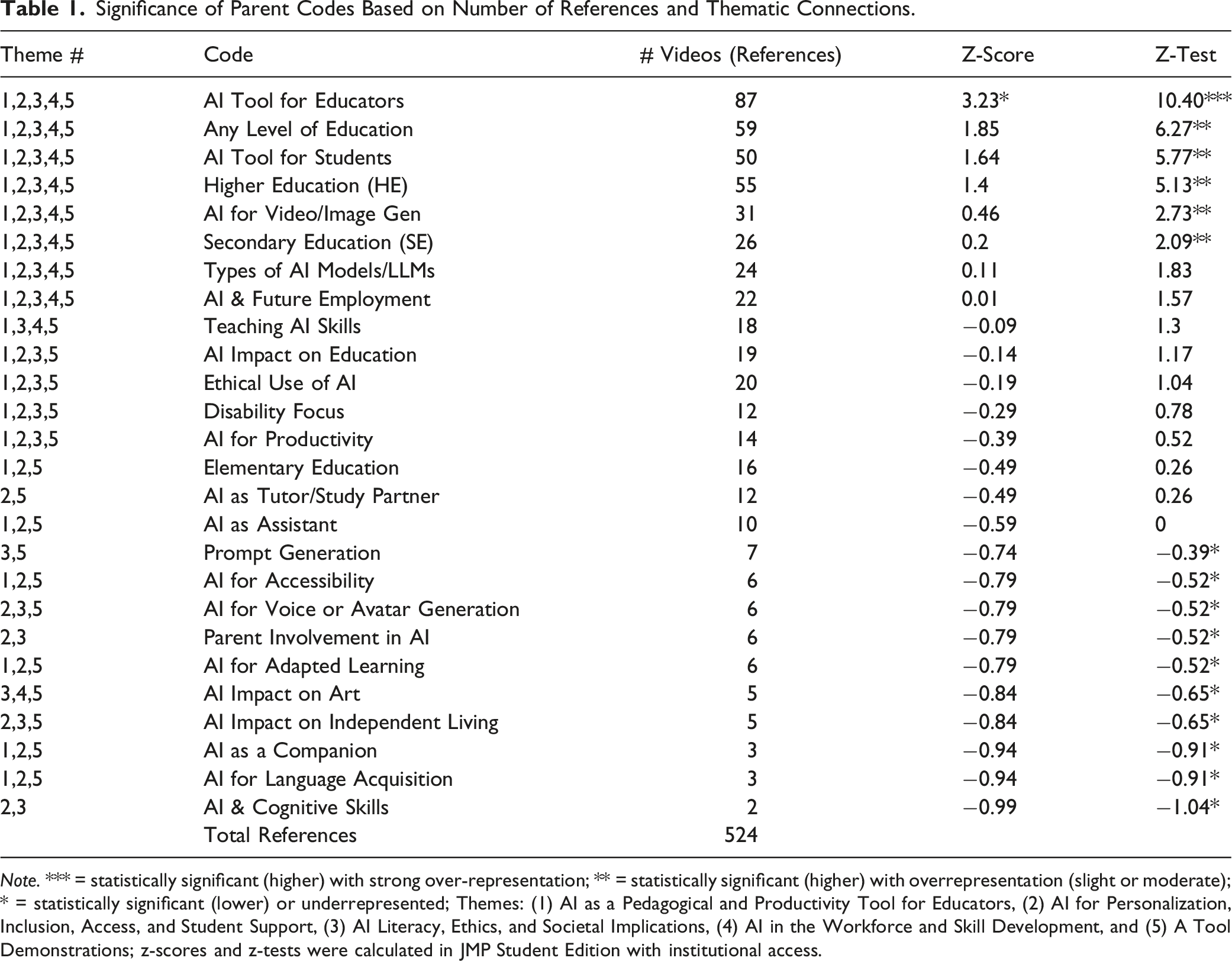
Note. *** = statistically significant (higher) with strong over-representation; ** = statistically significant (higher) with overrepresentation (slight or moderate); * = statistically significant (lower) or underrepresented; Themes: (1) AI as a Pedagogical and Productivity Tool for Educators, (2) AI for Personalization, Inclusion, Access, and Student Support, (3) AI Literacy, Ethics, and Societal Implications, (4) AI in the Workforce and Skill Development, and (5) A Tool Demonstrations; z-scores and z-tests were calculated in JMP Student Edition with institutional access.
Findings
According to the data, only a small subset of themes showed values significantly above the mean, reflecting the dataset’s wide variance. “AI Tool for Educators” (n = 87) was the only theme emerging as a strong positive outlier, indicating it occurred substantially more often than the typical code and was highly overrepresented (z ≈ 3.23). Due to the minimal differential, a z-test was conducted to add a quantitative layer of pattern detection to identify potential themes. The z-test results revealed asymmetries in video representation, indicating that certain coding structures or videos were statistically significant. “AI Tool for Educators” (n = 87; z ≈ 10.4) remained strongly overrepresented; “AI Use in Any Level of Education” (n = 59; z ≈ 6.27), “AI Tool for Students” (n = 55; z ≈ 5.77), and “AI Use in Higher Education” (n = 50; z ≈ 5.13) were also overrepresented; “AI for Video and Image Generation” (n = 31; z ≈ 2.73) was moderately overrepresented; and “AI Use in Secondary Education” (n = 26; z ≈ 2.09) was slightly overrepresented. Lower-frequency themes such as “AI Prompt Generation” (n = 7), “AI for Accessibility” (n = 6), “AI for Voice or Avatar Generation” (n = 6), “Parent Involvement in AI Skills” (n = 6), “AI for Adapted Learning” (n = 6), “AI Impact on Art” (n = 5), “AI Impact on Independent Living” (n = 5), “AI as a Companion” (n = 3), “AI for Language Acquisition” (n = 3), and “AI Impact on Cognitive Skills” (n = 2) showed negative z-test scores between −0.39 and −1.04, suggesting these topics appeared less frequently than average and are underrepresented.
Themes
Thematic Alignment with Number of Videos Referenced Within Parent Coding.
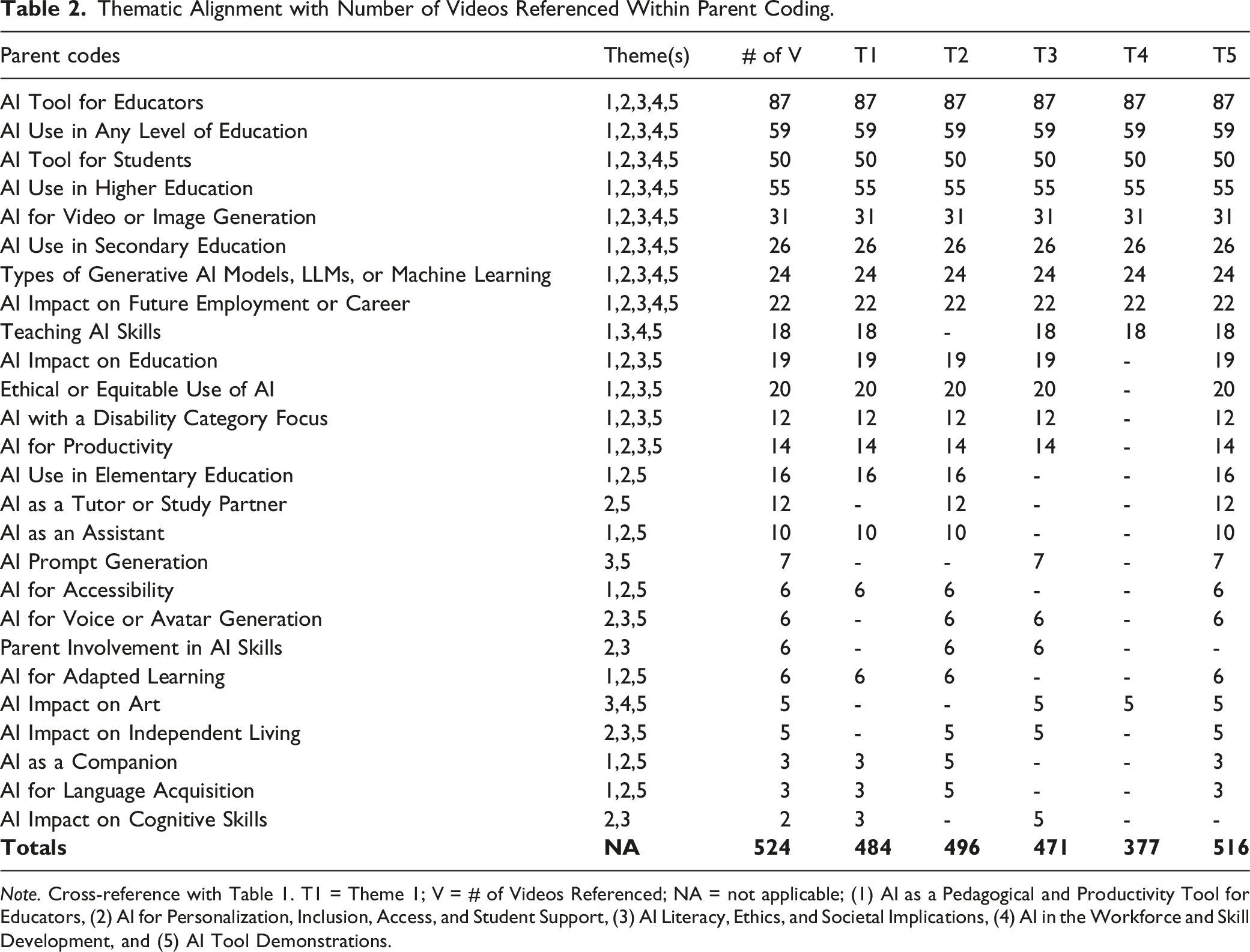
Note. Cross-reference with Table 1. T1 = Theme 1; V = # of Videos Referenced; NA = not applicable; (1) AI as a Pedagogical and Productivity Tool for Educators, (2) AI for Personalization, Inclusion, Access, and Student Support, (3) AI Literacy, Ethics, and Societal Implications, (4) AI in the Workforce and Skill Development, and (5) AI Tool Demonstrations.
Theme 1: AI as Pedagogical and Productivity Tool for Educators
The first theme identified was the use of AI as both a pedagogical aid and a productivity enhancer for educators, which appeared in 92% of coding references (n = 484). Educators on TikTok frequently present AI as an integral part of their teaching workflow, highlighting its ability to automate time-consuming tasks such as lesson planning, assessment creation, feedback generation, data analysis, and IEP documentation. Educators also used AI to enrich the instructional environment, including deploying real-time tutoring systems, multimodal demonstrations (i.e., image, audio, video, text), interactive digital study partners, and visual explanations that support language development. Creative media applications, such as AI-generated videos, animations, images, and voiceovers, are incorporated into the production of richer, more complex multimodal lessons that would be difficult to create manually. Educators also commonly showcase AI tools that generate presentations, slides, study guides, problem sets, reading-level adaptations, and other curriculum materials. Videos often demonstrate how teachers produce lesson plans, presentations, editable worksheets, choice boards, grading rubrics, and parent newsletters using comprehensive content-creation platforms. Educators also highlight AI systems that assist with research, summarize complex texts, and adapt material to different reading levels, including those that use a guided or Socratic teaching style. AI was also noted to be used to draft or refine professional communication, adjust learning objectives, and support IEP documentation by generating goals, accommodations, and modifications.
Theme 2: AI for Personalization, Inclusion, and Student Support
Theme 2 reflects educators’ belief that AI can be used to personalize learning and provide targeted interventions, as evidenced by 95% of coding references (n = 496). Educators describe adaptive systems that adjust difficulty, pacing, or content based on student performance and offer individualized feedback or tutoring. Many videos also show how AI helps teachers differentiate instruction for students needing extra practice, enrichment, scaffolding, or behavioral and communication support. Educators and students also demonstrate how AI can simplify texts, generate leveled questions, break down tasks step-by-step, analyze data, and create personalized learning activities or social stories. Videos also highlight AI’s role in accessibility, showcasing features such as text-to-speech, sign-language translation, AAC support, dyslexia-friendly adaptations, and visual support. Some posts show AI being used to create materials for students with unique communication, sensory, or mobility needs, including real-time assistance for visually impaired learners and adaptive practice for reading or math. Students also describe using AI study helpers to support executive functioning and memory through guided practice, simplified texts, and real-time coaching. Conversational agents, such as AI chatbots or digital assistants, were also found to offer low-pressure opportunities to practice communication, express emotions, complete tasks, answer questions, or obtain information. More specifically, a conversational agent is software that understands natural-language questions and responds in a human-like way, often appearing as a chat window or voice assistant that becomes available upon prompting (e.g., “Hey Siri,” “Okay Google”). AI Generative tools are also used to visualize complex scientific concepts, making abstract ideas more accessible. In one example, a student used AI-generated imagery to represent their disability identity.
Specific disabilities that were highlighted in the videos include using AI to support students or young adults with ADHD (n = 1), Autism (n = 1), Down Syndrome (n = 1), Dyslexia (n = 1), and Visual Impairment or Blindness (n = 2); however, many videos addressed a more Universal Design for Learning (UDL) approach that was beneficial across various disabilities categories broadly. Exploring areas specific to different disabilities is an area of need and was not representative in the videos based on the search criteria explored. The data also showed that educators and students in secondary (n = 26) and higher education (n = 55) environments were more active on TikTok related to AI use for educational support. Elementary education, however, was relatively frequent in the data (n = 16), but not as prominent as secondary or higher education (n = 81). While there was evidence of specific educational environments or levels in the data, 59 videos (n = 59) were found to apply to any educational level or could be generalized across any grade level. For example, “AI for Image and Video Generation” was frequently referenced as applicable to “Any Level of Education” if it was not explicitly stated or identified in the video. This most likely means that many AI topics, tools, and strategies on TikTok, including image and video generation, could be applied across the school-age and higher education environments, depending on use and context.
Theme 3: AI Literacy, Ethics, and Societal Implications
Educators on TikTok also discuss the importance of developing students’ AI literacy skills and of modeling responsible use of emerging technologies, including their societal impacts when used (e.g., how information is created, shared, or evaluated; interpretational bias and predictive profiling; shaping identity and social dynamics). This was present in 90% of the coding references (n = 471). Many videos highlighted the need to verify information produced by AI systems, noting that these tools can generate errors, biased outputs, or misleading content. Educators and students also demonstrated how to evaluate AI-generated responses using various tools, fact-check claims, and recognize fabricated or manipulated media (i.e., deep fakes). Educators and students also discuss the potential psychological implications of integrating AI into daily lives (e.g., cognitive offloading, perceived ownership, conversational use, perception of reality). Other posts describe broader social issues, such as surveillance features in emerging technologies and the personal data being collected by wearable devices (e.g., glasses, watches, smart devices).
Theme 4: AI in the Workforce and Skill Development
Theme 4 focuses on how AI is shaping workforce preparation and skill development, which is also an essential component of transition planning in special education and in preparing students for higher education. This was identified in 72% of the coding references (n = 377). Within this theme, educators and students frequently connected AI to the shifting employment landscape, noting that automation is already transforming industries such as healthcare, customer service, manufacturing, and software development. Many videos emphasized that both secondary and higher education systems may need to adjust career pathways, including opportunities in AI-related fields and technology-focused degrees. In addition to technical readiness, educators stress the ongoing importance of human-centered skills that AI cannot replace. Several videos highlighted the continued value of communication, empathy, collaboration, and sound judgment, especially in professions that rely on interpersonal relationships (e.g., healthcare providers, educators, social workers, public safety, mental health services).
Theme 5: AI Tool Demonstrations
Demonstrations of AI tools for both students and educators were recognized and tagged early in the data collection process and throughout the data analysis, with videos being integrated into all themes; however, their prominence amplifies their own thematic nature. These tools span platforms for writing, accessibility, multimodal learning, automation, creative media, and productivity, demonstrating a broad ecosystem of educational possibilities. This aligned with the identification of AI Tools within 98% of the references across all themes (n = 516). While some tools were replicated across multiple videos, such as ChatGPT, a total of 129 AI tools were identified across all themes. While technology and websites are frequently changing, all AI tool websites and their applicability were verified for accuracy after viewing the videos, ensuring they are active and have accessible websites for educators as of the fall of 2025. An alphabetical table of all of the identified tools, along with their links and general-use descriptions, is located in the Supplemental Materials B. Many of these tools are multifunctional and can be used by both students and educators with or without disabilities, depending on the content, context, or application, especially in higher education and secondary settings.
Within Theme 1, educators and students used AI tools for multiple instructional, research, skill development, and productivity purposes. The tools primarily functioned as practical supports to improve workflows and reduce overall labor by generating instructional materials, automating documentation, and producing multimedia content. Tools such as Magic School AI and Brisk AI streamlined lesson planning, grading, communication, and IEP-aligned documentation, helping educators devote more time to direct instruction and feedback. Classroom workflows also incorporated tools like Flowise AI and Stack AI, which educators used to create custom chatbots and automated learning agents (i.e., content-specific chats, adapted learning platforms, automated feedback and writing support, note-taking and study tools) tailored to their specific instructional context. Students also interacted with AI-supported content created by educators, but they also produced their own media using tools like Canva, Gamma, CapCut, Runway ML, and Speedpaint, shifting content creation from a teacher-only task to a student-driven mode of expression. Educators and students used media-generation tools to enhance instruction and create multimodal artifacts. Educators produced animated demonstrations, short instructional videos, or slide decks using Pika AI and Presentations AI, while students created digital portfolios, illustrated concept explanations, or animated storytelling assignments with Mini Studio AI, Dreamina, or Leonardo AI. Tools such as Fathom, Fireflies AI, TLDV, and Otter AI captured and summarized lectures, meetings, and class discussions, supporting accessible review and enabling students to revisit material asynchronously.
AI tools identified in Theme 2 supported proactive personalization, accessibility, and tailored learning support. For example, educators used Diffit.me to generate leveled texts to help differentiate reading instruction. Students also used Gauth AI for step-by-step help in math, while NotebookLM, Gemini, and Perplexity provided document-based summaries and clarifications during research and writing tasks. Accessibility tools such as Ella addressed specific learning needs that created visual schedules and social stories. Aira also demonstrated connecting blind or low-vision users with assistive navigation tools. Other tools, such as ElevenLabs and NaturalReader, that convert text to speech were also demonstrated, along with Migam AI, a supported sign-language interpretation tool. Multimodal tools such as Music FX, Suno, and Leonardo AI also offered students additional ways to demonstrate learning through sound and visuals instead of text. Similarly, many of these same tools were used by educators to provide clearer explanations and align instructional materials with student preferences.
Within Theme 3, various AI tools were found to support literacy, ethics, and societal implications. Showtools AI helped students analyze “how” AI-generated video content was constructed, which educators incorporated into lessons on misinformation, authorship, responsible digital citizenship, and media critique. Consensus AI, NotebookLM, and Perplexity were used to generate summaries grounded in specific documents or sources, supporting evidence-based reasoning, providing models and helping students distinguish verified information from AI generative content. Tools such as Anything LLM, VectorShift AI, and Apple AI enabled on-device or institutionally controlled processing, which educators relied on when handling private student data or classroom materials that could not be uploaded to public models. Students engaged with realistic output from tools like Sora, VEO3, and Character AI, prompting classroom discussions about authenticity, bias, and ethical representation as models generated lifelike simulations.
In Theme 4, students in secondary and higher education classrooms also used AI tools to develop professional skills that align with emerging workplace expectations. Tools such as Make.com, Pipedream, Bolt.new, and Loveable.dev enabled workflow automation and app or prototype creation without advanced programming, allowing students to build dashboards, productivity tools, and automated systems as part of their coursework. Creative and professional tools, including Runway ML, Notion AI, and Kling AI, prepared students for fields involving multimedia production, design, and knowledge management. Productivity systems like Vy and Superhuman AI modeled AI-mediated communication and workflow practices that are increasingly common in industry settings. Tools such as Art for Clinicians supported the drafting of healthcare documentation in clinical training programs at higher education institutions.
Discussion
Using a unique netnographic approach provided a better understanding of how educators navigate the pedagogical, ethical, and technical challenges of AI adoption in social media spaces. This includes various topics related to the growth of AI in education including prompt engineering, instructional changes, data minimization, and the responsibilities involved in inclusive education, and helps address the gap identified by Chen et al. (2020) in AI research rooted in authentic educational settings. These dynamics are especially important in special education, where educators are increasingly using AI for content adaptation, communication access, AAC, social stories, and sensory supports, yet little is known about how these practices are influenced or constrained by AI in digital public spaces. The influence of algorithmic systems within social media spaces broadly, however, also raises further questions about equity, reflecting the issues of access and bias (Al-Zahrani, 2024; McGehee, 2024).
By analyzing 209 publicly available videos created by educators and students mainly in secondary and higher education, the findings show that educators, students, and higher education professionals are not only experimenting with AI tools but also using social media, such as TikTok, to share teaching strategies, voice ethical concerns, improve productivity, and showcase inclusive practices to support young adults and students with disabilities. After analysis, the data identified five themes: (1) AI as a Pedagogical and Productivity Tool for Educators, (2) AI for Personalization, Inclusion, Access, and Student Support, (3) AI Literacy, Ethics, and Societal Implications, (4) AI in the Workforce and Skill Development, and (5) AI Tool Demonstrations.
Educators were found to use AI as a Pedagogical and Productivity Tool for lesson planning, grading, and creating classroom materials, supporting research aimed at improving efficiency and job performance (Al-Zahrani, 2024; Carpenter et al., 2023). For example, platforms like Magic School AI and Brisk AI help teachers save time on administrative tasks, allowing them to focus more on student interaction (Kang & Lou, 2022). Both educators and students benefit from accessing materials generated with AI tools, including creative media applications such as Canva, to express their understanding (Sawyer et al., 2020). These tools were found to apply across various grade levels, content areas, and abilities, making it difficult to determine the best use. For example, both pre-service teachers in higher education (i.e., students, interns, teacher candidates) learning to develop lesson plans and current educators in schools could benefit from lesson-planning tools that integrate AI.
Educators and students are also utilizing AI for Personalization, Inclusion, Access, and Student Support. For example, educators have been observed increasing students’ use of AI for studying assistance and adaptive content, aligning with research showing that AI-enabled personalized learning is becoming more common in classrooms (Chen et al., 2020; U.S. Department of Education, 2023). AI tools were also found to help educators customize lessons to meet individual needs, such as adapting reading materials or providing step-by-step support (i.e., task analysis; Greenhow & Askari, 2017). Tools like Diffit.me and Aira were used to support students with disabilities and to proactively create accessible learning resources, consistent with research on AI’s role in supporting accessibility for neurodivergent students (Harkins-Brown et al., 2025). Students also actively use AI study helpers to organize their schoolwork more efficiently and receive feedback tailored to their learning styles, boosting confidence and helping them progress at their own pace and improve skills (Naatz & Ruppar, 2025). These findings reflect broader trends in special education, where AI tools assist with representation, communication, and differentiation (Harkins-Brown et al., 2025; Naatz & Ruppar, 2025).
The theme of AI Literacy, Ethics, and Societal Implications focused on topics such as cognitive effects, ethical risks, language learning, impacts on the field of art, AI companionship, and parent involvement highlighting concerns about overdependence, privacy, and the need for stronger AI literacy among educators and students (McGehee, 2024; U.S. Department of Education, 2023). One teacher on TikTok modeled how to fact-check AI-generated content supporting discourse on digital privacy and raising questions about bias and misinformation (Al-Zahrani, 2024; Chen et al., 2020). Students in the videos also demonstrated how to assess AI-generated content critically and support connections to using technology responsibly in daily life (Lee et al., 2023). These conversations make ethical considerations real and relevant, aligning with the importance of ensuring that students grow into informed, thoughtful technology users (Shelton et al., 2024).
Educators and students, especially in secondary and higher education, are also using AI to explore new career opportunities, showing students how automation is changing jobs in fields such as healthcare and technology (McGehee, 2024). In the theme of AI in the Workforce and Skill Development, students were observed practicing with tools like Make.com and Notion AI to build prototypes, automate tasks, and simulate real-world scenarios. This theme is important because, outside the classroom, colleges, apprenticeships, and workforce centers are updating their training to focus on AI, offering hands-on experiences and certificates to help students, including those with disabilities, gain a competitive edge in new careers. The goal of these videos was primarily to help students not only learn how to use AI but also adapt and learn as technology continues to change.
With 129 different AI Tool Demonstrations for both educators and students across various themes, it is essential to conduct thorough vetting before adoption to ensure alignment with instructional goals, accessibility requirements, and ethical standards. Research indicates that adopting digital platforms without careful review can risk reinforcing inequities, spreading misinformation, or introducing tools that prioritize novelty over pedagogical value (Al-Zahrani, 2024; Chen et al., 2020). For learners with disabilities, who often depend on technology for access rather than convenience, unvetted tools could create new barriers related to usability, assistive compatibility, and cognitive load rather than eliminate them (Harkins-Brown et al., 2025). With this in mind, educators and schools are encouraged to evaluate whether tools protect student data, support accessibility, and avoid reinforcing bias or limiting the students’ ability to think, choose, or act critically and independently (Carpenter & Harvey, 2019; U.S. Department of Education, 2023). Proper vetting also reinforces educator professionalism by ensuring that AI use complements, rather than replaces, instructional expertise and maintains a balance between technological efficiency and pedagogical judgment (Naatz & Ruppar, 2025).
Limitations
As with all netnographic studies, our study does have multiple limitations and challenges. Due to the nature of online environments, there is often a lack of control over the sampling structure of the study population, which can introduce inherent sampling biases (Morais et al., 2020; Prior & Miller, 2012). There are also limitations central to sampling and external validity that introduce sampling biases with constraints to generalize the findings to wider populations (Prior & Miller, 2012), in addition to a lack of standardized or uniform data collection methods (e.g., questionnaires, interview schedules, or observation plans), making definitive conclusions harder to draw.
Ethical and consent complexities also remain a prominent concern in social media research. Unlike traditional ethnographic methods, where consent is often direct and explicit, netnography or research conducted in social media spaces frequently operates where participants may not be fully aware that their public profiles or online conversations are being observed for scholarly purposes (Morais et al., 2020; Nortvig et al., 2018). This has created tension between the public nature of online data and users’ private expectations (Morais et al., 2020). Given the volatility of social media research and the netnographic landscape, caution is required regarding data integrity. Researchers must navigate an environment characterized by misinformation, fake profiles, and false narratives, all of which can undermine data quality and the credibility of resulting interpretations (Lazer et al., 2018). The presence of bots and the fluidity of online identity also mean that “what is said” online may not always align with “what is done” in offline contexts, creating a potential dissonance between online representations and real-world behaviors (Morais et al., 2020).
Research subjectivity that affects how interactions are framed and subsequently interpreted (Kulavuz-Onal, 2015; Morais et al., 2020). Although interobserver agreement procedures improved reliability in the identification of AI and application across the videos, coding interpretation may also have been influenced by researcher bias. Viral reach, creator follower count, in-app purchases by the creator, and video aesthetics may have influenced visibility regardless of implied educational application or relevance. TikTok’s algorithm also most likely promotes certain videos over others within the platform based on each user’s preferences, settings, and usage; therefore, the data may be skewed by the internal systems in place. It is also important to consider that only public accounts were accessible, leaving out all educators with private profiles, an important gap since those working with sensitive student populations may be less likely to post publicly. Since this study also involved no participant interaction, interpretations depend solely on observable content without the ability to verify intent, clarify context, or understand educators’ reasoning for sharing. Data pulled from Apify included only what users chose to share, and many videos developed by the users lacked contextual details such as grade level, disability category, or instructional setting, which affected the data analysis and coding process, making the data vulnerable to assumptions or the influence of researcher reflexivity. Apify’s free version, used in this study, also limits the number of videos or usage credits that can be accessed. It is possible to increase video output and obtain richer data with a more advanced service. Since the original research was conducted, Tiktok (2026a) has updated its website and now provides an integrated Research Tool or research platform for academic researchers that allows researchers and scholars to apply and access its Application Programming Interfaces (APIs) directly through its developer portal. Future research is recommended to use the new TikTok Research Tool (2026b) within its traditional developers portal.
Implications
The findings from this netnographic study offer a unique perspective and methodology for future research, AI policy development, and educator training to promote responsible and inclusive AI use, supporting educators and both school-age and higher education students with disabilities. Future research should explore how educators make real-time decisions about AI adoption on social media platforms and how social media adoption across various platforms affects these decisions in the classroom. This includes more in-depth interviews with social media groups or longitudinal studies that capture intent, uncertainty, and more explicit classroom-level impacts. Researchers should also consider examining how platform algorithms across various social media platforms influence exposure to specific practices or use of AI and whether certain disability-related content is systematically underrepresented, including among educators and students, rather than relying solely on observational methods.
It is also important to understand how educators and students interpret the value of high-engagement content and how it influences their willingness to adopt AI tools for either educational or instructional use. Research should also examine how engagement algorithms affect educators’ exposure to specific AI practices, especially for students with disabilities, potentially shaping what becomes normalized or trusted in education environments. Teacher preparation programs should incorporate AI literacy, ethical prompt-generation techniques, and critical AI-evaluation skills. States, districts, and schools should also provide guidance and policies for selecting AI tools that are transparent, safe, accessible, and that meet data privacy and acceptable use standards, and that define when and how AI-generated materials can be integrated. It would also be helpful for educational leaders to invest in professional development related to AI, while comparing social media-based learning with formal professional development to explore how educators adopt or misinterpret emerging tools.
Conclusion
This exploratory netnographic study of 209 publicly accessible TikTok videos shows that the platform functions as a de facto professional learning network where educators and students, particularly in secondary and higher education, actively experiment with and make sense of AI tools to personalize and prepare for the evolving nature of AI in teaching and learning. More specifically, this research identified 129 different AI tools that educators and students are using in similar educational spaces. The findings revealed five main themes: (1) AI as a Pedagogical and Productivity Tool for Educators, (2) AI for Personalization, Inclusion, Access, and Student Support, (3) AI Literacy, Ethics, and Societal Implications, (4) AI in the Workforce and Skill Development, and (5) AI Tool Demonstrations. These themes highlighted that educators and students are applying AI tools in practical and creative ways while recognizing concerns about privacy, data ethics, and cognitive effects. This analysis also underscores that while AI-enabled tools are already woven into everyday practices, educators are simultaneously negotiating concerns about bias, privacy, and cognitive offloading. For students with disabilities, this dual reality heightens the stakes of thoughtful tool selection, data stewardship, and attention to use of accessibility features within AI tools. Given these dynamics, there is a pressing need for teacher preparation programs, school systems, and higher education institutions to embed AI literacy, including the ethical evaluation and appropriate use of AI tools, in both training and policy guidance.
Supplemental Material
Supplemental Material Hashtags to Help: An Exploratory Netnographic Study of How Educators Navigate AI on TikTok to Support Students With Disabilities
Supplemental Material for Hashtags to Help: An Exploratory Netnographic Study of How Educators Navigate AI on TikTok to Support Students With Disabilities by Krystle E. Merry, Stefanie L. McKoy, Christopher Uloko in Journal of Special Education Technology
Supplemental Material
Supplemental Material - Hashtags to Help: An Exploratory Netnographic Study of How Educators Navigate AI on TikTok to Support Students With Disabilities
Supplemental Material for Hashtags to Help: An Exploratory Netnographic Study of How Educators Navigate AI on TikTok to Support Students With Disabilities by Krystle E. Merry, Stefanie L. McKoy, Christopher Uloko in Journal of Special Education Technology
Footnotes

Funding
The authors received no financial support for the research, authorship, and/or publication of this article.
Declaration of conflicting interests
The authors declared no potential conflicts of interest with respect to the research, authorship, and/or publication of this article.
AI Use Disclosure Statement
The authors used Perplexity, powered by GPT 5.1, and Grammarly Pro to correct grammar and improve clarity. ChatGPT 5.1 was also used to generate links to AI tool websites and draft general descriptions of AI tools in the Supplementary Materials, with all outputs manually checked and verified by the authors for accuracy and relevance. MyBib was used to generate APA7 in-text citations and bibliographic references and was reviewed for accuracy. For research transparency related to AI use, these AI tools were used to support, not replace, research expertise, critical analysis, or intellectual contributions. The authors carefully reviewed and revised all manuscript content and take full responsibility for the accuracy and integrity of the final manuscript.
Supplemental Material
Supplemental material for this article is available online.
Author Biographies
References
Supplementary Material
Please find the following supplemental material available below.
For Open Access articles published under a Creative Commons License, all supplemental material carries the same license as the article it is associated with.
For non-Open Access articles published, all supplemental material carries a non-exclusive license, and permission requests for re-use of supplemental material or any part of supplemental material shall be sent directly to the copyright owner as specified in the copyright notice associated with the article.
