






Abstract
Challenges related to travel and transportation are a well-documented barrier to community engagement for young adults with intellectual and developmental disabilities (IDD). It is important for secondary educators to teach young adults with IDD to navigate their communities safely and independently, and technology tools such as smartphone applications are one common way to teach these skills. We used a single-case, multiple probe design to measure the effects of three transition-age students with IDD using constant time delay and the Google Maps application to independently navigate to unfamiliar locations on a college campus. Results indicated a functional relation between variables. Additional measures included generalization to use of Apple Maps, reported social validity of the intervention, and participants’ ability to problem-solve common issues that may occur when following a pedestrian route. We provide limitations, suggestions for future research, and implications for practice to enhance the community engagement of young adults with IDD through technology-based applications such as Google Maps.
Keywords
Scholars, families, and self-advocates sometimes compare the challenges experienced by young adults with disabilities during the transition from K-12 school to adulthood as a “service cliff” (Laxman et al., 2019). Although students with intellectual and developmental disability (IDD) are provided specialized services during K-12 education, these individuals are no longer protected under the Individuals with Disabilities Education Improvement Act (IDEIA; 2004) after exiting the public school system. For this reason and others, the transition to adulthood can be especially challenging for young adults with IDD. Historically, young adults with IDD experience some of the poorest postschool outcomes of individuals in any disability category (Newman et al., 2011). Individuals with IDD include those with intellectual disability, autism spectrum disorder, and other types of developmental disabilities (AAIDD, n.d.).
Young adults with IDD may experience unique challenges during secondary transition due to factors such as long wait lists for community support agencies (e.g., vocational rehabilitation, mental health support) and difficulty gaining competitive integrated employment (CIE). Additionally, despite accessibility features mandated by the Americans with Disabilities Act (ADA, 1990), many young adults with IDD experience barriers related to independent travel and transportation within their communities (Roux et al., 2024). Underresourced community support agencies and uneven implementation of best practices may also contribute to discrepancies in postschool outcomes of young adults with IDD (Test et al., 2020). For these reasons, it is imperative that secondary special education professionals support young adults with IDD in developing skills for more successful secondary experiences in employment, education/training, and community engagement (e.g., independent living).
Community Engagement and Travel Skills
The postschool outcome area of independent living can also include community engagement and participation. Community engagement supports individuals with disabilities to develop peer relationships and social networks, identify possible mentors, learn to relate to others, and build a resume of experiences that could help lead to CIE (Office of Special Education and Rehabilitative Services, 2022). Further, because places of employment and postsecondary education are part of the broader community where young adults with IDD live, community engagement is a critical factor in accessing all key postsecondary outcome areas. If a person cannot access their community, they may struggle to hold a job or complete continued education or training. In short, community engagement contributes to higher quality of life and sense of belonging for individuals with IDD.
Despite the importance of community engagement, young adults with IDD report less social involvement in their communities outside of school than individuals without disabilities (Lipscomb et al., 2017). This gap is concerning and indicates community engagement disparities between young adults with IDD and their peers without disabilities may exist even before secondary transition occurs. Furthermore, many young adults with IDD set goals related to increasing opportunities for leisure and recreation, social relationships, and community access, indicating a common interest in enhancing community engagement and participation for this population (Burke et al., 2020). Importantly, issues related to travel and transportation are a well-documented and often-cited barrier to community engagement that young adults with IDD experience (Deka et al., 2016; Kersten et al., 2020).
Research suggests that travel skills are critical for maximizing community engagement and independence for young adults with IDD as they transition into adult life. Additionally, travel skills are an established predictor of postschool success for students with disabilities (Alverson et al., 2025; Mazzotti et al., 2016). In the postschool predictor literature, travel skills are defined as “the confidence and skills students need to travel safely and independently throughout their communities utilizing various modes of transportation” (Alverson et al., 2025, p. 239). Some of the earliest studies related to teaching travel skills to individuals with disabilities involved the navigation of indoor spaces (e.g., Cihak et al., 2010), which aligns with the emphasis on “functional independence” seen in early discourse regarding community engagement (Hall, 2009).
Travel skills also include traveling outdoors from one location to another. Because individuals with disabilities travel their communities by walking, using public transportation, and/or riding as passengers or driving, researchers have also investigated methods to teach independent travel skills in the community. For example, Davies et al. (2010) and Price et al. (2018) taught young adults with disabilities to use technology to travel independently on a public bus. Because many individuals with IDD do not obtain their drivers licenses, a number of young adults with IDD rely on walking as a primary or regular mode of transportation (Curry et al., 2017; Deka et al., 2016). Previous researchers, including Kelley et al. (2013) and Yuan et al. (2019), used prompting strategies to teach young adults with disabilities to walk to a location of interest independently.
Use of Technology to Support Travel Skills
Use of technology tools is a well-documented strategy for teaching a variety of skills to individuals with disabilities, including those with IDD. For example, researchers have used technology tools to teach individuals with IDD to complete vocational tasks (Collins & Collet-Klingenberg, 2017; Damianidou et al., 2018); set goals related to secondary transition (Shogren et al., 2024); and demonstrate community safety skills (Bassette et al., 2018). Although some research indicates that individuals with IDD use personal technology devices at a lower rate than peers without disabilities, many young adults with IDD do own personal devices and use them for communication with family and friends, entertainment, and support for daily activities (Ramsten et al., 2018).
Travel-related technology can include applications (apps), GPS systems, and a variety of other tools. Different groups of researchers have investigated technology use as it relates to travel skills for individuals with disabilities. For example, Bross et al. (2023) used classroom and community-based instruction to teach young adults with IDD to use the ridesharing app Lyft to travel to community locations of their choice. Horn et al. (2021) used video models to teach young adults with autism to call or text their location to a trusted adult. Additionally, other researchers have taught individuals with disabilities to appropriately seek help when lost in the community (Taber et al., 2002, 2003). In one survey of individuals with IDD, more than half of respondents reported using some kind of technology app to support community travel (Alanazi, 2020), suggesting that incorporating apps into travel skills instruction is useful for young adults with IDD.
The present study investigated strategies to teach use of Google Maps, which is a free and widely available navigation app used broadly by individuals with and without disabilities. Google Maps users can search for a destination by name or enter a street address and select a modality of travel (e.g., walking, driving, public transportation), and the app generates a live route in which users can track their progress towards the desired destination. Google Maps is a non-stigmatizing support that young adults with IDD can use to navigate their current and future environments, making knowledge of Google Maps a valuable skill across the lifespan.
Use of Constant Time Delay to Teach Transition Skills to Young Adults with IDD
In addition to use of technology tools, constant time delay is a common and effective strategy for teaching a variety of skills to individuals with IDD (Horn et al., 2019; Swain et al., 2015). Constant time delay is a response prompting strategy that begins with 0-sec delay teaching trials, in which the implementer provides the response prompt and controlling prompt consecutively to promote errorless learning. Then, a fixed time delay (e.g., 10 sec) is inserted between the response prompt and controlling prompt, providing the learner an opportunity to respond independently (Cooper et al., 2020). Constant time delay has been used to teach transition skills such as independent completion of job tasks (Horn et al., 2019) and pedestrian navigation skills using Google Maps (Yuan et al., 2019).
The present study is an extension of Yuan et al. (2019) and contributes to the travel skills literature in several important ways. First, we elaborated on Yuan et al.’s original task analysis and parsed out twelve smaller steps to help avoid participant confusion and to make clear the distinctions between each step (Carter & Kemp, 1996). Second, participants in the present study had the opportunity to select a destination of interest, while participants in Yuan et al. (2019) were assigned a destination. Third, although following the programmed walking route was not a component of the task analysis in Yuan et al.’s study, the present study includes this step in the task analysis. Furthermore, Yuan et al. did not collect social validity data from participants regarding the use of Google Maps, while we do evaluate the perceptions of the participants and their special education teacher and job coach.
Accordingly, the purpose of this study was to determine the extent constant time delay instruction increased the ability of young adults with IDD to effectively use Google Maps. The following research questions (RQ) guided this study: (1) To what extent is there a functional relation between constant time delay and use of the Google Maps as measured by the number of steps completed independently by young adults with IDD on a task analysis? (2) To what extent do young adults with IDD generalize the skills learned to program and follow a Google Map walking route across use of Apple Maps and when encountering a problem while following a walking route? (3) What is the social validity of using Google Maps to teach travel skills as reported by young adults with IDD, their teacher, and job coach?
Method
Recruitment and Partnering Organization
Prior to recruitment and all research activities, this study received university institutional review board (IRB) approval. Because this study employed a single-case, multiple probe across participants design, we aimed to recruit between three and five participants total. All participants were recruited from an 18–21 transition program that was housed at a large urban university in the southeastern United States. Students enrolled in this program received special education services from a local public school system and completed on-campus internships with the support of a job coach with the goal of obtaining CIE after exiting the program. The students participated in a variety of job internships on the university campus but generally relied upon support from the public school teacher and job coach to navigate the campus. There were a few locations on campus that potential participants already frequented, including the student union, College of Education building, and library. These locations were excluded from the study. All included locations were reviewed with participants’ teacher to confirm that they were not locations that students already frequented or traveled to independently.
Target participants met the following inclusion criteria: (a) formal diagnosis of IDD including intellectual disability, autism, and/or other types of developmental disabilities confirmed by teacher report; (b) no issues with vision that would hinder viewing a smartphone screen or navigating the campus; (c) demonstrate sufficient physical stamina to walk for a minimum of 30 minutes at any pace; and (d) require support from school staff to navigate to new locations across the campus. We designed these inclusion criteria to be as broad as possible, but also to support participant safety; for example, we wanted to ensure participants had the physical stamina to reach any destination they selected, and no location options would have required participants to walk for more than approximately 30 minutes. Individuals with co-occurring disabilities and limited communication skills were eligible. We prioritized recruitment of participants who represented diverse identities and experiences, including race/ethnicity, level of support needs, and those experiencing multiple intersectional identities. We worked with the participants’ teacher to confirm adherence to the inclusion criteria for any interested participants.
Given the safety concerns associated with this study, potential participants were excluded for any of the following reasons: (a) possessed physical impairments that prevented them from walking for a minimum duration of 30 minutes; (b) were blind, deaf, of hard-of-hearing; (c) or had a history of elopement or other type of unsafe behavior while navigating the community or university campus. Lastly, if a target participant scored over 80% on the task analysis steps during preliminary baseline observations, they were excluded at that point in the study because they did not demonstrate sufficient need for intervention. Participants are described below using pseudonyms.
Participants
James
James is a 19-year-old Black male with intellectual disability and a speech/language impairment. James responded to questions in short spoken phrases or with a speech output program on his iPhone. James reported he preferred to try to find new places on campus alone first and then ask for help from school staff if needed. James navigated to his job internships on the university campus with support from the 18–21 transition program teacher and/or job coach. Within the broader community, James liked going to the gym or other athletic facilities where he could play sports. James owned a personal smartphone and used it to access social media, send text messages, and watch videos. James’ plans for the future after exiting the transition program were to obtain CIE and continue engaging with his primary hobby of football.
Caitlin
Caitlin is a 20-year-old White female with co-occurring intellectual disability and autism who uses vocal language as her primary mode of communication. Caitlin reported that when trying to find new places on campus, she typically asked her teachers for help. She enjoyed visiting a variety of restaurants in the community. Caitlin owned a personal smartphone and used it to make calls and send texts, access social media, watch videos, and play puzzles and games. Caitlin reported she wants to learn how to drive and obtain her driver’s license.
Derek
Derek is a 20-year-old Hispanic male with autism. He uses vocal language and regularly responds to direct questions using full sentences. Derek stated that he prefers to find new locations on campus independently and then ask for help from school staff only if needed. Within the broader community, Derek’s favorite locations were the gym and local restaurants. Derek owned a personal smartphone and used it for a variety of similar purposes as the other participants. Regarding his plans after graduation, Derek reported he wanted a job in the business field and to live independently while also spending time with friends on a regular basis.
Intervention Agents
The primary intervention agent is the first author who was a doctoral candidate at the time of the study. She had six years of experience working with young adults with IDD in a variety of settings including community, school, and university settings. The first author led all study activities including recruitment, data collection and analysis, and training secondary data collectors. Secondary data collectors were doctoral students studying special education who were also experienced in working with young adults with IDD in community settings.
Setting
All sessions began in the lobby outside of the 18–21 transition program classroom, located in an academic building on campus. The participants and researchers sat together at small tables in the lobby for the participants to select where they wanted to walk for each session. The destination options varied greatly and included athletic facilities, an aquatic center, dining halls, student health and counseling centers, campus employment office, and recreational areas such as the campus botanical garden. All settings across campus were novel to participants, and no participant walked to the same destination twice throughout the study.
Materials
We used paper data collection pages and an Apple watch timer for the timed delay intervals in the intervention condition. Other materials are described below.
Smartphone and Google Maps Application
The most essential material used in the study was an iPhone 11 with the Google Maps application downloaded. Although all participants owned their own personal smartphones, we decided to use the first author’s smartphone to prevent participants from accessing Google Maps outside of data collections sessions and to ensure availability of technology for all sessions. We implemented several steps to ensure the participants could not access other applications or content on the smartphone such as “Do Not Disturb” and “Screen Time” settings that locked participants out of all other apps besides Google Maps. We also cleared the history in-between each session so addresses of the campus locations did not auto-populate for participants.
Location Cards
We created a deck of approximately 20 location cards that featured various locations across the university campus. We collaborated with the transition program teacher to eliminate locations that participants were already familiar with prior to the study. Each location card was a 4 x 6 white index card with the location name and address on one side and a color image of the location on the other side. We wrote the location names and address in full exactly as they appear in Google Maps and included a brief description of available activities for each location (e.g., play volleyball at the gym).
Dependent Variable
The primary dependent variable was the number of task analysis steps completed independently for programming and following a walking route to a novel location using Google Maps. The task analysis consisted of 12 total steps and was adapted from Yuan et al. (2019)’s task analysis for programming a Google Map walking route (see Supplemental Table S1). If a participant completed a step correctly, without prompting, and within the time frame allotted for initiation (i.e., 10 seconds), they received credit for that step. If a participant completed a step incorrectly, asked for or required support, or did not initiate the step within 10 seconds, they did not receive credit for that step. Although Yuan et al. (2019) used a 5-s time delay for teaching use of Google Maps, we elected to use a 10-s delay for this study. We chose the 10-s delay after testing the 5-s delay and finding that the interval was too brief to view all the app options for some task analysis steps. We recorded on the paper data sheet the level of prompt provided for any incorrect responding (i.e., verbal prompt, physical model, or researcher performs step).
Secondary Generalization Measure: Problem-Solving Skills
To promote generalization of walking skills learned, we provided scenario-based teaching to prepare participants to solve common problems that could occur while following a walking route, including phone battery dying, encountering a construction zone, and starting a route from an unfamiliar place. This research question served as a mechanism to implement the behavior chain interruption strategy (BCIS; Cooper et al., 2020). Participants were taught to implement a three-part problem-solving framework to overcome the problem and reach their desired destination. We developed a five-step task analysis to measure problem-solving. The steps included independently programming the map, attempting a “try by myself” strategy, “ask for help” strategy, and/or a “return to class” strategy to overcome the problem.
Experimental Design
We conducted a multiple probe across participants design (Ledford & Gast, 2018). This study adheres to the What Works Clearinghouse (WWC) Quality Indicator standards for single-case design in that (a) baseline probes overlap vertically for the first three consecutive sessions across participants, (b) three consecutive probes were conducted immediately prior to introducing the independent variable, and (c) for cases in which the independent variable had not yet been introduced, a probe point is present when another case first receives the intervention (What Works Clearinghouse, 2022). We collected three baseline data points for each participant consecutively on the number of task analysis steps completed independently prior to intervention. We selected the participant with the lowest and most stable baseline data to enter the intervention condition first. After entering intervention, participants completed two consecutive 0-s delay teaching trials, in which they were prompted to complete 100% of the task analysis steps correctly. Then, participants were permitted 10 s to independently initiate and/or complete each task analysis step.
We selected mastery criteria as 11/12 (91.6%) of the task analysis steps completed independently for three consecutive sessions. Although successfully programming and following a map to an unknown location would generally need to be completed with 100% accuracy to reach the destination, the task analysis includes just one step for “following the route,” and routes varied in length and complexity across the study. For this reason, we decided to set the mastery criteria at 11/12 steps to allow for prompting during routes if needed. As a participant in the intervention condition approached mastery criteria, we collected at least three consecutive baseline probes for the participant whose baseline probes reflected the second lowest and most stable data, prior to the second participant entering intervention. We repeated this process across the three participants or tiers.
This study included maintenance and generalization conditions. We conducted maintenance probes approximately three and four weeks after the primary intervention condition ended. Next, participants generalized their Google Maps skills to the use of Apple Maps. Lastly, we conducted problem-solving probes to further support skill generalization.
Procedures
Participants completed one to three 30-min sessions per week for data collection purposes. All sessions occurred in the morning before participants reported to their on-campus job internships. Throughout all conditions of this study, participants were accompanied by a researcher when walking. The researcher was nearby (approximately 10 feet away), but out of sight of the participant to allow maximum independence.
General Procedures
For all sessions across conditions, the researcher presented the participant with the deck of location cards and asked them to shuffle and randomly select three cards. The researcher asked the participant if they had ever walked to one of the selected places before. If the participant said “yes,” the researcher asked them to return the card and randomly select a new one. This process repeated until the participant had three unfamiliar location cards. The researcher then asked the participant to choose the location they would most like to visit based on the photo, description, and location name. Next, the first author provided the verbal instruction, “please use Google Maps to find the way to walk there.”
All sessions presented participants the opportunity to follow their programmed maps towards their chosen destination. If a participant took a wrong turn or expressed confusion, a researcher immediately provided verbal and/or gestural prompts to support the participant in navigating back to the route. The accompanying researcher tallied the number of wrong or missed turns and requests for help, but there was no limit to the number of prompts allowed. After reaching the desired location and completing the final task analysis step, participants had the opportunity to explore the destination for up to 10 min if they wished.
Baseline Condition
For all baseline sessions, the general procedures described above were followed. Then, the researcher gave the participant the unlocked iPhone 11 and started the 10-s watch timer immediately after providing the verbal instruction. If a participant completed a task analysis step independently within the 10-s period, the step was marked as completed. If the participant did not complete the step within 10 s or completed it incorrectly, the researcher asked for the iPhone back, completed the step for them out of their sight, and then returned the iPhone so that the participant could attempt the next step.
Baseline sessions were only terminated if the participant did not attempt task analysis step nine (i.e., “participant starts walking and begins following the programmed route”), or if they made any errors while attempting step 10 (i.e., “participant follows each step in the walking directions”). This is because supporting a participant in completing either of these steps would require a verbal, gestural, or physical prompt.
Intervention Condition
This study employed constant time delay teaching (Cooper et al., 2020). The intervention condition for this study included two phases: a) two consecutive sessions of 0-s delay teaching trials, and b) up to seven 10-s time delay trials. To begin all intervention sessions, all general procedures as described above were followed.
Maintenance and Generalization
We conducted two maintenance probes for each participant following the end of the intervention condition. All procedures for maintenance probes exactly mirrored the procedures used in the 10-s constant time delay trial sessions in the intervention condition. We chose to mirror the intervention condition because we wanted participants to always have the opportunity to walk to their desired location during maintenance and generalization probes, even if prompts were required.
Each participant also completed two generalization probes. One generalization probe was conducted during the baseline condition, and the second occurred after the intervention condition. We used an Apple Maps task analysis to measure the number of steps participants completed independently in programming and following an Apple Map to an unknown location of interest. All procedures in the generalization probes exactly mirrored the procedures used in the 10-s constant time delay trial sessions in the intervention condition.
Problem-Solving Probes
Following maintenance and generalization probes, each participant completed three additional problem-solving probes. First, we provided one-on-one scenario-based instruction for each problem type (i.e., phone battery dies, construction zone, starting a route from an unknown location) using PowerPoint slides. After completing the scenario-based instruction, participants programmed a map, began to follow it, and were interrupted with the trained “problem.” Participants then applied the problem-solving framework to overcome the problem and reach their destination. Participants completed one problem-solving probe per session and were scored on a five-step task analysis.
Interobserver Agreement and Procedural Fidelity
Interobserver Agreement
To evaluate interobserver agreement (IOA), a trained secondary observer was present on 33% of all sessions across baseline, intervention, and maintenance/generalization conditions. For each session with a secondary data collector present, we used the point-by-point method to calculate the percentage of IOA immediately following each session (Ledford & Gast, 2018). We chose to set 90% IOA as the minimum acceptable percentage for this study. Interobserver agreement ranged from 92% to 100%, with a mean of 99% agreement across sessions. Retraining was not required for either secondary data collector during this study.
Procedural Fidelity
The two secondary data collectors also collected procedural fidelity data during 36% of all sessions across all conditions of this study. Secondary data collectors used procedural fidelity checklists specific to the study condition (i.e., 0-s delay teaching trials and 10-s delay intervention trials). Checklist items related to general procedures (e.g., asking participant to shuffle the location cards, verifying if the selected card(s) were unfamiliar), providing and tallying prompts as needed, and following behind the participant on the route (i.e., out of sight but nearby). We determined the minimum acceptable procedural fidelity percentage for this study was 90%. Across the study for all participants, procedural fidelity ranged from 89% to 100% with a mean of 99%.
Social Validity
We conducted semi-structured, one-on-one interviews (Galletta & Cross, 2013) to gather feedback from the participants and their teachers related to their satisfaction with the Google Maps app and participation in the study. These interviews were conducted at a small table outside of the participants’ classroom. Interview questions were designed in an open-ended format to provide participants the opportunity to describe their own perceptions and experiences. The open-ended questions were closely focused on the research topic and question to support participants in linking their experiences to our research topic of interest (Galletta & Cross, 2013). We permitted individuals to provide information beyond their specific answers in a natural manner. Participants and their teachers could skip any question. The first author and secondary data collector took detailed notes during each semi-structured interview for later analysis. The specific interview questions we asked can be found in Supplemental Table S1.
Data Analysis
Analysis of Graphed Behavioral Data
Across participants, we used visual analysis of the graphed data to examine potential immediacy of effect, changes in level or trend, data variability, and any overlapping data (Cooper et al., 2020; Spriggs et al., 2024). We conducted formative visual analysis while conducting the study to determine when to implement the intervention for each participant and summative visual analysis at the end of the study to determine if an effect was observed for each participant (Ledford et al., 2022). If three demonstrations of effect were observed, we determined a functional relation existed between constant time delay instruction and use of Google Maps to program and follow a walking route (Kratochwill et al., 2012; Ledford et al., 2022). Confidence in a functional relation was strengthened if immediacy of effects were observed for all three participants. Given the strong research base associated with time delay, we predicted positive responding and therapeutic trends during intervention, and that these changes would be replicated across the three participants.
Analysis of Social Validity Data
We examined the semi-structured interviews for similarities reported across several participants regarding their overall experiences with the intervention, as well as for emergent themes regarding the impact of increased travel skills on opportunities for current and future community engagement. We began by reviewing detailed interview notes from both recorders for broad descriptive codes and themes. Next, we reviewed all descriptive codes for those which were most pertinent to the posed social validity research question. We then considered how codes could be further grouped into categories that represented major themes related to participant opinions and perceptions (Galletta & Cross, 2013). We also noted direct quotes from interviewees that contributed to the identification of descriptive codes and categories.
Results
Research Question 1
Results of RQ 1 (i.e., percent of task analysis steps completed for programming and following a Google Maps walking route) are presented in Figure 1 and described subsequently for each study participant. Percentage of completed task analysis steps.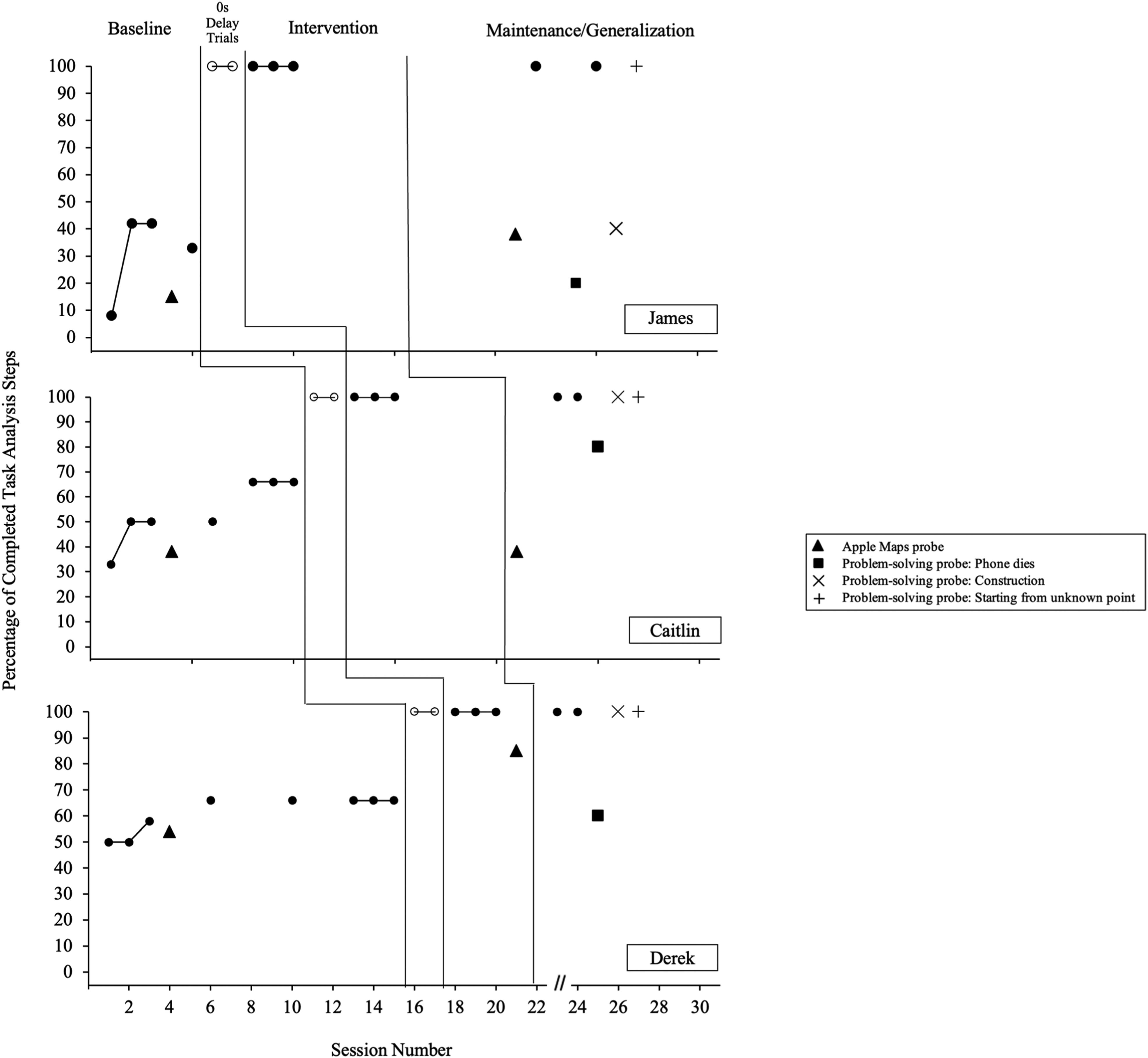
James
During baseline, James’s probes were somewhat variable and overall low in level. There was an increasing trend between probes one and two, and a decreasing trend between probes three and four. He completed between 8% and 42% of task analysis steps (mean = 31%) independently. James completed two consecutive 0 s delay trials, during which the implementer used constant time delay to teach him each step of the 12-step task analysis. Then, after the 10 s time delay was put in place, James continued to complete each of the 12 steps independently; there was an immediacy of change in level from baseline points. James met mastery criteria within his first three 10 s probes. Summative visual analysis indicated a functional relation was present for James.
After reaching mastery criteria in the intervention phase, James entered the maintenance phase. James completed maintenance probes four and six weeks post-intervention. During both maintenance probes, James completed 100% of task analysis steps independently. He did not require any prompting to program and follow the walking route to reach his desired destination.
Caitlin
During baseline, Caitlin’s probes were somewhat variable; she completed between 33% and 66% of task analysis steps (mean = 54%) independently. Caitlin’s baseline probes had an increasing trend, and although her probes were higher in level than James’s, she still demonstrated a need for intervention. After completing two 0 s delay sessions in which she learned the task analysis steps, a 10 s delay was inserted so that Caitlin had the opportunity to independently attempt each of the 12 steps. Caitlin continued to complete each of the 12 steps independently with the time delay in place; there was an immediacy of change in level from baseline points. Caitlin met mastery criteria within her first three 10 s probes.
After reaching mastery criteria in the intervention phase, Caitlin entered the maintenance phase. Caitlin completed maintenance probes at three and four weeks post-intervention, during which she completed 100% of task analysis steps independently. She did not require any prompting to program and follow the walking route to reach her desired destination. Summative visual analysis indicated a functional relation was observed for Caitlin.
Derek
During baseline, Derek’s probes had the least variability and showed only a slight increase in trend. His probes showed the highest level of the three participants, as he completed between 50% and 66% of task analysis steps (mean = 61%) independently. After completing two consecutive 0 s delay trials, a 10 s time delay was implemented, and Derek continued to complete each of the 12 steps independently. There was an immediacy of change in level from baseline points. Derek met mastery criteria within his first three 10 s probes.
After reaching mastery criteria in the intervention phase, Derek completed two maintenance probes at two and three weeks post-intervention. During both maintenance probes, Derek completed 100% of task analysis steps independently. He did not require any prompting to program and follow the walking route to reach his desired destination. Summative visual analysis indicated a functional relation was present for Derek.
Summative Visual Analysis Results
Visual analysis of graphed data indicates a functional relation between use of constant time delay and the percent of task analysis steps completed across the three participants. The functional relation was determined by immediacy of effect following constant time delay instruction and three demonstrations of effect across the three participants. Additionally, the data paths predicted during baseline changed in a therapeutic direction upon implementation of constant time delay instruction, and these changes were replicated across the three participants (Leford & Gast, 2018).
Research Question 2
Results of RQ 2 (i.e., generalization to Apple Maps and problem-solving probes) are presented below and in Figure 1.
Apple Maps
Participants completed untrained Apple Maps generalization probes once during the baseline condition, and again after completing all intervention sessions. An adapted task analysis was used for Apple Maps generalization probes. All three participants completed more task analysis steps independently during the second Apple Maps generalization probe than they did during the first probe, despite never receiving instruction on use of the Apple Maps application.
All three participants completed their first Apple Maps probe during session 4 and their second during session 21. James completed 15% (i.e., two of 13) of task analysis steps independently on the first generalization probe and 38% (i.e., five of 13) on the second probe. Caitlin completed 38% (i.e., five of 13) of task analysis steps on her first probe and 38% on her second probe. Lastly, Derek completed 54% (i.e., six of 13) of task analysis steps on his first probe, and 85% (i.e., 11 of 13) on his second probe.
Problem-Solving Probes
After the conclusion of the intervention condition, each participant was taught to use a three-step problem-solving framework to solve three different issues a person may encounter when using Google Maps to follow a walking route. A task analysis was generated from this framework to measure the percent of steps participants completed independently.
Problem-Solving Probe #1: Phone Battery Dies
For problem-solving probe #1, participants were asked to program a map and begin to follow it, but shortly into the route, the implementer informed each participant that “the phone was dead.” James completed 20% (1 of 5) of task analysis steps independently during his practice opportunity. After programming the map independently, James required verbal prompting to complete the remainder of the task analysis steps once the phone was “dead.” Caitlin completed 80% (4 of 5) of task analysis steps independently during her practice opportunity and needed verbal prompting only once after the phone was “dead” (i.e., “try by myself”). Derek completed 60% (3 of 5) of task analysis steps independently during his practice opportunity. Derek required verbal prompting in remembering what to do if he had already attempted “try by myself” and “ask for help” strategies.
Problem-Solving Probe #2: Encountering a Construction Zone
For problem-solving probe #2, participants were asked to program a map and begin to follow it, but shortly into the route, the implementer informed each participant that we were approaching a “construction zone” and they needed to find a new route. James completed 40% (2 of 5) of task analysis steps independently during his practice opportunity. After programming the map independently, James began to walk but did not attempt any strategies after encountering a construction zone. He required verbal prompting to attempt a “try by myself” strategy (i.e., walk another way and let the map re-route), attempted to “ask for help” independently, and required a verbal prompt to attempt the final strategy, “return to class.” Caitlin completed 100% (5 of 5) of task analysis steps independently during her practice opportunity. Derek also completed 100% (5 of 5) of task analysis steps independently during his practice opportunity.
Problem Solving Probe #3: Starting a Route from an Unknown Location
For problem-solving probe #3, the first author walked each participant to a random location on campus (e.g., unmarked walkway, cut-through path, building loading dock) before asking them to begin their practice opportunity. James, Caitlin, and Derek each completed 100% (5 of 5) of task analysis steps independently during his practice opportunity.
Research Question 3
RQ 3 focuses on the social validity of this study as reported by the study participants, their teacher, and their job coach. Subsequently, we detail semi-structured interview responses and general themes identified between responses.
Participant Responses
James said he enjoyed learning to use Google Maps and described it as “kind of easy.” James identified the gymnasium as his favorite walking location because “they have basketball.” When asked if he would change anything about the sessions or if he would keep them the same, James said he would “keep the same.” James pulled up the Google Maps application on his personal phone during the interview session and pointed to the icon; the first author asked if he downloaded it to use again in the future, and he nodded. Lastly, when James was asked “Do you feel like you did a good job using Google Maps?” James smiled and nodded.
When asked about her experience using Google Maps, Caitlin responded, “It was fun because I got to walk anywhere on campus. It was easy to use.” Caitlin identified the campus light rail station as her favorite selected destination: “I got to see which station we get off at.”
Caitlin reported that she would not change anything about the study procedures, and that she felt better at finding new places after the Google Maps sessions than she did before. Caitlin shared that she “liked getting to choose where we walked.” She plans to keep using Google Maps because she can “check out places by [herself].” When asked if she felt she had been successful with Google Maps, Caitlin said: “Yes, because I loved using it. It gave me confidence.”
Regarding his experience with the intervention, Derek said “It was fun, using the phone. It was easy.” Derek shared that he would keep the sessions the same if we were to do them again. He also responded “yes” when asked if he felt better at finding new places and whether he thought he would use Google Maps in the future. Derek stated he preferred choosing his own destinations. Last, Derek was asked if he felt he was successful learning to use Google Maps. “Yes! It was cool.”
Several common themes emerged across participant responses, including value of choice, intent to continue using Google Maps, and personal sense of success. Caitlin and Derek both identified that they enjoyed choosing their walking destination for each session, rather than having a destination assigned by a researcher. The location that each participant identified as their favorite aligned with interests and hobbies participants had expressed at other times during the study. Embedding participant choice and autonomy appeared to have increased the social validity of use of Google Maps for the participants, as they were able to directly experience how use of Google Maps could connect them with places of personal interest on campus.
James, Caitlin, and Derek expressed intent to continue using Google Maps in the future outside of the contexts of this study. All participants downloaded the application to their personal phones after the study and answered “yes” when asked if they planned to use it on their own. Additionally, all participants answered “yes” when asked if they thought Google Maps would be a helpful tool in life. Participants expressing intent to use Google Maps in the future suggests that a community navigation intervention was socially valid for these three participants.
Finally, all participants responded they felt successful in learning to use Google Maps, and Caitlin specifically shared that the sessions “gave [her] confidence.” Derek and James’s responses to the semi-structured interview questions also alluded to opportunities for self-determination (e.g., preferring to choose their own destinations, choosing destinations that align with hobbies), suggesting that each participant viewed opportunities for independence and choice as positive aspects of the study.
Teacher and Job Coach Responses
The participants’ special education teacher (pseudonym “Mr. Martin”) and job coach (pseudonym “Ms. Wright”) also completed semi-structured interviews at the conclusion of the study. Their responses are detailed below, and a complete list of semi-structured interview questions is included in Supplemental Figure S1.
Mr. Martin and Ms. Wright first described how their students typically locate new or unknown places on campus. Ms. Wright said: “We have to go with them in person.” Mr. Martin shared: “Our students come back to campus two weeks before the rest of the college students in August. We use those two weeks to walk around and learn the campus.” Ms. Wright stated that specifically, they walk around to learn where dining options are, practice using the campus bus system, and walk to each building where the students’ internships are located. Mr. Martin added that “once [the students] actually get their internship assignments, we have to walk them back a few more times before they learn the way.”
Mr. Martin and Ms. Wright shared about how acquisition of independent navigational skills may help their students. “It would be one fewer skill we have to focus on,” Mr. Martin commented. He shared that he and Ms. Wright provide instruction on many different transition topics, such as budgeting, professional emails, paying bills, job applications, and more. “We could spend less time on [travel skills] training and there would be more time for more job experiences.” Mr. Martin replied, “It would give them more independence, both as students and adults.” Ms. Wright added, “They could navigate to other spaces then, too. Grocery stores, doctors’ appointments… the community in general.” Mr. Martin shared, “It has been very helpful for the students, to gain independence for now and also for the future.”
Discussion
The primary purpose of this study was to determine if constant time delay was an effective teaching method for young adults with IDD to increase their walking/navigation skills when using Google Maps. Participants were provided the opportunity to choose preferred locations on a college campus, and their performance was measured using a 12-step task analysis to follow a walking route using Google Maps. Data indicated a functional relation between use of constant time delay and the percent of task analysis steps completed across study participants. Each study participant reached mastery criteria within the 10-sec time delay condition (i.e., completing at least 11 of 12 task analysis steps independently for three consecutive sessions) within their first three opportunities. Additionally, we measured the extent to which route programming steps generalized between the Google Maps and Apple Maps applications. Participants completed Apple Maps generalization probes once during baseline and after reaching mastery criteria and completed three problem-solving probes each after each intervention. All participants showed increasing data trends across the three problem-solving probes. Finally, social validity data were collected and indicated participants and their teacher and job coach valued choice in decision-making, intended to continue using Google Maps as a mode of transportation, and felt a personal sense of success in using the Google Maps app.
Results of this study contribute to the literature base in several important ways. First, although the efficacy of constant time delay to teach map programming to young adults with IDD has also been demonstrated in other studies (e.g., Yuan et al., 2019), a unique outcome of the present study was that all participants experienced immediacy of effect and reached mastery criteria at the first opportunity (i.e., after three 10-s delay trials). Given the relative speed at which participants increased their map programming skills, constant time delay may be an appealing choice for practitioners who desire to implement efficient strategies to teach transition-related or travel skills to young adults with IDD. Second, testing the setting/situational generalization of map programming skills between use of Google Maps and Apple Maps is a unique feature of this study. Other previous travel skill studies have investigated generalization to untrained routes (e.g., Kelley et al., 2013), but because each route used in this study was an untrained route, examining potential setting/situational generalization with use of Apple Maps is one way that the present study further extends the literature base. Setting/situational generalization is important in the context of pedestrian navigation because it is possible that navigation applications and technology may continue to update or change in appearance with time. Additionally, setting/situational generalization is important because an individual may prefer, or may only have access to one navigation application over another. Finally, the incorporation of problem-solving probes was a unique contribution of this study. Although previous studies have employed BCIS with transition-age individuals with IDD (e.g., Duker et al., 1994), BCIS is not often used to teach transition-related skills (Carter & Grunsell, 2001). Further, this study is the first known travel skill study to implement BCIS.
Limitations
Identified limitations of this study include small sample size, participant previous exposure to campus travel routes and possible observational learning, lack of natural experiences due to researcher intervention, and route inequivalence. The single-case design of this study was strong and allowed us to control for threats to internal validity (e.g., maturation, testing). While this study reflects a small-n intervention that should be taken into consideration, we were able to determine a functional relation between constant time delay and percent of task analysis steps completed across the three participants (Ledford & Gast, 2018). Second, participants were already familiar with some areas of campus and walkways due to their daily activities (e.g., walking from the bus to the classroom, from the classroom to internships). We were unable to know exactly where participants had access to and walked before intervention; therefore, we relied on participant self-report and teacher report for that information. Additionally, we did not control for possible observational learning; for example, a participant could have recalled seeing a future destination while following a route during a previous session. Next, the researchers’ iPhones were used for all map programming and walking during the study rather than the personal devices of the participants. Finally, not every walking route completed by participants was equivalent in terms of distance, number of directional steps, or difficulty (e.g., unmarked pathways, parking lots) indicating a potential true difficulty of task analysis step 10, which was following each step in the walking directions.
Implications for Future Research
Researchers should continue to investigate the utility of constant time delay to teach travel skills and may consider replicating or extending this study to address the identified limitations. First, future researchers may recruit larger groups of individuals of varied disability types, ages, ethnicities, and experience levels regarding community navigation. A larger and more diverse group of participants may lend additional context to how travel skills can be taught most effectively. Second, to reduce the possibility of previous exposure to walking routes and to better control for observational learning, researchers may consider teaching travel skills in completely novel settings that are of interest to participants. In this case, researchers might offer participants a selection of routes that are comparable in distance and complexity. Lastly, we used a researcher’s personal iPhone for all sessions. When possible, future researchers should consider having participants use their own personal devices to support generalization and future use of the Google Maps app.
Conclusion
The results indicated that constant time delay can be one effective strategy for teaching young adults with IDD to use Google maps safely and effectively. Participants demonstrated some potential generalization to use of an untrained navigation app (i.e., Apple Maps) and were able to develop problem-solving skills related to three different scenarios. Participants and their special education teacher and job coach expressed that learning to use Google Maps to find an unknown location of interest was socially valid and that the intervention increased participants’ confidence. Secondary special educators can support young adults with IDD in developing increased levels of community engagement by providing travel skills instruction. When young adults with IDD can independently and safely navigate their communities, they have additional opportunities for self-determination and enriched life experiences.
Supplemental Material
Supplemental Material - Using Constant Time Delay to Teach Use of Google Maps to Young Adults With Intellectual and Developmental Disabilities
Supplemental Material for Using Constant Time Delay to Teach Use of Google Maps to Young Adults With Intellectual and Developmental Disabilities by Jessica Rousey Hatz, Leslie Ann Bross, Valerie L. Mazzotti, Brianna Soares and Janie V. Claywell in Journal of Special Education Technology
Supplemental Material
Supplemental Material - Using Constant Time Delay to Teach Use of Google Maps to Young Adults With Intellectual and Developmental Disabilities
Supplemental Material for Using Constant Time Delay to Teach Use of Google Maps to Young Adults With Intellectual and Developmental Disabilities by Jessica Rousey Hatz, Leslie Ann Bross, Valerie L. Mazzotti, Brianna Soares and Janie V. Claywell in Journal of Special Education Technology
Footnotes

Funding
The authors received no financial support for the research, authorship, and/or publication of this article.
Declaration of Conflicting Interests
The authors declared no potential conflicts of interest with respect to the research, authorship, and/or publication of this article.
Supplemental Material
Supplemental material for this article is available online.
Author Biographies
References
Supplementary Material
Please find the following supplemental material available below.
For Open Access articles published under a Creative Commons License, all supplemental material carries the same license as the article it is associated with.
For non-Open Access articles published, all supplemental material carries a non-exclusive license, and permission requests for re-use of supplemental material or any part of supplemental material shall be sent directly to the copyright owner as specified in the copyright notice associated with the article.
