






Abstract
Patient-centered care (PCC) encourages active collaboration and effective communication among patients, their family caregivers, and health-care providers to achieve high-quality care. Despite its importance, there is no validated and reliable Korean instrument for assessing PCC among health-care providers yet. This study aimed to establish a Korean version of the PCC (K-PCC) Scale using international translation guidelines and systematically evaluating its psychometric properties. The participants in this study were 424 nurses with a mean age of 28.07 years (±4.56) from two university hospitals in South Korea. Confirmatory factor analysis identified that the revised model, which included three factors (holistic, collaborative, and responsive care), had a satisfactory goodness of fit. The testing of item convergent and item-discriminant validity revealed a 100% scaling success. Criterion validity showed that nurses who had positive perceptions of K-PCC were more likely to practice PCC (r = .692, p < .001). The internal consistency for 23 items as a whole was good, at .935. From these results, K-PCC is considered a valid and reliable instrument for measuring health-care providers’ perceptions of PCC among Korean populations. Scale brevity and simplicity, together with rigorous testing, indicate that validation of the PCC Scale may be helpful for ensuring quality improvement in hospital settings.
Health-care organizations have tried various ways to best engage patients in their own care to improve quality and patient safety (Berwick, 2009; Institute of Medicine, 2001). It seems particularly helpful to focus on delivery of care that is both respectful of and responsive to individual patient preferences, values, and needs. This is what is known as patient-centered care (PCC; Bertakis & Azari, 2011).
PCC is a term used in the literature on clinical care setting to refer to care that focuses on the person with the diagnosis (Castro, Van Regenmortel, Vanhaecht, Sermeus, & Van Hecke, 2016; Sidani & Fox, 2014). PCC is widely recognized as an important component of high-quality care and a holistic approach compatible with the clinician’s expertise (Castro et al., 2016). The International Alliance of Patients’ Organizations (2007) emphasized respect for patients’ needs and preferences as a key element of PCC and suggested that it should be incorporated into health-care practice. PCC involves treating patients as individuals and as equal partners in the process of healing; it is personalized, coordinated, and enabling (Delaney, 2018). The core objective of PCC is to achieve a working partnership between patients and families in relation to the delivery of health-care services (Australian Commission on Safety and Quality in Health Care, 2010). Accordingly, health-care professionals may see patient-centeredness as advocating for their patients to ensure their needs are met (White, Newton-Curtis, & Lyons, 2008).
The benefit of PCC in hospital settings is that it facilitates patients’ own health management and allows them to make informed health-care decisions, enabling them and their caregivers to take control over their lives (Castro et al., 2016; Goodrich & Cornwell, 2008). PCC can also lead to improved health outcomes, such as increased patient and caregiver satisfaction with care, higher quality of life, and decreased health-care utilization (Bertakis & Azari, 2011; Charmel & Frampton, 2009). Health-care professionals play a critical role in PCC (Berghout, van Exel, Leensvaart, & Cramm, 2015). If health-care professionals have a positive perception of PCC, it would make it easier for them to engage in PCC behaviors in clinical settings (Sommaruga, Casu, Giaquinto, & Gremigni, 2017). Furthermore, gaining a broader understanding and appreciation of PCC can also contribute to decision-making about investment in PCC while delivering health care in an economic context of limited financial resources (Kitson, Marshall, Bassett, & Zeitz, 2013; Rathert, Wyrwich, & Boren, 2013). Accordingly, knowing health-care professionals’ perspectives of PCC can assist health-care providers in developing an accurate and well-conceived treatment plan and accepting the challenge to deliver evidence-based practice (Castro et al., 2016). The implementation of PCC among all health-care workers is an essential part of daily work in health care (Sommaruga et al., 2017). However, a previous study indicated that as the nursing staff spends 24 hr a day at the bedside of the patient, nurses play the most significant role in PCC implementation (Merav & Ohad, 2017). The results of this survey indicated that nursing staff has a crucial influence on the patient care experience, including patient satisfaction, and are at the center of care (Merav & Ohad, 2017). Therefore, we need to measure nurses’ perceptions of PCC in their usual practices.
According to a recent review article (Edvardsson & Innes, 2010), there are 12 reliable and valid tools for person-centered care, compared to PCC. However, there are few standardized measurement tools for assessing health-care providers’ implementation of PCC in hospital care settings (Sidani & Fox, 2014). There is a particular lack of acceptable, reliable, and valid Korean instruments for the assessment of PCC among health-care providers in Korea. Recently, the PCC Scale was developed to assess health-care providers’ perceived PCC (Sidani et al., 2014). The validated and reliable PCC Scale consists of 27 items and three components: holistic, collaborative, and responsive care (Sidani et al., 2014). Further testing of the PCC Scale has been recommended in various samples and cultures in order to better understand its value (Sidani et al., 2014). In addition, it is vital to establish instruments that enable valid and reliable measurement to make national and international comparisons of health-care providers’ perceived PCC (Sidani & Fox, 2014). In particular, a cross-culturally valid self-administered questionnaire is essential for maintaining the content validity of the instrument and a good conceptual level across different cultures (Beaton, Bombardier, Guillemin, & Ferraz, 2000).
Understanding health-care professionals’ perceptions of PCC implementation is essential to improve the quality of care, as they are known to predict care quality (Bernabeo & Holmboe, 2013; Rathert et al., 2013). Accordingly, the purpose of this study was to validate the Korean version of the PCC (K-PCC) Scale by examining its psychometric properties for use among Korean nursing professionals.
Method
Study Design
A methodological study design was used to assess internal reliability and validity, including cultural translation, factorial construct validity, convergent and discriminant validity, and concurrent validity. A cross-sectional descriptive survey using a self-reported questionnaire and the translated K-PCC Scale was undertaken with nurses at two university hospitals.
Instrument
The original English-language PCC Scale was developed by Sidani and colleagues (2014). The PCC Scale was reported to have satisfactory psychometric properties, and it consists of 27 items divided into three components: holistic care (8 items), collaborative care (12 items), and responsive care (7 items). As described by Sidani and Fox (2014), holistic care entails comprehensive care that targets the totality of patients’ health condition. It involves the assessment of patients’ needs (including physical, emotional, behavioral, social, and spiritual) and education regarding self-management of needs and health condition. Collaborative care involves a process in which health-care providers facilitate patients’ engagement in their own care and in care-related decisions. Responsive care focuses on individualizing care to be respectful of patients’ needs and preferences. These item scores are summed to obtain the total PCC score, with higher scores indicating a higher level of PCC. In the original study, the items were rated on a 5-point Likert-type scale (1 = strongly disagree, 5 = strongly agree).
For criterion validity, the PCC Scale was hypothesized to be moderately related to the degree of perceived PCC practice using a single item, based on previous studies (Fredericks, Lapum, & Hui, 2015; Rathert et al., 2013). These previous studies suggest that the single-item measure can provide a reliable and valid assessment of PCC practice. Perceived PCC practice was assessed with the following item: “How well do you think you have performed PCC in the workplace?” This was scored on a 5-point Likert-type scale (1 = not at all, 5 = greatly). Additionally, the study’s self-reported questionnaire consisted of demographic characteristics such as age, gender, education level, marital status, position, years of clinical experience, and previous educational experience of PCC.
Cross-Cultural Adaptation Process of the K-PCC Scale
Permission to translate the PCC Scale into Korean was obtained from its original developer. According to the process recommended by the World Health Organization (2012) for the translation and adaptation of instruments, the original PCC Scale was initially forward-translated from English (the source language) into Korean (the target language) and then it was back-translated into Korean by two Korean–English bilinguals with high proficiency in both languages. After back-translation, both versions were reviewed by an expert committee. The procedure for asking questions was kept as cross-culturally equivalent as possible and was performed with a focus on semantic, rather than linguistic/literal, equivalence.
Ten clinical nurses working at a university hospital completed pilot testing to identify problems with the survey questions or response options. The respondents were asked whether they had any difficulties understanding the questions, and no concerns or questions were raised about the items.
Setting and Sample
A total of 424 nurses from two university hospitals in Pusan, South Korea, were recruited using convenience sampling. These two hospitals, which have more than 800 beds, were accredited by the Korean Institute for Healthcare Accreditation. The inclusion criteria for this study were as follows: having more than 1 year of work experience and actively conducting bedside patient care. The type of wards included medical, surgical, and special units (intensive care units and emergency rooms), among others (obstetrics and pediatric wards). The exclusion criterion was working in departments in which there was little physical contact with patients.
To determine an adequate sample size for conducting confirmatory factor analysis (CFA), we used procedures based on equations provided by K. H. Kim (2005). When the estimated model has 71 degrees of freedom, a minimum sample size N = 199 or N = 242 is adequate to achieve a power level of .80 or .90, respectively, based on a close fit (root mean square error of approximation [RMSEA]) test. Therefore, a total of 424 nurses was sufficient for testing the CFA model in this study.
Ethical Considerations and Data Collection
This study complied with the Declaration of Helsinki and was approved by Inje University’s institutional review board in Pusan, Korea (IRB No. 15-0260). Two trained research assistants explained the research purpose and process, voluntary participation and right to withdraw without any penalty at any time, guarantee of anonymity and confidentiality, and compensation for research participation. Written informed consents were obtained from all nurses who were interested in this study. After that, the questionnaire, information sheet, and a small gift for participation were distributed to participants who agreed to participate in this study with cooperation from the nursing unit manager. Participants were guaranteed confidentiality. Additionally, they could withdraw from the study at any time. Completed surveys were deposited in a folder kept by the nursing unit manager, and these were retrieved the following day. Data were collected between January and March 2016.
Data Analysis
Data were analyzed with AMOS 22.0 using the maximum likelihood method and SPSS Version 21 (SPSS Inc., Chicago, IL). General characteristics were analyzed using descriptive statistics. In order to examine the K-PCC Scale’s structure, CFA was conducted because the original version of the PCC Scale was reported as having a three-factor structure. Several steps were conducted to evaluate the psychometric properties of the K-PCC Scale.
First, item analyses were conducted by the following methods: percentage of missing data, descriptive information of mean and standard deviation, interitem correlation, and corrected item-total correlation. In the descriptive statistics, if means for the items are close to the center of the range of possible scores, it means there is no ceiling or floor effect in the items. In the interitem correlation, correlation coefficients from .30 to .70 are the recommended values for items within the same subscales, and thus, items having less than .30 correlation with other items within the same subscale can be deleted. In addition, items below .30 in the corrected item-total correlation can be removed because .30 is commonly suggested as a cutoff point for item deletion (Nunnally & Bernstein, 1994; Polit & Beck, 2012).
Second, for CFA, model parameters were estimated using a maximum likelihood method. The adequacy of the model fit was assessed by χ2 statistics and various fit indices, which are the ratio of χ2 to the number of degrees of freedom (χ2/df)—acceptable criterion is <3, the goodness-of-fit index (GFI) is >.90, adjusted goodness-of-fit index (AGFI) is >.90, RMSEA is <.08, the root mean square residual (RMR) is <.05, normed fit index (NFI) is >.90, Tucker–Lewis index (TLI) is >.90, comparative fit index (CFI) is >.90, and parsimonious normed fit index (PNFI) is >.60 (Hu & Bentler, 1998; Jackson, Gillaspy, & Purc-Stephenson, 2009; Schmitt, 2011). To revise the model, items were deleted by considering the modification index (MI) and correlation coefficient in the item analysis simultaneously. Moreover, the values of MI were subsequently used to connect the covariance between two error terms with two-headed curved arrows (Jöreskog & Sörbom, 1993; Lee, Kim, Kang, Yoon, & Kim, 2014). As an expansion of CFA, an item convergent test was conducted using the standardized regression weight (SRW) for factor loading (acceptable criterion is >.50), composite reliability (>.70), and average variance extracted (AVE; >.05). The AVE measures the explained variance of the construct (Fornell & Larcker, 1981; Hair, Black, Babin, Anderson, & Tatham, 2006). In addition, an item discriminant test was conducted through comparisons between AVE and the squared correlation coefficients between two subscales. If the square root of every AVE value belonging to each subscale is greater than the correlation among any pair of subscales, the item discriminant is confirmed (Fornell & Larcker, 1981; Zait & Bertea, 2011). Third, criterion validity was examined using the correlations between the scores of the K-PCC Scale developed in this study and the well-established PCC Scale (Polit & Beck, 2012). Lastly, reliability analysis using Cronbach’s α was performed. Values above .80 were considered as evidence of excellent reliability, and values above .70 indicated acceptable validity (Nunnally & Bernstein, 1994; Polit & Beck, 2012).
Results
Description of Study Sample
The sample’s mean age and current years of clinical experience were 28.07 years (SD = 4.56) and 40.89 months (SD = 25.99), respectively. The majority were university graduates (n = 250, 59.0%) and staff nurses (n = 383, 90.3%). Most participants worked in the medical (n = 162, 38.2%) or surgical (n = 152, 35.8%) units and had more than one experience with PCC education (n = 329, 77.6%).
Item Analyses
The percentage of missing values for each item was 0%, and the mean of each individual item ranged from 3.06 to 3.74, which shows that each individual item is close to the midpoint of 5 on the Likert-type scale. Therefore, there were no ceiling or floor responses in the mean scores. In the interitem correlation, the ranges of correlation coefficients among items within the same subscale were .317 to .684 for holistic care, .275 to .702 for collaborative care, and .129 to .649 for responsive care. In holistic care, the correlation of Q14 and Q12 was .297, which was not a satisfactory level for the recommended value of the interitem correlation. In addition, in responsive care, the correlation between Q23 and Q26 was .129, which was also an unsatisfactory level compared to the suggested value of .30. However, those items were not deleted at this stage because correlations between those items and the other items within each subscale were above .30, and a conservative position was taken toward item deletion and the items of the original PCC Scale were maintained. Lastly, the range of corrected item-total correlations was .448 to .698, which means that all items were appropriately correlated with other items within the scale, and a satisfactory level was achieved compared with the cutoff point of below .30 for item deletion (Table 1). Thus, all items were used for CFA without item deletion.
Item Analysis Results of the Korean Version of Patient-Centered Care Scale.

Note. N = 424.
Factorial Construct Validity
CFA was conducted to test the factor structure. To avoid a possible controversial factor structure, various factor structures were tested to verify the underlying constructs of the K-PCC Scale; these structures were “one-factor structure,” “three-factor first-order structure,” and “three-factor second-order structure.” Specifically, one-factor structure means that the K-PCC Scale is a one-factor construct without subfactors. Three-factor first-order structure means that the scale has three factors that correlate with each other without a hierarchical structure, and thus, it is called a three-factor correlated model. Lastly, three-factor second-order structure means that the scale has a higher order factor accounting for three individual factors (J. H. Kim, Kim, Kim, & Shin, 2008; Lee et al., 2014; Ma, Chen, You, Luo, & Xing, 2012). Among these three-factor structures, the three-factor first-order structure, that is, the three-factor correlated model, showed the most satisfactory values in key indices compared to the one-factor structure or the three-factor second-order structure. Thus, we selected the three-factor first-order model as the factor structure for the K-PCC Scale.
According to the test results for the three-factor first-order model, some indices of model fit satisfied the suggested values (RMSEA = .080, RMR = .023), while some did not (χ2 = 1,196.068, p < .001, χ2/df = 3.726, GFI = .810, AGFI = .776, NFI = .792, TLI = .823, CFI = .838, and PNFI = .725). Thus, the initial model needed to be modified.
To revise the model, items were deleted considering the MI and correlation coefficient in the item analysis simultaneously. Regarding MI, the values were checked to identify potential points of model misspecification, and covariance between two errors terms within the same subscale was added with two-headed curved arrows (Figure 1). Covariance between two error terms that contributed to significantly improve the model fit was first added, and subsequently, repeated covariance was added to the model (Bae, 2017; Lee et al., 2014).
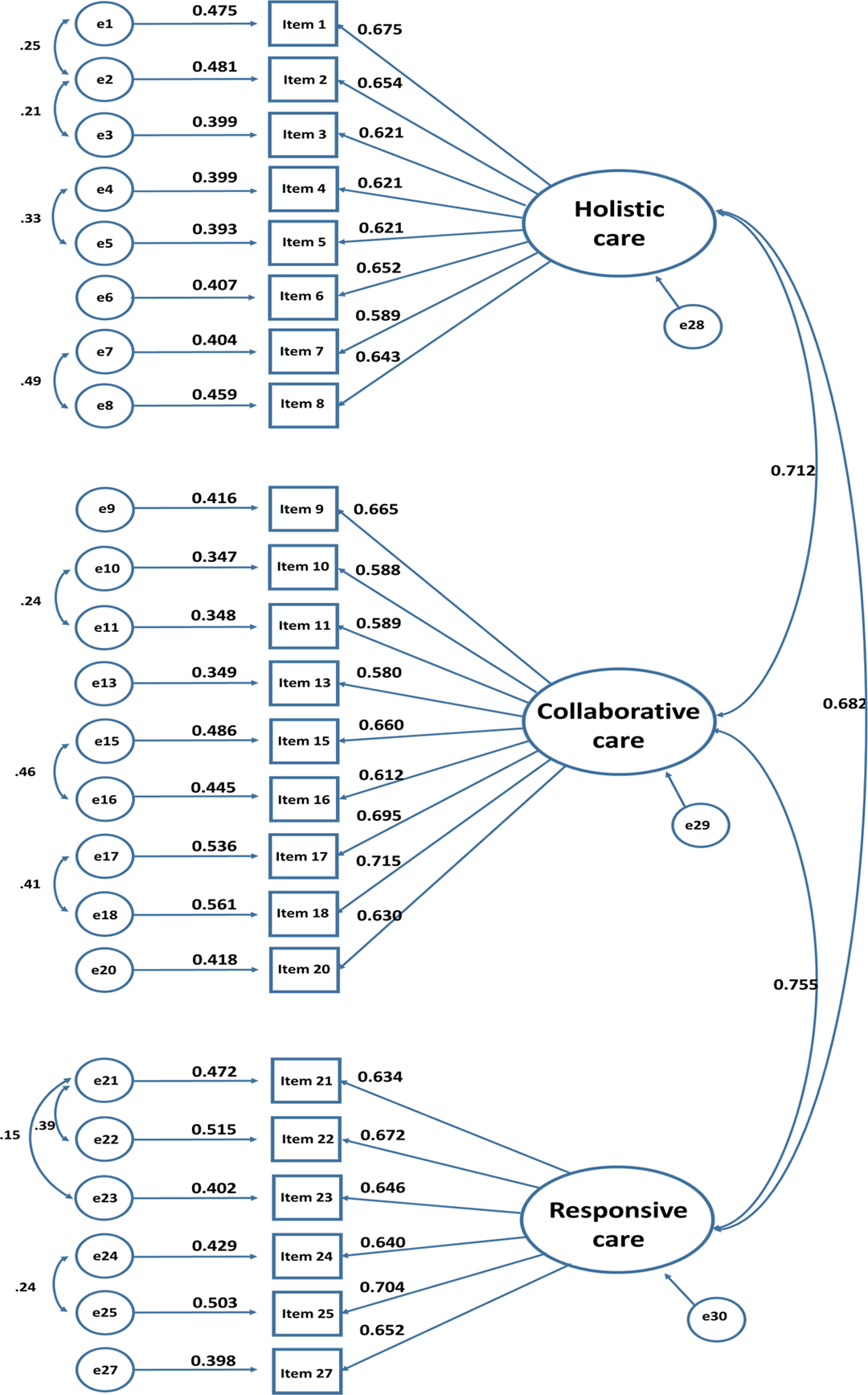
Three factor structure of the Korean version of Patient-Centered Care Scale with standardized regression weight.
First, we deleted 1 item (Item 26) from the responsive care factor because it showed low correlation with Q23 in the interitem analysis (r = .129). Among Items 23 and 26, Item 26 was deleted because MIs related to Item 26 were at a high level, above 10.0, that is, the recommended value for model modification (Bae, 2017), which meant that the removal of this item would significantly decrease the discrepancy of the model. MIs linked to Item 23, however, were not high. Thus, it was considered wise to delete Item 26 in responsive care. In addition, 2 items (Items 12 and 14) within the collaborative care factor were deleted because correlation between these 2 items within the same subscale was below .30 (r = .275), and MIs related to these 2 items were high. Therefore, Items 12 and 14 were also deleted. Moreover, MIs linked to Item 19 were very high. When Item 19 was deleted, the χ2 value also greatly decreased and fit indices significantly improved. Thus, these 3 items within the collaborative care factor were also deleted. In addition, 10 covariates between two error terms within the same factor were allowed with two-headed curved arrows to decrease the discrepancy between the empirical data and the hypothesis model (Bae, 2017; Lee et al., 2014).
After these revisions, all fit indices of the revised model were improved and reached an acceptable level. Specifically, the χ2 value was 393.566 (p < .001), but the ratio of the χ2 value to its degree of freedom, χ2/df, was 1.814, which was satisfactory, considering that the acceptable criterion was below 3.0. In addition, the fit indices were GFI = .924, AGFI = .903, RMSEA = .044, RMR = .016, NFI = .916, TLI = .954, DFI = .960, and PNFI = .786, which indicated good fits for the revised model.
As an expansion of factorial construct validity, item convergent and discriminant tests were conducted. Item convergent validity was evaluated by factor loading, composite reliability, and AVE. Specifically, the range of SRW, that is, factor loadings for all items, was .580 to .715, more than the acceptable level of .50 (Table 2; Figure 1). In addition, the values of composite reliability were .931 for holistic care, .900 for collaborative care, and .926 for responsive care, which were acceptable, given the suggested criterion of more than .70. Additionally, the values of AVE for the three factors were .629, .628, and .675 for holistic, collaborative, and responsive care, respectively. These were all at satisfactory levels compared to the cutoff value (more than .50; Table 2).
Standardized Factor Loading and Convergent Validity of the Korean Version of Patient-Centered Care Scale.
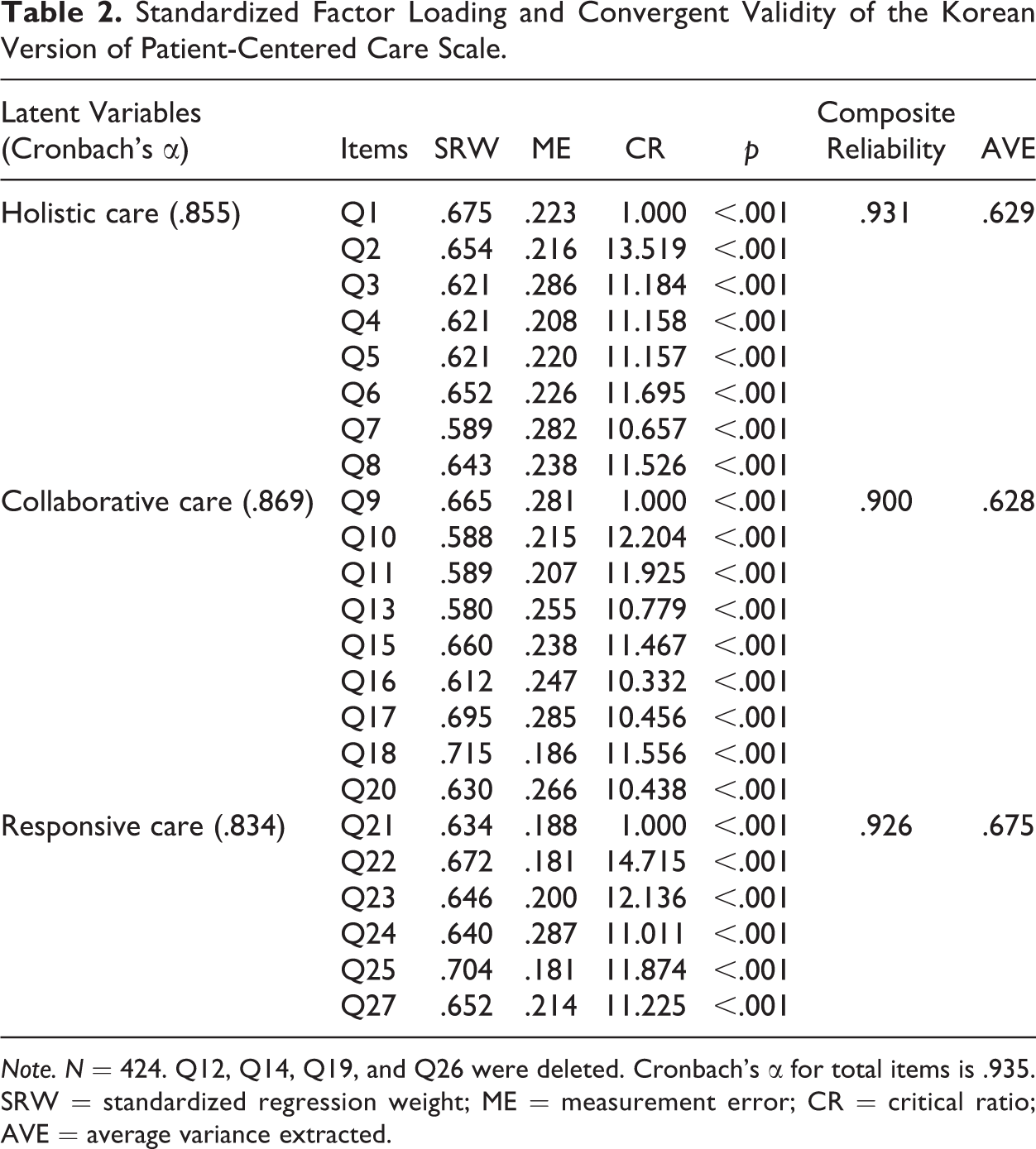
Note. N = 424. Q12, Q14, Q19, and Q26 were deleted. Cronbach’s α for total items is .935. SRW = standardized regression weight; ME = measurement error; CR = critical ratio; AVE = average variance extracted.
Lastly, item discriminant validity was also confirmed, in which the AVE values (.628 to .675) were higher than the squared correlation coefficients between the latent variables (.465 to .570; Table 3).
Discriminant Validity of the Korean Version of PCC Scale.
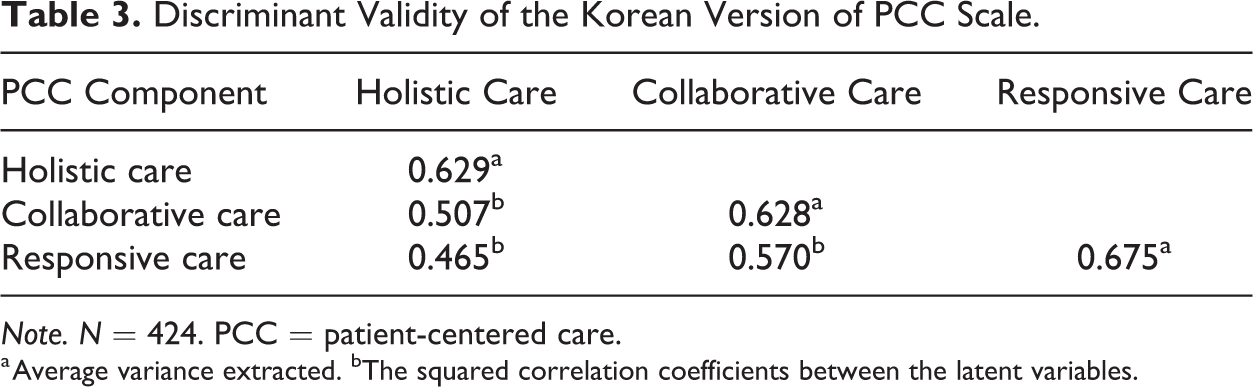
Note. N = 424. PCC = patient-centered care.
a Average variance extracted. bThe squared correlation coefficients between the latent variables.
Criterion Validity
There were significant positive correlations between the total score of the K-PCC Scale and perceived PCC practice (r = .692, p < .001), which was almost satisfactory given the suggested criterion value of above .70 (Bae, 2017). Additionally, the correlations between K-PCC subscales and perceived PCC practice were .606, .643, and .597 for holistic, collaborative, and responsive care, respectively. These were statistically significant (all p < .001).
Reliability
Cronbach’s α coefficient was calculated to examine reliability. Cronbach’s α for all 23 items was .935. In addition, Cronbach’s αs for the three factors were .855, .869, and .834 for holistic, collaborative, and responsive care, respectively, which were all satisfactory, given the suggested value (>.70; Polit & Beck, 2012; Table 2).
Descriptive Statistics
The mean score for the K-PCC Scale was 80.10 ± 9.28, and the mean scores for the subscales were 27.69 ± 3.56 for holistic care, 31.12 ± 4.03 for collaborative care, and 21.29 ± 2.69 for responsive care (Table 4).
Descriptive Statistics of the Korean Version of PCC Scale.
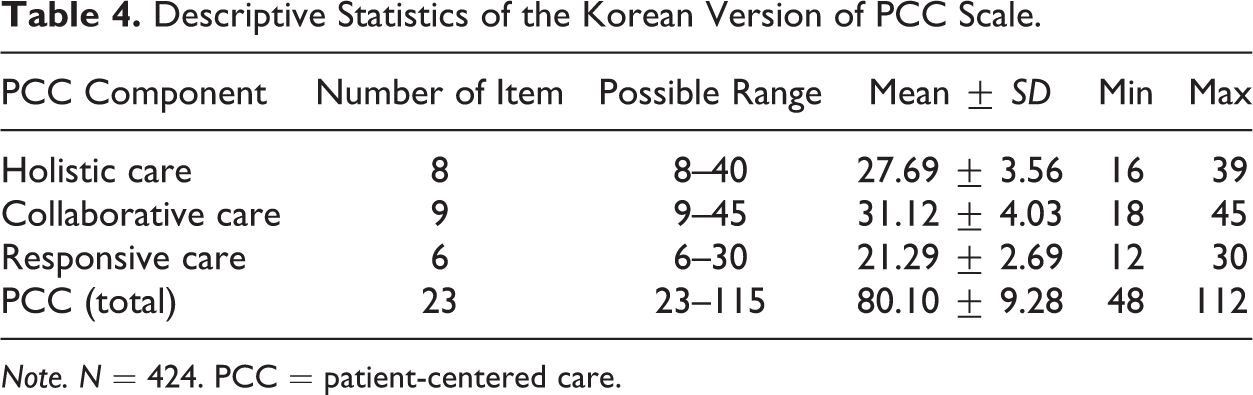
Note. N = 424. PCC = patient-centered care.
Discussion
PCC is internationally considered to be a key dimension of high-quality health care, since it puts the patient at the center of the care process (Bokhour et al., 2009; Castro et al., 2016; National Health Services, 2005). It is crucial to adopt a patient-centered approach in working with patients and their caregivers in hospital settings (Australian Commission on Safety and Quality in Health Care, 2010). Accordingly, it is important to explore, in a timely fashion, the extent to which PCC is actually practiced. The PCC Scale, which includes examinations of holistic, collaborative, and responsive care, is easy to administer, and it can provide a quick summary of nurses’ self-perceptions of PCC.
The present study is the first to evaluate the psychometric properties of the K-PCC Scale among hospital nurses. When a tool is developed based on theory and the factor structure is already established, it is appropriate to confirm the validity of the tool using CFA rather than exploratory factor analysis for construct validity (Harrington, 2009; Song, Chang, Park, Kim, & Nam, 2010). Because the PCC Scale consists of three essential elements, we performed CFA in the present study. We found that the three-factor model of the K-PCC Scale was well confirmed with CFA. Our goodness-of-fit results indicated that all items, except four, measured the intended constructs.
To revise the model, 4 items were deleted according to the MI and correlation coefficient, considering the theoretical implication and allowing for the covariates between measurement errors of items within the same factor (Jöreskog & Sörbom, 1993). The deleted items were as follows: Item 12, “Explain treatment options to the patient”; Item 14, “Answer specific patient questions”; Item 19, “Explore whether the patient wants to be involved in their care”; and Item 26, “Make sure what the patient needs with regard to community resources.” In the present study, many Korean nurses might perceive that Items 12, 14, and 19 were very similar to items belonging to the holistic or responsive care dimensions. Simultaneously, these 3 items may be considered to represent the role of the physician in the hospital environment in Korea. In particular, Korean nurses are more likely to think that the content of Item 26 mainly represents the role of social workers or home care nurses. Moreover, these deleted items were not matched to Korean cultural situations, including the working environments inside Korean hospitals. While patients’ needs and nurses’ workload in Korea have been increasing, nurse staffing has not increased yet (J. K. Kim, Kim, Kim, & Lee, 2015). This has led to a high turnover rate of nurses in Korea (Lee et al., 2014). Accordingly, nursing work environment in Korea can be less likely to implement the holistic, comprehensive, and collaborative aspects of PCC.
With regard to the results for the convergent and discriminant validity of items, we found that the constructs of the K-PCC Scale were supported. As both convergent and discriminant validity in item analysis are strong indicators of construct validity (Polit & Beck, 2012; Raubenheimer, 2004), the results to confirm the convergent and discriminant validities in this study are very important evidence for validating the K-PCC Scale. In other words, items in the K-PCC subscales contributed roughly equal proportions of information to their own subscale scores rather than other subscales. Criterion validity was also shown via significant correlations between the total or subscale scores of the K-PCC Scale and perceived PCC practice. Although perceived PCC practice was measured by 1 item, it was frequently used in previous studies (Fredericks et al., 2015; Rathert et al., 2013), and thus, it will be a good criterion for measuring PCC practice level perceived by nurses. However, to synthesize stronger evidence for criterion validity, future studies should investigate the relationship between K-PCC and patients’ adverse outcomes, such as complications and the average length of stay in hospital, or patient and caregiver satisfaction with care.
The reliability of the original PCC measure demonstrated rather low coefficient values (.66 for holistic care, .70 for collaborative care, and .42 for responsive care, respectively). The observed low coefficient values could be explained by the small number of items constituting the subscales assessing holistic and responsive care and the low variance in the responses to the respective items (Sidani et al., 2014). However, Cronbach’s coefficients for the K-PCC subscales were acceptable, ranging from .83 to .87. This indicated the scale’s satisfactory internal consistency. Regarding the improvement of Cronbach’s coefficients for the responsive subscale in the K-PCC Scale, the deletion of Item 26 would contribute to it because Item 26 seems to be a heterogeneous item showing low correlations with other items within responsive care. Moreover, although 3 items were deleted in the collaborative care factor of the K-PCC Scale, Cronbach’s coefficient was better than that of the original version. This could be related to the fact that Koreans prefer collaboration or teamwork, which is influenced by the Korean Confucian tradition.
The PCC Scale is not entirely unique. For example, a client-centered care instrument was previously developed for patients in a rehabilitation ward (Cott, Teare, McGilton, & Lineker, 2006) and in home care (DeWitte, Schoot, & Proot, 2006). Regarding person-centered care tools, several measurements exist for use in family medicine: the Person-Centered Climate Questionnaire for assessing the extent to which a hospital’s climate is person-centered (Edvardsson, Sandman, & Rasmussen, 2008), the Person-Centered Care of Older People with Cognitive Impairment in Acute Care Scale (Edvardsson, Nilsson, Fetherstonhaugh, Nay, & Crowe, 2013; Grealish, Chaboyer, Harbeck, & Edvardsson, 2017; Nilsson, Lindkvist, Rasmussen, & Edvardsson, 2013), and the Patient Perception Patient-Centeredness Questionnaire (Hudon, Fortin, Haggerty, & Poitras, 2011). However, these measurements were not guided by a clear and comprehensive conceptualization of PCC in hospital care settings (Hudon et al., 2011).
On the other hand, the PCC tool used in the present study has the advantage of comprehensively measuring the perception of PCC among health-care providers in a hospital environment (Sidani et al., 2014). Additionally, the present conceptualization that includes holistic, collaborative, and responsive care was derived from a more integrative review of conceptual, empirical, and clinical literature than was the case for previous tools. In particular, the PCC Scale was developed to assess the implementation of PCC by health-care providers including nurses, physicians, and allied health professionals in the context of acute care day-to-day practice. Therefore, the PCC Scale would be a much more acceptable or suitable measure of the level of health-care professionals’ perceptions of PCC.
The K-PCC Scale in this study was evaluated among hospital nurses. It is the only transcultural version that has demonstrated verified validity and reliability similar to the original PCC tool. Further psychometric testing of the K-PCC Scale should be done among other health-care providers and in different cultures to better understand the value of the scale and confirm its three-factor dimensionality. Moreover, further studies should be conducted to identify the optimal cutoff values through sensitivity and specificity tests of the PCC Scale. The cutoff values may be helpful in developing education programs for health-care professionals who do not consider PCC to be particularly important.
Even though the K-PCC Scale fulfilled the essential psychometric criteria, this study has the following limitations. First, participants were recruited from only two university hospitals in one metropolitan city in South Korea via convenience sampling; therefore, this may not be representative of the larger nurse population. We recommend, therefore, that further studies be undertaken to evaluate the K-PPC Scale in samples representing different hospital conditions such as total hospital beds, hospital admission rates, delivery of nursing care, patient-to-nurse ratio, and hospital location. Second, our participant sample is of relatively young age with an average work time of 3.4 years less than that in previous studies. Third, even though the goal of PCC is to see the patient and family as a single unit (Bertakis & Azari, 2011), some units such as pediatric, obstetric ward, and intensive care units could better emphasize family needs and values. Accordingly, further exploration is needed to clarify the distinction between PCC and family-centered care. Fourth, we attempted to revise the model with MIs, which could potentially lead to overfitting of the factorial structure to the data. Thus, readers should consider this possibility of overfitting when using the findings of our study. Lastly, given the inherent limitations of self-report measures, recall bias or socially desirable bias may have been introduced. Moreover, although the single item used as criterion validity is correlated to the K-PCC Scale, it consists of only 1 item, and therefore, it is not as reliable as longer measures. Thus, future studies should consider valid and reliable objective methods such as work hours or overtime as an outcome of K-PCC.
Conclusion
In conclusion, the K-PCC Scale was revealed to have a three-factor construct and excellent reliability and validity among Korean nurses. The K-PCC Scale can be widely adopted as a useful tool for assessing the perception of PCC among Korean hospital nurses. In addition, the PCC Scale could serve as an acceptable instrument for cross-cultural comparisons at the national or international level. Nevertheless, more research needs to be conducted to confirm that the PCC Scale is a beneficial tool with sound psychometric properties in clinical settings. Additional testing of the measure’s validity among different groups of health-care providers should be conducted. Therefore, we hope that health-care professionals in clinical settings could use the K-PCC Scale in their practice to measure their perceived PCC effectively and to provide more evidence about the K-PCC Scale’s efficacy.
Footnotes
Declaration of Conflicting Interests
The author(s) declared no potential conflicts of interest with respect to the research, authorship, and/or publication of this article.
Funding
The author(s) disclosed receipt of the following financial support for the research, authorship, and/or publication of this article: This research was supported by the Chung-Ang University Research Scholarship Grants in 2018.
