






Abstract
Figure rating scales (FRS) have been widely used to measure body dissatisfaction. In the current study, an FRS based on body mass index (BMI) and body shape of Chinese adolescents (C-BMI-FRS) was developed and validated. The perceived actual figure chosen from C-BMI-FRS by 2,237 Chinese adolescents aged 15–18 years old correlated strongly with BMI (r = .83 in girls and r = .80 in boys). Additionally, there was a strong relation between actual and ideal figure discrepancy (AID) scores and measures of body satisfaction (r = −.54 in girls, r = −.28 in boys) and eating disorder symptoms (r = .54 in girls, and r = .52 in boys). There also were moderate associations of AID scores with self-esteem (r = −.16) and negative affect (r = .18) in girls. Test–retest reliability over an 8- to 10 -week interval exceeded .57 for actual figure, ideal figure, and AID scores. Overall, findings support the utility of C-BMI-FRS as a measure of body dissatisfaction among Chinese adolescents.
A sizable number of adolescents in multiple cultural contexts experience dissatisfaction with their body size and shape. Studies conducted in multiple countries support high levels of body size dissatisfaction among adolescent girls. For example, 60% of U.S. girls between 11 and 15 experienced body size dissatisfaction, as did 80.8% of girls in Ireland between 12 and 19, and 83.5% of girls between 11 and 15 in South Africa (Lawler & Nixon, 2011; Pedro et al., 2016; Stice, 2002). Studies of Chinese adolescents also support high rates of body dissatisfaction, with 47.2% of boys and 56.5% of girls dissatisfied with their current body size (Li et al., 2005). In addition to being a problem in and of itself, body dissatisfaction has been consistently found to be a risk factor for disordered eating (Forste et al., 2017; Tylka, 2011), obesity (Griffiths et al., 2016), negative affect (Chen et al., 2015), low self-esteem (Tylka & Sabik, 2010), and reduced health-related quality of life (Griffiths et al., 2016). As a result, there is a clear need for brief and valid measures of body dissatisfaction that can be applied cross-culturally and used with children and adolescents.
Figure rating scales (FRS) represent a potentially useful and brief tool for assessing body satisfaction. As compared to self-report questionnaires and structured interviews, FRS are easy to understand by participants and quick to administer and score (Stunkard, 2000). FRS usually utilize a set of contour drawings or silhouettes of sex-matched figures ranging from underweight to obese (Collins, 1991; Pruis & Janowsky, 2010; Pulvers et al., 2004; Thompson & Gray, 1995; Tovee & Cornelissen, 2001), and participants are asked to choose the figures that best represent their actual figure and their ideal figure. Body size dissatisfaction is quantified as the difference between the current and ideal figures (Higgins, 1987).
Fallon and Rozin (1985) first used FRS to measure body dissatisfaction among U.S. college students with nine sex-specific contour drawings developed by Stunkard and colleagues (1980) and found that women generally chose an ideal silhouette that was thinner than their actual figure. Peterson, et al. (2003) noted that this FRS measure was limited in utility due to the ordinal nature of the possible figures provided, as well as the lack of representation of a number of body types. They developed a modified FRS which included a horizontal bar with 27 scale points under the anchored figures representing bodies of specific body mass indices (BMIs). Participant can then select a number ranging from 1 to 27 to represent their current and ideal figures.
Supporting the cross-cultural validity of FRS, Collins (1991) utilized an adapted FRS to assess body size dissatisfaction among Chinese children aged 3–15 years old (Li et al., 2005). Supporting the validity of this tool, the correlation between BMI and actual figure was .62. FRS have also been used to assess body dissatisfaction among Chinese adolescents and college students. Both the FRS developed by Stunkard and colleagues (1980) and by Peterson and colleagues (2003) have shown acceptable utility in Chinese samples (Lo et al., 2011; Wang et al., 2018). However, Chinese individuals tend to have smaller BMIs overall, and overweight and obese individuals of East Asian descent have greater accumulation of body fat in the abdominal region, as compared to U.S./European Whites (Lear et al., 2007). This supports the need to develop an FRS that better captures the body shapes of East Asian individuals for use among these populations.
The primary aim of the current study therefore was to develop an FRS for Chinese adolescents (defined as those who are between the ages of 15 and 18 years, the C-BMI-FRS) as well as to assess this measure’s reliability and validity among Chinese adolescents. Regarding the validity of the scale, we have three hypotheses. First, the actual figure chosen by participants on the C-BMI-FRS would be strongly correlated with their BMI. Second, actual and ideal figure discrepancy (AID) scores would be negatively correlated with self-esteem and positively correlated with negative affect, body dissatisfaction, and disordered eating symptomology (Forste et al., 2017; Stice, 2002). Third, girls would have significantly higher AID than boys (Fredrickson & Roberts, 1997).
Participants and Procedure
A total of 2,327 participants between 15 and 18 (M = 16.05 years, SD = 0.94 years) were recruited from 33 classes at a school in Shandong and 20 classes from two schools in Gansu, and 2,237 valid response (1,470 girls) were received (effective response rate: 96.1%). The majority of participants self-identified as Han Chinese (96.5%). All questionnaires were completed in class settings (about 40 students per class) and were administered by classroom psychology teachers.
Measures
Participants completed a checklist regarding their demographic information, including age, sex, ethnicity, height, and weight. Body dissatisfaction was assessed by the C-BMI-FRS developed in this study. To develop the C-BMI-FRS, height, weight, sex, and month and year of birth data among students aged 15–18 years in four schools were retrieved by school staff from an electronic database of annual physical examinations. These data were used to assess BMI. Altogether, data of 3,976 students (n = 1,314 boys) were obtained. The four age groups had similar height, weight, and BMI distributions for each sex (see Online Appendix 1). A professional artist then drew four equal-height silhouettes for each sex based on these data (see Online Appendix 2 for an exemplar for each sex). These silhouettes were put above a horizontal bar with 25 grids, with the silhouette representing the 20thpercentile BMI above the 5th and 6th grids, the one representing the 40th BMI above the 10th and 11th grids, the one representing the 60th percentile BMI above the 15th and 16th grids, and the one representing the 80th percentile BMI above the 20th and 21st grids.
Participants were asked to mark a circle in one of the 25 grids regarding the number which best represented their actual figure, and the one number that best represented their ideal figure. To evaluate the test–retest reliability of C-BMI-FRS, 590 students (328 girls) from 12 classes in Shandong were readministered the C-BMI-FRS after 8–10 weeks.
The Modified Body Satisfaction Scale (MBBS) was administered to assess body satisfaction (Neumark-Sztainer et al., 2002). Participants were asked to rate their satisfaction with 10 aspects of their appearance (e.g., height, weight, face) on a 5-point rating scale. Scores were then summed, with higher scores indicating greater body satisfaction. Cronbach’s α of MBBS in the current study was .89.
Self-esteem was assessed with the Chinese version of the Rosenberg Self-Esteem Scale (RSES) (Rosenberg, 1965; Yang & Wang, 2007). The RSES consists of 10 items assessing general feelings of self-worth. Scores were summed with higher scores indicating higher self-esteem. Cronbach’s α of RSES in the current study was .86.
The 22-item Chinese version of Eating Disorders Examination Questionnaire (EDEQ 6.0; Gu et al., 2017) was administered to assesses disordered eating symptoms. For each item, individuals indicated how frequently they experienced each symptom in the past week on a 7-point scale. Scores were then summed with higher scores indicating more severe symptoms. A total of 923 participants from Gansu completed the EDEQ, and Cronbach’s alpha was .91.
The Chinese version of the Depression, Anxiety, and Stress Scales-21 (Wang et al., 2016) was administered to assess general negative affect in the past week. Participants indicated the extent to which they experienced each symptom on a 4-point rating scale. Scores were summed with higher scores indicating higher overall negative affect. Cronbach’s α in the current study was .90.
Results
The mean BMI for boys (M = 20.85, SD = 3.62, range = 12.38–35.92) and girls (M = 20.96, SD = 3.49, range = 13.62–37.47) were not significantly different (F < 1), but the average actual figure chosen by girls (M = 12.11, SD = 4.50, range = 1–25) was significantly larger than that for boys (M = 11.41, SD = 3.86, range = 1–23) with a small effect size, F (1, 2235) = 13.47, p < .001, d = −.17. Girls (M = 8.14, SD = 2.79, range = 1–21) also chose significantly smaller ideal figures than boys (M = 11.17, SD = 2.47, range = 4–20) with a large effect size, F (1, 2235) = 642.80, p < .001, d = 1.15. AID for girls (M = 3.97, SD = 3.60, range = −8–20) was significantly greater than for boys (M = 0.24, SD = 3.59, range = −12–10) with a large effect size, F (1, 2235) = 542.83, p < .001, d = 1.05.
The 8- to 10-week test–retest reliability of actual, ideal, and AID on the C-BMI-FRS was .86, .74, and .82, respectively, for all participants; .86, .69, and .75 for girls, and .86, .57, and .80 for boys. The correlation between self-reported BMI and the actual figure participants selected on the C-BMI-FRS was r = .83, p < .01 for girls and r = .80, p < .01 for boys.
As displayed in Table 1, for girls, AID was negatively correlated with body satisfaction and self-esteem and positively correlated with negative affect and eating disorder symptoms. For boys, AID was significantly correlated only with body satisfaction and eating disorder symptoms in the expected direction.
Participant Scores on Measures of Body Satisfaction, Self-Esteem, Negative Affect, Eating Disorder Symptoms, and Their Correlations With AID.
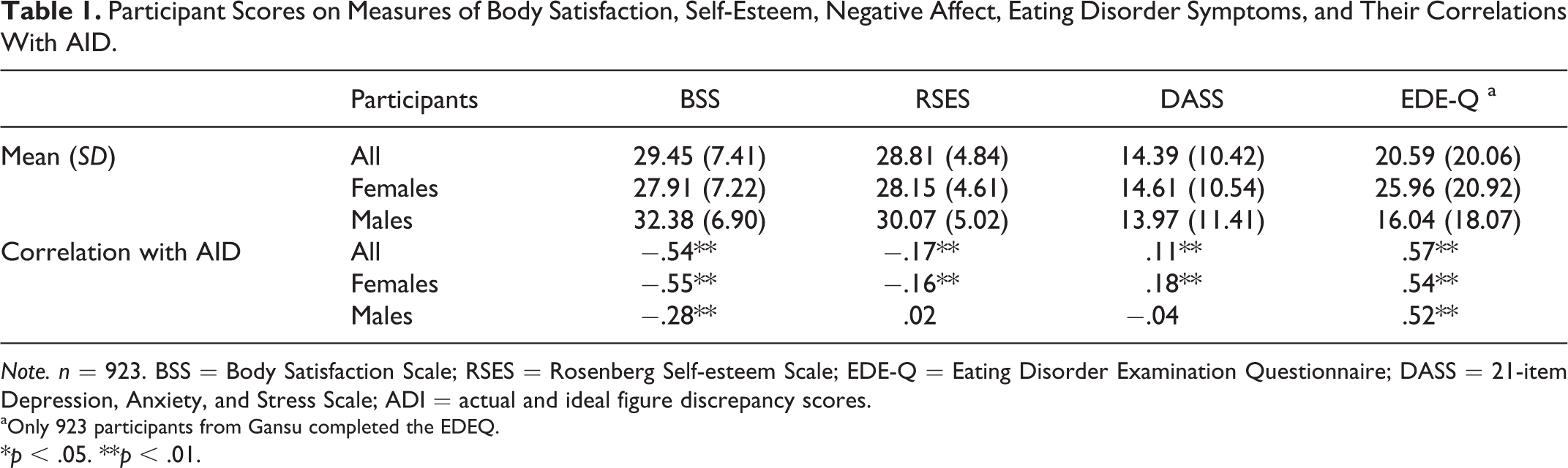
Note. n = 923. BSS = Body Satisfaction Scale; RSES = Rosenberg Self-esteem Scale; EDE-Q = Eating Disorder Examination Questionnaire; DASS = 21-item Depression, Anxiety, and Stress Scale; ADI = actual and ideal figure discrepancy scores.
aOnly 923 participants from Gansu completed the EDEQ.
*p < .05. **p < .01.
Discussion
Results from nearly 4,000 adolescents supported good test–retest reliability of the C-BMI-FRS. Indeed, the test–retest reliability in our current study was higher than that found using other FRS measures. For example, the widely used Stunkard’s FRS showed a test–retest reliability of .69 for actual figure and .48 for ideal figure over 2–6 weeks among 103 British men aged 18–50 years old (Ralph-Nearman & Filik, 2018) and was .78 for Chinese girls and .72 for Chinese boys over a 4-week interval (Lo et al., 2011).
The construct validity of the C-BMI-FRS was supported by the strong correlation between actual figure chosen by participants and self-reported BMI (r > .80). Indeed, the correlation between these two measures was somewhat higher than that found using the FRS developed by Peterson and colleagues (2003) in U.S. adolescents (r = .73 among boys and r = .69 among girls). Additionally, using Stunkard’s FRS among 5,566 Chinese adolescents in Hong Kong, the correlation between actual figure and BMI was r = .65 among girls and r = .63 among boys (Lo et al., 2011).
The validity of the C-BMI-FRS was also supported by the relation between AID and other measures. As expected, AID was strongly correlated with body satisfaction and eating disordered symptomology among both male and female adolescents. In addition, AID was correlated with self-esteem and negative affect among adolescent girls. This sex difference is consistent with prior findings among Chinese college students (Wang et al., 2018) and Britain (Furnham et al., 2002), indicating that body size satisfaction is more clearly tied to self-worth for young women than for young men. Finally, consistent with prior research in China, United States, and Greece, female adolescents had significantly higher AID values than male adolescents (Fallon & Rozin, 1985; Wang et al., 2018; Zaccagni et al., 2014).
Limitations of the current study should be acknowledged. First, participants were recruited from two provinces in China and were nearly all Han Chinese, limiting generalizability to ethnic minority groups in China. Second, as other FRS measures, the C-BMI-FRS measures AID and does not directly assess distress associated with one’s perceived body size. Bearing these limitations in mind, the initial reliability and validity data suggest that the C-BMI-FRS is a brief, easily scored measure assessing body size satisfaction among Chinese adolescents. As such, this measure could serve as an important tool to advance research on body image in Chinese samples.
Supplemental Material
Supplemental Material, sj-pdf-1-ehp-10.1177_0163278720926714 - Development and Validation of a BMI-Based Figure Rating Scale for Chinese Adolescents
Supplemental Material, sj-pdf-1-ehp-10.1177_0163278720926714 for Development and Validation of a BMI-Based Figure Rating Scale for Chinese Adolescents by Chao-Ran Yu, Xin-Yang Yu, Zhi-Tao Fan, Kui Wang and Heather L. Littleton in Evaluation & the Health Professions
Supplemental Material
Supplemental Material, sj-pdf-2-ehp-10.1177_0163278720926714 - Development and Validation of a BMI-Based Figure Rating Scale for Chinese Adolescents
Supplemental Material, sj-pdf-2-ehp-10.1177_0163278720926714 for Development and Validation of a BMI-Based Figure Rating Scale for Chinese Adolescents by Chao-Ran Yu, Xin-Yang Yu, Zhi-Tao Fan, Kui Wang and Heather L. Littleton in Evaluation & the Health Professions
Footnotes
Acknowledgments
The authors thank Ms. Guo, Shuang at Yishuhui Arts Training Center for drawing the eight silhouettes used in the current study.
Declaration of Conflicting Interests
The author(s) declared no potential conflicts of interest with respect to the research, authorship, and/or publication of this article.
Ethical Approval
All procedures performed in studies involving human participants were conducted in accordance with ethical standards of the Institutional or national research committee and with the 1964 Helsinki declaration and its later amendments or comparable ethical standards.
Funding
The author(s) disclosed receipt of the following financial support for the research, authorship, and/or publication of this article: This study was supported by grants from the Institute of Psychology, Chinese Academy of Sciences (Y9CX411008) and the CAS Key laboratory of mental health, Chinese Academy of Sciences (KLMH2014ZG09). These funding agents had no role in the study design; the collection, analysis, or interpretation of data; the writing of the manuscript; or the decision to submit the paper for publication.

Informed Consent
Informed consent was obtained from all individual participants included in the study. Additional consent was obtained from at least one of their guardians for participants younger than 18 years old.
Supplemental Material
Supplemental material for this article is available online.
References
Supplementary Material
Please find the following supplemental material available below.
For Open Access articles published under a Creative Commons License, all supplemental material carries the same license as the article it is associated with.
For non-Open Access articles published, all supplemental material carries a non-exclusive license, and permission requests for re-use of supplemental material or any part of supplemental material shall be sent directly to the copyright owner as specified in the copyright notice associated with the article.
