







Abstract
This study highlights the importance of quantitatively evaluating conversation turns (CTs) and speaking roles (SRs) in dyadic conversations between Mandarin-Chinese-speaking older adults with dementia (OADs) and healthy older adults (HOAs). Evaluating CTs and SRs provides comprehensive insights into how conversation processes and content are collaboratively co-constructed. Four mutually familiar dyads, each consisting of one OAD and one HOA, participated in five weekly 10-min conversations. Results revealed asymmetrical contributions in CTs, with HOAs assuming significantly more CTs to facilitate the conversation, but symmetrical contributions in SRs, indicating balanced involvement from both groups in shaping content. HOAs frequently took obligatory and nonobligatory CTs as the Animator or Author, supporting OADs in engaging meaningfully as the Author or Principal. These conversational behaviors reflect cultural values prevalent among Mandarin Chinese speakers, such as modesty, loyalty, and solidarity. Thus, integrating CT and SR evaluations provides valuable insights into conversational co-construction, particularly critical in dementia conversation research. However, findings are context-specific and culturally influenced and require cautious interpretation. In future research, these evaluative tools should be expanded to diverse populations and conversational contexts to enhance understanding of conversational dynamics across different cultures.
Introduction
Dyadic conversations involve two people who converse using verbal (e.g., Mandarin Chinese 那裡 (/nali/, there)) and nonverbal (e.g., headshakes) cues that adapt dynamically to each other (Hadley et al., 2019; Hadley et al., 2021). People speaking all languages, including Mandarin Chinese, and originating from all cultures take turns to sequentially exchange thoughts and construct their conversations (Hirvenkari et al., 2013). Mandarin Chinese is the official and most prevalent language in Taiwan (Lee et al., 2019; Liu et al., 2017), with nearly 66.3% of Taiwanese people aged 6+ years using it in conversation (Department of Statistics, 2021). Wu (2011) further argued that modesty—a core value in Chinese culture and characterized by loyalty and solidarity—plays a key role in shaping Mandarin-Chinese-speaking conversation. This cultural emphasis on modesty encourages appropriate expressions of acceptance and agreement, fostering an other-oriented conversation style (Wu, 2011; Li, 2001). As a result, among Mandarin-Chinese-speaking Taiwanese people, interactions are often marked by attentiveness to social harmony and interpersonal consideration (Wu, 2011; Li, 2001).
Positioning theory explains how both participants in the conversation co-construct its structure (e.g., turn-taking) and meaning based on shared experiences and world knowledge (Yoon et al., 2015; X. Li, 2014; Simmons-Mackie et al., 2004). This co-construction is shaped more by the people than by the behaviors in the conversation, helping reduce breakdowns (McTear & King, 1991; Purves & Phinney, 2012). Although no standard tool exists to evaluate this process, scholars (e.g., Culpeper & Gillings, 2019; Kindell et al., 2017; Stuart, Jones, and Windle 2022) argued that conversation turns (CTs) and speaking roles (SRs) might offer practical markers. Quantifying CTs and SRs provides a comprehensive picture of the co-construction of dyadic conversation and has been used in recent studies (e.g., Chang & Tsai, 2023; Tsai, 2023; Tsai & Chih, 2022).
A CT is a dominant element of all modes of conversational behavior, playing a critical role in conversations (Fetzer & Akman, 2002). It has various definitions. For example, a CT occurs when speakers change. When one speaker says “good morning,” and the other replies with “good morning,” too, both speakers have separately contributed a CT (Skantze, 2021). Although people across different languages and cultures typically engage in several CTs to exchange thoughts without difficulties and construct their conversation sequentially (Hirvenkari et al., 2013), Chang and Tsai (2023) argued that the other-oriented conversation style may encourage Taiwanese people to cooperatively take nonobligatory CTs to support and enhance meanings when using this conversational style in their dyadic conversations. Specifically, Mandarin-Chinese-speaking Taiwanese people often contribute additional words, phrases, sentences, or ideas—despite not being required to do so—when the other people’s intended meaning appears unclear (Wu, 2011; Li, 2001). For example, speaker A takes a CT that is not an obligatory response, by providing sentences (i.e., 今年是五十歲喔? (/jin nián shìh wǔ shíh suèi wò/, 50 years old in this year?)) to respond to unclear content (i.e., 五十,五十。(/wǔ shíh wǔ shíh/, fifty, fifty)). The number of times each speaker takes a CT in a conversation dyad can be evaluated (Norén et al., 2013).
Although analyzing CTs offers insight into how dyads co-construct conversational processes, it does not fully capture the way dyads co-construct the mutual meanings of the conversation content (Buder, 1991; Turkstra et al., 2006). How dyads make sense of their conversation content through evaluating only CTs has been overlooked (Bloch & Wilkinson, 2004; Stiegler, 2007), potentially resulting in an incomplete understanding of dyadic co-constructions. By contrast, the evaluation of SRs offers a more comprehensive view by identifying the individuals in the conversation who articulate the message (Animator (AN)), select the content (Author (AU)), and whose perspectives are represented (Principal (PR)) (Tsai et al., 2011). Researchers (e.g., Simmons-Mackie et al., 2004; Tsai et al., 2011) have advocated for integrating SR evaluation, particularly in studies involving adults with complex communication needs (e.g., dementia), to more accurately evaluate the co-construction in dyadic conversation.
As proposed by Goffman (1981), SRs, including an AN, AU, and PR, define or describe who speaks the messages, who selects the messages, and whose position is spoken in a dyadic conversation (Tsai et al., 2011). Simply speaking, SRs (i.e., AN, AU, and PR) are acted upon by speakers in a profiled way (Leahy, 2004). Each speaker naturally and actively acts on one or more SRs in a dyadic conversation to manage and negotiate conversation content (Clarke & Wilkinson, 2007; Goffman, 1974, 1981; Schieffelin & Ochs, 1986; Simmons-Mackie et al., 2004). Moreover, one speaker may not simultaneously act in all three SRs (i.e., AN, AU, and PR) (Goffman, 1981). The AN describes the individual verbally speaking words, AU represents the speaker selecting the words that are expressed, and PR is the one whose position and beliefs are determined (Goffman, 1981).
Extract 1 illustrates the AN, AU, and PR of the two individuals. In line 1, person A verbally asks person B a question, simultaneously acting as AN, AU, and PR. In line 2, B only repeats part of A’s question and acts only as AN; they do not select their own words or express their own position and beliefs. However, participant A acts as AU and PR in participant B’s repetitions. In line 3, A uses nonverbal conversation behaviors (i.e., head nodding) to respond to B’s question in line 2, acting as AU and PR. Thus, overall, person A contributed one AN role, three AU roles, and three PR roles, whereas person B contributed only one AN role in Extract 1. The number of times each person takes each contributing role (i.e., AN, AU, and PR) in a conversation dyad can be evaluated (Goffman, 1974, 1981; Schieffelin & Ochs, 1986; Simmons-Mackie et al., 2004).
Extract 1
(1) A: 明天好嗎? (/míng tian hǎo ma˚/, tomorrow, is it good?) (2) B: 明天 (/míng tian/, tomorrow)? (3) A: (head nod)
Older Adults With Dementia (OADs)
In Taiwan, the population of people aged over 65 rose from 3.98 million, accounting for 17.6% of the total population in 2022, to 4.39 million (18.75%) by the end of the second quarter of 2024 (Ministry of the Interior [MOI] 2024). The Ministry of Health and Welfare [MOHW] (2022) indicated that there are over 0.3 million Taiwanese adults with dementia, and 96% of that population were OADs. Among Taiwanese OADs, in 2011, 86.53% had mild-to-moderately severe dementia (Ministry of Health and Welfare [MOHW] 2020), and most were women (51.9%) (Ministry of Health and Welfare [MOHW] 2020; World Health Organization [WHO] 2023). Approximately 50% of the costs for OADs care in 2019 in Taiwan were covered by carers (World Health Organization [WHO] 2023), most of which are friends and family, comprising healthy older adults [HOAs]) (Ministry of Health and Welfare [MOHW] 2020; Amspoker et al., 2021).
Dementia is a disabling disease that is a global public health issue; dementia causes deterioration in memory, orientation, judgment, computational, word-finding, and abstract thinking skills (Ministry of Health and Welfare [MOHW] 2020; World Health Organization [WHO] 2023). These disabilities can impede OADs’ ability to participate in meaningful conversations (Nickbakht et al., 2023; Stuart, Jones, and Windle 2022; Xiao & Li, 2022) and influence OADs’ relationships, identities, and roles, causing a decrease in their quality of life (Nefkens et al., 2022). Several scholars (Kistner et al., 2020; Azios et al., 2021; World Health Organization [WHO] 2023; Atay et al., 2015) have emphasized that OADs should participate in activities and social conversations to maintain their quality of life, but such conversations might be challenging for OADs (Bressan et al., 2020). Conway and Chenery (2016) emphasized that effective conversation is much more important than other dementia-related community services. Researchers (e.g., Conway & Chenery, 2016; Z. Li, 2021; Stuart, Jones, and Windle 2022) further argued that friends and family (HOAs) should take on increased responsibility to co-construct conversation processes and content in their dyadic conversation with OADs.
Previous studies have examined linguistic features, such as discourse structure and speech pauses, among Mandarin and English-speaking adults with dementia and healthy adults using interviews, narratives, and conversations (Lai, 2014; Nickbakht et al., 2023; Sluis et al., 2020; Stuart et al., 2022). However, Tsai (2023) evaluated CTs and SRs only among healthy Mandarin-speaking older adults, while Lai (2014) compared discourse in interviews with 20 Mandarin-speaking adults with mild-to-moderate dementia and 20 healthy peers (mean ages 72.8 and 68.2), focusing on personal topics. Adults with dementia showed more discourse-impairing features, including word-finding difficulties and repetitions, and fewer discourse-building features (e.g., cohesion, clear information) than healthy adults.
Sluis et al. (2020) evaluated speech pauses (≥2 s) in 60 English-speaking adults aged 53–88, including groups with mild dementia, moderate dementia, and healthy controls. While pause durations increased with dementia severity, the differences were not statistically significant. The authors suggested that pauses may reflect various difficulties, such as word-finding, but do not always indicate conversation breakdowns. Stuart et al., (2022) reviewed the roles of English-speaking family members across five countries in supporting conversations with familiar adults with dementia, identifying three key themes: (1) dementia-related conversation challenges affect identity, often supported by family members; (2) linguistic complexity contributes to experience loss; and (3) family members adopt various helpful (e.g., scaffolding and nonverbal support) and unhelpful (e.g., overcorrection and test-like questioning) strategies. The study highlights the importance of examining dyadic conversations between people with dementia and their families.
Nickbakht et al. (2023) conducted semi-structured interviews with 13 English-speaking adults with dementia (aged 61–82) and 21 familiar carers (aged 35–81) in Australia to explore changes in conversation, related impacts, and coping strategies, highlighting three core themes: ongoing struggles with conversation, such as word-finding, emotional and relational impacts (e.g., frustration, isolation), and constructive approaches, including focusing on connection, and overcoming obstacles. The study emphasized the need for training and support for carers to facilitate respectful conversations. By contrast, Tsai (2023) quantitatively evaluated CTs and SRs in dyadic conversations among 20 Mandarin-speaking HOA dyads (65+ years). Each pair engaged in five 10-min sessions, totaling 50 conversations. The frequency and percentage of CTs and SRs were evaluated, revealing symmetrical contributions from both speakers.
Previous research has provided diverse perspectives on conversational behavior in OADs. Lai (2014) identified frequent discourse-impairing features—such as lexical retrieval difficulties—in interviews with Mandarin-Chinese-speaking adults with dementia. Similarly, Sluis et al. (2020) reported increased speech pause durations among English-speaking adults with dementia during picture description tasks. Findings from Stuart, Jones, and Windle (2022) and Nickbakht et al. (2023) further emphasized the critical role of familiar HOAs in supporting conversations with individuals with dementia, acting as facilitators to preserve identity and mitigate conversation breakdowns. By contrast, Tsai (2023) demonstrated quantitatively symmetrical contributions of CTs and SRs among mutually familiar Mandarin-speaking HOA dyads. Nevertheless, these studies primarily utilized monologic tasks (e.g., interviews or descriptions), which limits the applicability of the findings to interactive, dyadic conversation contexts involving OADs.
This pilot study aimed to address this gap in the literature by quantitatively evaluating the individual contributions of CTs and SRs in the co-construction of dyadic conversations between mutually familiar Mandarin-speaking OADs and HOAs. Specifically, two hypotheses were tested: (a) OADs and HOAs differ in their CT contributions, and (b) OADs and HOAs differ in their SR contributions. By focusing on Mandarin-speaking participants, this study extends current knowledge concerning conversational dynamics in OAD populations and complements prior research primarily conducted in English-speaking contexts.
Method
Participants
Four dyads (D1, D2, D3, and D4) containing two mutually familiar individuals, including a female OAD and a male HOA—a total of four female OADs and four male HOAs, or eight participants—took part in the study. Each OAD was recruited from a dementia community service or care centers in Taiwan, and all met the inclusion criteria of (a) being aged 65 and over; (b) being diagnosed with non-stroke-related dementia or Alzheimer’s disease (Dijkstra et al., 2004); (c) having a Mini-Mental State Examination (MMSE) score between 15 and 27 (15 < scores <27), indicating mild-to-moderate severe dementia; (d) being able to see people and hear the speech of others in face-to-face conversations with or without glasses or hearing aids; and (e) being able to speak Mandarin Chinese sufficiently to participate in basic social conversation. Each of the recruited OADs was asked to recommend one mutually familiar male HOA (e.g., spouse, sibling, or relative) in their communities, and all HOAs met the inclusion criteria: (a) being aged 65 and over; (b) having a MMSE score over 28 if educated for more than 6 years and over 27 if educated for less than 6 years, indicating no cognitive impairment; (c) being able to see people and hear the speech of others in face-to-face conversations with or without glasses or hearing aids; (d) being able to speak Mandarin Chinese sufficiently to participate in basic social conversation; (e) having conversations with the OADs on a regular basis; and (f) not receiving or having received specific training on how to converse with OADs (Dijkstra et al., 2004).
Demographic Characteristics of OADs
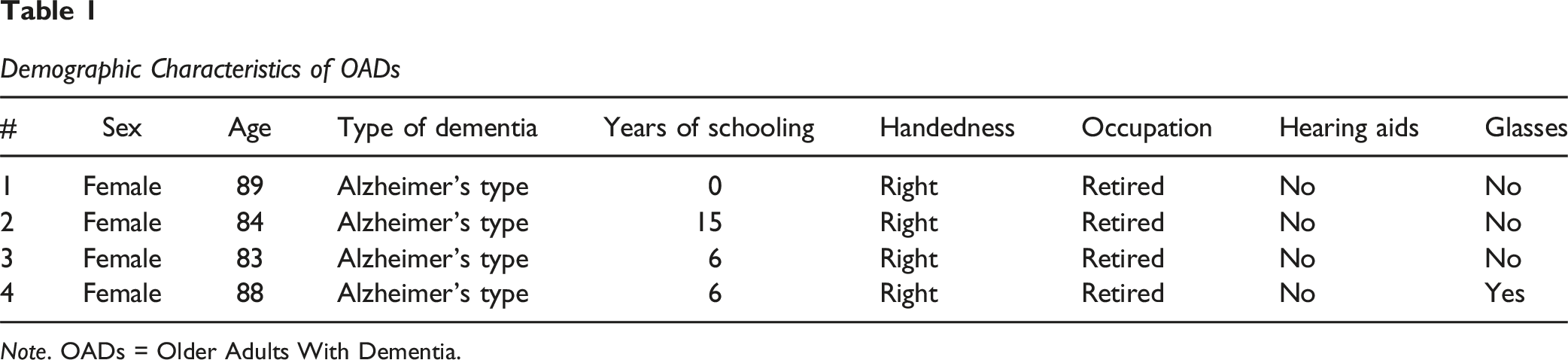
Note. OADs = Older Adults With Dementia.
Demographic Characteristics of HOAs
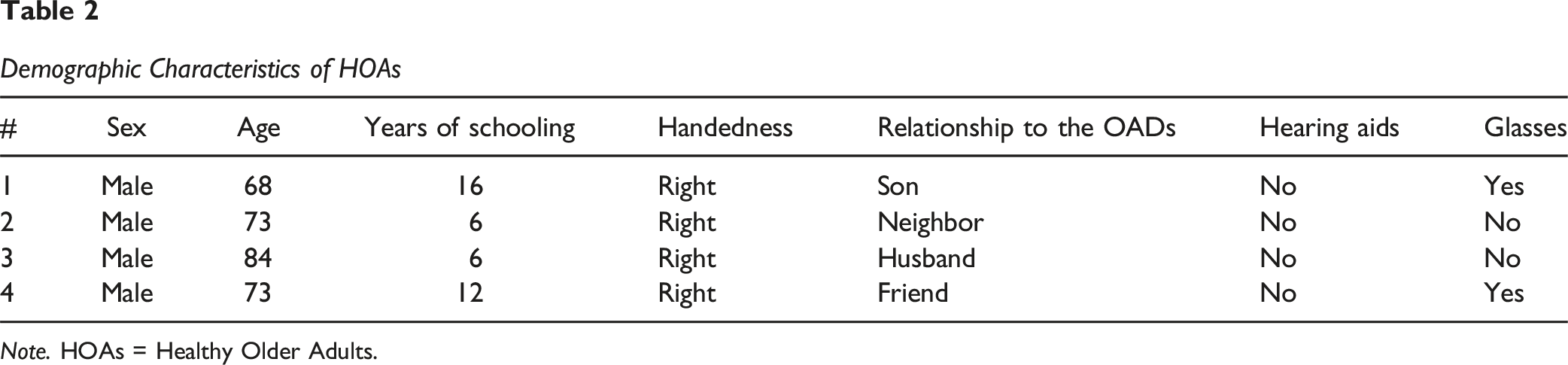
Note. HOAs = Healthy Older Adults.
Setting and Materials
To ensure natural, comfortable, and relaxed casual conversations, each OAD and their recommended HOA sat opposite each other in a quiet room at home or in a community care center where they conversed daily (Tsai & Chih, 2022). Two color video cameras (Datavideo
1
BC-50 1080p HD Block Camera) were placed behind the two participants, each capturing a separate frontal view of the head. These two captured views were loaded into a special effects generator (Datavideo
1
HS-1300 6-Channel HD Portable Video Streaming Studio) to video-record a split-screen view in which each individual was on one side of the split screen (see Figure 1). The audio was recorded using two lapel microphones (Sony
2
UWP-D21) clipped to the participants’ clothing at sternum level and sent to a sound mixer (Yamaha
3
MG10XU Mixer). The split-screen view was played back on a 17-inch color monitor (Datavideo
1
HS-1300 6-Channel HD Portable Video Streaming Studio), and audio recordings were monitored using an audio headset (Audio-Technica
4
ATH-M30x). The video and audio recordings were stored on a secure digital memory card (SanDisk
5
Extreme SDXCⅠC10 U3 V30 64 GB). Delve,
6
a software tool for analyzing qualitative data, was used to code CTs and SRs in the transcriptions. A Sample of Split-Screen Image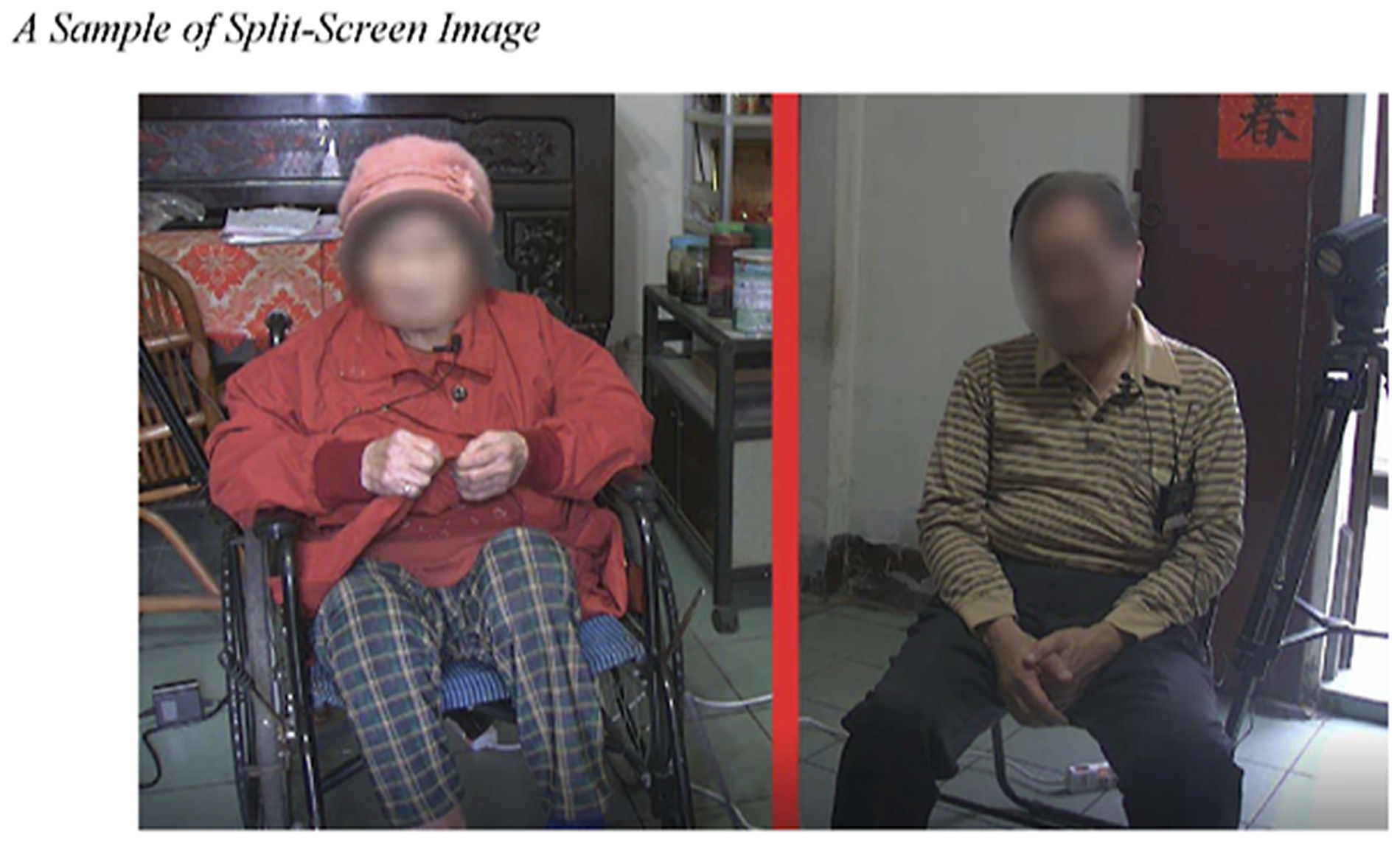
Research Design
The current study is part of a large-scale research project for analyzing the patterns of Mandarin Chinese dyadic conversations among OADs and HOAs; the research design is described in BLINDED FOR REVIEW. Non-experimental quantitative descriptive observations (McMillan & Schumacher, 2010) were conducted, and the quantitative percentages of contributed CTs and SRs from each individual (i.e., OAD and HOA) were investigated. The two dependent variables were (a) quantitative percentages of individually contributed CTs (i.e., OAD and HOA) and (b) quantitative percentages of individually contributed SRs (i.e., OAD and HOA). Paired-sample t-tests were performed to compare the mean percentages of CTs and SRs across the dyadic conversation sessions, considering the correlated and continuous dependent variables (i.e., percentages of the contributed CT) and applications for small sample size (Mara & Cribbie, 2012; Pham & Jimenez, 2012). The paired-sample t-tests have been performed in similar studies (e.g., Tsai, 2013; Tsai, 2023; Tsai & Chih, 2022). The study was conducted in accordance with the Declaration of Helsinki and approved by the Institutional Review Board of CHUNG SHAN MEDICAL UNIVERSITY (protocol code CS1-20139 and 2020/9/9 approval).
Researchers
The author works in the Department of Speech-Language Pathology and Audiology, has extensive experience in transcribing and coding, and acts as the primary investigator. Four research assistants ( R1, R2, R3, and R4) received training that was adapted and modified from the works of Guralnick and Paul-Brown (1989) and Olswang et al. (2006), then transcribed video-recorded conversation sessions and coded transcripts with CTs and SRs. First, a 5-min HOA-to-HOA dyadic conversation session from the previous study was viewed, with pre-completed transcripts. The independent transcriptions of five randomly selected 5-min dyadic conversation sessions were completed and compared with pre-completed transcripts. Only transcriptions of comprehensible and incomprehensible spoken words, gestures, and directions for eye gaze were considered for reliability; the exact duration of the individuals’ pause time was not examined since it was not the main objective and was unlikely to affect the current study. Transcription reliability was determined by dividing the number of agreements by the total number of agreements and disagreements, before multiplying the quotient by 100 (Patten, 2007; Portney & Watkins, 2000). Competence was demonstrated when at least 80% transcription reliability was reached for at least three of the segmented dyadic conversation sessions (Leaman & Edmonds, 2019).
Second, during the coding training sessions, the definitions of CTs and SRs were discussed. Each of the four research assistants independently coded two 5 min transcripts that had been collected in previous studies (e.g., Tsai, 2023) and compared their codes with the pre-completed codes. Discrepancies in these codes were discussed among the authors and research assistants and resolved. Coding reliability was determined similarly to transcriptional reliability, where competence was reached with at least 80% reliability for the two transcripts (Leaman & Edmonds, 2019).
Procedures
To generalize validity, Mackenzie (2000) emphasized that it is necessary to sample a large number of dyadic conversations. A 10-min conversation is generally representative of daily dyadic conversations (Boles and Todd 1998) and has been used in several studies (Chang & Tsai, 2023; Tsai, 2023). In the current study, each dyad had a 10-min conversation once a week for five weeks, for a total of five dyadic conversation sessions per dyad and 20 dyadic conversation sessions. Each session was video recorded separately. After 10 min, the author signaled the participants to end their conversation. To make the dyadic conversations as natural as possible, no structured script was used (Baker et al., 2015; Kindell et al., 2019; Söderlund et al., 2016), and individuals were encouraged to engage in spontaneous and non-structured conversations (Söderlund et al., 2016). Additional conversation topics related to four aspects of daily life—personal care (e.g., medicines, clothing), mobility (e.g., public transportation, taxis), household tasks (e.g., food shopping, cooking), and activities (e.g., reading a newspaper, visiting friends)—were offered when the conversation lasted more than 10 min (Turkstra et al., 2003). To reduce anxiety in the first 3 minutes following the start of the video recording, each participant was informed that the video recording was focused on the conversations of the other person in their dyadic conversations (Wiemann, 1981). Before the conversation began, the following instructions were given to each participant (Tsai & Chih, 2022): Your task today is to have conversations with each other. Both will choose conversational topics. You might like to talk about your daily life, including personal care, mobility, housework, and activities. Structured scripts are not used to keep the conversations as natural as possible. You will have about 10 min. I will signal you when 10 min have passed, so you may begin to wind up your conversation. If you feel you have finished your conversation before the end of the 10 min, let me know, and I will provide you with a list of possible topics to continue.
Data Collection
Data collection consisted of three steps: (a) transcribing dyadic conversation sessions, (b) coding CTs, and (c) coding SRs (AN, AU, and PR) (Tsai, 2023; Tsai & Chih, 2022). Assistants R1 and R2 were paired, as were R3 and R4. First, all video-recorded conversation sessions were transcribed using the established notations, as shown in Table S1 (adapted from Tsai (2013)). All multi-modality, including spoken words, nonverbal conversation behaviors (e.g., head nods), and silence between words, was transcribed precisely (Culpeper & Gillings, 2019; Mondada, 2019; Olswang et al., 2006). Assistants R1 and R3 first transcribed the conversation, before research assistants R2 and R4 reviewed the accuracy of the transcriptions before coding. To achieve consensus, all differences in the transcriptions were discussed, and all possible differences were resolved (Higginbotham et al., 2007; Soto & Clarke, 2017). Second, R1 and R2 independently coded a CT-OAD and CT-HOA for CTs contributed by the OADs and HOAs, respectively, on an utterance-by-utterance basis (Tsai, 2023; Tsai et al., 2011). The operational definitions for CT coding were adapted from the work of Tsai (2023); coding rules with illustrative extracts are documented in Table S2.
Third, R1 and R2 independently coded the SR as proposed by Goffman (1981), including AN-OAD (AN contributed by OAD), AU-OAD (AU contributed by OAD), and PR-OAD (PR contributed by OAD) for OADs, and AN-HOA (AN contributed by HOA), AU-HOA (AU contributed by HOA), and PR-HOA (PR contributed by HOA) for HOAs, on an utterance-by-utterance basis. An Animator (AN) is defined as a person who generates speech (giving the words “voice”) (Goffman, 1981), whereas an Author (AU) is defined as a person who selects words or deduces meanings from incomplete speech (e.g., difficult word-finding) and/or nonverbal conversation behaviors (e.g., headshake) (Goffman, 1981; Simmons-Mackie et al., 2004). A Principal (PR) is defined as a person’s beliefs, attitudes, perspectives, personal information, and feelings (Goffman, 1981). The operational definitions of SR coding were adapted from the work of Tsai (2023); different coding rules with illustrative extracts are documented in Table S3.
Inter- and Intra-Coder Reliability
R1 and R2 coded all 20 transcripts in the four conversation dyads (D1, D2, D3, and D4), with 10 transcripts each. One transcript from each dyad (four transcripts) was randomly selected to calculate the inter- and intra-coder reliabilities (Tsai, 2023; Tsai & Chih, 2022). The selected transcripts were coded again by R1 and R2 one week after the initial coding and coded by R3 and R4, with no discussion allowed (Olswang et al., 2006). The inter- and intra-coder reliabilities in coding CTs and SRs were calculated based on point-by-point reliability (Portney & Watkins, 2000). If a minimum of 80% reliability was not achieved, additional coding training sessions were provided (Tsai & Chih, 2022). The mean inter-coder reliability of CT coding was 98.89% (range = 97.66–100.00%), and that of SR coding was 96.25% (range = 94.33–98.26%). The mean intra-coder reliability of CT coding was 98.84% (range = 97.90–100%), and that of SR coding was 95.56% (range = 94.12–98.78%). Therefore, no additional coding training sessions were required in this study.
Data Analysis
The total frequency (n) and percentages (%) of contributed CTs and SRs by each OAD and HOA in each dyad were calculated separately to consider the varied duration of conversation (Muller & Soto, 2002). The total frequency (n) and percentages (%) of CT-OAD and CT-HOA (CTs contributed by the OAD and HOA individually) and SR-OAD and SR-HOA (SRs contributed by the OAD and HOA individually) were calculated. The percentages of CT-OAD and CT-HOA were calculated as the number of instances of CT-OAD and CT-HOA, respectively, divided by the total number of CTs in the dyad and multiplied by 100 (Tsai & Chih, 2022). A paired-sample t-test was performed through IBM® SPSS® Statistics Standard Edition to compare the mean percentages of CT-OAD and CT-HOA across the dyadic conversation sessions.
The frequency of SR-OAD (SRs contributed by the OAD) was summed up from the number of AN-OAD, AU-OAD, and PR-OAD, and that of SR-HOA (SRs contributed by the HOA) was summed up from the number of AN-HOA, AU-HOA, and PR-HOA (Tsai & Chih, 2022). The percentage of SR-OAD was then derived by dividing the number of SRs from the OADs by the total number of SRs in the dyad and multiplying the result by 100. The percentage of SR-HOA was derived by dividing the number of SRs from the HOA by the total number of SRs in the dyad and multiplying the result by 100 (Tsai & Chih, 2022). Another paired-sample t-test was performed to compare the mean percentages of SR-OAD and SR-HOA across the dyadic conversation sessions.
Results
The mean length of each dyadic conversation was 9 min 55 s, ranging from 9 min 38 s to 10 min 56 s.
Quantitative Percentages of Contributed CT
Frequency and Percentages of Contributed CT-OAD and CT-HOA
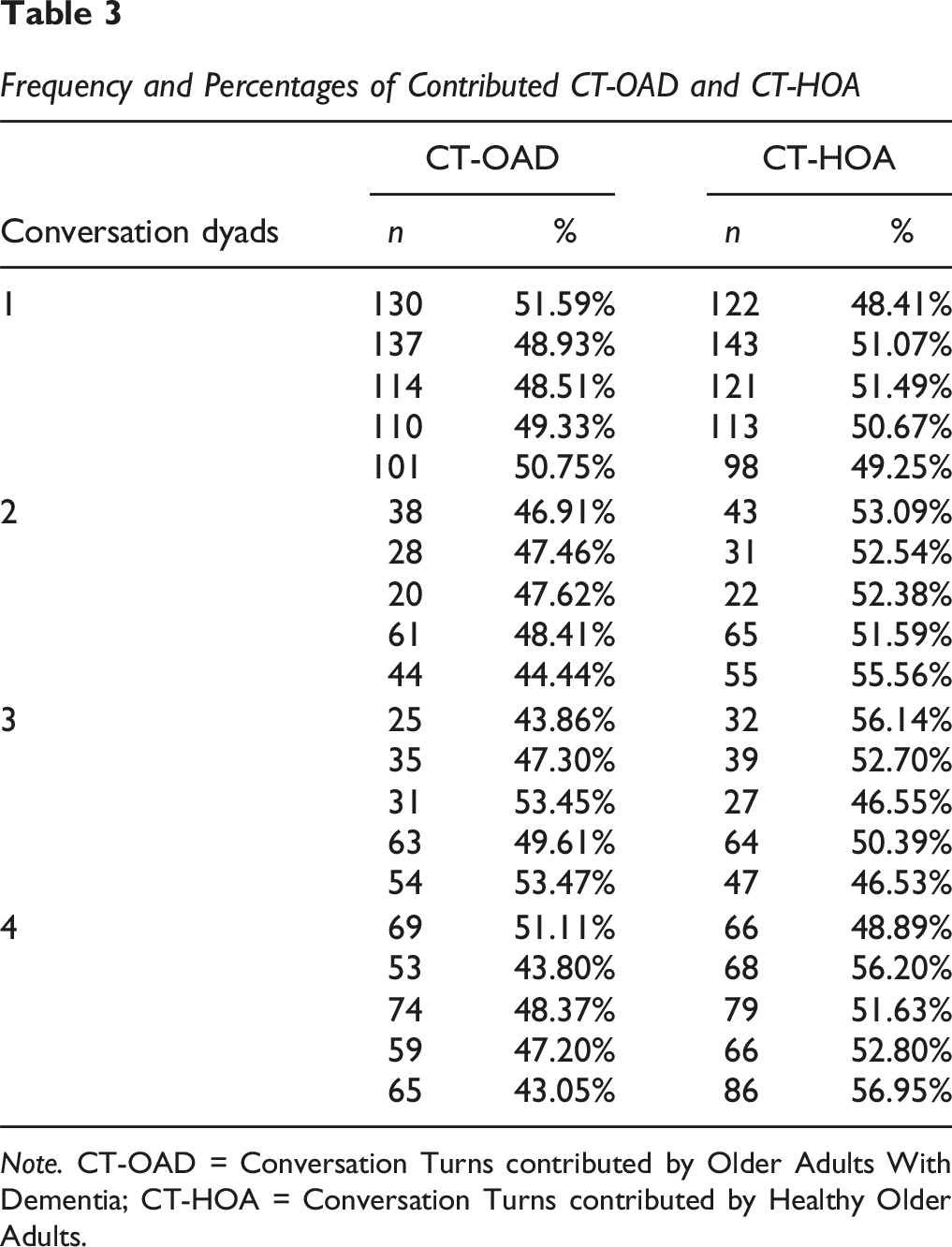
Note. CT-OAD = Conversation Turns contributed by Older Adults With Dementia; CT-HOA = Conversation Turns contributed by Healthy Older Adults.
Quantitative Percentages of Contributed SRs
Frequency and Percentages of Contributed SR-OAD and SR-HOA
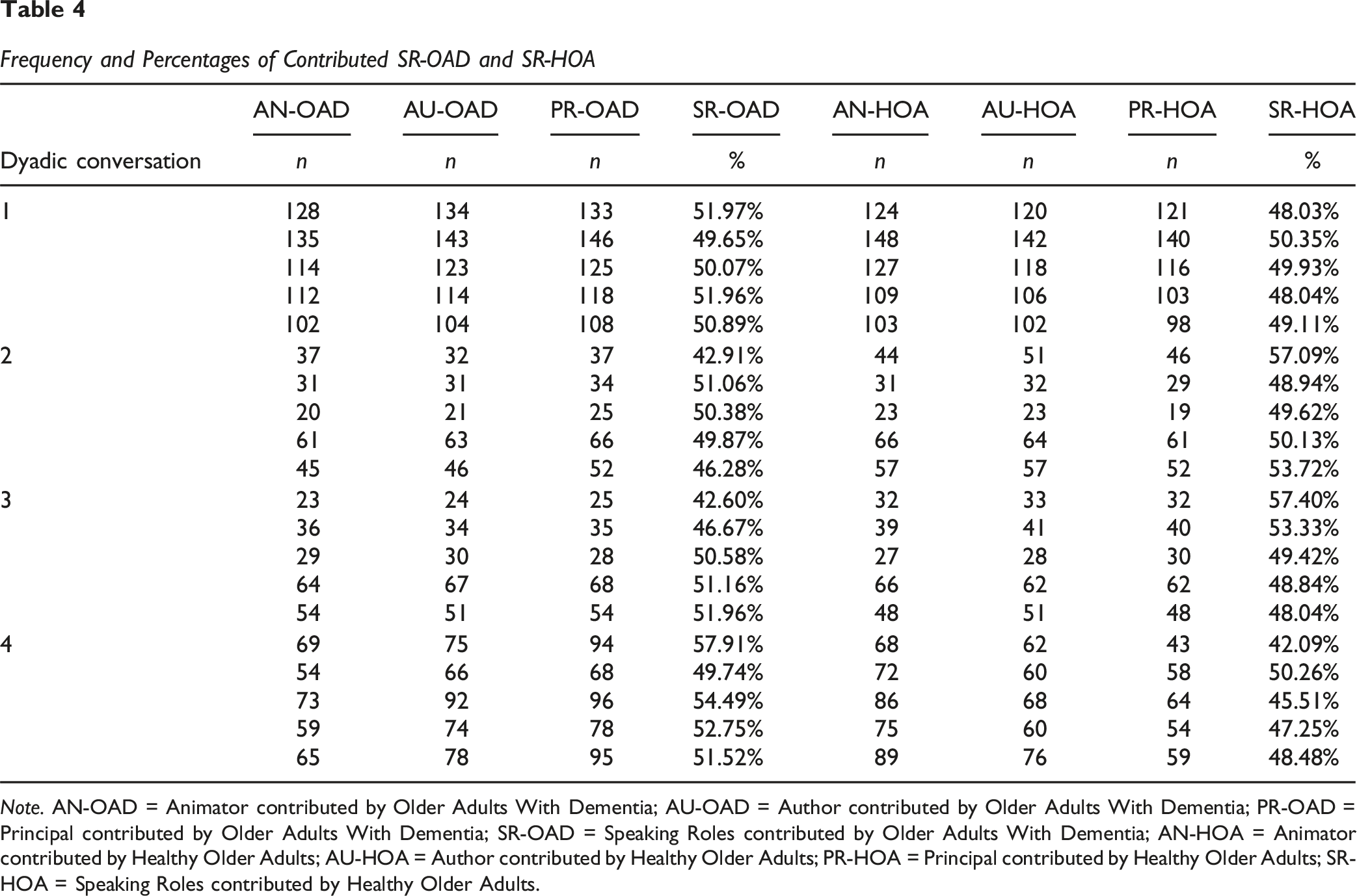
Note. AN-OAD = Animator contributed by Older Adults With Dementia; AU-OAD = Author contributed by Older Adults With Dementia; PR-OAD = Principal contributed by Older Adults With Dementia; SR-OAD = Speaking Roles contributed by Older Adults With Dementia; AN-HOA = Animator contributed by Healthy Older Adults; AU-HOA = Author contributed by Healthy Older Adults; PR-HOA = Principal contributed by Healthy Older Adults; SR-HOA = Speaking Roles contributed by Healthy Older Adults.
Discussion
In this study, the co-construction of conversation was quantitatively examined by evaluating contributions of CTs and SRs in dyadic conversations between mutually familiar Mandarin-Chinese-speaking OADs and HOAs. The results revealed a significant difference in the mean percentages of CTs contributed by OADs (CT-OAD) and HOAs (CT-HOA), indicating asymmetry contributions. By contrast, no significant difference was found between the mean percentages of SRs contributed by OADs (SR-OAD) and HOAs (SR-HOA), suggesting a symmetrical contribution. In summary, while CT contributions were asymmetrical, SR contributions appeared symmetrical, reflecting differing patterns of co-construction depending on the evaluated dimension. Evaluating both CTs and SRs offers a more complete understanding of how dyadic conversations are jointly constructed, a perspective increasingly emphasized in recent research (e.g., Chang & Tsai, 2023; Tsai, 2023; Tsai & Chih, 2022). Although evaluating CTs provides insights into how conversational structure is co-constructively managed by the dyad, it does not fully capture the creation of shared meanings in the conversational content (Buder, 1991; Turkstra et al., 2006). Relying solely on CTs to evaluate how conversational meaning is negotiated can lead to an incomplete picture of the co-construction process (Bloch & Wilkinson, 2004; Stiegler, 2007). By contrast, the evaluation of SRs provides a richer perspective by distinguishing among different SRs: who delivers the message (Animator, AN), who constructs the content (Author, AU), and whose viewpoint is expressed (Principal, PR) (Tsai et al., 2011). Researchers (e.g., Simmons-Mackie et al., 2004; Tsai et al., 2011) have been increasingly emphasizing the value of incorporating SR analysis, especially in research involving individuals with complex communication needs—such as those with dementia—to better capture the nuances of co-constructed interaction in dyadic contexts. The present study and the study conducted by Tsai (2023) demonstrated the utility of CTs and SRs as measures for evaluating co-construction in dyadic interaction. However, the CT and SR patterns observed in OAD-to-HOA dyads diverged from those found in HOA-to-HOA dyads in the study conducted by Tsai (2023), highlighting the unique conversational dynamics present when one of the participants has dementia.
Quantitative Percentages of Contributed CTs
Significantly different contributions of CT-OAD and CT-HOA were observed in mutually familiar Mandarin-Chinese-speaking OAD-to-HOA dyadic conversation, with the occurrence of CT-HOA being greater than that of CT-OAD, as demonstrated in Extract 2. The HOA asked a question in line 1 with no responses from the OAD, and 5 s later, the HOA took a nonobligatory CT, which should be taken by the OAD, to ask another simplified question in line 2. In line 3, the OAD responded to the HOA’s questions after having more time to think about the answers to these two questions. The HOA continuously took an obligatory CT to guess the OAD’s utterances about age in line 4; however, again, the OAD gave no response. After 6 s, the HOA took another nonobligatory CT (line 5). Extract 2 illustrates that the OAD and HOA contributed to one and four CTs, respectively.
Extract 2
(1) HOA: 今年幾歲你知道嗎? (/jin nián jǐ suèi nǐ jhih dào ma˚/, Do you know how old you are this year?) (2) HOA: (5.0) 今年幾歲了? (/jin nián jǐ suèi le˚/, How old are you this year?)? (3) OAD: 我還要再想一下。(/wǒ huán yào zài siǎng yi sià/, I have to think again.) (4) HOA: 蛤,八十? (/há ba shíh/, Huh, eighty?) (5) HOA: (6.0) 要再想一下喔? (/yào zài siǎng yi sià/, Do you have to think about it again?)
Several factors may explain the significantly different contributions of CT-OAD and CT-HOA, as well as the higher occurrence of CT-HOA. First, previous studies (e.g., Lai, 2014; Sluis et al., 2020) have identified common discourse-impairing features and extended speech pauses among adults with dementia during interviews, and picture descriptions might predict these significantly different contributions of the CT-OAD and CT-HOA. Although pauses in speech do not always signify conversation breakdowns (Sluis et al., 2020), Mandarin-Chinese-speaking HOAs, who share personal experiences and world knowledge with OADs, may adopt an other-oriented conversational approach by taking both obligatory and nonobligatory CTs to co-construct their dyadic conversation process (Hirvenkari et al., 2013; H.Z. Li, 2001). In contrast, OADs typically take only the obligatory CTs. By engaging in these additional nonobligatory CTs, HOAs provide words, phrases, sentences, or ideas that help clarify conversational content and reduce the likelihood of conversational breakdowns (H.Z. Li, 2001). As a result, distinct patterns of contribution between CT-HOA and CT-OAD can be expected.
Second, mutually familiar English-speaking healthy adults have reported acting as “translators” for adults with dementia, taking on substantial responsibilities and employing supportive conversation strategies to maintain effective dyadic conversations (Nickbakht et al., 2023; Stuart, Jones, and Windle 2022). These healthy adults, including HOAs, may engage in nonobligatory CTs as part of their assumed supportive role. Similarly, Chang and Tsai (2023) emphasized that the other-oriented conversation style of Mandarin-Chinese-speaking HOAs may also lead them to take nonobligatory CTs to actively support and facilitate other people’s intended conversation meaning. Consequently, such patterns might also be anticipated in Mandarin-Chinese-speaking dyads, where mutually familiar OAD-to-HOA interactions are characterized by a higher frequency of CTs initiated by HOAs—including both obligatory and nonobligatory CTs—compared to OADs, who predominantly take only obligatory CTs. In sum, the evaluation of CTs offers valuable insights into the co-construction processes within dyadic conversational dynamics (Buder, 1991; Turkstra et al., 2006).
Quantitative Percentages of Contributed SRs
No significantly different contributions of SR-OAD and SR-HOA were observed in mutually familiar Mandarin-Chinese-speaking OAD-to-HOA dyadic conversation, but the presence of SR-OAD was more than that of SR-HOA.
Extract 2 illustrates that in line 2, the HOA took a nonobligatory CT—a turn that would typically be taken by the OAD—to fulfill the roles of AN, AU, and PR. In line 3, the OAD responded to the HOA’s two questions by assuming the same roles: AN, AU, and PR. In the following line, the HOA proceeded with an obligatory CT, acting as AN and AU, while prompting the OAD to take on the role of PR by interpreting utterances related to age. Again, in line 5, the HOA took another nonobligatory CT to repeat the OAD’s utterance from line 3, acting as AN, while the OAD continued to serve as AU and PR.
In total, Extract 2 revealed six SR-OADs and nine SR-HOAs, consisting of one CT-OAD and four CT-HOAs. The HOA contributed four CTs, compared to the OAD’s single CT, resulting in nine SR-HOAs, while the OAD still managed to produce six SR-OADs. Although the frequency of CT-HOAs was notably higher than that of CT-OADs, the HOA took both obligatory and nonobligatory turns, primarily fulfilling the roles of AN and AU. In contrast, the role of PR was more frequently assumed by the OAD, even within the HOA’s turns. Thus, despite the HOA’s dominance in taking CTs, their conversational pattern of redistributing the AU and PR roles to the OAD may explain the relatively balanced distribution of semantic roles. This balance likely accounts for the absence of a statistically significant difference between total SR contributions made by the OAD and the HOA.
Additionally, the other-oriented conversation style rooted in Chinese culture may influence Mandarin-Chinese-speaking HOAs to take on nonobligatory CTs in addition to their obligatory ones, in order to actively support and clarify their OAD’s intended meaning (Chang & Tsai, 2023). When the OAD’s intended meaning appears unclear, the HOA may provide supplementary words, phrases, sentences, or ideas within their nonobligatory CTs to support comprehension (Wu, 2011; Li, 2001). In other words, conversation breakdowns caused by the discourse-impairing features and extended speech pauses commonly observed in adults with dementia (e.g., Lai, 2014; Sluis et al., 2020) may be mitigated when HOAs take both obligatory and nonobligatory turns to clarify and scaffold meaning (Hirvenkari et al., 2013; Li, 2001). In summary, although CT evaluation alone may not adequately capture the dynamic, collaborative construction of meaning in dyadic interactions (Buder, 1991; Turkstra et al., 2006), SR evaluation offers a more comprehensive lens. By evaluating semantic roles, researchers can gain deeper insights into how conversation meaning is co-constructed within dyads (Tsai et al., 2011).
Implications
The findings of this study have several practical implications. First, no standardized tool for evaluating the co-construction of dyadic conversations is currently available. Quantifying CTs and the three SRs—AN, AU, and PR—offers a comprehensive framework for evaluating how conversational processes and meanings are collaboratively constructed (Culpeper & Gillings, 2019; Kindell et al., 2017; Stuart, Jones, and Windle 2022). This approach has been successfully applied in recent studies (e.g., Chang & Tsai, 2023; Tsai, 2023; Tsai & Chih, 2022). Practitioners can evaluate CTs to understand how dyads manage conversational flow (e.g., obligatory and nonobligatory turns) and SRs to examine how mutual meaning is negotiated.
Second, although dementia can significantly hinder participation in conversations, this study demonstrates that mutually familiar HOA play a key role in sustaining their dyadic conversation. These HOAs often assume greater responsibility by taking on both obligatory and nonobligatory CTs and serving as the AN and/or AU while supporting OADs to act as the AU and/or PR. The importance of these familiar carers—alongside healthcare professionals—should be emphasized in dementia care, aligning with international human rights standards for OADs (Bressan et al., 2020; Conway & Chenery, 2016; Shannon et al., 2019). Healthcare professionals, such as speech-language pathologists, should leverage the strengths of HOAs to design supportive conversation strategies that reduce breakdowns and enhance mutual understanding (Bressan et al., 2020; Carey et al., 2023; Stuart, Jones, and Windle 2022).
Limitations and Future Research Directions
The results of this study should be interpreted in light of three research limitations that provide future research directions. First, CTs and SRs were used to quantitatively evaluate the co-construction of dyadic conversations between mutually familiar Mandarin-speaking OADs and HOAs. Although CTs and SRs could comprehensively represent the co-construction of dyadic conversation and have been used in recent studies (e.g., Chang & Tsai, 2023; Tsai, 2023; Tsai & Chih, 2022), whether other available tools are able to evaluate co-construction of dyadic conversation across all languages and cultures is unclear. Second, recruiting mutually familiar OAD and HOA participants who are eligible, willing, and available presents notable challenges, often due to reduced motivation or competing life priorities (Nefkens et al., 2022). As a result, this study evaluated only 20 dyadic conversation sessions using CTs and SRs. While the current focus was on mutually familiar dyads, future research could explore mutually unfamiliar and demographically diverse dyads to broaden clinical insights (Nickbakht et al., 2023). Additionally, although all the participating dyads met the inclusion criteria, individual differences in lifestyle, age, occupation, educational background, and conversational sensitivity may have influenced the validity and consistency of the CT and SR evaluations (Tsai, 2023; Tsai & Chih, 2022). Third, the dyadic conversations in this study were conducted in natural settings, such as the participants’ homes or community care centers—environments where OADs and HOAs typically engage in everyday conversations. While these settings offer valuable insights into natural conversational patterns, they may not accurately reflect interactions occurring in institutional environments such as hospitals or clinical care facilities (Hadley et al., 2021). Tsai (2023) noted that the impact of different conversational contexts—particularly institutional settings—on the quantitative use of CTs and SRs remains unclear. Thus, future research should include a broader range of settings, both natural and institutional, to better understand how interactional dynamics vary across contexts. Finally, this study recruited Mandarin-Chinese-speaking participants in Taiwan, whose conversational behaviors may be influenced by culturally embedded values such as modesty and an other-oriented conversational style (Hirvenkari et al., 2013; Li, 2001). As a result, the findings should be interpreted within the specific cultural context of Mandarin-Chinese speakers in Taiwan and may not be generalizable to individuals from other linguistic or cultural backgrounds.
Conclusions
This study highlights the value of quantitatively evaluating CTs and SRs to understand the co-construction of dyadic conversations involving Mandarin-Chinese-speaking OADs and HOAs. The results revealed an asymmetrical contribution in CTs—with HOAs taking significantly more CTs to facilitate conversational flow—and a symmetry in SRs, suggesting balanced involvement in shaping conversational content. HOAs frequently undertook obligatory and nonobligatory CTs, acting as the AN or AU, while enabling OADs to participate actively as the AU or PR. These conversational patterns likely reflected cultural values, such as modesty, loyalty, and solidarity, common among Mandarin Chinese speakers. Therefore, integrating both CT and SR evaluations offered a more complete and nuanced depiction of conversational co-construction, particularly essential in dementia research. However, these findings are context-specific and should be interpreted cautiously, considering cultural influences. In future research, the use of these evaluative tools should be expanded to diverse populations and settings to enhance understanding of conversational dynamics across different cultural contexts.
Supplemental Material
Supplemental Material - A Pilot Study of Dyadic Conversations Between Older Adults With Dementia and Healthy Older Adults in Taiwan
Supplemental Material for A Pilot Study of Dyadic Conversations Between Older Adults With Dementia and Healthy Older Adults in Taiwan by Meng-Ju Tsai in Evaluation & the Health Professions
Footnotes
Acknowledgments
The author wishes to thank C.-H. Chen from National Pingtung University of Science and Technology and T.-A. Kuo from Chung Shan Medical University for their recruiting research participants.

Ethical Considerations
The study was conducted in accordance with the Declaration of Helsinki, and approved by the Institutional Review Board of CHUNG SHAN MEDICAL UNIVERSITY (protocol code CS1-20139 and 2020/9/9 approval).
Consent to Participate
Written informed consent was obtained from all participants or a legally authorized representative.
Consent for Publication
Written informed consent for publication was obtained from all participants or a legally authorized representative.
Funding
The author disclosed receipt of the following financial support for the research, authorship, and/or publication of this article: This work was supported by the Ministry of Science and Technology, Taiwan under Grant [MOST 109-2410-H-040 -004 -SS2].
Declaration of Conflicting Interests
The author declared no potential conflicts of interest with respect to the research, authorship, and/or publication of this article.
Data Availability Statement
The data that support the findings of this study are available on request from the corresponding author. The data are not publicly available due to ethical restrictions.
Supplemental Material
Supplemental material for this article is available online.
Notes
References
Supplementary Material
Please find the following supplemental material available below.
For Open Access articles published under a Creative Commons License, all supplemental material carries the same license as the article it is associated with.
For non-Open Access articles published, all supplemental material carries a non-exclusive license, and permission requests for re-use of supplemental material or any part of supplemental material shall be sent directly to the copyright owner as specified in the copyright notice associated with the article.
