







Abstract
Decades of research on media coverage of the campaigns of women running for high public office have identified several patterns of gendered reporting that supposedly have discouraged citizens from voting for women candidates, discouraged them from contributing to women’s campaigns and dissuaded women from entering politics. This study examines the ways in which each of the patterns was evident in media reporting on Sarah Palin, the Republican candidate for Vice President of the United States in the 2008 election. Data reveal a mixed pattern of continuities and differences. The findings suggest that the consequences of gendered reporting may not be uniform. Rather, they can vary according to the issue or symbolic focus of a campaign, and the degree of conflict between a candidate attempting to keep reporting ‘on message’ and the commercial news media concerned with attracting a large market share.
Research has identified five characteristics of American commercial news media reporting on the campaigns of women running for high public office. First, women candidates tend to receive less attention than do their male counterparts (Carroll, 1994; Jalalzai, 2006; Kahn, 1996). Second, more often than stories about male candidates, discussions of political women tend to focus on comparatively trivial subjects such as their physical appearance, lifestyle and family rather than their positions on prominent campaign issues (Anderson, 1995; Braden, 1996: McChesney, 1999). Third, women tend to receive more negative coverage claiming that they lack the personality characteristics, experience and knowledge necessary for effective leadership in high public office (Carlin and Winfrey, 2009; Carroll and Schreiber, 1997; Devitt, 1999; Kahn and Goldberg, 1991). Fourth, to the extent that their issue positions are discussed, they will concern topics defined in American political culture as ‘woman’s issues’ such as abortion, childcare, education and the environment, rather than ‘men’s issues’ such as the economy, national security and military affairs (Carroll and Fox, 2006; Devitt, 1999; Heldman, 2009; Jamieson, 1995). Fifth, questions will be raised about the influence a woman candidate would have should she be elected (Braden, 1996). According to Falk (2008: 1), these or similar patterns have been manifest in press coverage of political women since 1884.
In modern societies, the mass media are the primary source of the symbolic material out of which people construct their understanding and evaluation of political actors, conditions and events. Particularly since 1992, ‘The Year of the Woman’:
Gender politics, once regarded as marginal, has emerged as one of the core dividing lines defining the identity of politicians, parties, issues and voters in America. In this context, not surprisingly, the way in which the media cover gender politics has become a matter of contention. (Norris, 1997: 1)
Studies have suggested that the media practices cited above have contributed to the under-representation of women in the US Senate and the House of Representatives. They discourage citizens from voting for women, contributing to women’s political campaigns and dissuade women from running for public office. Candidates are disadvantaged in making their case to voters when they are ignored by the press. Trivialization has the same consequence. Common gender stereotypes have less negative impact on women candidates than on men (Fridkin et al., 2009). However, a focus on personality attributes tends to be particularly problematic for women. If they are described in terms such as feminine or compassionate, they can appear to many voters as ill suited to handle difficult policy decisions in areas such as the economy and military affairs (Carroll and Fox, 2006; Devitt, 1999; Jamieson, 1995). On the other hand, writing that they are competent or tough can alienate women voters who have chosen to play traditional family roles (Huddy and Terkildsen, 1993; Jamieson, 1995). The assumption that the expertise of political women is confined to a limited range of domestic social issues is a long-standing component of American political culture. While women candidates might benefit from media attention to these issues, they have a harder time influencing the media’s agenda than do their male counterparts (Heldman, 2009; Kahn, 1996).
Relatively little attention, trivialization and negative reporting promote widespread speculation that political women are less likely than men to win their campaigns. Such belief discourages potential supporters from making monetary contributions (Carroll, 1994; Kahn, 1992; Kahn and Goldberg, 1991). This is also a consequence of the media tendency to suggest that, even if elected, women are more likely to become ‘anonymous bench warmers’ (Braden, 1996). Lack of resources is particularly difficult for women who, because they are less likely to be incumbents, tend to have less money, fewer campaign workers and less party support than their male counterparts.
While acknowledging the difficulties that patterns of media coverage have created for women candidates, Falk (2008) adds:
Press coverage of women candidates is often biased and prejudicial and is not better than it was in 1884. The major consequence of this is not what most people would expect: that should a woman run, the press would make it less likely for her to win. The most important consequence is that the press coverage makes more women less likely to run. (Falk, 2008: 14)
Gendered coverage of women in politics has been identified in nations in addition to the United States. For example, an analysis of British media reporting on women Members of Parliament claims:
Far from being neutral then, the classic claim of ‘objective journalism’, the imagery and language of mediated politics is heavily gendered, supporting male as norm and regarding women politicians as novelties. (Sreberny-Mohammadi and Ross, 1996: 112)
Media coverage of Sarah Palin
On August 29, 2008, Republican presidential candidate, John McCain, surprised the media and the American public by announcing that he had selected Alaska governor Sarah Palin as his running mate. This was the first time in its history that the Republican Party would have a woman running for this national office. The research reported below examines the ways in which American commercial news media reported Palin’s candidacy. Specifically, it addresses three related questions:
Were the patterns of media coverage of women candidates for high public office, reported in the research literature summarized above, evident in its discussions of Sarah Palin?
To the extent that media reporting reproduced established patterns, what were the effects of this coverage on Palin’s campaign?
What do the findings suggest for conducting future research on media coverage of political women and assessing the consequences of that reporting?
Methods
Newsweek and Time magazines were selected to represent the mainstream news coverage.
The news magazines arguably summarize the dominant news and editorial emphasis of the national media in the United States; their relatively leisurely deadlines usually allow them to canvass official sources (and other media) distilling the results in a narrative reflecting the principle themes in the news. (Entman, 2004: 30)
Both Newsweek and Time are parts of major media corporations. The Time Warner Company, owner of Time, owns among many other businesses, book publishers (e.g. Little, Brown), cable companies (e.g. CNN), and film distribution companies (e.g. Warner Brothers). The Washington Post Company, owner of Newsweek, also owns, among other businesses, newspapers (e.g. The Washington Post) and several television stations in major markets. The news magazines’ perspectives on political affairs are likely to be transmitted by their associated companies, reaching wider and more varied audiences, both domestic and international (Croteau and Hoynes, 2001).
Newsweek and Time observe the canons of the elite press represented by the New York Times and the Los Angeles Times, NPR’s ‘All things considered’, and ‘Morning edition’, and public television’s ‘The news hour with Jim Lehrer’ (Paletz, 2002: 72). As a consequence:
The heavy reliance by newspeople throughout the country on these ‘elite’ news sources … is one reason why patterns of news coverage are broadly similar throughout the country. Regardless of regional and local difference that shape social and political views, Americans share most of their news. This provides a basis for nationwide public opinions that bear, to a marked degree, the imprint of the pacesetter media. (Graber, 1993: 109)
Analysis was conducted of all Newsweek and Time discussions of Palin and/or her opponent Democratic Senator Joe Biden, that were at least 25 lines long and that were published from September 1 through November 3, 2008. The Democratic National Convention was held on August 25–8, while the Republican National Convention met September 1–4. Both Newsweek and Time published a ‘special issue’ on the Democrats on September 1 and on the Republicans on September 8. The November 3 issues of the two magazines were the last to be published prior to the general election.
The earlier date of the Democratic convention created the possibility that Biden would be covered in one more issue of each magazine than Palin. However, in neither of the ‘special issues’ of each magazine was the candidate of the opposing party discussed. That is, while neither the September 1 issue of Newsweek nor of Time mentioned Palin (who had not yet been nominated), neither of the September 8 issues commented on Biden.
Below, content analysis of Newsweek and Time discussions of the two vice-presidential candidates was used to assess the extent to which each of the five findings describing media coverage of women running for high public office in the United States was present in reporting on the 2008 campaign. Subsequent sections of the study will consider the consequences of this coverage for Palin’s campaign and the implications of the findings for further research dealing with media reporting on women in politics.
Findings
Did Palin receive less media coverage than did Biden?
The amount of photo coverage as well as the amount of written text devoted to each of the candidates were measured. Photographs can influence how voters evaluate a candidate’s personality traits (Barrett and Barrington, 2005).
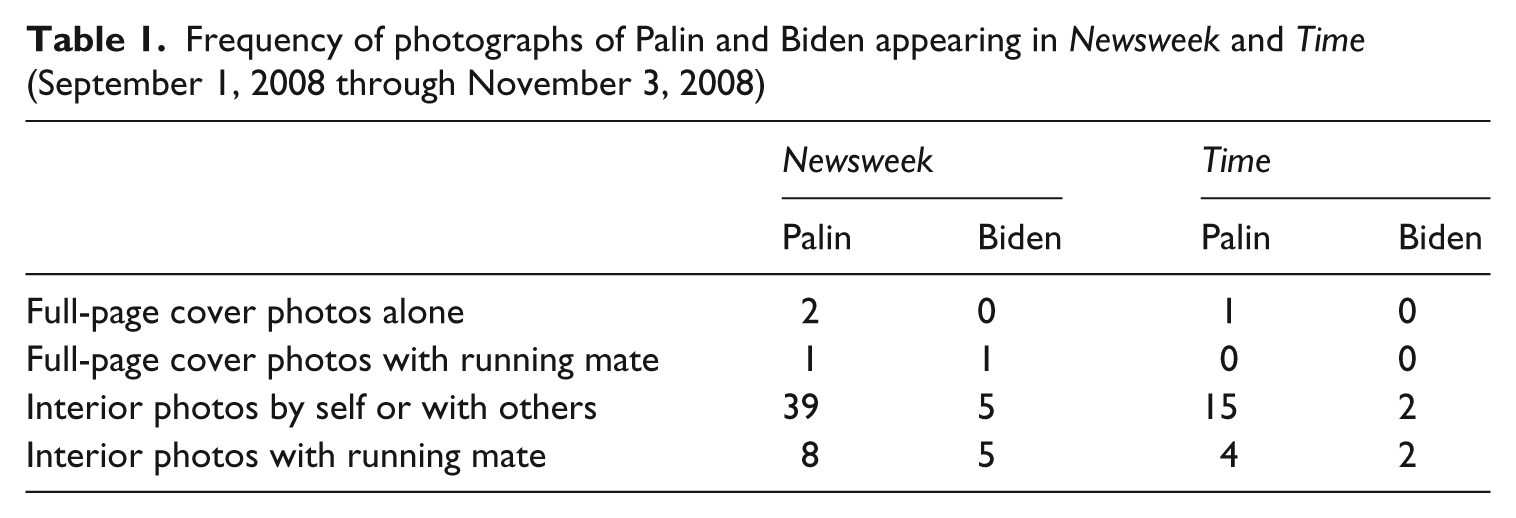
Photo coverage. Data in Table 1 show that photographs of Palin appeared more frequently and were placed more prominently in both Newsweek and Time than did those of Biden.
Frequency of photographs of Palin and Biden appearing in Newsweek and Time (September 1, 2008 through November 3, 2008)
Text coverage. Data show that Palin received considerably more attention than did Biden. Newsweek discussed Palin 37 times and Biden 6 times. Time paid less attention to both of the vice-presidential contenders. Here too, however, Palin received more coverage. She was discussed 13 times, Biden only 4 times.
Did most of Palin’s coverage focus on relatively trivial topics?
This question was addressed both quantitatively and qualitatively. First, the frequency of various topics appearing in discussions of Palin and Biden was recorded. Second, the contents of the five longest feature articles about Palin were analysed in detail.
Quantative data. Table 2 shows that most of Palin’s coverage did focus on trivial topics. Newsweek devoted more than half (58.2%) of its Palin coverage to discussions of her childhood, family, physical appearance and personality. By way of contrast, only 11.9 percent concerned her qualifications for office: legislative experience and understanding of the two major political issues of the national political campaign, the war in Iraq and the state of the nation’s economy. The corresponding figures for Time coverage were similar: 52.3 percent and 14.3 percent respectively.
The small number of discussions of Biden precluded formal comparisons with those about Palin. However, the few that were published in both Newsweek and Time suggest that, while Biden’s personality did appear to be of interest (Newsweek 18.2%, Time 12.5%), neither Newsweek nor Time devoted any attention to the other ‘trivial’ topics in their discussion of Biden. Also by way of contrast to their coverage of Palin, Newsweek considered Biden’s qualifications for office and/or his positions on Iraq and the economy in more than half (54.6%) of its discussions and Time devoted exactly half of its discussions to these topics. Additional data in Table 2 are considered later in this paper.
Frequency of topics appearing in Newsweek and Time discussions of Palin and Biden (September 1, 2008 through November 3, 2008) a

percent totals may not equal 100% due to rounding
Notes
Discussions are at least 25 lines in length. A single discussion can refer to more than one topic.
Includes references to spouse, children, other relatives, social friends, hobbies, lifestyle.
Three characteristics most often attributed to Palin: ‘tough’, ‘energetic’, ‘pragmatic’; to Biden: ‘verbose’, ‘pugnacious’, ‘gaffe-prone’.
Includes both positive and negative assessments of legislative experience and political sophistication.
Other issues include: abortion/traditional family, environment, gun control, religion in schools, size of federal government/government spending, states’ rights, terrorism.
Includes references to reasons for selection as vice-presidential candidate, relationship with presidential candidate, campaign strategies, and endorsements.
Qualitative data. as a qualitative indication of the extent to which coverage of Sarah Palin’s campaign focused on trivial topics, the contents of the five longest articles exclusively discussing Palin and published during the 10-week period are described and analysed below. During that time, neither Newsweek nor Time published a single article of equal length about Joe Biden. That media coverage of Biden’s campaign can be considered minimal is suggested by the fact that, during the period, Time did publish a full two-page article on the wife of the Democratic presidential candidate, Michelle Obama (Sittenfeld, 2008).
Evan Thomas and Karen Breslau, ‘McCain’s Mrs. Right’. Newsweek, September 8, 2008
Opening with brief reference to her working-class origin and to her early years in her hometown of Wasilla, Alaska, population 7,000 – she was ‘Miss Wasilla’ who played basketball aggressively and enjoyed hunting – the narrative moves to her self-characterizations as a ‘hockey mom’ (northern version of ‘soccer mom’) who ‘manages to juggle the lives of 5 children while running the state of Alaska and routinely antagonizing the powers that be’.
Continuing her biography, Thomas and Breslau report that after a short career as a sportscaster, Palin was elected mayor of Wasilla. She subsequently ran for lieutenant governor. Although she lost, her performance at the polls was impressive enough that Alaska Governor Frank Murkowski appointed her head of the Alaska Oil and Gas Conservation Commission. In that role, Palin was ‘shocked by the corruption she saw’. She left the position after less than a year, but not before she had reported on the practices of the Republican state chairman that violated state ethics laws. She also lodged other complaints against the state Attorney General, and spoke out against several pork-barrel projects. Subsequently, Palin turned on Governor Murkowski who was running for re-election and beat him by almost 2 to 1 in 2006.
Palin opposed the extensive federal control over Alaska’s natural resources and the wholesale leasing of its oil to the largest oil corporations. She supported drilling for oil and gas, but wanted more competition from smaller companies.
At the time the feature was written, Palin was under investigation by the state legislature for abusing the power of her office in response to an incident in which the state police were involved in an alleged case of domestic abuse in her family.
The article ends by noting that Palin was a great surprise selection as the Republican candidate for vice president. Subsequently, it notes, Republican spokesmen were ‘spinning as madly and creatively as they could’ to explain her choice given her lack of national political experience.
Nathan Thornburgh, ‘Call of the wild’, Time, September 15, 2008
The article repeats the basics of Palin’s biography: beauty queen turned anti-corruption crusader turned formidable politician. It also reinforces her image as ‘tough’ by providing additional examples of politicians who became ‘casualties of her ambitions’.
While providing very few details, the story points out that Palin consistently expressed a conservative view on a limited set of issues: abortion, gun control and energy/environment. These were the only issues, domestic or international, on which her positions were discussed, however briefly, in any of the five feature articles.
In specific instances, Palin’s conservatism was shown to be tempered by pragmatic considerations. For example, Thornburgh describes how she quit her position on the state energy commission because of her observation of Republican corruption. At that time opposition to abortion and gun control were not the hottest issues in Alaska, rather, they were corruption and cronyism. The account concludes:
Palin’s rise and overnight renown form one of the great arcs of the new century. Is she ready for the tests and attacks that come with that? She has already proved she can play tough, but the stakes just got higher.
Jeffrey Bartholet and Karen Breslau, ‘An apostle of Alaska’, Newsweek, September 15, 2008
The article appears in an issue of Newsweek featuring a cover photo of Palin with a shotgun slung over her shoulder. It is preceded by four entire pages of pictures of Palin and comes before yet another full-page photo of Palin, this time draped in an American flag.
Bartholet and Breslau argue that Palin’s public appeal is not to be found primarily in the policies she advocates. Rather, it is in the personal image she projects.
Palin’s story taps one of the great American myths – the hardy woman of the frontier, God-fearing and determined to succeed against the odds. Her story could be a Capra film, or a chick flick.
The authors focus on what they see as Palin’s total lack of engagement with one of the two or three major issues of the national campaign.
The insurgency next door in Iraq still raged, and politicians in Washington were wrangling over what to do. But Palin had no opinion. ‘I’m not here to judge the idea of withdrawing or the timeline,’ she said. ‘I’m not going to judge even the surge. I’m here to find out what Alaskans need of me as their governor.’
Palin’s understanding of politics is described as an ‘all politics is local approach’. That is, she ‘took the qualities she had as mayor of the small town of Wasilla and applied them to state politics’. Those attributes included ‘a focus on ordinary people’.
She doesn’t put on airs, or pretend she knows more than she does. She seems authentic and gives many voters a sense she’s one of them. ‘Palin grew up embracing the Alaskan ideal,’ says historian Stephen Haycox. ‘Self-reliance, individualism, outdoorsmanship and conservative economic and social values.’
The feature continues by wandering into a discussion of details of Palin’s domestic life. Finally, however, it does return to a politically more substantive matter raising the central question that it sees as confronting her candidacy: ‘whether she’s really prepared to be next in line for the most powerful job on the planet’.
Julia Baird, ‘From Senaca Falls to … Sarah Palin?’ Newsweek, September 22, 2008
From the banner above the title to its very end, the claim is reiterated that ‘history suggests issues of policy will ultimately trump the politics of identity’. Nevertheless, it is also pointed out that the case of Sarah Palin could prove to be an exception to this generalization.
The article noted that Palin was attracting support from Republican women, and from conservative Democratic women as well, because ‘she is one of them, a working mother whose values resonate with other working mothers even when her views may not’. To the audience, she appears to be winning respect for women by demonstrating that she is neither weak nor overwhelmed and is determined to win. Palin ‘works extraordinary hours but appears ordinary, thereby validating all moms and what they do each day – and what they might be capable of’.
When Democrats question how she can do it, Republicans accuse them of sexism and cry ‘Women can do anything’, flipping rhetoric about competent unapologetic working women back in their face.
Baird observes that Palin is widely viewed as a political outsider – as a working-class woman who understands the concerns of ‘average people’. In an election that has been defined as being about ‘change’ by both Democrats and Republicans, this is a distinct advantage. However, she notes, whether this advantage is great enough to make a difference in an election occurring in the context of a recession and an unpopular war remains to be seen.
Jonathan Darman, ‘The Palin Problem’, Newsweek, November 3, 2008
Written just days before the presidential election, when it seemed likely that the Republicans faced defeat, Darman considers the future of the party and Palin’s role in shaping that future.
Rather than blaming her for contributing to the anticipated loss, and dismissing her future relevance in national politics, the author suggest that Palin might help Republicans gain future support from a particularly important segment of the American electorate essential to Republican success. These are ‘common people’ – white, working-class voters who are anti-tax and receptive to conservative appeals on wedge issues such as abortion and gay rights.
Darman notes that, unlike most leaders of the Republican Party, Palin owed little to big business backing. This made it feasible for her to advocate additional positions that appeal to ‘common people’. She could then ‘dispose of any party orthodoxy, that kept her from marrying pitchfork populism with the ideas of the Christian right’. The article concludes:
In the event of a Republican embarrassment on Election Day, the real story won’t be John McCain licking the wounds from his lonely defeat. It may be Sarah Palin in reinventing the Republican Party – not from the middle, but from the right.
Four of the five longest feature articles about Palin contained lengthy discussions of two or more of these topics: childhood/adolescence (articles 1 and 3), domestic life (articles 1 and 3), physical appearance (articles 1 and 2) and personality (articles 1, 2 and 4). Not one of the features contained comparable discussions of her positions on the major issues of the campaign, and collectively they did not picture a political woman who was a sophisticated and experienced candidate competent to deal with such ‘male’ issues as the economy and military affairs. The fifth feature offered an assessment of Palin’s political future and clearly was not dismissive. It will be discussed later in this article.
Was much of Palin’s coverage negative?
Palin’s personality was referenced in 16 discussion in Newsweek and 5 discussions in Time. In these 21 contexts, these adjectives appeared (numbers indicate frequency of occurrence): ‘tough’ (6), ‘ambitious’ (4), ‘energetic’ (3), ‘authentic’ (2), ‘determined’ (2), ‘pragmatic’ (2), ‘strong’ (2), ‘devout’ (1), ‘self-reliant’ (1). Each of these, with the possible exception of ‘devout’, is an attribute likely to be understood as typifying a candidate capable of winning elections.
Palin’s limited political experience was a matter of public record. It was particularly striking when compared with that of Joe Biden, who had served in the United States Senate for 35 years and had run for president in 1988 and again in 2008. Newsweek’s 37 discussions of Palin mentioned her lacking political experience 9 times. The 13 discussions of Palin appearing in Time contained 4 such references. In addition, 3 of the 5 longest feature articles about Palin contained comments on her brief political history.
Discussion of Palin’s policy preferences (12 in Newsweek and 4 in Time) were limited, with one exception, to ideological labeling of her positions on a small set of domestic social issues. Questions concerning the depth of her understanding of these topics were never raised. On the major issues of the presidential campaign, the faltering economy and the war in Iraq, Palin was reported either as lacking clear views or simply as having no opinion.
Was there little coverage of Palin’s positions on most of the issues/policies on which she had expressed an opinion?
During the campaign, Palin stated her views on a wide variety of topics. For example, she favored reduction of capital gains and business taxes and elimination of the estate tax (speech at the Republican National Convention, September 3, 2008), approved preemptive military action in the face of an imminent threat to the US (interview with New York Times writer Jim Rutenberg, September 12, 2008), supported imposing extensive preconditions if the US were to meet with ‘rogue leaders’ such as Iran’s president Mahmaud Ahmadinejad and Syria’s president Bashar al-Assad (interview with CBS Evening News anchor Katie Couric, September 24, 2008) and approved of a two-state solution to the Israel/Palestinian conflict (vice-presidential debate, October 2, 2008). None of these views of Palin was reported in either Newsweek or Time during the period of the study.
By way of contrast, Palin’s position on abortion (it should be banned in nearly all cases, including rape and incest, except when the life of the mother is endangered) was mentioned four times in Newsweek and three times in Time. Her position on environmental issues (increase oil and natural gas exploration, including drilling in the Arctic National Wildlife Refuge) was mentioned twice in Newsweek and also twice in Time. Her view that creationism should be taught alongside evolution in the schools was noted once in both Newsweek and Time.
Were questions raised about the influence Palin would have should she be elected vice president?
Time did not speculate about the role Palin would play in a McCain administration. This could reflect lingering doubts about the importance of the United States vice presidency itself. Newsweek discussed the topic in a feature article (see Darman, 2008, summarized earlier in this section). In the author’s view, Palin would have little power as vice president. Nevertheless, the author concluded that, due to her considerable symbolic appeal to strategically important groups of American voters, she could become a major figure in the future of the Republican Party.
Continuities in media coverage of Sarah Palin and the curiosities of their consequences
Unlike many women candidates who have run for high public office, Palin received considerably more mainstream media attention than did her male opponent. Solely in terms of the amount of media coverage she received, the case of Sarah Palin certainly would neither discourage the public from voting for her nor from contributing to her campaign.
America’s news media are primarily profit oriented rather than public service organizations (Bennett, 2003; Croteau and Hoynes, 2001; Entman, 1989; Gans, 2003). Palin’s extensive photo coverage can be understood as a reflection of the commercial appeal of her physical image. Such coverage may have damaged her campaign and those of other political women. Continually objectifying women candidates promotes their perception as less than competent and less fully human (Heflick and Goldenberg, 2009). Her considerable text coverage could represent media recognition of audience attraction to her entertaining personality and interest generated by her surprising selection as the Republican Party’s vice-presidential candidate rather than her qualifications for office or the political positions she advocated. This would represent continuation and reinforcement of the institutionalized value system of America’s commercial news media rather than a departure from past patterns of gendered reporting on political women. However, in the case of Sarah Palin, ‘objectifying’ photographs and reporting on her few basic qualifications and limited views, may have promoted rather than hindered her campaign. Glamor photos drew attention to her, while pictures of Palin, such as those with her husband and five children, carrying a shotgun, and campaigning in the Midwest standing in front of a frozen custard stand all supported the image that was at the core of her campaign – a tough, tireless ‘hockey mom’, a Washington outsider, a maverick who understood and would represent the interests of everyday people. The metaphor ‘hockey mom’:
[substitutes the] language of strong and victorious politicians and activists with the language of privatization and domestication … the figure of the ‘soccer mom’ works to construct a less threatening identity, one derived in part from traditional stereotypes about women’s ‘proper’ places in combination with more contemporary assumptions about women’s integral function in the labor force as workers, and in the marketing and advertising worlds as a target demographic. (Vavrus, 2002: 108–9)
Because Palin was often described as ‘tough’, the ‘hockey mom’ identity was particularly helpful to her. Media characterization of women candidates such as Geraldine Ferraro and Elizabeth Dole as ‘tough’ cost them the votes of many women who felt threatened by the image of a woman who apparently was successful in a highly competitive profession while simultaneously performing conventional family roles (Falk, 2008). Such women, generally married, white, middle-class, small-town, modestly educated and with traditional values, have received considerable attention as ‘swing’ voters critical to the outcome of recent national elections. ‘The politics of soccer moms have received more play than that of assembly-line or lawyer moms, not to mention the poor moms who try to raise their children with minimum wage jobs’ (Gans, 2003: 62).
Much of Palin’s coverage focused on trivial topics such as her appearance, and personal stories. Repetition of this pattern could harm political women, particularly those running issue-focused campaigns. However, this was not Palin’s strategy. Rather, her campaign centered on the cultivation of an image appealing not just to ‘hockey moms’, but, more broadly, to ‘everyday people’ who had little trust in established institutions and felt marginalized in a complex and rapidly changing political world. In 2008, the story of an attractive, ‘tough’, Washington-outsider who was socially conservative, but pragmatic when politically necessary, could have wider appeal than a story of a candidate with a long political history and sophisticated views on a wide range of domestic and international issues.
Newsweek and Time discussed Palin’s positions on ‘women’s issues’ more frequently than her positions on ‘men’s issues’. This continued a tradition of gendered reporting that has been found disadvantageous to the campaigns of political women. However, in the case of Sarah Palin, the pattern may have promoted her interests by selecting those issues that Palin herself wished to address. Palin rarely stated more than cursory views on economic and international matters. If, in fact, she had them, her expression of sophisticated perspectives on such issues would have been inimical to the cultivation of her image as the ‘hockey mom’ candidate who identified with the everyday citizens who were the target of her campaign. Her prospective voters would seem more likely to find discussions of topics such as abortion, gun control and drilling for oil more appealing than comparatively abstract analysis of economic policies and military strategy in a distant land.
Neither Newsweek nor Time offered much speculation about Palin’s political future should the Republicans lose the 2008 presidential election. However comments scattered throughout the discussions on which this study is based suggested that the media did not take Palin very seriously. For example, it was reported that party leaders were ‘spinning creatively’ to explain her selection as their vice-presidential candidate. The question was raised about whether she was ready to be ‘next in line for the most powerful job on the planet’; she was given the dubious compliment that she did not pretend to know more than she did. Despite this, the one extensive discussion of Palin’s future influence (Darman, 2008) concluded that, in the event of a Republican defeat, her continuing and possibly enhanced symbolic appeal to her target audience could place her in a position of considerable influence in the future of the party.
What the case study suggests
Data indicated that coverage of Sarah Palin reflected most of the long-established media practices of reporting on political women. Contrary to the expected pattern, Palin did receive more coverage than did Joe Biden. However, this could be attributed to the fact that Biden had a long political career and was already well known to the public. Consistent with other research, Palin was objectified in the sense that she was treated as a sex object in references to her beauty queen background, youthful appearance, physical attractiveness and wardrobe (Carlin and Winfrey, 2009). There is evidence suggesting that such coverage was harmful to her career (Heflick and Goldenberg, 2009).
The news magazines focused on topics characterized in the research literature as ‘trivial’, such as her childhood, domestic life and personality rather than her ideological orientation or policy stances. Yet, rather than gendered reporting, this might be explained by the ‘personalization hypothesis’ according to which, in contemporary politics, individual political actors have become more prominent at the expense of parties and collective identities (McAllister, 2007). Personalization is a central formatting bias of American news media (Bennett, 2003: 45–6; Entman, 2010). Alternatively, it might be understood as a reflection of Palin’s campaign strategy with the objective of diverting attention away from her limited political experience and sophistication, while promoting the populist appeal of her personality.
The media did not contend that she lacked personality characteristics necessary for effective leadership. However, frequent reference to her total lack of national political experience and her disengagement from the major national political and economic controversies of the period can be considered negative coverage. Discussion of the policy issues she did address focused on ‘women’s’ issues. Comments dispersed throughout the discussions dismissed Palin’s political future, although the single feature article addressing the topic concluded that she had the potential for considerable influence in the future of the Republican Party. This study supports the conclusion that, with respect to the coverage of political women, the political culture of America’s commercial media remained largely unchanged through decades of election cycles.
Previous studies concluded that such gendered coverage of women’s campaigns has discouraged their potential voters and contributors, and has given other women sober second thoughts about running for office themselves. Curiously, this did not appear to be true in the case of Sarah Palin. ‘Objectifying’ photographs and ‘trivializing’ discussions drew public attention and promoted an image intended to attract strategically important sectors of the electorate. Criticism of her lack of national experience made her a political outsider – a desirable identity in the context of the 2008 presidential campaign. Her failure to discuss the complex issues of the war in Iraq and the faltering economy was not critical to her image-based campaign. Her brief comments on a limited set of concrete and close-to-home issues supported the construction of her image. All of this is consistent with Darman’s speculation (2008) that Palin could be ‘reinventing the Republican Party … from the right’.
Whether or not Palin’s coverage discouraged other women from entering the political arena is an empirical question. However, it does seem likely that potential candidates who understood that reporting as continuing and reinforcing long-established and apparently unalterable patterns of gender portrayals may have lost some enthusiasm for running for office. On the other hand, those who ignored journalism history and saw Palin’s image-oriented campaign as bearing little resemblance to any political appeal they themselves might make, would be less likely to lose any confidence in pursuing a political future.
The way in which a campaign is reported generally represents the result of a struggle between the candidate and the media. The candidate attempts to keep reporting ‘on message’, while the commercial news media are largely concerned with attracting a large market share (Cook, 1996; Graber, 2002; Hollihan, 2001; Miller and Gronbeck, 1996). Media coverage of Sarah Palin was not the result of such a struggle. Rather it reflected the unusual convergence of candidate and commercial media interests.
The image Palin’s campaign was promoting was one that attracted large audiences. What was distracting, gendered reporting for other political women was facilitating reporting for Palin. In 2008, pictures of and stories about a physically attractive, tough, energetic ‘hockey mom’ – a conservative political outsider who avoided pressing national issues but who expressed the concerns of ordinary people, could sell newspapers and magazines and bring viewers to nightly television news.
In the context of a long-established gendered reporting by the commercial news media, women’s political campaigns place unique individuals into unique political environments. The case of Sarah Palin suggests that future study of media and the campaigns of political women should consider the distinctive qualities of individual candidates; their campaign strategies, the particular political environment in which they conduct their campaigns, the formatting conventions of the media, and the ways in which the complex interaction of these variables can produce unique outcomes.