







Abstract
In the more than 50 years following World War II, the concept of ‘push-button warfare’ has continually metamorphosed in media discourses as a symbol of technological warfare from a distance. This rhetorical transformation has occurred within the context of complex social, cultural and historical shifts, and along the way news sources have played a key role in framing debates for readers. Acting as a translator of uncertainty and future scenarios, journalists and others have deliberated on values of and risks posed by automated forms of war and their potential impact on the United States and the world. This article examines nearly 500 print media stories in order to make sense of the shifting dialogue around push-button warfare both in times of tumult and relative calm. The longitudinal study investigates how reporters frame predictions, prophecies, forecasts and expectations when trying to assess future technologies for war and peace.
If push-button warfare Ever comes, Our greatest heroes Will be all thumbs. (Brody, 1965: 14)
In more than 50 years between World War II and the present day, push-button warfare – the concept of an ‘armchair general’, computer technician or political figure pressing a button hundreds or thousands of miles away from a conflict to engage in battle – metamorphosed in media sources from the stuff of doomsday portents and outlandish fantasy to a reality, a sad state of impersonal warfare. Although mentions of button-operated warfare occurred as early as the 1890s, the United States’ dropping of the atomic bomb during World War II truly brought a crisis of control to the fore of media discourses. Between 1945 and 1961, a flurry of more than 350 articles in newspapers and newsmagazines circulated with a range of theories about whether this kind of warfare existed, could exist and should exist. Acting as a translator of uncertainty, U.S. print media deliberated on values of and risks posed by automated war, offering predictions, prophecies, forecasts and contemplations. By the early 1960s, news coverage had died down to but a whisper, only to reappear nearly 40 years later with a surge of stories when the U.S. engaged in conflict with Kosovo. Once again, the issue of ‘pushing buttons’ captured media headlines, invoking Cold War fears of a military run by inhumanly distant button-pushers rather than people on the ground. Subsequent events, including 9/11 and wars in Iraq and Afghanistan, have triggered continued discussion about the place of long- distance, one-touch solutions in war. This article examines the period between 1945 and 2010 in order to understand how the phrase ‘push-button warfare’ has circulated in print media to project the future of automated battle.
A robust community of scholars has addressed the relationship between technology and warfare, particularly from an historical perspective (e.g. Boot, 2006; Bousquet, 2009; Boyer, 1987; Davidson and Levy, 1996; Edwards, 1996; Light, 2003; Virilio, 2000). Similarly, a wealth of literature has examined how reporters treat war in the media environment (e.g. Bennett et al., 2007; Berinsky and Kinder, 2006; Der Derian, 2001; Entman, 2004; Hallin, 1989; Taylor, 1992; Tumber and Palmer, 2004). To date, however, these accounts have paid less attention to the intersection of these two spheres – the point where members of the press evaluate benefits and risks of technological solutions to war and conflict. This article aims to suture these fields of inquiry by studying how media sources negotiate uncertainties presented by automating technologies. Specifically, it focuses on journalists’ strategies of prediction or forecasting, those techniques that try to manage readers’ expectations by framing visions (whether real or imagined) of future warfare. In a variety of circumstances, the media has played a crucial role in sorting out such expectations and making them visible (Hornig, 1993; Nerlich and Halliday, 2007; Petersen, 2001).
In recent years, two veins of scholarship have begun to tackle how various institutions – including the press – manage future prospects, especially those pertaining to science, technology and war. The first defines this area as the ‘sociology of expectations’, arguing that expectations of the future merit inquiry because they ‘link technical and social issues’, acting as both ‘cause and consequence of material scientific and technological activity’ in cases where unknowns outweigh knowns (Borup et al., 2006: 9). Scholarly interventions in this realm have primarily focused on science and medicine, citing cases such as avian flu, nanotechnology, genetics and climate change, and the uncertainties/risks they present (Altheide, 1997; Clarke, 2006; Friedman et al., 1999; Hornig, 1993; Kitzinger and Williams, 2005; Petersen, 2001). They typically investigate a singular moment or short block of years, when discussions of the future crop up in the news due to a constellation of social and cultural forces. A second strand of literature has arisen from Grusin’s (2004, 2010) concept of ‘premediation’, which refers to ‘a kind of cultural reaction formation … to make sure that when the future comes it has already been premediated, to see the future not as it emerges immediately into the present but before it ever happens’ (2004: 20). Building on this idea, De Goede notes that in areas of security and risk management, premediation comes from a desire to ‘imagine, harness and commodify the uncertain future’ (2008: 159; see also Hoskins and O’Loughlin, 2010). This body of work has emphasized that premediation practices emerged largely and intensely in reaction to the events of 9/11, although they began achieving salience in the 1990s.
This article thus builds on existing literature in three regards. First, it studies where prediction meets with life-or-death technological scenarios, raising questions about future expectations in times of war and peace rather than in localized milieus such as individual wars or conflicts (Edy and Melrick, 2007; Reese and Buckalew, 1995). Second, it advances a longitudinal approach to media analysis by considering how the term ‘push-button warfare’ mutated over time and stood as a marker for fears about wars conducted by and with machines. Finally, it examines how ‘premediation’ significantly pre-dated 9/11 in a print media context, as journalists sorted out possible future scenarios of button-operated conflict as early as the 1940s. The article takes a cue from Robinson et al., who call for further research ‘through comparative studies across recent conflicts and earlier ones’ in order to ‘build a more complete empirical and theoretical account of wartime media-state relations’ (2005: 955). This framework offers an opportunity to understand predictions not as isolated incidents but as historically contingent, replicating strains that appear, disappear and reappear in media discourses.
How push-buttons came to symbolize automated conflict
Making sense of journalists’ framing of ‘push-button warfare’ requires first understanding how button interfaces achieved salience as technical and social objects. In 1942, the Los Angeles Times ran an editorial cartoon with the caption ‘Our push button war’, featuring an image of Uncle Sam caught in a tangle of wires and push-buttons that signified the United States’ messy control system. The Oxford English Dictionary cites this editorial as the first instance of the phrase ‘push-button war’, although in fact one can trace the concept of war via buttons back well before 1900 (Sullivan, 1892). Still, World War II marked a turning point in cultural associations with buttons due to an intensifying relationship between war and control technologies. Many historical actors, ranging from politicians to journalists, participated in transforming buttons into ‘the button’ – creating a ‘black box’ that would remain largely uninterrogated for over 50 years (Latour, 1988). This reification of push-buttons offered a powerful sign for making sense of paranoia and anxiety surrounding nuclear war; more concretely, designers and engineers were developing a vast array of products for suburban life that featured buttons – from blenders and garage door openers to reclining chairs and television sets. Push-buttons’ very ordinariness and their ubiquity in everyday contexts made them compelling as rhetorical devices, as journalists marveled at the sheer simplicity of sending a bomb around the world with one touch.
In his discussion of 1950s domestic technologies, Hine notes that: ‘The term “push button” … promised technological complexity, non-involvement with the technology and great convenience. But it was unnerving because it implied a certain loss of control’ (1986: 128). Importantly, Hine points to the interface’s duality of meaning in the 1950s and 1960s, caught in a liminal space between promises of automation and its grave dangers. Use of push-buttons implied ‘space age’ progress, but, in the midst of Cold War politics, the interface took on new meaning. Stories in newspapers and news magazines never discussed exactly what button would be pressed, where this button came from or what it looked like. ‘The Button’ encompassed any kind of sinister weapon that could strike quickly, catastrophically and with little to no human effort. Importantly, although this article focuses on media discourses and their framing, images of push-button war also circulated widely in popular culture texts and images. Films like Dr. Strangelove and the James Bond series, and television programs including The Jetsons created a multi-faceted index of push-buttons as cultural objects and symbols alongside news reports.
A longitudinal view of push-button warfare stories
Between 1945 and 2010, approximately 480 stories circulated about push-button warfare in major newspapers (such as the New York Times, Washington Post, Los Angeles Times and Chicago Daily Tribune) and news magazines (including the Saturday Evening Post, Life, Time and Newsweek). This material was identified using ProQuest Historical Newspapers, Reader’s Guide Retrospective, Google Books and Lexis-Nexis databases. Each article examined for this study made specific mention of ‘push-button warfare’, although in some cases push-button warfare did not serve as the main topic of discussion. Those texts about technological warfare which did not mention ‘push-button warfare’ were not included, as this article aims to make sense of frames, associations and cultural attachments associated with the phrase itself, rather than to encompass all machine-related conflict. Figure 1 depicts ebbs and flows of the term ‘push-button warfare’ in media accounts. Three major ‘spikes’ occurred: 1947 (66 stories), 1957 (38 stories) and 1999 (17 stories) – with a smaller surge in 2001–2 (15 stories combined).
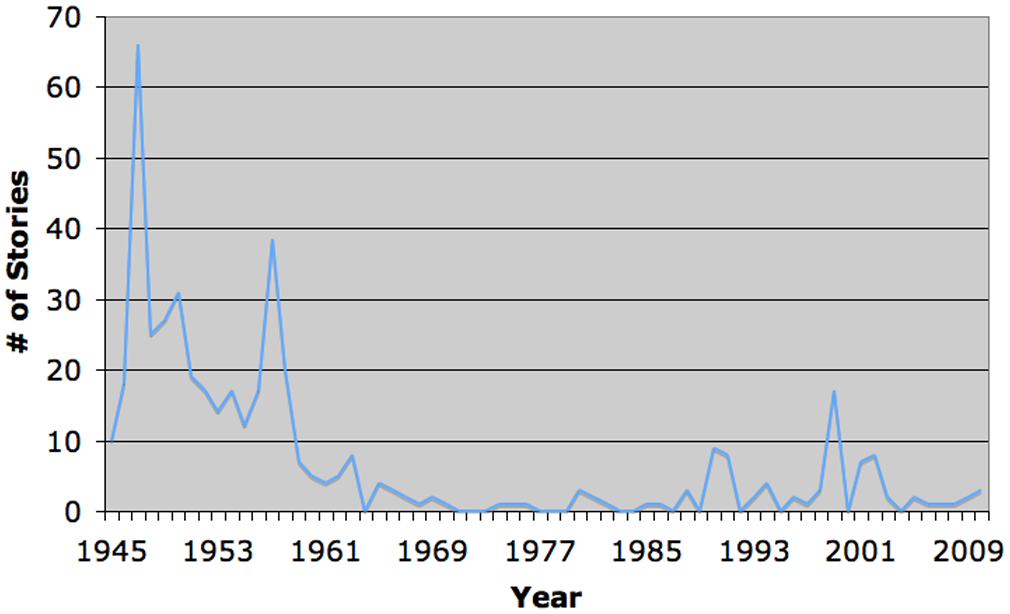
Frequency of stories on ‘push-button warfare’
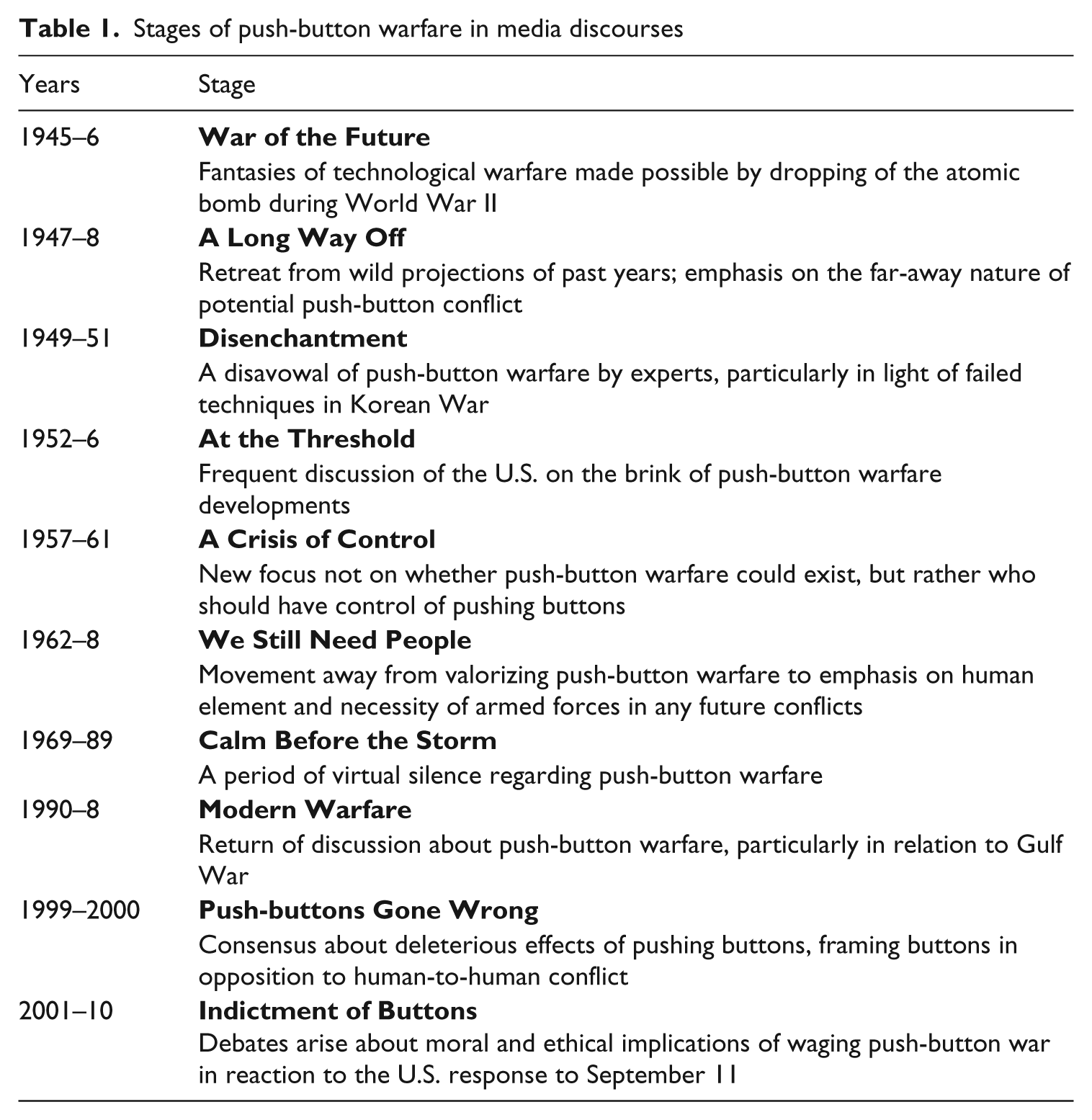
In the following pages, I conduct a qualitative content analysis by interpreting these spikes and the spaces between them, examining journalists’ language and sources, and the historical/social context of the usage. I sort these stories into 10 stages based on commonalities in journalists’ framing of ‘push-button warfare’ collectively (see Table 1). While hard-and-fast breaks did not occur between years, in general these stages represent shifting discourse about the push-button as a symbol of automated conflict.
Stages of push-button warfare in media discourses
From ‘war of the future’ to ‘a long way off’
Journalists, scientists and military personnel utilized news media as a platform for espousing predictions about future conflicts dominated by guided missiles and button pressing. In these media accounts, one can detect palpable uncertainty and near-desperate risk assessment as individuals tried to make sense of what lay ahead. Particularly in the first year after World War II, journalists facilitated discussion about the ‘war of the future’ and what role buttons would play. Elaborate and terrifying scenarios circulated. General George C. Marshall commented to the New York Times in 1945:
[T]here might be two scientists, one in Germany … and one in Washington. As each pressed a button, a horrendous explosion would occur in the other fellow’s territory. This process would continue short of a lucky hit on one of the scientists and his button establishment. (Marshall holds army role grows, 1945: 5)
Marshall used this scenario to suggest the irrationality of push-button warfare and the continued importance of men on the ground, but the effect of his words and others like them did little to assuage fears. Even when experts explicitly discounted the possibility of button-operated war, media frames redirected these stances to encourage readers’ continued interest. For example, in a 1946 article the author wrote that engineer John Northrop ‘says that this country is in no way ready to conduct a push-button war with guided missiles’. Yet the author continued: ‘Northrop’s words should not discourage the people who look forward to the era of remotely controlled warfare with rockets and flying bombs’ (Only 10 years to push-button warfare, 1946: A4). By promoting a fantasy of push-button warfare, journalists stirred continued debate, even when institutional forces pushed back against such imaginative prophecies.
Journalistic optimism regarding future war emphasized timelines in a second stage between 1947–8, when an incredible volume of stories on the far-off (and perhaps impossible) nature of push-button warfare proliferated. Both journalists and their sources fixated on pinpointing the exact time when guided missiles and other automating technologies would become operational, as they tried to anticipate whether this kind of war posed a credible option. Authors of a 12-page editorial in the Saturday Evening Post asked, ‘Are we ready for push-button war? How do we stand now? What are the perils that lay ahead?’ (Alsop and Alsop, 1947: 18). Journalists referred readers to experts who tried to damp down public expectations of a button-pressing future: ‘Dr. Vannevar Bush has little patience with exaggerated pictures of “push-button” warfare evoked by military prophets since the end of the war’, wrote a reporter for the New York Times (Topics of the times, 1947: 24). Particularly in 1947 – one of the ‘peak’ moments of discussion of this topic – prophecies that push-button war would not happen anytime soon seemed only to give the subject increasing momentum. Newspapers cautioned that push-button warfare ‘has not arrived’, that it was ‘but a promise’ or a ‘dim goal’, and that it was ‘not just around the corner’, but rather ‘so far in the future’ (Hurd, 1947; Norris, 1947; Practical advice on push-button warfare, 1947). Wrote one editorialist, ‘This Buck Rogers fantsy [sic] has flowered in a thousand different ways in the past few years. Unfortunately, millions of Americans have accepted the fantasy for reality’ (Childs, 1948: 9). Despite the author’s recognition of a gap between fantasy and reality, the very potential of push-button warfare gave it legs in media discourses well beyond the powers of containment of skeptical experts.
From ‘disenchantment’ to ‘at the threshold’
Where 1945–8 held the promise and paranoia of impending push-button warfare, if not a plan to bring it into operation, ensuing years were characterized by greater cynicism and reluctance in media discourses. Quoting Dr. Lloyd V. Berkner, a Washington Post author reinforced the notion in 1949 that: ‘It’s fairly clear that push-button warfare is a hell of a long way off’ (Carey, B3). Yet, paired with this cynicism came increasing concern over the U.S.’s preparedness for a future conflict with Russia. This promoted dueling narratives of disenchantment and desperation: ‘If guided missile warfare should begin within the next two or three years, we – at our present rate – would be very feeble participants’, Senator Lyndon B. Johnson told the Chicago Daily Tribune in 1950. ‘For a push button war, we have neither the push nor the button’ (Russia winning weapons race, senator says, 1950: 7). Promoting this notion of a race not yet won, Johnson’s words echoed many others in maintaining that the literal and figurative button remained out of reach. Disappointment came in large part from lessons learned during the Korean War, where military men found that traditional on-the-ground tactics remained essential and unavoidable. ‘Today neither the peace, nor the power, nor the push-buttons are actualities’, wrote one reporter, ‘and the war in Korea has been, up to now, very much like past wars’ (Phillips, 1950: SM7). Time magazine went so far as to call push-button warfare a ‘pipe dream’, while Popular Mechanics deemed it ‘tedious and deceiving’ (Dempewolff, 1950: 244; ‘Waging Peace’, 1950). Media stories reeked of antagonism toward promises made but unfulfilled. In 1951, General Brien McMahon, a lawyer and politician with ties to the Atomic Energy Commission, summed up popular attitudes: ‘Those fantastic statements about fantastic weapons are entirely too fantastic. No right thinking person is going to be misled by all this superman talk or push-button warfare’ (Laurence, 1951: 12). Importantly, despite consensus about the all too ‘fantastic’ nature of pushing buttons, the story did not reduce in terms of frequency or insistency during this time or in years to come.
In 1952, renewed enthusiasm permeated media discourses when the air force began testing pilotless planes in Korea. The Chicago Daily Tribune heralded this coming of push-button warfare as ‘electrifying news’, while an editorialist for the Los Angeles Times predicted that soon the military would conduct all war from ‘plush leather armchairs’ (Geyer, 1952: A5; Robots to fly atom bombs, 1952: 1). In the latter author’s imagination, pale, ‘push-button aviators’ would replace the tanned, athletic pilots of World War II, putting big brains at a premium in relation to heroism or strength. These colorful prophecies soon gave way to further disillusionment. According to Life magazine: ‘Some reporters in Korea last week thought they had their teeth in the story of the year: the announcement that push-button war had begun.’ Unfortunately, the magazine noted, these ‘gaudy’ accounts missed the mark by overbilling technological progress (Much ado about ‘push-button’ war, 1952: 35). Another reporter for the Los Angeles Times, contradicting its editorial writer, even called the excitement in the press an ‘excess of enthusiasm’ (Preview of push-button warfare, 1952: A4). This boomerang effect repeated in the 1940s and 1950s as journalists tried to reconcile expectations, fantasies, paranoia and ambivalence, making for a cacophony of press coverage with little consensus emerging.
While the Korean War did not bring push-button warfare to fruition, as many had hoped, it did spark a flurry of experimental activity in the realm of button pressing, encouraging the story to thrive in press environments. With this activity came a new framing of the ‘threshold’ as a metaphor for the U.S.’s foray into automated war. In 1953, a reporter noted that although ‘the military has long discouraged the idea that pushbutton warfare would materialize in the predictable future’, in fact new developments might ‘suggest that we are coming to the threshold of a new era’ (Pushbutton warfare comes closer, 1953: 12). Similarly, in the same year an editorialist wrote, ‘We are just on the threshold of radical new developments in warfare’ (Nike’s nests, 1953: A4). Two years later the same language persisted. According to the Wall Street Journal, the U.S. stood on ‘the threshold of a procurement revolution that [would] swing it from conventional to push-button war goods’ (Trussell, 1955: 1). Some journalists even began calling for increased public information, with implications that push-button warfare developments were taking place, only in secret. According to another editorialist: ‘The American public, which will be anything but a bystander in push-button warfare, has not been very generously treated as to basic information’ (Alexander, 1955: A5). In the years of such ‘threshold’ discussion, journalists had begun to distance themselves from experts in political and military arenas; most stories included an acknowledgment of the armed forces’ skepticism over push-button warfare, but these stories then went on to discredit such sources, who had vested interest in keeping their knowledge private. Here, media stories took on a watchdog function, but they also helped to manage future expectations – pushing forward the tide of push-button warfare whether or not experts saw fit to agree. In 1956, even as Secretary of the Army Wilber Brucker denounced publicly the ‘dangerous myth’ of push-button warfare in a press conference, newspapers and magazines continued to report its imminent arrival. One columnist told readers that although the button scenario ‘sounds like a science fiction nightmare’, in fact it was ‘frighteningly real’ (Norman, 1956: 12). This collision of myth and speculation made the ‘threshold’ stage one of heightened uncertainty.
A ‘crisis of control’
The year 1957 marked another ‘peak’ regarding the volume of stories written about push-button warfare, yet the tenor of these stories began to shift. Rather than try to predict when or whether automatic warfare would come to fruition, journalists began emphasizing the need to understand who would bear responsibility for pushing buttons in the event of a global crisis. This emphasis, and the timing of a large body of stories, stemmed in part from an accelerating space race with Russia and the development of Sputnik, as the U.S. and the Soviet Union ‘engaged in an immense, intense race to improve missiles to the ultimate point of “push-button warfare”’ (Soviet missile, 1957: 99). A Washington Post editorialist worried: ‘Suppose someone less responsible … accidentally pushes the wrong button, or deliberately pushes the right button?’ (Pearson, 1957: D7). A journalist in 1958 concurred: ‘At the heart of the struggle between sometimes contradictory strategic doctrines is the key issue: Who gets the pushbutton?’ (Norman, 1958: C8). And The Sun in 1960, in one of the most chilling discussions of button-pressing, proposed the following scenario: ‘If one or many of these ICBMs ever are fired in anger, nothing can bring them back. Thirty minutes after a man in Altus pushes a button, thousands of people in another land will be dead’ (Sehlstedt Jr, 1960: A1). The simplicity of pressing a button in one part of the globe and taking thousands of people’s lives in another part echoed ominously. This crisis of control – who should have the right to press buttons and how to stop enemies with such power – concerned even staunch optimists.
A race toward push-buttons and the right fingers to press them also caused some journalists to indict nay-sayers from years past. Rather than only reinforce frames of consensus in which the media uniformly agreed with its interviewees, a number of voices suggested the importance of their earlier predictions. One editorialist in 1957 bitterly noted that President Truman’s ‘second guessers […] might have done better if they had given thought to [possible push-button warfare] when they had the responsibility of delivering the goods themselves’ (The second guessers, 1957: 24). Two years later another editorialist complained:
When this newspaper years ago was preaching the necessity of getting rid of such cloistered notions and preparing for a radical transformation in the art of warfare, our ideas that wars of the future were likely to be pushbutton operations by ‘generals in business suits’ found scant favor among the prophets of obsolescence. (Let’s not be lunatics about Lunik, 1959: 14)
These rare recriminations against government officials reflected conflict between old prophecies and new, between dissenting voices in media spaces where expectations and future thinking found little resolution.
While journalists busily forecasted a new era of control via push-buttons, experts quoted in most of these sources repeatedly reinforced the necessity of ground troops in any upcoming conflict. A 1957 article, for example, featured a subheading entitled, ‘Need men to push buttons’, noting that many wrongly assumed that buttons would replace GIs on the battlefront (Raymond, 1957: 1). That same year the Los Angeles Times quoted General Nathan Twining, incoming chairman of the joint chiefs, who warned: ‘In spite of all this push-button warfare you read about, the night fighters are going to be with us as far down the road as I can see’ (Aerial chief prefers men to missiles, 1957: 5). In 1959, one reporter also emphasized the need for people to press buttons, but depicted a future in which experts would choreograph war from ‘secret, mechanized nerve centers’. Still, the writer put people at the center of any potential conflict (Closer than we think, 1959: J9). This pushback against idealists appeared frequently in news media. Officials in the armed forces fought vehemently to maintain their utility in a future conflict; to many, the greatest threat posed by the push-button was that it could make an entire profession obsolete.
In the early 1960s, paranoia over who would control the button persisted, with ongoing dystopic scenarios playing out in media discourses. A journalist for the Washington Post wrote in 1961: ‘Of course, [Mr. Kennedy or Mr. Khrushchev], being lunatic, may push his button. Of course one or the other, by misjudgment, may drive his rival into such a corner that there is no escape except button pushing or surrender’ (Alsop, 1961: A15). In the days at the height of the Cold War, the button came to represent the vast and terrifying power that two competing politicians’ fingers possessed. Another writer asked, in response to such terror: ‘If the United States and Soviet Union started their bomb dropping tomorrow, how would they know when to stop? … What about push-button peace?’ (Stone, 1961: 19). In this forward-looking assessment of the U.S.’s involvement in geopolitics, the author craved a quick-fix solution. For each of these journalists at the end of the 1950s and into the early 1960s, prophecies focused not on whether the U.S. or the Soviet Union could achieve push-button warfare, but rather what catastrophe might occur if someone actually pressed the literal or figurative button.
From ‘we still need people’ to ‘calm before the storm’
From 1962 on, the debate on the subject of ‘push-button warfare’ cooled down in the popular press. Tensions had waned somewhat between the U.S. and Soviet Union, the conflict in Vietnam began to escalate, and neither journalists nor military experts viewed automating technologies as a solution to the world’s problems. As a result, a noticeable shift occurred, with a frame of consensus emerging that promoted the value of people over push-buttons. Time magazine wrote in 1962 of the ‘old guard’ of soldiers who had witnessed failed attempts at fantastic weapons, noting that ‘these men think that they will be the ones who, even in a pushbutton war, will have to do the fighting’ (Those young men in mufti, 1962). Although many military officials had advanced this party line from World War II on, most journalists now seemed to accept such rhetoric, advancing stories that supported a future of hand-to-hand combat over technological warfare. A year later, The Sun quoted Secretary of the Navy Fred Korth, who suggested that ‘pushbutton warfare never will eliminate the need for dedicated military professionals’ (Pushbutton war limit stressed, 1963: 4). By 1965, when few stories on push-button warfare even appeared, General Thomas S. Power wrote a special article in which he forcefully commented:
[M]any people seem to think that … ‘push-button warfare’ …] leaves little else for the military man to do besides figuring out what button to push and when. But all the electronic brains in the world cannot take the place of the human mind and brain. (1965: A6)
The general’s comments reflected the fact that, as military technology grew increasingly sophisticated, expectations of button-operated conflict grew dimmer. Experts resisted the notion that ‘electronic brains’ or push-buttons could replace the human element; journalists did little to contradict this view.
Diminished interest in push-buttons also occurred due to greater commitments to Vietnam, a war that the United States could not win, despite its best efforts, with technology. In the same year that the U.S. began deploying troops into Vietnam, an American officer quoted in The Sun suggested, ‘We have pretty well discarded the idea of some kind of laboratory, push-button warfare in which rockets would do all the work’ (GIs practicing with red guns, 1965: 5). The end of the 1960s ushered in a period of virtual silence on the subject of push-button warfare that would last for the next two decades. Gone were both wild fantasies and vehement dismissals of a future war controlled by push-buttons. What had once provided a meaningful frame for understanding the relationship between technology and geopolitics now seemed nothing more than a relic of a past moment. On occasion, in this stage of ‘calm’, a journalist would resurrect the phrase, as in the case of an editorialist in 1980 who asked, with regards to gender equality in the military, ‘Will it really matter, in the push-button war of the future, whether the fingers on the buttons belong to men or women?’ (Raspberry, 1980: A19). Importantly, the author still referred to the push-button war as one of the ‘future’, enacting a common strategy of imagining conflicts beyond what one could reasonably know. It is unsurprising that the phrase ‘push-button warfare’ would all but disappear from media discourses in the 1970s and 1980s, as it evoked a highly specific cultural and historical moment; more surprisingly, however, the term reappeared with force in the 1990s, hearkening back to the past and offering a new vision of the future.
From ‘modern warfare’ to ‘push-buttons gone wrong’
The United States’ involvement in the Gulf War precipitated renewed talk about war and technology. In 1990, the Star-Ledger noted that, since the dropping of the atomic bomb, push-button warfare had been a ‘dreaded term’. The newspaper suggested that, in a new age of technological sophistication however, ‘the button that the soldiers of the future may be pushing is on a mini-computer that is still under development’, where buttons would call up information rather than bombs (Finger on the button, 1990). Repurposing the phrase ‘push-button warfare’ in a late 20th-century frame, the author imagined doomsday buttons as the new interfaces of high-tech, information-driven warfare. Writers for Newsweek in 1991 admitted that, despite earlier realizations that ‘push-button, remote-control war won without casualties’ was an unrealistic prospect, in fact ‘the promise of high-tech warfare still beckons: to move men farther and farther from the killing fields’ (Thomas and Barry, 1991: 38). And in 1994, a World War II veteran commented, ‘Whether it’s a push-button war or whatever, it’s going to take the old foot soldier to go in there and mop it up’, much as military officials had proclaimed during the Cold War (Estes, 1994: A15). By 1998, a reporter stated bluntly, ‘There is no such thing as a “push button war”, recalling the stance of many others 40 years prior (The perils of a ‘feminized’ navy, 1998). These approaches demonstrate the multiple frames through which journalists and experts interpreted expectations of war from the vantage point of the 1990s. ‘Push-button warfare’ came to represent everything from the nuclear holocaust of the past to the high-tech, ‘modern’ war of the future.
Despite new technological advances employed in Desert Storm, journalists and experts focused very little on pushing buttons, with only a handful of stories circulating between 1990 and 1998 – while indeed a techno-war, it did not spark debates over the country’s moral, ethical and social relationship to military technology. Things changed notably, however, in 1999 when U.S. President Bill Clinton considered long-distance military action in Kosovo. In the context of this intervention, both journalists and members of the armed forces began criticizing Clinton’s approach, using the phrase ‘push-button warfare’ in a derogatory way with regard to the president’s unwillingness to engage troops: ‘The pro-peace crusading Democrats are satisfied with bombing’, wrote an editorialist. ‘[T]hey’re predatory in their support of a safe push-button war’ (Kass, 1999). Another journalist similarly questioned: ‘[D]oesn’t removing the element of sacrifice through push-button warfare somehow corrupt even the most nobly motivated war?’ (Apple, 1999). These brief excerpts demonstrate a new frame at work, in which journalists explicitly pitted push-buttons against people; one could either conduct a war based on sacrifice and human skill, or one could antiseptically dictate from a distance. More than 50 years after the U.S. dropped the atomic bomb, the country struggled with prophecy-turned-reality.
The ‘element of sacrifice’ mentioned above repeatedly appeared in the ‘pushbuttons gone wrong’ frame that circulated widely in 1999: ‘[T]echnological warfare doesn’t demand much personal sacrifice’, a writer for USA Today lamented. ‘All we need to do is plot vectors and push buttons, from 100 miles away or 4 miles above’ (Reich, 1999: 23A). A journalist for the Boston Globe painted an image of a multi-tasking soldier – the ‘push-button warrior’ – who could drop bombs one day and do homework with his kids the next, without his children ever knowing that ‘Daddy has been to war’ (Canon, 1999). Another reporter called this a video game syndrome in which ‘we will fight for a moral goal as long as nothing morally ambiguous happens’ (Dowd, 1999: A25). These stories, fueled by partisan politics, framed ‘push-button warfare’ quite differently than their predecessors. They took issue not with whether push-button wars were possible, or who should push buttons, but rather whether one should use push-buttons in wars at all. Yet despite this turn in interpretation, a central tension remained across decades of press coverage between the humanness of warfare and machines that could make humans largely irrelevant. Cynicism had invaded press coverage when Cold War prophecies had become too real, possible and simple.
Particularly reflecting attitudes of the 1960s, a number of discussions emphasized the need for ground troops over technology. Speaking to the U.S.’s success in the Gulf War, President George H.W. Bush commented to the Houston Chronicle: ‘We could not have won with robots and people sitting back in Washington pushing buttons. … [Y]ou will never eliminate the need for committed, well-trained people on the ground’ (Hassell, 1999: 14). Bush’s emphasis on the human element strikingly echoed the words of officials in the Cold War era, when push-button technologies posed a threat to the structure, purpose and value of armed forces. At the same time, the president’s quote appeared in an article entitled ‘Wired for battle – fantastic new technology may change the face of warfare in the next century’ – a journalistic frame that suggested, despite objections to the contrary, that technology would play an invaluable role in battles on the horizon. Once again, journalists looked to the future, emphasizing button pressing as one of many technological possibilities. The timing of the Kosovo conflict in 1999, as the world stood on the brink of a new century, most certainly contributed to this introspection and speculation. Journalists, political figures and members of the armed forces renegotiated what the future might hold, and the concept of ‘pushing buttons’ again achieved salience after nearly 30 years of dormancy. By invoking the phrase ‘push-button warfare’, journalists transported from the Cold War a complex mix of anxiety, fantasy, prophecy and expectation that colored interpretations of Kosovo and warfare more broadly.
Gathering ‘indictments of buttons’
Where push-button interventions existed largely hypothetically in the 20th century, technological advances in the 21st century brought the question of button pressing sharply into focus. Although the dramatic paranoia and optimism that characterized earlier periods did not return, moral and ethical questions remained. The events of 9/11 and subsequent interventions in Iraq and Afghanistan ensured the continued cultural relevance of the phrase. In 2002, one journalist reported that, ‘Push-button warfare, largely by pilotless aircraft, including a “hypersonic” missile that could knock out a mobile rocket launcher 600 miles away in no more than 15 minutes, is among the Pentagon’s goals’ (Pentagon emphasizes ‘push-button’ warfare, 2002: A4). Push-button warfare seemed a natural strategy to deal with the unnerving aftermath of 9/11. Still, however, experts resisted any suggestions that the U.S. could fight a war without the skill and sacrifice of human beings. According to a writer for the New York Times, ‘[Donald Rumsfeld] has warned that the campaign against terror will be lengthy, costly and bloody – the antithesis of a push-button, cruise-missile war fought at long distance’ (Shanker, 2002: A10). Similarly, one journalist reported skepticism among some defense analysts, who worried about ‘the message that wars can be fought with few casualties by “push-button warfare”’ (Pentagon starts shift away from Cold War strategy, 2002: 15A). Fundamental definitional issues arose about the very nature of war.
In more recent years, push-button warfare discussions have centered on ethical dimensions. Commented a reporter in 2008: ‘Push button missile warfare might unleash regional terrorism and conventional warfare without regard to civilian casualties’ (Corsaro, 2008). A year later, author and academic P.W. Singer warned in the New York Times that ‘The drone warfare pioneered by the C.I.A. in Pakistan and the Air Force in Iraq and Afghanistan is the leading edge of a wave of push-button combat that will raise legal, moral and political questions around the world’ (Shane, 2009). Another journalist emphasized that ‘Washington is struggling to understand the long-term implications of a push-button conflict’ (Mazzetti, 2009). And an editorialist for the Christian Science Monitor, calling for greater consideration of drone warfare, wrote in 2010 that:
It’s easy to understand the appeal of a ‘push-button’ approach to fighting Al Qaeda, but the embrace of the Predator program has occurred with remarkably little public discussion, given that it represents a radically new and geographically unbounded use of state-sanctioned lethal force. (Adams, 2010)
Each of these samples points to political and ethical indictments of warfare from a distance. Even though drone warfare and its related technologies hardly resembled potential push-button warfare of the Cold War, journalists and political/military experts alike turned toward the button as a representative icon of automated conflict. Anxiety loomed large in these media accounts because the U.S. had finally achieved its mission – begun as early as the 1940s – to remove one’s enemy with a simple push of a button.
Conclusion
Between 1945 and 2010 an incredible spectrum of stories proliferated on the future of automated warfare. As an historically contingent concept, ‘push-button warfare’ has constantly evolved, depending on its use, its user and the events in question. To try to pin down one definition of ‘push-button warfare’ thus proves neither possible nor desirable; rather, the mutating quality of the phrase provides insight into the ways that journalists, politicians, members of the armed forces and others negotiated the uncertain terrain of international conflict. Discussing what it might mean to push buttons and launch a missile halfway around the world, historical actors participated in media discourses in order to filter anxieties and produce predictions and theories in a kind of ‘premediation’ characterized by vivid rehearsals of possible scenarios (Grusin, 2010). At times ‘push-button warfare’ represented the nation’s hopes for control, for preventing casualties, for furthering the nation’s prowess as a superpower. At other times, the phrase recalled fears about instant extinction, a failure to get to the finish line first, and a loss of morality. ‘Pushing buttons’ has served – and continues to serve – as a salient journalistic frame for working out visions of future war, particularly at those moments of greatest uncertainty and hysteria.
This study has focused on expectations and predictions and the ways they play out when technological affordances come to fruition. By the late 20th century, when push-button war no longer referred to a future fantasy or fear, participants and observers were forced to cope with the messiness of predictions-turned-realities. That anxiety has continued to proliferate in a post-9/11 context, with journalistic frames trying to sort out perceived binaries of human/machine, manual/automatic, sacrifice/cowardice, etc. By recycling these binaries, media accounts have never fully begun to process the rich and complex dimensions of long-distance, technological warfare. In fact, ‘push-button warfare’, especially in the present moment, seems to offer a limiting frame, caught between Cold War paranoia and futuristic idealism. It remains difficult for media discourses to get beyond the button, given the interface’s potency as a symbolic object. As recently as 2009, for example, when U.S. Secretary of State Hillary Clinton tried to present Sergei Lavrov with a ‘reset’ button to reflect new and peaceful ties with Russia, the symbolic gesture failed as the button’s label accidentally translated to read ‘overloaded’ or ‘overcharged’, triggering a flurry of media stories about the embarrassing miscommunication (Button gaffe embarrasses Clinton, 2009). While news sources and world leaders try to collectively reevaluate and ‘reprogram’ what push-buttons mean in the 21st century, it becomes that much more important to understand why symbolic objects take hold – and how they help/hinder discussions of socially and politically charged issues that persist over time.
By analyzing more than 50 years of press coverage, this article has emphasized the importance of historical specificity and longitudinal analysis for academic work on media, technology and society. While case studies that examine individual episodes of forward-looking discourses meaningfully contribute to a dialogue on societal expectations, attention to the long term can help scholars to understand how future visions mesh (and conflict) with actual outcomes. Suturing the past with the present and with possibilities still imagined offers a new way to measure what might have been, what is and what could be. Media discourses offer a rich environment for studying expectations, as they serve as incubators for discussion about society’s most basic hopes and fears. Previous studies have shown that, particularly in times of political consensus, such as during the Cold War, journalists ‘tend to act as “responsible” members of the political establishment, upholding the dominant political perspective and passing on more or less at face value the views of authorities assumed to represent the nation as a whole’ (Hallin, 1989: 10). In the case of ‘push-button warfare’ discussion throughout the Cold War, however, journalists’ frames often ran counter to dominant attitudes of military and political figures, as they doggedly advanced forward-looking views about potential button-operated war. By following how journalists make sense not only of news, but also the absence of news – those wild predictions, expressions of fear and emotional appraisals based on what the future might hold – we can begin to understand how expectations matter deeply to social attitudes and to the development and use of new technologies in times of war and peace.