







Abstract

The world in which communication and media studies grew up is manifestly changing. By general agreement, the sources of the most influential academic thinking about media and communication lie in the USA and western Europe, which have long been home to the universities and journals that dominate the field. The experiences and assumptions of scholars located in the ‘advanced global North’ have defined the problems investigated and the methods employed to investigate them. This has always meant that the primary concerns of the field were defined by representatives of a small part of the human story. Even in 1950, as the field was beginning to take shape, the combined populations of Europe and North America accounted for only 28.4 percent of the world total. Demographic developments are rendering this concentration even more unrepresentative: today these populations account for around 15.6 percent of the world total and the projection is that by 2050 Europe and North America together will account for 12.5 percent. At the birth of the field, however, the economies of these regions were overwhelmingly dominant, and still today they, together with that of Japan, are larger than those of the rest of the world taken together, but technical, social and economic changes are eroding this preponderance. The majority of universities with research ambitions, and the funding sources to pursue them, remain within this small segment of humanity, but that will certainly change, and with it communication and media studies will have to change.
The depth of these changes, their future pace and direction, and the likely outcomes are all extremely uncertain. In this short introduction, I will comment only upon two of the factors involved. The first is the consequences of the shift in global power away from the advanced global North towards other countries that have developed rapidly in the last couple of decades. In particular, I will contrast the USA and Japan with the situation in the group of countries known as the ‘BRICS’ (Brazil, Russia, India, China and South Africa). Second, I will look at the impact of technical change upon the media in the advanced global North. On the basis of these investigations, I will make some suggestions about the future of global communication and media studies.
Economic realities
The shift in economic power away from the advanced global North is a well-known phenomenon. Between 1970 and 2010, the US economy grew roughly three times in constant 2005 dollar terms. During the same period and in the same terms, the Chinese economy grew roughly 35 times. These relative growth rates mean that the centre of the world economy is moving away from the advanced global North. Figure 1 gives a very rough idea of the change in the balance of the world’s economic activity between the USA and Japan on one hand and the BRICS from 1980 to 2010. 1 The trend is an established one, predictions for future GDP growth suggest it will continue, and its ramifications have been explored in many different contexts.
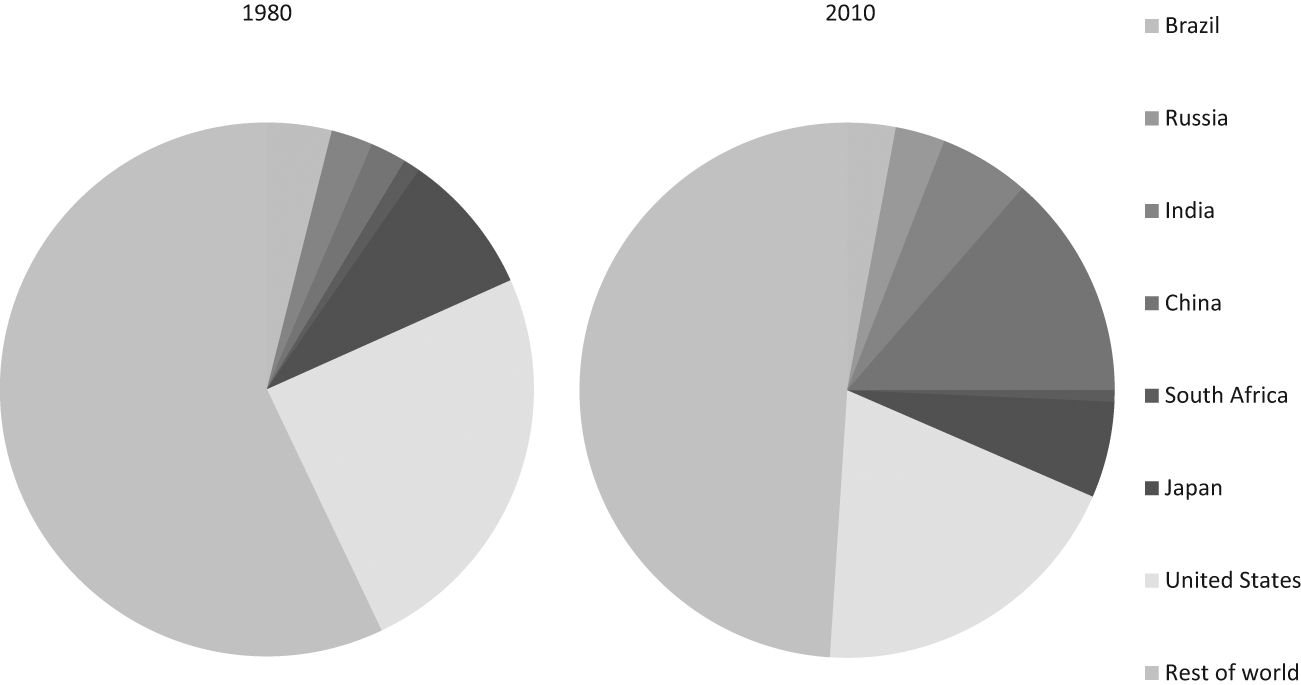
Percentages of world GDP for selected countries
What Figure 1 also illustrates, however, is that the shift is a protracted one. In absolute terms it is far from the dramatic picture of western collapse that is sometimes painted. It is true that, in PPP (purchasing power parities) terms China, which is the country that has demonstrated the most spectacular growth, is now the second largest economy in the world, but the record of growth of the other BRICS is much less impressive and, taken together, they still only account for roughly a quarter of world GDP. Adding in the other economies of the advanced global North would make its continuing domination even clearer. Similarly, while this economic growth has lifted hundreds of millions of people out of the most miserable poverty, GDP per capita is still very much lower in the BRICS: in 2010, China’s per capita GDP was $US4428.50 as compared with $US47,198.50 in the USA.
There is, however, one economic indicator on which the BRICS have caught up, and sometimes surpassed, much of the advanced global North: despite dramatic reductions in absolute poverty, they are starkly unequal countries. Table 1 gives the Gini coefficients for selected countries. 2 As is clear, the BRICS share comparably high levels of social inequality with the USA (and the United Kingdom, for that matter). The reasons for this remain obscure: it cannot easily be attributed to supposed Asian cultural values, since Japan is an example of a country with a relatively low score; it is not directly related to the kinds of market imperfections that are obvious in China, since the USA, Singapore and Hong Kong are highly market-oriented economies; neither does it directly correlate with political systems, since Japan (long dominated by a rightist party) shares a score with Sweden (the nirvana of social democracy).
UNDP estimates of Gini coefficients 2000–11
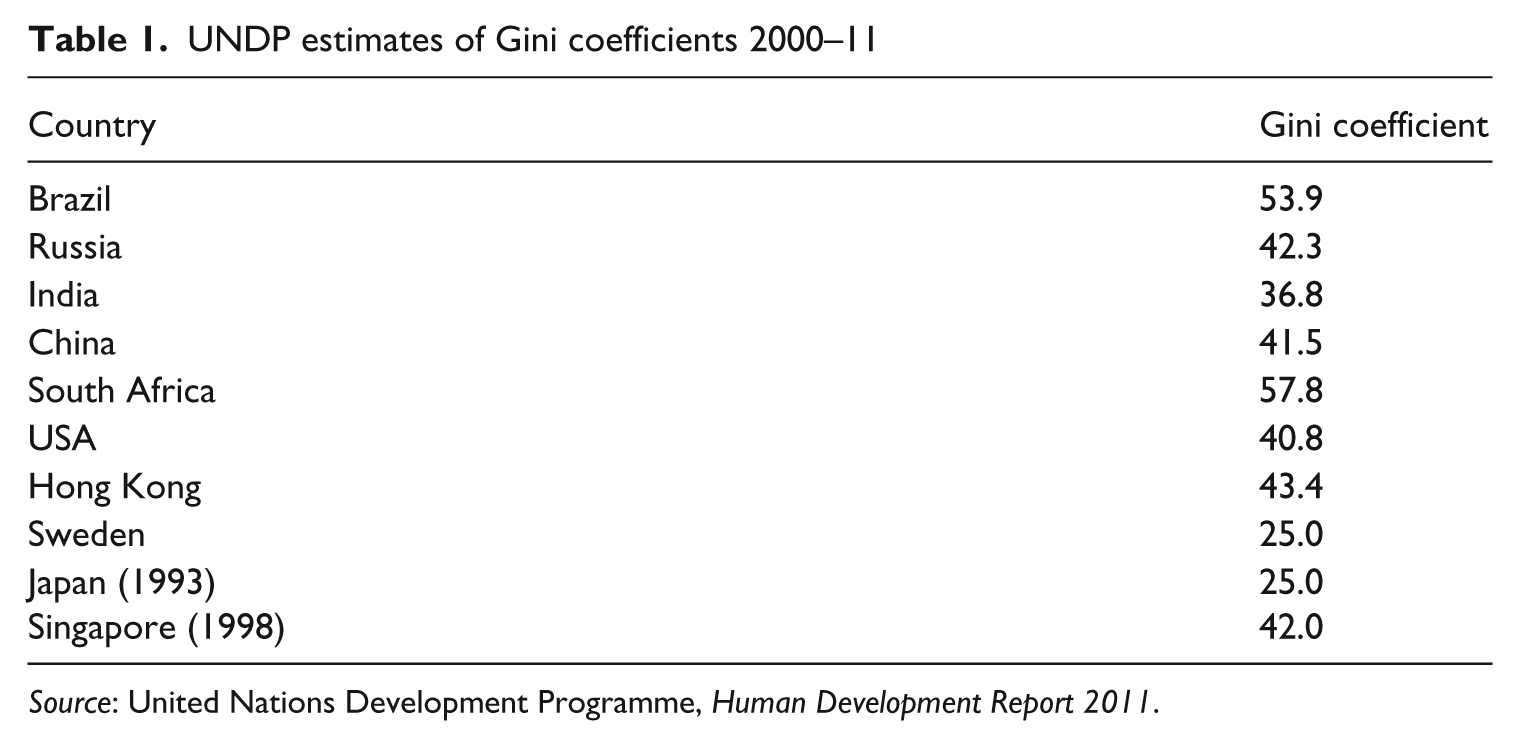
Source: United Nations Development Programme, Human Development Report 2011.
The overall economic picture is thus fairly clear: there is a shift in the centre of economic power away from its traditional seat in the advanced global North, although this is nowhere near as dramatic as is sometimes argued. Politically, however, the picture is rather less clear. There are problems of legitimacy in the advanced global North, and there are certainly popular protests in many, if not all, developed countries, but the issues tend to be posed more starkly in other societies. India is, of course, ‘the world’s largest democracy’ but its duly elected government faces armed peasant uprisings in several states, while estimates of the number of ‘mass actions’ in China last year run to around 200,000. 3 Overall it would be fair to say that the ruling classes in these emerging economic powers do not enjoy the same degree of legitimacy as do those in the advanced global North. Their political futures are relatively uncertain, and upheavals might have substantial economic consequences. On the other hand, the legitimacy of the ruling classes in the advanced global North is a product of half a century or so of substantial economic success and the effect of relative decline and increased international competition are unpredictable. Economic change will impact on political arrangements around the world, both within countries and between countries.
Consequences for the media
It was always a mistake to start from the assumption that the social positions of the media in the North were in any way representative of the human experience, and still more of an error to take them as a normative standard against which other arrangements could be judged. The changes discussed above are making such views even more untenable. As Daya Thussu shows in this section, the Indian media system is experiencing a major expansion, both in newspapers and broadcasting. More generally, eight out of ten of the newspapers with the largest circulations are published in Asia and four out of the five countries with the most newspaper titles in the world are BRICS. 4 In terms of numbers of stations and of titles, size of readership and audiences, the centre of the world media industry is definitively not to be found in the advanced global North. 5
That evident fact, however, needs as much qualification as do the economic realities discussed above. Although the absolute size of the economies of the BRICS is growing, the fact that they all have low per capita incomes means that the revenues that can be gained from paid consumption are relatively low, so one of the main growth areas of television in the advanced global North faces real limits elsewhere. Similarly, the advertising backbone of both the printed press and free-to-air television is of a different scale in the two regions. As Figure 2 demonstrates, although advertising revenues in the BRICS are growing rapidly, they are still dwarfed by the giants of the advanced global North. In real terms, US advertising expenditure has actually fallen over the decade, reflecting the severity of the current economic crisis, but even taking that into account, it is still more than eight times larger than that in China, which has overtaken Brazil as the largest in the BRICS. The harsh reality is that, in international terms, the media of the BRICS remain financially very much weaker than their actual and potential competitors in the advanced global North. Where they might expect to command economic parity is likely to be in the provision of media financed through luxury consumption. The sharp income divisions revealed by the Gini coefficients, combined with the huge scale of the populations in question (at least in China and India) means that while the revenues available to mass media proper are constrained, those media with elite audiences can prosper.
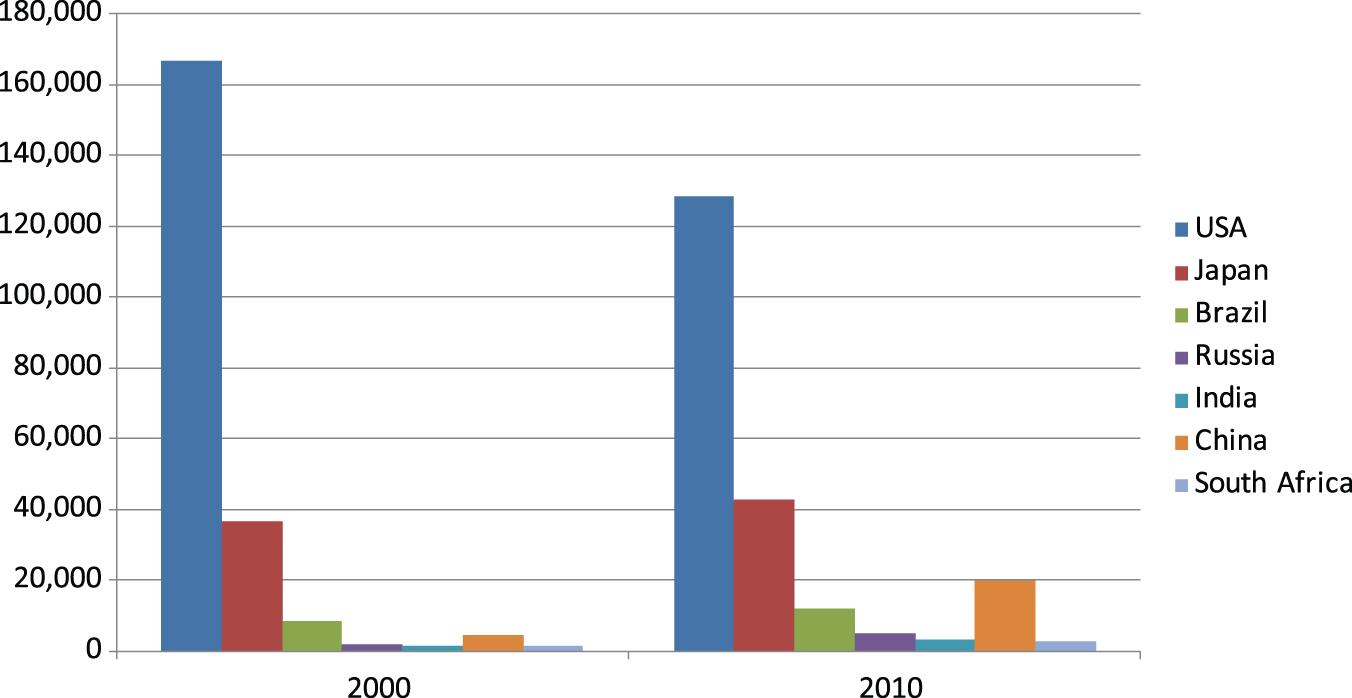
Advertising expenditure 2000–10 at constant 2005 $USm
Within this relative poverty of resources, there are a several ways in which the situation of the media is radically different from that in the advanced global North. There, the direct bribery of journalists and media organizations is relatively rare. All of the BRICS score rather poorly, and very much worse than the advanced global North, on Transparency International’s ‘Corruption Perceptions Index’, although this is limited to public sector corruption so it is not direct evidence of pervasive bribery in the media. It is, however, generally agreed that in all of the BRICS there is widespread direct payment to journalists and media organizations: what is ‘red envelope journalism’ in China is ‘brown envelope journalism’ in South Africa and paid-for political reporting in India. The evidence is strong that there are close formal and informal links between journalists and media on the one hand and the holders of economic power on the other.
Relations between the holders of political power and journalists and the media are more complex. Issues of media freedom are mired in controversy, but of the BRICS only South Africa is in the top half of ‘Reporters Without Borders’ Press Freedom Index 2011–12. If one sticks to relatively hard evidence of the threats to journalists’ life and limb, Table 2 demonstrates clearly that they are very much greater in most of the BRICS than in the advanced global North, although one wonders where responsibility for the 151 journalists and media workers murdered in Iraq between 2003 and 2011 should be placed. 6 At a structural level, the lines of division do not seem to run so simply between the advanced global North and the rest of the world. For example, journalists in the USA and South Africa, at least those working for newspapers, probably have more in common in terms of their distance from political power than do those in the USA and Japan.
Persecution of journalists in selected countries
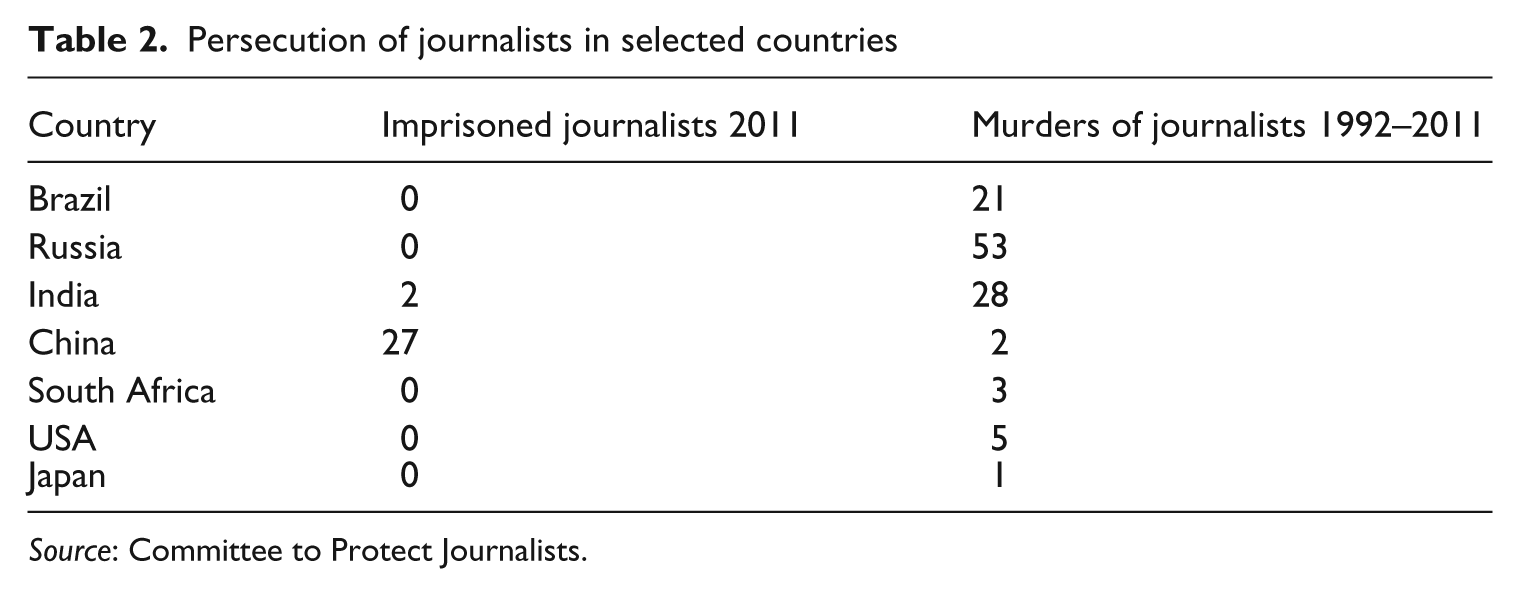
Source: Committee to Protect Journalists.
If one accepts that there are real and persistent differences between the media of different countries in the advanced global North, let alone between them and at least some of the newly developing countries, then this raises the question of how the evident economic and political changes examined above will work their way through in the media. There is a long tradition in media and communication studies, stretching from theories of network society through transitology, right back to modernization, which argues that the future of the rest of the world is already written in the prevailing conditions in the advanced global North. At a greater or lesser speed, the rest of the world, including obstinate highly developed hold-outs like Japan, will converge on the model pioneered in the USA. In order to assess the truth of such claims, we need not only to understand the dynamics of the newly developing economic powers but also how the media in the advanced global North are changing.
Broadcasting and the press
Mass media and communication studies have, for more than half a century, been concentrated upon broadcast television and the newspaper press. Other important media, notably radio and the magazine press, have received far less scholarly attention. Whether this was justified or not is beside the point; these two media, in the advanced global North, display symptoms of deep crisis, originating in profound social and technological changes.
Free-to-air television, broadcast through a limited array of channels, was for long the central cultural resource of developed societies. It was through this medium that audiences experienced a diet of drama, entertainment, news and other cultural forms. These experiences were available to, almost, the entire population: after the initial period of cost and scarcity, television receivers became, in effect, universally available, and the funding of broadcasting through advertising or taxation meant that there was no reason for price discrimination in programme consumption. Mass audiences received high-quality programming at a very low individual cost. Around these conditions were built elements of commonality that were central to the constitution of society: news with Walter Cronkite or Trevor MacDonald; I Love Lucy or Eastenders; the Superbowl or the FA Cup Final, were political and cultural experiences shared by more or less the whole of society.
Two changes have disrupted that pattern: the shift to multi-channel provision and the growth of subscription television. The effects of these changes are two-fold: on the one hand multi-channel provision fragments the mass audience, and with it the revenues that any programme can generate; the shift from free-to-air to subscription means that price discrimination can be introduced into programme consumption. These developments have perhaps the longest history in the USA, but the wealth of the media market in that country has meant that the consequences have not been so readily apparent. Audience fragmentation, and consequent revenue fragmentation, has had a relatively muted effect since a small share of a very large pie can still be more than adequate for some purposes. 7 If there has been a shift in the programme mix towards cheaper forms like reality television, there has at the same time been a renaissance of high-quality drama amongst broadcasters freed from the cultural taboos that the mass audience and the advertisers imposed in the days of channel scarcity. Similarly, the relatively high absolute income levels even amongst the poorer sections of society have meant that subscription payments have been affordable for a quite substantial proportion of the audience. In other societies, where the process has happened much more rapidly and the absolute income levels have been lower, the effects have been more pronounced since the size of the market that has fragmented is relatively much smaller. Free-to-air broadcasting has been impoverished, subscription television is mostly derivative, and access to premium content has become expensive. Today it is discretionary spending rather than imposts effected through taxation or higher retail prices that is the dynamic area of television revenue growth. 8
Newspapers have experienced a different crisis. In the USA, circulation began to fall in the late 1980s. This was before the internet was widely diffused, before graphical browsers were available, and before there were any consumer-oriented online news services. While the internet and online news may have accelerated the decline, the fact is that people, particularly young people, became more reluctant to purchase and read newspapers long before they had access to Google News. In itself, this has not meant disaster for the newspaper industry, since the proportion of its revenues that came from subscriptions revenue has long been rather low – around 15 percent during the 1990s, for example. In fact, for more than a decade after circulation began to decline, total subscription revenues increased, beginning to fall in the mid-2000s, and then only declining relatively gently. Although the circulation decline indicates a developing crisis of news consumption, it does not in itself constitute a threat to the future of the newspaper press.
Such a threat does indeed exist, and it is indeed mediated through the internet. The most dramatic effect of the internet upon newspapers has not been the ways in which they are accessed, or even the ending of the geographically enshrined local news monopolies they so long enjoyed in the USA. Much more serious has been the economic effect of the shift online by advertisers. As Figure 3 illustrates, online advertising now clearly surpasses newspaper advertising. True, some of the online advertising goes to newspapers, but very little. In the USA, roughly 48 percent of online advertising spending is with search engines (mostly Google), and for every $1 a newspaper gains in online advertising it loses $7 in print advertising. The fact that it is also very hard for most newspapers to charge for online content adds to this problem, but it is not the crux of the matter since, as we saw above, subscription revenue only ever constituted a small proportion of total revenues.
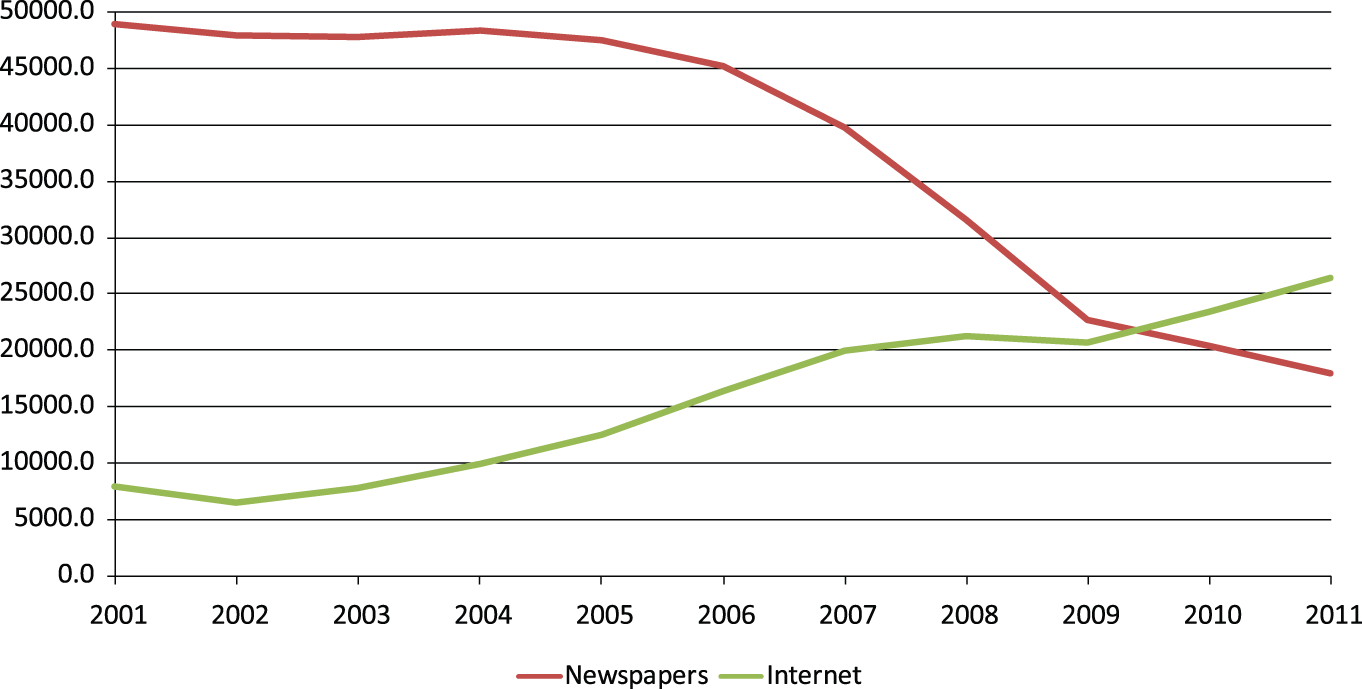
US advertising revenues in constant 2005 US$m
Faced for the first time in about 50 years with serious economic competition, the US newspaper industry is being forced to reconsider some of the assumptions upon which journalism has rested. Quite apart from the fact that some titles have already closed, the survivors are cutting newsroom staff, on one account by 30 percent between 2000 and 2010, and the idea of journalistic autonomy embedded in the commitment to a serious news agenda has come under strain in the effort to retain readership and advertising. 9
This pattern of crises is not reproduced uniformly across the advanced global North: the USA is perhaps the most extreme example of what elsewhere are much less serious problems. There is, however, enough evidence to suggest that the confident assertion of the superiority of the media structures and journalistic models developed there can no longer be sustained. At the very least, the structures and content of the main mass media are in the process of radical revision. For example, the central concepts of neutrality and balance have always fitted very well a situation of monopoly, or at most comfortable oligopoly, and the genuine strengths of US journalism reflect the economic realities of its media markets. Increasing competition leads to market segmentation and to partisan journalism, as the UK national press market so clearly demonstrates, and we can already see some evidence of that emerging in the increasingly competitive US television news environment.
The plain truth is that even if the current economic problems are replaced by another epoch of generalized prosperity, and the relative decline of the advanced global North is slowed or reversed, these changing market conditions mean that the media whose study provided the material for our field will in future be profoundly different. It is certainly true that these problems are not shared, today at least, by the media of the newly developing economies: as the World Association of Newspapers headlined a recent report, there is ‘Gloom in the West, boom in the East.’ It is, therefore, unlikely that, as the processes of economic, political and media change in the BRICS and elsewhere continue, the result will be media that closely resemble those with which we are used to working.
The future of media and communication studies
The call to ‘de-westernize’ media studies is hardly a new or revolutionary one: Curran and Park’s well-known book with that title is already more than a decade old. Nevertheless, relatively little has so far been achieved: the contributors to this section are unanimous in seeing the task as one for the future and none can yet point to any strongly developed alternative to the western orthodoxies. There is a very good reason for at least part of this failure: changes to the academy have not kept pace with changes in the world economy. For choice, ambitious young scholars still go to the US or Europe for their training, and the best and most energetic of them often remain there to make their careers. The universities of the newly developing economies are still, for the most part, struggling with the legacies of inadequate funding, political restrictions and linguistic disadvantage, and are not yet able to provide an equivalent platform for original research.
The consequences of these continuing imbalances are clearly visible in the practices of the International Communication Association (ICA), one of leading international organizations in this field. The ICA has long suffered from a disjuncture between the rhetorical claims of its title and the reality that its membership and interests come largely from the USA. In recent years, it has made serious efforts to address this issue, but it still demonstrates strong evidence of domination by scholars working in the advanced global North. So, for example, participation in the 2012 ‘Virtual Conference’, which was organized in parallel with its physical conference, obliged the authors of selected papers to choose from a pre-determined list of key words. The list included ‘race,’ which is of course of central importance in understanding media in the USA, but did not include ‘caste’, which Daya Thussu notes is of central importance in the study of Indian media. 10 The list included ‘Twitter’, which is entirely justified since it has more than 300 million users around the world, but did not include ‘Weibo’, which has more than 300 million users in China, and which Hu and his colleagues (in this section) note plays a central role in discussions of contemporary political communication in China. Neither ‘imperialism’ nor ‘colonialism’ were key words, nor were any possible synonyms for these concepts, despite the certainty that, as Waisbrod (this section) and Kupe (this section) argue, they had indisputable historical impacts on the media in Latin America and Africa, and arguably have a more general relevance for contemporary issues around the world. It was almost certainly not the intention of the scholars who selected these key words to privilege the media experiences of around 300 million people over those of nearly 6000 million people. On the contrary, I am sure their conscious desire was to be as internationally inclusive as possible. The problem is deeper than that: the unconscious working assumptions of the scholars who make decisions in an international forum like the ICA, and those who edit journals like Media, Culture & Society, remain rooted in the conviction that our own way of looking at the world is the normal, natural and universal one.
There is, however, a much more difficult issue at stake than the personal limitations of scholars in the advanced global North: to what extent do the concepts and methods which the field currently employs have any claims to universality at all? In the natural sciences all is simple: the laws of physics are the same in Seattle, São Paolo and Shanghai and there is no point in trying to develop a ‘de-westernized’ physics, although different cultures may operate with assumptions that make discovering, understanding and applying these laws more or less difficult. The dominant current in the social sciences, which is very well represented in media studies, at least aspires to the same status: surely our task is to try to discover invariant laws that operate independently of social and geographical location? Those currents of media studies deriving from the humanities have tended to the polar opposite view: social meanings are inherently local and contextual, and any attempts at universal grand narratives are bound to be imperialistic in one dimension or another. The former position, of course, leads to an unreflective universalism, which at least in the past was frequently the servant and agent of genuinely imperialist agendas, while the latter offers little purchase on the commonalities of human experience and its stress on particularism provides a weak ground for any critique of the ways in which local despotisms sustain themselves. 11
Resolving this antinomy will become an ever more pressing issue as the factors discussed above work themselves through in the media and in the academy. If a naïve, sometimes complicit, universalism of progress towards modernity, defined in explicitly western terms à la Daniel Lerner, is impossible any longer to sustain, we can certainly point to some very powerful structural features, for example manifold and apparently increasing social and economic inequalities, or rapid processes of urbanization, which are both evidently more or less universal and impossible to deny. The solution to the conundrum cannot, therefore, be to junk all of the insights of the kinds of media studies developed in the advanced global North and start afresh, and differently, in each part of the world. If one major part of developing a media studies adequate to the new realities is developing theories that can account for their particularities, another, at least as important, lies in interrogating theories developed elsewhere to discover how much, if anything, of the insights they offer is genuinely universal.
Space permits only one brief example of how this might be done. The concept of ‘journalistic professionalism’ is a central one in studies of news, and it is indelibly marked by its Parsonian associations. There have been many influential attempts to export it around the world as a universal reality of media practice. Some of these have been crassly uncritical but others have been genuinely reflexive and illuminated important aspects of media realities. It is certain, however, that this is a polyvalent term even in its home in the advanced global North, and it is at least arguable that its centrality derives from specific features of journalistic practices and self-conceptions that can be placed historically within the same social space. There are certainly grounds for considering whether it is an appropriate category to analyse journalistic practices elsewhere: too often it is employed in an idealized form as a normative standard against which other practices are, predictably, found wanting. A critical interrogation of the concept, however, reveals that some of the issues it addresses may well be of much wider relevance. In the narrow, but certainly not trivial, sense, the technical competences necessary to transform the infinite variety of events into the recognizable forms of news, within constraints of time and in line with the established requirements of different organizations, are certainly widespread. More broadly, the structural ambiguities of journalists as employees of large, hierarchical and bureaucratic organizations subject to external direction, and their attempts to negotiate that position, are indeed, if not universal, at least very widespread. 12 Negotiating the interplay between adaptation, autonomy and subordination constitutes the reality of the working situation of most journalists. It makes better sense to take these constituent elements of journalistic practice as the starting point for a theory that would indeed have a wider validity, rather than beginning from a pre-defined concept that closes off such an exploration.
From this perspective, what we think we know about the media in the advanced global North does not need to be abandoned in the search for new theories that can account for the new realities. Rather it needs to be critically examined and stripped of its ideological dimensions. Building on that basis, perhaps we can construct theories of the media that will illuminate not only the media of emerging world powers but also help us better to understand those of the advanced global North itself.