







Abstract
This article posits that a spatial discourse can be discerned in broadcasting and media policies in India that has framed nationalism, globalization, sovereignty, and citizenship. Through a range of spatial practices, India’s nation-state has historically elaborated two overlapping modalities of power: national sovereignty from 1947 to 1990, and governmentality since 1991. To understand the spatial discourses and the modalities of power we need to move beyond methodological nationalism: that is, explanations that treat state as a container and a fixed entity, where social relations are organized within territorially bounded national spaces. The article demonstrates that the spatial discourse of the state can be grasped through a transnational framework that considers national and international as part of the wider global field of relations.
In recent years, postcolonial media scholars have begun to focus their attention on the dialectical relations between state and media policies (Chakravartty, 2004; Jeffrey, 2006; Kumar, 2006; McDowell, 1997). While such scholarship has persuasively analyzed the construction of nationalism, examined the debates surrounding autonomy and deregulation in Indian media policies in the context of economic liberalization, a significant absence from this body of work is an engagement with how the concept of sovereignty is being reworked in the moment of globalization. In addition, two issues manifest within communication research and postcolonial media studies that pertain to an understanding of state as a container and a fixed entity and the absence of adequate theorization of broadcasting and space. According to Raka Shome (2003: 40): ‘communication research, for the most part, has yet to address in a systematic way the role space plays in the (re)production of social power’. In recent years, a few studies – collected in a book, MediaSpace (Couldry and McCarthy, 2004) – have taken up questions of space in terms of different media modalities: radio, television, computers, and video-gaming. Clive Barrett (2004) offers persuasive theoretical reflection on space and public life via the specific writings of John Dewey, Harold Innis, and Raymond Williams. Despite these contributions, broadcasting and space in the postcolonial contexts remains unexamined. More importantly, however, such studies have not produced a theoretical account of how broadcasting and media policies are connected with state spatialities.
This article makes two interrelated claims. First, a ‘spatial’ discourse can be discerned in broadcasting and media policies that has framed nationalism, globalization, sovereignty, and citizenship; and, through a range of spatial practices, India’s nation-state has historically elaborated two overlapping modalities of power: national sovereignty from 1947 to 1990, and governmentality since 1991. 1 Second, taking a cue from Manu Goswami’s (2004: 4) insights, I suggest that in order to understand the spatial discourses and the modalities of power, we need to move beyond ‘methodological’ nationalism: that is, explanations that treat state as a container and a fixed entity, where social relations are organized within territorially bounded national spaces. Indeed, the spatial discourse of the state can be grasped through a transnational framework that considers national and international as part of the wider global field of relations. To this end, the article examines particular imaginations of nationalism and globalization, and demonstrates how the spatial constructions of sovereignty and citizenship – both in terms of abstract principles and performative practices – have been/are produced in broadcasting and media policies. This article proposes to rethink the history of Indian broadcasting and media policies by foregrounding the question of space, and argues that a spatial approach opens up fresh new insights on broadcasting and media policies not only in the Indian case, but also in postcolonial and other contexts as well.
In the first section, I outline the theoretical underpinnings of my arguments by drawing upon a number of studies that have developed key ideas pertaining to state, power, policies, and spatialities in the work of Antonio Gramsci, Michel Foucault, and Henri Lefebvre. The second section examines spatial contexts of nationalism, globalization, citizenship, and sovereignty in Indian broadcasting, and in the third section, I analyze a range of spatial discourses through which sovereignty, territoriality, and citizenship have been produced in media policies. Finally, in the fourth section, the conclusions are situated against the background of the findings.
State, power, and policies: toward a spatial perspective
Monroe Price (2002: 13) offered a substantive normative framework to account for a range of state strategies in coping with sovereignty and authority. Price pointed out that: states have undergone frenzied testing of new and modified techniques aimed at regulating, if not mastering, the market for speech in response to the forces that seem to undercut their autonomy … there is a shift away from the regularly inward forms of state control to outward-looking, regional, or multinational approaches.
Price’s broad-based ‘mixed’ model approach sheds light on how states reassert their power through a combination of strategies: regulation/deregulation of communication media, and policy transfer mechanisms.
Sandra Braman (1995: 4) commenting on the complex relationships between state and media policies, urged that communication researchers pay greater attention to the epistemological issues in media policies because ‘failure to understand the state leads to an inability to analyze policy [and] understanding information and communication policy as power is particularly important in today’s environment’. Following Braman’s arguments, Stephen McDowell (1997) considered India’s software policy in terms of a concept of network state. However, this article posits that Gramsci’s concept of hegemony, along with Foucault’s notion of governmentality, combined with Lefebvre’s theory of state spatiality gives analytic insights into the power dynamics of the postcolonial state, construction of sovereignty and citizenship in broadcasting, while enabling a detailed analysis of the intertwined relations between nationalism and globalization. 2
Pointing out that cultural and media studies have typically ignored policy dimensions in understanding the relations between culture and power that has a bearing on theories of the state, Tony Bennett (1992: 23) argued that culture, power, and policy are central to the ‘field of government’. Taking a cue from Bennett and other scholars like Ian Hunter, Terry Flew (1997: 90) pointed out that Foucault’s notion of governmentality is an important counterpoint to various state theories beset with problems of reductionism and functionalism. Flew maintains that: Foucault proposed a move from sovereignty to materiality of power relations [and] from state theory toward what can be termed as a general theory of government, where the conduct of the state shifts from a primarily juridical to an increasingly administrative and technical basis. (1997: 90)
Flew also suggested that ‘theories of governmentality’ are particularly attuned to policy discourses that seek to link individuals, ideologies, institutions, and social programs via a range of ethical, moral, and reform techniques.
Applying the concept of governmentality 3 to state spaces, James Ferguson and Akhil Gupta (2002: 981–2) argued that because states are ‘powerful sites of symbolic and cultural production’, that they ought to be considered as ‘spatializing’ apparatuses, and that ‘discussions of the imagination of states have not attended adequately to the ways in which states are spatialized’. They usefully extend Foucault’s ideas via the notions of ‘vertical encompassment’ and ‘transnational governmentality’ to study the spatial properties of the Indian and South African states in terms of large-scale development policies.
The work of Partha Chatterjee (1993) and Gyan Prakash (2000) usefully deployed the notion of governmentality, thus moving away from overarching state theories, to probe the formation of culture and power in colonial and postcolonial contexts. Postcolonial scholars pointed out that Foucault paid little attention to the effects of colonialism in developing theoretical formulations about modernity, power, and governmentality. Nonetheless, the concept of governmentality has been productively reworked to examine colonial rule in India. In his study of the Indian nation and nationalism, Chatterjee (1993) offered a brilliant critique of Benedict Anderson’s ideas on nation and nationalism as ‘modular’ forms common to Europe, Asia, Africa and Latin America, However, Chatterjee’s thesis that the Indian bourgeois nationalists divided social practices and institutions into two broad and distinct domains, the material and spiritual, was critiqued by Manu Goswami (2004: 24) as well as Gyan Prakash (2000: 170) for positing the spiritual domain as being a pure, autonomous repository of cultural difference. According to Chatterjee (1993), the material domain represents the West (which the nationalists called ‘outside’) and the spiritual domain represents the East (termed ‘inner’). Goswami noted that the two domains were increasingly shaped by geographic and spatial imperatives of colonialism and capitalism, and Prakash (2000: 179) argued that the ‘material’ and ‘spiritual’ division frequently overlapped, and in fact: ‘subjugation drove anti-colonial nationalism in a more ambitious direction as it simultaneously drew upon and transgressed inner/outer dichotomy, distinguishing community from the state while seeking to realize the former in the latter.’ In the following analysis, drawing upon Goswami and Prakash’s critiques, I shall demonstrate some of the contradictory spatial modalities and contexts through which anti-colonial nationalism borrowed the procedures of colonial governmentality, and how Nehru’s nation-building project incorporated Gandhian ideas and idioms as they sought to articulate conceptions of nation, sovereignty, and citizenship in the sphere of broadcasting and media policies.
Satish Deshpande’s (2000: 183) discussion of Indian nationalism via Foucault’s notion of ‘heterotopias’ is persuasive and offers substantial analytic insights into how particular spatial strategies brought together the ‘physical-material and mental-imaginative aspects of social space’ in the hegemonic construction of nationalism. A significant feature of Deshpande’s study is its ability to examine the overlapping spatial practices of nationalism that allows him conceptual clarity in showing how distinct forms of nationalism – Nehru’s economic geography and Sarvarkar’s sacred geography – get embedded in nation-state practices. Deshpande noted that during the 1950s and 1960s, nation was thought as a space of production and imagined in terms of various economic associations, and the names of regions and towns where large-scale public sector corporations were established became the principal heterotopias fashioned by Nehruvian regime. An important absence from Deshpande’s study, however, is the role of global relations in shaping India’s nationalist discourse. An engagement with Henri Lefebvre’s writings on state spatiality would have provided the way forward, and not only shed more light on the spatial transformations of nationalism but also illuminated the role of transnational forces that inflected the Nehruvian heterotopias.
Manu Goswami (2004) and Subir Sinha (2008) argued that nationalism has been historically produced in terms of global restructuring of inter-state relations and as transnational development regimes. Indeed, for Sinha (2008: 59, emphasis in original): ‘the periodization of the history of development as part of a national history is inadequate, and … it needs to be located on another register, that of transnational regimes’. In contrast to Deshpande’s approach and other Foucault-centered studies, Goswami extended Lefebvre’s theory of state spatialities to examine historical-geographic developments of Indian nationalism from 1885 to 1930. These developments, Goswami (2004: 244, emphasis added) pointed out, were marked by global restructuring of capitalist relations where the ‘self understanding and trajectory of colonial India was inseparably tied to colonial spatial practices and capitalist expansion’.
For Goswami, Lefebvre’s work offered a critique of both the Cartesian conceptualization of a bounded and pre-given container notion of territoriality as well as the discursive approaches to space in favor of materialist understanding of space embedded in social relations. Sinha (2008) examined several community development programs in postcolonial India, not only as a result of a global restructuring of inter-state relations (pace Goswami) but also in terms of a wider set of ideas that flowed among several individuals and institutions that he characterized as ‘transnational development regimes’. Both Goswami and Sinha present key arguments on the historical-geographic aspects of nationalism in colonial and postcolonial contexts. Thus, on the one hand, their analysis is attentive to the transnational and spatial contexts of nationalism and, on the other, it leads to a deeper understanding of sovereignty and territoriality.
Drawing insights from the preceding discussion and, more specifically, Lefebvre’s (1974: 38) notion of ‘representations of space’, this article considers sovereignty, citizenship, nationalism, and globalization as spatio-temporal concepts. In Lefevbre’s theory of space, outlined through a tripartite model, space is socially produced and characterized in terms of ‘spatial practice’ (perceived space), ‘representations of space’ (conceived space), and ‘representational space’ (lived space). Since the focus of this study is the production of space in broadcasting and media policies, I draw upon the concept of ‘representations of space’, a dominant form of space tied to relations of production, characterized as the ‘space of scientists, planners, urbanists, technocratic subdividers and social engineers’, through which power and hegemony are materialized.
For the purposes of this article, I define sovereignty as the power of the state – and other national and global entities – to reorganize and control space through policies, legislation, law, or other extra-legal activities. A persuasive account (Held, 1995: 20) of globalization refers to it as ‘the stretching and deepening of social relations and institutions across space and time’, and nationalism is understood as involved in the political and economic ‘production of space’ that is marked by territorial and geographic associations. Goswami and Sinha’s work offers concrete analytic strategies to study the spatial discourse in broadcasting, particularly in terms of how nationalism and globalization have been and are involved in the reshaping of sovereignty and citizenship.
Broadcasting and space
The 19th-century expansion of colonial rule in India coincided with the establishment of the principles of liberalism in Britain. Liberal theorists reframed the concept of sovereignty to include citizens’ rights and freedom. However, these principles contradicted colonialism in India. In order to justify colonial rule, theorists like John Stuart Mill produced intellectual arguments for the postponement of giving these rights to Indians on the grounds that they had not yet reached the stage of political and civilizational maturity. As an organizing discourse of colonial sovereignty, then, liberal imperialism shaped administrative and bureaucratic procedures that the British applied in terms of various ‘state projects’ in India – geographic, cartographic, statistical surveys, enumerative practices, etc. – in the name of colonial modernization. Indeed, the configurations of colonial forms of sovereignty in India operated through several overlapping layers of power involving local landholding elites, provincial rulers, and religious authorities, who were granted permission by the colonial state to impose taxation, and adjudicate local courts and panchayats (village councils), but the ultimate power was vested in the British colonial state (Hansen, 2008: 172).
The colonial construct of sovereignty – and with it, the procedures of governmentality – significantly shaped the spatialities of broadcasting. An example of liberal imperialism articulated in the Plymouth Report published by the Colonial Office in 1937 situated broadcasting as part of the ‘machinery of civilization and administration’ of native populations. Although the colonial and postcolonial spatialities of broadcasting exhibited distinct modalities of power, they share several common ideologies. For instance, colonial broadcasting’s centralized control, program formats, and construction of audiences through essentialized cultural categories were imbricated with the postcolonial state’s upper-caste and -class Hindu ideologies in subsequent developments in broadcasting (Lelyveld, 1990: 43). While agreeing with the overall arguments of Lelyveld, this article (pace Sinha and Goswami) contends that several significant continuities and changes, informed by national and transnational contexts, shaped the development of broadcasting in colonial and postcolonial India.
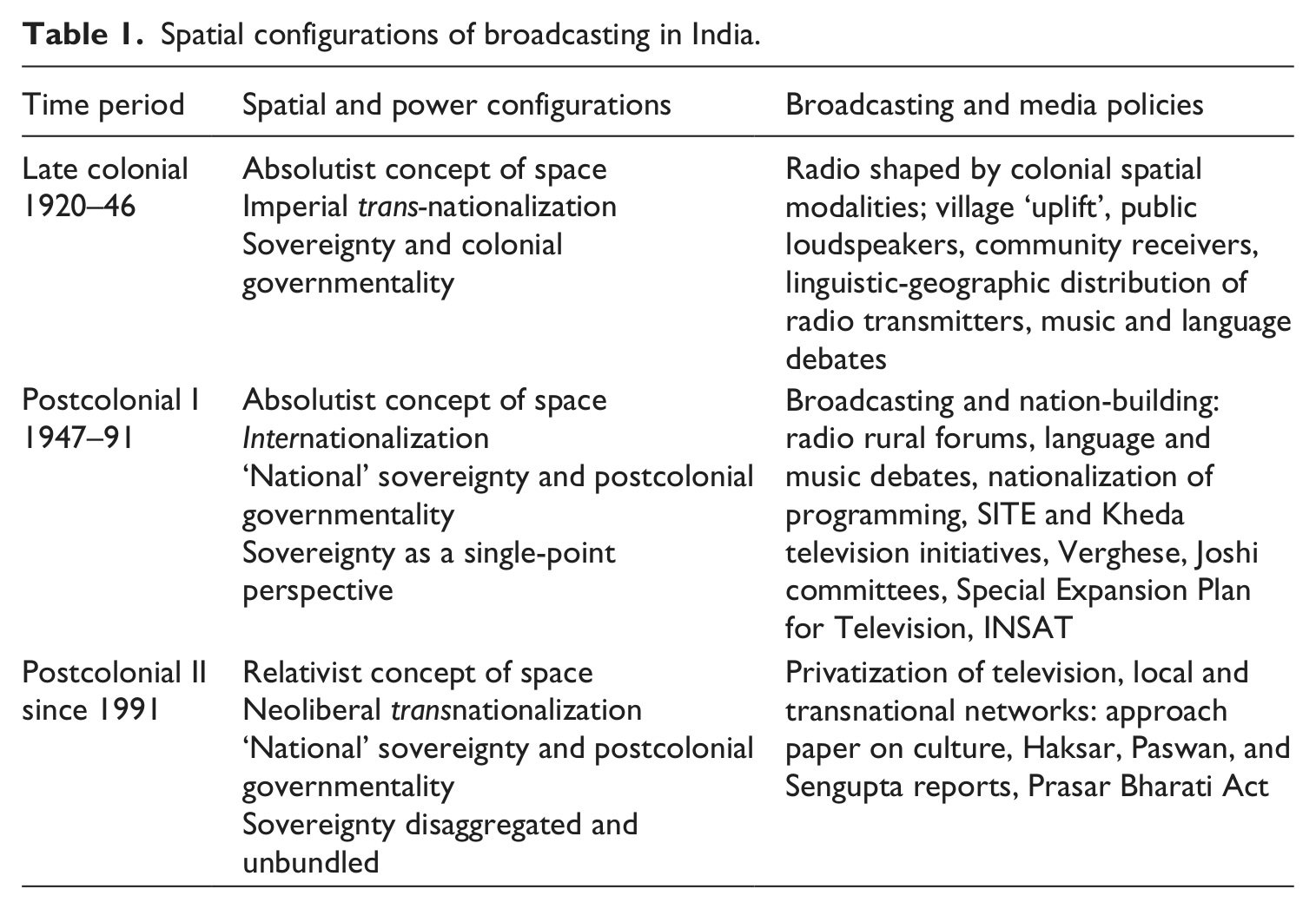
Thus, on the one hand, the postcolonial state translated nationalist ideas embodied in the swadeshi–swaraj dialectic, 4 and. on the other, it reproduced the colonial state’s administrative habits and procedures to realize progress and development in the name of nation-building. In the following pages, highlighting the continuities and changes in the construction of public, citizenship, sovereignty, etc., I discuss the spatial discourse of broadcasting in several radio and television experiments – community listening schemes, public loudspeakers, low-power transmitters, linguistic-geographical surveys, music and language debates, radio rural forums, SITE (Satellite Television Experiment), the Kheda project, INSAT (Indian Satellite Television), privatization of television, etc. To understand the transnational dynamics, to examine the dialectical relations between the national and the global, and to examine the construction of sovereignty and citizenship in broadcasting and media policies, I outline a heuristic framework (see Table 1), with particular emphasis on the two modalities of power: sovereignty and governmentality.
Spatial configurations of broadcasting in India.
The development and growth of broadcasting from the colonial to the postcolonial period has been increasingly shaped by a transnational exchange of ideas and resources among several individuals and institutions – private capital, British bureaucrats, engineers, army officers, American and British missionaries, the British Broadcasting Corporation (BBC), and the colonial and postcolonial state (Das, 2006; Zivin, 1998). In sketching the spatial modalities of radio, these bureaucrats drew upon colonial categories of knowledge about village communities inscribed in the colonial state’s geographical and linguistic surveys. Strickland (1934) and Hardinge (1934) drew upon the liberal imperialist ideas espoused by the Indian Village Welfare Association (IVWA) of London on how to situate broadcasting as an instrument of administration in villages of India. While Strickland proposed a scheme for establishing several low-power ‘district transmitters’ and ‘communal receivers’ in rural areas, Hardinge (1934: 620) argued that ‘the rural population of India is in urgent need of enlightenment’ and ‘broadcasting is the ideal method of producing both the stimulus and knowledge to move the villager to carry out those simple changes in his habits’. Hardinge (1934: 619) pointed out that the ‘peasant needs short daily talks of a homely nature upon rudiments of hygiene, sanitation, child welfare, improved agricultural methods and marketing, and similar helpful subjects leavened with entertainment.’
Broadcasting in India was shaped by the economic and political imperatives of the British administration, particularly the global economic situation wrought by the 1929 depression in England and the rising popularity of Gandhi’s anti-colonial nationalist, ‘Civil Disobedience’ movement in India. 5 Partha Sarathi Gupta (1988) and Alisdair Pinkerton (2008) argued that the British sought to deal with anti-colonial nationalism’s challenge to its authority by promoting the policy of ‘provincial autonomy’. In 1937, under British constitutional reforms, local elections brought the Congress Party to power in several provinces of India. In the sphere of broadcasting, however, the immediate political imperatives led the British to keep control of broadcasting as a department of central government, rather than a corporation as advocated by John Reith. In 1936, Reith sent an engineer, H.L. Kirke to develop a broadcasting map of India. After an extensive tour and analysis of Indian conditions, Kirke proposed a decentralized system of broadcasting with numerous low-power transmitters around Delhi and other cities. However, his successor C.W. Goyder, ignored Kirke’s recommendations in favor of a centralized system wherein radio programs would originate in Delhi and be relayed to several regional centers. The idea of ‘zones of broadcasting circles’ was developed, which employed colonial geographic and linguistic surveys, soil and topographic studies of various towns and cities fit for radio transmission. Thus, this particular spatial discourse of broadcasting envisaged through broadcasting circles and zones, and as a centralized system, gradually consolidated during the late colonial period and shaped several postcolonial experiments in radio and television.
During the 1930s, India’s villages figured prominently on the agendas of both the colonial administrators who wanted to ‘produce better villages through radio’ and the anti-colonial nationalists led by Gandhi who considered villages and peasants as crucial to their struggle. Through paternalistic village broadcasting experiments, British bureaucrats, and later the colonial state sought to curb the increasing popularity of anti-colonial nationalism in the countryside. In several radio experiments, the colonial state could only conceptualize the Indian ‘public’ as an amorphous collective of imperial subjects, rather than rights-bearing citizens. Framing their ideas of a bounded village space, envisioning a collective radio audience, the colonial bureaucrats constructed an Indian ‘public’ through the design of loudspeakers, acoustic spread of community receivers, and the territorial gaze of transmitters. Ostensibly designed for village ‘uplift’ and for the peasants, the loudspeakers and community receivers ‘locked’ the rural audience into a one-way modality of communication.
By installing the community receivers in the courtyards and on the rooftops of local elites – Lambardars, Khans, Zamindars, and village headman – colonial bureaucrats incorporated local idioms of rule and power to prevent possible peasant unrest. Initially, the colonial state had authorized the police to install, maintain, and operate radio broadcast equipment, but colonial bureaucrats suggested that local village leaders and landowners would serve British interests better than the police (Zivin, 1998). Thus, by embedding the spatialities of colonial radio in conjunction with the local ‘power-geometries’ in the villages and the countryside, colonial bureaucrats constructed a negative notion of the public, one that is to be controlled through broadcasting. It is interesting to note that, in the 1930s, the paternalistic and restrictive public of radio broadcasting stood in sharp contrast to the boisterous and chattering public spaces enabled by the increasing popularity of gramophone music and records in South India (Hughes, 2002). Although gramophone music was aired on the Madras radio station, funded by colonial broadcasting, it was the playing of gramophone music in restaurants, shops, and other public spaces that became a social event in the 1930s. 6
This restrictive conception of public, produced by colonial broadcasting and carried forward in the postcolonial period, was visible in the music and language debates. For instance, in the sphere of music, colonial knowledge based on European musical canons defined the contours of Indian classical music that would fit radio broadcasts. In short, ‘Indian music required substantial reform in order to serve the purposes of broadcasting’ (Report on the Progress of Broadcasting in India, 1940: 21). This perspective organized the typology of musical programs by separating the ‘pure’ from the ‘impure’ in Indian music as the Report on the Progress of Broadcasting in India (1940: 21) noted: ‘the whole of art music has fallen into the hands of prostitutes and mirasis and from this association has sprung a general feeling that there is something inherently immoral about music itself’.
The nationalists, who came to power in 1947, blamed the British for neglecting Indian music; that is, classical music, and sought to reclaim Indian culture, along upper-caste, class, and religious lines. Many North Indian women musicians were barred from performing on All India Radio (AIR) because of their ‘immoral’ antecedents. B.V. Keskar, Minister of Information and Broadcasting from 1950 to 1962, the ‘major formulator of the musical ideologies and policies of All India Radio’ developed the concept of the National Programme of Music that was framed by upper-caste Hindu morality (Jeffrey, 2006). In the 1950s and 1960s, the high point of nation-building, Keskar banned commercial Hindi film music from AIR for its corrupting influence.
Thus, the brand of nationalism promoted by the ruling elite in the sphere of broadcasting stood in sharp contrast to the ‘secular, reformist, mildly egalitarian, cosmopolitan’ nationalism the anti-colonial movement espoused in its struggle against the British rule (Kaviraj, 1998: 150). Instead of transcending the colonial forms of sovereignty visible in the construction of the ‘public’, the ruling elite incorporated ideologies of class, caste, gender, and religion in radio program formats. Keskar’s bureaucratic strictures blocked the possibilities for radio to either engage with nationalism or to foster a dialogue with the people. Radio could only produce a staid bureaucratic form of nationalism couched in a Sanskritized form of Hindi that was far removed from the everyday world of ordinary Indians. This was in line with how the postcolonial ruling elite framed various cultural institutions as spatializing sites for enacting the discourses of sovereignty and citizenship. In contrast to radio, several popular films of this period developed an interesting synthesis of Hindi and Urdu into a sort of ‘Hindustani’ language through which a variety of meanings associated with nationalism were represented.
As discussed above, whether one interprets the broadcasting experiments in terms of the ‘instrument-effect’ of bureaucratic-institutional penetration (Ferguson, quoted in Sinha, 2008) or ‘vertical encompassment’ (Ferguson and Gupta, 2002), the spatial modalities and logics of such a discourse are materially produced. For instance, one of the first postcolonial broadcasting experiments, the radio rural forums, launched in 1956 as part of the national community development programs, borrowed the colonial idea of ‘zones of broadcasting circles’ that covered 150 villages in the Bombay State spanning five districts (Poona, Ahmadnagar, Nasik, North Satara, and Kolhapur). The colonial practices of linguistic and demographic analysis, population densities, and the urban–rural distribution framed the policies and programs of radio rural experiments.
Both the colonial and postcolonial practices drew upon a range of ‘transnational’ exchanges of ideas, concepts, policies, and resources. Within such exchanges, colonial and postcolonial administrators proposed and implemented broadcasting and community development schemes, shaped by what Sinha (2008) characterized as a ‘transnational development regime’ that operated through the ‘institutional matrix’ created by this regime, combining aspects of colonial, national, and postcolonial logics, along with forces outside the colonizer–colonized binary as well. Therefore, following Sinha, I assert that both the spatial discourse of India’s community development project, along with several imperial, colonial, and nationalist ideas and practices, framed radio rural forums. The postcolonial Indian state, through radio and television, framed ideas of sovereignty and citizenship through a set of pedagogic practices. From 1947 to 1991, which I have characterized as ‘postcolonial I’ (see Table 1), the pedagogic practices in the context of broadcasting and media policies were, in large measure, influenced by the discourse of national sovereignty and development, pointing to both continuities and changes from the colonial period. For instance, the Indian ‘village’, as a geographic and territorial unit, represented by the colonial broadcasting model, the anti-colonial nationalist movement, and the postcolonial state, was enfolded into the development project through several administrative and bureaucratic practices. The organizational hierarchy, program production units, and community listening centers of radio forums, drew upon the bureaucratic structures of India’s community development project: villages organized into development blocks with a block development officer and village-level workers overseeing the running of the programs.
Although communication scholars pointed to radio rural forums as successful broadcasting experiments, the benefits of the radio forums were unequally distributed in favor of landowners; rather than the poor (Papa et al., 2006). More importantly, the spatial ‘power-geometries’ of the radio forums sought to reinforce class- and caste-based divisions in the countryside, despite the fact that several radio programs were designed to address caste-based and other social issues. After a few years, while radio forums were discontinued in the face of the failure of the larger community development projects initiated by the Indian state, the administrative and bureaucratic procedures reappeared in the development of television.
State-run television, Doordarshan (in Hindi, ‘Distant Vision’), was introduced in 1959 after a series of discussions on its relevance to the state projects of national integration and social development enunciated and enumerated in the Constitution and outlined by the National Planning Commission. The first television experiment, initiated in 1961 and sponsored by UNESCO and the Ford Foundation, sought to explore ideas of community development and citizenship through its programming. As part of the developmental agenda of the Indian state, a pilot agricultural program, Krishi Darshan, initiated in 1967 around Delhi, drew upon the 1930s colonial idea of ‘broadcasting circles’. Conceptualized and implemented by technological and scientific experts, Krishi Darshan, unlike the radio forums, explicitly mobilized technology that would become key to India’s television experiments in subsequent years (Mody, 1979). Both the 1961 and 1967 television experiments demonstrated the need for broadening television’s reach by establishing larger terrestrial transmitters and a range of regional centers (in Hindi Kendras).
In 1975, India launched the most ambitious postcolonial television experiment anywhere, the one-year Satellite Television Experiment (SITE). It was designed by India’s technocratic-bureaucratic elite – in consultation with UNESCO, and using a satellite loaned by the USA – and worked through already established colonial spatial discourse: terrestrial radio centers that became television production/broadcast units. SITE, covered 2300 villages spread over 20 districts of 6 states (Rajasthan, Bihar, Orissa, Madhya Pradesh, Karnataka, and Andhra Pradesh). SITE’s spatial reach, facilitated by satellite broadcasting, followed the colonial construction of broadcasting space in terms of linguistic and geographic surveys. This is visible in the idea of treating regions with established radio stations and hastily set-up television broadcast and production facilities as ‘clusters’ and ‘units’. Chander and Karnik (1976: 15) outlined this in their report on SITE thus: ‘each cluster area covers 3–4 districts and each district on an average has about 1000 villages, so the problem was to select 400 out of about 4000 villages’.
An important argument for starting SITE related to the idea of television as enabling a ‘participatory democracy’ through several short skits and docu-dramas that mixed everyday issues with larger goals of family welfare, health, sanitation, addressing social ills, etc., and aimed at rural students, farmers and women. However, the developmental ideologies of SITE reproduced the colonial notions of ‘village uplift’ through its pedagogic and moralizing stance. Embedded within the pedagogic imperatives was the idea that such programs could lead to an attitude change among people. The concepts of participatory democracy and attitude change were unable to dislodge deeply entrenched feudal, caste, and class relations in the countryside.
Around the time SITE project was being implemented, technocrats at the Indian Space Research Organization (ISRO) developed a smaller and more focused rural community television project, the Kheda Television project, as a hybrid decentralized broadcasting project that covered around 350 villages in the Kheda district. Both the SITE and Kheda projects pointed to different and overlapping models for rural communication. For the radio and television bureaucrats, SITE served as model for expanding and facilitating a commercial television network with hundreds of urban television transmitters, whereas ISRO technocrats argued for transmitters to be located in rural centers. In fact, as Satish Poduval (1991) argued, the notion of rural television embodied in the Kheda project might point to an alternate history of television in India; however, one needs to be careful in interpreting television’s discourse of rural development and urban commercialism. The failure of rural television in India has to be understood in the context of peasant unrest and labor strikes in 1970s that led to the imposition of Emergency in India (Rajadhyaksha, 1990). Both the SITE and Kheda television projects ran concurrent with the Emergency rule in India. The hegemony of the Indian state, in the face of the socio-political unrest, gradually shifted from developmental and socialist policies to free-market-driven economics.
SITE created a new spatial context for satellite television in India by creating the necessary conditions for the India’s INSAT (Indian Satellite Television) program in the 1980s that was designed, among other things, to expand and facilitate the rise of India’s commercial television services. Indeed, studies have noted that the 1980s geographic expansion of television in India, spurred by the INSAT space program and the establishment of hundreds of low-power transmitters across the nation, was a significant attempt by the state to deal with the socio-political tensions (Butcher, 2003; Rajadhayksha, 1990; Roy, 2008). With these massive infrastructural changes, national programming for television was being put in place, particularly through Doordarshan, which would begin broadcasting from Delhi. Several regional centers located in Bombay, Calcutta, Madras, and Bangalore, along with numerous local terrestrial networks in smaller cities, were connected to Delhi and each other through satellite and terrestrial links. For several years (1982–91), the regional and local centers transmitted Hindi language programs emerging from Delhi during primetime, and regional language programs from their respective centers at other times. Thus, the centralized spatial expansion of television network and programming enabled the state to create the presence of a televisual nation-ness. Johnson’s (2008) recent study on how particular spatial ideologies in American television inflected the development of regional and national identities offers substantive analytic insights that may be usefully applied to examine programming on Indian television as well.
Although there was a spurt in state-sponsored commercial programming during 1980s, a significant number of programs produced during this period dealt with separatist and sub-national movements in Punjab, Kashmir, and the nationalist movement constituting the discourse of the state that sought to construct a national culture on television. Therefore, the construction of nation via television was one way through which the state sought to cope with the cracks in its hegemony during the intervening years (1982–91) before the arrival of private television. Empirical data on television during this period demonstrates the spatial consolidation of Doordarshan and the rise in sponsored commercial programs, indicating television’s shift from state-led developmentalism toward market-based consumerism. Manjunath Pendakur (1991) and Abhijit Roy (2008) noted the shift as a consequence of a particular ideological grafting of consumerism into pro-development television forms as a concrete instance of a ‘certain negotiation between the State and the Market in the context of an emergent commercial popular in the 1980s’ (Roy, 2008: 38). The dialectic between state and market marks an important phase in television in India. While a certain form of entrenched state capital was visible in the development of broadcasting until 1982, the seven-year period 1983–90, and the period post-1991 demonstrate the rise of national and transnational capital, propelled by what has been commonly referred to as media globalization.
After 1991, as private television networks started to broadcast using satellite communication, the government expanded the range of programming by setting up four new channels through the INSAT system. The second channel, Metro Network, was initiated as a competitor to the private entertainment networks like ZEE, STAR, SONY, etc. As is well known, satellite television, unlike terrestrial and geographic-based broadcasting, breaks down boundaries and borders between rural, urban, regional, and national spaces, thereby complicating notions of sovereignty and citizenship. In the following section, I offer a brief discussion of a few media policies in India by focusing on the spatial discourses of nation, citizenship, and sovereignty. This account of how spatial modalities inflected media policies can be traced back through the history of broadcasting in India that I explored in the previous sections.
Spatial discourse in media policies
The postcolonial Indian state, through a combination of coercion and consensus, has historically negotiated with broadcasting through a series of measures legitimated by the Constitution. The governmental documents, committee reports, inquiry commissions, and draft policies represent ‘sites’ where a ‘spatial discourse of power’ operates. This spatial discourse is represented by the way in which a series of policy decisions was implemented in the expansion of broadcasting, particularly television, during the early 1980s. The numerous laws, acts, and policies relating to broadcast media are instances of the coercive spatial strategies that embody the project of national integration and the construction of national culture (Prasad, 1998). The spatial discourse in media and broadcasting policies in the periods, 1947–91 and post 1991, points to major shifts in the state–market dialectic. Broadcasting and media policies during 1947–91 were articulated in terms of two types of policies, cultural and communication. In the case of cultural policy, the ‘state seeks to produce certain educational and aesthetic outcomes amongst the people’ (Cunningham and Miller, 1994: 23), whereas a communication policy engages with questions around technology, and the ownership and structure of a broadcast organization. However, with the rise of private and satellite television since 1991, it is through regulation/deregulation of communication media, and policy transfer mechanisms that sovereignty and citizenship have been reframed. For instance, since 1996, the formulations of media policies and legislation regarding transnational private corporations can be located within a neoliberal policy regime, where a market-driven logic reconfigures sovereignty and citizenship.
In order to demonstrate the spatial discourse in media policies, I shall briefly focus on several committee reports and parliamentary legislations. The Janata Party government constituted a committee in 1977, with B.G. Verghese, a former newspaper editor, as its chair, to examine a series of issues that centered on granting autonomy to state-owned broadcast media, radio, and television. The Verghese Report (Verghese, 1978), recommended establishment of an autonomous corporation, Akash Bharati, under which radio and television were to be operated. The Congress Party, which came back to power in 1980, blocked the passage of the Verghese Report in the Indian parliament, with members arguing that the country was not ready for an autonomous broadcast media. Following this, many ad hoc structural and technological changes were undertaken to prepare Doordarshan for the Asian Games in New Delhi in 1982. As Doordarshan expanded its spatial reach across the country, it lacked the ability to produce regular commercial programming needed to fill the daily broadcast slots. Thus, after that sports spectacle, for which broadcast changes were undertaken, Doordarshan faced a crisis in the form of an acute lack of programming material for broadcast. In December 1982 the government of India appointed P.C. Joshi as the chair of a committee to formulate ‘a software plan for Doordarshan’ (the Joshi Report – Joshi, 1985).
The Prasar Bharati Act (Ministry of Information and Broadcasting, 1990) passed in parliament in 1990, sought an autonomous broadcast corporation for radio and television and offered several changes – structural, legal, financial, and technical for state-owned broadcast media. Many provisions of the Prasar Bharati Act, despite being ratified in the parliament, were not implemented for political reasons. In 1996, a comprehensive report, National Media Policy: A Working Paper (the Paswan Report – Paswan, 1996), drafted by several members of the Indian parliament, with Ram Vilas Paswan as the chair, argued that satellite television threatens India’s sovereignty and territorial integrity. A three-member committee with Nitish Sengupta as its chair reworked and reformulated some core notions in the Prasar Bharati Act of 1990 (Sengupta Report – Sengupta, 1996: 1–2), and argued that: dramatic changes have taken place at a dizzying pace on the media front since the passing of the Prasar Bharati Act in 1990. The advent of satellite channels and their rapid proliferation has substantially transformed the environment [and] complete rethinking of the role, organization and functions of Prasar Bharati became necessary in a multi-channel scenario, mostly driven by market forces.
Most discussions of policies took up issues of sovereignty and citizenship and linked these with territoriality, particularly through the geographical metaphor. The deployment of a geographical imagination figured frequently in all policies but with differing emphasis on particular issues. For instance, both the Verghese and Joshi reports argued that by setting up low-power transmitters across the country the Indian state sought, in geographic and linguistic terms, to provide a ‘national’ radio and television presence. To ‘imagine’ a nation, the Verghese and Joshi reports argued, geographic and linguistic integration of places, people and communities was a central mission. The Joshi Report (1985: 45) argued that cultural communities residing in districts could be reached through the use of low-power transmitters. This ‘mapping’ of India, by the use of terrestrial technology linking Doordarshan centers (in Hindi called Kendras) into a network, would help to ‘attain the national objectives of unity and development’. The Hindi term, Kendra is infused with social power; that is, it denotes a notion of power and authority that is centralized. The semantic and linguistic force of the term also designates the Kendra as a center from where national development programs are relayed; the transmitters would also serve production of ‘area-specific’ programs catering to the needs of the local population. Thus, the primary metaphor in the Verghese and Joshi reports, geography – invoked in multiple ways through references to space, place, territory, borders, and boundaries – gives a ‘hinge’ to the idea of India as a nation. The nation’s identity is constructed by linking geography with sovereignty, whether spoken of in political, economic, or cultural terms. Protecting and securing borders and boundaries from ‘outside’ forces, whether from the ‘evil’ designs of neighboring countries or the cultural imperialism of the West, marked the language. The very title of the television system, Doordarshan (in Hindi ‘Distant Vision’), suggests a certain mythic and geographical imagination at work.
Furthermore, the spatial construction of India as a nation that underpins the notions of sovereignty and citizenship is represented in Verghese and Joshi reports through the ‘fabrication’ of a putative past. Ideas of essence and destiny, transcendence, and continuity are linked to the nation’s imagination. Though the term ‘Bharati’ in Sanskrit refers to language, it also signifies ‘India, that is Bharat’ (as in the nation’s Constitution). This double inflection of the phrase is more than a semiotic twist, for it carries a particular spatial history that has informed the nationalist project (Deshpande, 2000; Goswami, 2004). The Verghese Report, through its title, Akash Bharati, tries to reconstruct the nation in a mystificatory and exclusivist manner. The phrases ‘national values’, ‘unity in diversity’, and ‘national goals’ produce a particular conception of a nation whose identity is fixed in the past. The Joshi Report made similar assertions about nation that are signified by several phrases and clauses that are used in conjunction with one or more discursive elements – of essence, destiny, continuity and transcendence – which form a subtext to the arguments suggesting that the main task of communication policy is the maintenance and preservation of national values.
While the Paswan and Sengupta reports drew upon the arguments of Verghese and Joshi regarding the ideas of nation, they were directly concerned with the influx of satellite television into India and focused on issues of ‘uplinking’ from Indian soil. The ideas around territoriality and sovereignty are deepened due to the ‘invasion from the skies’. This ‘invasion from the skies’, they argued, requires a laissez-faire doctrine for program production and broadcasting. What is needed, according to them, is a new set of juridical and legal instruments. The Sengupta Report contains an extensive discussion of these issues, noting that ‘the new technologies [satellite based] have demolished the monopoly of state-run electronic media and rendered redundant the regulations. Loosening of controls is a global phenomenon’ (Sengupta, 1996: 69). As a result of its argumentation, the report concluded that terrestrial broadcasting should not remain a monopoly of the Indian state and that private broadcasting companies should be allowed into India. Although the Paswan and Sengupta reports gradually moved away from the absolute concept of national sovereignty, the spatial discourse in India’s media policies indicates a realignment of state ideologies with market forces that has resulted in contradictory articulations of citizenship with the consumer-subject (Rajadhyaksha, 1999).
In 1996, India’s Supreme Court ruled that the airwaves are public property to be regulated by an independent public body, not by the government. Although the court’s judgment called for the creation of an autonomous zone mediating the interests of the Indian public, the underlying logic suggested a move toward a public being thought in terms of a free-market consumer public or, more precisely, the citizen-as-consumer. On the one hand, the parliamentary reports and the committees outlined strategies for regulating private satellite television and raising revenues through advertisements and commercial sponsorship, on the other, they were promoting private broadcasting.
Concluding remarks
This article has demonstrated how a spatial approach to broadcasting and media policies within a transnational framework enabled a better grasp of the changing power dynamics of sovereignty and citizenship in colonial and postcolonial India. In several broadcasting experiments and media policies, sovereignty and citizenship were produced in terms of hegemonic articulations of territoriality, geography, populations, and people. A closer examination revealed how spatial power modalities inflected the changing configurations of nationalism, sovereignty, and citizenship as part of a wider set of ideas that flowed among individuals and institutions as part of a ‘transnational development regime’. Importantly, colonial spatial practices significantly shaped the anti-colonial nationalist movement’s ideological program as well as the broadcasting experiments of the postcolonial Indian state. While this article also explored the spatial implications of neoliberal policies as they pertain to Indian broadcasting and media, I propose that a detailed spatial analysis of how such policies are leading to class, caste, gender, and religious inequities is much needed. Although this study dealt with India, I argue that a sustained examination of broadcasting and media policies in postcolonial societies, particularly in the context of the increasing presence of information and communication technologies (ICTs), the internet, and the various ‘new’ media modalities offers substantive analytic insights into the spatial materialism of how localities and places – urban cities and rural towns – intersect with the spaces of media flows: regional, national, and transnational (Hay, 2001). Furthermore, in much of the postcolonial world, economic globalization has precipitated the rise of neoliberal forms of governance and this has influenced broadcasting and media policy-making in a variety of ways. The ongoing developments are also leading to new kinds of alliances between state and private – local as well as transnational – corporations in regulating and controlling media environment. The widespread deployment of ‘policy transfer’ discourse underpinning the formulation of media policies is reconfiguring the notions of sovereignty and citizenship. While most studies in media and communication have understood the reconfiguration of sovereignty in terms of its diminution, some scholars consider sovereignty as being ‘disaggregated’ and ‘unbundled’ into multiple components of power, and point out that, in fact, nation-states reassert their authority through a range of political, legal, and economic strategies (Ong, 2006; Ruggie, 1993). However, missing from such studies is a sustained examination of state and neoliberal spatialities with respect to broadcasting, media policies, and ICTs, and the concomitant reshaping of sovereignty and citizenship.
Footnotes
Funding
This research received no specific grant from any funding agency in the public, commercial, or not-for-profit sectors.