







Abstract
This article studies the image of the boat immigrants use to cross the Strait of Gibraltar, which separates Europe and Africa, through the analysis of 125 cartoons published in Spanish press between 2006 and 2012. Our study shows that in this span of seven years – which coincides with a period of growth for Spanish economy and the subsequent crisis – there was an interesting and meaningful conceptual evolution regarding the image of the immigrant boat. This situation resulted in argumentatively effective visual analogies, metaphors and metonymies which evolved all along this period, making this boat a cultural symbol of our time. The article also intends to highlight the importance of cartoons in opinion journalism as well as their importance in the mass media landscape today.
Since 2000, ‘migration management’ has become the dominant policy framework in Europe (Balch, 2010). From that year on, southern European countries experienced a significant increase in the numbers of immigrants arriving in their territories, especially in Portugal, Spain, Italy and Greece (Sciortino and Colombo, 2004). This situation also affected many other areas of the world, which led Papademetriou (2005) to claim that migrant populations added up to 30–40 million people. No less than six different expressions are used to refer to these immigrants: clandestine, illegal, unlawful, undocumented, unauthorized and irregular immigration. In addition, terms such as sans papiers (French), sin papeles (Spanish), migranten zonder papieren (MZP, Dutch) or Papierlose (German) label this type of migrants. The arrival of undocumented immigrants in Spain reached its peak in 2006, with the arrival of 39,180 illegal immigrants, according to Spanish government data (Ministerio del Interior, 2013).
This underground migration constitutes a social construct which is specific to the late 20th century. However, material on how European media communicate ideas about immigration controls, or open movement of workers in the EU is scarce. The analysis of their impact on the media has been meagre and most analyses are content analysis (Cheng et al., 2009; Igartua et al., 2005, 2006). We also lack an in-depth analysis of the visual representation of migration, except for a few works (Muñiz et al., 2006), based exclusively on the analysis of photographs (regardless of whether those pictures belonged to a photo agency or not).
Many immigrants cross the Iberian Peninsula on their way to other European countries due to its privileged location. The Strait’s 16 km barrier between Africa and Spain is an obstacle which is easy to overcome as long as you take the trip on a proper boat. However, illegal immigrants have used all sorts of precarious boats to cross the Strait of Gibraltar, where there are strong currents and winds. The boats used by immigrants are generally small, old fishing boats, precariously adapted to this new purpose (painted blue to make it more difficult for patrol boats to spot them at sea), and called ‘patera’ (small boat) or ‘cayuco’ (Indian canoe). The word patera comes from the Latin patera – a shallow bowl used in ancient times to perform pagan sacrifices with the aim of pleasing the gods. On the other hand, cayuco refers to a flat canoe built by hollowing a tree trunk and comes from the word cayo. In both cases their keels are very small and both are very useful for manoeuvring in shallow waters, but their use in the open sea poses great danger.
In this article, we study the symbolic use of this boat in Spanish press cartoons. In just a few years the concept of patera or cayuco has been introduced into everyday language and has created, according to Lakoff (2004), new mental structures which at the same time determine the way we understand the world. In the 1990s a stranded boat on a beach in southern Spain or northern Africa was only linked to fishing, whereas a decade later it could be connected to all kinds of concepts related to poverty, human smuggling, uprooting, North–South inequality or even death. Along these lines, the image of the patera is also used to construct a great number of metaphors in Schön’s (1993) sense, and especially in the sense of Lakoff and Johnson’s (1980; Lakoff, 1987, 1993) conceptual metaphor, which provides a general framework for the analysis of the use of different metaphors.
Likewise, we have framed our study within the analysis of visual rhetoric (Birdsell and Groarke, 1996) and how cartoons can be much more illustrative than other visual genres (Domínguez and Mateu, 2014; Wekesa, 2012). Cartoons are a useful tool for analysing social reality (Caswell, 2004; Powell and Paton, 1988), especially due to the use of visual language and the explicit aphoristic and judgemental phrases (Hempelmann and Samson, 2008). It is also very important to assess the reception of news in relation to the socio-cultural reality of a country (Domínguez and Mateu, 2013). In addition, cartoons are useful for creating new metaphors and communicating and structuring new concepts (Bounegru and Forceville, 2011; Domínguez, 2014; El Refaie, 2003; Giarelli and Tulman, 2003). Many of the cartoons studied are editorial cartoons, so it is also through them that the medium tries to construct and portray its role and identity in order to persuade its readership (Van Dijk, 1997).
A seven-year span was chosen for the study – from 2006 to 2012, coinciding with the year with the highest number of arrivals to Spanish coasts (2006) and the subsequent plummeting of the figures (2010–12). During these years, Spain underwent an ‘economic miracle’ – mainly based on the real estate economy. In 2008, a deep economic crisis broke out, originating from the system itself. This time span of analysis allows us to follow the evolution of the image of pateras and migration in cartoons. Therefore, in our study we address the following research questions:
RQ 1: Do pateras become symbolic elements that refer to immigrants?
RQ 2: Are there important differences between cartoonists in Spanish newspapers depending on the editorial line?
RQ 3: Is there an evolution in the symbolic and metaphoric use of the patera in this period (before and after the crisis)?
Corpus, terminology and method of analysis
The corpus of this paper is made up of cartoons by Spanish visual artists published between 1 January 2006 and 31 December 2012. This span of time was chosen taking into account the fact that 2006 was the year that recorded the highest number of immigrants arriving in Spain using pateras (Ministerio del Interior, 2013), and that in 2008 a financial and economic crisis broke out in Spain (and had become considerably worse by mid-2010). We outline the evolution of cartoons during the years that saw more illegal arrivals by sea and the years in which the effects of the economic crisis were more seriously felt in Spain.
We have chosen cartoons only when pateras or cayucos were explicitly depicted or talked about. We have also taken into account cartoons that showed the Strait of Gibraltar, referring to the usual scenario where this patera migration takes place.
For a preliminary study we checked the main internet search engines introducing ‘viñeta + patera + inmigración’ (‘cartoon + patera + immigration’ in Spanish) and ‘viñeta + cayuco + inmigración’ (‘cartoon + cayuco + immigration’ in Spanish) as keywords, which allowed us to establish a first preliminary sample and determine which cartoonists had dealt with this issue in their blogs and sections in digital media.
Next, we manually searched the archives of the main Spanish newspapers – El País, El Mundo, Público (in this case from its launch in 2007 to its closure in 2012), La Vanguardia, La Razón and ABC. In these newspapers, we analysed the work of the main political cartoonists: El Roto, Forges, Ricardo, Guillermo, Manel Fontdevila, Medina, Ventura & Coromina, Caín, Mingote and Máximo. We also studied the most important Spanish free newspaper – 20 minutos – and the work of its cartoonist, Eneko. These samples of cartoons, together with those found on the internet, make up the corpus of our study.
Once the sample was arranged, cartoons were assessed and quantified according to subject matter and the use of metaphor or metonymy – which were identified and categorized according to their subject matter too. We classified the cartoons into five different groups: (1) The dangers of the journey – these cartoons show the dangers of migrating by patera, associating it with concepts like death, shipwreck or the weakness of the boat at sea. (2) Pursuit of prosperity – these cartoons focus on migration as the search for better life conditions, which shows a social tragedy related to hunger and social improvement needs. (3) North–South inequality – in this section we included the cartoons that focused on the contrast between immigrants and citizens from western countries; in this case, cartoons adopt a European point of view, emphasizing the contrast between opulence and poverty as well as society’s rejection of immigrants. (4) Economic crisis – cartoons dealing with the economic and financial crisis. (5) Politics – cartoons that use immigration to approach current affairs.
After classifying the cartoons, we needed to test the reliability of our classification as well as the reliability of the topics selected for the metaphors and metonymies. On that account, we performed independent intercoder reliability tests (Fleiss, 1971; Wimmer and Dominick, 1996), giving 3 independent researchers 12 randomly selected cartoons (10% of the sample). Results were 0.67 for topic classification and 0.65 for metaphor classification. Given that some topics overlap, we thought that this indicator was satisfactory enough.
Results: boat migration cartoons
The final sample contains 125 cartoons, including 65 cartoons from printed editions of Spanish newspapers of record, 23 from free newspapers, 8 from online newspapers and 29 from personal blogs or cartoonists’ websites. We classified these cartoons according to subject matter and results were: 18 cartoons that point out the dangers of the journey and the frailty of the boat; 17 that focus on the immigrants’ hope and their pursuit of a better life; 64 that focused on North–South inequality and the indifference and rejection found by the newly arrived; 15 cartoons that frame the arrival of pateras within the context of economic crisis; and 11 cartoons that use the arrival of immigrants to talk about political issues, either from a partisan point of view or regarding government affairs. Each one of these subjects uses its own metaphor group, with the exception of political cartoons, as we can see in Table 1.
Identified groups of visual metaphors.
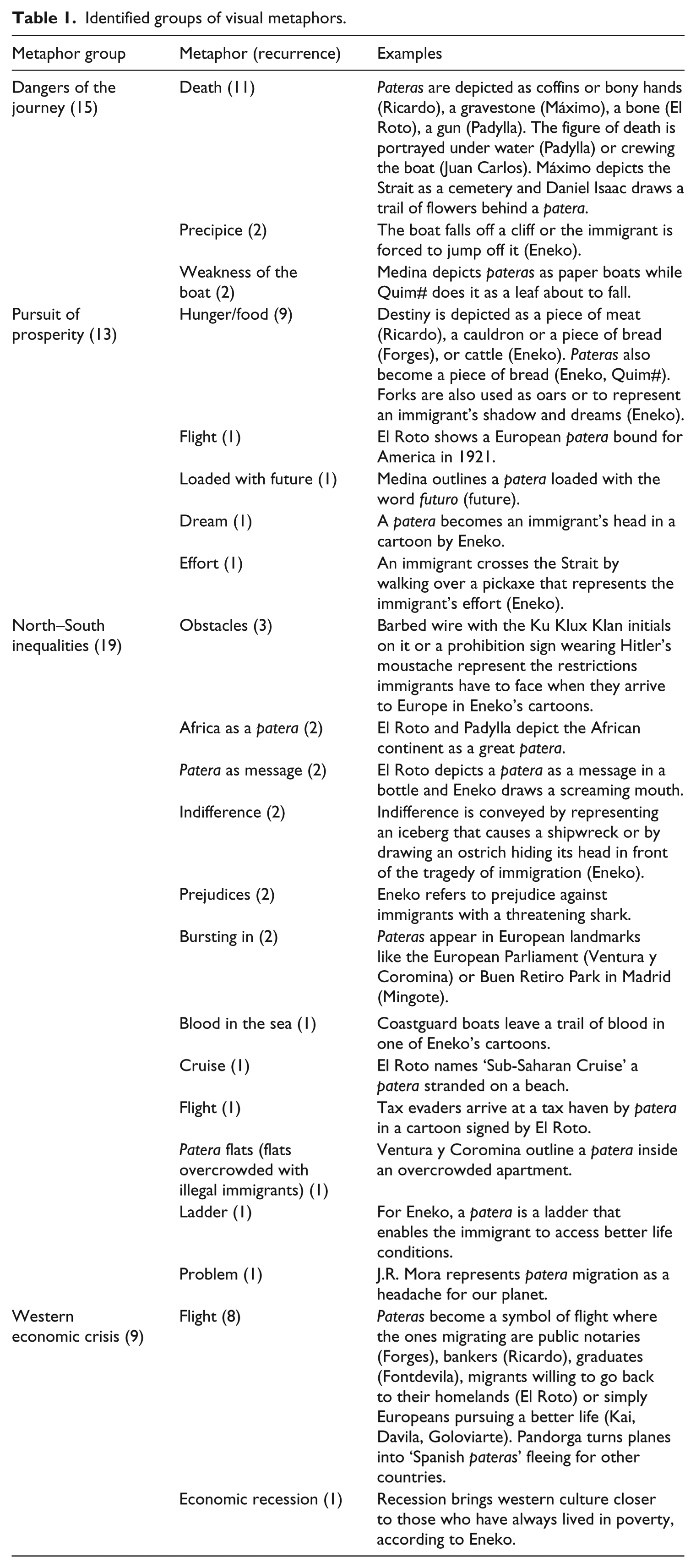
We can arrange the cartoons in two big groups. On the one hand, the ones published between 2006 and 2008 – when most cartoons dealt with the issue from a social point of view, emphasizing the tragedy of the journey; on the other hand, a second group that included the cartoons published between late 2008 and 2012 – when the approach to the matter changes due to a strong economic recession.
Boat migration cartoons before the crisis
Cartoonists depict the trip from Africa to Europe crossing the Strait of Gibraltar as a dangerous one which, more often than not, results in the death of many of the travellers. This is why in most cartoons from the first period there is an association of the patera or cayuco with death or the dangers experienced by migrants. Thus, death is depicted as another passenger (Juan Carlos, 22 May 2007), 1 who uses his scythe as the boat’s tiller. In other cartoons danger lies under water and the scythe looks like a shark fin (Padylla, 27 October 2007). Sometimes a shark represents the prejudice against the arrival of immigrants (Eneko, 30 April 2008 and 11 July 2008). Even though there are not many sharks in the Strait, it becomes a prevalent symbol of the great dangers found in those waters, maybe because it is more easily depicted than storms or strong winds. Death is also represented as a coffin on which the immigrants are sailing (Figure 1a: Ricardo, 15 March 2006), or even representing a long human femur (El Roto, 2 April 2006), acting as a canoe full of undocumented immigrants. Sometimes the patera is a gravestone (Máximo, 18 May 2006), or death’s bony hand (Ricardo, 26 October 2012), or even a hand transformed into a gun pointed to the immigrant’s head (Padylla, 27 October 2007).
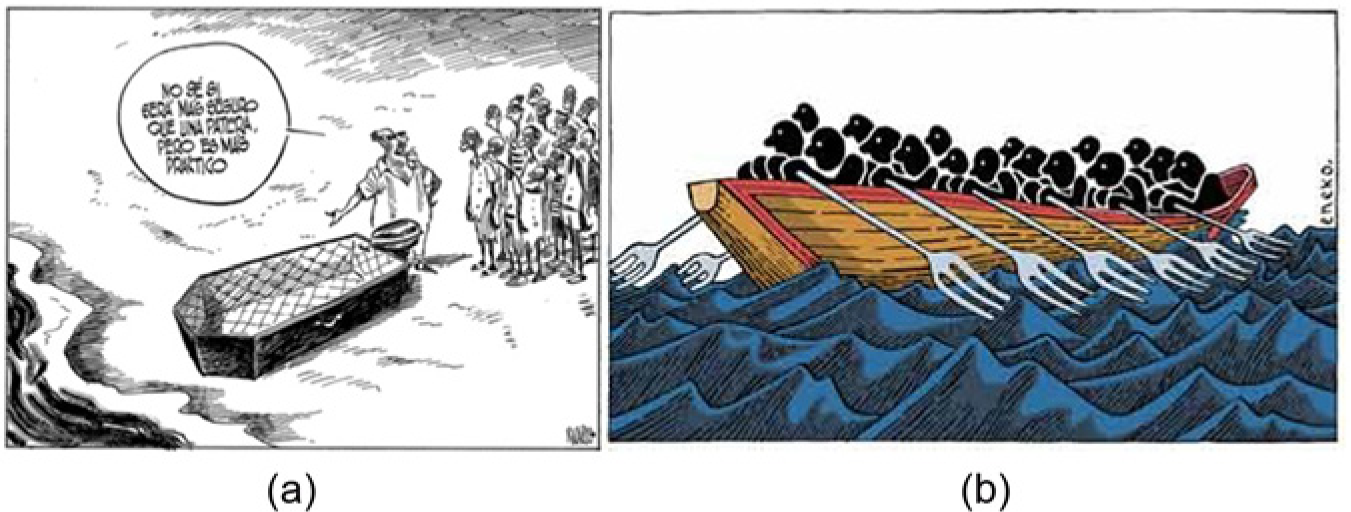
Pateras depicted before the economic crisis. Left: (a) Cartoon by Ricardo, published in El Mundo on 15 March 2006 (‘I don’t know if it is safer than a patera, but it is more practical’). Right: (b) Cartoon by Eneko, published in 20 minutos on 6 September 2009.
The Strait of Gibraltar itself – where the tragedy takes place – becomes a cemetery in some cartoons (Máximo, 5 September 2006 and 21 June 2007) or a barrier the migrant has to overcome with great difficulty and danger (Eneko, 9 July 2007, 24 August 2007, 23 July 2008). In other cartoons the sea becomes another character, depicted as an impassive observer of the tragedy. This resource is mainly used when referring to the loss of children and teenagers in the journey (Eneko, 1 October 2008; Padylla, 17 February 2009).
The frailty of the boat is also illustrated and represented in different ways – a paper boat (Medina, 21 June 2008), a patera swallowed by a big wave (Eneko, 11 May 2011), a deciduous leaf (Quim#, 13 April 2012), or falling off a precipice (Eneko, 9 July 2007). In two of the cartoons the African continent is depicted as a big patera (El Roto, 21 January 2007; Padylla, 27 October 2007), representing the scale of the migration problem – a whole continent adrift, a continent that needs help. The arrival of pateras stands, thus, for Africa’s call for help, only a reflection of a bigger problem – hunger and poverty. This is the interpretation of some cartoonists: they draw the boat as a message inside a bottle (El Roto, 15 November 2009) or as a mouth crying for help (Eneko, 21 September 2009).
In contrast to this negative approach that addresses the dangers of the trip, another set of cartoons focuses on the migrants’ motives for their crossing of the Strait: from the patera, migrants perceive Europe as a land full of new opportunities. The need to prosper and leave misery behind is a recurring motif in these cartoons. Thus, the patera sometimes becomes a piece of bread (Eneko, 16 May 2007; Quim#, 23 June 2008), although the coastline of the European continent is the one that is most frequently portrayed as a giant piece of bread or a steaming cauldron in the middle of the sea (Forges, 9 February 2007, 16 October 2007, 16 October 2008). Ricardo depicts Europe as a chicken thigh (Ricardo, 5 September 2006). Eneko maps different kinds of meat in the Osborne bull – a Spanish hallmark – like cattle in a slaughterhouse (Eneko, 8 March 2006). Following the same idea, the oars of the immigrants turn into forks (Figure 1b: Eneko, 6 September 2006). In another cartoon, a fork becomes a footbridge between Africa and Europe to the eyes of an African woman (Eneko, 19 October 2009). Other authors have tried to capture the immigrants’ hopes by drawing a cayuco that leaves a trail of flowers behind (D. Isaac, 11 July 2008) or one loaded with letters that spell out the word ‘future’ in Spanish (Medina, 12 July 2008). The patera also represents the materialized dream of the immigrant (Eneko, 25 June 2007), the boat that carries ‘the torch of hope’ (Padylla, 10 May 2008) or the ladder that allows the immigrant to access a more prosperous life (Eneko, 17 March 2006).
Many cartoons show the contrast between the North and the South – the hypocritical and disrespectful attitudes western countries adopt regarding the arrival of undocumented immigrants; the contrast between the luxurious yachts and speedboats of some and the poor pateras of others. This contrast is shown in numerous cartoons and in very different ways. Pateras are depicted in contrast to yachts, cruises, limousines or sports canoes (El Roto, 31 May 2006, 7 July 2006, 26 February 2009, 4 July 2009, 23 June 2011; Ventura & Coromina, 4 May 2010; J.R. Mora, 30 July 2012; Eneko, 21 July 2006; Javier Argul, 4 September 2006; Neorrabioso, 28 March 2012). Among the cartoons that show the indifference of the First World towards the arrival of immigrants in such poor conditions, the ones that show the arrival of pateras as symbolically bursting into emblematic European scenarios like the European Parliament stand out (Ventura & Coromina, 6 June 2009), Buen Retiro Park in Madrid (Mingote, 18 May 2006) or simply a crowded beach with indifferent tourists that the immigrant sees as ‘the other shore’ (Medina, 21 August 2008).
Most times immigrants are portrayed as impersonal figures, faceless blurs cramped into the same boat. In fact, some cartoonists use their own personal symbols, which are easily recognizable for the reader, to depict undocumented immigrants. For instance, Eneko draws a patera loaded with black dots, which represent the immigrants’ heads. This depersonalization of immigrants highlights their anonymity and the lack of empathy of the western world towards their situation. They have been turned into a mere figure, making it very easy not to be really interested in them. Most citizens in Spain, as well as in the rest of Europe, are unaware of the real situation in Africa, and for most of them immigration is just a number, which is as depersonalizing as the dots cartoonists draw to portray immigrants.
Even taking into account this depersonalization, the scarce number of immigrant women depicted is very noteworthy – when women appear they are usually depicted in their role of mothers and answering their children’s questions: ‘Mom, will I have a pencil?’ (Forges, 5 September 2006), or holding a baby that fuses with the sea (Eneko, 1 October 2008). Women portrayed as mothers, and especially children featured in cartoons, can be understood as a resource to highlight the tragedy of immigration. It is a very effective way to portray the migrants’ vulnerability, represented in the child and his mother, so as to appeal to the readers’ sensibility.
Another one of Eneko’s cartoons refers to a tragic event that happened in 2008. All through that year, the number of immigrants arriving by boat had significantly decreased, due to the onset of the economic crisis. Also, in this year more cartoons on this issue were registered. The causes for this lie in some events that occurred in this period, like the strictness of European immigration laws, the ‘social integration contract’ for immigrants pushed through by the Partido Popular (the Spanish conservative party) and the increase in the number children arriving in those boats. A picture showing a child’s corpse being taken out of the water had major repercussions in Spanish media, and cartoonist D. Isaac dealt with the event in two horrifying cartoons (D. Isaac, 5 March 2008 and 25 May 2008).
Boat migration cartoons during the crisis
Cartoonists have approached African migration from very different points of view and have been particularly critical from a social and humanitarian perspective. One of those approaches points towards the parallelism between current African immigration and other previous migrations. Thus, some have depicted Christopher Columbus’s caravels as the first example of massive migration, while others remind us that not so long ago Europeans were the ones taking boats in pursuit of a better future. Along these lines, El Roto (23 June 2011) painted a boat full of people under the title: ‘European pateras heading for America (1921)’. This is how graphic humourists remind their audience about the fact that Europeans have also immigrated to other countries and that we may end up in the same sort of situation. With the economic crisis in Spain, cartoonists have used the concept of patera as a metaphor for Spanish immigration to other western European countries in the pursuit of better life conditions and a job.
From 2008 onwards – at the beginning of the economic crisis in Spain – the status of the Spanish economy is displayed in graphic humour. Cartoons referring to the impoverishment of the nation are quite common (Manel Fontdevila, 2 February 2010; Eneko, 8 March 2006, 5 December 2008; Padylla, 18 December 2012; Faro, 14 October 2008; Pareja, 27 June 2008; Mel, 30 June 2009; Mingote, 22 July 2008 …). In these cartoons, newly arrived immigrants find only unemployment and scarcity. Padylla draws a scarepateras (Padylla, 3 June 2009), a scarecrow set up in an open sea buoy warning immigrants that the land they are heading to (in this case the Canary Islands) suffers from a 26% unemployment rate. However, many cartoonists emphasize the idea that, no matter how hard the crisis is in Spain, the situation in their countries of origin is far worse. In this period cartoonists published some cartoons where immigrants returned to their homeland due to the recession (El Roto, 12 April 2008), so in some cases the patera changes direction and returns to Africa from Europe.
Pateras no longer carry a sub-Saharan population but Europeans instead, and they are much more meaningful – Ricardo depicts a boat loaded with bankers (Ricardo, 1 September 2008), Forges draws a boat loaded with public notaries arriving in Dubai (Forges, 7 June 2011) and Manel Fontdevila represents some immigrants who have sold their boat to some youngsters (Figure 2a: Manel Fontdevila, October 13, 2011): ‘He says they don’t have a job … but I got good money for the patera’, while three young people leave the Peninsula (one wearing a white coat and carrying lab flasks, another one carrying a book and a third one carrying a folder with a ruler sticking out). Luis Davila sketches a Spanish boat full of workers that runs into a boat full of sub-Saharans and one of the members of the Spanish crew asks to the passengers of the other boat: ‘Hey, mate! Is this the way to Senegal?’ (Figure 2b: Davila, 15 July 2012).
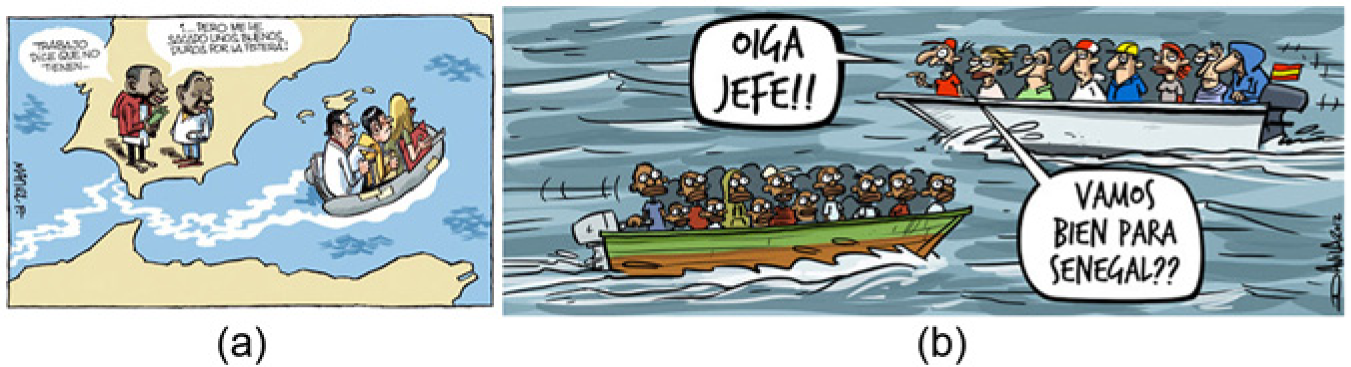
Pateras depicted after the economic crisis. Left: (a) Cartoon by Manel Fontdevila, published in Público on 13 October 2011 (‘He says they don’t have a job… but they gave me good money for the patera’). Right: (b) Cartoon by Davila, published in his blog on 15 July 2012 (‘Hey, mate! Is this the way to Senegal?’).
Thus, pateras – formerly crowded with sub-Saharans – are now occupied by Spaniards who need to migrate to find a good job. The words patera or cayuco acquire new meanings and are now used to refer to all means of transportation used by immigrants – Pandorga talks about ‘the new Spanish pateras’ and outlines some Iberia planes with the text ‘The situation has changed so much in only five years!’ (Pandorga, 10 March 2012). Kai also deals with this reversal of roles, and depicts two seagulls having the following conversation: ‘They have intercepted a patera 36 miles away from Mazarrón.’ ‘Were they coming or going?’ (Kai, 8 August 2012).
Discussion: visual metaphors and metonymies – a new visual rhetoric about migration
The analysed cartoons show how pateras and cayucos have become a symbol for migration. First, they were used to symbolize undocumented immigrants, but ever since the economic crisis broke out they became also a symbol for European immigrants (Spanish, Italian and Greek) with an EU passport and a need to flee from their countries. They are often highly qualified and look for jobs beyond their countries’ borders (in Germany, Canada or Dubai). Therefore, the patera represents a sub-Saharan immigrant for the reader, but also the European lower classes. Ever since it first appeared in cartoons at the end of the 1990s, the patera has undergone an interesting conceptual evolution that can be summed up with the diagram outlined in Figure 3.
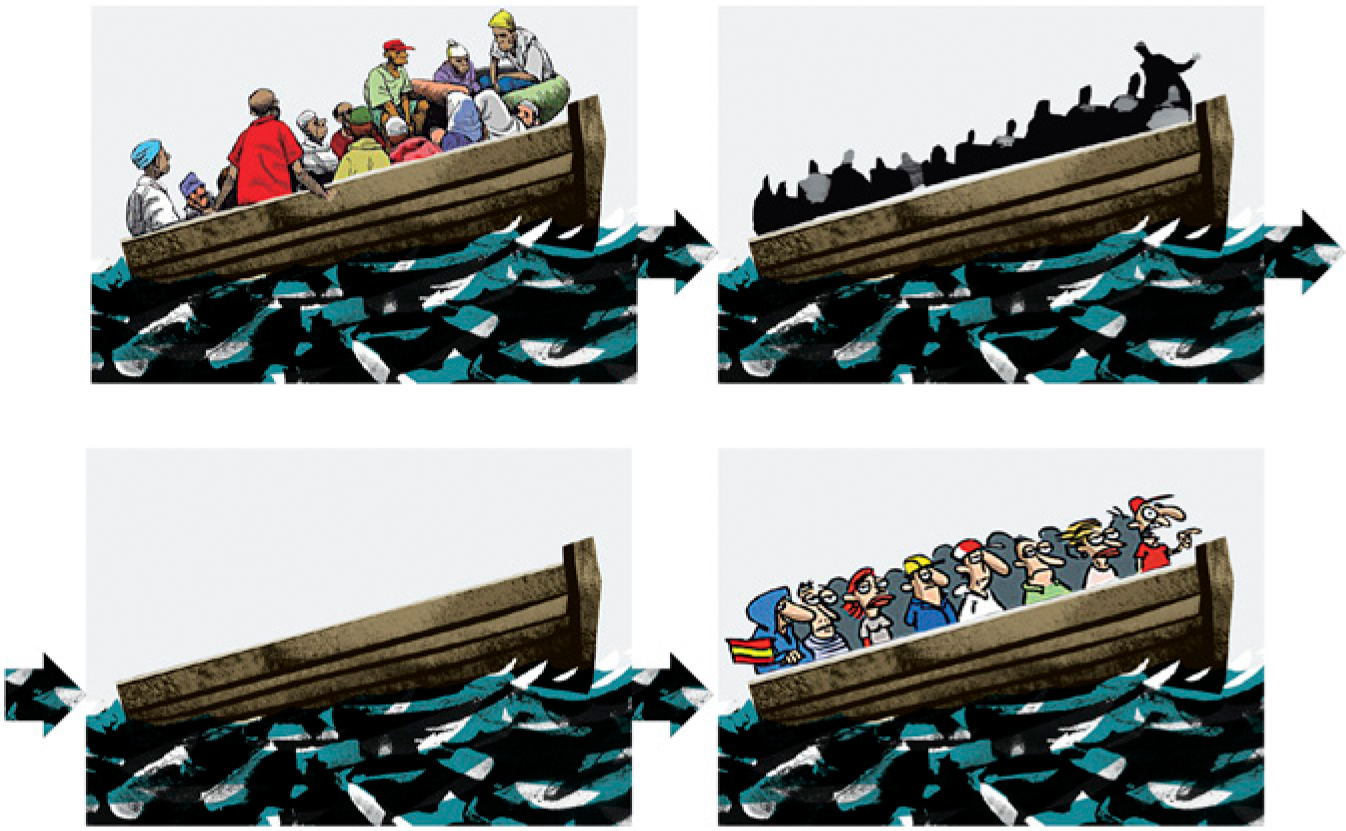
Conceptual evolution of the migrants’ boat over Spanish cartoons over time. Diagram made using elements from Caín’s, Ventura & Coromina’s and Davila’s cartoons.
The study has also shown the different stereotypes now established in Spain regarding immigration: human suffering, social injustice, citizens’ indifference to abuse and the state of defencelessness suffered by most immigrants… The representation of immigrant women is also very interesting since it is always linked to her role as a mother. Generally, these cartoons can be understood from the point of view of the patriarchal concept of ‘total motherhood’, in which a woman’s sole goal in life is reproduction. According to Nash (2000, 2004), the discourse of domesticity is the one that makes women appear depicted in the press as mothers and playing their role in the family and in reproduction. This discourse is based on women’s lack of independence.
Both conservative and more liberal media have dealt with this topic in similar ways. Since the arrival of pateras is such a delicate matter, with many moral implications, the media have probably tried to leave ideology aside when dealing with this issue. We have found no cartoons that condemn the arrival of immigrants, nor have we found xenophobic arguments against immigration like those used by extreme right-wing groups, based on insecurity and lack of jobs. Cartoonists have generally sympathized with immigrants, and have particularly focused on the tragedy of their situation and the social inequality they have to face. At most, they point out the overcrowded situation of Spanish beaches during the summer, never losing focus on the social aspect of the matter (hunger and poverty driving them out of their homes and the harshness of their journey). We can only detect references to politics when cartoonists point out the electioneering use of ‘illegal immigration’ that some politicians make (D. Isaac, 12 March 2008; Guillermo, 21 August 2006; Mingote, 24 September 2006; Caín, 1 February 2010, 16 May 2008), or the ones that use this situation to talk about other issues like the Moroccan government’s disrespect for human rights (Ventura & Coromina, 20 January 2012; Padylla, 2 July 2009, 9 January 2011) or the dispute over Gibraltar (Raúl Salazar, 23 November 2009).
The number of visual metaphors used by cartoonists is outstanding. Our research clearly shows how the use of pateras in cartoons once symbolized the poverty and precariousness of the African continent and now also refer to the European crisis, especially in Spain. According to Lakoff (1993), metaphors can be conveyed through imaginative products such as cartoons, literary works, dreams, visions and myths, and this means that metaphors are not limited to the verbal mode. Bounegru and Forceville (2011) studied metaphors in cartoons that dealt with economic crisis and concluded that the high number of metaphors found was due to the difficulty of the topic, but that, in any case, the genre itself facilitated their use. Along these lines, El Refaie (2003) claims that the use of visual metaphors makes it easier for the author to deal with delicate topics and also that they facilitate their understanding.
Probably, all the aforesaid explains the high number of metaphors found in our study (Table 1): pateras become coffins, gravestones, human femurs, paper boats, guns, a railway, a piece of bread, a ladder (to get to the dream destination). Cartoonists have also established many analogies – as we have seen some have compared immigrants with Spaniards who, in other times, had to leave for other countries; others have compared pateras with overcrowded flats (Ventura & Coromina, 24 January 2009). The image of pateras has been exploited to the point of becoming a symbol charged with meaning. As stated in the introduction, a fishing boat stranded on a beach in southern Spain or northern Africa now has a very different meaning than it did only a few years ago. Cartoonists have also exploited the Spanish coastline, transforming it metaphorically into bread, a piece of meat or a piping hot cauldron. Africa is also used metaphorically to refer to pateras or immigration. In some cartoons the continent is depicted as a boat heading for a better future (Figure 4a: El Roto, 21 January 2007).
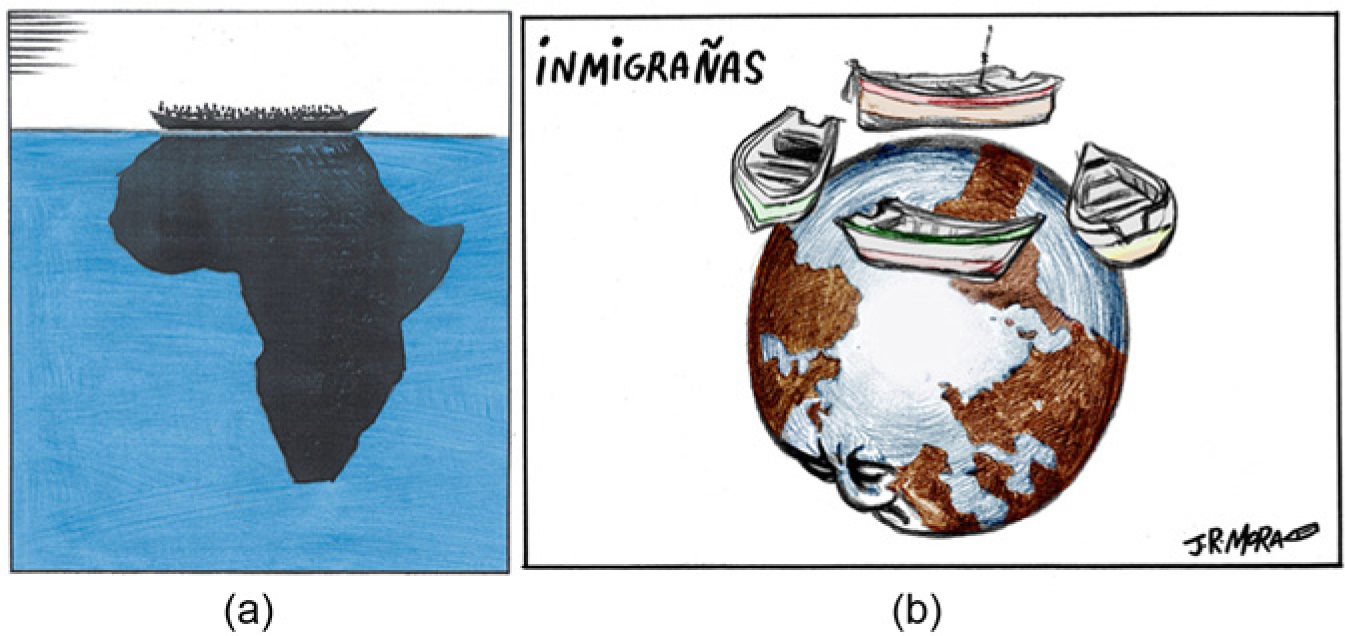
Pateras used metaphorically. Left: (a) Cartoon by El Roto, published in El País on 21 January 2007. Right: (b) Cartoon by J.R. Mora (License CC BY-NC-ND 3.0 ES), published in his blog on 15 May 2008 (‘Inmigrañas’).
Some cartoonists have gone even further and have created powerful metonymies: the boat (the container) stands for the content (immigrants and the dangers they face). According to Lakoff and Johnson (1980), metonymies allow us to send messages to the reader more easily than other rhetorical strategies and, undoubtedly, produce more surprising and brilliant cartoons. In this sense, El Roto published in El País a cartoon with a stranded boat in a beach and gave it the name Crucero Subsahariano (Sub-Saharan Cruise) (El Roto, 4 July 2009) – the stranded boat represents the journey, immigration, poverty, and even North–South inequalities. In J.F. Mora’s cartoon titled Inmigrañas (Immigraines) (Figure 4b: J.R. Mora, 15 May 2008) there are empty boats spinning around our planet, giving it a strong headache.
Lakoff and Turner (1989) showed in More Than Cool Reason, ‘how metaphor and metonymy can interact to form a unified interpretation’. In some cartoons we find a double use of skilfully combined visual metaphors and metonymies. A good example of this is Eneko’s cartoon titled El emigrante (The Migrant) (Eneko, 16 May 2007), in which the boat becomes a baguette. Two resources are very expertly merged here – metonymy (the boat stands for immigration) and metaphor (the bread refers to the immigrants’ hunger and their reasons for leaving their countries). The reader easily connects these two visual concepts and mentally translates them – the boat refers to the sea journey of the immigrant and the baguette to the reasons for their diaspora. Another meaningful example can be found in one of Quim#’s cartoons, which combines both metaphors and metonymies (Quim#, 23 June 2008) – the boat becomes a baguette with a layer of pâté spread with a knife that represents the boat’s oar (the author plays with the words pâté and patera). Metonymy and metaphor complement each other and create a very artistic cartoon infused with meaning. Padylla goes a step further outlining Africa and naming the cartoon ‘El cayuco más grande’ (The biggest cayuco) (Padylla, 27 October 2007) – in this case the boat is the African continent itself, which works as a strong metonymy, and at the same time as a metaphor for migration.
In this way, migration boats become ‘root-metaphors’ (Pepper, 1942), surrounded by a network of interrelated metaphors. Any part of the boat – like the boat’s tiller that becomes a scythe, or the oars that become forks (and one of them a long footbridge that connects both continents), or the boat seats that become rungs in an imaginary ladder that leads to Europe – can create new metaphor possibilities, susceptible of being exploited by the cartoonist. The great patera metaphor creates new metaphor sub-sets and these can develop into new images or analogies, in an epistemic tree structure. Sometimes these visual metaphors come with a metaphoric text, as in Medina’s cartoon, when a lonely immigrant, machete in hand, exclaims from his patera: ‘My boat is my fatherland’ (Medina, 9 October 2007). Both the Atlantic Ocean and the Strait of Gibraltar – where migration takes place – are used to develop many analogies and metaphors. Máximo points to the Atlantic Ocean near Spanish coasts and names it Cementerio Marino (The Graveyard by the Sea) (Máximo, 5 September 2006), referring, as the author himself admits, to Paul Valéry’s poem.
Cartoonists explore what can be called ‘visual epistemic actions’ with the goal of making the issue more easily understood and providing it with a dramatic quality, which works in favour of the effectiveness of the message. As Lakoff and Turner (1989) point out, poets combine apparently contradictory ideas and images to build new and unexpected metaphors, and the same happens in many of the cartoons, but reduced strictly to the visual level, creating new poetically charged cartoons.
Conclusion
David S. Birdsell and Leo Groarke (1996) were the first to refute prejudice against visual images for being less precise and more vague than words, especially written. Shelley (1996) claimed that visual arguments are useful for their ease of comprehension and their emotional impact on the viewer. Ever since, different authors have supported this idea (Bounegru and Forceville, 2011; El Refaie, 2003, 2009) and have claimed that ‘visuals have the power and ability to argue even more simply and forcefully than their verbal counterparts’ (Wekesa, 2012).
The study of these cartoons confirms the theses of those authors, and supports the need to promote this kind of genre in mass media. Probably, a good team of graphic journalists is capable of rousing public opinion in a more persuasive way – as Schilperoord and Maes (2009) pointed out – than a group of columnists. Cartoons skilfully mix caricature, satire and even gallows humour with tenderness, sensibility and a positive message of solidarity. Sometimes they verge on the limits of decorum (Kuipers, 2006, 2011), and cartoonists take the risk of creating important conflicts (Domínguez and Mateu, 2014; Hussain, 2007; Lægaard, 2007). Therefore, it would be a great mistake to separate cartoons – and consequently humour – from public discourse, in Habermas’ strict sense (1989), since, according to Lockyer and Pickering (2008), ‘it is not separate or separable from the broad spectrum of communicative forms and processes or from the manifold issues surrounding social encounter and interaction in a multicultural society’. Quite the opposite: cartoonists’ work and witty humour are essential to denounce excess and warn society about dangers, and their role should be more prominent in mass media, where graphic humourists are sometimes overlooked.
Footnotes
Funding
This research received no specific grant from any funding agency in the public, commercial, or not-for-profit sectors.