







Abstract
In accordance with the global trend of women’s employment in journalism, China has witnessed an unprecedented increase in women’s participation in the news profession over the last two decades. However, while accounting for more than 40% of the labor force in journalism, women still tend to occupy roles with lower pay and less power. Against this background, this article tries to provide an insight into the obstacles in the path of the success of women journalists in Chinese media. Through in-depth interviews with the journalists, three major constraining mechanisms are identified: women-unfriendly job contracts and salary systems, weak women’s associations and trade unions, and the prevalence of a sexist newsroom culture.
Introduction
In the past 30 years or so, one of the most dramatic changes in the global media industry has been a substantial growth in the number of female journalists. Cross-national data show that women have been entering the news profession in unprecedented numbers, and more women than ever before undertook journalism education in universities (Frohlich and Lafky, 2008; Sparks and Splichal, 1989). The change is so phenomenal that scholars have even talked about a ‘gender switch’ in the news profession (Sparks, 1991; Van Zoonen, 1998b). However, this massive shift in the industry’s workforce has not been matched by a change in the newsroom locations of male and female journalists. People who applauded the numerical increase of females in the profession soon found themselves being disappointed by the fact that journalism has continued to be a male-dominated profession and female journalists are still subject to various forms of gender inequality in the majority of the countries in the world (Cho and Davenport, 2007; de Bruin and Ross, 2004; Djerf-Pierre, 2005; Kim, 2006; North, 2009; Steiner, 1998; Tsui and Lee, 2012). In the case of China, the pattern of women journalists’ employment is closely in accordance with the global trend, that is, while more and more women have been entering the news profession, they tend to be employed in roles with lower pay and less power. On one hand, survey data tell us that the proportion of female journalists in China has been steadily increasing over the years. In 1995, a national survey showed that women accounted for 33% of the total number of Chinese journalists (Chen et al., 1998), but data after 2000 show a considerable rise in that proportion. Women made up 37.1% of the total in the 2001 Shanghai survey (Jia, 2001), 40.9 % in the 2003 national survey (Zheng and Chen, 2004), 43.8% in the 2005 Guangzhou survey (Lin, 2010), 43.2% in the 2013 Shanghai survey (Shanghai Journalists Association (SJA), 2014), and 46.2% in the most recent national statistics released by the regulatory body – the General Administration of Press and Publication (GAPP, 2015). But, on the other hand, the proportion of females at executive and managing levels is typically low. The 2005 Guangzhou survey shows that only 18.7% of executive positions in media are occupied by women, while the International Women’s Media Federation, in a study of 11 Chinese news organizations, found that women hold a mere 7.7% of the top management positions and 13.4% of the senior management positions (International Women’s Media Foundation (IWMF), 2011). At the same time, as is the case in many other countries, women journalists in China are usually assigned to report so-called ‘soft news’ such as health, education, and culture, while men hold most of the ‘hard news’ beats such as politics and economics (Global Media Monitoring Project (GMMP), 2010; North, 2014; Ross and Carter, 2011). Men also have better chances than women to become investigative reporters and editorial writers, groups who are viewed as more ‘powerful’ than other types of journalists (Svensson and Wang, 2014; Wang, 2012). In a recent survey, Zhang and Shen (2013) found that less than 20% of Chinese investigative journalists are women, and in editorial departments, women are even thinner on the ground.
The figures cited here suggest that the increase in women’s labor force participation has not resulted in the diminishing of gender-based job segregation, as was commonly anticipated. Gender-based inequality still persists in the journalism workforce. Against this background, this article aims to sketch out the major obstacles constraining and limiting women’s careers in Chinese journalism. In doing so, I situate my inquiry in the context of Chinese media reform and focus on the influence of media commercialization on (female) journalists.
Chinese media reform and its implications for women
It has been established through a wide array of research studies that the source of gender inequality rests mostly at structural level. Among many social structures (i.e. patriarchal society, state power, and so on), the male-centered market economy is an important element contributing to gender inequality. As many Marxist–feminist scholars have argued, capitalism, characterized by exploitation and oppression of one class by another, brought about inequalities in the lives of working people, and working women were one of the most vulnerable groups (cf. Van Zoonen, 1994). This observation is also applicable to the case of China. Several studies conducted by gender-aware scholars have provided evidence that as China’s economic policies converged toward the capitalist model after 1992, gender inequalities have widened, along with other forms of inequality in many economic sectors (see edited collection by Berik et al., 2010). The Chinese media industry, which has also embraced a version of free-market capitalism, is no exception.
Since the introduction of the ‘Reform and Open Policy’ in 1978, the Chinese media have undergone a comprehensive change. China’s media reforms can be broadly divided into three phrases: the expansion of media diversity and the relaxation of ideological control in the 1980s, the suppression of press freedom after the crackdown on the pro-democracy movement at Tiananmen in 1989, and rapid commercialization from the 1990s until the present. The most recent phrase of media reform has directly shaped the contemporary configuration of Chinese media. As scholars have noted, media commercialization in the 1990s was an accommodation to the prevailing economic reforms. Former leader Deng Xiaoping’s speech during his Southern Tour in 1992 consummated the ideological legitimacy of the market economy, and subsequently, the speed of commercialization was accelerated, penetrating into almost every aspect of people’s lives. As the popular saying initiated by Deng Xiaoping goes, ‘It doesn’t matter if a cat is black or white so long as it catches mice’. It was widely held that dogma should not override pragmatism regarding economic policy, and that any system – whether it be socialist or capitalist – should be brought into play with the ultimate aim of creating a strong economy. What has happened in the media industry has been a reflection of the country’s overall policy in pursuing this goal.
The impact of commercialization on the media industry has been profound. In the first instance, it brought a rapid growth in the number and variety of commercial media outlets. The most typical examples have been the flowering of metropolitan and weekend newspapers targeting urban citizens in pursuit of profit. Second, most press outlets attained financial self-sufficiency, making themselves independent of Party/state budgetary control (He and Chen, 1998), and the economic basis of the media has been transformed from a system based on state subsidies to one based on advertisement subsidies (Zhao, 2000). Third, the press has become more responsive to the needs of audiences rather than the needs of the party and the government; competition over content between different media outlets has become fierce. As a result, these transformations have subsequently changed the nature of the work of the news profession and the working conditions of news professionals.
With the expansion of media outlets, the employment opportunities for media professionals have substantially increased, and women, who are now better educated than before, are obvious beneficiaries of it. The survey data at the beginning of this article show this change. In addition, the commercial imperatives of the market have encouraged media outlets to go for more ‘soft’ content. ‘Soft’ news such as culture, health, education, fashion, and life style has become important building blocks for many commercial media. Although ‘soft’ news is not necessarily valued highly, its expansion has become one of the reasons for more women to be hired in the news industry (Sparks, 1991; Van Zoonen 1998a, 1998b). However, alongside this, the unfavorable conditions brought about by media commercialization are equally prominent in the case of female journalists. Due to fierce competition between different media outlets, journalists are required to work longer hours, and this makes it more and more difficult for female journalists to obtain a good work–family balance. The working environment tends to be more unfriendly and exploitative to women than men, in the sense that women are usually the ones who are expected to take care of family and children after work. In addition, while media content is converging toward the ‘soft’ end, this is often accompanied by a quest for the professionalization of journalism. Since journalistic professionalism has predominantly valued ‘hard’ news more than ‘soft’ news, female journalists who concentrate on reporting ‘soft’ news are dismissed as less competent media professionals and are more likely to be relegated to lower newsroom positions. Taken together, these factors suggest that media commercialization is a double-edged sword for women journalists. Media reform has indeed brought about more job opportunities for women journalists and increased their economic independence, but it has also introduced new sources of gender inequality.
Research method
In order to understand women’s employment status in the context of media commercialization, I conducted 19 in-depth interviews in three Chinese cities during two research trips. One took place from 29 May to 15 July 2010 in Guangzhou and Chengdu and the other from 7 to 28 November 2012 in Shenzhen. The reason for choosing these three cities for conducting the interviews was because of their prominent role in China’s media reform. Guangzhou is the capital city of Guangdong Province where China’s economic reform was launched and media reform was pioneered. It is the host city of some of the most prestigious commercial media outlets (i.e. Southern Weekend, Southern Metropolitan Daily, and Guangzhou Daily) in the country. Shenzhen is a southern coastal city located in the same province as Guangzhou. It neighbors Hong Kong, the former British colony, and was the first ‘special economic zone’ China opened up to the world in the early 1980s. Like Guangzhou, media in Shenzhen are highly commercialized in terms of business operations, although it is more submissive and pro-government in terms of political orientation. Scholars have famously described media in the city as ‘Political Publicity Inc.’ (Lee et al., 2006). As to Chengdu, it is an inland city in Southwest China where commercial media have also dominated the local market since the early 1990s. Although not very well-acknowledged by external observers, commercial competition between media outlets in the city is actually no less fierce than it is in the southern and eastern coastal cities. There was a time when seven daily newspapers were competing for the same readers and advertisers. It is also the place where the first metropolitan newspaper in China, Huaxi Metropolitan Daily, was launched in the 1990s and where the country’s seventh most profitable newspaper, Chengdu Economic Daily, in the new century resides, confirming its status as a location of profound media marketization.
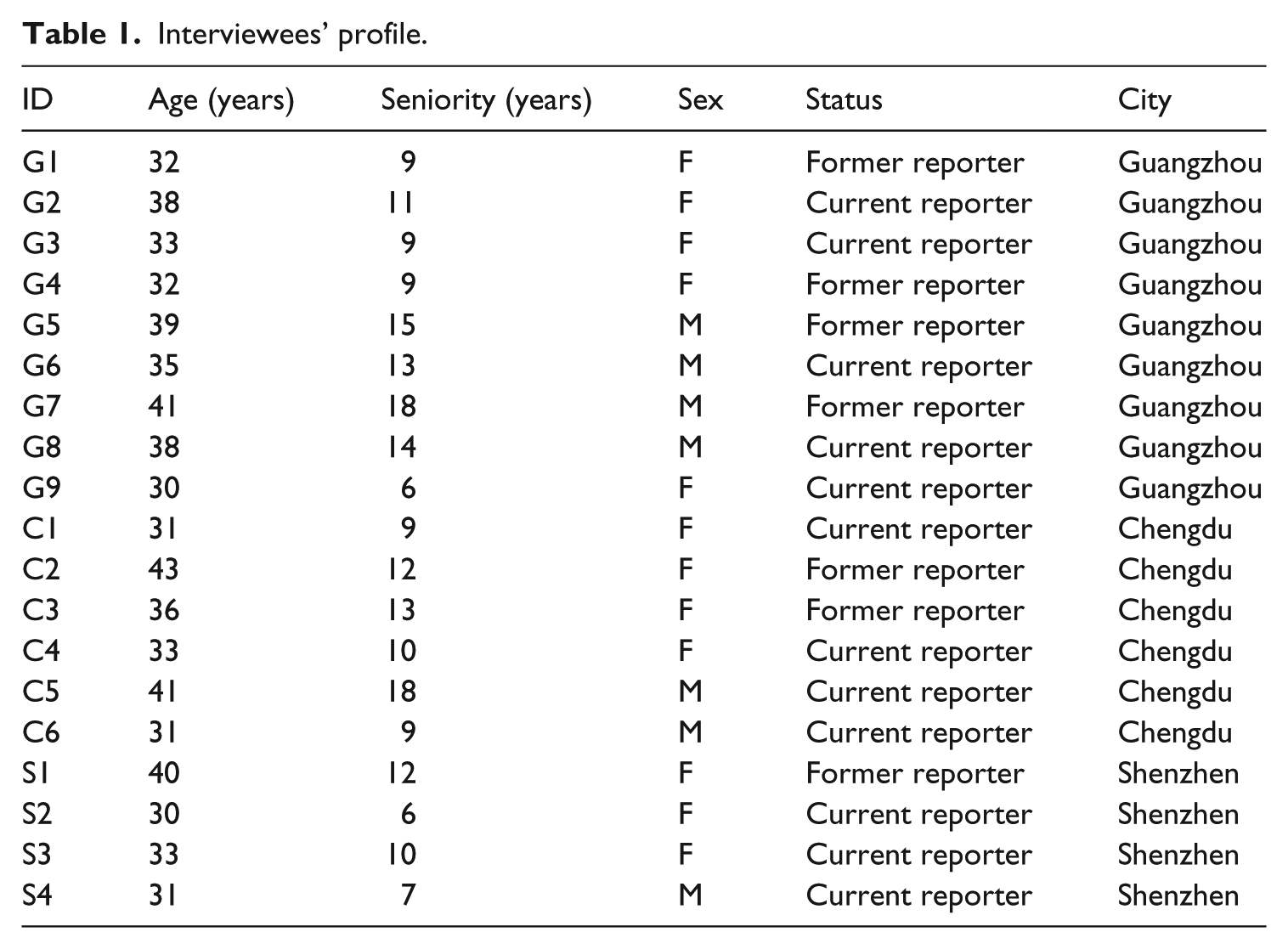
The interviewees for this study were recruited from commercially oriented newspapers in these three cities, through the snowballing method. I deliberately restricted my inquiry to the print media since other media such as broadcast television and those solely on the Internet have their own set of complex cultures that are not entirely identical to print journalism. Table 1 provides a basic profile of the interviewees. As can be seen, the 19 interviews cover both males and females. They range in age, seniority, and industry experience. Most of them are in their 30s, and some are slightly over 40 years. They all entered the profession after 1992 when the media reform started and have worked as journalists for no less than 6 years. The most senior one has been in the industry for 18 years. Most of them are current front-line news reporters; some have moved to other positions in their respective news organizations such as editing, administration, and managerial; and two of them have already left the media industry.
Interviewees’ profile.
My major subject of inquiry in the interviews was how journalists have experienced media commercialization and how females’ experience is different from that of male journalists. I asked my interviewees, both male and female, a set of guiding questions, but not strictly in the same order, and sometimes these were followed up by questions probing for more detail. Some of the interviewees are active personal blog writers. Their weblog entries cover a wide range of topics such as news, politics, travels, family, friends, and work. Upon gaining their consent, I accessed their weblogs and used the information in their writings as supplementary data. Although the responses and writings of this handful group of people do not necessarily reflect the experiences of all Chinese journalists, they nevertheless provide some insights into the working conditions of journalists, especially women journalists, amid media commercialization in China.
Three sources of gender inequality
The inequalities faced by women in contemporary Chinese media industry have various sources. From the interviews for this study and supplementary weblog research, I have identified three major ones: women-unfriendly job contracts and salary systems, weak women’s organizations and trade unions, and the prevalence of a sexist newsroom culture. I will examine each in turn.
Job contracts and salary systems
In the Chinese media, there are now two types of employment relationships between the journalists and their news organizations. One is the market system in which journalists have to sign a contract with their employing media organization on a yearly basis. The other is the quota system, in which journalists are guaranteed lifetime employment and granted sociopolitical status as governmental officials of the state (guojia ganbu). Along with the deepening of media marketization reforms, journalists signing the second type of contract in the industry are becoming fewer and fewer. In a survey of Guangzhou journalists, Lin (2010) found that among her representative samples, only 22% of the journalists were in the quota system, and most are the older generation of journalists who were recruited to the industry in the pre-reform era. Not surprisingly, in my study, none of the interviewees, female or male, are on the second type of contract because they entered the profession in the post-1992 era. This means, to borrow a Chinese expression popularized in the 1990s, they are all ‘swimmers in the sea’ (xiahai) without wearing a ‘state’ vest. In its economic reform, China has adapted a market-centric development model. The state has retreated from many aspects of social life. Lifelong employment is no longer provided by the state, neither are social welfare services such as housing, childcare, education, and health care. The state has gradually introduced market sectors to handle these. This is the context in which yearly contracts have gradually replaced lifelong employment in the media industry. And journalists are no longer proud state princes or princesses but have become ‘news laborers’ (xinwen mingong), as they would like to call themselves.
Being a ‘news laborer’ may mean two things to journalists. First of all, they have to work very hard in order to earn a decent salary, and more importantly, to keep their jobs. For journalists on commercial contracts, their incomes are made up of two components: fixed salary and monthly bonus. Their fixed salary is pretty low, usually 20% of their total income. The rest is the so-called ‘bonus’ which is dependent on the quality and quantity of their work. And, the total ‘bonus’ a journalist earns over the year cannot be small because it is directly related to the possibility of signing another job contract for the next year. In this way, the yearly commercial contract becomes a mechanism of intensifying job pressure.
Many journalists in this study like to quote a catchphrase to describe their job pressure: ‘females are used as males, males are used as mules’ (Personal communication with C1). In Chinese, a ‘mule’ is a hard-working animal, and it often works like a slave under the whips and scolds of its owner. Using ‘mule’ as a metaphor, the journalists, on one hand, describe how hard they have to work and, on the other hand, register their complaint against a system that makes them work under such bad conditions. This is related to the second implication of being a ‘news laborer’, which also means that the journalists are deprived of the free health care, free children’s education, and affordable housing services which were once available in the pre-reform era. Although in socialist times these welfare services were of poor quality and many dismissed them as existing only in name, completely losing them nevertheless gives journalists of the new generation a feeling of insecurity and uncertainty. It has contributed to the deep fear of being unemployed.
At first glance, this kind of job pressure is gender-neutral. It is the same for both sexes. But for female journalists who are at the same time expected to fulfill their irreplaceable family roles such as bearing children, the pressure and fear are in fact doubled. Many women journalists get married late, usually in their 30s, and have children after they are 35 years old. As with their counterparts in Western countries, having children is a hard decision for them to make (Ross, 2001). But the negative influence of it on their careers is much more direct and immediate. ‘From the moment you get pregnant, you are dumped to the lowest level of the hierarchy’, a female journalist in Guangzhou (G4) said. The commercialized contract and salary system does not give much consideration to women’s special needs in pregnancy and maternity. It is distributed mainly on the basis of the quality and quantity of their work. So for the female journalist who takes pregnancy or maternity leave, her salary will immediately reduce to next to zero. A female journalist in Guangzhou recalled her experience during her maternity leave:
I took two months’ leave after giving birth. My unit only paid me the fixed salary. Well, no work, no bonus. That’s the rule … But then my housing insurance, security and health insurance are all deducted from it. In the end I only had 82 Yuan coming to my account each month. It’s not even enough to buy a pack of milk powder for my child. I was so sad. So in the third month, I stopped breastfeeding and went back to work. I can’t afford to take leave any longer. (Personal communication with G4)
In this story, G4 has given a vivid example of how the salary system affects childbearing women to the extent that even the supply of milk and bread would be threatened. To deal with the problem, her solution was to ‘stop breastfeeding’ and go ‘back to work’, that is, to partly withdraw from the traditional role of motherhood. It indicates that under the current contract and salary system, there is an innate contradiction between being a career woman and being a childbearing mother. The two can hardly go together because the ‘no work, no bonus’ system is designed to encourage uninterrupted work and allows little room for any forms of leave.
More importantly, because the bonus is tied up with the renewal of the contract, the journalist who earns a small sum in bonus will face the risk of being demoted or unemployed. This pushes some childbearing female journalists to the limit of their physical capacity. A female journalist in Chengdu said that she worked until the closest moment to the birth of her child, and on the 15th day after giving birth, she was already back in the newsroom. After giving birth, many women journalists find it very hard to go back to their previous positions. They shift to less-privileged positions in their news organization such as sub-editing and administration or simply find another job in a different industry and start over. In this way, motherhood has forced many women journalists out of their profession. An example of this is the experience of C3, who works for a local press group in Chengdu, formerly as a current affairs reporter and currently as an administrative officer in its human resource (HR) department. As in many news organizations in China, her newspaper adopted a performance evaluation system through which the rank and basic salary of each journalist are determined year by year. C3 was demoted to a lower rank after she came back from maternity leave and was unable to resume her original rank, although she made several attempts. As a result, she decided to leave journalism and find another job:
At that time, I was still in this evaluation system, once I was demoted to second tier, then, I would be promoted to the first tier very soon, but I was short of one thing, short of one, I was just short, I was just short of that one thing, just short of one thing, then I would be promoted. But you know, sometimes just that little thing, you can’t. Then it made me – I cried. Our executive saw me and said, oh, you cried, why, bla bla … They do not understand us at all. I was demoted from first tier because I had a child, I was helpless. Then there was an opportunity, but I couldn’t get the promotion this time. My colleagues, they all said, xx (C3’s name), you should complain, they said, you should be promoted, you can. But how difficult it is to be promoted, you know? So I say, I can’t stand this eighteen-floored hell. I think, at that time I was cornered, felling very sad. So then, that’s why I don’t want to stay with xx (the name of the newspaper), I don’t want to work within this evaluation system. (Personal communication with C3)
In this excerpt, C3 is basically describing a battle because she makes the listener feel as if she was fighting against a merciless enemy. Her phrase ‘short of one (thing)’ was repeated four times, and such intensive repetition aroused a sense of life or death urgency, as if in a war. She also used direct reported speech to vividly re-enact different characters’ performance and invited the listener to share her experience and feeling (‘you know’). But overall it is a sad story. It began with C3’s demotion in rank, advanced with her attempt to fight back, peaked at her crying, and then ended with her failure to resume the struggle. After going through all these experiences, the result was that C3 left journalism. In fact, for many women journalists, giving birth is the major factor that interrupts and even terminates their career in journalism. As another interviewee in Shenzhen (S3) said, ‘The time a woman decides to have a child is the time she decides to leave her career’.
While some women journalists publicly complain about the women-unfriendly contract and salary systems and dismiss them as ‘unfair’ and ‘unethical’ to women, many are unconscious of its exploitative nature and take it for granted. It is more so for their male colleagues. A male interviewee in Guangzhou said,
I think if a woman wants to have children, she should not have any ambition in her career. Bearing a child takes her at least a year. And when coming back to work, she needs another year to readapt. It’s biophysically determined. They are naturally slower (in climbing the career ladder). So … they need not complain. (Personal communication with G5)
In this excerpt, G5 tries to naturalize women’s relatively disadvantageous position in the newsroom by referring to biological reasons. To him, women are slow in climbing the career ladder because of the category they are born into, not because of any socio-cultural factors. He uses the terms such as ‘determined’ and ‘naturally’ to emphasize this point, implying that this condition is given, undeniable, and should be taken for granted. So, women ‘need not complain’, they should accept this condition and live with it. Overall, G5 shows an unsympathetic attitude toward women’s difficulty in career advancement. But why so? In the later part of the interview, it was revealed that the reason behind his attitude is more or less directly related to the market-centric contract and salary system:
To be honest, I don’t want to have women reporters in my department. They are troublesome, getting married someday, having children and taking maternity leave, and then you have to do their jobs yourself. Otherwise your bonus will be affected. Your performance will be evaluated low. You can’t keep your position any more. (Personal communication with G5)
As a department head, G5’s bonus is dependent on the average bonus of the staffers under his supervision, and his performance is evaluated according to the overall performance of the reporters in the department. So the work efficiency of each reporter is decisive to his own career. Under this pressure, he tends to refuse women journalists, especially those of childbearing age, to enter his department. He uses the term ‘troublesome’ to describe women journalists. In his eyes, they make more trouble than contributions to the department. G5’s attitude to women journalists is typical of the management of many media organizations, and this contributes to the factors limiting women’s careers.
Although gender-aware managers appear in the narrations of the interviewees from time to time, they are nevertheless very rare. An example often brought up is Hu Shuli, the woman editor who founded Caijing Magazine and is currently chief editor of Caixin Media Company. She has made herself a name in China and abroad for promoting media professionalism and practicing critical journalism. As a woman editor, she has indeed inspired more women to participate in news work. More than 50% of Caixin’s journalists are women, and the chief correspondent of the magazine is also a woman. But, as scholars have observed, there has been no sign that Hu Shuli has shown any clear feminist identity or that Caixin has adopted any gender-aware newsroom policy (Svensson and Wang, 2012).
Weak women’s association and trade union
In many countries, certain policies are introduced by the state to facilitate women’s rights, and there are also non-governmental organizations (NGOs) such as women’s associations and trade unions aiming at pursuing gender justice. Many Chinese policy-makers would argue that China has women’s rights legislation and women’s NGOs too. For example, the state council passed a women’s rights protection law (Zhongguo Funv Quanyi Baozhang Fa) in 1992 and a labor law (Zhonghua Renmin Gongheguo Laodong Fa) in 1995, both containing articles on women’s employment. And, there are national labor organizations – the All-China Federation of Trade Unions (Quanguo Zonggong hui), national women’s organizations – the All-China Women’s Federation (Quanguo fulian), and thousands of their local branches. Specifically, for journalists, there are the All-China Journalists’ Association (Zhongguo Jixie), the Women Journalists’ Association (Nv jizxie) and many of their local branches too. But, as scholars have argued, in a one-party authoritarian state like China where civil society organizations are banned from operating without official supervision, the above-mentioned state-engineered and state-run associations are essentially different from autonomous NGOs, as defined by the mainstream standard (Spires, 2011). Since their launch, they have been no ‘more than an organ of the party-state’ that takes on the project of making Chinese women or laborers into ‘statist subjects’ (Wang, 2005: 520). In addition, as the country is now marching toward a market economy, these organizations, seen as ‘baggage’ inherited from the old socialist system, have been seriously marginalized, whereas bottom-up feminist or labor movements are suppressed because of all sorts of constraints (Chen, 2009). Therefore, women journalists’ rights are in fact under no real protection at all.
In principle, every contracted journalist in the Chinese media industry is a member of both the journalists’ association (jixie) and trade union (gonghui), and female journalists automatically become members of the women journalists’ association (nvjixie) and women’s federation (fulian). But many of the interviewees for this study said they did not even realize that they belonged to any of these associations. Their influence is too small to be noticed. A journalist in Guangzhou told me about his encounters with the trade union in his workplace like this:
Trade Union? … To be honest, I never know what their real function is. Only when I get my salary notice each month, can I feel its existence, because it reminds me I’ve contributed 2 Yuan to the ‘Trade Union’. And then at the end of the year, I will be given some domestic stuff, usually rice and cooking oil. We are told that these are ‘festival hospitalities’ from the Trade Union, wishing we all have a happy new year. Hahaha … That’s all. (Personal communication with G6)
As this interviewee said, the trade union seldom makes its presence felt in journalists’ working lives. His first reaction to my question is surprise as if it is a completely strange thing. It took a while for him to recollect his connection with the trade union, but that connection is nothing to do with the protection of his rights as an employee. If a journalist has any trouble getting paid or having a contract renewed, the trade union is certainly not the place where they seek help. Moreover, since the personnel in the trade union are all appointed and financed by the news organization, its function is not to fight for workers’ rights but to smooth the tension between the news organization and its employees. It has reduced itself to a hospitality deliverer and to a large extent serves as a token of nostalgia for the past socialist age. ‘Nothing more than that’, as the interviewee emphasized.
For the other kinds of organization such as the journalists’ association and women’s federation, the situation is more or less the same. Although they each have different focus, none take journalists’ or women’s rights in the workplace as their top priority. Ironically, some have even drifted to the opposite side of their original purpose to become hostile and discriminatory against women. In her recent study of urban-educated Chinese women’s struggles over property rights, Fincher (2014) found that the women’s federation has been a major force in promoting the discourse of ‘leftover women’ in the media, reinforcing gender stereotypes and stoking fear among unmarried women in their late 20s to give up property rights. Hershatter (2004) has also argued that in the case of family planning, the women’s federation has been a significant player in imposing the forceful implementation of ‘one-child policy’ and thereby directly imperiling women’s control of their bodies. A female journalist in this study told me a similar story about the women’s federation in her news organization:
On International Women’s Day this year, our unit launched a ‘Qi’pao show’. The Women’s Federation said, in order to show the ‘elegance’ and ‘beauty’ of ‘traditional’ ‘oriental’ (emphasis original) women, all women staff should please wear Qi’pao to work on that day … Some women colleagues thought it silly. They didn’t wear it. Some thought it novel. Good fun, right? Besides, they would select the 20 most ‘beautiful babies’ and 20 most ‘charming ladies’ on that day. There would be awards … (Personal communication with G1)
Qi’pao is a traditional women’s costume in China. It is a long dress usually made of expensive silk and tailored to tightly fit the figure, aiming to highlight the shape of women’s bodies. In the old days, upper-class women wore Qi’pao on a daily basis. Nowadays, Chinese women rarely wear it, except on some special occasions. In this story, women journalists were persuaded to wear Qi’pao for the purpose of a ‘show’. The object of the show, as the organizer said, is to demonstrate the ‘elegance and beauty of traditional oriental women’, but in essence it is about the display of women’s bodies. The audience of this show is unstated, but is not difficult to guess – mostly male colleagues. It is even more ironic if we take a look at the organizer and the occasion: women journalists were asked to put on this show by the Women’s Federation on Women’s Day. The Women’s Federation is supposed to be an institutional supporter of women’s equality, and Women’s Day is supposed to be an occasion to honor gender equality. But in this case, the Women’s Federation acted in exactly the opposite way. The narrator of this story, G1, is rather vague in her attitude toward the show, as she stated the different opinions of other people instead of herself. But it aroused heated discussion in another community. A female journalist in Guangzhou who identified herself as a feminist said she was outraged about this show. She said she and some of her colleagues are against ‘objectifying women’ and ‘exploiting women’s bodies for men’s pleasure’ and in that respect, in the region, they have many wars to fight but that they ‘never thought such an utterly entirely ridiculous proposal would come out of the Women Federation, the women’s own organization’ (Personal communication with G2). As this case demonstrates, weakness is not the only problem with the official associations; what is more worrying is that they are likely to become instead an apparatus for reinforcing gender inequality in the workplace.
According to the interviewees, the reasons for these women’s associations and trade unions being weak and even dysfunctional are complicated. But partly, it has to do with the market-centric logic that is prevailing in China’s media industry. Besides party propaganda, ‘making profits’ is the overriding task of media organizations in China now. Since these labor/women’s/journalists’ associations are not making any money, their development is not likely to be supported by the news organizations. Meanwhile, they are not allowed to seek independence from the news organizations because of the political constraints the state has put on the development of civil society in general in China. Therefore, their influence has gradually diminished. They have become a kind of ‘socialist’ decoration that is still hanging on the wall but is dying and very much forgotten.
Sexist newsroom culture
Another factor that contributes to gender inequality in Chinese journalism is the prevalent newsroom culture of sexism. As scholars have recognized, sexist culture exists widely in newsrooms (Kim, 2006; North, 2009), but for different reasons, it is left largely unexplored. This is because, first, informants usually hesitate to tell their experiences in this regard to researchers. Second, even if informants are willing to talk, the researchers may find it difficult to retell these stories. In the case of China, there seems a dominant view in the society, and academia as well, that a sexist environment is natural in workplace, that women’s experience of it is often biased, and that they over-react and sometimes even exaggerate. However, this article contends that the sexist newsroom culture is not natural, nor insignificant; on the contrary, it constitutes the daily working environment women journalists have to face, and more importantly, it is a major source of gender inequality in their career advancement.
Many female interviewees for this study talked about their experiences of being judged by their appearance. Sometimes this is already apparent at the moment they begin their career in the profession. In recruiting new staff, many news organizations require women applicants to be good-looking, although this is often not a criterion written in black and white in their job advertisements. An interviewee in Chengdu thus said,
In the job ads they don’t say so. But my colleagues in the human resources department clearly told me this. They have a standard in mind. They want males. If they don’t get males, alternatively they want girls, young girls with fine faces and slim figures. (Personal communication with C1)
In this excerpt, the interviewee told the different ways male and female applicants are evaluated in the job market: for male journalists, there is no obvious ‘appearance’ requirement; but for female journalist, it is better to possess a ‘fine face’ and ‘slim figure’. For many women journalists, this is humiliating and an insult to their intellectual ability, but often they are powerless to fight back, since they are the ones who want the job. The way C1 (a woman journalist who has been thus evaluated before) talked about this phenomenon is rather neutral, refraining from expressing any emotions and comments.
Meanwhile, those females who have successfully made their way into journalism are also likely to be greeted by appearance-based discrimination. A female journalist in Guangzhou who has stayed with the profession for 11 years talked about her own experience like this:
In their eyes, there are only two types of women, either ‘mei nv’ (young, beautiful women) or ‘da ma’ (middle-aged ladies). Their looks, talk and attitudes are all very offensive. Sometimes when hanging out together after work, they will say, ‘oh, there are no “mei nv,” how boring!’ They just talk like this. They don’t care what you think. (Personal communication with G2)
In Chinese, ‘da ma’ is a term referring to middle- or old-aged ladies, as opposed to ‘mei nv’, beautiful women who are usually young and sexually appealing. As a woman in her late 30s with a child, G2 was often categorized as the ‘da ma’ type by her male colleagues. The circulation of this discourse around her imposed many limitations on what she could do and say, whereas the male journalists are often unconscious of the harm this does to her and other female colleagues. According to G2, it is common for her male colleagues to talk openly about women’s appearance in the office and judge their female colleagues’ clothing, hair-dressing, make-ups, and even bodies. Pornographic images, usually of naked or half-naked women, appear on their computer screens, and women journalists are even invited to view and comment on these images.
However, as far as the male journalists are concerned, these behaviors are often not meant to be offensive to women but to give themselves some ‘fun’ in their heavily burdened jobs. G2’s experience is echoed by a story told by a male interviewee:
After work in the evening we don’t go home. We (colleagues) get together, eat, drink, review our reports over the past day or (week), and discuss what reports we will do next. One day after the meeting, a colleague said let’s play a game. ‘Suppose we are now going home, and we are allowed to take a woman from here to spend a night with. Who would you choose?’ Then we vote, in the presence of these women colleagues … We do this kind of game often. Just for fun. (Personal communication with G8)
In this example, the male journalist appeared to be extremely unconscious of their sexist attitudes toward women. Or, if he was conscious about it, he tended to see it as natural and not at all wrong. The story he told explicitly indicates the existence of a sexist newsroom culture to which women journalists have to accommodate themselves. Objectifying women as sexual objects becomes a normalized newsroom practice on a day-to-day basis. Through these practices, men are able to display their prestige and power. In contrast, women are placed in a subordinate position. This constitutes a major source of male domination in the newsroom.
Some female interviewees for this study actually said that their reason for leaving the industry is because they find it difficult to accept this kind of sexist newsroom culture. A former journalist who has just left the profession said,
When they made sexist jokes to me, I often returned a cold face. I didn’t want to react in the way they expected, like … laughing, returning another joke … But gradually I noticed the consequences. They saw me as a boring and uninteresting person, well … because I am not playful. I felt I was isolated. It was getting very hard. So I quit. (Personal communication with S1)
On the other side, women journalists gain little sympathy from the men in this regard. Instead, they are blamed for not utilizing their ‘female’ advantages properly. When the question of sexist newsroom culture causing difficulties to females’ career arose, a male journalist in this study said that it is ‘nobody’s fault but themselves’:
Women have natural advantages. They should utilize them. … They should make the boss feel it is pleasant to have them around. This way, they will have good chances in their careers even though they can’t make good journalists. (Personal communication with G8)
In the face of such a sexist newsroom culture, some women journalists respond with a feminist attitude by confronting it, and some choose to ignore it or avoid it. But inevitably, there are also some who will choose to conform to it in order to keep their job. In the recent anti-corruption campaign launched by the Xi Jinping government, Zhou Yong Kang, a former Politburo Standing Committee member, became the highest-ranking official to be sacked in China since 1949. Amid his downfall, several national TV journalists were investigated, and the stories about the sex life of Zhou and his accomplices in CCTV (China Central Television) became known to the public. One of them, Shen Bing, a 37-year-old TV anchor who was one of Zhou’s alleged mistresses, admitted in a recently published autobiography that for women journalists to use sex to advance their careers is not uncommon in China (Shen, 2014). Although the stories she told in the book are hard to prove, they nevertheless provide a glimpse for outsiders to see to what extremes the sexist culture in the newsroom can go and how desperate and powerless women journalists can be in living with this culture.
Conclusion
In this article, I have identified and analyzed three sources of gender inequality in Chinese journalism. These are the women-unfriendly commercial contract and salary systems, weak women’s association and trade unions, and a dominant newsroom culture of sexism. In varying degrees, these three factors are all associated with the commercialization of the media since the 1980s. The commercial contract and salary systems are a direct creation of the media reform, replacing the ‘equal job equal pay’ employment policy of the old socialist days. Although this has been successful in encouraging media organizations to grow, the new system is exploitative of women journalists, who bear reproductive responsibility but are granted no paid maternity leave. Meanwhile, women’s associations and trade unions have generally lost their power in negotiating proper working conditions for journalists, especially the women journalists. Some organizations formally devoted to the liberation of women have now become carriers of sexist discourse. Together with the pervasive sexist newsroom culture, they have seriously limited women’s capacity in struggling for gender equality.
In describing the situation of women journalists in the context of media commercialization, I use this term – ‘naked swimmers’. There are two layers of meaning here.
In the context of China’s media reforms in the past three decades, working conditions have undergone profound changes. Journalists are no longer government officials, the proud ‘kings without crowns’. They have become ‘news laborers’ who work for commercialized media organizations on temporary contracts, depending on their own efforts to secure health care, education, housing, and other social welfare services. To borrow a phrase popularized the 1980s, they have become ‘swimmers in the sea’, the sea of the market economy. Yet, the market is at once an enabling and constraining device, especially for women. It is women who have to pick up the new unpaid caring tasks in the households as public services have been cut, as well as competing for a paid career with men. Neither the state nor the market is women-friendly. At the same time, civil society is seriously underdeveloped and there are virtually no truly independent women’s NGOs or trade unions that aim to pursue gender inequality. In this sense, women journalists are naked swimmers in the sea; they have no ‘protective vest’, neither the state or the market nor the NGOs and trade unions.
In the meantime, the changing labor conditions have been accompanied by growing cynicism in the news profession. This leads to a newsroom culture that is hostile toward women’s advancement. Women journalists are exposed to sexist jokes, ‘humor’, pornography, and from time to time even direct sexual harassment in their workplaces. They are made powerless embodied objects in the face of the deeply sexist newsroom culture. Neither the surrounding culture in society nor the laws support them in fighting it. They are also ‘naked swimmers’ in this sense.
Having said that, I do not mean to indicate that the situation of Chinese women in the pre-reform era was any better. Although in the socialist time, working women’s equality was protected by top-down state policies, the biggest problem with that system was that it failed to recognize women’s agency. What I set out to question in this study is whether economic reform has in any way enhanced women’s rights. As I have shown, the influence of the market on women professionals is rather ambivalent. On one hand, it has opened up room for women to seek subjectivity, agency, and independence from state-patriarchy control. On the other hand, the male-centric market logic has brought about new problems for women. As the state reduces funding for public services and social welfare, women are subject to greater gender inequality. With the deepening of commercialized culture, women journalists, like other women in society, inevitably become sexual objects in their news organizations. To pursue gender equality, Chinese women journalists need independence not only from the patriarchal state but also from the male-dominated market.
Footnotes
Funding
The author(s) received no financial support for the research, authorship, and/or publication of this article.