







Abstract
The article examines the case of the terrorist attack on a free speech event hosted at Krudttønden café in Copenhagen on 14 February 2015, exactly at the time when Femen’s leading activist Inna Shevchenko was delivering her speech on the illusion of free speech in Europe. I focus on the intersections of sound, feminine vulnerability, mediatized support, and transformations of Femen activism network within layered and interlaced networks. Guided by the concept of Badiou’s event, the article offers the perspective of Shevchenko’s ‘evental’ activism, which stands out with its instantaneous switch from usual Femen-disapproving rhetoric to the rhetoric of support for Femen and its terrorist-attack survived leader in particular. The fact that Shevchenko not only witnessed and survived the attack but also became a popular spokesperson for the event and the issue of free expression signposts a major transformation of Femen activism and brings into the light larger cultural phenomenon. The article argues that the mediatized perception of intense and immediate fears helps level out of the smaller cultural and aesthetic differences at the expense of creating new ‘us versus them’ division accompanied by the discussions attempting to counteract it.
Keywords
Introduction
Quite often, we talk about events and how they transform our ways of thinking or being by dislocating us into new worlds. What is often lost in such discussions is the multiplicity of nonhuman layers and their roles in articulating transformative truths arising from such events. These layers are situational details ranging from sounds to digital attunements for multiplication and re-mediation. It is easy to see how nonhuman nature and agency of the networked new media affordances fade in the light of acute questions concerning truths and ethics of feminist and other ‘blasphemous’ actors, especially given that they do not remain bloodless, even in such secular countries as France and Denmark. The Charlie Hebdo deadly attack on 7 January 2015 elucidated that those transgressing borders of religious ethics are not protected by their secular aspirations or political locale. Their actions simultaneously occur in places near and far, now and then. The risks, debates, and activisms pertaining to freedom of expression and feminism become acute, especially in the light of recent Islamic terror attacks, the rise of ISIS, and the influx of Muslim refugees in Europe.
The case at hand is the Muslim terrorist attack on a Krudttønden café hosting a free speech event on 14 February 2015, exactly at the time when Femen’s leading activist Inna Shevchenko was delivering her speech on the illusion of free speech in Europe. The event titled ‘Art, Blasphemy and Freedom of Speech’ was also attended by the ‘controversial’ Swedish cartoonist Lars Vilks and the French ambassador to Denmark Francois Zimeray, among other journalists, artists, and activists from Europe. It is an important case study for several reasons: First, the absence of visual material and exclusive audio-phonetic account of the event propels underprivileged aspect of new media – sound. Second, this event allows us to study the unplanned, event-based nature of activism with unusually high mobilization of support around Femen. Through close-textual and audio-visual analysis of media artifacts, the article addresses the following research questions:
R1. How does the audio recording of the shooting influence Femen’s evental activism of the 2015 Copenhagen shooting?
R2. How did the audio witnessing of the shooting and Twitter-mediated testimony of Inna Shevchenko incite the mediatized discourses surrounding the event?
R3. What transformations did the event produce for Femen and its movement?
This case study stands out with its instantaneous switch from usual Femen-disapproving rhetoric to the rhetoric of support for Femen and its leader Inna Shevchenko in particular. Her tweets and media interviews after the shooting focusing on Shevchenko’s association with the larger battle against terrorism smoothed out the rough edges of sextremist and iconoclastic style for which Femen’s activism is usually criticized. Instead of critiquing Femen, the forces of online communities in the West gathered around one goal – to support her in her fight against the common enemy, Islamic terrorism. The support toward Femen is evident in the discussions of the event on Twitter, many TV and print interviews, where journalists sympathize Shevchenko’s shaken voice (CCTV America, 2015) and ask her to elaborate on what was she going to say right before the sound of bullets interrupted her (BBC News, 2015; Töpper, 2015). Such focus on Inna’s plight blends the movement of Femen into the Western mainstream along with its sextremist baggage.
How Shevchenko not only witnessed and survived the attack but also became a popular spokesperson for the issue of free expression presents a unique confluence of theoretical concepts that signpost a major transformation in Femen’s activism. I focus on the intersections of sound, witnessing, feminine vulnerability, mediatized support, and transformations of Femen activism network within layered and interlaced networks guided by the concept of Badiou’s event. The analysis in this article shows that all these layers are mediatized forces assembling around the event validating Femen’s sextremist iconoclastic activism, acknowledging its freedom of expression causes, vulnerability, and Twitter-mediated support. In order to analyze those and many other details and conceptions that bring the event of the 2015 Copenhagen shooting into being, the next section outlines a layered and interlaced framework of evental activism.
The theoretical framework of event and its multiple layers
The event as proposed in this article illustrates an instance of actor-network theory in action (Latour, 1993, 2005) and stands on the junctures of the nomadic subject (Braidotti, 2011), sound, witnessing, vulnerability, writing (Cixous, 1976), freedom of speech, and blasphemy. Before going any further, I need to explain Badiou’s event and its relevance for this project. One of the aspects about the event, in Badiou’s (2001) sense, is that it is neither natural nor neutral, but an assemblage of multiplicities that forms a singularity. For this reason, it is often hard to delineate and find clear edges to an event. Such an event, with all its moving parts being in the process of emergence, is committed to chance. Another key word in Badiou’s event theory is truth, which manifests itself through subjects that are formed in the process of being faithful to the event. An event is nothing if not the emergence from a specific evental site, or a situation that arises from intersections of multiple factors.
Digital media contains magnifying and amplifying effects, as it brings closer details often neglected in visual-dominating encounters. Sound plays a role of a ‘unique identifier’ (Peters, 2004: 7). For the most part, once we hear someone speak, we know his or her gender, sexuality, and, sometimes, even nationality, or race. Anyone who recognized Inna Shevchenko’s voice speaking before the gunshots was able to connect it to the topless activism and realize her presence, feminine vulnerability, and her fight for change.
Shevchenko, with her provocative, anti-Muslim protests and ties to Charlie Hebdo activists and another highly targeted artist from Danish cartoon controversy, Lars Vilks, who was also in attendance during the terrorist-targeted free speech event, makes her witnessing an even more intense ‘event-generator’ as Thomas (2009) would say. Many media scholars writing about witnessing mostly tie it to journalism and new media technologies. They often implicitly rely on the ideas of Peters in regard to bodily aspects of witnessing. He writes, ‘to bear witness is to put one’s body on the line’ (Peters, 2010: 256). Peters (2010), similar to Thomas (2009), traces the religious connotation of witness and brings up its connection to the idea of martyr.
Powerful notions of witnessing interlaced with affective forces of survival and martyrdom make a witness not only reliable, but also a necessary, truthful mediator who provides an account of the event at hand. With the rise of mobile witnessing technologies (Andén-Papadopoulos, 2013) and ‘perpetual crisis-awareness’ (Frosh and Pinchevski, 2009), expectations for journalists, citizens, and activists to report lively from hot spots have become implicit. With new media tools come such affordances as searchability (Boyd, 2010), spreadability (Jenkins et al., 2013), shareability, and affective engagement (Papacharissi & de Fatima Oliveira, 2012). Those affordances enable ‘nomadic subjects’ (Braidotti, 2011) to function.
Twitter represents one of the most noteworthy affordances in the case of the Copenhagen shooting. It was the platform through which Inna Shevchenko, a good example of a ‘nomadic subject’, provided her live testimony right after fleeing the room under the attack reporting, commenting, and discussing live. I will discussion these mobile communications later in the article.
Actors, such as Femen’s activist, deploy their forces in ways that make others do things and produce unexpected events that trigger other actors and mediators to follow them (Latour, 2005). It is through such affective streams and movements that emotions enter into our bodies and make us do things. Deploying networked media affordances and her own precarious experience of surviving terrorist attack, Femen leader triggered eradication of differences between her radically provocative style of activism and mainstream discussions of the terrorist attacks.
Eradication of differences is particularly interesting in the context of breaking news, which in the age of mobile media is a place and time in whirls, warps, and remediations at an incredible speed. In this context, identifying first iterations of events is hard, if not useless. What matters is to find iterations that caught traction and trace these iterations as they assemble and produce transformative forces. The artifacts this article analyzes comprise traditional media coverage of the event, tweets, and other peoples’ interactions with Shevchenko around the Copenhagen shooting event.
Tracing sounds and movements
On 14 February 2015, several hours after the attack on the free speech event in Copenhagen, BBC News published a brief online news story with a headline ‘Danish shooting: Audio of moment gunman struck in Copenhagen café’. The story starts with a still image of the café pierced with numerous gunshots and two law-enforcement agents working in front of it. The stories reporting the event of shooting such as BBC submit to an ‘abrupt creation not of a new reality, but of a myriad of new possibilities’ (Badiou, 2012: 109). These possibilities are compelling, swaying possibilities of not only feeling, acting, and being otherwise but also of reporting and connecting otherwise through nonhuman affordances. As the story on BBC website loads, the audio part of the media starts and one has to click pause in order to read the rest of the story first: An audio recording obtained exclusively by the BBC captures the moment a gunman struck a free speech debate in the Danish capital, Copenhagen. A manhunt is under way for the suspect who targeted the event at the Krudttoennen cafe in the Oesterbro district of the city. Controversial Swedish cartoonist Lars Vilks, who has drawn caricatures of the Prophet Muhammad, is understood to have been present at the debate, as well as the French ambassador, Francois Zimeray. A speaker at the event is interrupted by a volley of shots. (BBC News, 2015)
The text does not mention the leader of the Femen movement, Shevchenko, but it is her voice that we hear first in the media clip embedded above the news story. In the clip, we hear her say, ‘I realize that every time we talk about activity of those people, there will always be “yes, it is freedom of speech, but …” And the turning point is “but”. Why do we still say, “but” when we …’ At this moment, 17 seconds into her speech, we hear gunshots in a relatively close range from the audio recording. Then, sounds of chaotic movements of chairs, tables, and frantic footsteps follow as the gunshots continue. At last, gunshots stop and something metallic falls on a hard surface. Sounds of people murmuring in haste, moving hurriedly dominate the ending of the audio clip with the ambience of a quieter, smaller room or a corner of a room. This 45-second clip was taken up by the major media outlets and shared on social media.
The sound of the human voice followed by gunshots has a visceral ability to induce fear. In his highly Deleuzian book on sonic warfare, Steve Goodman (2010) theorizes ‘affective mobilization and contagion’ (p. 11) with the potentialities for ‘the production of the ecology of fear’ (p. 13), which emerge out of audible vibrations and sonic experiences. In the case of the terrorist shooting at the Copenhagen 2015 free speech seminar, the cause of fear does not have as much to do with sounds of gunshots at the event, as with the anticipation and nervousness due to past and future terrorist attacks carried out in the name of ISIS or a group similar to it.
These media reports providing background information, the Charlie Hebdo link, and the statement from political leaders and experts increased the salience of the event. Later news identified Shevchenko and included more details from the event. The Guardian (Booth and Chrisafis, 2015) begins the story by stating that ‘Inna Shevchenko, a leader of the Ukrainian protest group Femen, was addressing the audience of about 30 people on the danger of gunmen suppressing free speech when the bullets started flying’ (para. 1). The article also identifies Lars Vilks as the apparent target of the attack because of his 2007 cartoon depicting prophet Mohammed on a dog’s body. ‘Among the shooting I could hear Arabic: “Allahu Akbar!”’ The Guardian quotes a participant of the event Agnieszka Kolek, the curator of the Passion for Freedom Arts Festival in London. The remediated version of the 45-second sound clip, capturing the moments of the attack, includes The Guardian logo over the slideshow of seven photographs depicting the scene of shooting (Booth and Chrisafis, 2015).
The Washington Post (Witte and Adam, 2015), reporting a day after the attack, elaborates on the terrorism issues and also links the shooting to the Charlie Hebdo attack. Toward the middle of the article, Witte and Adam (2015) write about Shevchenko, include a link to BBC’s audio clip of the attack and describe it too: In audio of the moment the gunman struck that was posted online by the BBC, a woman can be heard speaking before she is interrupted by a volley of gunfire. … The shots are steady and sustained. From inside the cafe, the sounds are of chairs sliding along the floor as people dive for cover. No one screams. (para. 27)
As we see here, with the multiple ways of remediation and multiplication, digital media contains magnifying and amplifying effects, as it brings closer details often neglected in visual-dominating encounters. Sound plays a role of a ‘unique identifier’ (Peters, 2004: 7). For the most part, once we hear someone speak, we know his or her gender, sexuality, and, sometimes, even nationality, or race. Hearing Shevchenko’s voice even those who did not know her, recognized her as women in a vulnerable position. As Peters (2004) puts it, voices ‘drip with erotic and political power’ (p. 14), which aided the Femen’s cause by inciting further dissemination and discussion of the audio clip.
The embedded audio clip in a new media story (Henderson et al., 2015) manifests the ephemeral, temporal, fleeting nature of sound media. It affects audiences and moves reporters through its reproductive and remediative capacity. There is not much of a discussion of the sound clip itself, but of the fears, voices, and movements it represents. Clearly, the audio recording of Shevchenko being interrupted by the sound of gunshots during the 2015 Copenhagen terrorist attack on free speech event magnified Femen as one of the most, if not the most, important participant of the free speech event and therefore immensely aided Shevchenko’s activism, which is in direct correlation with media attention and twitter-mediated support toward her.
The Telegraph (Henderson et al., 2015), reporting the next day after the attack, has the audio clip of the attack twice in the story, in the opening and in the middle. This remediated version opens with the Telegraph logo graphic animation, logo, and the slideshow of images from the attack site. The lengthy story provides detailed reverse timeline of the attack on the free speech event and later on the synagogue. This story, like many others, weaves in audio account of the attack and spotlights Femen. Shevchenko in this assemblage is similar to an “actor” in the hyphenated expression actor-network … [she/it] is not the source of an action but the moving target of a vast array of entities swarming toward it’ (Latour, 2005: 46). One of the most important elements of the 2015 Copenhagen shooting event unraveled via Shevchenko’s live-tweeting of the immediate aftermath of the shooting and engaging audiences in discussions that were later cited by major media outlets.
Twitter-mediated testimony
‘I did not see anything, I heard around 20 shots while speaking and then people started to run’ (NBC News, 2015: para. 20). This was one of the first tweets that media picked up from Inna Shevchenko’s timeline, in this section referred to by her Twitter handle @femeninna. NBC News (2015) cited this tweet in their story about the Copenhagen attack. Shevchenko, with her provocative, anti-Muslim protests and ties to Charlie Hebdo activists and another highly targeted artist from Danish cartoon controversy, Lars Vilks, makes her witnessing an even more intense ‘event-generator’ as Thomas (2009) would say: Against the background of this instability, every act of witnessing is tied to a ‘transformation’ that can be expected or even ‘triggered’. In the act of witnessing, something is added to the witnessed ‘event’ (be it either ‘inside’ or ‘outside’ the witness), thereby changing the event itself. (p. 96)
What Thomas is suggesting here is that a witness may not only transform the event by becoming part of it but also feel/bear the transformations on her or his own self. This transformation is visible, in media stories citing her tweets and referencing her Twitter timeline for more updated information.
In their live phone interview with Inna Shevchenko, CCTV America (2015) showed her headshot with a concerned look in her eyes, flower crown on her head and a text above the photo ‘Inna Shevchenko Witnesses Shooting’. Next to this image, there was her tweet with a photo showing all the survivors of the attack resting in the dim room of the local police station. While she is answering TV journalists’ questions about the event in a live-audio interview, the next tweet of hers appears on the screen: ‘I was at the point of my speech when I was saying that often it is an illusion that we have freedom of speech in Europe. Then we heard shots’. This tweet with 710 re-tweets and 250 likes ended up being by far the most popular among her live-tweets from the aftermath of the shooting. This and her other tweets from the event were published in the Telegraph (Henderson et al., 2015), Washington Post (Witte and Adam, 2015), Le Monde.fr (2015), Elle (2015), and Spiegel (Töpper, 2015) among others. @Femeninna’sTwitter-mediated testimony shows precarious juncture between her experience and the world, where ‘words can be exchanged, but experiences cannot’ (Peters, 2010: 251). This juncture is even more precarious in the case of female speakers, who due to her provocative sextremist protests, is often perceived as marginal, exiled from her home country of Ukraine and criticized in the country of her political asylum – France.
Support-ripples around @femeninna
The users with both large and insignificant number of followers interacting with @femeninna and amplifying her assemblage discussions act similar to what James Carey dabbed as ‘ritual communication’. The key words here being ‘sharing’, ‘participation’, ‘association’, and ‘fellowship’. Within such ‘ritual communication’, the affective news stream on Twitter (Papacharissi and de Fatima Oliviera, 2012) communities form, reform, and move as they pledge their support and give thanks to @femeninna: @femeninna Just saw news Inna. You ok? http://news.sky.com/story/1427630/manhunt-after-shooting-at-free-speech-meeting. (kevo, 2015) @femeninna heard the audio. So glad ur ok. (Carruthers, 2015) @Ali_Jones89 @femeninnaInna, just read; hope you are all ok. People talk about your brave words which is unsurprising but great. (Goroya, 2015a) @femeninna Stay safe. Thank you for standing up for free expression. (Stephen Knight, 2015) @femeninna The free world stands behind you in support! Never let the bully win. (Aren, 2015)
Thus, shareability and spreadability affordance of new media turned the evental activism of @femeninna into expanding assemblage ((Jenkins et al., 2013; Latour, 2005). Along with these comments users were posting their photos with Inna (@ChrisMoos, @ElizaGoroya), tagging her in their tweets with the hashtags #SolidriteCopenhague (chisAPteam, 2015), #jesuisInna, #LiberteDExpression (Bierlein, 2015; TELLZETRUTH FQSP, 2015), #FreeSpeech (Spratt, 2015), and #femen (Sargeant, 2015a).
An interesting category among those supporting @femeninna were people admitting to support her despite disliking her or her activism tactics: @femeninna @Femen_France I don’t like you, but I hope you’re safe, thanks God. (†CHOISIS TON CAMP 2015, ن) @femeninna To tell U the truth, I think U women R a bit weird; but to be shot at????NO WAY! (Eytan, 2015) @femeninna: Despite some disagreements on your actions, receive my full support and solidarity after the drama you livedin #Copenhagen. (Pierre-Yves Bureau ن, 2015)
Here Latour’s (2005) point about actors making other actors do unexpected things is evident. We can see how the intensity of connection is beyond mundane likes and dislikes and how this connection forms evental assemblage. Tweets such as these ones were often referencing or replying to the conversations linking the Copenhagen shooting to the Charlie Hebdo terrorist attack. Similar to many of the print and TV news, Twitter users also elaborated on the chilling similarities between the Copenhagen shooting at the free speech event and Charlie Hebdo murderous attack.
A photojournalist from Hungary, Léa Lecouple, @LeaLecouple (Lecouple, 2015) posted an archival drawing of Femen by Charlie Hebdo. The caricature depicts a bare-chested woman with Femen name and blue-yellow logo of the group painted on her breasts, passing by a press kiosk overflowing with images of naked or almost-naked sexualized women. A man sitting at the entrance into the kiosk has one hand stretched out to point at the activist, while holding a sexualized image of a woman under his other arm. He angrily yells at the activist through his sharp teeth and long nose. The activist holds a sign above her head ‘MY BODY MY RULES’. As Charlie Hebdo connection became relevant and newsworthy, it started assembling elements from past timelines making them actual once again.
Capitalizing of Charlie Hebdo connection, @femeninna herself posted an image from Charlie Hebdo’s magazine after the terrorist attack. The square image of empty whiteness has a frame and a thin handwritten font saying: ‘PLEASE ENJOY THIS CULTURALLY, ETHICALLY, RELIGIOUSLY, AND POLITICALLY CORRECT CARTOON RESPONSIBLY. THANK YOU’. TerrorWatch (2015), @ConflictHubre-tweeted this image from @femeninna and added a line to it: ‘Seems even more relevant today. Scary times indeed. #Copenhagen’.
Such a vivid association with Charlie Hebdo, placed @femeninnaon an even-more-precarious and vulnerable pedestal in the eyes of the Twitter users and journalists. As @femeninna was posting her updates on her and other witnesses’ whereabouts, her followers were responding back with news updates and compassionate safety warnings: ‘@femeninna be careful with a shooter still at large after shooting in #Copenhagen at a synagogue’ (McCain, 2015). It is evident how assembling of the people is done around the cause of safety. This assembles ideas of empathy and fear-driven solidarity at issue.
Be brave: the force of fear-induced rhetoric around @femeninna
Even though @femeninna was not the most famous person at the event, with her voice in the recording, live-tweeted testimony, and people supporting her, she gained authority and seized the opportunity to speak up for the causes Femen has been fighting for. These tweets below are not just @femeninna’s comments on the attack but also the gist of her talking points in the interviews with journalists and her own columns: 1/2 ‘We don’t have to talk about freedom of speech, we have to practice it’ was the point of my today’s speech. (Shevchenko, 2015a) 2/2 it was interrupted by someone who was practicing his ideology. (Shevchenko, 2015b) If all secularists, humanists would be that brave as those gunmen, we would NOT live this now #Copenhagen #copenhagenshooting. (Shevchenko, 2015c) Let’s NOT be scared! Let’s fully enjoy our freedom. This is the best weapon against extremists. (Shevchenko, 2015d) Don’t fall into their game: by being scared you will not protect yourself … #Copenhague There is no longer such a thing as ‘safe Europe’ #CopenhagenShooting #Copenhague I wish all liberals have bravery to show their ideas as those terrorists are … (Shevchenko, 2015e) If Charlie Hebdo, Lars Vilks, Raif Badawi, Aliaa Elmahdy, FEMEN & others would NOT be alone in this fight, we would NOT become a target. If you believe in free speech but with no offense to others, you don’t believe in free speech. (Shevchenko, 2015f) We are in the middle of ideological war in Europe. They fight us with guns, we have to fight them with cartoons, street protests, speeches, etc. (Shevchenko, 2015g)
As we can see in these tweets, @femeninna is cultivating a group based on ‘us’ versus ‘them’ division. ‘It is always by comparison with other competing ties that any tie is emphasized’ (Latour, 2005: 32). In the case of the Copenhagen 2015 shooting, the ties delineate liberty-loving Europeans from Islamist terrorists. Following Latour (2005), in order to sustain itself, a group needs a spokesperson, an actor ‘defining who they are, what they should be, what they have been. These are constantly at work, justifying the group’s existence, invoking rules and precedents and, as we shall see, measuring up one definition against all the others’ (Latour, 2005: 31). Such a spokesperson acts as an actor, turned into a node, turned into a network, and all this mostly amplified and speeded up via digital media affordances that help transport agencies of change across vast distances and fragile bridges.
Many of @femeninna’s tweets were about fear and not being scared, while she in fact was sounding scared as one of her followers pointed out: ‘@femeninna I am listening to you speak to CCTV Susan Roberts. I am sorry … you sound really frightened’ (The Global Investor, 2015). She herself in the interview with CCTV admitted having a shaken voice, but directed this vulnerability as a power against the oppressors of freedom of expression and insisted on continuing the fight for their rights despite the fear. Fear, shock, and horror formed a theme of its own among those discussing the event online in relation to @femeninna: @FEMENSWE @elisabethohlson @arnstad I’m still in shock. They shot at wonderful @femeninna and Lars! (Natschki, 2015) Heureusement @femeninnavabien.J’aieupeur pour elle. Maisçan’enlèverien à l’horreur.#Copenhague. (de la VitreArrière, 2015) Ukrainian feminist @femeninna gave a speech in CPH today, when she was interrupted by shots. Horrifying #cphshooting. (Foght, 2015) I think you need to stop calming yourself down. It is evidently#WWIII and we need to win it #BanIslam @ChrisMoos_@DRNyheder @femeninna. (Raam, 2015)
Often, the theme of fear and oppression in Twitter discussions was entwined with Islam and terrorism so closely it was hard to disentangle them. There is an array of comments in this vein (eigenscape, 2015; Figure 1), commenting on how Muslims are incapable of understanding free speech (Plantiko, 2015) and cannot joke (Mac, 2015). Others were calling Muslims ‘Islamofascist animals’ (Treacher, 2015) and urging the world to get together and destroy them (kile, 2015). Here, we can see how fear-induced antagonism grows into hate speech.
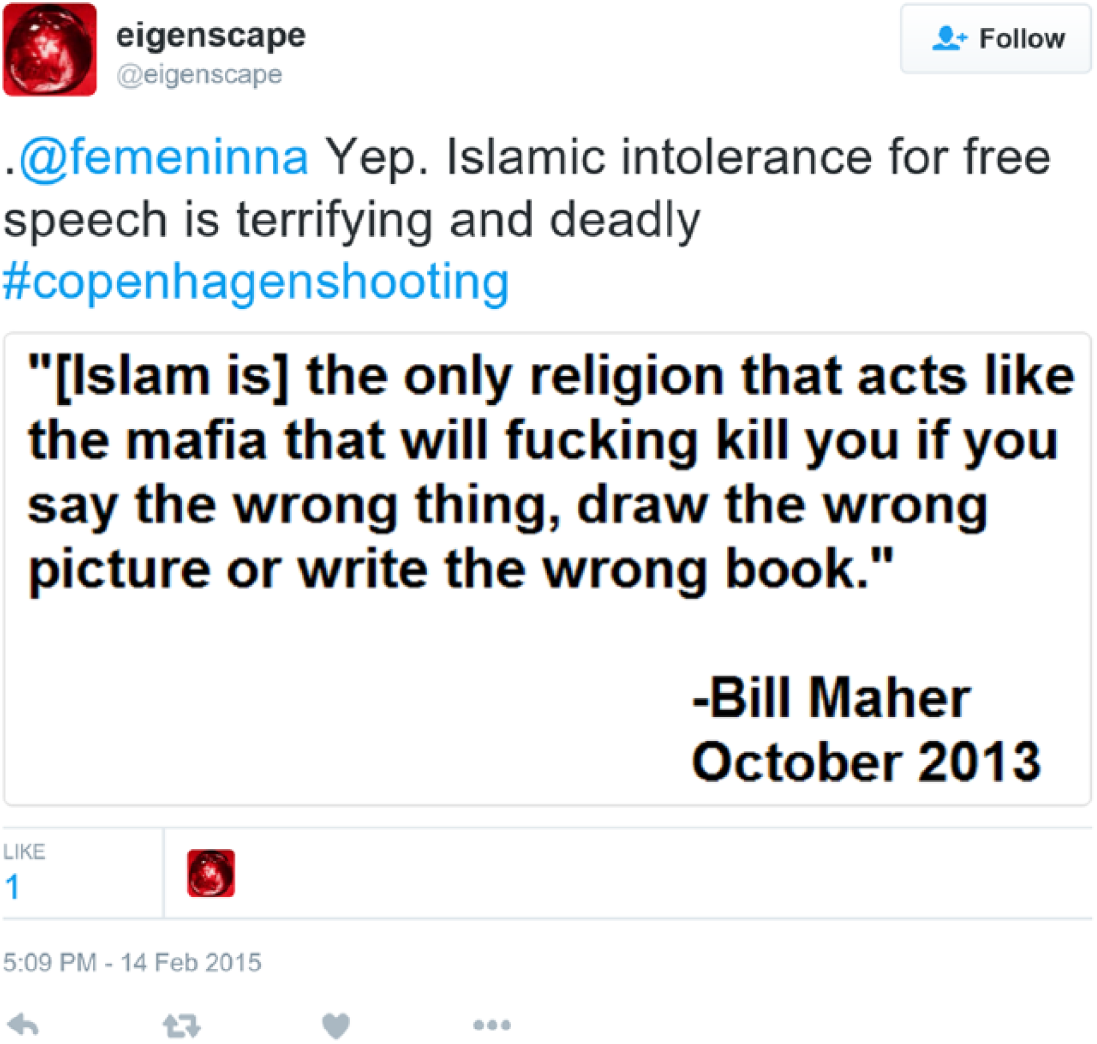
Screenshot of eigenscape (2015) tweet.
Such hatred-laced discussion on Twitter stemmed from the initial audio recording of the terrorist attack and amplified its importance in all the stories and remediations of the event that followed. Fear induced through the sonic experience, as Goodman (2010) explains, could be even more intense as it becomes part of an affectively activated network: ‘The human actor triggering an alarm merely plays a catalytic role, enveloped in a self-effecting networked agency. In such a capillary network, the sonic security nexus is subject of the event, and the induced collective fear is object’ (p. 72). Collective fear grows to create a sense of ‘us’ versus ‘them’, often known as a noble pathos of solidarity. Extending Ulrich Beck’s (1992) work, Ahmed (2004) claims that solidarity is based on ‘insecurity’ rather than ‘need’, thus ‘it is through the perception of shared risk that communities become a “binding force”’ (p. 72).
This ‘binding-force’ drew in Muslims attempting to delineate their position from radicalized ones (Figure 1): ‘maybe it’s time to the west to know a little bit about Islam and to know how people in the middle east suffer from it @femeninna’ (شارليأكبر worldcitizen_x, 2015). Former Muslims and those promoting secular ideas latched on to the discussion @femeninna incited on Twitter. For instance, blogger Maryam Namazie (Namazie, 2015a, 2015b, 2015c) posted several tweets with links to her articles on the issues of religion, free speech, and blasphemy. Once the relevant connections are made, there may well be various actors drawing on its force and forging newer connections however not without paying tribute to the influencer.
One of the most interesting posts by @MaryamNamazie includes a link (Namazie, 2015c) to her earlier interview with Shevchenko about women, blasphemy, and activism. The tweet under the embedded video reads, ‘We must celebrate blasphemy until no reason to do so, i.e. when Islamism is pushed back to Middle Ages @femeninna’ (Namazie, 2015c). In the interview, she discusses how Femen cut down a cross in Kiev in 2012 and how this was not the major blasphemous act of Femen. The effective media utilization of Copenhagen event creates a force that elevates corresponding events from the past timelines and enriches present streams of discussions with new depths and breadths. In the interview with Namazie (2015c), Shevchenko says that their and most women’s everyday lives are acts of blasphemy, because most religions repress women through multiple regulations and expectations of timidity, submissiveness, and servility. Forty-one users re-tweeted this post by @MaryamNamazie and 37 liked it (Namazie, 2015c). Some, in fear of being allied with the wrong side, expressed support for @femeninna and @MaryamNamazie: ‘I am a Muslim and find no difficulty agreeing with wholeheartedly! I would like to go on the record’ (Elbarasi, 2015).
Comments such as the ones above were lost in the noise of fear, threat, and support, which was amplified by the Copenhagen attack, but also became the reason for reminding people about the past threats and hardships Femen had been enduring. The same day as the attack, @femeninna (Shevchenko, 2015h) posted a screenshot of an email wishing her a violent death (Figure 2).
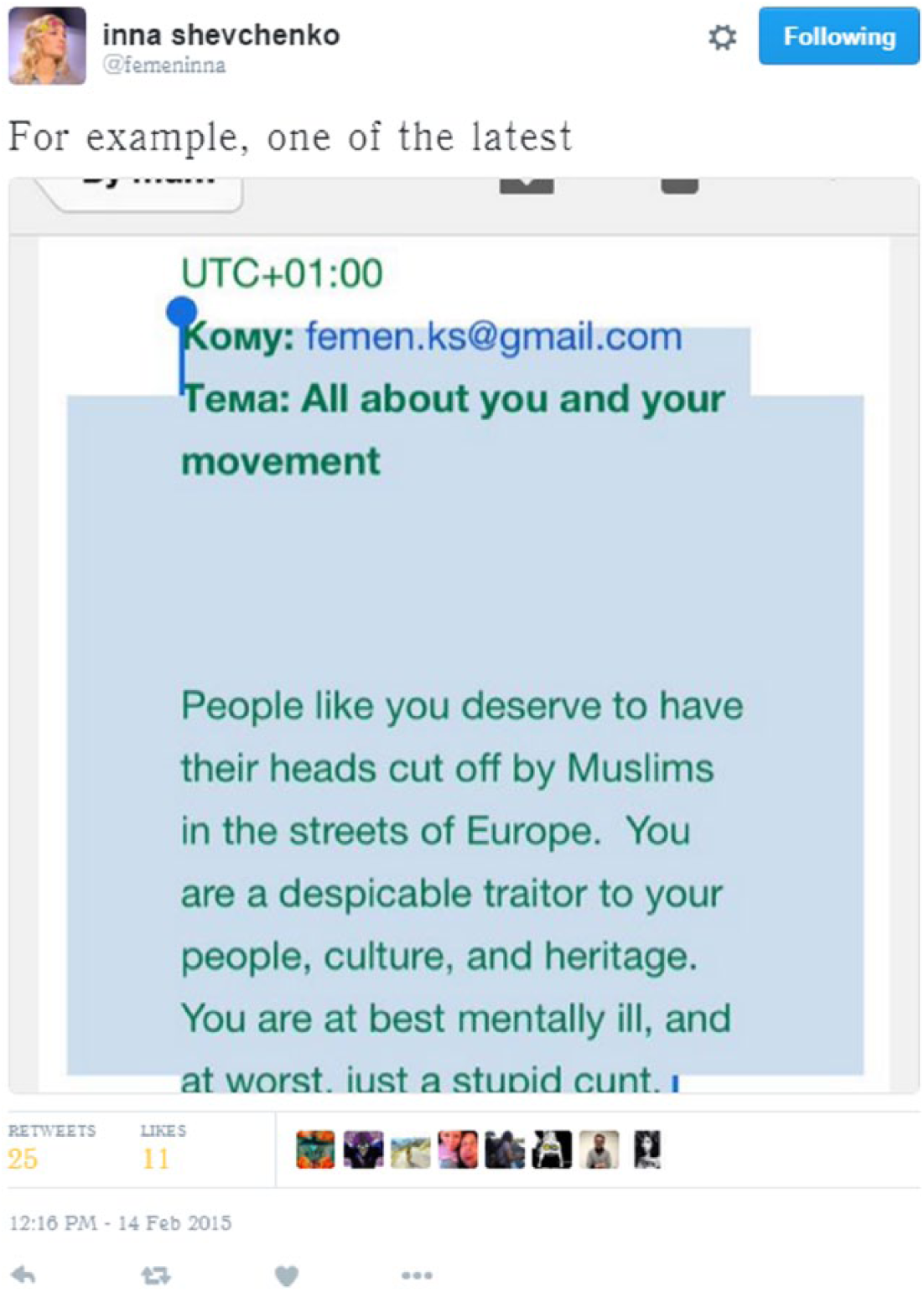
Screenshot of Shevchenko (2015h) tweet.
A Twitter user, @ElizaGoroya, from Greece translated a letter of a similar content published in a Greek newspaper (Goroya, 2015b). Others reiterated their own aggressive antagonism with Femen. @salipokor posted a photo of five women in Muslim attire holding a sign that read ‘FEMEN STOLE OUR VOICE!’ The tweet under the photo reads, ‘@femeninna It is time for you to stop your provocation because your life is from now on in danger!!!’ (NamDia, 2015). Interactions here are ‘overflowing in all directions’ defying any hidden, structural force of a central, presupposed context (Latour, 2005: 202) becoming a versatile force of moving assemblage.
As a nomadic subject (Braidotti, 2011), @femeninna affirms and embraces her precarious position with humor: ‘2011 Belarus, 2013; France, 2015 Danmark: i have no luck with death #copenhagenshooting’ (Shevchenko, 2015i). Making statements about free speech and free expression while still receiving threats puts @femeninna in the position of parrhesiastes. A person who speaks truth despite the risk: ‘@femeninna it brings home the risks of standing for the principles that give everyone freedom. Thinking of you all’ (Sargeant, 2015b). I should point out here that by truth I do not mean universal truth, but truth in Badiou’s (2001) sense of being faithful to the event and to persevere.
Even though in this evental activism Shevchenko did not pose in her usual topless with slogans painted across her chest, the images of that nature resurfaced and recirculated once again. An image of Shevchenko photographed by Guillaume Herbaut for Internazionale in 2013 re-emerged in the timelines of Copenhagen shooting (Figure 3). In this post (Puman, 2015), similar to numerous interviews, tweets, and blog posts triggered by the Copenhagen shooting, the image of Shevchenko flew within the digital realms of news followers, freedom of speech supporters, and those who find her existence offensive to mankind. Her resurfaced body within new contexts only strengthened the link of Femen with freedom of speech activism and related media discourses. Shevchenko’s body became ‘a springboard for subversive thought’ (Cixous et al., 1976: 879) as it ruptured previous ways of thinking about female activism and free expression.
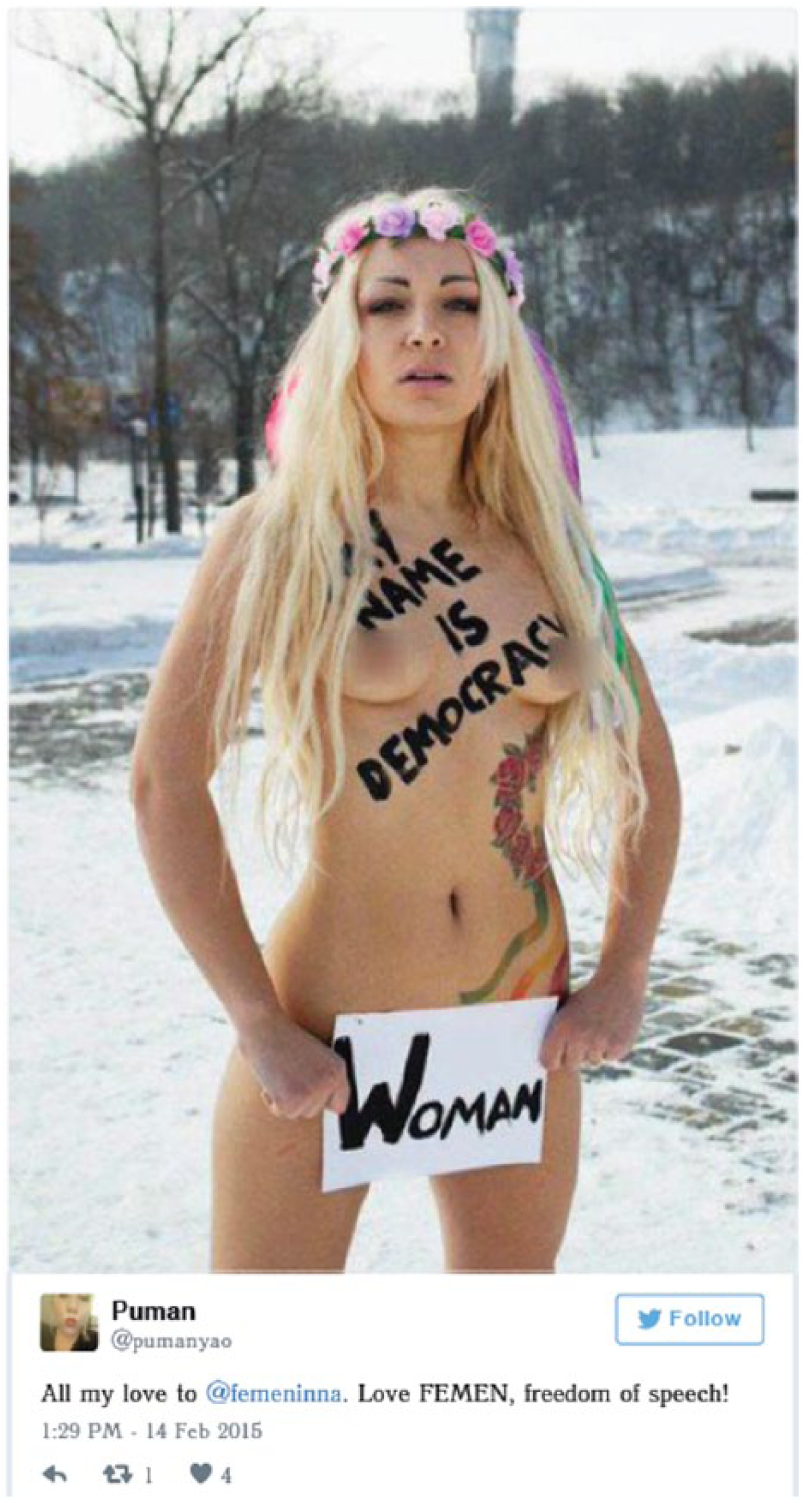
Screenshot of Puman (2015) tweet.
Conclusion: traces of Inna’s evental activism
The goal of this article was to examine the mediatized witnessing of Inna Shevchenko in the 2015 terrorist attack on the Copenhagen free speech event, mobilization of support around her, as well as transformations around Femen in the light of perceived Islamic terrorism. The theoretical lenses consisting of Badiou’s (2001) event concept showed how mobilization of support was made possible through the interrelations of multiple mobile layers of female activism and its surrounding situations. Supplemented with actor-network theory, the article illustrated how Shevchenko became an evental actant – a nomadic subject, consisting of a connection to mediatized audio clip, witnessing and testimony disseminated online, vulnerability and fear forming divisive associations, freedom of speech, and activism.
The sound recording of Shevchenko being interrupted by gunshots relayed the power of fear and witnessing. The fear of terrorism incited discussions even before identifying Shevchenko in the recording. Her later identification as a witness of the terrorist attack supplemented by her live-tweeted testimony brought up powerful layers of the event into the light. The powerful layers of Shevchenko’s vulnerability, and credibility, and online communities on Twitter gathered in her support. The support for Shevchenko and Femen grew at the expense of perhaps alienating Muslim communities by means of association with terrorism. As Latour (1993) points out, ‘discourses and associations are not equivalent, because allies and arguments are enlisted precisely so that one association will be stronger than another’ (pp. 168–169). In this case, the associations of Copenhagen free speech even shooting with other ISIS terrorist attacks induced fear-driven support and strengthened the image of Femen as the freedom fighters.
Shevchenko’s vulnerability-based credibility intensified by the threat of Muslim terrorism created new expectations and needs for her to speak. Her speech on truth and justice of free expression, invited by the power of witnessing, summoned her earlier iterations via body and text. Even though the Copenhagen shooting event did not produce any new visual of Shevchenko in her usual activist uniform of bare skin and slogans, the images from her earlier activism resurfaced on the Internet.
Braidotti (2011) writes that ‘nomadic subjects’ are ‘transformative tools’ as they enact metamorphosis by mobilizing untapped resources. Shevchenko, along with all her connections and networks, became such a nomadic subjectivity not by accident as suggested earlier in the article, but by the ‘faithful’ (Badiou, 2001: 41–42) work of various actors and actants that brought the Copenhagen shooting event into being: To be faithful to an event is to move within the situation that this event has supplemented, by thinking the situation ‘according to’ the event. And this, of course – since the event was excluded by all the regular laws of the situation – compels the subject to invent a new way of being and acting in the situation. (Badiou, 2001: 41–42)
A Femen activist, articulating the shooting event, and the causes it has supplemented to, drew together others who were not-yet-compelled to support freedom of speech and Femen. By becoming an accidental witness of the event, she did not automatically turn into a spokesperson for the event, but by live-tweeting, answering journalists’ questions, interacting with her followers on social networks, and engaging in discussions, she transformed the event and her own activist, nomadic self as well. As Latour (1993) writes, ‘since an actant can become greater than another only by being one of several, and since this association is always a misunderstanding, the one who defines the nature of the association without being contradicted takes control’ (p. 169). In the case of the Copenhagen shooting, Shevchenko not only defined the nature of her association with the terrorist attack as one of the potential targets but also amplified it by drawing stronger associations with the terrorist attack on the Charlie Hebdo cartoonists to whom she referred to as ‘ideological brothers’ in her media interviews. This connection to Charlie Hebdo is one of many elements that brought about Femen’s evental activism in Copenhagen. In doing so, Shevchenko’s nomadic writing emerged from more-than-one place and took a well-deserved spot as a free speech activist. This point can be further explicated by her TEDx Talk in Kalamata (TEDx Talks, 2015), The Rubin Report (2016), and multiple conference speeches on freedom of expression she gave during the year following the attack in Copenhagen.
Shevchenko’s faithfulness to the event grew into a force that assembled various media accounts, audio clips, videos, tweets, shares, interviews, and blog posts in support of her cause and vulnerability. Such disposition of actors around her brings us to the question of instantaneity of social media connections versus gradual social change with no warranty and batteries included. 1 Her multilayered and interlaced evental activism validated Femen’s provocative existence, drew support even from those opposing them, and acknowledged their feminine fight for freedom of expression.
