







Abstract
Although the rise of fake news is posing an increasing threat to societies worldwide, little is known about what associations the term ‘fake news’ activates in the public mind. Here, we report a psychological bias that we describe as the ‘fake news effect’: the tendency for partisans to use the term ‘fake news’ to discount and discredit ideologically uncongenial media sources. In a national sample of the US population (N = 1000), we elicited top-of-mind associations with the term ‘fake news’. Consistent with our hypothesis, we find evidence that both liberals and conservatives freely associate traditionally left-wing (e.g. CNN) and right-wing (e.g. Fox News) media sources with the term fake news. Moreover, conservatives are especially likely to associate the mainstream media with the term fake news and these perceptions are generally linked to lower trust in media, voting for Trump, and higher belief in conspiracy theories.
Introduction
‘The FAKE NEWS media (failing @nytimes, @NBCNews, @ABC, @CBS, @CNN) is the enemy of the American People!’ – Donald J. Trump, 45th President of the United States – Twitter, 17th February 2017.
The widespread dissemination of ‘fake news’ – false information that mimics news media – has become a major threat to societies worldwide (Lazer et al., 2018; Lewandowsky et al., 2017; van der Linden et al., 2017). The phenomenon itself is not entirely new of course: false or misleading information has always played a role in human societies throughout the ages (Taylor, 2003).
Yet, the Internet and social media are proving to be particularly fertile soil for fake news. For example, a recent paper by Vosoughi et al. (2018) indicates that stories declared ‘false’ by numerous fact-checking organizations spread farther, faster, and deeper than any other type of news content. Crucially, they argue that such stories proliferate not primarily because of bot activity, but rather because humans bear a large share of the responsibility for the spread of fake news and misinformation.
Although a large literature exists on the social and cognitive determinants of political misinformation (Flynn et al., 2017; Lewandowsky et al., 2012), research into the psychological underpinnings of belief in fake news and its societal impact is emerging, including the role of partisan identities (Pennycook and Rand, 2019), cognitive style (Bronstein et al., 2019), the spread of fake news during elections (Allcott and Gentzkow, 2017; Grinberg et al., 2019) and potential solutions, such as preemptively inoculating individuals against fake news (Cook et al., 2017; Roozenbeek and van der Linden, 2018, 2019). While objective definitions of the term ‘fake news’ abound (see for example, Lazer et al., 2018; Tandoc et al., 2018; van der Linden, 2017), little is currently known about how people perceive the term ‘fake news’ or what associations it might activate in memory. Moreover, recent polls suggest that Americans increasingly believe that the mainstream media reports fake news, with 42% of the American public indicating that major news sources report fake news to advance a particular agenda (Monmouth University, 2018). This trend is troubling as any healthy democracy relies on accurate and independent news media as a source for information. Moreover, research has indicated clear ideological asymmetries in the spread of misinformation (Jost et al., 2018). For example, fake news tends to proliferate and is shared more extensively in the networks of conservatives and among older audiences in particular (Allcott and Gentzkow, 2017; Grinberg et al., 2019; Guess et al., 2019; Roozenbeek and van der Linden, 2019). Thus, there may be important cognitive differences in how liberals and conservatives access, share, and perceive fake news.
Present research
Specifically, as illustrated by the opening quote from President Trump, the term ‘fake news’ gained steam within the context of the 2016 US presidential election (Tandocr et al., 2018), and the hyperpolarized US political landscape is known to facilitate intergroup conflict and motivated partisan reasoning (Martherus et al., 2019). Accordingly, we hypothesize that the term ‘fake news’ has become a rhetorical device used to discredit and dismiss attitude dissonant information (‘you are fake news’) – a psychological bias that we describe here, as the ‘fake news effect’. We examine empirical evidence for the fake news effect in a nationally representative YouGov survey of 1000 Americans. Specifically, to the best of our knowledge, this is the first study to elicit ‘Top of Mind’ associations by asking partisans to report the very first thing that comes to mind when they think of the term ‘fake news’. A classic method in psychology (Szalay and Deese, 1978), top-of-mind (ToM) associations can be thought of as mental representations of an issue, that is the first words, thoughts, or symbols that come to mind when prompted with a cue (Clarke et al., 2015; Nelson et al., 2000). For example, the first thing that comes to mind when thinking of the word ‘happiness’ is ‘smile’ for Americans but ‘family’ for Koreans (Shin et al., 2018). In general, free association tasks are a reliable and valid method for uncovering important elements of people’s associative memory network (Nelson et al., 2000; Rozin et al., 2002; Shin et al., 2018).
For example, one advantage is that compared to highly structured response options, free association tasks allow for relatively more uninhibited responses (McDowell, 2004) that often guide subsequent judgments and decisions. Accordingly, we next explore whether the tendency to dismiss mainstream media and counter-attitudinal media sources is consequential in terms of its relationship with trust in media, conspiracy theorizing, and voting behavior in elections. Because recent research has offered evidence of partisan bias among both liberals and conservatives (Ditto et al., 2018), we hypothesized that – depending on ideology – both groups would associate the term ‘fake news’ with outlets that are traditionally perceived to be left-or-right leaning and that this perception is associated with significantly lower trust in media.
Methodology
Sample and participants
We recruited a national sample (N = 1000) from YouGov in February of 2018. YouGov maintains a large online panel and respondents are matched to a sampling frame on gender, age, race, and education. The sampling frame is constructed by stratified sampling from the 2016 American Community Survey (ACS). In total, the sample composition was as follows: 53% female, 47% male, 68% White, 11% Black, 13% Hispanic, 2% Asian, 1% Native American and 5% mixed or other. The average age in the sample was (M = 48 and SD = 18). About 4% of the sample received no formal education, 36% earned a high school degree, 21% reported some college, and 39% were college educated or higher. In terms of political ideology (self-placement), 28% of participants reported to identify as liberal, 35% moderate, and 37% conservative. About 32% voted for Hillary Clinton in the 2016 US Presidential election, 34% voted for Donald Trump, 26% did not vote, with the remainder (8%) voting for another candidate.
Measures and procedure
Top-of-mind associations
Participants were asked to report the first thing that comes to mind when hearing the term ‘fake news’. A coding scheme was developed to categorize and parse participants’ responses. One of the authors developed the initial framework of the coding scheme and categorized each response. A second coder then used this framework to conduct an independent categorization. Both coders’ results were then compared with each other. Absolute agreement (87%–99%) and inter-rater reliability (k = 0.61 − 0.96) were fairly high and consistent across categories – any initial disagreements were resolved by the first coder. In some cases, it was not possible to reliably place a response into a certain category. These responses were therefore left out of the analysis. The resulting coding scheme (Figure 1) consists of two main categories and a number of sub-categories. In total, 69 out of 1000 responses were excluded entirely as they did not contain any useful information (e.g. they were left blank).
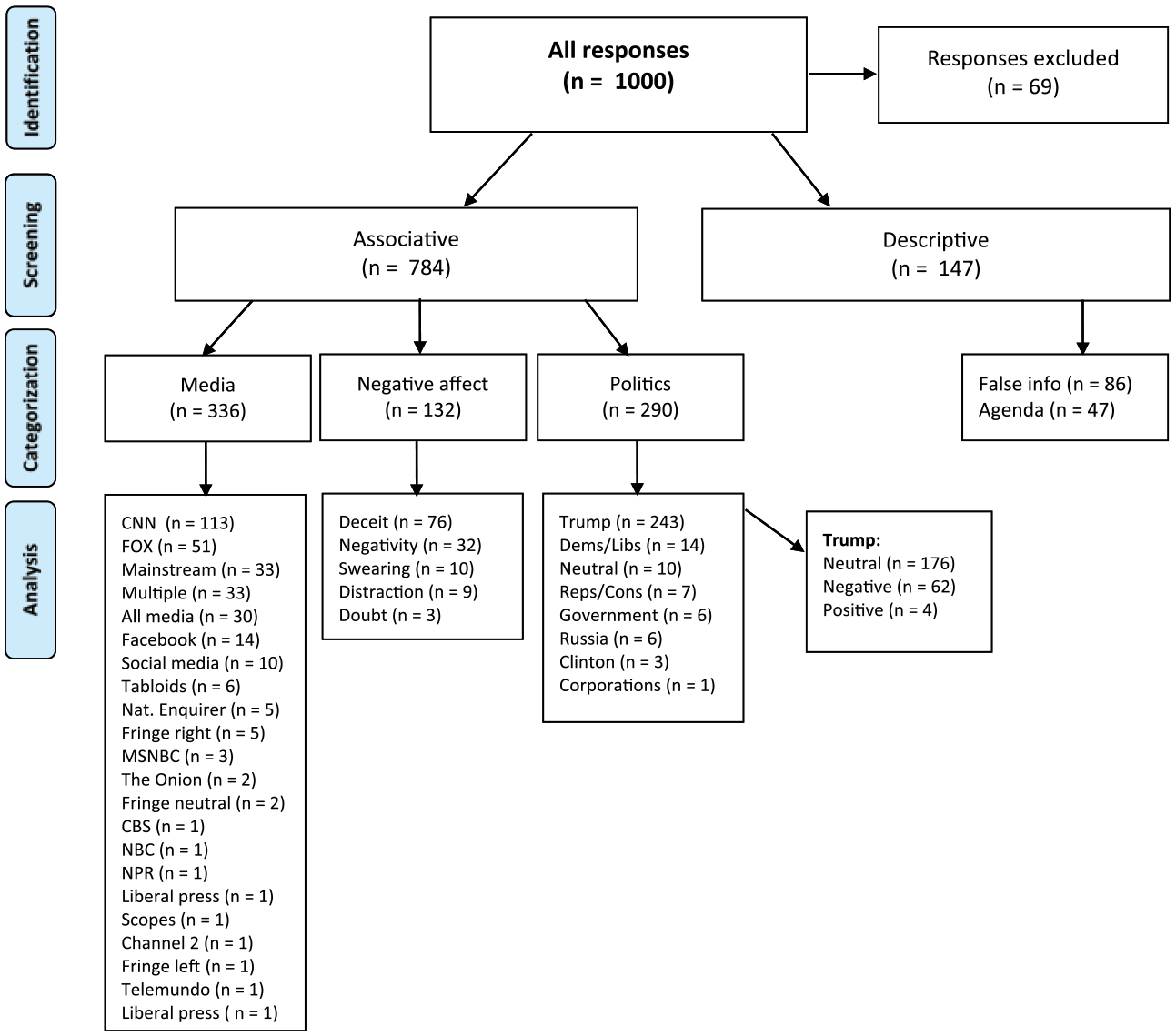
Top-of-mind associations flowchart and coding scheme.
Responses were first classified into two main categories: truly ‘associative’ (pertaining to responses where participants associated the term ‘fake news’ with other words or concepts, n = 784) or as merely ‘descriptive’ (where participants gave a factual description or definition of ‘fake news’, n = 147). The ‘associative’ category contains the following three sub-categories: negative affect (e.g. words related to negativity, swearing, deceit, and so on), media (e.g. associating the term fake news with media outlets such as CNN or Fox News) and politics (e.g. mentioning US President Donald Trump or former Secretary of State Hillary Clinton). As 243 responses mentioned Mr Trump specifically, we also classified responses containing Trump’s name as either neutral (mentioning only his name with no further information, n = 176), negative (n = 62), or positive (n = 4). The ‘descriptive’ category contains the following two sub-categories: false information (e.g. describing fake news as information being false) and agenda (e.g. describing fake news as news with bias or politically charged information). In some cases, it was not possible to reliably place a response into a certain category or sub-category; for example, one entry only contained the word ‘media’. This entry was placed under the category ‘associative’ and the sub-category ‘media’, but further sub-categorization was not possible. Thus, the total number of entries in a sub-category may be slightly lower than the number of entries in the main category. Figure 1 illustrates the coding scheme. The responses and corresponding coding scheme have been included as supplementary information.
We also included several other measures in the survey, including belief in conspiracies, trust in media, and political ideology. To assess belief in conspiracy theories, we asked participants whether or not they believe that Russians interfered with the 2016 US election (M = 67.10, SD = 30.65), whether climate change is a hoax (M = 39.57, SD = 46.56), and whether vaccines cause autism (M = 34.57, SD = 28.17) on a 0 to 100 scale (definitely not true = 0, definitely true = 100). We also included the 5-item Conspiracy Mentality Scale (CMS) from Bruder et al. (2013). This scale (M = 67.72, SD = 17.41, ɑ = 0.79) taps into conspiratorial thinking without referencing any specific conspiracy theories (e.g. ‘I think that events which superficially seem to lack a connection are often the result of secret activities’). We also asked participants to what extent they trust the mainstream news and media (1 = extremely untrustworthy, 7 = extremely trustworthy) with a single-item (M = 3.47, SD = 1.93). Finally, political ideology was assessed on a standard 5-point self-placement scale (1 = very liberal, 2 = liberal, 3 = moderate, 4 = conservative, and 5 = very conservative; M = 3.12, SD = 1.21).
Results and discussion
We focus our results on true associations (n = 784). By far, most were related to the media (44%), followed by politics (38%), and negative affect (18%). Within the politics category (n = 290), the vast majority of ToM impressions were about President Trump (84%). Within the media category (n = 336), nearly a third of the sample suggested that the mainstream media is ‘fake news’ (31%). 1
We examined ideological differences next. Although there were no differences in negative affect (48% vs 52%), liberals associated ‘fake news’ more with politics (72% vs 28%), whereas conservatives associated the term more with media (79% vs 21%; χ2(2) = 100.81, V = 0.47, p < 0.001, n = 449). Accordingly, within the politics category, 83% of ‘Trump’ mentions came from liberals compared to 17% of conservatives, χ2(1) = 36.97, V = 0.47, p < 0.001, n = 166. Finally, within the media category, striking patterns emerged between liberals and conservatives (Figure 2). Conservatives overwhelmingly associate the liberal media outlet ‘CNN’ with ‘fake news’ (75%), whereas liberals identify the conservative outlet ‘Fox’ as ‘fake news’ (59%). Importantly, it is primarily conservatives who think of the mainstream media as ‘fake news’ (71% vs 5%).
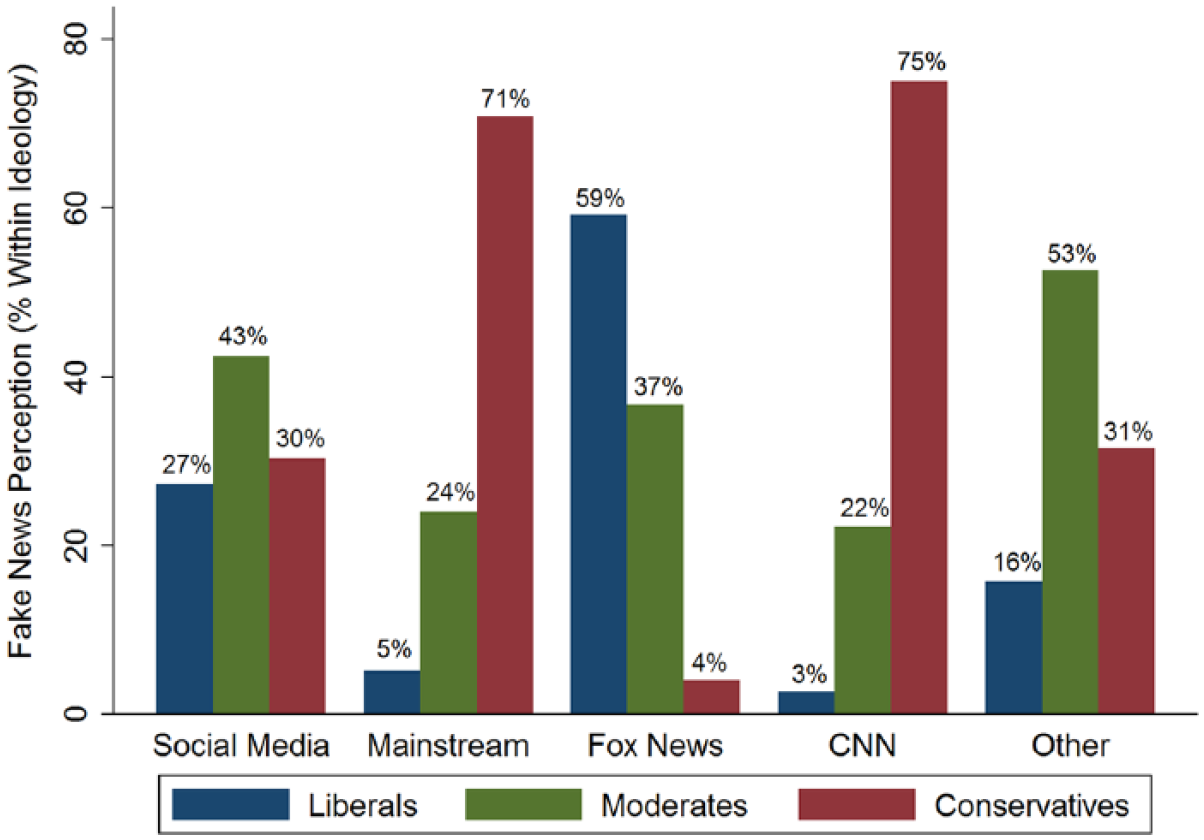
Top-of-mind associations ( ‘fake news’) by political ideology.
We subsequently investigated whether the public’s general perception that the media is ‘fake news’ is consequential in terms of its association with trust in media, belief in conspiracy theories and self-reported voting for President Trump. Perhaps somewhat unsurprisingly, among those for whom media-related content was the primary ToM association (n = 336), fake news correlated strongly and negatively with trust in the mainstream media (r = −0.39, p < 0.001).
Interestingly, when these results are partitioned by political ideology (Figure 3), a significant interaction emerges. A two-way ANOVA indicates a significant main effect for media associations (F(1, 675) = 37.21, MSE = 90.54, η2 = 0.05, p < 0.001), political ideology, (F(2, 675) = 114.2, MSE = 277.87, η2 = 0.25, p < 0.001), as well as a significant interaction between media associations and political ideology (F(2, 675) = 8.67, MSE = 21.10, η2 = 0.03, p < 0.01). As Figure 3 clearly illustrates, the nature of the interaction is such that, whereas for liberals, trust in media remains unaffected by the association (Mdiff = −0.02, p = 0.93), moderates and especially conservatives are less likely to trust the mainstream media when they mentally associate news media outlets with the term ‘fake news’. The magnitude of the difference is substantial for conservatives (Mdiff = 1.30, 95% CI = [0.93, 1.67], Cohen’s d = 0.95, p < 0.001). In other words, the association between the mainstream media and fake news seems to particularly affect conservatives when it comes to trust in media.
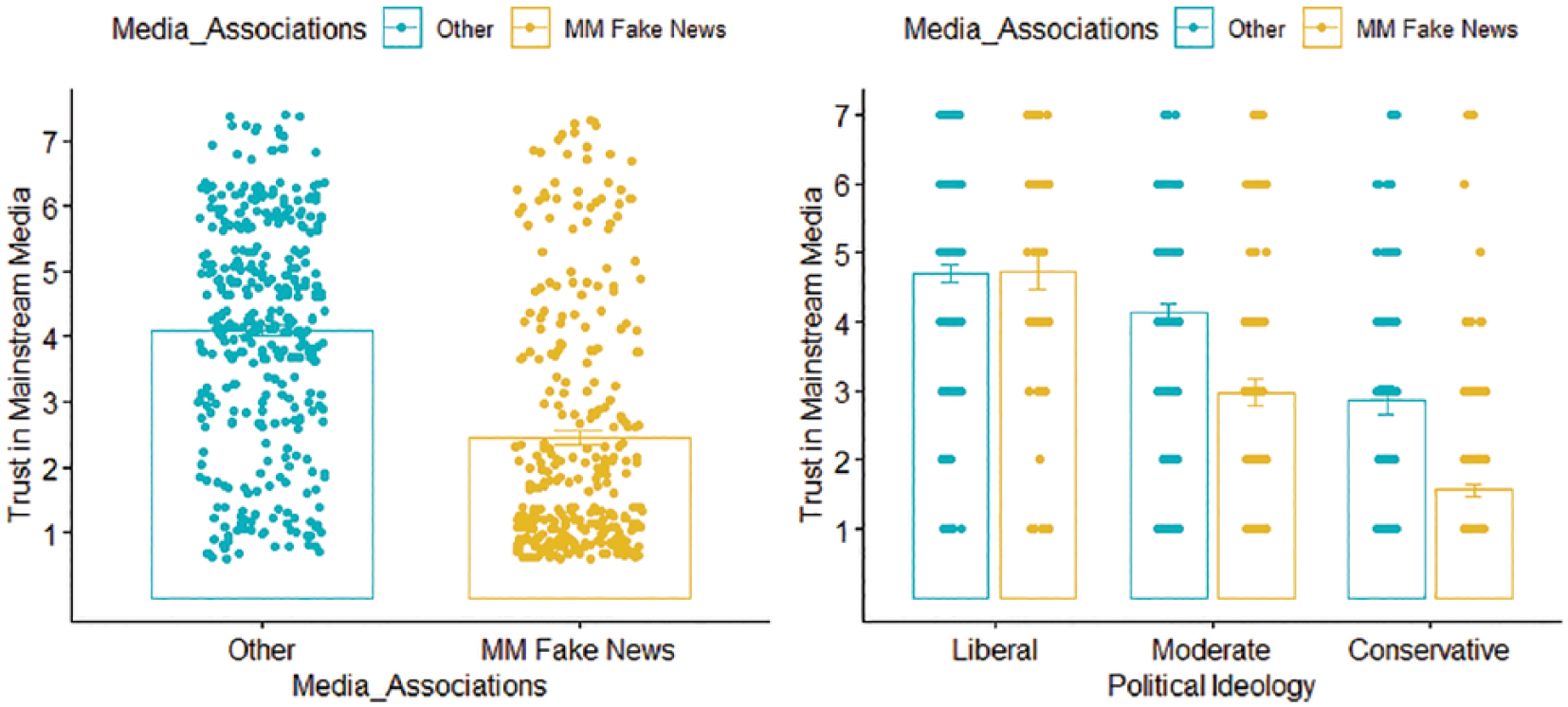
Trust in media by ToM media associations and political ideology.
For belief in conspiracies, we find significant correlations between perceptions that the media is ‘fake news’ and belief that Russians interfered with the US election (r = −0.30, p < 0.001), that climate change is a hoax (r = 0.23, p < 0.001) and conspiratorial mindsets more generally (r = 0.11, p = 0.002). The exception was the belief that vaccines cause autism (r = 0.05, p = 0.20). There was no significant interaction between media perceptions and ideology on conspiracy mindsets (p = 0.87). Finally, a simple logistic regression indicated that having voted for Donald Trump in the 2016 US election significantly predicted the perception that the mainstream media is ‘fake news’, OR = 5.37 (95% CI = [3.89, 7.40]) p < 0.001, even when adjusted for important covariates, including political ideology, age, gender, education, and race, ORadjusted = 2.87 (95% CI = [1.88, 4.36]), p < 0.001. In other words, having voted for Trump increases the odds of mentally associating the mainstream media with fake news by 187%.
Discussion and conclusion
In short, we document several clear findings. First, as hypothesized, we find evidence of the fake news effect: a psychological bias where well-known liberal outlets (e.g. CNN) are described as ‘fake news’ by conservatives and, in turn, well-known conservative outlets (e.g. Fox News) are described as ‘fake news’ by liberals. In fact, it is noteworthy that CNN and Fox were the most popular ToM media associations as they are known to be heuristic proxies for liberal and conservative viewpoints, respectively (Turner, 2007). In general, this finding complements existing research that partisan bias occurs on both sides of the political spectrum (Ditto et al., 2018; Nisbet et al., 2015) and that liberals and conservatives both perceive media bias (Stroud and Lee, 2013). A common explanation for this is that people are similarly motivated to defend their moral commitments. Yet, because moral foundations are known to differ across the political spectrum, for any given issue, either a liberal or conservative bias could be magnified (Brandt et al., 2014; Crawford, 2012). For example, when it comes to sexual harassment, conservatives often think this is less of a societal issue and punish their in-group less than their liberal counterparts (e.g. van der Linden and Panagopoulos, 2019).
One factor that is intriguing about the current research is that, although the issue of fake news in general clearly cuts across the political spectrum, the fake news effect appears more pronounced among conservative audiences. In fact, although the bias itself occurs on both sides, we find evidence of an ideological asymmetry, such that more conservatives (75%) think CNN is fake news than liberals think Fox News (59%) is fake news (Z = 2.03, p = 0.04). Of course, although the two outlets are not equivocal, they are both rated by independent sources as politically biased with mixed accuracy (Media Bias/Fact Check, 2019). These findings coincide with prior research which shows that liberal Democrats are more likely than conservative Republicans to indicate that neither outlet is particularly credible (Stroud and Lee, 2013). In addition, we find that liberals seem to associate the term ‘fake news’ more with politics (and Trump in particular), whereas conservatives overwhelmingly use the term to discredit the mainstream media (71% vs 5%, Z = 9.42, p < 0.01), possibly following elite cues from the President and the Republican Party. These findings are in line with other recent research on fake news (Pennycook and Rand, 2019) and opinions polls which find that conservatives (45%) are substantially more likely than liberals (17%) to state that the mainstream media is regularly reporting fake news (Monmouth University, 2018).
Finally, as expected, the ToM association that the media is ‘fake news’ is negatively correlated with trust in media and positively correlated with belief in conspiracies and having voted for Trump in 2016 election. Somewhat surprisingly, however, the main effect of mentally associating the media with ‘fake news’ on public trust was moderated by political ideology, suggesting that the association may be more consequential for conservatives than liberals. This is in line with the finding conservatives generally trust the media less than liberals (Stroud and Lee, 2013) and that for most liberals, the primary ToM association with the term ‘fake news’ relates more to politics (Trump) than the media.
Importantly, the findings around ideological biases should be interpreted within the context of the US media landscape, which is highly polarized (Levendusky, 2013), and therefore, may not generalize to other countries and political systems. For example, in a recent study of political polarization on social media, Urman (2019) finds that the intensity of polarization varies significantly as a function of a country’s political system, with the highest degree of social media polarization occurring in two-party countries (such as the United States) and the lowest levels in multi-party political systems with proportional voting. Similarly, Hornsey et al. (2018) find that the correlation between conservatism and climate change conspiracies is uniquely pronounced in the United States, likely due to the high level of polarization on the issue. Thus, we acknowledge that these findings are mainly descriptive of the US media landscape and that subsequent research will need to adjudicate the extent to which the findings we report generalize to other countries, political systems, or over time. To the best of our knowledge, however, this study is the first to explore the meaning of ‘fake news’ in the American mind in a national sample. As such, these results provide important insights into the nature of political perceptions of fake news, at least in the US context.
Research Data
Fake_news_perception_-_categorisation_FINAL_SCM – Supplemental material for You are fake news: political bias in perceptions of fake news
Fake_news_perception_-_categorisation_FINAL_SCM for You are fake news: political bias in perceptions of fake news by Sander van der Linden, Costas Panagopoulos and Jon Roozenbeek in Media, Culture & Society
Footnotes

References
Supplementary Material
Please find the following supplemental material available below.
For Open Access articles published under a Creative Commons License, all supplemental material carries the same license as the article it is associated with.
For non-Open Access articles published, all supplemental material carries a non-exclusive license, and permission requests for re-use of supplemental material or any part of supplemental material shall be sent directly to the copyright owner as specified in the copyright notice associated with the article.
