







Abstract
In this paper, I investigate how Instagrammers re-construct themselves as agentive and digitally mobile despite their physical immobility during the early COVID-19 pandemic. By examining four types of post that emerged or became popular during this period, I delineate how Instagrammers take subject positions to negotiate their (im)mobile selfhood in the online-offline nexus. I contend that as the Instagrammers negotiate their own invisibility and sociality during the lockdown, their physical bodies are reconfigured digitally as part of their multimodal self-presentation, troubling the traditional (im)mobile divide. While this study illuminates the democratic potential of Instagram, it also contemplates the extent of an individual’s agency on a global scale.
Introduction: life in the online-offline nexus during early COVID-19
The coronavirus pandemic, or the COVID-19 pandemic, has posed unprecedented challenges to people around the world. Originating in Wuhan, China, the virus spread quickly across the globe, resulting in over 6 million total cases and 300 thousand deaths worldwide by early June 2020 (WHO, 3 June 2020). It has also caused a worldwide lockdown: international and national travel has been severely restricted; governments in most countries have introduced social-distancing measures, and individuals have had to perform self-quarantine in their homes. It was estimated that half of the world’s population has been affected by confinement measures (Euronews, 3 April 2020).
Simultaneously COVID-19 has brought about cultural shifts. The BBC News (30 April 2020) predicts that we will be increasingly dependent on technology, especially digital communication. Since the pandemic, people have had to engage themselves online, be it for work, education or leisure. The overwhelming presence of mediated communication has greatly reshaped and reproduced people’s habitus: contexts have collapsed, and people who would otherwise only meet offline are now brought together to the same online chatroom (Marwick and boyd, 2011); new social identities and groupings come to be formed. However, the enforced social isolation and the sudden shift to an online working/living environment also expose issues of inequality, such as digital poverty (Galperin and Mariscal, 2007) and intensification of already existing social divides. All these phenomena ensuing from the global pandemic call for a renewed look into the contemporary digital culture by considering most of our daily actions as occurring in the online-offline nexus (Blommaert, 2019). People are not simply disembodied personas in the cyberspace; instead, their online and offline practices are deeply entwined. Their online self-presentation is a reflection of their lived, embodied experience, which is embedded in the existing discursive power structures. People, however, possess a certain level of agency in the digital realm, and they can construct their identity and subjectivity by performing different social actions and enacting social relationships.
In this paper, I take a primary interest in how people present, construct and negotiate their agency in their multimodal social media content during the early stages of COVID-19 pandemic. I show how this presentation of the self intersects with their global and social (im)mobility. The spatiotemporal contexts in which people are situated are multi-layered, multi-scalar, and dynamic, giving rise to multiple potentialities for meaning making. As will be discussed in the following, I am concerned with the sociocultural dimension of individuals’ agency. In other words, people’s crafting of an agentive self is part of their self-(re)presentation in relation to their audiences and also the local, translocal, and global contexts in which they are situated. Specifically, there has not been a unified perspective in literature as to where to draw the line between “self-presentation” and “self-representation.” As Rettberg (2018) points out, the usage of these two notions varies with discipline. Moreover, while selfies and other social media posts are self-representations that can be interpreted as texts, they have always been social in the Goffmanian sense. Therefore, these two terms are used interchangeably in this paper. I argue that digital embodiment and self-(re)presentation are entwined. As Asenbaum (2019: 10) contends in his paper on digital democracy, the digital subject “does not consist merely of a digital body, but also of the reconfigured physical body, which it perceives differently through the digital.” The digital media are used to materialize certain “classed, raced and gendered bodies” (p. 1), helping the digital body regain agency and control through visually representing itself in social interactions. Such a perspective is helpful to understanding Instagrammers’ agency and self-presentation. In the coronavirus pandemic, people’s agency is curtailed in some ways but could also be exploited and negotiated by themselves. Their physical bodies are reconfigured digitally as part of their self-presentation, re-constructing themselves as agentive and mobile through a variety of discursive and semiotic means.
(Im)mobility: a binary under erasure
The sociolinguistics of mobility is concerned with the trajectories of humans across time and space and the linguistic repertoires they bring with them in a globalizing world. People’s migration nowadays is to a certain extent afforded by their own sociolinguistic repertoires, and their repertoires are in turn shaped by their migration and lived experiences. Deumert (2020) remarks that (im)mobility in the globalizing world entails more than transnational movement and migration; it is also a matter of (in)visibility, the power and legitimacy to be “mobile,” and where to draw the line between mobility and stasis. This suggests that socioeconomic powers, as well as linguistic and semiotic resources, play important roles in mobilizing the individual to transcend geographical and imaginary boundaries. For instance, a youth from the Philippines might not afford to pay a long-term visit to the Global North countries, but being fluent in English enables her to connect with people from worldwide via instant messaging and social media apps, creating new dimensions of spaces in her lifeworld without crossing border. While she is physically stuck, the digital world renders her more mobile as she could see what the Global North is like, be exposed to its cultures, and also be seen by people from there. In this kind of context, mobility refers to transnational interaction, migration and immigration. In a more conventional sense, mobility is associated with a person’s economic and legal status within a hierarchical society, in which their social position grants them certain power, capital, and right to move freely. Thus, in a globalizing world, mobility comes with bivalent connotations, and the horizontal and vertical conceptualizations interrelate.
Baynham (2020) discusses the role of embodiment in the construction of space. He comments that “embodiment is not about the body per se but of the body as a kind of source point for perception, agency and practice” (p. 89). (Im)mobility is not simply about the spatial movement of bodies, but is increasingly concerned with the capacity of the body to experience, to make sense of, and to construct space(s) through social practice. When it comes to border crossing, spatial mobility, and social mobility more often than not intersect. However, digital communication tools have the potential to transcend the (im)mobility binary in both senses by opening up new spatialities for the body. While as a result of the individual’s position within the globalizing market, the physical body’s (non-)movement could be either lasting or temporary, the digitally represented body is not moored to its physical location and becomes somewhat fluid and flexible, flouting the boundary between the Global North and South, the middle and the working class, and the powerful and the invisible, thus troubling the separation between stillness and mobility.
This paper argues Instagrammers during the early COVID-19 pandemic articulate discourses of mobility from different sociocultural spaces, erasing the (im)mobility binary in the online-offline nexus. Instagram, a very popular image and video sharing network, opens up spaces of visibility for people (Marwick, 2015), allowing them to take agentive subject positions in the time of the pandemic. Users can negotiate physical immobility and re-imagine themselves and their followers as digitally mobile. Furthermore, Instagram enables a non-binary sense of mobility because of the nature of online embodiment: mobility is not limited by the spatial (un)movement of bodies, and physically immobile people can engage in digital practices that allow them to participate in global flows. For instance, stay-at-home quarantiners often (re)post previously captured travel photos, whose mobility is often more than aspirational because such a digital practice showcases their capacity to be mobile in normal situations. The mobility and immobility of individuals during this particular period, however, are two sides of the same coin: while confinement could be a constraint on the embodied, phenomenological self, urging it to seek mobility, and freedom, translocality could also lead to unsettlement that needs to be managed, as reflected in the experiences of expats and study abroad students. Therefore, the capacity to (a) render the immobile body as mobile in a literal and/or metaphorical sense, or (b) to further manage the consequences caused by their mobility during the pandemic, showcases a person’s agency. Such a capacity is contextualized, and largely mediated by linguistic and semiotic means.
My research examines four types of post that seem to have emerged or become prevalent on Instagram during early COVID-19 from the content posted by ordinary users. In this paper, ‘ordinary’ refers to those users who manage a personal instead of business account, do not post sponsored content, and do not own a sizable number of followers. In other words, these people do not invest in crafting a commercial persona (e.g. Abidin, 2016; De Veirman et al., 2017; Miles, 2013; Smith, 2019) but focus on self-representation. These types of post in my dataset involve: (a) Pastimes: during home quarantine, Instagrammers have been posting a multitude of content about their pastimes, such as homemade cuisine, handcrafts, plants, and yoga, to represent their creative selves and to negotiate their visibility and sociality; (b) Flashbacks: people also have been posting flashbacks of previously taken photos, mainly in the form of travel or food photographs, in reminiscence of the “good old days” back when they were freely mobile; (c) Updates: some expats have been actively sharing updates from their country of residence, recounting the social situation from the beginning of lockdown measures till the situation gradually equalizes; (d) Unsettlements: study abroad students were obliged to return to their home country in the middle of the outbreak, creating visual narratives to diarize such a process that is often mixed with struggles, contestation, angst and consternation. Via digital photography on Instagram, users not only get to construct their agentive selfhood by mobilizing a range of linguistic and semiotic resources in their repertoires, but also enact certain social relationships and negotiate their (im)mobility to navigate their imagined audiences, despite the various structural and social constraints they are facing due to COVID-19. Therefore, they offer various perspectives to understanding how the binary between (im)mobility is problematized and blurred in the online-offline nexus.
Revisiting the structure-agency dialectic
The structure-agency dialectic is an ongoing debate in the social sciences. Agency is a widely used term by scholars in humanities and social sciences, but it remains a slippery concept. Different traditions and approaches need to be considered before we arrive at a universal definition of agency. Social and cultural theorists have attempted to conceptualize agency in relation to social structures and forces. As a critique of structuralist Marxism, Althusser (1970) in Ideology and Ideological State Apparatuses states that while the roles and activities of individuals are assigned through social practices, our beliefs, desires and values are developed as a result of ideological practices. In his view, agents are “bearers” of structures, and society makes the individual in its own image. In other words, individuals’ actions are determined by structures, social reproduction, and their ideological positionings. As a result of social movements in the 1960s and 1970s and to meet poststructuralist and postmodern critiques, later scholars have increasingly emphasized agency and change. For instance, social theorist Giddens (1984) sees social structures and human agents as co-constitutive. Giddens (1990) also proposes that self and identity are reflexively understood by the individual in terms of their shifting experience, foregrounding the biographical and communicative dimensions in the formation of the self. Sociologist Sztompka (1994) understands agency and practice as two sides of the social functioning; agency is actualized in practice. While this approach has human actions as its focus, it places them inside the social structures by which they are shaped. Following this line of thinking, Ahearn (2010: 32) defines agency as the “socioculturally mediated capacity to act,” which is not to be confused with free will, as the latter fails to adequately consider the social nature of agency. By understanding action and practice as socially constructed, these views assist us to understand how social structures influence actions, and how, in turn, actions come to shape social structures.
Sarangi (2010) suggests that linguists and discourse analysts, however, have been working on a dimension of structure and agency that is different from that of social and cultural theorists. For instance, Duranti (2004) introduces performance and encoding as two mutually constitutive dimensions of agency in language: performance is understood as the enacting of agency, and encoding is how human action is depicted through linguistic and/or semiotic means. King’s (2018) research on New Zealand students’ use of Hip Hop styling to manage ascriptions of sexual agency focuses on how individuals contest hegemonic ideologies about gender and sexuality that circulate as discourses in society. He argues that these ideologies constitute the broader sociocultural context in interaction, placing structural constraints on the resources available for individuals’ gender performances. These sociolinguistic approaches reveal how the speaker’s agency is performed through their mobilization of linguistic, semiotic, and discursive resources in micro-interactions. These communicative events are situated in the broader sociocultural contexts, and thus enunciate how agency is conceptualized in a multi-scalar society.
In order to seek a middle ground between different dimensions and traditions, I will adopt a sociocultural approach to agency and define it as the discursive or semiotic mobilization of a capacity to act (Ahearn, 2010; Bucholtz and Hall, 2005; King, 2014, 2018). This capacity is constructed and negotiated through self-positionings in (inter)action or self-presentation via subject positions (King, 2014, 2018). In the case of Instagram photography during the COVID-19 pandemic, this is instantiated as the ability to negotiate a subject’s (im)mobile selfhood through self-presentation as well as enactment of certain social roles and relationships by employing a range of linguistic and semiotic resources in their repertoires. These local processes intersect with broader transnational discourses and processes about migration and globalization. Such a viewpoint places mobility within the discussion about structure and agency, illustrating how Instagram users’ construction of an agentive selfhood is realized in relation to the broader sociopolitical, economic, and cultural factors that underpin their practices.
Toward a visual semiotics of agency
The body of research on visual subjectivity justifies why a visual semiotics of agency is imperative. Studies of selfies (e.g. Hess, 2015; Zhao and Zappavigna, 2018) reveal that the digital world consists of more than just spectacularized commodification, offering us a lens into the individual’s subjectivity and intersubjectivity in this “society of the spectacle” (Debord, 1970). Subjectivity and agency are interrelated, coming to form part of individuals’ social identities.
A framework of agency in visual communication will also benefit from studies at the intersection of visibility and social power. Mirzoeff (2002) states that digital culture promotes a kind of “empowered amateurism”: The ‘media-environment’ in everyday life is the operating arena for a new visual subjectivity, which is what is ultimately at stake for visual culture. During the modern period a two-fold visual subject. . .added to Descartes’s early modern definition of self a new mantra of visual subjectivity: I am seen and I see that I am seen. . .For visual culture, the object of visibility is precisely the entities that come into being at the points of intersection of visibility with social power. (Mirzoeff, 2002: 10)
This kind of visual subjectivity is intertwined with the “counter-hegemonic struggle” (Mirzoeff, 2002: 19) over the visuality of the agentive self in relation to the authority. This is echoed in Jones’ (2020) discussion of “the right to look”: claiming the subjectivity that has the autonomy to arrange the relations between the visible and the sayable. In other words, it is about “seeing” and “being seen”: the capacity to communicate one’s embodied experiences of seeing, especially in face of imbalanced power relations. Similarly, media researchers illustrate the effectiveness of digital media for citizens to participate in cultural production (Burgess, 2006) and civic movements (Garcia-Ruano et al., 2013), legitimating the ordinary voice and empowering the participant to represent themselves in the global digital circuits. Therefore, it is crucial for visual semiotics to be able to account for the sign makers as autonomous and agentive beings, which, in the context of this current study, refers to how individuals utilize the affordances of social media tools to negotiate the conflicts between structural and social constraints as well as their own agency in complex sociopolitical situations and in cross-cultural encounters. In this way, we can arrive at a dialectical understanding of ordinary people’s digital practices in their lifeworlds.
Returning to our definition of agency – the discursive or semiotic mobilization of a capacity to act, we see the significance of considering the power relations and inequality that are potentially at stake when an individual constructs their agentive self. This is to shed light on the complex social processes that give rise to the signs and representations we see in the digital realm, and also for the aim of achieving a comprehensive conception when we contemplate the extent of an individual’s agency that is fundamentally emplaced in certain sociocultural space(s).
Instagramming as an agentive, heteroglossic practice
In sociolinguistics, it is increasingly important to understand “language” as a verb rather than as a noun – a social construct that is the negotiated result of social (inter)actions – to foreground the agency of the speaker who mobilizes communicative resources at their disposal. Individuals employ linguistic resources to perform social actions and to enact social relationships; they draw upon the linguistic knowledge and skills in their repertoires to perform identities in various sociocultural contexts in a dynamic manner. For instance, in a multilingual society, we could invariably see a speaker employing words and features from different languages in their conversation with others to achieve their communicative purposes. Their linguistic knowledge does not only involve phonetic, morphosyntactic or semantic dimensions, but also entail the values ascribed to certain features (Jørgensen, 2008). Through the notion of languaging (Becker, 1991; Jørgensen, 2008; Swain, 2009), we could see how individuals appropriate linguistic and semiotic resources from their repertoires to get things done in different sociocultural contexts. Wei’s (2018) translanguaging is in line with this thinking, but it is more compatible with multimodal and social semiotic studies as it embraces linguistic signs as “part of a wider repertoire of modal resources that sign makers have at their disposal” (p. 22). Translanguaging as an analytical concept is especially helpful in the study of the multimodal writing and self-expression online, and of how different subjectivities are communicated and performed through the use of linguistic and semiotic signs. By embracing subjects as agentive beings who employ resources in their own repertoires that are shaped by their constantly changing life trajectories, these conceptualizations avoid essentialization and objectification, enabling us to see agency and meaning making in action in an age of diversity.
Pietikäinen et al. (2008: 81) used the concept of languaging, in conjunction with Bakhtin’s (1981) heteroglossia, to illustrate the “coexisting ways of speaking” formed by “different languages, varieties, styles and registers” in a multilingual community. Bakhtin proposed the concept of heteroglossia to exemplify the juxtaposition of “multiple voices of a given culture, people and epoch” (p. 60) within an utterance, foregrounding the social, historical and ideological dimensions that shape the languaging. Researchers utilize heteroglossia as a heuristic to study the creative writing practices and stylizations in digital discourse and interactions (Blackledge and Creese, 2014; Leppänen, 2012; Tagg, 2016). To understand linguistic heterogeneity online (Androutsopoulos, 2011: 282), heteroglossia provides a more helpful perspective than code-mixing due to its ability to address both monolingual and multilingual language use, as the former explicates the social and ideological functioning of language (Bailey, 2007: 258, as cited in Androutsopoulos, 2011: 283).
Bakhtin (1981) also contends that language is a socio-ideological construct and carries two forces: the centripetal forces and the centrifugal forces. The centripetal forces signal the centralization, unification forces, imposing pressure toward the normative, while the centrifugal forces refer to the decentralization forces – the different and resistant, thus resulting in “social and historical heteroglossia” (p. 272). The forces converge in the utterance. In Instagrammers’ photography during the early pandemic, this multivoicedness is instantiated in their struggle between the two tendencies in their multimodal self-presentation: while these individuals are conforming to the governmental lockdown measures and norms, they are simultaneously constructing an agentive selfhood in digital circuits to negotiate the conflicts caused by their immobility.
In the context of this study, the multimodal identity work on Instagram is embraced as hybridized, multi-voiced, and translocal construct. Heteroglossia always has a metapragmatic dimension, as it encompasses linguistic and semiotic processes that link certain features to identity elements. This is not only demonstrated in the hybridized writing practice that oftentimes involves code-mixing, emojis, and tags, but also manifested in people’s efforts to voice their subjectivity, visuality and visibility via multimodal means. The various linguistic forms employed by the subject, as well as semiotic resources such as places, artifacts, practices, and effects of aesthetics, constitute emblematic (Agha, 2006) resources for individuals to invoke in their self-identification. They can dis/orient with certain objects or ideologies, by sharing a photograph accompanied by a caption, to express approval or rejection. Such notions as languaging and heteroglossia help explicate how individual Instagrammers appropriate the different resources in their sociolinguistic repertoires, as well as those provided by digital technologies, to assume identities and establish social relations.
Data and methodology
The data that constitute this study is a sample of 100 Instagram posts shared between March and June 2020. The data collection was devised as part of a larger project investigating youths’ social media practices. Screengrabs of the posts were taken from Instagram’s website and the mobile app, including the photograph, caption, and the comments (if any). Whether the screengrab was taken from Instagram’s website or the mobile app was determined by the length of the caption and comments of each post, and this decision was made by me during the data archival process. Instagram’s webpage displays each photograph on the left side of the caption and comments (Figures 1 and 4), while its mobile app displays arranges the photograph and written texts vertically (Figures 2, 3, and 5). Therefore, the spatial relationships of visual and verbal elements do not have any bearing in meaning making in this specific study.
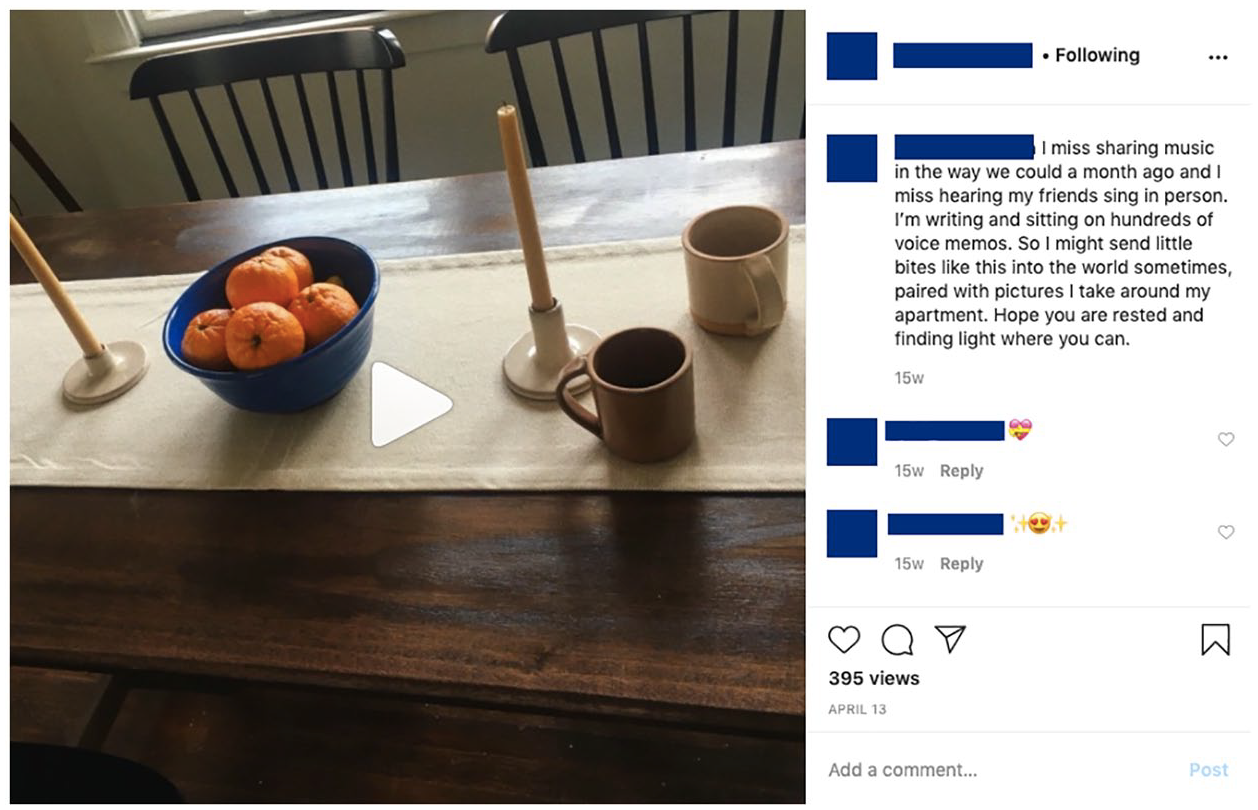
Post by Tracy, screengrabbed 27 July 2020.
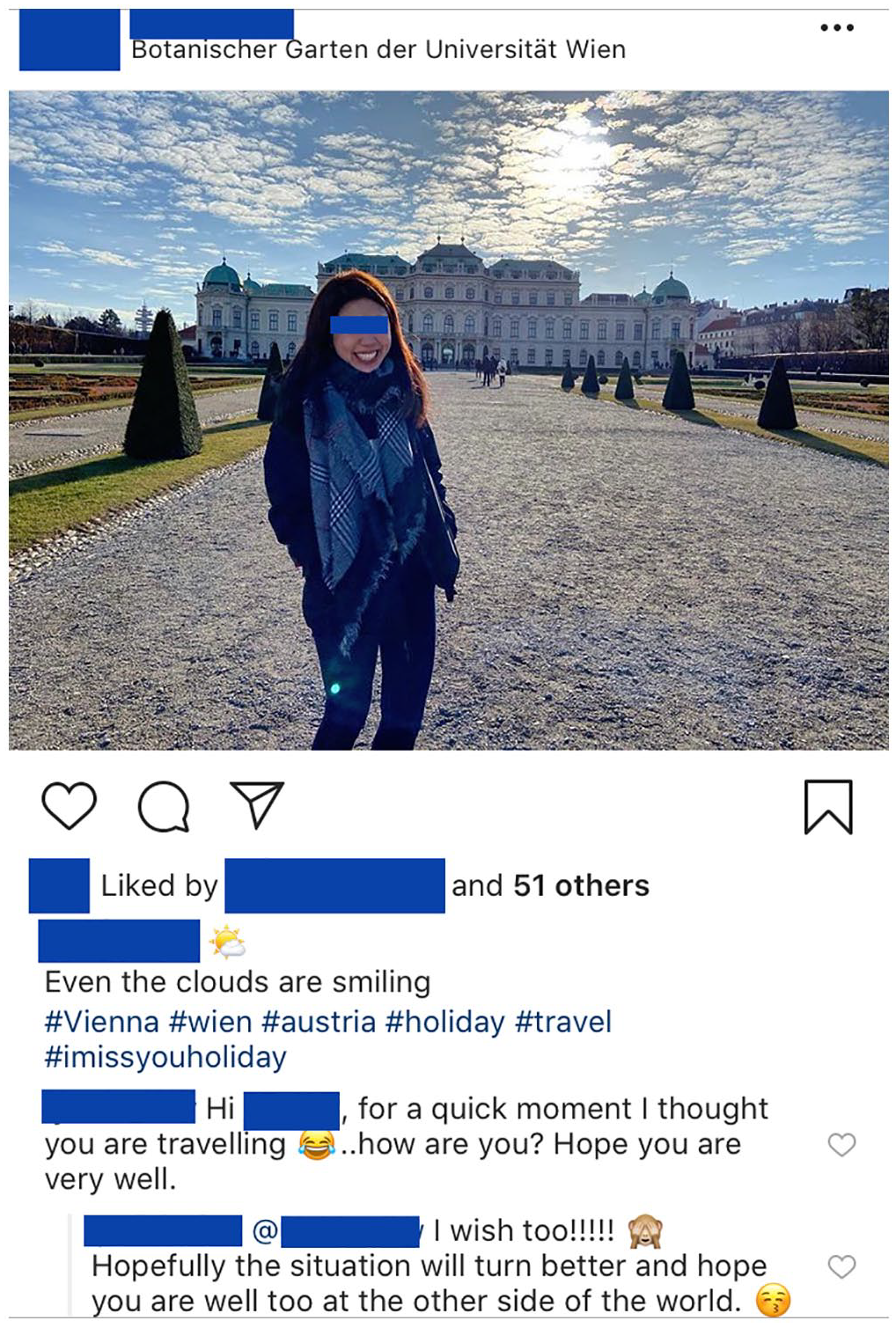
Post by Mable, screengrabbed 27 July 2020.
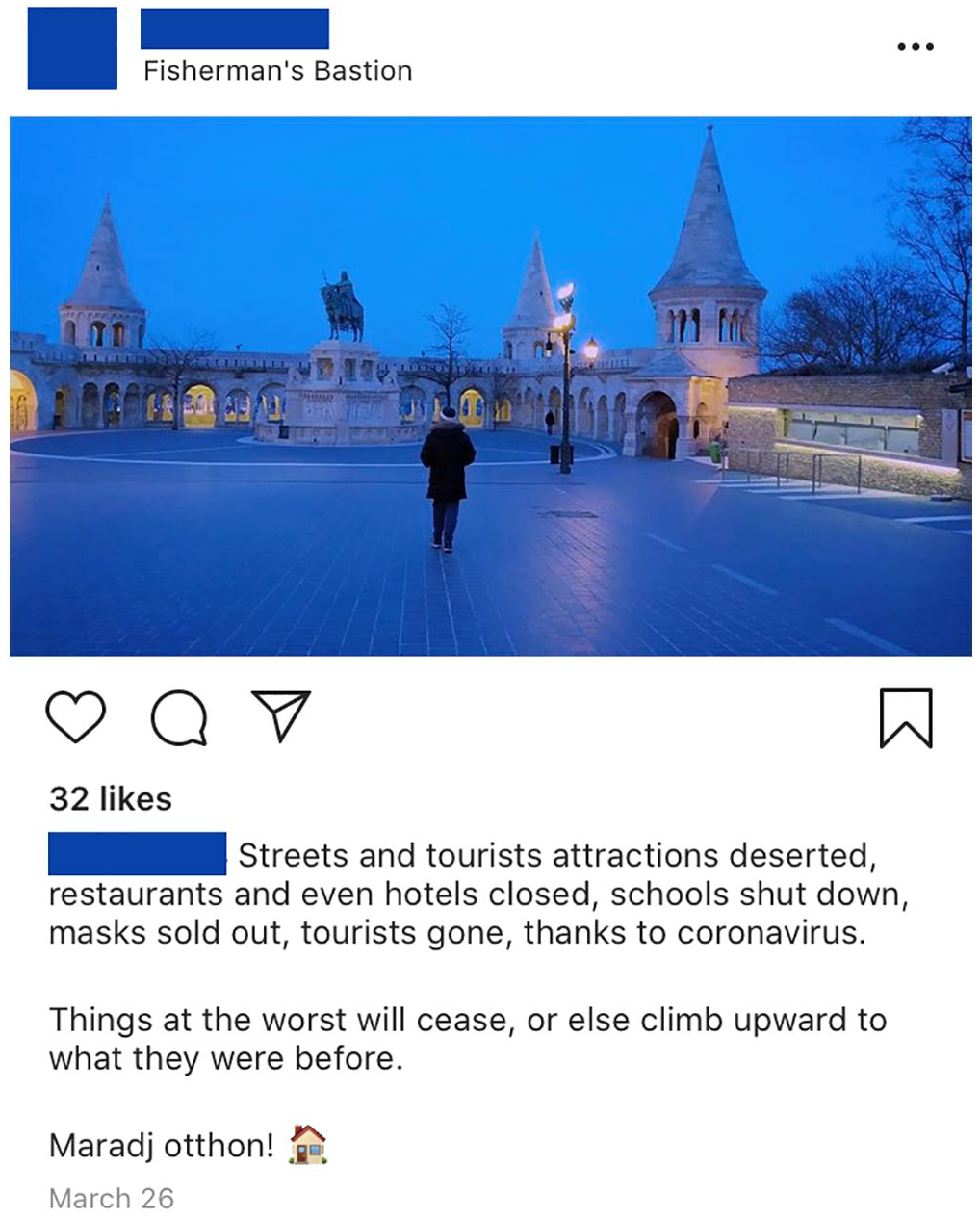
Post by Calum, screengrabbed 27 July 2020.
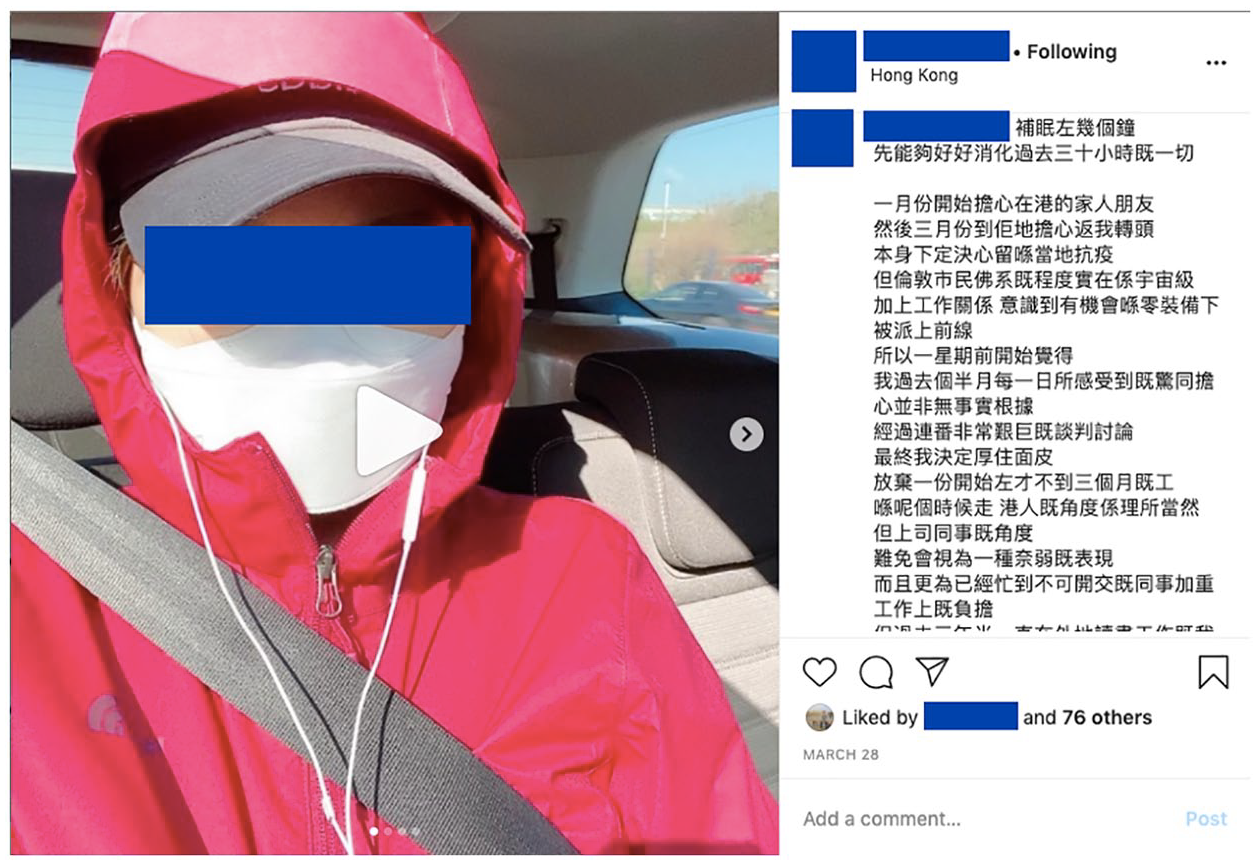
Post by Helen, part 1, screengrabbed 27 July 2020.
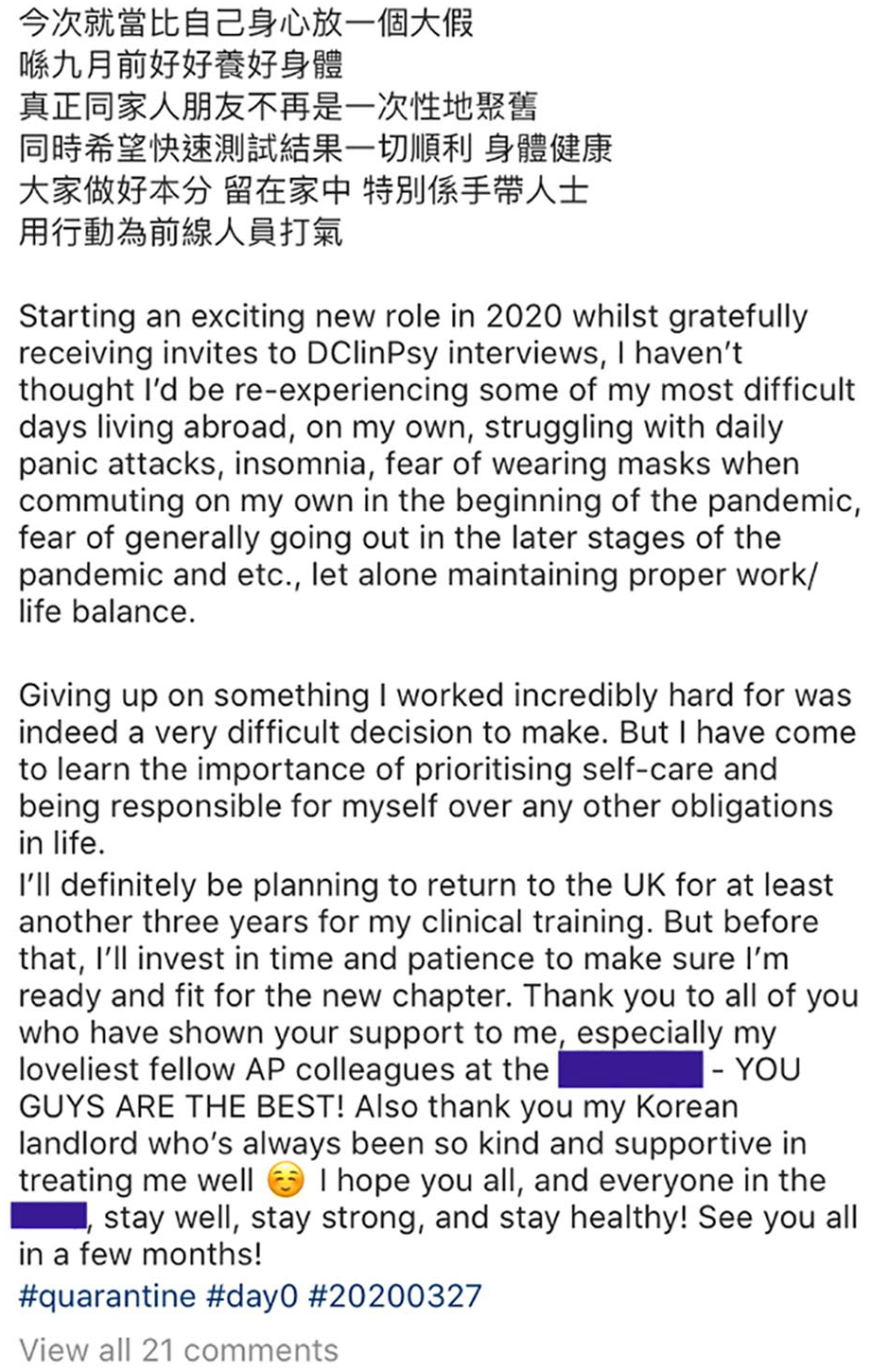
Post by Helen, part 2, screengrabbed 27 July 2020.
Only ordinary users’ posts were included, since this study is not concerned with how professional Instagrammers manage their impression to make profit, but how ordinary people construct an autonomous selfhood during this special period. Although one of them is a singer-songwriter (see Figure 1), she is not a professional Instagrammer who creates branded content but mainly uses Instagram as a way to share her daily activities and get in touch with her friends, listeners, and other singers-to-be like her. Specifically, none of the Instagram users involved in this study has over 2000 followers. In the study of Smith (2019), the Instagram influencers that he identified typically owned a number of follower larger than 30,000, and their posts usually receive over thousands, even tens of thousands, of “likes.” Since all Instagrammers involved in this study do not own more than 2000 followers, their influence should be considered limited on Instagram, which presumably does not directly lead to profit. Besides the above criteria, I carefully examined the users’ profiles to ensure that the accounts were not directly business-related.
Ethical and practical challenges of social media research are inevitable but could be managed and mitigated in my work. In order to protect the privacy of the owners of the posts, and in line with Veum and Undrum (2018)’s practice in seeking consent from the content creators in their work on selfies, I sent each of the Instagrammer a request allowing them to not participate in this study, and have received informed consent from the creators of the posts used in this paper. I have also put mosaic on their face and all account names in the posts to further minimize the potential harm to them, as some of them are using a private account so their content is not publicly available. Moreover, pseudonyms have been used for each of the Instagrammer in this study.
I adopted snowball sampling for this particular study, which emanated from several university students or young working professionals based in Hong Kong, the United States and Europe. Some of them were not located in their home country at the time of producing the post. Although hashtag searching via keywords (e.g. Veum and Undrum, 2018; Zappavigna, 2016) is a common sampling method in social media studies, I decided to not adopt it due to this study’s focus on (im)mobility: in order to capture how individuals negotiate structural as well as spatiotemporal constraints in the COVID-19 context, I deemed it more practical to start relatively small and scrutinize a few individuals’ self-presentation and voices in a situated manner. This study does not aspire to make a generalizing claim on how people in different sociocultural spaces cope with their situations during the pandemic; instead, by utilizing Instagram posts shared in this period as a case study, it intends to glean insights as to how the (im)mobility binary is problematized through individuals’ agentive self-presentation in the context of early COVID-19.
Multimodal discourse analysis developed by Kress and van Leeuwen (2001) is the major analytical tool for this study. Their social semiotic theory of communication takes an interest in the sign maker’s agency, and how individuals orchestrate semiotic resources to articulate certain discourses or perform certain social actions. It considers signs and sign-making practices as socially embedded (Kress, 2009: 69), exploring the social relationships that give rise to the production of signs. Their approach can provide insights into how individuals produce heteroglossic meanings that are unique to the period under investigation, and what personal and social motivations contribute to their meaning making on social media.
Popular post types on Instagram during the lockdown
“Finding light where you can”: pastimes
Albeit seemingly mundane, the first type of post manifests people’s capacity when dealing with physical immobility during COVID-19 lockdown, typically foregrounding still-life objects, homemade cuisine or indoor activities in the domestic setting. The indoors setting does not limit the Instagrammer’s self-expression; rather, it is oftentimes utilized as a canvas to write their agentive stories upon. This kind of narration reconstructs Instagram users and their audience alike as mobile, as people from different locations are brought into the same online space and extend support for one another. In other words, sharing a post about one’s pastimes at home during this period articulates a discourse of mobility by showcasing their capacity to transcend spatiotemporal limitations, and this is done collaboratively between Instagrammers and their target and imagined audiences. Figure 1 is a music clip uploaded by Tracy, and she uses a still photograph captured at home as the cover photo. The audio is an original piece of indie folk song she creates and sings while playing the guitar. In the image, on the wooden table lie two candles, two mugs and a bowl of fresh oranges. The objects invoke a sense of French impressionist artists’ still life paintings, creating a cozy ambience in her apartment. As a singer-songwriter based in Detroit, Michigan, Tracy is nostalgic of the pre-pandemic time when she was freely singing and performing with friends and other people. As a result of Michigan’s lockdown at the time, she has to stay in her own apartment and engage herself on the previously recorded songs on her phone. She pairs these singing bits with pictures captured at home, and shares them with her audience periodically. She hopes her audience are seeking joy and hope in their life wherever they are. Despite the physical immobility and isolation at the moment, Tracy is remediating her daily life and pastimes during the lockdown into Instagram – a new context for “social visibility and connection” (Vivienne and Burgess, 2013), not only in reminiscence of but also in seeking of mobility.
Tracy’s post gathers hundreds of views and dozens of “likes.” Her acoustic, visual and verbal choices altogether present a self-assured quarantine life, where she focuses on music production and social bonding. This positive self-presentation is mediated by her identity as an emerging singer and Detroiter, and sharing her music with others via social media further contributes to her negotiation of the temporarily immobile self. As she is “finding her own light” with her music skills and social network, she encourages her audience to get around the limitations posed by lockdown as well by exploiting their creativity, re-constructing them as potentially mobile and capable of challenging their spatial immobility.
“Walking down memory lane”: flashbacks
Figure 2 is a travel photo shared by a woman from Hong Kong, Mable, on May 22, 2020 to her Instagram profile. It was taken during a previous trip to Austria. She is standing on the left side of the picture, with a big grin on her face. She writes in the caption “Even the clouds are smiling,” followed by a couple of hashtags related to travel, including one that explicitly displays her longing for going on a trip again, #imissyouholiday. A frequent Instagram user could tell that the image has been edited using the “sharpen” function provided on Instagram’s filter, thus forming a strong visual effect and highlighting the clearness of the sky. This is reminiscent of her carefree travel days before the pandemic, presenting herself as a fun-seeker and appealing to the viewer. Under this image, a friend of hers said she thought that Mable was actually traveling and wished her well in the current situation. Mable confirmed her desire to be on a trip, and she also wished her friend well who is “at the other side of the world.” The carefully crafted travel photo as a flashback sets the ambience for Mable and her potential audience to get in touch, wish each other well during the pandemic, and rekindle their friendship. As a Hong Kong woman who writes this post in English, emojis and hashtags, she freely mobilizes the resources and stylizations in her linguistic repertoire and those enabled by her habitus to communicate her affection during the lockdown with her friends worldwide.
Physically still as she was at the moment, Mable aspired to be mobile and crafted a self that is fun-loving and well-networked. Although she used an old travel photo to write her wish upon, this is not to be taken at face value as her self-presentation is one that could only be performed from a particular position of socioeconomic power. The Instagram post suggests that she travels to Europe regularly from Hong Kong, but the coronavirus interrupts her plan. In other words, money and trip planning are the last things to worry about because she is totally capable of doing so in normal days. Mobility, in her case, is no longer just about the spatial movement of the body, but also about her social position in a hierarchical society; it is both material and metaphorical. In other words, she is agentive and mobile not just because she is aspirationally so, but also because she has access to the resources and representational tools to be. By posting an old picture of herself in a foreign locale, she reconfigures her represented body and re-constructs herself as mobile, and negotiates the tension between her physical body and represented body.
“Maradj otthon! (Stay at home!)”: updates
Figure 3 is a photo shared by Calum, a man from Hong Kong. We can see an empty city in the evening. The geotag shows that he was in Budapest, Hungary at the moment when the picture was captured. According to Calum’s caption, tourists had all left the city due to the pandemic, implying that he was staying in the city with a non-tourist identity. At the end of the caption, he uses Hungarian, “Maradj otthon!” (which translates to “stay at home!” in English), followed by a house emoji perhaps to address those in his imagined audience that speak Hungarian. His visual and verbal choices create a sense of intimacy between him and his Hungarian friends and followers; his use of Hungarian shows people that he has started to become local. This post forms an update from Budapest on the pandemic situation. His locally meaningful post shows that it seems to be a privilege to be exposed to and exploring an exotic lifestyle, and that he could also afford to stay in a foreign city for a long period of time. The adding of Hungarian, a relatively less known language in the world, further lends itself to the production of an asymmetry between himself and the non-Hungarian speakers in his followers. In this way, Calum creates a multi-voiced and multi-layered “textual amalgam” (Leppänen et al., 2009), constructing a hybrid and translocal identity that is both locally meaningful and also globally oriented (Kytölä, 2016). His utilization of mobility as a unique semiotic resource, as well as his alignment with Budapest and its people, articulates his specific position and social identity as an expatriate during the pandemic.
Interestingly, his mobility was also relative and relational: in a foreign locale, he is performing being a mobile person, but his body is profoundly not mobile due to the lockdown measures; therefore, he seems to be mobile and immobile, both at once. Nevertheless, his mobility is enabled via Instagram self-presentation regardless of his spatial movement, that is, positioning himself as someone who affords to be mobile, both linguistically and socially, during the worldwide lockdown. Calum’s self-presentation showcases an agentive self by revealing the linguistic and material resources he has access to, which rendered him mobile to a certain degree, both online and offline.
“Fear of wearing masks”: unsettlements
Figures 4 and 5 constitute an Instagram post by Helen, a woman from Hong Kong. This is a selfie she uploads with a mask on, that is taken during a car ride in Hong Kong, accompanied by a heartfelt caption recounting her experience in the UK before and during the coronavirus outbreak. It elaborates how she finally made up the decision of giving up her recently begun clinical training and returning to Hong Kong to reunite with her family. Notably, the caption is written with a mix of traditional Chinese and English, yet the English part is not a direct translation of the Chinese content and has skipped some details that display her nuanced struggles and frustration, such as 放棄左一份開始才不到三個月既工 (giving up a job that I didn’t start until 3 months ago). She did not explain the reason for this, yet the audience could probably take an educated guess from the clue “struggling with daily panic attacks, insomnia, fear of wearing masks when commuting on my own in the beginning of the pandemic.” This “difficult decision” was a negotiated result of her prioritizing her “self-care” and “being responsible” for herself, but it appears more like a compromise for the time being. As we can imagine, she was faced with competing voices and ideologies in the early stage of the pandemic, when Asians who chose to wear masks in public and were worried about going to work or school were simply dismissed by more authoritative voices at the time (e.g. BBC News, 14 March 2020). Although she had the capacity of locating a decent traineeship in clinical psychology in the UK, her power granted by her socioeconomic status dwindled in this society in the midst of the outbreak – her voice was unheard, rendering her powerless in that specific spatiotemporal context. In this case, social class is revealed to intersect with race and nationality, and her power is relative on a global scale. As she was met with intercultural conflicts arising from the pandemic that were extremely tough, the pressing social issues, and sociocultural differences were another side of the coin of her mobility.
As the tags in this post reflect, she had already arrived in Hong Kong by late March, and finally had the chance to contemplate upon her journey and her own experiences during the pandemic; the resolution to her unsettlement is enabled by her “fixity,” by her returning to the original sociocultural environment in which she spent most of her socialization. Her multimodal narrative is a reflective account of her struggles in the globalizing society, exploring her identity as a competent and striving Hong Kong youth in a time of precarity. This Instagram post, in which she finally gets to present herself with a mask on confidently, also provides the tool and resources for her to negotiate and assert her own visuality and visibility. Notably, with the use of the geotag “Hong Kong,” she actively positions herself as a Hongkonger who aligns with local norms. Despite her unsettling experience, she continues to write: “I’ll definitely be planning to return to the UK for at least another 3 years for my clinical training.” This suggests that the impacts brought about by coronavirus to her would be lasting; nevertheless, with support from her family, friends, and former colleagues, she gets to again pick up her optimism for the future and demonstrates an agentive and resilient self. The discourse of mobility Helen articulates is an extremely multi-layered and dialectic one, where her physical mobility is intertwined with her longing for settling.
Conclusion and discussion
Based on the scrutinization of four prevalent types of post on Instagram during the early COVID-19 pandemic, I in this article elaborate on a standpoint that construes individuals’ subjectivity and agency as negotiated through personal-social processes, which is instantiated in how people articulate their mobility by using it as a semiotic resource and manage their physical (im)mobility through linguistic and visual means. This kind of mobility involves spatial and social dimensions. On Instagram, people’s physical bodies are reconfigured digitally as part of their multimodal self-presentation. The traditional stillness-movement binary is put under question as Instagrammers craft agentive selfhoods online, rendering the immobile body mobile to a certain extent.
An emphasis on agency is not to dismiss power relations and inequality issues in the globalizing world. While the participants forming this study all more or less belong to the “winners” of globalization, the analysis evokes potential issues of inequality in terms of people’s mobility, which could easily permeate from the offline world to the online realm. As Tavares and Juffermans (2020: 218) contend, “movement and mobility is not a human right but a privilege to be struggled over.” While some become mobile, others’ movements might be hindered as a consequence, thus perpetuating existing unequal social orders. Indeed, while digital media enable a more fluid and democratic sense of mobility, they do not fully free the bodies from their moorings. Taking job market as a case in point, if someone from Asia has the privilege to immerse themselves in a native English speaking country, their English proficiency and accent acquired there would still likely grant them advantages over those who never have the chance to sharpen their English skills by living overseas, although the latter also have access to abundant online learning resourses. This echoes Tavares and Juffermans’ (2020) argument that one’s (im)mobility shapes their linguistic repertoire and vice versa. Therefore, researchers need to remain cautious when they contemplate to what extent digital communication tools render people agentive and emancipated. This calls for a visual semiotics of agency, which will enable researchers to account for how people respond to various structural constraints in their sociocultural spaces, trace the relational contingencies of mobilities and moorings (Bissell and Fuller, 2011), and envision new social relations in the global world.
