







Abstract
What can cultural studies contribute to our understanding of Hong Kong’s print and broadcast media? We reorient the current preoccupation with politics in Hong Kong’s local media to focus upon culture. Drawing from cultural studies, and specifically the search for ‘common culture’, we explain divergent perspectives on migrant domestic worker (MDW) abuse in Hong Kong’s English and Chinese-language print and broadcast media. Whereas the English-language media relies upon international experts and NGOs to tell a story of human rights abuses against MDWs, the Chinese-language media is more likely to take us into local homes and to present the employer and community as victims of trickery from domestic workers and agencies. We use the kitchen sink drama as a metaphor to describe this reportage. What forces shape the production of these dramas? and what are the implications for the public understanding of MDW abuse and human rights?
Academics and journalists have written extensively about China’s political intervention in Hong Kong’s media (Hong Kong Journalists Association, 2017; Lee, 2018). We, however, draw on the tradition of cultural studies to understand positions taken in Hong Kong’s most popular local newspapers and television shows. We take one particular story, the violent abuse of a migrant domestic worker (MDW) by her employer, to illustrate this approach. The distinctive reportage of this story in Hong Kong’s Chinese-language media resembles what Williams (1958) called ‘common culture’ which, we argue, has emerged as a response to the international universalistic discourse on human rights in Hong Kong’s English-language media. The Chinese-language media invites its audiences into private homes to learn about domestic workers from employers, neighbours and local politicians. This world is presented in ways reminiscent of the ‘kitchen sink drama’, a genre of documentary in post-war Britain which showcased the lives of ordinary working people involving morality tales, lurid detail and sexualisation. What forces shape the production of these dramas in the Chinese-language media?
To answer this question, we undertake a systematic quantitative and qualitative comparison of three English-language- and three Chinese-language-television news shows that covered the abuse of MDWs in Hong Kong during 2014 plus 445 newspaper articles from three Chinese-language and two English-language newspapers in the same year. We ask: What are the main topics or themes covered in the stories and from whose perspective are they told? We supplement this data with interviews with staff who work in both media to help us understand the evolution of these two discursive communities.
We explain the differences in reportage in terms of the construction of a ‘journalistic other’ in the Chinese-language press, which provides a forum to challenge accusations of human rights abuses imposed by international NGOs, academics and human rights experts in the English-language press. Such resistance, we argue, has been primordial among Hong Kong residents, particularly its working classes, in a struggle to assert themselves against aspects of colonial rule in the past when there were protests over poor labour conditions and corruption, and now even more presciently to preserve the city’s particularism in the face of becoming ‘just another city’ in the Chinese mainland and the loss of autonomy that this implies. The search for a common culture in the UK was precisely this appreciation of the local, or as Hall (2015) argued referring to Britain, ‘the impulse to close in on older images of themselves, a tight little island, in order to defend themselves against all this otherness that is pressing on them’.
This is not to say that employers of MDWs or consumers of the Chinese-language media are always working class, like the populations that Williams studied. However, the affordability of full-time domestic workers in many parts of Asia means that paid domestic help is available to those on relatively modest incomes. For instance, the median monthly household income in Hong Kong is HKD26,600 (USD3417). Yet 19% of all families that employ domestic workers have monthly incomes below HKD20,000 (USD2570) (Census and Statistics Department HKSAR, 2021). Relationships with domestic workers are therefore very much a part of Hong Kong’s common culture. Further, while the abuse case we studied occurred in 2014, the treatment of domestic workers has been a talking point in the territory for many years, and now even more so as women continue to enter the workforce and the demand for domestic workers grows in the face of scarcity due to restrictions on migrants during the Covid 19 pandemic.
We begin by describing the evolution of the Chinese-language press in relation to its traditionally more elite and international English-language counterpart to explain how the Chinese-language media, like the search for common culture, encouraged a mass newspaper literacy (Hoggart, 2009) in the territory. We then show how the Chinese-language media constructs kitchen sink dramas around MDWs as a foil to the standard human rights discourse of international human rights experts cited in the English-language media, showcasing the employer as the ordinary Hong Kong resident who fights back against forces perceived as foreign.
The kitchen sink drama, common culture and the development of the Chinese-language media in Hong Kong
The kitchen sink drama was a literary genre that emerged in the 1950s in Britain among working-class communities who rejected the romanticism and escapism of high-brow literature, theatre and art in favour of everyday mundane realism. At a time of economic insecurity, a new wave of playwrights wrote about disillusioned young working-class Britons. The genre was preoccupied with the lives of poor families in cramped accommodation, conversations in pubs, everyday romances, infidelities, pregnancy and abortion to show ‘life as it really is’ for ordinary people. As the name suggests, the setting for these stories and the telling of them was in people’s kitchens, allowing audiences a glimpse of British life in a ‘naturalist’ environment (Heidarzadegan and Yildiz, 2020).
The kitchen sink drama was part of a larger cultural project in post-war Britain to search for what Williams (1958) called ‘common culture’. Common culture bridged the ordinariness of working-class culture with elite culture, celebrating the collective struggles of the Second World War and the emergence of the welfare state. Williams, the son of a railway worker, emphasised that ‘culture is ordinary’, everyday and pervasive rather than top-down, and celebrated the culture of the ‘enclosed personal world’ (Williams, 1958: 99) of the working classes over that of the elites.
Hoggart (2009), a contemporary of Williams, described the reading habits of the working classes with reference to what would today be considered ‘tabloid’ media. Working-class publications present themselves as ‘modern’ and ‘forward looking’ (p.144). They ‘seek out the startling . . . are almost entirely sensational and fantasy producing’ (Hoggart, 2009: 196). They promote the ‘virtues of the ordinary man as shrewd and honest’ (Hoggart, 2009: 205). Whereas elites sometimes use the term ‘tabloid’ judgmentally to denote a threat to ‘serious’ or ‘socially responsible’ journalism and even to democracy itself (Biressi and Nunn, 2008), for Williams (1961: 41), the popular press is a resource to understand ‘structures of feeling’ of a particular moment in history. As such, the tabloid press can also be a democratising one.
In the 1970s, the tabloid newspapers in Britain became synonymous with sexual vulgarity, popular vernacular and working class conservatism (Biressi and Nunn, 2008). The tabloidization of the British news media was a marketing strategy to divide audiences into a large working-class and an elite readership that consumed ‘quality’ press (Johansson, 2007). As a former British colony with marked social economic and educational disparities, as well as a colonial legacy that privileged white non-Chinese migrants, a similar ecology of tabloid and highbrow media emerged in Hong Kong.
Until 1974, English was the only official language in the territory, used in the courts and government offices. Consequently, the English-language media held disproportionate influence and prestige until the 1980s. The South China Morning Post (SCMP), Hong Kong’s most widely-known English-language newspaper (founded in 1903) was associated with status and upward mobility (Chan, 2003). During the colonial era, the SCMP devoted more articles to British rather than Hong Kong affairs and was the least critical newspaper of the colonial government (Mitchell, 1996). The Hong Kong Standard, Hong Kong’s other English language paper, founded after the SCMP, was less elitist, appealing to unskilled non-Chinese speaking ethnic minorities. Continuing this tradition, The Standard is free and circulates in areas of the city frequented by MDWs.
It was the Chinese press that introduced more pluralistic and popular styles of journalism to the territory, beginning with Oriental Daily. Founded in 1969, Oriental Daily focussed more on entertainment, sex and violence than previous Chinese newspapers. It was also the first to launch a complaints page in which readers could voice grievances against government departments or private companies, as well as sections written in colloquial Cantonese. In the tradition of common culture, it championed the acumen of non-elites to talk back to authority.
In 1995, Jimmy Lai Chee-ying, a clothing retailer and democracy activist, founded the recently-closed Apple Daily in competition to Oriental Daily. Originally printed in colour and modelled on USA Today, it is widely considered to be Hong Kong’s first tabloid paper, aimed at ‘the man on the street’ and focussing on crime, celebrity news, sex, gambling and drugs. Upon its founding, it reached out to poorer residents by distributing coupons to reduce the price of the paper. The paper also ran a ‘sex page’ on which sex workers advertised their services. In 1998 it was accused of paying HKD5000 (USD641) for photos of a widower in bed with prostitutes after his wife threw his children out of a window before killing herself.
Apple Daily also provided a forum for ‘localists’ – those protesting visitors from the Chinese mainland. In 2012 it aired a cartoon which depicted pregnant women from the Chinese mainland as locusts, swarming the city and appropriating its public services, resembling how tabloid newspapers in the UK often depict refugees. Hostility towards migrants in the Chinese-language media is not confined to Apple Daily. Ng et al. (2019) found that Chinese-language newspapers are more likely than English-language newspapers to frame asylum seekers as ‘fake refugees’ and ‘criminals’ who are ‘abusing the system’ rather than expressing sympathy towards them.
Similar trends in the articulation of common culture can be found in the Chinese-language broadcast media. It was the Chinese-language broadcast media which, in the late 1960s, first hosted talk shows, providing a place where ordinary residents could make complaints without the risks of entering government offices or having the educational levels to write letters in English to the SCMP (Lee, 2014).
At the time of our study, Hong Kong had two commercial terrestrial broadcasting companies, ATV Television (ATV) and Television Broadcast Ltd (TVB). A third source of terrestrial television media was Radio Television Hong Kong (RTHK), a government department that makes programmes to be aired on the other commercial stations (Aitken, 2015).
A franchise requirement of all terrestrial stations in Hong Kong is that they supply both English and Chinese-language programming and that each channel produces at least two weekly in-depth news programmes. One must be a ‘documentary’ – an in-depth look at an issue from the perspective of a particular stakeholder. The other must be a ‘current affairs’ programme, a more impartial examination of a recent news story from the perspectives of its different stakeholders. In practice, however, the format of the news shows is left to the discretion of individual producers, and there was little consensus among our informants about how the shows we studied were classified.
As with the English-language newspapers, English-language television has a smaller role in the territory given that the majority of residents are Cantonese speakers. TVB therefore syndicates many of its English-language programmes to other countries in the region. Common culture, however, is focussed on specific localities. Stories about waiting lists for public housing, for instance, rarely appear on the English language news shows, since non-Chinese speaking migrants usually live in private housing: ‘What would Mrs. Chan cooking her dinner want to hear?’ as one editor who was familiar with the Chinese-language news desk told us. Stories about the environment and human rights, which have a more international appeal, are more popular among the English-speaking audiences.
Chinese-language television, like Chinese-language newspapers, has more content that might be considered tabloid than its English-language counterpart. Chinese-language shows such as ‘Scoop’ (TVB) and ‘Hong Kong Today’ (ATV) present themselves as news shows, but feature celebrity interviews, beauty pageants, gossip and reality-style matchmaking shows. No such equivalents exist on the English-language channels, where the content features travel, fashion and consumerism.
This is not to suggest, however, that the Chinese-language media is only consumed by the working classes. There is considerable variation within the Chinese media, with some outlets being more high-brow than others. Mingpao, for instance, like the SCMP, serves a more middle-class readership. We found that it was more likely than other Chinese newspapers to report on the rights and welfare of domestic workers.
Method
MDWs have attracted the attention of Hong Kong’s media since they began arriving from the Philippines in particular under special immigration arrangements in the early 1980s. To undertake a fine-grain analysis of media stories, we restricted our analysis to one particular year, 2014, a year in which the treatment of MDWs generated unprecedented debate in the media in the wake of a high-profile case of abuse of an MDW by her employer. This provided a large sample of newspaper articles and television coverage on the topic.
In January 2014, a story broke in the Hong Kong media about a 23-year-old Indonesian MDW, Erwiana Sulistyaningsih, whose employer prohibited her from leaving her house and contacting her family, and repeatedly beat her. In the trial that followed, the court heard how Erwiana had the metal tube from a vacuum cleaner forced into her mouth. On another occasion, she was stripped naked, sprayed with cold water and forced to stand in front of a fan for 2 hours. While stories about MDW abuse are not uncommon in the Hong Kong media, unlike in previous reports, Erwiana successfully pursued the prosecution of her employer, to whom the judge handed down a 6-year prison sentence and awarded Erwiana HKD809,430 (USD104,014) in damages.
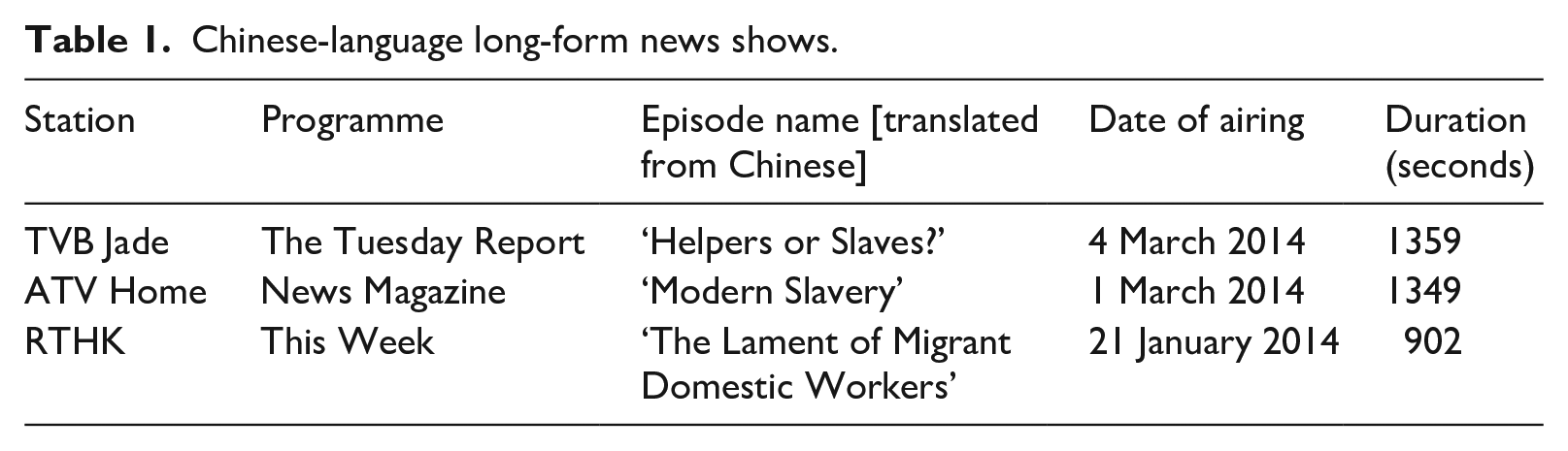
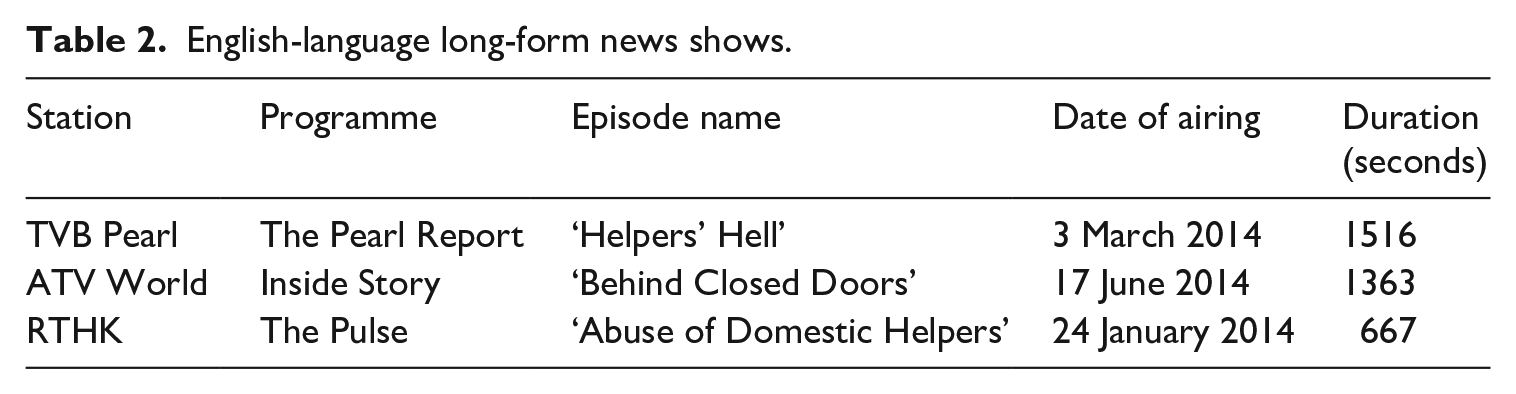
We examined six long-form television news shows that followed the early evening news dedicated to the Erwiana abuse case. These were produced by the three terrestrial television Channels in operation at the time, RTHK, TVB and ATV. Each station produced a Chinese-language and English-language long-form news show about Erwiana’s abuse which allowed us to systematically compare the English and Chinese-language coverage (see Tables 1 and 2).
Chinese-language long-form news shows.
English-language long-form news shows.
Using the qualitative software analysis programme, Nvivo, we coded the number of seconds devoted to various scenes in the documentaries, identifying the proportion of the shows, for instance, that comprised scenes of MDW abuse, of MDWs performing their jobs, engaging in leisure activities, undergoing training and participating in protests.
Aside from these themes, we also wanted to know from whose perspective the stories were told. We therefore recorded the number of seconds allocated to the various stakeholders: the MDWs themselves, employers, government and law enforcement officials, NGOs, professional experts (doctors, lawyers, academics) by-standers (e.g. the general public, neighbours, non-employers) or the documentary narrators.
The video materials provided other data relevant to the construction of the kitchen sink drama. Some parts of the shows were dramatised with background music. We therefore coded, again by the second, the type of music played (happy, sad, worrisome and tense, rock) and the number of seconds in which there was no music.
Documentary is a genre of media narrative engendering morality tales. Typically a narrator establishes a central thesis at the start of the show, for example, how widespread is MDW abuse? who is responsible for it? Various perspectives are then presented. Finally, stories resolve with a conclusion and recommendations about what is to be done about the problem. We undertook a qualitative analysis of these narratives.
In addition to these television shows, we collected data for the same year from three local Chinese-language and two local English-language newspapers: Apple Daily, Mingpao, Oriental Daily (those with the highest circulation in the Chinese community) and the SCMP and The Standard, Hong Kong’s two English-language papers. Apple Daily had online content not available in its print version, specifically animated cartoons about MDWs. We separately analysed this material in the same way that we coded the television shows.
We started our analysis of the newspapers by collecting newspaper articles that contained the keywords ‘domestic worker’ and ‘maid’ (and their Chinese-language equivalents) published in 2014. This yielded 445 news articles, 263 of which were from Chinese-language newspapers (95 articles from Apple Daily, 76 from Mingpao and 92 from Oriental Daily) and 182 English-language newspapers (140 from SCMP and 42 from The Standard). We classified each of the articles according to their dominant theme, determined by story headline. Eleven recurrent themes emerged: physical abuse of MDWs, MDW’s rights, employers deceived by MDWs, protests in support of MDWs, theft by MDWs, personal development undertaken by MDWs, MDWs involved in accidents, sexual abuse of MDWs, protests by employers, MDWs committing suicide, and MDW sexuality.
As with the television news shows, we wanted to know from whose perspective the stories were told. We did this by counting the number of times a particular commentator was cited in the articles, for example: MDWs, employers, government and law enforcement officials, employment agencies, NGOs, professional experts, by-standers, or the columnist’s own opinion.
Finally, we contacted principals involved with the production of the stories to learn more about their editorial decisions. This presented challenges. The Chinese press rarely identifies authors of specific newspaper articles. We did, however, interview a veteran columnist from the SCMP who had written about MDWs. Aitken (2015) observed that journalists from TVB are reluctant to talk to academic researchers. Indeed, several of the producers of the Chinese and English documentaries either declined or ignored our request for interviews. A producer of the TVB Pearl Report and The Pulse television shows did agree to talk with us, along with several former employees from the news department at TVB, albeit under the condition of anonymity.
Findings
The English-language media: themes and perspectives
Hidden abuse
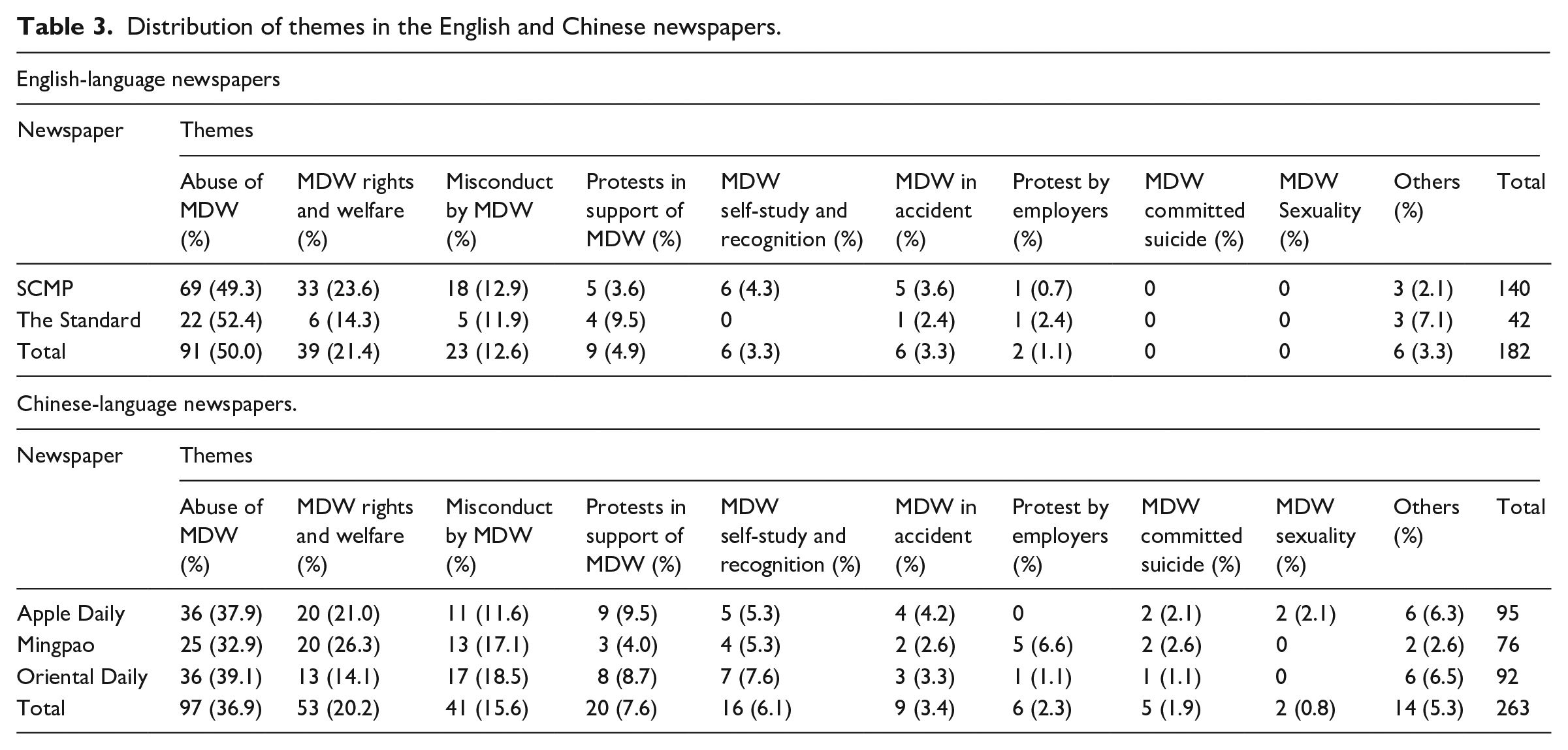
Since our data covers the period of the Erwiana abuse case, it is not surprising that the physical abuse of MDWs, along with their rights and welfare, were the most recurrent themes in both the Chinese and English-language media. MDW abuse is implied in all the titles of the English and Chinese-language television shows (e.g. ‘Helpers Hell’, ‘Behind Closed Doors’ and ‘Abuse of Domestic Workers’). Abuse stories also captured 36.9% of the Chinese headlines and 50% of English headlines. The rights and welfare of MDWs is also almost equally present in the headlines of the English and Chinese-language newspapers (21.4% and 20.2% and respectively; see Table 3).
Distribution of themes in the English and Chinese newspapers.
The English-language media, however, focuses more on the extent of the abuse, suggesting that it is be more pervasive than ‘locals’ and lawmakers acknowledge, as in the title of the ATV English-language television show ‘Behind Closed Doors’. The Pulse, an RTHK English-language news show, similarly begins with the premise that ‘many domestic helpers are in a very vulnerable situation’. The English-language TVB Pearl Report assigns agency to the employer first: ‘how and why bosses abuse their maids’, as well as acknowledging ‘misguided policies and inadequate support systems’ that contribute to the abuse.
Reliance on international NGOs and experts
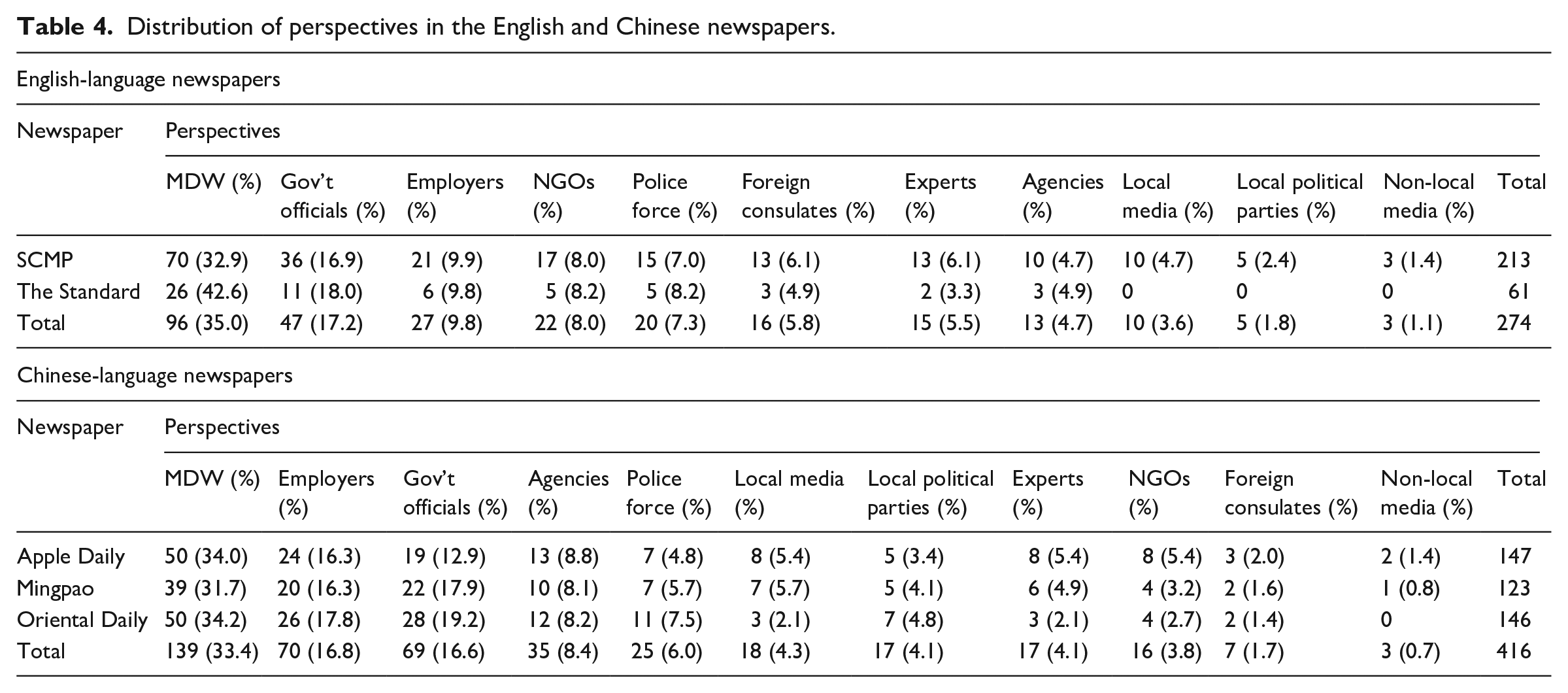
The English-language media relies on reports of MDW abuse not just from the domestic workers themselves (10.1% of the time duration in seconds taken up in the English-language videos and 35.0% of those consulted by the newspapers) but also from various advocates for MDWs such as NGOs, whose voices account for 21.1% of the seconds in the television shows and 8.0% of those consulted in the English-language newspapers. In addition reporters rely on a collection of ‘experts’, often foreign, that includes academics, social workers, psychiatrists, human rights activists, film-makers and media pundits (accounting for 15.9% of the seconds taken up in the television news shows and 5.5% of those cited in the newspaper reports; see Tables 4 and 5).
Distribution of perspectives in the English and Chinese newspapers.
Distribution of perspectives in English-language and Chinese-language Television Shows.
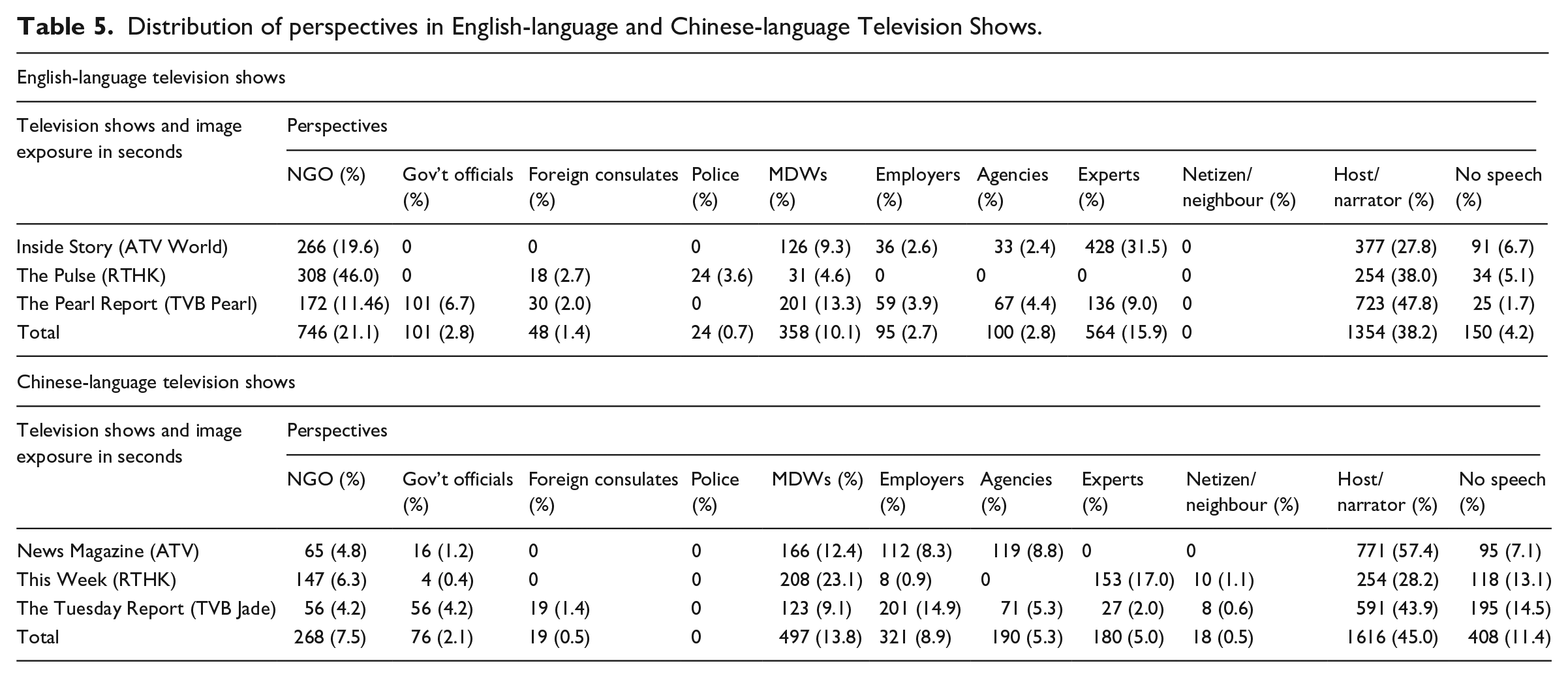
Editorial constraints and decisions in the English-language press reinforce reliance upon these parties since most of them speak English and, as several producers explained, not all English-language television reporters speak Cantonese. One editor believed that non-Chinese speakers prefer to hear ‘English soundbites’ in their news shows rather than read English subtitles. Again, such soundbites could be more easily obtained from MDWs, NGOs and foreign experts than from local employers, neighbours and friends, some of whom only speak Cantonese.
Abuse of power
Noteworthy too is how the narratives unfold in the television news shows and the conclusions drawn about what is to be done about MDW abuse and who is responsible. The English-language television shows conclude from the perspective of MDWs themselves or from the experts and NGOs who speak on their behalf. From this standpoint, MDWs are victims of an unequal power balance between the employer and employee. Those who speak out are celebrated as human rights activists who mobilise other abuse victims.
In the English-language TVB Pearl Report, for example, Siti, an Indonesian MDW who filed a complaint against her employer for unpaid wages and physical abuse, is invited by the programme host to offer a message to Hong Kong at the conclusion of the show: ‘Don’t treat domestic helpers or Indonesians like rubbish!’ she responds. The ATV Inside Story television show concludes with a professor of English praising MDWs for ‘being brave and deserving of respect’. Other experts lament that MDWs are denied equal immigration status and working conditions to Western expatriates. The Pulse ends with an interview with the Vice-Chairperson of the Filipino Migrant Workers’ Union who claims that one in five MDWs has been physically assaulted by employers. He says that ‘others can see themselves like Erwiana’ and have come forward to complain. Erwiana, he says, has provided the way for MDWs to ‘shout for justice’.
The Chinese-language media: themes and perspectives
The employer as victim
As noted, the English and Chinese-language media devote almost equal attention to the rights and welfare of MDWs. The Chinese-language media, however, introduces another set of actors and events that broaden the story beyond the plight of MDWs to their impact on the everyday lives of residents. In place of booklined offices of academics and NGO shelters, we are invited into employers’ homes and given a glimpse of everyday domesticity, reminiscent of Hoggart’s (2009) descriptions of the living rooms and arrangements of the working classes. Whereas the English-language television shows devote only 2.7% of their airtime to employers, the Chinese-language television shows devote 8.9% to them. NGOs and experts who speak on behalf of MDWs together occupy 37.0% of the airtime in English-language television shows, but only 12.5% of the Chinese-language shows (see Table 5). This difference is also present in the newspaper reports. Employers make up 16.8% of those interviewed in the Chinese-language newspaper articles compared to 9.8% in the English-language newspapers (see Table 4).
Indeed, a recurrent theme in the Chinese-language newspapers and television shows is that, while acknowledging the abuse suffered by MDWs, there are other ‘victims’, namely the employer and the local community. The narrator of the Chinese-Language ATV News Magazine, for instance, announces that ‘Employers and MDW groups believe the rights of both parties are breached under existing employment policies’. The title of the Chinese-Language TVB Tuesday Report on the topic is ‘Worker or Slave?’ The question mark opens the possibility of an alternative framing to the human rights framing of MDWs as ‘slaves’ that prevails in the English-language media. The narrator sets the premise for the show as giving voice to the employer, whose ‘pain’ has been ignored: ‘When cases of abuse occur’, he announces, ‘people suspect that Hong Kong employers enslave MDWs. But some employers say only they themselves know the pain of employing the helper’. [Translated from Cantonese].
Interspersed with interviews with MDWs and NGOs in the Chinese-language Tuesday Report, is a lengthy interview with the President of the Hong Kong Domestic Helpers Employers’ Association who says that human rights and MDW organisations use reports of MDW abuse to portray Hong Kong as a city that ‘enslaves’ MDWs. He describes how MDWs (in collaboration with employment agencies) deliberately get themselves fired (‘bok chau’ [搏炒] in Cantonese) so that agencies can keep the employer’s referral fee and collect yet more fees from new contracts. The show provides undercover footage of an agency allegedly instructing MDWs with a PowerPoint presentation on how to do this. No mention of this is made in the English-language television shows. Consequently, non-Chinese speakers would remain unaware of the practice.
The Tuesday Report follows up these claims with interviews with an employer, Mrs. Fan, who employed three MDWs. One of them, she explains, stole her son’s dinner. Another did not wash clothes thoroughly, triggering her daughters’ skin allergies. Another stole HKD800 (USD102) in cash. Mrs. Tam, an employer interviewed in the ATV World Chinese-language television show, News Magazine, paid HKD8000 (USD1027) in referral fees to an agency for an MDW who left her daughter alone at home and stole her money. Mr. Ng, another employer, claims his domestic worker falsely accused him of beating her. He employed eight MDWs through six agencies in the last 4 years, but most of them ‘underperformed’. No such stories were reported in the English language shows. Stories of theft or deception by domestic workers against employers did occur in some of the English-language newspaper headlines (12.6% of the headlines). But they were more common in the Chinese-language newspaper headlines (15.6%; see Table 3).
The employer thus emerges in the Chinese-language media both as an innocent victim of MDWs and their agencies, and also as someone who has dared to speak out and challenge the grand narrative of human rights abuses. Like the ‘ordinary people’ championed in common culture, they see through what they believe to be the distortions of the international media.
A problem for the whole community
Aside from employers, the Chinese-language media consults a broader range of constituents from within the community than the English-language media, including street hawkers (patronised by MDWs) and neighbours. In this media, MDWs entered the fray of local politics. Local politicians were four times more likely to be given voice in the Chinese-language press than the English-language press. In the English-language press, these politicians were drawn exclusively from the Pan-Democratic camp (e.g. Emily Lau Wai-hing) who are outspoken about human rights. In the Chinese-language newspapers, a broader selection of politicians were consulted including those known to be ‘pro-establishment’ that traditionally champion everyday livelihood issues (housing, welfare, infrastructure, elderly care) over political reform.
Narrators in the Chinese-language shows also explored the impact of MDWs on the broader community. Several worried that reports of MDW abuse brought shame on the city. The narrator of the Chinese-language ATV television show, News Magazine, described how Indonesian domestic workers were re-generating parts of the city where shops had been empty, turning these areas into a ‘Little Indonesia’. Unlike their English-language counterparts, this presentation went beyond how MDW abuse affects the MDWs themselves by introducing a more holistic understanding of disruptions to everyday life in the local community.
Indeed, MDWs engender nostalgia for Chinese residents of Hong Kong. Constable (1996) describes how Hong Kong Chinese residents idealise a previous generation of Chinese domestic workers from the Chinese mainland, known as sohei and muijai. These were bonded servants ‘bought’ by their wealthy employers. Hong Kong residents romanticise these workers as loyal household members, chaste and devoted to servitude. When compared to these ‘superior servants’, they view the more recent wave of Filipino and Indonesian domestic workers as undisciplined, mercenary and, as young seemingly unattached women, associated with promiscuity, prostitution and a threat to the moral order.
A problem of cultural incongruities and mis-communication
With regards to the narratives in the television shows, while both English- and Chinese-language television stations share some of the same footage and interviews, the two media draw different conclusions about the diagnosis and resolution of MDW abuse. The English-language television frames its conclusions according to the international NGOs, legal experts, human rights activists and academics, calling for justice and rights according to international conventions.
In the Chinese-language media, however, we are shown the quotidian domestic struggles of ordinary families. Protagonists seek resolution by calling for a restoration of relationships between MDWs, their employers and the community. The TVB Chinese-language Tuesday Report concludes with a tearful scene of Zenny, an MDW about to return to the Philippines after 23 years of service to her employer, Wendy. Wendy is held up as a model employer by seamlessly uniting her family with Zenny’s in a common struggle to raise their families. The show gives us a snapshot of the families’ emotional bonds: Wendy [employer]: If she’s not feeling well, we are all worried for her and we don’t ask her to work and we take her to the doctor. We care about her. Our two families seem to have become one. Like when everyone was panic-buying salt. She went to buy salt too – brought back a pack for 15 dollars. We all laughed!
Zenny similarly speaks of her affection for Wendy’s daughter: ‘I treat her like my own children . . . They treat me well, that’s why I stay for such a long time’. Wendy insists that ‘it’s crucial to care about and respect each other’. Whereas the English-language television-shows end with commentary from an MDW, NGO or human rights expert, this show concludes with Zenny’s employer defending employers and explaining that cultural differences and communication barriers are the main problem.
Maids don’t mean to harm Hong Kongers; Hong Kong employers don’t aim to fire a maid. Cultural differences, language and communication barriers like what I experienced with Zenny at the very beginning. If we solve them well, that’s how we’ll get where we are today.
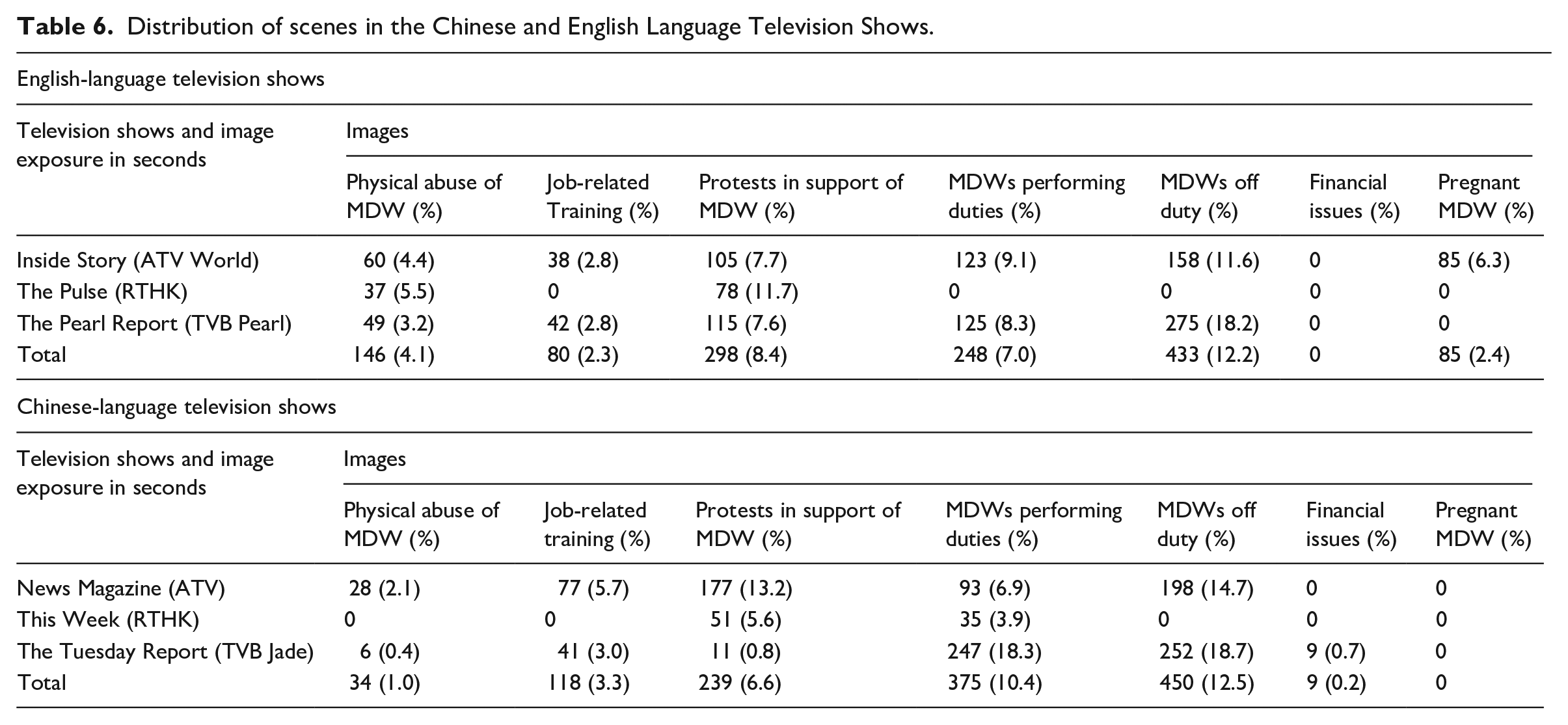
Indeed, by reporting more from the employer’s perspective, the Chinese-language shows highlight aspects that the English-language shows have, at least until very recently neglected, the actual work and contributions that domestic workers make to Hong Kong. Scenes of domestic workers carrying out their duties (i.e. looking after children and performing housework) consume 10.4% of the time in Chinese-language television shows, compared to 7.0% in the English-language shows (see Table 6).
Distribution of scenes in the Chinese and English Language Television Shows.
Sexuality and drama
As competition grows between media addressing working-class concerns, so does the need to find more accessible style and content (Conboy, 2006). Accordingly, tabloid media builds alliances with the entertainment industry (Biressi and Nunn, 2008), supplementing the written word with illustration and graphics. Apple Daily, for instance, relies upon Next Animation Studios in Taiwan to animate its stories with cartoons published on its website and social media.
The Chinese-language press infuses sexuality into its coverage of MDWs. Sexual references and language surrounding MDWs were entirely absent in the English-language media in 2014. However they were present in both the Chinese-language newspapers and television shows. Apple Daily headlines included: ‘Wan Chai has become a hotspot for Indonesian prostitutes. Modest women dress up to lure foreign men’; ‘As an employer, I am fine with a lesbian Indonesian being my helper’; ‘Indonesian lesbian mother says “I don’t need men”’; and ‘MDWs make their living in the red light district’. The Oriental Daily ran a headline: ‘Nightmare of employers when a baby cries at night as an Indonesian maid gives birth at employer’s home’ [translated from Chinese].
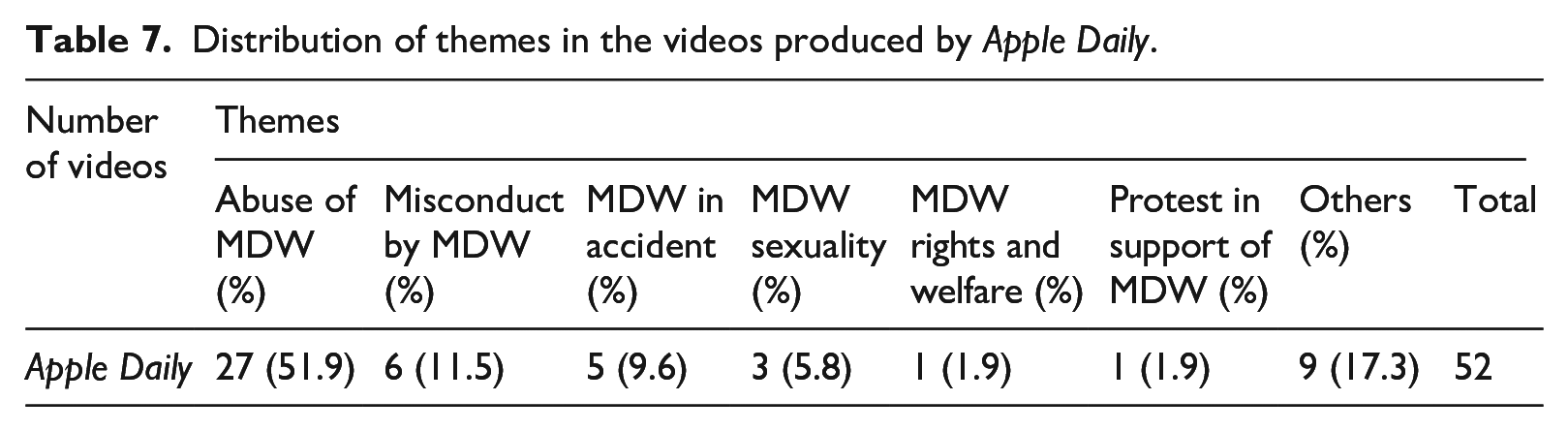
Themes and images of sexuality were particularly prevalent in Apple Daily’s animated cartoons (see Table 7 and Table 8), one of which depicts a scenario in which an MDW allegedly teaches a 2-year old girl in her care to masturbate and shares photographs of the act with her mobile phone. In the TVB Chinese-language Tuesday Report, the President of the Hong Kong Domestic Helpers Employers’ Association refers to stories in the Chinese media (which he dismissed as untrue) about MDWs serving their employers ‘fried pubic hair and veg and menstrual blood soup’. No such sexual references were mentioned in the English-language television news shows.
Distribution of themes in the videos produced by Apple Daily.
Distribution of images (e.g. animation and videography) in the videos produced by Apple Daily.

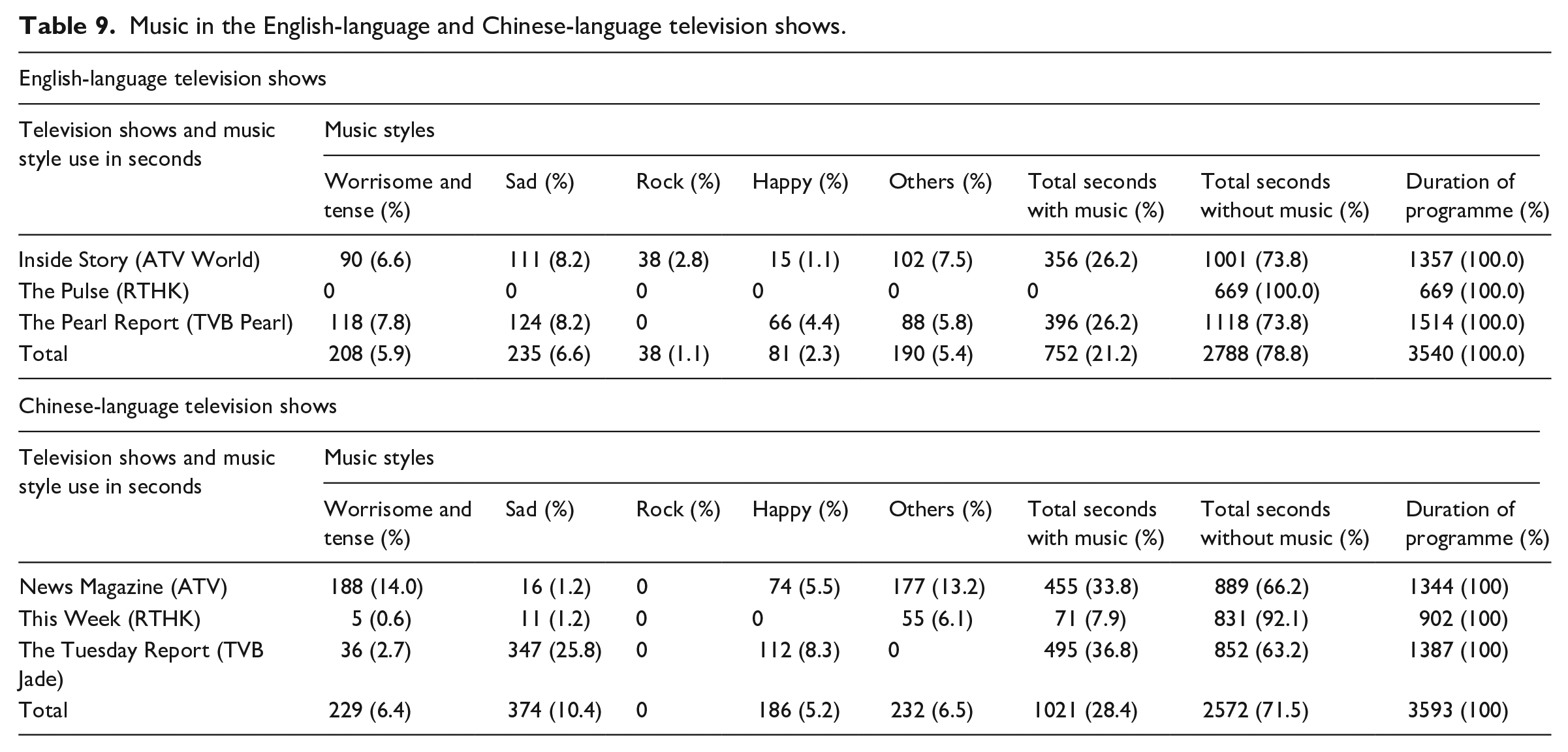
Music adds texture to the kitchen sink dramas in the Chinese language-television documentaries. While both English and Chinese-language television news shows play music with their reporting, it was more frequently played on the Chinese-language shows (28.4% of the duration of the Chinese-language news shows and 21.2% of the duration of English-language news shows, featured music; see Table 9). Adding to the overall drama, the Chinese-language television news shows are almost twice as likely to play happy upbeat music than the English-language news shows, and also twice as likely to play sad music, thus musical selections were more pronounced in the Chinese-language news shows. One producer told us that the use of music in the Chinese-language television shows was a recent development, since previous producers feared it would be editorialising, thereby attesting to the growing tabloid trend in this particular media.
Music in the English-language and Chinese-language television shows.
Conclusions
The early cultural studies project initiated by Raymond Williams has been overlooked in discussions about Hong Kong’s media in favour of political analysis. While focussed on working-class culture and its relationship with elites, we extend its application to the search for common culture in Hong Kong’s local Chinese-language media in the context of international discourses about human rights.
Specifically, we draw on this tradition to understand the coverage of MDW abuse in the Chinese-language media which constructs kitchen sink dramas around MDWs. With the help of music, graphics and cartoons, we are taken into the homes of local families to bear witness to the dynamics of domestic worker-employer relationships. Here, employers reorient the prevailing human rights discourse in the international media which they see as condescending and threatening to the city’s reputation. Featured employers are held up as model citizens who have been taken advantage of by MDWs or agencies. This contrasts with the monolithic focus on power imbalances between MDWs and their employers in the English-language media. This perspective is further reinforced by the scarcity of Chinese-speaking reporters in the English-language media and the preference for English soundbites for non-Chinese audiences. These limitations made it more difficult for the English-language press to explore the common culture described in the Chinese-language media.
Those we spoke to in the English-language media distanced themselves from the tabloidization of the Hong Kong press. A producer on the English-language show, The Pulse told us: ‘I’m not interested in doing just entertainment. I’m more interested in dealing with something that could improve people’s lives’. He considered that adding music to the documentaries, as practiced in the Chinese-language television documentaries, to be editorialising and therefore biased.
While acknowledging the sensationalism found in the Chinese-language media, those working in the sector who spoke to us did not see tabloidization as a threat to objectivity or necessarily prejudicial against MDWs. On the contrary, a TVB producer told us that she thought it was the English-language media that was ’superficial’ for lacking ‘detail’ found in the Chinese-language press: ‘I mean Apple Daily, Oriental Daily, they really go into the story’, she told us. ‘A lot is maybe salacious, but there’s a lot of interesting details that the English newspapers always miss’, suggesting that sensationalism and drama in the Chinese-language press added important texture to the stories. Accordingly, she suggested that a story about lesbianism among MDWs, while appearing sensationalist, might also serve to highlight their separation from their husbands and loneliness.
By focussing on employers, the Chinese-language media is more likely than the English-language press to highlight the important role that MDWs play in the care of children and the elderly, the collective struggles of raising a family, as well as the possibilities and practicalities of harmonious relationships between employers and MDWs – a perspective largely ignored in the English-language media’s singular reliance on accounts from unions and human rights NGOs in 2014. Rather than arguing that the Chinese-language media is universally positive or negative as media analysts who report on migrants often do (Bleich et al., 2015), the kitchen sink drama reveals a more nuanced picture. Although the rights of MDWs may be overlooked, their contributions as workers are underscored and audiences are alerted to faulty government policies and pernicious employment agencies.
An appreciation of the search for common culture in the Chinese-language press accordingly furthers our understanding of Hong Kong’s media beyond political censorship. The kitchen sink dramas that we describe in the Chinese-language media express long-standing anxieties about Hong Kong’s particularism in the face of cosmopolitan integration with outsiders. Nowhere is this more evident than in Apple Daily’s first editorial which announced: ‘We are making a newspaper for Hongkongers. As long as readers choose us, support our reports and agree with our stance, we will certainly be able to stand tall no matter how strong the pressure has become’ (Chow, 2021). Now at a time of anxieties about assimilation with the Chinese mainland, there is once again a longing to showcase the struggles of the ordinary resident, to embrace nostalgia for a more harmonious past, and to create spaces for frank social commentary. Accordingly, when Apple Daily recently closed its doors after national security officers raided its offices, froze its assets and arrested its founder under the new National Security Law, it was not just political censorship that media commentators lamented (see, e.g. Lo, 2021), but rather the loss of ‘a structure of feeling’ (to borrow again from Williams) – about Hong Kong’s very identity.
