







Abstract
This paper seeks to question whether and how instrumentalization of refugees by states impacts their media representations, based on the example of a border spectacle that took place in March 2020, when Turkey unilaterally opened its borders to the West, causing hundreds to flock to the land border with Greece and to the coasts of the Aegean Sea. In many ways, this ended up as a failed border spectacle, especially for international publics: Turkey appeared neither as a strong state nor as a benefactor of asylum-seekers. Yet, the paper claims, the spectacle nonetheless led to an ordering of the visibility of asylum-seekers that cannot be captured on the victim-threat spectrum across which they are usually represented. Examining Turkish mainstream TV evening news as well as state agencies’ Twitter accounts, the paper traces how Greece was made hypervisible through the use of three frames (humanitarian, legalistic and moralistic) and asylum-seekers were reduced to extras (figurants) in the process. Such an ordering of visibility facilitated the re-moralization of instrumentalization of refugees and may have accordingly shaped the response-ability of citizens. The figure of the extra enables us to link refugee visibilities to splintering moral geographies of asylum.
Introduction
On February 27th, 2020, 33 Turkish soldiers lost their lives inside Syria, as part of a military incursion into Idlib, which had among its official aims the control of the movement of internally displaced Syrians into Turkey. In response, the Turkish government announced it would open its borders to the West. As hundreds flocked to Edirne, the Turkish city that borders Greece, and the coasts of the Aegean Sea, various officials and the President himself declared that Turkey was unable to contain refugees any longer and demanded better burden-sharing from the European Union (EU). More people arrived in the border zone everyday. Alternative news outlets shared reports of how some were bussed to Edirne by various local and national governmental units. There were even claims that migrants were released from detention centres so that they could trek to the border. People set up camps in the buffer zone between the Turkish checkpoint in Pazarkule and the Greek checkpoint in Kastanies, waiting for the Greek side to allow entry. Some tried to cross Evros, the river that separates Turkey from Greece. Initially, one could even watch live on TV how they embarked on inflatable boats and attempted to reach the other side, with or without help from a smuggler.
People would gather in front of the Greek checkpoint, where the Greek border police forced them back with water cannons, tear gas, and rubber bullets. Greek authorities were also pushing boats back in the Aegean Sea. The Turkish Coast Guard recorded and released footage of these pushbacks. A war of numbers was waged between the Turkish Interior Minister and his Greek counterparts, as the Turkish Interior Minister regularly used his Twitter account to give counts of people who had managed to enter Greece, only to be denied by the other side. While Greece ramped up its border security, the EU representatives accused Turkey of instrumentalizing migrants and refugees. This border spectacle was heavily mediatized on Turkish TV and lasted until the end of March. By March 27th, the COVID-19 pandemic forced Turkey to close its borders. Those waiting at the border were forcibly removed to various reception and detention centres to be kept under quarantine. In the end, the Turkish government could not achieve whatever it aimed for; there was no substantial change to existing deals and agreements with the EU. The Turkish state appeared neither as a strong state, capable of driving policy, nor as benevolent to migrants and refugees in the protection that it provided. It was basically understood as treating refugees as pawns. One could easily argue what had happened was a terribly failed border spectacle in the eyes of international publics.
Taking such a failed spectacle as its case study, this paper is motivated by the question: How do border spectacles in the context of refugee instrumentalization frame refugees? The literature on border spectacles discusses how scenes created at the border frame border-crossers in particular ways, such as lawbreakers, security threats or lives in need of saving, while obscuring the socio-political processes that led up to the materialization of the scene in the first place. However, more work is needed to understand how border spectacles produced as part of refugee instrumentalization impact existing framings of refugees. I argue below that the Turkish TV coverage of the border spectacle made Greece hypervisible and enacted a scene of vindication, whereby the Turkish state appeared to domestic publics as morally superior and distributed responsibility for protection away from itself as well as from its citizens. I also illustrate that asylum-seekers and refugees were represented in ways that cannot be contained on the victim-threat spectrum across which they are usually represented and were turned into extras in a story that foregrounded state parties as protagonists. Although charges of instrumentalization posit the refugee as a pawn, the figure of the extra does not only better encapsulate Turkish mainstream TV’s refugee imagery, but also allows us to better make sense of its reception by citizens.
Border spectacles in migration and asylum politics
Border spectacles are common-place occurrences among the media visibilities of refugees and migrants. When de Genova (2013) coined the term, he argued that the spectacularization of crossings across the US-Mexico border helped fix the crossers in the public eye as violators of the law, while obscuring the processes of making and changing laws through which migrants were illegalized. He argued that border spectacles enacted a ‘scene of exclusion’, whereby ‘illegal’ migrants were seen to be detected and captured by a vigilant state, which capably controlled the border, enforced the law of the land, and provided much-needed security to its threatened citizens. Through the border spectacle, the state made an outcome (e.g. the illegal migrant) hypervisible, while concealing its role in the processes that produced this outcome in the first place.
Border spectacles serve further purposes at the external borders of the EU. Especially in search and rescue missions in the Mediterranean Sea, EU member states and agencies present themselves as not only fighting off the threats posed by irregular(ized) boat migrations, but also as saving migrants from drowning (Andersson, 2014; Musarò, 2017; Tazzioli, 2016). In such border spectacles, the limelight falls on the saviour state while the role migration control policies play in the occurrence of these boat emergencies remain hidden. In fact, migration control policies do not only limit any other, legal channels to reach Europe, but they also cause migrants to resort to ever more dangerous, life-threatening routes to avoid early detection on safer routes (Heller et al., 2017). The spectacularization of border-crossings into the EU in 2015 was built on such a humanitarian securitarianism.
Border spectacles may also be staged by EU member states for the consumption of other member states. For instance, Mainwaring (2019) argues that Malta uses irregular boat arrivals to create border spectacles and strengthen the perception that it is in a constant state of migration ‘crisis’. This enables the country to demand further financial support from the EU for migration governance and to increase its influence over EU migration policymaking. Non-member states, too, may make use of border spectacles for purposes of refugee instrumentalization. In both the Turkish-Greek border spectacle in 2020 and the Belarusian-Polish border spectacle in 2021 asylum-seekers and migrants were encouraged and supported by authorities of non-EU states (likely aided by opportunist smugglers as well) to group at the border and attempt crossing. Both spectacles were framed by the EU representatives as instrumentalization of refugees by state leaders who wanted to force the EU into a change in action in non-asylum-related policy areas. The EU responses to both spectacles were hence decorated with war-related metaphors: in one, the commission president thanked Greece for being the EU’s ‘shield’ and in the other, she accused Belarus of engaging in a ‘hybrid attack’ and weaponizing migrants. Dissenters and rights activists have drawn attention to the fact that the frame of instrumentalization helps the EU to shy away from its own responsibilities towards asylum-seekers and that the language of weaponization contributes to their dehumanization (HumanRights360, 2021).
Instrumentalization of refugees and shifting frames of visibility?
There is a long lineage of scholarship on how refugees have been represented in the media either as victims in need of protection or as potential threats to be avoided, with the line between the two easily sliding (Greussing and Boomgaarden, 2017; Kaye, 2013; Malkki, 1996; Wright, 2002). The media coverage of border spectacles builds on this repertoire. For instance, when covering the border spectacles of 2015, European media predominantly framed border-crossings as a ‘crisis’ and incoming refugees and migrants as ‘outsiders and different to Europeans’ (Georgiou and Zaborowski, 2017: 3). Politicians, government, and party officials increasingly depended on these media representations to find support for their policies and to ground their politics (Krzyżanowski et al., 2018). The mutuality between migration policymaking and media representations was revealed once again in 2022 when the EU gave a very different policy response to Ukrainian refugees in the context of media representations that portrayed Ukrainian refugees as ‘one of us’, therefore not initiators of a ‘crisis’ (Acu, 2022).
Refugee representations in the Turkish media overall have been found to match their counterparts in the Global North with regards to an oscillation between refugees as victims in need of help and protection and refugees as sources of danger and disruption (Atasü-Topçuoğlu, 2019; Şenol-Cantek and Soykan, 2018; Sunata and Yıldız, 2018). As part of the victim representation, one finds the figure of the Syrian refugee as a ‘guest’ and as a ‘person sharing the same faith’, in line with the government’s initial approach to refugee arrivals. As part of the threat representation, an increasing number of news stories portray refugees in relation to crime or as economic burdens, and in parallel to the rise of anti-refugee sentiment in the country, in ways which stoke fears of loss of ethno-cultural identity. What is worth noting is that a ‘crisis’ framing has not taken a general hold in the media. Sert and Danış attribute the lack of a crisis framing to the government’s efforts to give off the impression that it is ‘in control’ of the refugee issue and to its determination to use such impression as a sign of its ‘moral superiority’ vis-à-vis the inhospitable West (Sert and Danış, 2020).
Syrian refugees have indeed provided the ruling authorities in Turkey both an occasion to assert moral superiority over the West (more concretely directed at the EU) and an opportunity to engage in instrumentalization. On the one hand, ruling authorities continuously contrast the EU’s reluctance to accept refugees and rising anti-immigrant sentiments in different member states to the high number of refugees living in Turkey, glossing over rising anti-refugee sentiments within the country. For Turkey’s ruling authorities, Syrian refugees present a litmus paper: they reveal how the EU identifies with universal human rights in talk but shies away from practicing them, while Turkey exemplifies how a state may not need to rely on human rights after all to act morally. On the other hand, Turkey-EU relations throughout the Syrian refugee crisis steered towards refugee instrumentalization (Danış, 2016). Europe’s long summer of migration in 2015 ended with a Joint Action Plan in October 2015 and 3-billion-euro aid package in November 2015. By March 2016, a ‘deal’ was struck in return for another 3 billion euros: Turkey would agree to readmit Syrians who have moved onto Greece and put in place tighter border controls so that they could not leave the country in the first place. There were other promises made with regards to visa liberalization for Turkish citizens and reviewing of the Customs Union, though those promises have withered. The deal has been widely criticized not only for how it tramples refugee rights (most significantly by declaring Turkey to be a safe third country) but also for how it circumscribes the EU when addressing Turkey’s human rights violations in general and holding authoritarian grabs of power accountable.
Adamson and Tsourapas (2019) highlight the emergence of refugee rentier states against the background of increasing unwillingness of Northern states to receive refugees. Refugee rentier states come into being when states in the Global South realize they can receive compensation from states in the Global North in exchange for hosting refugees (ibid). Comparing refugee rent-seeking behaviour of Jordan, Lebanon and Turkey, Tsourapas (2019) also argues that states use two strategies to this end: blackmailing and back-scratching. While back-scratching involves seeking compensation in a more cooperative manner, blackmailing is more coercive and is based on ‘threatening to flood a target state(s) with refugee populations within its borders unless compensated’ (ibid: 465). Tsourapas identifies Turkey as resorting to blackmailing and Jordan and Lebanon as employing back-scratching. Indeed, international media covered the March 2020 border spectacle as part Turkey’s blackmailing, while Turkish refugee rights organizations accused the government of instrumentalizing refugees and migrants for foreign policy purposes, of putting their lives at grave risk by unilaterally opening borders. Thus, a closer look into how this spectacle was covered by the Turkish media enables us to examine whether and how instrumentalization of refugees impacts their media representations.
Methodology
Data selection
For especially the first 2 weeks of the border spectacle, evening news on mainstream TV channels all covered this story at length (although after people were removed from the border, mainstream TV channels stopped their coverage). TV continues to be a major source of information for a big chunk of the country’s population. According to a 2018-dated, country-wide survey, 84% of the respondents claimed to follow the news via TV despite a decreasing trend (Konda Research and Consultancy, 2018). This paper is based on coverage by eight national TV channels (out of a possible nineteen). In the selection, priority was given to news channels, thus, five out of eight are news channels (TRT Haber, A Haber, NTV, CNNTurk, Haberturk). TRT Haber belongs to the public broadcasting agency, and the remaining four belong to the four biggest national media groups currently operating in the country: A Haber belongs to Kalyon Group, NTV belongs to Dogus Group, CNNTurk belongs to Demiroren Group (50% owned by Warner Media) and Haberturk belongs to Ciner Group. The rest consists of Fox TV, which belongs to the international Fox Networks Group and had the highest rating share between the hours of 19:00 and 24:00 in March 2020 (TV Audience Research Company [TIAK], 2020), Kanal D, which belongs to Demiroren Group (100% ownership) and Star TV, which belongs to Dogus Group. In terms of rating shares, both Kanal D and Star TV were among the top five channels in the same hours of 19:00–24:00 in March 2020. A research assistant compiled all segments related to the border spectacle that aired as part of evening (prime time) news on these eight channels from February 28th to March 28th.
While I focus on mainstream Turkish TV, this in no way consumes all the ways in which the border spectacle was discussed within the country at the time. Alternative news outlets broadcasting on the web as well as civil society organizations provided a multiplicity of analyses, different than that offered on mainstream TV. I also use mainstream in the sense of commonly watched, however, in Turkey’s contemporary media environment, mainstream does not refer to a representation of political positions that concentrate around the centre (from centre-right to centre-left). Rather, mainstream has become almost synonymous with pro-government. This has to do with the structure of media ownership. Big media bosses own and have made their fortunes through businesses in other sectors (such as construction, energy and mining, banking and finance). In these other sectors, they enter into various public tenders and execute state-funded projects. Their business interests thus necessitate that they do not cross the government and align their reporting with government framing (MOM, 2021).
To cross-check the links between government framing and media framing, I also examined the Twitter accounts of three government agencies in charge of border control and migration governance. These were the Twitter accounts of the Interior Minister, the Directorate General of Migration Management (DGMM), 1 which ran a Twitter campaign, and the Turkish Coast Guard. All accounts were actively used as public information channels. I also went through public speeches given by the President and the Interior Minister during this time. The coverage of the border spectacle on mainstream TV was generally in tune with how the government saw and wanted to represent it. While Fox TV’s ownership affords some distance from the government in contradistinction to the other channels, in its coverage of the border spectacle Fox TV also tended to converge with the rest.
Data analysis
Upon data compilation, a framing analysis was conducted (Kitzinger, 2007). I understand framing to be the process of ‘select[ing] some aspects of a perceived reality and mak[ing] them more salient in a communication text, in such a way as to promote a particular problem definition, causal interpretation, moral evaluation, and/or treatment recommendation’ (Entman, 1993: 52). Such a definition of framing speaks well to the notion of border spectacle, as border spectacles depend on making certain aspects of border-crossing hypervisible while rendering other aspects invisible. Similarly, the literature on border spectacles draw attention to the power effects of such selective visibility, for example, with regards to what is seen as the problem (the irregular migrant vs. state policies of irregularization). Framing analysis proves to be a fitting method for examining border spectacles since it shares the premise that problems are not merely relayed but made through news (D’Angelo and Kuypers, 2010).
Building on Van Gorp’s (2005) inductive frame analysis, I asked the following questions of each news segment: (i) How is the problem defined? (ii) Who are the main actors that are identified as the source or the cause of the problem? (iii) How are these actors morally evaluated within the story? (iv) How and to whom is responsibility assigned for finding a solution to the problem? (v) How does the story call on spectators to act? As framing devices, I looked into the use of metaphors, historical examples, visual images, catchphrases and lexical choices (ibid). Across the news stories, I compared what was included and what was excluded.
More than half of the examined news segments centred on Greek actors and their actions: politicians, police, coast guard, soldiers, farmers and locals living just across the border, right-wing protestors. Thus, the problem was predominantly defined not as people’s attempts at spontaneous border-crossing but as Greece’s attempts to prevent such crossing. If Greece would let them pass, the problem would be solved. A second-level analysis of these news clips, which indicated Greece as both the source of the problem and the party responsible for its solution, revealed that three different but mutually reinforcing frames were employed to this end. A legalistic frame highlighted Greece as a violator of international law. It was used in response to pushbacks from Greece, Greece’s suspension of asylum applications and the death of (at least) one crosser. A humanitarian frame focused on the conditions people endured in the border zone and identified Greece as the cause of their suffering through its denial of entry and use of violence. Even when people were shown in their makeshift tents in the border zone, during no immediate encounter with Greek actors, the images in fact pointed to Greece. A moralistic frame generalized the border spectacle into Greece’s lack of morals, Europe’s hypocricy and therefore Turkey’s moral superiority. In what follows I first go over how Greece was made hypervisible through the use of these frames. I then turn to refugee visibilities.
Ordering Greece’s visibility
Legalistic frame
TRTHaber, the public broadcasting agency itself, announced on the first day of the border spectacle, February 28th, that thousands of irregular migrants were moving onto the border with Europe (TRTHaber, 2020). Indeed, at the outset of the border spectacle, the adjective ‘irregular’ commonly appeared in news titles, however, this was quickly corrected. 2 While the media dropped the adjective ‘irregular’ in referring to those gathered at the border, news titles continued to oscillate between migrants, asylum-seekers and refugees (crf. Crawley and Skleparis, 2018). Of all the news titles used by the 8 channels, there are 6 titles that refer to asylum-seekers, 37 titles that refer to refugees, and 77 titles that refer to migrants. This ironically indicated that an asylum-seeker, a refugee and a migrant may well have (or not have) the same social legitimacy for the general Turkish public regardless of their naming. Mainstream TV also collapsed together the multiple countries of origin that those gathered at the border came from. The majority of people who became a part of the border spectacle in March 2020 was not of Syrian origin; many were Afghans but there were also Iranians, Iraqis, Palestinians and Africans. Yet mainstream TV grouped everyone under the same general heading of ‘migrants’ or ‘refugees’ and did not consider how one’s country of origin would legally impact their claim to cross the border.
In this border spectacle, then, the border-crosser was not spectacularized as a violator of the law. In press talks, for example, the Turkish Interior Minister declared that asylum was a human right and people could not be prevented from seeking it according to international law. This obscured the fact that Turkey does not grant permanent asylum to refugees from outside of Europe and only allows temporary statuses of protection. The Minister associated the right to asylum with Greece, and bracketed Turkey’s position vis-à-vis it. What was spectacularized was Greece, not as a state asserting its sovereignty and protecting its borders but as a rogue state violating international refugee regime. Between March 5th until around mid-March, the DGMM posted a tweet everyday that highlighted Greece’s offenses with a group of pictures from the border zone, meant to visualize the violation in question. These included, among others, ‘arresting refugees for illegal entry’, ‘loss of life due to Greek intervention to refugee-carrying boats’ on their way to Greek islands, ‘suspension of asylum applications’, ‘closure of borders to refugees’, ‘confiscation of money and clothing belonging to refugees’, ‘discrimination against refugees based on their nationality’ and ‘lack of a civilian zone at the border for the processing of international protection applications’.
On March 5th, a thousand special operations police were deployed on the Turkish side of the border to prevent pushbacks on land. Mainstream TV channels followed the government’s lead in broadcasting pushbacks as a violation of international law. Visually, two kinds of scenes were used. One kind of scene consisted of close-ups of migrant bodies, who claimed to have crossed into Greece overland and been pushed back. They showed bruises and scars inflicted by the Greek police and recounted how their belongings were taken away and destroyed in the process. One of the memorable images here was that of a man’s back, which appeared whipped. In the other kind of scene, boats were fired at or chased away in the Aegean Sea by the Greek Coast Guard. As early as March 1st, the Turkish Coast Guard informed the public on Twitter how the Greek Coast Guard prevented migrant boats from entering Greek territorial waters, even cut their gas pipes so the boats could not move. The Turkish Coast Guard would then release videos of people stranded in the Aegean Sea due to Greece’s pushbacks and saved from drowning by the Turkish Coast Guard.
However, the Turkish Coast Guard was even more confused than the mainstream TV regarding how it should name those attempting to cross. When it announced that it would not allow further crossing by sea due to the high risk of death it posed (under orders of President Erdogan), its tweet thread talked about ‘illegal migrants’ (T.C. Sahil Güvenlik Komutanlığı [@sahilguvkom], 2020): ‘While in all of Turkey the principle of non-intervention is in place with regards to those illegal migrants who want to leave, this approach does not include sea crossings due to their life-threatening [character]’. Accordingly, the Coast Guard tweeted, ‘Illegal migrants, upon entry to Greek territorial waters, are pushed back by the Greek Coast Guard into Turkish territorial waters, their engines broken, or boats deflated, left in desperation in the middle of the sea’. That the Coast Guard could so openly conflict with how the DGMM referred to boat passengers as refugees highlights the extent of the Turkish state’s refusal to sort between mobilities and their accompanying legalities. While the DGMM in its public relations campaign, at least over Twitter, aimed to bestow a foolproof legality on crossers by naming them refugees, the Coast Guard’s careless use of ‘illegal’ migrants showed how the legitimacy of crossing was not circumscribed by its legality and was in fact sought elsewhere.
Humanitarian frame
All eight TV channels frequently struck a humanitarian chord. As cameras showed migrants set up camps in the border zone, they also trapped them in a humanitarian present. Here migrants were going cold, without proper tents; they were going hungry; not to mention the lack of sanitation; it was especially the children who suffered from this waiting. Footage also showed migrants gathering before the Greek border crossing in Kastanies, protesting, holding banners and chanting, demanding entry, and then being teargassed or watercannoned. As teargas moved into the crowd, cameras followed the migrants running for cover, coughing with burning eyes. This humanitarian present of basic need and immediate injury gave the news story its main contours. First, it shut out the past: when, how and why had these migrants entered Turkey? How did they survive in Turkey? Why did they want to leave Turkey? If they were on a ‘journey to hope’ (a phrase used by all TV channels at least once in their reporting), why were they unable to find hope in Turkey? These questions were suppressed so that the cameras could only see the current moment of vulnerability caused and perpetuated by Greece.
Secondly, once Greece was identified as both the problem and the solution, this reinforced the message that the solution was not in Turkey. The future lied elsewhere, not in Turkey, and Turkey could only serve as transit. A tweet shared by the DGMM on March 10th, along with four pictures full of children from the tent area in Pazarkule, read: ‘Hope: [what] billions of people have, the word that excites everyone. If there is life, there is hope. In Pazarkule, thousands of people hope for a safe future. Just like the children in the photo[s]’ (Göç İdaresi Genel Md [@Gocidaresi], 2020a). Another tweet the next day read: ‘When it was already difficult to leave their country, the road they embarked on was filled with obstacles. On their trying journey, they were met with fence walls that Greece put up, pepper gas that filled up their lungs, and guns that aimed at their freedom’ (Göç İdaresi Genel Md [@Gocidaresi], 2020b). The tweets, among others in similar spirit, oriented the hoped-for safe future and destination towards Greece, and almost rendered Turkey a non-place.
Thirdly, the humanitarian present also enabled a contrast between a compassionate Turkey and a cruel Greece. While Turkey was no place to stay, it did not abandon people, either. Rather, it cared for and provided support to those who wanted to leave. Images of Greece teargassing crowds were counter-balanced with images of Turkish paramedics, treating those affected by tear-gas or rubber bullets. The paramedics became news stories on their own right: they were interviewed about the medical aid they provided and called on to witness the effects of Greece’s violence on migrant bodies. One particular nurse turned into the poster woman for Turkish kindness, as opposed to Greek violence. Büşra Durmaz, a 27-year-old paramedic, offered emergency medical treatment to children affected by tear gas in a Ministry of Health operated ambulance parked within the border zone. In a news segment titled ‘Border’s selfless angels’ (NTV, 2020), she appeared addressing a child she was treating as ‘my princess’. While the Minister of Health later tweeted that he ‘would not replace [her] conscience with any value that Europe deems universal’ (Koca [@drfahrettinkoca], 2020), in her interviews Ms. Durmaz made the observation: ‘We, the Turkish nation, are very helpful. The other day soldiers and policemen here did whatever they could for a baby whose bottle was broken. Migrants we talk to also say “Turks are the best.” Little children love us very much’ (Milliyet, 2020).
The humanitarian present was populated with vulnerable people who deserved a safe future. Yet that future could not be achieved in Turkey; Turkey was already doing its most for them, as evident in the behaviour of its paramedics. Hence the people at the border were justified to demand a crossing and should be allowed to do so. The humanitarian present did not only bestow such legitimacy on those waiting to cross but also posited humanitarianism as a proudly Turkish trait, and as Turkey’s difference from Greece and the rest of Europe, exemplified in the Health Minister’s and Ms. Durmaz’s comments.
Moralistic frame
Mainstream TV news did not only accuse Greece of wronging migrants then and there but also drove home the point that the wronging in question showed a deeper, generalizable lack of morals. News segments were titled as ‘where is your humanity’, ‘neighbor[ing Greece] illustrates humanity has died’, ‘no mercy no conscience’, ‘Greek cruelty’, ‘Greece cannot lecture on ethics’. In a speech he gave on March 9th at the parliament, President Erdogan himself referred to a 3-year-old girl, who was aired on TV on March 6th trailing behind her mother in the border zone and repeatedly falling onto the muddy ground (A Haber, 2020). Erdogan had been watching with his grandson. In reference to the Greek police, from whom Erdogan said the 3-year-old was running, the grandson had asked: ‘are these bad uncles [sic. men]?’ Erdogan told his listeners that he had confirmed they were bad men. He said: ‘Believe me, if they could, they would use bayonets even against children. They lack [any sense of] humanity’ (Hongur et al., 2020).
Around the same time, the DGMM began using a hashtag together with its tweets: #ÖlenİnsanDeğilİnsanlık (humanity is dying, not human[s]). 3 It announced: ‘Europe achieves the difficult one. It kills not only people but humanity . . .’ (Göç İdaresi Genel Md [@Gocidaresi], 2020c) Both in its tweets and mainstream news, it was highlighted that European powers turned away from the suffering of others, showing no sign of the human capacity to feel compelled to respond to it. The DGMM also noted how the EU was one of the biggest political and economic entities in the world (Göç İdaresi Genel Md [@Gocidaresi], 2020d), implying a discrepancy between their available resources and the extent to which they were willing to share these resources, in other words, portraying the EU as selfish and unfair. The DGMM’s conceptualization of humanity went as far as to challenge the existence of borders: ‘Greece that ignores this humanitarian plight stuck at the border, has settled for turning a deaf ear to the screams of children who had escaped the war on their wailful journey. A warless and borderless world is a human right’ (Göç İdaresi Genel Md [@Gocidaresi], 2020e). This was obviously a rhetorical move on the part of the DGMM, since it is the state agency that oversees Turkey’s integrated border management systems and cannot publicly disavow its raison d’etre. The point, rather, was to present Greece’s border-work as undermining the experience of a common humanity as it isolated those in misery from those in relative comfort.
The slogan ‘humanity is dying’ and Erdogan’s ‘bad uncles’ complemented each other. Greece’s offenses against the migrants were evidence to character – Greece as well as the countries it was shielding were made up of immoral people. Lack of morals on their part continued to highlight Turkey’s difference. That Turkey could be the host to the largest refugee population in the world proved both Turkey’s strength as a country and its moral superiority vis-à-vis the West, especially the EU. At the onset of the border spectacle, the Interior Minister had tweeted: ‘To the EU! Here is the difference between you and us: we haven’t lost our humanity . . . Fortunately . . . What abt. you???’ (Soylu [@suleymansoylu], 2020) Even after the border spectacle failed and Turkey did not appear to international publics either as powerful or as benevolent, in his opening speech for the DGMM’s annual Migration Board meeting in December 2020, the Minister maintained that ‘a civilization once proud with its declaration of human rights now sees all other communities other than itself as disposable and worthless’ while ‘the Turkish nation due to its wisdom, faith, spirituality, culture and Anatolian civilization succeeded to become the honor of humanity in migration management in the 21st century’ (Euronews, 2020).
Ordering refugee visibilities
In a foundational essay, Malkki explains that refugees are often visualized as a ‘sea of humanity’ or as an ‘anonymous corporeality’ in the media and argues that this is a visual representation that de-historicizes and de-contextualizes refugees by making it impossible to ‘realize each of the persons . . . [in the frame] has a name, opinions, relatives, and histories’ (1996: 387). Such visual representations also enable the appearance of the refugee as helpless. While they hint at the bare ‘body-in-need . . . as an anthropological minimum’ (Chouliaraki and Stolic, 2017: 1173) that is common to all humans, they are in fact de-humanizing in the sense that they prevent any identification or connection with the refugee as a person, an individual. In the mainstream TV coverage of the March 2020 border spectacle, those gathered at the border were indeed seen as a mass of suffering and in need of protection, captured by the humanitarian frame. Yet, the hypervisibilization of Greece also provided a context, an (albeit distorted) history of Turkey-EU relations through which spectators could make sense of refugee bodies. Such re-contextualization through the moralistic frame was consequential for how refugees appeared both on TV screens and in the Twitter campaign ran by the DGMM.
Towards the end of the border spectacle, between March 22nd and March 26th, the DGMM’s ‘HumanityIsDyingNotHuman[s]’ hashtag accompanied four poster-like images. In all four, pictures of children in distress at the Pazarkule border crossing were matched with a caption (Figure 1).
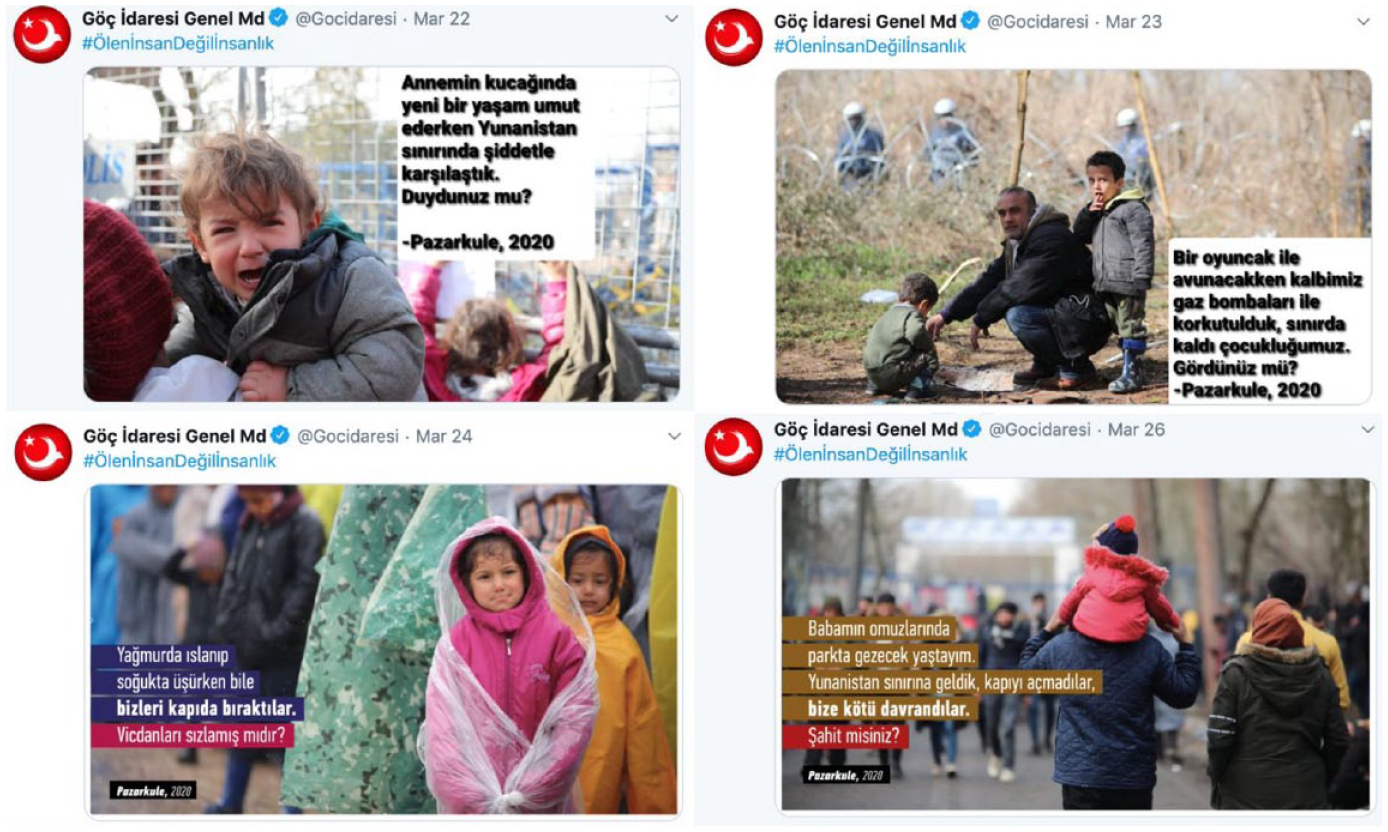
Caption List (from top left, going clockwise). (a) ‘While I was hoping for a new life on my mother’s lap, we encountered violence at the Greek border. Have you heard?’ (Göç İdaresi Genel Md [@Gocidaresi], 2020f). (b) ‘We could have found consolation in a single toy, instead we were frightened by gas bombs; our childhood ended at the border. Have you seen?’ (Göç İdaresi Genel Md [@Gocidaresi], 2020g). (c) ‘I am at the age when I should stroll in the park on my father’s shoulders. We came to the border of Greece, they did not open the door, they treated us badly. Are you bearing witness?’ (Göç İdaresi Genel Md [@Gocidaresi], 2020h). (d) ‘They left us at the door while we got wet in the rain and trembled in the cold. Did it hurt their conscience?’ (Göç İdaresi Genel Md [@Gocidaresi], 2020i).
Images of refugee women and children are commonly used to convey innocence, vulnerability and deservingness of protection (Moeller, 2002). The pictures on their own therefore gesture towards such a background of humanitarian imagery, with people looking helpless and passive. While they seem to be speaking through captions, viewers actually have no details vis-à-vis their identities and they remain anonymous bodies, temporarily taken out from the sea of humanity to be dropped back. Viewers are not provided with any life story.
Yet, the captions tell spectators how to make sense of the vulnerabilities thus portrayed: these are children whose vulnerability has been deepened and ignored by Greek authorities. As the viewer is oriented towards Greece as the acting force that led to the scene captured in the picture, asylum-seekers and migrants, who are visually in the foreground, recede into the background of the message. If the people in the photos address the viewers, it is to ask them to notice an actor other than themselves – like a crowd of black-wearers would accentuate the main protagonist in white in a film. While a victim representation would call on viewers to feel responsible to assist them and a threat representation would call on viewers to demand security, in the border spectacle of March 2020 viewers are called on to see and hold responsible a third party. The border spectacle of March 2020 exemplifies an ordering of visibility which underwrites a geopolitical story where Turkey and countries to its west, including Greece, are the real actors and people on the move are reduced to extras.
Analysing refugee visibilities in European news throughout 2015, Chouliaraki and Stolic (2017) associate different refugee visibilities with different forms of responsibility and different claims to action that they evoke, such as charity, hospitality, solidarity or disengagement. Media representations thus do not only frame refugees but also ‘. . . establish the conditions of possibility for a political response’ by producing difference and distance between the spectator and the spectated (Campbell, 2007: 361). To better understand how refugees were framed in the March 2020 border spectacle, one also needs to ask how the news stories called on their spectators to act. The hypervisibilization of Greece in the news stories encouraged spectators to either (i) feel no responsibility since their state had already taken more action for refugees than other states, or worse (ii) develop a sense of resentment that their state had done too much compared to other states. As spectators were called on to witness what third parties did or did not do, their response-ability towards refugees and migrants became skewed. The displacement of responsibility from spectators to third parties, who should be providing protection, further reinforced refugees’ and migrants’ appearance as extras in media exposure.
Border spectacles help re-draw the boundaries of the nation (Cantat, 2020), by differentiating and distancing citizens from border-crossers and by rallying them behind their state’s border control and migration policies. The March 2020 border spectacle affirmed Turkish citizens’ difference both with regards to Greece/EU and refugees and migrants. While the discourse, which has enabled the Turkish government to posit moral superiority vis-à-vis the West on the basis of refugee reception since the beginning of the Syrian conflict, may subsume (some) refugees under ‘us’ via Ottoman heritage or religious affinity and oppose ‘us’ to the West (Karakaya-Polat, 2018; Korkut, 2016; Yanaşmayan et al., 2019), refugee visibilities in the March 2020 border spectacle suggest that such moralizing discourse, perpetuated by ruling authorities and adopted by the mainstream media, can in fact operate without any gesture towards inclusion. Displacement of responsibility from spectators simultaneously vacates the ground for inclusion.
Conclusion
Border spectacles frame border-crossers in particular ways (e.g. victimized refugee, illegal migrant, shipwrecked person, cause of crisis). This paper questioned how a border spectacle in the context of refugee instrumentalization framed migrants and refugees. The literature on border spectacles (i) highlights a dual dynamic of hypervisibilization (of the border-crosser) and invisibilization (of processes and policies regarding mobility and its control), (ii) examines how border-spectacles reproduce border-crossers’ difference from and distance to citizens, (iii) probes how they condition spectator responses and (iv) serve to generate consent for state policies of migration and border control. In the March 2020 border spectacle, what was hypervisibilized was not people attempting to cross the Turkish-Greek border but Greece. While mainstream TV news, in line with the government’s framing of the spectacle, hypervisibilized Greece as acting immorally by denying entry to border-crossers, they also exonerated Turkish state’s responsibility towards the same people and led spectators to disavow responsibility as well. By being presented as others’ responsibility, migrants and refugees were further distanced and differentiated from citizens. Mainstream Turkish TV news thus broadcasted a scene of vindication and produced a moral geography of asylum (Garelli and Tazzioli, 2013) by delineating who should be assisted and protected where. Where international publics may thus have seen an immoral state using asylum-seekers and migrants as pawns for blackmailing purposes, domestic publics were presented with a radically different moral geography of asylum.
The literature on refugee media visibilities on the other hand emphasizes how refugees cannot control how they are framed by the media, how their framing de-historicizes and de-humanizes them such that they are reduced to anonymous, vulnerable bodies, and cannot appear as equal peers of their spectators. People gathered at the Turkish-Greek border in March 2020 could not indeed control how they were framed by mainstream Turkish TV news. While they were placed in the history of Turkey-EU relations, their own personal histories were erased to the extent that their countries of origin and reasons for seeking asylum did not matter to news stories. They were seen as suffering and in need of protection, but it was a kind of suffering that neither implicated Turkish citizens among its causes nor called on them to take action. In news stories about Greece’s wrong-doings, they appeared as extras (figurant in French and borrowed into Turkish from French). The figure of the extra thus enables us to link refugee visibilities to splintering moral geographies of asylum.
Extras may be seen as superfluous and of lesser value and import than the main protagonists. Spectators are not expected to identify with, or become emotionally invested in the plight of, extras. Thus, it is not surprising that migrants and refugees would appear as extras in a border spectacle meant to instrumentalize them. As long as states in the Global North remain reluctant to receive asylum-seekers and prefer to support mechanisms of refugee-hosting within regions of origin, instrumentalization is bound to become more common. If instrumentalization is understood as a passing around of the responsibility to protect, it is important to understand the media visibilities and frames it depends on, not least to counter the impact on spectators.
In a 2009 article, art-historian and philosopher Didi-Huberman (2009) drew attention to the contradictory role that extras play in cinema. While extras themselves ‘tend to disappear, to not figure, so to speak, since instead they melt into the base, always behind the acting figures’ (ibid: 20), they ‘serve as a framework for the role of the central heroes, the real actors in the story’ (ibid: 19). Cinema tells a ‘local story’ that follows the actors, but the extras tell ‘the history in which [the story] takes place’ (ibid: 20). The extras in this border spectacle tell us of the contemporary historical conjuncture, which includes the instrumentalization of forced migration, the emergence of refugee rentier states and splintering moral geographies of asylum. The question remains: What media visibilities and frames could establish a different ‘relation between the local story and the history in which it takes place’ (ibid)?
Footnotes
Acknowledgements
I thank Yasemin Korkmaz for her research assistantship and her diligence in compiling and sorting out news video clips. I am also grateful for the opportunity to think through the media visibilities of asylum-seekers and migrants with Selen Çatalyürekli, with whom we organized a video remixing workshop on May 161–7, 2020, where we invited participants to re-mix news and other found videos as a response to the border spectacle. The workshop participants have provided the inspiration for the writing of this paper.
Declaration of conflicting interests
The author reports no competing interests to declare.
Funding
The author received no financial support for the research, authorship, and/or publication of this article.
