







Abstract
Following widespread public outrage over the deadly impacts of severe pollution of Ogoniland emanating from decades of oil mining by Shell, the Nigerian government commissioned the UNEP in 2006 to undertake an independent environmental assessment of Ogoniland. The UNEP report indicted Shell for violation of established industry standards, pointing out that it could take up to 30 years to clean up oil spills that have destroyed the environment and the people’s livelihood. Thereafter, the government pledged to undertake a holistic clean-up of Ogoniland. The study evaluates the status of the ongoing clean-up, and seeks to recommend the role the Nigerian media can play in the project actualisation. This qualitative research adopts mixed methods comprising documentary research and personal observation. Results indicate a significant stakeholder dissatisfaction with the pace and quality of the remediation of Ogoniland, and a general lack of public confidence in HYPREP to actualise the clean-up. It also demonstrates, in specific terms, how advocacy journalism, environmental surveillance and agenda-setting can be applied to pressure the government to make good its professed commitment to the clean-up. It is recommended that HYPREP partner with the media to drive stakeholder engagement for a successful execution of the clean-up project.
Keywords
Introduction
Media coverage is critical to spreading awareness about environmental challenges to drive policy reforms and for public re-orientation on the need for environmentally friendly behaviour. The media remains an important channel to raise public consciousness about the harm irresponsible industry practices have caused the environment in Nigeria’s Niger Delta region, where there has been a running tension between locals and oil transnational corporations, TNCs, due largely to massive ecological damage arising from oil mining since oil was discovered in the region in commercial quantities in the 1950s (Ibeanu, 2008; Okonta and Douglas, 2001).
Matters came to a head in 1995 with the unjust execution of a foremost Niger Delta environmental rights activist Ken Saro-Wiwa and his eight Ogoni kinsmen by the Abacha military junta over environmental rights-related issues in Ogoniland viz-a-viz the Niger Delta region. Before his execution, Saro-Wiwa had mounted an environmental campaign that drew international attention to the massive environmental degradation of Nigeria’s Niger Delta linked to decades of reckless oil mining activities of Shell and other oil TNCs. His well-articulated global campaigns for environmental rights thoroughly embarrassed the Nigerian government and Shell, a leading oil-mining company in the oil-rich Niger Delta region. Therefore, his execution in 1995 became counterproductive for the Nigerian government as it further helped to draw more global attention to the plight of Niger Delta people, given the global outrage and widespread condemnation that followed (James, 2024). In the circumstance, Ogoni had been registered globally as the epicentre of environmental despoilation in Nigeria’s Niger Delta region.
A Shell-sponsored United Nations Environmental Programme (UNEP) environmental assessment of Ogoniland submitted to the Nigerian government in August 2011 indicted Shell for violation of established industry standards, pointing out that it may take up to 30 years to clean up oil spills that have harmed both terrestrial and aquatic lives and destroyed the livelihood of the people (UNEP, 2011). The UNEP recommended a comprehensive clean-up of Ogoniland and stoppage of all forms of ongoing oil contamination in the region. The report concluded that Ogoniland requires the world’s largest ever oil clean-up, which would cost an initial $1billion (UNEP, 2011). In response, the Nigerian government pledged its commitment to undertake the clean-up of Ogoniland and established the Hydrocarbon Pollution and Restoration Project (HYPREP) in 2012 to drive the clean-up process. Expectations were high that Mr Goodluck Jonathan, who was the President at the time and coming from the Niger Delta region, would himself be interested in implementing the UNEP report. But no tangible action was taken thereafter until the next administration of President Muhammadu Buhari kick started the clean-up project on June 2, 2016 with an official flag off at Numuu Tekuru, Bodo, Gokana LGA of Rivers State (Channels TV, 2016).
The $1 billion-project fund needed for the clean-up was to be contributed by SPDC Joint Venture Limited, a private-public entity comprising Shell Petroleum Development Company, SPDC, Total Exploration and Production of Nigeria, TEPNG and Nigerian Agip Oil Company, NAOC, the government-owned Nigerian National Petroleum Corporation, NNPC and the Nigerian government). The fund was to be deployed for restoration of the Ogoni environment, including capacity building, skills transfer and conflict resolution. Out of the $1 billion, SPDC Joint Venture pledged $900 million (90%) to be paid over 5 years. Shell paid $180 million in July 2018, $180 million in 2019, and $212 million in 2022, bringing its total contributions to $572 million, which translates to 64% of the $900 million earlier pledged (Anudu, 2023). On its part, the Nigerian government under President Buhari released the sum of $10 million (about ₦1.5billion going by the exchange rate of ₦155 to $1 in 2011 when the UNEP report was presented) (Nyiayaana, 2018) out of its own ₦100b counterpart funds (Anudu, 2023). What the Nigerian government has contributed is approximately 2% of its own counterpart funds.
In the face of declining public confidence in the Ogoniland clean-up (Anudu, 2023; Kuru, 2024; Youths and Environmental Advocacy Centre (YEAC), 2020), the study, which is anchored on stakeholder engagement theory, highlights the expected role of the Nigerian government, HYPREP and the Nigerian media for the actualisation of the Ogoniland remediation. It also buttresses how advocacy journalism, media agenda-setting and the surveillance role of the media could be deployed to drive stakeholder engagement to see to the successful completion of the Ogoniland clean-up. Specifically, two research objectives drive the study: to evaluate the current status of the ongoing remediation of Ogoniland, and secondly, to demonstrate how advocacy journalism, environmental surveillance and agenda-setting could be employed to drive stakeholder engagement for a successful clean-up of Ogoniland.
Literature review
Brief history of oil exploration in Ogoniland
Oil was discovered in commercial quantity in Ogoni in 1958, and Shell commenced operations (Saint, 2022) by drilling the first oil wells in Bomu and Ebubu. From 1976 to 1991, it was reported that over two million barrels of oil polluted Ogoniland in 2976 separate oil spills (Friends of the Earth International, 2019) even as Nigeria made the list of the world’s largest oil producers. The Ogoni people who depend on farming and fishing for survival have borne the direct impact of the oil pollution of their environment (see Figure 1) and residents have reported myriad health challenges (UNEP, 2011).
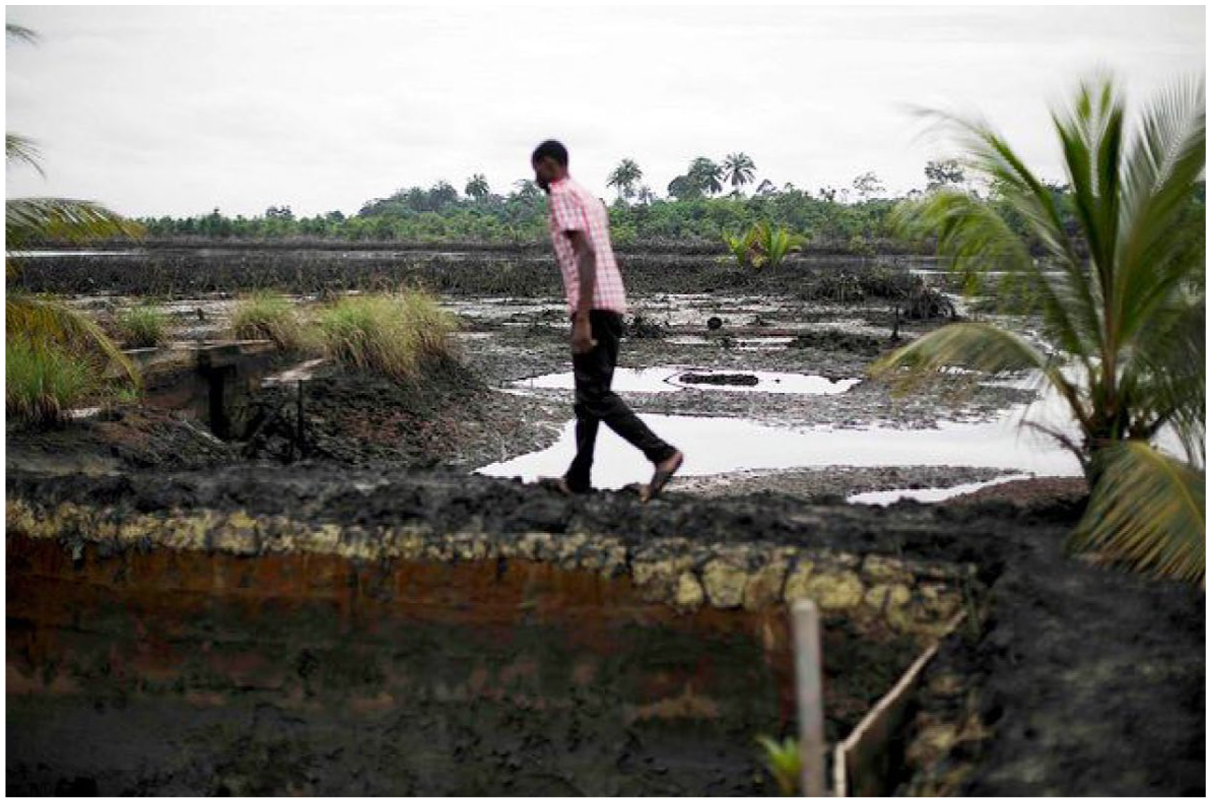
One of the several oil-polluted sites in Ogoni, Rivers State, Nigeria.
This resulted in a strong resistance by the Ogoni people. In 1990, Ogoni leaders, led by environmental rights activist Ken Saro-Wiwa, formed the Movement for the Survival of the Ogoni People (MOSOP), a non-partisan organisation, to challenge the exploitation of the Ogonis by Shell and the Nigerian government. Given the stiff resistance put up by Ogoni leaders against Shell for its environmental damage and refusal to address the infrastructural demands of the Ogoni people, the company was forced to withdraw from Ogoniland in 1993 (Boele et al., 2001). Since then, no oil company has drilled oil in Ogoniland.
However, recently, there have been talks of resumption of oil activities by the Nigerian government and some Ogoni groups which have met with a strong resistance by a majority of the Ogoni people. The Buhari’s government insisted on the resumption of oil production even while the clean-up exercise was yet to kick off, a move that was resisted by Ogonis, leading to fresh tension in the area (Nyiayaana, 2018).
Impact of oil-related pollution
Oil-related pollution is among the most exacting environmental challenges in the world today. Prominent examples of oil-related pollution include gas flaring and oil spillage common in Nigeria’s oil-rich Niger Delta region, which Ogoni typifies. Nigeria has one of the worst rates of gas flaring in the world (Ismail and Umukoro, 2012). For instance, the United States Energy Information Administration International Energy Statistics Database (2023) reported that Nigeria flared about 5.318 billion cubic metres of natural gas in 2022. About one million gallons of oil was reported to have spilled in Nigeria in 2021 in 106 incidents (Global Shell, 2022). All this results in environmental pollution with serious negative impact on human health and the environment itself.
Gas flaring emits various alkanes, and hazardous air pollutants (Kindzierski, 2000) which are transmitted into the blood through the respiratory tract (Vetter et al., 1995) and also transferred to humans through the food chain (Eyong, 2000). Oil spill destroys renewable natural resources, disrupts the food chain and causes wildlife injury and death, among other things (Short et al., 2017; US National Research Council Committee on Oil in the Sea: Inputs, Fates, and Effects, 2003).
In humans, reduced haemoglobin, red blood cells and platelet (Onwuka, 2021), mean corpuscular volume (MCV), mean corpuscular haemoglobin concentration (MCHC), total protein and albumin (Egwurugwu et al., 2013; Mohammed et al., 2015; Okoro et al., 2006) have been linked to gas flaring. Mean alkaline phosphatase, alanine amino transferase, aspartate aminotransferase, total bilirubin and albumin (Onwuka, 2021); renal dysfunction biomarker, urea, creatinine, potassium, uric acid and inorganic phosphate (Gobo et al., 2010) of residents of gas flaring communities significantly increased when compared with those people living in a flare-free environment. Fertility determinants spell impending doom for residents of gas flaring communities (Onwuka, 2021). Studies have found significant increase in total cholesterol (TC), triglyceride, low-and high-density lipoprotein in study subjects compared with the controls (Fisher, 2001). People living in areas of gas flaring have complained of headache, watery eyes and breathing problems (Mark Oboetim, 2017, personal communication; Paul Okon, 2017, personal communication).
Oil spill led to altered blood profiles, shortness of breath, cough, fatigue, night sweats and chest pain (D’Andrea and Reddy, 2014), mental health problems (Buttke et al., 2012; Grattan et al., 2011; Morris et al., 2013; Na et al., 2012), eye and nose irritation (Cheong et al., 2011; Ha et al., 2013; Janjua et al., 2006), reduced lung function (Meo et al., 2009) and respiratory symptoms (Zock et al., 2012). Higher levels of serum liver enzymes compared with the unexposed subjects have also been reported (D’Andrea and Reddy, 2014) among residents of oil spill impacted areas.
Rising heat wave and loss of water as a result of gas flares and even continual pollution of water bodies through oil spillages take their toll on water bodies thereby affecting fishes and other aquatic creatures (Agbola and Olurin, 2003). Studies have shown that oil-related pollution led to a decrease in erythrocyte count, haemoglobin concentration, haematocrit and an increase in mean corpuscular volume and total WBC compared to control. Liver and adrenal weights increased with a reduction in mesenteric lymph node weights (Ita and Udofia, 2011; Momoh and Oshim, 2015; Schwartz et al., 2004).
Studies have indicated that concentration of oxygen, ozone, carbon dioxide, suspended particulate matter, hydrogen disulphide, volatile organic compound (VOC), noise (Onwuka, 2021) and heavy metals (Ite et al., 2013) was higher in gas flaring impacted communities. Gas flaring emissions also contribute to global warming (Gervet, 2007). In all of this, sustained media coverage is required to provide residents with accurate information on how environmental pollution impacts their life as well as drive policy reforms that can tackle these challenges.
Environmental news coverage
Environmental problems – whether they are man-made (push factors) or natural (pull factors) – affect people. In both qualitative and quantitative terms, therefore, environmental issues deserve adequate media attention to generate public awareness, induce eco-friendly behaviour and influence policy decisions in the right direction. Given their power to structure issues, media coverage can impact on public understanding of environmental issues, assign importance and draw public attention to them, in a bid to arrest such issues and point out directions for living in harmony with the environment.
Environmental journalism has emerged over the years as the field of journalism to shoulder the burden of “collecting, verifying, generating, distributing and displaying current information, trends, topics and individuals linked with the environment to enhance awareness of environmental concerns by improving media quality” (Hase et al., 2021, cited in Ogadimma et al., 2025: 5). How this task has been performed by the media is a thriving area of scholarly scientific investigation. And the results have been a mixed bag. Some studies highlight the media’s positive contributions to environmental awareness and protection. They indicate that news coverage has fostered a better understanding of environmental issues through environmental education (Welzenbach-Vogel et al., 2022).
Conversely, others have berated the media for paying little attention to the environment, resulting in a dearth of environmental stories (Friedman, 2015; Hase et al., 2021; Kumar et al., 2020; Udoudo, 2006). Some argue that environmental news coverage is replete with distortions, inconsistencies, data misrepresentation and manipulations (Hussain et al., 2024; Welzenbach-Vogel et al., 2022). Ukonu et al. (2012) coined the term, “Vulture reporting” to capture the brand of media reporting of the environment that is crisis-driven and reactionary. There seems to be a general media inability to forecast environmental disasters to help nip them in the bud (Friedman, 2015; Ogadimma et al., 2025). Globally, it has been established that “mainstream media does not give sufficient coverage to the environment and sustainability issues” (McCluskey, 2014: 3).
With specific reference to Nigeria, scholars have lampooned the Nigerian media for showing a lacklustre attitude towards environmental coverage that has produced both qualitative and quantitative dismal reporting of environmental issues in Nigeria. They demonstrate that the Nigerian media does not accord the environment its deserved priority attention (Nwabueze et al., 2015; Ogadimma et al., 2025; Udoudo, 2006; Ukonu et al., 2012). Several reasons have been adduced for the insufficient media attention to environmental coverage globally (Friedman, 2015; Greenberg, 2022; Hansen, 2011; Hase et al., 2021; Karlsson, 2021; Yadlin and Marciano, 2022). Specifically, scholars point to the technical nature of the field, media’s commercial interest, external pressures and journalistic routines, among others.
In Nigeria, where its Niger Delta region has had to grapple with a myriad of ecological problems arising mainly from the oil-mining activities of oil TNCs, particularly Shell, there is a crying need for sufficient media attention to these ecological problems to raise public awareness to safeguard the environment so as to ensure a viable future for members of the Delta communities. As has been established in the UNEP (2011) Report, the assault on the eco-system of the Ogonis of Nigeria’s Niger Delta region is monumental and requires urgent clean-up to restore the environment and make it conducive to healthy living. What role can the Nigerian media play given their pride of place in society as agenda setters, the people’s advocate and (environmental) watchdogs to ensure that all stakeholders, particularly the Nigerian government, make good its professed commitment to the clean-up of Ogoniland? This is what engages our attention in this study.
Theoretical framework
Stakeholder engagement theory
Stakeholder engagement focuses on relationship building. By applying stakeholder engagement, organisations inform, listen to and collaborate with their existing stakeholders (Sedmak, 2021). It requires identifying, mapping and prioritising stakeholders using available resources in order to achieve effective communication. Stakeholder engagement is carried out through communication, consultation, relationship building, negotiation and compromise to influence a variety of outcomes. When properly done, it can help to check potential risks and conflicts that may arise with stakeholder groups, and address uncertainties, dissatisfaction, misalignment, disengagement and resistance to change (Sedmak, 2021).
Stakeholders of the Ogoni clean-up project constitute individuals and/or members of environmental organisations, advocacy groups, citizens’ groups, companies, media, traditional rulers, youths, the Nigerian government and its agencies. These stakeholders play a role in facilitating the clean-up process by bringing their input and perspectives to environmental issues, incorporating cultural, historical and other community-based values, technological and development concerns. Their efforts can produce robust strategies that could catalyse the processes leading to the eventual clean-up of Ogoniland. It is our position in this study that HYPREP and the Nigerian media partner to drive stakeholder engagement to see to the successful completion of the Ogoniland clean-up.
Method
The study, which is qualitative in nature, adopted mixed methods approach comprising documentary research and personal observation in the data collection process. The documentary method is a systematic process of generating data by analysing existing documents. It entails a thorough evaluation of documents containing relevant data about a given issue or event being investigated. The documentary research method has been employed by social scientists to analyse documents for historical or social value, or to create a larger narrative by studying several documents relating to a subject or an event (McCulloch, 2004; Payne and Payne, 2004).
Data generated from books, official documents, journal articles, historical documents, directories, handbills, maps, conference papers, periodicals, mass media and other online material remain the sources of documentary research (Nwangwu et al., 2018). Specific documentary sources used in the work include journal articles, conference papers, books, book chapters and mass media materials related to oil exploration in Nigeria, health impact of oil-related pollution, advocacy journalism, environmental communication, media role in environmental management and pollution control as well as communication theory. The research design is relevant in several ways. It helps the researcher bypass the difficulties involved in obtaining relevant information through direct personal contact. It provides a faster and cost-effective means of accessing data than the survey method. Documentary research can help researchers gain access into hidden aspects of group life, individual behaviour motivations, organisational structure, including bureaucratic processes (Nwangwu et al., 2018).
Personal observation provided deep insight that enriched our discussions and formed a basis for verifying findings from the documentary research. In fact, it became a tool for data validation. A similar methodological approach has been applied in previous studies (see, for instance, Nwankpa et al., 2022). Analyses of results involved explanation building.
Audit of the Ogoniland clean-up project
The UNEP report which was a study of the impact of oil pollution in Ogoniland was released in August 2011. The UNEP report established that Ogoni has been severely polluted and recommended that $Ib to be set aside for initial remediation. The money was to be contributed by the Nigerian government and the oil companies. The work plan of the first 5-years of the clean-up project was clearly mapped out in the UNEP Report. The Report highlighted issues such as emergency measures, clean-up, mangrove restoration, centre of excellence, alternative employment to those in artisanal refining, surveillance and monitoring, clean-up of sediments and restoration of artisanal refining sites, to be given attention in the first 5 years. The President Tinubu administration has continued with the remediation programme started by the Buhari government in 2016, and coordinated by HYPREP.
But HYPREP has come under scathing criticisms for failing to deliver on its mandate. Nine years have passed since the project began in 2016, yet the “initial remediation” expected to last for 5 years as contained in the UNEP Report has not been completed, prompting projections that it may take HYPREP extra 22 years to hit that target (YEAC, 2020). (See the UNEP (2011) for the detailed components of the remediation.) HYPREP’s inability to meet expected timelines has never been attributed to lack of funds. Instead, there is a broad consensus among stakeholders that HYPREP is underspending (Kuru, 2024).
Several Ogoni indigenes and civil society organisations have expressed disapproval of the way the clean-up is going. For instance, a former lawmaker representing Khana Constituency 2 in the Rivers State House of Assembly, Prince Ngbor, and the past president of Ogoni Youth Federation, Legborsi Yamabana, respectively have all scored HYPREP low in the Ogoni clean-up project. Prince Ngbor said that HYPREP has not done the needful, and wants it to return to the Ogoni Bill of Rights for guidance. Legborsi Yamabana called on HYPREP to expedite actions on the clean-up project as it has implications for the livelihood of the Ogoni people. He noted that “man is a product of his environment and having destroyed the environment, you have destroyed the man. And if you are remediating the environment, you must also look at how to uplift the standard of the man” (NDNTV, 2022).
In a newspaper interview, Tijah Bolton-Akpan, Executive Director/Co-founder of Policy Alert, described the clean-up efforts in Ogoniland as far below expectations, especially because the clean-up is not being done according to specifications, and with a very disturbing lack of transparency and accountability in the management of resources that have gone into it (Global Business, 2021).
An Ogoni activist, Fyneface Dumnamene, is of the view that between 2017 and 2023, six years had elapsed and the $1b that was meant to be spent has not been spent. He argued that the problem of HYPREP was not resources or funds, but the inability to use the funds to work for the people (Nigeria Info, 2023).
An independent assessment of the status of the clean-up project demonstrated that HYPREP has failed to deliver on its mandate with false claims of jobs done that were not done, execution of shoddy jobs, use of non-existent companies, inactive companies and those with no previous remediation experience (Anudu, 2023). Pastor William Probel, president of a pressure group, Ogoni Peoples Assembly, featured in the report asserted that a majority of Ogonis believe the remediation is a scam because “HYPREP and the Federal Government have not been able to gain the confidence of the people.” The report concluded that although all coordinators of HYPREP have been Ogonis, their people say “they have failed Ogoni people” (Anudu, 2023: n. p). In his reaction, HYPREP spokesman, Mr Kpobari Nafo, dismissed the report, insisting that the clean-up was not substandard.
Our personal observation shows that some factors have contributed to the slow pace of work on the Ogoni clean-up project. There have been several litigations against HYPREP by civil society organisations and aggrieved individuals that have stalled the progress of the work. Some have obtained court orders restraining HYPREP from carrying out certain aspects of its mandate. As a government agency under the Federal Ministry of Environment, HYPREP operations have been slowed down by institutional bureaucracy. There have also been allegations of lack of capacity, financial misappropriation, benefit capturing, nepotism, unclear contract procedure, poor clean-up process and re-pollution. However, HYPREP continues to refute such allegations, arguing rather that some groups deliberately misinform the public, by insinuating that the clean-up has failed (HYPREP, 2020).
However, even though the project is behind schedule, our personal observation confirms that some progress has been made in terms of providing water to the affected communities, and some livelihood initiatives. Prof. Nenibarini Zabbey, HYPREP Coordinator, said that HYPREP is currently managing over 130 projects in Ogoniland, encompassing remediation, shoreline clean-up and mangrove restoration (Obeme-Ndukwe, 2024). Media coverage is critical to painting an accurate picture of the status of the remediation project, debunking lies, correcting misperceptions and pointing the right direction for all stakeholders if the clean-up exercise is to remain on course.
Driving Ogoniland clean-up through advocacy journalism, environmental surveillance and media agenda-setting
Now we turn attention to the critical role the media can play in driving the Ogoniland clean-up through a tripartite approach for maximum impact and result. It is no doubt that the Ogonis of South-South Nigeria have borne a substantial brunt of Nigeria’s revenue drive with the despoilation of their environment consequent on the over 30 years (1958–1993) of oil-mining by Shell whose approach has been described as far below industry standards (UNEP, 2011). The Nigerian media has a central role to play to change this ugly trend and drive the ongoing process of environmental remediation of Ogoniland through aggressive environmental journalism anchored on advocacy, environmental surveillance and agenda-setting.
Advocacy journalism
Advocacy journalism encourages the journalist’s active role in interpreting and amplifying the voices of the marginalised and speaking on their behalf (Charles, 2019; Laws and Chojnicka, 2020). Many authorities agree that advocacy journalism still remains “fact-based,” sound reporting driven by a passionate desire to provide a solution to the problems being reported (Tong, 2017: 3). Research evidence has demonstrated that advocacy does not hurt the credibility of journalists (Kotcher et al., 2017). Advocate-journalists promote social issues and causes (Fisher, 2016) and strengthen the voices of common folks in news coverage lest they get overlooked by the leadership in policy debates (Stillman et al., 2001). As Waisbord (2009) has pointed out, advocacy journalism can be used “to raise awareness, generate public debate, influence public opinion and key decision makers, and promote policy and programmatic changes around specific (environmental) issues” (p. 371). Studies have established that media advocacy can be a potent force for influencing public debate, speaking directly to those with influence and putting pressure on policy makers (Jernigan and Wright, 1996; Wallack, 1994). By reporting on the human dimensions of environmental catastrophes, the media can propel individuals and groups to actions, bolster conservation initiatives and engender policy reforms.
In the current situation, advocacy journalism can provide a forum for the Ogonis to tell their own story in their own words to advance social change. It will promote a strategic and innovative use of the Nigerian media to better pressure the government to support changes for healthy environmental policies in the oil sector. Such changes could include environmental justice, manifest in prompt clean-up of oil spills, ending gas flaring and meting out adequate sanctions for irresponsible industry behaviour that harm the environment. By playing the role of advocates, the Nigerian media will represent the public voice in the ongoing clean-up; they can support, criticise or suggest how to achieve set timelines in the clean-up. Since decades of research has established that environmental issues are usually underreported (Kamboh and Ittefaq, 2023; Kamboh and Yousaf, 2020; McCluskey, 2014; Ogadimma et al., 2025; Udoudo, 2006), what is required now is a special journalistic treatment that accords prominence to environmental issues globally and particularly, in Ogoni, part of which is that the media drive the ongoing clean-up to a successful end.
One way to achieve this is increased editorial attention to the clean-up exercise. “Editorials allow newspapers to make allegiances known; support and oppose individuals; speak on behalf of their readers; speak to readers; and speak to politicians, parties, and other organisations” (Firmstone, 2020: 3). The power of editorials to influence policy changes have been established (Kamboh and Ittefaq, 2023; Pimentel et al., 2022; Pimentel and Marques, 2021).
Antagonists of advocacy journalism have criticised it as subjective. Yet we do know that “All journalism is advocacy journalism. No matter how it’s presented, every report by every reporter advances someone’s point of view” (Edwards, 2013 cited in Laws and Chojnicka, 2020: 6). Fisher maintains that each journalistic work falls even “along a continuum of advocacy, ranging from subtle displays at one end to overt at the other” (Fisher, 2016: 711). Consequently, the real dividing line difference between “objective” journalism and advocacy journalism is the fact that the former conceals its positionality, while the latter is open and honest about it . . . In other words, we should value journalists making claims from a particular perspective, resulting in knowledge that is necessarily partial but honest, open, debatable, embedded in experience, situated and critical, rather than those who do not see or pretend not to see how embedded and situated their own claims are. (Laws and Chojnicka, 2020: 6).
Taking sides to promote public good is healthy journalism. As Moraes (2007: 4) has argued, “taking sides concerning current affairs is imperative to journalism.” And environmental issues are current affairs. If journalists save the environment by taking sides, they have done society greater good.
Environmental surveillance
The watchdog role has been ascribed to the media in open societies. Through surveillance, it is the media’s role to keep watch over society and report on daily basis happenings in the environment to keep citizens abreast with matters that affect their lives. This information function is critical to the functioning of every society. And news on the environment is part of the media’s information fare. Citizens and policy makers need adequate information on the environment for several reasons. Adequate environmental coverage can modify behaviour by creating public awareness that can drive eco-friendly behaviour and policies. Proper environmental surveillance is a sine qua non for proper environmental management. “Media coverage can expose the shortcomings of existing policies, highlight regulatory failures, and uncover instances of environmental harm or corporate negligence. This scrutiny can lead to public demand for policy reforms and regulatory interventions” (Abdujabbarovna, 2023: 132).
It has been argued that there is a link between dearth of information about the environment in the media and the persistence of environmental challenges (Popoola, 2014; Welzenbach-Vogel et al., 2022). To tackle environmental problems, societies need accurate, balanced and comprehensive environmental information in a timely manner, which only the media can supply. In fact, given their enormous powers, the media can influence attitudes, values, and public action on the environment through quality environmental surveillance. By providing a platform that enhances public discourse of environmental issues, the media can promote stakeholder dialogue and public participation in environmental decision-making processes, that can result in collaborative solutions to environmental problems. The media have the power to humanise environmental issues by relaying personal stories, narratives and visual representations. Applying this reportorial style can kindle empathy, establish emotional connections and prompt actions to safeguard the environment (Abdujabbarovna, 2023). In the Ogoni case, environmental surveillance can help the Nigerian media to detect harmful ecological conducts of oil TNCs such as oil spills and irresponsible dumping of oil-related wastes and promptly draw public attention by advocacy journalism that engages all stakeholders. News coverage must go beyond spreading awareness on the progress of work on the clean-up to highlighting the core issues stalling progress and what needs to be done to dismantle identified roadblocks. It is the media’s role to expose alleged cases of corruption involving government officials, agencies and individuals involved in the clean-up. There is need for journalists to follow-up on set targets to ensure that all stakeholders play their expected roles and honour their commitments. The media should drive the expected partnership among all stakeholders to achieve set goals.
Media agenda-setting
Media agenda-setting research has focused on how society uses media attention on public issues as a measure of the relative importance of such issues. By the media’s emphases on a news item, society members can begin to treat such item as salient among other items. The media plays a pivotal role in structuring audience perception of environmental issues through agenda setting and framing. By selecting which environmental issues to cover, the depth, angle and slant of coverage, the media determines the prominence of these issues in the public sphere.
If the media consistently projects a specific environmental challenge, such as pollution in Ogoni, it could result in media audience and by extension, society taking pollution very seriously. For instance, Ader (1995) found support for the agenda setting hypothesis for the issue of pollution in the US from 1970 to 1990, while Detjen (1990) established a positive relationship between media coverage of the environment and public concern for environmental issues.
The way the Nigerian media presents information on, the language it uses, and the prominence accorded the Ogoniland clean-up, can determine how the public perceives the severity of the ecological injustice the Ogonis have been through and the consequences of government’s negligence over the years. By understanding this influence, the Nigerian media can help in building a more informed public opinion, promote environmental justice, and drive a speedy clean-up of Ogoniland.
Closely related to the agenda setting hypothesis is framing. Framing has been described as the way the media constructs and presents issues in media narratives. The media employs varying frames to influence how people interpret and understand issues in society, in the present context, environmental issues. With respect to climate change, media coverage could frame it as a “scientific debate,” a “political issue,” an “economic challenge,” or “humanitarian crisis.” Each frame emphasises different aspects and can shape public opinion and policy responses. As regards the Ogoni environmental degradation, media framing can influence audience perception of responsibility, potential solutions and the urgency of tackling this challenge.
Tying the knot: The media, government and community engagement
The need to achieve sustainable development and environmental protection calls for public participation from the government, media, civil society organisations and locals. The United Nations Agenda 21 has underscored the necessity of new forms of participation for governments to actualise sustainable development and environmental protection. At the heart of this call for newer forms of participation is the need to ensure inclusiveness in decision-making about the environment, which allows different segments of society to participate, influence and determine how environmental outcomes impact their lives (Jänicke and Jörgens, 2009). Community engagement is therefore pertinent to win people’s lost confidence in the Ogoni environmental remediation project, especially as many Ogonis believe the whole exercise is a scam (Anudu, 2023).
Community engagement entails meetings with various stakeholders to address pressing topics so as to ensure positive acceptance of changes. Parties involved in community engagement will feel a genuine sense of belonging and embark on meaningful communication. The interaction goes beyond a simple exchange of facts or updates, but extends to developing true relationships and connections. Community engagement aims to benefit all stakeholders involved through listening, sharing and facilitating dialogue to create understanding and address community needs. It encourages an understanding of local community needs and concerns, and fosters open dialogue and partnership.
To drive the ongoing environmental remediation of Ogoniland to a successful end requires a synergy among all principal stakeholders. And as we have advocated in this paper, HYPREP needs to partner with the Nigerian media to drive this engagement with all stakeholders. As the government agency at the forefront of the clean-up, it cannot abdicate this responsibility if it intends to deliver on its vital mandate. It needs the support and goodwill of all stakeholders, particularly, the Ogonis. HYPREP needs to understand that what the Ogonis need now is action and more action. All the media blitz must give way to real work. Ogonis are hungry for results and nothing less.
The Nigerian government under whose watch the Ogoni environment was destroyed by oil TNCs (Ibeanu, 2008; Nwankpa, 2015; Okonta and Douglas, 2001) must match words with action. The government must provide leadership at this juncture in our nation’s history by paying its own counterpart fund of N100 billion in full. Treating the ongoing environmental remediation with every seriousness it deserves is one way the government can prove to the world that it feels sincerely remorseful for the long years it neglected and abandoned its critical role of protecting lives in the Niger Delta region, by failing to hold oil TNCs to account (Ibeanu, 2008; Nwankpa, 2015). No single incident in Nigeria’s history has cast it in bad light more than the unjust execution of Ken Saro-Wiwa and his eight Ogoni kinsmen in 1995. Even though the government had charged them with inciting the murder of four rival Ogoni leaders, their rushed trial and subsequent execution attracted global outrage and widespread condemnation. It is widely believed that their execution had more to do with their legitimate demands for self-determination and environmental rights protection than with the trumped-up charges pressed against them before a special military tribunal (James, 2024). By acting decisively on the clean-up of Ogoniland, Nigeria can restore its battered image and prove to the world that it truly cares for and values, human lives and the environment.
On its part, the Nigerian media, through more robust environmental news coverage, can raise public concern, mobilise support for ongoing environmental remediation efforts in Ogoniland and create a sense of urgency required to get the task accomplished. The media should provide ample space for diverse perspectives and stakeholders to engage in the ongoing environmental discourse. Through documentaries, commentaries, features, opinion articles, interviews and editorials, the media can amplify the voices of Ogoni communities, environmentalists, decision makers and industry representatives.
Nigerian media organisations, environmental organisations and individuals can actively engage in advocacy to influence policy reforms and project sustainable environmental practices in Ogoni. By providing a platform for environmental advocates, the Nigerian media can amplify their voices, extend their reach and boost public support for their initiatives. By framing issues, public opinion mobilisation, and advancement of persuasive arguments, media advocacy can sway public sentiment and shape policy debates. Besides, media advocacy can influence the Nigerian government directly by providing it with information, research and perspectives that advance progressive environmental policies.
Conclusion
The paper has X-rayed how the Nigerian government can be pressured into making good its professed commitment to the clean-up of Ogoniland using the instrumentality of the Nigerian media through robust environmental news coverage built on advocacy, surveillance and agenda-setting. Environmental concerns should be everybody’s concern because we all depend on the environment for our survival. The Nigerian media should drive the clean-up process given the media’s enormous powers to structure issues and influence public opinion. In the face of increasing public discontent with the ongoing environmental remediation of Ogoniland, HYPREP needs to partner with the media to build stakeholder confidence through stakeholder engagement. The Ogonis want to see their once-flourishing natural environment restored and made safe for habitation. The Nigerian government must aim at full implementation of the UNEP Report and use the ongoing remediation to right its wrongs of the past in Ogoniland (Ibeanu, 2008; Okonta and Douglas, 2001).
Footnotes

Author contributions
Nduka N. Nwankpa: Conceptualised the research; developed the methodology; manuscript development; contributed in data collection and discussion of findings; editing and proofreading of manuscript. Leton C. Kuru: Contributed in data collection and manuscript development; editing and proofreading of manuscript. Ngozi A. Onwuka: Contributed in manuscript development and data collection, editing and proofreading of manuscript.
Funding
The authors received no financial support for the research, authorship, and/or publication of this article.
Declaration of conflicting interests
The authors declared no potential conflicts of interest with respect to the research, authorship, and/or publication of this article.