







Abstract
Digital platforms are often portrayed as increasingly dependent on automation to optimise user engagement and streamline governance, a logic commonly captured by the notion of the ‘human-in-the-loop’. Emerging evidence from transnational platforms, however, points to a more hybrid operational model in which algorithmic systems are actively steered through context-sensitive human intervention. This article examines Bigo Live, a Chinese-owned livestreaming platform, as it expands into Oceania, specifically Australia, New Zealand (ANZ), and Papua New Guinea. Drawing on in-depth qualitative research, including interviews and participant observation conducted in Guangzhou and Sydney, the study demonstrates that Bigo’s internationalisation relies heavily on human-led adaptation to negotiate intercultural sensitivities, localise marketing strategies, and comply with highly varied content regulations. Unexpected developments, such as the platform’s unanticipated popularity in Papua New Guinea, reveal the limitations of automation and the continuing centrality of human labour in recalibrating platform operations. The article introduces the concept of ‘human-directing-the-loop’ to describe a mode of platform governance in which human labour does not simply validate algorithmic outputs, but actively shapes how automation is deployed across culturally, legally, and infrastructurally uneven transnational environments.
Keywords
Introduction
AI-driven automation, along with platform capitalism, has dramatically reshaped the global labour landscape. From driverless vehicles and automated service agents to algorithmically managed logistics and labour allocation, automation is no longer confined to the factory floor—it is now deeply embedded in diverse forms of labour (Altenried, 2022; Bruun and Duka, 2018; Jones, 2021; Kelly, 2023, 2024). This transformation has sparked widespread public concern, particularly over the displacement of workers, the erosion of labour rights, and the corrosive impact on human creativity (Grohmann et al., 2026; Kelly, 2023).
Among the many debates, one important line of scholarship centres on ‘human-in-the-loop’ (Kent and Du Boulay, 2022; Mosqueira-Rey et al., 2023) and ‘human-as-a-service’ (Jones, 2021), along with the critical issues they raise concerning the role of human labour in automated systems. Both paradigms retain limited human involvement, typically for tasks such as data labelling, supervision, or correction, while preserving the dominance of automation and relegating human labour to peripheral roles (Kent and Du Boulay, 2022; Morreale et al., 2024). The ‘human-as-a-service’ model, exemplified by platforms such as Amazon Mechanical Turk, further commodifies human input as an interchangeable and invisible resource, summoned and discarded at will (Jones, 2021). Recent research has responded to these developments by raising questions concerning the political economy of automation, its moral and legal ramifications, and its role in engendering precarious labour (Joyce et al., 2021; Lei and Kim, 2024; Patulny et al., 2020). This literature risks reinforcing a prevailing view of automation as a deterministic force: AI is envisioned not simply as the future of work, but as the principal agent shaping how labour is organised, governed, and valued (Lei and Kim, 2024; Patulny et al., 2020). Implicit in this account is a diminished view of human agency, interpersonal complexity and human market-savviness.
Against this backdrop, this article joins recent critical AI scholarship that challenges automation-centred narratives by questioning the assumption that AI is a universal or culturally neutral technological force (Fu et al., 2026; Lei and Kim, 2024; Patulny et al., 2020), instead emphasising its situated, relational, and geopolitical embeddedness in everyday social life, regulatory systems, and global infrastructures (Arora and Natale, 2025; Natale et al., 2025). As Natale et al. (2025) contend, although AI operates as a global phenomenon, its development, use, governance, and social consequences are always shaped by specific local contexts, including legal systems, cultural values, and economic conditions. Drawing on Doreen Massey’s classic concept of power geometries, Natale et al. (2025) highlight how different actors, including states, corporations, developers, users, and workers, occupy unequal positions within global and local systems. In a similar spirit, emerging empirical research has called for greater attention to the meso-level mechanisms through which human labour connects micro-level data practices with broader macro-level institutional, commercial, and governance imperatives (Fu et al., 2026). Specifically, these meso-level mechanisms refer to the organisational and regulatory processes through which platforms translate different state directives into content moderation frameworks, which are then implemented by annotators through manual annotation practices to ensure that algorithms and AI systems operate in accordance with regulatory requirements (Fu et al., 2026). Examining these meso-level mechanisms and micro-level practices allows us to better understand the complex interactions among different actors, including platforms, developers, users, and workers, as they move across global and local governance systems.
The empirical case in this article emerges from a cross-border investigation into how smaller-scale Chinese digital platforms expand into global markets, with particular attention to often-overlooked meso-level operational mechanisms. Recent scholarship on alternative, smaller-scale, and fringe platforms shows that an exclusive focus on large-scale, corporate-dominated platforms, such as Facebook, X, Instagram, YouTube, Baidu, Alibaba, and Tencent (BAT), risks obscuring the complex and multi-layered ecology of contemporary platform economies (de Winkel, 2023; Liu and Pertierra, 2024; Van Dijck et al., 2023). In contrast to these multinational giants, smaller-scale entertainment-oriented platforms often pursue highly flexible and adaptive strategies, targeting niche user bases and culturally specific markets (Liu and Pertierra, 2024). As recent East Asian critical AI scholarship suggests, AI systems and governance models do not travel unchanged, but are continually reshaped through regional frictions, local adaptations, and situated governance contexts (Chung, 2026). In this regard, through an in-depth case study of Bigo, a Chinese-owned quasi-sexualised live-streaming platform expanding into Oceania, this paper explores how human agency is not merely retained but actively directs the platform’s operational loop, a process we conceptualise as ‘human directing the loop’. With this novel conceptualisation, this study moves beyond assumptions of automation as inherently inescapable, instead examining how platform managers and workers actively guide, recalibrate, and override automated processes in response to cross-border socio-cultural, regulatory, and commercial conditions—demands that often exceed the capacities of automation itself. In doing so, it also sheds light on the under-studied, situated practices through which human actors sustain and reconfigure platform expansion.
Literature review
Having outlined our theoretical and empirical aims, we now turn to a review of the relevant literature. We begin by revisiting the concepts of ‘human-in-the-loop’, examining the critical questions they raise about the role of human labour within automated systems, and introducing our own theoretical intervention of ‘human-directing-the-loop’. We then engage with scholarship on the global expansion of Chinese digital platforms, ranging from globally dominant platforms such as TikTok to commercially successful entertainment-oriented services including gaming, livestreaming, and quasi-gambling platforms.
From ‘human-in-the-loop’ to ‘human-directing-the-loop’
The rise of automation has sparked significant concern, particularly in relation to worker displacement, the erosion of labour rights, and the devaluation of human creativity (Bruun and Duka, 2018; Grohmann et al., 2026; Kelly, 2023, 2024; Zhang, 2025). One influential strand of this discourse centres on the concepts of ‘human-in-the-loop’ (Kent and Du Boulay, 2022; Morreale et al., 2024; Mosqueira-Rey et al., 2023; Roberts, 2019) and ‘human-as-a-service’ (Jones, 2021). The former refers to AI system designs that retain limited human involvement, typically in data labelling, supervision, task refinement, or decision validation, without disrupting the broader dominance of automation (Crawford, 2021; Roberts, 2019). Empirically grounded research has consistently revealed a profound disjuncture between how AI developers frame human involvement, as effortless, seamless, and even enjoyable, and the material realities of human labour, which is often repetitive, exploitative, and indispensable to the functioning of AI systems (Crawford, 2021; Morreale et al., 2024; Newlands, 2021; Roberts, 2019). In studies of digital products that use machine learning (ML) to emulate human abilities, knowledge, and intellect, the human-in-the-loop framework is revealed not as a site of meaningful collaboration between humans and machines, but rather as a mechanism for extracting, standardising, and scaling human judgements to serve algorithmic training (Morreale et al., 2024). Morreale et al. (2024) identify recurring human-led tasks, such as content annotation, emotion tagging, and cultural contextualisation, that are essential to system performance yet are routinely subsumed under machine-centric development narratives. Importantly, much of the human labour is performed by workers in the Global South, who remain structurally invisible even as their contributions sustain AI infrastructures and generate value that disproportionately benefits corporations in the Global North (Chung, 2026; Crawford, 2021).
In a parallel critique, Newlands (2021) examine how human labour is strategically managed through the politics of (in)visibility. While automation is often portrayed as eliminating the need for human workers, Newlands (2021) reveals that the systems remain deeply dependent on human inputs across various stages of data preparation, content moderation, and system calibration. Visibility itself becomes a calculated design choice: human labour is made visible when it enhances a product’s marketability, ethical legitimacy, or perceived safety, and concealed when it threatens the ideal of seamless automation or exposes vulnerabilities in system performance (Newlands, 2021). Similar arguments can also be found in studies foregrounding the discursive and material practices through which automation is staged and legitimated across platform economies (Fu et al., 2026; Joyce et al., 2021; Lei and Kim, 2024; Mosqueira-Rey et al., 2023; Patulny et al., 2020). In this context, humanness—once associated with ethical sensitivity, cultural depth, and epistemic agency—is increasingly flattened and instrumentalised through the metrics of datafication and computational efficiency. These studies also remind us to attend to often-overlooked meso-level mechanisms that connect increasingly automated micro-level tasks with macro-level governance and financial imperatives (Fu et al., 2026).
Yet, to avoid reproducing an overly binary Global North–Global South framework, Chung (2026) urges critical AI scholarship to ask how AI research itself travels, and what happens when it arrives in regions such as East Asia. Chung (2026) argues that East Asia is neither simply the centre nor the periphery of global AI development, but an ‘in-between’ space where AI is imagined, governed, and implemented through regional comparison, geopolitical competition, and global technological networks. AI practices across East Asia are therefore neither uniform nor isolated. In Hong Kong, AI is framed as an innovation strategy in a post-crisis context; in Taiwan, it is imagined as both a democratic shield and an economic buffer amid US–China competition; and in Singapore, it is embedded in state-led projects of administrative optimisation and long-term smart-nation planning. A similar argument can be made for Oceania, including Australia and New Zealand, which also occupy an ‘in-between’ position in global AI and platform governance. Australia and New Zealand are usually classified as part of the Global North, yet their platform economies operate through dualised core–periphery labour regimes in which formal legal protections and public regulatory discourse coexist with weakly protected migrant labour, transnational infrastructures, Asia-Pacific platform circulation, and the expansion of Chinese and other Asian digital companies (Liu et al., 2026). In this sense, Oceania is not simply a protected regulatory endpoint where global technologies arrive fully formed, but a region where AI and platform systems are actively reworked through local labour markets, multicultural user communities, migration regimes, and geopolitical proximity to Asia. This perspective allows us to examine how Chinese platforms adapt their operational models in Australia and New Zealand, while also revealing how Global North protections coexist with peripheralised forms of digital labour and uneven platform governance.
Building on the above line of inquiry, this paper responds to the call for a sociologically grounded investigation into the social shaping of automation and the complex, layered cultural influence of algorithms, data, and code (Joyce et al., 2021). It introduces the novel concept of human-directing-the-loop to capture how, particularly at the meso level, human agency continues to guide and structure automation processes in ways that are strategically responsive, relationally attuned, and contextually embedded. This study shows that cross-border, smaller-scale platforms continue to depend heavily on human labour, especially in multicultural markets where market intelligence, interpersonal negotiation, and regulatory navigation require situated human judgement beyond the reach of automated systems. Human-directing-the-loop is especially visible in practices such as market expansion and talent acquisition, where human actors actively shape platform operations amid legal ambiguity and cultural heterogeneity. The article’s key critical intervention, however, is to resist any celebratory reading of this human presence as inherently progressive or ethically redemptive. Rather than signalling a return to humanistic values, human-directing-the-loop is often embedded in precarious labour arrangements, extractive commercial strategies, and conservative gender and sexual politics. In this light, human-directing-the-loop does not rescue the platform from automation; rather, it represents a calculated, instrumental response to the limitations of automation across uneven and multi-jurisdictional terrain.
Chinese platform globalisation and quasi-sexualised livestreaming
The recent internationalisation of Chinese platforms can be understood as part of a longer state-market project often described through the language of ‘going out’ (zou chuqu) and, more recently, chuhai, literally meaning ‘going out to sea’ or ‘sailing overseas’. Rather than having a fixed point of origin, chuhai has gradually emerged as a commercial and media shorthand for the overseas expansion of Chinese enterprises, especially digital and platform companies. This vocabulary builds on China’s broader ‘going out’ strategy, which was announced in 1999 and became more active after 2001, initially encouraging firms to establish overseas operations, acquire technological and brand assets, set up joint ventures, and seek global listings. In the digital era, however, this outward movement has increasingly been driven by platform capitalists such as Alibaba, Tencent, ByteDance, and JD.com, whose expansion aligns with state ambitions for technological ascendency, digital infrastructure building, and China’s growing influence across the Asia-Pacific and along the Digital Silk Road. In this more recent phase, chuhai refers not only to commodity trade or overseas asset acquisition, but to the export of digital platforms, payment systems, logistics infrastructures, apps, games, e-commerce models, and platform-mediated cultural services (Keane et al., 2007; Keane and Wu, 2018; Keane and Yu, 2019). As Keane and Yu (2019) argue, China’s outbound digital platforms are therefore not simply commercial actors entering foreign markets, but part of a broader ‘digital empire in the making’, where private platform expansion, state strategy, infrastructure, and regional influence become increasingly intertwined.
Among successful Chinese digital platforms that have gone global, TikTok is one of the clearest examples of how business model, platform form, and localisation mechanisms interact. TikTok has fundamentally changed the world by reorganising how culture is produced, circulated, monetised, and felt in everyday life, turning ordinary users into performers, consumers into promoters, and fleeting jokes and sounds into transnational cultural forms through its endlessly scrolling interface, algorithmic For You Page, reusable audio memes, duets, stitches, challenges, filters, hashtags, and other engagement-oriented features (Abidin, 2025). Its rise also demonstrates that platform globalisation is never a smooth process of simply exporting a fixed Chinese model. As different research shows, TikTok entered different markets through uneven and frictional trajectories: in South Korea, it was initially resisted as a ‘Chinese app’ and later dismissed as a ‘vulgar app’, before gaining wider acceptance through K-pop challenges (Abidin, 2025; Abidin and Lee, 2023); in India, it faced bans and competition from local alternatives (Song and Ray, 2023); in the United States, it became entangled in controversies over ownership, data governance, and forced-sale debates (Juned et al., 2023); and in Vietnam and Southeast Asia more broadly, its growth was shaped not only by creators, agencies, and local media ecologies, but also by pre-existing care-based retail networks, feminised infrastructures of online selling, and everyday demands for trusted food, household goods, and flexible income opportunities that made social commerce especially viable (Nguyen-Thu, 2026). These frictions highlight the importance of studying meso-level mechanisms, which are precisely the focus of this article: the work of local partners, influencers, agencies, managers, regulators, and platform intermediaries who translate, negotiate, and adapt platform operations across different cultural and regulatory contexts.
Beyond globally dominant platforms such as TikTok, the internationalisation of Chinese platform capitalism is also taking shape through a more dispersed ecology of smaller-scale platforms (Liu and Pertierra, 2024). These platforms are commercially driven, often politically low-profile, and comparatively limited in user base, geographical reach, and service scope when set against corporate giants (Liu and Pertierra, 2024; Liu and Yang, 2026). Yet their apparent marginality should not be mistaken for insignificance. Smaller-scale platforms often expand by targeting niche markets, regional audiences, and culturally specific user groups, including domains that sit uneasily within mainstream platform governance, such as sexualised entertainment, gambling-adjacent services, fan cultures, or other forms of grey-zone digital consumption (Liu and Pertierra, 2024; Liu and Yang, 2026). These smaller and mid-sized Chinese platforms are distinctive actors in recent chuhai expansion, whose flexible, less visible, and regulatory-agile internationalisation strategies. Services such as Bigo Live, with its quasi-sexualised livestreaming economy, MissEvan, with its boys’ love audio drama cultures, and ReelShort, with its vertical-format short drama model, demonstrate how smaller-scale platforms cultivate international audiences through regionally tailored content, culturally specific affective appeals, and flexible operational strategies.
Within this broader ecology, livestreaming offers a particularly useful entry point for examining the meso-level operational dynamics of platform internationalisation. As a transborder digital format, livestreaming has shifted from a relatively decentralised and independent camgirl culture (Senft, 2008), into a corporatised, large-scale platform industry (Liu et al., 2023; Wang, 2021). Its real-time, interactive, and playful affordances monetise forms of attentive, emotional, and caring labour that have historically been feminised and undervalued, transforming them into paid affective work organised around intimacy, companionship, responsiveness, and, in some cases, strong sexual innuendo (Guarriello, 2019; Wang, 2021; Ye et al., 2023; Zhang and Hjorth, 2019). Like other forms of digital entrepreneurial labour, success in livestreaming is rare and contingent. Streamers must learn to become algorithmically recognisable by aligning their performances with platform metrics, audience expectations, and monetisation systems (Gillespie, 2017: 63), while often relying on professional guidance and platform intermediaries to sustain visibility and income (Abidin, 2025).
This process of algorithmic recognisability is highly stratified, gendered, and sexualised. Female streamers are frequently required to embody gendered and sexualised personas that appeal to male viewers’ desires, protectiveness, curiosity, and emotional investment, encouraging virtual gifting and other forms of financial contribution (Guarriello, 2019; Wang, 2021; Ye et al., 2023; Zhang and Hjorth, 2019). In China, the rapid expansion of the livestreaming industry has drawn large numbers of young women, especially those from rural and migrant backgrounds with limited educational and economic opportunities, into this sector (Wang, 2021). For some, livestreaming offers more attractive possibilities than conventional low-wage work, including gifts, sponsorships, visibility, and the promise of upwards mobility (Wang, 2021). Individual streamers often struggle to decode platform algorithms independently, necessitating collaboration with intermediary organisations, commonly known as ‘live-streaming guilds’ (Liu et al., 2023). These guilds play a crucial role in managing streamer accounts, maintaining relationships with platform authorities, and providing training in performance techniques (Liu et al., 2023). This collaboration is inherently asymmetrical, as guilds demand a significant share of streamers’ earnings, while individual streamers hold limited bargaining power in negotiations (Liu et al., 2023).
The regulatory context of Chinese livestreaming further complicates this economy. In China’s tightly regulated digital environment, sexually suggestive content is heavily censored (Liu, 2016), prompting female streamers to operate within ambiguous grey zones using strategies that avoid direct violations of state regulations (Cunningham et al., 2019). Explicit breaches may result in serious consequences—including bans, fines, or account removal—for streamers, live-streaming guilds, and platforms. Faced with strict censorship and a saturated domestic market, many Chinese livestreaming platforms have pursued international expansion, where foreign markets may appear to offer greater commercial opportunities and fewer immediate constraints (Liu and Pertierra, 2024). Yet internationalisation also introduces new cultural, legal, religious, racial, and child-safety concerns. These frictions are particularly significant for quasi-sexualised livestreaming, where the line between entertainment, intimacy, sexual suggestion, and platform violation is unstable and locally specific. Our empirical case focuses on Bigo Live (hereafter as Bigo). We now outline the research design through which we examine this case.
Research design
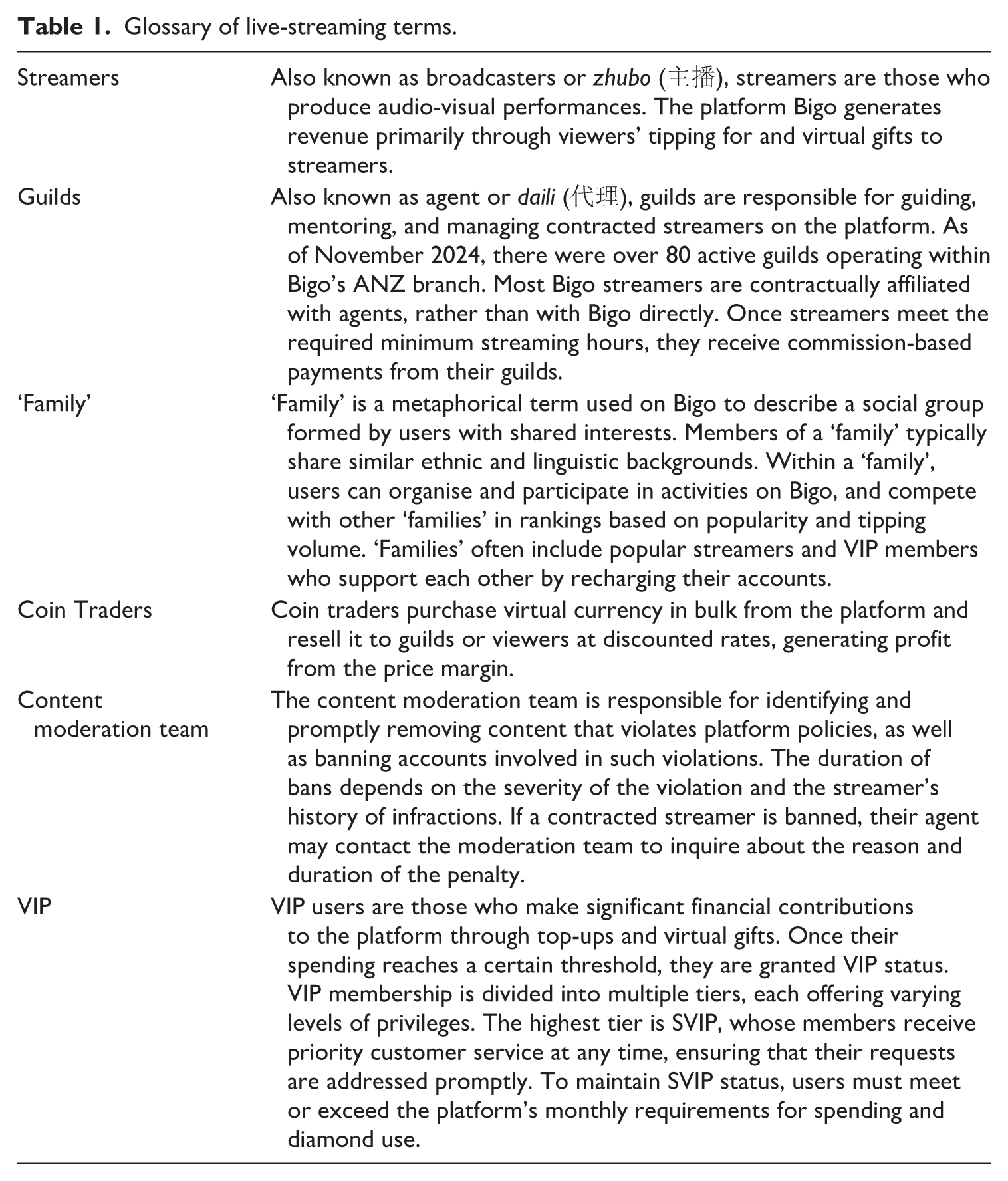
This study focuses specifically on Bigo and forms part of a broader, long-term, ongoing ethnographic project, conducted from June 2023 to the present, examining the internationalisation of Chinese digital platforms. Bigo is a Singapore-headquartered, Chinese-owned livestreaming platform whose executive and market operations are primarily based in Guangzhou. Its content moderation division is located in Foshan, while its regional marketing offices are distributed globally. Bigo is owned by the Chinese multinational conglomerate JOYY Inc. Since its inception, the platform has specifically targeted non-Chinese international markets, with particular emphasis on the Middle East and the Commonwealth of Independent States (hereafter CIS; Liu and Pertierra, 2024). Bigo has also emerged as one of TikTok’s strongest competitors in Japan (Abidin, 2025). This article concentrates on Bigo’s recent expansion into Australia and New Zealand (hereafter as ANZ), where it has gained significant traction, particularly among culturally and linguistically diverse (CALD) communities. With a global user base of approximately 5 million, Bigo operates on a notably smaller scale than major technology platforms. Its workforce consists of between 500 and 600 employees, and the company relies heavily on outsourced labour, particularly through intermediary live-streaming guilds responsible for recruiting, training, and managing streamers (A glossary of industry-specific live-streaming terms is provided in Table 1). Much of the platform’s content is tailored to niche markets and often features sexually suggestive material aimed at attracting adult male audiences.
Glossary of live-streaming terms.
This article draws on three empirical research components. First, since February 2024, the first author has conducted in-depth interviews with nearly 30 Bigo employees—both Chinese and non-Chinese nationals—based in Turkey, Russia, Germany, and the ANZ region. Given that many participants were already accustomed to online communication and considering the potential risks posed by ongoing geopolitical tensions in Turkey and Russia, this phase of the research was conducted primarily through video calls (See Figure 1 for a screenshot of an interview conducted by the first author with three employees from Bigo’s Turkey branch, assisted by a translator and a research assistant). Second, from July 2024 to January 2025, the second author undertook a 6-month internship with Bigo’s ANZ division in Guangzhou, conducting participant observation. This internship granted privileged access to Bigo’s internal workflows, decision-making procedures, and organisational culture. Additionally, in March 2025, the first author conducted in-person interviews with Bigo staff at the company’s branch office in Sydney, Australia. These engagements allowed both researchers to interview key personnel responsible for shaping Bigo’s international expansion strategies in the ANZ region, providing valuable insights into the platform’s localised adaptations and broader transnational operations. In total, we interviewed 15 informants who were involved in different aspects of Bigo’s international operations, including visual design, social media operations, targeted advertising, streamer management, guild management, VIP user service, streamer and guild recruitment, executive decision-making, and ‘family’ management. In the main text, informants are referred to anonymously in the following format: alias, position, location/assigned region, age, gender.
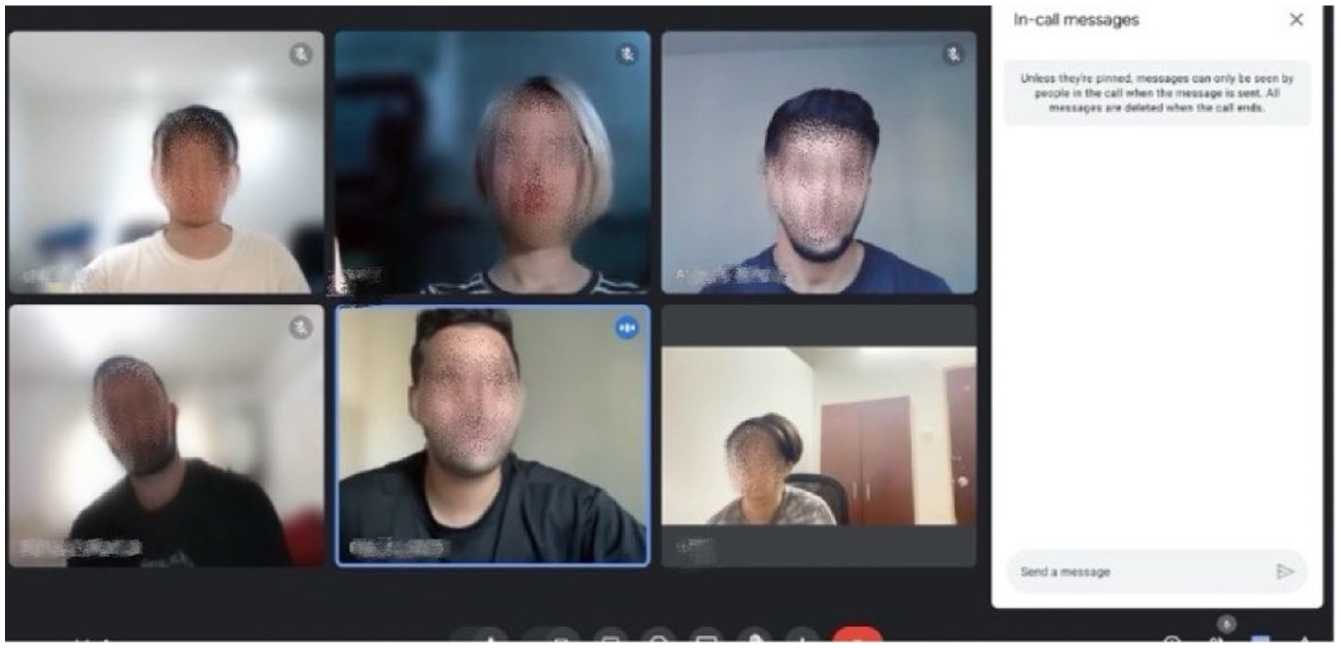
Screenshot of the first author’s interview with three Bigo staff (8th May 2024).
Findings: Human-directing-the-loop in platform expansion and governance
This article finds that Bigo, a platform with limited algorithmic autonomy, increasingly relies on hybrid operational strategies that blend automation with intentional, human-led interventions. We begin by analysing how Bigo leverages automated systems to facilitate international expansion—particularly in culturally and commercially unfamiliar markets like the ANZ region. Here, AI-driven technologies support user acquisition, efficiency, and engagement. However, automation alone is insufficient: human actors play a critical role in adapting and reconfiguring platform strategies on the ground. In particular, recruitment practices, talent acquisition, and community building rely on interpersonal communication and cross-cultural negotiation. Finally, we examine content moderation, where human discretion and oversight remain indispensable for regulatory compliance and platform legitimacy. Across all domains, human labour does not simply ‘fill the gap’ left by automation; rather, it actively directs, interprets, and governs the loop.
Human calibration following market entry in unfamiliar terrain
Like many other digital platforms, Bigo has sought to expand into new markets by leveraging automated systems to collect user data and disseminate globally standardised content. This automation-driven strategy aims to attract new users through algorithmically targeted promotion, often resulting in unexpectedly successful market entries beyond the scope of human prediction. A striking example occurred in October 2024, when Bigo unexpectedly gained traction in Papua New Guinea (PNG)—a low-income Pacific island nation that had previously remained outside the strategic focus of the platform’s headquarters. The surge in user engagement in PNG was triggered by promotional videos produced by the Guangzhou team and automatically disseminated through Bigo’s official Instagram account. These materials were not tailored to any specific region, yet they resonated with PNG users by tapping into a pre-existing but under-recognised desire to publicly share everyday life, cultural heritage, and social environments with both local communities and global audiences.
Automation initiated this unanticipated user uptake, but human actors recalibrated the loop to sustain and scale platform engagement. Recognising this emergent growth, Bigo’s ANZ team based in Sydney rapidly implemented a series of manual interventions to convert random viewers into active and loyal users. This marked a critical inflexion point where human labour no longer merely supported automation but actively directed it. Region-specific engagement campaigns were designed and executed by the ANZ team, including referral incentives, top-up rewards, and content creation activities tailored to PNG. One such campaign, hashtagged Islanders’ Voice, encouraged users to share visual content highlighting their heritage and environment. Users who posted more than three entries within 7 days of registration were rewarded with digital incentives (see Figures 2–4). All stages of this campaign, from design to quality control and reward distribution, were manually handled by Bigo staff, underscoring how platform responsiveness and cultural appropriateness hinged on human-directing-the-loop rather than automated optimisation alone.
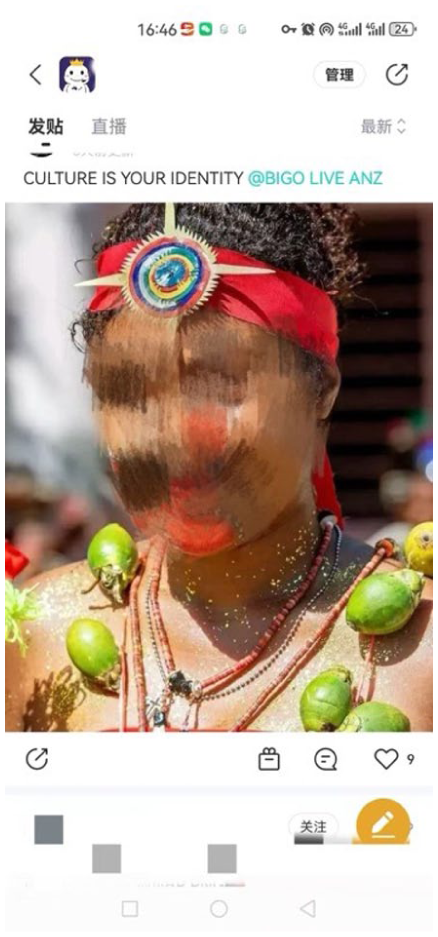
PNG user post highlighting traditional facial adornment and cultural identity.

PNG user post depicting vernacular architecture and natural landscape.

PNG user post showcasing Torres Strait Islander dance performance.
The Guangzhou-based visual design team also responded to the surge in PNG-related data by developing virtual items that incorporated culturally specific motifs to foster a sense of belonging and ethnic pride (Santos da Costa, 2021). This creative initiative exemplified a human-led orchestration of AI tools within a cross-cultural platform design process. Fiona (visual design, ANZ, 25, female), explained that while generative tools such as Wenxin Yige, SeaArt AI, and Freepik were employed to produce visual outputs, the design process was always initiated and steered through manual research and her own aesthetic judgement. Human designers did more than refine machine-generated outputs: they shaped the conceptual direction, defined visual goals, and adjusted prompts in response to cultural sensitivities. This example reinforces the article’s broader argument that, in unfamiliar markets, automation depends on human discretion, contextual awareness, and strategic intervention to guide the loop.
This design work unfolds within algorithmically structured environments, including platforms such as Google, Xiaohongshu, Instagram, and YouTube, which designers commonly use for inspiration and learning. Search results and content visibility on these platforms are shaped by opaque algorithms, meaning that even manual research occurs within a computationally mediated lifeworld that conditions how cultural meaning is accessed, filtered, and interpreted. Yet designers retain agency by selectively translating algorithmically surfaced content into visual strategies that meet both commercial and cultural objectives. As Fiona described: Before I start designing, I usually scroll through platforms like Google, Xiaohongshu, YouTube, or Instagram just to get a feel for the vibe I want—like the overall look and style. The aim is to make users instantly think, ‘Oh, this feels like Australia but PNG is definitely not Australia.’(Author’s note: Papua New Guinea gained independence from Australia in 1975 and is not part of Australia. Fiona’s initial confusion highlights the Guangzhou-based team’s limited familiarity with PNG-specific contexts.) So I continue to search for things like the PNG national flag or traditional clothes to pick out colour palettes or elements that really stand out culturally. For example, if I’m working on an outfit design, I’ll look for patterns that are unique—ones you wouldn’t really see in other cultures. That kind of stuff helps me come up with more accurate prompts when I use AI tools to generate the images.
Through this manually directed process, designers determine which visual motifs are both culturally salient and commercially viable before prompting the AI. In Fiona’s case, through proactive learning and critical discernment, she came to understand that PNG is an independent nation. She also noted important aesthetic distinctions between the Indigenous visual cultures of Australia, New Zealand, and PNG. Without such human scrutiny, there is a real risk of incorporating misleading or superficial representations into platform content. The iterative process continues beyond initial image generation. As Fiona clarified, AI outputs are typically incomplete and require considerable human refinement: AI-generated images are mostly useful for setting the frame; they do not really produce the exact thing you are looking for. They can help with style inspiration, such as colour palettes or minor design elements, but that is about it. I usually pick out the parts that work, such as colours, shapes, fonts, or character ideas, and then tweak and assemble them by hand to create the final design I want.
AI tools may accelerate ideation and stylistic generation, but they do not replace the human labour of cultural interpretation, visual curation, and final design assembly. This case shows that human-directing-the-loop in design is not a residual or supplementary role, but a necessary and continuous engagement, especially in intercultural branding and regional expansion, where nuance, sensitivity, and strategy cannot be left to automation alone.
In more routine market development efforts, Bigo’s targeted advertising strategies provide further evidence of human-directing-the-loop as a core operational logic. While the platform deploys automated systems to analyse user data and generate advertising placements, these processes are embedded within—and ultimately directed by—human expertise and judgement. For instance, in the ANZ region, Bigo’s internal analytics identified its core demographic as male blue-collar workers aged between 35 and 40. Based on this segmentation, algorithmically generated advertisements were deployed across online content containing occupation-related keywords such as ‘boots’, ‘workwear’, and ‘tools’, directing users to Bigo’s app download page via targeted placements in app stores.
However, this automation-led targeting was far from self-sufficient. To maximise outreach, Bigo’s Sydney-based team manually compiled lists of offline venues (such as sports bars and gambling pubs) frequented by individuals matching the identified user profile. These initiatives required not only familiarity with local consumption geographies, but also cultural tact and contextual understanding, capacities that automated systems alone cannot provide. Here, human-directing-the-loop becomes indispensable: staff with lived cross-cultural experience and marketing expertise steered the interpretation of algorithmic insights, identified on-the-ground promotional opportunities, and crafted culturally resonant engagement strategies.
Human-led growth in recruitment and talent acquisition
Recruitment and talent acquisition form a crucial operational domain where Bigo’s expansion strategy explicitly relies on human-directing-the-loop. While automation supports preliminary outreach, the platform’s success in cultivating a vibrant creator ecosystem across culturally diverse markets like ANZ ultimately hinges on human discretion, relational labour, and intercultural competence. This is particularly evident in the recruitment of guilds—informal intermediaries responsible for identifying, training, and managing live-streamers in Australia.
Unlike major platforms such as Instagram or TikTok, which benefit from widespread brand recognition, established user bases, and large-scale network effects, smaller-scale platforms like Bigo must actively build and sustain creator ecosystems through human-led intervention. In Australia, a market shaped by Anglo-Australian cultural norms and high ethnic diversity, Bigo prioritises two groups: digitally literate, socially embedded young Anglo-Australians, and prominent youth micro-celebrities within CALD communities. These individuals are recruited less for content creation skills than for their capacity to mobilise interpersonal networks, a relational function that automation cannot replicate.
Bigo’s Sydney-based team has developed four primary recruitment strategies, each illustrating the critical role of human cultural literacy in guiding key decision-making processes. The first approach involves manually identifying and initiating contact with potential streamers via mainstream social media platforms such as TikTok, Instagram, and Xiaohongshu. Staff like Danny (streamer and guild recruitment, German, 31, female) and Stone (streamer and guild recruitment, East Europe, 28, male) spend their working hours cultivating rapport online—‘spending all day online’ and ‘making friends quickly’, as they describe it. Such social tact and cultural sensitivity are not programmable; rather, they require emotional labour and platform literacy grounded in human intuition. One illustrative example was shared by Alex (streamer and guild recruitment, ANZ, 35, male). Alex recounted his most successful case in 2019, which began by using the ‘People Nearby’ function on a dating app. There, he connected with a Chinese Australian woman who had grown up in China, spoke fluent Hunanese (a widely used provincial dialect), and had lived in Melbourne since childhood, completing her primary, secondary, and tertiary education in Melbourne. Upon discovering her interest in Bigo, Alex invited her to become a streamer and eventually established a professional partnership with her. They quickly found common ground. As an international student with a broad social network, the woman was able to leverage her connections extensively. Crucially, she also had ties to the Chinese-language media outlet 58.com in Australia, which she used to recruit additional streamers through media promotions. ‘It exploded’, Alex recalled. ‘She alone helped me recruit over 100, maybe even close to 200 streamers, and they were all very active, outgoing, and high quality!’ The process exemplifies how automated discovery tools may identify leads, but only human actors can activate, sustain, and scale these opportunities through relational work.
The second strategy involves reaching out to artists and influencers through entertainment agencies. In more structured markets like Germany or the UK, where creative labour is professionalised, this requires Bigo’s recruiters to understand local industry dynamics and negotiate persuasively. Danny, for example, succeeded in attracting independent musicians by offering visibility and monetisation pathways that resonated with their artistic goals. However, these negotiations are bounded by economic pragmatics. As Alex noted, influencers with modest followings often earn more through a single sponsored Instagram post than they could through hours of live-streaming, posing a challenge that no automated incentive system can overcome without human recalibration of financial strategies.
A third strategy, talent poaching from competitor platforms, together with the related practice of maintaining amicable ties with current streamers to prevent defection, further highlights the limits of automation. While Bigo’s technical team can scrape publicly available data to identify promising recruits, effective poaching and retention depend on human intermediaries, particularly non-Chinese staff with local knowledge, negotiation skills, and established reputational capital. This reliance is critical in regions where competition intersects with high-stakes dynamics or illicit industries, as seen in parts of the Middle East and CIS markets. ANZ offers a more stable recruitment context, yet human oversight remains essential for assessing social risks, anticipating local responses, and safeguarding the platform’s public image, tasks beyond the scope of algorithmic systems.
The fourth and most consistently effective recruitment strategy employed by Bigo involves identifying promising streamers, contracting them as guild agents, and leveraging their interpersonal networks to recruit additional streamers. This method, grounded in interpersonal network recruitment, has demonstrated significantly higher efficacy, particularly in the Australian market, where CALD communities often show strong internal cohesion. As Marina (streamer management and guild management, ANZ, 30, female) explained, streamers are frequently more knowledgeable about Bigo’s atmosphere than staff themselves, due to their close ties to the streamer community. Reflecting on her interactions, she noted: ‘Who could be more suitable as a guild agent than the streamers themselves?’ Moreover, cultivating interpersonal relationships among streamers is essential not only for recruitment but also for user retention. Even when potential streamers are successfully recruited, they are unlikely to remain active on the platform without meaningful social connections. The absence of familiarity or peer support results in a diminished user experience, leading to rapid disengagement. Bigo’s ‘family’ feature addresses this challenge by enabling like-minded streamers to form social groups, fostering a sense of belonging. Word-of-mouth referrals from family and friends remain the most effective pathway for acquiring new users. Wendy (user growth promotion, ANZ, 28, female) confirmed this pattern, observing that many agents are romantically or socially connected: ‘In the ANZ region, Agent A might be the husband or partner of Agent B’, which often results in extended networks of streamers. ‘They are originally a genuine friend group, and with that sense of belonging, they’re less likely to leave the platform’. Alex further explained that streamers’ income often depends not just on individual appeal but on collective visibility: ‘Unless you’re stunning and can attract traffic on your own, you still need people around you to support you’. This reflects an expanded notion of digital labour that includes emotional, relational, and community-oriented work, all guided by human actors embedded in context-specific social worlds.
Bigo’s reliance on automation is not absent but limited in its effectiveness. Recruitment typically begins with scraping data from third-party platforms like Instagram and Facebook. Scripts and contact flows are generated algorithmically, but the conversion rate is low. As Marina explained, such outreach often feels impersonal or even suspicious: ‘Imagine receiving a random DM. You might ignore it or think it’s a scam. Even if someone responds, you still have to explain everything manually, and they’ll need time to think about it’. In other words, automation may initiate contact, but conversion and retention are fundamentally human tasks. This layered orchestration, in which algorithms assist but humans steer, interpret, and adapt, defines human-directing-the-loop in Bigo’s recruitment infrastructure.
Algorithmic-human synergy in content moderation
The final finding shows that content moderation at Bigo Live operates through an entangled algorithmic-human assemblage, in which automation remains insufficient and human oversight is central to effective governance. While algorithmic systems play an indispensable role in enabling large-scale, real-time monitoring, they function not as autonomous decision-makers but as tools continuously shaped, trained, and corrected by human labour. In this sense, content moderation offers a paradigmatic case of human-directing-the-loop, wherein human agents retain the authority to identify harms, navigate cultural nuance, and calibrate interventions in platform governance.
Like other audiovisual platforms, Bigo must manage multiple and often conflicting imperatives. It must comply with jurisdiction-specific legal frameworks (e.g. bans on child exploitation, religious slander, hate speech), protect underage users, and uphold platform reputation through quality control. However, the ways in which Bigo enacts these imperatives rely not on disembodied algorithmic neutrality, but on culturally informed human labour that defines what counts as harm, which actors are protected, and how regulatory compliance is implemented in practice. At the initial stage, Bigo’s regional teams manually develop databases of sensitive keywords and visual markers, requiring cultural literacy and moral discernment. For example, the ANZ office maintains a moderation lexicon focussed on underage exploitation, with linguistic cues mapped across severity levels, languages, and legal categories. These human-designed taxonomies feed into machine-learning systems that enable automated flagging and takedown procedures. The classification work itself, including what is considered ‘high severity’ or ‘medium severity’, reflects fundamentally human judgement.
Even with algorithmic detection in place, moderation cannot be fully automated. The sensitive content database remains dynamic, requiring continual human revision. Ellen (VIP user service, CIS, 28, female) described flagging a livestream cover image that depicted a veiled Muslim woman kissing a pig, an image that bypassed existing filters but violated regional religious norms. This incident illustrates a broader pattern: offencive or harmful content often emerges in culturally encoded forms that cannot be detected through keyword search or automated image recognition. In such cases, human moderators must interpret content and train the algorithm by feeding it new data categories, effectively steering the system’s learning trajectory.
These human interventions are especially vital in contexts where algorithmic misjudgement risks marginalising minority cultures. In the ANZ region, Indigenous users have repeatedly contested the platform’s moderation decisions. For instance, images of knives used in everyday hunting in PNG were incorrectly flagged as violent, and bullet-shaped jewellery worn by an Indigenous streamer triggered automatic bans. In both cases, local agents intervened to recalibrate the moderation thresholds, underscoring the cultural blindness of automated systems and the need for human interpretive flexibility. As Wendy noted, ‘We realised we were failing to promote Indigenous culture. The system couldn’t tell the difference between violence and tradition’.
Moreover, Bigo’s moderation architecture is shaped by an unspoken but powerful visual regime that privileges certain aesthetic norms and marginalises others, especially those deemed deviant, excessive, or non-conforming to heteronormative standards. Despite the platform’s formal restrictions on pornography, the moderation system demonstrates greater leniency towards sexualised performances by heterosexual women than it does towards queer-coded or non-normative forms of bodily expression. This disparity became more pronounced in Russia after the government expanded its ‘gay propaganda’ law in November 2022, extending the ban from minors to adults and effectively prohibiting any public expression of LGBTQ+ identities. This asymmetry reflects a deeper bias embedded within the platform’s visual governance: rather than a neutral application of community standards, moderation becomes a mechanism that reinforces sexist and heteronormative sensibilities under the guise of automated neutrality. As such, human-directing-the-loop becomes not only a technical imperative but also a political and ethical one. Human moderators do more than correct algorithmic errors; they define the moral boundaries of platform visibility. Their decisions shape which bodies, identities, and practices are deemed acceptable, and which are systematically erased. Understanding moderation as a site of human discretion, rather than computational inevitability, opens up a critical space to interrogate how gendered and racialised assumptions are operationalised in platform infrastructures. In sum, content moderation at Bigo cannot be understood as a seamless function of automation. It is a contested site where legal obligation, algorithmic filtering, cultural judgement, and gendered visual politics collide. The system’s efficacy depends not on automated efficiency alone, but on the continuous involvement of human actors who guide, adjust, and challenge the algorithm.
Conclusion
This article has examined Bigo’s international expansion to develop the concept of ‘human-directing-the-loop’. Rather than treating automation as inevitable, culturally neutral, or universally effective, the article shows how platform operations depend on situated human intervention, especially across multilingual and multicultural markets such as Australia, New Zealand, and Papua New Guinea. In Bigo’s design, recruitment, and content moderation practices, human intelligence does not operate as a supplementary safeguard to automated systems. It actively shapes how automation is interpreted, adjusted, and made operational across different cultural contexts. The article therefore responds to calls for a more situated, relational, and culturally attuned understanding of automation through concrete empirical examples (Arora and Natale, 2025; Chung, 2026; Natale et al., 2025). It shows that platform expansion is sustained not only by technical scalability, but also by affective human intelligence, including interpersonal trust, cultural judgement, embodied communication, and contextual interpretation. At the same time, human intervention should not be romanticised as inherently progressive or humane. Human actors may also reproduce harmful gendered, sexual, racialised, or commercial scripts. Future research may further examine human–automation relations as complex sociotechnical formations, where agency, labour, and judgement shape platform governance.
Footnotes
Acknowledgements
Earlier versions of this paper were presented at a public talk series organised by Associate Professor Jian Xu through the Asian Media, Culture & Society Research Group at Deakin University, where Professor Haiqing Yu provided valuable and insightful feedback. A subsequent version was also presented at the symposium Digital Temporalities: Slow, Quick and Everything In-between at the University of Queensland, organised by Dr. Giang Nguyen-Thu. The author is deeply grateful for the thoughtful comments and intellectual engagement offered through these scholarly exchanges.

Funding
The authors received no financial support for the research, authorship, and/or publication of this article.
Declaration of conflicting interests
The authors declared no potential conflicts of interest with respect to the research, authorship, and/or publication of this article.