






Abstract
In Western regions, tensions surrounding mediated nation-building progressively converge with growing commercialization of cultural institutions. The Story of Flanders (2023), a docudrama that narrates the genesis of Belgium’s northernmost region, proves exemplary of how reimaging national identity through public service media heightens fears for instrumentalization. This study investigates how heritage practitioners “make do” with the series and broader restrictions defined by austerity and political fragmentation. Despite ample research on historical television, identity and production, works commonly engage with historians as key expert contributors. Yet, important alternative roles have been neglected as central to the construction of televisual history. Results show austerity-drive imperatives guide practitioners to leverage discreet tactics to navigate this sensitive climate. Three areas of tension manifest, as the burden of history is weighted down by an added ideological layer: anticipating political fragmentation and fostering trust, negotiating authority and authorship, and facilitating dialogue and navigating austerity.
Introduction
Historical television provides access to a cultural experience, a mode through which viewers encounter the often-unknown world of the past (Bondebjerg, 2020). Although televisual history is coded as foreign, it simultaneously speaks to shared memory (Nelson, 2024). Historical television is commonly approached by cultural studies through textual or reception foci, and political economy centering policy and commercial structures. Yet, research investigating cultural workers’ opportunities to negotiate, resist and reproduce these institutional logics falls between the cracks of both traditions (Havens et al., 2009). The expert is fundamental to these mnemonic narratives as they inform their “authority,” perceived relevance (Khitrov, 2020), and connect heritage conventions in text and on the ground. The contribution of this research to critical media studies is to extend beyond the common scope of academic historians as key experts for televisual remembrance and embrace alternative roles within the heritage sector as fundamental to its production process. Heritage practitioners, more broadly, are often overlooked or their roles underestimated (Edgerton, 2001; Rosenstone, 2023; Sklar, 1997) with the important exception of Bell and Gray (2010) considering public historians and media professionals, while they are vital within the production of historical television.
In Flanders, Belgium’s northernmost region, the cultural landscape is marked by contested notions of national identity, posing very relevant questions to explore this topic in depth. Indeed, the 2019–2024 governmental agreement triggered cultural projects which have laid out the groundwork for recent controversy concerning political instrumentalization of heritage in favor of sub-state nationalism. As the Flemish government, led by the separatist New Flemish Alliance (N-VA), declared its explicit interest in public culture to strengthen the Flemish identity (Vlaamse Overheid, 2019); The Canon of Flanders was ordered through an official brief. This resulted in a list of quintessentially Flemish historical frames of reference (Gerard, 2023). Before its release, media reported extensive criticism of the concept through academic essays, pamphlets, blogs, and interviews – including accusations of state propaganda (Reynebeau, 2022). The supplementary announcement of a museum dedicated to Flemish history further fueled commotion (Tollebeek, 2022). When uncovering vast governmental funding for a series, The Story of Flanders (2023), the polemic snowballed toward peak-momentum (Dumon, 2023; El Bakkali, 2023). Yet, N-VA’s Minister for culture argued it is natural such strategies, including television, are employed by the government to further the Flemish identity – resorting to “voter fraud” in his defense (Brinckman, 2022).
In a relative short period of time the Belgian heritage sector has been confronted with three disputed ventures, requiring practitioners’ input. Considering the complex identitarian struggle in multi-lingual and federalized Belgium, the docudrama makes a compelling case. The Story of Flanders is based on the Danish format Historien om Danmark (2017), which further inspired the Dutch Het Verhaal van Nederland (2022), Swedish Historien om Sverige (2024) and French Notre Histoire de France (2024). Clearly, the Flemish version sets itself apart by scoping nation-building regionally instead of nationwide. However, this scope isn’t a mere production-based strategy, but rather a consequence of pre-existing top-down political structures, embedding the sub-national focus into televisual historical narratives (Dhoest, 2003) and broader collective memory.
This article sheds light on The Story of Flanders as a case exemplary of how subversive tactics can still be implemented in areas that leave room for negotiation (de Certeau, 1984); even when political agendas drifts from academic committees, and collections, into television productions. This research seeks to nuance structure-agency perspectives by examining how heritage practitioners “make do” with tensions surrounding political re-appropriation of heritage narratives, both from within production and on the ground. The main research questions guiding this study are: (1) How do heritage practitioners negotiate historical television in the context of political fragmentation and austerity? (2) What tactics do heritage practitioners employ surrounding The Story of Flanders?
First, the theoretical background delves into collective memory, the role of Flemish public service media (PSM), and heritage practitioners in relation to televised history. Next, methodology and sample are addressed. Results report on different tactics employed by heritage practitioners in relation to three distinct areas of tension. Each tactical dimension is shaped by the contextual restrictions imposed by dominant political, commercial, or productional strategies.
Historical television and memory
Historical television works as both a narrative device and a cultural intervention. Due to its audio-visual character, historical television has been established as one of the most immersive modes to access the past and provides the ability to preserve it, ad infinitum (de Leeuw, 2010). Nelson (2024) describes the concept moving histories, the synergetic result that marries moving image and history, as delivering a “mass spectacle of memory” (p. 5). Dominant actors have and are still turning to mass media for constructing, supporting, and questioning the principal narratives of group identity and the construction of collective memory. This research thus understands historical television as central to our contemporary idea of the past, reality, and consequently ourselves.
Collective memory includes shared norms, values, ideologies, meaning and interpretations of events and narratives that are continuously reproduced and thus ground a national community in a common history (Halbwachs, 1997). It is established as a fundamental criterion in constructing collective identities. Despite the communal element to shared memory, it is an individual process limited over space and time as each member is able to engage with remembrance differently (Bell, 2003). Mass media and television traditionally play a major role in molding the communal psyche in forming cultural memory and nation-states (Anderson, 2006; Mi, 2005) as visual narratives with a serial structure are known to build stronger psychological bonds with viewers. Despite social media’s dominance, TV still provides effective means to distribute ideologies to a broad audience (Bignell and Woods, 2022).
Although historical television has an inherent cultural weight to it; formally, these narratives are increasingly governed by institutional logics. Bondebjerg (2020) highlights this cultural gravitas claiming national historical television facilitates mediated cultural encounters where foreign worlds, peoples, events, and reality of the past meet our present through television. Still, if one wants to fully understand the makeup of these texts, the creative process mustn’t be overlooked. Gray (2013) argues that it is important to address historical television not only “as free-floating cultural artefacts” (p. 81) but essentially position it within the broader systematic structures which are defined by different, sometimes competing imperatives. Thus, this research approaches The Story of Flanders as a cultural text that provides access to an identitarian experience but is progressively shaped by intersecting commercial and political practices.
Public service media and Flemish identity
As PSM are grappling to balance societal values and commercial logics in the context of austerity and political fragmentation, these tensions influence the treatment of historical programming. In Flanders, classic documentaries have foregrounded societal value over consumption value, attracting smaller audiences (Livémont et al., 2017). However, PSM seek to broaden niche genres to entice larger viewership to democratize history. Docudrama, a television genre that leverages dramatic strategies whilst committing to factual documentation of history (Ogunleye, 2005), arises as a popular solution. The relevance of exemplar formats like Historien om Danmark (2017), Het Verhaal van Nederland (2022), Het Verhaal van Vlaanderen, Historien om Sverige (2024), and Notre Histoire de France (2024) is not only tied to its content but also to its “authority” as a PSM production.
Re-imagining Belgian history is notably sensitive as the ruling party seeks to leverage PSM for sub-state nationalism. Belgium is shaped by a mosaic of linguistic, cultural, and regional alignments, with the most prominent ones being the Dutch-speaking region Flanders and French-speaking Wallonia, along German-speaking Belgium, and Brussels. Within this federalized state, Flemish sub-state nationalism has sought to assert a distinct identity separate from, and sometimes in tension with, Belgian national identity (Vos, 2002). Historically, Flemish actors have done this through right-wing, occasionally populist rhetoric (van Haute et al., 2018). Willems and De Wever (2020), describe how Flemish-minded strategies have leveraged media for sub-state nation building via distinct phases. Traditionally the Flemish Movement, a nationalist political formation, has always supported Flander’s independence through these different stages where a final phase prescribes policy decisions to favor Flemish media at the expense of Belgian media organizations. The N-VA, which has distinct roots in the Flemish Movement, is the biggest party in Belgium and has established its hold on policy since 2010 (Dewulf, 2012). Seen as a harbinger for heightened “organic” reproduction of Flemish-national sentiments, this media policy framework makes such narratives self-evident.
These strategies seep into historical narratives produced for Flemish PSM. During the 50–60s, Flemish PSB explicitly meant to popularize a uniform Flemish identity through its educate-and-emancipate approach (Van Den Bulck, 2001). Even later, when including entertainment, the promotion of Flemish identity persisted. Between 1953 and 1989 during the PSB-monopoly, 20 out of 32 fictional programs imagined Flanders in the past. Dhoest (2003) found that most texts presented a homogenous and one-sided image of a nostalgic Flanders, focusing on the diligent working-class roles. Examples like In Flanders Fields (2014) which takes place during German occupation in WWI and interestingly combines this with elements of the Flemish/Wallonia conflict (Bondebjerg et al., 2017) indicate a continuous focus on historic narratives. Felgenhauer (2013) argues this top-down effort to define a region through historical narratives includes a conservative dimension that rejects imagining a region as ever evolving, constructing a Flanders in stasis. While political agendas shape Flemish historical television, one mustn’t overlook the opportunities to perform individual agency on the productional level. To date, it is unclear how these historical narratives are negotiated upon creation.
Negotiating Flemish heritage narratives for television
To balance authority over the portrayed fictionalized narrative, docudramas often rely on collaboration with experts. In developing historical television, production’s main concern is to create “good television” and commonly does so via the conventions of fiction TV to maintain audience engagement (Gray, 2013). Yet, compared to other television programs, moving histories negotiate different audience expectations concerning its treatment of truth claims–also framed as The Burden of History (White, 1966). When practitioners are selected to perform as the expert; they become representative of institutional power and authority to construct a “neutral” narrative (de Certeau, 1984). Nevertheless, experts aren’t merely symbols of systems. Khitrov (2020) found that in the case of Hollywood TV production, experts such as historians trade symbolic capital and negotiate between different imperatives. Negotiation is multidirectional, as experts are also considering the trade-off from their end. With historiophoty, White (1988) was the first to define the complementarity of the motion picture to traditional histography with attention for the important societal role of film as a device and podium for public history (Nelson, 2024). For instance, broader exposure could prove the relevance of the expert’s work (Gray and Bell, 2013). This study sees experts as active agents, crucial in constructing historical docudrama.
Yet, marrying heritage expertise with television isn’t always straightforward or met with approval within the sector. It has been profusely documented that, for historians, discomfort is often involved when approaching history as a popular product (Evans, 2015). Professional historians traditionally tend to act as historian-cop and project scholar-level expectations onto television (Sklar, 1997). While public historians lean towards being more agreeable to the format as they’re used to working for a broader audience (Gray and Bell, 2007). Hereby, Nelson (2024) seeks to subvert this paternalistic approach toward principles, such as plurality and reflexivity, that embrace and improve audio-visual practices. Edgerton (2001) too argues that historiophoty and historiography keep each other balanced; as one provides a frame to understand the other. Notably, professional historians have increasingly been participating in popular history. However, Gray and Bell (2013) argue that as university-based historians become more restricted in funding for research, they need to find ways to prove the importance of their research with more commercial-driven means. This trend is also visible in the broader heritage sector (Tobelem, 2013). The loss of control over historical narratives through television when in the context of underfunding institutional levels, while demanding measurable impact and societal relevance, is worrying as participation becomes more of a necessity than a choice.
In Flanders, where national identity is inherently sensitive, discomfort with historical television has recently taken a different form due to fear of political re-appropriation more broadly. The 2019 Flemish governmental agreement includes initiatives concerning the promotion of Flemish identity, as the experience ought to be “uncomplicated” (Vlaamse Overheid, 2019). So, a commission of experts is ordered by an official brief to develop The Canon of Flanders. This results in a list of Flemish historical frames of reference, aimed at education, integration and naturalization, and heritage and tourism (Gerard, 2023). Ironically the canon became controversial within the realm of heritage, academia and beyond, underscoring the complex reality it aimed to avoid (Boone, 2021; De Paepe et al., 2019; Tollebeek et al., 2022). Next, the agreement announced what would become the Flemish All Around Museum, to make Flemish history and culture accessible (Vlaamse Overheid, 2019). After protest against a brick-and-mortar museum, the project transitioned to an online environment (Tollebeek et al., 2022). When eventually unveiling governmental funding for a new television series; The Story of Flanders was set to be told in its third iteration. After “defining” and “experiencing,” now there is also a series “imagining” the region as a nation. Heritage practitioners – working to facilitating dialectic platforms – find themselves in a climate of rapidly heightening identitarian discussion, whilst politics shifts support from PSM and cultural institutions toward the specific historical narrative itself.
The tactical expert and Flemish historical television
This study approaches heritage practitioners capable of consciously nuancing or rejecting top-down strategies. Important work argues in favor of foreground cultural workers in media research. Smith Maguire and Matthews (2010) highlight the concept of cultural intermediaries to lay bare issues of power, agency, and negotiation regarding daily cultural production practices. They expose lacuna as “the articulation and negotiation of tensions that arise between objective credentials and subjective dispositions in the performance of authority; the tension between formal strategies and informal tactics employed. . .” (p. 12). Thomas (2015) too shows that archaeologists’ approach contested television programs, either via collaboration, condemnation, or ignoring. This research avoids painting heritage practitioners as solely providing symbolic capital but sees them as capable of seizing opportunities relative to their position, to divert strategies with personal tactics (de Certeau, 1984). So historical productions can, rather than being approached as media product or cultural artifact, be treated as both; a space of constant and multi-layered negotiation. It is unclear how practitioners experience production when set in a broader sensitive context, such as in Flanders where the mere act of reimagining the past is inherently polarizing.
The analysis framework integrates de Certeau’s (1984) theory surrounding strategy and tactics to describe how actors make use of discreet opportunities to claim agency. Highmore (2006) elaborates on how de Certeau’s work helps to analyze cultural production. de Certeau (1984) argues that people employ tactics within dominant structures – for example, operated by the state, institutions, broadcasters – which in turn apply strategies to meet broader ideological goals for cultural production. Tactics are always opportunistic and employed by people or groups to navigate the constraints enforced by hegemonic players. He critiques the perceptual positioning of professionals as neutral “expert” as they risk tapping into more generalized fields of knowledge, straying away from their core expertise.
This study employs a qualitative research design to investigate the relationship between the The Story of Flanders and heritage practitioners. The analysis draws on complementary strands of data collection, organized along two main sections, contextual analysis, and expert interviews, using thematic analysis (Braun and Clarke, 2012). This docudrama, produced by De Mensen and broadcasted by VRT, counts 10 weekly episodes of approximately 50 minutes centering specific periods in Flemish history (see Appendix 1). Two hundred practitioners were consulted including curators, archaeologists, and historians (VRT, 2022). As the relative position of individuals to the series informs tactical opportunities, this study looks at heritage practitioners who are collaborating on screen, partnering behind the scenes, consulted in the pre-production, and/or receptive of tourism induced by the series. Expert interviews were conducted with 17 heritage practitioners in alternative roles to academic historians, including curators, historians, directors, archaeologists, and public-educational staff. Compared to Bell’s and Gray (2007) argument that it is crucial to interrogate how historians view the mediation of history on television, this study approaches “expertise” holistically, aligning with the productional approach (VRT, 2022) and the theoretical framework (de Certeau, 1984).
For the contextual analysis, I interviewed three TV professionals to provide insight into collaboration, decision-making, and constraints (Braun and Clarke, 2012). Further, a textual thematic analysis of all episodes, using a code-book approach (Braun and Clarke, 2012) connects experiences of practitioners to the series. This informed the topic list, better understanding of expert interviews, and familiarization with the text. Conjointly, I consulted news articles, policy documents, and reports; supplemented by personal communications with four tourism professionals. The analysis resulted in three areas of tension, each with related tactics employed by heritage practitioners.
Anticipating political fragmentation and fostering trust
Flemish heritage practitioners operate in a context defined by increased attention of the government for strategic nation-building projects. Even though The Story of Flanders exists in the realm of popular media, it is concerned with public history and therefore lends itself to the interest of heritage practitioners. When research started, and the scope of the series wasn’t clear yet, 200 practitioners were consulted (VRT, 2022). Providing access to information about history is a core activity for practitioners, thus they aided production like they would any other person with interest. Many organizations also had experience providing support for filming previously. Their position as public servants is at the heart of these roles. Yet, when the Flemish scope of the series was communicated, concerns and vigilance toward potential signs of politization arose. E, a heritage practitioner and part of the production of the series, connects it to broader politics.
E: You can see that all three [canon, museum, series] start from the same ideology. Those are N-VA products. And those three products have been imposed by politics and don’t stem from bottom-up from the sector. The canon is mostly for education, FAAM specifically for the heritage sector. You can feel that you can help guide this together with the sector. But television. . .
While written independently, the docudrama was haunted by the ghost of previously controversial projects. Recalling that internal communication surrounding the canon and series coincided; it was the first association made by most experts. Some practitioners took initiative to warn production about the sensitivity during the ongoing research process. For production this project didn’t seem as politically laden as it later proved to be. The format was introduced to De Mensen through its parent company which owns the production of Het Verhaal van Nederland. The Dutch success was viewed as an opportunity to replicate it in Belgium. Indeed, tailoring its national scope was an internalized practice to adhere to funding priorities. Makers made an explicit effort to subvert associations that linked their project to The Canon and broader political connotations after explicit warnings by experts. This triggered them to consider language and representation even more carefully. Considering the extra cultural weight was added to the burden of history of the program, when concerns went beyond “factual” storytelling only, I argue that reconceptualizing “the burden of history” and factoring ideological weight is central to its heft.
The anticipation of a potentially controversial project impacted the way practitioners would consider their own or their organization’s association with the series – still neutrally linking their societal role as heritage professionals – however with effort to detach from politics. Their role as public servants becomes an added restrictive framework in which tactics can still be employed.
R: “I always try to distance myself from politics. I find this a difficult matter. Also, because, as a civil servant, you’re best to partly take a step back from it.”
Notwithstanding the sensitivity surrounding the series was still present. In reaction, the main tactics to foster trust are (1) reframing and contextualizing the concept of the series, (2) seeking extra support internally, and (3) inquiring about the (other) academic historians involved to justify their own position. Practitioners reflected upon the series more broadly by reframing its contexts to more abstract levels. Even though a reflection about “objectivity” is valid, this analogy could lead to false equivalence.
A: “In everything you make as documentary maker, there will always be critical voices. Because there is never one truth that can be told. So, it’s very correct that these criticisms surface. But I feel this is the case with every documentary that was made.”
Many practitioners consulted their internal team to gain more support from within.
O: “We discussed it with the directorial team if we would partake or not.”
Other than contributing as consultant behind the scenes, accepting on-screen roles wasn’t as straight forward. The fact that this was seen as a potentially politized project pushed some to seek extra information with production to see whether prominent “authorities” would be collaborating as well.
S: “Thus, we knew from [expert A] and [expert B], that they were involved. Those are thorough scientists. Those are not people who would participate in any project that is scientifically so-so. So, for us the decision was made upon this.”
It proved important to onboard academic historians with certain status as a gateway for trustworthiness and deflection of certain responsibilities. Production selected one such main expert per episode to closely collaborate with, which provided some peace of mind and legitimacy. The idea was also to counter critics merely through strategically linking the right expert to difficult historical narratives in the series. This connects with de Certeau’s (1984) critique of the expert as constructing a neutral narrative by association and could be seen as a reaction to the previous argument. Especially when dealing with contested themes, authorities were important; K, a production member, highlighted.
K: “There are a couple experts that support that, and they explain their vision. So, especially in those parts where we felt there would be discussion surrounding it. . . And this will always stay this way. But for this reason, we were like; we need a back-up [. . .]”
Some experts wanted to make sure that dark history had a prominent place within the narrative. This, to balance a purely heroic arc commonly associated with nationalist narratives. After guiding viewers through fragments of impressive technological inventions during the industrial revolution in episode eight, the presenter takes a more solemn tone. There are some undertakings, he explains, that haven’t been granted the same visibility in historiography. Colonialism for instance, with the 1897 Brussels World Expo including Zoo Humains where Congolese peoples were abused and exhibited for Western entertainment as tokens of discovery and progress. Photographs of enslaved people pass on screen as experts read a press excerpt to illustrate how the colonial gaze seeks to normalize and rationalize its wrongdoings. M, an expert that was interviewed by production, recalls the inclusion of this theme as a personal criterion for trustworthiness.
M: “That’s how I knew that, for instance, the Congolese that were exhibited and the story of the colonization would be covered. And we did think it was important that the social-economical [lenses] would be discussed. [. . .] So yes, that fostered trust too.”
Yet not everyone was equally vigilant. Archaeologists were the most comfortable with the series. Other practitioners too identified the difference between narrating history about periods that relied heavily on archaeological material compared to those who were more recent. It is true that the earlier episodes adopted a wider lens on “local” history, and there was more reflexivity involved, echoing some of Nelson’s (2024) principles. The series paints a prehistoric picture grounded in its natural landscape, avoiding a purely anthropocentric lens. Further, these times didn’t adopt modern bordering and contested events mostly centered around later developments like The Battle of the Golden Spur (1302), an event which is heavily mythologized and at the heart of the Flemish Movement.
H: “Fortunately, archaeology is [politically laden] to a lesser extent. That’s before the Battle of the Golden Spur. Then it is okay, then we can all be friends.”
The mythic battle references the Flemish revolution against French rule. Although this win was relatively brief and subverted 2 years later, its memory claims a prominent position within Flemish-nationalism movements. Hendrik Conscience’s (1838) romantic retelling was mandatory literature in schools; the story was institutionalized as propaganda to recruit Flemish soldiers for WWI and is traditionally deemed as the dawn of Flemish-national consciousness. Today, the event is still celebrated as an official holiday in Flanders (Shelby, 2014). This foundational myth is referenced to sustain a historic divide based on language and extends it to a broader cultural level.
The opposite was true for practitioners who were concerned with more recent cultural events. One respondent, D, recounts the attempts made to broaden the proposed narrative by arguing about the significant influence of international cultural encounters. After it became apparent their vision wouldn’t be prominent “enough” in the series, the practitioner withdrew collaboration.
D: “And again, [production] reply: ‘good argument, but it is not possible’. It must remain the same story. And then I said, I can’t come to terms with this, with my understanding of [historic event]. I stop my cooperation here and now.”
Thus, in the developmental stages of the series, most strategies manifest themselves politically first. The top-down focus of the Flemish government to produce specific projects collides with practitioners’ approach as servants to the community. This is where the ideological layer to the burden of history manifests clearly, also for the media professionals. Within this position, practitioners negotiate via three tactics: the trustworthiness of the series via inquiry of productional information, requesting internal dialogue and support, and guarding an intersectional input. What makes the televisual context in relation to tactics even more specific is the added distance for experts in relation to narrative control. Most practitioners did move forward when asked to collaborate more intensely, other than one individual who ultimately left the project in fear of positional misuse and to reclaim agency.
Negotiating authority and authorship
Various practitioners positioned collaboration not as obedience, but rather an attempt to regain a higher degree of narrative control. Participants talk about their hands-on experience with the efforts of changing and nuancing proposed narratives in the series. Examples include, (1) flagging sensitive topics to production, (2) asking for insight into script to suggest adjustments, and (3) inserting nuance and countering arguments during interview sessions with production. E reflects upon the opportunity to implement tactics from within.
E: “The program will be made regardless. Thus, you would be better off trying to help and to get the quality right. [. . .] We try to help shape it.”
Experts sought more narrative control, often in ways to nuance elements that would otherwise foster nationalist discourse. These tactics were often anchored around prominent but sensitive historical events that are central to Flemish-nationalist ideology. Practitioners avoided or subverted these myths in a discreet manner. Through voice-over or interviews, for instance, they could try to nuance with transparency concerning sources, probability, and biased perspectives. T, a historian, talks about opening the narrative to shed light on the international influences on an important historic event to make the story less uniquely heroic to the Flemish experience.
T: “I [would focus] much more, much more, on the multicultural aspect of [historic event]. I was only able to highlight this in two sentences.”
Some explicitly wanted to include Wallonia in the narrative to make it more holistic and minimize separatist readings of the series. One of the main points of contestation is the scope of the series which didn’t extend to the Belgian context. However, the series proved this line could be crossed. Relying on Walloon sources for prehistoric storying, isn’t surprising, as there were relatively few archaeological artifacts found in Flanders. Other references to Belgian’s southernmost region were more intentional. M, made sure to connect the theme they were specialist in, included the perspective from Belgium’s southernmost region too.
M: “I thought it was very important that the importance of Wallonia was included. So, I told them and they added this afterwards. Even if it was only one sentence.”
Incidentally, the federal lens isn’t always heralded as fitting. For example, for themes such as colonization, it can be argued that Belgian King Leopold II’s prominence in the enterprise justifies shifting toward a national perspective. However, critiques could argue it avoids focusing on disproportionate number of Flemings complicit in the atrocities committed (Kanobana, 2022). Yet, WWI was narrated through a mostly Flemish view. While others lambaste the absence of Limburg. As the historical province of Limburg was split up after the Belgian Revolution into a Dutch (east) and Flemish (west) side, an intrinsic connection with Flanders is less self-evident and renders the contemporary relationship between regional and national identities as complex (Knotter, 2020). Clearly, the geographical scope is a difficult editorial balance to tend, as different lenses highlight specific sensitivities surrounding memory.
Some economic strategies and production conventions resulted in a lack of transparency for experts. For some, discussing the script or ideas with other experts wasn’t an option, considering a part of the practitioners had to sign a non-disclosure agreement. This common practice in television production added to the restrictions for experts in coping with sensitive historical narratives. Being able to communicate more openly might have helped reach broader consensus. The lack of transparency brought to the fore multiple struggles for practitioners, such as the blurred lines of thematic mastery which de Certeau (1984) critiques. He argues that experts are asked to speak on more generalized topics that go beyond their expertise. When they are pulled into a greater realm of “authority,” experts exchange knowledge for the right to speak in the name of knowledge. S recounts their experience with a colleague who claimed authority/mastery at the expense of “exactliness.” S: “One of my colleagues did the interview, where we weren’t happy about it here for a long time. [. . .] He wasn’t an expert on the matter.”
Yet, narrative control isn’t always desirable. Depending on the theme of the narrative, practitioners reported more discomfort with the uncertainty of their position as “expert”; especially with the idea of being associated with a controversial historical event. E talks about being asked questions about topics that go beyond her expertise. However, this topic connects to a historical event that is disputed within the field of historiography and plays a central part in Flemish-nationalist mythologies. This time the practitioner refuses association and avoids being positioned as a general “authority” in the sense that de Certeau warns about.
E: “It was only by the time the interview was added, that [production] said that it was the episode of [contested theme]. And immediately that was a different context wherein the interview was placed. [. . .] There is a lot of discussion among historians about [theme]. I won’t be telling anything about it.”
It is important to consider the position of these nuances made by experts within the structure of the series. Experts noted that the structure of the narrative was often non-negotiable. For strategic reasons, reenactments were shot before experts gave their input through interviews. At times, experts would contradict what was shown in the reenactments. Production then tried to go back and nuance the storyline through voice-overs or in case of completely faulty information scenes were cut as productional resources were too tight to reshoot scenes. However, information through voice-over isn’t as prominent in hierarchy as the dramatic execution of a scripted scene. The presenter would for instance add that there is discussion about certain events but mention there are also indications to believe the portrayed narrative.
D: “They tried to make it right in the [presenter’s] commentary, a little bit [. . .] But those are the kind of minor stopgap measures that people do.”
Clearly, topical “authority” doesn’t result in narrative control. The need of experts to reclaim authorship transcends what tactics are at disposal within the series and seeps into external channels. Some experts reflected on the press as an important partner to channel additional nuance to reclaim some of the control over the narrative. Some practitioners that didn’t get the opportunity to be on-screen or part of the series did the same. Moving away from the series to reclaim agency within the broader cultural ecosystem.
A: “It was an interview. And the [journalistic crew] let us talk about everything. But they were unbelievably well prepared. Truly fantastic.”
Here, the ideological pendulum also dictates the push/pull for narrative control. Whilst production conventions govern editorial choices and narrative structure, heritage practitioners branch outside of this framework. Insomuch, I argue tactics transcend television histories by turning to other media in search for stable ground from which dialogue can grow in a broader communicative ecosystem.
Facilitating cultural dialogue and navigating austerity
All heritage experts talk about the potential organizational benefits to justify the link to the series. Additionally, practitioners mention the opportunity to reclaim control over the narrative, this time on the ground. Many are convinced by the complementary nature of the series to their heritage work, praising the reach of additional audiences in an engaging and digestible format. T, a historian, argues that political re-appropriated narratives don’t necessarily obstruct the autonomy of other heritage initiatives.
T: [. . .] projects [museum, series and canon] imposed by politics, but which can be turned for the better or serve as conduits to other, more autonomous projects.
When viewing the program in positive daylight, many are motivated by the broader need for more public awareness of history. Yet, experts aren’t convinced if The Story of Flanders is the exact mode to fulfill this. One practitioner nuances the need for programs that aren’t focused on WWII. While others are happy with any attention at all as a means to not forget the shared past from which we are able to understand our present and future better.
M: “Regardless of whether [The Story of Flanders] portrayed [history] to dramatically, or everything wasn’t correct. . . But still, I would rather [the audience] won’t forget in this way then have nothing happen surrounding it.”
Austerity pushes heritage practitioners toward more sales-driven tactics. Seeing the series as an instrument to attract a new audience to their work is a consensus among all interviewees. For smaller organizations in more precarious positions, series like this are more vital than institutions with extended resources. Many organizations work together with city level partners and tourism boards. However, this makes negotiation more restricted, as the democratic aims of heritage organizations get overpowered by economic strategies. Tourism would mostly aim at consumption as a key parameter, where, for instance, heritage organizations look to stimulate dialogue and understanding. While discourse is focused on political interference, the potential of commercial instrumentalization is left in the dark. Production, for instance, presented different promotional packages to market the rights of the series to cities. This included certain options about narrative visibility or the rights to visuals for marketing campaigns. Most partners didn’t have the extra budget to pay for these expenses, which only left already advantaged cities to reap the fruits from their own labor.
O: “The colleagues of tourism were determined to have [the package]. And they wanted to get the most out of it and they have succeeded in this, to the extent that is possible. The negotiations on its own happened mostly through them. We had little opportunity to contribute.”
However, initiatives exist that help broaden the narrative toward other Belgian associations. MuseumPASSMusée, a cooperative with social purpose which provides subscription-based access to Belgian museums, organized its own federal campaign and guided viewers to collections all over the country and gave heritage organizations access to themed POS material. The importance of such federal initiatives lies in its scope and creates a more level playing field. Notwithstanding that austerity heightens existing competition amongst certain heritage teams working around connected subjects. Some respondents recount their disappointment when losing visibility within the series to another organization. Moreover, for some participants the series yielded direct positive responses from regional political actors, providing them with more funding. H talks about this notion and the added internalization of funding strategies.
H: “They were able to release some funds to investigate that further. [. . .] So even the [city’s] politicians have still, or at least within an organization, given some positive feedback, return. [. . .] During this time and still, it had become an inspiration for when we submit funding applications, to reference The Story of Flanders.”
Yet, the lack of transparency and the need for deeper sectoral collaboration resulted in fundamental subversive tactics that were missed. On the ground, the series proved fitting for commercial strategies, implemented in external communication through social channels for instance, however this didn’t necessarily extend toward an opportunity to mobilize citizens in engaging with the discourse. One practitioner mentioned organizing a themed reading. Yet, this would only be possible if one was actively collaborating with the series and had enough budget to acquire the commercial package. This is a privileged position that isn’t available to most practitioners.
A: “A lot has come out about [The Story of Flanders], in the media too. [. . .] Maybe we could’ve organized stuff surrounding it, here, in-house. To be able to accommodate different opinions, to engage in conversation about it, to open dialogue. […] you get the information, but you can’t say anything back.”
However, even when collaborating, organizing events with heritage organizations has its own restraints. Due to contracts prohibiting communication about the production during the broadcast of series, engaging in a timely and open dialogue was nearly impossible.
Conclusion
This research contributes to critical media studies by advocating for more intersectional foci on hybrid media genres and addressing the gap concerning how heritage practitioners function with strategic restrictions. Other than production studies’ usual attention to crew, cast, distribution and academic historians; I argue alternative roles including curators, historians, directors, archaeologists, public-educational staff are important to consider. Results lend themselves beyond media studies and toward the complementary field of memory studies as this research investigates how collective memory is perpetually formed and appropriated for identity construction (Havens et al., 2009). With the increased commercialization of heritage and the heightened exposure of traditional historiography to popular culture, findings provide awareness of how both production and heritage professionals are faced with new challenges within their respective day-to-day environments.
Conversations with heritage practitioners provide insight into how The Story of Flanders reveals discomfort and political fragmentation within the cultural landscape concerning the re-imagination of historical narratives through television. Partly, respondents echo Rosenstone’s (2023) analysis surrounding the discrepancy between histiography and histiophoty addressed by Nelson (2024); but the contribution of this paper goes beyond this framework. This study nuances claims about experts in TV production using field analysis (Khitrov, 2020) and archaeologists’ responses to contested historical programming (Thomas, 2015). Results cement the series and broader Belgian national identity pre-coded as contested and proposes the reconceptualization of “the burden of history,” as traditional challenges of factuality are further weighted down by ideological pressure.
Key findings lay bare different tactics adopted by heritage practitioners for reclaiming agency over narratives within restricted frameworks of production. I argue that these tactics must be understood in the context of austerity and political fragmentation, where both sectors (TV and heritage) are incentivized to seek more direct resources from political actors. Interestingly, most tactics are motivated by concerns surrounding politics, whereas vigilance for commercial instrumentalization is less prevalent. Ultimately, adopted tactics are clustered around three key tensions: anticipating political sensitivity and fostering trust, negotiating authority and authorship, facilitating cultural dialogue and navigating austerity.
While the series aims to unify Flemish identity, findings expose a fragmented cultural sector grappling with concerns of reappropriation of history and institutional instrumentalization. The main point of concern is the lack of transparency that restricts organizations in facilitating a public dialogue about the series. By the convergence of political, creative and economic strategies, heritage practitioners gear main tactics toward providing nuanced and inclusive information for media consumption. Notwithstanding the series triggered an opportunity for open conversation, practitioners felt they lacked the sectorial opportunity to engage with a narrative that incidentally proved the need of more critical discussion about national identity in Belgium. News media was an important outlet in the attempt to address tensions and subvert internal restrictions. Yet, voices in news reporting aren’t as democratic as is the case with public institutions. Therefore, sidelining the sector that is especially equipped to address complex notions of shared identity in a democratic manner is troubling in a time of political fragmentation.
Future research is needed to connect productional dynamics in more holistic settings. While interviews were conducted with production members, this data was treated as contextual. Additional perspectives from below-the-line-workers are necessary to draw a bigger picture of how the creative process functions with added ideological burden and strategic restrictions.
Footnotes
Appendix
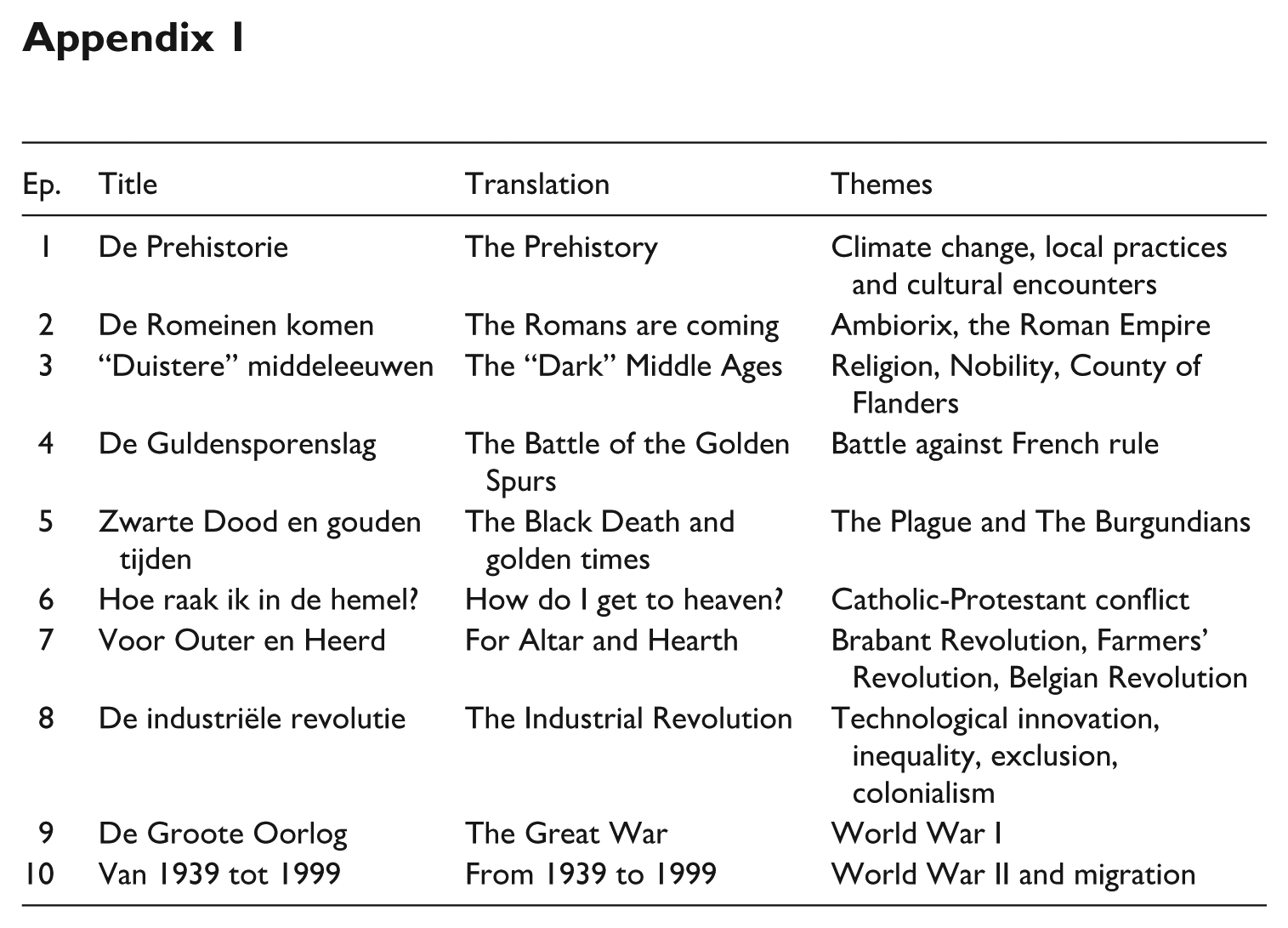
| Ep. | Title | Translation | Themes |
|---|---|---|---|
| 1 | De Prehistorie | The Prehistory | Climate change, local practices and cultural encounters |
| 2 | De Romeinen komen | The Romans are coming | Ambiorix, the Roman Empire |
| 3 | “Duistere” middeleeuwen | The “Dark” Middle Ages | Religion, Nobility, County of Flanders |
| 4 | De Guldensporenslag | The Battle of the Golden Spurs | Battle against French rule |
| 5 | Zwarte Dood en gouden tijden | The Black Death and golden times | The Plague and The Burgundians |
| 6 | Hoe raak ik in de hemel? | How do I get to heaven? | Catholic-Protestant conflict |
| 7 | Voor Outer en Heerd | For Altar and Hearth | Brabant Revolution, Farmers’ Revolution, Belgian Revolution |
| 8 | De industriële revolutie | The Industrial Revolution | Technological innovation, inequality, exclusion, colonialism |
| 9 | De Groote Oorlog | The Great War | World War I |
| 10 | Van 1939 tot 1999 | From 1939 to 1999 | World War II and migration |
Acknowledgements
I want to express my sincerest gratitude to prof. dr. Kevin Smets and dr. Lennart Soberon for their feedback and extended guidance, which was valuable to this study. I extend my appreciation to prof. dr. Olga Van Oost and the colleagues at research group Echo for their keen eye and time.

Ethical considerations
The Human Sciences Ethics Review Committee at Vrij Universiteit Brussel approved my interviews (approval: ECHW_513-WP1) on April 02, 2024. Respondents gave written consent for review and signature before starting interviews.
Consent to participate
Respondents gave written consent to participate via the informed consent mentioned above.
Consent for publication
Respondents gave written consent for publishing via the informed consent mentioned above.
Funding
The author received no financial support for the research, authorship, and/or publication of this article.
Declaration of conflicting interests
The author declared no potential conflicts of interest with respect to the research, authorship, and/or publication of this article.