






Abstract
Severe disability is an important predictor of nursing home admissions. The purpose of this study is to examine the role of severe disability pacing on risk of short- and long-term nursing home stays. Respondents who developed severe disability were assigned into one of two pacing trajectories: catastrophic or progressive disability. The author analyzed seven waves of data from the Health and Retirement Study and created a series of discrete-time event history models. The analysis showed that the risk associated with severe disability and nursing home stays varied based on severe disability pacing. Progressive and catastrophic disability were associated with increased risk of short- and long-term stays; however, the risk of nursing home stays was much greater for respondents with catastrophic disability for short- and long-term stays. The findings have implications for policy and research. The author suggests that future research focus on interventions aimed at slowing the pace of severe disability.
Introduction
Nursing home stays are potentially problematic to both individuals and the community. For example, on an individual level, nursing home stays are associated with lower quality of life, and on a community level, nursing home stays are costly and particularly expensive for Medicaid and Medicare programs (Gaugler et al. 2007). Identifying major risk factors of nursing home stays enables researchers to consider possible interventions to decrease the number of nursing home stays, which may improve the quality of life and well-being for the growing aging population. The onset of severe disability among the elderly represents the inability to complete everyday tasks and the loss of independence, and it has been a focal point for many aging researchers. Severe disability, defined as having difficulty completing three or more activities of daily living (ADLs), is a strong and important risk factor of nursing home stays (Gaugler et al. 2007). However, the significance of severe disability pacing or the time characterization of onset is often overlooked in the current literature. Ferrucci and colleagues (1996) distinguished between progressive and catastrophic disability onset. In general, progressive disability is characterized as a slower or more gradual onset, while catastrophic disability is characterized as a faster or sudden onset. The purpose of this study is to explore the role of severe disability pacing on the risk of nursing home stays. More specifically, this study examines the unadjusted and adjusted risk of short- and long-term nursing home stays following progressive or catastrophic disability onset. This study attempts to highlight the role of severe disability pacing in relation to nursing home stays, so that future researchers will have a more complete understanding of a major risk factor.
Risk Factors of Nursing Home Stays
According to the most recent National Nursing Home Survey (NNHS) results, in 2004, the majority of nursing home patients were 65 years or older, female, and White (Jones et al. 2009). Previous research echoes these findings from the NNHS; among sociodemographic characteristics, age is the strongest and most consistent predictor of nursing home stays (Andel, Hyer, and Slack 2007; Hanely et al. 1990; Tomiak et al. 2000). Other major sociodemographic risk factors include race (i.e., White) and gender (i.e., female; Miller and Weissert 2000). Prior studies have also found family structure to be an important risk factor for nursing home stays. Individuals who are divorced/separated, widowed, or never married have a greater risk for nursing home stays (Freedman 1996; Miller and Weissert 2000). Those with fewer available kin are at a greater risk of nursing home stays (Aykan 2003; Noël-Miller 2010). For example, the availability of living children or living siblings is associated with reduced risk of nursing home admissions (Freedman 1996).
Additional studies have focused on health measures as risk factors of nursing home stays. A fairly recent study concentrated on lifestyle-related risk factors. Valiyeva et al. (2006) demonstrated that numerous lifestyle measures, including physical inactivity, smoking, and obesity, significantly increased the risk of nursing home stays. Miller and Weissert’s (2000) comprehensive literature review noted that health insurance status (i.e., Medicare coverage), functional performance, greater illness severity, and prior hospital use were significant and reliable predictors of nursing home admissions. Similarly, a recent meta-analysis of nursing home admissions identified severe disability, cognitive ability, and prior nursing home stays as the strongest risk factors of nursing home use (Gaugler et al. 2007). Both severe disability and cognitive impairment are strong predictors of nursing home admissions, yet cognitive impairment is strongly associated with disability (Aguero-Torres et al. 1998; Dodge et al. 2005; Greiner, Snowdon, and Schmitt 1996). ADL disability reflects difficulty in completing daily tasks such as bathing or dressing and a loss of independence, which may reflect functional or cognitive impairments (Dodge et al. 2005). Greiner et al. (1996) delineate two possible scenarios to describe the relationship between cognitive impairment and disability: (1) low cognitive impairment indicates the beginning stages of a dementing disease or (2) concurrent cognitive and function declines from a disease or condition (e.g., stroke). While this study does not explicitly measure cognitive ability, ADL disability implicitly captures both functional and cognitive declines. Gaugler et al. (2007) discovered that “once certain functional or cognitive thresholds are reached, future risk of [nursing home] admission increases substantially (net a host of other factors)” (p. 12). Accordingly, the authors found that having three or more ADLs (severe disability) tripled an individual’s likelihood of nursing home admissions (Gaugler et al. 2007). Thus, although there are many significant risk factors for nursing home admissions and stays, severe disability is one of the most critical risk factors.
Nursing Home Stays and Length of Stay
The majority of research examining nursing home stays does not differentiate between short- and long-term stays (Gaugler et al. 2007; Liu, McBride, and Coughlin 1994); however, not all nursing home stays are alike. Nursing home stays may reflect a need for long-term care from chronic conditions, short-term rehabilitative care, or short-term care for end stages of a terminal illness (Liu et al. 1994; Pourat, Anderson, and Wallace 2001). According to Liu et al. (1994), approximately one-third of lifetime nursing home stays were short-term stays (90 days or less). In 2004, among nursing home residents aged 65 years or older, approximately 19.4% of stays were less than three months and approximately 24.2% of stays were three months to less than a year, while the majority (56.4%) of nursing home stays were longer than a year (Jones et al. 2009). Furthermore, partnered residents and residents who lived with family members prior to admission had shorter stays (Jones et al. 2009). In relation to disability, the length of stay is an important consideration. Liu, Coughlin, and McBride (1991) found that ADL limitations were associated with greater risk of admission and longer duration. In another study, ADL dependency was not found to be significantly associated with short-term stays, yet it was associated with long-term stays (Liu et al. 1994). Gaining more knowledge about the risk of both short- and long-term nursing home stays is central to developing a more complete understanding of nursing home stays for both researchers and policy makers.
Severe Disability and Nursing Home Stays
Severe disability is one of the most robust risk factors for nursing home stays (Gaugler et al. 2007); however, there is little research investigating the influence of severe disability pacing on nursing home stays. The concepts of progressive and catastrophic disability enable researchers to examine the pacing of severe disability onset. Rapid onset of severe disability is indicative of catastrophic disability with a markedly steeper decline, while gradual onset is indicative of progressive disability onset. During a catastrophic decline, an individual with no initial impairment develops severe disability in a relatively short period of time. Often catastrophic disability occurs from sudden medical events (i.e., stroke, falls, hip fractures; Ferrucci et al. 1996); however, the pacing of disability is influenced by other contextual factors via exacerbators and interventions (Verbrugge and Jette 1994). Interventions and exacerbators either reduce or escalate, respectively, the impairment an individual may experience; examples of interventions include medical care and rehabilitation, medications and other therapeutic regimens, and modifications of built/physical/social environment, while examples of exacerbators include “interventions that have gone awry” and societal impediments such as “inflexible work hours, architectural barriers, social prejudice” (Verbrugge and Jette 1994:8). Progressive disability typically stems from degenerative diseases (e.g., arthritis), and severe disability onset occurs over a longer period of time. Distinguishing between progressive and catastrophic disability is vital given that previous studies have shown that following catastrophic disability onset, individuals are more likely to be hospitalized or die when compared to progressive disability onset (Ferrucci et al. 1996, 1997). Moreover, using catastrophic and progressive disability to examine severe disability pacing emphasizes that the onset of disability is often a process (see Verbrugge and Jette 1994), which suggests that there are opportunities to reduce the speed of severe disability onset.
Only one study has investigated progressive and catastrophic disability in relation to nursing home stays. Ferrucci et al.’s (1997) research demonstrated that among individuals without prior nursing home use, a higher proportion of respondents experiencing a nursing home admission had reported a catastrophic decline compared to a progressive decline. The authors found that the likelihood of nursing home admission was almost three times that for respondents with catastrophic disability compared to those with progressive disability (Ferrucci et al. 1997). The Ferrucci et al. (1997) study only explored catastrophic and progressive disability in a limited way. The authors controlled for age and sex, but other important factors shaping likelihood of nursing home admissions such as family structure and health measures were not included in the analysis. Additionally, their study did not differentiate between short- and long-term stays. More recently, Li (2005:65) found that seven to eight months prior to institutionalization an “upsurge of ADL disability” occurred; the author’s findings suggest that shortly before nursing home admissions, individuals tend to experience a catastrophic decline.
The current study adds to the extant literature by taking a closer examination of catastrophic and progressive disability and nursing home stays. The analysis takes into account other key risk factors of nursing home stays, which enables the author to discuss unadjusted and adjusted risk. Additionally, the author utilizes a longitudinal data set representing 12 years of data that also distinguish between short- and long-term stays. Based on existing literature, the author anticipates that respondents who experience catastrophic disability onset will be at a significantly greater risk of nursing home stays, especially long-term stays. This research furthers the understanding of a major nursing home stay risk factor—severe disability. By exploring severe disability in relation to pacing, this study creates opportunities for future researchers to consider mechanisms to slow the disabling process and ultimately reduce nursing home stays.
Method
Data
This research uses data from Waves 2 through 8 (1994-2006) of the Health and Retirement Study (HRS), which is sponsored by the National Institute of Aging (grant number NIA U01AG009740) and the Social Security Administration and conducted by the University of Michigan (HRS 2006). The initial goal of the HRS was to describe, in detail, the lives of older U.S. adults, including information about physical and mental health, health insurance, finances and retirement, and family. The HRS is an ongoing nationally representative longitudinal survey of a late midlife cohort (born 1931-1941) and their spouses (regardless of the spouse’s age). African Americans (1.86:1), Hispanics (1.72:1), and Florida residents (2:1) were oversampled. The first interviews were conducted as structured face-to-face interviews in 1992, and then two-year follow-up telephone surveys have been used. Some proxy interviews have been conducted after the death of a respondent; the proxy informant was the person “most familiar” with the respondent’s finances, health, and family, which was usually the spouse. The initial sample size was approximately 12,600 people in 7,600 households. In Wave 3 (1996), the HRS was merged with three other subsamples: the Asset and Health Dynamics Among the Oldest Old (AHEAD), War Babies, and Children of the Great Depression (HRS 2006). Additionally, to assist in the data management and analysis of this project, the most recent RAND HRS data file was used; the RAND HRS data file is a user-friendly, longitudinal data set created from original HRS data by the National Institute on Aging and Social Security Administration (RAND 2008). Because the HRS focuses on a late midlife cohort with an abundance of health information and has many years of follow-up data, it is ideal for examining nursing home stays and disability.
Measures
For this study, the dependent variable was nursing home stays. The RAND HRS data file created a dichotomous dummy variable (nursing home stay = 1) for each wave. The variable was created from the question: “In the past two years or since [previous interview date], have you been a patient in a nursing home overnight?” Respondents who were currently living in a nursing home facility were also interviewed and their admission dates were calculated to determine if respondents had entered during the interval. Additionally, information was provided for the length of stay; the number of nights was calculated for any respondent reporting that they had been a patient in a nursing home. Because of the variation in length of nursing home stays, nursing home stays were broken into two categories: short-term stays (90 days or less) and long-term stays (more than 90 days). Ninety days is a commonly used cut-off for short- and long-term nursing home stays (see Liu et al. 1994; Pourat et al. 2001). Respondents who reported more than one nursing home admission were omitted to eliminate the possibility of a respondent being categorized as having a long-term stay when they had multiple short-term stays. For example, a respondent could report having stayed 120 days in a nursing home over the two-year interval, yet the respondent may have had two 60-day stays; therefore, respondents with multiple stays were not included in the analysis.
The independent variable of interest was severe disability. More specifically, the independent variable of interest was whether or not a respondent had developed catastrophic or progressive disability, which are measures that account for the time characterization of the severe disability onset. A respondent was considered to have severe disability if they had difficulty completing three or more ADLs. This threshold of three or more ADLs has been used in the previous progressive and catastrophic disability studies (see Ayis et al. 2006; Ferrucci et al. 1996, 1997). Three disability categories were formed based on ADL summary index created for the RAND HRS data file: no disability, mild disability, and severe disability. The ADL summary index ranged from 0 to 5 and used five standard ADL measures: (1) difficulty walking across the room, (2) difficulty bathing/showering, (3) difficulty dressing, (4) difficulty eating, and (5) difficulty getting in/out of bed. The ADLs were all self-reported. Respondents who had “any difficulty” for each task were assigned a value of 1 for that ADL task. Respondents who had difficulty completing all of the ADL tasks were assigned the maximum value of the index (5), and those respondents who had no difficulty completing any of the ADL tasks were assigned the lowest value of the index (0). For each wave, respondents were assigned into the three disability categories: no disability (ADL summary index = 0), mild disability (ADL summary index = 1 or 2), or severe disability (ADL summary index = 3 to 5). From these measures, catastrophic and progressive disability categories were formed by using information from the previous wave. If respondents had no disability from the previous wave and then experienced severe disability in the subsequent wave, then they were categorized as having catastrophic disability. Respondents who had mild disability in the previous wave and then experienced severe disability in the following wave were categorized as having progressive disability. In all, there were a total of three categories for severe disability: no severe disability (reference), progressive disability, and catastrophic disability.
Other independent variables were included in the analysis, including sociodemographic characteristics and family structure measures. Sociodemographic characteristics included age, gender, race and ethnicity, education, and household income. With the exception of household income, the sociodemographic characteristics were treated as time-fixed variables. Age was measured at Wave 3 (1996). A dichotomous dummy variable was created for gender (female = 1). A four-category dummy variable was created for race and ethnicity with White (reference), Black, Hispanic, and Other Race as the categories. Education was measured as the number of years of formal education. The RAND HRS data file created a measure of total household income (respondent and spouse only). In the analysis, household income was treated as a time-varying variable and was scaled ($10,000).
Family structure measures included marital status, number of living children, number of living siblings, and number of living parents. All of the family structure measures were treated as time-varying variables. A four-category dummy variable was created for marital status with married/partnered (reference group), separated/divorced, widowed, and never married. The other family structure measures, number of living children, number of living siblings, and number of living parents, were created for the RAND HRS data file. The number of living children (biological or adopted) included the children of the respondent and the spouse’s living children. The number of living siblings was a count measure of the respondent’s living siblings. This measure did not include step-siblings. Finally, the number of living parents was also included. Step-parents were not included in the measure.
Additionally, health care access and utilization measures, health behaviors, and morbidity status were included as covariates. Health care access and utilization were measured using three variables, including health insurance coverage, doctor visits, and hospitalizations. All of the health care access and utilization measures were treated as time-varying variables. Health insurance coverage was determined by self-reports of having private insurance (personal or spousal), government insurance, or no insurance. Respondents with any type of private insurance were categorized as having “private insurance,” while those with government insurance but no private insurance were categorized as having “government insurance,” and respondents reporting no private insurance or government insurance coverage were categorized as having “no insurance.” Both doctor visits and hospitalizations were self-reported and were measured at the beginning of the interval about the past two years.
Health behaviors were measured as time-varying variables and included body mass index (BMI), smoking status, and physical activity. The measure of BMI used for this analysis was created in the RAND HRS file based on self-reports of weight and height. BMI was treated as a quadratic term and BMI2 was included in the analysis. A three-category dummy variable was created for smoking status (i.e., never smoked, former smoker, and current smoker). This variable was constructed from two RAND HRS measures of whether respondents were “current” smokers or had “ever” smoked. Respondents who reported that they were not current smokers but had smoked in the past were categorized as “former smokers,” while respondents who reported that they were not current smokers and had not “ever” smoked were categorized as “never smoked,” and those who reported that they were current smokers were categorized as “current smokers.” Respondents were considered physically active if they participated in vigorous exercise or sports three or more times per week. Physical activity was based on self-reports and constructed from the RAND HRS data file. Morbidity status was also measured as time varying. Eight individual conditions were included: high blood pressure, diabetes, cancer, lung disease, heart problems, stroke, arthritis, and psychological problems (i.e., emotional, nervous, or psychiatric problems). The conditions are based on self-reports of being diagnosed by a doctor or other medical professional.
Analytic Strategy
A total of seven waves of data (Wave 2 through Wave 8) were utilized. There was a cross-wave concordance issue with the ADL measures from Wave 1 to Wave 2; therefore Wave 1 was not included in the analysis. The sample was restricted to respondents aged 50 years or older in Wave 3 with no prior nursing home use (1996; N = 16,125). For each interval, the previous wave of data was used to establish the time characterization of severe disability, so there were a total of five intervals created from seven waves of data. The risk group at the beginning of each interval was respondents without prior nursing home use; therefore, the initial risk group was respondents who did not report a nursing home stay in Wave 3 (or did not have a nursing home stay between Wave 2 and Wave 3). Discrete-time event history analysis with multiple competing events was estimated using multinomial logistic regression. The models include short-term stays versus no nursing home stay and long-term stay versus no nursing home stay. Additionally, attrition was modeled explicitly as a competing event, but the results for attrited respondents are not presented. Odds ratios were then ascertained for each variable. Model 1 included severe disability and time, while Model 2 introduced sociodemographic characteristics. Model 3 added family structure. The final model (Model 4) introduced the health measures, health care access and utilization, health behaviors, and morbidity status. This model strategy was employed so that unadjusted and adjusted risk could be examined.
Sample Characteristics
In Wave 3, the average age of the respondent was approximately 67 years, a little over 3% of the sample reported having had a nursing home stay in the past two years. Of the respondents reporting having stayed in a nursing home, the average length of stay was 215 nights (median: 90 nights). Approximately 8% reported having severe disability. Table 1 presents key descriptive measures of the sample. The majority of respondents were female (55.7%). For race and ethnicity, the sample was 76.4% White, 14.5% Black, 1.6% Other Race, and 7.5% Hispanic. The average amount of formal education was 11.6 years and the scaled averaged income was 4.3 ($43,000). Most respondents were married (66.3%).
Descriptive Statistics at Time 3

Source: RAND Health and Retirement Study (HRS) Data (1996).
Percentage distributions are shown for nominal variables; means and standard deviations are shown for quantitative variables.
Results
Short-term Nursing Home Stay Versus No Nursing Home Stay
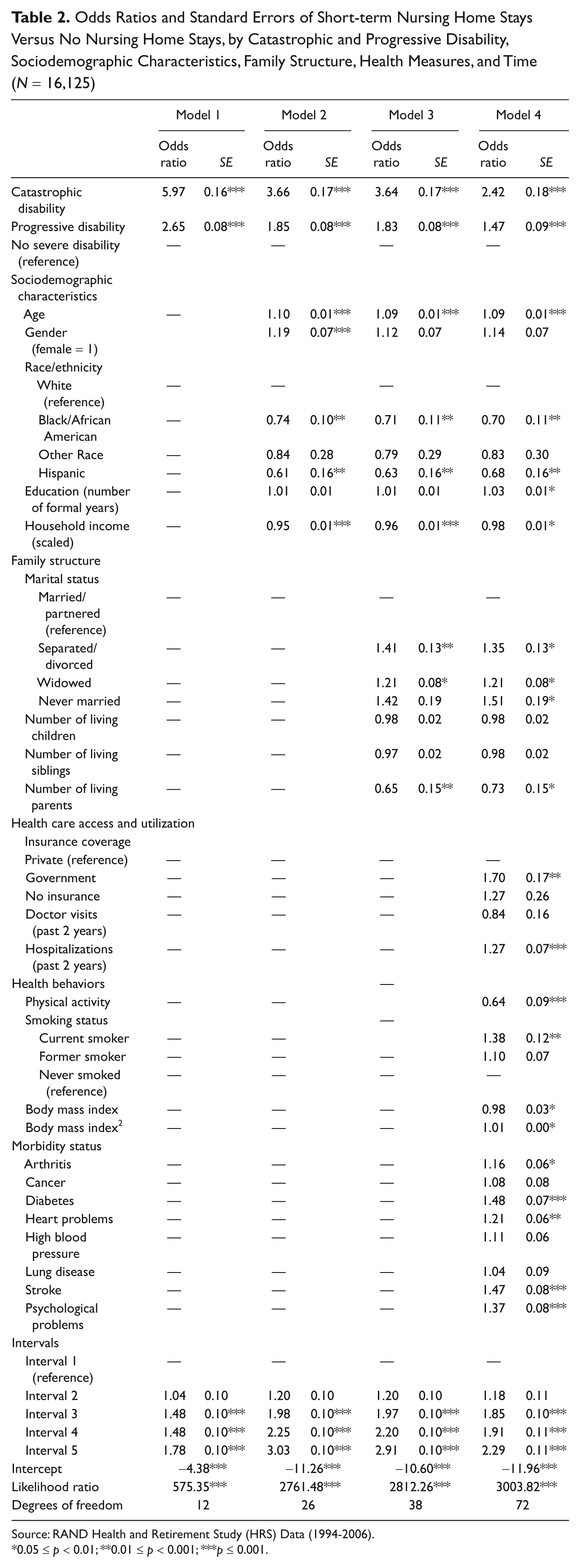
Table 2 displays a summary of the findings of multinomial logistic regression analyses for short-term nursing home stays versus no nursing home stay. Odds ratios are presented (along with standard errors). The likelihood ratio and intercept for all models are statistically significant at an alpha level of less than 0.001. Model 1 presents the unadjusted risk for short-term nursing home stays for severe disability (i.e., catastrophic and progressive disability). Both respondents with catastrophic and progressive disability were at an increased risk of short-term nursing home stays; however, respondents who reported having catastrophic disability onset had an exceptionally high risk (odds ratio = 5.97) of short-term nursing home stay as compared to those without severe disability, and respondents who reported having progressive disability were more than two and half times (odds ratio = 2.65) more likely of reporting a short-term nursing home stay.
Odds Ratios and Standard Errors of Short-term Nursing Home Stays Versus No Nursing Home Stays, by Catastrophic and Progressive Disability, Sociodemographic Characteristics, Family Structure, Health Measures, and Time (N = 16,125)
Source: RAND Health and Retirement Study (HRS) Data (1994-2006).
0.05 ≤ p < 0.01; **0.01 ≤ p < 0.001; ***p ≤ 0.001.
Model 2 demonstrates the risk of short-term nursing home stays for catastrophic and progressive disability adjusted for sociodemographic characteristics. The risk of experiencing a short-term nursing home stay compared to no nursing home stay remains remarkably high for catastrophic disability (odds ratio = 3.66) as well as progressive disability (odds ratio = 1.85). Once again, the risk for nursing home admissions was much greater for those respondents with catastrophic disability. Older and female respondents were at a greater risk of a short-term nursing home stay with odds ratios of 1.10 and 1.19, respectively. Black/African American (odds ratio = 0.74) and Hispanic respondents (odds ratio = 0.61) were at a lower risk of short-term nursing home stays as compared to Whites. Income (odds ratio = 0.95) also had a protective effect—respondents with higher income levels were less likely to report a short-term nursing home stay.
In Model 3, family structure measures were introduced. The risk of short-term nursing home stays for catastrophic disability adjusted for sociodemographic characteristics and family structure remained high (odds ratio = 3.64). Respondents who reported a catastrophic decline were more than three and half times more likely to experience a short-term nursing home stay even after adjusting for sociodemographic characteristics and family structure. The adjusted risk for progressive disability also continued to be large (odds ratio = 1.83). Age and marital status were significant risk factors in Model 3; older, separated/divorced, and widowed respondents were more at risk of having a short-term stay with odds ratios of 1.09, 1.41, and 1.21, respectively. Being Black/African American (odds ratio = 0.71), Hispanic (odds ratio = 0.63), having a higher household income (odds ratio = 0.96), and a higher number of living parents (odds ratio = 0.65) were all protective measures.
In the final model (Model 4), health care access and utilization, health behaviors, and morbidity status were added to the model. The adjusted risk of short-term nursing home stays for catastrophic disability was almost two and a half times (odds ratio = 2.42) that of no nursing home stay. Progressive disability (odds ratio = 1.47) was also associated with a higher risk of short-term nursing home stay. In the final model, age (odds ratio = 1.09), education (odds ratio = 1.03), and being separated/divorced (odds ratio = 1.35), widowed (odds ratio = 1.21), or never married (odds ratio = 1.51) were risk factors for short-term nursing home stays. The education finding is somewhat unexpected given that previous research has found education to not be significantly associated with nursing home stays (see Bharucha et al. 2004; Kemper and Murtaugh 1991); however, education has only been investigated in a limited fashion, often using a dichotomous measure or not differentiating between short- and long-term stays. Being Black/African American (odds ratio = 0.70) or Hispanic (odds ratio = 0.68), and having a higher household income (odds ratio = 0.98) or number of living parents (odds ratio = 0.73) were associated with lower risk of short-term nursing home stay. Among the health care access and utilization variables, insurance coverage and hospitalizations were significant risk factors. Compared to respondents with private insurance coverage, respondents with government insurance coverage (odds ratio = 1.70) were at an increased risk of short-term nursing home stays. Prior hospitalizations (odds ratio = 1.27) also increased a respondent’s risk of a short-term nursing home stay. Physical activity, smoking status, and BMI were also significant predictors. Physical activity had a protective effect with an odds ratio of 0.64. Current smokers (odds ratio = 1.38) were more likely to experience a short-term nursing home stay compared to nonsmokers. BMI and BMI2 were both significant—indicating that the relationship between BMI and short-term nursing home stays was quadratic. Respondents at the low end and high end of BMI were at increased risk of short-term nursing home stays. For morbidity status, five of the eight conditions were significant risk factors. Arthritis (odds ratio = 1.16), diabetes (odds ratio = 1.48), heart problems (odds ratio = 1.21), stroke (odds ratio = 1.47), and psychological problems (odds ratio = 1.37) were all associated with a higher risk of short-term nursing home stays.
For all four models, there was a general trend of the risk of short-term nursing home stays increasing over time. For example, in the final model, interval 3 (odds ratio = 1.85), interval 4 (odds ratio = 1.91), and interval 5 (odds ratio = 2.29) were all significant risk factors; compared to interval 1, the likelihood of experiencing a short-term nursing home stay increased with the aging of the sample over time.
Long-term Nursing Home Stay Versus No Nursing Home Stay
Presented in Table 3 is a summary of the findings acquired from multinomial logistic regression analysis for long-term nursing home stays versus no nursing home stay. Odds ratios are presented (along with standard errors). The likelihood ratio and intercept for all models are statistically significant at an alpha level of less than 0.001. Model 1 presents the unadjusted risk for long-term nursing home stays related to catastrophic and progressive disability. Both respondents with catastrophic and progressive disability were at an increased risk of long-term nursing home stays. Respondents who reported having experienced a catastrophic decline were at an extraordinarily high risk (odds ratio = 14.84) of long-term nursing home stay as compared to those without severe disability, and respondents who reported experiencing a progressive decline (odds ratio = 3.77) were more likely of reporting a long-term nursing home stay.
Hazard Odds Ratios and Standard Errors of Long-term Nursing Home Stays Versus No Nursing Home Stays, by Catastrophic and Progressive Disability, Sociodemographic Characteristics, Family Structure, Health Measures, and Time (N = 16,125)

Source: RAND Health and Retirement Study (HRS) Data (1994-2006).
0.05 ≤ p < 0.01; **0.01 ≤ p < 0.001; ***p ≤ 0.001.
The risk of long-term nursing home stays for catastrophic and progressive disability adjusted for sociodemographic characteristics are shown in Model 2. The risk of experiencing a long-term nursing home stay compared to no nursing home stay remains remarkably high for catastrophic disability onset (odds ratio = 5.94) as well as progressive disability (odds ratio = 2.10). Older and female respondents were at a greater risk of a long-term nursing home stay with odds ratios of 1.15 and 1.45, respectively. Hispanic respondents (odds ratio = 0.48) had a considerably lower risk of long-term nursing home stays as compared to Whites. Also, higher household incomes (odds ratio = 0.95) were associated with lowered risk of long-term nursing home stays.
Family structure measures were introduced in Model 3. The risk of long-term nursing home stays for catastrophic disability adjusted for sociodemographic characteristics and family structure remained very high (odds ratio = 5.82). Similarly, the risk of long-term nursing home stays for respondents who reported a progressive decline remained substantial; the risk of long-term nursing home stays was more than two times (odds ratio = 2.12) more likely for those with progressive disability compared to no severe disability even after adjusting for sociodemographic characteristics and family structure. Significant risk factors for Model 3 included age (odds ratio = 1.13) and marital status; compared to married respondents, those who were separated/divorced (odds ratio = 1.49), widowed (odds ratio = 1.94), or never married (odds ratio = 2.16) all had a higher risk of long-term nursing home stays. Race/ethnicity and number of living children were also significant predictors. Black/African American and Hispanic respondents were less likely to experience a long-term stay compared to Whites, and having more living children reduced a respondent’s likelihood of a long-term stay.
In Model 4, health care access and utilization, health behaviors, and morbidity status were added to the model. The adjusted risk of long-term nursing home stays for catastrophic disability was more than four and a half times (odds ratio = 4.54) that of no severe disability. Progressive disability (odds ratio = 1.92) was also associated with a higher risk of long-term nursing home stay. In the final model, age (odds ratio = 1.13) and being separated/divorced (odds ratio = 1.57), widowed (odds ratio = 1.93), or never married (odds ratio = 2.09) were risk factors for long-term nursing home stays. Black/African American (odds ratio = 0.87), Hispanic (odds ratio = 0.45), number of living children (odds ratio = 0.93), and number of living parents (odds ratio = 0.91) were associated with lower risk of long-term nursing home stay. Among the health care access and utilization variables, insurance coverage and hospitalizations were significant risk factors. Compared to respondents with private insurance coverage, respondents with no insurance coverage (odds ratio = 3.84) were at a substantially increased risk of long-term nursing home stays. Prior hospitalizations (1.22) also increased a respondent’s risk of a long-term nursing home stay. Physical activity and BMI were also significant health behavior predictors. Physically active (odds ratio = 0.48) respondents were considerably less likely to experience a long-term nursing home stay compared to inactive respondents. BMI and BMI2 were both significant, which indicates that the relationship between BMI and long-term nursing home stays was quadratic. Respondents with low BMIs (underweight) or high BMIs (obese) were at increased risk of long-term nursing home stays. Only two out of eight conditions, diabetes (odds ratio = 1.62) and psychological problems (odds ratio = 1.95), were associated with a higher risk of long-term nursing home stays.
In Model 1, interval 2 (odds ratio = 0.78) and interval 5 (odds ratio = 0.77) were significant predictors; compared to interval 1, respondents were less likely to experience a nursing home stay in intervals 2 and 5. In Models 2 through 4, the risk of long-term nursing home stays, generally, increased over time. For example, in the final model (Model 4), interval 3 (odds ratio = 1.31), interval 4 (odds ratio = 1.55), and interval 5 (odds ratio = 1.41) were all significant risk factors; compared to interval 1, the likelihood of experiencing a long-term nursing home stay increased with increased age of the respondents.
Discussion
Distinguishing between catastrophic disability and progressive disability demonstrates role of severe disability pacing as a risk for both short- and long-term nursing home stays. The odds ratio for the unadjusted risk (Model 1) of short-term nursing home stays for catastrophic disability was 5.97 and the adjusted risk (Model 4) was 2.42, whereas the odds ratio for the unadjusted risk (Model 1) of short-term nursing home stays for progressive disability was 2.65 and the adjusted risk (Model 4) was 1.47. The odds ratio for the unadjusted risk (Model 1) of long-term nursing home stays for catastrophic disability is 14.84 and the adjusted risk (Model 4) is 4.54, whereas the odds ratio for the unadjusted risk (Model 1) of long-term nursing home stays for progressive disability is 3.77 and the adjusted risk (Model 4) is 1.92. Even after controlling for numerous other risk factors such as sociodemographic characteristics, family structure, and health measures, respondents that experienced a catastrophic decline were almost two and half times more likely to experience a short-term nursing home stay and more than four and half times more likely to experience a long-term nursing home stay.
In relation to short-term stays, a number of sociodemographic characteristics (i.e., age, race/ethnicity, education, and income), family structure measures (i.e., marital status and number of living parents), health care access and utilization (i.e., insurance coverage and hospitalization), health behaviors (i.e., physical activity, smoking status, BMI), and morbidity status (i.e., arthritis, diabetes, heart problems, stroke, and psychological problems) were all significant predictors. Many of these predictors are in line with previous research that has examined nursing home stays or admissions. There was one unexpected finding in relation to short-term nursing home stays; higher levels of education were associated with increased risk of short-term nursing home stays. It is possible that the nature of short-term stays, for example, being used for rehabilitative purposes or terminal stays, contribute to this finding.
For long-term stays, there were a number of significant predictors, including sociodemographic characteristics (i.e., age and race/ethnicity), family structure measures (i.e., marital status, number of living children, and number of living parents), health care access and utilization (i.e., insurance coverage and hospitalization), health behaviors (i.e., physical activity and BMI), and morbidity status (i.e., diabetes and psychological problems). For both short- and long-term stays, BMI and BMI2 were significant predictors. These quadratic relationships reflect the harmful effects of frailty—where the frail are more likely to be underweight (Fried et al. 2004)—and obesity on nursing home stays. Additionally, government insurance coverage was associated with an increased risk of short-term nursing home stays, while no insurance coverage was associated with an increased risk of long-term nursing home stays. The insurance coverage findings may stem from the restrictions placed on Medicare and Medicaid recipients; governmental programs currently pay for short-term, acute care in regards to nursing homes (Pourat et al. 2001).
The majority of health conditions were associated with short-term stays except high blood pressure and cancer; however, only two conditions, diabetes and psychological problems, were associated with long-term stays. A study conducted by Travis et al. (2004) profiled nursing home residents with diabetes and concluded that residents with diabetes required additional care due to increased comorbidities and complications compared to residents without diabetes. Diagnosable psychological problems among nursing home residents have been estimated at 80% or higher (Rovner et al. 1986; Rovner and Katz 1993; Tariot et al. 1993). There is evidence that being placed in a nursing home leads to deterioration in psychiatric profiles (Scocco, Rapattoni, and Fantoni 2006). It is possible that the particularly pronounced relationship between psychological problems and long-term stays are a result of a decline in mental health over time, the nature of the stay (e.g., awareness of a long-term or permanent stay without the potential to return home), or psychological problems contributing to the decision to place an individual in a nursing home.
Limitations
One of the main limitations of this research is the attrition due to mortality and drop-outs. The author explicitly modeled attrition as a competing event to minimize attrition bias. The second main limitation of this study is the two-year interval. The author cannot establish at what point during the two-year interval respondents were admitted to a nursing home. Furthermore, decline in ADL functioning is treated as a single event; however, the concepts of progressive and catastrophic disability view the disabling process as a continual decline where catastrophic disability represents a distinctly steeper slope compared to progressive disability. Finally, to whom those with progressive and catastrophic disability were compared, respondents without severe disability, was heterogeneous. This group includes those with no disability or mild disability. Despite these limitations, this research provides evidence that pacing of disability influences the risk of short- and long-term nursing home stays.
Conclusions
This research has implications for aging policy and research. Following catastrophic disability, the risk of short- and long-term nursing home stays are very high; however, the risk of long-term nursing home stays is remarkably high, yet Medicare and Medicaid often will not pay for long-term care (Pourat et al. 2001). Health care reform continues to be a contentious topic within the political arena, yet major concerns about health care spending are in the forefront of the conversation. As the baby boomers reach old age, concerns about financing the possible increased need for formal short-term acute care and formal long-term chronic care will need to be addressed. Understanding the risk of short- and long-term nursing home stays is an important step in developing adequate guidelines for health care expenditures related to formal care.
The time characterization of severe disability pacing is an important antecedent of nursing home stays. Gaining a more complete understanding of the mechanisms such as exacerbators and interventions that influence disability pacing could aid researchers and clinicians in reducing the number of long-term nursing home stays. Interventions aimed at slowing the pacing of severe disability onset will not only lead to a better quality of life for individuals, but also may prevent some of the financial burden associated with nursing home stays. In the future, the author suggests more research exploring severe disability pacing—in particular, intervention research targeted at reducing the amount of catastrophic disability and slowing the disabling process more generally. Additionally, the author suggests future studies using retrospective or prospective longitudinal data with smaller interval periods aimed at understanding the time characterization of the disabling process leading to a nursing home stay. By using retrospective data, researchers could find potential triggers that lead to a catastrophic decline and the increased need for formal care.
Footnotes
The author(s) declared no potential conflicts of interest with respect to the authorship and/or publication of this article.
The author(s) received no financial support for the research and/or authorship of this article.