







Abstract
This study aimed to identify differences in individual, social, and physical environmental factors across the stages of physical activity and explore the effect of those variables on physical activity among older adults. Two hundred and ninety adults aged over 65 years were recruited from the Seodaemun district of Seoul. Standardized scales were used to measure physical activity, stage of change, self-efficacy, decisional balance, social support, and the physical environment. The results indicated that 70.7% of older adults engaged in regular physical activity. Based on the multivariate analysis of variance, only the psychological variables of self-efficacy and perceived benefits and the environmental variables of family support and the physical environment increased significantly across the stages of physical activity change. Based on the regression analysis, the most important predictors of physical activity in a descending order of significance were self-efficacy, perceived benefits, family support, and the physical environment. The total variance in physical activity explained by these variables was 40%.
It has been reported that the older adult population (i.e., those aged over 65 years) has been rapidly increasing in most countries worldwide (Department of Statistics, 2006; Federal Interagency Forum on Aging-Related Statistics, 2008). As people age, they experience several negative physical and psychological changes, such as decreased muscle strength, flexibility, balance, cognitive function, and increased depression (Burbank, Riebe, Padula, & Nigg, 2002). Physical activity is one of the most important health behaviors that can decrease the negative health-related risks of aging (Cyarto, Moorhead, & Brown, 2004; Netz, Wu, Becker, & Tenenbaum, 2005). However, recent statistics indicate that many older adults are insufficiently active to obtain the many health-related benefits of exercise (U.S. Center for Disease Control and Prevention, 2004). In the United States, approximately 30% of older adults reported that they did not participate in leisure-time physical activity in 2000 (U.S. Center for Disease Control and Prevention, 2001), and the prevalence of physical inactivity among older adults increased to 40% in 2004 (National Center for Health Statistics, 2004). Older U.S. women tend to be especially inactive; only 20% of women aged 65–74 years and 11% of women aged 75 years or older participate in regular leisure-time physical activity (King, 2004). Korean data related to the physical activity levels of older adults demonstrate similar trends to those observed in the U.S. statistics. For example, Cheong and Chang (2004) indicated that only 14% of Korean older adults (males = 22% and females = 8%) participated in physical activity on a regular basis. In addition, in 2006, the Korean Institute of Sport Sciences reported that approximately 48% of older adults do not participate in any types of physical activity, which is a higher inactivity rate than the one related to younger age groups. In this regard, it is widely documented that physical inactivity is a significant cause of hypertension, Type 2 diabetes, cardiovascular diseases, and coronary heart disease (Rejeski & Mihalko, 2001; Struck & Ross, 2006).
In the last decade, it has become increasingly important to identify ways to promote physical activity for health and wellness among older adults in western societies (Brawley, Rejeski, & King, 2003; Lim & Taylor, 2005). However, in Korea, there has been no research in this area; instead, the focus has been on the differences in physical activity levels based on demographic factors and the effects of physical activity on health (Kim, Kim, & Kim, 2005; Lee, 2001). Physical activity itself is a complex behavior that is affected by the interaction of multidimensional variables (Ronviak, Anderson, Winett, & Stephens, 2002). Therefore, variables that impinge upon and affect the physical activity of older adults can derive from psychological, social, and environmental domains (Fleury & Lee, 2006; Kim & Cardinal, 2010). Given its complex nature, the multiple influences of physical activity, such as psychological, social, and environmental factors, must be considered.
The social ecological model (SEM) has been increasingly applied in identifying correlates of participation in physical activity in a comprehensive viewpoint (Furman, 2005; Sylvia, 2004). The SEM emphasizes that physical activity is influenced by a complex interaction of multiple factors (i.e., psychological, social, and environmental), and therefore addressing variables at multiple levels is necessary to understand physical activity (Shibata, Oka, Harada, Nakamura, & Muraoka, 2009). According to this model, the influences on physical activity are made up by a series of layers (i.e., individuals, social environment, and physical environment). The innermost level represents the individual factors, which is then surrounded by the environmental factors (Bronfenbrenner, 1994). Specifically, individual factors that increase or decrease the likelihood of an individual being physically active include demographic variables (i.e., sex, age, and level of education, etc.) and psychological variables (i.e., self-efficacy, perceived benefits, and perceived barriers, etc). The next level surrounding the individual is the social environment that comprises the social relationships, the culture, and the society within which the individual lives and functions. The social environment includes social support from family, spouse and friends, social norm, and cultural background and has a significant influence on physical activity (Pis, 2006). Along with the social environment, the physical environment plays an important role to continue physical activity participation because physical activities take place in physical environments. There are a number of considerations when attempting to understand how the physical environment might influence physical activity participation. Natural factors (i.e., weather and geography, etc.), availability and access to exercise facilities (i.e., parks, playgrounds, swimming pool, etc.), and perceived qualities and safety of facilities are examples of physical environments (Troped, Saunders, Pate, Reininger, & Addy, 2003).
Many studies have applied an ecological perspective toward the promotion of physical activity, whereby multiple influences on physical activity are accounted for (Blanchard et al., 2005; McNeill, Wyrwich, Brownson, Clark, & Kreuter, 2006). According to these studies, self-efficacy, social support from family and friends, access to facilities, and various interactions between these variables were significantly and positively associated with physical activity. ThØgersen-Ntoumani (2009) examined the usefulness of an ecological model in predicting physical activity in Greek older adults and indicated that both psychosocial and environmental factors were positively related to physical activity. Of those factors, self-efficacy was the optimum predictor of physical activity, followed by support from friends and the presence of sidewalks. In Korea, there are very limited studies aimed at physical activity in an ecological viewpoint. However, the available studies had findings similar to the western studies. Yang, Lee, Kim, and Hyun (2005) tested the possibility of integrating psychosocial variables with physical environmental variables for better predicting physical activity. The result reported that the integrating model strongly contributed to explain physical activity and that self-efficacy and perceived benefits well mediated the relationship between social and physical environmental variables and physical activity. Recently, Kang and Kim (2011) investigated the multiple influences of psychological, social, and environmental variables on physical activity in Korean older adults and reported that all social ecological constructs had a significant effect on physical activity, with self-efficacy being the best exercise predictor. However, the strength and direction of the association of other psychosocial factors (i.e., intentions, social norm, perceived benefits, barriers to physical activity, etc.), and, in particular, environmental factors (i.e., availability and access to physical activity resources, neighborhood sidewalk and safety, and aesthetics, etc.) with physical activity continued to vary across previous multivariable studies (Pan et al., 2009; Shibata et al., 2009).
Limited research has been conducted to understand the relationship between physical activity and its multiple levels of influence among older adults, and, as indicated above, has been primarily undertaken in western societies; such research is lacking in other cultures, such as Korea, where the promotion of physical activity among older adults has only recently gained attention. Therefore, this study aimed to identify any differences in individual, social, and physical environmental factors across the stages of physical activity change and explore the effect of those variables on physical activity in Korean older adults.
Method
Participants
A total of 290 adults aged 65 years old or older (M age = 68.56 years, standard deviation [SD] = ±4.39, range = 65–89 years old) were recruited from the Seodaemun district of western Seoul. Dissemination sources for participant recruitment included the following (a) a press release issued through the district office, (b) recruitment flyers posted on the websites of community centers, and (c) announcements made through classes in community centers. The recruitment period lasted 1 month, and the potential participants who expressed an interest in the study during this time were added to a waiting list database. In the description of the study, it was emphasized that those who currently exercise, those who currently do not exercise, and those who are not interested in exercising were all encouraged to participate in the project. In this stage, also, older adults who had severe cognitive disability were ineligible to participate in the study. Of the 324 older adults who expressed an interest in participating in the study, 290 individuals (89.5% retention rate; male = 87 and female = 203) provided their consent forms and completed the survey. The study was approved by the Research Committee of the Seoul National University of Science and Technology.
Measures
Participants self-reported their gender, education level (elementary school, middle school, high school, university), and living situation (with children, with spouse, and alone). The exercise self-efficacy scale developed by Bandura (1997) was adapted for Korea and used in this study to measure the self-confidence of the participants with regard to undertaking the physical activity. The revised scale consisted of 18 items, with a 5-point response rate ranging from 1 (not at all confident) to 5 (extremely confident). Individuals rated the degree of confidence they possessed that they could exercise regularly (i.e., at least 5 times per week) under various circumstances (e.g., When I am feeling depressed or it is raining). A 2-week, test–retest reliability was performed, resulting in a reliability coefficient of .91 (Kim, 2007). In addition, construct validity was examined based on the results of a factor analysis and supported in the current study.
The decisional balance scale for exercise developed by Plotnikoff, Blanchard, Hotz, and Rhodes (2001) was adapted for Korea and applied to assess the perceived benefits and barriers of exercise. This 5-point scale consisted of 10 items (i.e., 5 benefits and 5 barriers), and participants were asked to indicate how important each statement was to them with regard to their decision of whether or not to exercise. Response rates ranged between 1 (strongly disagree) and 5 (strongly agree). An example of a perceived pro item is regular physical activity would help me relieve tension and an example of a perceived con item is regular physical activity would take up too much of my time. A 2-week, test–retest reliability was performed, resulting in a reliability coefficient of .81 for perceived benefits and .78 for perceived barriers (Kim, 2007). In addition, based on a factor analysis, construct validity of this measure was supported.
The social support scale for physical activity developed by Sallis, Grossman, Pinski, Patterson, & Nader (1987) was translated into Korean (Yang, Lee, Kim, & Hyun 2005) and used in the present study. The revised scale consists of 24 items (i.e., 12 relating to family support and 12 around friend support), and participants respond to statements such as I have a friend or acquaintance who encouraged me to exercise, with 5-point response rates ranging between 1 (never) and 5 (very often). The internal consistency of the scale was established (α = .85 for family and α = .88 for friends). In addition, a 2-week, test–retest reliability resulted in a reliability coefficient of .83 for family support and .89 for friends support (Yang et al., 2005). Based on a factor analysis, construct validity of this measure was supported.
The physical environment scale for physical activity developed by Stahl et al. (2001) was translated into Korean (Yang et al., 2005) and used in the present study to measure participant perception of neighborhood environment in relation to physical activity. The revised scale consists of 3 items evaluating availability and access to physical activity facilities (i.e., parks, jogging paths, and wellness centers, etc.). The study participants were asked to indicate how they perceived each statement, such as my residential area offers enough facilities for me to be physically active, with 5-point response rates ranging between 1 (not true at all) and 5 (definitely true), and the internal consistency of the scale was established among a middle-aged sample (α = .89) and a college sample (α = .78). A 2-week, test–retest reliability was performed, resulting in a reliability coefficient of .91 (Yang et al., 2005). In addition, based on a factor analysis, construct validity of this measure was supported.
The stages-of-change scale for physical activity developed by Marcus, Selby, Niaura, and Rossi (1992) was translated into Korean and used in the present study to measure participant current stage of physical activity. In this scale, stage of physical activity was assessed using a 5-item, dichotomous scale (yes/no) related to regular physical activity and intentions. The participants were categorized into one of the five stages of physical activity: (1) precontemplation (individuals are physically inactive and do not intend to initiate exercise within the next 6 months), (2) contemplation (individuals are physically inactive and intend to begin regular exercise within the next 6 months), (3) preparation (individuals are irregularly active below a criterion level three or more times per week for at least 30 min each time), (4) action (individuals have been regularly active for less than 6 months), and (5) maintenance (individuals have sustained regular exercise for more than 6 months after initial exercise). A 2-week, test–retest reliability was conducted, resulting in a reliability coefficient of .85. In addition, construct validity of this measure was supported by correlation with the Korean LTEQ in the current study (Spearman’s ρ = .93).
A leisure time physical activity scale developed by Godin and Shephard (1985) was adapted for Korea and used in the present study to assess habitual weekly physical activity behaviors. Participants reported how many times during a typical week they took part in strenuous (e.g., running and vigorous cycling), moderate (e.g., fast walking and easy swim), and mild (e.g., yoga and golf) physical activity for more than 15 min. Scores were calculated by multiplying each reported activity session by its metabolic equivalent (MET) value and adding the result (MET score = [Strenuous × 9] + [Moderate × 5] + [Mild × 3]). The 2-week, test–retest Cronbach’s α reliability coefficient for the Korean version of the LTEQ was .86 (Kim & Cardinal, 2010). Construct validity of the Korean LTEQ was supported by correlation with an accelerometer in the previous study (Spearman’s ρ = .77; Kim, 2011).
Procedures of Translation and Validation for the Measures
The measures applied in this study were translated into Korean and their reliability was supported by previous studies (Kim, 2007; Kim & Cardinal, 2010; Yang et al., 2005). However, validation processes were performed for the current measures because the previous studies were conducted in adolescents and young adults. These procedures were guided by the methodology of Banville, Desrosiers, and Genet-Volet (2000), which resulted in measures that appeared to be both culturally appropriate and psychometrically sound. In the initial stage, the standardized measures were administered to two Korean scholars who were familiar with physical activity in older adults and psychological variables for additional item modifications. Through this process, content validity suitable to the purposes of the study was established. In addition, the measures were tested among a sample of 78 Korean older adults of similar age to the target population to control for item clarity and response variance and to estimate reliability. Two weeks after the initial measures were taken, the measures were administered again using the Korean pilot-based sample (n = 78) to evaluate their test–retest reliability.
Data Analysis
Descriptive statistics (i.e., means, SDs, and frequencies) were used to summarize participant characteristics. Crosstab analysis with chi-square (χ2) was carried out to examine physical activity distribution by gender, education level, and living situation. A one-way multivariate analysis of variance (MANOVA), along with post hoc analyses, was performed to explore the differences in psychological, social, and physical environmental variables and physical activity across the stages of change. Correlation analysis was then used to examine associations between the multiple levels of variables and physical activity. A stepwise multiple regression analysis was carried out to identify the most significant predictors of physical activity. Before running MANOVA and the regression analysis, the normal distribution and homogeneity of variance were tested and supported. All statistical methods applied in this study were conducted using the SPSS 18.0 version.
Results
Stage-of-Change Classification
Participants were classified into one of five stages of change as follows: precontemplation (n = 6, 2.1%), contemplation (n = 11, 3.9%), preparation (n = 66, 23.3%), action (n = 19, 6.7%), and maintenance (n = 181, 64.0%). Participant physical activity did not differ statistically by gender, χ2(4) = 3.18, p = .52, education level, χ2(11) = 11.13, p = .51, and living situation, χ2(16) = 17.43, p = .35. Therefore, the demographic variables were not treated as moderators of physical activity in subsequent analyses.
Difference in Physical Activity Determinants Across the Stages of Change
Table 1 illustrates the results of one-way MANOVA with Tukey post hoc contrasts for physical activity, psychological, social, and physical environmental variables across the stages of physical activity. Before running MANOVA, the participants in the precontemplation stage (n = 6) and those in the contemplation stage (n = 11) were combined into one stage (inactive) due to the small number of people in precontemplation. In the psychological variables, self-efficacy, F(3, 286) = 31.45, p < .001, and perceived benefits, F(3, 286) = 7.59, p < .001, differentiated older adults at different stages of physical activity. The post hoc tests revealed significant increases in both variables from the inactive to the maintenance stages. In addition, for the environmental variables the significant differences in family support, F(3, 286) = 3.64, p < .05, and physical environment, F(3, 286) = 2.69, p < .05, emerged across stages of physical activity. Older adults in the precontemplation and contemplation stages perceived their family support and physical environment associated with physical activity as being significantly worse in comparison with those in the action and maintenance stages. In addition to this, on the basis of eta-square (η2), most of the variables were significantly associated with stage of change, except perceived barriers and friend support. In a descending order of explained variance, the largest portion of variance was explained by self-efficacy (η2 = .51), followed by perceived benefits (η2 = .29), support from family (η2 = .18), physical environment (η2 = .12), and physical activity (η2 = .12).
Means and Standard Deviations of Psychological, Social, and Physical Environmental Variables and Physical Activity Across the Stages of Change.
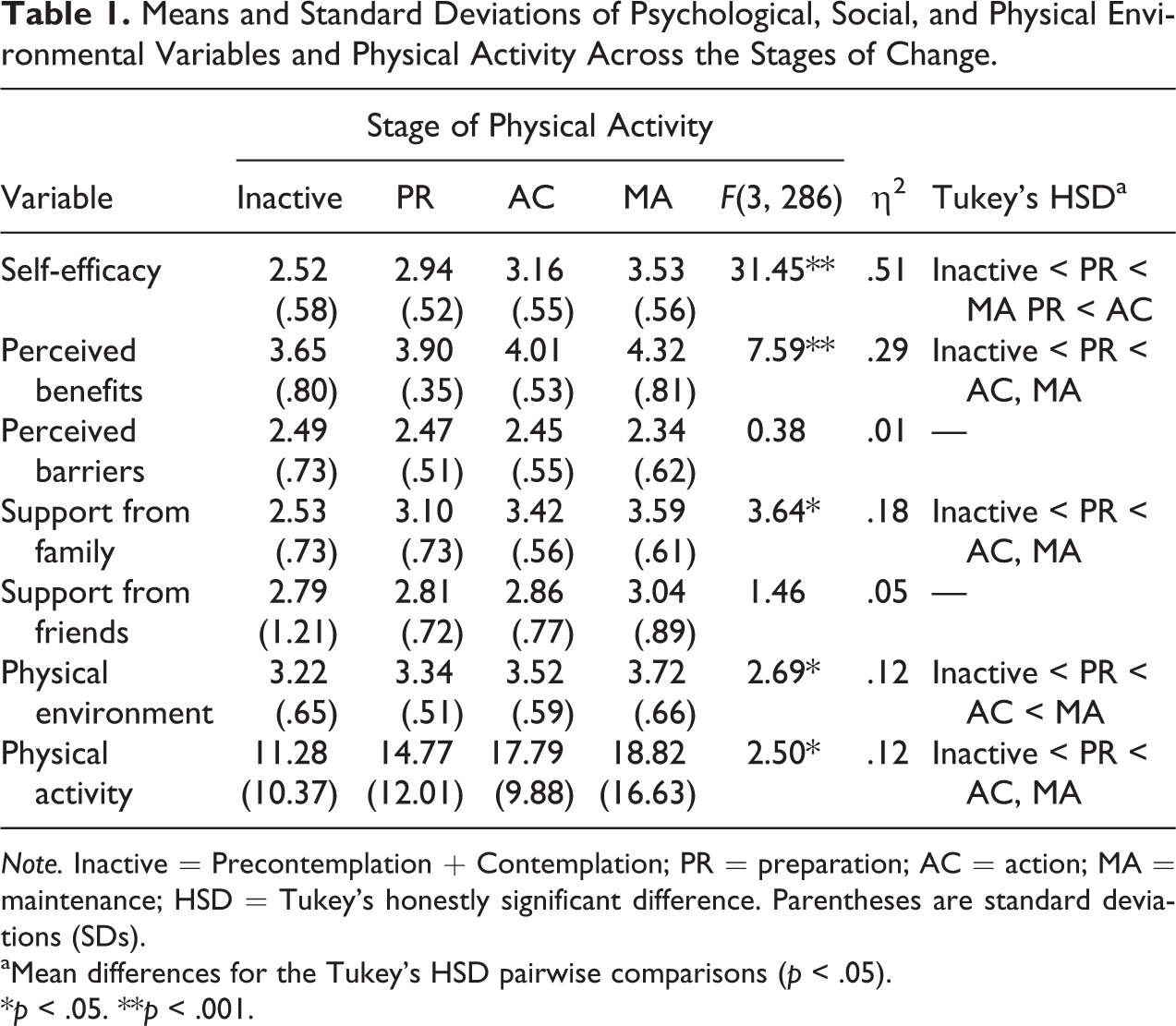
Note. Inactive = Precontemplation + Contemplation; PR = preparation; AC = action; MA = maintenance; HSD = Tukey’s honestly significant difference. Parentheses are standard deviations (SDs).
aMean differences for the Tukey’s HSD pairwise comparisons (p < .05).
*p < .05. **p < .001.
Correlation Between Physical Activity and Multiple Variables
Table 2 shows the results of correlation analysis to identify the relationships among physical activity and psychological, social, and physical environmental variables. Physical activity was significantly correlated with self-efficacy (r = .53), perceived benefits (r = .38), family support (r = .28), physical environment (r = .24), friends’ support, (r = .17), and perceived barriers (r = −.13).
Correlations Between all of the Study Variables.
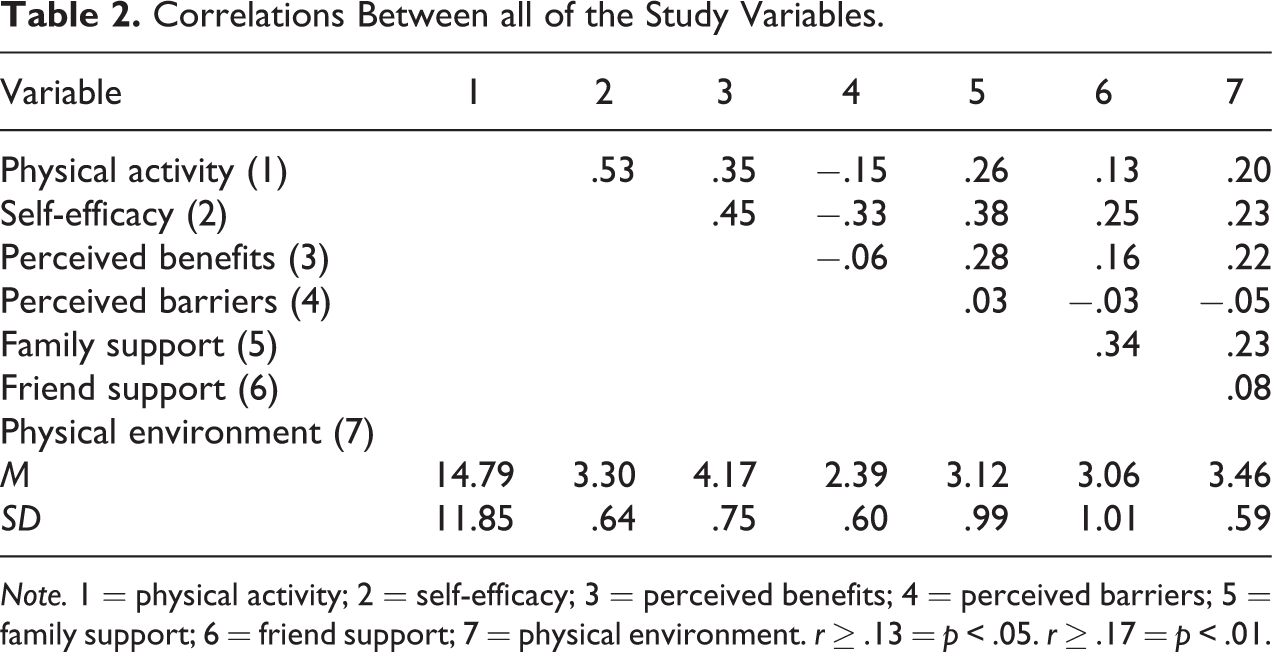
Note. 1 = physical activity; 2 = self-efficacy; 3 = perceived benefits; 4 = perceived barriers; 5 = family support; 6 = friend support; 7 = physical environment. r ≥ .13 = p < .05. r ≥ .17 = p < .01.
Effect of Multiple Variables on Physical Activity
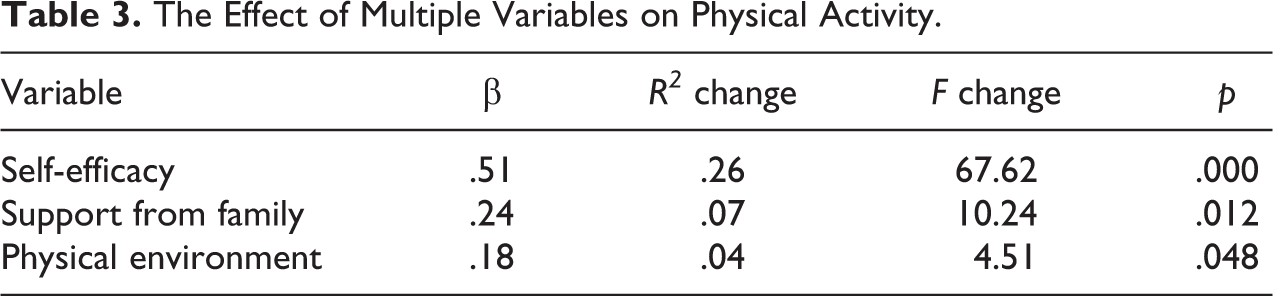
A stepwise multiple regression analysis was conducted to identify the most important predictors of physical activity, based on the multiple levels of physical activity. In a descending order of significance, the most important predictors of physical activity were self-efficacy, F change(1, 280) = 67.62, p = .000, R 2 change = .26, β = .51, support from family, F change(2, 279) = 10.24, p = .012, R 2 change = .07, β = .24, and physical environment, F change(3, 278) = 4.51, p = .048, R 2 change = .04, β = .18. The overall variance explained by psychosocial and environmental variables was 40% (R 2 total = .40).
The Effect of Multiple Variables on Physical Activity.
Discussion
The current investigation examined differences in psychological, social, and physical environmental factors across the stages of physical activity and the associations of those factors with physical activity levels among Korean older adults.
We found that 70.7% of the study participants regularly engaged in physical activity, although the detailed physical activity distribution has not been shown. Interestingly, the physical activity rates were considerably higher compared with those observed in previous studies. According to the Korea Institute of Sport Science (2006), 51.8% of older adults participated in physical activity on a regular basis. In addition, Centers for Disease Control and Prevention (2004) pointed that 58.5% of American older adults engaged in regular physical activity. These differences in the physical activity rates between our study and previous studies imply that increasing numbers of older adults want to live longer and they have perceived that regular physical activity is one of the most important lifestyle habits to acquire in order to achieve this desire. However, such a comparison should be interpreted with caution, because different population groups were studied. In addition, it can be interpreted that a broad dissemination of the health benefits of physical activity and greater attention to a healthy lifestyle greatly contribute to increasing the number of older adults who have actually engaged in a greater amount of various physical activities. Another reason may be that people overestimated their activity levels due to the self-report measures.
Furthermore, in our study, physical activity stage was not significantly different according to personal variables such as gender, education level, and living situation. More specifically, most of the study participants were in the action and maintenance stages, regardless of gender, education level, and living situation. These results might be due to the processes we used to select participants. In the initial stage of the study, a participant recruitment notice was delivered to various organizations catering for the elderly within the Seodaemun district. During this process, the notice was posted to four elderly welfare centers, from which several individuals participated in our study. However, many of these may have already enrolled in activity classes at these centers.
The present study indicated that self-efficacy, perceived benefits, support from family, and physical environment were significantly different across the stages of physical activity, and these findings are supported by the results of previous studies (Kocourek & Reid, 2006; Thøgersen-Ntoumani, 2009), which demonstrated that these variables increase continuously as people move from an inactive to an active lifestyle. Our finding concerning self-efficacy can be explained by the fact that older adults with a high level of confidence regarding engaging in physical activity, despite various obstacles, have high self-efficacy for physical activity. In addition, they can be expected to feel much more prepared for physical activity and to regularly participate in actual physical activity than older adults with low self-efficacy (Kim, 2007).
In addition, the study indicated that perceived benefits were improved with advancing physical activity stages. It is plausible that older adults with high perceived benefits might have already been exercising regularly and therefore that either they have previously experienced physical and psychological health benefits from engaging in regular physical activity or that they are currently experiencing such benefits. Conversely, older adults who do not currently engage in physical activity might have never experienced various health benefits from physical activity in the past (Flath & Cardinal, 2006; Lee, 2005).
To achieve a deeper understanding of the relationship between multiple variables and physical activity in older adults, we examined the association of psychological, social, and physical environmental variables with physical activity. The results indicated that the studied variables accounted for 40% of the physical activity variance, and that self-efficacy was the most significant predictor of physical activity, followed by support from family and physical environment. Although the current literature does not provide sufficient information regarding the relative influence of psychological, social, and environmental variables on physical activity, our findings are supported by numerous studies, indicating that self-efficacy is the strongest predictor of adopting and maintaining regular physical activity (Kim, Cardinal, & Lee, 2006; Rovniak, Anderson, Winett, & Stephens, 2002).
However, regarding the importance of the current discussion on the relative influence of psychological, social, and environmental variables, we showed that social and environmental variables have an important role to play in explaining physical activity. Family support exerted a positive effect on physical activity, suggesting that supportive family relationships can facilitate regular involvement in physical activity among older adults. For example, regularly scheduled jogging with family members can help sustain an active lifestyle. These findings are easily understandable if we consider the cultural and normative nature of Korean society. Although this particular society has been radically changed and westernized in many sectors, a family centered social climate is still widely reflected in the lifestyle of Koreans. From this perspective, family members are an important socially supportive group that encourages older adults to engage in regular physical activity, and their support can act as significant factor in its reinforcement. Furthermore, the results showed that physical environment is a significant predictor of physical activity; its relationship to physical activity included quantitative adequacy of exercise facility or place, accessibility to exercise facilities, and provision of appropriate opportunity for physical activity. Therefore, the significant relationship between physical environment and physical activity can be interpreted as being that older adults who are engaging in regular physical activity are likely to perceive their exercise facilities and place as positive, that is, considering that the number of study participants who responded that they regularly engage in physical activity was over 70%, the majority positively perceived the connection between their given physical environmental settings and their physical activity. Although family support and the physical environment are significantly related to physical activity, there is a need for further study to see whether it is an aspect of Korean culture because those variables explained a small amount of variance.
There are several limitations to our study that should be addressed in the future. We used a cross-sectional research design, so caution must be exercised when making causal inferences. Longitudinal studies are required to determine the effect of the multiple variables on physical activity over time. Most participants were older adults who enrolled in activity centers. Therefore, data obtained from these populations cannot be considered representative of the eligible population of all Korean older adults. The study primarily aimed to identify relationships between the multiple levels of variables and level of physical activity in older adults. Therefore, interaction effects between those variables on physical activity were not examined. Our study did not assess the perceptions of quality of the presence or absence of various environmental attributes (i.e., condition of jogging path, streetlights, safety, etc.). It would be useful if future scales measure perceptions on the perceived quality of the indicators. The measures applied in our study underwent a rigorous and systematic translation and validation process. However, they relied on self-report, which may result in some bias from item interpretation, recall, and social desirability.
Our study offers initial evidence of a relationship between multiple variables and the physical activity of older adults, on the basis of an ecological viewpoint. The ideas and issues identified in our study are partly consistent with the results of previous western research in the same field. In our study, self-efficacy is the most important predictor of physical activity. However, as it is widely understood that the psychological attributes of individuals are formed within a social–physical environment, recent academic interest has paid much attention to the significance of social and physical environment variables and the interaction of these variables with psychological variables in explaining physical activity. The strength is that our study compared the effects of psychosocial and physical variables on physical activity for an unstudied population because most of the research outcomes have been primarily carried out in western societies. Therefore, the findings of our study can be utilized by physical activity professionals who should promote successful activity experiences (self-efficacy) as well as a supportive social and physical environment, which is conducive to active lifestyles for health and wellness. More importantly, the present study offers a starting point for practical interventions aimed at increasing physical activity levels of older adults in health care settings and also encourages and supports senior health care providers to increase their knowledge of physical activity and its related multiple variables.
Footnotes
Declaration of Conflicting Interests
The author(s) declared no potential conflicts of interest with respect to the research, authorship, and/or publication of this article.
Funding
The author(s) received no financial support for the research, authorship, and/or publication of this article.