







Abstract
The study evaluated the concept of autonomy from the perspective of older adults and their adult children following a transition of the older adult to a continuing care retirement community (CCRC). Overall, 70 interviews (with older adults and their adult children; 34 dyads) were analyzed, using a line-by-line open coding, followed by dyadic analysis. Autonomy was not portrayed as a uniform, homogenous construct, but rather encompassed four different domains: (a) the focus of one’s attention or concerns: on others, on self, or not at all; (b) the ability to exercise decisions and make independent choices; (c) the degree of physical functioning and ability of the older adult; and (d) the financial ability of the older adult. The duality in the relationships between older adults and their adult children is discussed in relation to the give and take of autonomy that occur following a transition to a CCRC.
Keywords
Introduction
This study evaluated the perspectives of older adults and their adult children on autonomy following the entrance of an older adult to a continuing care retirement community (CCRC). The CCRC represents a form of formal care, which is available to older adults who are independent upon entering the facility. This long-term care (LTC) setting is designed to allow older adults with maximum independence, while meeting their increasing needs for assistance and support (Doron & Lightman, 2003) in light of the almost inevitable deterioration of physical and cognitive functioning in old age (Smith, Walter, Miao, Boscardin, & Covinsky, 2013). As such, many CCRCs have an assisted living unit and a nursing care unit available for older adults with physical and cognitive impairments.
CCRCs in Israel
Israel is a society in transition between traditionalism and modernization (Lavee & Katz, 2003). Past research has characterized family relationship in Israel as being high on both ambivalence and solidarity (Lowenstein, 2007). As such, family involvement and care continues even when formal care services for older adults are provided (Ayalon, 2009; Lottmann, Lowenstein, & Katz, 2013). The high involvement of family members is facilitated by the small country size and by a generous governmental support aimed to maintain older adults in their homes (Ayalon, 2009). Older Israeli Jews are often concerned about burdening their family members and as a result, many prefer to rely on formal services (Halperin, 2013), most often in the form of home care services (Asiskovitch, 2013). Only about 3% of older Israelis rely on institutional care (Brodsky, Shnoor, & Be’ er, 2012). Although the CCRC is an LTC alternative available mainly to affluent older Israelis, the number of CCRCs has been expanding over the past decade (Mirovsky, 2007). In Israel, there are 184 CCRCs. Current statistics stands at 31 units per 1,000 individuals over the age of 65 or at 64 units per 1,000 individuals over the age of 75 (Brodsky et al., 2012). Give the important role played by the Israeli family even when formal care services are available to the older adult (Ayalon, 2009; Lottmann et al., 2013), this study is focused on intergenerational perspectives of autonomy following the older adult’s transition to a CCRC. This is particularly important in light of the emphasis of CCRCs on maintaining the autonomy of older adults (Shippee, 2009).
The Role of Autonomy in the CCRC
Autonomy is broadly defined as the ability to exercise self-determination and goal-oriented behaviors (Atkins, 2006; Horowitz, Silverstone, & Reinhardt, 1991). Autonomy has shown to be a substantial predictor of a variety of health and quality-of-life indicators (Gerstorf, Röcke, & Lachman, 2010; Ross & Mirowsky, 2013). It is highly valued among older adults who often manage to maintain a sense of autonomy even when they are physically (Custers, Westerhof, Kuin, Gerritsen, & Riksen-Walraven, 2012) or cognitively impaired (Fetherstonhaugh, Tarzia, & Nay, 2013).
Given the inherent tension between individual autonomy and institutional care, autonomy in LTC settings has received considerable attention (Capitman & Sciegaj, 1995; Chang & Yu, 2013; Collopy, 1988). When used in relation to older adults in LTC or older adults with physical or cognitive impairments, this concept often carries unrealistic expectations (Perkins, Ball, Whittington, & Hollingsworth, 2012). As a result, researchers have argued for a relational perspective on autonomy that takes into account care relations, interdependence, and even dependency (Agich, 1993; Atkins, 2006).
The decision to move into a CCRC often represents a wish, on the side of older adults to maintain their autonomy in the face of future declining health and physical functioning (Shippee, 2009). However, with deteriorated health and physical functioning, older adults’ autonomy is often hampered as they require more intensive levels of care (Ayalon & Green, 2012; Shippee, 2009) and are exposed to LTC systemic features that limit their autonomy (Sherwin & Winsby, 2011; Sikorska-Simmons, 2006).
To date, research on autonomy in LTC has been conducted mainly from the perspective of older adults (Ball et al., 2004; Clark, 1987; Shippee, 2009). The few studies that have addressed the role of autonomy through an intergenerational lens found that protecting one’s parents’ autonomy is seen as a major filial responsibility and receives considerable attention even when the parents suffer from cognitive impairments (Hall, Dodd, & Higginson, 2014; Piercy, 1998). Adult children respect their parents’ autonomy not only as a means to protect their parents’ individuality, but also to set emotional and practical boundaries between themselves and their parents (Funk, 2010) and are often more sensitive to the issue of autonomy than their frail older relatives (Horowitz et al., 1991). Nonetheless, autonomy of family caregivers within the intergenerational context was questioned, as family members do not always perceive their caregiving role as a choice, but rather as an obligation (Hodgins, Wuest, & Malcolm, 2011; Schulz et al., 2012; Tsutsui, Muramatsu, & Higashino, 2013).
Given the interdependent nature of autonomy, research on the construction of autonomy from the perspectives of older adults and their adult children is particularly desired. This study addresses the issue of autonomy following the transition to a CCRC, as this transition likely represents a defining point in intergenerational relations as well as in older adults’ sense of autonomy.
Research Design
Sample
The study was partially funded by the Israel Science Foundation (ISF) and approved by the Helsinki committee of Maccabi Health Care Fund and by the ethics committee of the principal investigator's university. All participants received detailed information about the study and signed an informed consent prior to participation.
Inclusion criteria for older adults were, that is, transitioning to the CCRC within the past year, being cognitively intact, as assessed by the CCRC staff and speaking Hebrew or English. In most cases, older adults identified an adult child that would be available for an interview. In a few cases, we interviewed older adults who had no adult children available for an interview.
The study was conducted between 2010 and 2014. We first conducted interviews with 32 older adults and 19 adult children from a single chain (three different CCRCs). A social worker employed by this chain explained about the study and offered the opportunity to participate. Interested parties were referred to a graduate-level research assistance to schedule an interview.
Following funding from the ISF and to increase the variability of our sample, we approached 13 additional settings. Of these, nine had agreed to participate in this study, two refused, and two were irrelevant. Forty new residents were approached. Ten were excluded because they had no children and three refused. Because of our interest in dyadic analysis, this study is limited to 34 dyads of older adults and their adult children (in two cases, two older adults were interviewed).
Interviews
The most interviews occurred in the CCRC. There was an explicit request to interview adult children separately from their older parents and vice versa. All interviews were tape-recorded and transcribed verbatim. Interviews lasted on average, between one and one and a half hours. Interviews were conducted by five different graduate students in the social sciences. Interviewers had prior training in qualitative interviewing, including the conduct of mock interviews prior to the start of this study. Ongoing supervision and mentoring regarding interviewing was provided by the principal investigator, a psychologist with over 10 years of experience in qualitative research.
Interviews followed a funnel approach. Following the review and analysis of a select number of interviews, interview style was modified to include a much broader perspective, starting with a general request to tell one’s life story. This was subsequently followed by more specific questions related to the transition to the CCRC. See Appendix for the interview guide.
Analysis
Analysis followed several stages. First, a line-by-line, open-coding analysis was employed (Strauss & Corbin, 1998). Analysis did not use pre-conceived codes but instead allowed themes to emerge directly from the text (Creswell, 1998). Subsequently, codes were merged to represent more comprehensive and cohesive thematic categories using constant comparisons within each interview and across interviews (i.e., axial coding; Strauss & Corbin, 1998). Next, selective coding was employed to represent a coherent story line focused on autonomy from the perspective of older adults and their adult children (Strauss & Corbin, 1998). Other themes not related to the overall concept of autonomy, such as ageism, grief, or the adjustment process to the CCRC, are discussed elsewhere (Ayalon & Green, 2015; Ayalon, 2014; Ayalon & Green, 2012; Ayalon & Green, 2013). This was followed by dyadic analysis, in which thematic comparisons occurred within the dyad (Eisikovits & Koren, 2010). Overlaps and diversions were examined within each dyad separately to develop a comprehensive view on autonomy from the perspective of both older adults and their adult children. This represents a form of triangulation (Breitmayer, Ayres, & Knafl, 1993), in which the same phenomenon is addressed by different individuals who are tied to each other. Analysis was conducted by the principal investigator. Open-coding analysis was also conducted by a graduate student in social work. Using a dyadic perspective, two graduate students in social work analyzed selected interviews for the purpose of triangulation. ATLAS.ti was used for the purpose of data management (Friese, 2012).
Sources of Trustworthiness
To obtain a broader range of responses that are not directed by the unique characteristics of a single interviewer (Tietel, 2000), several interviewers conducted the interviews. As detailed previously, some of the coding was conducted by different raters. The use of two different sources of interview and the reliance on dyadic analysis are forms of triangulation that further enhance the trustworthiness of the data (Breitmayer et al., 1993). An audit trail (Rodgers & Cowles, 1993) was maintained to thoroughly document all stages of analysis.
Results
The present sample consists of 34 interviews with adult children and 36 interviews with older adults. Table 1 presents the demographic characteristics of the sample and Table 2 presents the characteristics of the 11 CCRCs from which dyads were drawn.
Demographic Characteristics of the Sample.
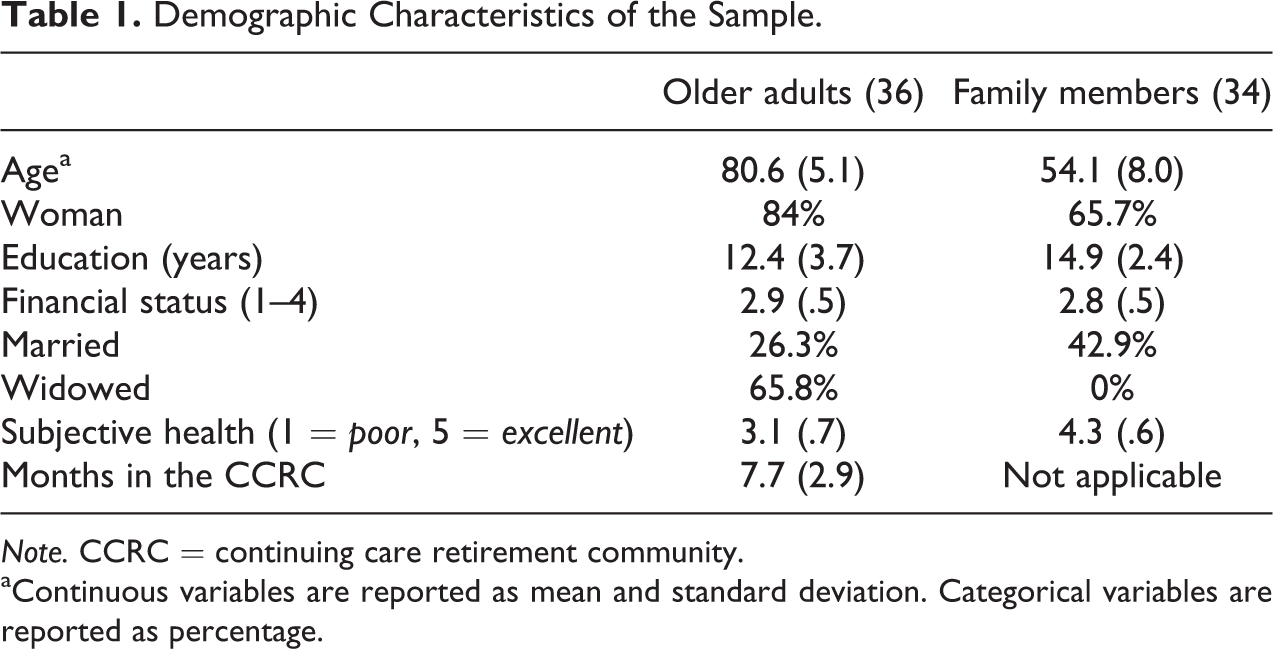
Note. CCRC = continuing care retirement community.
aContinuous variables are reported as mean and standard deviation. Categorical variables are reported as percentage.
CCRCs’ Characteristics.
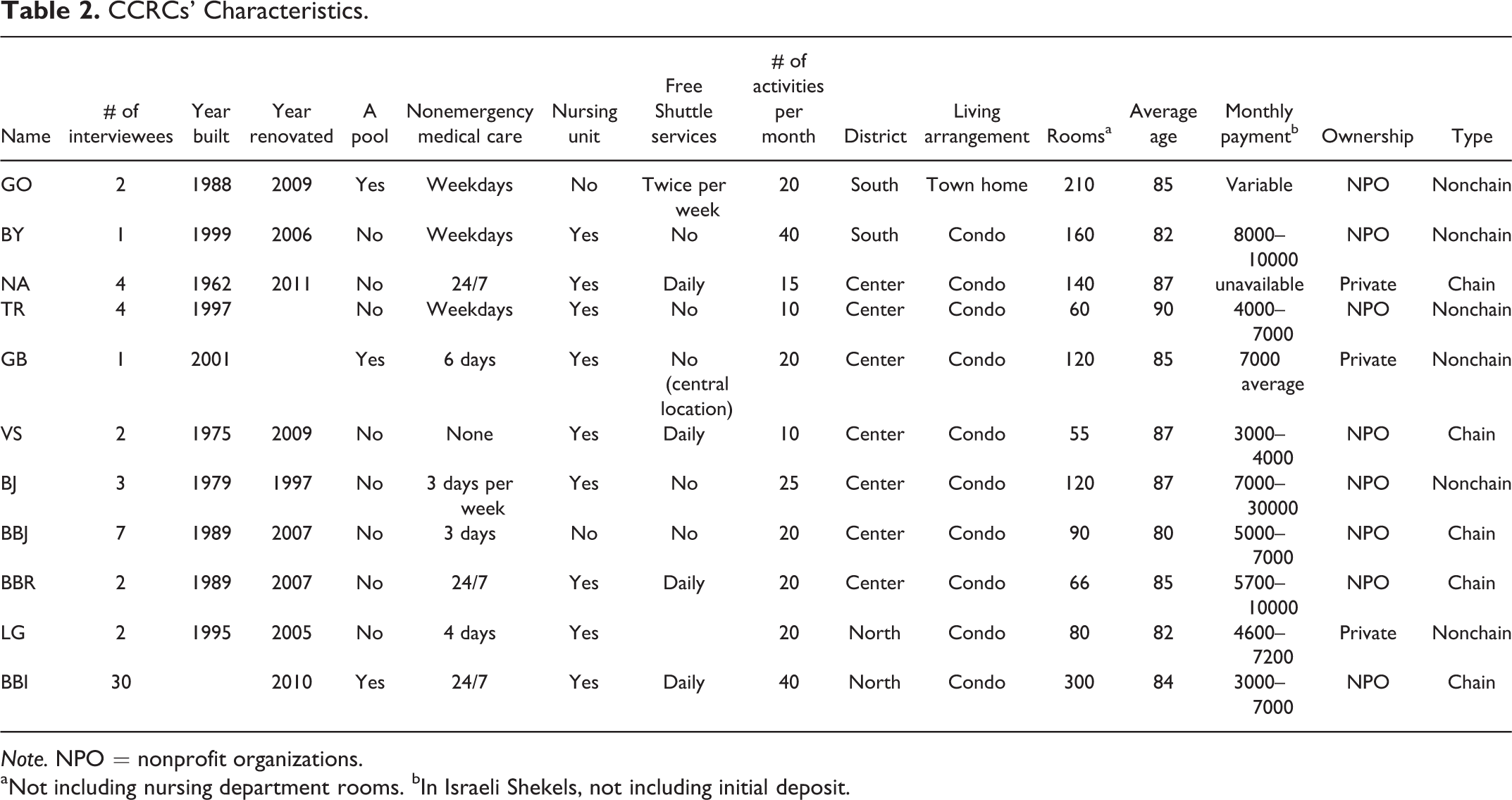
Note. NPO = nonprofit organizations.
aNot including nursing department rooms. bIn Israeli Shekels, not including initial deposit.
In analyzing the interviews, autonomy was identified as an important construct. Autonomy was not portrayed as a uniform, homogenous construct, but rather as encompassing four different domains: (a) the focus of one’s attention or concerns: on others, oneself, or not at all; (b) the ability to exercise decisions and make choices; (c) the physical functioning and ability of the older adult; and (d) the financial ability of the older adult. The perceived nature of these four aspects of autonomy changed to maintain a delicate equilibrium that was disrupted upon the entrance of the older parents to the CCRC. Direct quotes from the text are provided to better illustrate the themes identified.
The Focus of One’s Attention or Concerns
This theme refers to the main area of attention or concern of older parents and their adult children. Three mother–adult child dyads were characterized as more enmeshed than others. These dyads typically shared a living environment prior to the mother’s transition to the CCRC. In these three dyads, both mother and adult child had no other significant relationship. Even though, the mother use substantially younger and of better physical functioning than the general CCRC population, she had substantial emotional needs that were attended to by the adult child. In these more enmeshed intergenerational relations, both mother and adult child talked about the transition as an opportunity to shift the mother’s focus from the daughter in order for the mother to truly enjoy her life in old age and vice versa.
In the next segment, the daughter explicitly talks about the autonomy she has gained as a result of the transition. Although the mother is functionally independent and the daughter does not care for her mother instrumentally, she has supported her emotionally over the years and the transition has provided both of them with greater emotional autonomy: Finally, I can concentrate on myself. Let's say it that way; this is really the bottom line. And it is with regard to everything. To be independent. Really, without my mother messing me up. Without me thinking of her depression. Her problems, whether or not she is in a good mood or a poor mood. Or whatever is going on with her. A 26 year-old single woman. It (the transition) is wonderful. Truly wonderful. I really enjoy this. I am having fun. I can sleep when I want to, eat when I want to. Except for lunch, which I have here. Downstairs. Free to myself. Do not need to care for anyone. A 69 year-old divorced woman.
In particular, food, transferred from parents to their adult children, captured an important role as a symbol of affection and care. Even though the new unit in the CCRC did not allow for the same level of food preparation and hospitality as the older adult’s old residence, children, and their adult parents made extra efforts to maintain food transfers from older parents to adult children as a means to assert continuity in the relationship: It was important for us that she (mom) won't feel that that's not her home. That she will continue, we will continue to come over there and that she will continue to host. This holiday, we were 19 people there. Nineteen people in the CCRC, all sit in the living room. She never thought that we would fit in. True, it was a little crowded, but we stayed in her kitchen to show her that life goes on as usual.”A 52 year-old married woman.
The Ability to Exercise Decisions and Make Choices
Most adult children (n = 27) emphasized the fact that their older parents were cognitively intact and, therefore, they exercise their own volition. This ability was regarded as most important and as a primary criterion for autonomy. In light of the significance assigned to the ability of older adults to exercise independent decision making, the decision to move to a CCRC was portrayed by these adult children as an autonomous decision of their parents.
In the following segments, both son and mother discussed the decision to move to a CCRC as being within the domain of the mother. However, whereas the mother perceived the transition as gradual and as being part of an overall family discussion, the son viewed the transition as being completely within his mother’s control, with very limited input sought from other parties during the decision-making process: Well, she (mother) just decided one day that she was doing that (moving to a CCRC). She got the approval (from the CCRC), called movers, and a friend of mine organized the move. And on the same day, she just packed up everything, sold the house, and just decided that she was disconnecting completely. A 43 year-old married man. The wife of my brother, she is a social worker, so I spoke with her, I spoke a lot with her about the decision, what I should be expecting, and with the kids of course, but in the end, I realized that this (moving to the CCRC) was the right thing to do. A 76 year-old divorced woman.
The mother attributed the move to her children’s persistence but viewed it as her own decision: “my daughter Tammy (pseudonym) said, ‘mom, I have a unit attached to my house. Come live with us.’ I told her, ‘no. I want to be independent.’ The son came and said, ‘come live with me. I bought a new house.’ And, I said, ‘what will I do at your place?’ So, I moved over here to make sure they stop nagging me.” A 72-year-old widow.
In the few cases (n = 6 dyads), when the older parent was not interested in transitioning to a CCRC, adult children still attempted to present the transition as volitional. This is evident in the following segments taken from interviews with a daughter and her mother. The daughter believes that she was truly able to convince the mother to move to the CCRC: We (children) eventually managed to convince her to go visit (the CCRC). We told her we weren't going to decide anything. You do not commit to anything. And if you are having such a hard time, we will come and take you back. But ‘go ahead and pack a few things, stay there overnight. We will see what happens tomorrow. Step by step. You do not commit now for your entire life.’ A 57 year-old married woman.
The most (n = 29 dyads) noted that the parents’ transition to a CCRC provided adult children with more flexibility in the relationship and allowed them with greater autonomy. The move to a CCRC was often precipitated by high levels of loneliness, the death of a spouse, and increasing physical impairments of the older adult. In these situations, adult children often felt committed to support their parents and to provide them with emotional and instrumental care. The CCRC was viewed as an opportunity to make their caregiving activities optional rather than obligatory. Relationships were no longer viewed as being driven primarily by need and obligation. The following quote is from an interview with a son, who describes his high commitment to his mother. Following his mother’s move to a CCRC, the son has regained autonomy in relation to the nature of the relationship with his mother: There is the period, from the time he (father) died to the point when she (mother) fell off. There is the period, from the time she fell off to the time she moved and there is the period after the move. When he died, I felt more responsibility. I had to take care of things. I had to come to her a little more. I live in Tel Aviv. When she fell off, I came twice, three times a day to her. This was a physical burden, an emotional burden and financial-mainly for me but also for my sister. Now, when I come here, the only responsibility I have is to check her bank account and to bring food for Friday. We come every Friday. A 52 year-old married son.
Physical Functioning
For many of the new CCRC residents interviewed (n = 25 dyads), the ability to carry out instrumental activities was on the decline. Nevertheless, this decline was not always viewed as a sign of reduced autonomy. Instead, the CCRC was identified as a viable opportunity to remain autonomous even in the face of decline.
The following dyad demonstrates how the CCRC freed not only the daughter, but also her mother from performing everyday tasks of daily living, which have become more difficult to perform over the years. There is this thing, if for heavens' sake something happens to you in the middle of the night. You pick up the phone and they come. There is this thing if the light bulb burns. I do not have to. I used to climb a ladder or something. I can fall down. Now, you call and they (CCRC maintenance team) come. All sort of things that you are free not to worry about any longer. An 80-year-old widow. Even if I drive her (mother) around and I know there are things that are more for older adults. But, she is not old for me. To think that she is getting old after all, because she is over 80. A 52-year-old married woman.
In contrast to the strong emphasis on portraying the decision to move to a CCRC as being within their parents’ domain, the actual transition and the physical adjustment it required were portrayed as being well within the domain of the adult children (n = 16 dyads). Substantial instrumental assistance during the move was provided by adult children, following the realization that the transition was highly challenging physically and emotionally to their older parents. In the following dyad, the daughter describes the decision to move as being reached solely by her mother, yet, settling in this new setting was actively supported by the daughter, given the mother's declining physical functioning: She (mother) worked up until a few months ago, when she decided that she wanted to move to a CCRC. I was shocked. I never thought my mom was that old. This is when I finally realized she was that old…then she said, ‘I’d be really happy if you fixed my apartment. I'd be really happy to come to a fixed apartment.' A 64 year-old married woman. When we (daughter and I) decided that I was coming here (CCRC), then my daughter with her friend, she has a good friend, told me, ‘you are not coming for two days’. They came alone, they fixed my room. They fixed everything. An 85-year-old widow.
Financial Ability
Both adult children and their older parents discussed financial considerations as being part of the decision to move to a CCRC (n = 27 dyads). The older parents’ financial ability was perceived as an indicator of autonomy. Most perceived the transition to a CCRC as costly, available only to selected few. Several older adults expressed a concern that they would not be able to leave a financial inheritance to their children as a result of the transition, as their money was spent on accommodation rather than saved.
Although financial issues were mentioned in 27 dyads, children paid less attention to financial issues and it was mentioned by only 12 adult children. Children regarded the potential dwindling of a financial inheritance as insignificant in comparison to the autonomy the transition to the CCRC had brought to their lives as well as to their parents’ lives: “She really worried about her money. Not for herself, for us. I mean she all the time was concerned whether or not the money would be enough, to leave us something,” said the daughter of an older resident, a 44-year-old married woman.
Older parents were adamant about not receiving financial support from their children for as long as they could in order to maintain their autonomy. In the following segment, the mother discussed her wish to remain financially independent: I was concerned with my financial security: ‘we will help you and we will give you. Tell us how much you need each month and leave what you have (the house) over there. This will be my saving and you will tell me, tell us and we each will pay you as much as you need every month.’ On the one hand, it really touched me. I was happy. At least I succeeded in my role as a mother, that the kids have not deserted me. They do not want to throw me away. But, on the other hand, I said ‘no’. You feel good only as long as you are independent. The minute they are late to give you money for some reason, I will not pick up the phone and say, ‘you haven't given me money’. No, I cannot. It is my character that I cannot ask. All of a sudden, mom wants to buy new things, a dress, shoes, a haircut, facial. ‘what the heck, we work all day just to give her money? (Say the kids)’ A 78-year-old widow.
Discussion
This study has focused on intergenerational perceptions of autonomy within the CCRC. In contrast to past research that viewed the transition mainly from the point of view of older adults (Ball et al., 2004; Clark, 1987; Shippee, 2009), this study has addressed the topic from the perspective of both older adults and their adult children. Given past research that has shown that adult children do not abandon their caregiving roles and responsibilities even when formal care is provided, the perspective of adult children is highly desirable (Ayalon, 2009). Exploring both perspectives, the study provides a new conceptualization concerning the reconstruction of autonomy within the intergenerational relationships following a transition to a CCRC.
The findings point to the delicate balance between adult children and their older parents. The transition to a CCRC is portrayed as allowing greater autonomy to both parties by reducing the interdependence between the generations through the introduction of a formal source of support, namely a CCRC. In their interviews, both older adults and their adult children identified the CCRC as a potential source of both instrumental and emotional support to older adults. Israel is a society in transition, between traditional values and beliefs and more modern ones (Lavee & Katz, 2003). It is highly likely that in a society in transition, the sharing of responsibility and the burden of care with formal LTC services provides a relief to both generations and allows them to maintain greater autonomy in intergenerational relations.
Consistent with past research (Ball et al., 2004; Becker, 1994), autonomy was not viewed as a cohesive construct, but rather as a multidimensional construct. A very clear hierarchy of domains of autonomy was evident. Consistent with past research (Fetherstonhaugh et al., 2013), the ability to exercise an independent decision received the greatest value among adult children and their older parents. It was highly important primarily to adult children, but also to their older parents to emphasize the autonomous decision abilities of the older parent. Even in more ambivalent cases, when the older adult was not in full agreement with the decision to move to the CCRC, family members attempted to portray the decision as being the older adult’s decision and stressed their limited involvement in the decision. The loss of cognitive faculties has been identified as a major source of grief in past research (Garand et al., 2012; Givens, Prigerson, Kiely, Shaffer, & Mitchell, 2011). The emphasis on autonomous decision making could have been fueled by an attempt to address the expectation for future inevitable losses that come with advanced age (Ayalon & Green, 2012). Although, research has shown that older Israeli Jews tend to prefer formal care to informal care (Halperin, 2013), negative feelings of guilt or depression are common among family members upon the admittance of the older adult into an LTC facility (Sury, Burns, & Brodaty, 2013). The findings could reflect attempts of adult children to address their ambivalence and guilt about their parents’ transition.
Many of the dyads interviewed in this study discussed the transition to the CCRC as being partially fueled by the physical decline of the older adult. However, in contrast to past research conducted in assisted living facilities, which has indicated that residents put a great value on physical abilities as a sign of their autonomy (Ball et al., 2004), loss of physical functioning was not automatically equated with loss of autonomy in the present population of CCRC residents and their adult children. In fact, the CCRC was viewed as allowing older adults and their adult children to enjoy their re-gained autonomy by freeing them from the mundane tasks of daily life. Both family members and older adults were no longer obligated to perform household chores that they found difficult to perform, as these were completely within the domain of the CCRC.
Much attention has been given to tangible aspects associated with intergenerational care, such as financial or time transfers (Albertini & Kohli, 2012; Attias-Donfut, Ogg, & Wolff, 2005; Deindl & Brandt, 2011). In this study, in contrast, emotional care has received as much attention as concrete, measureable aspects of care. In more enmeshed older parent–adult child relations, the ability to redirect one’s attention to one self and to disengage from intense intergenerational care was viewed as an advantage by both older mothers and their adult children.
In other dyads, in which the older adult had experienced reduced health and independence, continued care and attention of the older parent devoted to the adult children was viewed rather positively as an indicator of the older adult’s continued autonomy. This clearly attests to a fragile balance that older adults and their adult children attempt to maintain. Past research has stressed the role of ambivalence in the relationship between older adults and their adult children. On the one hand, older adults wish to maintain their autonomy, but on the other hand, they still hope for their children’s help and care (Spitze & Gallant, 2004). This study adds by showing how important it is not only for older adults, but also for adult children to maintain their parents’ autonomy and to maintain continuity in the relationship even in the face of physical decline.
In this study, both older adults and to a lesser degree their adult children viewed financial status as an indicator of one’s autonomy. Even in a country that has a relatively generous welfare system (Asiskovitch, 2013), the ability to enjoy LTC alternatives of one’s choice is largely determined by the older adult’s financial abilities. Consistent with past research (Attias-Donfut et al., 2005), financial transactions are seen as normative when they occur from the older to the younger generation. Downward financial transactions are thought to serve as an assurance for future upward intergenerational exchanges of care (from children to older parents), once the older adult’s health and functioning decline (Silverstein, Conroy, Wang, Giarrusso, & Bengtson, 2002). According to the present study, downward financial transactions are perceived as guaranteeing autonomy and control in intergenerational relations.
Although there was a general agreement in perceptions within dyads, discrepancies should also be noted. Overall, adult children were more likely than their older parents to stress the cognitive and functional autonomy of their parents, even when decline was noted. Potentially, older adults have had many opportunities to adjust to their physical decline over the years. Most adult children, on the other hand, did not live with their older parents or interact with them on a daily basis. As a result, they had to face the older adult’s decline more explicitly upon the older adult’s transition to a CCRC. Even though the transition was viewed as allowing greater autonomy in the relationship, it also served as a constant reminder of inevitable losses that take place in old age (Ayalon & Green, 2012). Alternatively, it is possible that older adults refrained from addressing their decline as a means to protect themselves from its unwanted consequences.
The study has several limitations that should be noted. The focus on intergenerational relations precluded the analysis of interviews of those older adults who did not have children available for an interview. The study focused on older adults within the first year of entry to a CCRC, who by definition, had to be physically and mentally independent to enter. Hence, the study was limited to a very unique population of older adults. The qualitative nature of this study and the small sample size preclude our ability to generalize the findings. Nonetheless, we took several measures to establish to rigor of the study and address its subjective nature, including triangulation (Cresswell, 2003), by two different sources of information and the coding of the data by several researchers. A “thick description” was used, which consisted of quotes from the interviews to ensure that the findings are transparent (Polkinghorne, 2005] and to allow the readers to judge the proposed interpretations by themselves (Cresswell, 1998). Finally, the long period of data collection employed in this study could also be a limitation, as differences between participants could potentially be due to environmental or policy changes.
By examining the concept of autonomy from an intergenerational perspective, the study emphasizes the fact that autonomy is a multidimensional construct of implications for both adult children and their older parents. Based on the interviews with adult children and their older parents, a hierarchy of domains was evident. The most valued domain was one’s ability to exercise an independent will. Physical functioning, on the other hand, was viewed as a noncrucial requirement, given perceived adequate assistance provided by the CCRC. In fact, many times the ability to transfer some of the mundane requirements of everyday life to the CCRC was viewed as a relief by both adult children and their older parents and as a source of freedom that enhanced autonomy in the relationship.
Footnotes
Appendix
Declaration of Conflicting Interests
The author(s) declared no potential conflicts of interest with respect to the research, authorship, and/or publication of this article.
Funding
The author(s) disclosed receipt of the following financial support for the research, authorship, and/or publication of this article: The study was financially supported by a grant from the Israel Science Foundation.