







Abstract
This study explores the relationship between cell phone use and self-reported happiness among older adults in Mainland China and whether rural/urban residence status moderates this relationship. The analysis is based on a sample of 6,952 respondents over the age of 60, from the 2010 wave of China Family Panel Studies. Findings show that using own cell phone is positively associated with self-reported happiness among Chinese older adults (odds ratio [OR] = 1.283, p < .001). This relationship remains for respondents residing in rural areas (OR = 1.616, p < .01) but not for their urban counterparts. Findings reflect on how the happiness of Chinese older adults has been affected by a growing shift in the traditional family values due to the unprecedented economic growth. Results also highlight the disparities between state support for older adults in rural and urban areas as well as the necessity to develop relevant policies to improve the subjective well-being of China’s rapidly growing population of older adults.
China has been facing a rapidly aging population over the past three decades mainly due to a decline in mortality, delayed fertility, and an increase in life expectancy of Chinese residents (World Health Organization, 2015). In 2015, 16% of China’s population (around 220 million) was over the age of 60 (National Bureau of Statistics of China, 2015). The aging population has called attention to the subjective well-being of this segment of population primarily due to the rising depression and suicide rates among Chinese older adults, attributed to the fragmentation of China’s traditional family system and erosion of the custom of filial piety (Miao & Wu, 2015; Zhou et al., 2015).
In the context of the aforementioned issues, the Chinese government has acknowledged the urgency to develop effective policies to improve the well-being of its aging population, given the country’s limited social services due to overcapacity and overuse (Wang, Morris, & Brubaker, 2016). Consequently, there is a growing interest in social research focusing on the needs of the older adults. Results indicate that better social engagement through improving connections with children, relatives, and friends is important to prevent older adults from developing a sense of isolation and loneliness and related depressive symptoms (Chen & Short, 2008; Chi & Chou, 2001; Luo & Waite, 2014). Studies also suggest more emotional and filial support for older adults in China (Huang, 2012; Leung, Chen, Lue, & Hsu, 2007; Li & Liang, 2007), particularly those residing in rural areas where the quality of public infrastructure and service is generally poor compared to urban areas (Zimmer & Kwong, 2003). But despite the proliferation of studies on such issues, Chinese older adults continue to experience social isolation. For example, the consistently rising proportions of Chinese older adults living alone or with a partner (Ren & Treiman, 2015; Zeng & Wang, 2003) indicate the difficulty of maintaining close intergenerational connections as in the traditional Chinese family life. Specifically, China’s large-scale domestic immigration since the 1980s triggered by its accelerated urbanization led to a large proportion of “empty-nested” households in rural areas where many young- and middle-aged people tend to work and reside in cities (He & Ye, 2014; Liu, 2014). Similarly, the number of solo-living older adults in urban areas has increased over the years mostly because of the shrinking family size across cohorts and adult children’s preference for independent living (Forrest Zhang, 2004; Sun, Lucas, Meng, & Zhang, 2011). In addition to the declining connections between parents and children, Chinese older adults’ networking with relatives and friends may be less frequent because of physical limitations due to aging (Savikko, Routasalo, Tilvis, Strandberg, & Pitkälä, 2005).
In light of the rapid increase in the use of information and communication technology (ICT) taking place in China, enhancing older adults’ social connectedness and social involvement with the help of ICT could be a viable solution to their problem of isolation. In some more developed societies, older adults have reported higher levels of happiness with the use of ICT, which enables regular communication with adult children and grandchildren and helps maintain connectedness with friends and relatives (Chen & Schulz, 2016). For instance, in East York, Toronto, Canada, older adults highly value digital media, including e-mail, telephone, and Skype, for the purpose of keeping in touch with friends and family members (Quan-Haase, Mo, & Wellman, 2017). Correspondingly, many governments highlight the expansion of the use of ICT among older residents in policy making (Eggermont, Vandebosch, & Steyaert, 2006). Yet, the role of such technological advancements, particularly the impact of the use of cell phones on happiness and well-being of older adults has not been explored in the Chinese context. This is problematic because of the increasing need among senior Chinese to avoid social segregation. To fill this gap in the literature and offer relevant policy suggestions, we explore the relationship between cell phone use and self-reported happiness among the older Chinese population. Additionally, although the Chinese government has been exerting efforts to reduce the existing rural–urban digital gap (Minges, Kimura, Beschorner, Davies, & Zhang, 2014), China’s current urban–rural divide is enlarging in terms of the levels of household income (Xie & Zhou, 2014), social service quality (Zimmer & Kwong, 2003), as well as health care and residents’ average educational attainment (Zhang & Kanbur, 2005). Despite governmental efforts, financial and emotional support by the state is limited especially for older adults residing in rural areas in terms of pensions as well as physical and mental health facilities (He & Ye, 2014). On the other hand, older adults residing in urban areas not only benefit from adequate pension programs but the state facilitates the provision of leisure activities such as travel, personal development, and community involvement in order to support an active lifestyle and emotional well-being of these individuals (Zhu, Chi, & Sun, 2016). Considering that these socioeconomic indicators are potentially associated with older adults’ well-being (Chen & Silverstein, 2000; Chyi & Mao, 2012; Ding, 2017), we will further examine whether Chinese older adults’ residence status moderates the focal relationship. Specifically, the current study addresses the following two research questions: Is cell phone use associated with self-reported happiness among older adults (60 years or more) in Mainland China? Does rural/urban residence status moderate the relationship between cell phone use and self-reported happiness among older adults in Mainland China?
Literature Review
Happiness is considered the end goal of human activity. The word can even be found in official government documents and declarations, and utilitarian philosopher Jeremy Bentham believes that it is the primary duty of every government to ensure the happiness of all its citizens (Shin & Johnson, 1978). Although many different definitions of happiness have been furnished by various scholars, for the present study, we consider the term to be an evaluation and an overall positive assessment of one’s quality of life (Austin, 1968; Cameron, 1975). The affect theory of happiness holds that the subjective assessment of one’s life can have a substantial impact on happiness (Schwartz & Strack, 1991). Zhou (2013) believes that this subjective assessment of life may help explain how objective social factors or events can influence people’s happiness.
In recent years, there has been a substantial increase in the empirical study of happiness, because, on the individual level, it helps maintain mental and physical health (Seligman & Csikszentmihalyi, 2000; Veenhoven, 2009), on the group level, it promotes a better community life (Diener & Seligman, 2004; Lyubomirsky, King, & Diener, 2005), and on the social level, happiness can serve as an important indicator of the success of policy implementation (Diener & Seligman, 2004). Terms like utility, well-being or life satisfaction (Easterlin, 2005; Mroczek & Kolarz, 1998), and subjective well-being (Diener, Suh, Lucas, & Smith, 1999) have also been equated with happiness in related literature.
The Use of ICT and Its Impact on Happiness
The social impact of China’s economic development can be observed in the weakening of the country’s traditional family system, which is taking a toll on older adults (Zhou et al., 2015). Smaller family sizes, preference for the nuclear family over the joint family system, and a growing rate of temporary migration (usually by junior family members) leave the older adults to suffer social isolation, without adequate financial and psychological support (Lowry, 2009). A sense of loneliness and abandonment can contribute to severe consequences such as depression (Iliffe et al., 2007), self-harm (Berkman, Glass, Brissette, & Seeman, 2000), and increased mortality (Cornwell & Waite, 2009).
Social connectedness, which is the feeling of belonging and relatedness, helps develop a sense of value and attachment among people (Ashida & Heaney, 2008; Iciaszczyk, 2016) and is essential for happiness and well-being especially for older adults (Baumeister & Leary, 1995; Grieve, Indian, Witteveen, Tolan, & Marrington, 2013). Research has indicated that a strong social and emotional support system for older adults can lead to higher levels of happiness (Brehm & Rahn, 1997; Hermalin & Yang, 2004; Hsu & Chang, 2015). This connectedness involves needs, fulfillments, and behaviors, such as seeking company to avoid feeling lonely, asking for advice, or socializing, which are important for an individual’s well-being.
The use of ICT is a significant way to improve social connectedness of older adults. Research shows that communication programs using technology, such as landline phones, smartphones, and iPads, have a positive relationship with the well-being of older adults, as it helps to develop a sense of accomplishment and satisfaction among them (Chen & Schulz, 2016). Through the use of ICT, older individuals are able to maintain and enhance their social connections thus increasing their available social capital (Quan-Haase et al., 2017). Such technology can help older adults deal with social exclusion and isolation through the ability to preserve connections with the outside world and reduce social isolation (Chen & Schulz, 2016; Mealor & Van Belle, 2015).
The Role of Region in Moderating the Relationship Between ICT Use and Happiness
China is one of the leaders in technology adoption with 74% of its population owning some type of technological gadget such as a computer, a tablet, or a smartphone, and so on. (Microsoft Corporation, 2014). China’s commitment to advancement in ICT is evident from the fact that the government has made significant efforts to provide a strong structure such as mobile networks and Internet even in rural areas of the country to improve ICT use among the residents with the help of Non-Governmental Organizations (Qiang, Bhavnani, Hanna, Kimura, & Sudan, 2009; Zhao, 2010). But despite all these efforts, a digital divide still exists between urban and rural communities in terms of technology adoption and older adults in the two locations reflect different reasons for ICT use (Minges et al., 2014). A survey of 284 older adults of retirement apartments in Eastern China by Chen, Downey, McGaughey, and Jin (2016) revealed the patterns of cell phone use by this group. Verbal communication emerged as the most common use along with texting, photography, social media, and a small number indicated playing games, e-mailing, banking, and online shopping. But the rural population has a different pattern of cell phone and technology use due to financial as well as educational limitations as well as cultural differences that exist between rural and urban Chinese households.
Around 108 million older adults (aged 65 or above) reside in the rural areas of China, which comprises 74% of the total population of Chinese older adults (National Bureau of Statistics of China, 2010). Due to the migration of young individuals to urban centers for employment, minors, women, and older people are left behind in villages (Liu, 2014). But despite the changing sociocultural scenario, rural older adults in China still maintain relatively close relationships with family and friends, compared to their urban counterparts (Guo, Chi, & Silverstein, 2012). Besides tradition, this may also be attributed to the lack of availability of alternative activities such as recreational activity. Although state-sponsored social support programs are currently common in rural areas, the level of material support regarding monetary and recreational opportunities is not at par with that in urban areas, and the programs largely lack elements of emotional support (VanderKlippe, 2017).
Guo and Chen’s (2011) study of ICT use in five Chinese villages shows that due to lower levels of education and familiarity with technology, most older adults in villages use cell phones only for the purpose of making and receiving calls and usually receive used phones from their children. The study also identifies durability and reliability of the cell phone as well as quality of service to be more important for older adults compared to the style and model considerations that younger rural residents have.
On the other hand, Oreglia (2014) argues that although the younger rural population in China is more adept in using ICT, older adults when exposed to technology like cell phones eventually learn to use them for entertainment purposes. Some of the older adults in rural China interviewed by Oreglia (2014) were using their cell phones for photography, reading books, watching videos, and playing games, albeit with the help of younger family members. Although landlines are available in most rural households, older adults are becoming accustomed to the convenience of using cell phones, as it enables them to maintain contact with family members while remaining mobile. Due to these differences in the usage pattern, we expect rural/urban residential status to moderate the relationship between ICT use and happiness among older adults in China.
Research Design
Sample
In the current research, we used the 2010 wave of the China Family Panel Studies (CFPS). The Institute of Social Science Survey of Peking University collected the data. We used the 2010 wave of CFPS as it is the wave that includes detailed questions on individual cell phone use, the focal independent variable in our study. CFPS is well suited to our research questions, as it is a nationally representative survey of communities, families, and individuals that focuses on Chinese citizens’ self-reported happiness, socioeconomic activities, their family dynamics and relationships, and physical health (Xie & Hu, 2014). Moreover, the data provide information on a large variety of social phenomena in contemporary China, for example, communication technology development in both rural and urban areas. CFPS employs a multistage probability sampling strategy, which is effective when data were collected from a geographically dispersed population, and personal contact with the respondents is required. For example, CFPS has sampled 25 provinces with stratified levels of socioeconomic development in Mainland China, which covers 94.5% of China’s population (Xie & Hu, 2014).
There are a total of 33,600 respondents in the 2010 wave of CFPS. The age of respondents ranges from 16 to 110 years, with an average of 45.5 years. For our study, we have selected 7,030 individuals who were at or above the age of 60 years in 2010 for two reasons. First, our research questions are based on the self-perceived happiness of older adults in China. Second, the age of 60 is often seen as a critical threshold of an individual considered an older adult in Chinese government reports (National Bureau of Statistics of China, 2017; State Council of People’s Republic of China, 2016) and related research (Feng, Liu, Guan, & Mor, 2012; Merriam & Kee, 2014). After excluding missing data (around 1.11% of the analytical sample size), the final population size for the analyses was 6,952.
Measures
Our dependent variable is self-reported happiness. CFPS asked Chinese older adults the following question regarding their self-reported happiness: “According to your situation, are you happy (ranging from 1 = very unhappy to 5 = very happy).” As the sample sizes for older adults who reported scores 1 and 2 were small, we reduced the range of scores to three categories, with the score of 1 (unhappy) including previous scores 1 and 2, the score 2 (fairly happy) including previous score 3, and the score 3 (happy) including previous scores 4 and 5. Our focal independent variable is “cell phone use.” Respondents were asked cascading questions, “Do you currently use or have you ever used a mobile phone?” and “Is the mobile phone you are using or once used your own?” Since it is not possible to know the frequency of cell phone use utilizing the CFPS 2010, the ownership of a cell phone is thus considered an important indicator because this study aims to explore the potential association between cell phone use and the level of happiness among older adults. Therefore, we combined these two questions to identify older adults who had used their own cell phone (0 = no, 1 = yes). The other important independent variable we considered was rural/urban residence status (0 = urban, 1 = rural). According to the National Bureau of Statistics of China (2006), urban areas are defined as cities (or districts of cities) and counties, which are made up of urban residents’ committees, their administrative areas, and affiliated infrastructures. Areas outside of cities and counties are defined as rural areas, the basic administrative unit of which is villagers’ committee. CFPS adopted specific codes that are used to distinguish urban and rural areas offered by the National Bureau of Statistics of China and coded respondents’ residence status as the rural/urban binary variable.
In addition, we drew on existing studies that focused on happiness among older residents especially in Chinese societies, which suggest four sets of control variables (Appleton & Song, 2008; Chou & Chi, 1999; Chyi & Mao, 2012; Ding, 2017; Li, Ji, & Chen, 2014; Ng, Tey, & Asadullah, 2017). As for demographic variables, we considered respondents’ province of residence because of geographic difference within China concerning some key socioeconomic indicators such as gross domestic product, gross domestic product per capita, geographic location, and infrastructure (Hoshino, 2011; Oizumi, 2010). Based on previous research, we categorized the variable into the least developed province, medium-developed province, and most developed province, with these categories being assigned as 1–3. Moreover, we also measured respondents’ age-group (1 = 60–69 years, 2 = 70–79 years, 3 = 80 years and above) and gender (0 = male, 1 = female). As for socioeconomic variables, we controlled for educational attainment (1 = illiteracy, 2 = elementary school, 3 = middle school, 4 = high school and above), level of self-rated household income (scores 1–5 from low to high, we coded it as 1 = low, 2 = medium, and 3 = high), and whether they have insurance (0 = no, 1 = yes). Moreover, in the specific context of China, participation in authoritative political organizations (e.g., the China Communist Party) can to some extent raise life satisfaction (Appleton & Song, 2008). Therefore, we measured whether respondents belong to any formal political organizations such as the China Communist Party, People’s Congress, and People’s Political Consultative Conference (0 = no, 1 = yes). In addition, we included two variables on social connection. We looked at respondents’ living arrangement, which has been argued as a key predictor of Chinese older adults’ well-being (Chyi & Mao, 2012; Zhang & Liu, 2007). We measured it as a four-category variable: 1 = living alone, 2 = living with partner only, 3 = living with children only, and 4 = living with both partner and children. We also measured respondents’ participation in daily activities. CFPS asked respondents about their participation in both personal activities such as reading books, exercising, and doing housework, and social/recreational activities such as watching television, traveling, and playing cards or mahjong. We coded the variable with no being assigned as 0 and yes as 1. Finally, we took into account respondents’ physical health status. They were asked “what is your self-rated health status?” with scores 1–5 referring to the range from healthy to unhealthy. We measured the variable as a dummy variable (0 = unhealthy; 1 = healthy) by combining scores 3, 4, and 5 to 0 and scores 1 and 2 to 1.
Sample Characteristics
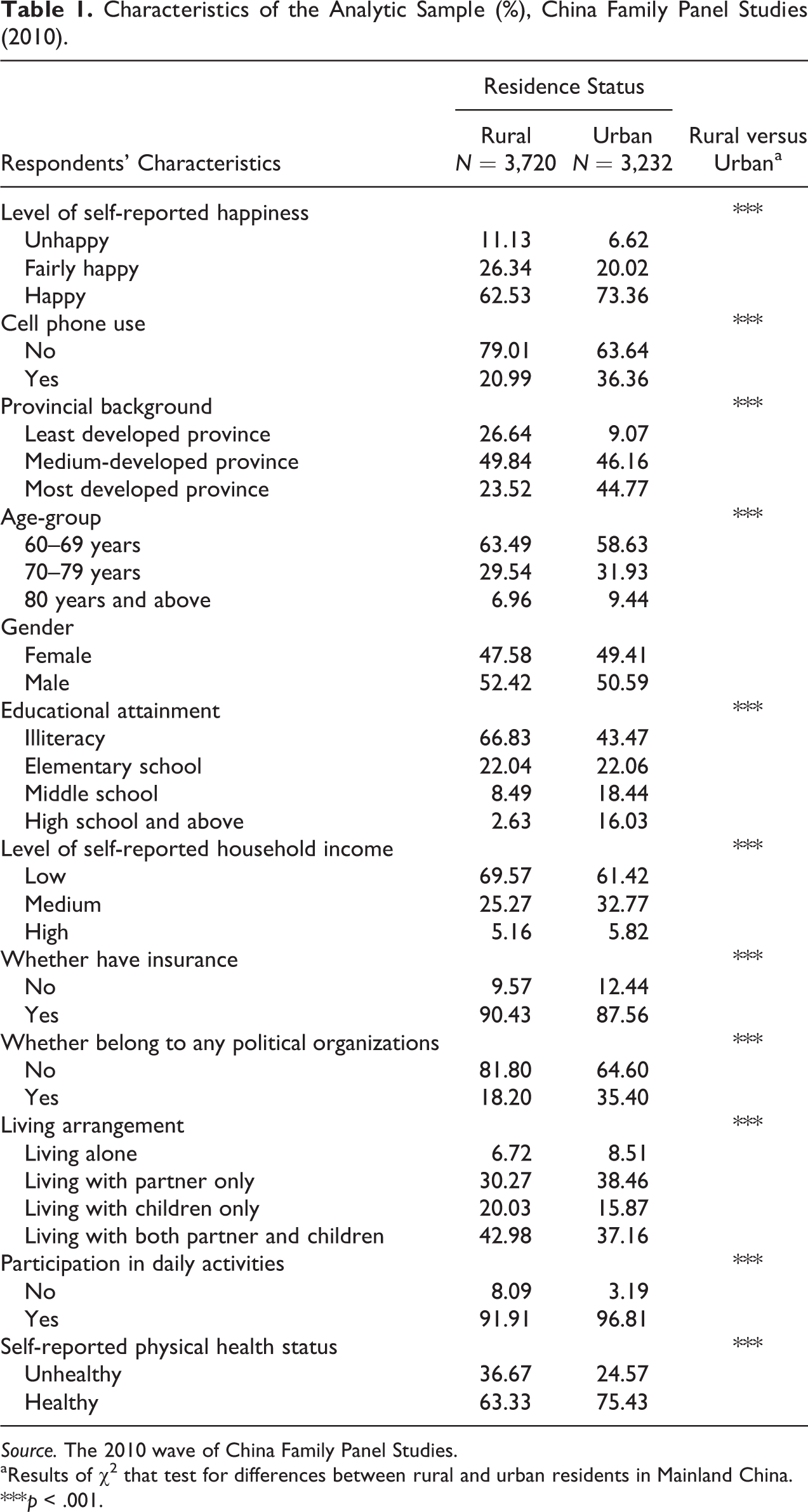
Table 1 shows characteristics of the sample, consisting of 3,720 rural residents and 3,232 urban residents. As for the level of self-reported happiness, 11.13% of rural older adults reported low level and 62.53% reported high level, whereas the figures of their urban counterparts were 6.62% and 73.36%, respectively. Moreover, urban respondents were more likely to have a cell phone than rural respondents (36.36% vs. 20.99%, p < .001). We can also see in Table 1 that there are many other significant differences between rural and urban older residents. For example, 26.64% of rural respondents were from least developed provinces, while the percentage of urban residents is 9.07%. In comparison, more urban respondents resided in most developed provinces than their rural counterparts (44.77% vs. 23.52%). Moreover, 8.09% of rural older adults reported that they did not participate in daily activities, whereas the figure of urban older adults was 3.19% (p < .001).
Characteristics of the Analytic Sample (%), China Family Panel Studies (2010).
Source. The 2010 wave of China Family Panel Studies.
aResults of χ2 that test for differences between rural and urban residents in Mainland China.
***p < .001.
Data Analysis
We employed ordinal logistic regression analysis, as the dependent variable was a three-category ordered variable. Results were reported as odds ratios (ORs). The purpose of reporting ORs is to identify the potential change in dependent variable due to the focal independent variables. OR is the ratio between two odds. In our study, ORs refer to the odds of older Chinese residents reporting they feel happy, divided by the odds of respondents reporting fairly happy and unhappy. Specifically, ORs larger than one indicate that the Chinese older residents were more likely to report that they feel happy, whereas ORs less than 1 imply lower odds of reporting happiness. Last, we looked at marginal effects of focal independent variables and the interaction term on the three categories of self-perceived happiness among older residents in Mainland China.
Equation
We estimated the following model:

Here, Logit
Results
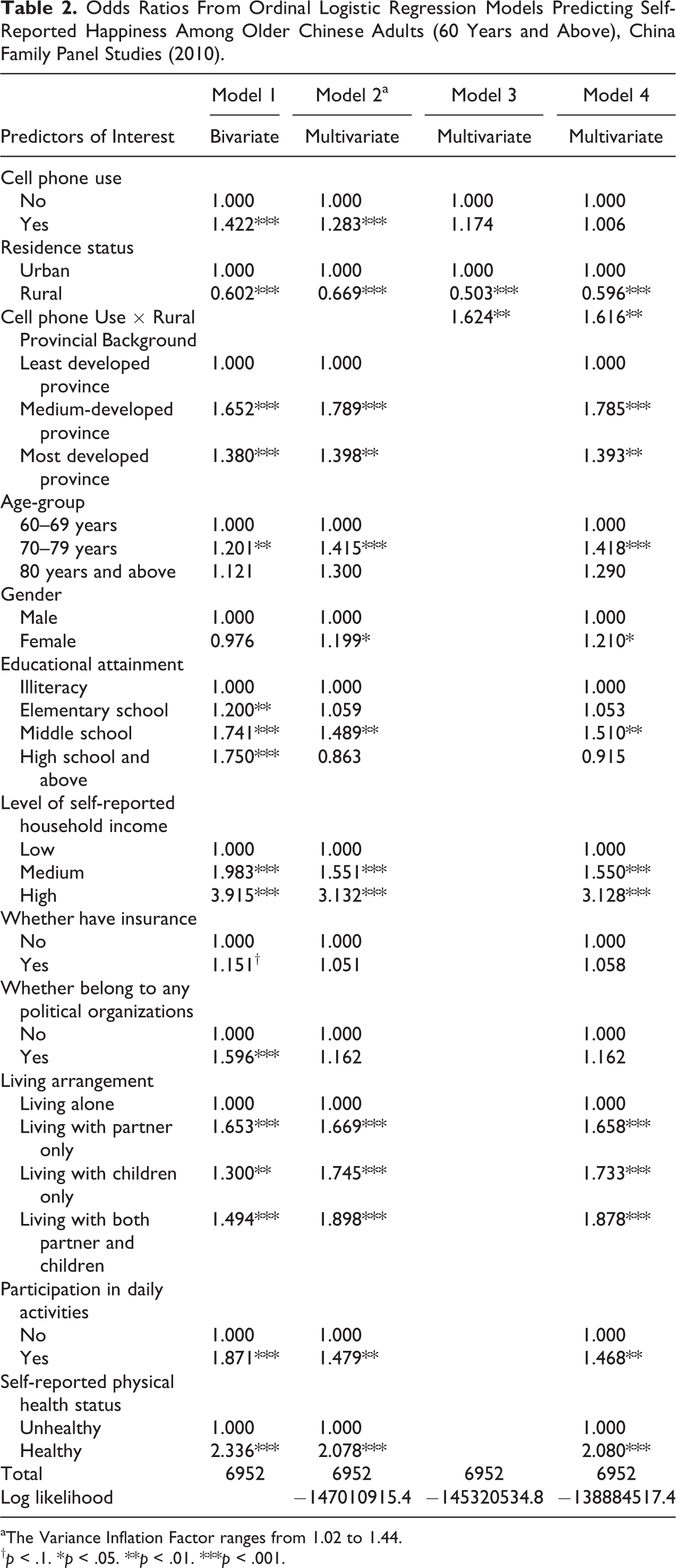
Table 2 presents ORs from ordinal logistic regression models examining whether older adults who had used their own cell phones were more likely to report higher levels of perceived happiness and whether such association differs according to the residence pattern. In Model 1, we found that cell phone use was positively linked to self-perceived happiness among Chinese older adults (OR = 1.422, p < .001) at the bivariate level. Similarly, residence pattern was associated with the dependent variable, with rural residents being less happy compared to urban residents (OR = 0.602, p < .001). When looking at the multivariate-level relationship, as shown by Model 2, the positive association between cell phone use and self-reported happiness among Chinese older adults persists (OR = 1.283, p < .001) as well as the negative association of rural residence status with self-reported happiness (OR = 0.669, p < .001).
Odds Ratios From Ordinal Logistic Regression Models Predicting Self-Reported Happiness Among Older Chinese Adults (60 Years and Above), China Family Panel Studies (2010).
aThe Variance Inflation Factor ranges from 1.02 to 1.44.
† p < .1. *p < .05. **p < .01. ***p < .001.
Additionally, as indicated by the multivariate-level findings in Model 3, we found that the positive relationship between cell phone use and happiness disappeared when we included the interaction term. Nevertheless, the interaction term was statistically significant (OR = 1.624, p < .01) indicating that rural older adults felt happier when they had used own cell phones compared to other rural residents who did not own a cell phone. As shown by Model 4, when theoretically relevant covariates were included, the association between the interaction term and Chinese older adults’ happiness persists (OR = 1.616, p < .01). Moreover, rural residence status is negatively related to Chinese older adults’ self-perceived well-being in both Model 3 (OR = 0.503, p < .001) and model 4 (OR = 0.596, p < .001).
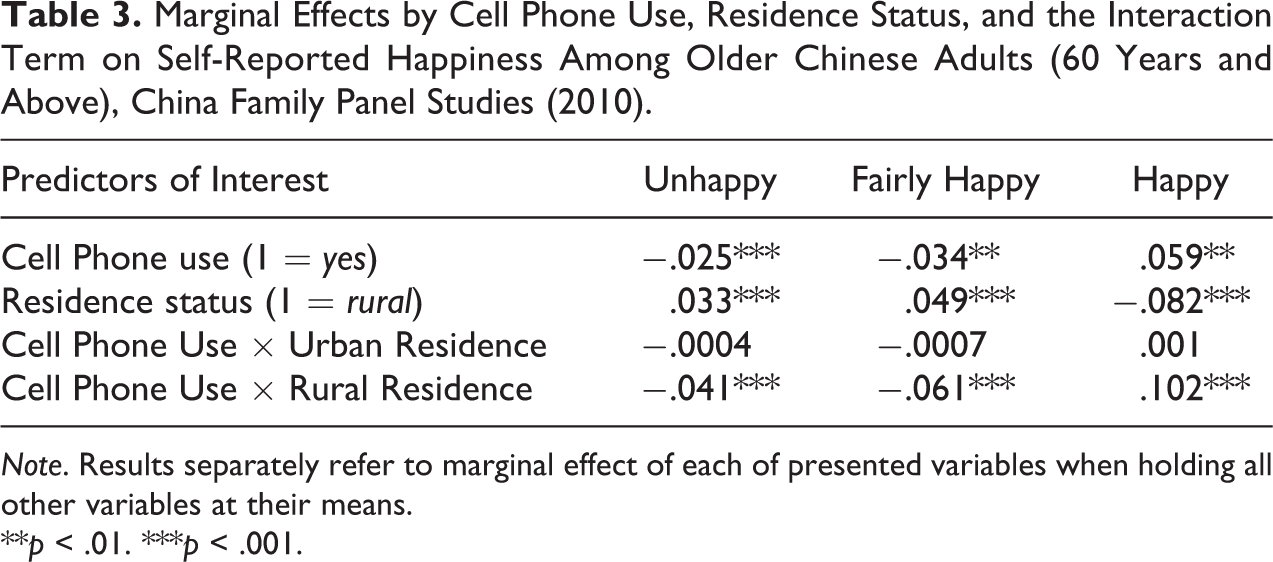
As shown in Table 3, we further explored marginal effects on stratified levels of self-reported happiness that are attributed to key predictors of our study. Specifically, marginal effects are used to understand the extents to which using own cell phone, residing in rural areas, and the interaction term between these two predictors increase or decrease the probabilities of Chinese older adults reporting unhappy, fairly happy, or happy. Using own cell phone instead of having no cell phone or using others’ cell phone will decrease the probability of Chinese older adults reporting not happy at all by 2.5%; notably, it will additively increase the probability of reporting feeling happy by 5.9%, when holding other predictors at their means. Furthermore, consistent with findings in Table 2, using own cell phone can reduce the probability that rural older adults will feel unhappy (−4.1%; p < .001) and increase the probability that rural older adults will feel happy (10.2%; p < .001), keeping other predictors at their mean level.
Marginal Effects by Cell Phone Use, Residence Status, and the Interaction Term on Self-Reported Happiness Among Older Chinese Adults (60 Years and Above), China Family Panel Studies (2010).
Note. Results separately refer to marginal effect of each of presented variables when holding all other variables at their means.
**p < .01. ***p < .001.
Discussion
The purpose of the present study was to examine whether the use of modern technology—cell phone—is related to the happiness and subjective well-being of Chinese older adults and whether rural/urban residence status moderates this relationship. The first research question explored the relationship between cell phone use and happiness among older adults in China. Results suggest that the use of cell phones by Chinese older adults is positively related to their self-perceived happiness. This finding is consistent with previous studies in developed countries where a positive impact of technology use on senior well-being has been observed (Chen & Schulz, 2016; Mealor & Van Belle, 2015).
In the context of Mainland China, our second research question addressed whether a person’s rural/urban residential status affected the relationship between cell phone use and happiness. Results show that for urban residents, cell phone use was not a factor associated with self-reported happiness, while higher levels of happiness were observed among rural residents who have cell phones, compared to those do not. Looking at the details, to rural older adults’ cell phone use could improve the likelihood of feeling happy by a significant margin. Such positive influence on rural older adults is important, especially considering that they reported a much lower level of happiness compared to urban counterparts. These findings are in line with previous literature on the sources of well-being among urban and rural elders.
A study by Pei and Pillai (1999) showed that the subjective well-being or happiness of urban Chinese older adults was higher due to state-sponsored pension and support programs that are more widespread in urban areas. Compared to their rural counterparts, older adults in urban areas have a range of activities available such as attending senior schools, traveling to other places, or taking part in group physical activities such as Tai Qi (Su, Shen, & Wei, 2006; Zhu et al., 2016). A recent example is “dancing grannies” in modern Chinese cities who can regularly enjoy group open-air fitness dancing in public areas, such as parks and squares, while older residents in rural areas are less likely to have such opportunities (Huang, 2016). Thus, the availability of greater resources, leisurely activities, and regular access to modern amenities and social networking opportunities may explain why cell phone use does not raise the levels of happiness of older adults in urban areas, compared to their rural counterparts.
Previous studies have indicated that rural older adults face greater socioeconomic and psychosocial challenges in comparison to those in urban areas (Zeng, Liu, & George, 2003; Zhan & Montgomery, 2003). Even for older adults who do possess adequate pension support, the emotional needs may not be easily satisfied due to fragmentation of the traditional family ties (Krause, Liang, & Gu, 1998). Under such circumstances, anyone possessing a cell phone is able to maintain contact with friends and family, which enhances their sense of subjective well-being. Also, since educational levels are lower in rural areas, using a cell phone could provide a sense of accomplishment and self-perceived modernity, thereby leading to a greater sense of independence and happiness (Chen & Schulz, 2016). Although the opportunities for physical participation in social activities may be limited for these individuals, the sense of being socially connected through maintaining close personal relationships may lead to higher levels of happiness (Baumeister & Leary, 1995). Overall, the results of our study also align with affect theory of happiness (Schwartz & Strack, 1991), which considers happiness to be a subjective phenomenon. The increased level of happiness among rural older adults is largely due to a perception of well-being related to modern technology and social connectedness. Our results are also in agreement with previous research on older adults in Taiwan, which shows that it is not just instrumental support but also emotional support that ensures the well-being of Chinese older adults (Hsu & Chang, 2015).
Recommendations
According to prior research, the use of technology, such as cell phones, may help raise the levels of subjective well-being of these individuals, who face declining opportunities for social contact due to physical and financial limitations and the loss of social roles (Pinquart & Sorensen, 2001). In comparison to China, Western governments are paying special attention to programs aimed at social inclusion of older adults, sometimes in collaboration with private sector partners and charities. They have developed frameworks for social interventions, which deal with social exclusion in older adults and solutions for their well-being and happiness (Pate, 2014). The use of information technology, particularly telephone communication, is an indispensable element of most of these initiatives. For instance, the telephone befriending program by a charity called age UK (Cattan, Kime, & Bagnall, 2011), the Social Connections Programs by the Canadian government involving telephone check-in services (Gilmour, 2012), and free cell phone services to older adults in the United States (Federal Communications Commission, 2017) and Australia (Department of Human Services, 2017), have special state-sponsored programs focused on the issues of isolation and loneliness of senior citizens.
As in other parts of the world, technology plays a vital role in the everyday lives of the Chinese population. While the diffusion of technological innovations such as cell phones has been slow among the older adult population, it can be expected that well-designed and affordable technology may have the potential to improve their lives. Based on the results of our study, and the models adopted in the West, we offer the following recommendations for a policy to improve the social connectedness and happiness of the Chinese older adults:
Provision of technology should be a part of the state-sponsored social support program for older adults. The local Chinese governments can provide low-cost cell phones and talk time free of charge to rural older adults to maintain contact with their family and friends.
Although there are smartphone interfaces available, which cater specifically to the needs of the older adults, due to lower education levels in rural areas specifically, the adoption of technology may pose a challenge to the older adults. We propose training programs to the older adults for the use of cell phones, which can have a positive effect on their happiness and well-being (Chen & Schulz, 2016). The Chinese government should also encourage older adults to participate in training programs to use cell phones for video calls to remain in contact with friends and family. Moreover, technology companies should optimize their preexisting software and further simplify the interface in order to cater to the needs of the rural older adults.
In conclusion, the use of cell phone is not only a means to maintain social ties, in the case of rural older adults, but restores a sense of subjective well-being by overcoming the feeling of not being able to catch up with the rapid technological development. Technological advancements such as cell phones can therefore be considered a means to ensure the well-being of older adults by the Chinese government.
Limitations
One limitation of our data set was the absence of questions related to the composition of the social network of the older adults. Previous research suggests that network size as well as composition—whether it is composed of family, friends, or either of the two groups—has a significant relationship with the level of well-being of older adults (Chi & Chou, 2001). Future studies should incorporate questions related to network size and composition in order to determine whether it mediates the relationship between cell phone use and happiness.
In addition, the variable “self-reported happiness” was assessed with only one question that did not specify which aspects of happiness for the participants to consider. Earlier research has identified a number of factors relating to happiness such as family relationships, income, work, friends, health, freedom, and so forth (Layard, 2005), which cannot be determined from one question. Future research should be based on questions that clearly define the reasons behind and the meaning of happiness.
As for the focal predictor of our research, CFPS did not ask respondents about the types of cell phone they used, leading to an unclear definition of cell phone and preventing us from understanding the exact manner in which the device could be used by older adults. Furthermore, the 2010 wave of CFPS contains three questions regarding cell phone use and ownership that were not all used in the following waves, limiting our analysis to cross-sectional data. Future studies would benefit from a longitudinal design with a clear definition of cell phone would be helpful in determining whether the relationship between cell phone use and happiness changes over time and if so, to which extent the rural/urban residence contributes to such change. For example, with time passes, the relationship between owning cell phone and happiness may decrease due to the consistent investment in the ICT development especially in rural areas by the Chinese government for the sake of reducing the rural/urban digital divide. Such investment may increase the number of older adults in rural areas owning their cell phones, reducing the likelihood of cell phone ownership remaining a significant indicator of social status. Another interesting variable for future studies to explore as a moderator would be gender, as Oreglia (2014) discovered different patterns of technology adoption among older male and female adults in her ethnographic study of ICT use in rural China.
Conclusion
The results of the present study show an association between cell phone use happiness among Chinese older adults and how the relationship is moderated by rural or urban residence status. Although the Chinese Government is investing in providing instrumental support to older adults in rural areas, the emotional support aspect is still lacking, and programs involving the psychological well-being of the senior citizens should also be a part of policy development.
While our recommendations may seem extensive, this investment in the happiness and well-being of older adults has potential benefits to the government and society in the long run. These measures can provide a novel solution to the social isolation problem of the older adults. Not only will the families remain well connected and will have happier older adults but the government can benefit from this less expensive alternative, instead of heavier investments in mental and physical health costs for these individuals.
Footnotes
Declaration of Conflicting Interests
The author(s) declared no potential conflicts of interest with respect to the research, authorship, and/or publication of this article.
Funding
The author(s) received no financial support for the research, authorship, and/or publication of this article.