






Abstract
We analyzed Wave 3 data from the National Social Life, Health, and Aging Project (weighted n = 2907) to examine variations in pain presence and intensity among US community-dwelling Black, Latino, and white adults aged 50 plus. Adjusting for factors that commonly contribute to stress and health inequalities (educational attainment, inadequate health insurance, perceived economic position, and perceived discrimination), we examined how pain presence and intensity varied by race/ethnicity. Seventy percent reported pain presence. Reported mean intensity was 2.91 (SD = .99; Range; 1–6) indicating moderate pain. Compared to white participants, Black and Latino individuals reported less presence of pain. However, Latinos reported higher pain intensity. Perceived discrimination and educational attainment were associated with pain outcomes, but these relationships varied by race/ethnicity. Work is needed to examine racial/ethnic differences in other pain dimensions and to understand how educational attainment and perceived discrimination may contribute poorer pain outcomes across groups.
Introduction
Pain is a national research priority owing to its association with significant impairments in mobility (Peat et al., 2006), mood (Bierman & Lee, 2018), premature mortality (Smith et al., 2018), and high medical costs (Simon, 2012), all of which disproportionately affect the growing numbers of midlife and older adults in the U.S. (Administration on Community Living, 2022; Nahin, 2015). Defined as “an unpleasant sensory and emotional experience associated with, or resembling that associated with, actual or potential tissue damage” (Raja et al., 2020), pain is challenging to identify and effectively treat in older adults, and it thus often goes untreated or undertreated (Simon, 2012). Chronic illnesses are common in later life, for example, and often contribute to the onset and worsening of pain (Morrisey et al., 2014). Providers may hesitate to prescribe pharmacologic treatments due to issues related to comorbidity, polypharmacy, and potential for adverse effects such as falls, addiction and hospitalizations (Gloth, 2011; Murphy et al., 2018; Oscanoa et al., 2017; Scherer et al., 2016; Toye et al., 2018). Older adults may also underreport the presence and intensity of pain because they are reluctant to complain, attribute pain to normal aging, or have different pain thresholds (Herr & Garand, 2001; Lautenbacher et al., 2017).
The number of midlife and older adults (50+ years) in the U.S. is continuing to expand and become more racially and ethnically diverse. By 2060, the number of older adults (65+) is projected to approach 100 million (Administration on Community Living, 2021a), when Black and Latino persons, who comprise the largest racial and ethnic minority groups in the U.S., will represent one-third of this age sector (Administration on Community Living, 2021a; Administration on Community Living, 2021b; Administration on Community Living, 2022). Despite public health concerns, knowledge of pain in Black and Latino midlife and older adults remains limited. The current study addresses this gap by exploring differences in pain presence and intensity in Black, Latino, and white midlife and older adults in the U.S.
Theoretical Framework
The Biopsychosocial Diathesis Stress Model of Chronic Pain (Bevers et al., 2016) holds that biological, psychological, and social factors interact with stress to affect the onset of acute pain, the development of chronic pain, and the experience of more severe pain intensity. For example, biological factors, including female sex (Fillingim et al., 2009) and chronic diseases, (e.g., arthritis; Sarzi- Puttini et al., 2014, diabetes;Merashli et al., 2015), psychological factors (e.g., depressive symptoms; Surah et al., 2014) and social factors (e.g., low educational attainment; Grobschadl et al., 2016 and low socioeconomic status (Fliesser, 2017) individually and together contribute to increased stress levels and disruptions in homeostasis. Stress-related disruptions can lead to muscle, bone, and tissue deterioration and enhance the likelihood of injury and physical deconditioning that lead to pain.
Reciprocally, pain can impair physical functioning and contribute to higher levels of experienced stress (Bevers et al., 2016). For example, psychological distress related to initial injury or physical deconditioning may also lead to mental deconditioning (e.g., learned helplessness, substance abuse, depression) and changes in behaviors (e.g., avoidance of physical activity due to fear of worsening injury) that may worsen pain intensity. Further, social and economic factors (e.g., limited socioeconomic status, lack of medical insurance) may limit access to pain care (Bevers et al., 2016) and further increase psychological distress. Singly and together, these factors and related experiences may lead to prolonged cycles of pain and stress that can further contribute to muscle, bone, and tissue deterioration that eventuate in chronic pain (Gatchel, 2004).
Social systems and structures (e.g., institutional and structural racism; Boen, 2020; Boen & Hummer, 2019; Forrester et al., 2019) can also contribute to differences in stress and related health outcomes (e.g., pain presence, intensity) across Black, Latino, and white individuals. In particular, institutional and structural racism pose significant risks for Black and Latino individuals, who have lower levels of formal education, less access to medical insurance, and a greater likelihood of poverty and exposure to discrimination than their white counterparts. Efforts to navigate discriminatory social systems exacerbate overall levels of stress (Boen, 2020; Boen & Hummer, 2019; Brown, 2020) in Black and Latino populations compared to their white counterparts. These differences in stress levels can lead to increased physiological dysfunction in mid-to-later life and may contribute to racial/ethnic disparities in pain (presence and intensity).
Experiences related to education, economic security, access to adequate health insurance, and discrimination may produce stress for Black, Latino, and white individuals. However, variations in these experiences may produce differences in stress and pain presence and intensity among these groups. For example, whereas all older adults may face age-related discrimination, white individuals are much less likely to experience discrimination due to race/ethnicity or skin color. Some older white adults (e.g., heterosexual white men) may not experience discrimination until they become older, while risks of structural and institutional racism and discrimination start much earlier for US born Black and Latino individuals. For example, Black and Latino individuals who enroll in higher education may experience heightened stress in predominantly white academic structures (e.g., Stevens et al., 2018). Further, obtaining an equivalent level of education does not eliminate structural racism and other forms of discrimination in employment (e.g., Borowczyk-Martins et al., 2017). And while equal income helps to level overall purchasing power, access to commodities such as housing are still subject to discrimination (Quillian et al., 2020). Finally, even with equal access to medical systems, Black and Latino individuals have less access to pain and related treatments (e.g., Morales & Yong, 2021). Seemingly equivalent assets such as education, economic security, and health insurance can lead to varying stress levels and relationships with pain outcomes. Therefore, it is critical to examine if and how the impact of education, economic security, access to adequate health insurance, and discrimination on pain outcomes varies across Black, Latino and white groups.
Literature Review: Pain Presence and Intensity Across Black, Latino, and White Adults
There are persistent gaps in knowledge about racial and ethnic differences in the presence and outcomes of pain in community-based samples. To begin, studies on pain experiences are needed to understand observed differences within and among racial/ethnic groups. Here it is important to distinguish between community and clinical samples. Subjective appraisals, including meanings attached to the pain (Riley et al., 2000), cultural factors (Meghani & Houldin, 2007), and barriers to treatment such as medical insurance and limited quality and availability (Park et al., 2013), influence reporting on pain, seeking healthcare, and receiving treatment. Clinical samples of individuals with osteoarthritis, back pain, or painful neuropathies, for example, may be more comfortable reporting pain, more likely to be connected to healthcare resources, and more willing to engage in treatment than community samples. Findings in studies involving the latter have the advantage of being more generalizable.
Pain Presence
Research on differences in prevalence rates of pain in Black, Latino and white midlife and older adults has yielded mixed results. Some studies report higher rates of pain among Latino than white persons (Dunn et al., 2004; Grubert et al., 2013; Plesh et al., 2011; Reyes-Gibby et al., 2002; Spector et al., 2023). Others report lower rates of pain among Latino (Hardt et al., 2008; Hollingshead et al., 2016; Plesh et al., 2011; Spector et al., 2024) and Black individuals (Grol-Prokopczyk, 2017; Grubert et al., 2013; Hardt et al., 2008; Hollingshead et al., 2016; Plesh et al., 2011; Zajacova et al., 2021). Still others report no differences in white and Latino (Grol-Prokopczyk, 2017; Janevic et al., 2017; Patel et al., 2013; Plesh et al., 2011; Reyes-Gibby et al., 2007; Riley et al., 2002; Spector et al., 2024; Zajacova et al., 2021) or Black persons (Dunn et al., 2004; Janevic et al., 2017; Patel et al., 2013; Plesh et al., 2011; Reyes-Gibby et al., 2002, 2007; Riley et al., 2002; Spector et al., 2024).
Pain Intensity
A handful of studies have examined pain intensity among community-dwelling midlife and older adults. In four of the six studies we identified, Black and Latino individuals report significantly more intense pain than white counterparts (Janevic et al., 2017; Park et al., 2015; Reyes-Gibby et al., 2007; Yang et al., 2022). Grol-Prokopczyk (2017) found that Black and Hispanic persons reported more severe pain than white persons in bivariate analyses, but after accounting for socioeconomic status, these differences disappeared for Hispanic participants, while Black individuals had lower pain intensity scores than their white counterparts. Similarly, Spector and colleagues (2024) found no difference in severe chronic pain across Black, Hispanic, or white participants. Finally, we note that two of these studies included relatively small numbers of Latino participants (Park et al., 2015, 55 Latino participants in sample of 174; Yang et al., 2022: 67 Latino individuals in a sample of 684). Additional studies are thus needed to elucidate possible differences in pain intensity across midlife and older Black, Latino, and white adults.
Social and Economic Factors Associated with Stress and Pain
Social and economic factors such as low educational attainment, limited socioeconomic status, and lack of medical insurance are associated with increased stress (Forrester et al., 2019) and are predictors of pain outcomes (see Grol-Prokopczyk, 2017; Janevic et al., 2017; Reyes-Gibby et al., 2007), yet few studies of pain explore if these relationships vary across racial/ethnic groups. In a recent study of Black, Hispanic, and white individuals from the US Health and Retirement Study (HRS), Spector and colleagues (2023) found that greater financial strain was associated with the presence of chronic pain, but this relationship did not vary across racial/ethnic groups.
Another critical gap in pain studies is limited examination of discrimination. Multiple studies link discrimination with stress and poorer health (Triana et al., 2015; Williams et al., 2019). However, few quantitative studies have examined the relationship of discrimination and pain in midlife and older Black or Latino adults (Burgess et al., 2009; Hollingshead et al., 2016). One recent study by Spector and colleagues (2024) using the 2018 US HRS found that greater exposure to everyday discrimination was positively associated with the presence of any chronic pain, severe chronic pain, and high impact chronic pain. However, in fully adjusted models (age, sex, and self-reported general health, and list of chronic stressors), they found no differences in these relationships across Black, Hispanic, or white participants.
Contribution of Current Project
Our primary aims are to examine the prevalence and intensity of pain among three different racial/ethnic groups of middle-aged and older adults in the U.S., addressing gaps in the literature. We hypothesize that Black and Latino participants will report (1) a higher prevalence and (2) greater intensity of pain than same-aged white individuals. In exploratory analyses, we examine whether the relationships of educational attainment, perceived economic position, inadequate health insurance, and perceived discrimination and pain outcomes (presence and intensity) vary across racial/ethnic groups.
Methods
Data Source
Data are from the National Social Life, Health, and Aging Project (NSHAP), a nationally-representative survey of community-dwelling midlife and older adults age 50+ that is designed to assess the physical, mental, and social well-being of older Americans (O’Muircheartaigh et al., 2021).We analyzed data from Wave 3 (n = 4,777, collected 2015-2016), which included in-person interviews from two cohorts: (1) respondents continuing from the first rounds of interviews (born 1920-1947), and (2) newly-recruited participants (born 1948-1965). Live-in partners of both cohorts were also eligible for interviews. In addition to interviews, participants were asked to complete leave-behind, self-administered questionnaires and to submit up to 11 biomeasures.
We analyzed data from only Wave 3 for two reasons. First, measures of pain in the planned analyses are only available in the leave-behind questionnaire (LBQ) of Wave 3, as are other concepts of theoretical interest (e.g., perceived discrimination). Second, inclusion of a fresh sample of older adults in Wave 3 and live-in partners increased the sample size for testing our hypotheses and extended the age range to include the baby boomer cohort. Final return rates for the leave behind questionnaire (LBQ) were 85% for the full sample, 91% for the continuing participants, and 80% for newly recruited participants (O’Doherty et al., 2021).
Population
Our target population included home-dwelling midlife and older adults aged 50 and older who completed self-reports of presence and intensity of pain in the LBQ and identified as Black, Latino, or white (weighted n = 3435). We then eliminated individuals with missing data on important study variables. Our final weighted sample included 2907 respondents who were either white (n = 2399), Black (n = 306) or Latino (n = 202) and who completed all pain and covariate data points.
Measurements
Outcomes
Presence of pain was assessed by response to the question: “In the past 4 weeks, have you had any pain?” (yes/no) (Shega et al., 2014).
Intensity of pain was measured by an original item that asked participants to “Please check the box next to the phrase that best describes the level of pain in the past 4 weeks.” Options were: 0 = no pain, 1 = slight pain, 2 = mild pain, 3 = moderate pain, 4 = severe pain, 5 = extreme pain, and 6 = the most intense pain imaginable (Scudds & Østbye, 2001; Shega et al., 2014). We focused our analyses on individuals who acknowledged having pain at any intensity (i.e., 1 = slight pain to 6 = the most intense pain imaginable).
Race/ethnicity was assessed with two questions: “Do you consider yourself primarily white or Caucasian, Black or African American, American Indian, Asian, or something else?” and “Do you consider yourself Hispanic or Latino?” To analyze data by group, we used an NSHAP-coded race/ethnicity variable that classified participants into four mutually exclusive groups (Non-Hispanic white, Black (included Hispanics who self-reported Black race), Hispanic (of all races except “Black”), and “Other” (e.g. Asian, Native American, Pacific Islander).
Common Sources of Stress
Educational attainment was measured as less than high school = 1; high school or equivalent = 2; vocational certificate, some college or associate’s degree = 3 and bachelor’s degree or more = 4.
Perceived economic position was determined by asking participants: “Compared with American families in general, would you say that your household income is far below average = 1; below average = 2; average = 3; above average = 4, or far above average = 5?” Answers ranged from 1 = “far below average” to 5 = “far above average”.
Adequacy of Health Insurance was based on two items. Participants reported whether they had difficulty receiving healthcare services because of a lack of adequate insurance: (1) “In the past year, has a lack of adequate health insurance kept you from getting medical care?” and (2) “In the past year, has a lack of adequate health insurance kept you from getting prescription medications?” Response options were yes or no for both variables. If participants answered yes to either item, they were coded as having inadequate health insurance.
Perceived discrimination was measured by an adapted version of the Perceived Discrimination Scale (Monk et al., 2021; Williams et al., 1997) and included two questions: “In your day-to-day life, how often have you been treated with less courtesy than other people?” and “In your day-to-day life, how often have people acted as if they’re better than you are?” Responses options were “Never” = 0, “Less than once a year” = 1, “About once or twice a year” = 2, “Several times a year” = 3, “About once a month” = 4, “Every week” = 5, and “Several times a week” = 6. We summed the two items to create a total score (Range: 0-12).
Covariates
Sociodemographic variables included age (in years), sex (male = 0, female = 1), and marital status (married or living as married = 1, divorced, separated, or never married = 2 and widowed = 3).
Employment status was measured by a single item: “Are you currently working?” (yes = 1 or no = 0). The number of chronic diseases was calculated by responses to separate questions with the stem: “Has a medical doctor ever told you that you have?” (heart disease, arthritis, breathing problems, stroke, hypertension, diabetes, and cancer; yes = 1 or no = 0 for each condition). The total ranged from 0 to 7. Depressive symptoms were measured with the NSHAP Depressive Symptoms Measure, which assesses the frequency of 11 self-reported depressive symptoms in the past week (0 = rarely or none of the time, 1 = some of the time, and 2 = much or most of the time; Cronbach’s Alpha = .692). We also accounted for Body Mass Index (BMI). Height and weight were collected in person by a trained study research assistant. Height was measured using a stiff tape and rounded to the nearest half-inch. For weight, the study used a scale on a flat, non-carpeted surface (For more details see O’Doherty et al., 2014 Electronic Supplement 1). We used the Centers for Disease Control (CDC), 2022) formula based on height and weight to calculate BMI.
Analytical Strategy
Our primary aim was to examine pain presence and intensity across the three racial/ethnic groups. We hypothesize that overall higher stress levels in Black and Latino participants across the life course (Brown, 2020) contribute to greater physical dysregulation and ultimately higher pain presence and intensity compared to their white counterparts.
Common sources of stress include low educational attainment, limited household income, inadequate health insurance, and perceived discrimination (Forrester et al., 2019). Further, inequities in long-term stress levels may also contribute to higher numbers of chronic diseases (e.g., Miller et al., 2011), depressive symptoms (Mahar et al., 2014), and BMI (e.g., Cuevas et al., 2021). Both stress and disease processes may lead to physiological dysregulation and ultimately the onset of pain and increased pain intensity. We thus control for the effects of stress and disease processes. Because Black and Latino individuals are more likely to report these conditions, controlling for their main effects may partially explain racial/ethnic disparities in pain. Finally, we included other relevant social and demographic factors that may contribute to differences in health and pain outcomes.
The dependent variables in our main models are pain presence and pain intensity. Reports of pain intensity were limited to study participants who reported pain levels (range 1–6). We examined these as two separate outcomes for several reasons. First, measures of pain presence and pain intensity follow the original NSHAP question structure and allow us to explore two important layers of pain reporting. Second, pain disclosure depends on multiple factors, including age (e.g., viewing pain as normal part of aging; Meghani & Houldin, 2007), gender (e.g., women are more likely to disclose pain than men; Osborne & Davis, 2022), and cultural views (e.g., only when pain affects functioning; Monsivais, 2013). Retaining a two item outcomes structure permits a comparison of pain intensity across Black, Latino, and white individuals who were willing to acknowledge and disclose their pain.
With respect to pain outcomes, we first examined the main effects of sociodemographics including race/ethnicity, sex, marital status, educational attainment, inadequate health insurance (no, yes), as fixed classification factors. Covariates included: age, perceived economic position, number of chronic medical conditions, perceived discrimination score, depressive symptoms, and BMI.
Second, we consider that lower educational attainment and perceived economic position, having inadequate health insurance, and higher levels of perceived discrimination would contribute to increases in stress across all racial/ethnic groups. However, we underscore that social experiences of these common challenges may lead to overall greater stress levels for Black and Latino individuals compared to white participants across the life course. Even when the effects of these factors are treated as equal, they may produce more stress that contributes in turn to physical dysregulation and worse pain outcomes. To explore if effects vary across racial/ethnic groups, we examined the interactions of educational attainment, inadequate health insurance, perceived economic position, and perceived discrimination on pain outcomes and race/ethnicity (a single variable at a time). We focused on prespecified race/ethnic group contrasts (Black vs. white; Latino vs. white).
We used weighted linear mixed models to account for nesting among subjects (spouses/partners) from the same household and to examine pain presence and pain intensity respectively. We used NSHAP-generated person level weights that accounted for non-response for all statistical analyses (for a detailed description of the weighting approach, see O’Muircheartaigh et al., 2021). We used the recommended Wave 3 NSHAP variable (weight_adj), which assigns each case different weights (by simulated replication), to provide unbiased estimates of population parameters (IBM SPSS, 2020; O’Muircheartaigh et al., 2021). Assigned weights indicated the number of observations represented by each case. Cases with missing values were excluded from our analyses. We performed analyses with SPSS version 27 survey procedures.
Results
Weighted Descriptive Statistics at Wave 3 (n = 2907).
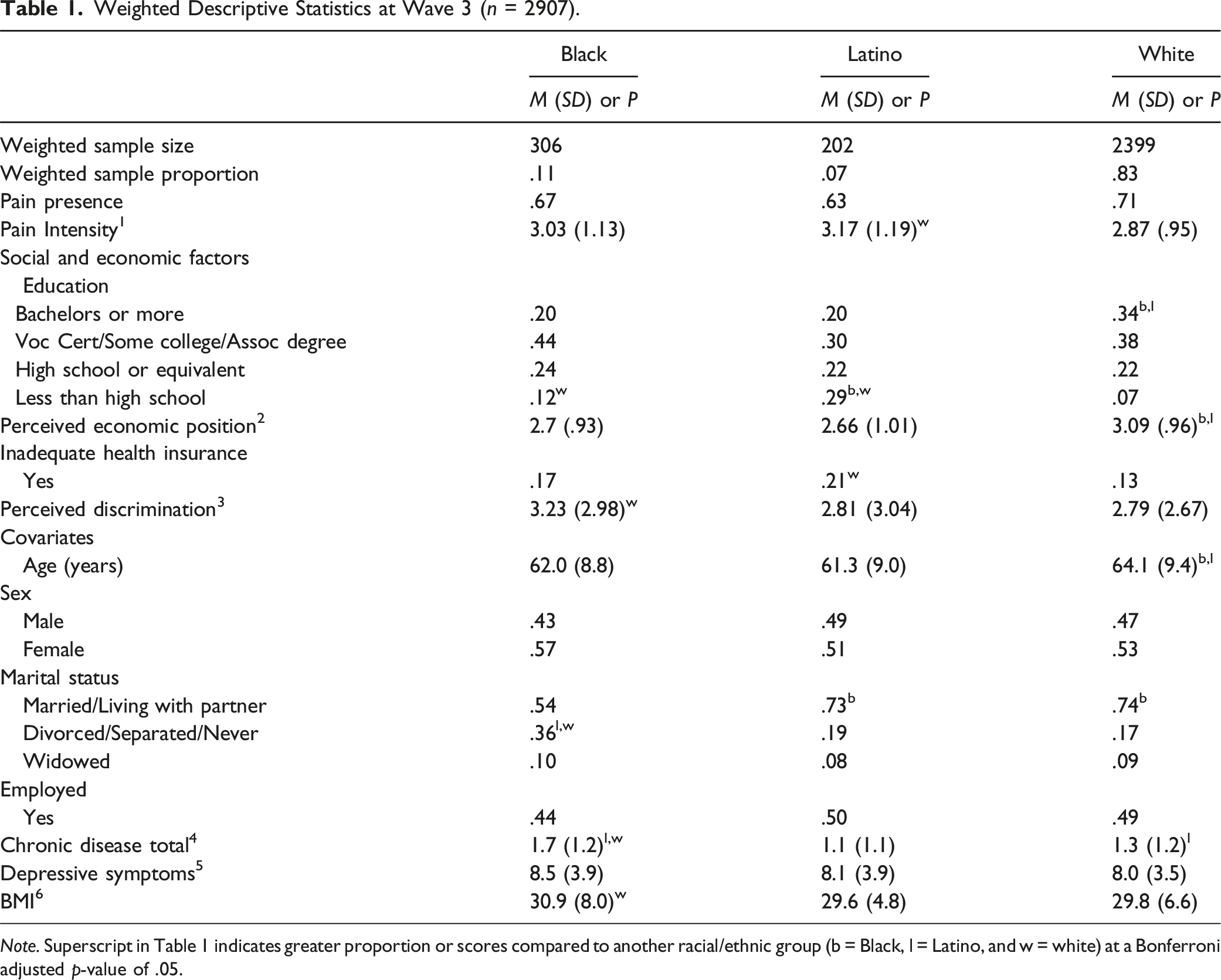
Note. Superscript in Table 1 indicates greater proportion or scores compared to another racial/ethnic group (b = Black, l = Latino, and w = white) at a Bonferroni adjusted p-value of .05.
The sample reported a mean age of 63.7 years (SD = 9.4) with Black (SD = 62.0 SD = 8.8) and Latino (61.3, SD = 9.0) individuals being younger, on average, than white participants 64.1 years (SD = 9.4). Just over half of participants were female (53%) and 71 % were married or living with a partner. However, a significantly lower percentage of Black participants were married or living with a partner (54%) than Latino (73%) and white (74%) participants. Almost half (49%) of all participants reported being employed. There were no significant differences across racial and ethnic groups. On average, participants reported 1.3 chronic diseases (SD = 1.2). Compared to white individuals (1.3, SD = 1.2), Black participants (1.7, SD = 1.2) reported more chronic diseases than Latino (1.1, SD = 1.1) and white (1.3, SD = 1.2) individuals. Further, White participants reported more chronic diseases than Latinos participants. The mean depressive symptom score was 8.1 (SD = 3.5). There were no significant differences across Black, Latino, and white groups. The average BMI was 29.9 (SD = 6.6); Black participants (30.9, SD = 8.0) had significantly higher BMI scores than white individuals (29.8, SD = 6.6). There were no other significant differences.
Relationship of Race/Ethnic Groups, Sources of Stress, and Pain Outcomes
Effects of Race/Ethnicity, Sociodemographic and Health Variables on Pain Presence and Intensity.

Note. Models are weighted to account for the probability of selection, with adjustment for the likelihood of non-response. AOR: Adjusted Odds Ratio. Both adjusted models presented control for race and ethnicity, social and economic factors associated with stress, and all covariates. CI = Confidence Interval. BMI is units are reported in kg/m2.
With respect to pain intensity, there were no significant differences between Black and white participants. However, Latino participants (β̂ = 0.46, SE = .10, p < .001) reported significantly higher pain intensity than white participants. Indeed, they were more than two times (OR: 2.29, 95% CI [1.28, 4.10]) more likely to report severe pain or higher than white participants. Compared to persons with bachelor’s/associate’s degrees and higher levels of educational attainment, individuals with a high school or equivalent degree (β̂ = 0.36, SE = 0.06, p < .001) reported greater pain intensity. Similarly inadequate insurance (β̂ = 0.40, SE = 0.06, p < .001), a higher number of chronic diseases (β̂ = 0.09, SE = 0.02, p < .001), depressive symptoms (β̂ = 0.04, SE = 0.01, p < .001), and BMI (β̂ = 0.02, SE = 0.003, p < .001) were all positively associated with greater pain intensity. Individuals who were employed (β̂ = −0.17, SE = 0.05, p < .001) reported lower levels of pain intensity.
The relationships of inadequate insurance and perceived economic position and pain outcomes did not vary by race/ethnicity. However, we found that having less than a high school education for Black participants (β̂ = 0.80, SE = 0.29 p = .006) and a vocational certificate, some college or associate’s degree for Latinos (β̂ = 0.57, SE = 0.28, p = .043) were positively associated with greater pain intensity. Perceived discrimination (β̂ = 0.06, SE = 0.02, p = .007) was positively associated with stronger pain intensity for Black participants only (See Figure 1). Relationship between perceived discrimination and pain intensity by race/ethnicity. Note. All models are adjusted for demographic, social and economic factors associated with stress, and all covariates. Models weighted to account for the probability of selection, with adjustment for the likelihood of non-response. AOR: Adjusted Odds Ratio; CI = Confidence Interval.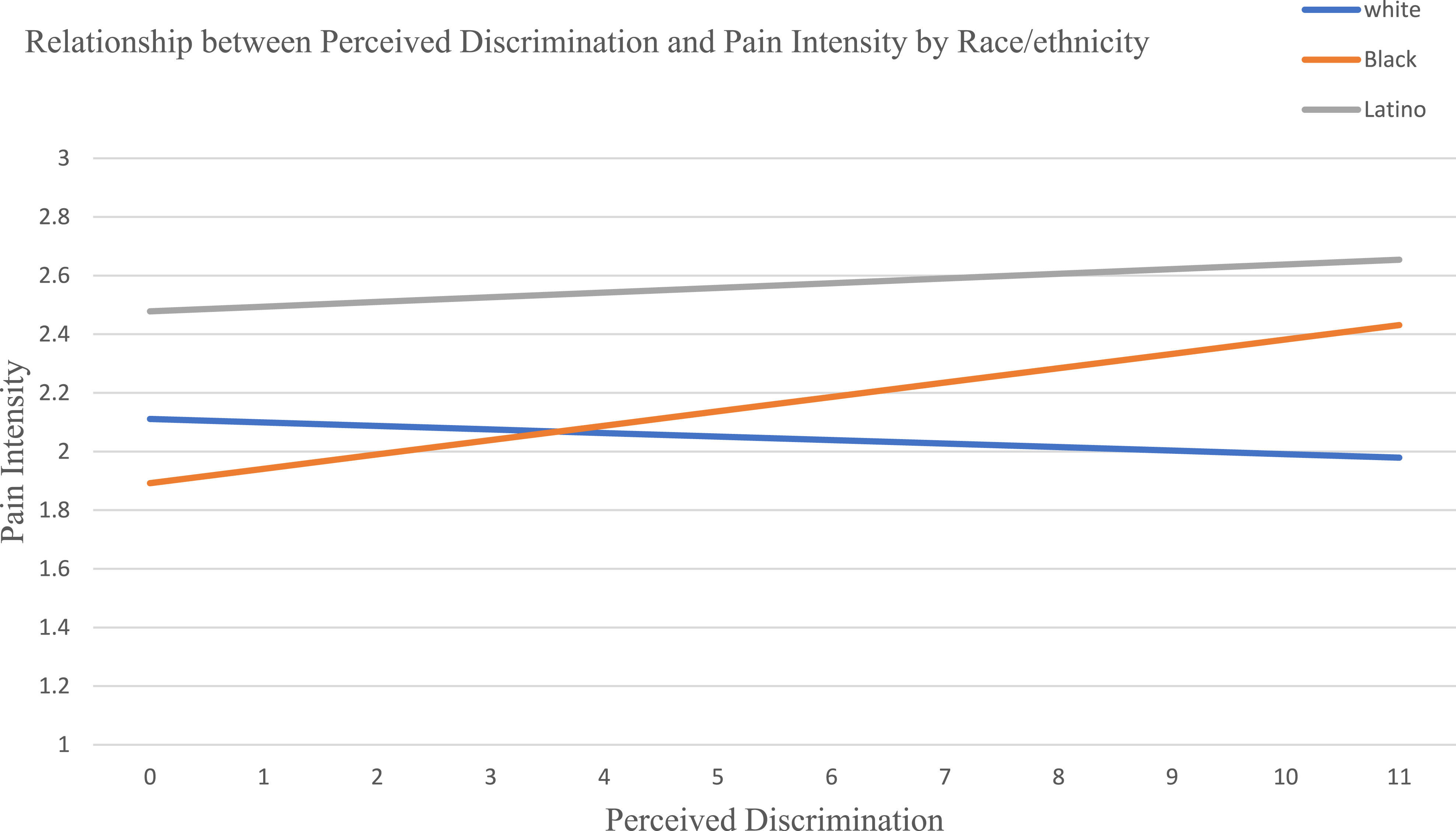
Discussion
Our findings provide important insight into differences in pain across midlife and older Black, Latino, and white adults. First, our final fully adjusted weighted models indicated that Black and Latino individuals reported significantly lower rates of pain presence compared to white participants. Among those who reported pain, there were no differences in pain intensity between Black and white individuals. However, Latino participants reported significantly higher levels of pain compared to white individuals. Consistent with the Biopsychosocial Diathesis Stress Model of Chronic Pain and previous literature, common correlates of stress including lower levels of educational attainment, inadequate insurance, and greater perceived discrimination were significant predictors of worse pain outcomes. However, our study makes a further significant contribution to existing literature by noting that the relationships among educational attainment, perceived discrimination, and pain intensity varied across Black, Latino, and white participants.
Contrary to our hypotheses, Black participants were significantly less likely to report pain compared to white participants. These results are at odds with previous studies indicating no differences in rates of pain between Black and white participants (Dunn et al., 2004; Janevic et al., 2017; Patel et al., 2013; Plesh et al., 2011; Reyes-Gibby et al., 2002, 2007; Riley et al., 2002). However, our analyses do support findings from Grol-Prokopczyk, 2017, Grubert et al., 2013, Hollingshead et al., 2016, Plesh et al., 2011; Zajacova et al., 2021.
Our findings also indicated that Latino individuals were less likely to report the presence of pain compared to their white counterparts. These findings do not support previous work that indicates that Latino individuals report greater rates of pain compared to white persons (Dunn et al., 2004; Grubert et al., 2013; Plesh et al., 2011; Reyes-Gibby et al., 2002; Spector et al., 2023). However, our results are similar to studies of chronic pain in other midlife and older adult samples (Hardt et al., 2008; Hollingshead et al., 2016; Plesh et al., 2011).
Our models further indicate that among those who reported pain, pain intensity did not significantly differ for Black and white participants. These results are contrary to our hypothesis and with findings of prior research (Grol-Prokopczyk, 2017; Janevic et al., 2017; Park et al., 2015; Reyes-Gibby et al., 2007; Yang et al., 2022). Supporting our hypothesis, our final adjusted models indicated that compared to white participants, Latino individuals had significantly more intense pain. These results align with prior research (Janevic et al., 2017; Park et al., 2015; Reyes-Gibby et al., 2007; Yang et al., 2022). However, our fully adjusted models do not support the findings of Grol-Prokopczyk, as Latino persons in our sample reported more intense pain even after accounting for perceived economic position and other salient social and health factors.
Our results suggest that Black and Latino midlife and older adults may hold a health advantage in the context of pain prevalence; however, fully 70% of participants reported pain. Unlike prior studies (Dunn et al., 2004; Hardt et al., 2008; Hollingshead et al., 2016; Patel et al., 2013; Reyes-Gibby et al., 2002, 2007), we examined presence of any type of pain regardless of body location, frequency, perceived impact, or chronicity. Similar to studies by Dunn and colleagues (2004) and Patel and team (2013), our participants were asked about pain over a four-week period. The NSHAP pain items likely captured individuals who experienced episodes of acute, subacute, and chronic pain (Shega et al., 2014). Given the broad scope of our measure, our pain prevalence estimate underscores the magnitude of public health concerns regarding pain. We found a higher prevalence of pain compared to previous studies of racially / ethnically diverse samples of home-dwelling midlife and older adults. We highlight that despite having lower rates of pain than white participants, Black and Latino individuals still reported very high rates of pain (67% and 63%).
In terms of pain intensity, despite our inclusion of demographic, health, socioeconomic, and social factors known to be associated with higher levels of stress exposure, Latino participants continued to experience significantly greater levels of pain intensity. Hence, even if Latino individuals truly hold a health advantage in terms of pain presence, once they experience pain, it tends to be more intense than for white individuals. In our sample, more than one in three Latino participants with pain reported their pain as severe or higher.
In line with our guiding perspective, socioeconomic and social factors that are associated with higher levels of stress exposure emerged as significant predictors of pain presence and intensity (Bevers et al., 2016). We did not find that the relationships across having inadequate insurance, perceived economic position and pain outcomes varied by racial/ethnic group. However, more nuanced assessments may help test theoretically informed pathways that lead to poorer pain outcomes (i.e., social factors that increase stress, physical dysregulation). We did find that the relationship between educational attainment and pain intensity varied across Black, Latino, and white participants. Lower education attainment per se may not produce pain. However, the lived experience of lower levels of education may contribute to greater stress across the life course by limiting access to high paying employment. Compared to white study participants, Black and Latino individuals are more likely to report lower levels of educational attainment and to disproportionately work in physically demanding blue-collar positions, such as construction, service sector and agriculture, that may lack job security or healthcare insurance (Wilson & Maume, 2014). Individuals in these positions may minimize pain and not take time off to obtain healthcare to avoid being perceived as lazy or unable to do their job and to jeopardize employment.
Similar to findings reported by Spector and colleagues (2024), our results indicated that perceived discrimination was positively associated with reporting the presence of pain across all three groups, that is, Black, Latino, and white. There is need to further explore life-long and late-life experiences of institutional and structural racism and other forms of discrimination and if and how these factors contribute to greater stress, and pain presence. All midlife and older adults may experience perceived discrimination (e.g., ageism), but the frequency, chronicity, and impact likely vary individually and by intersecting identities (e.g., race/ethnicity, sexual orientation, gender; Crenshaw, 2013). Unlike white participants, Black Americans in our sample reported lifelong exposures to institutional and structural racism (e.g., education, segregation, mass incarceration; Forrester et al., 2019). Similarly, compared to their white counterparts, Latinos in the U.S. are more likely to experience discrimination based on skin color, immigrant status, limited English proficiency, and when navigating anti-immigrant environments (Hacker et al., 2011).
Although we found no significant differences in pain intensity between Black and white participants, we found that higher levels of perceived discrimination were associated with more intense pain among Black compared to white participants only. Rigorous studies of discrimination and pain with midlife and older Black and Latino adults are needed. Exposure to and perceptions of institutional and structural racism and discrimination may lead to varying levels of stress depending on social context and statuses that allow one to challenge or buffer against discriminatory acts, for example, living in a Latino enclave, being a U.S. Citizen or permanent resident, navigating predominantly white spaces; Findling et al., 2019. Exploring the nuances of discrimination and their impact was beyond the scope of this study. However, we posit that experiences of discrimination and the ability to recognize these exposures may produce varying levels of acute and chronic stress, physical dysregulation, that contribute to the varying rates of pain and intensity (Bevers et al., 2016). Further work is needed to understand how perceptions of discrimination among groups with different intersecting identities of gender, immigrant status, and sexual orientation contribute to stress and influence pain outcomes, particularly minoritized midlife and older adults.
Finally, our findings did not indicate consistent differences in pain presence and intensity in Black and Latino individuals compared to their white counterparts. However, in line with the Biopsychosocial Diathesis Stress Model of Chronic Pain, psychological and social factors may help explain our findings. We underscore that cultural perspectives and perceived discrimination may influence some participants to not disclose their pain or to minimize their pain. Black adults may avoid talking about pain due to a fear of being labeled as drug-seeking by their family, friends, or medical providers (Meghani & Houldin, 2007); view pain as a normal part of aging (Meghani & Houldin, 2007); consider pain as a personal inadequacy or weakness (Booker, 2016); and have distrust in the U.S. medical system rooted in a history of discrimination in medical research and health care (Palanker, 2008). Our models indicated that inadequate insurance was associated with worse pain outcomes. However, further work should explore how healthcare quality and perceived discrimination in healthcare may contribute to stress and racial/ethnic differences in pain.
Strategies to cope with discrimination may also limit pain disclosure and minimization. For example, Black women may assume a superwoman role to enhance survival and cope with social stressors such as racism, oppression, and discrimination (Woods-Giscombé, 2010). Midlife and older Black women who serve as family matriarchs may feel obliged to reject vulnerability and dependence, including limited disclosure or delayed reporting of pain. Similarly, Latino individuals may not express pain openly if they see it an “obligation” to be met “stoically” (Rutledge et al., 2013). Or they may disclose pain if they perceive it to affect personal, interpersonal, social, or spiritual functioning (Monsivais, 2013). However, shame from not being able to fulfill their roles may further limit their disclosure. If Latinos delay disclosure of pain until it affects their functioning, it may also be that greater stress may manifest as higher pain intensity and interference (Bevers et al., 2016). As few studies have included midlife and older Latino adults, further studies that explore potential pain disparities and consider challenges to disclosure and perceptions of pain with Latino groups are needed.
Limitations
Pain chronicity and causes of pain (e.g., arthritis, falls, infections, cancer) are important facets of the pain experience, but neither measure was available in our data for the entirety of the Wave 3 sample. We also did not examine pain as a function of body location (e.g., upper vs. lower extremity) or pain interference as an outcome. Studies with more refined data are needed to assess pain chronicity, etiology, and pain-specific body locations in mid- to late-life. Ideally, these assessments will include larger, representative samples of Black and Latino midlife and older adults and will consider important aging and cultural perspectives.
Second, our data were cross-sectional and collected from 2015 thru 2016. The evolving US political landscape has likely increased experiences of racism and discrimination (Canizales & Vallejo, 2021) and related stress and pain. Our sample also includes disparate sample sizes of Black, Latino, and white groups. The smaller number of Black and Latino participants may have limited our ability to identify significant interactions, though we found significant interactions with pain intensity among educational attainment, perceived discrimination and race/ethnic groups. NSHAP is one of few nationally representative data sets with our measures of interest; however, more recent data with larger samples and comparable group sizes may confirm, qualify or dispute our findings.
Third, we note that Black and Latino groups are not monolithic. NSHAP does not include measures of country of origin, years living in the US, citizenship or other important migration factors that influence stress over the life course (e.g., Puerto Ricans are US citizens). Finally, other intra-group social statuses (e.g., sexual orientation across race/ethnic groups) and experiences that affect stress levels and may contribute to differences in presence and intensity of pain.
Conclusion: Implications for Research and Practice
Our findings of high rates of pain presence and potentially undertreated pain among racially / ethnically diverse midlife and older adults indicate the need for better, more equitable pain prevention and treatment. Qualitative research that draws on trauma-informed principles and cultural humility are needed to understand how culture and context influence stress and its impact on pain over the life course; (Camacho et al., 2023). Qualitative approaches such as pain narratives may also support development of theories that help account for racial and ethnic differences (see Kleinman, 1980). Few evidence-based pain treatments are tailored for and implemented with midlife and older Black and Latino individuals in real-world settings (Niknejad et al., 2018), making these groups vulnerable to worse pain related outcomes. Finally, clinical and research collaborations should examine if and how pain interventions may be adapted and implemented in the context of socioeconomic and social factors associated with higher levels of stress exposure.
Footnotes
Declaration of Conflicting Interests
The author(s) declared no potential conflicts of interest with respect to the research, authorship, and/or publication of this article.
Funding
The author(s) disclosed receipt of the following financial support for the research, authorship, and/or publication of this article: This manuscript was supported by a fellowship from National Institutes of Health (T32 AG049666)
