






Abstract
This study examined how older women’s friendships were intertwined with their opposite-sex romantic partners, and their friendships, via interviews using a constructivist, grounded theory approach. Participants (N = 19) were women from the Northeastern United States, had at least some college, and all were non-Hispanic White. Theoretical coding led to two main themes: Friendship Level: Couple Versus Individual and Conflicts and Differences: Gendered Dynamics. Within Friendship Level, couple activities such as vacations and dinners were mentioned as key activities, along with the women’s role in crafting couples’ friendships. Reasons why friendships remained separate were also discussed. For Conflicts and Differences, women talked about how they had more friends than their romantic partners and that their romantic partners’ friendships were largely work-based. Women also discussed instances in which a romantic partner misbehaved. These findings have implications for how romantic partners navigate friendships together.
Older adults’ social relationships are an amalgamation of lifetime experiences. Friendships, in particular, are associated with life satisfaction and well-being during later life (e.g., Siebert et al., 1999). Romantic partners can also play a role in how individuals navigate their friendships over time. Conversely, romantic partners may not necessarily have the same friends or friendship experiences. These differences may place strain on the romantic relationship. Likewise, stressors in a friendship may spill over into the romantic relationship.
Prior studies suggest that women’s and men’s friendships operate differently, with women focusing more on affective factors, such as feelings, as compared to men (e.g., Adams et al., 2000). Additionally, women tend to have a greater number of friends and have stronger social ties with their friends compared to men (Chatters et al., 2018; Ermer, 2021). Therefore, older women’s perspectives are focused on in this study. The present study seeks to further examine the lifelong experiences of how older women’s friendships are intertwined with their opposite-sex romantic partners’, and their friendships, through a series of interviews. Having older women reflect on how their friendships are intertwined with their opposite-sex romantic partners’ friendships provides insight into how shared friendships with a romantic partner have changed, or remained the same, over time.
Friends Throughout Life
Friendship is voluntary (Wiseman, 1986) and requires time and effort to maintain. Therefore, how individuals craft their social networks early in life may perpetuate into late adulthood. Friends are a particularly relevant social relationship to examine in later life due to their links to life satisfaction. Among older adults, informal activities with friends are associated with decreases in negative affect and increases in life satisfaction, whereas informal activities with family had no association with life satisfaction and were associated with increases in negative affect (Huxhold et al., 2014). Older adults report that interactions with friends are more pleasant compared to romantic partners or family members (Ng et al., 2021). Similarly, on days when friends primarily provide emotional support, older adults report lower negative affect (Scholz et al., 2012). Friends provide emotional support in different ways compared to other social networks.
As individuals become older, friendships change. The life course perspective offers some insight into these changes, with the concepts of chronological age and transitions of relevance to the present study (Elder Jr & Shanahan, 2007). For example, transitions into different living arrangements, caregiving for a spouse, or out of marriage are examples of ways in which friendship patterns may change. Older adults may gain new friends after they are widowed, or lose friends as a result of a divorce or move. Similarly, friendships developed throughout early parenting experiences may change when children transition out of secondary school and out of the household. These friendships could potentially be strengthened, as the parents have more time. Or, they could weaken if the friendship was mainly due to convenience, rather than emotional support.
Age, a component of the life course perspective, also plays a role in social network composition. Age is a centrally organizing element in how individuals experience their lives, and friendships may be dependent on age (Nicolaisen & Thorsen, 2017). Older adults tend to have smaller social networks (Wrzus et al., 2013) and report greater satisfaction with the amount of contact that they have with their friends, compared to younger adults (Nicolaisen & Thorsen, 2017). Additionally, the socioemotional selectivity theory posits that older adults tend to focus on emotionally satisfying relationships during later life due to time constraints (Carstensen, 1992). Although the number of friends declines, it does not necessarily mean older adults are less satisfied with their friendships (Nicolaisen & Thorsen, 2017). Rather, friendships in later life may be characterized by higher levels of satisfaction and greater emotional closeness. This lifelong friendship history culminates in current friendship experiences for older adults.
Romantic Partners and Friendship
Although not all romantic relationships end in marriage, the centrality of romantic relationships in the broader structure of social ties permeates into other social relationships, including friendships. The dyadic withdrawal hypothesis (Johnson & Leslie, 1982) posits that as individuals grow together in a romantic relationship, they withdraw from peripheral relationships, such as friendships. This has implications for individuals’ own friendships and the friendships that couples may cultivate together; couples may spend less time with friends than if they were uncoupled. The integration of couples’ social networks has traditionally been a less commonly researched area of study (e.g., Barton et al., 2014; Felmlee & Sprecher, 2000), with research more commonly focused on between group differences comparing couples and those who are single (e.g., Ermer & Proulx, 2019).
The social convoy model (SCM; Antonucci & Akiyama, 1987) provides additional support for how social relationships are intertwined. How individuals interact with their friends is related to spousal relationships, and vice versa. The SCM suggests that people move with one another throughout life. Circles are also used to describe relationships that people have with others, ‘representing three levels of closeness: close, closer, and closest’ (Antonucci et al., 2014, p. 84). Romantic partners likely represent the closest level, whereas friends may fluctuate between the close and closest levels, depending on life stage and the friendship itself. The SCM emphasizes that social relationships expand upon prior experiences, from multiple perspectives, and that context plays a role when examining social relationships (Antonucci et al., 2014). As older women reflect on their friendships over time, they are also reflecting on a lifetime of experiences dependent upon their social context, including the context of their romantic relationships, at that particular period in time. Additionally, any discussion about women’s romantic partners’ friendships is from their own perspective, rather than their partners’ perspective, highlighting the role of multiple perspectives (Antonucci et al., 2014).
Friendship experiences, at both the individual and couple level, have implications for romantic relationships. A greater number of shared friends is associated with fewer marital problems and more positive marital interactions (Amato, 2007; Mahoney et al., 1999). Additionally, spouses may not have similar friends or perceptions about their spouse’s friends. For example, husbands’ disapproval of their wives’ friends was associated with an increased risk of divorce among White couples (Fiori et al., 2018). How couples navigate friendships and create shared, couple friendships is unclear, and less is known about how romantic relationship experiences permeate into friendships (e.g., Barton et al., 2014).
Although less is known about couple-level friendships, a study by Cronin (2015) provides some insight into couple friendships. Cronin (2015) interviewed individuals between the ages of 30-60 about their friendship experiences. Cronin found that many of the individuals organized their social lives around being a couple. Friendships shifted depending on whether a friend moved into a romantic relationship; the friend’s new partner may change friendship dynamics. Therefore, the present study provides an extension by examining older adults and their reflections on their friendships over time.
Gender also plays a role in friendship experiences due to gender differences in how friendships operate. For couples in opposite-sex relationships, couples are navigating the bounds of gendered expectations with regard to how to interact with friends and within a romantic relationship. Women’s friendships tend to be considered ‘face-to-face,’ whereas men’s friendships tend to be considered ‘side-by-side’ (Wright, 1982), implying that women’s friendships tend to involve more affective components, whereas men’s friendships tend to be more activity based (Fehr, 1996; Marshall, 2010). Compared to men, women tend to retain a greater number of separate friends from their spouse (Kalmijn, 2003) and their social networks are less likely to decrease over time (McLaughlin et al., 2010). When discussing friendship with regard to one’s romantic partner, we expect that the women in the study will discuss the emotional aspects of friendship and that friendship will be less central to their opposite-sex romantic partners.
An additional item to consider when thinking about couples’ friendships is the role of the romantic relationship type (e.g., marriage, dating). Older adults have a diverse set of relational experiences. Although 90% of adults over age 60 have been married (Gurrentz & Mayol-Garcia, 2021), there is substantial variation in their current marital status. Widowhood is a common relational experience (Gurrentz & Mayol-Garcia, 2021). Of those over age 65, it is estimated that 36% are single (Brown, 2020). For singles over age 57, it is estimated that 14% are involved in a dating relationship. For those who date, their social networks with their dating partners may be less enmeshed. Widowhood and divorce may also result in changes to friendships, with divorce shrinking social and friend networks and widowhood stabilizing or strengthening social networks (Ermer & Matera, 2021; Terhell et al., 2004; Utz et al., 2002).
Drawing from the life course perspective construct of transitions, transitions into or out of a relationship may change and play a role in the perceptions we hold about that romantic relationship. For example, those who are currently married or who had happy relationships prior to the death of a romantic partner or spouse may hold positive illusions about how they navigated friendships with that partner. Positive illusions enable individuals to view their partner in a positive manner (Holmes, 2004), and that means that individuals view their partner, and the social relationships that they had with the partner, more positively than others (Conley et al., 2009). However, a transition out of an unhappy union may mean that an individual no longer holds these positive illusions, and their perspective may be soured. Therefore, knowing the relationship context when examining friendships and romantic relationships is important and has ramifications for how older couples navigate friendships during later life.
Current Study
This study utilized the SCM and the life course perspective to examine how older women have navigated the intersection between their romantic relationships and friendships throughout their lives, highlighting the role of multiple perspectives. Specifically, we asked participants about their partners’ friends and how they navigated friendships with their partner(s) while in a romantic relationship, taking a SCM perspective. We also utilized the life course perspective by asking participants to reflect on friendships over time, capturing how role transitions (e.g., into marriage, parenthood) may have shaped couples’ and individuals’ friendships. Two research questions guide the present study: (1) How do older women navigate their friendship experiences in the context of romantic relationships? (2) How do older women perceive their romantic partner(s) friendships?
Methods
Participants and Procedure
Participants (N = 19) were from the Northeastern United States, had at least some college, were female, and identified as non-Hispanic White. The participants are part of a broader qualitative study on friendship and forgiveness experiences. The ages of women in the study ranged from 62-89 years old (M = 75.89 years, SD = 8.51 years), and 17 of the women had adult children. In terms of their current marital status, three participants had never been married, seven were divorced, seven were widowed, and two participants were currently married.
After institutional review board (IRB) approval was attained at the first-author’s institution, participants were recruited through purposive and snowball sampling in a suburban setting in the Northeast United States. Recruitment flyers were placed in local public libraries, and recruitment emails were sent to local aging organizations. Potential participants contacted the first-author via email to set up an interview. Semi-structured interviews took place over the phone (N = 2), at a university office (N = 3), or at participants’ homes (N = 14) during the summer and fall of 2018. The first author and a doctoral student conducted the interviews. Interviews ranged between 45 and 120 minutes.
Data Analysis
A constructivist, grounded theory method was used (Charmaz, 2014). Grounded theory aims to explain a specific phenomenon, which requires in-depth data, such as interviews. A structured interview protocol was followed. Data was collected until saturation was met. We followed Charmaz's (2006) guidelines for data saturation; saturation was reached when the interviews no longer yielded new information. Saturation can occur with small sample sizes when a structured interview protocol is used (Guest et al., 2006). Most of the data for this study came from questions pertaining to the participants’ romantic relationships and friendships.
Four undergraduate students, two master’s students, two doctoral students, and one faculty member helped to conduct initial (incident-by-incident), focused, axial, and theoretical coding. Research team members were involved at different points throughout the project. Each research team member was trained in qualitative methods. The first author provided team members with readings related to grounded theory and qualitative analyses. Additionally, the two doctoral students (including the second-author) involved in this project completed coursework on qualitative methods during their doctoral program. One of the doctoral students conducted interviews. The first author has experience conducting qualitative interviews and publishing qualitative work.
Although grounded theory emphasizes the construction of theory from data (Charmaz, 2014), previously established theoretical frameworks, including the SCM and the life course perspective, helped to guide the coding process. Inherent in the overall purpose of the broader study was to examine how friendship over time, and how friendship is embedded in other social structures, especially romantic relationships. Therefore, the questions asked in the structured interview protocol led to coding that focused on elements related to the life course (e.g., marriage transitions; friendship related to children) and how social networks were intertwined; the SCM and the life course perspective served as a backdrop for the coding process. That being said, we also made sure to focus on the content within the interviews and be guided by the data, a core component of grounded theory.
Focused and Axial Codes
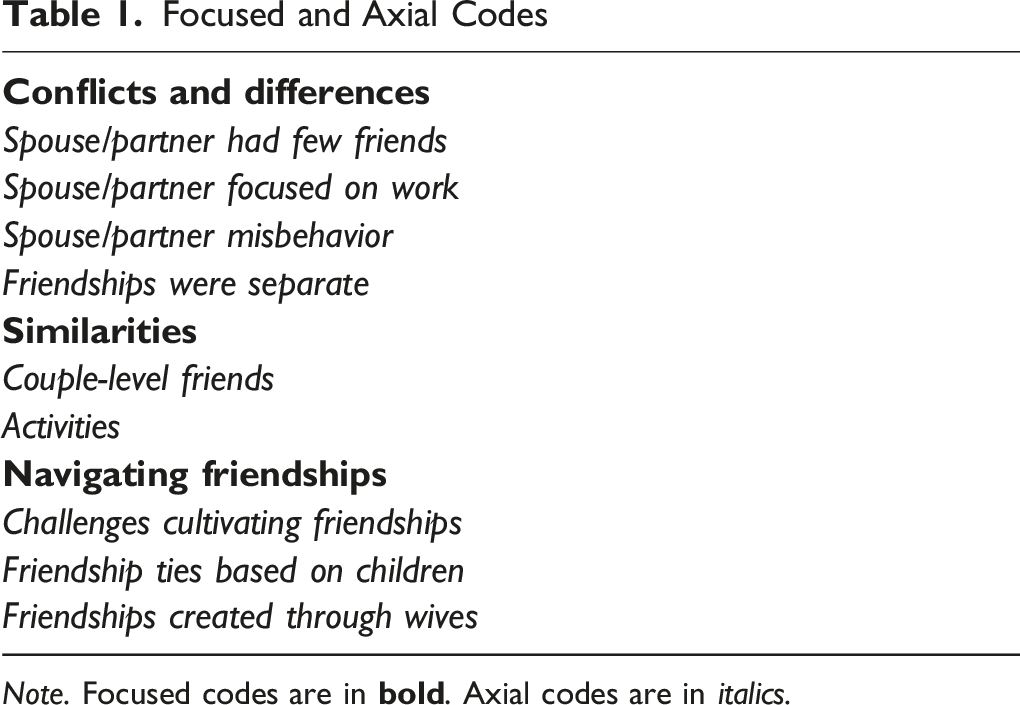
Note. Focused codes are in
Theoretical Coding
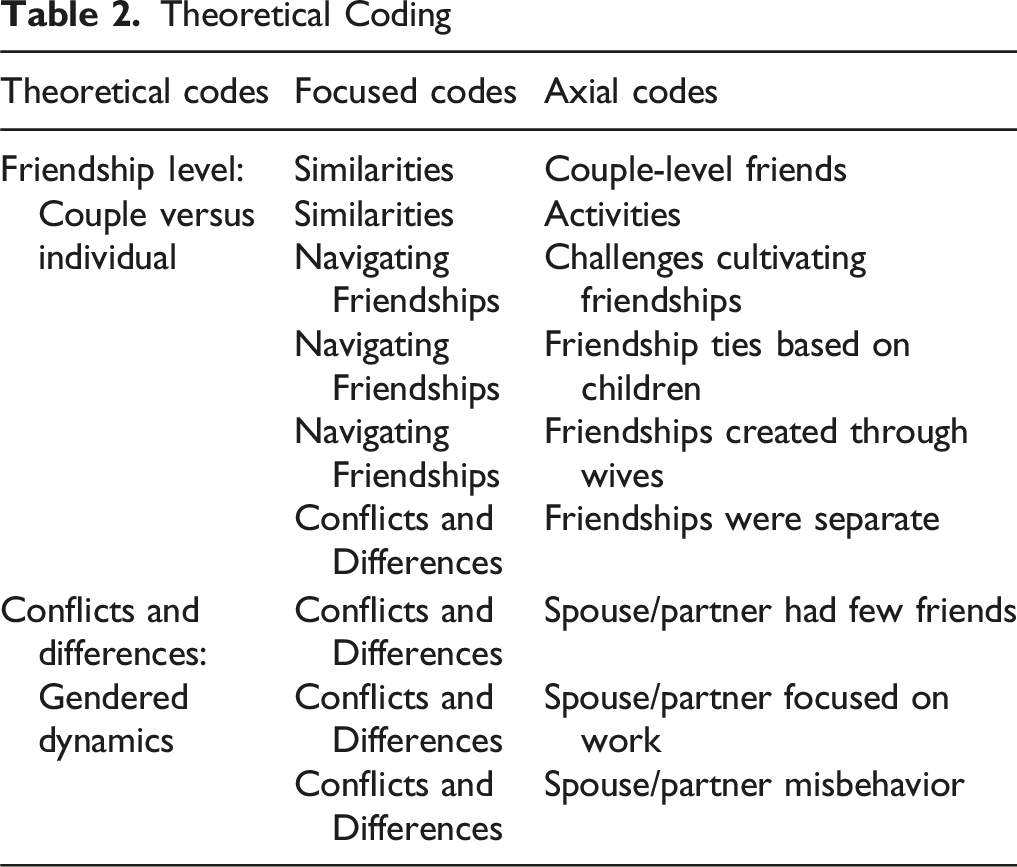
Results
Seventeen women discussed codes related to the present study. Of note, the two women who did not discuss items related to the present study had not previously been married. Next, we will probe the theoretical codes to further elucidate participants’ experiences.
Friendship Level: Couple Versus Individual
One distinction that occurred during the coding process was whether the participants were discussing shared, ‘couple’ friends, or friends separate from their romantic partner. Going into the participants’ individual friendships in detail is beyond the scope of this paper. However, in this section, we will focus on how and why some of the friendships discussed by participants were considered individual friends instead of couple friends.
Couple Level
For the couple level responses, joint activities, parenting, and compatibility with other couples arose as common responses. These are discussed below.
Participants often discussed joint activities that they would do with other couples. These activities ranged from trips to dinners. Joint activities, rather than emotional closeness, appeared to be more salient in maintaining these friendships. Dinner was a common activity mentioned. With regard to how her friendships operated in the context of marital change, Margaret (15) (widowed) stated, ‘These are the people that I started to go out to dinner with when they were couples and I wasn’t, both when [spouse] was sick and then after he died. I continue to see them because longevity helps a lot of stuff. You’ve known them forever, you have lived through so much together.’
For some, particularly for those who have been married for extended periods of time, couple friends are well established later in life. And, as in this example, a long life and romantic relationship means that couple friends may fluctuate over time due to illness and death. Margaret’s example highlights how these friendships can persist with the social convoy remaining relatively intact, even after changes occur in the spousal dyad.
Participants also reminisced about trips that they took with other couples. Although some of the participants relished these trips, others realized that vacations with other couples were not for them. Jane (4) (widowed) mentioned, ‘When we traveled, we found out it was better for just the two of alone…we both liked certain things that other people didn’t…and money is another thing, we may have more or less.’ Again, experiences appear to play a role in participants’ preferences regarding traveling with other couples on vacations; the couples, not just individuals, had to experience vacationing with others before determining whether it was for them. Connie (divorced) (9) talked a bit about trips that she enjoyed, ‘We have a couple that were friends with us here, and I even have a whole album of all the trips we took together as a family. And you know, I’m still close with them. [Former spouse] is not…we had two kids of the same age, and they’re still friends.’
The latter statement also emphasizes how couple-level friendships can enable children’s relationships with others; the social relationships that parents nurture reverberates into their children’s friendships, helping to craft their social convoys.
Indeed, participants frequently brought up parenting children up in the discussion about couple-level friends. Millie (divorced) expressed how, ‘For the 20 years that I was raising my children, my children were the focus. My [former] husband and I, we did children pretty well. We had less friends as a result. We had lots of people we saw on sports fields and other events that were child-driven. But they weren’t necessarily our friends, they were just parents with whom we shared experiences. Some of the parents became my friends.’
Millie’s experience provides evidence for an important distinction: the distinction between friends and acquaintances made through parenting and children’s activities. Margaret (widowed) also commented on the role that parenting played in their couple friendships, ‘The [town] friends were really our joint friends because we met them at the same time. We met them when we were a couple with young kids, and met them through whatever activities.’ These two examples highlight how children’s activities, including parenting overall, can serve as a central point for making friends. However, friendships were often through a central organizing premise – children’s activities – and sometimes participants characterized these relationships as acquaintances rather than friends.
Participants expressed that it was helpful if all parties, meaning all members of the couples involved, got along well and were compatible with one another. Central to this aspect of couple friendship was that women often played a role in creating and maintaining the friendships, performing emotional labor to help start and keep couple friendships afloat. Patrice (widowed, previously divorced) remarried later in life. She talked about the creation of a particular couple friendship involving her spouse’s friend. When Patrice met the friend’s wife, they instantly ‘clicked.’ She stated, ‘He was a close friend [of her husband’s] before we were together as a foursome, but because we all clicked so well, [friend] became my husband’s really closest friend. And vice versa.’ Therefore, the dynamic of her husband and his friend shifted once Patrice and his wife met. This integration of the ‘foursome’ together helped to propel their friendship forward. She further stated, ‘They knew each other…but men don’t really cultivate their friendships, you know? It’s all about sports or whatever and business. So, the four of us the next few decades were friends.’ Irene (16) mentioned that most of the couple friends started out as her friends, ‘I would say they’re my friends, but whenever we find a couple and he clicks with the husband, it goes into a deeper level.’ Irene additionally stated, ‘Very often, his friends are the husbands of my friends ‘cause some he likes more than others. Very often, it’s the husbands of the women.’ Laurie (2) (widowed) furthered these points and offered the following, ‘They were mostly my friends, because I had more friends than he did, he really didn’t have that many.’ This sentiment held throughout many of the interviews, that women were the ones helping to prompt the couples level friendships along. As evidenced above, the women often brought the couples together through their female friendships. Or, as in Patrice’s example, the women helped to further along already established friendships by the men.
One participant mentioned that most of her close friendships developed after the death of her spouse. Ruth (widowed, previously divorced) had a busy job and further stated, ‘He and I had each other. That was all we really needed.’ We include this example under ‘couple level’ as it provides a counterexample and shows how some individuals do not view themselves as needing close friends while in a romantic relationship.
Individual Level
Not all friendships operated at the couple level. Sometimes friendships were separate and had clear boundaries. As Lena (8), (widowed), expressed, ‘He didn’t really concern himself very much with my friends. Like befriend whom you like, I don’t care. I mean, he really liked some of them better than others, but it didn’t matter much to him really.’ Other times an incident may have transpired that relegated one member of the couple to ‘unfriend’ a prior couple level friend. Irene (16) (married) elaborated upon an instance when a friend did not treat his significant other well after a health diagnosis. Irene and her husband had become ‘couple friends’ with the individuals. Irene was so hurt by the friend that she no longer maintained contact. However, her husband maintained the friendship, which did not appear to bother Irene: Irene: My husband has a relationship with him still. Interviewer: Okay. Does that cause conflict between you and your husband? Irene: No, not at all. I just said, ‘Don’t invite him into my house.’
Irene’s response also emphasizes another theme in these interviews: that friendship factors that may have been problematic early on in dating or life, such as a strongly disliked friend that a romantic partner has or a friend meeting up with one’s romantic partner, are no longer major concerns. For example, Millie (5) (divorced) elaborated upon a scenario in which her close friend’s husband reached out to her about being a friend, rather than just her friend’s husband. The two meet up once a month to share a meal. Millie explained the rationale for why he reached out, ‘Some of it for him was about retiring and realizing that his own social group had changed radically, and that he really had to make friends, keep it up, keep it going.’
Other times, friendships were separate due to life course reasons involving relationship transitions. For example, participants who repartnered later in life more often expressed how their friends were fairly separate. Elizabeth (14) (single, never married) noted how her former boyfriend was quite private with his friendships, ‘He’s been way more private with his friendships. Like, ‘this is my friend.’ And so sometimes, you know, that kind of hurts your feelings. But whatever. I’ve got other friends.’ Likewise, Connie (9) (divorced) chatted about her current boyfriend. Although they met through friends, she emphasized that, ‘He’s not very interested in my friends.’ Patrice (widowed, previously divorced) also provided insight into her and her former boyfriend’s friends, ‘I was friends with them. But no, I made no close friends with them.’ This statement highlights how, even though she viewed her former boyfriend’s friends as friends, they were not close.
Conflicts and Differences in Friendships: Gendered Dynamics
In this section, we focus on differences and conflicts that the couples encountered in their friendships. Not all differences within individual friendship patterns were problematic for the couple, which is why conflicts and differences are separated.
Differences in Friends
Participants elaborated upon differences in the number and quality of friendships between themselves and their spouses; gender differences underscored many of these discussions. Jane (widowed) stated, ‘I think I was enough for him, and he was not enough for me.’ Additionally, Jane noted, ‘…he [spouse] loved being with women, he said “They’re much more interesting, Men are boring. If you don’t talk about sports and you don’t drink, they’re boring. You’re boring,” bringing up another general finding in this theme that the men utilized their romantic partners to engage in social interactions.
However, participants rarely discussed how spousal differences in friends, whether the number of friends or quality of their friendships, were problematic. To many, it seemed as though friendship differences, whether due to the number of friends or emotional closeness with friends, was a normative part of their relationship, albeit an irritation at times. Evelyn (divorced) was the lone participant who discussed how her husband was more social than her, stating, ‘[It] irritated me. It wasn’t why we got divorced, but anyway.’ She then went on to state, ‘I think it is usually the woman who’s more the one who sets the social calendar, but he tended to do it more because it was more important to him. It was fine…but if it hadn’t been for him, I probably would not have done that much.’ Participants also mused about general differences between male and female friendships, and how these differences spilled over into their romantic relationships. As Patrice (11) (widowed, previously divorced) reflected, ‘Men don’t normally have those close friendships, and now I think they miss out on that. They’re so different anyway, but you know, in a good way. Women who have incredible friendships are so enriched, but they don’t just happen,’ implying that friendships take time and effort to maintain.
When women reflected on the friendships that their male spouses did have, they were often tied to work. Indeed, discussions related to spouse’s friends and work were included in six participant responses. The women reflected on how their romantic partners’ friends were mostly from work. As Lena (married) noted, ‘But, he didn’t really have, he had a few friends sort of, in the workplace [work]. But not close. Not very close. So, I don’t think he could say that he had really, really close friends. But he was very concerned with [those] that he served.’ Laurie (widowed) also offered the following about her spouse when talking about their friendships, ‘He worked a lot…Men in general don’t have any friends in the town usually. His friends were some of the fathers of our children’s (friends). We did things with them, but he didn’t go out bowling or drinking with a bunch of guys.’ Therefore, for some of the women’s spouses, the workplace held a particular space where they had social interactions during their working years. Together, these examples from the interviews show differences in how friendships operate between women and men.
Irene (married) reflected on a pattern she noticed regarding men’s friendships later in life, particularly after retirement and moving to a retirement community: ‘So many of the women talk about that this is like the first time that men have had relationships on their own and they’re forming beautiful friendships. We’ve laughed watching them together because they truly love each other. I think this might be the first time in their lives that they’ve experienced this.’
Therefore, retirement may be a turning point for men’s friendships, offering an opportunity to cultivate their own friendships.
Conflicts in Social Settings: Misbehavior
Although most of the differences in friendship did not cause problems, conflicts between spouses with regard to friendships did occur. Some participants expressed concerns regarding their former spouse/partner misbehaving. Of the 12 participants who reported conflicts or differences, 4 women discussed instances where their spouse (N = 3) or their friend’s spouse misbehaved (N = 1). This axial code is included in the results, as it provides insight into how actions of a spouse/partner can affect friendships and potentially strain marriages. Notably, all of the participants who discussed instances of misbehavior were divorced; the one participant who discussed the misbehavior of a friend’s spouse mentioned that the friend had since divorced.
Misbehavior ranged from ‘acting out’ to instances in which a spouse was socially inappropriate. As Connie (9) (divorced) mentioned, ‘He [former spouse] was an interference in my friendships. Yeah. Definitely…I have one friend from work….who recalled instances when he was really socially inappropriate, and unfriendly, and stuff like that.’ Similarly, Sylvia (12) (divorced) discussed her friendships early on in her marriage and childrearing. She discussed why these friendships ended and recalled the following, ‘I’m trying to think of when that kind of dissolved. Probably by the time I got the divorce, that had ended. Particularly the couple’s group, because my husband acted out again at other people. He would just pick an argument with anybody. It was very embarrassing.’
These experiences highlight how behavior can affect friendships.
Sometimes, social interactions with friends served as a stressor in a marital relationship. Tamara (divorced twice) discussed an incident when her and her ex-husband hosted friends for an evening. An incident occurred that did not involve her and her spouse was the only one in the group who did not laugh. However, her husband became upset at her for what happened, ‘You know, everything was my fault, even if I wasn’t there, do you know what I mean? Somehow it always came back to me. And it was very traumatic, you know, it’s years ago, but it was very, very traumatic.’ Therefore, social interactions could prompt stressors in romantic relationships, especially if misbehavior occur.
Discussion
Women in the study discussed how they navigated friendships with their romantic partners throughout their lives. They discussed how their friendships at the couple and individual level, emphasizing the role of women in cultivating couple friendships, the activities couples performed with their friends, and why some friendships were at the individual level. The women discussed different types of conflicts and differences in friendships between the women and their romantic partners. These findings have implications for women’s perspectives on how they navigated their own friendships and friendships with spouses and/or partners. It also provides support for the SCM (Antonucci & Akiyama, 1987) and the life course perspective (Elder Jr & Shanahan, 2007) in that friendships are intertwined with romantic relationship experiences and that prior experiences shape friendships.
With regard to how spouses navigated their couple friendships, participants discussed both dinners and vacations as ways that they incorporated couple friends into their lives. Dinner served as a common way to bring couple level friends together. Food can help to bring people together, and dining can serve as a social activity, upholding social hierarchies (Julier, 2013; Van Dyk, 2023). Likewise, women brought up vacations as a means to interact with other couples. Vacations are one way to strengthen friendships, although challenges may arise and may result in individuals not wanting to vacation with friends in the future (Matteucci et al., 2022). These two activities played a role in mixed-gender friendships; activities, more commonly attributed to male notions of friendship (e.g., Wright, 1982), were fundamental to couple friendships.
Women in the study discussed their role in helping to maintain friendships at the couple level, and for their romantic partners. Many of the women discussed how they were the driving force behind the couple-level friendships that they had with their romantic partners. This points to the role that women may play in the social convoys of men in opposite-sex romantic relationships; men may benefit if they have a romantic partner who is willing to do the work of kinkeeping for their shared friends. Indeed, kinkeeping involves performing duties that help to maintain family ties, such as planning family gatherings and regularly checking in with family members (e.g., Rosenthal, 1985). However, women in this study were doing similar work as kinkeeping, albeit with friends, to help themselves and their romantic partners maintain friendships. Recently, a subset of kinkeeping has emerged to explain the emotional labor that women may take on in dyadic relationships with men to help them retain and create social relationships: mankeeping (Ferrara & Vergara, 2024). The present study aligns with both concepts. However, a central premise of mankeeping is that, ‘labor is done at women’s own emotional and temporal expense’ (p. 395). The participants did not express concerns about kinkeeping in their responses, however, they were not probed about the costs of providing this labor. Women talked about navigating social plans for themselves and their romantic partner as though it were an inherent, normative role, emphasizing how the role of women as kinkeepers is strongly embedded within cultural mores in the United States. Additionally, the differences in friendship between the women and their opposite-sex romantic partners did not often cause conflict. Future studies can further probe the potential costs associated with mankeeping and kinkeeping.
Although work on romantic relationships and friends tends to focus on differences between romantic relationship types (i.e., Ermer & Proulx, 2019; Kim & Dew, 2016), the present study enables a better understanding of the ways in which couples, both together and separately, promote and hinder their friendships. Umberson and colleagues (2015) discuss the gendered nature of emotion work within opposite-sex and same-sex couple relationships, focusing on boundaries with regard to sex and emotional intimacy. Friendship may be another avenue through which emotion work and kinkeeping occurs. Friendships, and their maintenance, likely contribute to the emotional atmosphere of the romantic relationship.
The intersection of life course elements, particularly age and linked lives, played a role in friendships that were separate. Women who repartnered later in life talked about how their friendships were fairly separate or were less close. The dyadic withdrawal hypothesis (Johnson & Leslie, 1982) may operate differently in later life. Rather than a romantic relationship taking individuals away from their friends; older adults may rely on the stability of other established social networks, such as friends, upon entering a romantic relationship later in life. In other cases, separate friendships that the women discussed were due to other reasons. Although prior work shows that romantic partners have a greater number of shared friends as they get older (Kalmijn, 2003), women in this study noted instances in which they had separate friends from their romantic partners. Older adults have more optimal emotional regulation than younger adults (Urry & Gross, 2010). This may be why the women in this study seemed unbothered by instances in which friends were not shared or when they reported differences in friendships. When women noted friendship differences their romantic partner, these differences did not seem to be problematic for the women. Often, differences between partners can translate to relationship problems; those who are more similar are less likely to divorce (Clarkwest, 2007). Individuals often seek out those who are similar to them (e.g., Figueredo et al., 2006; Montoya & Horton, 2013), and couples become more alike over time (Becker & Lois, 2010). Changes in emotional regulation during the life course may be one reason to account for women not viewing these differences as problematic and causing strain in their relationship.
In terms of friendship differences between the women and their romantic partners, gender delineated the differences. Women routinely noted that their romantic partner had fewer friends, which largely aligns with prior research (e.g., McLaughlin et al., 2010). Men report less emotional closeness with friends and talk less frequently to their social networks (Ermer, 2021); so, it also could be that these measures are not fully capturing aspects of friendships that are salubrious for men and that the description of friendship is largely gendered as feminine. However, the women in the study noted that men’s friendships were mainly through the workplace during their working years. Indeed, retirement is associated with increased contacts with friends and neighbors (Bosma et al., 2025). Retirement, and the identity shift that is involved with retirement, may be a turning point for men in how they organize their friendships. Retirement is also a salient time period to check in with men about their social engagement, given increases in suicide and loneliness after this transition (Schneider et al., 2011; Segel-Karpas et al., 2018).
In this study, women generally did not view their spouse having fewer friends as problematic. However, women in the study, particularly women who were divorced, noted instances in which a former spouse, or friend’s former spouse, misbehaved in social settings. Misbehavior by the former spouse was stressful for the women in this study. Positive illusions of the relationship (Holmes, 2004) may be one reason why women who were married or widowed did not express any instances where their own spouse misbehaved. However, a spouse’s misbehavior in social settings may place strain on the romantic relationship. Fiori and colleagues (2018) found that husband’s disapproval of wives’ friends was linked to divorce; the same was not true for wives’ disapproval, providing some support to the idea that negative perceptions of a spouse’s social network can be problematic for a relationship. Although Fiori et al. (2018) did not find any links between shared friends and divorce, many of the women in the present study expressed that their shared friends were the result of their own, longstanding friendships. Or, they noted that they were responsible for cultivating shared friendships, which could contribute to this finding.
Implications and Conclusion
This study focused on how older women navigated friendships with romantic partners throughout their lives. Women discussed ways in which their friendships were shaped by romantic partners. This is an underexplored topic area that deserves more attention due to links between social interaction, health, and loneliness (e.g., Cacioppo & Cacioppo, 2014). Limitations include the general sample of participants (i.e., White, suburban, highly educated) and the focus on opposite-sex relationships. We also did not capture information on household income. Additionally, few women were currently married, which limits an understanding of married women’s experiences with friendship during later life. Couple friendships may look different in different locations, such as in urban or rural settings. Additionally, this study focused on the gendered nature of women’s interactions with their romantic partners. Women may navigate their shared friendships differently in same-sex friendships due to gendered scripts (e.g., Umberson et al., 2015). Additionally, the study focused on women and their perceptions regarding their romantic partners; their romantic partners may have a different perspective. Dyadic interviews may be a future step to understand the processes behind couples’ friendships across the life course.
These findings have implications for how older women have navigated friendships with spouses and dating partners throughout their lives. For those who repartner later in life and have longstanding, separate friendships, it may be beneficial to engage in conversations with romantic partners about whether they want to integrate their romantic partnership into their friendships. For example, does the couple want to spend time with their friends together? Or do they want to spend time apart with their own friends, separately? This may also be a fruitful exercise for couples across the lifespan, as it provides awareness regarding how couples want to integrate themselves into one another’s friendships. Practitioners should attend to conflicts related to friendships that occur between spouses, as this has potential implications for relationship outcomes and overall well-being. Additionally, retirement may serve as a transitional time for men’s friendships. Although much research focuses on retirement as a time of concern for men, it could also be a time of opportunity to foster close friendships (e.g., Bosma et al., 2025). Romantic partners may be one resource that men in opposite-sex relationships can draw upon in retirement. Clinicians can help men, in particular, with ways to seek social support outside of work throughout the life course. Future research should probe the creation of shared friendships and how romantic partners navigate shared friendships in different settings and contexts.
Footnotes

Funding
The author(s) received no financial support for the research, authorship, and/or publication of this article.
Declaration of Conflicting Interests
The author(s) declared no potential conflicts of interest with respect to the research, authorship, and/or publication of this article.