






Abstract
Existing literature frames intergenerational transfers as resource buffering. This study, adopting a family obligation perspective, examined whether contemporaneous bidirectional exchange predicts elevated depressive symptoms net of directional transfer intensity, and extended “bidirectionality” from a binary indicator to a multidimensional structural attribute. Using CHARLS panel data, we found that higher directional transfer intensity was associated with fewer depressive symptoms, whereas bidirectional co-occurrence was positively associated with depressive symptoms and persisted in lagged models. Multidimensional operationalization further showed that this positive association held independent of total intensity: entering a bidirectional structure was linked to more severe symptoms, potentially reflecting the psychological costs of simultaneously occupying “supporter” and “dependent” roles, while the synergistic interaction between received and provided intensities exhibited a mitigating effect. These findings clarify that the existence, structural entry, and synergy of bidirectional exchange constitute separable effect dimensions.
Keywords
Introduction
Background and Overview
In Chinese societies, family obligation remains institutionally central to eldercare amid population aging. Macro-institutional transformations have restructured the architecture of old-age support (Zhu & Walker, 2018), while labor migration has further altered the organizational modality of intergenerational support (Guo et al., 2009; Song, 2017), rendering economic exchange a critical pathway for sustaining family support under conditions of intergenerational separation (Lei et al., 2015).
Longitudinal evidence typically conceptualizes intergenerational monetary transfers as a resource buffering mechanism, associating received support with fewer depressive symptoms (Appleton et al., 2024). However, recent studies disaggregating support by role, type, and direction indicate that health associations vary depending on whether older adults are giving, receiving, or simultaneously engaging in both, with both provision and receipt linked to adverse health consequences—yet the specific patterns differ across support dimensions, underscoring the analytical importance of directionality in models of late-life well-being (Bertogg & Manzoni, 2025). Intergenerational solidarity theory treats functional solidarity as the behavioral manifestation of resource reciprocity and relational cohesion, expecting it to enhance intergenerational contact frequency through normative integration and affectual solidarity (Bengtson & Roberts, 1991); conversely, intergenerational ambivalence theory posits that structural role transitions and incompatible normative expectations (such as the tension between dependence and autonomy) may incur psychological costs (Luescher & Pillemer, 1998). On this basis, the high-density co-occurrence of giving and receiving within bidirectional exchange can be regarded as a concrete behavioral expression of role strain and the ongoing negotiation of obligation boundaries.
Although prior research has distinguished health effects by support direction, it has conflated directional intensity with within-period co-occurrence: the continuous operationalization by Davey and Eggebeen (1998) (net difference between giving and receiving) and the mutually exclusive categorical paradigm widely adopted in subsequent research (Zhao et al., 2023; Zheng et al., 2022) have both failed to isolate the structural properties of bidirectional exchange from net resource transfers. If the protective effect of bidirectional exchange derives from the net increase in economic resources, then the bidirectionality indicator should become non-significant after controlling for directional intensity; conversely, if the effect stems from the relational density of the exchange process itself, then the indicator should predict depressive symptoms independently of transfer amounts. In the Chinese context, intergenerational exchange is embedded within family organization and support obligations, simultaneously possessing material and relational properties, and its association with mental health depends on broader family circumstances (Silverstein et al., 2006), rendering the above theoretical divergence particularly salient.
The core contribution of this study lies in disentangling the independent effects of transfer intensity and exchange structure. Utilizing multi-wave panel data from the China Health and Retirement Longitudinal Study (CHARLS) from 2011 to 2020, this study estimates the association between intergenerational economic exchange and depressive symptoms by distinguishing direction, intensity, and contemporaneous bidirectional co-occurrence, thereby refining the theoretical meaning of bidirectionality in mental health research (for data description, see Zhao et al., 2014).
Literature Review
Research has conceptualized intergenerational solidarity as a multidimensional construct encompassing affectual, associational, consensual, and functional dimensions (Bengtson et al., 2002; Bengtson & Roberts, 1991; Silverstein & Bengtson, 1997). Within this framework, bidirectional economic exchange is viewed as the behavioral manifestation of intergenerational reciprocity and relational cohesion, expected to promote mental health through enhanced emotional bonding and contact frequency (Bengtson & Roberts, 1991). However, intergenerational ambivalence theory points out that structural contradictions within intergenerational relationships—such as the tension between dependence and autonomy, and the conflict between reciprocity and solidarity norms—generate role strain and persistent negotiation demands (Luescher & Pillemer, 1998). Ambivalence is associated with higher depressive symptoms and lower positive affect (Suitor et al., 2011), as well as greater loneliness (Hua et al., 2021). This study extends this perspective to the domain of economic exchange, proposing that the high-density co-occurrence of giving and receiving within the same period constitutes the concrete behavioral expression of the above contradictions, signaling older adults’ frequent switching between “supporter” and “recipient” identities and the accompanying negotiation of obligation boundaries.
The impact of social relationships on mental health is shaped not only by positive support. Rook (1984) demonstrated that the negative aspects of social relationships may damage psychological health more than the protective effects of positive interactions. Krause and Rook (2003) further documented that conflict in late-life social relationships exhibits temporal stability and cross-relational generalizability. Extending this perspective to the domain of intergenerational economic exchange, when giving and receiving co-occur within the same period, intergenerational relationships involve more frequent negotiation over amounts and responsibility boundaries, potentially activating negative interaction and relational tension, although the provision of practical support may also carry within-day mood-alleviating effects (Huo et al., 2019). Thus, the high-density co-occurrence of bidirectional exchange may simultaneously carry the dual properties of resource flow and negotiation burden, with its net effect depending on the relative strength of the two mechanisms.
At the empirical level, the association between social relationships and physical and mental health outcomes has received extensive documentation (House et al., 1988; Pearlin et al., 1981; Thoits, 2011), and these processes are nested within specific intergenerational relationship structures. The association between unidirectional support and mental health has accumulated substantial evidence, yet effect directions vary by support dimension and family context. Regarding received support, CHARLS-based studies report that financial support from children is associated with fewer depressive symptoms (Wu et al., 2018, 2023). Regarding provided support, giving itself is associated with fewer depressive symptoms (Roll & Litwin, 2010); the association between older adults’ provision of support and depressive symptoms is moderated by their perceived meaning of giving behavior (sense of reward versus stress) (Bangerter et al., 2015). Evidence from China indicates that gender and intergenerational norms within Chinese families must be considered when understanding the mental health consequences of intergenerational support (Guo et al., 2017); instrumental support receipt and depressive symptoms may exhibit a nonlinear relationship (Djundeva et al., 2015); parents’ need levels and family structure characteristics jointly shape the direction and magnitude of intergenerational economic exchange (Logan & Bian, 2003), and the health effects of intergenerational support on older adults differ significantly between rural and urban areas (Yang et al., 2023).
However, both continuous operationalizations (Davey & Eggebeen, 1998) and the mutually exclusive categorical paradigm widely adopted in subsequent research (no exchange, receiving only, giving only, bidirectional exchange; e.g., Zheng et al., 2022) have failed to isolate the structural properties of bidirectional exchange (contemporaneous co-occurrence) from net resource transfers. Zhao et al. (2023) found that bidirectional support patterns were associated with successful aging, yet their cross-sectional design based on CHARLS 2018 and mutually exclusive categorical analytical framework (under-benefited/reciprocal/over-benefited) could not disentangle directional transfer intensity from exchange structure, thus precluding clarification of the relative contributions of resource accumulation versus relational process. Su et al. (2026) employed latent transition approaches to characterize support pattern changes, offering methodological reference for embedding family event processes. From a comparative perspective, European research situates intergenerational transfers within the same institutional context as public welfare, with cross-national evidence indicating that transfer patterns vary systematically by welfare regime type (Albertini et al., 2007). A recent systematic review of East Asian countries confirmed that emotional and financial support exert protective effects against depression among older adults, while the effect direction of instrumental support remains contested (Sharifi et al., 2024).
In summary, the existing literature contains two core limitations. First, at the theoretical level, solidarity and ambivalence perspectives diverge regarding the psychological effects of bidirectional exchange, yet empirical tests isolating exchange structure (co-occurrence) from resource intensity are lacking. Second, at the measurement level, existing operationalizations cannot determine whether the protective effect of bidirectional exchange derives from the net increase in economic resources or from the relational density of the exchange process itself. In the Chinese context, intergenerational exchange is embedded within family organization and support obligations, simultaneously possessing material and relational properties, and its association with mental health depends on broader family circumstances; clarifying the above mechanisms is particularly important for understanding inequalities in late-life mental health.
Theory and Hypotheses
The core theoretical contribution of this study lies in disentangling transfer intensity from exchange structure, thereby refining the theoretical meaning of bidirectionality in mental health research. According to the resource buffering explanation, higher transfer intensity from adult children is expected to be associated with fewer depressive symptoms, an effect potentially realized through mechanisms such as economic resource supplementation, enhanced emotional bonding, and compensation for geographic separation (Wu et al., 2018). Parents’ subjective perceptions of support provision (sense of reward or stress) moderate the association between intergenerational support and their mental health (Bangerter et al., 2015). When bidirectional exchange is examined without further disaggregation, it may proxy stable connectedness and readily mobilizable assistance—conditions that, under a solidarity-based interpretation, may plausibly be associated with lower depressive symptoms (Bengtson & Roberts, 1991). Once transfer intensity is disaggregated by direction, contemporaneous co-occurrence additionally captures frequent coordination, recurrent negotiation of obligations, and restricted leeway for disengagement from needs—processes that negative interaction and ambivalence perspectives expect to incur psychological costs (Krause & Rook, 2003; Luescher & Pillemer, 1998; Rook, 1984).
These considerations generate four hypotheses distinguishing directional intensity from bidirectional co-occurrence:
The above hypotheses treat bidirectional exchange as a homogeneous binary state, yet important heterogeneity may exist within the exchange structure. If the association between bidirectional exchange and depressive symptoms is partly attributable to role conflict, then simultaneously assuming both the “supporter” and “dependent” roles within the same period should increase psychological burden (Luescher & Pillemer, 1998). Accordingly, the degree of bidirectional exchange structure—as captured by the extent to which an older adult is engaged in both receiving and providing transfers—may additionally predict depressive symptoms. Moreover, if the “existence” of bidirectional exchange marks the opening of an obligation negotiation domain, whereas “intensity synergy” reflects a more mature coordination mechanism, then the two may exhibit separable effects: the qualitative leap of bidirectional co-occurrence incurs psychological costs, yet high-intensity symmetrical synergy may alleviate the burden through the stabilization of exchange relationships. The following hypotheses extend bidirectional exchange from a binary presence to a multidimensional structural attribute. Together, these three hypotheses constitute a nested theoretical progression that moves from ruling out a resource-aggregative explanation (H3a), to establishing the psychological cost of entering the bidirectional domain (H3b), to identifying the intra-structural conditions that may mitigate that cost (H3c).
Hypothesis 3a (Total intensity decomposition): Even after combining received and provided intensity into total intensity, bidirectional co-occurrence remains positively associated with higher depressive symptoms independent of total intensity.
Hypothesis 3b (Structural entry hypothesis): After controlling for directional intensity, entering a bidirectional exchange structure (relative to not entering) is associated with more severe depressive symptoms.
Hypothesis 3c (Synergistic interaction hypothesis): Among those already engaged in bidirectional transfers, the synergistic interaction between received and provided intensity is associated with lower depressive symptoms.
Finally, we examine whether these structural associations persist under one-period lagged specifications to improve temporal ordering and further alleviate reverse-causality concerns (H4).
Data, Variables, and Methods
Data
This study uses data from the China Health and Retirement Longitudinal Study (CHARLS). CHARLS is a nationally representative longitudinal survey covering individuals aged 45 years and above and their spouses, collecting multidimensional information on demographic characteristics, health status, family structure, and economic behavior (Zhao et al., 2014). The survey employs multi-stage stratified cluster sampling, with the sample covering 28 provinces nationwide and exhibiting strong national representativeness. Sample selection followed these criteria: (1) age ≥45 years; (2) non-missing CES-D-10 depression scale scores. After screening, the contemporaneous analytical sample comprises 68,235 person-wave observations spanning multiple panel waves. To examine lagged effects, we further required non-missing transfer data for each individual in the prior period, yielding a lagged analytical sample of 50,453 person-wave observations. To avoid the influence of extreme values on estimation results, this study winsorizes the raw amounts of intergenerational economic transfers at the 1st and 99th percentiles, and calculates log-transformed intensity indicators based on the winsorized amounts.
Variables
Dependent Variable
Depressive symptoms are measured using the Center for Epidemiologic Studies Depression Scale (CES-D-10). The scale contains 10 items inquiring about the frequency of various depression-related symptoms during the past week (e.g., feeling down, sleep difficulties, feeling lonely). Response options range from “rarely or none of the time” to “most of the time,” yielding a total score of 0–30, with higher scores indicating more severe depressive symptoms (Chen & Mui, 2014). The CES-D-10 demonstrates good reliability and validity in this population. It captures symptom frequency on a 0–30 continuous scale rather than clinical diagnosis; accordingly, we model variation in symptom severity rather than disorder incidence.
Key Independent Variables
Intergenerational economic transfers are characterized by the following variables. Intensity of financial support received from adult children (lfc): the raw amount transferred from children to parents is winsorized at the 1st and 99th percentiles and log-transformed. Intensity of financial support provided to adult children (ltc): the raw amount transferred from parents to children is winsorized at the 1st and 99th percentiles and log-transformed. Bidirectional transfer indicator (both_any): a dummy variable coded 1 when contemporaneous received and provided amounts are both greater than 0, and 0 otherwise. To examine lagged associations, the above transfer intensities and bidirectional transfer indicator are further lagged by one period (i.e., corresponding measures from the prior period t − 1), denoted as L.lfc, L.ltc, and L.both_any, respectively. In addition, to capture the structural properties of bidirectional exchange, this study constructs the following measures: (1) total transfer intensity (total = lfc + ltc), used to test whether bidirectional effects depend on separate identification of receiving versus providing; (2) bidirectional structure (both_ratio = min (lfc, ltc)/max (lfc, ltc)), ranging from 0 to 1, with values closer to 1 indicating deeper engagement in bidirectional structure (values greater than 0 denote entry into bidirectional exchange, whereas a value of 0 indicates unidirectional or no exchange). This ratio captures the degree of symmetry between received and provided intensities: it equals 1 when the two directions are exactly balanced (e.g., receiving 5,000 yuan and providing 5,000 yuan), approaches 0 when one direction strongly dominates (e.g., receiving 1,000 yuan but providing 50,000 yuan, yielding 0.02), and equals 0 in purely unidirectional cases. Unlike a simple difference score, this ratio is invariant to the absolute scale of transfers and thus isolates structural balance from total volume. Unlike the binary both_any indicator, it additionally distinguishes shallow bidirectional engagement (one direction minimally present) from deep structural embedding (both directions substantively engaged); and (3) the interaction term between received and provided intensity (lfc × ltc), to test the synergistic effect of bidirectional exchange.
Control Variables
To mitigate omitted variable bias, the models incorporate multidimensional covariates. Demographic characteristics: age, gender (female = 1), marital status (married = 1), household registration (hukou; rural = 1), and educational attainment (with illiteracy as the reference group, dummy variables for primary, junior secondary, and senior secondary or above). Health status: chronic disease status (1 = yes), number of ADL limitations, and number of IADL limitations. In addition, family structure variables are included to ensure that family-level confounders are not omitted. Family structure: number of living children, household size, living alone indicator, coresident with family indicator, and non-coresident kin contact indicator. Social security: pension insurance participation (1 = yes) and medical insurance participation (1 = yes). Furthermore, all models control for survey wave fixed effects to capture macro-level temporal trends.
Methods
This study employs linear regression models (OLS) with cluster-robust standard errors at the individual level. Standard errors are clustered at the individual level to adjust for correlation among repeated observations within the same person. To improve temporal ordering and alleviate reverse-causality concerns, this study further estimates one-period lagged models, using prior-period (t − 1) transfer intensity and bidirectional transfer status to predict contemporaneous depressive symptoms. Longitudinal research in the field of geriatric health has repeatedly documented the prevalence of reverse causality; for example, CHARLS-based research has shown significant bidirectional predictive associations between Activities of Daily Living (ADL) limitations and depressive symptoms (Zhou et al., 2024), further underscoring the necessity of improving temporal identification through lagged specifications. Multicollinearity diagnostics indicate that the core predictors are numerically distinguishable: the Pearson correlation coefficient between the two continuous intensity measures is 0.19, and variance inflation factor (VIF) values range from 1.46 to 3.24. No severe multicollinearity exists among the predictors, supporting the empirical feasibility of simultaneously including directional intensity and bidirectional indicators.
Results and Analysis
Descriptive Statistics
Descriptive Statistics for the Primary Analytical Sample
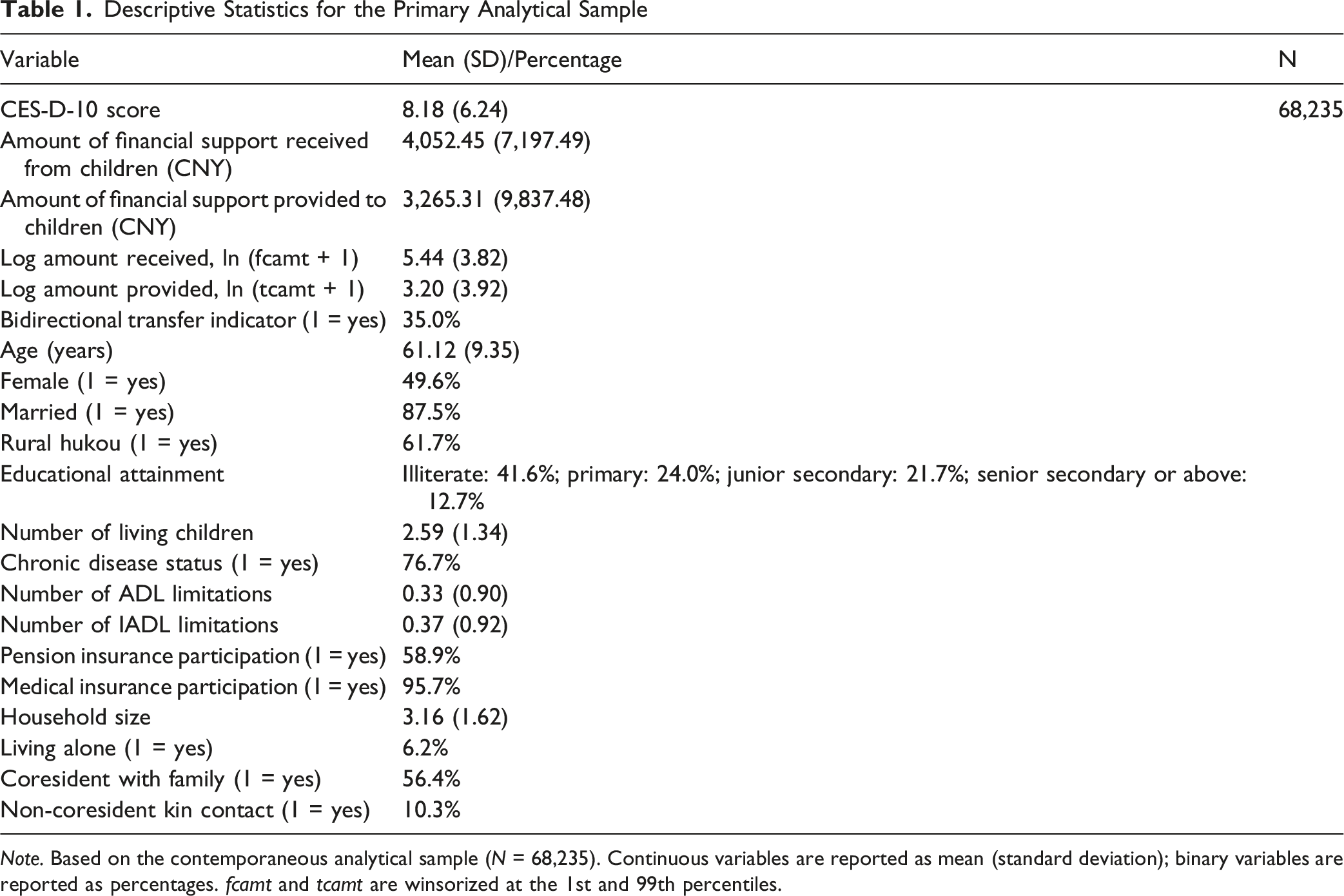
Note. Based on the contemporaneous analytical sample (N = 68,235). Continuous variables are reported as mean (standard deviation); binary variables are reported as percentages. fcamt and tcamt are winsorized at the 1st and 99th percentiles.
The demographic characteristics of the sample exhibit the following distribution: the mean age of respondents is 61.12 years (SD = 9.35); women comprise 49.6%, married individuals 87.5%, and those with rural household registration 61.7%. Regarding educational attainment, the proportion of illiterate respondents is relatively high (41.6%), with primary, junior secondary, and senior secondary or above education accounting for 24.0%, 21.7%, and 12.7%, respectively. Regarding health status, 76.7% have chronic conditions. Regarding family structure, mean household size is 3.16 persons, the proportion living alone is 6.2%, the proportion coresident with family is 56.4%, and the proportion with non-coresident kin contact is 10.3%. Regarding social security, 58.9% participate in pension insurance and 95.7% in medical insurance.
Mean Comparisons of CES-D-10 Scores Across Intergenerational Transfer Statuses

Contemporaneous and Lagged Regression Results
OLS Regression of Depressive Symptoms (CES-D-10) on Transfer Intensity and Bidirectional Co-Occurrence
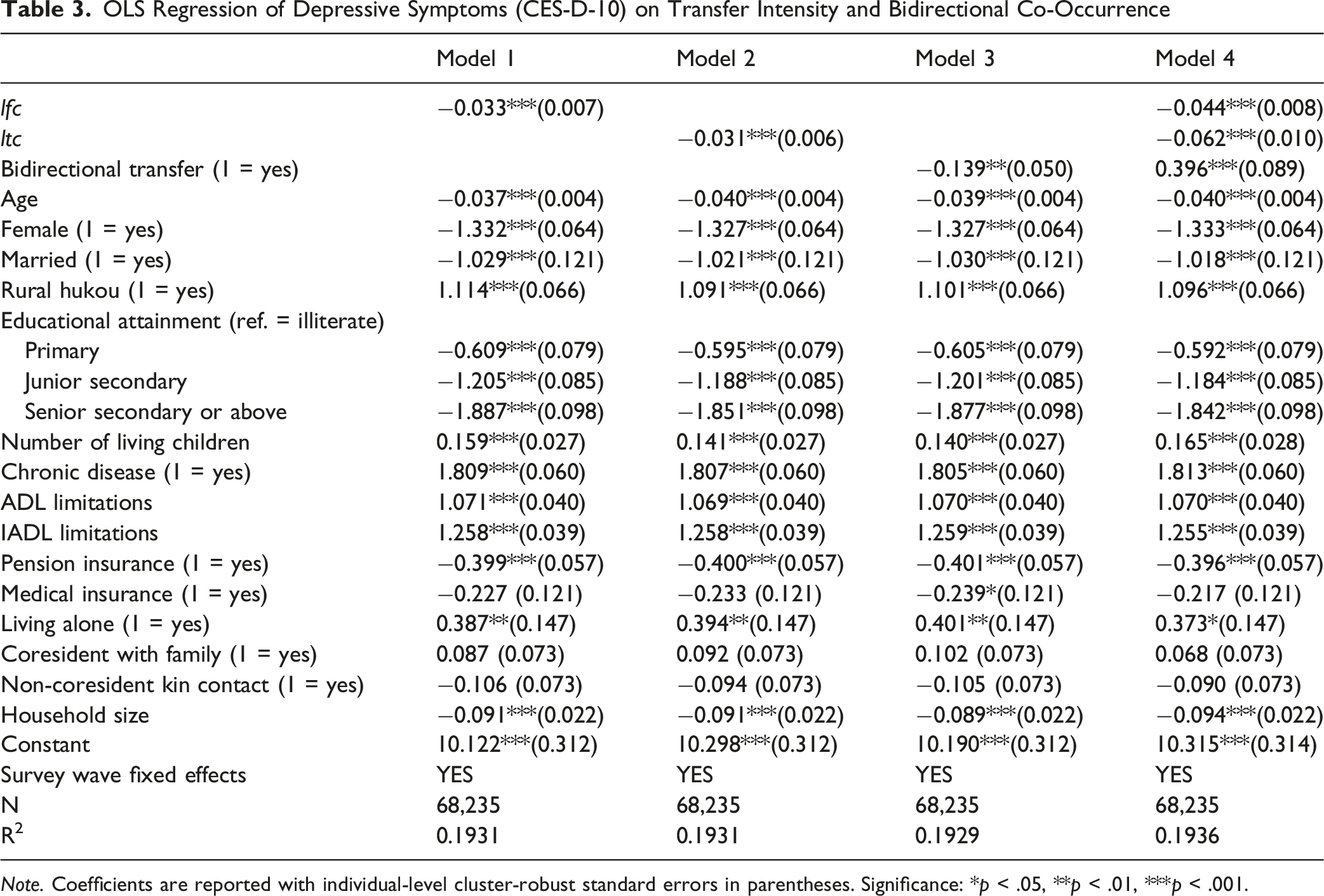
Note. Coefficients are reported with individual-level cluster-robust standard errors in parentheses. Significance: *p < .05, **p < .01, ***p < .001.
Model 3 examines the bidirectional transfer indicator alone and finds that both_any is significantly negatively associated with depressive symptoms (b = −0.139, SE = 0.050, p < .01). However, this result is subject to omitted variable bias, because when transfer intensity is not controlled, both_any simultaneously captures dual information regarding both “transfer presence” and “transfer intensity.” That is, the coefficient for both_any in Model 3 is confounded by the protective effects of directional transfer intensity and the potential intrinsic effect of bidirectional co-occurrence itself. When received and provided intensity are included in the same model, this confounding is eliminated.
Model 4, after simultaneously controlling for received and provided intensity as well as all demographic, health, and family structure covariates, reveals a critical reversal: the negative effects of lfc and ltc remain significant (lfc: b = −0.044, SE = 0.008, p < .001; ltc: b = −0.062, SE = 0.010, p < .001), but the coefficient for both_any turns from negative to positive and reaches a high level of significance (b = 0.396, SE = 0.089, p < .001). By comparison, the absolute value of the negative coefficient for ltc (0.062) is larger than that for lfc (0.044), indicating that the negative association of providing support to children is stronger than that of receiving support from children. This pattern may reflect the additional protective effect on mental health of the valued social role information carried by giving behavior under specific conditions (Bangerter et al., 2015). This coefficient corresponds to approximately 6.3% of the standard deviation of the CES-D-10 (0.396/6.24 ≈ 0.063). This finding is consistent with Hypothesis 3 of this study: after controlling for transfer intensity, bidirectional transfer co-occurrence is positively associated with depressive symptoms. Unidirectional transfers reflect relatively clear role divisions in intergenerational support—the recipient primarily plays the role of “dependent,” and the provider primarily plays the role of “supporter”—whereas bidirectional transfers mean that older adults simultaneously assume both roles within the same period. This role overlap may activate psychological costs (Bengtson et al., 2002; Luescher & Pillemer, 1998). Among family structure variables, living alone is associated with higher depressive symptoms (b = 0.373, SE = 0.147, p < .05), coresident with family and non-coresident kin contact do not reach statistical significance. Household size is associated with lower depressive symptoms (b = −0.094, SE = 0.022, p < .001).
Lagged Regression of Depressive Symptoms (CES-D-10) on Intergenerational Financial Support
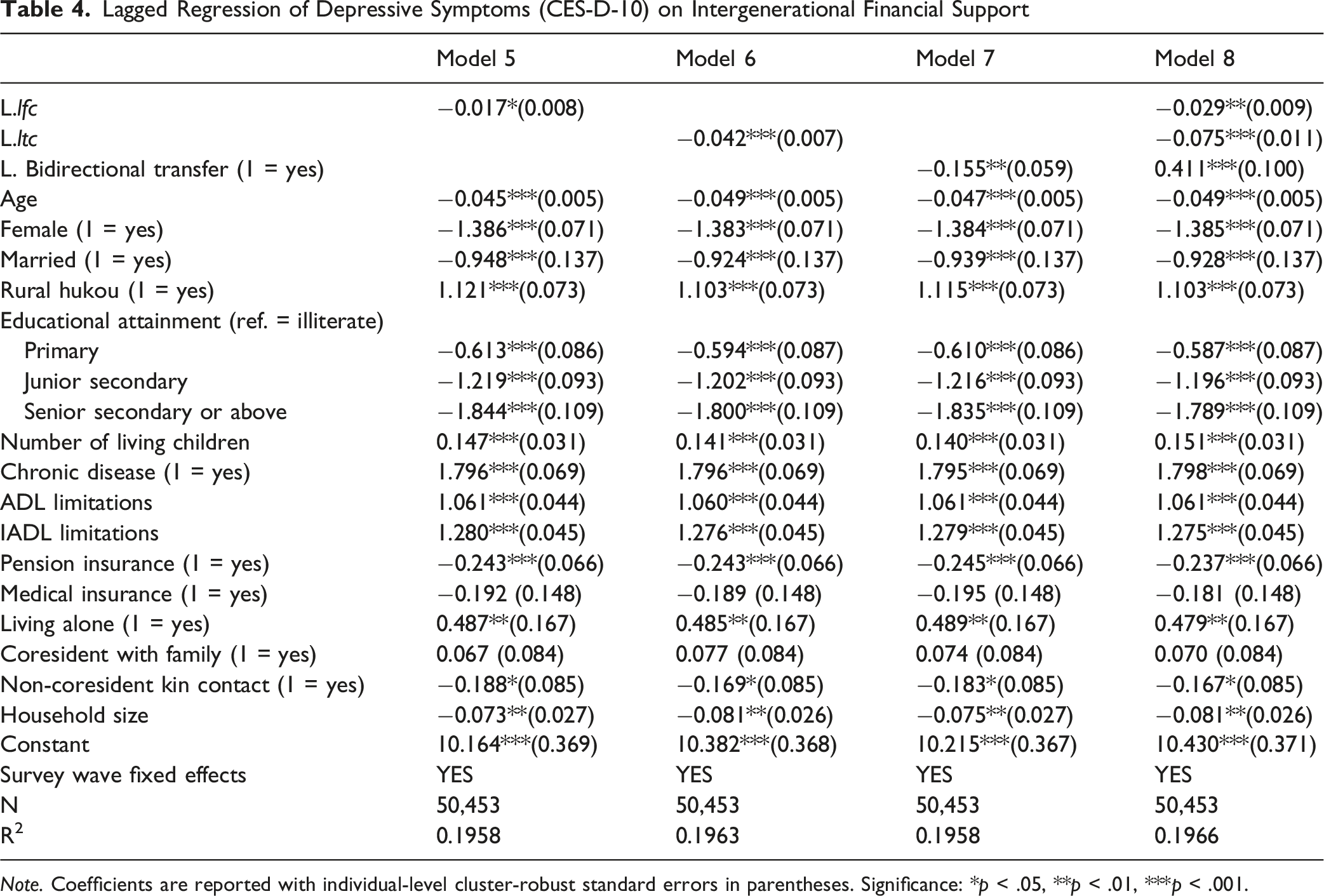
Note. Coefficients are reported with individual-level cluster-robust standard errors in parentheses. Significance: *p < .05, **p < .01, ***p < .001.
Model 8, after simultaneously controlling for lagged received and provided intensity as well as all covariates, shows that L.lfc (b = −0.029, SE = 0.009, p < .01) and L.ltc (b = −0.075, SE = 0.011, p < .001) maintain significant negative effects, whereas L.both_any turns significantly positive (b = 0.411, SE = 0.100, p < .001). In the lagged model, the negative effect of L.ltc (−0.075) is significantly larger in absolute value than that of L.lfc (−0.029); the lagged protective association of provided support is approximately 2.6 times that of received support. This difference may reflect the more enduring psychological protective effects of self-efficacy and role value embodied in giving behavior. This lagged bidirectional co-occurrence coefficient corresponds to approximately 6.6% of the standard deviation of the CES-D-10 (0.411/6.24 ≈ 0.066). This lagged estimate is highly consistent with the contemporaneous model, improving temporal ordering—that is, the bidirectional transfer pattern existing in the prior period is associated with higher levels of depressive symptoms in the contemporaneous period, rather than being driven by reverse causality. In Model 8, the coefficient for L.both_any is 0.411 (SE = 0.100, p < .001), and the main effect directions of family structure variables are consistent with the contemporaneous model: living alone is associated with higher depressive symptoms (b = 0.479, SE = 0.167, p < .01), coresident with family does not reach statistical significance (b = 0.070, SE = 0.084), and non-coresident kin contact is associated with lower depressive symptoms (b = −0.167, SE = 0.085, p < .05). Household size is associated with lower depressive symptoms (b = −0.081, SE = 0.026, p < .01). The lagged negative effect of L.ltc (−0.075) remains larger than that of L.lfc (−0.029), and both remain statistically significant, indicating that the protective effects of directional intensity possess cross-wave stability.
Multidimensional Operationalization of Bidirectional Exchange Structure
Multidimensional Operationalization of Bidirectional Exchange Structure
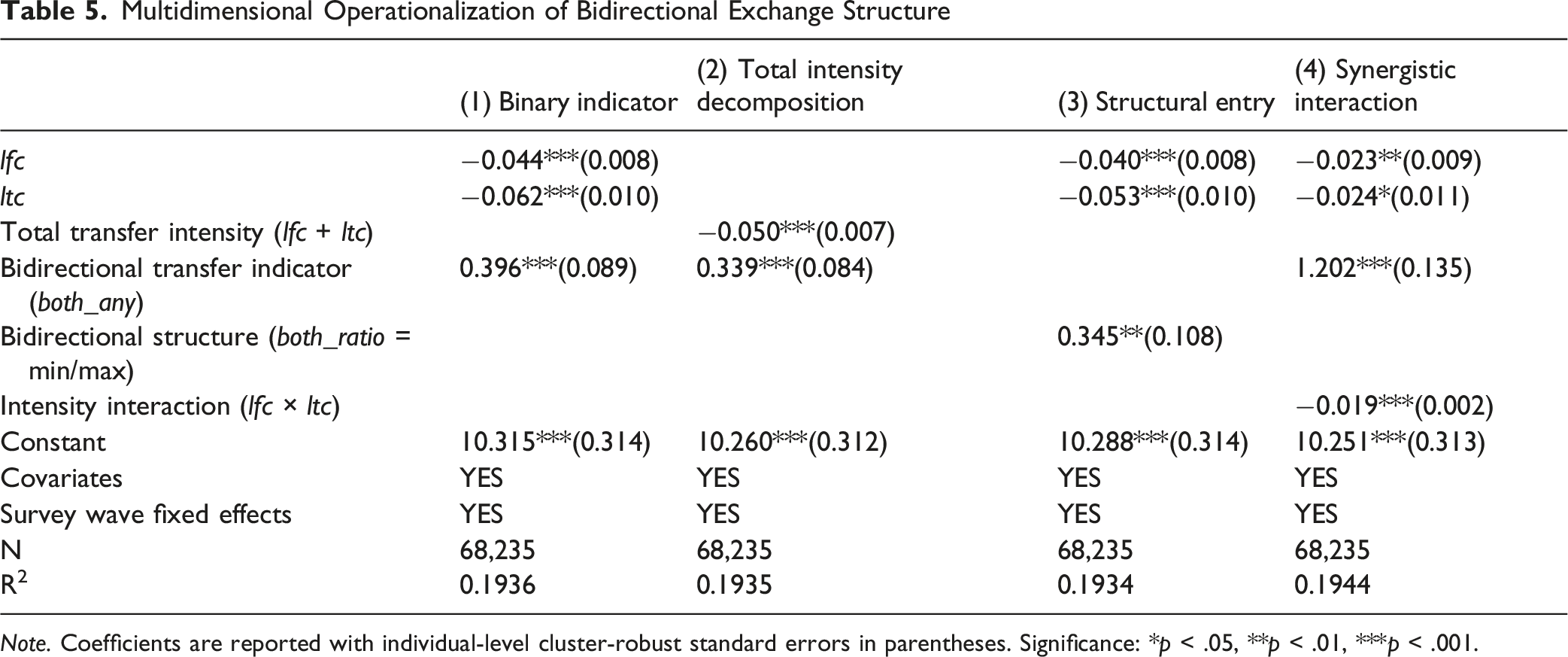
Note. Coefficients are reported with individual-level cluster-robust standard errors in parentheses. Significance: *p < .05, **p < .01, ***p < .001.
Total Intensity Decomposition
The necessity of directional identification (H3a). The benchmark model separately controls for received and provided intensity, implicitly assuming that the two directions possess heterogeneous health effects. If the psychological costs of bidirectional exchange essentially derive solely from the “net increase” of resource flows rather than directional structure, then when bidirectionality is examined within total intensity (lfc + ltc), its independent effect should be dissolved. Column (2) replaces separately controlled directional intensity with total intensity; results show that both_any remains significantly positive (b = 0.339, SE = 0.084, p < .001), while total intensity itself is significantly negative (b = −0.050, SE = 0.007, p < .001). This indicates that the core conclusion does not depend on separate identification of “received/provided”: even when the two directions are treated as a homogeneous resource aggregate, bidirectional co-occurrence remains independently associated with higher depressive symptoms, supporting Hypothesis 3a. In other words, the positive association of bidirectional exchange with depressive symptoms is not a simple derivative of total resource flows; it is more consistent with an interpretation that emphasizes exchange structure as a source of psychological burden.
Structural Entry
Bidirectional exchange structure and role conflict (H3b). If the psychological costs of bidirectional exchange stem from simultaneously assuming both “supporter” and “dependent” roles within the same exchange structure, then entering such a structure—regardless of the exact intensity ratio—should increase psychological burden. Column (3) introduces the bidirectional structure indicator (both_ratio = min (lfc, ltc)/max (lfc, ltc)), ranging from 0 (no bidirectional exchange) to 1 (completely balanced bidirectional exchange), to characterize the degree of bidirectional exchange structure. Results show that both_ratio is significantly positive (b = 0.345, SE = 0.108, p < .01), meaning that after controlling for directional intensity, entering a bidirectional exchange structure is associated with higher levels of depressive symptoms. This finding supports Hypothesis 3b: when older adults simultaneously assume both “supporter” and “dependent” roles within the same exchange structure, the resulting configuration is consistent with the logic of role conflict and heightened psychological burden posited by intergenerational ambivalence research (Hua et al., 2021).
Synergistic Interaction (H3c)
The above results suggest that the “existence” of bidirectional exchange itself may mark a leap—that is, the entry from a unidirectional clear role into a bidirectional negotiation domain. However, among those already engaged in bidirectional transfers, further synergy between received and provided intensity may reflect the maturation and stabilization of exchange relationships, thereby alleviating role conflict. Column (4) adds the interaction term between received and provided intensity (lfc × ltc) to the benchmark model to test whether intensity synergy produces a mitigating effect independent of bidirectional co-occurrence. Results show that both_any remains highly significantly positive (b = 1.202, SE = 0.135, p < .001), whereas the interaction term is significantly negative (b = −0.019, SE = 0.002, p < .001). This result reveals a more nuanced pattern: the “existence” of bidirectional transfer (both_any) is associated with higher depressive symptoms, yet among those already engaged in bidirectional transfers, further synergy between received and provided intensity (lfc × ltc) exerts a mitigating effect. That is, role conflict primarily stems from the qualitative leap of “whether bidirectional” rather than the quantitative accumulation of intensity itself; once bidirectional exchange has already occurred, higher symmetrical synergy may reflect more mature coordination mechanisms.
In summary, the three operationalizations converge on the same conclusion: the “existence” of bidirectional exchange is consistently independently associated with higher depressive symptoms, yet its internal structure—structural entry and synergy—exhibits differentiated effect gradients. This further confirms that bidirectionality should be treated as a structural construct with intrinsically differentiated dimensions.
Discussion and Conclusion
The core findings of this study can be summarized in three respects. First, directional transfer intensity—whether receiving or providing—is associated with fewer depressive symptoms, and this negative association remains visible under a one-period lagged specification. This pattern is consistent with prior evidence (Appleton et al., 2024; Bangerter et al., 2015; Wu et al., 2018). Second, when transfer intensity in both directions is simultaneously controlled, contemporaneous bidirectional co-occurrence is positively associated with depressive symptoms, and this positive association persists in the one-period lagged model. Third, by operationalizing bidirectional exchange along three dimensions—binary co-occurrence, structural entry, and interactive synergy—this study reveals that “bidirectionality” is not a unitary construct. The “existence,” “structural entry,” and “synergy” of bidirectional exchange possess separable effects. The structural entry indicator finding in particular---that deeper engagement in a bidirectional exchange structure corresponds to greater depression. When older adults move from no bidirectional exchange to any degree of bidirectional engagement (and ultimately to evenly matched exchanges), the obligation boundary between ‘supporter’ and ‘dependent’ becomes increasingly blurred, and identity-switching demands intensify. This pattern is consistent with the interpretation that entering the bidirectional domain itself carries psychological costs net of directional resource flows, although the specific mediating mechanisms remain to be empirically verified.
Plausible Explanatory Mechanisms
One plausible interpretation is that bidirectional co-occurrence reflects a dense domain of obligation negotiation. . Older adults simultaneously receiving and providing financial support must manage competing role demands between “support provider” and “dependent” identities, and this role switching may engender emotional tension and structural stress (Luescher & Pillemer, 1998). An alternative explanation is that bidirectional exchange signals ongoing family events requiring repeated financial coordination. Family members simultaneously holding recent records of both contributions and claims increase the frequency of negotiation over amounts, timing, and responsibility boundaries; research has found that providing within-day practical support to children facing difficulties can alleviate parents’ negative emotions (Huo et al., 2019). Negative interaction in social relationships, once formed, exhibits persistence across time (Krause & Rook, 2003), suggesting that tension accumulated through frequent negotiation may not be a short-term phenomenon. These mechanisms are not mutually exclusive, and the current data cannot adjudicate their relative contributions—they constitute explanatory frameworks rather than empirically verified pathways. In addition, positive selection—older adults with higher psychological resilience may be more inclined to maintain bidirectional exchange—and unobserved heterogeneity (such as the quality of parent-child relationships, fine-grained gradients of children’s economic conditions) may also contribute to the observed association patterns.
Clinical and Policy Relevance
Despite the associational nature of the findings, their magnitude carries practical significance. For clinicians working in family contexts, inquiring about the structure of financial exchange (rather than merely its presence or direction) may offer insight into family stress dynamics. For policymakers, the findings suggest that support programs targeting older adults should consider whether family financial coordination imposes psychological burdens beyond material benefits. Recent research based on the China Family Panel Studies (CFPS) further notes that the effect of intergenerational support on older adults’ subjective well-being varies with filial piety cultural expectations: in contexts of low filial piety expectations, the well-being effect of financial support is more pronounced; conversely, in contexts of high filial piety expectations, the role of emotional care is more critical (Zhan et al., 2025). This implies that if social policy can reduce older adults’ dependence on children’s financial transfers through universal pension coverage, it may not only reduce bidirectional financial exchange and its accompanying negotiation burden but also facilitate a shift in intergenerational interaction from “monetary negotiation” to “emotional exchange.” In China’s institutional context, expanding the coverage of universal old-age pension security may reduce the occurrence of bidirectional exchange by lowering older adults’ dependence on transfers from children, thereby improving late-life mental health.
Three limitations warrant concern. First, fundamental limitations in causal identification. The associations reported herein should be interpreted as conditional statistical relationships after controlling for observed covariates and survey wave fixed effects, rather than causal effects. Two identification threats persist: reverse causality---older adults experiencing elevated depressive symptoms may alter their financial transfer behavior through cognitive decline or increased help-seeking. Besides, anticipation effects---respondents may prospectively adjust transfer patterns based on expectations of future health changes; although the lagged specification improves temporal ordering, it cannot eliminate such dynamic selection. Second, the indirect nature of mechanism interpretation. The mechanisms invoked herein—negotiation density, relational tension, and obligation pressure—constitute explanatory frameworks rather than causal pathways directly verified by the data. Their relative contributions await adjudication by future research through finer-grained process measurement. Third, the boundary of mitigation by control strategies and residual confounding. To partially mitigate confounding from relationship quality and chronic stress, the models incorporate family structure proxy variables including household size, number of living children, living alone status, coresident with family members, and non-coresident kin contact. However, even after controlling for these observable dimensions, unobserved family-level shocks—such as family, economic, or health crises among adult children—may simultaneously increase bidirectional transfers and parental psychological distress; furthermore, residual confounding from unmeasured dimensions such as the emotional tone of parent-child relationships, fine-grained gradients of children’s economic conditions, or older adults’ anxious expectations regarding future care arrangements cannot be ruled out.
Footnotes

Author Contributions
Conceptualization: ZHANG Hanting; FAN Ruoxuan. Research design and methodology: ZHANG Hanting. Data curation and formal analysis: ZHANG Hanting; FAN Ruoxuan. Writing (original draft): ZHANG Hanting; FAN Ruoxuan. Writing (review & editing): ZHANG Hanting; FAN Ruoxuan. Supervision: ZHANG Hanting
Funding
The authors disclosed receipt of the following financial support for the research, authorship, and/or publication of this article: This research was supported by Major Social Science Projects in China. (Grant No. 24&ZD152).
Declaration of Conflicting Interests
The authors declared no potential conflicts of interest with respect to the research, authorship, and/or publication of this article.
Data Availability Statement
The data that support the findings of this study are third-party survey data from the China Health and Retirement Longitudinal Study (CHARLS). De-identified CHARLS public-use datasets are available to researchers worldwide via the CHARLS project website after registration and acceptance of the CHARLS data use agreement. No new data were collected for this study. The Stata code used to generate analytic variables and reproduce the tables and figures is available from the corresponding author upon reasonable request, subject to the CHARLS data use terms.