







Abstract
The aim of this study is to examine the role of Dutch second grade (age 13–14) high school peer networks in mediating socioeconomic background and school type effects on smoking behavior. This study is based on a longitudinal design with two measurement waves at five different high schools, of the complete networks of second grader friendships, as well as their smoking behavior, school type, and parents’ educational level. The analysis is done by simulation investigation for empirical network analysis (SIENA) modeling that can control for friendship selection on the basis of smoking similarity when assessing friends’ influence on smoking. The findings show that, when controlling for friendship selection, the influence of friends still plays a significant role in adolescent smoking behavior, and suggests that socioeconomic background and school type effects on smoking are mediated by the friendship networks at school.
Keywords
Smoking is a well-documented health hazard that is distributed unequally across different socioeconomic status groups (World Health Organization [WHO], 2008). Although the causes of this inequality are partly unknown (Mackenbach, 1994), we do know that a negative relation between socioeconomic status and smoking is widely occurring (Pampel, 2002, 2005, 2006; Pampel & Rogers, 2004). Furthermore, it is well known that most smokers (80–90%) start their habit before the age of 18 (Cotterell, 2007; Gielkens-Sijstermans et al., 2010). For this reason, adolescents are the prime target of smoking onset studies. These studies show that adolescent smoking is related to various factors (Cotterell, 2007; Voelkl & Frone, 2000), encompassing the family situation of parents and siblings (Avenevoli & Merikangas, 2003; Engels, 1998; C. Huisman, van de Werfhorst, & Monshouwer, 2011), socioeconomic background (de Vries, 1995; Lowry, Kann, Collins, & Kolbe, 1996; Van Lenthe, Boreham, & Twisk, 2001), peers and friends (Aloise-Young, Graham, & Hansen, 1994; Ennett, & Bauman, 1993, 1994), as well as the school environment (Ellickson, Bird, Orlando, Klein, & McCaffrey, 2003; Kumar, O’Malley, Johnston, Schulenberg, & Bachman, 2002). Recently, researchers in the field of adolescent smoking behavior have argued that not just those individual factors but in particular their interrelationship needs to be accounted for when examining the development of smoking habits (Ennett et al., 2010; Wen, Van Duker, & Olson, 2009). In this line of inquiry, the contribution of our study is its focus on the interrelatedness of parents, friends, and school in explaining health inequalities across different socioeconomic status groups. Furthermore, as many current smoking prevention programs only yield short-term results (at least in the Netherlands; see Crone et al., 2003), the practical relevance of this study lies in providing a better understanding of smoking behavior as a stepping stone to develop more effective prevention programs.
The core research question of this paper takes the key factors pointed out in the literature into account and reads: What is the role of high school peer networks in mediating the socioeconomic background effect and the school type effect on adolescent smoking behavior? We address this question in a study of second grade students (similar to grade eight in the United States) in five high schools in the Netherlands. We do this by using longitudinal network data and simulation investigation for empirical network analysis (SIENA) modeling, which is especially developed for the examination of the type of question raised in this study. Recent studies on smoking behavior under the same age group, using SIENA modeling, have yielded valuable new insights into adolescent smoking (Mercken, Candel, Willems, & de Vries, 2007; Mercken, Snijders, Steglich, Vartiainen, & de Vries, 2010; Mercken, Snijders, Steglich, & de Vries, 2009). The novelty of this study is to add to these insights by looking at the interrelation with socioeconomic background and school type. We first discuss in more detail the relevance of socioeconomic background, school type, and friendship networks for adolescent smoking, each in turn.
The effect of the socioeconomic status of parents on adolescent smoking varies between countries (Richter & Leppin, 2007), and in some countries there is no, or only a weak, association. Yet a study done by de Vries (1995) shows that Dutch adolescents from low socioeconomic backgrounds smoke more than adolescents from high socioeconomic backgrounds, which is confirmed by a recent Dutch study (C. Huisman et al., 2011). A possible mechanism that explains this relation is that children with a low socioeconomic background are more likely to grow up in a family environment where smoking is more prevalent, and therefore more easily pick up smoking habits (de Vries, 1995; C. Huisman et al., 2011).
According to data of the Dutch National School Survey on Substance Use 2007 (DNSSSU) there is considerable variation in smoking behavior among high school students across different school types. As Table 1 shows, the lifetime, last month, and daily prevalence of smoking behavior is highest in the lowest school types. According to Elstad (2010), school type placement affects adolescents’ self-perception and sense of self-esteem, which in turn affects their behavior towards health compromising behaviors such as smoking. The categorizing and labeling that comes with the assessment of school achievement and the placing in school types makes students aware of their future position in the socioeconomic hierarchy: A higher inclination to engage in health-compromising behaviors among low-achieving adolescents may arise from more need for stress-alleviating behaviors, less interest in the future because of unpromising social prospects, adaptation to the lifestyles of future socioeconomic milieus, attempts to compensate lack of recognition in school by excelling in alternative social fields, and deliberate opposition to social authorities because of the experience of being rejected by them. (Elstad, 2010, p. 146) Percentages of smoking prevalence among Dutch high school students, ages 12–16
Source: Dutch National School Survey on Substance Use (DNSSSU), 2007. Note. b = basic, t = theoretical.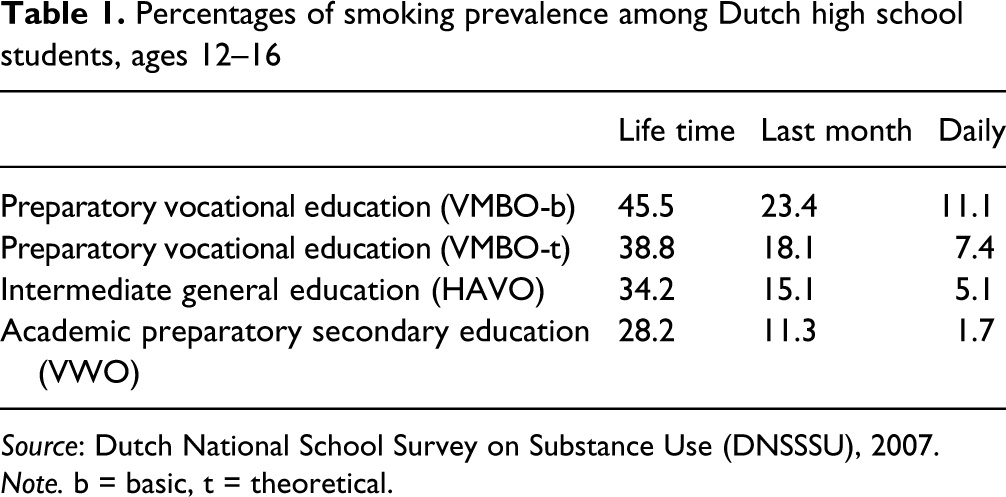
While “birds of a feather flock together,” people can also be similar because they influence rather than select each other. For example, delinquents prefer to hang out with other delinquents, but they also imitate their friends’ behavior, and are thereby influenced by those friends (Sutherland & Cressey, 1974). The discussion about selection versus influence has sparked various social network studies on friendship formation and smoking behavior. The findings of these studies indicate that both selection and influence are at play (Mercken et al., 2007, 2009, 2010).
From the 1950s, American studies repeatedly show that adolescents with lower-educated parents smoke more, and that adolescents who smoke more have lower educational achievements (see Waldron & Lye, 1990, for an overview). Some of these studies suggest that school tracking mediates social background effects (Waldron & Lye, 1990). A study by C. Huisman et al. (2011) shows that, in the Netherlands, high schools also play a mediating role in the intergenerational transmission of this health inequality, as children with lower socioeconomic backgrounds are more likely to end up in the lower school types, and are more likely to smoke.
Our question is, however, how friendship networks in turn mediate this relationship. As the educational level of parents affects school type placement (Brunello & Checchi, 2007; Lucas, 2001), and high schools are important social foci for friendship formation (Ennett & Bauman, 1994), school type affects the options for friendship formation. But perhaps the immediate cause of smoking behavior is social influence through friendship networks. Thus in contrast with Elstad’s (2010) argument that school type placement has a direct effect on health-related behavior such as smoking, we conjecture that, even after controlling for friendship selection, the effect of parental education that runs via school type is strongly reduced by the influence of friends on smoking behavior.
Method
Participants
The data collected consist of a network-and-behavior panel of 961 second grade Dutch high school students at five different schools, of which four were in an urban area and one in a rural area, with nominal age of 13 at the beginning of the school year. According to research on the general Dutch student population, this is the school year in which most smoking onset is taking place (Monshouwer, Dorsselaer, Gorter, Verdurmen, & Vollebergh, 2004; Monshouwer et al., 2008). The data were collected at two time points, wave 1 at the beginning of school year of 2008–2009, and wave 2 6 months later, halfway through the school year.
The data were collected by means of a questionnaire. The students were assured that their responses were treated with confidentiality and could not be traced back to them. They were also told that they could refuse to participate. Only two students refused. As Table 2 shows, at wave 1 (the first observation) 8.8% of the students were absent, and the figure was slightly higher at wave 2, 11%.
Absence of students at waves 1 and 2

Instruments
Friendship
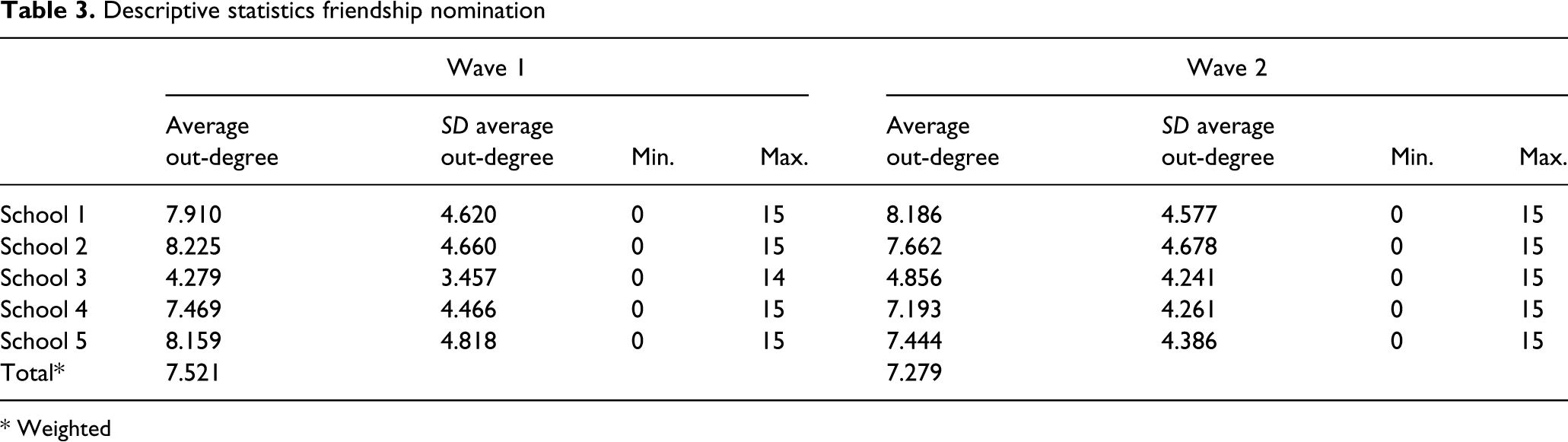
Knowing that students in this age group mostly befriend students in the same grade (Shrum, Cheek, & Hunter, 1988), we asked them “Who are your friends in the second grade in this school?” They could then list up to 15 nominations. Table 3 shows the average out-degree (number of friends listed), standard deviation (SD) for out-degree, and minimum and maximum for all five schools. These data were used to assess the network of second graders within and across their classes at each school.
Descriptive statistics friendship nomination
* Weighted
Smoking behavior
The smoking behavior instrument is a frequency–quantity interaction measure constructed from two items on smoking behavior. The first item, on frequency, contains five alternatives: never smoked; smoked once or twice; intermittent (non-daily) smoker; I used to smoke, but now I stopped; and daily smoker. We recoded this item by merging the categories “intermittent (non-daily) smoker” and “I used to smoke, but now I stopped” into one category, resulting in a four-item ordinal variable for the frequency of smoking. The second item measures quantity by asking: On a day that you smoke, how many (self-rolled) cigarettes do you smoke? We recoded this variable into four categories: I never smoke; less than 1 cigarette; 1 to 20 cigarettes; 20 or more. We use this cut-off point at 20 cigarettes because it is in accordance with the definition of heavy smoking used by the Dutch National Institute on Health and Environment (RIVM, n.d.) and Statistics Netherlands (CBS, n.d.). At both waves these two items have a high correlation, 0.85 and 0.86, respectively. By multiplying these two items, the frequency–quantity interaction measure was constructed.
Parental educational level
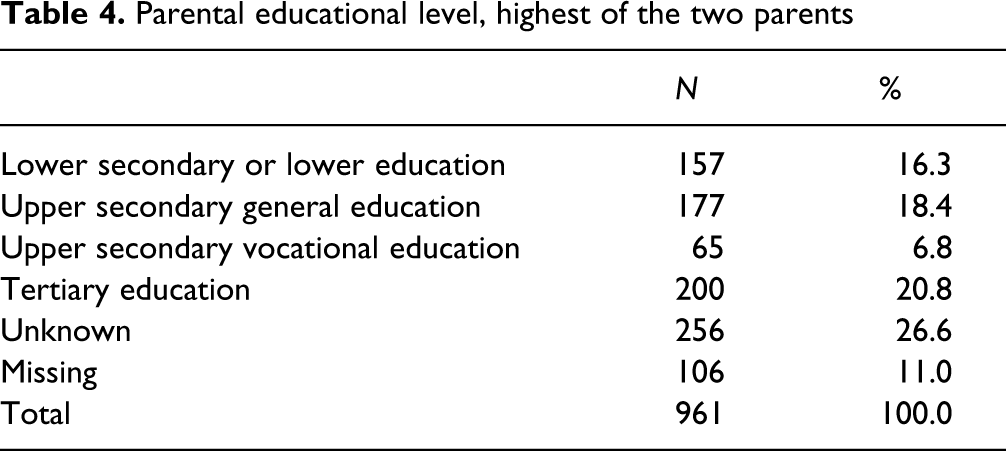
The educational levels of both the mother and the father were researched. We took the highest score among both parents which could be one of four categories. As Table 4 on the frequencies of parental educational level shows, 26.6% of the students did not know their parents’ educational level. For that reason, this variable was recoded into five dummies, one for unknown parental educational level, and tertiary education as the reference category.
Parental educational level, highest of the two parents
School type
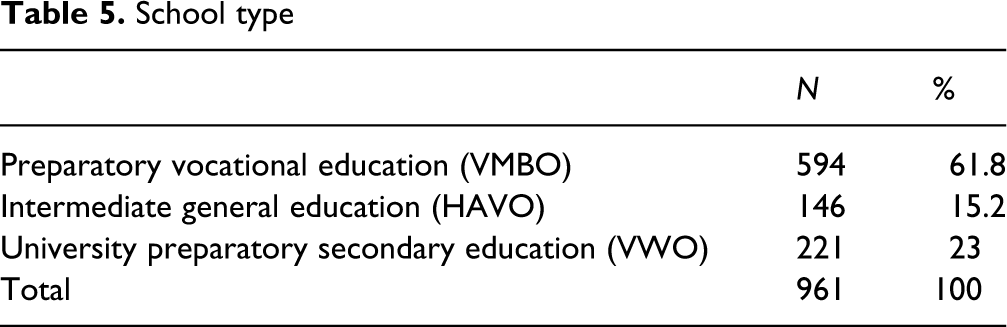
For this variable we used one dummy variable for preparatory vocational education (VMBO) and one dummy variable for intermediate general education (HAVO). Academic preparatory education (VWO) is the reference category; see Table 5.
School type
The percentage of smokers among ego’s friends (where ego is a focal individual)
This variable is computed for the OLS regression models indicating the percentage of daily smoking prevalence among friends with reciprocal ties.
Remainder variables, such as age and gender (male = 1, female = 2), don’t need to be explained, while network variables constructed from the data for the SIENA model are explained in Appendix 1.
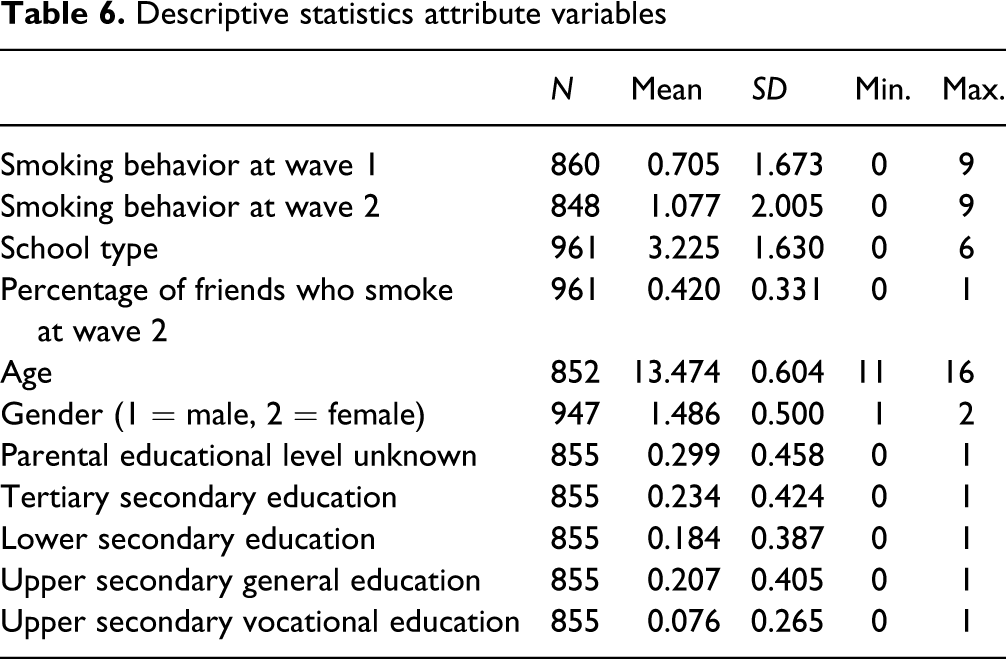
For missing network data, various treatments have been tested in simulations (M. Huisman & Steglich, 2008), among others naïve and “clever” (i.e., model-based) imputations. Their study points out that, when there are less than about 20% missing data, they can be left out without serious consequences for the estimated effects. When SIENA deals with them, standard errors are not underestimated. In our case we miss 8.8% of the students at wave 1 and 11% at wave 2, so we are well below the 20% threshold. Table 6 gives an overview of the descriptive statistics.
Descriptive statistics attribute variables
Analytical strategy
First, we test the hypothesis without network effects by estimating the effects of gender, age, parental education, school type, and smoking behavior of friends on ego’s smoking behavior, based on the data collected at wave two using ordinary least squares (OLS) regression modeling. This approach is straightforward and well-known. However, OLS modeling is centered on ego networks and cannot take into account indirect network effects such as transitivity, assortative selection, “properties of non-chosen potential partners” (Steglich, Snijders, & Pearson, 2010, p. 332), and it can’t deal with unobserved changes due to incomplete observations (Steglich et al., 2010). Therefore we need a different approach, for which we use SIENA modeling, which uses complete network data instead of ego-centered data.
The data of five schools were merged into one dataset using the “structural zero” method (see Ripley, Snijders, & Preciado, 2011 for details). Ideally, when doing so, one should control for between-school variation using fixed effects models. However, some of the schools in the sample have only one school type, whereas others have more than one but still not all types (at one location). Therefore modeling both school type and school location leads to severe multicollinearity. For the same reason, a meta-analysis of the outcomes of five separate SIENA models, one for each school, would not make it possible to investigate the effect of variation in school type on smoking behavior. For this reason we choose not to control for school location.
Our two-wave panel makes possible the employment of a longitudinal approach. In our case, (smoking) behavior and network ties change interdependently, and someone’s decision, for example to establish a tie, may lead to a decision by somebody else, for example to reciprocate the tie or to start smoking. To take this complex interdependence into account, we turn to stochastic actor-based models for network dynamics, also called SIENA (Ripley et al., 2011; Snijders, 2001; Snijders, Steglich, & van de Bunt, 2010).
The network part of these models rests on the assumption that people can decide about their “outgoing” ties only; that is, whom they choose as social contacts, not by whom they are chosen. With respect to network dynamics, we control for reciprocity and transitivity (Davis, 1970; Wasserman & Faust, 1994). Reciprocity means in this case that, if ego mentions alter as a friend, then alter also mentions ego as a friend. Transitivity means that if ego and alter have a common friend, their chance to meet and establish a friendship are much higher than if they do not have a friend in common. For a more detailed discussion of SIENA modeling, see Appendix 1.
Results
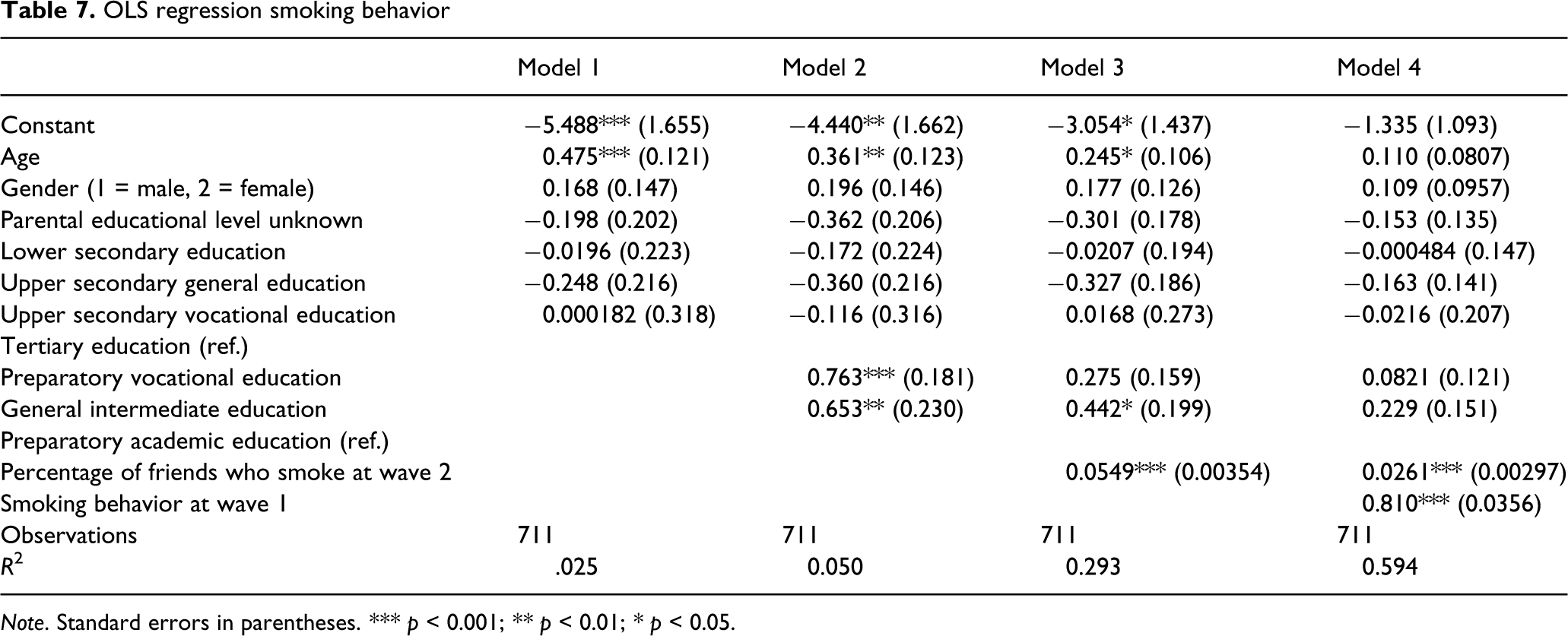
First, we discuss the outcomes of the OLS regression (see Table 7). Subsequently, we discuss the outcomes of the SIENA models (Tables 8 and 9).
OLS regression smoking behavior
Note. Standard errors in parentheses. *** p< 0.001; ** p< 0.01; * p< 0.05.
Friendship selection part of SIENA
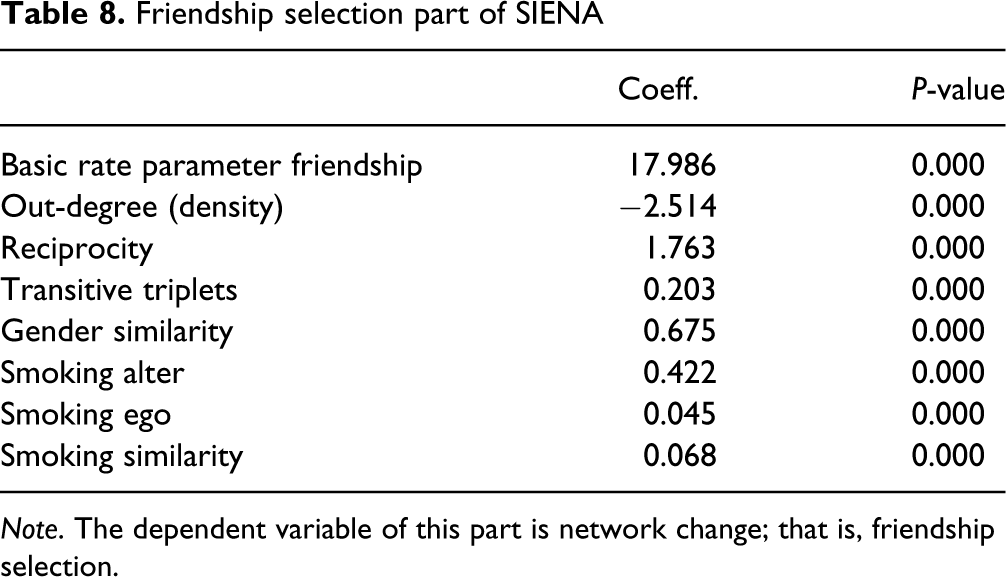
Note. The dependent variable of this part is network change; that is, friendship selection.
Behavioral influence part of SIENA
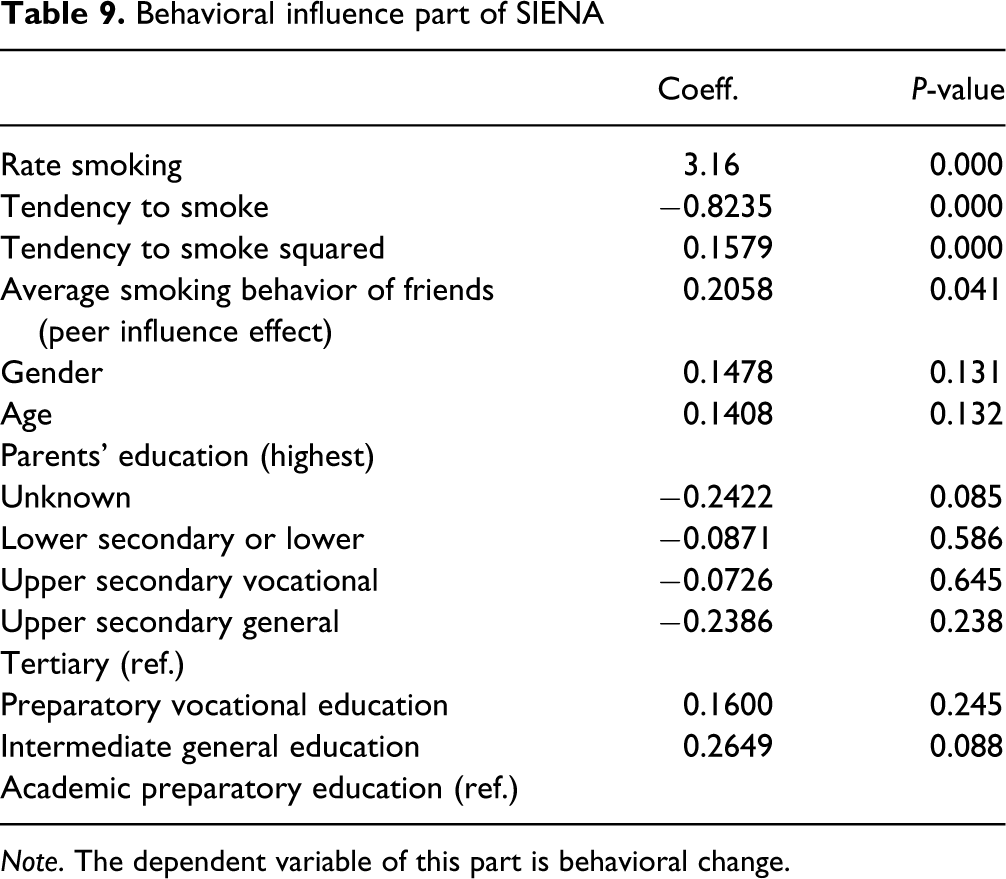
Note. The dependent variable of this part is behavioral change.
OLS regression
Models 1 to 3 show a positive and significant age effect. When controlling for smoking behavior at wave 1, the age effect declines and becomes non-significant; we’ll return to this finding at the SIENA modeling subsection. All four models show no significant difference in the mean smoking behavior between boys and girls. Except for the negative coefficient for the parameter of parental educational level unknown (model 2), models 1 to 4 show no significant effects, suggesting that, in contrast to former findings, parental educational level might not have a negative effect on their children’s smoking behavior. In model 2, the two dummy variables for school type are added, showing a negative and significant coefficient. However, when adding the percentage of friends who smoke effect in model 3, which has a positive and significant value and adds nearly 25% to the explained variance, the effect of preparatory vocational education decreases strongly and becomes non-significant. The effect of general intermediate education then stays significant but decreases strongly as well. This finding suggests that a large part of the school type effect is mediated by friends’ smoking behavior.
When controlling for smoking behavior at the first wave (model 4), the effect of general intermediate education decreases even more compared to the change we saw between models 2 and 3, and becomes non-significant. In the same model (4), the effect of friends’ smoking behavior decreases, but remains positive and significant. Taken together, these outcomes plea against Elstad’s (2010) argument that school type placement affects behavioral motivations directly, but suggest instead that network effects are key. The latter are examined in more detail now with SIENA.
SIENA
Table 8 displays the parameter values for the friendship selection part of the SIENA model. The dependent variable of this part is network change; that is, friendship selection. As usual in network studies, out-degree is negative and significant, and reciprocity and transitivity are positive and significant (see Appendix 1 for elaboration). The effect of gender similarity is positive and significant which also shows, in line with former studies, that gender assortment influences friendship selection. The positive and significant smoking ego effect shows that smoking increases the likelihood of nominating other students as friends. The positive and significant smoking alter effect indicates that students who smoke are more likely to be nominated as a friend by other students. The smoking similarity effect is positive and significant, which strongly suggests that assortative selection on smoking behavior governs friendship formation.
Table 9, displaying the parameter values for the behavioral influence part of the SIENA model, shows that the gender effect on smoking is non-significant. This is in line with the findings in the OLS models that there is no difference in smoking behavior between boys and girls. The age effect is non-significant. The dummy variables for parental educational level are non-significant. Furthermore, the parameters for preparatory vocational education and intermediate general education are also non-significant implying that, on top of social influence by friends, and controlling for friendship selection, there is no effect of school type. Indeed, the average smoking behavior of friends effect is positive and significant. Taken together, these results suggest that there is support for our hypothesis that the school type effect is mediated by peer networks.
Discussion
The relevance of peer networks for adolescent smoking behavior is well established, and the same goes for socioeconomic background and school type. However, little is known about how these three factors are interrelated. This is especially regrettable for a country such as the Netherlands, where there are stark differences in smoking prevalence between students across different school types, and school type plays such an important role in the intergenerational transmission of inequities. Therefore the aim of this paper was to investigate the role of high school peer networks in mediating the effects of socioeconomic background and school type on adolescent smoking behavior. We pre-selected the school year in which the onset of smoking is largest, which is grade 2 of secondary education in the Netherlands, the country where we collected the data. First, we examined the effects of age, gender, parental education, school type, and smoking behavior of friends on ego’s smoking behavior, using the data collected at wave 2, modeled by OLS regression. Second, we investigated the same list of effects combined with friendships dynamics of selection and influence by using SIENA.
Looking at the attributes without controlling for the network dynamics in OLS regression, we found no significant relation between parental educational level and smoking behavior. Furthermore, we found a significant relation between school type and smoking behavior, until we controlled for the smoking behavior of friends and for smoking behavior at the first wave, which both have a significant effect on smoking behavior at the second wave. This preliminary result indicated that smoking behavior of friends and previous smoking behavior are relevant factors to further look into. Consistent with the OLS regressions, after controlling for friendship network effects in SIENA, we found no direct effects of parental educational level and school type on smoking behavior. Finally, after controlling for assortative friendship selection, we found that friends’ smoking behavior has a positive effect on the smoking behavior of focal actors.
Although the novel possibilities provided by SIENA are a welcome addition to the statistical toolkit, Burk, Steglich and Snijders (2007) point out several limitations, of which two might have affected our study. First, SIENA does not provide a model-fit, such as R 2, making it difficult to compare outcomes with those of other statistical approaches, such as regression, in a clear-cut manner. Second, “[. . .] the assumption of Markov chains implies that there are no systematic influences on the network and behavioral dynamics other than the influences implied by the effects in the model specification” (Burk et al., 2007, p. 403). This limitation is related to the data, wherein confounding unobserved variables may not have been taken on board as pointed out by Ali and Dwyer (2009) and Cohen-Cole and Fletcher (2008). Our data were collected on second grade networks within the school, while it is possible that adolescents also pick up smoking habits from higher graders or outside the school. In that case we might have underestimated the social network effects. Moreover, the measurements for smoking are based on self-reported data and not on biochemical indicators such as nicotine concentration measurements in saliva. Self-reported smoking prevalence is significantly underreported by respondents (Wagenknecht, Burke, Perkins, Haley, & Friedman, 1992). If smoking behavior is systematically higher than we have measured, our qualitative outcome would not be affected, though. Another limitation to the data is that the categories unknown and missing of the parental educational level variable added up to 37.8%. Of these unknown and missing values, a large part (45.9%) is found among the students in preparatory vocational education. This might have resulted in underestimating the effect of socioeconomic background; While we found that it was not significant, it might have turned out to be significant if we had had all data. Furthermore, our data were gathered in a rural area and in a small town. Research at schools in urban areas might yield different results because, in the Netherlands, smoking is more prevalent in urban areas (permanent living situation survey [POLS], CBS, n.d.). Finally, due to the nature of the data used to address this study’s research question, we cannot appropriately distinguish between school location and school type effects.
These possible shortcomings should be seen in the right perspective. A great many studies on adolescent smoking have already been conducted, which provide useful guidelines when it comes to assessing relevant variables and their measurement. Even with the listed modeling and data limitations in the back of our minds, it seems that we found reasonable support for our claim that social networks have a strong impact on smoking behavior, and that they mediate the effects of socioeconomic background and school type. Socioeconomic background does affect school type placement, as children with higher-educated parents are more likely to end up in higher school types. School type placement in turn affects students’ opportunities to establish social ties, but the negative effect of school type on smoking is overruled by network effects. In sum, the chance to start smoking does not depend on socioeconomic background or school type directly, but mostly on the social network.
Recently a number of studies have been done on adolescent smoking behavior in the Netherlands and other European countries (Mercken et al., 2007, 2009, 2010), but also on alcohol use, delinquency, and school attitudes (Knecht, 2007), using longitudinal network data and SIENA models. Although these studies provide valuable new insights into adolescents’ behavior, they do not account for institutional factors such as school organization, which are well known to play a significant role in the variations of adolescent behaviors, such as smoking. This study aimed to fill that gap in the literature.
Although no direct effect was found of parental education, it might still be the case that parents and parents of friends are an important factor for explaining the variation in smoking behavior between students across different school types. Possibly, students’ smoking is affected by other contacts (e.g., parents) in the social network outside the school, which in turn channels social influence to other students via the school friendship network, in line with Coleman’s (1988) notion of social capital. Keeping in mind the relevance of school-based smoking prevention programs (Isensee & Hanewinkel, 2012), future research should be aimed at exploring this possibility. Finally, in line with Crone et al. (2003), the findings of this study underline that smoking prevention programs should be school based, school type based, and long term.
Footnotes
Funding
This research received no specific grant from any funding agency in the public, commercial, or not-for-profit sectors.