







Abstract
The Adoption Curiosity Pathway (ACP) model was used to test the potential mediating effect of curiosity on adoption information-seeking in a sample of 143 emerging adult adoptees (mean age = 25.0 years) who were adopted as infants within the United States by parents of the same race. Adoptees were interviewed about their intentions and actions taken to gather new information about their birth mothers and fathers. As expected, level of curiosity was positively associated with information-seeking behavior. Moreover, level of curiosity was influenced by adoptees’ perceptions of barriers and facilitators toward information-seeking. In fact, curiosity partially mediated the impact of internal and external barriers on information-seeking about birth mothers. Curiosity fully mediated the impact of external barriers and partially mediated external facilitators on birth father information-seeking. This study provides important support for the ACP, which describes context, motivation, and behavior relating to seeking new adoption-related information.
Curiosity is central to the human condition and provides incentive to answer the questions of daily life and engage in new experiences (Reio, Petrosko, Wiswell, & Thongsukmag, 2006). For adopted persons, a unique focus of curiosity is their own adoption. Most adopted individuals, at various points in life and across all types of adoption arrangements, consider their desire to obtain information regarding their adoptions and birth families (Wrobel, Ayers-Lopez, Grotevant, McRoy, & Friedrick, 1996; Wrobel, Grotevant, & McRoy, 2004). Adopted adolescents in particular are curious about a number of issues, most commonly the reasons their birth parents placed them for adoption (Wrobel & Dillon, 2009). Those in emerging adulthood express a strong desire to know the health and medical histories of their birth relatives as well (Wrobel & Grotevant, 2012). Some adopted persons display no desire to seek out such information, whereas others feel so curious that they will use multiple avenues to find out what they want to know and will not stop their efforts until they get answers.
Perceptions of barriers and facilitators to obtaining information create a context for adoption-related curiosity and subsequent action. If information is perceived as obtainable, it can increase curiosity and information-seeking. Barriers to obtaining the information can either energize one to overcome the barriers or seem so strong that they cannot be surmounted, thus minimizing the motivation to find new information (Loewenstein, 1994). The purpose of this paper is to explore how, for emerging adults, barriers and facilitators (contexts) influence adoption-related curiosity (motivation) for seeking out unknown adoption-related information (behavior).
The adoption curiosity pathway
Research questions are guided by theory expressed in the Adoption Curiosity Pathway (ACP). The ACP is a process model that addresses the expression of adoption-related curiosity and subsequent decisions to seek out specific adoption information (Wrobel & Dillon, 2009; Wrobel & Grotevant, 2012). Palacios and Brodzinsky (2010) called for the use of process models in adoption research to better understand the key factors and processes in adoptive families. Related to curiosity, most prior research has focused on the outcome of a birth parent search (Müller, Gibbs, & Ariely, 2002; Müller & Perry, 2001b; Sullivan & Lathrop, 2004) rather than why a person begins the search process. The expression of adoption curiosity and information-seeking is tied to an adoptee’s circumstances, including contact with birth family members. As such, the ACP provides a framework for understanding the diversity of curiosity and information-seeking behavior observed in adopted persons.
There are three steps on the ACP towards information-seeking about birth parents: (1) identifying an adoption information gap, (2) determining the intensity of adoption-related curiosity, and (3) seeking out the desired information. Curiosity is viewed as the motivation to engage in information-seeking behavior. Barriers and facilitators to obtaining that information contribute to the context within which curiosity and information-seeking reside (Wrobel & Dillon, 2009).
Identifying an adoption information gap
The ACP begins with adopted persons reflecting upon the adoption-related information they possess. That reflection may lead to the identification of further desired information or to the conclusion that information possessed is enough. When the adoption information known matches the information desired, there is no information gap and no curiosity; curiosity is the motivation to fill the identified information gap (Loewenstein, 1994). A gap is more likely to be formed by those who engage in more thinking about their adoption and who have less contact with birth parents (Wrobel & Grotevant, 2012). In the model, for those who do desire more information, an adoption information gap is identified and intensity of curiosity to gain that information is considered.
Curiosity
Curiosity in the ACP model describes the intensity of desire to obtain additional information contained in the adoption information gap. Curiosity provides the motivation for seeking out that information. As such, as curiosity varies in intensity, so does the motivation to seek out desired information. One can experience curiosity but never actually seek out information. The context within which this curiosity resides consists of several factors, including age, gender, openness arrangement (the type of contact between birth and adoptive family members), who the adopted person is curious about, (e.g., birth mother, father, siblings) and the barriers and facilitators to obtaining the desired information. Previous research (Wrobel & Dillon, 2009) focusing on adopted adolescents has shown no difference in intensity of curiosity about birth mother and birth father across age, gender, and openness arrangement, with all groups expressing moderate to moderately strong curiosity. A closer look within groups revealed that younger adolescents were equally curious about birth mothers and birth fathers, whereas older adolescents were more curious about their birth mothers. Many adults (Müller & Perry, 2001a) also describe finding information about their birth mother as their primary goal. Wrobel and Dillon (2009) found that as adopted adolescents begin to fill the information gap about their birth mothers and birth fathers, they become motivated to find even more information. Adolescent females were more curious about their birth mothers, whereas males were equally curious about their birth mothers and fathers. It may be that adolescent girls are particularly curious about their birth and adoption experience because they are similar in age and child bearing capability as their birth mother was when they were placed for adoption.
Information-seeking
Adoption exists in multiple forms, including adoptions with openness arrangements reflecting varying amounts of direct and indirect contact with birth families. Information-seeking is the behavioral response to the motivation of curiosity. As such, information-seeking is a broad concept that moves beyond birth parent search and reunion as the predominant way of satisfying curiosity. Such a broader conceptualization is needed more than ever, as all parties to adoption have begun using social media (e.g., Facebook) to obtain information about one another and sometimes to connect directly (Fursland, 2010). Information-seeking is defined as “the gathering of information previously unknown to the adopted person about his or her adoption and birth family” (Wrobel & Dillon, 2009, p. 223) and is a strategic, goal directed activity (Skinner-Drawz, Wrobel, Grotevant, & Von Korff, 2011). This definition allows for the diversity of adoption information sought and sources used by those experiencing different types of openness arrangements. For example, adoptees placed as older children had direct experience with their birth families prior to their adoption and may wonder how birth relatives are currently faring. Adoptees with no contact with birth relatives may want to meet their birth mother or know if they have birth siblings. Those with ongoing direct contact with their birth mother may want to know what she can tell them about their birth father. For some, the information they desire resides in adoption or birth records, and information-seeking can involve active strategies that do not require direct interaction with the birth family (e.g., reading agency records, searching the internet, asking adoptive parents for information). Other strategies may involve interaction with birth relatives by directly requesting information (Berger, 2002).
Wrobel and Dillon (2009) found that during adolescence, there was a wide range of adoption information-seeking, ranging from little interest in finding new information to having already sought out information. Information-seeking was also positively influenced by an increase in curiosity from childhood and more open adoption arrangements. Those who have more contact with birth families may identify more possible information sources, including birth family members. Irhammar and Cederblad (2000) found for a group of internationally-adopted adolescents, those whose families had ongoing contact with the child’s orphanage or a person from the country of origin involved in the adoption were more interested in finding our more information about their birth families. The actual amount of information they had about their background did not influence information-seeking intentions. Skinner-Drawz et al. (2011) found that information-seeking was also positively influenced by open communication about adoption within the adoptive family across adolescence and emerging adulthood.
Barriers and facilitators to information-seeking
Barriers and facilitators contribute to the context within which curiosity develops (Wrobel & Dillon, 2009). The ACP allows for barriers and facilitators to influence both the ease with which information is obtained and the level of curiosity experienced surrounding unknown information. Perceiving facilitators to obtaining desired adoption-related information will enhance curiosity because the information is viewed as accessible. Facilitators can include people (e.g., birth relatives or adoptive parents willing to actively support information-seeking); policies (e.g., those allowing access to information); or resources (e.g., funds or internet access needed to conduct a search). Barriers can also include people, policies, and resources; encountering barriers can produce frustration that can enhance or diminish curiosity. The frustration can energize one person to galvanize resolve to overcome the barrier, whereas another may view that barrier as insurmountable, decreasing motivation to avoid frustration. According to the ACP, then, curiosity is a motivation for information-seeking which increases or decreases depending on how barriers and facilitators are perceived.
Barriers and facilitators can either represent an internal state of reflection (e.g., feeling of personal readiness, belief that information may be beneficial or harmful to the relationship) or an external context (e.g., access to records but only at a certain age, financial resources). The exploration that occurs in emerging adulthood (Arnett, 2000) can influence information-seeking by opening new avenues to obtaining adoption-related information (e.g., Tieman, van der Ende, & Verhulst, 2008). Adoption records may be accessible once the adoptee is 18 years old, allowing information to be sought independently from adoptive parents. Friends or romantic partners often wield important influence, not felt in adolescence, on the decision to seek out information. Income received from work can help or hinder meeting costs associated with information-seeking.
Research questions
The ACP provides a framework for understanding the process associated with adopted persons’ seeking out new information related to their adoptions. All participants in this analysis had, at one point, an identified information gap. The current study tests the ACP model by addressing the impact of openness arrangements, barriers and facilitators, on curiosity and information-seeking in emerging adulthood. Barriers and facilitators to information-seeking are conceptualized as representing the context in which curiosity as a motivator for information-seeking develops, as are openness arrangements. The study includes separate models for curiosity about emerging adults’ birth mothers and birth fathers, allowing for the possibility that these processes might operate differently. We examine whether emerging adult adoptees’ curiosity mediates the associations between the predictors of internal and external barriers/facilitators and openness level and the outcome of information-seeking. In addition, the content of identified barriers and facilitators are described.
Method
Participants
Data were drawn from a sub-sample of adoptees who participated at Waves 2 and 3 of the Minnesota / Texas Adoption Research Project (MTARP) (Grotevant & McRoy, 1998). MTARP focuses on the impact of contact between adoptive and birth families on the development of members of the adoptive kinship network, which includes the adoptee, adoptive family, and birth family. Details about the broader study may be found as follows: Wave 1: Grotevant & McRoy (1998); Wave 2: Grotevant, Perry, & McRoy (2005); Wave 3: Farr, Grant-Marsney, Musante, Grotevant, & Wrobel (in press).
Wave 2 data were collected between 1996 and 2001, from 156 adopted adolescents (75 boys and 81 girls) ranging from 11 to 20 years of age (mean age = 15.7 years). Wave 3 data were collected between 2006 and 2008 from 169 adopted emerging adults (87 male, 82 female) ranging from 21 to 30 years of age (mean age = 25.0 years). All children had been adopted as infants (mean age of placement = 4 weeks) through private adoption agencies in the United States by parents of the same race. The majority of adoptees identified as White; four identified as Hispanic/Mexican American, and one identified as Black/African American. Approximately 20% of the adopted emerging adults were married and 20% had children. Fifty percent had earned at most a high school diploma, GED, or high school equivalency degree, with the remaining 50% earning advanced degrees (14% junior college, 33% bachelor’s, 3% master’s). At the time of the interview, 28% were still attending school. The majority of participants (80%) reported living in their own place and paying all or more than half of their housing expenses.
This article used a sub-sample of 143 adoptees who identified an adoption information gap at Wave 3 (n = 127 with regard to birth mothers, n = 134 with regard to birth fathers). Participants with an information gap stated there was something they wanted to know about their adoption with regard to a birth parent (coding described in detail below). In total, 118 adoptees reported a gap for both birth mother and birth father, 9 had a gap for birth mother only, and 16 had a gap for birth father only.
Procedure
At Wave 2, adoptive families were seen in their homes during a single session that typically lasted 4 to 5 hours. The session included individual interviews with each parent and the target adopted child (approximately 1 to 2 hours each) and administration of several questionnaires and a family interaction task. Some family members completed phone interviews (16 fathers, 20 mothers, 14 adolescents, 2 siblings) when it was impossible to gather everyone together for the home visit. Interviews were subsequently transcribed from audiotape; names and identifying information were changed to protect participant confidentiality.
At Wave 3, adopted emerging adults completed interviews via secure, password-protected internet chat-sites and online questionnaires protected by secure socket layer web technology. Participants first completed the online interviews, conducted by trained research assistants. They then completed the online questionnaires at their convenience. Paper-and-pencil measures and telephone interviews were made available to participants without internet access or with disabilities precluding internet use. Compensation was $75 for the questionnaires and $75 for the online chat interviews. The study was approved by the Institutional Review Boards of the University of Minnesota and the University of Massachusetts Amherst.
Measures
All variables were drawn from Wave 2 and Wave 3 adoptee interviews. At Wave 2, open-ended questions were answered on a variety of topics, including adolescents’ experiences, feelings, knowledge, and attitudes about his/her adoption and kinship networks. At Wave 3, open-ended questions were asked about school and occupation, religion, close relationships, and adoption. Responses from both waves were coded on a number of dimensions, discussed below.
Coding and variables
General coding procedures
Coding schemes were developed to assess information-seeking in emerging adulthood, including what the emerging adult was curious about, the intensity of curiosity regarding the information they wanted to know, and the number of identified barriers and facilitators to seeking out that information (Wrobel, Skinner-Drawz, & Grotevant, 2008). Openness arrangements were also coded. Ratings for all variables were based on the entire interview transcript. The codebook is available on request.
All transcripts were coded by the principal investigators, graduate students, or advanced undergraduates. Following intensive training about the meaning of the codes and the rating anchor points, coders were required to attain percent agreement of .80 or better with the code developers on at least two transcripts before coding independently. At least 50% of all transcripts were double-coded to monitor reliability. If needed, coders met to compare ratings and resolve disagreements. Reliability information for specific variables is provided in the sections below. Following our practice of allowing the voices of the participants to help shape our variables (Grotevant et al., 1998), we conducted a text analysis to determine the breadth of the continuum and points of demarcation of curiosity and information-seeking behavior.
Emerging adult information-seeking (Wave 3)
Interviewers probed participants: “Some choose to seek out more information or contact [with birth family members] and others do not. How about you?” Responses were coded on a 6-point scale based on the degree to which they were seeking information about or contact with their birth parents. All persons included in this report indicated, at one point, the presence of an information gap. Emerging adult adoptees coded as 1 (will not seek information) made strong statements that they would not seek information in the future even though an information gap was identified. One possible reason for this code would be a perception on the part of the adopted person that information-seeking may hurt the adoptive parents. Adoptees with a code of 2 (most likely will not seek information but leave open a slight possibility) stated there was only a slight possibility of seeking unknown adoption-related information. Participants with a code of 3 (maybe will seek information) said they might seek information about or search for birth relatives in the future; adoptees who left open the possibility of information-seeking but expressed ambivalence were included. Emerging adults coded as 4 (will definitely seek information) said they would definitely seek information or search for birth parents in the future. A code of 5 (actively seeking information) indicated that adoptees had already taken some action toward obtaining information or contact with birth relatives. Adoptees receiving a code of 6 (obtained) included emerging adults who had sought and obtained their desired information or contact. The weighted kappa for birth mother information-seeking was κw = .84; weighted kappa for birth father information-seeking was κw = .86.
Curiosity (Wave 3)
Participants were asked questions related to the establishment of an adoption information gap which included “What more would you like to know about your birth family?” and “What information would you like?” In accordance with our semi-structured interview format, interviewers were trained in the use follow-up probes to determine the intensity of curiosity related to the identified content. Curiosity was coded from these responses. Curiosity regarding each birth parent was coded separately, using a 3-point scale. Adoptees who desired new information but indicated that knowing the information would not make a big personal difference or who had low interest in the information were coded as 1 (low curiosity). Those receiving curiosity codes of 2 (moderate curiosity) indicated that they would like to know the identified information. A code of 3 (strong curiosity) represented individuals who stated an intense desire for the identified information which was of high importance. The weighted kappa for birth mother curiosity was κw = .53; weighted kappa for birth father curiosity was κw = .35.
Identified facilitators and barriers to obtaining desired information (Wave 3)
Participants were asked questions regarding barriers and facilitators which included, “What factors did you consider [when deciding if you would or would not seek out additional information or contact]?” Facilitators and barriers to obtaining desired information are found in the contexts of legal requirements (e.g., age of majority required to access adoption records); adoption agency practice and policy (e.g., policy regarding contact, fees for information-seeking assistance); personal situation (e.g., financial resources, personal readiness to have information); and the adoptive kinship network (e.g., amount of current contact with birth relatives, expressed receptivity of adoptive or birth parents to the adoptee seeking information). Facilitators and barriers were also categorized as internal and external. Internal factors were those that included personal feelings regarding self (e.g., not personally ready) and others (e.g., perceived positive response from the birth mother). External factors included concrete actions (e.g., birth mother withheld pertinent information, stated support of adoptive parents), having necessary resources (e.g., finances or time to support a search) or policy (e.g., old enough to legally obtain records) beyond the individual. The specific topics for each type of barrier and facilitator by percentage endorsement for birth mother and birth father information gap are provided in Table 1. Rankings for all identified barriers were the same for birth mother and birth father information. Rankings of internal facilitators were the same for birth mother and birth father information-seeking. The ranking of external facilitators varied slightly with adoptive parent offers of assistance ranked first and having the necessary resources ranked second for birth mother information and vice versa for birth father information. As mentioned above, under general coding procedures, coders did not code independently until they had met 80% agreement with criterion transcripts. Thereafter, ongoing reliability checks were made, and at least 50% of transcripts were rated by two coders. Disagreements were resolved by consensus. A random sample of 10% of the cases for barriers – birth mother, barriers – birth father, facilitators – birth mother, and facilitators – birth father were tabulated for the percent of exact matches between the two coders across the multiple indicators of each variable. Percent agreement was excellent: .97, .96, .86, and .89, respectively, for the four variables mentioned in the preceding sentence.
Content of identified barriers and facilitators for birth mother (BM) and birth father (BF) information gap.
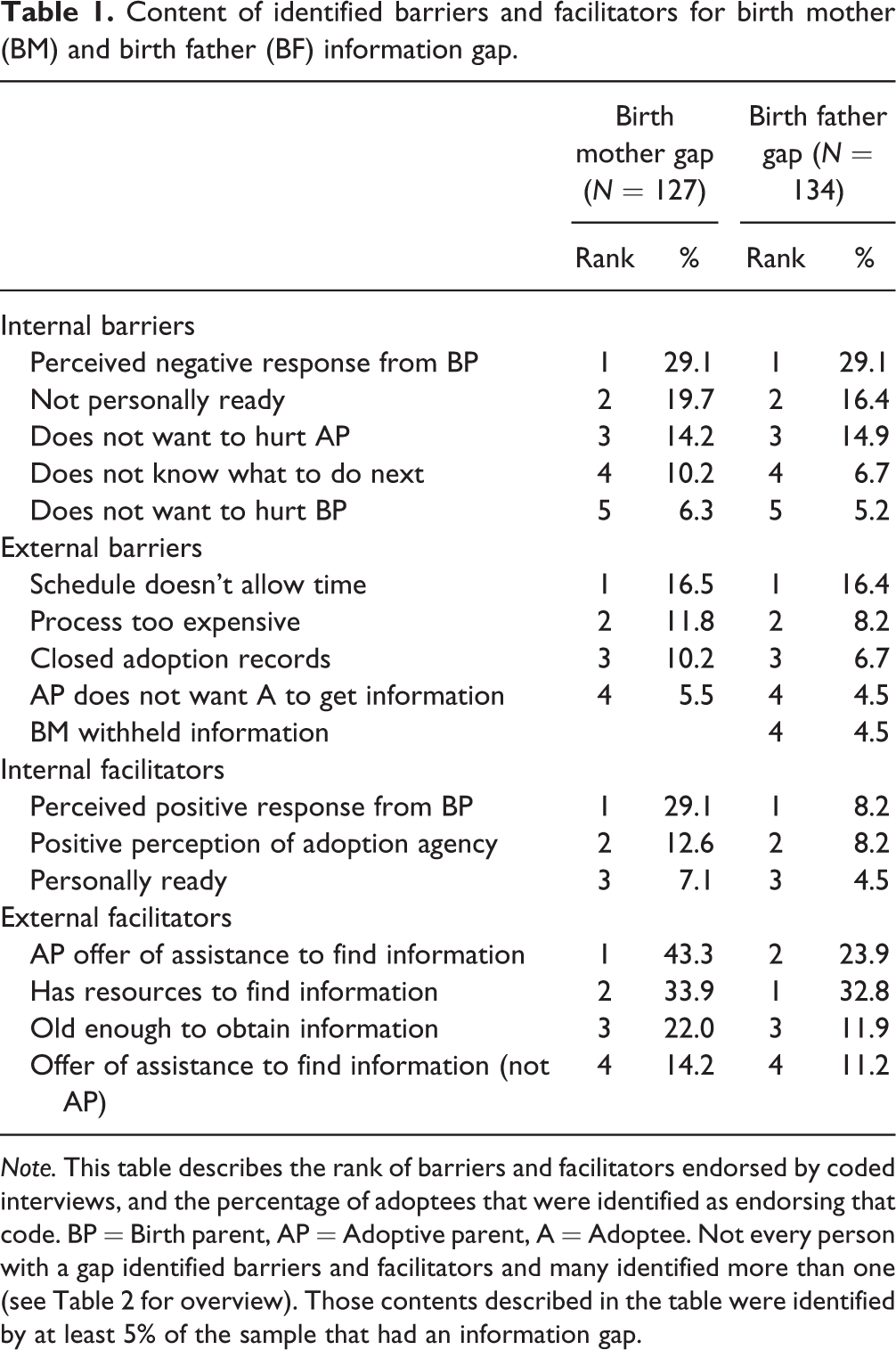
Note. This table describes the rank of barriers and facilitators endorsed by coded interviews, and the percentage of adoptees that were identified as endorsing that code. BP = Birth parent, AP = Adoptive parent, A = Adoptee. Not every person with a gap identified barriers and facilitators and many identified more than one (see Table 2 for overview). Those contents described in the table were identified by at least 5% of the sample that had an information gap.
Openness arrangement (Wave 2)
Adoptees reported whether they had any contact with their birth mother, birth father, and/or another birth family member during the Wave 2 interview. Consistent with Grotevant et al. (2007), openness arrangements were coded into four categories using adoptees’ interviews: (1) no contact: no contact with birth relatives has occurred and no information has been shared beyond 6 months post-placement (2) stopped contact: information sharing and contact had stopped by time of the interview (3) contact without meetings: contact is occurring, but the adoptee has not had face-to-face contact with birth parents, or adopted adolescent and/or family has had mediated or personal contact with birth parent, but adolescent has not had face-to-face contact; contact has not stopped, and (4) contact with meetings: adoptee has had face-to-face contact with birth parent and contact has not stopped. As outlined above, attainment of 80% reliability on criterion transcripts was met throughout the coding process.
Data analysis plan
Multivariate path analysis (using MPLUS version 6.0; Muthén & Muthén, 2012) was used to test whether curiosity (motivation) mediated the associations between the predictors of identified internal and external barriers/facilitators and openness level (context) and the outcome of information-seeking (behavior). All variables were analyzed for normality; we followed Kline’s (2005) guidelines of meeting the normality assumption by having a skewness <3 and kurtosis < 10 on all variables (in fact, skewness was < 2 and kurtosis ≤3 for all variables). To test for mediation, we analyzed three separate regression models (Baron & Kenny, 1986).
First, a model was run to determine if there were significant associations between independent variables (internal and external barriers, facilitators, and openness) and dependent variables (inform-ation-seeking). Next, we tested the association between the mediator variable (curiosity) and dependent variable (information-seeking). If both analyses resulted in significant effects, a last model was run that included independent, mediator, and dependent variables. We tested for the extent to which the mediator (curiosity) carried the influence of the independent variable to the dependent variable by using MODEL INDIRECT statements. The default standard errors are the delta method, which is equivalent to the Sobel (1982) method but simplifies the formula for models using continuous observed variables (MacKinnon, 2008; Muthén, 2011). Full mediation of curiosity would be supported by significant indirect, but not direct associations in this last model (given they were significant in the first and second models). Partial mediation by curiosity would be supported by significant direct and indirect paths in this last model. All models were tested separately for information-seeking with regard to birth mothers and birth fathers, and used age and sex as controls. If there were multiple independent variables in the model (Step 1 and Step 3), they were correlated.
Missing values analysis
Data from 134 cases with an information gap related to birth father and 127 cases related to birth mother were available for MPLUS analyses. All study variables (barriers, facilitators, openness, curiosity) had less than 6% of missing data (see Tables 3 and 4 for percent of complete data). Complete data were available for at least 118 cases for birth mothers and 119 cases for birth fathers. Missing data were handled using Full Information Maximum Likelihood, which has proven superior in simulation studies as accurately representing the sample data compared to listwise, pairwise deletion, similar response pattern, and mean imputation (FIML; Enders & Bandalos, 2009; Johnson & Young, 2011).
Results
Total numbers of internal and external barriers and internal and external facilitators by birth mother and birth father information gap are provided in Table 2. The greatest percentage of participants identified no barriers and facilitators; the next greatest percentage was for those who identified one. Internal barriers were identified at a slightly higher percentage than external barriers. External facilitators were identified at a higher percentage than internal facilitators. Descriptive statistics and correlations are provided in Tables 3 and 4 for birth mother and birth father analyses, respectively. Overall, for both birth mothers and birth fathers, adoptees’ mean levels of curiosity were moderate (for birth mother, M = 2.08, for birth father, M = 1.89); and moderate to strong interest in information-seeking was expressed (for birth mother, M = 4.22, birth father, M = 3.72).
Total number of identified barriers and facilitators for birth parents.
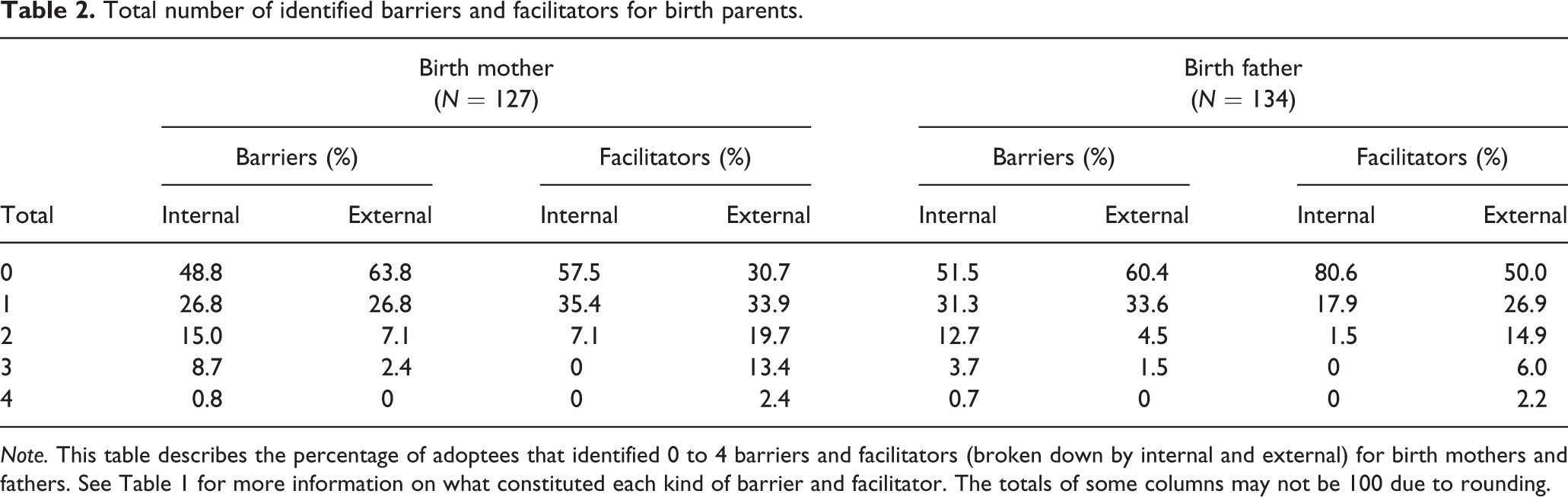
Note. This table describes the percentage of adoptees that identified 0 to 4 barriers and facilitators (broken down by internal and external) for birth mothers and fathers. See Table 1 for more information on what constituted each kind of barrier and facilitator. The totals of some columns may not be 100 due to rounding.
Pearson correlations and descriptive statistics for adoptees with an information gap for birth mothers (N = 127).
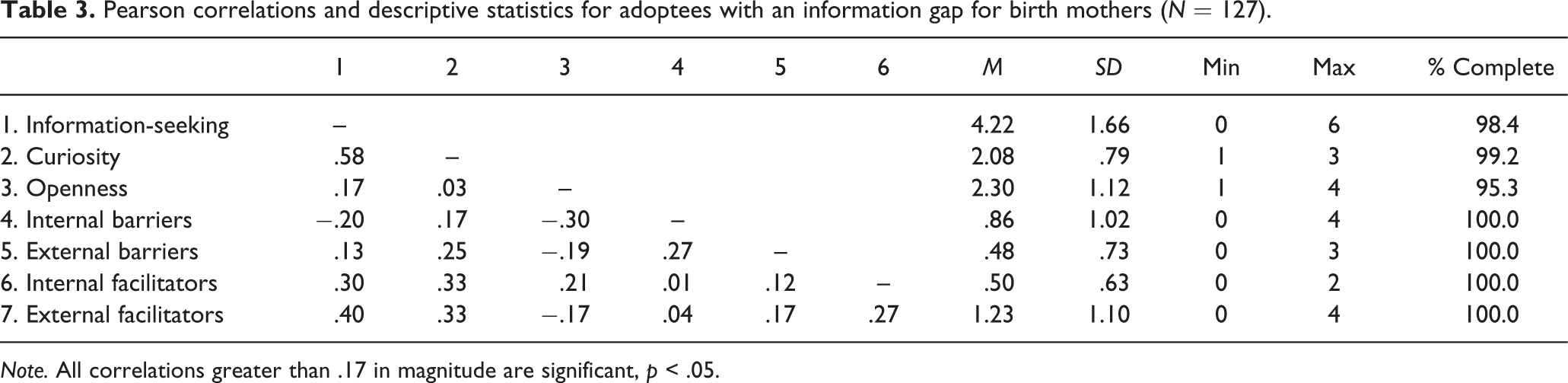
Note. All correlations greater than .17 in magnitude are significant, p < .05.
Pearson correlations and descriptive statistics for adoptees with an information gap for birth fathers (N = 134).
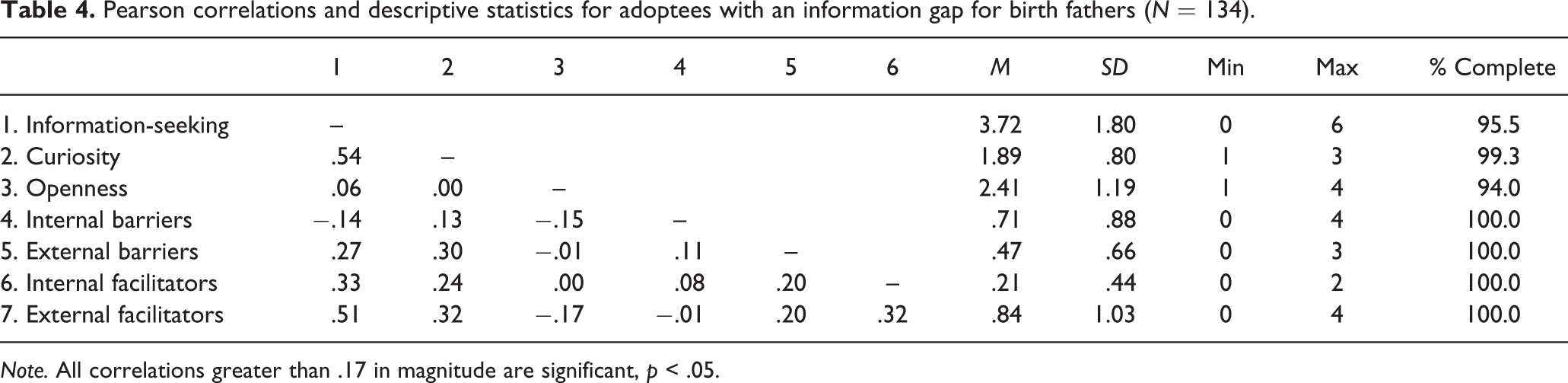
Note. All correlations greater than .17 in magnitude are significant, p < .05.
Information-seeking regarding birth mothers
Step 1
The first step was to evaluate the relationships between independent variables (openness, internal and external barriers and facilitators) and dependent variable (information-seeking). There was a significant association between openness (β = .18, t = 2.02, p = .04), internal barriers (β = −.19, t = −2.37, p = .02), and external facilitators (β = .38, t = 4.83, p < .001) in relation to information-seeking, but not external barriers (β = .13, t =1.54, p = .12) or internal facilitators (β = .12, t =1.60, p = .12). Age (β = −.03, t = −.40, p = .69) and sex (β = .07, t = .88, p = .38) were not significantly associated with information-seeking. Significant correlations among independent variables are noted in Table 3. No further analyses were conducted on external barriers, internal facilitators, age, and sex because of their lack of significant association with information-seeking.
Step 2
Next, we went on to evaluate the relationship between the mediator variable (curiosity) and dependent variable (information-seeking). This relationship was significant for birth mothers, β = .58, t = 9.82, p < .001.
Step 3
Based on the results of steps 1 and 2, a mediation model was tested. There were significant indirect effects of curiosity in the association between internal barriers and information-seeking (β = .11, t = 2.26, p = .02) and between external facilitators and information-seeking (β = .18, t = 3.39, p < .001), but the indirect effect of curiosity between openness and information-seeking was not significant (β = .08, t = 1.67, p = .10). The regression equation results are shown in Figure 1. Because both the direct and indirect paths were significant in the association between internal barriers and external facilitators with information-seeking by curiosity (as evidenced by significant direct and indirect paths through curiosity), there is evidence for partial mediation. Openness was no longer significantly associated with information-seeking or curiosity after accounting for the correlations among internal barriers and external facilitators. In total, 49% of the variance in birth mother information-seeking was explained.
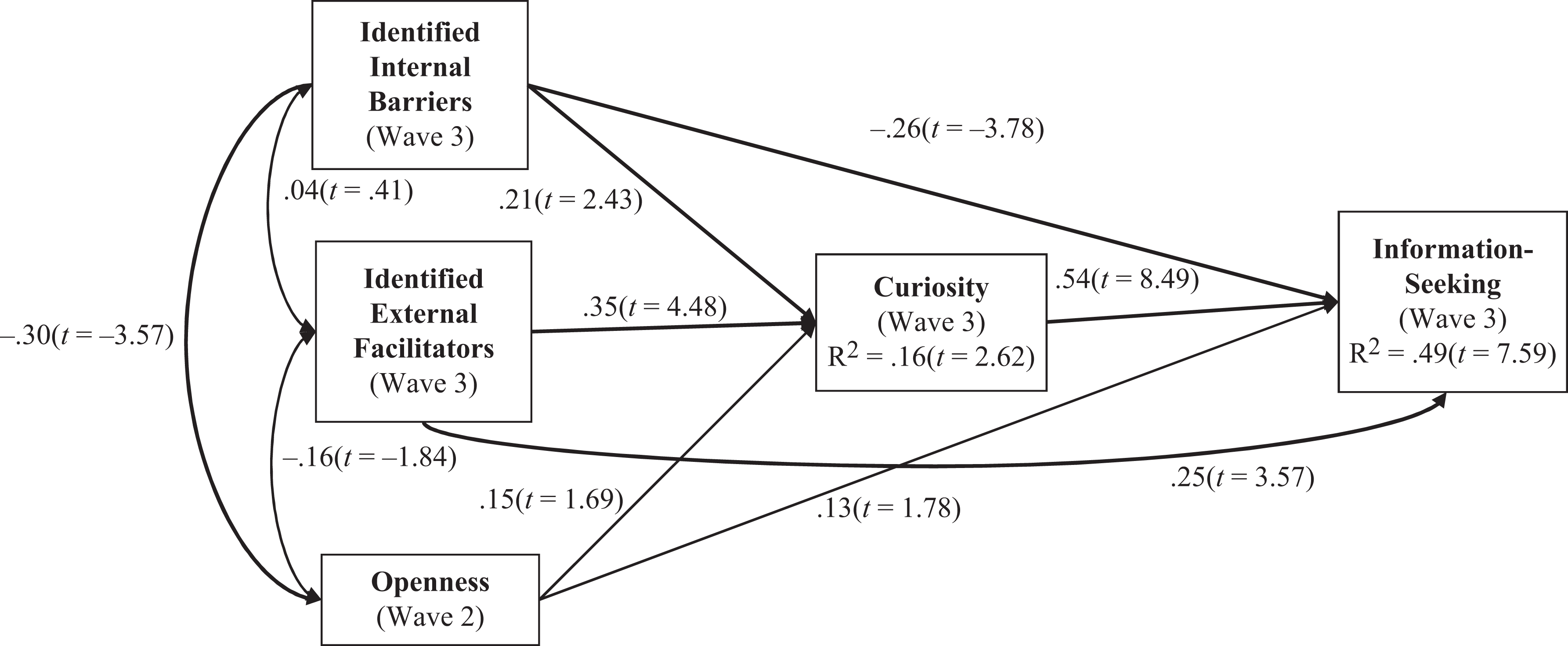
Mediation of curiosity for birth mothers. Standardized coefficients are presented followed by t statistics (t’s greater than or equal to 1.96 are significant and paths are bolded). External barriers, internal facilitators, age, and sex were not included because of a lack of a significant direct association with information-seeking (Step 1). There were significant indirect effects of curiosity in the association between internal barriers and information-seeking (β = .11, t = 2.26, p = .02) and between external facilitators and information-seeking (β = .18, t = 3.99, p < .001), but the indirect effect of curiosity between openness and information-seeking (β = .08, t = 1.67, p = .10 (indirect paths not shown in the figure for clarity of presentation). There was partial mediation in the association between identified internal barriers and external facilitators with information-seeking by curiosity (as evidence by significant direct and indirect paths through curiosity).
Information-seeking regarding birth fathers
Step 1
Again, we first examined the relationships between the independent variables (openness, internal and external barriers) and the dependent variable (information-seeking). There was a significant association between external barriers (β = .15, t = 2.06, p = .04), internal facilitators (β = .17, t = 2.18, p = .03), and external facilitators (β = .44, t = 6.00, p < .001) in relation to information-seeking, but not openness (β = .11, t = 1.43, p = .15), or internal barriers (β = −.14, t = −1.87, p = .06). As in the birth mother model, adoptee age (β = −.04, t = −.59, p = .56) and sex (β = .04, t = .59, p = .56) were not significantly associated with information-seeking. See Table 4 for significant correlations among independent variables. No further analyses were conducted on openness, internal barriers, age, or sex because of their lack of significance with information-seeking.
Step 2
Next, we evaluated the relationship between the mediator (curiosity) and dependent variable (information-seeking). This relationship was significant for birth fathers, β = .54, t = 8.53, p < .001.
Step 3
Based on the results of steps 1 and 2, a mediation model was tested. The indirect effect of curiosity on the relationship between external barriers and information-seeking (β = .09, t = 2.55, p = .01), external facilitators and information-seeking (β = .09, t = 2.63, p = .008) were significant, but was not in the relationship between internal facilitators and information-seeking (β =.05, t = 1.39, p = .17). As shown in Figure 2, there was full mediation in the association between identified external barriers and information-seeking by curiosity (as evidenced by insignificant direct and significant indirect paths through curiosity). There was evidence of partial mediation in the association between identified external facilitators and information-seeking by curiosity (as evidenced by significant direct and indirect paths through curiosity). After accounting for correlations with external barriers and facilitators, internal barriers were no longer significantly associated with information-seeking or curiosity. In total, 43% of the variance in birth father information-seeking was explained.
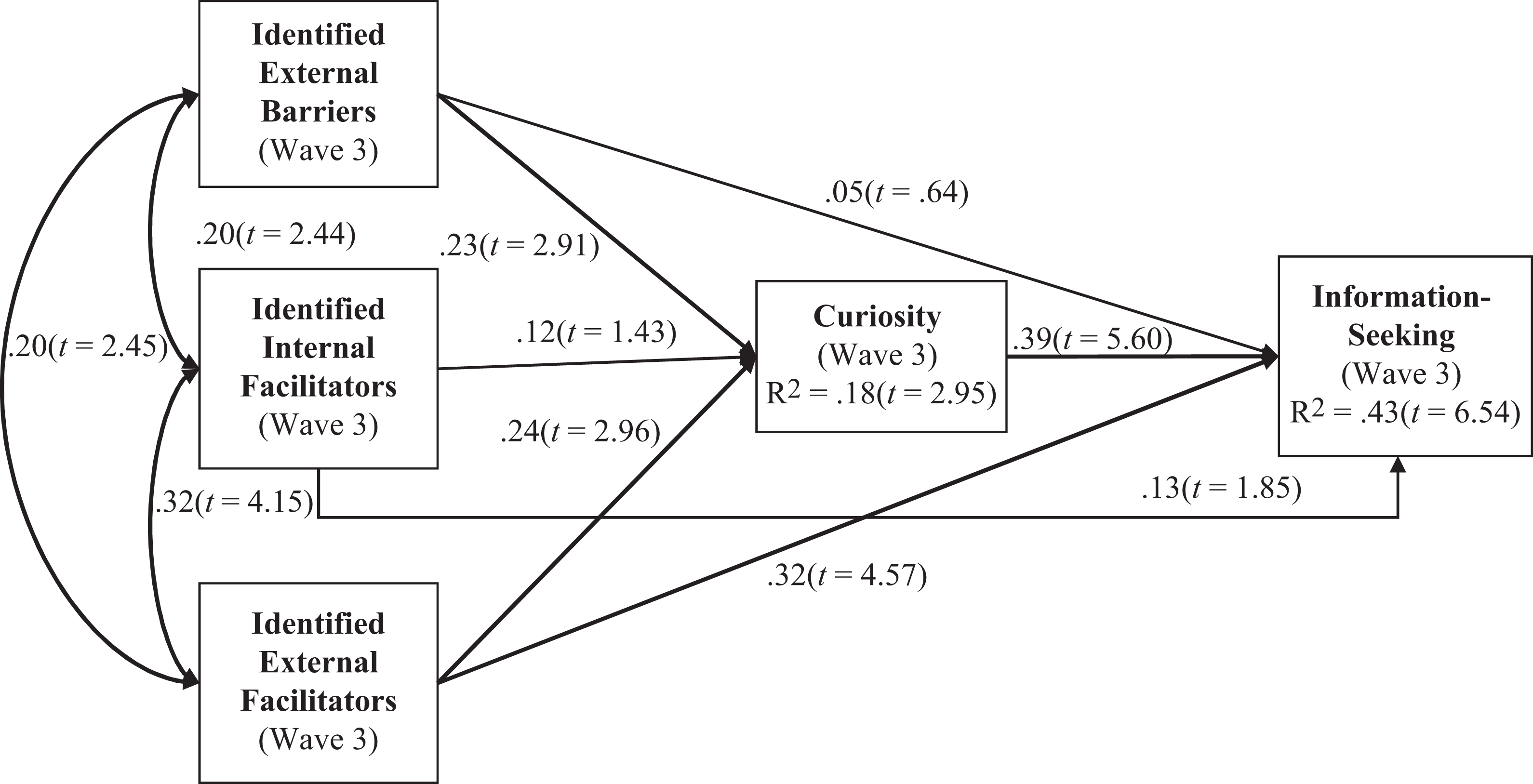
Mediation of curiosity for birth fathers. Standardized coefficients are presented followed by t statistics (t’s greater than or equal to 1.96 are significant and paths are bolded). Internal barriers, openness, age, and sex were not included because of a lack of a significant direct association with information-seeking (Step 1). The indirect effect of curiosity on the relationship between external barriers and information-seeking (β = .09, t = 2.55, p = .01), and between external facilitators and information-seeking (β = .09, t = 2.63, p = .008) were significant, but was not in the relationship between internal facilitators and information-seeking (β =.05, t = 1.39, p = .17; indirect paths not shown for clarity of presentation). Because the direct path of external barriers on information-seeking was no longer significant when including the indirect effects of curiosity in the model, there is evidence for full mediation in the association between identified external barriers and with information-seeking by curiosity. There was evidence of partial mediation in the association between identified external facilitators and information-seeking by curiosity as evidenced by significant direct and indirect paths through curiosity. After accounting for correlations with external barriers and facilitators, internal barriers were no longer significantly associated with information-seeking or curiosity.
Discussion
The current study tested mediation models of adoption information-seeking about birth mothers and birth fathers with a United States’ sample of emerging adults. Adoptees were interviewed about their intentions and actions taken to gather new information about their birth parents. For both birth mother and birth father models, level of curiosity (motivation) was positively related to information-seeking (behavior). There was partial mediation in the association between identified external facilitators and information-seeking about both birth mothers and birth fathers. The presence of external facilitators such as offers of assistance from adoptive parents or others predicted increased information-seeking. The presence of barriers played different roles in the models for birth mother and birth father information-seeking. With regard to birth mother information, there was partial mediation in the association between identified internal barriers and information-seeking. Identifying internal barriers to gaining desired information (e.g., not feeling ready or not wanting to hurt someone) increased curiosity, but decreased information-seeking. With regard to birth fathers, the effect of identified external barriers (e.g., agency policies or fees) was fully mediated by curiosity. The barriers increased curiosity, which in turn increased information-seeking. Thus, information-seeking is not only influenced by curiosity but also perceptions of the context in which information-seeking occurs, highlighting the importance of context in the ACP model (Wrobel & Dillon, 2009).
Curiosity and information-seeking
As predicted by the ACP, curiosity proved to be an exceptionally strong predictor of seeking information about adoptees’ birth parents. Greater curiosity yielded more information-seeking. This relationship reflects the motivation curiosity provides, within a context of current barriers, facilitators and adolescent openness, to engage in information-seeking behavior. These results reflect the same relationships found during adolescence (Wrobel & Dillon, 2009), and extend the findings for the first time to a sample of emerging adult adoptees.
Curiosity as mediator between facilitators/barriers and information-seeking
Once an information gap is established (as was the case for all our participants), the ACP considers how identified facilitators and barriers to obtaining that information influence curiosity and subsequent information-seeking.
Facilitators
The positive nature of facilitators makes them influential to the perceived ease of information-seeking. External facilitators include having the necessary resources (e.g., money, initial information) and support of important individuals in the adoptee’s life (including adoptive parents) to engage in the process. Consistent across all analyses for birth mothers and birth fathers, greater numbers of identified external facilitators were associated with greater intensity of curiosity and more information-seeking behavior. The perception of circumstances that support obtaining new information (identified facilitators) increase motivation (intensity of curiosity) to fill the adoption information gap through information-seeking behaviors (Wrobel & Dillon, 2009). The models predicting information-seeking about the birth mother and birth father revealed that curiosity partially mediates the impact of external facilitators upon information-seeking about birth mothers and birth fathers. External facilitators also directly impact information-seeking behavior. Information perceived as easily accessible, such as asking for an adoption record in the adoptive parents’ possession or being able to contact a birth parent for the information can increase curiosity and motivation to obtain the information. External barriers also ease the practical gathering of new adoption-related information. It is easier to seek out information that seems obtainable, especially if the age of majority has been reached. Internal facilitators were not associated with curiosity or information-seeking. Compared to external facilitators, internal facilitators were endorsed less often (See Table 1), making them less influential. It may be that a positive internal outlook on its own is not enough to move toward information-seeking, but external facilitators can tip the balance toward action.
Barriers
The birth mother model revealed that curiosity partially mediated the impact of internal barriers upon information-seeking. The relationship between internal barriers and curiosity was positive; more internal barriers were associated with greater curiosity and more subsequent information-seeking. The ACP suggests that this results from barriers being perceived as surmountable, and when resources are committed to overcoming the barrier, curiosity increases (Wrobel & Dillon, 2009). Internal barriers identified revolved around relationships in the adoptive kinship network, e.g., not wanting to hurt the birth mother or adoptive parents or anticipation of a negative response from the birth mother. Also identified as internal barriers were personal readiness to seek information and having a next step in mind. These internal barriers contribute to the psychological work of assessing one’s intensity of curiosity and desire to seek out information. Emerging adults possess the desire to engage relationships in the adoptive kinship network in new adult ways (Farr et al., in press), facilitating information-seeking. When a path for negotiating relationships in the adoptive kinship network as an adult is identified, curiosity and subsequent information-seeking increase because barriers are viewed as surmountable. In contrast, the direct path between internal barriers and information-seeking was negative; more internal barriers were associated with less information-seeking. It may be that reflection about preparing to seek information and negotiate relationships in the adoptive kinship network increases curiosity but does not directly translate into actions necessary to seek out information. Internal barriers appear to mitigate against action as adoptees’ curiosity is aroused.
The birth father model revealed that curiosity fully mediates the impact of external barriers upon information-seeking. More external barriers are associated with increases in curiosity and subsequent information-seeking. Examples of external barriers identified were being too busy or not having enough money, closed adoption records, and adoptive parents indicating resistance to the adoptee obtaining the information. In addition, for those that sought out birth father information, withholding of information about the birth father by the birth mother was identified as an external barrier. The full mediation of external barriers and lack of influence of internal barriers in seeking birth father information may be explained by greater access to birth mother information. Although adoptees are more likely to search for their birth mothers over birth fathers (Müller & Perry, 2001b), in the broader context of information-seeking, access to information may be the more salient factor. Adoption files typically contain more information about the birth mother, as she typically initiates placement. In addition, for those with contact, it is negotiated first with the birth mother. For the adolescent adoptees in our study who had any birth family contact, all had contact with the birth mother (Grotevant et al., 2007). Greater access to birth mother information would increase the ease of obtaining information because a source can be more readily identified. Once the psychological work is complete to construct a path through internal barriers related to seeking birth mother information, that path does not need to be renegotiated. As such, the focus when seeking birth father information can be on external barriers since internal barriers have been addressed. For example, concerns over hurting adoptive parents may have been confronted when seeking birth mother information. As birth father information is sought, the adoptee knows how adoptive parents will react. As plans are made to meet the challenge of an external barrier, they are viewed as obstacles that can be overcome; thus, curiosity increases (Wrobel & Dillon, 2009). External barriers can then be negotiated; schedules can be rearranged and money saved to support information-seeking.
Sex differences in curiosity and information-seeking
Traditionally, women have been viewed as more curious about their adoptions than men, especially with regard to the possibility of a reunion with their birth mother (Irhammar & Cederblad, 2000; Müller & Perry, 2001a). Our research has demonstrated that men are also curious and do act upon that curiosity. Both men and women possessed a moderate level of curiosity about their birth mothers and birth fathers, and the lack of association between sex and curiosity provides support to the understanding that both adopted men and women can be curious about both birth fathers and birth mothers. These results regarding sex and curiosity replicate what has been found for adoptees during childhood (Wrobel et al., 1996) and adolescence (Wrobel & Dillon, 2009). Wrobel and Grotevant (2012) also found there was no sex difference among emerging adult adoptees who formed an adoption information gap, which influences curiosity. This consistency of curiosity across time provides impetus to understand the underlying processes associated with its expression.
Strengths and limitations
An important strength of this article is that the investigation was explicitly guided by theory, the Adoption Curiosity Pathway model (Wrobel & Dillon, 2009), which itself is an extension of established curiosity theory (Loewenstein, 1994). The ACP responds to calls for the development of process models in adoption (Palacios & Brodzinsky, 2010) and guided us in our interpretation of the temporal order of events that can lead one to seek out desired adoption-related information. In addition, for the first time, specific barriers and facilitators associated with adoption-related curiosity and information-seeking have been identified from participants’ experiences. The study also fit the model separately for adoptees’ information-seeking about their birth mothers and birth fathers; the findings revealed subtle and meaningful differences, suggesting that adoptees do not view their birth mother and birth father as a single unit, but rather as distinct members of their adoptive kinship network. Furthermore, this study has addressed the developmental period of emerging adulthood, which is underrepresented in adoption research, when information-seeking may occur independent of adoptive parents.
The sample (individuals adopted as infants in the United States) places limitations on the generalizability of the findings to other populations of adoptees. Future work should examine the applicability of this model to international adoptions, where barriers and facilitators have the potential to be decidedly different than in domestic adoptions (Tieman et al., 2008). In addition, our analyses proposed a specific order of occurrence among variables based on the ACP model. However, other models with a different temporal order of events could also be proposed. The ACP theory posits that curiosity is the motivational energy brought to the task of information-seeking. Alternatively, it may be that the amount of perceived support from others in one’s network of relationships may have stronger impact on information-seeking behavior and be a factor that helps one to see barriers to information-seeking as surmountable. Another limitation is that data were provided through interviews with single respondents, potentially magnifying associations among variables. In addition, all participants identified an information gap containing specific pieces of additional adoption-related information they would like to know. Those who do not identify such an information gap should also be the focus of future research to identify the context within which no adoption-related curiosity is identified. Replication of these results with other samples will provide further support for the proposed pathway; however, the articulation of the process model is a clear contribution of this research.
Conclusion
The current study provides important support for the ACP, which describes context, motivation, and behavior relating to seeking new adoption-related information. It has long been known in the adoption field that some people are driven to know about their adoption history whereas others have much less interest. Until the development of the ACP model we have not had adequate tools for understanding those differences. Important to the ACP is the recognition that curiosity develops and information-seeking takes place within a unique individual context. Barriers and facilitators to obtaining additional information are part of that context. The ACP is a useful model for understanding how curiosity and information-seeking are encountered in emerging adulthood.
Footnotes
Funding
The authors gratefully acknowledge the adoptive family members who generously shared their experiences as part of the Minnesota / Texas Adoption Research Project. Thanks to Rachel Farr for providing comments on an earlier draft of this article. Funding was provided by National Institute of Child Health and Human Development, grant R01-HD-049859, National Science Foundation, grant BCS-0443590, and William T. Grant Foundation, grant 7146.