







Abstract
This study examined emotion understanding and reconciliation in 47 (24 girls) 4–6-year-old preschool children. Participants first completed emotion recognition tasks and then answered questions regarding reconciliation tendencies and affective perspective-taking in a series of overt and relational aggressive conflict scenarios. Children’s teachers reported their overt aggression, relational aggression, and prosocial behaviors in daily life. The results indicated that children’s emotion recognition ability was associated with their reconciliation tendency in both types of conflict scenarios. Furthermore, children’s affective perspective-taking in conflicts was associated with their reconciliation tendencies in the overt aggression conflict scenarios, but not in the relational aggression conflict scenarios. Additionally, we found that children’s affective perspective-taking in overt aggression conflict scenarios was associated with their daily prosocial behaviors. The results suggest that the ability of detecting and recognizing others’ emotions may facilitate conflict reconciliation and positive peer interactions.
Just as described in the famous slogan, “There are no permanent friends or enemies”, conflict and reconciliation are an integral part of interpersonal interactions. Reconciliation refers to the affiliative behaviors between former opponents (de Waal & van Roosmalen, 1979). People reconcile with each other to maintain their relationship and to bring an end to a state of conflict. The use of affiliative behaviors to repair interpersonal relations after conflict is present in many cultures (Butovskaya, Verbeek, Ljungberg, & Lunardini, 2000). During the preschool years, children develop various types of reconciliation behaviors to resolve conflict. Invitations to play, gift-giving, physical contact, offering apologies, conducting mediations, and smiling are common post-conflict processes of reconciliation that can repair damaged relationships (Sackin & Thelen, 1984). Despite the advances in the research of preschool children’s post-conflict reconciliation, limited research has examined the social cognitive processes involved in reconciliation. In particular, as an important aspect of social cognition, emotional understanding may play an important role in conflict reconciliation given that negative emotions are typically experienced by children during conflict. The present study investigates the association between children’s emotion comprehension and their post-conflict reconciliation.
Children use aggressive behaviors in conflict situations, including overt and relational aggression. Research on aggression has traditionally focused on overtly aggressive acts, which involve causing physical harm. Victims of overt aggression often express negative emotions, such as anger and sadness, which are easily observed. Recent research has used both overt aggression and relational aggression to conceptualize children’s aggressive behaviors (Crick, 1996). Relational aggression involves manipulating or damaging the victim’s relationships with others (Crick & Grotpeter, 1995). Snitching, gossiping, and social exclusion are typical relationally-aggressive behaviors. The emotional responses of victims of a relationally-aggressive conflict may not be as intense as those displayed for a physically-aggressive conflict and, therefore, are less noticed by others.
Extensive evidence has indicated that preschool boys and girls differ in their use of aggressive behaviors in conflict situations. Boys are more likely to be part of peer conflicts involving both physically-aggressive and relationally-aggressive acts (Zhang, Ji, Gong, Zhang, & Wang, 2003). In contrast, girls are more likely use relational aggression (Crick & Grotpeter, 1995). Compared with overt aggression, relational aggression has a strong relation with social intelligence (Kaukiainen et al., 1999) and theory of mind (ToM) (Werner, Cassidy, & Juliano, 2006) and is often indirect rather than direct.
Past research has documented a variety of reconciliation strategies used to manage conflict. For example, object offers are used in reconciliation for a large percentage of conflicts caused by object competition, physical contacts are used in reconciling conflicts caused by physical and psychological harm, and verbal apologies are only used to reconcile conflicts caused by physical harm (Ljungberg, Horowitz, Jansson, Westlund, & Clarke, 2005). In addition, substantial changes in the development of reconciliation behaviors have been observed. For example, higher reconciliatory rates of exchange after conflict were observed among 5-year-old children compared with 4-year-old children, and 5-year-old children enlisted the help of a third-party in attempts to resolve conflict (Fujisawa, Kutsukake, & Hasegawa, 2006). Older preschool children also use more sophisticated reconciliation strategies to maintain their peer relationships (Westlund, Horowitz, Jansson, & Ljungberg, 2008). Despite the advances in this area of research, social cognitive processes that facilitate these strategies have not been thoroughly investigated. Emotion understanding is a core component of general social cognitive comprehension and helps individuals understand the needs of others following conflict. Understanding emotions is an important predictor of the development of social competences (Sallquist, Eisenberg, Spinrad, Eggum, & Gaertner, 2009). The ability to understand the emotions of others enables children to redirect and control emotion displays, to interpret and react to the emotion displays of others, and to anticipate how situations may affect feelings (Seja & Russ, 1999). Because individuals use facial expression cues to infer the emotions and thoughts of others, emotion recognition is an important aspect of early emotional development. Children aged between 4 and 5 years are able to recognize and name the facial expressions associated with anger and happiness (Denham & Couchoud, 1990). The understanding of the mental aspects of emotion appears by 6–7 years of age, and children can understand mixed and moral emotions by 8–9 years of age (Pons, Harris, & de Rosnay, 2004).
Individuals recognize others’ specific emotion from their facial expressions (Nelson & Russell, 2013; Yik, Widen, & Russell, 2013). Accurately interpreting facial expressions is very important for carrying out prosocial behaviors (Marsh, Kozak, & Ambady, 2007), and it facilitates empathic arousal and altruistic responding (Hoffman, 1984). Children use not only facial expressions but also the causes and consequences to infer the basic and social emotion (Widen & Russell, 2010). Combining facial expression and situational cues helps children take the affective perspective of others and comprehend their emotions (Pons & Harris, 2000). Low affective perspective taking skills hinder children’s ability to infer the need for prosocial actions from relatively subtle social cues (Knafo, Steinberg, & Goldner, 2011). The prosocial roles in conflicts have significant positive correlations with emotion comprehension, whereas the victim and outsider roles are negatively related to the use of external cues in emotion comprehension (Belacchi & Farina, 2010). Several studies have shown positive relationships between children’s emotion comprehension, prosocial behavior, and acceptance by peers (Denham et al., 2002; Izard et al., 2001). Psychiatric studies have also found that poor emotion understanding is one of the main deficits associated with autism and schizophrenia (Baron-Cohen, 2002; Trentacosta & Fine, 2010). Although there is substantial support for the associations among prosocial behaviors, peer conflicts and emotion comprehension, it is still unclear whether children have different patterns of emotion understanding in response to conflicts involving different types of aggression (e.g. overt aggression or relational aggression). The aim of the current study is to investigate the association between children’s emotion understanding and their reconciliation tendencies after conflict. Conflict scenarios will be used to investigate children’s prediction of the inner states of the figures in the stories, including the victims’ feelings and reconciliation tendencies. The findings of this study will illuminate the role of children’s emotion understanding in reconciliation strategies following different types of conflicts. Based on the literature, there are three hypotheses for this study.
Method
Participants
A total of 47 children (23 boys and 24 girls) from two kindergartens in Beijing, China, participated in this study. Of the children, 15 were 4 years old (M = 47.5 months, SD = 4.15, 8 girls), 16 were 5 years old (M = 59.76 months, SD = 3.83, 8 girls) and 16 were 6 years old (M = 69.8 months, SD = 3.34, 8 girls). In addition, six teachers of these children were recruited to complete questionnaires.
Procedure
Upon entering the lab, children played with the experimenter for 5 minutes to become familiarized with the environment. After this period, they completed the emotion-recognition task, followed by a 1-minute rest. Six conflict stories, involving physical, verbal and relational aggression (human and animal figures were depicted in different versions) were presented, and the children were asked to answer questions about these stories. The children received stickers as a reward at the end of the experiment. The teachers of the participating children rated the children’s aggressive and prosocial behaviors in daily life.
Instruments
Emotion recognition
Children’s emotion-recognition ability was assessed using a task adapted from Denham and Couchoud’s (1990) study. This task included a face-match task and a word-match task. In the face-match task, children were asked to select a face from four pictures, which depicted four facial expressions randomly selected from happiness, anger, fear, sorrow, or disgust, to match a given emotion word (e.g. “Which picture has the happy face?”). In the word-match task, children were asked to select one emotion word from four words to name a given face (e.g. “What is the face feeling like? Happiness, fear, sorrow or disgust?”). There were three trials for each task, resulting in total of six trials for each child. We recorded the correct responses made by the children in these tasks to create the emotion recognition score, which ranged from 0 to 6.
Conflict stories
Three types of aggression stories were used to investigate the children’s reconciliation tendencies under different conflict scenarios, including overt (both physical and verbal) aggression and relational aggression (for examples, see Figure 1). The scenario of the physical aggression story involved two figures hitting each other. The verbal aggression story was about a figure that won a competition and then made fun of the figure that had lost. In the relational aggression scenario, a figure asked others not to play with a certain other figure. Two versions of each type of aggression story were used: one featuring pictures of human figures (the gender of the figures was consistent with the gender of the child) and one featuring pictures of cartoon figures. To investigate the children’s affective perspective-taking ability, the children were asked to evaluate the victim’s emotion after the conflict using a 7-point smiley face scale (from 1 = very sad to 7 = very happy). A higher affective perspective taking score indicated less emotional understanding of the victim’s emotion and less empathy with the victim. Additionally, children were asked to evaluate the possibility of reconciliation between the two figures in each of the six stories through the questions “Will they get along later?” or “Will they be reconciled in the end?” The “yes” answers reflected the belief that the figures would reconcile and were recorded as the reconciliation tendency score. Other studies have used physical aggression and verbal aggression together to assess children’s overt aggression (Crick, 1996; Crick & Grotpeter, 1995). Therefore, the reconciliation tendency score in overt aggression was represented by the average of the scores in the physical aggression and verbal aggression scenarios. Higher scores reflected a greater chance of the figures in the stories reconciling after the conflict.
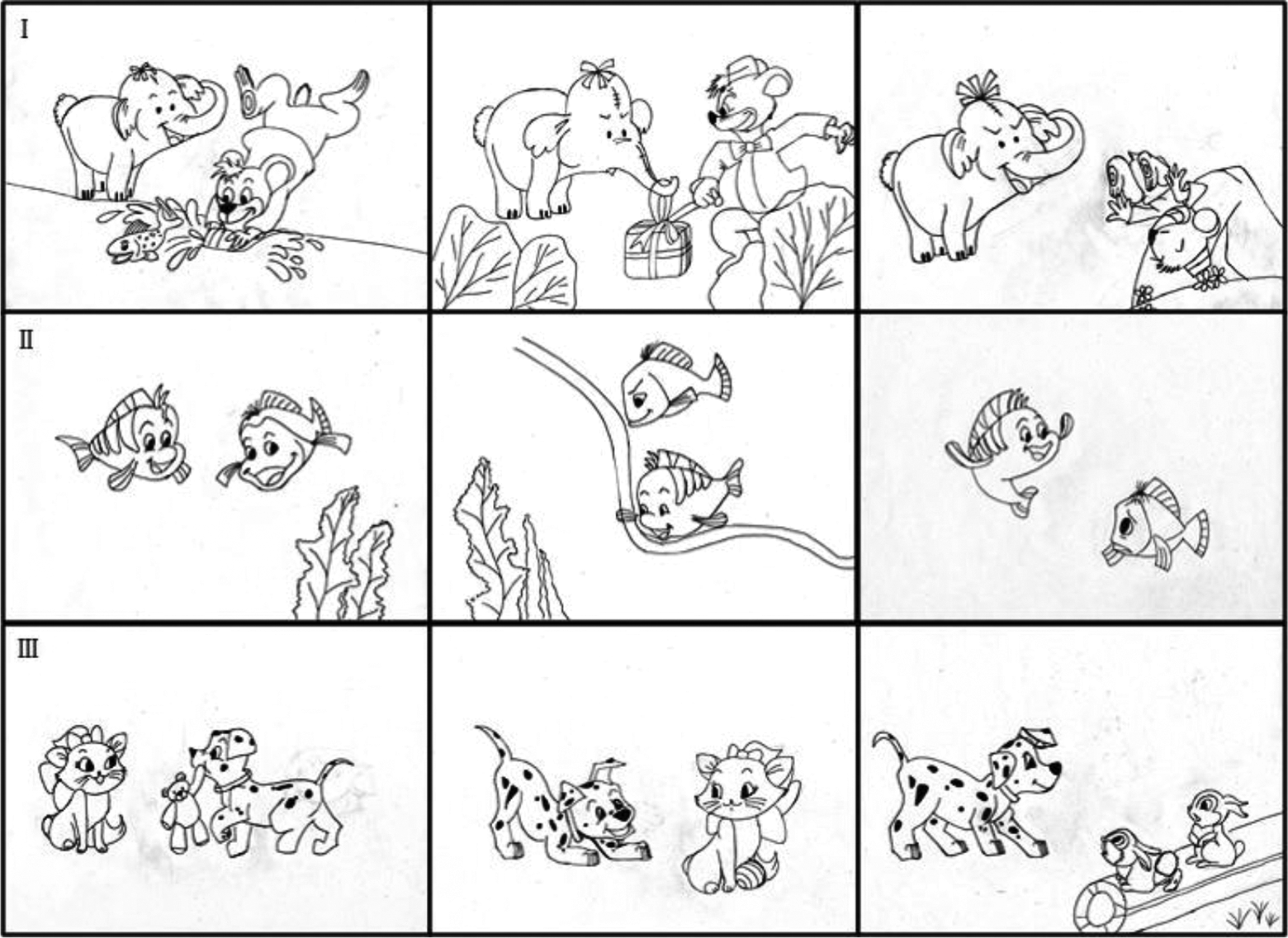
The cartoon version of the conflict scenarios.
Social behaviors
The teachers completed the Children’s Social Behavior Scale-Teacher Form (CSBS-TF) to assess the children’s aggressive behaviors (Crick, 1996). There were 15 items, which addressed a child’s relational aggression (e.g. “This child spread rumors or gossips about some peers”), overt aggression (e.g. “This child hits, shoves, or pushes peers”), and prosocial behavior (e.g. “This child says supportive things to peers”). The response scale for each item ranged from 1 (never occurred) to 5 (almost always occurred). One item concerning overt aggression was excluded due to poor internal consistency. In the final scale, there were three items for overt aggression (α = .73), seven items for relational aggression (α = .72), and four items for prosocial behaviors (α = .68).
Results
Means and variances for the key variables and the zero-order correlations between emotion understanding, social behavior and reconciliation tendency are shown in Table 1. The results revealed that emotion recognition was positively correlated with reconciliation tendency in overt and relational aggression scenarios (r = .40, p < .01 and r = .35, p < .01, respectively).
Descriptive statistics and zero-order correlations.
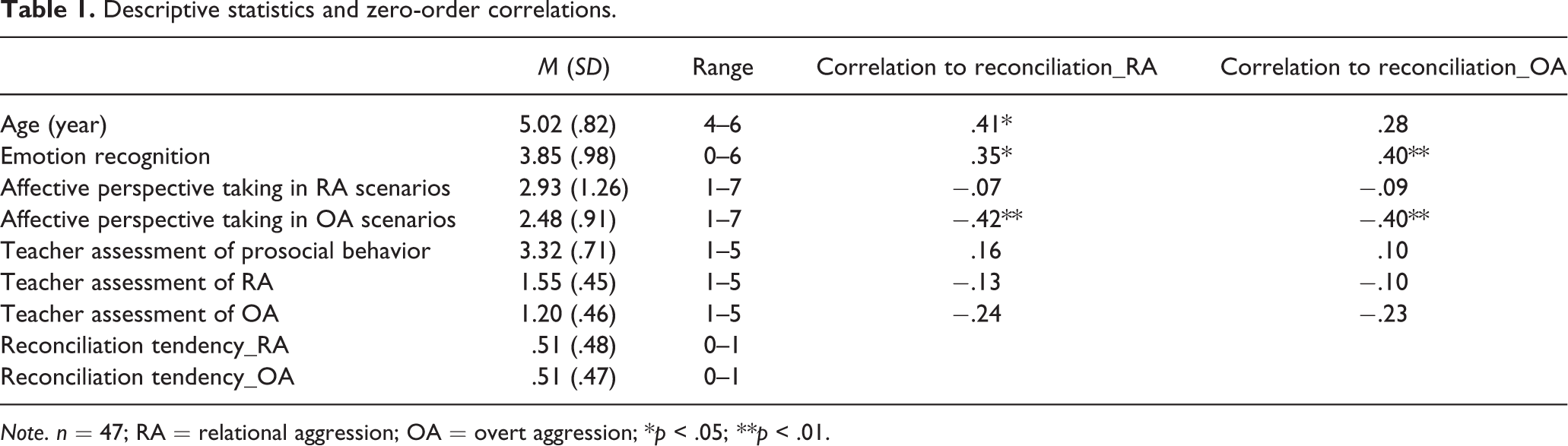
Note. n = 47; RA = relational aggression; OA = overt aggression; *p < .05; **p < .01.
A MANOVA was conducted to examine age and gender effects on children’s reconciliation tendency. There was no gender difference, F(2) = 0.18, p = .84, but age made a significant difference in reconciliation tendency, F(4) = 3.9, p < .01, η 2 = .16. Specifically, the results from the Bonferroni post-hoc tests showed that 6-year-old children demonstrated a higher reconciliation tendency than 5-year-old children in overt aggression conflict, p < .05. Additionally, 6-year-old children had a higher reconciliation tendency than 4- and 5-year-old children in relational aggression conflict, p < .05 and p < .01, respectively.
A hierarchical regression analysis was conducted to examine the associations between emotion understanding (emotion recognition and affective perspective-taking) and reconciliation tendency in overt aggression conflicts (see Table 2). The predictors were entered in the regression model in three steps. The first step consisted of child demographic characteristics (age and gender), followed by children’s emotion recognition and children’s affective perspective taking in overt aggression conflicts (Table 2). After controlling for age and gender, children’s emotion recognition ability explained the 14% of the variance in reconciliation tendency (β = .39, p < .01). Additionally, when we controlled for the effects of age, gender and emotion recognition, affective perspective-taking in conflict explained an additional 8% of the variance in reconciliation tendency (β = −.30, p < .05). The effect size was 0.11, which was between the small (0.02) and modest (0.15) threshold values of effect size suggested by Cohen (1988). These findings suggest that a higher emotional understanding score is associated with a higher reconciliation tendency score in children’s responses to the overt aggression conflict scenarios.
Hierarchical regression analysis predicting children’s reconciliation tendency in overt aggression conflicts.
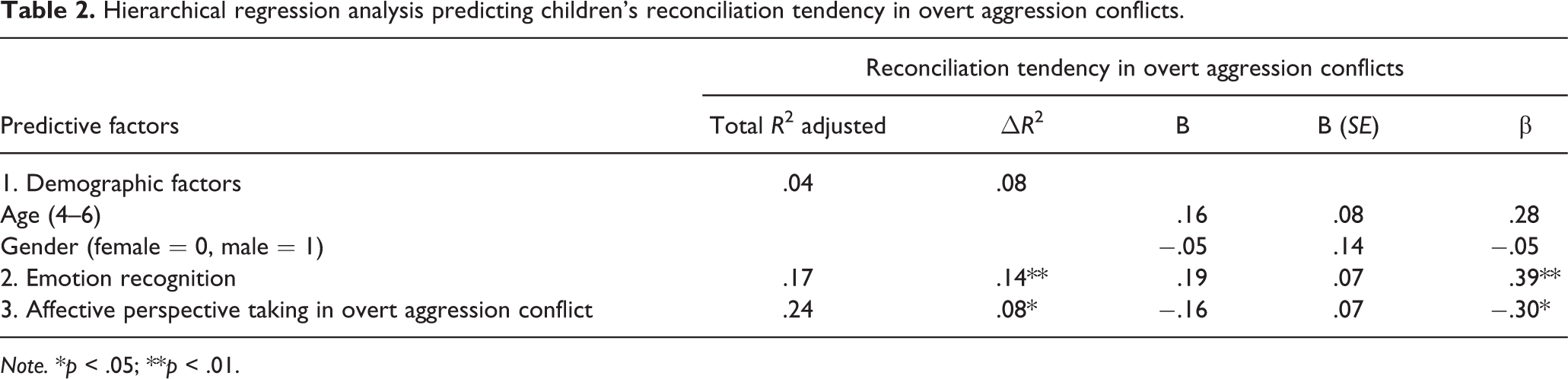
Note. *p < .05; **p < .01.
We examined the above associations for reconciliation tendency in relational aggression conflicts (see Table 3) in a similar manner. After controlling for age and gender, children’s emotion recognition ability explained 9% of the variance in reconciliation tendency (β = .31, p < .05). Therefore, higher emotional-recognition ability scores were associated with higher reconciliation-tendency scores in children’s responses to the relational aggression conflict scenarios. However, affective perspective-taking did not significantly predict reconciliation tendency in relational aggression conflict when we controlled for the effects of age, gender, and emotion recognition (β = −.04, p > .05).
Hierarchical regression analysis predicting children’s reconciliation tendency in relational aggression conflicts.
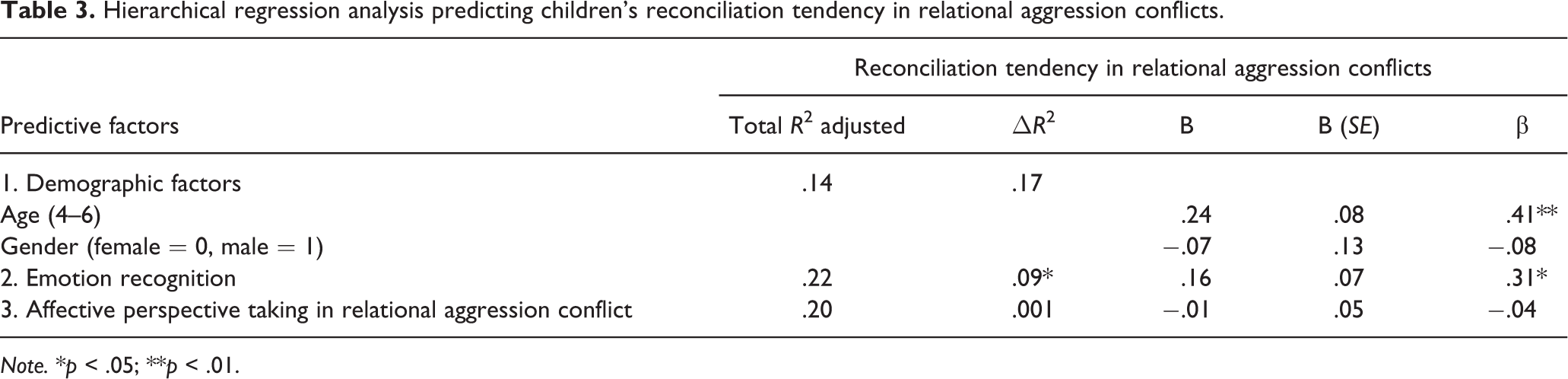
Note. *p < .05; **p < .01.
To examine how emotion understanding was related to children’s social behavior in daily life, we conducted correlation analyses among children’s emotion-recognition ability, affective perspective-taking, and social behaviors reported by their teachers. There were no significant associations between children’s emotion-recognition ability and their overt aggression behaviors or relational aggression behaviors. However, we found that the empathy expressed by children toward the victims in overt-aggression conflict scenarios (reflected by children’s assessment of victims’ negative emotions) was associated with more prosocial behaviors in daily life (r (47) = −.34, p < .05). However, we did not find similar patterns for affective perspective-taking in relational aggression conflicts (r (47) = −.04, p = .81).
Discussion
The purpose of this study was to investigate the associations between post-conflict reconciliation tendency and emotion understanding in preschoolers. The results revealed positive associations between children’s emotion-recognition and reconciliation tendency in both overt and relational aggression conflict scenarios. Additionally, affective perspective-taking was also positively related to post-conflict reconciliation tendency when the conflict involved overt aggression and was related to the children’s daily social behaviors. These findings highlight the important role of emotion recognition and affective perspective-taking in children’s reconciliation tendencies and behavioral development, and it is suggested that these skills might assist young children’s reconciliation efforts after conflicts.
In the present study, we found that children’s emotion recognition was positively related to their reconciliation-tendency scores. Children with higher emotion-recognition scores tended to believe the figures in the scenarios would be more likely to reconcile after conflicts. Emotion-recognition ability enables children to detect the emotional reactions of others. Accurate recognition and interpretation of emotion expressions helps children make socially-acceptable emotion expressions (Mostow, Izard, Fine, & Trentacosta, 2002). Additionally, this research indicated that children with a higher level of emotion understanding used more flexible social skills to achieve reconciliation, whereas those with a lower level of emotion understanding lacked the skills to successfully resolve conflicts (Dunn & Cutting, 1999).
Children were often able to perceive the victim’s emotion expression in the conflict scenarios, and this skill can be influenced by many factors, such as emotion cues, social communication, emotion attributions to the conflicts, or motivation (Banninger-Huber, 1992; Malti & Keller, 2009). In this study, when children perceived more negative emotion from the victim, they were more likely to believe that the figures would eventually resolve the conflict. One possible explanation for this finding is that recognizing the victim’s negative emotion may allow for more empathy. Empathy helps a child solve the interpersonal problem and end the conflict (de Wied, Branje, & Meeus, 2007). Previous studies have indicated that youth with a higher level of empathy have more prosocial behaviors (Roberts & Strayer, 1996; Gutiérrez, Escartí, & Pascual, 2011). Wilhelm and Bekkers (2010) also found that individuals with empathy for others were more likely to offer help, and the relationship between help and empathy was mediated through a sense of caring about others. The use of these prosocial behaviors in conflicts promotes conflict-resolution and reconciliation.
Furthermore, we found that children’s affective perspective-taking was associated with their reconciliation tendency in overt aggression conflicts, but not in relational aggression conflicts. This suggests that different types of aggression are related to a different pattern of association between emotion perception and reconciliation. It is possible that the two types of aggression may generate different emotion responses from the victims in the conflict. For instance, relational aggression indirectly hurts the social life of the victim, but may not generate an immediate emotion response. In contrast, overt aggression hurts the victim directly through physical and verbal attacks, and this may lead to immediate negative emotions (Miller et al., 2006). As a result, preschool children may perceive a victim’s emotions in overt aggression conflicts more easily than in relational aggression conflicts. An alternative explanation is that young children use more physical aggression in conflicts, whereas relational aggression is more often used by an older age group (Woods & Wolke, 2004), because it requires more developed social cognitive abilities, especially sophisticated social skills and abundant social experiences. Additionally, research has found that theory of mind is negatively correlated with preschoolers’ overt aggression, but not relational aggression, due to the low frequency of observed acts of relational aggression (Werner et al., 2006). The lack of familiarity with relational aggression may cause preschool children to misjudge the victim’s emotion.
The current study revealed that teacher-rated prosocial behaviors were correlated with children’s emotion understanding. Specifically, we found that children who had more empathy for the victims in the overt aggression conflict stories showed more prosocial behaviors according to their teacher’s report. This finding suggests that the ability to detect emotional cues may facilitate positive peer interactions. In contrast, a deficit in this ability contributes to behavior problems and academic difficulties (Izard et al., 2001). Past research has shown that affective perspective taking is positively associated with positive social behaviors (Cassidy, Werner, Rourke, Zubernis, & Balaraman, 2003; Ensor & Hughes, 2005). Similarly, affective empathy is positively correlated with prosocial behavior in bullies (Belacchi & Farina, 2012). Children with higher emotion understanding scores are less likely to threaten others and are more likely to use distraction strategies to deal with conflicts, which helps them reconcile after conflicts (Dunn & Herrera, 1997). Children with poor emotion understanding cannot perform well in social interactions because of this deficit in social skills. It is often difficult for them to use communication skills, so they resort to aggression to achieve their goals (Bowie, 2010).
The results of our study are a useful addition to the literature regarding the associations between preschoolers’ emotion understanding and reconciliation. A few limitations should be noted along with some directions for future research. The sample size was relatively small in this study, which might have limited the statistical power to detect age effects. In addition, 47 children may not well represent all the Chinese preschoolers. However, we used GPower to calculate the sample size prior to conducting the study. According to Faul, Erdfelder, Buchner, and Lang’s suggestion (2009), to get adequate power (0.80) with a moderate effect size (0.20), our study should recruit at least 42 children. Given this power analysis, we recruited 47 preschool children in the present study to meet the calculated sample size. In addition, past researches has indicated that older preschool children start to understand complex emotion and use relational aggression to harm other’s reputation (Crick et al., 2006). Although the children’s age was controlled in our present study, developmental changes may be observed for influenced the association between emotion understanding and reconciliation, which calls for future research to address these effects. A larger sample size would be helpful to detect how emotion understanding ability facilities reconciliation across different age groups. Furthermore, emotion understanding may contribute to both the accurate assessment of an opponent’s emotion in conflicts and sophisticated social interaction skills. Future studies may be able to further delineate and further examine the contributions of these two functions in the process of reconciliation. Finally, the current sample comes from the Chinese culture. We should bear in mind that there are cultural differences in emotion suppression and facial expression among children in Asian cultures versus Western cultures (Camras, Perlman, Fries, & Pollak, 2006; Soto, Perez, & Kim, 2011). Differential enculturation process from home to the outside world during the preschool time may explain the variations in emotion knowledge among cultures (Wang, 2008). Samples in other cultures and the influence of the family and schools should be considered in the future studies to allow an enriched knowledge of the association between emotional understanding and post-conflict reconciliation in various contexts.
In summary, this study reveals different patterns in the relations between emotion understanding and post-conflict reconciliation, varying by the type of aggression involved in the conflict. Children’s emotional understanding of aggression in conflicts is positively related to their prosocial behavior during peer interaction. These findings contribute to our understanding about preschoolers’ emotional information processing in their approach to reconciliation.
This research was supported by the National Natural Science Foundation of China (Project 30970907, 31170995, 31371040) and the National Basic Research Program (973 Program: 2010CB833904).
Footnotes
Acknowledgments
We would like to thank all the children involved in this study for their enthusiastic support and participation.