







Abstract
The present study investigated how Chinese children develop theory of mind (ToM) in a language environment with limited mental state talk that is rich in behavior discourse. In Study 1, 60 mothers shared a wordless storybook with their 3–4-year-olds. The children completed two false-belief tasks and the Peabody Picture Vocabulary Test-Revised at the same time and again 1 year later. Mothers’ early behavior clarifications during book-sharing predicted children’s later false-belief understanding independent of children’s early false-belief scores; children’s early verbal ability; maternal education; and mothers’ early mental state clarifications, simple mental state mentions, and simple behavior mentions. Using a discussion paradigm, Study 2 experimentally exposed 46 children aged 4 to 5 years to mental state or behavior clarifications or physical features of object talk (control group) through storytelling. Children in the experimental groups showed improvement in false-belief tasks from the pretest to the posttest. These findings indicate that behavior clarifications facilitated Chinese children’s mental understanding, suggesting a culture-specific mechanism for ToM development.
Theory of mind (ToM) refers to children’s understanding of others’ mental states, which allows children to interpret others’ behaviors (Premack & Woodruff, 1978). One of the most important milestones in ToM development is false-belief understanding, namely, the ability to recognize the differences between people’s internal beliefs and reality (Wellman, Cross, & Watson, 2001). Early socialization practices, particularly maternal mental talk, are a factor in the individual differences in Western children’s ToM development (Carpendale & Lewis, 2004; Ruffman, Slade, & Crowe, 2002; Symons, 2004). Chinese parents refer to more external behaviors and fewer mental states with children than their Western counterparts do (Doan & Wang, 2010; Wang, 2001, 2007; Wang, Leichtman, & Davies, 2000). The limited opportunities for exposure to mental talk may raise developmental challenges for Chinese children. How do these children develop ToM in such a socialization environment? This study aimed to understand the role of the language environment in supporting Chinese children’s ToM development to provide a deeper understanding of the way culture shapes children’s ToM development.
Mental state talk and Western children’s ToM development
As an important aspect of early narrative input, mothers’ mental state discourse facilitates the ToM of Western children (Peterson & Slaughter, 2003; Ruffman et al., 2002; Slaughter, Peterson, & Mackintosh, 2007) by making internal states explicit and drawing children’s attention to mental processes (de Rosnay, Pons, Harris, & Morrell, 2004; Ruffman et al., 2002). Consistent with these theoretical views, studies have shown that 33-month-old children whose mothers frequently talked about mental states displayed advantages in ToM over their peers concurrently and longitudinally (Dunn, Brown, & Beardsall, 1991; Dunn, Brown, Slomkowski, Tesla, & Youngblade, 1991). Moreover, Ruffman et al. (2002) showed that mothers’ early mental talk was associated with children’s later ToM ability after controlling for children’s early language ability, early ToM, and maternal education, whereas children’s early ToM did not relate to mothers’ later mental talk, which indicated a unique role of maternal mental state talk in 2–4-year-old children’s ToM development.
More recent studies have highlighted nuances in the content of maternal mental talk. Maternal references to desires, emotions and cognitive terms may play different roles at various developmental stages (Adrián, Clemente, & Villanueva, 2007; Slaughter et al., 2007; Symons, Fossum, & Collins, 2006). Maternal references to desires when children were 2 years old predicted children’s ToM development 3 years later (Symons et al., 2006). As children grow up, maternal talk about cognitions (e.g. think, thought) becomes critical for children’s ToM development (Adrián et al., 2007; Ensor, Devine, Marks, & Hughes, 2014). It is also important to distinguish between simple references to mental states and clarifications of mental states. Mothers can talk about mental states by simply mentioning mental state terms (e.g. “He knew”) or by making clarifications that are explanatory, causal or contrastive (e.g. “He thought it was an apple, but in fact it wasn’t a real one”). Peterson and Slaughter (2003) found that children’s false-belief understanding was related to maternal self-reported tendencies to clarify mental states. Another study showed that 3–5-year old children’s false-belief understanding was associated with maternal cognition clarifications during picture-book sharing (Slaughter et al., 2007). These studies indicate that mental talk is a driving influence in children’s ToM development.
Training studies have provided strong evidence for the causal relationships between exposure to mental state talk and children’s ToM development (Gola, 2012; Guajardo & Watson, 2002). For example, Guajardo and Watson (2002) manipulated children to be exposed to naturalistic mental state talk by training children to discuss the mental states of story characters during storytelling. Asking children questions about characters’ mental states during discussions can draw children’s attention to mental states and prompt children to think about feelings and thoughts, which can improve their ToM (Gola, 2012; Guajardo & Watson, 2002).
Behavior discourse and Chinese children’s ToM development
To date, almost all studies that establish an association between mental state talk and children’s ToM development have been conducted in Western cultures, in which autonomy and independence are highly valued (Kagitcibasi, 2005; Markus & Kitayama, 2003). Mental state talk can be used to affirm an autonomous sense of self in child-rearing practices (Doan & Wang, 2010). However, it is unclear whether the role of mental state talk in supporting ToM development can be generalized across cultures, or whether it is specific to Western culture. Compared to Western culture, China embraces interpersonal harmony and interdependence, in which individuals’ external behaviors and their regulations are highly emphasized because they may directly affect group functioning, whereas individuals’ internal states are often devalued because they may be socially divisive (Han, Leichtman, & Wang, 1998; Markus & Kitayama, 1991; Wang & Leichtman, 2000).
Such divergent cultural value systems may affect individual communication and preference in social interaction (Kim, 2002). During mother–child storytelling, Western mothers frequently refer to mental states, whereas Chinese mothers provide more descriptions of behaviors and moral rules (Doan & Wang, 2010; Wang, 2001; Wang et al., 2000). Similar cultural differences exist in mother–child memory sharing (Wang, 2001, 2007). How does such a cultural-specific language environment influence Chinese children’s ToM development? Do Chinese children develop ToM through mental state talk, like their Western peers, or do they gain ToM ability through behavior talk?
Theoretically, behavior talk may contribute to Chinese children’s ToM development. According to Bruner (1990), social situations (i.e., false-belief context) contain two components: the landscape of consciousness (which refers to mental states) and the landscape of action (which refers to behaviors). The landscape of consciousness is essential for children to understand social situations (Astington, 1990; Lewis, 1994), but the landscape of action is also important (Bruner, 1988, 1990). For example, Moses and Flavell (1990) showed 3-year-olds a false-belief movie. In the movie, a young adult, Cathy, found nothing in the top drawer of a chest but found a box of crayons in a bag on a chair and then left. A clown hid the crayons in the top drawer, put some rocks in the bag, and left. Cathy came back to get the crayons. The children were asked the belief question, “What does Cathy think is in the bag?” The results showed that when behavioral cues were provided (Cathy went toward the bag to get the crayons), the children performed better on the belief question than children who did not receive behavioral cues. Naito and Koyama (2006) showed that when justifying the correct response of the protagonist with a false belief in the “unexpected transfer task”, 6–8-year-olds in Japan referred primarily to the protagonist’s behaviors and social rules but not to beliefs or desires.
Behavioral cues may be especially important for Chinese children to understand social situations due to their cultural-specific language environment. With limited opportunities to directly access internal states through mental talk, Chinese children must interpret and infer others’ mental states based on external behaviors, which is considered adaptive to Chinese society (Lu, Su, & Wang, 2008). Behavior talk may draw Chinese children’s attention to behavioral cues, indirectly inducing children to introspect internal states from external actions, which can improve children’s ToM. Moreover, it is important to consider the role of elaboration in children’s ToM development (Ontai & Thompson, 2008). Behavior clarifications may provide rich and contextualized information for children to interpret and infer others’ internal states.
However, Doan and Wang (2010) found that maternal talk about behavioral and descriptive manifestations of emotions (e.g. “the bear is crying”) was negatively associated with Chinese immigrant children’s emotion situation knowledge, namely, children’s knowledge about how various situations may elicit specific emotions. This result might be due to the particular tasks these authors used, which asked children to describe situations that were likely to provoke various emotions (e.g. “What makes you feel sad?”). These questions require verbal responses, whereas other tasks rely on children’s behavioral responses (Doan & Wang, 2010). These emotion situation tasks may not fully reflect the mental inference process compared to false-belief tasks. Moreover, emotion understanding is seen as affective ToM, which is different from cognitive ToM (e.g. false-belief understanding) (Adrián et al., 2007; Kidd & Castano, 2013). The contradictory results for the relationship between behavior talk and children’s ToM development need to be clarified, which is the main purpose of the current study.
The current study
The present study investigated the relationships between language environment and Chinese children’s ToM to explore the potential culturally specific mechanism underlying Chinese children’s ToM development. In Study 1, maternal story-sharing and children’s false-belief understanding were assessed in children who had an average age of 3.5 years, and they were then assessed again 1 year later. We hypothesized that mothers’ early behavior clarifications would predict children’s later false-belief understanding independent of children’s early ToM, verbal ability, mothers’ education, and other categories of mothers’ early talk. We also hypothesized that mothers’ mental state talk would not relate to children’s false-belief understanding. Using a training paradigm, children were experimentally exposed to behavior clarifications, mental state clarifications or physical features of object talk (control group) through storytelling in Study 2. We predicted that the children in the experimental groups would show improvement in false-belief scores from the pretest to the posttest.
Study 1
Method
Participants
A total of 60 preschoolers (28 boys, 32 girls; age range = 31–50 months, M = 42.53, SD = 4.53) and their mothers were recruited from one kindergarten in a major city, Kunming, the capital of a southern province in China, with a population of 6,432,000. In this sample, 50.8% of mothers had a college degree, 37.3% had a high school diploma, and 11.9% had a middle school diploma. At Time 2 (1 year later), the children’s ages ranged from 43 months to 62 months (M = 54.88 months, SD = 4.5). One child failed to complete all tasks at Time 1, and another child failed to complete all tasks at Time 2, so these children were excluded from the analysis.
Materials and procedure
At both time points, children’s ToM and receptive language were assessed in a random order in a quiet room in the kindergarten. Afterwards, the mothers were asked to share a wordless picture book with their children. The book-sharing interactions were audiotaped.
ToM tasks
Two standard false-belief tasks were adapted in a context familiar to Chinese children. In the “unexpected transfer task” (Wimmer & Perner, 1983), children were told a story: a boy named Ming put a ball in a box and then left; a girl named Hong then moved the ball from the box to a basket and left. In the last scene, the boy returned. The children were asked the test question “Where will Ming look for the ball first?” and three control questions (“Where was the ball in the beginning?”, “Where is the ball now?”, and “Did Ming see when Hong moved the ball?”). In the “unexpected content tasks” (Hogrefe, Wimmer, & Perner, 1986), the children were shown a toothpaste box and asked what was inside. When the children gave the correct answer, they were shown a key in the box. A control question was asked to check whether the children remembered what was inside the box. Then, another child named Ming who had not seen the inside of the box was introduced. The test question was, “When Ming first sees this box, before we open it, what does he think is in the box?” In each task, a forced-choice prompt was used if necessary, and the children received one point if they answered both the control question and the test question correctly. The ToM scores were the sum of the two false-belief tasks ranging from 0 to 2. The tasks used at Time 2 were similar to those at Time 1 with different physical properties, such as protagonists, objects and boxes.
Verbal ability
Receptive language ability was assessed using the Peabody Picture Vocabulary Test-Revised (Chinese revised version) (Sang & Miao, 1990). The number of correct answers was used to indicate children’s receptive language ability.
Picture-book tasks
At both time points, mothers were asked to share a story with their children using an 11-page wordless picture book (A Kitten Planting Fish) as they would in daily life. This picture book depicts a story about a cat trying to plant fish in a field. The cat saw a farmer planting crops in the field and thought he could also plant fish. Although the cat worked hard to water the fish, all the fish died. The cat finally realized that fish should be raised in water rather than in soil and put some fish into a fish bowl at home. This story provides a context involving multiple mental states, including emotions (e.g. the little cat was depressed), desires (e.g. the cat hoped to have many fish), and beliefs (e.g. the cat thought that fish could grow in the soil like plants and later realized that fish should be raised in water). Moreover, these pictures described the characters’ behaviors (e.g. the cat was fishing in a river).
Coding
The mothers’ and children’s utterances during the book sharing were transcribed. The total number of words in the mothers’ narratives was counted as the Total Words score, which reflected maternal verbosity (Slaughter et al., 2007; Taumoepeau & Ruffman, 2006). The children’s utterances were also coded, but their frequencies were too low to warrant analysis. The analyses included maternal utterances that related to the storyline but not particular utterances (e.g. “Do you know?”, “Let’s see”) that were used to keep dialogue going, to redirect and maintain children’s attention, or for turn-taking (Ruffman et al., 2002; Slaughter et al., 2007). A few mothers asked clarifying questions from their children and immediately provided the answers (e.g. “What is the cat doing? He is fishing”). The questions and answers were considered a coding unit. Two aspects of the mothers’ utterances during story-sharing were coded: (1) the extent to which mothers referred to mental states and behaviors in story-sharing and (2) the extent to which mothers provided simplifications and clarifications (Slaughter et al., 2007).
Mental state talk
Mental state clarification and simple mental state were included in mental state talk.
Simple mental state
According to Ruffman et al. (2002), mental state terms include cognitions (e.g. think, know), desires (e.g. wish, like), emotional states (e.g. happy, sad), modulations of assertions (e.g. maybe, might) and other mental states (e.g. remember, forget). Utterances that simply refer to mental states were coded as simple mental states. For example, the utterance “the cat is thinking hard,” “the cat is too happy,” and “the cat wants to” were coded as simple mental states. These simple mentions of mental states were summed to obtain a simple mental state score.
Mental state clarification
Utterances that referred to mental states in an interpretative, causal, analogous, or contrastive manner were coded as mental state clarifications (LaBounty, Wellman, Olson, Lagattuta, & Liu, 2008; Slaughter et al., 2007). For example, the statement ‘‘the little cat realized that the fish can’t be planted in the soil’’ clarified the character’s cognitive state; the statement “the cat is happy because it has caught lots of fish” explained the character’s emotion; and the statement “the cat is eager to eat fish” explicitly spelled out the cat’s desire. The total number of statements that elaborated on mental states in these ways was regarded as the mental state clarification score. The mental state clarification and simple mental state codes were mutually exclusive.
Behavior talk
Simple behavior and behavior clarification were coded together as behavior talk.
Simple behavior
Simple references to behaviors using the sentence structure “S + V + O” were coded as simple behavior (e.g. “the cat is planting fish”).
Behavior clarification
Utterances referring to characters’ behaviors and including interpretative, analogous, or contrastive information or clauses were coded as behavior clarifications. Specifically, behavior clarifications contained (a) causal explanations about behaviors (e.g. “The little cat is watering his fish to make the fish grow quickly”); (b) comparative utterances that indicated similarities or differences between the behaviors of different characters (e.g. “The little cat is planting the fish in the field just as the farmer planted his crops”); or (c) utterances that referred to behaviors and included clauses (e.g. “The little cat asked the farmer what he planted in the field”). Simple behavior and behavior clarification codes were also mutually exclusive.
The first author coded all transcripts, and a second trained coder who was blind to the study aims coded 30% of the transcripts. The interrater reliability (Kappa coefficient) of these categories ranged from .83 to .94.
Results
Two mother–child dyads were excluded from the analysis because the mothers’ behavior clarifications and mental state clarifications were more than three SDs above the mean at each time point. There were no significant gender differences in children’s false-belief scores at Time 1 (T1), t(56) = .14, p = .888, d = 0.03, or at Time 2 (T2), t(56) = 1.72, p = .092, d = 0.45. Children’s age was not associated with their false-belief scores, T1, r(58) = −.14, p = .291; T2, r(58) = .12, p = .390. Gender and age were therefore excluded from further analyses.
Descriptive statistics of key variables
Table 1 shows the descriptive statistics of the key variables in this study. Mothers’ behavior talk accounted for 68.1% of the total utterances at T1 and 66.5% at T2. Paired-samples t tests showed that the mothers’ behavior talk was more frequent than mental state talk at each time point, T1: t(57) = 14.11, p < .001, d = 1.56; T2: t(57) = 13.83, p < .001, d = 1.38. Mothers’ simple behavior utterances occurred more frequently than simple mental state utterances at each time point, T1: t(57) = 17.03, p < .001, d = 2.46; T2: t(57) = 17.36, p < .001, d = 2.35. Similarly, mothers produced more behavior clarifications than mental state clarifications at each time point, T1: t(57) = 3.50, p = .001, d = 0.46; T2: t(57) = 5.04, p < .001, d = 0.66.
Descriptive statistics of the key measures.
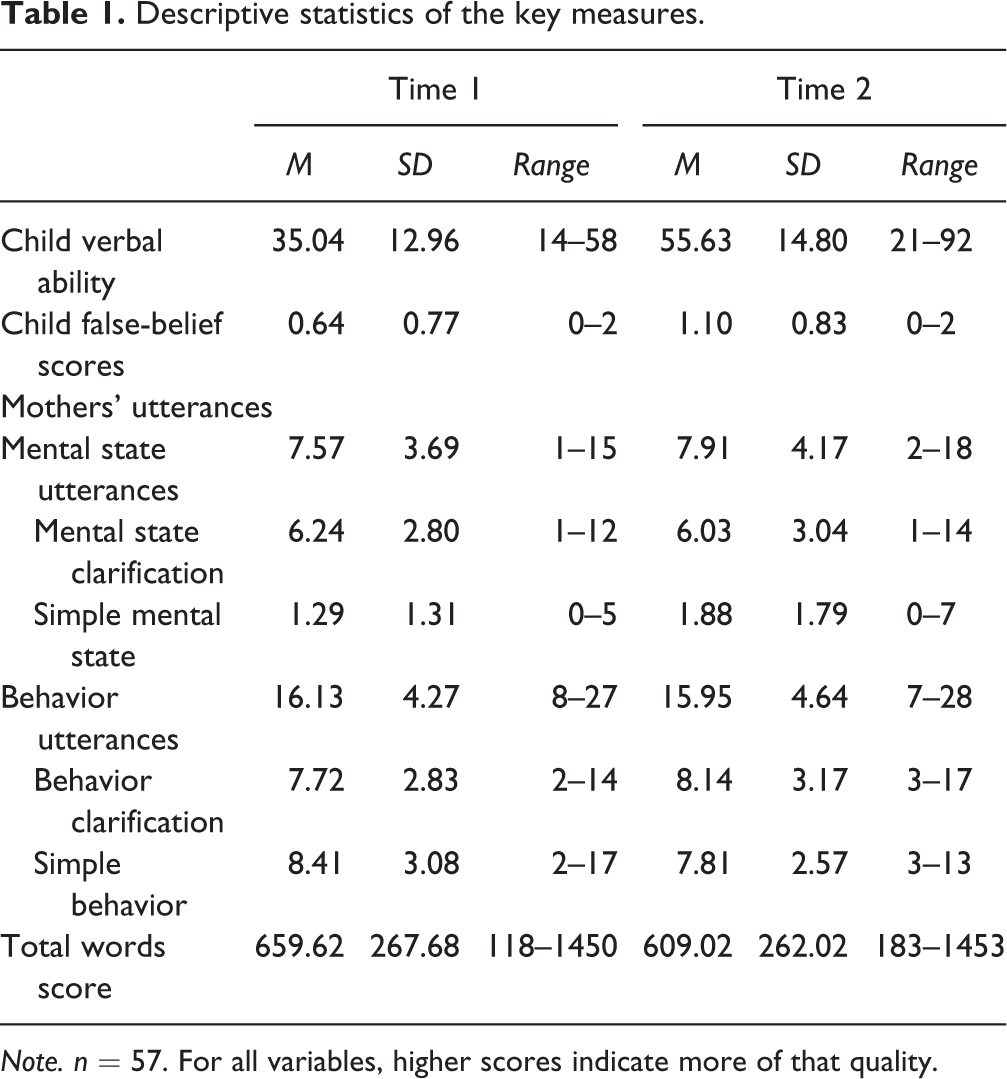
Note. n = 57. For all variables, higher scores indicate more of that quality.
Within-time point correlations between maternal talk and children’s false-belief understanding
Children’s language ability was associated with their false-belief scores at each time point, T1, r = .29, p = .026; T2, r = .45, p = .001. Therefore, in the subsequent correlational analyses, children’s language ability and mothers’ Total Words score and education were controlled. At each time point, maternal behavior clarifications were associated with children’s false-belief scores, controlling for these covariates (see Table 2). In comparison, mothers’ simple mentions to or clarifications of mental states and their total mental state utterances did not significantly relate to children’s false-belief understanding. Next, we conducted two multiple regressions at each time point to examine whether maternal behavior clarifications could predict children’s concurrent false-belief understanding after controlling for children’s verbal ability, maternal education, maternal Total Words score, and other categories of talk (see Table 3). At both time points, maternal behavior clarifications emerged as the only significant predictor of children’s concurrent false-belief scores, T1, β = .44, p = .002; T2, β = .60, p < .001.
Partial correlations between maternal talk and child false-belief scores controlling for mothers’ verbosity and education and children’s verbal ability at each time point.
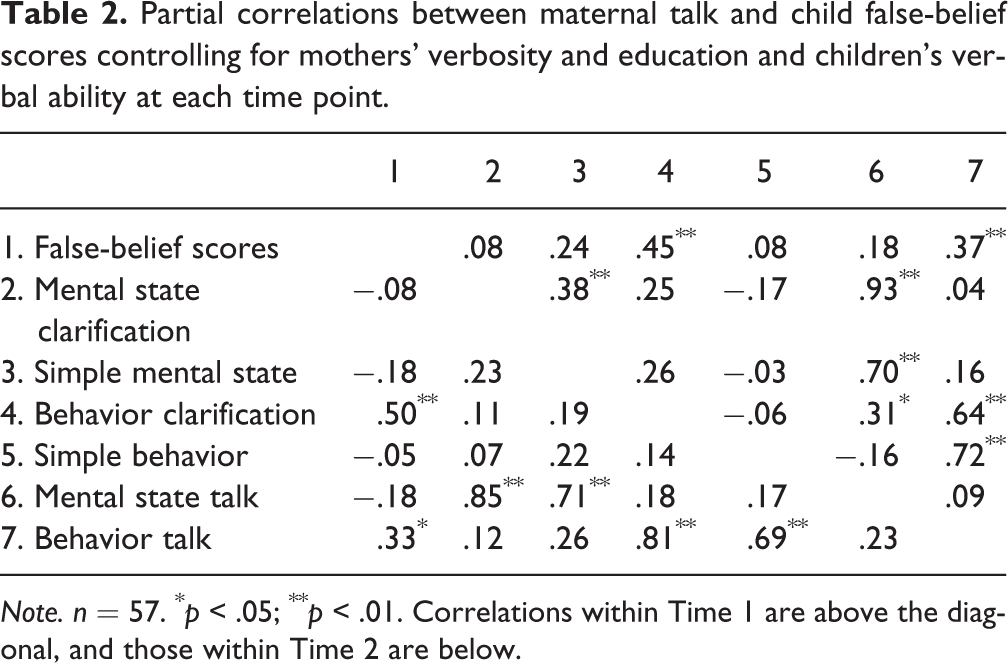
Note. n = 57. * p < .05; ** p < .01. Correlations within Time 1 are above the diagonal, and those within Time 2 are below.
Multiple regressions for maternal talk predicting concurrent children’s false-belief scores at each time point.
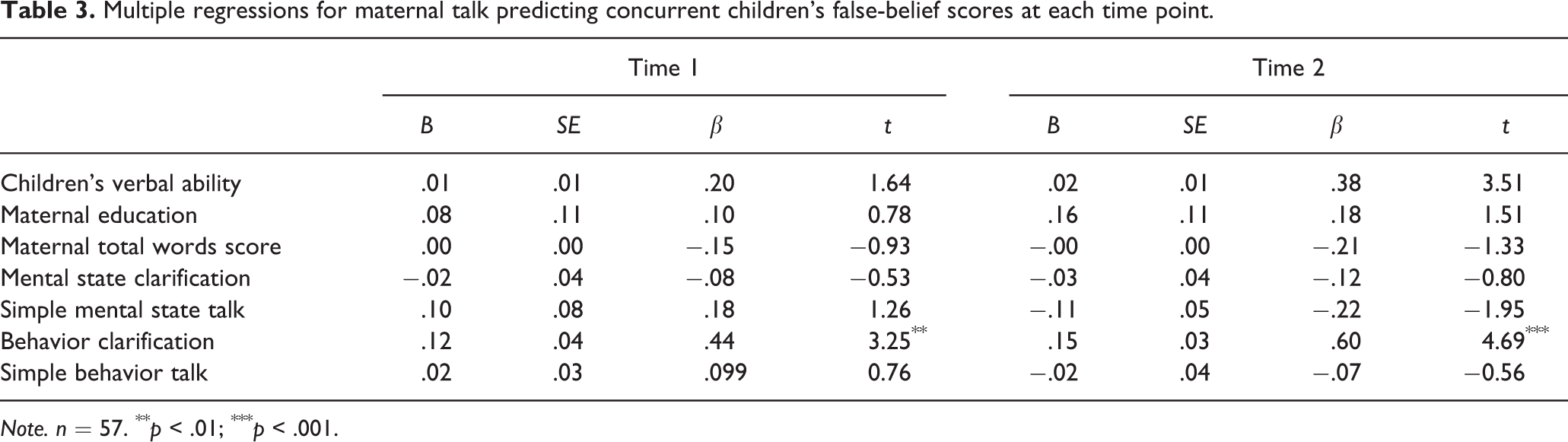
Note. n = 57. ** p < .01; *** p < .001.
Longitudinal prediction of false-belief understanding
To examine the longitudinal contribution of maternal behavior clarifications to children’s false-belief understanding, hierarchical regression analyses were conducted on false-belief scores at T2, controlling for children’s verbal ability, false-belief scores, maternal education, mothers’ Total Words score, mental state clarifications, simple mental state talk, and simple behavior talk at T1 (see Table 4). These covariates were entered in the first step, F(7, 49) = 5.21, p < .001, R 2 = 42.7%. Behavior clarifications at T1 were entered in the second step, ΔF(1, 48) = 5.22, p = .027, which uniquely accounted for 5.6% of the variance in children’s false-belief understanding at T2.
Hierarchical regression analyses for Time 1 variables predicting children’s false-belief scores at Time 2.
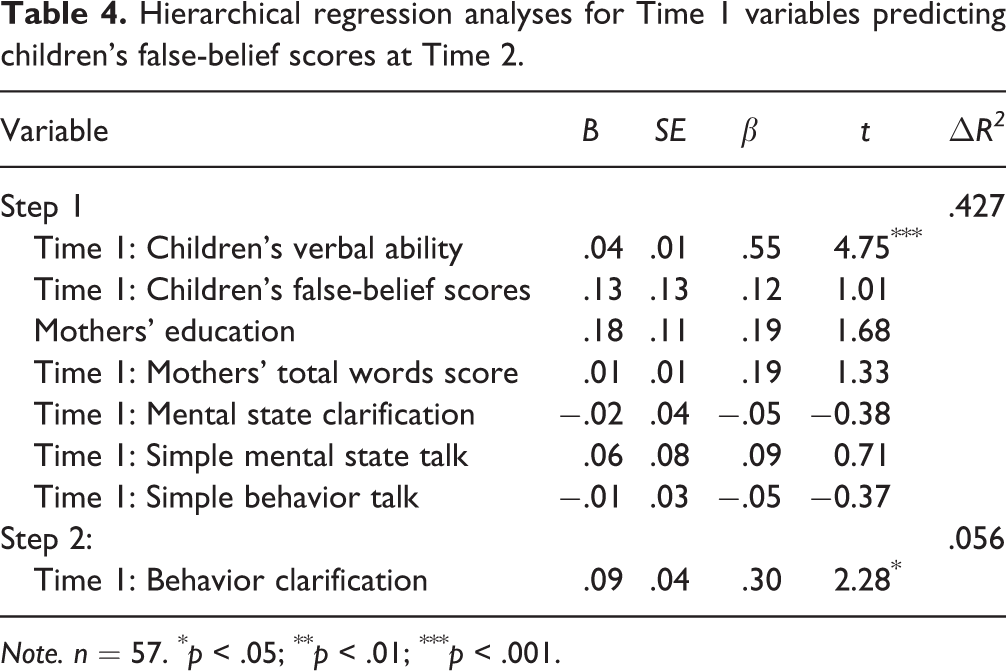
Note. n = 57. * p < .05; ** p < .01; *** p < .001.
Longitudinal prediction of maternal behavior clarifications
To test the possible reverse causal direction, namely, children’s false-belief understanding causing maternal behavior clarifications, we conducted hierarchical regression analyses on maternal behavior clarifications at T2 with children’s false-belief scores at T1 as the predictor. In the first step, children’s verbal ability, the maternal Total Words score, mental state clarifications, simple mental state utterances, simple behavior utterances, behavior clarifications, and education at T1 were entered, F(7, 49) = 4.47, p = .001, R 2 = 39.0%. Maternal behavior clarifications at T1 predicted maternal behavior clarifications at T2. Children’s false-belief scores at T1 were entered into the second step, ΔF(1, 48) = 0.24, p =.629, suggesting that children’s false-belief understanding at T1 did not uniquely predict mothers’ behavior clarifications at T2.
Discussion
Our findings showed that mothers’ early behavior clarifications during book sharing uniquely predicted children’s later false-belief understanding independent of children’s early verbal ability, early false-belief scores, maternal education, and other categories of mothers’ early talk, whereas children’s early false-belief understanding did not predict subsequent maternal behavior clarifications after controlling for mothers’ early behavior clarifications and other covariates. This finding indicates a unidirectional relationship between maternal behavior clarifications and children’s false-belief understanding.
Currently, there is limited evidence to suggest that children may develop their ToM through maternal behavior clarifications, except for one longitudinal study with weak evidence that maternal descriptions of a picture’s content (e.g. characters’ behaviors) and causal talk about non-mental states were associated with children’s later ToM after controlling for children’s early ToM (Ruffman et al., 2002). However, the predictive effect of non-mental state talk disappeared if mothers’ mental talk was controlled. It seems that maternal references to non-mental states (particularly behaviors) also play a role in Western children’s ToM development, but the effect may be smaller than mental state discourse.
Study 1 did not find significant associations between mothers’ mental state talk and children’s false-belief understanding. Although inconsistent with previous findings suggesting that mothers’ mental talk facilitated Western children’s ToM development (Ensor et al., 2014; Ruffman et al., 2002), our findings were consistent with the results of Doan and Wang (2010) in which maternal mental state language did not significantly relate to Chinese immigrant children’s emotion situation knowledge in zero-order correlation analyses. This result is most likely because Chinese mothers tended to focus more on external behaviors than on mental states during story sharing compared with their Western counterparts (Doan & Wang, 2010; Wang, 2001; Wang et al., 2000). Therefore, children’s attention was drawn more to external behaviors than to mental states. The evidence from Chinese children’s autobiographical memory also indicated that Chinese children referred more to others’ behaviors when sharing autobiographical events (Han et al., 1998).
Due to the nature of correlational analysis, we are cautious about identifying causality between exposure to behavior clarifications and children’s false-belief understanding even with the longitudinal design in Study 1. Moreover, it is unclear whether the lack of a relationship between mental state language and false-belief understanding in Study 1 was due to the fact that mental state talk has no effect or because of the small “dosage” (the amount of exposure is too small), which may draw children’s attention less to mental states. Therefore, Study 2 used a training paradigm to examine whether exposure to behavior clarifications promoted Chinese children’s false-belief understanding and whether sufficient mental state clarifications could facilitate Chinese children’s false-belief understanding similar to Western culture.
Study 2
Training studies have documented the benefits of story-telling to children’s ToM (Guajardo & Watson, 2002; Lu et al., 2008). Based on the theoretical view that mental state talk may draw children’s attention to internal states and facilitate their ToM (de Rosnay et al., 2004; Ruffman et al., 2002), Guajardo and Watson (2002) utilized a discussion paradigm to direct children’s attention to mental states and successfully improved children’s ToM ability. We posited that behavioral clarifications work similarly by indirectly drawing children’s attention to internal states through discussions of external behaviors. Our design was similar to this work except that children were involved in discussions of either the mental states or behaviors of story characters.
Method
Participants
The sample comprised 46 preschoolers from middle-income families (27 boys and 19 girls; age range = 44.5–65.2 months, M = 52.66, SD = 4.46) who did not pass the false-belief tasks in the pretest (i.e., they received no more than 2 of a possible 4 points). Participants were recruited from two kindergartens in Beijing, China. Although systematic demographic data were not collected, the two kindergartens mostly served children of university staff and faculty in urban Beijing. Each child was semi-randomly assigned to one of three groups based on his or her false-belief score in the pretest, so the three groups did not differ in their initial false-belief scores (Guajardo & Watson, 2002). There were 16 children in the mental state clarification group (nine boys and seven girls; age range = 45.7–63.5, M = 53.27, SD = 4.02), 15 children in the behavior clarification group (nine boys and six girls; age range = 48.1–65.2 months, M = 53.22, SD = 4.33), and 15 children in the control group (nine boys and six girls; age range = 44.5–61.9 months, M = 51.43, SD = 5.06). There were no significant group differences in children’s ages, F(2, 43) = 0.83, p = .442, η p 2 = .037, children’s verbal abilities, F(2, 43) = 1.55, p = .224, η p 2 = .067, or gender ratio, χ 2 = 0.06, df = 2, p = .970. One child in the behavior clarification group and another child in the control group did not finish the training process due to an illness; therefore, they were excluded from the analysis.
Procedure
We conducted the pretest a week before the training started and the posttest a week after the training was completed. The training consisted of four storytelling sessions with 2–3-day intervals for 2 weeks, and were administered by a female researcher. During each session, groups of 1–3 children were told three unfamiliar stories, with each story lasting 5 minutes. Pictures were used to attract the children’s attention and help them comprehend the stories.
The experimenter first told the story to the children. Then, the children were asked to discuss the story with the experimenter to direct the children to focus on various aspects of the story (e.g. mental states, behaviors). These discussions typically started with the experimenter’s input to direct the children’s attention to a particular aspect of the story. The experimenter went on to question the children about the specific aspect. Following the children’s responses, the experimenter provided feedback, either correcting or expanding on the children’s responses to clarify the aspect of the story. As such, the children were not only led to focus on mental states or behaviors, but also exposed to language from the experimenter.
To illustrate how experimental manipulations were administered during the experimenter–children discussions (Guajardo & Watson, 2002), we used a story of deception as an example. In this story, a fox tricked a crow into singing and took away the meat that fell from the crow’s mouth. In the behavior clarification group, the experimenter first directed the children’s attention to the characters’ behaviors and prompted the children to answer a series of questions about the characters’ actions and behaviors in the story (e.g. “Look, the crow is standing on the tree. What’s in its mouth?”). The experimenter led discussions as the story progressed and intentionally avoided mentioning mental states (e.g. “What does the fox say to the crow?” “What did the crow do before, and what does he do then?” “What did the fox ask the crow to do?”). Following the children’s responses, the experimenter gave feedback and clarified the characters’ behaviors again. In the mental state clarification group, the experimenter followed the same procedure but initiated a discussion of the reasons and consequences of mental states, a comparison of reality with mental states, or a discussion of different characters’ mental states (e.g. “What does the fox want?” “Does the fox think that the crow sings beautifully?” “Why is the fox happy in the end?”). No discussions of the characters’ behaviors were conducted with the children in this group. In the control group, the experimenter asked the children a series of questions about the physical features of the story (e.g. “Where did the story happen?”, “What is this?”). The children were directed away from discussions of the characters’ behaviors and mental states. The three groups answered an equal number of questions.
Measures
The children completed the PPVT-R in the pretest, and two false-belief tasks in the pretest and the posttest.
ToM ability
The false-belief tasks that were used to assess children’s ToM were the same as those in Study 1, except that an explanation question was included (i.e., “Why will Ming look for the ball at this location first?”). In each task, the children received one point if they answered both the control question and the test question correctly and another point if they gave a correct explanation (Adrián et al., 2007). The total score for false-belief understanding ranged from 0 to 4 in both the pretest and the posttest. The tasks in the posttest were the same as in the pretest but with different physical properties, such as protagonists, objects and boxes.
Results
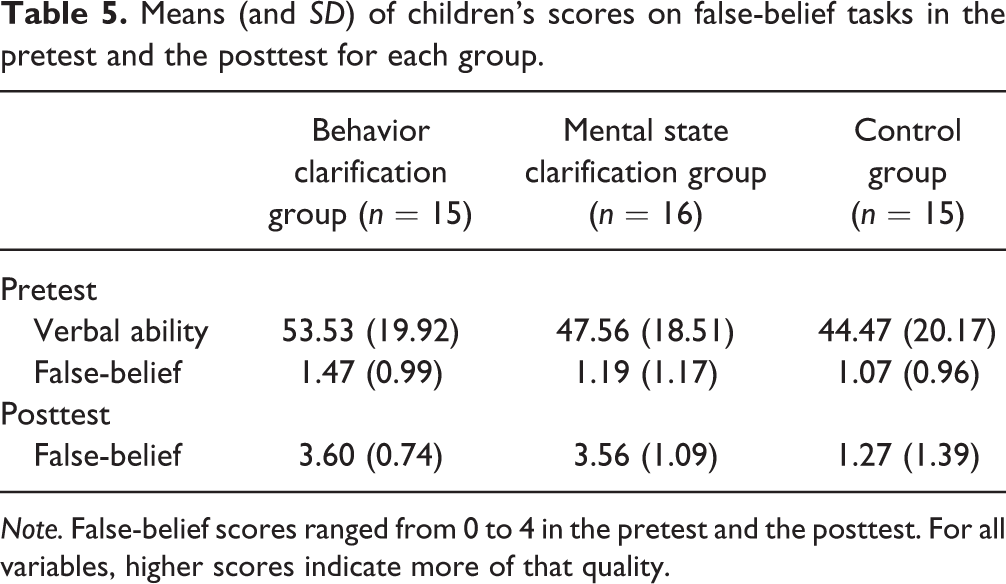
Table 5 shows the descriptive statistics for the key variables by group. A 2 (time: pretest and posttest) × 3 (group: behavior clarification, mental state clarification and control group) ANCOVA was conducted for the children’s false-belief scores, controlling for the children’s verbal ability. The results indicated significant main effects for time, F(1, 42) = 4.16, p = .048, η p 2 = .09, and group, F(2, 42) = 12.37, p < .001, η p 2 = .371, as well as a significant time × group interaction, F(2, 42) = 9.97, p < .001, η p 2 = .322. To further understand the interaction, we conducted a one-way ANOVA to examine the group differences in the pretest and again in the posttest. Significant group differences emerged in the posttest, F(2, 43) = 22.18, p < .001, η p 2 = .508, but not in the pretest, F(2, 43) = 0.58, p = .566, η p 2 = .026. Post-hoc Bonferroni tests showed that both the mental state clarification and the behavior clarification group outperformed the control group in the posttest (ps < .001). Moreover, the two experimental groups did not differ significantly from each other (p = 1). The children from the mental state clarification group performed better in the posttest than in the pretest, t(15) = 6.33, p < .001, d = 1.58, as did those in the behavior clarification group, t(14) = 7.79, p < .001, d = 2.04, whereas children in the control group showed no significant improvement, t(14) = 0.48, p = .638, d = 0.13. Figure 1 shows the false-belief scores as a function of time and group.
Means (and SD) of children’s scores on false-belief tasks in the pretest and the posttest for each group.
Note. False-belief scores ranged from 0 to 4 in the pretest and the posttest. For all variables, higher scores indicate more of that quality.
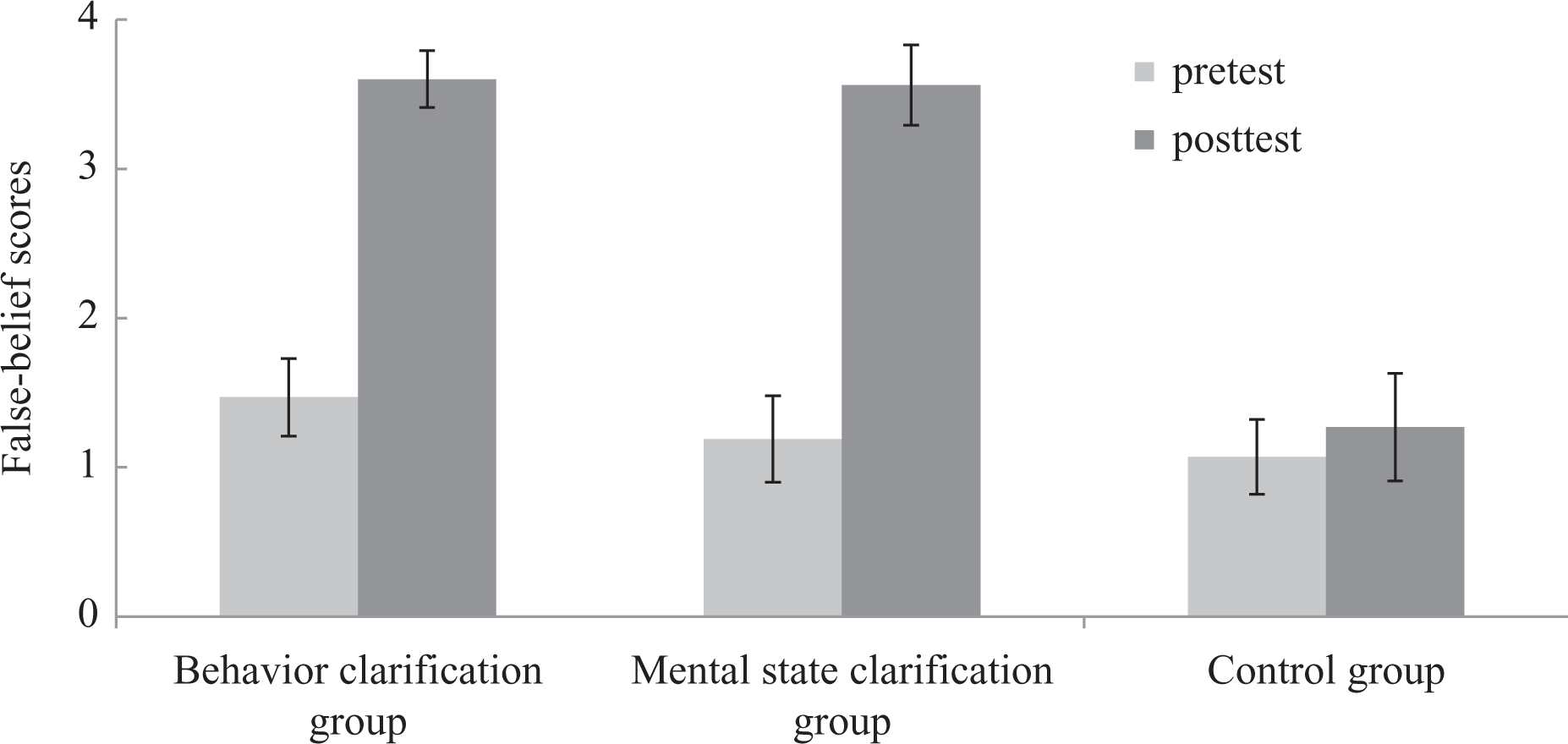
False-belief scores as a function of time and group (n = 46). The error bars added to each column represent standard errors in the figure.
We further explored the training effect at the individual level. Fourteen of the 15 children in the behavior clarification group (M = 2.13, SD = 1.06) and 14 of the 16 children in the mental state clarification group (M = 2.38, SD = 1.50) showed a pretest-posttest improvement; in comparison, only 5 of the 15 children in the control group made progress from the posttest to the pretest (M = 0.20, SD = 1.61). More children improved in the two experimental groups than in the control group, χ 2(1) = 4.26, ps = .039.
Discussion
Our findings showed that despite similar false-belief scores in the pretest, children exposed to behavior or mental state clarifications performed better on false-belief tasks than those in the control group in the posttest. Only the two experimental groups displayed obvious improvement from the pretest to the posttest. Moreover, the two experimental groups did not differ from each other in the pretest or the posttest, suggesting that the effect of behavior clarifications was similar to that of mental state clarifications on Chinese children’s false-belief understanding.
Consistent with previous studies in which preschoolers were trained to understand mental states and the concepts of belief and deception (Guajardo & Watson, 2002), our study showed that mental state clarifications facilitate children’s false-belief understanding. Moreover, our study found that behavior clarifications could facilitate children’s false-belief understanding. It seems that both mental state clarifications and behavior clarifications are beneficial to Chinese children’s ToM development. Mental state clarifications may draw children’s attention to internal states (de Rosnay et al., 2004; Ruffman et al., 2002) and encourage children to think about internal states (Guajardo & Watson, 2002), thereby improving children’s ToM. Behavior clarifications may guide children’s attention to the behaviors of others, indirectly inducing children to interpret and infer mental states from behaviors and improving their ToM (Lu et al., 2008).
General discussion
The current study aimed to examine the culture-specific mechanism underlying ToM development in Chinese children who are exposed to more behavior talk and less mental state talk than their Western peers. Study 1 showed that mothers’ early behavior clarifications during book-sharing predicted children’s false-belief understanding 1 year later independent of children’s early language ability, false-belief scores, mothers’ education, early verbosity, and other categories of mothers’ early talk. Study 2 further suggested that experimental exposure to behavior clarifications improved children’s false-belief understanding. These two results together indicate that behavior clarifications facilitated Chinese children’s false-belief understanding, highlighting a culture-specific mechanism underlying Chinese children’s ToM development. Additionally, Study 2 showed that exposure to mental state clarifications in experimental training improved children’s false-belief understanding, indicating that sufficient mental state talk is also beneficial for Chinese children’s ToM development.
According to Bruner (1988, 1990), a false-belief situation includes mental states and external behaviors. Of these two aspects, mental states are more important for understanding social situations (Astington, 1990; Lewis, 1994). However, previous studies also indicated the effects of behavioral cues on children’s understanding of false-belief situations (Bruner, 1990; Moses & Flavell, 1990; Naito & Koyama, 2006). Behavioral cues are particularly important for Chinese children to understand false-belief situations because they have few opportunities to access mental states but are exposed to more behavior talk. The specific language environment that Chinese children experience requires them to infer people’s internal states according to behavioral cues without being explicitly told to do so (Lu et al., 2008). For example, Chinese mothers tend to say, “After seeing the farmer’s harvest, the little cat went fishing and then planted the fish,” without indicating the cat’s desire (i.e., the cat wanted to have more fish) or the cat’s false belief (i.e., the cat thought that fish could be raised in the soil). Such behavior talk draws Chinese children’s attention to behavioral cues, indirectly inducing children to figure these internal states out by themselves based on behaviors (Lu et al., 2008). These indirect inferences from the external to internal states may facilitate Chinese children’s false-belief understanding.
Behavior clarifications, which are defined as utterances that include interpretative, causal, or comparative information about behaviors or that use clauses to describe characters’ behaviors, may further scaffold this indirect inference process in three ways. First, comparative talk about behaviors delineates the similarities or differences between various characters’ behaviors, which may parallel different perspectives. For example, a maternal statement such as “the little cat is planting the fish in the field just as the farmer planted his crops” would indirectly draw children’s attention to the reasons for the actions of the cat and the farmer, which would help children understand these two perspectives and further facilitate children’s ToM development (Adrián et al., 2007). Second, maternal interpretative and causal talk about behaviors may provide coherent information about social actions, which helps children understand the story as a whole and is beneficial to children’s ToM development (Turnbull, Carpendale, & Racine, 2008). Finally, behavior clarifications often rely on the syntax of sentential complementation with an embedded clause (e.g. “The farmer said he was going to harvest his corn”). This grammatical structure is used frequently in mental talk (e.g. “he thought he was going to harvest his corn”) and has been found to be associated with children’s false-belief understanding (Hale & Tager-Flusberg, 2003).
Our results contrast with the findings by Doan and Wang (2010), who showed that behavior talk was negatively associated with children’s emotion situation knowledge. There may be several reasons for this. First, and most importantly, our study distinguished between simple mentions and clarifications of behaviors. Then, the tasks that were used to assess children’s affective ToM in the study by Doan and Wang (2010) relied on verbal responses, whereas the tasks we used required behavioral responses and were used to assess children’s cognitive ToM. Many studies have indicated that affective ToM and cognitive ToM are two interrelated but independent domains (Adrián et al., 2007; Kidd & Castano, 2013). Additionally, the sample differences should be considered (Chinese immigrants versus native Chinese participants). Chinese immigrants may have experienced acculturation processes and adopted Western child-rearing beliefs and practices.
We observed inconsistent patterns in Study 1 and Study 2 for the effect of mental state clarifications on children’s false-belief understanding. Maternal mental state clarifications were not associated with children’s false-belief understanding in Study 1, whereas Study 2 showed that experimental exposure to mental state clarifications improved children’s false-belief understanding. These seemingly inconsistent findings may be due to the extent to which children pay attention to mental states during naturalistic story sharing and experimental training. During naturalistic mother–child story-sharing, as indicated in Study 1 and previous studies (Doan & Wang, 2010; Wang et al., 2000), Chinese mothers tend to focus more on external behaviors and use less mental-state language. Despite some mental-state talk, the increased value that mothers place on behaviors may routinely draw children’s attention to external behaviors and make children indirectly infer internal states, which is considered adaptive in Chinese society (Lu et al., 2008). However, during the intervention in Study 2, children’s attention was purposely drawn to mental states in the mental state clarification group (Guajardo & Watson, 2002), which directly encourages children to reflect on internal states (de Rosnay et al., 2004; Ruffman et al., 2002). Thus, an emphasis on mental state clarifications is also beneficial for Chinese children to develop their ToM.
Therefore, we propose that mental state clarifications and behavior clarifications are two pathways for ToM development. Due to different cultural customs, children in different cultures acquire ToM through different routes (Su & Liu, 2012). During naturalistic development, children in Chinese culture learn from maternal behavior clarifications as a route to mental understanding, whereas those in Western culture acquire ToM through mental state talk. Notably, sufficient mental state clarifications can also facilitate Chinese children’s ToM development, but only behavior clarification is taken as an acquainted pathway in Chinese culture.
There are several limitations to the current study. First, we only trained 4- and 5-year-old preschoolers. It is unclear whether the training is effective for younger children. However, several studies have shown that 4 to 5 years of age is a critical period for the development of children’s false-belief understanding (Wellman et al., 2001). According to Vygotsky (1978), training may better support children’s understanding in the zone of proximal development. Only mothers were included in Study 1 to correspond with most studies conducted in Western cultures (Ensor et al., 2014; Slaughter et al., 2007). Further studies should explore the relationships between fathers’ talk and children’s ToM because fathers are increasingly involved in childrearing (Bruce & Fox, 1999). Moreover, we only examined the role of behavior clarifications in Chinese children’s false-belief understanding. Researchers have noted that ToM not only includes false belief understanding but also contains other components, such as the understanding of emotions, knowledge and desires (Astington, 2001). Future studies should examine whether behavior clarifications also facilitate other aspects of ToM ability in Chinese children. Finally, future studies should examine whether the findings of the current study can be generalized to other non-Western populations. For example, recent studies have suggested similarities between Chinese and Iranian children’s acquisition of ToM. Both Iranian children and Chinese children lag behind their Western peers in their understanding of different beliefs, whereas these children show advantages in their understanding of knowledge access (Shahaeian, Nielsen, Peterson, Aboutalebi, & Slaughter, 2014; Shahaeian, Nielsen, Peterson, & Slaughter, 2014; Shahaeian, Peterson, Slaughter, & Wellman, 2011). Expanding ToM research to other non-Western cultures may provide further evidence for the culturally-specific mechanism underlying children’s ToM development.
In conclusion, our study showed that a focus on mental state clarifications in training facilitated Chinese children’s ToM, indicating that the role of mental state talk in children’s ToM found in Western culture can be generalized to Chinese culture. Most importantly, our study indicated that behavior clarifications facilitated Chinese children’s ToM development, which provides a culturally specific insight into non-Western children’s social cognition development (Lu et al., 2008; Wang, 2006). Compared to Western children, who have direct access to internal states through mental talk, it may be more difficult for Chinese children to indirectly infer, compare, and comprehend others’ mental states independently using external cues during naturalistic development. Therefore, Chinese children may need more time to achieve this skill (Naito, 2003; Naito & Koyama, 2006). This difference may partly explain why Chinese children pass false-belief tasks later than Western children, as a meta-analysis (Liu, Wellman, Tardif, & Sabbagh, 2008) indicated.
Footnotes
Acknowledgement
We thank all the individuals who kindly participated in our research.
Funding
This research was supported by the National Natural Science Foundation of China (Project 31170995, 31371040) and the National Basic Research Program of Ministry of Science and Technology of China (973 Program: No. 2010CB833904).