







Abstract
This study explored how sharing past and future life events among late adolescents and their parents influenced the quality of their own time perspectives. Triads (N =104) of female students and their parents described three important life events from their past and future. The results showed that adolescents who shared past and future life events predicted a positive impact on their time perspective, whereas parents displayed a more complex dynamism that included the impact of sharing the past on the future and vice versa. It is suggested that the impact of sharing past and future life events varies according to the age group.
“[W]e feeling” makes for less tension and conflicts. The readiness to consider the other member’s views and goals and to discuss personal problems rationally leads to quicker solution of conflicts. Doubtless the same holds for the atmosphere in marriage. (Lewin, 1948, p. 102)
Lewin’s suggestion about the “we feeling” in marriage indicates the importance of sharing goals in a family. Such sharing can accomplish more than conflict resolution in relationships by contributing to the elaboration of life goal setting, and regulation to their attainment by each partner. This study examines how the sharing of past and future life events among adolescents and their parents, as well as sharing between partners, may influence the quality of their personal time perspectives.
Time perspective
Time perspective refers to the integration of the past, present, and future in an individual’s psychological life space (Lens, Herrera, & Lacante, 2004). Time perspective is used by individuals in forming expectations, goals, and life paths, and thus may influence their identity formation and self-development and enhance their well-being. This is true not only for adolescents (Higata & Saito, 2007; Luyckx, Lens, Smits, & Goossens, 2010; Seginer, 2009; Shirai, Nakamura, & Katsuma, 2012) but also for middle-aged people (Higata & Okamoto, 2008), although the way of using time perspectives differ with age (Shirai, 1997). For example, while adolescents form identity by focusing on and pursuing future goals, middle-aged people revise their identity through time integration of the past and future (Shirai, 1997).
Time perspectives are conceptualized in terms of two dimensions: temporal extension and time attitude. Temporal extension refers to the length of time, or temporal distance, to events in the past or future (Nuttin & Lens, 1985). Studies have shown that individuals with a longer temporal extension can set larger goals and make greater effort than individuals with a shorter extension (Lens, Paixão, Herrera, & Grobler, 2012; Peetsma, Schuitema, & Van der Veen, 2012). Time attitude refers to a positive or negative attitude toward the past and the future (Nuttin & Lens, 1985). A positive time attitude indicates well-being for both adolescents (Higata & Saito, 2007; Mello & Worrell, 2006; Mello, Worrell, & Andretta, 2009) and middle-aged people (Higata & Okamoto, 2008).
Impact of sharing on time perspective
Previous studies provide evidence that a shared time perspective within a family can enhance the quality of the personal future time perspective of adolescents (Lanz, Rosnati, Marta, & Scabini, 2001; Scabini, Marta, & Lanz, 2006). Lanz et al. reported that adolescent and parents can share a positive vision of the future that is characterized more by hopefulness than by fear. Several studies have also shown that sharing can establish a positive time attitude by creating a highly supportive family climate (Paleari, Tagliabue, & Lanz, 2011; Scabini, Lanz, & Marta, 1999).
Moreover, Lanz et al. (2001) indicated that sharing hope between adolescents and their parents confirms the normative transition to adulthood (finishing one’s education, getting a job, and getting married). It creates long-term goals that require greater dedication and tenacity while the adolescent is learning to achieve easier short-term goals, such as the management of their leisure time. The significance of focusing on normative life events has also been emphasized by longitudinal studies of time perspective in goal-setting during the transition to adulthood (Salmela-Aro, Nurmi, Saisto, & Halmesmaki, 2001; Salmela-Aro, Pennanen, & Nurmi, 2001).
Thus, sharing in a family can increase more positive time attitudes, in a more supportive climate, as well as increased focus on normative life transitions that result in longer temporal extensions, than in the absence of sharing.
Dynamics of time perspectives in a family
In this study, we will expand the findings of previous research (Lanz et al., 2001; Scabini et al., 2006) in the direction impacting on parents and in the direction of the past.
First, previous studies have dealt with only on unidirectional influences – from parents to adolescents, despite the importance of overall family dynamics (Kuczynski, 2003; Lerner, 2002). Salmela-Aro, Nurmi, Saisto, and Halmesmaki (2010) have reported that primiparous women with high support for shared goals, such as family-related goals, are more satisfied with their spousal relationships. It is known that satisfaction with relationships can establish a positive time attitude (Paleari et al., 2011; Scabini et al., 1999). Therefore, satisfaction with spousal relationships might improve personal time perspectives.
Second, previous studies have focused only on the future, although the conceptualization of time perspective also includes an orientation to the past (Frank, 1939; Lens et al., 2004; Lewin, 1948). We assume that sharing the past as well as the future can enhance the quality of personal time perspective. There is evidence supporting this assumption (Niederhoffer & Pennenbaker, 2002; Weeks & Pasupathi, 2010). Weeks and Pasupathi showed that conversational remembering with parents, or sharing, helps adolescents make sense of their lives and promotes their identity development.
Third, past and future time perspectives are connected, rather than separate from one another (Frank, 1939; Haith, Benson, Roberts Jr., & Pennington, 2005; Karniol & Ross, 1996; Zimbardo & Boyd, 2008). Mental time travel literature (Szpunar, 2010) has shown that episodic future thought involves flexible (re)organization of memory. Episodic memory supports the construction of future events by extracting and recombining stored information into a simulation of a novel event (Schacter, Gaesser, & Addis, 2013; Szpunar, 2010; Szpunar, Addis, McLelland, & Schacter, 2013). Therefore, we assume that time perspective is dynamic: Sharing the future has an impact on perspectives on the personal past and sharing the past has an impact on the personal future.
Our hypothesis
Based on above rationale, first, we hypothesized that sharing the future, but also sharing the past, among adolescent and parents – as well as sharing between partners – would predict a more positive time attitude and longer temporal extension, than the absence of sharing. The studies on mental time travel (Berntsen & Bohn, 2010; Berntsen, Rubin, & Siegler, 2011) suggest that sharing the past can also create a positive attitude towards the past, as well as a longer temporal extension, through a focus on normative life events.
Second, we hypothesized that mutual influence of the past and future has greater effect on middle-aged people, who may exhibit more dynamic reconstruction of their time perspectives, than adolescents. According to views of life-span development in time perspectives (Higata & Okamoto, 2008; Higata & Saito, 2007; Shirai, 1997), while adolescents make temporally separate commitments to the past, present, and future (Higata & Saito, 2007), middle-aged people connect the past with present and future temporal dimensions (Higata & Okamoto, 2008). The source of this difference might be age differences in life space; for example, middle-aged people focus on limitations, and adolescents focus on opportunities (Cate & John, 2007; Steinberg & Silk, 2002).
The purpose of this study is to examine whether sharing the past and future among family members has an effect on the quality of their own time perspectives; First, we hypothesized that sharing the future, but also sharing the past, among adolescent and parents – as well as sharing between partners – would predict a more positive time attitude and longer temporal extension, than absence of sharing. Second, middle-aged people may be more likely than adolescents to show dynamic time perspectives, in which sharing the future has an impact on personal past time perspective and sharing the past has an impact on personal future time perspective.
Method
Participants
This study analysed a total of 104 triads comprising female students in three 4-year colleges and one 3-year professional nursing school, together with their parents. Participants were asked to complete surveys in their classrooms in 2000–2005. They were then asked to administer the survey to both parents. Although the task was part of their class activities, they voluntarily consented to the use of the results for research purposes. Twenty triads who failed to submit complete responses were excluded from the sample. The mean age of adolescents was 19.6 years (SD = 1.18; range = 18–23); mothers, 48.5 years (SD = 3.34; range = 35–59); and fathers, 51.3 years (SD = 4.03; range = 40–64). Mothers in this survey included full-time workers (27.2%), part-time workers (18.5%), and homemakers (53.4%), while 98.0% of fathers worked in full-time jobs.
Questionnaire
Participants were asked to write about three important life events in their past and future and were asked to assess the age at which these life events occurred in the past or could come true in the future. We calculated a temporal extension score by summing the distances (years) between the age at which each event was reported to occur and the participant’s present age and dividing by three (the number of events). Participants were also asked to evaluate each event by choosing one response option on a three-point scale: negative (1), neither negative nor positive or I do not know (2), and positive (3). We calculated a valence or time attitude score by dividing the sum of the evaluations by three (the number of events).
This questionnaire was based on the Hopes and Fears Questionnaire, an open-ended questionnaire in which respondents write their hopes and fears for the future, which is often employed in future orientation research across different cultures (e.g., Nurmi, 1989; Seginer & Lilach, 2004; Trommsdorff, Lamm, & Schmidt, 1979). We expanded this method to include the past, by shifting the focus on hopes and fears to more neutral “life events.”
Content analysis and scoring
Life domains
Each life event reported by participants was independently coded by an assessor and placed into one of nine life-domain categories. These categories were established during pre-analysis and were based on those used most frequently in the literature (e.g., Salmela-Aro, Vuori, & Koivisto, 2007; Seginer, 2005; Seginer & Lilach, 2004): schooling/education (e.g., entering college), work/career (e.g., getting a job), family (e.g., having children), love/marriage (e.g., getting married), friendship (e.g., making a friend), other interpersonal relations (e.g., encountering a significant person), leisure activities (e.g., travelling), self in general (e.g., myself’s death), and other (all life events not part of the previous categories). The reliability of content analysis, measured by the agreement between two assessors, one of whom was a person who did not know the research objective, was 91.3% (κ = .892, p < .001).
Appraisal
Appraisal refers to a participant’s estimate of the event as more positive or negative than people’s typical estimate of the event. For example, although certain parents may estimate the marriage of their daughter as a neutral event, people may typically estimate this family life event as positive. We take the difference between a participant’s estimate and the typical estimate as the appraisal or bias of a participant. An assessor rated the extent to which people typically think of each event as positive or negative by selecting one of three assessment options: negative (1), neither negative nor positive (2), or positive (3). For example, since “death” generally implies a negative event, it was coded as negative (1). We calculated each participant’s appraisal score by summing the differences between the participant’s assessment and the assessor’s rating of each event and dividing it by three (the number of events). This score is considered to be an indicator of appraisal: a higher value means that the participant assigns a meaning to the life event that is more positive than the evaluation of another person, whereas a lower value implies a more negative meaning. Reliability, measured as the percentage rate of agreement between two assessors, was 94.6% (κ = .843, p < .001).
Sharing
The number of congruent life events between two or three members of a family was calculated and considered as an indicator of sharing between a) the adolescent and her mother, b) the adolescent and her father, c) her mother and father, and d) among all three family members (triad). Only distinct descriptions were confirmed. For example, even when both parents described “the birth of a daughter,” this was not considered congruent when the daughter was not the adolescent participant but her sibling instead. Reliability, measured as the percentage rate of agreement between two assessors, was 92.5% (κ = .863, p < .001).
Results
Table 1 presents the frequencies of domain categories in the past and future by adolescents and their parents. Table 2 presents the means and standard deviations of the study variables. For the past, adolescents wrote more frequently about events related to school or education, whereas parents wrote more often about events related to family or marriage. For the future, parents wrote about family-related events, whereas adolescents wrote mainly about marriage.
Means and standard deviations of life-event domain categories.
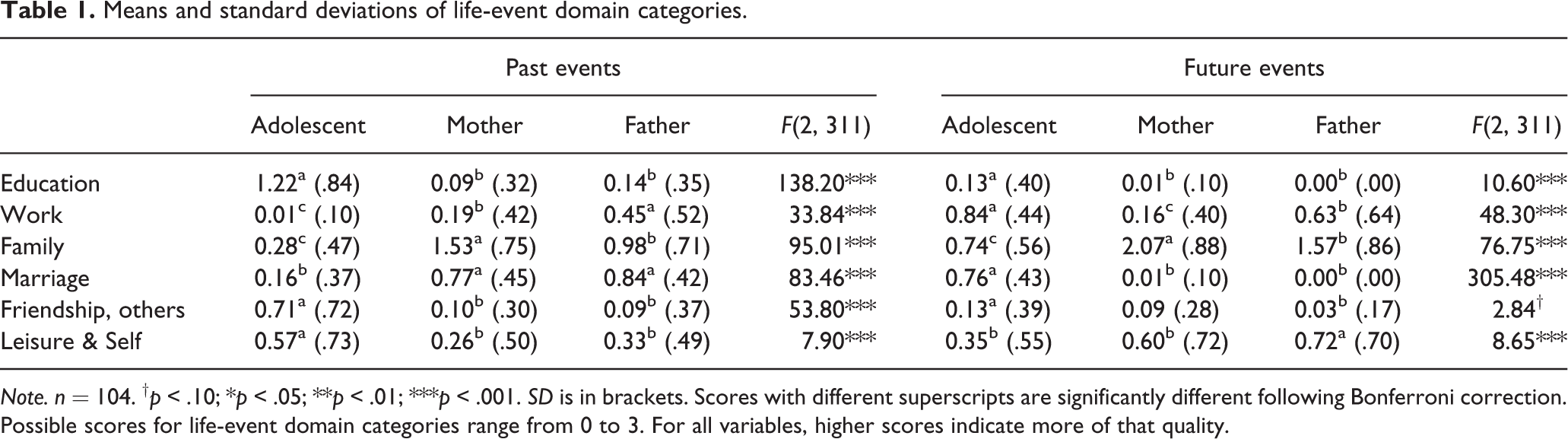
Note. n = 104. † p < .10; *p < .05; **p < .01; ***p < .001. SD is in brackets. Scores with different superscripts are significantly different following Bonferroni correction. Possible scores for life-event domain categories range from 0 to 3. For all variables, higher scores indicate more of that quality.
Means and standard deviations of time-perspective variables.
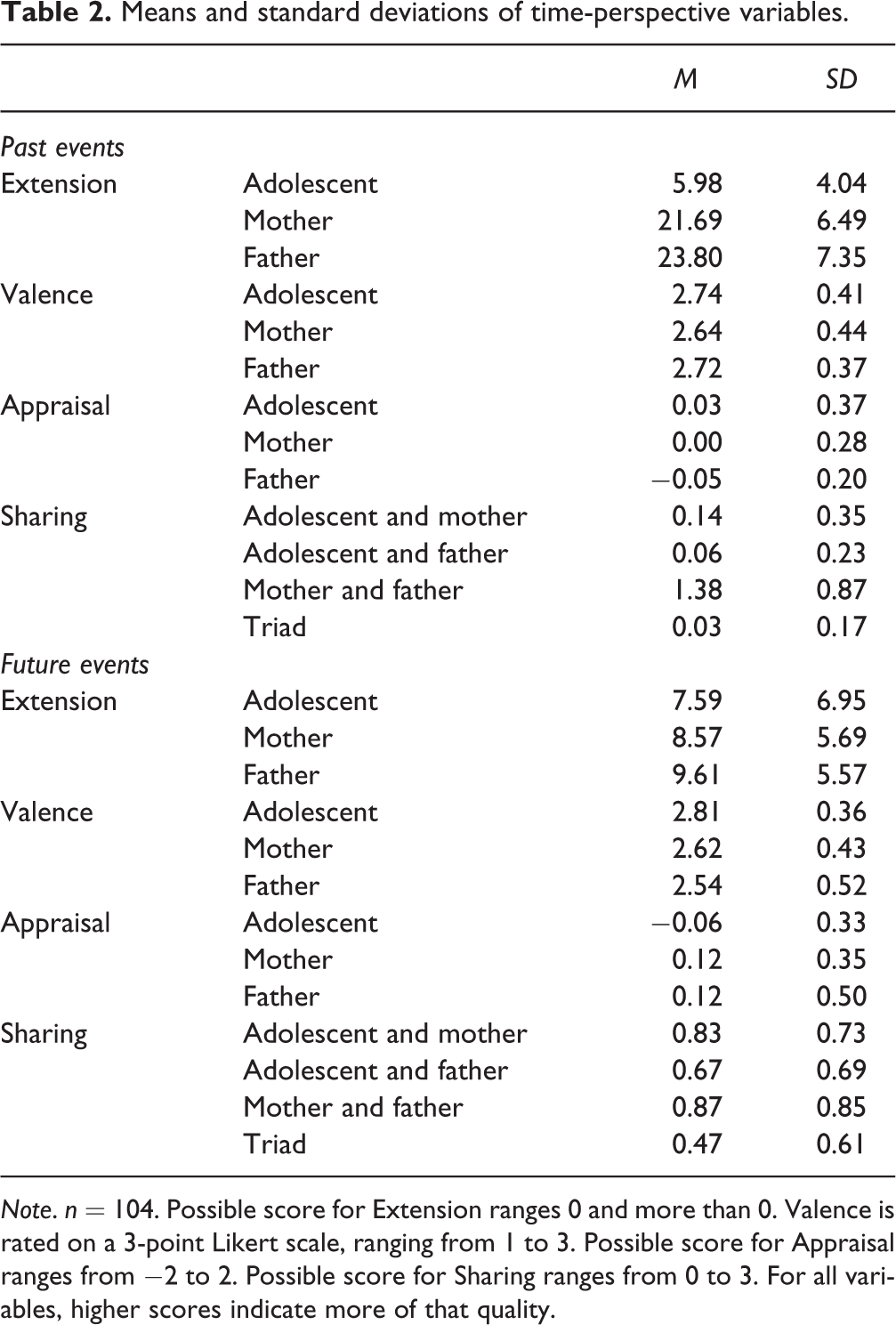
Note. n = 104. Possible score for Extension ranges 0 and more than 0. Valence is rated on a 3-point Likert scale, ranging from 1 to 3. Possible score for Appraisal ranges from −2 to 2. Possible score for Sharing ranges from 0 to 3. For all variables, higher scores indicate more of that quality.
The life events most frequently shared between adolescents and parents were the birth of the participant adolescent in the past and her marriage in the future. The most frequent past events shared between wife and husband were their marriage and the birth of their children in the past, and the marriage of the adolescent in the future. These shared events reflect normative life events.
The intercorrelations shown in Table 3 reveal that adolescents who shared more past events with their parents showed longer temporal extensions. Also, an adolescent who shared more future events with her father produced more positive events. A mother who shared more past events with the adolescent and with her partner had shorter temporal extensions in each case. A mother who shared more past events with the adolescent and with her partner showed more positive events in each case, whereas the opposite trend was found for future events; more future events shared between adolescent and father produced fewer positive events. A father who shared past events with his wife produced more positive past events than a father who did not share them, and the same tendency was seen for his sharing of future events with the adolescent.
Intercorrelations of the variables.
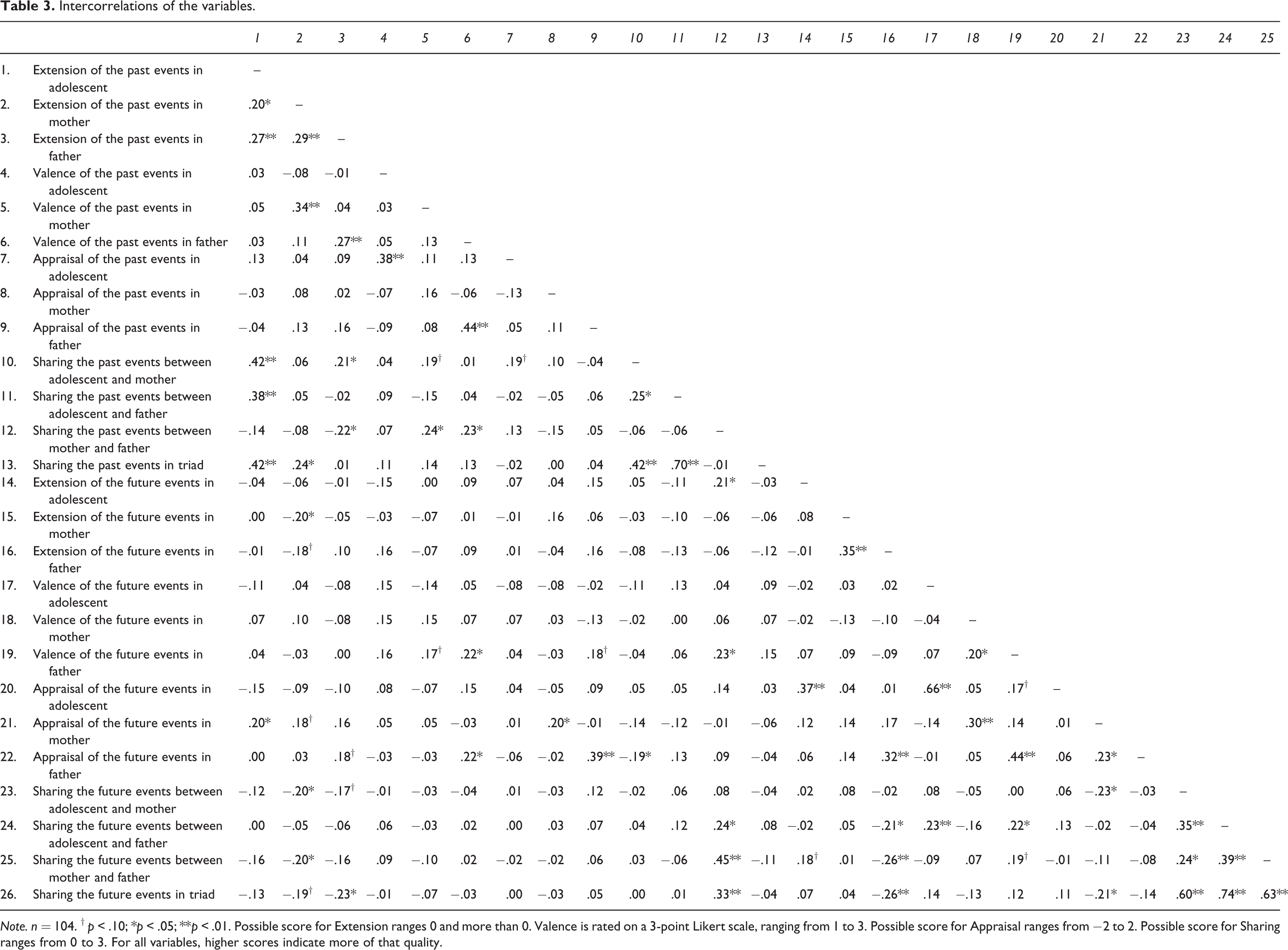
Note. n = 104. † p < .10; *p < .05; **p < .01. Possible score for Extension ranges 0 and more than 0. Valence is rated on a 3-point Likert scale, ranging from 1 to 3. Possible score for Appraisal ranges from −2 to 2. Possible score for Sharing ranges from 0 to 3. For all variables, higher scores indicate more of that quality.
We used multiple-step models as tested by structural equation modeling (Amos 22) to analyse the data, producing a model with a direct path from sharing life events to temporal extension and valence, and an indirect path through appraisal, as shown in Figure 1.
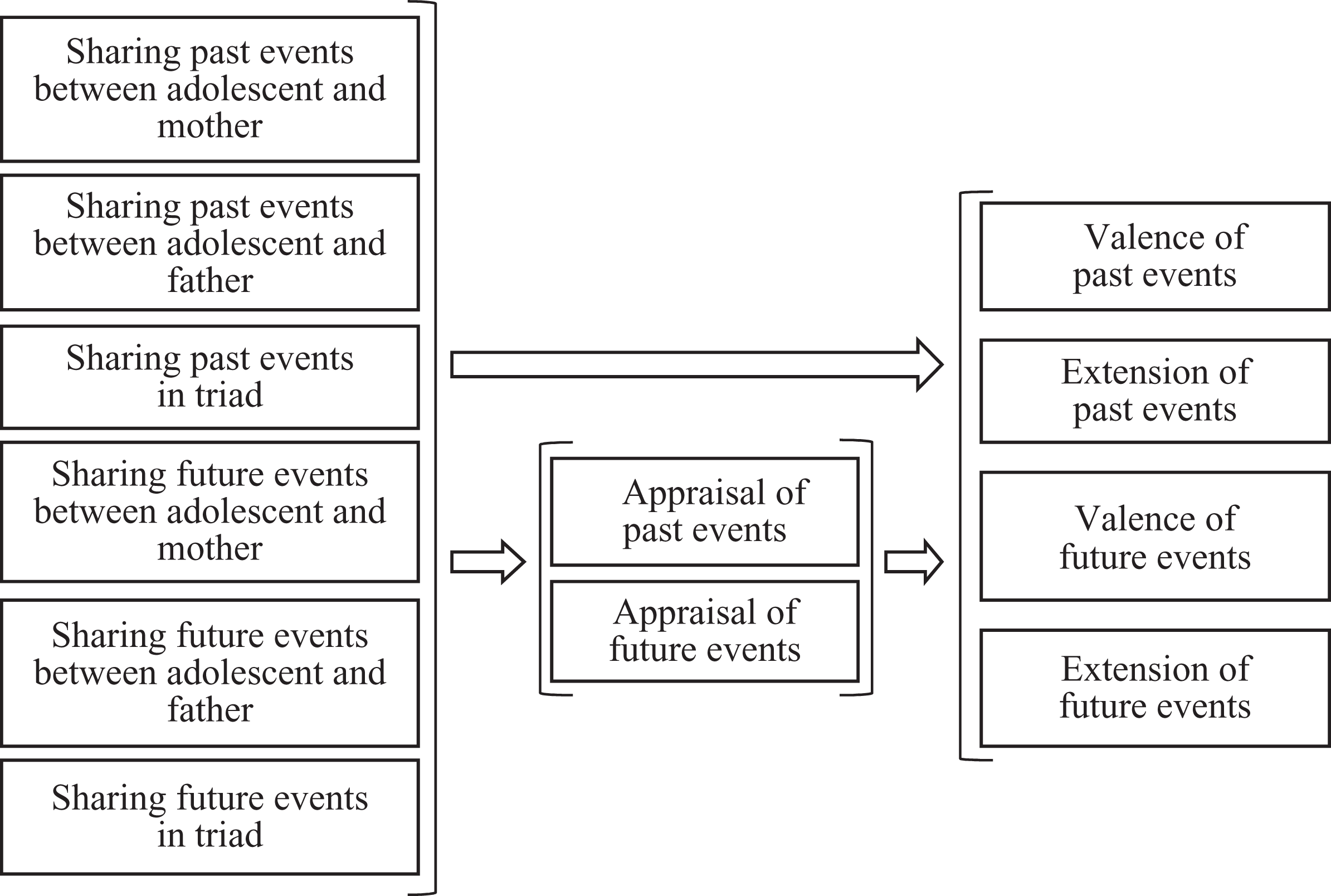
Model of the influence of sharing life events on temporal extension and valence.
For adolescents, adequate goodness-of-fit indices confirmed the model, with the following empirical estimates: χ2(14) = 10.21, p = .75, GFI = .97, AFGI = .95, RMSEA = .00, CFI = 1.00. As shown in Figure 2, an adolescent who shared more past events with her mother perceived them more positively, which led to a more positive attitude toward the past. She also showed longer past extensions. An adolescent who shared more past events with other family members showed longer past extensions. The adolescent who shared more future events with her father produced more positive future events, which led to more positive past events.
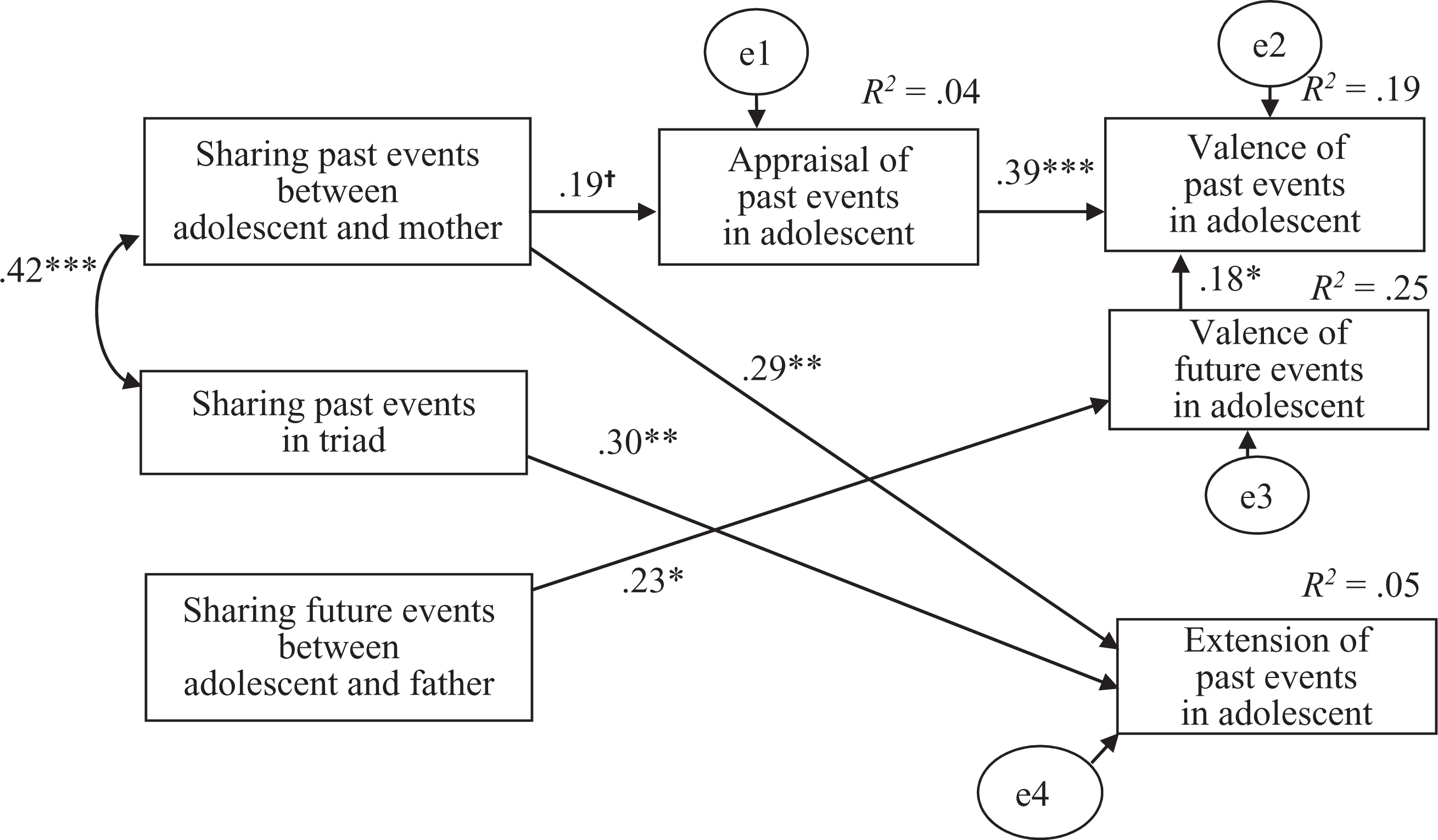
Influence of sharing life events on temporal extension and valence for adolescents.
For mothers, adequate goodness-of-fit indices confirmed the model, with these empirical estimates: χ2(19) = 13.42, p = .82, GFI = .97, AFGI = .94, RMSEA = .00, CFI = 1.00. As Figure 3 shows, a mother who shared more past events with an adolescent and with her partner showed a more positive attitude to the past. In contrast, a mother who shared more future events with an adolescent showed a shorter past extension. She also perceived their future events more negatively, which led to a more negative attitude toward the future. A mother who shared more future events with her partner showed more negative past events.
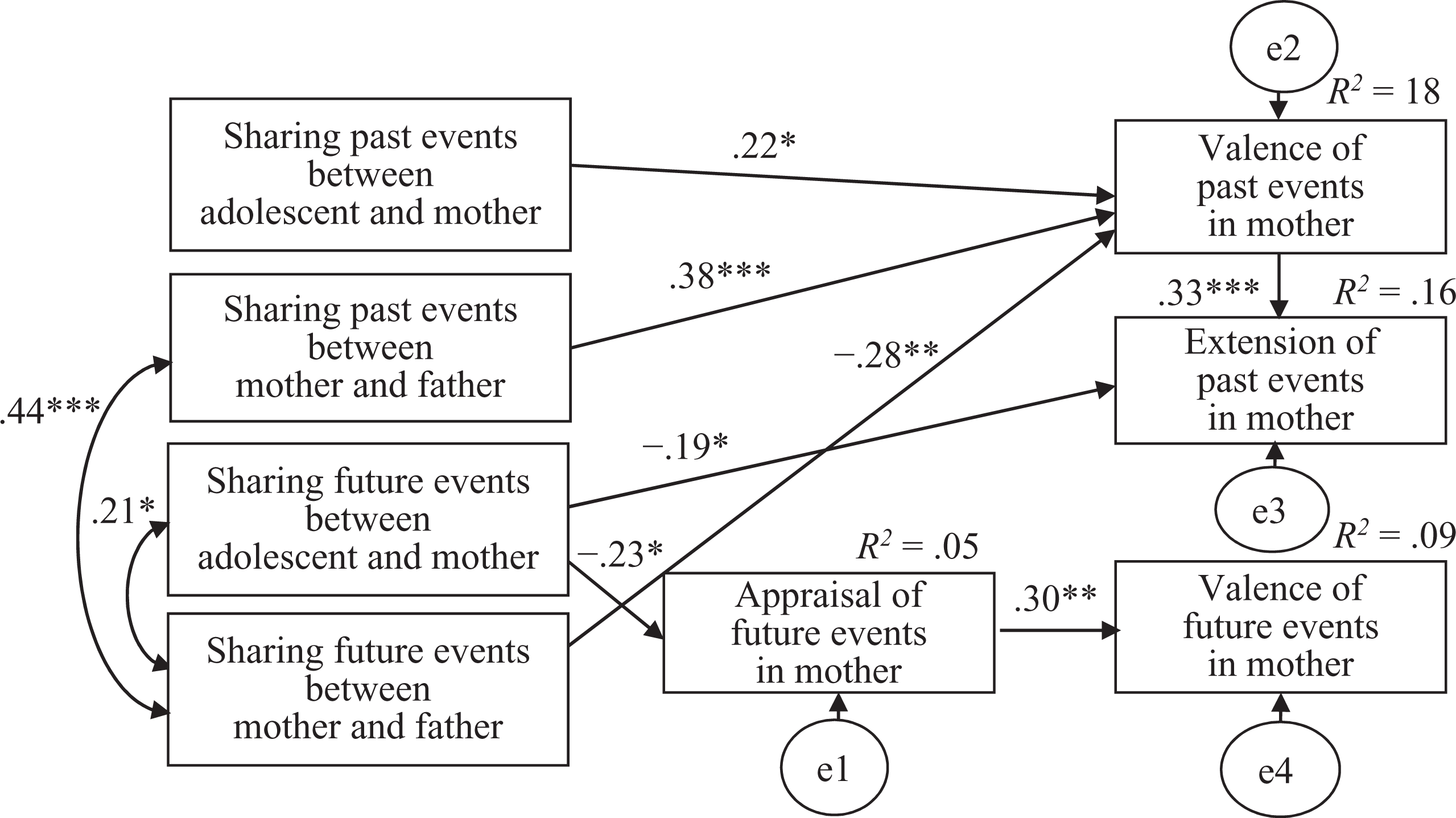
Influence of sharing life events on temporal extension and valence for mothers.
For fathers, adequate goodness-of-fit indices confirmed the model, with the following empirical estimates: χ2(23) = 28.81, p = .19, GFI = .94, AFGI = .88, RMSEA = .05, CFI = .97. As shown in Figure 4, a father who shared more past events with an adolescent perceived his future events more positively, which led to more positive past and future events and longer future extensions. In contrast, a father who shared more past events with both family members perceived his future events more negatively, leading to more negative past and future events and shorter future extensions. A father who shared more past events with his partner showed more positive past events and shorter past extensions. In addition, a father who shared more future events with his partner showed a more positive attitude toward the future.
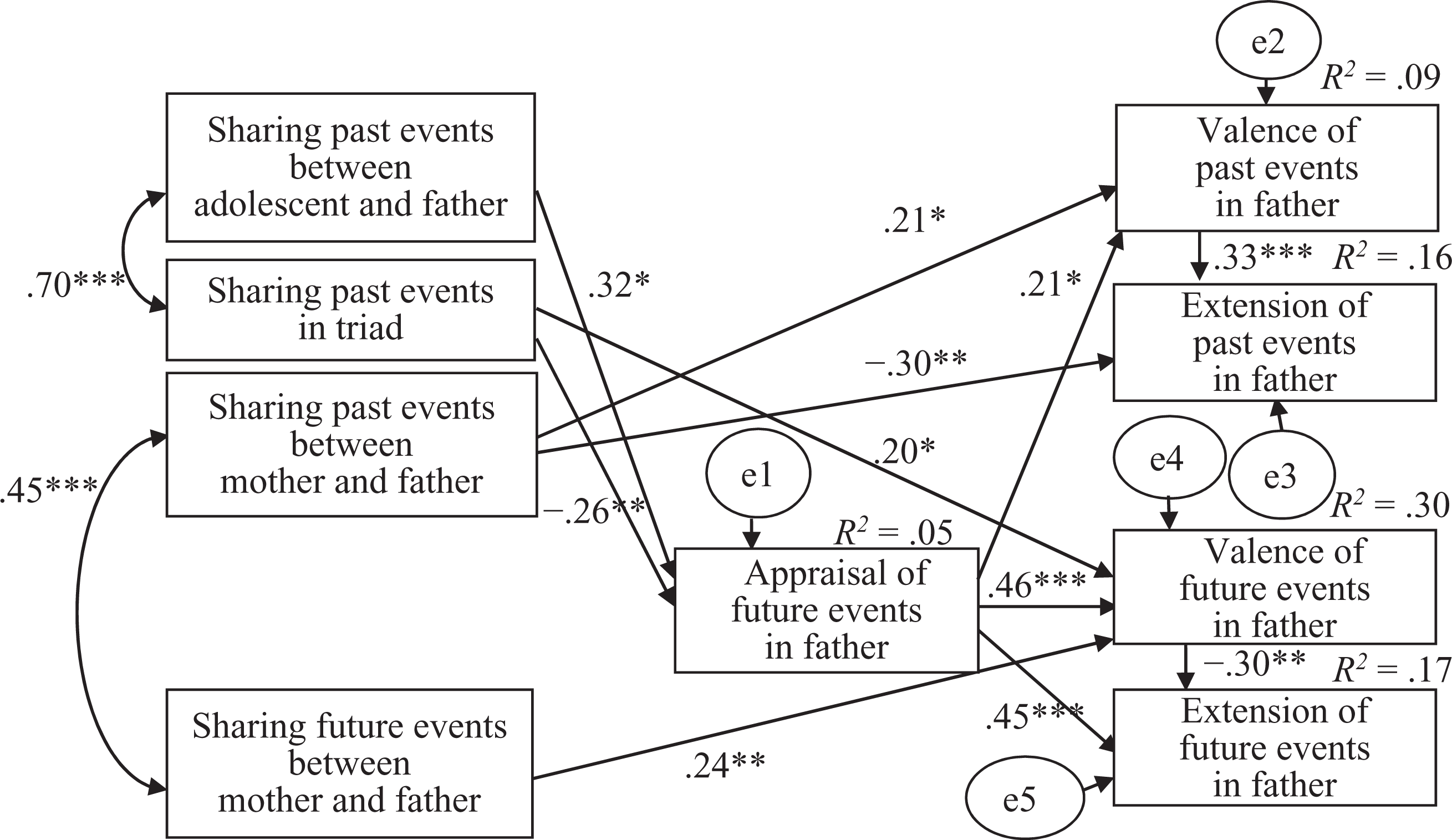
Influence of sharing life events on temporal extension and valence for fathers.
Discussion
This study is unique in using the triad data set and expanding the findings of previous research (Lanz et al., 2001; Scabini et al., 2006) in the direction impacting on parents and in the direction of the past.
First, we found that sharing not only the future but also the past predicted a positive impact on an adolescent’s personal time perspective. The most frequent life events shared in a family were normative life events, such as the daughter’s past birth and future marriage. These findings support our assumption that sharing the past and future creates a focus on normative life events, which generates for adolescents a more positive time attitude and longer temporal extension, not only into the future but also into the past. These results are consistent with previous research that focused on the future (Lanz et al., 2001) and provide new data that extends the scope of such research in the direction of the past. At the same time, the present results, indicating normative life events, demonstrate that the same mechanism underlies the impact of sharing on time perspectives, both in the past and in the future.
Second, middle-aged people showed a mixture of positive and negative evaluations in both directions, from the future to the past, and from the past to the future, which is a new finding that has not been demonstrated in previous studies.
Some of the findings in this study were expected; in the case of a mother, as expected, sharing the past predicted high quality for past time perspectives. Most shared past events, such as the birth of children and her own marriage, are of critical significance in adult development (Wapner & Demick, 2002) and are therefore normative life events for mothers. Perrig-Chiello and Perren (2005) suggest that middle-aged people who report normative transitions show a higher overall emotional valence for past transitions. For a father, as expected, sharing the future with his partner predicted high quality personal time perspectives. The future event most shared with his partner was the marriage of his daughter. A father’s sharing with a partner can develop a focus on normative life events, which creates a higher valence for future events. Thus, the results indicating a normative life event demonstrate that the mechanism that underlies sharing in adolescents might be available for sharing in parents.
On the other hand, there were also unexpected findings. For a mother, sharing the future with an adolescent and the spouse predicted a negative quality for past time perspectives. The most shared future event was the marriage of a daughter. Szpunar et al. (2013) suggest that future thinking involves remembering the content of simulated events. In line with this, the mother may remember her own experience of marriage when forecasting on the marriage of her daughter. Moreover, Schacter et al. (2013) argue that counterfactual simulations of what could have happened in the past – for example, thoughts about what “might have been,” regret, and related phenomena – may color the meaning of experience with negative emotion. Thus, the mother may associate the expectation of the daughter’s marriage with the possibility that she might have had a regrettable experience, although this is speculation on our part.
Fathers showed a pattern opposite that of mothers, shifting the focus from the past to the future. A father’s sharing of past events in a triad produced a positive valence for future events and negative appraisal of future events. The most frequently shared past event was the birth of the daughter. Karniol and Ross (1996) propose that positive autobiographical memories provide a positive future outlook. This suggests that when a father remembers positive past events – the birth of the daughter, he associates them with positive future events – the marriage of the daughter, for example. At the same time, the father makes a negative appraisal of a future life event that people usually evaluate positively. It may indicate that the future event is colored to be especially meaningful for him by remembering the past event. For example, the memory of the birth of the daughter may convey to a father something negative in the future, perhaps loneliness at the time she gets married.
Thus, the findings showed the dynamics of time perspective in midlife. It is consistent with the time perspective literature; Middle-aged people tend to construct time perspectives through more connections between the past and future than do adolescents (Higata & Okamoto, 2008; Higata & Saito, 2007; Shirai, 1997). Age difference is also indicated by the mental time travel literature arguing that older adults, more than younger adults, tend to make meaning while remembering the past or imagining the future (Gaesser, Sacchetti, Addis, & Schacter, 2011; Schacter et al., 2013). Schacter et al. indicate that older adults tend to be more focused on conveying the general significance and meaning of experiences, while younger adults tend to remember the past and imagine the future with more episodic detail.
In summary, the present results confirm the findings of previous studies (Lanz et al., 2001, Scabini et al. 1999) and provide new insight by expanding the focus of investigation from the future to the past and from simple parent-to-adolescent interactions to mutual interactions among adolescents and their parents, including supposal relationships. The findings also provide new information about the dynamics of time perspective in midlife.
Limitations
First, the data is very limited including only 104 triads and actually adolescents are only females. There may be a gender difference in sharing the past and future (Domene, Arim, & Young, 2007; Lanz & Rosnati, 2002; Scabini et al., 2006). Lanz and Rosnati reported that parental support promotes optimism in female adolescents, whereas this is not the case for males. Scabini et al. found that female adolescents are influenced by both parents; however, male adolescents are influenced directly only by the mother, who acts as a spokesperson in communicating the desires of both parents for their sons’ and daughters’ futures. Thus, larger samples including male adolescents should be examined to establish the generalizability of these findings.
Second, no information is given about the social economic status or the nuclear family; How many were divorced, how many were living with the parents, and how many were married, etc.; all background information is totally missing. Ways of sharing and its impact may vary according to the relationship status of adolescent participants, as well as their parents. Also, family dynamics includes interactions with siblings and also with grandparents. Furthermore, time perspective varies according to social class (Lamm, Scmidt, & Trommsdorff, 1976). Therefore, we need to examine how sharing varies according to the household structure or the life situation of adolescents and parents.
Third, the present study assessed the congruence of important life events that family members individually reported, and made comparisons between families with and without congruence. However, it did not examine the process of co-construction of the family time perspective and the process of making sense of an individual’s life events. Seginer (2009) points out the limitations of the use of congruence scores, which do not necessarily indicate co-construction through communication but only similarity of values among family members. Confirmation of these findings would require a combination of quantitative and qualitative research that more explicitly explores what adolescents and their parents communicate to one another in order to construct their personal and family life image together.
Finally, cultural variation is likely. Although this study shows the influence of the father’s expectations on his daughter’s sharing of the future in Japan, Western studies have reported a larger influence of the mother on her daughter (Scabini et al., 2006; Seginer, 2009). The spousal relationship might indicate those in the West are likely to emphasize the importance of exclusive spousal relationships, whereas the Japanese are likely to emphasize close ties between parents and children (Rothbaum, Rosen, Ujiie, & Uchida, 2002). Therefore, this topic could be extended to study cultural differences in the impact of sharing the past and future on the individual development of family members.
Conclusions and suggestions
Despite these limitations, this study is unique in going beyond an individualistic view of personal development to focus on shared time perspectives. Instead of referring to the impact of an individual’s view on another’s time perspective, we focused on the impact of sharing a view within a family on personal time perspective. This new approach illustrates how the dynamics of sharing has an impact on time perspectives, including both the past and the future, of all family members excluding siblings throughout their development.
Erikson (1964) calls mutuality “a relationship in which partners depend on each other for the development of their respective strengths” (p. 231), which may provide hope as well as effective and ethical human action. Thus, sharing the past and future can cause intergenerational exchanges that may create a future orientation. This orientation may help adolescents navigate the transition to adulthood and enable parents at midlife to change a crisis into a turning point, for example, in facing the loss of their own parents.
The strengths of the study are the triadic sample in a non-Western country and the examination of family dynamics, involving not only bi-directionality of adolescent and parental relationships but also mutuality in spousal relationships. We believe this is an important initial step in the understanding of the complexity of function of time perspectives in terms of family dynamics and development.
Clarification of the mechanisms underlying the impact of sharing life events on personal time perspectives can be accomplished by combining the findings of time perspectives studies (Lens et al., 2004; Nurmi, 2001; Nuttin & Lens, 1985) and mental time travel studies (Berntsen & Rubin, 2004; Szpunar, 2010). In addition, life-span development in the dynamics of time perspectives should be examined from holistic and systems-oriented perspectives (Wapner & Demick, 2002), including the examination of changing family structure in an intergenerational context.
Footnotes
Funding
This research received no specific grant from any funding agency in the public, commercial, or not-for-profit sectors.