







Abstract
Parental disciplining of their misbehaving children continues to draw much research attention. Baumrind’s typology of parenting styles has been frequently used to classify Chinese parenting as more authoritarian. Although influential, research tends predominantly to focus on abstract characterization. Yet, parenting is a practice informed by specific cultural ethnotheories and enacted in response to their children’s behavior in specific contexts. Our study attempted to explore this type of disciplining in situ. We interviewed 89 mothers from Taiwan (45) and Hong Kong (44) with children from near the end of infancy to beginning-school age. Mothers were asked to share their disciplinary strategies for handling four hypothetical yet common situations in which children misbehaved. These situations varied in setting, social distance among participants, possible consequences, nature of rules involved, and degree of conflict. We found five strategy types. Moreover, mothers prioritized them differently for different situations. Finally, we identified four ways of using strategies: single, contingent, simultaneous, or ratcheting-up. Depending on their strategies in a given situation, these uses also varied. We were compelled to conclude that Chinese parenting is more multi-faceted than has been typically portrayed in research. Implications for future research on parenting across cultures are discussed.
Extant research has demonstrated the importance of parenting styles in child development. Authoritative parenting, originally proposed by Baumrind (1971) and tested on Western samples, is related to better outcomes for children than authoritarian parenting style (Areepattamannil, 2010; Beato, Pereira, Barros, & Muris, 2016; Pinquart, 2015). Central to our study was this authoritarian style. We focused on parents’ need to discipline their children where negativity might be revealed. Specifically, we examined parents’ preferred disciplinary strategies and their respective executions.
Before describing our study’s rationale, it is necessary to review relevant extant research. Despite its influence, Baumrind’s (1971) typology of parenting styles may not fit non-European heritage parents. Chinese parenting is a case in point. Chinese parents have frequently been identified as more authoritarian in their parenting (Camras, Kolmodin, & Chen, 2008; Chua, 2011). Yet, counter to the predictions, Chinese children achieve relatively well academically (Duckworth, Gendler, & Gross, 2014; Organinization for Economic Co-operation and Development [OECD], 2012; Zimmerman, 2013), showing few ill effects supposedly attributable to authoritarian parenting.
Need for more detailed research on Chinese parenting
To address the above incongruence, researchers have made important advances. For example, Chao (1994, 2001) showed that Baumrind’s parenting typology did not accommodate Chinese parental values, norms, and practice. Instead, she proposed a reconceptualization of Chinese parenting as “guan” (governing) along with “jiaoxun” (training) that better explains the Chinese parenting style. Further research tackled topics of differences in controlling (e.g., Lai, Zhang, & Wang, 2000), varying benefits of parental authoritativeness to children in different cultures (e.g., Chen, Dong, & Zhou, 1997; Leung & Kwan, 1998; Ren, 2015), and effects of maternal versus paternal parenting styles in Chinese families (Chen, Liu, & Li, 2000; Shek, 1995). Other research finds Chinese parenting to be more authoritarian due to the widespread cultural endorsement of such a style. Accordingly, authoritative parenting is linked to better socioemotional adjustment among Chinese children, whereas authoritarian parenting to greater maladjustment (Chen et al., 1997, 2000; Ren, 2015).
While acknowledging the progress of this research, we still see two persisting obstacles that may impede greater understanding of Chinese parenting. First, research has predominantly focused on the single but dichotomous type to capture Chinese parenting, characterizing Chinese parenting style as either authoritarian or authoritative. When the general type is the focus, the particularities of parenting as anchored in concrete sociocultural contexts are less considered. Yet, parenting is a practice that unfolds on the ground in specific sociocultural contexts that cannot be reduced or condensed to an abstract or single dimension. The particularities also need to be examined.
Second, this general, abstract tendency is coupled with the predominant empirical method relying on Likert scales with premade statements for parents or older children to fill out, followed by factor analysis. Despite its utility (Cheah & Rubin, 2004), this empirical approach is more likely to classify a given parent as belonging to only one type (Kim, Wang, Orozco-Lapray, Shen, & Murtuza, 2013; Nelson et al., 2006). Yet, conceptually, given how many sociocultural contexts a given parent encounters daily (e.g., eating meals together vs. child playing with peers) and how complex each social context is, it is more sensible to also entertain parenting as responding to contextual demands in situ, often unexpected and chaotic in nature. Thus, our study attempted to examine such parental responses. To document them, we compared parents’ preferred disciplinary strategies as a function of specific contexts.
Chinese cultural values, parenting ethnotheory, and disciplinary practice
Contexts are not stand-alone but embed cultural values and practices that exert a normative force on parenting. It is a force because cultural norms express the standard belief system and way of life embraced by its members (D’Andrade & Strauss, 1992; Harkness & Super, 1996; Shweder, 2011). Endorsing one’s cultural values and way of life is often a process of internalization one undergoes via one’s own upbringing (Legare, Wen, Herrmann, & Whitehouse, 2015). Once internalized, cultural norms hold taken-for-granted power over its members with their willing observances. C.-Y. Li (2008) further argues that cultural values are configurations so that they occur not as a singular notion but a set of interrelated beliefs endorsed by the members.
Under cultural influence, parenting has generally been theorized as parents’ knowledge/beliefs and practice (Bornstein, 2006). The former, also viewed as ethnotheories (Harkness & Super, 1992), concerns what parents know and believe about children and childrearing. Practice is what parents actually do to socialize their children, generally, guided by their ethnotheories.
Relevant to our study are the following Chinese cultural values, parenting ethnotheories, and general practice: (1) an age-differentiated and generation-based moral order of authority and duty in the family, (2) differentiation between inside and outside settings and associated moral implications, and (3) “guan” as a basic parenting practice. Regarding (1), Chinese culture operates on the so-called role ethics (Ames, 2011; Ames & Rosemont, 1998). Each family member has his or her roles—mother, father, child, and sibling. A given member routinely assumes multiple roles (e.g., a daughter is also a sister), and each role comes with responsibilities and privileges (J. Li, 2016). As a parent, one has the duty to care for children with utmost dedication—“tender love” (慈爱). Parents are also charged to teach and guide children toward becoming a better person (Tu, 1985). Children are expected to heed and accept such parental prerogatives (Fung, 1999; J. Li, Fung, & Chen, 2014). In close family and extended kinship (J. Li et al., 2008), a given parent’s measure of discipline is observed, concerted, and even countered by other family members (Fung & Chen, 2001; Miller, Fung, Lin, Chen, & Boldt, 2012; Miller, Wiley, Fung, & Liang, 1997). Thus, parenting is held accountable to the entire family/kin network.
Regarding (2), Chinese culture also differentiates inside from outside settings, with the former enjoying intimate relationships and the latter not (J. Li, 2012). Parenting also proceeds accordingly, more relaxed in the former setting but vigilant and effortful in the latter (Fung, 1999). Different settings call upon disciplining with varying intensity.
Finally, Chao’s empirical evidence for “guan” (1994) attests directly to the Chinese parenting charge as outlined by Confucianism for millennia. Accordingly, parents are expected to monitor their children constantly. They are charged to discipline their misbehaving children. Parents who perform this charge dutifully are admired and emulated. Those who fail may face not only the family’s reprimand but also the community’s disapproval and reproach.
Yet, parenting does not proceed robotically according to these values and practices. Because daily life does not usually follow parents’ wishes but proceeds often unpredictably, parents need to evaluate each situation and take appropriate action. Depending on the kind and severity of transgression committed by the child as well as on the particularities of the context and sociality (i.e., who is present), parents may select different strategies to use simultaneously and contingently to achieve the disciplinary goal. In sum, to better understand Chinese parenting, it is necessary to regard parental discipline not as isolated events that involve parent and child alone, but as events situated in sociocultural contexts. We argue that parental concerns and decisions in disciplinary encounters are flexible, mutually interactive, and setting-dependent under cultural influence.
The present study
Based on research reviewed above and cultural values, ethnotheories, and parenting practice in situ, we pursued the following two research questions: (1) Assuming that they do not favor a uniform disciplinary strategy for all contexts, then what types of strategies do Chinese parents prefer for disciplining their misbehaving children in different contexts? In other words, we sought to compare parental disciplinary responses to commonly occurring but different contexts. (2) If parents use different strategies for different contexts, how do they prefer to use these strategies? Question 2 explores different ways parents may discipline their children, given multiple strategies they can select for different contexts. In short, we focused on within-culture and within-parent disciplining across different contexts. To address these research questions, we adopted an empirical approach to approximate practice in situ: presenting mothers with situations that depicted commonly occurring child misbehaviors. To ensure greater validity, we used an open-ended method to elicit parents’ own responses.
We were particularly interested in parental disciplining that involved children from near the end of infancy through early school-age for two reasons. First, previous research shows that Chinese parents discipline misbehaving children at the age of about 2 years (Fung, 1999). As children grow, parental disciplining increases (Ho, 2009; Wu, 1996). Second, children of this age range tend to misbehave more as a function of less-developed cognitive, social, and emotional competence (Lightfoot, Cole, & Cole, 2013; Wellman, Fang, Liu, Zhu, & Liu, 2006). As parental disciplining occurs more, they are more ready to access their thoughts and preferences.
For our research question (1), we hypothesized that mothers would prefer varying disciplinary strategies in response to different contexts. Depending on the contextual particularities and culturally-informed guidance, mothers might find certain strategies more suitable. Regarding our research question (2), we predicted that mothers would not employ their strategies mechanically but judiciously suitable to contextual demands.
Methods
Participants
A sample of 89 mothers of young children from Taipei, Taiwan (n = 45) and Hong Kong (n = 44), all Chinese in ethnicity, were recruited through local preschools. All but one of the Taiwan (TW) mothers were born and grew up in TW with nearly all TW fathers (96%) born and raised in TW. Most Hong Kong (HK) mothers were born and grew up in HK (80%) with 20% from other East Asian countries. Most HK fathers were born and grew up in HK (79%) with 21% from other East Asian countries. Table 1 presents the remaining demographic information.
Demographic data of the sample with means and standard deviations (N = 89).
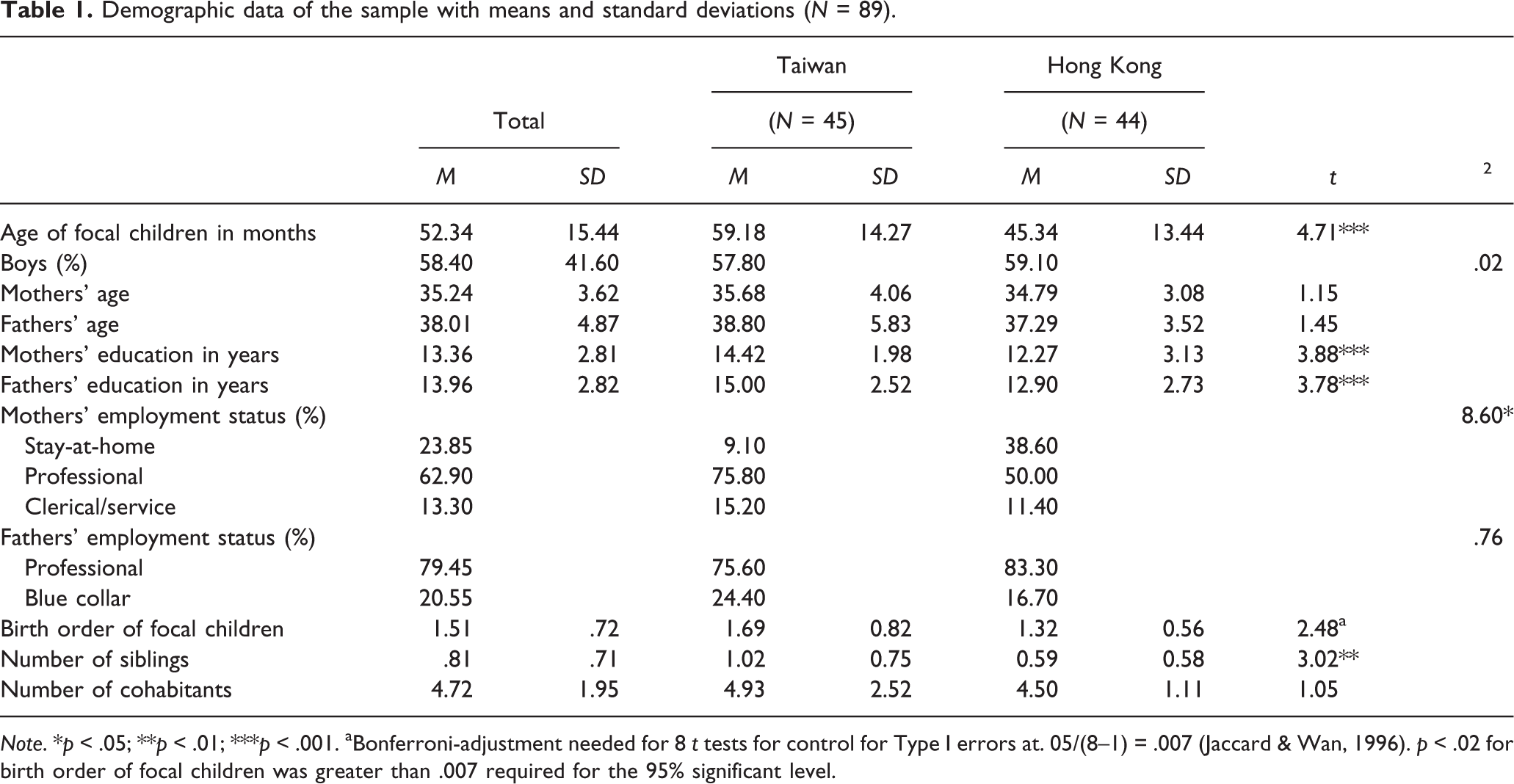
Note. *p < .05; **p < .01; ***p < .001. aBonferroni-adjustment needed for 8 t tests for control for Type I errors at. 05/(8–1) = .007 (Jaccard & Wan, 1996). p < .02 for birth order of focal children was greater than .007 required for the 95% significant level.
TW and HK are similar both in economic development and social and political climate. Despite their colonial history, they still retain their Chinese cultural heritage (Fok & Shek, 2011; Fung, 1999). Although five out of 11 demographic indicators differed between TW and HK, one variable, number of siblings, was correlated only once with one strategy type across all four situations. Both parents’ education was correlated with some but not all strategy types and uses in individual situations. Thus, only two such indicators mattered in the end, and we controlled for their effects in our subsequent analyses. We therefore combined the two samples into a single cultural group. Maternal employment was not used as an additional covariate because it was strongly correlated with maternal education (r = .34, p < .01).
Children’s age was divided into three age groups: youngest (1 year 2 months–3 years 6 months, M = 34.65 months, SD = 7.33), middle (3 years 7 months–4 years 11 months, M = 51.12 months, SD = 4.87), and older (5 years–6 years 6 months, M = 68.97 months, SD = 4.83). This division was based first on the well-documented tendency that children younger than 3.5 years have a less matured theory of mind required for understanding others’ minds (Wellman et al., 2006). The middle group is the age where children’s cognition, although increased, is still less consistent for understanding complex social/moral situations. The older group is more mature and the beginning school age in both regions. These ages have been treated commonly as groups rather than continuous according to developmental theory on discontinuity (Sobel & Letourneau, 2015; Wellman et al., 2006). Furthermore, in Chinese ethnotheory, parenting is also more lenient toward the youngest group, increased for the middle group, but more strict for the older group (Ho, 2009; Wu, 1996).
Design of four hypothetical situations
To address our research questions, we used hypothetical situations of children’s misdeeds to elicit mothers’ disciplinary responses, a method commonly employed in developmental research (e.g., J. Li, 2015; Reid & Valsiner, 1986). We chose this paradigm to avoid real situations that might arouse mothers emotionally when faced with their children’s misbehaviors. Researchers strive to capture parenting for real-time in situ. However, if mothers become emotionally aroused, it would be difficult for them to report their parenting calmly, therefore reducing data accuracy. We note that, although hypothetical, these situations were drawn from parents’ routine encounters with their children.
Based on previous research, we designed children’s misdeeds in four situations along five dimensions: (1) setting, (2) social distance among participants, (3) rules involved, (4) possible consequences, and (5) degree of caregiver–child conflict (see Appendix A for the full list of these situations: Acting up at dinner, Refusal of medicine, Tantrum at a supermarket, and Hitting mother in front of a guest).
Table 2 presents these dimensions across the four situations. Generally, private and public settings are important to consider. Since Chinese culture especially differentiates inside from outside settings, parental sensitivity to this distinction is likely more heightened (Fung, 1999). At home, in private, Chinese are more relaxed, open, and direct with each other than in public (Paulhus, Duncan, & Yik, 2002).
Conceptual features of the four hypothetical situations.
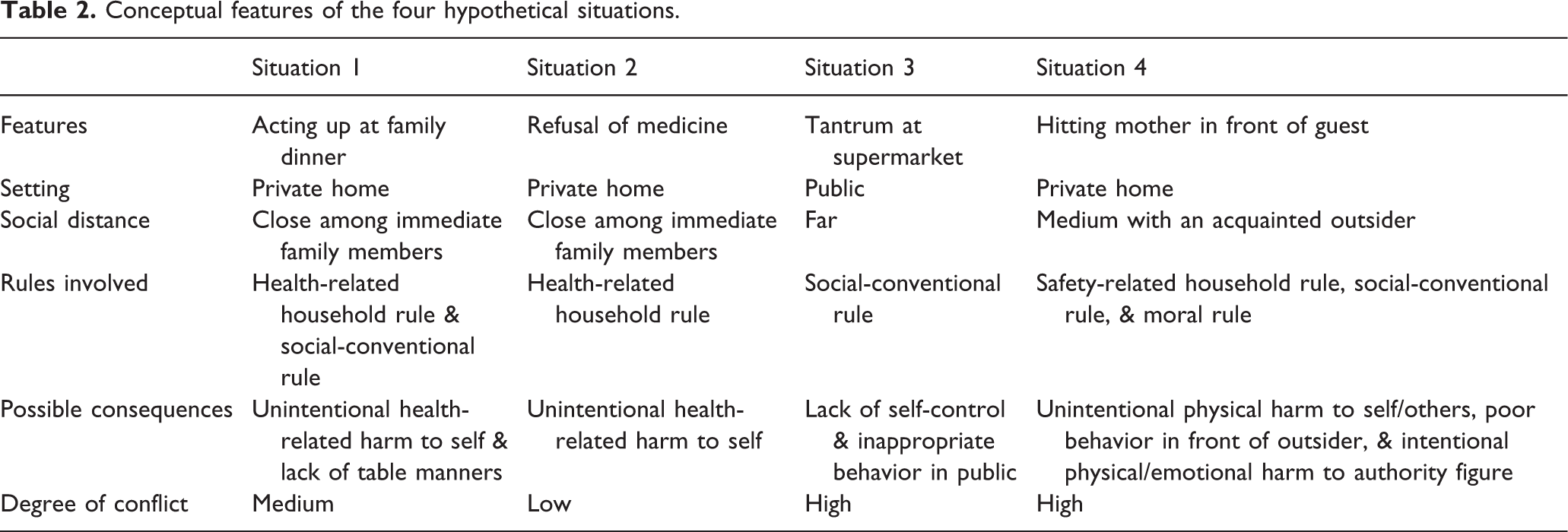
Closer social distance may also make Chinese mothers more relaxed due to fewer negative judgments and more forgiving family reactions. In contrast, greater distance may alert mothers more to their need for stricter parenting of their misbehaving children (Fung, 1999; J. Li et al., 2014). Both Situation 1 (hereafter S1, S2, S3, and S4) and S2 occur at home with immediate family members, thus in closer social distance, but involving different rules and consequences.
Regarding the rules, there are at least three kinds: social-conventional, moral, and household. Social-conventional rules refer to offenses in social order, customs, norms, and so forth that define appropriate behavior in interpersonal interactions (e.g., table manners). Moral rules concern justice, fairness, and welfare that apply to everyone and are regarded as most serious (Smetana, 2013). Examples include intentional physical and psychological harm to others and the self. Household rules often serve to protect the child or others from unintentional physical, material, and psychological harm that are enforced by family members.
In disciplinary encounters, caregiver–child conflict is inevitable. Given harmony as a long-standing Confucian outlook (C.-Y. Li, 2013), conflict violates this basic orientation and is a high-stress producer, which may lead to embarrassment of the other and the self (Gao, 1998). In high conflict, parents may choose strategies such as deliberate ignoring, acquiescence, or simply no response to avoid confrontation and achieve their goals more effectively (Chang, 1999).
In S1, inappropriate eating behavior (e.g., causing unbalanced diet) and poor table manners might violate both a health-related household and a social-conventional rule. In S2, refusal of medicine may violate unintentional health-related harm to the self. In S3, demanding that the mother buy a toy and making a public spectacle may violate a social-conventional rule with moral implications in Chinese culture (Hwang, 2006). In S4, taking scissors may violate a safety-related household rule against unintentional physical harm to the self and/or others. The child’s aggression may result in intentional physical/emotional harm to the mother, which may break both social-conventional and moral rules.
S3 and S4 were designed as more serious than S1 and S2. Hence, the mother–child conflict in S3 and S4 was also higher than S1 and S2. Comparatively, S2 represented the lowest conflict. We expected the strategy types mothers prefer would vary along these situational factors.
Procedure
The interview was semi-structured for about 1.5 hours with HK mothers interviewed in Cantonese and TW mothers in Mandarin. Mothers were free to respond to each situation with as many strategies as she wished. For vague and brief responses, we asked mothers to clarify or elaborate. At the end, we obtained the family demographic information, the child’s developmental history, and daily routines. We transcribed verbatim and double-checked each interview with two native speakers.
Data coding
We generated major themes and categories for both types and uses of strategies based on available research (Grusec, 1997). We also adopted the qualitative method of careful and multiple readings of the transcripts (Berg, 1998).
Types of strategies
The mothers initially reported a total of 820 strategies across the four situations. Given our relatively small sample size, we analyzed five conceptually grouped types that had a response rate of at least 15% (Smetana et al., 1999). We describe the definition and distribution of each and its subtypes below.
Power Assertion (PA, 38.6% to 55.2% across the 4 situations, M = 47.63% of the response rate, hereafter percent only). PA referred to parental command/demand for immediate compliance without any explanation with five subtypes. “Withdrawal of privileges” indexed maternal prohibition of the child’s desirable activities (e.g., watching TV). “Forced appropriate behavior” referred to maternal demand of immediate compliance or forceful removal of the child from the spot. “Verbal punishment” concerned scolding/yelling at the child. “Physical punishment” contained hitting, spanking, or “fixing (xiuli)” the child. “Threats,” verbal or nonverbal (e.g., staring), made the child comply by fear.
Reasoning (RS, 31% to 47%, M = 38.87%) contained two subtypes: “Matter-of-fact induction” involved reasoning on the consequences of the child’s behavior, rules, or norms for compliance (e.g., “medication makes you healthy”). “Other-oriented induction” referred to awareness of consequences of the child’s transgression on others (e.g., “hitting Mommy upsets her”).
Conflict Avoidance (CA, 13.1% to 54.4%, M = 38.28%). Mothers endorsed strategies that avoided conflict with the child with six subtypes. “Distraction” indexed maternal attempts to redirect the child’s attention from the ongoing event (e.g., “let’s go and eat something delicious”). “Bargaining” involved explicit promise of a reward later in exchange for the child’s cooperation (e.g., “If you behave well, I’ll buy a toy for you”). “Playing a game” captured turning the child’s transgression in playful ways (e.g., singing a song to the child). “Partially satisfying the child’s needs” dealt with maternal offering of compensations such as material reward (e.g., buying an ice cream instead of the requested toy). “Positive reinforcement” contained maternal coaxing the child into acceptable behavior (e.g., hugging). “Offering alternative choices” involved giving the child alternatives to choose from to lure him/her away from misbehaving (e.g., taking the medicine).
Isolation (IO, 0% to 29.9%, M = 15.15%) had two subtypes. “Ignoring” tallied deliberately ignoring the child (e.g., “if he wants me to feed him, I’d pretend not to see him”). “Separation” created a “space to reduce tension” that allowed the child to calm down (e.g., “remove my child from the scene to a quiet corner”).
No Reaction (NR, 1.2% to 23%, M = 8.83%). Not viewing the transgression as serious, mothers did not believe any disciplining was necessary (e.g., “I’d let her be if she doesn’t want to eat at the table”). Note that we analyzed NR because its frequency for S1 reached 23%, despite the overall mean of 8.83%.
Uses of strategy
Because mothers also spontaneously offered explanations for how they would use their strategy types in various ways, we established four recurrent uses of strategies.
Single (39.5% to 61.6%, M = 47.73%) captured when the mother used a strategy as a stand-alone approach in a given situation without using other strategies. Simultaneous (12.3% to 38.2%, M = 25.53%) indexed two or more strategies used simultaneously. For example, for S3, “I’d tell him that we already have the toy at home (coded as RS). I’d ignore him (IS)…tell him I’ll get another toy for him, so that he’d have hope (CA).” Contingent (6.2% to 36.6%, M = 20.85%) captured evaluations mothers would make about the context before choosing strategies. Accordingly, different contexts would call for different strategies (e.g., child’s mood, behavior, and the desired object). Conjunctions mothers often used were “when…happens, I’d…; but if she…, I’d…; and I’d…depending on…” For example, for S1, “Sometimes I’d be more lenient. If she doesn’t want to eat dinner, I’d let her run away (NR). If we cajole her, I’d give her a favorite drink…” (CA). Ratcheting-up (12% to 24.1%, M = 15.88%) indicated disciplinary steps, specifically, when the first strategy failed. Mothers would choose another one. For example, for S4, “I’d scold him…(PA). If scolding doesn’t work, I’d punish him. If he still won’t stop, I will warn him about spanking (PA). And if he still won’t listen, I’d really spank him” (PA). Ratcheting-up included both increasingly punitive and encouraging strategies, for example, “I would ask him to sit down and eat (PA). If he doesn’t listen, I’d say ‘I’ll sing a song for you if you eat faster’” (CA).
The five types and four uses of strategies were then used for reliability coding for the two respective datasets. Two native Chinese speakers, unaware of the study hypotheses, independently coded 20% of randomly selected data from the sample, following a procedure developed by Shaver, Schwartz, Kirson, and O’Connor (1987) and refined by Li (2004) for coding qualitative data. Inter-coder reliabilities for both types of strategies and uses of strategies were at the excellent level, Cohen’s kappa = .86 (Bakeman & Quera, 2011). For actual coding, we counted the number of occurrences in each mother’s interview, excluding identical strategy types and uses for the same detail.
Results
Types of strategies
Overall, most mothers reported the first four types of strategies. PA had the highest frequency (91.4%), followed by CA (85%), RS (71.8%), IS (50.6%), and NR (29.9%). The column “Total” (Table 3) presents the sums of means of these five variables across the four situations. A repeated measure analysis with the five strategy types as the within-subject variable, three age groups as the between-subject variable, and the correlation between NR and fathers’ education (r = .32, p < .01) as a covariate yielded a main effect for Type of Strategy, F(2, 73) = 3.99, p = .004, η2 = .05, adjusted Ms = 2.47, 1.92, and 1.59, .62, and .35 for PA, CA, RS, IS, and NR, respectively, with no main effect for Age and interaction. This finding indicates that across all four situations, mothers named PA more often than the other types.
Mean frequencies and standard deviations (in parentheses) for types of strategies by age.
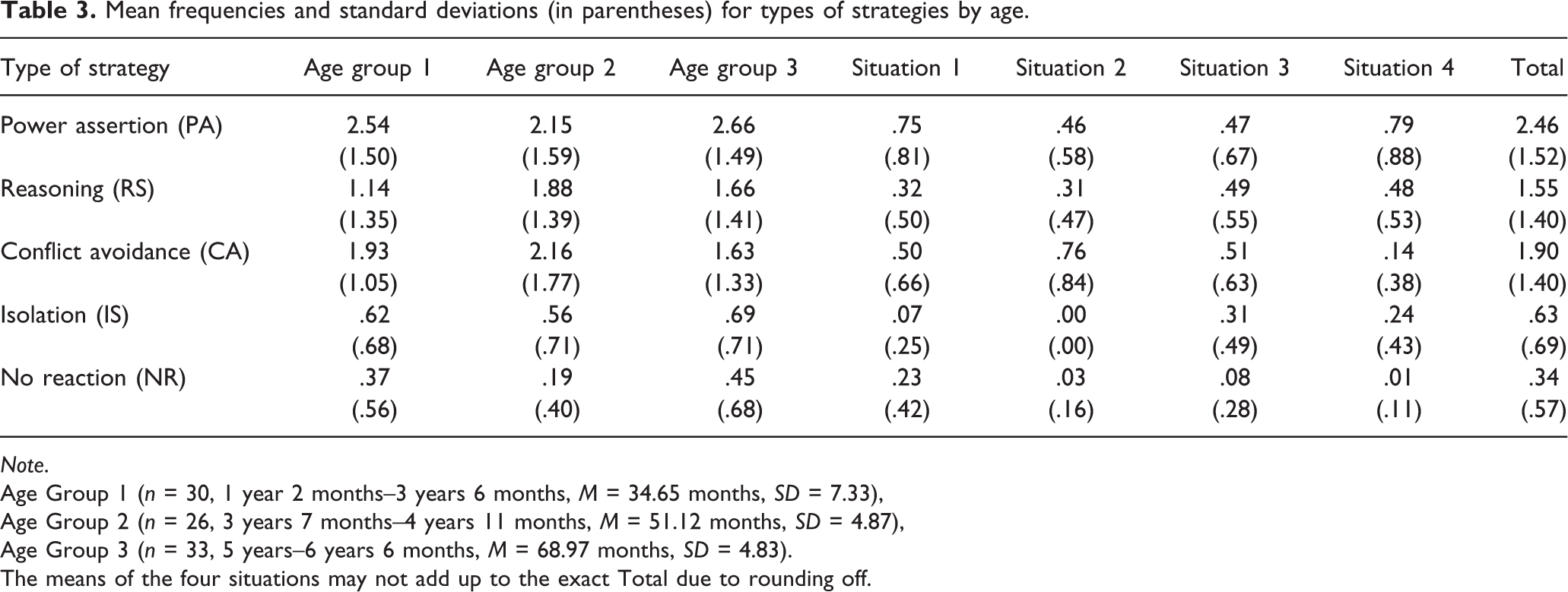
Note.
Age Group 1 (n = 30, 1 year 2 months–3 years 6 months, M = 34.65 months, SD = 7.33),
Age Group 2 (n = 26, 3 years 7 months–4 years 11 months, M = 51.12 months, SD = 4.87),
Age Group 3 (n = 33, 5 years–6 years 6 months, M = 68.97 months, SD = 4.83).
The means of the four situations may not add up to the exact Total due to rounding off.
For estimating the effects of three demographic variables that differed significantly between the TW and HK groups (mothers’ and fathers’ education and the number of siblings. Note that children’s age was used as an independent variable) as well as children’s sex, we ran correlational analyses with the five sums of strategy types. We found only one correlation: NR with fathers’ education (r = .32, p < .01) and controlled for it in our subsequent analyses. A further MANCOVA found no main effects for Age on the five strategy types pooled over the four situations.
We also performed correlational analyses between these demographic variables with strategy types for each situation. For S1, we found two correlations: both mothers’ and fathers’ education with CA (r = .28, p < .05) and NR (r = .28, p < .01), respectively. For S2, children’s sex correlated with PA (r = −.28, p < .05). For S3, fathers’ education correlated with NR (r = .23, p < .05). And for S4, there were three correlations between mothers’ education and PA (r = −.22, p < .05) as well as CA (r = .28, p < .05) and between fathers’ education with CA (r = .31, p < .01). Similarly, we controlled for these effects in our subsequent analyses.
To address our first research question on types of strategies, we performed four repeated measures analyses for the four individual situations with Type of Strategy as the within-subject variable, Age as the between-subject variable, controlling for demographic effects. We found a number of main and interaction effects for Type of Strategy, but no between-subject main effects for Age.
For S1, because IS had a very low mean (.07 in Table 3), we analyzed only the remaining four strategy types. We found a main effect for Type of Strategy F(2, 84) = 3.44, p = .02, η2 = .04, adjusted Ms = .75, .32, .50, and .23 for PA, RS, CA, and NR, respectively, but no main effect for Age. This finding indicates that mothers preferred PA more for S1 than the remaining strategies. However, this main effect was qualified with an interaction between S1 Type of Strategy and Age. A simple 1-way ANOVA test showed no other interactions but RS that differed significantly between the youngest group and the oldest group F(2, 84) = 2.87, p = .05, η2 = .04, Ms = .17 and .47 for G1 and G3, respectively. Mothers named RS more for handling the oldest children than the youngest.
For S2, we analyzed only three strategy types: PA, RS, and CA because NR had a low mean score of .03 while IS had no score. We found a main effect for Type of Strategy F(2, 71) = 3.55, p = .03, η2 = .05, adjusted Ms = .46, .31, and .76 for PA, RS, and CA, respectively, but no main effect for Age and interaction. This finding indicates that mothers chose CA more frequently than the other two strategies.
For S3, we analyzed only PA, RS, CA, and IS without NR due to its low mean score of .08. We did not find any main effect for Type of Strategy or Age, but an interaction between the two F(2, 80) = 3.04, p = .007, η2 = .071, adjusted Ms = .46, .49, .51, and .31 for PA, RS, CA, and IS, respectively. This indicates that mothers named all four strategies more or less equally. A simple 1-way ANOVA test showed that mothers named PA more frequently for the oldest group than the youngest group, F(2, 80) = 3.45, p = .05, η2 = .08, Ms = .72 and .36, respectively. Furthermore, mothers also favored CA more for the youngest group than oldest group, F(2, 80) = 3.31, p = .05, η2 = .08, Ms = .68 and .28, respectively.
For S4, we analyzed only three strategy types: PA, RS, and IS, without CA and NR because of their low mean score of .14 and .01, respectively. We found a main effect for Type of Strategy F(2, 81) = 5.65, p = .004, η2 = .07, adjusted Ms = .79, .48, and .24 for PA, RS, and IS, respectively, but no main effects for Age and interaction. Mothers chose PA more than the other two strategies.
Uses of strategies
To address our second research question on maternal strategy use, we first pooled overall all four strategy uses and found that 100% of the mothers reported using at least one of the four ways (single, simultaneous, contingent, and ratcheting-up). Among them, 78.7% used two, 43.8% used three, and 7.9% all four. In Table 4, the column “Total” presents the sums of means of single, simultaneous, contingent, and ratcheting-up use across the four situations, respectively. Single use had the highest mean, followed by simultaneous, contingent, and ratcheting-up use.
Mean frequencies and standard deviations (in parentheses) for uses of strategies by age.
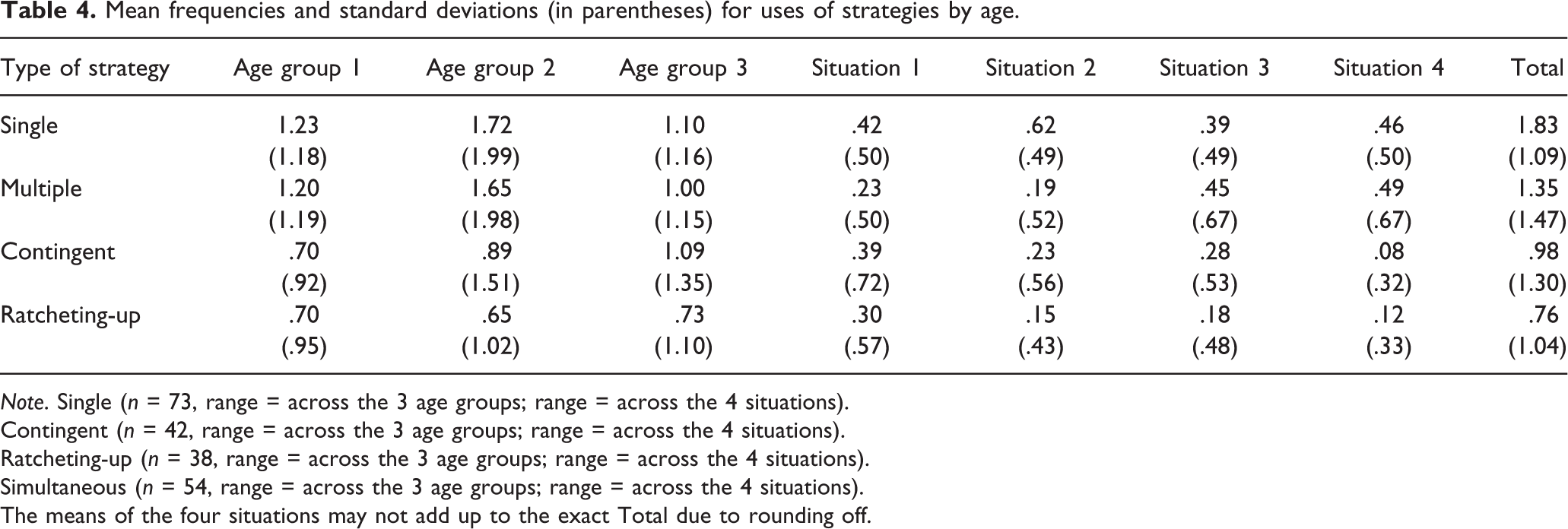
Note. Single (n = 73, range = across the 3 age groups; range = across the 4 situations).
Contingent (n = 42, range = across the 3 age groups; range = across the 4 situations).
Ratcheting-up (n = 38, range = across the 3 age groups; range = across the 4 situations).
Simultaneous (n = 54, range = across the 3 age groups; range = across the 4 situations).
The means of the four situations may not add up to the exact Total due to rounding off.
We followed a similar approach for estimating effects. Accordingly, we ran correlational analyses between the three demographic variables that differed significantly between the TW and HK groups as well children’s sex and the sums of means of the four strategy uses across the four situations. We found four significant correlations: single use with both parents’ education (rs = −.24 and −.27, ps < .05, respectively) and contingent use with both parents’ education (rs = .32 and .34, ps < .01, respectively). A repeated measure analysis with Use of strategy as the within-subject variable, age as the between-subject variable, controlling for both parents’ education yielded a main effect for Uses of Strategies, F(2, 74) = 8.15, p = .000, η2 = .10, adjusted Ms = 1.83, 1.38, .95, and .75 for single, simultaneous, contingent, and ratcheting-up, respectively, but not for Age and interaction. This finding indicates that across all four situations, mothers preferred single and simultaneous use more often than the other two ways. A further MANCOVA found no main effects for age on the four strategy uses pooled over the four situations.
Next, we performed correlational analyses between these demographic variables with the strategy uses for each situation. Children’s sex and number of siblings were not correlated with any strategy use. However, for S1, we found four correlations: both mothers’ and fathers’ education with single use (rs = −.27 and −.28, ps < .05, respectively), both mothers’ and fathers’ education with contingent use (r = .30, p < .01) and (r = .24, p < .05), respectively. For S2 and S3, fathers’ education was correlated with contingent use (r = .32, p < .01, r = .23, p < .05, respectively). For S4, there were no correlations. As before, we controlled for these effects.
To further determine how mothers specifically preferred the four strategy uses, we performed another set of four repeated measures analyses for the four respective situations with Use of Strategy as the within-subject variable, Age as the between-subject variable, controlling for significant demographic effects. We found three main effects for Use of Strategy, but no between-subject effects for Age.
For S1, we found a main effect for Use of Strategy F(2, 81) = 3.95, p = .009, η2 = .05, adjusted Ms = . 43, .24, .41, .31, and for single, simultaneous, contingent, and ratcheting-up use, respectively, but no main effect for Age and interaction. The significant main effect indicates that mothers conveyed single and contingent uses more than the other uses. For S2, we found a main effect for Use of Strategy F(2, 70) = 4.30, p = .006, η2 = .06, adjusted Ms = .62, .20, .23, and .15 for single, simultaneous, contingent, and ratcheting-up use, respectively, but no main effect for Age and interaction. The significant main effect indicates that mothers conveyed single use more than the other uses. For S3, we found no main effect for Use of Strategy, Age, or interaction, adjusted Ms = .39, .47, .28, and .18 for single, simultaneous, contingent, and ratcheting-up use, respectively. This finding indicates that mothers preferred these four ways similarly. Finally, for S4, we found a main effect for Use of Strategy F(2, 74) = 12.17, p < .000, η2 = .14, Ms = .37, .50, .09, and .13 for single, simultaneous, contingent, and ratcheting-up use, respectively, but no main effects for Age and interaction. Mothers were more likely to use simultaneous strategies to handle their children than the other three ways.
Discussion
This study was conducted to look at Chinese parental disciplining as a function of specific contexts to go beyond the predominant conceptual framework focusing on general parenting styles (Baumrind, 1971). We also employed mixed methods to broaden the empirical scope. We asked (1) what strategies mothers faced with their misbehaving children in different situations would use and (2) how they would use their many strategies. With open-ended methods, we collected data that enabled us to answer these questions.
In line with our predications regarding our first research question, we found five types of strategies: PA, RS, CA, IS, and NR. Furthermore, the first four types had subtypes: PA with five, RS with two, CA with six, and IS with two, totaling to 15 types of strategies. Each of these types was a concrete technique that mothers revealed as part of their disciplinary repertoire from which to select appropriate strategies to use for a given misdeed. Whereas PA and RS have been featured centrally in Baumrind’s typology, corresponding to authoritarian and authoritative style, the other three types seem more culture-specific. As stated previously, CA is a common response to conflict in Confucian-heritage cultures. It was not surprising that CA was the second most often chosen strategy across the four situations. Similarly, IS and NR also emerged as two additional strategy types. Although mothers reported PA more often than the other types, their situation-specific choices offered a more nuanced landscape.
For S1, supporting our hypotheses, mothers preferred PA more than the other strategies. IS was rarely chosen because the disciplinary goal was to make the child comply with better table manners. As stated previously, guiding children is not just the mother’s solitary charge; the entire family is involved. Isolating the child from the family dinner would counter this Chinese childrearing norm. Also supporting our hypothesis, mothers were sensitive to children’s age. They reasoned more with the oldest children than the youngest ones, thus displaying an adjustable style according to age. Various PA techniques may be more appropriate and effective to make the child comply.
For S2, mothers favored CA over PA and RS, while rarely NR and not at all IS. Age did not seem to matter here. This finding confirms our hypothesis that parents in Confucian-heritage cultures tend to avoid conflict for a situation where the goal is to motivate children to take medicine for their own health. Although the child was misbehaving, harsh punishment would be inappropriate because the child’s behavior was not really wrong morally or conventionally. Hence, the other strategies might be less suitable. Instead, CA would allow the mother to maintain a congenial relationship with the child. Consequently, she would be more likely to succeed in coaxing the child to take the medicine. Yet, still depending on the contextual particularities, such as the child’s responses and ensuing degree of conflict, mothers also would choose PA and RS.
Similarly confirming our hypotheses for S3, mothers favored no one type except almost not naming NR at all. They preferred the remaining types equally. However, for the oldest children, mothers preferred PA more than for the youngest children, but they did so with CA more for the two reversed age groups. Considering the previous discussions, the finding on the balanced types supports the clear distinction between private versus public settings in a Confucian-heritage culture. The goal of disciplining here was to make the child comply so as to minimize/end the embarrassing public spectacle. Whichever strategy was effective, the mother might take. Yet, mothers were again sensitive to children’s age. For the youngest children, mothers preserved CA similar to S2, but they chose PA for the oldest children, probably to achieve compliance more effectively in a public setting.
The finding for S4 likewise supports our hypothesis. Due to the imminent danger and the child’s aggression toward the mother, controlling the child became necessary. Mothers indeed preferred PA more but still also RS and IS to a lesser extent. However, CA and NR were rarely chosen. This difference is sensible as CA and NR both might end up achieving the opposite effect. Seeing a minor response of CA from the mother, the child would likely feel encouraged to misbehave further. In the case of NR, the child would simply be allowed to continue the misdeed. S4 implicated the highest moral rule, along with a strong conventional and household rule. Using PA to discipline the child along with RS and IS was called for.
For our second research question, beyond the single strategy use, 84.3% of the mothers also reported one other use. Among these mothers, 52.8% used three and 10.1% all the strategies. Thus, it seems that mothers do not just rely on the single but also other strategy uses. Overall, mothers prefered single and simultaneous uses over the other two.
In support of our hypotheses, for S1 and S3, mothers used the four ways more evenly. This suggests flexibility in their uses. This finding makes sense because of the similar ultimate goals in S1 and S3: to bring the child to compliance in S1 and stop the public scene in S3.
For S2, mothers were more particular because they favored the contingent use over the other ways. Given the goal was to get the child to take medicine, it seems fitting that mothers would use the contingent way more. If, for example, the first strategy works, there would be no need for the second strategy. However, if the first one fails to work, the mother may choose another strategy until her child accepts the medicine. Finally, for S4, considering the imminent danger and the child’s aggression, using any of the four ways as reported by mothers seems sensible.
Our study had limitations. First, our sample was small. A larger sample would help us to accomplish: (1) greater confidence in estimating the effects, (2) analyzing potentially meaningful regional differences between TW and HK, and (3) analyzing strategy subtypes. Second, situationally salient types could be examined. Third, we used only hypothetical situations to probe mothers’ disciplinary responses. Real daily life in childrearing is full of complexities and warrants research.
Nevertheless, by using an open-ended method to collect parents’ own responses instead of relying on researchers’ ideas, we obtained data with greater cultural and contextual validity. Our analyses suggest that Chinese parents use different types of strategies to care for and guide their children, and their uses of their strategies also differ in different situations. No single dichotomous typology adequately captures types of parental disciplinary strategies and their associated uses. Research exploring different conceptual frameworks and using different methods can enrich our knowledge of parenting.
Footnotes
Acknowledgement
The authors thank Tsai-ping Wang and many other research assistants for their assistance with data collection and analysis. Special thanks go to children and parents who made this study possible.
Funding
The authors disclosed receipt of the following financial support for the research, authorship, and/or publication of this article: This research was supported by the Ministry of Science and Technology, Taiwan Government (MOST88-2413-H-001-003 and MOST87-2413-H-001-001).