







Abstract
An emerging literature suggests that females are more likely than males to take and post selfies and that such selfies tend to both conform to and legitimize the sexualization of femininity. It has been found that key predictors of selfie behaviors are narcissistic personality traits and that taking a higher number of selfies may, in turn, put young people at risk of engaging in negative social interactions online. No studies to date have investigated the mediating effects of selfies and, moreover, selfies that are taken with the intention of to appear physically attractive (i.e., sexualized selfies), on the relationship between narcissism and cyber behaviors. The following study examined selfie taking among a group of 262 adolescent girls (aged 13–16). Results of a path model found a serial mediation effect, indicating that exploitativeness was associated with increased selfie taking, which increased sexualized selfie taking and in turn increased cyber aggression and victimization. In contrast, contingent self-esteem was associated with taking sexualized selfies (with indirect positive effects on cyber behaviors). Results of this model also show that the effect of taking selfies on cyber behaviors is fully mediated by taking sexualized selfies. These findings are discussed in relation to the characteristics of the online environment and the risks of young women’s sexualized online self-presentations.
Developments in mobile technologies, the proliferation of social networking sites, and the rise of photo-sharing forms of social media have allowed individuals to share their lives with a larger audience much more quickly and easily than ever before (Belk, 2013). Indeed, the rise of Internet in everyday life has not only increased the capacity and ease of self-presentation, digital media now enables individuals to “inspect, edit and revise” (Walther, Slovacek, & Tidwell, 2001, p. 110) the self as presented online. As such, individuals tend to spend more time constructing self-presentations, are more selective in their displays, and focus more on self enhancement and desirability of self-portrayals online than they do offline (Kim & Chock, 2017). As a case in point is the phenomenon of “selfies” (or digital self-portraits), which are usually taken with the intention to upload to social media, meaning that they are produced with the aim of being viewed by others (Weiser, 2015).
Taking and posting selfies has rapidly become an integral part of people’s lives, particularly for young adults. In a large study of technology use among youth, it was found that one out of every three photographs taken by the participants’ was a selfie, and more than half of the young people in the study had posted and shared their selfies online (Pew Research Centre, 2014). For many youth, the act of taking and posting selfies is goal driven in that it allows one to establish individuality and self-importance as well as to craft an online identity that may be distinct from the offline self (Koliska & Roberts, 2015). However, selfies are also part of “like-seeking” behaviors, where individuals strategically engage with social media in the pursuit of attention and self-validation as well as to increase their social status, reputation, and peer group relevance (Mascheroni, Vincent, & Jimenez, 2015). The current study seeks to investigate a particular type of selfie behavior among young women that is related to status seeking; sexualized selfies or images of the self that are taken with the intention of to appear physically attractive.
Gender, Selfies, and Attractiveness of Self-Presentation
Research consistently finds substantial gender differences in all manner of selfie behaviors; females take and post more selfies than males (Qiu, Lu, Yang, Qu, & Zhu, 2015), they take a greater number of pictures before posting a single image, spend more time enhancing their photos (e.g., cropping and filtering, Dhir, Pallesen, Torsheim, & Andreassen, 2016), post pictures in more suggestive poses, and spend more time deleting or untagging unflattering photos on social media (Herring & Kapidzic, 2015; Kapidzic & Martins, 2015). These findings replicate the broader field of research which shows that females tend to be more active on social media, put greater effort into impression management online, and report higher levels of self-objectification in the digital environment when compared to males (e.g., McAndrew & Jeong, 2012).
While some research has found that selfies can have positive effects in boosting confidence and are a vehicle for self-expression (Barry, Doucette, Loflin, Rivera-Hudson, & Herrington, 2017), it has also been found that selfies are potentially detrimental to mental health, particularly for young women (Dumas, Maxwell-Smith, Davis, & Giulietti, 2017). One of the reasons for this is that selfies tend to both conform to, and legitimize, gendered norms of beauty and the sexualization of femininity, which has profound flow-on effects for self-esteem and body image (Mascheroni et al., 2015; Qiu et al., 2015). Social media has been found to be a highly gendered identity space where the eroticization of self-presentation and reproduction of gendered stereotypes is even more apparent than in traditional advertising (Döring, Reif, & Poeschl, 2016). These sexualized norms of self-presentation often result in young women taking and posting selfies in an aim to be perceived by others as sexually attractive (Mascheroni et al., 2015).
The taking and posting of sexualized selfies, where one seeks to be seen as “hot,” is similar in nature, but not the same as sexting behaviors; or the exchange of self-produced, sexually explicit materials using digital media (Albury, 2015; Hasinoff, 2013). When referring to image-based sexting, this means the creation or distribution of sexually suggestive nude or (semi-) nude photos or videos (Lenhart, 2009). Unlike sexting, sexualized selfies do not tend to be sexually explicit. While the intention of both sexting and sexualized selfies may be to appear sexually attractive, “hot” selfies do not require nudity nor need to directly suggest sexual behavior. The distinction between sexting and sexualized selfies is particularly important because research indicates that taking sexualized selfies may be more socially acceptable than sexting. In fact, recent research has found young women desire recognition for their sexual attractiveness in the online environment, but understand sexting to be stigmatized (Brandes, & Levin, 2014; Ging & O’Higgins Norman, 2016; De Ridder, 2018). Due to the social pressure and normative acceptance of sexualized selfies as a form of self-presentation, the current study focuses on this behavior among young women.
Narcissism and Sexualized Selfies
One key area where there is growing evidence concerning what predicts selfie taking and posting are trait levels of narcissism (e.g., Barry et al., 2017; Weiser, 2015). The inherent self-objectification of sexualized selfies and the relationship with crafting a desirable online image has a natural association with narcissism, which is a personality trait that is characterized by self-obsession, self-gratification, and aspirations for dominance and popularity (Baumeister, Bushman, & Campbell, 2000).
Recent meta-analytic research by McCain, Campbell, and Sumerson (2018) reveals that some facets of narcissism may be more influential than others in predicting selfie behavior. In the research of Miller and colleagues (2011), two types of narcissistic tendencies were derived: grandiose (i.e., characterized as an inflated sense of self coupled with aggression and entitlement) and vulnerable (i.e., characterized by feelings of inadequacy and incompetence). Subsequent research has found that subtypes of grandiose narcissism such as self-enhancement/exhibitionism (e.g., attention-seeking behavior, self-absorption) and exploitativeness (e.g., immoral, selfish, or shameless acts) tend to be the most reliable predictors of selfies (Barry et al., 2017). However, it has also been found that vulnerable narcissism is positively associated with taking selfies that are thematically centered on physical appearance (Barry et al., 2017). Overall, research finds that vulnerable narcissism is less consistently associated with selfie behaviors than grandiose narcissism (McCain, Campbell, & Sumerson, 2018). Yet, trait differences in subtypes of narcissism remain underresearched and have the potential to reveal depth and complexity of narcissistic motivations when it comes to selfie behaviors among youth.
Cyber Aggression, Cyber Victimization, and Sexualized Selfies
As outlined above, taking sexualized selfies may be a self-presentation outlet for young women with narcissistic tendencies. Yet, the external validation afforded by the social feedback that comes as a result of this behavior can, itself, have negative outcomes for individuals high in narcissism. For instance, not receiving likes or being subject to a negative comment may threaten the ego, which, for individuals with high levels of narcissism, can result in distress and externalizing behaviors to heal damaged self-worth (Baumeister et al., 2000). Thus, if the tactics of self-promotion fail to evoke a desired response, young women with narcissistic inclinations may be prompted to engage in aggressive online behaviors to diminish others and inflate the self. Alternatively, young women higher in narcissism may take and post increasingly provocative selfies to garner validation and recognition, inadvertently leaving themselves open to victimization and derogation, a phenomenon dubbed “selfie-shaming” (or victimization targeted toward one’s selfies; Brandes & Levin, 2014).
Despite the widespread nature of sexualized selfies as mechanism of self-presentation among young women, a sexual double standard exists such that girls who post sexually suggestive images of themselves are both desired and disparaged (Mascheroni et al., 2015; Ringrose & Eriksson Barajas, 2011; Willem, Tortajada, & Figueras-Maz, 2017). Research has found that while young women acknowledge the pressures to take sexualized images of themselves and are more aware than boys of the risks associated with this practice (e.g., being victimized, stigmatized, or the subject of unwanted attention), they also condemn other girls who choose to post these (Grogan, Rothery, Cole, & Hall, 2018). Additionally, young men not only blame women’s photos for encouraging lewd behavior but use these online images as an indicator of promiscuity (Mascheroni et al., 2015; Willem et al., 2017). Young men also commonly criticize young women’s sexy profile pics for their attention seeking behaviors and desperation for popularity (Mascheroni et al., 2015).
Kowalski and colleagues (2012) suggest the opportunities and potential for self-affirmation and self-expression that digital contexts provide can easily be turned into vehicles for cyberbullying. Adolescent girls seem to be particularly prone to this and report frequently being both victims and aggressors of bullying online, especially toward other girls as young women take on the role of maintaining, policing, and reinforcing norms of self-objectification (Grogan et al., 2018; Ringrose & Eriksson Barajas, 2011; Willem et al., 2017). Therefore, the online environment may provide reinforcing cues for young women to take and post sexualized selfies, but through these behaviors, opportunities can arise to aggress against others and be victimized for these behaviors.
The Current Study
To date, the majority of past research has focused on trait levels of narcissism as predictors of selfie behavior in general. However, the extent to which vulnerable and grandiose sub-factors of narcissism are associated with young women taking sexualized selfies has yet to be explored. Additionally, to the authors’ knowledge, no research has examined whether sexualized selfies influence negative cyber behaviors nor have any studies examined the effects of selfies as a mediator of the relationship between narcissism and cyber behaviors. As such, the following study aims to examine the relationship between selfie taking and sexualized selfie taking as well as the potential outcomes of these behaviors. The hypotheses of the study are as follows:
Method
Participants
This article uses data from a cross-sectional study collected from a diverse range of secondary schools in New Zealand that represented a mix of urban and rural localities, socioeconomic profiles, and mixed-gender and single-gender institutions. Data from 262 young women who reported that they took selfies in the overall study were used, the average age of which was 14.40 (standard deviation [SD] = 1.26; range: 13–16). The sample was culturally and socioeconomically diverse, at proportions similar to the overall New Zealand population. Specifically, the majority identified as New Zealand European (61.8%; n = 162), and smaller numbers identified as Maori (27.8%; n = 57), Asian (9.2%; n = 24), Pacific Islander (3.8%; n = 10), and other 3.8% (n = 10).
Procedure
Thirty schools were randomly selected from a sampling frame of all secondary schools in New Zealand, of which 18 (60%) agreed to participate. Within each school, year 9 (aged 13–14) and year 10 (aged 15–16) classes were selected at random, and research information and consent forms were sent to all students within these classes for parental consent procedures. Data collection was carried out using online surveys administered via tablets by research assistants during school time. Ethical approval was obtained from the Victoria University of Wellington School of Psychology Human Ethics Committee, and all schools, principals, parents, and adolescents consented to the study’s procedures prior to data collection.
Measures
Frequency of taking selfies and sexualized selfies
A single screening item “Do you ever take selfies?” was used to define the sample of the study; those who answered yes were then asked “How often do you take solo selfies?” rated from 1 = never to 5 = very often and “How often do you take selfies where you are looking hot” rated from 1 = never to 5 = very often.
Narcissism
The four maladaptive sub-factors of the Pathological Narcissism Inventory (Pincus et al., 2009) were used to assess elements of narcissistic personality. 1 These four factors comprised two elements of grandiose narcissism: 5 items for exploitativeness (e.g., “I can make anyone believe anything I want them to”) and 7 items for grandiose fantasy (e.g., “I often fantasize about being admired and respected”), as well as two elements of vulnerable narcissism: 8 items for entitlement rage (e.g., “It irritates me when people don’t notice how good a person I am”) and 12 items for contingent self-esteem (e.g., I need others to acknowledge me). Responses were collected on a 6-point scale ranging from 1 (not at all like me) to 6 (very much like me). The subscales each had high internal consistency ranging from Cronbach’s α of .77 to .93 (see Table 1).
Correlations Among Selfies, Narcissism, Cyber Victimization, and Cyber Aggression (N = 262).
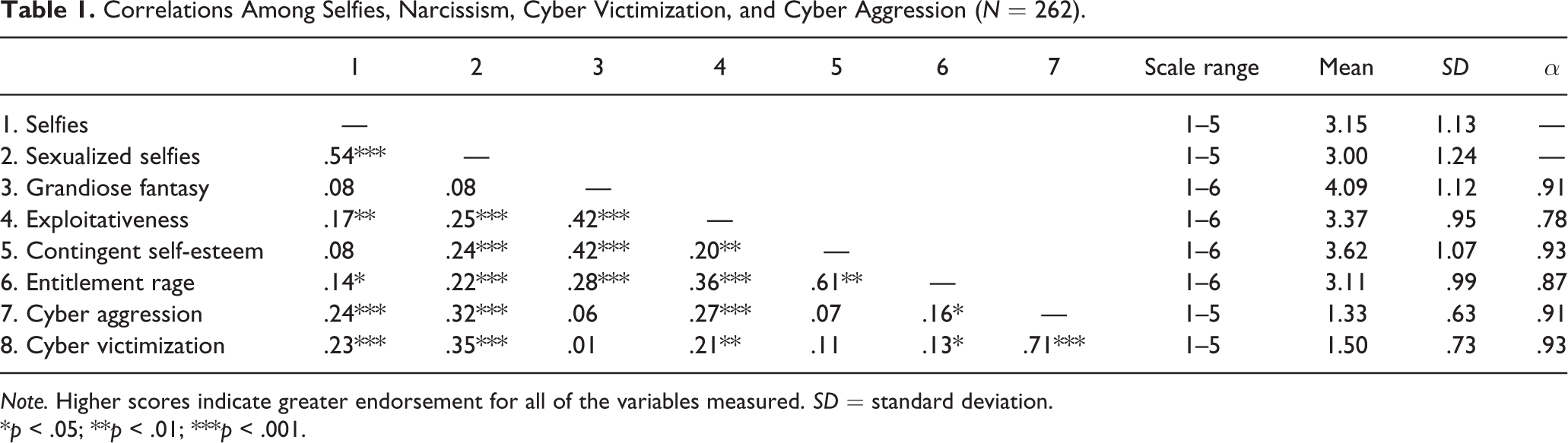
Note. Higher scores indicate greater endorsement for all of the variables measured. SD = standard deviation.
*p < .05; **p < .01; ***p < .001.
Cyber aggression and victimization
A total of 7 items assessing a range of cyber aggressive behaviors and 8 items assessing cyber victimization behaviors were developed for this study. Participants were asked to rate how often in the last month they had engaged in any of the listed behaviors either as the perpetrator (e.g., “I posted something online about someone else to make others laugh”) or as the victim (e.g., “Someone posted something on social media that you think was deliberately sent to make you upset or uncomfortable?”). Items were scored on a 5-point Likert-type scale ranging from 1 (never) to 5 (7 or more times). Full information on scale validity and reliability is outlined in Kurek, Jose, & Stuart, 2019. Both measures had very high internal consistency with Cronbach’s α of .92 for both scales.
Results
Data cleaning and descriptive analyses were conducted in SPSS version 25, and all subsequent analyses were conducted in AMOS version 25. To test the substantive hypotheses, a path model was computed using observed variables where all indirect effects were estimated with 5,000 bootstrapped iterations (bias corrected 95% confidence interval [CI]). Checks for normality were conducted and descriptive analyses were then computed (see Table 1).
Results of the serial mediation model (see Figure 1 and Table 2) indicate that the model fit the data very well (χ2 (4) = 10.69, p = .03; comparative fit index (CFI) = .99; root mean square error of approximation (RMSEA) = .07; 95% CI: [.02, .11]). 2 Exploitativeness (β = .18, p < .001) exhibited a significant association with selfies as well as being the only sub-factor of narcissism that was directly associated with both cyber behaviors (aggression: β = .19, p = .006; victimization: β = .18, p = .005). However, both exploitativeness (β = .18, p = .017) and contingent self-esteem (β = .19, p = .006) were found to be directly associated with taking sexualized selfies. Additionally, exploitativeness was both indirectly associated with increased sexualized selfies via selfies (β = .10, 95% CI [.03, .18], p = .006) and indirectly associated with increased cyber aggression (β = .06, 95% CI [.03, .11], p < .001) and cyber victimization (β = .07, 95% CI [.03, .12], p < .001) through the serial mediation effect. Whereas contingent self-esteem was found to be indirectly associated with greater cyber aggression (β = .05, 95% CI [.01, .10], p = .014) and cyber victimization (β = .06, 95% CI [.02, .11], p < .003) via sexualized selfies (but not via selfies). Furthermore, frequency of taking selfies was not found to have a significant direct effect on cyber behaviors but did have significant positive indirect effects through sexualized selfies resulting in significant total effects on both behaviors (total effect aggression β = .21, 95% CI [.10, .33] and total effect victimization β = .27, 95% CI [.01, .28], ps < .001).
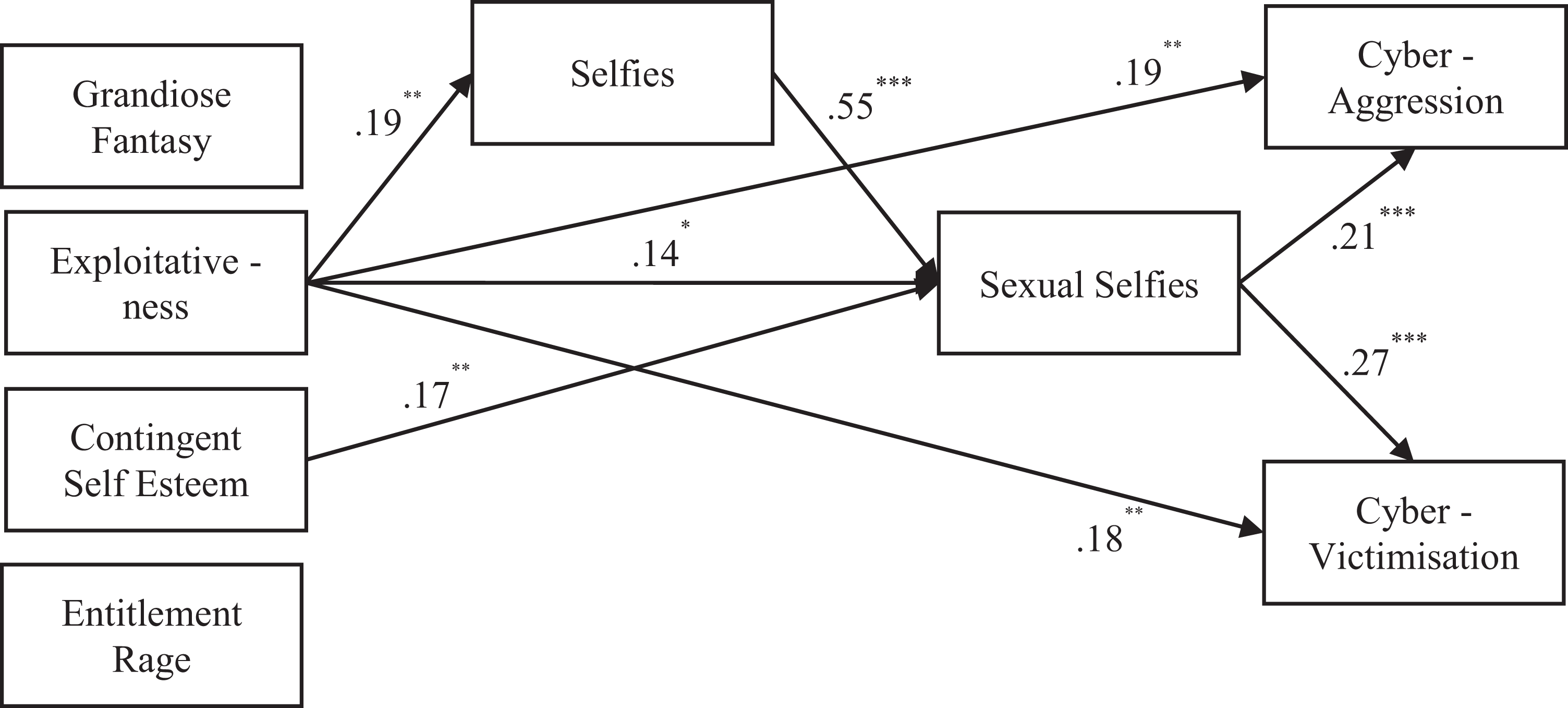
Simplified Pictorial Depiction of the Serial Mediation of Narcissistic Traits on Cyber Aggression and Victimization via Selfies and Sexualized Selfies (N = 262).
Bootstrapped Standardized Direct, Indirect, and Total Effects [95% Confidence Intervals] of Serial Mediation of Narcissism on Cyber Behaviors via Selfies and Sexualized Selfies (N = 262).
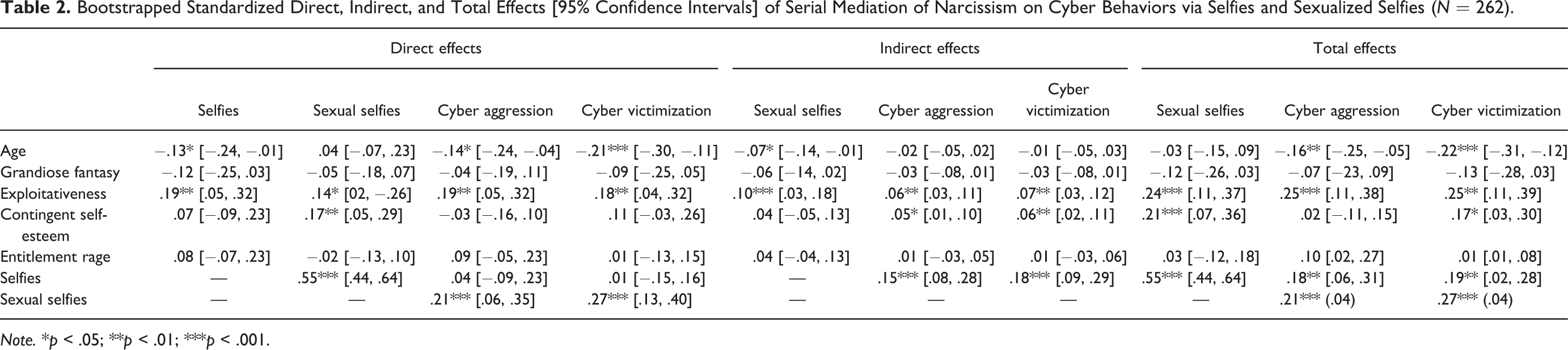
Note. *p < .05; **p < .01; ***p < .001.
The overall findings partially support the hypotheses, indicating that frequency of taking selfies was positively associated with the frequency of taking sexualized selfies (H1), and the frequency of sexualized selfies was associated with greater negative cyber behaviors (H4b). Yet, contrary to H4a, selfies were not directly associated with cyber behaviors, in fact they were found to be fully mediated by sexualized selfies, with a total predictive effect comprised almost entirely of the indirect effect via sexualized selfies. Furthermore, in testing the direct and indirect associations between narcissism, selfies, and sexualized selfies, hypotheses 2a, 2b, 3, and 5 were partially supported as only exploitativeness and contingent self-esteem were found to have significant direct and indirect effects. Specifically, exploitativeness exhibited a positive indirect effect via selfies and sexualized selfies on cyber aggression and victimization, whereas contingent self-esteem had a significant positive indirect effect on both cyber behaviors via sexualized selfies but only had a significant total effect on cyber victimization
Discussion
The present study contributes several novel findings to the growing literature on selfies among adolescent girls. This study was able to elucidate both potential risks and potential consequences of taking selfies during a developmental period where young women are particularly vulnerable to the pressures of self-sexualization. Specifically, the current study found that the frequency of taking selfies was strongly related to frequency of taking self-sexualizing selfies and provided credence to the importance of considering how sub-factors of pathological narcissism are associated with selfie behaviors. The present findings showed that exploitativeness (as an element of grandiose narcissism) was associated with both increased selfie and sexualized selfie taking, whereas contingent self-esteem (as an element of vulnerable narcissism) was associated only with sexualized selfie taking. Additionally, in line with the hypotheses, selfie behavior mediated the effects of narcissism on cyber behaviors, with both simple and serial mediation effects evident. These results indicate that taking selfies may both increase the propensity to take sexualized selfies and have negative flow-on impacts on digital behaviors, indirectly increasing aggression and victimization online. Interestingly, it was found that the impact of frequency of selfie taking on cyber behaviors was fully mediated by sexualized selfies, such that the negative effects of taking selfies were only evident via the increased likelihood of taking sexualized selfies.
Consistent with previous research that indicates grandiose narcissism predicts selfie behaviors (McCain et al, 2018), it was found that exploitativeness was associated with both taking more selfies and taking more self-sexualizing selfies. In turn, exploitativeness was also both indirectly (via selfies) and directly associated with increased negative cyber behaviors. One of the reasons for these associations may be that individuals who are high in exploitativeness tend to manipulate situations to profit in some way. For the young women higher in exploitativeness in our study, taking selfies may be a goal-driven activity that is utilized to exploit the conditions of the digital environment, with garnering attention as their desired outcome. Notably, previous research has suggested that the attention received online does not need to be positive to meet its objectives; “if you really want to get your peers’ attention, the images should be shocking, funny, surprising or provocative” (Willem et al., 2017, p. 88). Therefore, it may be the case that taking selfies, and in turn sexualized selfies, are not fully motivated by the need to be as desirable but may simply be a call for attention, whether positive or negative.
However, because of their reliance on the evaluations of others, individuals with higher levels of grandiose narcissism may be at risk of both acting out and experiencing diminishing self-worth when they do not receive the approval or attention from others that they desire (Baumeister et al., 2000). Therefore, while young women high on exploitativeness may be self-sexualizing to elicit a response from their networks with the intention to increase feelings of empowerment and self-worth, they may be inadvertently putting themselves at a greater risk of peer rejection and social isolation. Because young women who post provocative images are subject to a double standard, where overt sexualization is often disparaged by the broader peer groups, these young women may potentially become the target of online aggression (Mascheroni et al., 2015). Additionally, because the digital landscape has afforded youth a much wider audience, the number of strangers who access self-sexualized content may put these young women at greater risk for other types of victimization. Nevertheless, sexualized content is efficacious in that it attracts attention, meaning that these young women begin to expect and anticipate social feedback as a result of these behaviors, which in turn, can act as a reinforcing agent (Weiser, 2015).
Alongside the results supporting the relationship between grandiose narcissism and selfie behavior, our results also found a positive association between contingent self-esteem (a component of vulnerable narcissism) and sexualized selfies. Previous research has found that vulnerable narcissism is related to appearance-based contingencies of self-worth and approval from others both online and offline (Zeigler-Hill, Clark, & Pickard, 2008). Furthermore, compared to those high on forms of grandiose narcissism, individuals high in vulnerable narcissism often rely on covert forms of self-enhancement to mitigate feelings of inadequacy and inferiority (Miller et al., 2011). In the current study, it was found that contingent self-esteem was not significantly associated with taking selfies, but it was associated with taking sexualized selfies. These results suggest that young women who believe their self-worth is conditional on the approval of others may be more likely to engage in self-sexualization and, in turn, may be more likely to be victimized. This potentially indicates that young women who base their self-worth on the opinions of others believe portrayals of desirability are a means of achieving such approval, but they may fail to assess the risks of this behavior.
Limitations and Future Research
The current research investigated the associations between sub-factors of narcissism, selfies, and cyber behaviors among adolescent girls with the aim of extending our knowledge concerning self-presentation in the digital age. However, some limitations need to be outlined. Firstly, the measure of sexualized selfies was operationalized as young women’s self-reported frequency of taking selfies where they were “looking hot.” It must be noted that the meanings and motivations of this type of self-presentation were not assessed nor was the context of the selfie measured. While a growing body of research has examined how women present themselves online to appear physically attractive (e.g., Dhir et al., 2016; Herring & Kapidzic, 2015), the actual images taken and posted may differ substantially. For some girls looking hot in a selfie may mean posing in a provocative way, wearing particular types of clothing, showing particular body parts, or using particular expressions. It is likely that different types and presentations of “hotness” in selfies have different antecedents and outcomes. Additionally, where the photos are posted, whom these are shared with or intended for, and the extent of crafting (e.g., editing, using filters) are yet to be explored. As such, more research is required to understand the nuances in the content and intended audiences of digital sexualized self-presentation among young women.
Furthermore, due to the cross-sectional nature of the data, the temporal relationships between narcissism, selfies, and cyber behaviors could not be assessed. Halpern, Valenzuela, and Katz (2016) found that general levels of narcissism had weak bidirectional associations with the number of selfies taken a year later. However, the relationship between types of selfies and specific elements of narcissism has yet to be examined in a longitudinal manner. In fact, the current research would indicate the specific sub-factors of narcissism that have relationships with some types of selfie behavior. As such, a more nuanced understanding of the transactional relationship between these constructs over time is needed.
A growing body of research finds that the complex nature of cyberspace, the prevalence of social media in the everyday lives of young people, and the perceived lack of consequences for behavior may leave some youth vulnerable to engaging in risky behavior online (Kurek, Jose, & Stuart, 2017; Runions & Bak, 2015). Therefore, it is incredibly important and timely to investigate whether sexualized self-presentations are, themselves, an outcome of unique features of the digital environment. Indeed, although narcissistic tendencies were found to be associated with increased selfie taking, future research should examine whether other factors of the online environment (e.g., perceived anonymity, asynchronicity, lack of social cues) interact with individual level characteristics in predicting selfie behavior. Finally, this research only investigated two potential outcomes of sexualized selfies for young women: cyber aggression and victimization. Future research is suggested to examine whether sexualized self-presentation online predicts other risk-taking behaviors both online and offline, as well as mental and physical health outcomes.
Conclusion
The digital environment is a platform for adolescent self-discovery, socialization, exploration, and validation. The selfie, therefore, should be viewed not simply as a reflection of self but rather as a tool for social self-promotion that simultaneously serves as a performative act of identity building (Koliska & Roberts, 2015). However, selfies often result in self-objectification (particularly for young women) which reinforces the idea that the body is an object by explicitly or implicitly inviting others to rate one’s self-image through likes or comments (Salomon & Spears Brown, 2019). In fact, it has been shown that selfies are effective in attracting social approval, with research highlighting that selfies posted to social media tend to generate the highest number of likes when compared to non-selfie images (Bakhshi, Shamma, & Gilbert, 2014). Yet, as this study has illustrated, there are risks involved in self-sexualization in the digital landscape. Not only do sexualized selfies influence negative cyber behaviors, it is suggested that encouraging young women to be sexy without simultaneously teaching them about sexuality tends to normalize unattainable ideals of beauty and can distort healthy sexual self-expression. However, while such content continues to attract attention, young women (particularly those with narcissistic tendencies) may continue to engage in self-sexualizing behaviors. As such, it is imperative that these behaviors are examined in depth and both intervention and prevention strategies are put in place to mitigate the negative effects.
Footnotes
Acknowledgment
The authors express their appreciation to the schools, teachers, and students who participated in the study, to Victoria University of Wellington for funding this study, and to Professor Paul Jose for his involvement in the project oversight.
Funding
The author(s) declared receipt of the following financial support for the research, authorship, and/or publication of this article: The Victoria University Research Fund supported the data collection.
