







Abstract
The current study was designed to address gaps in the existing literature by examining the role of discrimination and familism values as predictors of multiple forms of prosocial behaviors across time in a sample of recent immigrant Latino/a adolescents. Participants were 302 recent immigrant Latino/a adolescents (53.3% male; average age 14.51 years, range = 13–17). Data were collected from adolescents in two U.S. cities: Los Angeles (n = 150) and Miami (n = 152). Adolescents completed measures of their own discrimination experiences, familism values, and tendency to engage in six forms of prosocial behaviors. Results indicated generally positive links between familism values and prosocial behaviors. Discrimination also positively predicted public prosocial behaviors and negatively predicted altruistic prosocial behaviors. We discuss the development of cultural processes and perceptions of discrimination experiences, and how these factors predict helping behaviors among immigrant adolescents.
Systemic racism in the United States (U.S.) permeates institutions (including educational institutions) and impacts the experiences and trajectories of ethnic and racial minority youth and families, including U.S. Latino/a families (Levinson & Smith, 2016). Because of the historic bias and systemic discrimination facing many Latino/a families in the U.S., youth may be exposed to relatively high levels of discrimination. Research has highlighted the role of discrimination in negative outcomes, including depressive symptoms and academic motivations (Perreira et al., 2010; Sanchez et al., 2018). At the same time, understanding the role of discrimination in positive adjustment is also important in order to understand development from a holistic perspective while also mitigating deficit-based approaches of minority youth development (see Cobb et al., 2019; Davis & Carlo, 2019). Therefore, considering the role of discrimination in the development of positive social behaviors, including prosocial behaviors, is an important research question, particularly in contemporary U.S. society with a contentious political climate characterized by derogatory rhetoric surrounding Latino/a immigrants (Pierce & Selee, 2017).
Focusing on discrimination is particularly important among recent immigrant youth, as youth may experience discrimination based on multiple indicators (e.g., language use, skin color). These youth must navigate acculturative processes (process of adjusting to a new culture and community when the destination culture differs from the individual’s traditional culture; see Berry, 1997, 2017) that can result in stressful experiences. Although substantial research has been conducted on discrimination, much of this work has focused on maladjustment, including internalizing and externalizing behaviors (Corral & Landrine, 2008; see Crockett et al., 2007), and research on discrimination and prosocial behaviors is still limited.
Prosocial behaviors represent one indicator of positive adjustment and refer to actions intended to benefit others (including a variety of helping behaviors in different situations and with differing motivations; Carlo & Randall, 2002). Prosocial behaviors include a multitude of helping behaviors such as comforting others, volunteering, helping others when asked, and donating time or resources (see Carlo & Randall, 2002).
Such behaviors are indicative of morality and care for others, and they are also an indicator of health and social well-being (see Carlo, 2014). Therefore, prosocial behaviors represent an important behavioral outcome from both individual and community health perspectives (Carlo, 2014; Randall & Wenner, 2014). There is evidence, for example, that prosocial behaviors among youth and emerging adults are positively associated with academic performance (Caprara et al., 2000), social competence and healthy relationships (Streit et al., 2018), and markers of physical and mental health (Carlo, 2014; Davis et al., 2016; Laible et al., 2004).
Prosocial behaviors are not a single construct and can be differentiated according to the helper’s underlying motivation and situational characteristics. For example, there are differences between public and altruistic prosocial behavior. Public prosocial behaviors represent helping behaviors done in the presence of others, often with the expectation of recognition. Altruistic prosocial behaviors, in contrast, represent helping behaviors carried out with little or no expectation of reward to the self and are thus often a more costly form of helping (Carlo & Randall, 2002). Public prosocial behaviors are thought to be motivated by a desire to maintain a positive social image or to gain the approval of others, and are therefore considered to be relatively more selfishly motivated, whereas altruistic prosocial behaviors are primarily oriented toward benefitting others and are therefore selflessly motivated (Carlo & Randall, 2002). Additionally, helping behaviors can differ depending on situational characteristics. Dire prosocial behaviors include helping in emergency situations. Compliant prosocial behaviors include helping when asked. Emotional prosocial behaviors include helping in emotionally evocative situations, and anonymous prosocial behaviors include helping when others do not know, such as donating. Previous research with the current data set has suggested that the development of these prosocial behaviors follows distinct trajectories across adolescence, further supporting the need to examine these unique forms (McGinley et al., 2020; see the Method for an overview of these changes across time).
While it is important to examine the role of discrimination experiences in Latino/a adolescents’ prosocial behaviors, it is also important to consider cultural values that might also predict such behaviors and provide a contextualized understanding of how such behaviors develop within specific cultural groups. One cultural value that has been the focus of research on Latino/a families is familism. Familism is defined as feelings of obligation toward one’s family, viewing the family unit as part of the self, and prioritizing the needs of the family unit (Knight et al., 2010). Adolescence is an important developmental period to study familism values, as values tend to be internalized during adolescence (see Knight et al., 2010).
Theoretical Perspectives
Theoretical models have highlighted the role of cultural stressors, including discrimination experiences, as well as cultural processes in predicting developmental competencies among ethnic minority youth. Specifically, the Integrative Model for the Study of Developmental Competencies in Minority Children emphasized discrimination and oppression as salient predictors of developmental trajectories, ultimately shaping positive adjustment through contextual variables, such as neighborhood experiences, and family processes (García Coll et al., 1996). Extensions of this model have emphasized the diversity of Latino/a youth with regards to social experiences and have warned against relying on deficit perspectives to characterize Latino/a youth development (Fuller & García Coll, 2010).
Carlo and Conejo (2017) also developed a model specific to U.S. Latino/a prosocial behaviors that was inspired by these previous conceptual models. This model proposes that Latino/a youth exposed to discrimination and other perceived stressors (e.g., academic, family conflict, economic stressors) are posited to influence, and be influenced by, cognitive and emotive traits (e.g., empathy, ethnic identity, moral reasoning), which affect their subsequent prosocial behaviors. These models recognize the role of discrimination as a pervasive experience that can shape development but also emphasize cultural strengths that might promote competence, including traditional cultural values (Fuller & García Coll, 2010).
The current study aimed to test theoretical models focused on Latino/a developmental competencies by examining the role of discrimination and familism values as predictors of U.S. Latino/a recent immigrant adolescents’ prosocial behaviors at six timepoints, spanning 3 years in time.
Discrimination and Prosocial Behaviors
As Latino/a youth progress into adolescence, they are exposed to increasingly complicated peer relationships (Bukowski et al., 2011) that might present more opportunities for perceptions of discrimination. There are also increases in social cognitive development (see Choudhury et al., 2006) that might contribute to deeper understandings of various forms of discrimination.
Stress and coping theories suggest that pervasive stressors can reduce cognitive and socioemotional resources, which may lead to reduced capabilities for positive social outreach (see Batson & Powell, 2003; Lazarus & Folkman, 1984). Discrimination experiences might negatively predict altruistic prosocial behaviors among recent U.S. Latino/a immigrant youth. Discrimination experiences during adolescence might lead to social isolation and marginalization because of the pervasive stress often associated with such experiences (Major & O’Brien, 2005; Smart Richman & Leary, 2009). Discrimination and the resulting social exclusion and marginalization might also lead to reduced motivations to engage in helping behaviors, particularly when such behaviors invoke a cost to the self, as is the case with altruistic prosocial behaviors because of the resources needed to engage in selfless helping behaviors. Low levels of prosocial behaviors, in turn, could contribute to social marginalization and isolation. More specifically, prosocial behaviors require cognitive and emotional resources as well as a connection with others (see Carlo, 2014).
Alternatively, discrimination experiences might not always negatively predict prosocial behaviors and might positively predict public prosocial behaviors. Scholars have argued that experiencing adversity and stress might promote emotional sensitivity to the plight of others, thereby ultimately promoting social responsibility and prosocial behaviors (Staub & Vollhardt, 2008). There is evidence that altruistic behaviors can result from trauma and stressful life events, consistent with the “altruism born of suffering” concept (Davis et al., 2018b; Taylor & Hanna, 2018). Therefore, experiencing discrimination might result in feelings of stress that promote care for others and ultimately selfless helping behaviors.
Moreover, Latino/a youth who experience discrimination may engage in specific forms of prosocial behaviors, such as public helping, in order to maintain a positive reputation or to gain the approval of others in an effort to combat negative stereotypes or in an effort to induce their own positive mood (McGinley et al., 2010; Snippe et al., 2018). Therefore, discrimination experiences might impede some forms of helping but may actually promote other forms under certain circumstances. Such a proposition underscores the need to examine various types of prosocial behaviors rather than collapsing prosocial behavior into a single construct. Because the research on discrimination and prosocial behaviors is still relatively sparse, more evidence is needed to disentangle competing hypotheses, particularly when considering the role of discrimination in predicting altruistic prosocial behaviors.
Studies have documented longitudinal links between discrimination and prosocial behaviors among U.S. Latino/a adolescents. Brittian et al. (2013) examined the associations between discrimination and prosocial behaviors among a sample of U.S. Mexican adolescents. Results indicated that discrimination experiences in Grade 5 negatively predicted multiple forms of prosocial behaviors (including altruistic behaviors) in Grade 10. However, discrimination experiences in Grade 5 positively predicted public prosocial behaviors in Grade 10. There is evidence that perceived discrimination positively predicted depressive symptoms 6 months later. Depressive symptoms, in turn, negatively predicted altruistic helping behaviors 6 months later, controlling for initial levels of altruism, among a sample of recent immigrant Latino/a adolescents (Davis et al., 2016). Thus, the existing findings generally suggest that discrimination may be differentially related to helping behaviors with distinct underlying motivations, and that discrimination might be particularly detrimental for selfless helping behaviors but might not negatively predict public motivated prosocial behaviors. However, the number of studies is limited, so more work is needed to better disentangle these effects across time.
Familism Values and Prosocial Behaviors
In light of the risks associated with discrimination experiences, it is essential to identify factors that might also promote prosocial behaviors among recent immigrant youth. Familial factors and cultural values are important assets for immigrant youth and might promote prosocial behaviors (see Davis & Carlo, 2019). Because many Latino/a families endorse traditional cultural values rooted in interdependent values, including familism values, maintaining harmonious family relationships might be a priority among adolescents and might be important in shaping prosocial behaviors. When adolescents endorse familism values, they may be oriented to consider the needs of others (which is an inherent component of familism), which may in turn, foster their perspective taking skills (i.e., understanding the social situation of others), and ultimately behaviors aimed at helping others (Calderón-Tena et al., 2011). Familism values might most strongly predict helping behaviors that are common among family members and in the home environment, such as emotional, dire, and compliant prosocial behaviors (see Knight & Carlo, 2012).
While discrimination experiences might predict prosocial behaviors based on underlying motivations, familism values might predict prosocial behaviors depending on situational characteristics. There is evidence that familism values are associated with prosocial behaviors among U.S. Latino/a youth (Armenta et al., 2011; Calderón-Tena et al., 2011). Specifically, among Latino/a young adults, there is evidence that familism values positively predict public, emotional, compliant, and dire prosocial behaviors (Davis et al., 2018a). In a sample of U.S. Mexican adolescents, familism values in fifth grade positively predicted compliant and emotional prosocial behaviors, and increases in familism over time positively predicted public prosocial behaviors and dire prosocial behaviors (for girls only; Knight et al., 2018).
Study Hypotheses
In a prior study with the present data set, McGinley et al. (2020) investigated the relations between acculturation and growth in prosocial behaviors. In the present study, we examined how discrimination and familism uniquely predicted prosocial behaviors at each timepoint while controlling for the latent growth processes established by McGinley et al. (2020). Thus, the present study extends the current literature by examining the role of both discrimination experiences and familism values as predictors of recent immigrant Latino/a adolescents’ multidimensional prosocial behaviors, after accounting for latent growth processes in prosocial behaviors (see Figure 1).
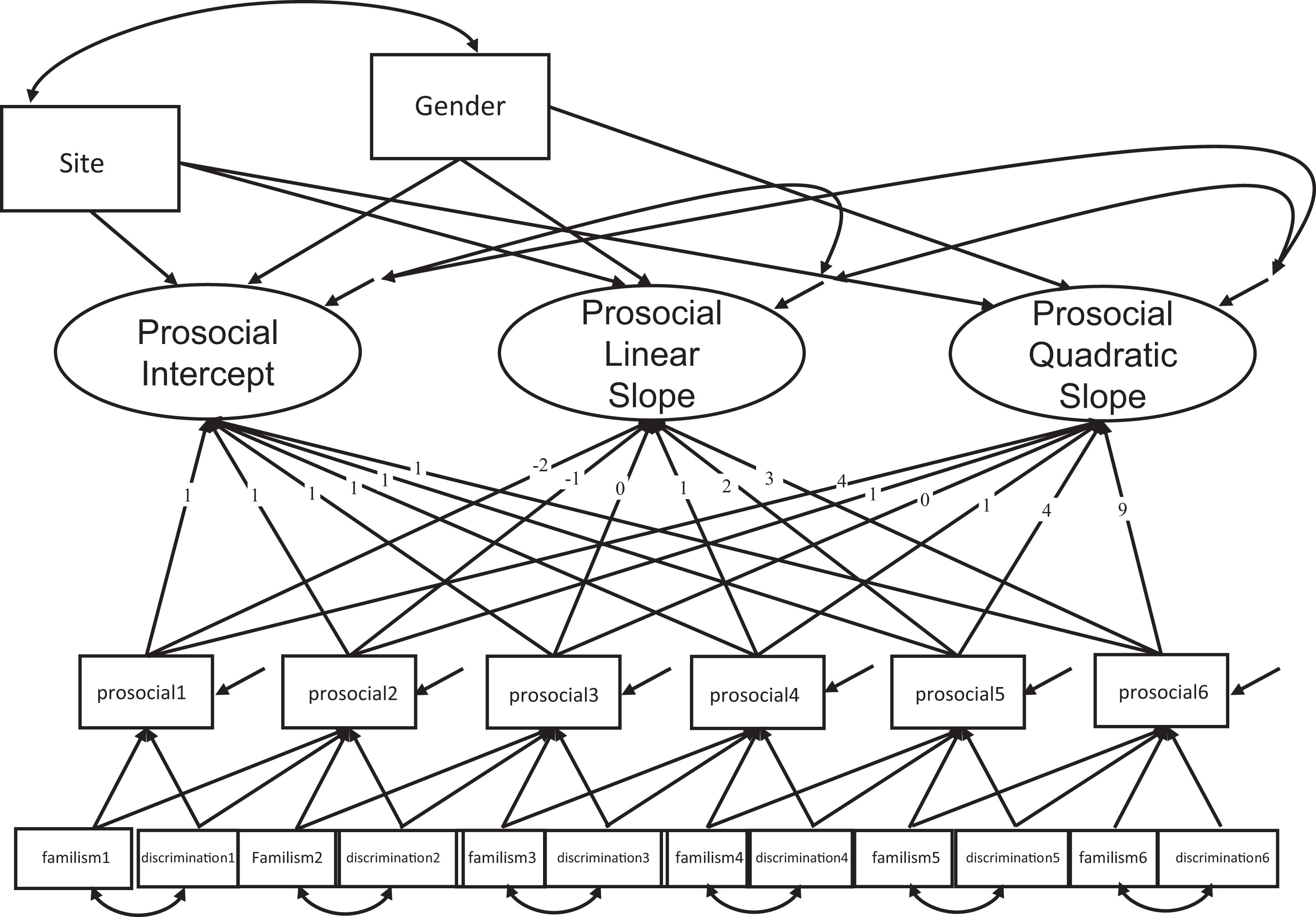
The Latent Growth Curve Model for Prosocial Behaviors with Time-Invariant and Time-Varying Predictors.
Specifically, we hypothesized that discrimination would be positively associated with public and negatively associated with altruistic prosocial behaviors at each timepoint after controlling for the latent growth process. We also hypothesized that familism values would be positively associated with multiple forms of prosocial behaviors, including emotional, dire, and compliant prosocial behaviors at each timepoint above and beyond the variance accounted for by the latent growth curve model. Finally, since these hypothesized relations may potentially change across time, we tested whether the relations between the time-varying covariates (discrimination, familism) and prosocial behaviors were equivalent across the six timepoints. However, we had no a priori hypotheses regarding whether the influence of these predictors on prosocial behaviors was comparable across time.
Methods
Participants
The present study was conducted using data from a longitudinal project entitled Construyendo Oportunidades Para los Adolescentes Latinos (COPAL [Building Opportunities for Latino Adolescents]; Schwartz et al., 2015a, 2015b). The goal of this longitudinal project was to examine cultural changes and health behaviors among recently immigrated Latino adolescents and their families (see Forster et al., 2015). Only adolescent data were used for the present study.
Participants were 302 adolescents, 53.3% male, and the average age was 14.51 years old (range = 13–17). Data were collected from adolescents in two U.S. cities: Los Angeles (n = 150) and Miami (n = 152). Participants from Los Angeles were predominantly from Mexico (70%), El Salvador (9%), Guatemala (6%), and other countries (15%), and the participants from Miami were predominantly from Cuba (61%), Dominican Republic (8%), Nicaragua (7%), Honduras (6%), Colombia (6%), and other countries (12%). The primary caregiver also reported on their education (Los Angeles sample mean = 8.84 years, SD = 4.72 years; Miami sample mean = 11.23 years, SD = 3.67 years). Seventy-one percent of adolescents were from two-parent homes, while 29% were from single-family homes. These two cities were selected because they are both home to large numbers of Latino adolescents. Per inclusion criteria, each target school was at least 75% Latino. We targeted densely Latino areas because many recent Latino immigrants tend to settle in ethnic enclaves (Portes & Rumbaut, 2006). The retention rate through Time 6 was 80% (n = 241); however, the full sample was analyzed with the use of missing data analysis procedures.
Procedures
Adolescents were recruited from 13 schools in Los Angeles County and 10 schools in Miami-Dade County. Latino students were eligible to participate in the study if they had lived in the U.S. for 5 years or less and were entering or finishing the ninth grade at baseline. Data collection occurred at the schools, at the research centers, or at other locations convenient to families every 6 months for 3 years (Time 1–Time 6). Monetary incentives were provided to parents at each timepoint, and the youth received a movie ticket at each timepoint. Parents and adolescents were assessed in separate rooms. Surveys were administered via audio computer-assisted software. Participants indicated their responses on the computer. A button was provided for each response, and no prior computer experience was necessary. The Research Review Committees for each of the participating school districts and the University of Miami and the University of Southern California Institutional Review Boards approved this study.
Measures
Discrimination
At all timepoints, participants completed a measure assessing their perceptions of discrimination (Phinney et al., 1998). The measure consisted of seven items that asked about discrimination experiences in school, with peers, and in society generally (Time 1 α = .89; Time 2 α = .92; Time 3 α = .93; Time 4 α .94; Time 5 α = .94; Time 6 α = .95). Sample items include: “How often do teachers treat you unfairly or negatively because of your ethnic background?” “How often do people your age treat you unfairly or negatively because of your ethnic background?” “To what extent do you feel that you are not wanted in American society?” Participants rated each item on a scale from 0 = Not at all to 4 = Almost always. This scale and items from this scale have demonstrated convergent and divergent validity, as well as good reliability in studies with Latino youth (Phinney et al., 1998; Szalacha et al., 2003).
Familism
At all timepoints, participants completed a measure of familism designed specifically for Latino populations (Lugo Steidel & Contreras, 2003). The measure consisted of 18 items reflecting the participants’ attitude of familism (Time 1 α = .89; Time 2 α = .90; Time 3 α = .92; Time 4 α = .92; Time 5 α = .92; Time 6 α = .93). Sample items include: “A person should rely on his or her family if the need arises,” and “A person should cherish time spent with his or her relatives.”
Prosocial behaviors
At all six timepoints, adolescents completed a measure of their tendency to engage in six forms of prosocial behaviors: emotional, dire, compliant, anonymous, altruistic, and public prosocial behaviors (assessed using an adapted version of the Prosocial Tendencies Measure-Revised; Carlo et al., 2003). Emotional prosocial behaviors (4 items; Time 1: α = .76, 3 items; Time 2 α = .80; Time 3 α = .77; Time 4 α = .81; Time 5 α = .83; Time 6 = .86) include helping behaviors in emotionally evocative situations (e.g., “I feel better when I am able to comfort someone who is very upset”). Dire prosocial behaviors (3 items; Time 1: α = .77, 3 items; Time 2 α = .76; Time 3 α = .73; Time 4 α = .73; Time 5 α = .77; Time 6 = .85) include helping in emergency situations (e.g., “I like to help people who are in a real crisis or need”). Compliant prosocial behaviors (2 items; Time 1: α = .53, 3 items; Time 2 α = .53; Time 3 α = .53; Time 4 α = .57; Time 5 α = .57; Time 6 = .74) include helping others when asked (e.g., “When people ask me to help them, I help them as quickly as I can”). Anonymous prosocial behaviors (3 items; Time 1: α = .80, 3 items; Time 2 α = .83; Time 3 α = .81; Time 4 α = .82; Time 5 α = .85; Time 6 = .86) include helping without the knowledge of others (e.g., “Most of the time, I like to help others when they do not know who helped them”). Altruistic prosocial behaviors (3 items; Time 1: α = .69, 3 items; Time 2 α = .76; Time 3 α = .73; Time 4 α = .78; Time 5 α = .81; Time 6 = .81) include helping behaviors with no expectation for personal reward (e.g., “I believe I should receive more recognition for the time and energy I spend helping others” [reversed]). Public prosocial behaviors (4 items; Time 1 α = .84; Time 2 α = .84; Time 3 α = .86; Time 4 α = .85; Time 5 α = .88; Time 6 = .87) include helping in the presence of others (e.g., “I am best at helping others when everyone is watching”). Participants rated each item on a scale from 0 = Does not describe me at all to 4 = Describes me greatly.
Results
Data Analysis Plan
Descriptive statistics and correlations were examined in SPSS at each of the six timepoints. Next, linear latent growth curve models with time-invariant and time-varying covariates for the six prosocial behaviors across the six equally spaced timepoints (centered at the third timepoint) were examined using Mplus 8.0 (Muthén & Muthén, 1998–2017). Figure 1 depicts the tested model. The intercept and slope for prosocial behaviors, as well as the time-varying predictors, were regressed onto time-invariant control variables (gender, site). We controlled for gender because of the documented differences in responses to stress among boys and girls as well as differences in prosocial behaviors (Taylor et al., 2000). Previous research has found that girls tend to be more likely to engage in care-based helping behaviors, while boys are more likely to engage in pragmatic prosocial behaviors (Carlo et al., 2003). Prosocial behaviors at the six timepoints were regressed onto the contemporaneous set of time-varying predictors (familism, discrimination). Correlations among the time-varying predictors (within construct, across timepoints, and across construct, within timepoints) were also estimated to account for method variance (Brown, 2006).
We again note that the latent growth curve models for prosocial behaviors with this data set have been previously established (see McGinley et al., 2020). In this study, the linear growth curve model provided the best fit to the data for all prosocial behaviors except for emotional prosocial behaviors. For emotional prosocial behaviors, a latent growth curve model accounting for quadratic growth provided the best fit to the data. Overall, a negative mean linear slope was found for public and dire prosocial behaviors, and a positive mean linear slope was established for anonymous prosocial behaviors. The mean linear growth for emotional, altruistic, and compliant prosocial behaviors was not significant. However, for every prosocial behavior examined, the variance for the linear slope was statistically significant, suggested that the rate in change varied across participants. Finally, a mean negative quadratic mean was established for emotional prosocial behaviors, suggesting a deceleration in emotional helping by the final timepoints. The variance term for this quadratic growth was marginally significant. These latent growth curve models established by McGinley et al. (2020) served as the initial latent growth curve models in the current analysis.
Guidelines provided by Hu and Bentler (1999) regarding the root-mean-square error of approximation (RMSEA), comparative fit index (CFI), and standardized root mean residual (SRMR) were adopted to evaluate model fit. Models were characterized as fitting the data well if they produced values of CFI ≥ .95, RMSEA ≤ .06, and SRMR ≤ .08 (Hu & Bentler, 1999). Finally, we note that models were estimated using full information maximum likelihood estimation (FIML-robust estimator) to make use of all available data.
Descriptive Statistics
Means and standard deviations for the six prosocial behaviors, discrimination, and familism across the six timepoints can be found in Table 1. Bivariate correlations within constructs across timepoints were positive and significant (p’s < .01) for familism (r’s = .20–.54), discrimination (r’s = .26–.58), altruistic prosocial behaviors (r’s = .31–.64), public prosocial behaviors (r’s = .37–.65), emotional prosocial behaviors (r’s = .38–.53), dire prosocial behaviors (r’s = .28–.50), compliant prosocial behaviors (r’s = .29–.51), and anonymous prosocial behaviors (r’s = .21–.47). Bivariate correlations within timepoints and across constructs were then examined. At all timepoints, bivariate correlations among discrimination and altruistic prosocial behaviors were negative and significant (r’s = −.20 to –.40, p’s < .001), and bivariate correlations among discrimination and public prosocial behaviors were positive and significant (r’s = .14–.36, p’s < .05). Generally, no significant relations were found among discrimination and other prosocial behaviors, with the exception of negative and significant correlations among anonymous prosocial behaviors at Time 2 and Time 4 (r’s = .17 and .19, respectively, p’s < .01). Bivariate correlations among familism and prosocial behaviors (except for altruistic prosocial behaviors) were typically significant and positive (r’s = .13–.40, p’s < .05), though correlations between familism and public prosocial behaviors were not significant at Time 3 and Time 4. Bivariate correlations between familism and altruistic behaviors ranged from negative and significant to not significant (r’s = −.15 to +.01, p < .05 for r’s
Means (Standard Deviations) for the Six Prosocial Behaviors, Familism, and Discrimination Across the Six Timepoints.
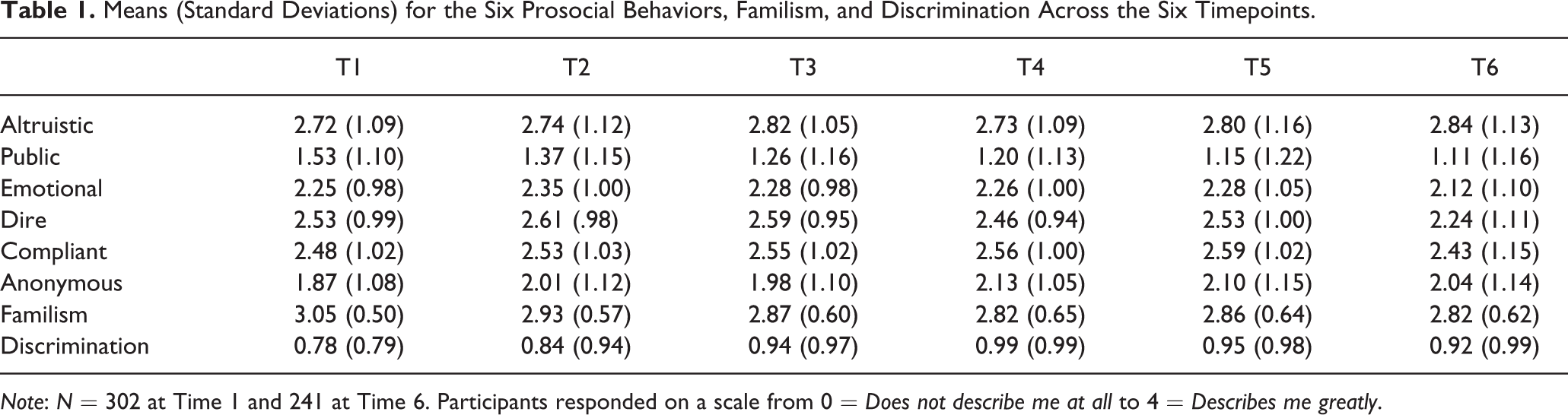
Note: N = 302 at Time 1 and 241 at Time 6. Participants responded on a scale from 0 = Does not describe me at all to 4 = Describes me greatly.
Latent Growth Curve Modeling with Time-Varying Covariates Results
The altruistic prosocial behavior model fit the data well (χ2 [114] = 143.50, p = .03; CFI = .98, RMSEA = .03, SRMR = .07; Table 2). Being female was related to a higher mean intercept for altruistic prosocial behaviors. Except for Time 1, discrimination was negatively related to altruistic prosocial behaviors. No paths between familism and altruistic prosocial behaviors were significant. The Satorra–Bentler chi-square difference tests suggested that the relations among discrimination and altruistic prosocial behaviors (S-Bχ2 [5] = 9.96, p > .05) and familism and altruistic prosocial behaviors (S-Bχ2 [5] = 4.30, p > .05) were equivalent at each timepoint.
Unstandardized Latent Growth Curve Model Results (95% Confidence Intervals).
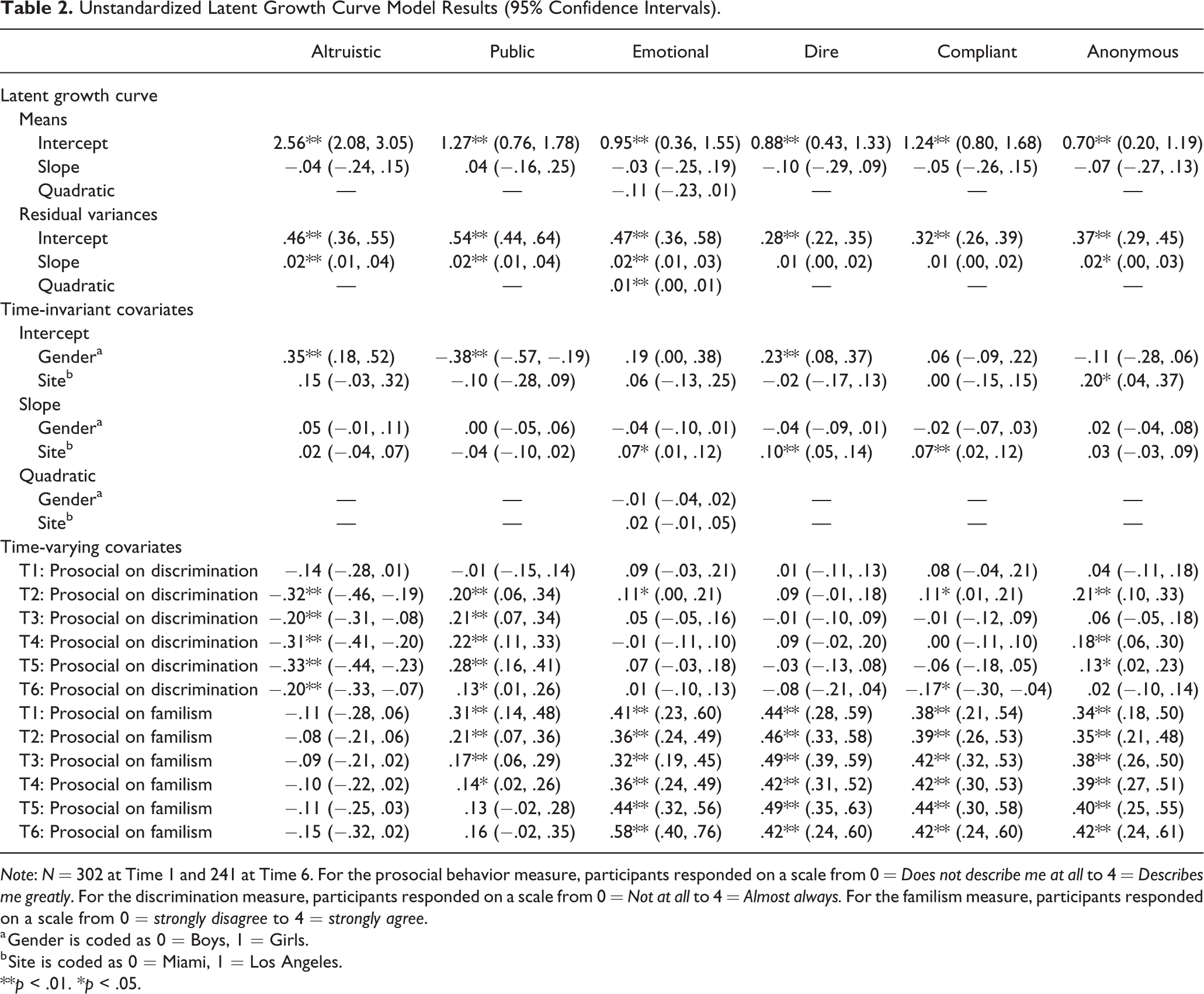
Note: N = 302 at Time 1 and 241 at Time 6. For the prosocial behavior measure, participants responded on a scale from 0 = Does not describe me at all to 4 = Describes me greatly. For the discrimination measure, participants responded on a scale from 0 = Not at all to 4 = Almost always. For the familism measure, participants responded on a scale from 0 = strongly disagree to 4 = strongly agree.
a Gender is coded as 0 = Boys, 1 = Girls.
b Site is coded as 0 = Miami, 1 = Los Angeles.
**p < .01. *p < .05.
The public prosocial behavior model fit the data well (χ2 [114] = 170.69, p < .01; CFI = .96, RMSEA = .04, SRMR < .08). Being female was related to a lower mean intercept for public prosocial behavior. Both discrimination (Time 2–6) and familism (T1–T4) were positively related to public prosocial behaviors. The Satorra–Bentler chi-square difference tests suggested that the relations among discrimination and public prosocial behaviors (S-Bχ2 [5] = 11.90, p < .05) and familism and public prosocial behaviors (S-Bχ2 [5] = 15.46, p < .01) were not equivalent across the six timepoints. We freely estimated discrimination at Time 1 since this relation was not statistically significant in the completely unconstrained model. The Satorra–Bentler chi-square difference test was no longer statistically significant after freeing this path (S-Bχ2 [4] = 3.84, p > .05). These results indicated that the relation between discrimination and public prosocial behaviors was weaker (and nonsignificant) at Time 1 compared to the relations across Time 2–6. Next, we freely estimated familism at Time 6 since this relation was not statistically significant and had the largest standard error. The Satorra–Bentler chi-square difference test was no longer statistically significant after freeing this path (S-Bχ2 [4] = 8.27, p > .05). Thus, the relation between familism and public prosocial behaviors was weaker at Time 6 compared to the relations across Time 1–5.
The emotional prosocial behavior model fit the data well (χ2 [108] = 110.45, p = .42, CFI = 1.00, RMSEA = .01, SRMR = .05). Being female was related to a less negative slope in emotional prosocial behavior. Typically discrimination was not related to emotional prosocial behaviors, excepted at Time 2 when a positive relation was observed. At Times 1–6, familism was positively related to emotional prosocial behaviors. The Satorra–Bentler chi-square difference tests indicated that the relations among discrimination and emotional prosocial behaviors (S-Bχ2 [5] = 3.77, p > .05) and familism and emotional prosocial behaviors (S-Bχ2 [5] = 5.82, p > .05) were equivalent at each timepoint.
The dire prosocial behavior model fit the data well (χ2 [114] =138.61 [114], p = .06, CFI = .98, RMSEA = .03, SRMR = .05). Being female was related to a higher mean intercept, and participants residing in Los Angeles and a higher mean slope for dire prosocial behavior. Discrimination was not related to dire prosocial behaviors. At Times 1–6, familism was positively related to dire prosocial behavior. The Satorra–Bentler chi-square difference tests suggested that the relations among discrimination and dire prosocial behaviors (S-Bχ2 [5] = 8.51, p > .05) and familism and dire prosocial behaviors (S-Bχ2 [5] = 9.54, p > .05) were equivalent at each timepoint.
The compliant prosocial behavior model fit the data well (χ2 [114] = 129.35, p = .15, CFI = .99, RMSEA = .02, SRMR = .06). Participants residing in Los Angeles and a higher mean slope for compliant prosocial behaviors. Typically discrimination was not related to compliant prosocial behaviors, excepted at Time 2 when a positive relation was observed, and at Time 6, when a negative relation was observed. At Times 1–6, familism was positively related to compliant prosocial behaviors. The Satorra–Bentler chi-square difference tests suggested that the relations among discrimination and compliant prosocial behaviors (S-Bχ2 [5] = 11.90, p < .05) were not equivalent across the six timepoints. We freely estimated discrimination at Time 6 since this relation was the strongest in the completely unconstrained model. The Satorra–Bentler chi-square difference test was no longer statistically significant after freeing this path (S-Bχ2 [4] = 6.02, p > .05). These results indicated that the relation between discrimination and compliant prosocial behaviors was stronger (and significant and negative) at Time 6 compared to the relations across Time 1–5. Finally, the Satorra–Bentler chi-square difference test suggested that the relations among familism and compliant prosocial behaviors (S-Bχ2 [5] = 1.71, p > .05) were equivalent at each timepoint.
The anonymous prosocial behavior model fit the data well (χ2 [114] = 125.45, p = .21, CFI = .99, RMSEA = .02, SRMR = .05). Participants residing in Los Angeles and a higher mean intercept for anonymous prosocial behaviors. Discrimination was positively related to anonymous prosocial behaviors at Times 2, 4, and 5. At Times 1–6, familism was positively related to anonymous prosocial behaviors. The Satorra–Bentler chi-square difference tests indicated that the relations among discrimination and anonymous prosocial behaviors (S-Bχ2 [5] = 10.00, p > .05) and familism and anonymous prosocial behaviors (S-Bχ2 [5] = 0.67, p > .05) were equivalent at each timepoint.
Discussion
The results of the current study highlight the role of both discrimination experiences and familism values as predictors of recent immigrant adolescents’ prosocial behaviors. Interestingly, discrimination consistently predicted prosocial behaviors based on underlying motivation (i.e., public and altruistic), while familism values were related to prosocial behaviors that can be distinguished by situational characteristics (i.e., emotional, dire, and compliant). The findings demonstrate support for conceptual models that emphasize familial factors as assets and highlight the importance of simultaneously considering discrimination experiences in predicting recent immigrant youth outcomes.
Discrimination was negatively associated with altruistic prosocial behaviors across 3 years. These findings extend prior evidence that discrimination experiences are negatively associated with altruistic prosocial behaviors among U.S. Latino/a adolescents (Brittian et al., 2013; Davis et al., 2016) by demonstrating this association in a sample of recent immigrant adolescents across multiple timepoints. It may be that when recent immigrant adolescents experience discrimination, they become socially isolated and potentially depleted of the cognitive and emotional resources needed to suppress their own needs and engage in selfless helping behaviors (see Lazarus & Folkman, 1984; Major & O’Brien, 2005). Discrimination experiences might be particularly salient for recent immigrant youth as they adapt to a new context. Consistent with our hypotheses, discrimination was also positively associated with public prosocial behaviors, but only after the first timepoint. These findings might suggest that youth engage in public prosocial behaviors as a way to protect their self-image and maintain a positive reputation (McGinley et al., 2010; Snippe et al., 2018). These findings are consistent with previous research (Brittian et al., 2013), including one study with recent immigrant Latino/a adolescents using the COPAL data (Davis et al., 2016). The Davis and colleagues (2016) study examined prosocial behaviors only at Time 3, and the results of the current study extend those findings by demonstrating the links between discrimination and altruistic and public prosocial behaviors at six timepoints while controlling for the latent growth processes for these prosocial behaviors.
While discrimination most consistently predicted altruistic and public prosocial behaviors, there was also a positive link between discrimination and emotional prosocial behaviors at Time 2, compliant prosocial behaviors at Time 2, and anonymous prosocial behaviors at Times 2, 4, and 5. Discrimination might predict these forms of helping less consistently but might still be meaningful for understanding helping behaviors that require a connection with others, such as emotional and compliant helping. Immigrant youth who are experiencing discrimination might also be more motivated to engage in anonymous prosocial behaviors, as such behaviors might contribute to positive mood and might be a relatively low-cost form of helping. Anonymous helping can also be done with little social interaction (donating), so this form of helping might be comfortable for youth if they feel socially isolated or marginalized. Interestingly, there was also a negative link between discrimination and compliant prosocial behaviors only at Time 6. While this finding warrants further investigation, it might be that discrimination is costly over time for youth, as the stress from such experiences compounds (Taylor et al., 2018). More research is needed to better understand how discrimination predicts these multidimensional forms of helping.
Familism was also associated with multiple forms of prosocial behaviors but tended to most consistently predict prosocial behaviors that are commonly directed toward family members in the home environment (see Knight & Carlo, 2012). Specifically, familism was consistently positively associated with emotional, dire, compliant, and anonymous prosocial behaviors at all timepoints. Familism values might promote an orientation to the needs of others, fostering perspective taking, and promoting other-oriented behaviors, including prosocial behaviors (Calderón-Tena et al., 2011). Because emotional, dire, and compliant prosocial behaviors are relatively common and occur frequently in families (see Knight & Carlo, 2012), familism values might play a direct role in predicting these specific forms of helping. Additionally, the links with anonymous prosocial behaviors suggest that familism values might promote prosocial behaviors in situations where no one is aware of the helping behavior, such as donating. These findings are consistent with previous research documenting links between familism and multiple forms of prosocial behaviors, including emotional, dire, and compliant prosocial behaviors among Latino/a adolescents and emerging adults (Davis et al., 2018a; Knight et al., 2018). Interestingly, familism values also positively predicted public prosocial behaviors at earlier timepoints, and there is also prior evidence that familism values are positively associated with public prosocial behaviors (Davis et al., 2018a). Because immigrant youth who endorse familism values may prioritize harmony in relationships, public helping might be one way to maintain a positive image and promote a positive reputation.
Interestingly, there were differences in the slopes of multiple forms of prosocial based on location, such that participants in Los Angeles had higher mean slopes for dire, compliant, and anonymous prosocial behaviors. While more research is needed to better understand these results, there might be differences in sample characteristics (e.g., levels of acculturation, socioeconomic status) that account for these differences. The Miami sample consists primarily of Cuban immigrant youth, while the Los Angeles sample consists primarily of immigrant youth from Mexico. The samples also differ with regards to socioeconomic status, as the Miami sample reported higher levels of maternal education than the sample from Los Angeles (Los Angeles sample mean = 8.84 years, SD = 4.72 years; Miami sample mean = 11.23 years, SD = 3.67 years). There is evidence in previous research that economic stressors can promote prosocial behaviors among Latino/a youth (Davis et al., 2020), so it may be that experiencing economic disadvantage is a catalyst for multiple forms of prosocial behaviors.
There were also notable gender differences in prosocial behaviors. Specifically, being female was related to a higher mean intercept for altruistic prosocial behaviors, a lower mean intercept for public prosocial behavior, a higher mean intercept for dire prosocial behaviors, and a less negative slope in emotional prosocial behavior. Overall, these results are consistent with previous research, which demonstrates gender differences in prosocial behaviors such that girls tend to engage in higher levels of altruistic and care-based helping (e.g., emotional prosocial behaviors) and lower levels of public prosocial behaviors than boys (Carlo et al., 2003). These results add longitudinal evidence among immigrant Latino/a youth for the role of gender in prosocial behaviors.
Limitations and Future Directions
Although the present study contributes to our understanding of the role of discrimination and familism values in predicting prosocial behaviors at six timepoints across 3 years, some limitations should be considered. Although we utilized a longitudinal design across 6 timepoints, we can draw predictive—but not causal—conclusions. An experimental design is generally required to assume causality. Further, all data were gathered using adolescent self-reports; therefore, shared method variance and self-presentation biases might have affected our findings. Future studies should utilize multiple reporters, behavioral tasks, and independent behavioral observations to account for these potential biases. Additionally, although we used data from recent immigrant youth in two U.S. cities, the findings may not generalize long-term or later generation U.S. Latino/a immigrant subgroups or to Latino/a youth migrating to “nontraditional” destinations in the U.S. (e.g., the Midwest, Mountain West, Northwest, or Deep South). Our sample also consisted of immigrants living in communities and attending schools with relatively large populations of Latino/as; therefore, future research should examine immigrant populations in a variety of receiving contexts and families living in varying socioeconomic conditions.
Conclusions
Despite these limitations, the present results contribute to our understanding of factors that might promote or mitigate prosocial behavior among recent Latino/a adolescents immigrating to the U.S. Results suggest that familism might be a traditional cultural value that promotes multiple forms of prosocial behaviors, while discrimination might promote helping in front of others and might mitigate selfless helping. This study contributes to the literature on prosocial behaviors among Latino/a youth by demonstrating discrimination as a predictor of motivations for helping and familism values as a predictor of helping in specific situations.
These findings lead us to more sophisticated characterizations of recently immigrated Latino/a youth and their associated outcomes, which has important implications for practitioners and policy makers. Intervention efforts aimed at strengthening traditional cultural values of recently immigrated youth, including youth who experience discrimination, can promote prosocial behaviors among these vulnerable Latino/a adolescents. Particularly, efforts should be focused on promoting higher levels of familism values in youth, while also focusing on reducing experiences of discrimination. Promoting familism values among recent immigrant youth might be a particularly important area for intervention in order to foster prosocial behaviors.
Footnotes
Authors’ Note
Gustavo Carlo is currently at University of California–Irvine, USA; Seth J. Schwartz is currently at University of Texas at Austin, USA.
Acknowledgements
We would like to thank Maria-Rosa Velazquez, Tatiana Clavijo, Mercedes Prado, Alba Alfonso, Aleyda Marcos, Daisy Ramirez, Lissette Ramirez, and Perlita Carrillo for their hard work conducting assessments and tracking families. We would also like to thank Dr. Judy Arroyo for her guidance and wisdom. Finally, we would like to thank the study families for sharing their experiences with us.
Funding
The author(s) disclosed receipt of the following financial support for the research, authorship, and/or publication of this article: The research presented here was supported by National Institute on Drug Abuse grant DA026594 (Seth J. Schwartz and Jennifer B. Unger, Principal Investigators).
