







Abstract
This study investigated the longitudinal trajectories of peer rejection and their predictive effects on Internet gaming addiction among Chinese children. The sample comprised 818 students from Grades 1 to 3 (M = 8.30, SD = 1.11, 51.3% boys). Peer rejection was assessed using peer nominations in five waves over a period of 2.5 years, and Internet gaming addiction was measured using the Internet Gaming Disorder Scale–Short Form in the fifth wave. We used a growth mixture model to explore the developmental trajectory of peer rejection and identified four heterogeneous developmental trajectories: low-drop, moderate-drop, moderate-rise, and high-rise rejection. The trajectory categories of peer rejection significantly predicted Internet gaming addiction. In particular, the prediction in the moderate-rise rejection group was higher than that in the low-drop rejection group. This study indicates that exploring the prediction of trajectory categories on Internet gaming addiction is necessary and that it is essential for families and schools to help children establish good interpersonal relationships and to reduce the development of addictive behaviors associated with Internet gaming.
Introduction
With the popularization of electronic products and mobile networks, children began spending more time on Internet gaming (Muslu & Aygun, 2020; Tsai et al., 2020), to the extent that some have become addicted to it (Zhou et al., 2017). One reason for the development of Internet gaming addiction among children is the experience of rejection by offline peers, and online gaming is becoming another way for them to seek acceptance (Liu & Yan, 2016). However, few studies have explored the relationship between peer rejection and Internet gaming addiction, especially from longitudinal and developmental perspectives (Zhou & Fang, 2015; Zhu et al., 2015). Therefore, this study aimed to explore the developmental trajectories of peer rejection and investigate how these trajectories predict Internet gaming addiction at the individual level.
Internet Gaming Addiction in Children
According to the 2022 Internet usage report by China Internet Network Information Center (CNNIC), 52.6% of all users engage in online gaming, increasing the probability of becoming addicted to Internet gaming. Internet gaming addiction is defined as the uncontrollable, excessive, or compulsive use of online or offline games that result in physical and mental health problems, as well as impairment in social functions (Young & de Abreu, 2011).
Previous studies on Internet gaming addiction have mainly focused on college students and adolescents but have paid little attention to children. In particular, only four studies have examined Internet gaming addiction among Chinese adolescents and young adults (Paulus et al., 2018). These studies have found that approximately 2.4%–21.5% of Chinese adolescents and young adults aged 12–24 years were addicted to Internet games (Paulus et al., 2018; Rosendo-Rios et al., 2022; Xu & Yuan, 2008; Yu & Shen, 2010).
However, Internet gaming addiction has shown an apparent trend in children (Zhou et al., 2017), with Internet gaming being introduced to them between ages 6 and 10 (Paulus et al., 2018). A survey based on 10 provinces in China showed that 3.6% of primary school learners were addicted to Internet gaming, compared to 4.5%, 3.3%, and 4.6% of junior high school, senior high school, and college students, respectively (Zuo & Ma, 2010). These results have shown that Internet gaming addiction is common among Chinese children. However, there are few studies on children’s Internet gaming addiction in China, and even fewer have examined the factors that affect Internet gaming addiction.
Peer Rejection and Internet Gaming Addiction
The importance of peer relationships increases during childhood (Shorey et al., 2018). Children who experience peer rejection are more likely to have externalization problems, such as fewer active interactions and poor adaptability to society (Esen & Gündoǧdu, 2010; Holmes et al., 2016; Zhou & Fang, 2015). However, little is known about the effects of peer rejection on children’s Internet gaming addiction.
Peer rejection refers to the degree to which an individual is ignored or rejected by a group (Williams, 2007). The psychological decompensation hypothesis explains adolescents’ Internet addiction behavior based on individual psychological development processes (Gao & Chen, 2006). They suggest that adolescents have two different developmental states: the first is a state of normal development free from adverse internal or external influences and the second is a blocked developmental state with adverse factors. In the blocked development stage, if individuals receive constructive compensation, the self-repair process can be activated, and typical development can be resumed. If individuals receive pathological compensation, they cannot repair themselves, that is, they lose compensation, leading to an interruption in development. Peer relationships become increasingly important after entering primary school. Children seek close peer relationships, hoping to establish a sense of belonging and security by connecting with their peers (Zhou & Fang, 2015). However, not all children experience positive peer relationships (Holmes et al., 2016). Some children are rejected by their peers, resulting in an interruption in their development. At this time, children may compensate by seeking other ways to bring pleasure, such as Internet gaming. The pleasure derived from Internet gaming and creating social connections can compensate for the psychological pain caused by peer rejection in reality (Griffiths, 1997; Milani et al., 2009; Tsai et al., 2020; Xin et al., 2019). The results of most studies supported the psychological decompensation hypothesis (Gao & Chen, 2006): the greater the peer pressure, the more serious Internet game addiction becomes (Esen & Gündoǧdu, 2010; Tsai et al., 2020), whereas good peer relationships act as a protective factor against Internet gaming addiction (Ariani et al., 2018).
On the other hand, the results of some studies did not support the psychological decompensation hypothesis, such as Zhou and Fang’s (2015) study, which found that peers’ social status had no significant correlation with Internet gaming addiction. In addition, a longitudinal study of 908 Chinese children aged 9–14 years showed that deviant peer affiliation observed in Grade 7 predicted Internet gaming addiction in Grade 8 and that the same observation in Grade 8 could also predict addiction in Grade 9. Interestingly, the predictive effect of Internet gaming addiction in Grade 7 was weaker than that in Grade 8, indicating that the predictive effect of peer rejection on Internet game addiction had changed over time (Lin et al., 2020). However, how the development of peer rejection affects Internet gaming addiction remains unclear.
Development of Peer Rejection in Children
Group homogeneity has been highlighted in previous studies on the longitudinal development of peer rejection. Researchers have used longitudinal methods to repeatedly measure levels of peer rejection at different points in time (i.e., average or mean) and to explore the development of peer relationships (J. S. Liu et al., 2013). For instance, research has found that rejection from the preschool to school transition maintained a stable medium-to-high rate (Quinn & Hennessy, 2010; Zhao & Zhou, 2006), and the negative nomination rates of children in Grades 3 to 6 remained at a moderate-to-high level for at least 2 years (Walker, 2009). Although these studies have broadened our understanding of the developmental stability of peer rejection, the developmental changes in peer rejection remain unknown.
With the deepening of inquiry, researchers have put forward the hypothesis of group heterogeneity. A group may have different potential categories rather than just the overall development trend over time, and there is also variation within the same latent category, meaning that a category has similar, but not identical, developmental trajectories (Liu & Liu, 2020).
In real interactions, the valence of other people’s reactions may change over time. A person who initially disliked us may warm up as an interaction, or someone who once liked us may never want to see us again (Buckley et al., 2004). The gain-loss theory (Aronson & Linder, 1965) provides possible insights into the effects of declining or increasing levels of rejection over time. This theory holds that people would receive one of the four patterns of peer feedback over time: constant acceptance, increasing acceptance, increasing rejection, or constant rejection (Buckley et al., 2004). We like people more when they evaluate us increasingly more positively over time (i.e., a “gain” of esteem) than they constantly rate us positively. This means that increasing acceptance should result in greater happiness over time than constant acceptance. Likewise, we dislike people more when they evaluate us increasingly more negatively over time (i.e., a “loss” of esteem) than when they constantly rate us negatively. This means that increasing levels of rejection result in greater mental distress than constant levels of rejection.
Studies have also begun focusing on the developmental trajectories of adolescents’ peer relationships over the past 5 years. One such study identified four trajectories of peer victimization from the ages of 6 to 17 years over a period of 8 years: low, moderate-emerging, childhood-limited, and high-chronic (Oncioiu et al., 2020). Another study, conducted over a period of 4 years, found three trajectories of peer rejection in adolescents aged 10–14 years: low, medium, and high rejection (Giunta et al., 2018). A third study, conducted with Grade 2–5 learners (the ages of 6–9 years), found five trajectories: high-chronic victims, high-decreasing victims, moderate-increasing victims, moderate-decreasing victims, and low victims (Ettekal et al., 2022).
Only one study has used cluster analysis to test the different development categories of children’s social preferences in China (S. Y. Liu et al., 2012). Social preference is the difference between peer acceptance and rejection scores and is an essential indicator of peer relationships. This study identified four groups of children with distinct longitudinal profiles. However, researchers have ignored two problems: first, they did not explain the development of peer rejection, and second, individual differences within potential categories of peer rejection were not considered. In summary, the lack of understanding of the developmental trajectories of peer rejection among Chinese children remained.
In addition, evidence suggests that increasing prolonged peer rejection is more harmful than temporary peer rejection (Dodge et al., 2003; Ladd et al., 2008). The high peer rejection trajectory group was significantly associated with low academic performance, high anxiety-depression symptoms, and antisocial behaviors (Giunta et al., 2018). Children with high-chronic rejection had higher externalizing symptoms, such as aggressive behavior, than those in the moderate-emerging group (Oncioiu et al., 2020). However, it is necessary to clarify how the developmental trajectories of peer rejection predict Internet gaming addiction.
Sex Differences in Peer Rejection and Internet Gaming Addiction
Previous studies have indicated sex differences in peer rejection among children and adolescents (Ettekal & Ladd, 2015a). Boys were negatively nominated more than girls, indicating that boys were more frequently rejected by their peers than girls (Wu et al., 2013). Girls were found to prefer having close contact with their peers and experienced less rejection from them (Lier et al., 2010). Considering this difference in peer rejection between sexes in the horizontal study, it seems likely that differences would emerge in the longitudinal study of peer rejection development.
Previous studies have also found sex differences in Internet gaming addiction among adolescents. Internet gaming disorder rates were found to be higher in boys than in girls among children and adolescents (Nasser et al., 2020; Paulus et al., 2018). However, two studies found no sex differences in Internet gaming addiction (Dreier et al., 2017; Festl et al., 2013). Considering these inconsistent results, for this study, we used a large sample size to explore the sex differences in Internet gaming addiction.
The Present Study
This study had three aims: (1) to explore the sex differences in peer rejection development and Internet gaming addiction; (2) to identify the developmental trajectories of peer rejection in Chinese children through five waves by employing a person-centered approach, such as the growth mixture model (GMM), in which the variability in individual profiles, rather than the average scores on single variables, was the central unit of analysis; and (3) to investigate how the developmental trajectories of peer rejection predict the onset and development of Internet gaming addiction among children. Thus, we proposed the following three hypotheses:
Boys had higher scores for peer rejection and Internet gaming addiction than girls.
According to the gain-loss theory and previous studies, several subgroups were identified, including a group of children who were rejected over time, at least one group with moderate rejection experiences (i.e., increasing or decreasing development), and a group with stable low levels of peer rejection.
Based on the psychological decompensation hypothesis, the developmental trajectories of peer rejection could significantly predict Internet gaming addiction. According to the gain-loss theory, children in the moderate-rise group would have the highest scores for Internet gaming addiction and the low-drop group would have the lowest scores.
Methods
Participants
The sample of participants comprised 923 children from an urban elementary school in China in the first wave; 11% of them failed to finish all five waves owing to transferring schools. A total of 818 children (51.3% boys) completed all five waves of this study. The class sizes comprise approximately 34 learners (Min = 23, Max = 41, SD = 4.13); in the first wave, the participants were in Grade 1 (n = 249, Mage = 7.19, SD = 0.72, 50.2% boys), Grade 2 (n = 293, Mage = 8.30, SD = 0.82, 47.8% boys), and Grade 3 (n = 276, Mage = 9.29, SD = 0.65, 56.2% boys). Of these participants, 86.9% of them had no brothers or sisters, 48.8% of their fathers held a college degree or above, and 25.3% of their mothers held a college degree or above.
Measures
Peer Rejection
To assess peer rejection, the participants’ classmates provided peer nominations, a method most frequently used in different cultures. Previous studies have found that peer nominations for rejection were reliable and valid with younger children (Cillessen & Bukowski, 2000; Coie et al., 1982; Sun et al., 2013). Children were given a roster of their classmates and asked to choose three classmates they least liked. In Grades 1 and 2, the experimenter read all the names on the roster to help the children nominate. In Grade 3, the children worked independently and quietly. Children who received the most negative nominations from their classmates were labeled as expertly rejected. The total number of nominations each child received was standardized within classrooms to adjust for differences in the number of nominators (Ji et al., 2017). The test–retest reliability coefficients ranged from r = .86 to r = .88. Peer rejection scores were positively correlated with Internet gaming addiction scores, with correlation coefficients ranging from .14 to .19. These results indicated that peer nomination was reliable and valid for calculating the peer rejection variable (Pang, 1994).
Internet Gaming Addiction
The nine-item Internet Gaming Addiction Scale–Short Form (IGDS9-SF) developed by Pontes and Griffiths (2015) was used to measure the severity of children’s Internet gaming addiction. The IGDS9-SF is a self-reported screening measure that uses a 5-point Likert-type response scale (ranging from 1 = “never” to 5 = “very often”). The scale has a maximum possible score of 45, with higher scores being indicative of a higher degree of Internet gaming disorder; scores greater than 35 were considered as indicative of Internet gaming addiction. Confirmatory factor analysis (CFA) of the IGD9-SF showed an acceptable fit index with a unidimensional structure, χ2(27, N = 800) = 255.91, comparative fit index (CFI) = 0.92, Tucker–Lewis index (TLI) = 0.89, standardized root mean square residual (SRMR) = 0.045, root mean square error of approximation (RMSEA) = 0.103 (p < .001) (Ferede et al., 2022; Kashani et al., 2018). Cronbach’s alpha showed high internal consistency (α = .87). Moreover, the IGD9-SF is prevalent in several countries (Chen et al., 2020).
Data Collection
The Ethics Committee of Tianjin Normal University gave ethics approval (the IRB number is 2017011401). Informed consent was obtained from the learners, parents, and schools before measurement. The assessment was conducted in a class with two experimenters, and all experimenters had undergone operational training. Peer nominations were conducted in five waves, the dates of which were: April 2017 (T1), January 2018 (T2), January 2019 (T3), May 2019 (T4), and October 2019 (T5). The participants completed the IGDS9-SF in October 2019 (T5).
During the administration of the IGDS9-SF, the participants were asked to read the assessment instructions and answer the questionnaire. All the children were kept quiet during the assessment process to prevent them from communicating with each other. It took approximately 10 min to complete the questionnaire, and the children received gifts afterward.
Data Analysis Plan
First, missing data analyses were performed using t-test and chi-square test. Second, a t-test or a one-way analysis of variance (ANOVA) was used to identify sex and grade differences in peer rejection and Internet gaming addiction by SPSS 26.0. Third, a GMM was used to assess the different trajectories of peer rejection in Chinese children using Mplus 8.0. The information criteria of the GMM include the Akaike information criterion (AIC), Bayesian information criterion (BIC), sample-size-adjusted BIC (aBIC), entropy, and the Lo-Mendell-Rubin likelihood ratio test (LMR-LRT). Models with lower AIC, BIC, and aBIC values indicate better solutions. Entropy values closer to 1.0 indicate that individuals are being more precisely classified. A significant p-value (<.05) for the LMR-LRT indicates that a model with k classes has a better fit to the observed data than a model with k − 1 classes (Muthén & Asparouhov, 2009). In addition, we used a one-way ANOVA to examine the effectiveness of the categories. Finally, linear regression was used to examine how peer rejection developmental trajectories predicted Internet game addiction using Mplus 8.0.
Results
Missing Data and Preliminary Analyses
The t-test showed no significant difference between the ages of the lost participants and those who completed all five waves, t(903) = −1.68, p = .093). The chi-square test showed no significant difference in the sex ratio between the lost participants and those who completed all five waves, χ2(1) = 2.00, p = .157. This indicated that there was no structural loss in the participants. Therefore, missing data were not considered in this study.
The means and standard deviations of peer rejection and Internet game addiction are presented in Table 1. In the fifth wave of Internet gaming addiction, 1.0% of the children were found to be highly likely to have an Internet gaming disorder (with total scores ranging from 35 to 45). The correlation analysis of children’s peer rejection in the five waves (from T1 to T5) and Internet gaming addiction is also shown in Table 1. The results showed that peer rejection in each wave was strongly and positively correlated with peer rejection in the other waves (with correlation coefficients ranging from .66 to .82). Moreover, there is a significant positive correlation between Internet game addiction and peer rejection, but the correlation coefficient is low (Cohen, 1988).
Bivariate Correlations Between Study Variables and Descriptive Statistics.
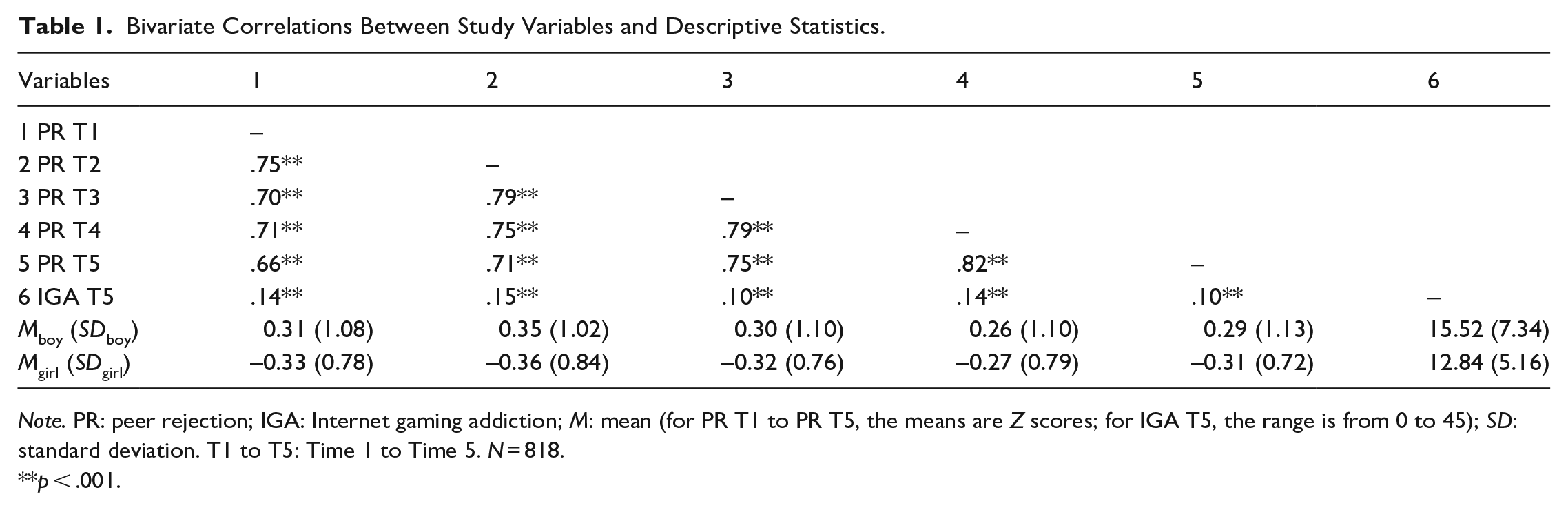
Note. PR: peer rejection; IGA: Internet gaming addiction; M: mean (for PR T1 to PR T5, the means are Z scores; for IGA T5, the range is from 0 to 45); SD: standard deviation. T1 to T5: Time 1 to Time 5. N = 818.
p < .001.
Sex Differences in Peer Rejection and Internet Gaming Addiction
To assess whether sex and grade played a role in peer rejection, we specified the average peer rejection levels during the five waves. The independent-sample t-test showed that the main effect of sex was significant, t(816) = 0.61, p < .001, Cohen’s d = 0.74, 95% confidence interval (CI) =[0.51, 0.74], and boys’ peer rejection (M = 0.30, SD = 0.97) was significantly higher than that of girls (M = −0.32, SD = 0.67). One-way ANOVA showed that the grade’s main effect was insignificant (p > .05).
To assess sex and grade differences in Internet gaming addiction, we performed a t-test and a one-way ANOVA. The t-test results showed that boys’ Internet gaming addiction (M = 15.52, SD = 7.34) was higher than that of girls, M = 12.84, SD = 5.16, t(765) = 5.85, p < .001, Cohen’s d = 0.42, 95% CI = [1.78, 3.58]. The main effect of the grade was significant, F(2, 764) = 10.15, p < .001, η2 = 0.03. The Bonferroni post hoc analysis revealed that Internet gaming addiction in Grade 3 (M = 12.66, SD = 5.79) was significantly lower than that in Grade 4 (M = 14.47, SD = 6.36, t = 3.17, p = .005, Cohen’s d = 0.30, 95% CI = [−3.18, −0.45]) and Grade 5 (M = 15.20, SD = 6.92, t = 4.40, p < .001, Cohen’s d = 0.40, 95% CI = [−3.92, −1.15]). There was no significant difference between Grades 4 and 5 (p = .572).
Peer Rejection Trajectories
To identify children’s peer rejection trajectories, a series of GMMs, with sex and grade as covariates, were specified with varying numbers of classes (i.e., one to six classes). The fit indices for each solution are listed in Table 2. As the LMR of the 6-class model was not significant, dividing it into six classes was deemed inappropriate. According to the class assignment probability, one of the groups in the 5-class model contains too few people; therefore, it was excluded. Compared with the 2-class and 3-class models, the 4-class model had the smallest AIC, BIC, and aBIC. Moreover, it has sufficient entropy and average distribution probability. The LMR and LRT were also significant. Considering these criteria, the 4-class model appeared to be the optimal solution.
Model Fit Indices for Peer Rejection Trajectories Models.
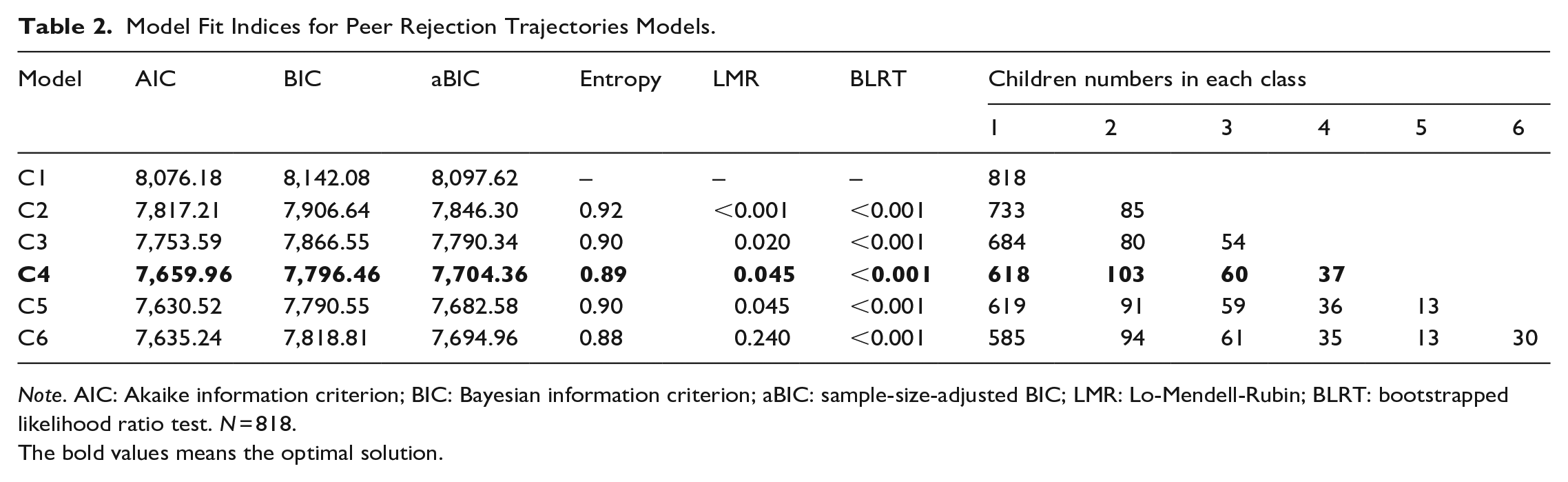
Note. AIC: Akaike information criterion; BIC: Bayesian information criterion; aBIC: sample-size-adjusted BIC; LMR: Lo-Mendell-Rubin; BLRT: bootstrapped likelihood ratio test. N = 818.
The bold values means the optimal solution.
The results of the GMM are shown in Figure 1. The average intercept values (α) of the four potential categories were as follows: Group 1: −0.131 (SE = 0.077, p = .086); Group 2: 1.879 (SE = 0.168, p < .001); Group 3: 0.629 (SE = 0.142, p < .001); and Group 4: 2.185 (SE = 0.260, p < .001). Group 4 had a high initial value (α), Groups 2 and 3 had a moderate initial value, and Group 1 had a low initial value.
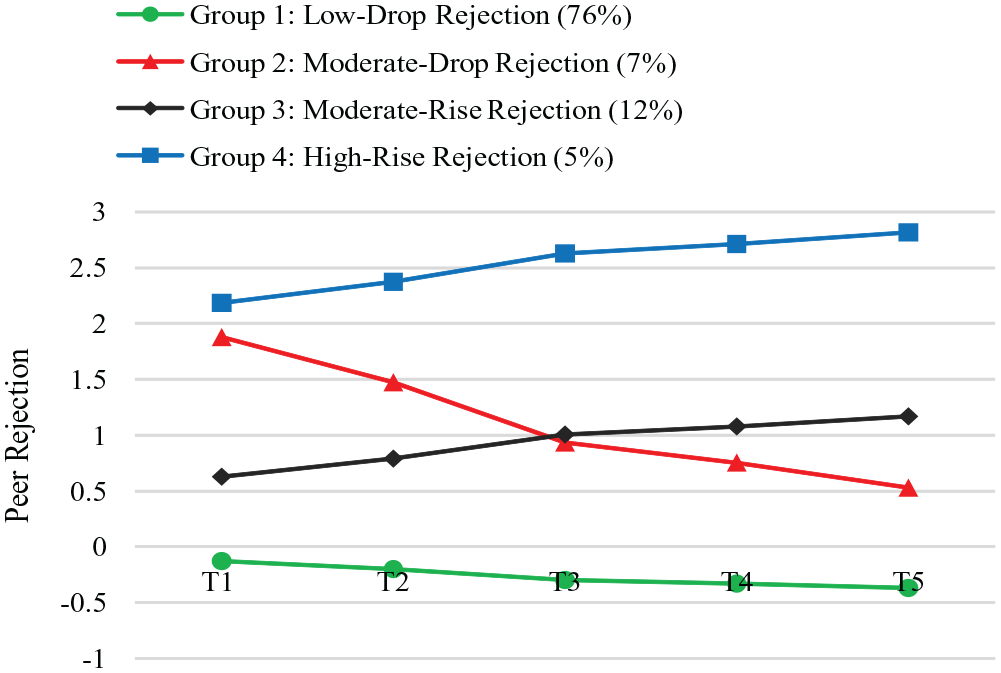
Children’s Peer Rejection Trajectories. N = 618 in Group 1, N = 60 in Group 2, N = 103 in Group 3, and N = 37 in Group 4. T1 to T5 = Time 1 to Time 5.
The mean slope (β) was each potential category’s average growth (or decline) rate. The slopes of the four categories were as follows: Group 1: −0.008 (SE = 0.003, p = .001); Group 2: −0.045 (SE = 0.006, p < .001); Group 3: 0.018 (SE = 0.005, p < .001); and Group 4: 0.021 (SE = 0.006, p < .001). The results indicated that peer rejection decreased significantly over time in Groups 1 and 2, whereas Groups 3 and 4 displayed a significant upward trend.
In addition, sex significantly predicted the intercept (−0.398, SE = 0.058, p < .001) and slope (0.007, SE = 0.002, p < .001) of the peer rejection trajectory. However, the grade had no significant predictive effect on the peer rejection trajectory’s intercept (p = .546) and slope (p = .307). These results were consistent with those of the t-test and one-way ANOVA.
In summary, combined with the results of α and β, four categories of children’s peer rejection development were identified: Groups 1 and 2 showed significant declines in peer rejection, and the difference in initial level (α) between them was relatively high. Groups 3 and 4 showed significant increases in peer rejection, and the initial level (α) difference between them was also relatively high. Therefore, the four categories were named as follows: Group 1: low-drop rejection (n = 608, 76%, 46.1% boys, 29.9% in Grade 1 and 35.0% in Grade 2); Group 2: moderate-drop rejection (n = 60, 7%, 56.7% boys, 26.7% in Grade 1 and 38.3% in Grade 2); Group 3: moderate-rise rejection (n = 103, 12%, 71.8% boys, 35.9% in Grade 1 and 41.7% in Grade 2); and Group 4: high-rise rejection (n = 37, 5%, 86.5% boys, 29.7% in Grade 1 and 29.7% in Grade 2).
To assess the validity of the potential classification results of peer rejection trajectories, we performed a one-way ANOVA. The ANOVA results showed that the main effect of peer rejection categories was significant, F(3) = 909.53, p < .001, η2 = 0.77. The Bonferroni post hoc analysis found that the scores in Group 1 (M = −0.41, SD = 0.42) were significantly lower than those in Group 2 (M = 1.08, SD = 0.43, t = 25.74, p < .001, Cohen’s d = 3.51, 95% CI = [−1.61, −1.38]), Group 3 (M = 0.91, SD = 0.41, t = 28.78, p < .001, Cohen’s d = 3.18, 95% CI = [−1.41, −1.23]), and Group 4 (M = 2.55, SD = 0.57, t = 41.08, p < .001, Cohen’s d = 5.91, 95% CI = [−3.10, −2.82]). The scores of Group 2 were significantly higher than those of Group 3 (t = 2.41, p = .015, Cohen’s d = 0.40, 95% CI = [0.03, 0.31]). The score of Group 2 was significantly lower than that of Group 4 (t = 16.28, p < .001, Cohen’s d = 2.10, 95% CI = [−1.64, −1.29]). The scores in Group 3 were significantly lower than those in Group 4 (t = 19.93, p < .001, Cohen’s d = 2.37, 95% CI = [−1.80, −1.47]). These results suggest that the categories of peer rejection trajectories are appropriate.
Peer Rejection Trajectories and Internet Gaming Addiction
Linear regression was used to calculate how peer rejection trajectories predicted Internet gaming addiction using Mplus 8.0. Peer rejection trajectories were coded as dummy variables, and boys in Group 1 (the low-drop rejection group) were used as reference categories. We used sex, grade, and peer rejection trajectories as the prediction variables and Internet gaming addiction scores as the result variables for the regression analysis. The results indicated that sex (B = −2.44, SE = 0.47, p < .001) and grades (B = 1.24, SE = 0.28, p < .001) significantly predicted Internet gaming addiction scores. These categories significantly predicted Internet gaming addiction scores and the prediction of Group 3 (the moderate-rise group) was significantly higher than that of Group 1 (the low-drop group, B = 1.62, SE = 0.70, p = .021). The other variables were not statistically significant (ps > .05).
To identify whether the prediction of peer rejection trajectories was better than the fifth peer rejection score, we conducted a regression analysis using sex, grade, and the fifth peer rejection score as the prediction variables and the fifth Internet gaming addiction score as the result variable. The results showed that sex (B = −2.44, SE = 0.47, p < .001) and grades (B = 1.18, SE = 0.28, p < .001) significantly predicted Internet gaming addiction scores. However, the fifth peer rejection score did not significantly predict the fifth Internet gaming addiction score (B = 0.27, SE = 0.24, p = .266). The results showed that the prediction of the categories was better than that of the fifth wave alone.
Discussion
Few previous studies have explored intragroup variations in peer rejection, and even fewer studies have examined the relationship between peer rejection trajectories and Internet gaming addiction among Chinese children. To bridge this gap, we utilized a large sample that provided longitudinal data across five time points to explore the developmental trajectories of peer rejection and their predictive effects on Internet gaming addiction. The results showed that boys had a higher risk of developing Internet gaming addiction and peer rejection than girls, which is consistent with previous studies (Nasser et al., 2020). Peer rejection nominations by Chinese children developed four different trajectories and had a significant predictive effect on Internet gaming addiction. This study provided evidence for the current situation of Internet gaming disorders and the developmental trajectories of peer rejection in Chinese children.
Our first hypothesis that boys’ peer rejection and Internet gaming addiction are higher than that of girls was supported by this study and is consistent with previous studies (Ettekal & Ladd, 2015a). Compared to girls, boys had lower life satisfaction in real life and experienced more immersion and presence in Internet gaming. Therefore, they are more active in Internet games (Stavropoulos et al., 2013).
This study also supported our second hypothesis that several subgroups would be identified in Chinese children. Moreover, this finding is consistent with the gain-loss theory which states that four subgroups of peer rejection exist among Chinese children (Aronson & Linder, 1965; Liu & Liu, 2020). Children in Group 4 (the high-rise group) had been continuously and permanently rejected by their peers, corresponding to one of the four patterns of the gain-loss theory—constant rejection, which indicated that they had established a stable reputation and low social status within their peer groups (Latané, 1981).
Children in Group 3 (the moderate-rise group) had a moderate start and experienced an increasing level of rejection over time, which also corresponds to one of the four patterns—increasing rejection. According to the gain-loss theory, these children struggle with greater mental or behavioral problems than children in the high-rise group (Aronson & Linder, 1965).
Children in Group 2 (the moderate-drop group) had a moderate start and experienced a decreasing level of rejection over time, which also corresponds to one of the four patterns—increasing acceptance. This decrease may be due to these children developing and establishing the same interests or hobbies as their classmates, thereby forming small groups. These classmates may have felt that they had something in common with the other rejected children, such as playing the same Internet games, which subsequently reduced rejections from their classmates (Kang & Ying, 2009). Moreover, we found that children in Group 2 scored relatively high for Internet gaming addiction.
Children in Group 1 (the low-drop group) maintained good relationships with their peers, thereby also corresponding to one of the four patterns—constant acceptance. The initial level of peer rejection experienced by this group was relatively low, indicating that the number of negative nominations by peers was low; this level then gradually decreased within 3 years, which meant that these children could maintain good friendships and make them better. This can be explained by conformity—a child thinks a classmate is nice, and the friends of this child may have similar views or ideas that this classmate is nice, thereby all of them become good friends (Yang et al., 2020).
This study did not find stability in the experience of peer rejection in early childhood, which is inconsistent with previous studies (Ettekal & Ladd, 2015b; S. Y. Liu et al., 2012). Ettekal and Ladd (2015b) tracked 383 children from Grades 1 to 6 (between the ages of 6 and 14 years); the GMM results found three potential peer rejection developmental trajectories: high rejection, moderate rejection, and low rejection. We excluded the effect of grades, as Grades 1 to 3 were included in every assessment. This study found that grades had no significant predictive effect on Internet gaming addiction, and each grade accounted for about one-third of the four developmental trajectories of peer rejection. Therefore, the three possible reasons for the inconsistent results are as follows:
The tracking times were different. Ettekal and Ladd (2015b) tracked the children for 6 years, whereas we tracked the children for only 3 years. Thus, the shorter time was insufficient to reflect stability. The results show that the slopes of the groups were significant but relatively low; therefore, there is a possibility of stability over time.
Our study had a large sample size. Therefore, reaching a statistically significant level was easy.
Sex affected the development of peer rejection. Previous studies have only considered the influence of peer rejection, whereas sex was included in the GMM of this study, which significantly predicted the intercept and slope of the developmental trajectories of peer rejection. These findings were consistent with the results that compared with the developmental trajectories of children with low peer rejection, those with moderate or high chronic peer rejection were more likely to be boys (Oncioiu et al., 2020). Given the lack of literature on the developmental trajectories of peer rejection, we could not determine the specific reasons.
Our third hypothesis that different trajectories of peer rejection have different effects on Internet gaming addiction in middle childhood was also supported. The psychological decompensation hypothesis supports that peer rejection is a factor that could inhibit children’s development; children resort to Internet gaming to resume their development (Gao & Chen, 2006). Specifically, the scores of Internet gaming addiction in Group 3 (the moderate-rise group) were significantly higher than those in Group 1 (the low-drop group). This finding is consistent with the gain-loss theory—increasing levels of peer rejection result in greater psychological pain than constant low levels of peer rejection (Aronson & Linder, 1965). Therefore, children seek Internet gaming to compensate for the mental pain caused by a lack of real friends.
The contributions of this study are as follows. First, this study was based on a large sample of Chinese children and is the first to investigate the current situation of Internet gaming among Chinese children. Second, based on the hypothesis of group heterogeneity and gain-loss theory, this study tracked children’s peer rejection for 2.5 years in five waves and further analyzed the different developmental trajectories at the individual level among Chinese children. Finally, this study revealed that trajectory categories of peer rejection could predict Internet gaming addiction, thereby supporting the psychological decompensation hypothesis. However, the fifth peer rejection cannot predict Internet gaming addiction and does not support the psychological decompensation hypothesis (Gao & Chen, 2006). These findings indicate that the trajectories of peer rejection offer a better fit as predictors for the data. The developmental process at the individual level affects the predictive effect of peer rejection on Internet gaming addiction. A single peer rejection index may have prediction bias, suggesting that we should explore the factors affecting Internet game addiction from the perspective of group heterogeneity.
The results provide practical guidance for developing good peer relationships and preventing Internet gaming addiction among children. First, teachers and parents should pay attention to the communication patterns between children and their peers in daily life and help children establish positive and friendly relationships with others to improve their acceptance in the group. Second, parents and schools should encourage children to participate in colorful community activities and develop secondary skills. Finally, it is necessary to limit the time and frequency of Internet gaming for boys.
This study has several limitations. First, the tracking time was short. Second, the data sources needed to be further diversified. For instance, the reports of parents or teachers should be considered in the future. Finally, this study cannot explain the Internal mechanisms by which peer rejection affects Internet gaming addiction. Ji et al. (2017) found that peer rejection negatively predicts executive control function. Reducing executive control function leads to an individual’s inability to overcome external temptation, resulting in Internet gaming addiction, which can be a direction for future research.
Conclusion
This study concluded that there were four heterogeneous developmental trajectories of peer rejection in Chinese children: low-drop, moderate-drop, moderate-rise, and high-rise rejection. The trajectory categories of peer rejection significantly predicted Internet gaming addiction. In particular, the prediction of the moderate-rise rejection group was higher than that of the low-drop rejection group.
Footnotes
Acknowledgements
We are grateful to all the children, their teachers, principals, parents, and everyone who participated in the data collection and worked on this project. We successfully completed this research with the help of the staff members.
Declaration of Conflicting Interests
The author(s) declared no potential conflicts of interest with respect to the research, authorship, and/or publication of this article.
Funding
The author(s) disclosed receipt of the following financial support for the research, authorship, and/or publication of this article: This work was supported by the Humanities and Social Sciences Youth Foundation of the Ministry of Education of China (19YJC190035).
