







Abstract
Despite the importance of school connectedness and bullying victimization in students’ school burnout, to our knowledge, very few studies have analyzed their reciprocal associations, and most of them have used cross-sectional designs. So, the nature and directions of these relations have not been established yet. The general aim of this study was to address this gap by testing a longitudinal model of the association between the mentioned variables in a group of Italian students. The participants are 363 students from Italian secondary schools (34% females; Mage = 13.35, SD = 1.47), who took part in three waves of data collection. One hundred and eighty-four students attended middle school (45% females; Mage = 12.01, SD = 0.46), and 179 students attended high school (22% females; Mage = 14.62, SD = 0.836). The adolescents filled out a questionnaire containing self-report measurements of studied variables three times, with an interval of 6 months. At both school levels, the results show the reciprocal and longitudinal role of school connectedness in reducing burnout, and of school burnout in reducing the sense of connectedness to school, both directly and indirectly. On the contrary, bullying victimization is not longitudinally associated with school burnout, whereas it negatively predicts the level of students’ connectedness to school. The study findings have revealed the importance of considering longitudinal and reciprocal associations among school burnout, connectedness, and bullying victimization, and are discussed referring to their implications for research and intervention efforts aimed at promoting students’ school well-being.
Introduction
The Construct of School Burnout
Children and adolescents spend most of their time at school, therefore researchers and school practitioners have traditionally been interested in identifying which school-related aspects might affect their well-being (Tobia et al., 2019). Among other perspectives, the person-environment fit framework (Eccles & Roeser, 2011) suggests that students’ school well-being is promoted when the learning context offers a supportive atmosphere, characterized by positive relationships with, and perceived support from, teachers and peers, otherwise, students are not likely to succeed. However, schools are not always enjoyable places, since oftentimes they become sources of stress, high work-requests, and negative relationships that may result in several forms of maladjustment and ill-being such as school burnout (Salmela-Aro & Upadyaya, 2014).
The construct of school burnout derives from the classic conception of job burnout, which has recently been extended to the scholastic context, based on the reasoning that school is the students’ workplace, characterized by some misfit between the demands and the resources (Salmela-Aro & Upadyaya, 2014). Demands can be school-related, such as workload, but there are also aspects that concern students personally, such as the pressure to be successful or the best, which may impart feelings of anxiety (Salmela-Aro & Upadyaya, 2014). Following Salmela-Aro and colleagues (2009), school-related burnout can be considered as a continuous phenomenon, from academic stress to major burnout, due to high schoolwork demands, which is composed of exhaustion, the development of cynical and detached attitudes toward school, and feelings of incompetence as a student. The levels of school burnout, moreover, may be linked to the school grade, since literature has extensively suggested that high school students tend to experience more stress than middle school counterparts in several areas, such as when studying, as well as in their social relationships with both teachers and peers (e.g., Hamarat et al., 2001; Hampel & Petermann, 2006).
Research concerning the original construct of job burnout has mainly explained its development using the Job Demands-Resources Model (Demerouti et al., 2001). Within this framework, burnout is affected by demands and resources. Demands are all aspects that exhaust and stress the individual, whereas resources refer to all features that help achieve goals, and encourage personal growth and development. Since it is broadly considered as a borrowed construct of its workplace counterpart, it is fair to presume that school burnout may likewise be explained as affected by school demands and alleviated by resources (Salmela-Aro & Upadyaya, 2014, 2020).
The Role of School Connectedness and Bullying Victimization on School Burnout
The literature informs that school burnout is linked to several individual or situational factors, such as negatively with students’ school motivation (Aypay & Eryılmaz, 2011), positively with time dedicated to homework (Özdemir, 2015), and negatively with perceived school competence (Bilge et al., 2014). As previously stated, Salmela-Aro and colleagues (2009) proposed considering school-related burnout as strictly linked to elevated school work demands. So, according to this perspective, chronic fatigue resulting from overtaxing school work can enhance the risks of developing burnout. However, research has underlined that some relational dimensions, such as having positive or negative relationships with teachers and/or peers at school may protect from or improve the chance of developing school burnout.
It is plausible that students who perceive themselves as accepted by peers and supported by teachers are less likely to disengage from school or experience higher levels of school-related stress (Osterman, 2000). In fact, school resources such as perceived social support, positive school relationships, and having high school connectedness might be potential buffers against perceived schoolwork overload, and so developing school burnout (Salmela-Aro, Kiuru, Pietikäinen, & Jokela, 2008).
School connectedness refers to experiences of caring at school, a sense of closeness to the personnel and environment, perceptions of safety, feelings of belonging and engagement, and, in particular, perceived support from teachers (see García-Moya et al., 2019 for a review). It has been considered an important aspect of the general school climate. However, although within schools with positive climate students are more likely to develop a strong sense of connectedness, a positive climate is not an absolute prerequisite to connectedness (Wilson, 2004). School connectedness has been considered to be an ecological concept (García-Moya et al., 2019) which includes care, respect, and support in relationships at school and positive feelings of liking or enjoying school. In addition, it is conceived as mainly dependent on the quality of relationships with adults at school, such as teachers and other members of the school staff, and as a dimension that decreases with age, in particular, in the transition from middle to high school (Monahan et al., 2010; Whitlock, 2006).
In a recent meta-analysis, Kim and colleagues (2018) found that perceived support from teachers, an important aspect of school connectedness, had a strong negative association with student burnout, even more than perceived support from parents. Also, Erentaitė and colleagues (2018) found a negative association between the sense of connection to school and burnout. In particular, within a cross-sectional study, involving high school adolescents, they concluded that school connectedness also has many positive consequences on learning outcomes, since it improves adolescents’ ability for self-regulation, metacognition, and monitoring personal signs of progress during learning activities. Students with high school connectedness, in fact, usually have a strong bond with their teachers, and are also more likely to discuss their problems and fears about school with them (e.g., Romano et al., 2021). Consequently, it may be plausible that the knowledge of being able to count on their teachers would be an additional source of confidence, and, even in the case of high school work demands, this may play an important role against burnout risks.
On the contrary, difficulties with teachers and/or peers may be additional risk factors for school burnout, as these relationship problems may transmit a negative image to adolescents about themselves, their adequacy in relationships with others, and, in general, their school experiences and learning abilities (Kiuru et al., 2020; Kutsyuruba et al., 2015). Bullying victimization, in particular, can be considered as an important stressful aspect, which might exhaust students. It refers to the experience of intentional and repeated aggression from bullies, and characterizes individuals who cannot easily defend themselves as a consequence of the imbalance of power (Menesini & Salmivalli, 2017; Olweus, 2001, 2013). It can take different forms, physical, verbal, direct, and indirect. This behavior generally declines with increasing school grades (e.g., Craig et al., 2009).
The literature has underlined that bullying victimization is associated with poor academic achievement, a low sense of belonging to the school, school avoidance, and higher stress, which may increase the risk of developing burnout symptoms (Buhs, 2005; Juvonen et al., 2000; Nakamoto & Schwartz, 2010). Moreover, traditional research on work burnout has brought forth the strong predictive role that mobbing, a form of occupational bullying victimization, plays in burnout (Mościcka-Teske et al., 2014; Sá & Fleming, 2008; Stanisławska et al., 2015). Therefore, even if very few studies have investigated the direct associations between bullying victimization and school burnout, we can expect to find the same pattern of associations as with its workplace counterpart.
To summarize, the literature has suggested that a high sense of connection to the school, together with low levels of negative peer experiences may be linked to several positive developmental patterns, including better academic achievement and low rates of risky behavior (Wilson, 2004), whereas low connectedness to school and high negative peer experiences such as bullying victimization may be associated to several negative outcomes, including higher risk of school-related stress, burnout, and dropping out (Buhs et al., 2006; Danielsen et al., 2010; Libbey, 2004; Salmela-Aro et al., 2008; Walburg, 2014).
Last, but not least, the research suggests that school connectedness may play a mediational role between negative experiences and adjustment. In particular, school connectedness has been investigated as a mediator between bullying victimization and students’ well-being (e.g., Hong & Espelage, 2012). Therefore, it is feasible to hypothesize that it may not only play a direct role in reducing school burnout, but also another one in mediating the negative effects of bullying victimization (Arango et al., 2016; Duggins et al., 2016). Nevertheless, we are not aware of studies that consider the longitudinal associations between all these constructs at the same time.
Effects of School Burnout on School Connectedness and Bullying Victimization
Despite the suggested important role of school connectedness and bullying victimization in school burnout, to our knowledge, very few studies have analyzed their reciprocal associations, and most of them have used cross-sectional designs. So, the nature and directions of these associations have not been established yet and may be more multifaceted than expected.
First, these associations may also be bidirectional. For instance, research has suggested that school connectedness is promoted by an environment in which student relationships are positive and respectful, and students perceive a safe and positive school climate (e.g., Allen et al., 2016). However, high levels of school burnout (as well as experiences of bullying victimization) might reduce the perception of school as a positive and safe place (Ripski & Gregory, 2009), consequently reducing the levels of school connectedness.
Furthermore, the association between bullying victimization and school burnout may be reciprocal: so not only bullying victimization may lead to psychological maladjustment, stress, and burnout but also adolescents who experience these psychological difficulties are more likely to become the possible targets of bullies (Prinstein et al., 2001). For example, school burnout may endorse various internalizing and interpersonal problems like symptoms of depression or anxiety and low self-concept, which in turn may lead to low peer acceptance, having few or no friends, peer rejection, and bullying victimization (Košir et al., 2020; Menesini & Salmivalli, 2017; Saarento et al., 2013).
The Present Study
Research within the person-environment fit framework has already documented the risks related to a school context that does not satisfy the need for belongingness, being valued, accepted, included, and encouraged by peers and teachers (Deci & Ryan, 1985; Eccles & Roeser, 2011; Goodenow, 1993). This may be especially relevant in the Italian school system. In our current school organization, students attend 3 years of lower secondary education (ages 11–14, grades 6–8) and 5 years of upper secondary education, choosing among several different types of schools, and proposing diverse educational curricula. Within each of these two stages of secondary school, the class composition remains the same throughout the schooldays and years. Similarly, they have the same teachers every year. This means that Italian adolescents spend most of their time together with the same classmates and teachers every day, for several consecutive years: aspects such as a low sense of belongingness or negative peer relationships and bullying victimization may play an even more deleterious role on well-being. In addition, some limitations characterize Italian school organization, such as the lack of a structured welfare system, present in other European countries, that includes psychologists and other professionals who may take care of the students’ needs (Dossena, 2017). Therefore, it is particularly important to better understand which factors may promote or undermine students’ well-being and how these aspects are related to each other over time.
Despite the literature that has proposed to consider school connectedness, and bullying victimization as having an important role in adolescents’ burnout, the existing knowledge concerning their associations is mostly based on cross-sectional studies, which means that the possible longitudinal cross-lagged and mediational paths between them have been overlooked. The general aim of this study was to address this gap by testing a longitudinal model between the mentioned variables in a group of Italian students, using a three-wave (November 2016, May to June 2017, and November to December 2017) longitudinal dataset. Although previous literature did not include longitudinal studies considering these three variables together, according to the existing research we hypothesize the following: (1) negative concurrent associations between school connectedness and burnout, (2) positive concurrent associations between bullying victimization and burnout. We also hypothesize that (3) school connectedness would reduce future school burnout and vice versa, (4) bullying victimization may lead to an increased school burnout and vice versa, and (5) that school connectedness may mediate the association between bullying victimization and school burnout. Since all studied dimensions have been considered as changing with increasing school grades, we also checked for differences between middle and high school students, hypothesizing that (6) for high school adolescents, more stressed by school workloads and more at-risks for burnout, school connectedness, and bullying victimization would play a stronger role than for their middle school counterparts.
Method
Participants
The participants were 363 students (34% females; age M = 13.35, SD = 1.47; age range = 11–18) nested in 20 classes of 8 Secondary Schools situated in three medium-sized cities in Tuscany, central Italy: Livorno (N = 72), Lucca (N = 246), and Pistoia (N = 45). In our sample, 184 students attended the lower secondary education, which in Italy it is called middle school (seventh grade—45% females; age M = 12.01, SD = 0.46; age range = 11–15), whereas 179 students attended the upper secondary education (or high school; 9th and 10th grades—22% females; age M = 14.62, SD = 0.836; age range = 13–18). Specifically, the four high schools offered technical (e.g., technical design, electronic) and vocational (e.g., mechanic and electric) courses, that in Italy are mostly attended by males. In total, 89.5% of the students were born in Italy, 1.1% in Morocco, 0.8% in Romania, 0.6% in Colombia, 0.6% in Albania, and 1.9% from various Countries in the world (5.5% did not give us information on their country of birth).
Design and Procedure
The participants belong to the control group of a quasi-experimental trial aimed at testing the effectiveness of the NoTrap! anti-bullying program (Palladino et al., 2016). Differently from the experimental group, the eight schools of the control group included in this study did not receive any kind of intervention during the three waves of data collection, but they did receive it after the end of the study. The research was carried out in accordance with the 1964 Helsinki declaration by the World Medical Association (WMA) and its later amendments, the ethical standards of the Italian Association of Psychology ethics code, and the obligations imposed by Italian law for the protection of minors. It was not approved by the ethics committee of the University of Florence, which was not yet established when the study started. However, in accordance with the Italian law on the protection of minors, preliminary informed consent, consisting of initial approval by the School Principal and the class council, was requested. Once permission was gained from schools, informative letters were sent to all 373 students (35% females) and their families, explaining the study, and requesting the parents’ consent for their child’s participation. In total, 97% of the target sample (N = 363) received parents’ approval to participate in the study. We collected data once every 6 months: November 2016 (T1, wave 1), May to June 2017 (T2, wave 2), and November/December 2017 (T3, wave 3).
Between T2 and T3, there was the transition from the school year 2016/2017 to the school year 2017/2018. In this transition, we lost 75 participants from the initial sample (20.7%). Unfortunately, we do not know if they were simply absent during the third administration or if they had not passed the previous grade, or whether they had dropped out of school. Attrition analysis was conducted through a logistic regression model in which dropout at T3 (0 = dropout, 1 = in the study) was predicted by school level (1 = middle school, 2 = high school), gender (0 = females, 1 = males), school burnout at T1, school connectedness at T1, and victimization at T1. Results showed that dropout at T3 is predicted only by school level (OR = 0.280, 95% CI = [0.150, 0.523], p < .001). Students lost at T3 are more likely to be high schoolers, and this is in line with the Italian data, in which the probability of leaving or changing school between grades is higher for high school students than for middle school ones (Ministry of Education, University and Research [MIUR], 2019). For this reason, and also following literature concerning grade differences between lower and secondary school students in school burnout (e.g., Read et al., 2022), school connectedness (e.g., Liu et al., 2020), and bullying victimization (e.g., Yeager et al., 2015), we controlled for school-level effects in the analyses. On the contrary, gender (OR = 0.861, 95% CI = [0.452, 1.639], p = .649), school burnout (OR = 0.758, 95% CI = [0.355, 1.616], p = .473), school connectedness (OR = 0.965, 95% CI = [0.439, 2.121], p = .929), and victimization (OR = 0.458, 95% CI = [0.053, 3.964], p = .478) had no impact on attrition. Consequently, for this study, we used all the information available across time. The missing data were dealt using maximum likelihood estimation.
Measures
School Connectedness
The school connectedness subscale of the What’s Happening In This School? (WHITS) questionnaire (Aldridge & Ala’I, 2013) was used. It consists of eight items measuring the extent to which students perceive that they are part of a community at school (e.g., “I feel included at school”; “At this school, I feel welcome”; “At this school, I am part of a community”). Each item was evaluated along a 5-point scale from 1 (almost never) to 5 (almost always). The subscale showed good internal consistency and a good face, convergent, discriminant, concurrent, and predictive validity in the original study (Aldridge & Ala’I, 2013).
The Confirmatory Factor Analyses (CFAs) showed good fit indices both at T1, χ2(18) = 23.163, p = .184, CFI = 0.993, RMSEA = 0.030, 90% CI = [0.000, 0.061], SRMR = 0.029; at T2, χ2(18) = 33.429, p = .015, CFI = 0.976, RMSEA = 0.053, 90% CI = [0.023, 0.081], SRMR = 0.033; and at T3, χ2(18) = 43.076, p = .001, CFI = 0.960, RMSEA = 0.076, 90% CI = [0.047, 0.106], SRMR = 0.049. For the following analyses, the saved factor scores were used. In each set of data collection, the scale presents acceptable internal consistency: T1 Cronbach’s alpha is .83, at T2 it is .83, and at T3 it is .85.
Bullying Victimization
The subscale of bullying victimization of the Florence Bullying-victimization Scales (FBVSs; Palladino et al., 2016) was used. It consists of 10 items asking how often in the last couple of months the participant has experienced certain bullying behaviors as a victim. The definition of what it means to be bullied has been introduced on the scale:
A child is bullied when another child or a group of children: says bad and unpleasant things to him/her; makes fun of him/her; calls him/her with offensive names; ignores or completely excludes him/her from their group; hits, kicks, pushes him/her; threatens him/her; tells lies or spreads stories about him/her. In bullying situations, these facts happen more than one time. It is always bullying even when a boy/girl is teased repeatedly and maliciously. It is not bullying when two boys and/or girls of almost the same strength fight with each other.
This definition is based on the one proposed by Olweus (1993), which captures all three main elements of bullying: the intention to harm the victim, the repetitive nature of bullying, and the imbalance of power between the victim and the perpetrators. Each item was evaluated along a 5-point scale from 1 (never) to 5 (several times a week). The scale is composed of the following three subscales: physical (four items; for example, “I have been beaten up”), verbal (three items; for example, “I have been teased”), and indirect (three items; for example, “I have been ignored by my schoolmates”) bullying victimization. The scale showed good factorial validity and reliability in previous studies (Palladino et al., 2016; Zambuto et al., 2020).
In our sample, the second-order CFAs showed acceptable fit indices both at T1, χ2(30) = 76.503, p < .001, CFI = 0.922, RMSEA = 0.069, 90% CI = [0.050, 0.089], SRMR = 0.052, at T2, χ2(30) = 53.229, p = .006, CFI = 0.943, RMSEA = 0.051, 90% CI = [0.028, 0.074], SRMR = 0.050, and at T3, χ2(30) = 52.175, p = .007, CFI = 0.941, RMSEA = 0.056, 90% CI = [0.029, 0.081], SRMR = 0.045. For the following analyses, the saved second-order factor scores were used. In each set of data collection, the scale presents acceptable internal consistency: T1 Cronbach’s alpha is .87, at T2 it is .84, and at T3 it is .83.
School Burnout
The Italian version of the School Burnout Inventory (SBI) was used (Fiorilli et al., 2014; Salmela-Aro et al., 2009). It is composed of nine items measuring three factors of school burnout: (a) exhaustion at school (four items; for example, “I feel overwhelmed by my schoolwork”), (b) cynicism toward the meaning of school (three items; for example, “I feel that I am losing interest in my schoolwork”), and (c) sense of inadequacy at school (two items; for example, “I often have feelings of inadequacy in my schoolwork”). All the items were rated on a 6-point Likert-type scale ranging from 1 (completely disagree) to 6 (strongly agree). The overall scale showed good reliability and concurrent and factorial validity both in the original version (Salmela-Aro et al., 2009) and in the Italian validation (Fiorilli et al., 2014).
In our sample, the second-order CFAs showed good fit indices both at T1, χ2(23) = 41.802, p = .010, CFI = 0.961, RMSEA = 0.051, 90% CI = [0.025, 0.076], SRMR = 0.040; at T2, χ2(23) = 45.681, p = .003, CFI = 0.966, RMSEA = 0.060, 90% CI = [0.034, 0.085], SRMR = 0.036; and at T3, χ2(23) = 42.927, p = .007, CFI = 0.958, RMSEA = 0.065, 90% CI = [0.033, 0.094], SRMR = 0.043. For the following analyses, the saved second-order factor scores were used. In each set of data collection, the scale presents acceptable internal consistency: T1 Cronbach’s alpha is .81, at T2 it is .86, and at T3 it is .88.
Overview of the Analyses
Descriptive statistics of the raw data and correlations between variables were computed for all variables included in the study, separately for middle and high school students.
To assess the longitudinal associations between school burnout, school connectedness, and bullying victimization, a cross-lagged panel analysis (Little et al., 2007) was performed using three waves of data collection with Mplus 7.0 (Muthén & Muthén, 1998–2010). The cross-lagged panel model is a type of Structural Equation Model (SEM) data structure that describes change through temporal directional effects (both autoregressive and cross-lagged) in longitudinal data (Little et al., 2007). The model included correlations among constructs at every time point, autoregressive paths for each construct across time, and all cross-lagged paths (Figure 1).
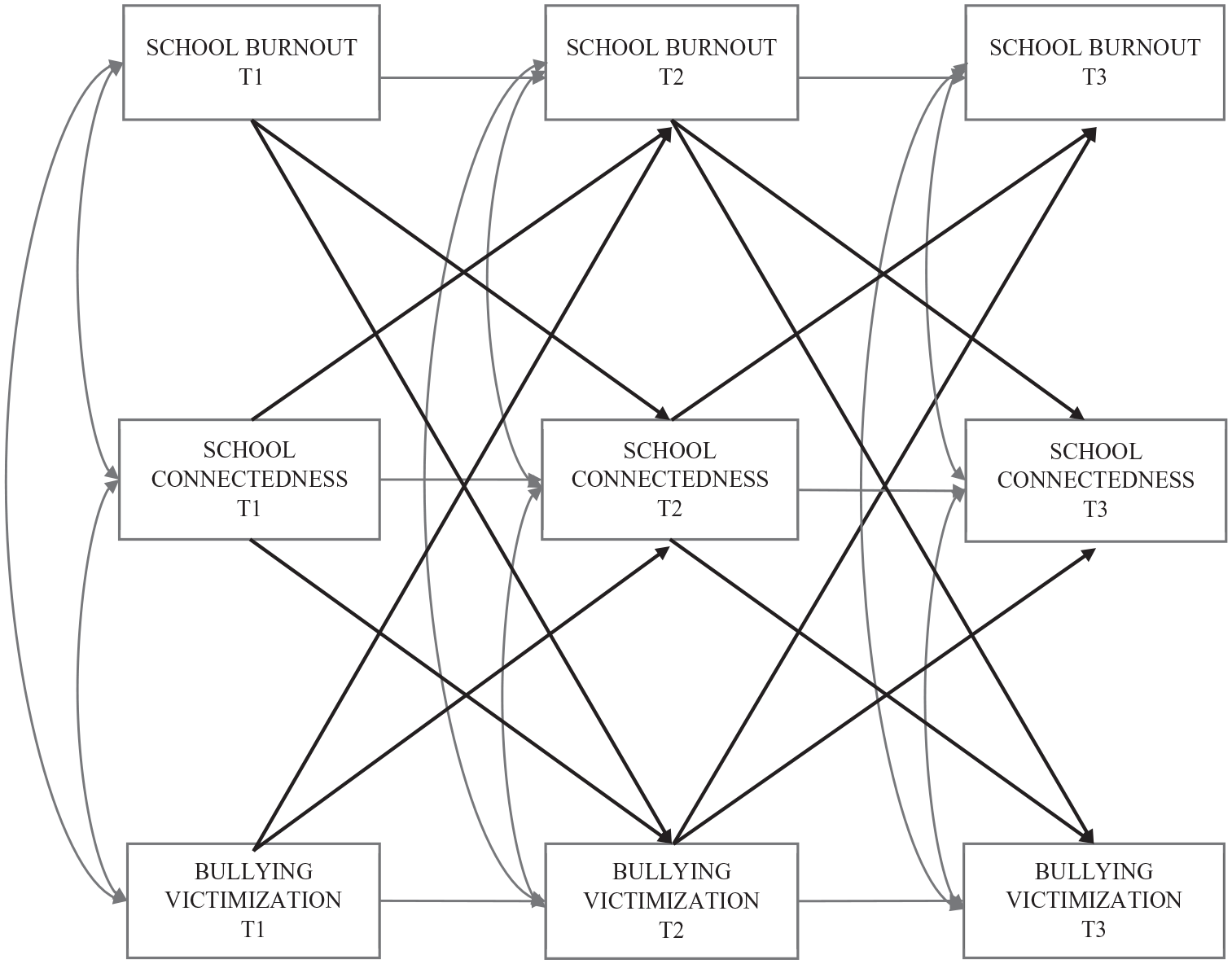
Model Tested. T1 = wave 1 (November 2016); T2 = wave 2 (May to June 2017); T3 = wave 3 (November/December 2017).
As a result of attrition analyses, school grade level differences were explored using a multi-group approach, in which a model with all paths freely estimated across the school level was compared to a constrained model in which cross-lagged effects were fixed to be equal for middle school and high school students. Furthermore, by using the procedure of stratification, we also controlled for the school sampling. The classroom level was considered as a reference instead of school because in Italy the classroom represents a meaningful unit of peer clustering that can be considered as a between-level variable. In fact, students in Italy stay in a single classroom with the same peer group every day, for the entire school year and across the years. The strategy of testing included the comparison between nested models using Satorra–Bentler-scaled chi-square difference tests (see Mulder & Hamaker, 2021; Satorra & Bentler, 2010).
Second, to allow for a meaningful comparison of factors over time, time-invariance was added in relation to all autoregressive paths followed by concurrent (within-time) effects and finally to cross-lagged effects (Meredith, 1993). To estimate the models’ goodness-of-fit, in addition to the chi-square statistic, we analyzed the meaning of the Comparative Fit Index (CFI), the Tucker–Lewis index (TLI), and the Root Mean Error of Approximation (RMSEA). CFI and TLI close to 0.95 and RMSEA of 0.08 or lower indicate a reasonably good fit (Hu & Bentler, 1999). When a final model was determined, the indirect effects were tested using the bias-corrected bootstrap method, as recommended by Hayes and Scharkow (2013), with 5,000 bootstrap runs. Confidence intervals are reported.
Results
Descriptive Statistics and Correlation
Descriptive statistics of the raw data and correlations between the constructs are respectively presented in Tables 1 and 2. Concerning correlations (see Table 2), in both school levels, school burnout and bullying victimization are concurrently and longitudinally positively associated, except for school burnout at T1 and bullying victimization at T3 which are not significantly associated both in middle and high school. School connectedness is always negatively and longitudinally associated with school burnout in middle school. In high school, school connectedness (both at T1 and T2) is negatively associated with school burnout in all three times, while school connectedness at T3 is negatively and significantly associated only with school burnout at T1 (r = –0.333). Finally, school connectedness and bullying victimization are significantly, negatively, and longitudinally associated in both school levels except for one not significant association in middle school (school connectedness at T3 with school burnout at T3).
Descriptive Statistics for Middle and High School Students—Means (M), Standard Deviations (SD), Minimum (Min) and Maximum (Max) Scores.
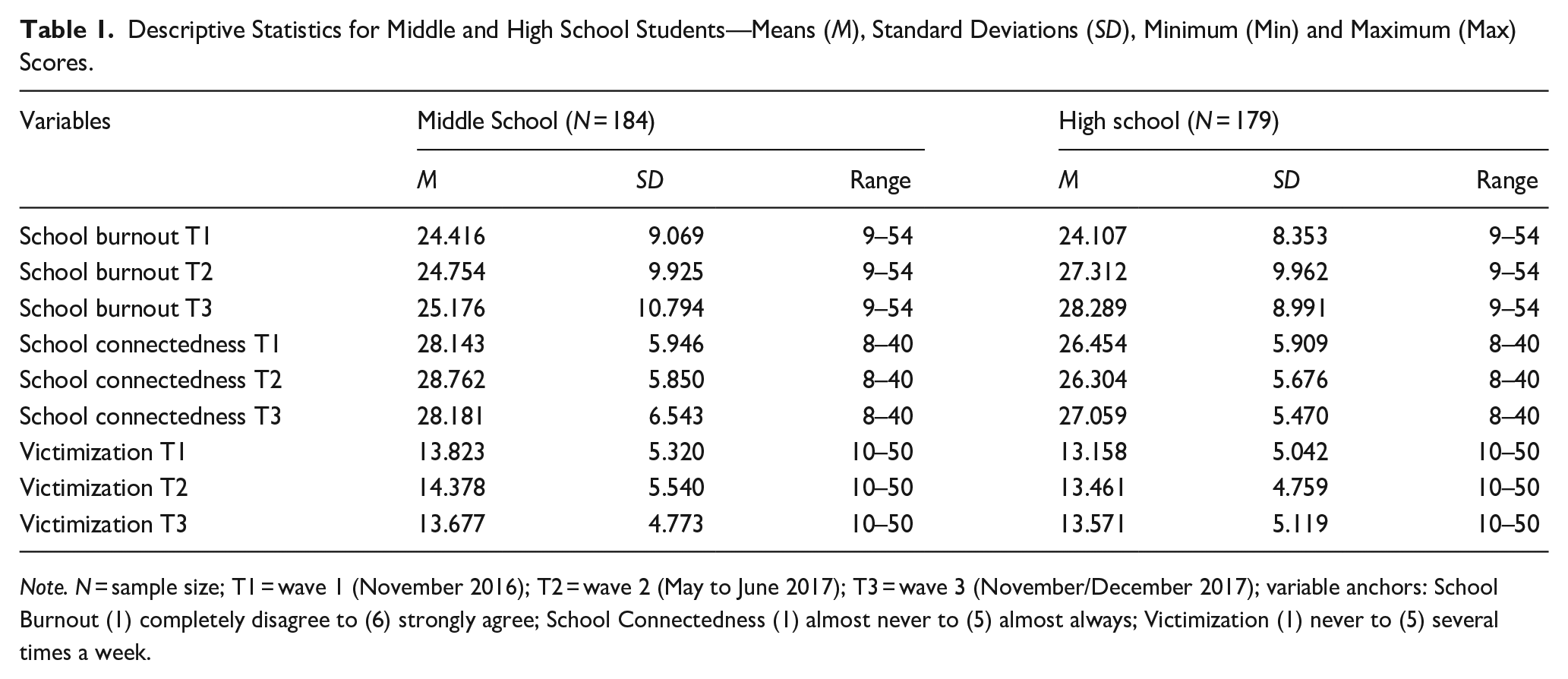
Note. N = sample size; T1 = wave 1 (November 2016); T2 = wave 2 (May to June 2017); T3 = wave 3 (November/December 2017); variable anchors: School Burnout (1) completely disagree to (6) strongly agree; School Connectedness (1) almost never to (5) almost always; Victimization (1) never to (5) several times a week.
Pearson Correlations among Variables Separately for Middle (N = 184) and High Schools (N = 179).
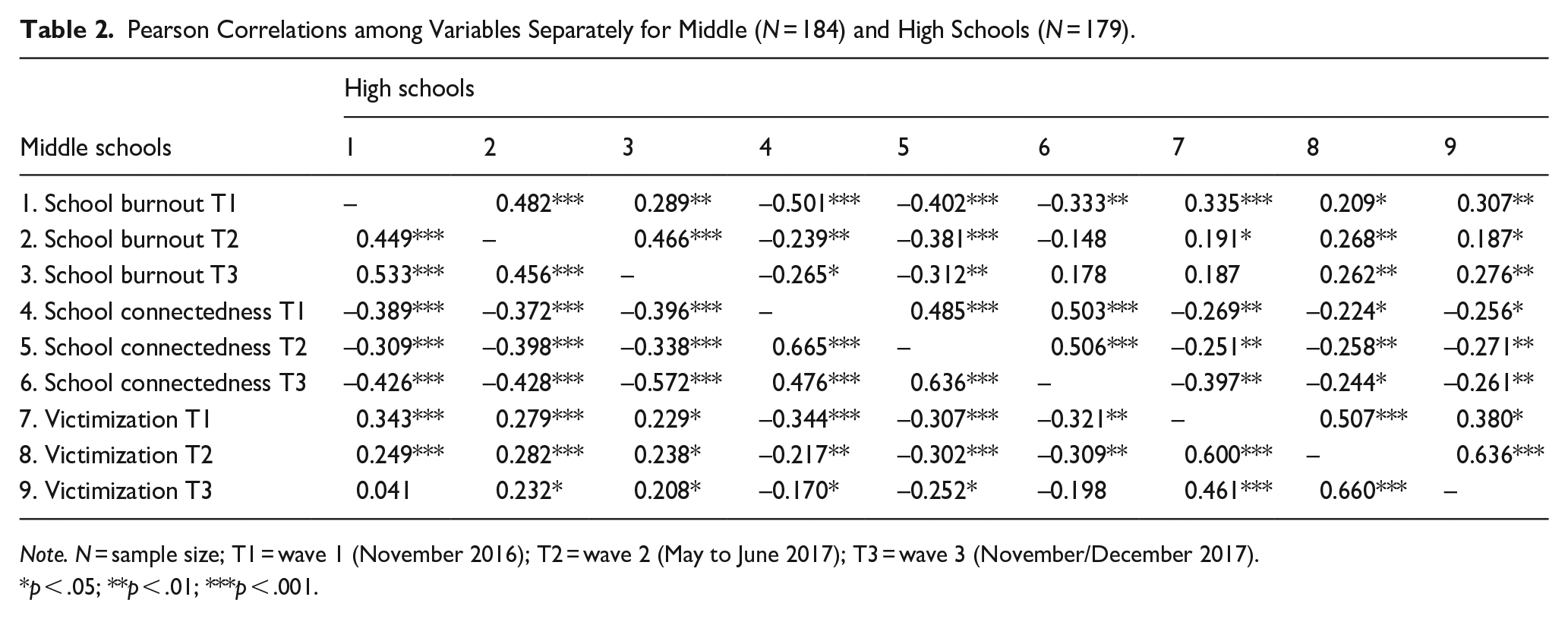
Note. N = sample size; T1 = wave 1 (November 2016); T2 = wave 2 (May to June 2017); T3 = wave 3 (November/December 2017).
p < .05; **p < .01; ***p < .001.
Cross-Lagged Panel Modeling
Model comparisons conducted to test school-level differences and time-invariance are reported in the Supporting Information (see Supplementary Appendixes 1 and 2; Tables S1 and S2). With regard to the school-level moderation, constraining the cross-lagged effects to be equal across school levels did not worsen the model fits (see Supplementary Appendix Table S1), indicating that the within-person reciprocal effects between the three variables were similar for middle and high school students.
Regarding the time-invariance, except for the concurrent associations between school burnout and school connectedness and between school connectedness and bullying victimization, all the constrained models did not result in a significantly worse fit than the unconstrained one (i.e., non-significant chi-square difference test). Therefore, in the final model (Model 4), the concurrent associations between school burnout and school connectedness and between school connectedness and bullying victimization were freely estimated over time, whereas the concurrent associations between school burnout and bullying victimization, and all autoregressive and cross-lagged effects were fixed to be equal over time. This model fit the data well, χ2(50) = 54.870, p = .295, CFI = 0.988, TLI = 0.984, RMSEA = 0.023, 90% CI = [0.000, 0.055], and fit the data equally well as the model with all freely estimated parameters. Therefore, it was retained as the final model. Figures 2 and 3 respectively display the model’s significant paths for middle and high school students. All the path estimates are reported in the Supporting information (Supplementary Appendix Tables S3 and S4).
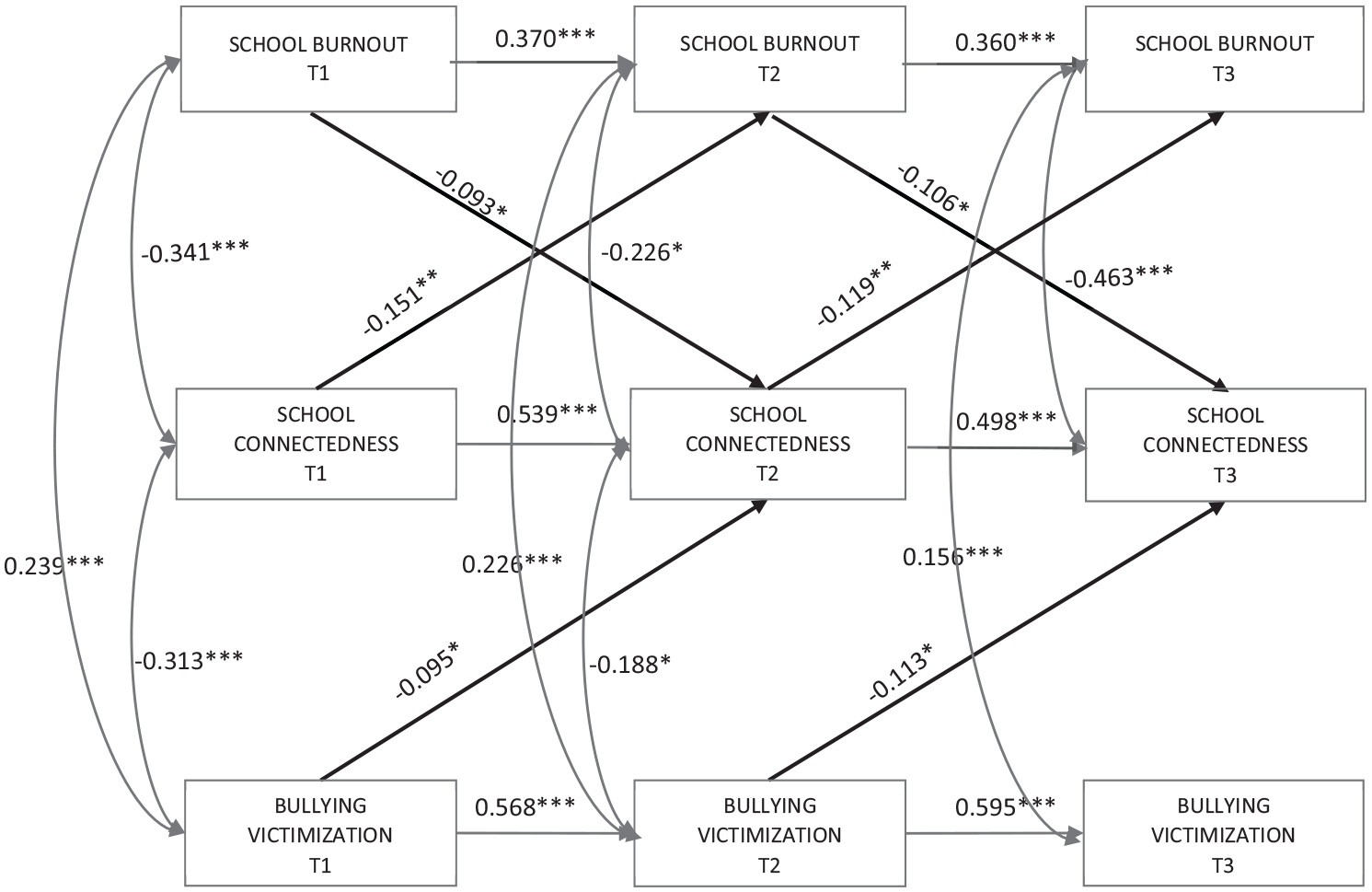
Final Model of the Relationship among School Burnout, School Connectedness, and Bullying Victimization for Middle School Students (N = 184).
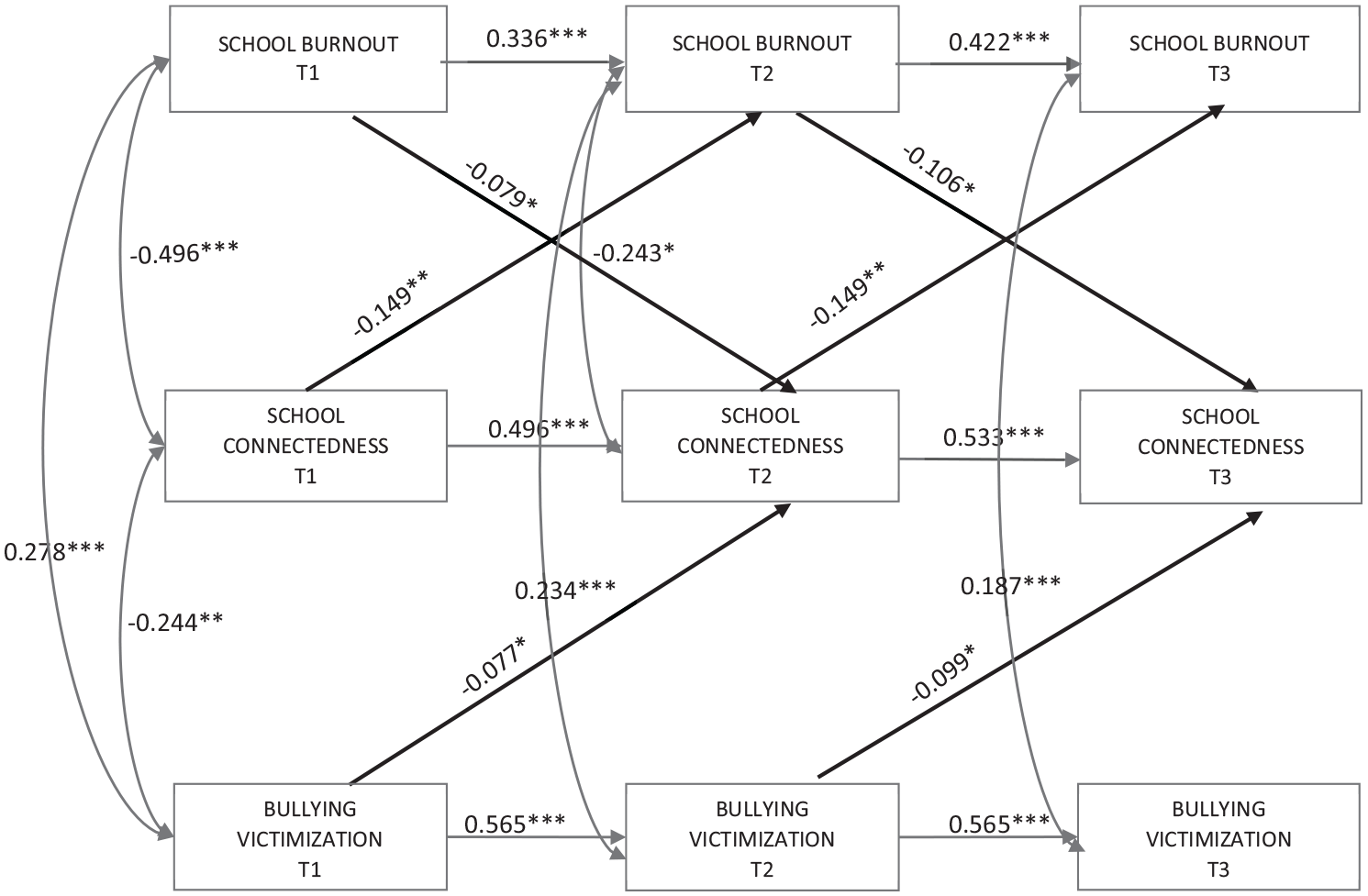
Final Model of the Relationship among School Burnout, School Connectedness and Bullying Victimization for High School Students (N = 179).
For both middle and high school students, the autoregressive path coefficients were significant, indicating that school burnout, school connectedness, and bullying victimization maintained significant stability over time. Furthermore, for both middle and high school students all within-time estimates were significant for T1. At T2, all within-time estimates remained significant for middle school, while the association between school connectedness and bullying victimization was not significant in high school. At T3, the within-time associations between school burnout and bullying victimization and between school burnout and school connectedness remained significant for middle school. In high school, only the within-time association between school burnout and bullying victimization remained significant.
Concerning cross-lagged estimates, for both school levels, school burnout and school connectedness negatively and reciprocally predicted each other both between T1 and T2 and between T2 and T3. Furthermore, bullying victimization negatively predicts school connectedness both between T1 and T2 and between T2 and T3.
Results did not show significant cross-lagged paths between school burnout and bullying victimization over time. Furthermore, no significant paths have been found from school connectedness to bullying victimization.
Indirect Cross-Lagged Paths
Finally, contrary to our hypothesis (d), the bootstrapping mediation analysis did not show a significant indirect effect of bullying victimization at T1 to school burnout at T3 through school connectedness at T2 both for the middle, β (SE) = .011 (0.007), p = .125, 95% CI = [–0.001, 0.023], and high school, β (SE) = .011 (0.007), p = .121, 95% CI = [–0.001, 0.024].
However, the bootstrapping mediation analysis highlighted four significant indirect effects both for middle school and high school (Table 3). Specifically, in both school levels, school burnout at T1 predicted school connectedness at T3 through school connectedness at T2. This means that the initial level of school burnout (T1) negatively influenced the school connectedness at the end of the school year (T2), and this, in turn, predicted a lower school connectedness level at the beginning of the following school year (T3). Furthermore, school connectedness at T1 predicted school burnout at T3 both through school burnout at T2 and school connectedness at T2. This means that higher levels of connection to the school at the beginning of the school year 2016/2017, predicted lower levels of school burnout and higher levels of school connectedness at the end of the school year. These in turn predicted the school burnout level at the beginning of the school year 2017/2018. In addition, bullying victimization at T1 predicted school connectedness at T3 through school connectedness at T2. This means that students who were more victimized at the beginning of the school year 2016/2017 became less connected to their school at the end of the school year, and this in turn led to lower levels of school connectedness in the new school year as well.
Significant Indirect Standardized Cross-Lagged Estimates for the Model 4.
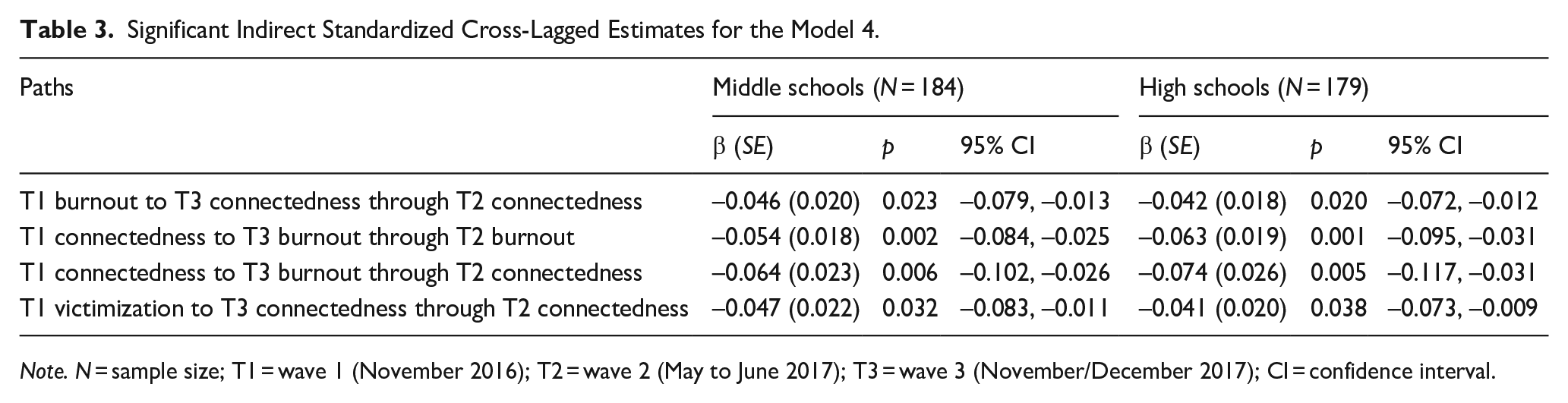
Note. N = sample size; T1 = wave 1 (November 2016); T2 = wave 2 (May to June 2017); T3 = wave 3 (November/December 2017); CI = confidence interval.
Discussion
The literature has recently focused on better understanding a specific aspect of school ill-being, namely school burnout, and which school factors may play a role in its improvement or reduction. Although there is some evidence about the role of school connectedness and bullying victimization using mainly cross-sectional research designs (Biggart et al., 2013; Erentaitė et al., 2018; Juvonen et al., 2000), full models including all the possible direct and indirect paths have not been studied yet. The present study aimed at investigating the reciprocal associations between school burnout, connectedness, and bullying victimization using a longitudinal design (three waves of data collection), testing for mediational effects, and considering differences between middle and high school levels.
As expected (hypothesis 1), and consistent with previous findings (Fiorilli et al., 2017), school connectedness and burnout were concurrently and negatively associated with each other, and this was true for all times considered in middle school and for the first and second times considered in high school students. These findings are in line with other studies (i.e., Fiorilli et al., 2017; Salmela-Aro, 2017; Salmela-Aro & Upadyaya, 2020) which modeled school burnout and connectedness simultaneously (not longitudinally). The variables were studied as correlates, and the outcomes of the two constructs were examined together. In addition, our results add an important and original tip to the literature concerning these issues, confirming our hypothesis 3 (that school connectedness would reduce future school burnout and vice versa). In fact, our findings displayed a longitudinal and reciprocal negative influence of school connectedness and burnout, both directly and indirectly, and both in middle and high school students. If, on one hand, school connectedness showed a role in reducing school burnout, at the same time, school burnout may constitute an important risk dimension for the reduction of the sense of connectedness to school. Taken together, these findings confirm both to the job-demands-resources theory (Demerouti et al., 2001) in the scholastic context (Salmela-Aro & Upadyaya, 2014) and the person-environment fit framework (Eccles & Roeser, 2011). As previously explained, according to the job-demands-resources theory, accumulating individual resources is essential for effectively dealing with school-related stress. Because feelings of connection to school and a sense of belonging are undoubtedly positive factors, we can assume any students facing difficulties in their daily life at school would find them helpful, thus reducing the risk of developing burnout symptoms over time. Similarly, poor school adjustment due to work overload and high levels of school-related stress and burnout may generate negative feelings toward school in adolescents, thus confirming the results and conclusions of Salmela-Aro and Upadyaya (2014) about the important role of school burnout for the later decrease in connectedness and sense of relatedness to school. Moreover, following the person-environment fit framework, when the school setting satisfies adolescents’ need for belongingness, students may handle best school-related stress and demands, reducing the risks of burnout (Eccles & Roeser, 2011; Tomaszek, 2020). Concurrently, when students face high levels of stress, cynicism, and exhaustion, they are less likely to experience positive feelings and a sense of attachment toward the school context and the people within it. This is particularly critical for Italian adolescents. As suggested by Gabola and colleagues (2021), the Italian school system does not offer the presence of stable support services to their students, so, scholars with psychological needs can only trust and rely on supportive teachers to feel better and diminish their stress and probability of burnout.
However, in contrast to our hypotheses (2 and 4), bullying victimization and school burnout were significantly and positively correlated only at T1, and bullying victimization did not predict burnout levels or vice versa, neither in middle school nor in high school students, neither directly nor mediated by school connectedness (hypothesis 5). This result differs from the research on workplace burnout, which has found a strong positive predictive role of occupational victimization on burnout (Giorgi et al., 2016; Mościcka-Teske et al., 2014; Sá & Fleming, 2008; Stanisławska et al., 2015). It seems that burnout within the school context has a specific and different nature along with some peculiarities, which must be considered and further studied.
On the contrary, bullying victimization longitudinally and negatively predicts the levels of school connectedness. In general, these findings seem to suggest that being victimized by bullies may decrease the level of connectedness in school, maybe, as suggested by Ripski and Gregory (2009) since this enhances feelings of unsafety, unfairness, and inhospitality in the school context. Accordingly, despite being victims of bullies seems not to be important for school burnout, it showed to play a role in reducing school connectedness. Hence, diminishing experiences of bullying victimization can be considered fundamental to promote this important aspect of school well-being.
Furthermore, taken together, our results did not confirm our hypothesis (6) that for high school adolescents, school connectedness and bullying victimization are more relevant for school burnout than for their middle school counterparts. In fact, despite the association between school connectedness and bullying victimization being stronger for high school students, there were no other differences related to grades. These findings are important since they highlight that students may experience stress and burnout from early grades, and that being committed to school is a buffer, independently of the educational stage. So, to prevent school ill-being, and burnout in particular, intervention efforts (such as those promoting school connectedness) need to be planned from middle school, or even earlier.
Nevertheless, following our data concerning school burnout, we might argue that aspects that are more related to relationships with adults may play a stronger role in students’ burnout symptoms than those specifically related to interactions between peers. Our results, in fact, suggested that school connectedness—which is, as previously explained, mainly dependent on the quality of relationships with adults, such as teachers and school staff—may have a stronger predictive role in adolescents’ burnout levels, than facets related to relationships with peers, such as negative experiences of bullying victimization. Nevertheless, assuming the importance of collectivism and connections to others through the life course for many Italians (Lo Cricchio et al., 2019), we are not surprised that this aspect occurred as a particularly important factor in the prediction of school burnout among our participants. In addition, despite its strong negative connotation, the bullying victimization aspect of school demand appears not to play a direct role in burnout. However, again this is not completely unexpected since, to some extent, it is in line with previous findings from the literature concerning adult workplace burnout. In fact, some studies in the work field have underlined the importance of job resources, which sometimes play an even stronger role than demands, acting as buffers in reducing stress and burnout (Bakker & Demerouti, 2007; Boyd et al., 2011; in school context, see Salmela-Aro & Upadyaya, 2020). For example, a high-quality relationship with one’s manager has been found to have an alleviating effect on certain aspects of job stress, as the added support shifts demands into a different, less relevant perspective (Bakker & Demerouti, 2007). Moreover, Boyd and colleagues (2011) revealed that job demands longitudinally predict stress only indirectly, and are mediated by job resources. It is possible that some students’ personal or interpersonal resources such as socio-emotional skills, which have not been specifically considered in our study, may have acted in mediating, and dropping the role of victimization on burnout (Salmela-Aro & Upadyaya, 2020). So, future studies must explore other possible mediating variables to better understand the association between these important indicators of school well-being. Last, but not least, our study also introduced the important role of school burnout on school connectedness. To our knowledge, this result replicates only one longitudinal study, that of Salmela-Aro and Upadyaya (2014), calling for the need to further investigate how these two important aspects of school well-being are influencing each other over time.
As with any study, several shortcomings limit the interpretability of the present findings. First, the self-report nature of the measures may have increased the possibility of inflated associations. For example, there is sometimes concern about the risk of underreporting individual problems (such as being bullied victimized) when self-reports are used. Moreover, relying exclusively on self-report measures obtained from the same respondents may introduce bias in the results concerning the shared method variance issue. Specifically, it is likely that a portion of the observed variance is attributable to the specific measurement method rather than the actual association between the constructs. Therefore, in future research should include a multi-informant approach to mitigate this limitation.
Furthermore, a methodological constraint of this study is the limited sample size. This limitation has the potential to bias the effect size and compromise the statistical power of the findings, thereby increasing the risk of non-replicability. In addition, another limitation is related to the fact that our sample was mainly composed by Italian adolescents, which may restrict the generalizability of the results. To address this limitation, future studies should aim for a larger and more diverse sample encompassing participants from various cultural backgrounds.
Second, considering the exploratory nature of our study, we have not tested the potential moderating role of other variables, within our sample. For example, the literature has underlined that school burnout is usually higher among girls (Kiuru et al., 2020; Salmela-Aro et al., 2008), but our sample was composed mostly of males (63%), which may have influenced our results. In addition, we have not considered the potential role of disruptive behavior, even if this can be critical in activating a vicious cycle between the considered variables. Future research must take other variables into deeper consideration, evaluate their weight in associations, and consider samples with more balanced composition and characteristics. A further limitation of the study is that the traditional cross-lagged panel model does not allow us to disentangle “between-person effects” from “within-person effects.” This means that we do not know if our results were influenced by stable, trait-like differences between persons. Further studies should use a Random Intercept Cross-Lagged Panel Model (RI-CLPM) to decompose observed scores into within-person dynamics and stability between-person differences (Mulder & Hamaker, 2021). Last, but not least, despite having considered an overall burnout factor in our study, several researchers (Kim et al., 2018; Leiter & Maslach, 1988; Salmela-Aro & Upadyaya, 2020) have proposed burnout models which suggest a specific and different nature in each of its dimensions. As such, in the future, it is advisable to consider and evaluate exhaustion, cynicism, and inadequacy separately.
Conclusion
Understanding the education community lies at the core of constructing a safer school context (Calabrese, 2000). Teachers and administrators must make sure that every student feels a sense of security and well-being to take part in the educational process (McEwan, 2000). In this aim, it is pivotal to better understand how school-related aspects of well-being are linked to each other, and how they develop over time. This is particularly relevant for school problems. When problems are understudied, in fact, they remain unresolved, and the whole community suffers, whereas, when school context-related aspects are analyzed in-depth, it becomes possible to build a better society (Lambert et al., 1997).
Although much work remains to be done, the findings of our study have revealed the importance of considering longitudinal and reciprocal associations among school burnout, school connectedness, and bullying victimization, confirming, in particular, the significant role of school connectedness in reducing student burnout and of school burnout in reducing the sense of connectedness to school, in both middle and high school levels. As main practical implications, results highlight that students, teachers, and other school staff members should be guided and trained not only toward early identification of burnout indicators but also to increase school protective factors such as students’ school connectedness and positive peer relationships. On one hand, educators should pay more attention to the fit of each other’s expectations of students’ learning outcomes, to prevent and mitigate school burnout. For example, students experiencing difficulties and stress may profit from a transitory reduction of their school workload, to better fit their psychological resources. On the other hand, the learning environment must provide students with the academic, and social skills necessary to be actively engaged in school. For any school, but undoubtedly for those struggling with students’ burnout, the implementation of a program that addresses student’s connectedness, and sense of belongingness could be fundamental. In addition, our results highlighted the need for more in-depth analyses on the associations between bullying victimization and school burnout. Despite strict links being revealed between school and workplace dynamics, the results of our study have called attention to the necessity to reconsider the former, which traditional research has overlooked. Finally, this study suggests that potential warning signs of school burnout should not be ignored and attention should be directed to earlier schooling stages.
Supplemental Material
sj-docx-1-jbd-10.1177_01650254231198028 – Supplemental material for The association between school burnout, school connectedness, and bullying victimization: A longitudinal study
Supplemental material, sj-docx-1-jbd-10.1177_01650254231198028 for The association between school burnout, school connectedness, and bullying victimization: A longitudinal study by Maria Grazia Lo Cricchio, Valentina Zambuto, Benedetta Emanuela Palladino, Annalaura Nocentini, Katariina Salmela-Aro and Ersilia Menesini in International Journal of Behavioral Development
Footnotes
Acknowledgements
The authors are grateful to all of the students, teachers, schools for their collaboration.
Declaration of Conflicting Interests
The author(s) declared no potential conflicts of interest with respect to the research, authorship, and/or publication of this article.
Funding
The author(s) disclosed receipt of the following financial support for the research, authorship, and/or publication of this article: This work was supported by the CR Foundation of Lucca—Project “Bullying, Cyberbullying and school drop-out prevention in Lucca’s schools (PREBULL_LAB)” in 2016.
Ethical Approval
All procedures performed in studies involving human participants were in accordance with the Italian Association of Psychology recommendations and we can state that the investigations followed the 1964 Helsinki Declaration and its later amendments or comparable ethical standards. This article does not contain any studies with animals performed by any of the authors.
Informed Consent
Informed consent was obtained from all individual participants included in the study, from their parents, and from the School Principal and the class council.

Supplemental Material
Supplemental material for this article is available online.
References
Supplementary Material
Please find the following supplemental material available below.
For Open Access articles published under a Creative Commons License, all supplemental material carries the same license as the article it is associated with.
For non-Open Access articles published, all supplemental material carries a non-exclusive license, and permission requests for re-use of supplemental material or any part of supplemental material shall be sent directly to the copyright owner as specified in the copyright notice associated with the article.
