







Abstract
The present study tests the hypothesis that friend selection similarity increases after the transition into middle school but only for those attending schools with an expanded pool of similar others who could potentially serve as friends. Participants included 456 (247 girls, 209 boys) students (ages 10–15) attending public primary and middle schools in Florida (USA) and Lithuania. In Florida, 40.2% were European American, 26.5% were Hispanic-American, 22.6% were African American; the remainder had other backgrounds. Most Lithuania students were ethnic Lithuanian. Florida and Lithuania primary school students attended classes with the same 22–24 classmates. Florida middle school students attended classes with a rotating group of students, drawn from 78 to 89 potential classmates. Lithuania middle school students attended classes with the same 21–30 classmates. Participants completed peer nomination surveys twice during a single academic year, from which 344 (Florida n = 168, Lithuania n = 176) future-friend dyads [i.e., partners who reciprocally nominated one another as friends in January (Time 2) but not in September/November (Time 1)] were identified. Within-dyad intraclass partial correlations indicated that Florida middle school future friends were more similar than primary school future friends on peer-reported academic achievement, acceptance, athleticism, and popularity (but not on disruptiveness or rejection). In Lithuania, there were no differences between primary school and middle school future-friend similarity. The findings suggest that previously identified developmental increases in friend similarity can be traced, in part, to structural changes in schools, such that middle schools with rotating class rosters provide students with more options to identify compatible others than primary schools.
Similarity is central to friendships. Friends resemble one another more than nonfriends (Haselager et al., 1998). Friend similarity increases with age, peaking during the mid-adolescent years (e.g., Richmond et al., 2018). The reasons for this developmental shift are unclear. Most attention has focused on increases in conformity to peers, which suggests that similarity surges after a friendship is formed as partners increase resemblances to bolster compatibility during a period of developmental uncertainty (Laursen & Faur, 2022). Less attention has been given to another (not mutually exclusive) possibility, that selection similarity grows across the late childhood and early adolescent years, a product of increased interest in and opportunities to identify compatible partners as friends. We focus here on friend selection similarity, examining age group differences in future-friend resemblances in a diverse sample of 10- to 15-year-old Florida (USA) and Lithuania youth. To this end, we identified new reciprocated friends at the midpoint of the school year, and then determined the degree to which they resembled one another 8.5 weeks earlier. To test the hypothesis that increases in selection similarity coincide with changes in school structure, we contrasted the future-friend similarity of fourth and fifth graders (late primary school) with that of sixth and seventh graders (early middle school), separately in Florida (where middle school students attend classes with a greater number of different students than primary school students) and Lithuania (where middle school and primary school students attend classes with roughly the same number of students).
The similarity attraction model holds that resemblances are an organizing principle for friendships (Byrne, 1971). Similarity describes the degree to which the behaviors, attitudes, and interests of two parties are aligned. It reflects compatibility in the sense that the more similar two individuals are, the more they have in common and the easier it is for them to get along. Compatibility increases the likelihood of mutually rewarding interactions and decreases the chances that off-putting differences will arise. Thus, similarity is an important basis for identifying potential friends because shared interests provide a common ground for initiating social exchanges. Compatibility also helps to ensure the success of early interactions. Prospective friends who “hit it off” have interactions that are enjoyable; they are able to defuse disagreements with diversions to mutual interests and activities (Gottman & Graziano, 1983). Emulation and conformity heighten similarity as friends strive to bolster compatibility with the goal of maintaining and enhancing the rewards that flow from a close, interdependent relationship (Laursen, 2017). Strong evidence ties similarity to friendship initiation and stability. Children who change friends are more similar to their new friends than their old ones (Bowker et al., 2010). Future-friend similarity (i.e., the degree to which two individuals resemble one another prior to the onset of a friendship) forecasts friendship formation (Urberg et al., 1998). Future-friend similarity also forecasts friendship longevity: Adolescents in friendships that were stable from 1 year to the next were more similar (on characteristics such as delinquency, alcohol misuse, and academic achievement) the year before they became friends than those in friendships that did not survive the year (Hafen et al., 2011). Other findings indicate that similarity in internalizing problems, peer status, and aggression forecast the longevity of new friendships (Guimond et al., 2018; Hartl et al., 2015).
Speculation about developmental changes in friend similarity has outpaced research on the topic. Conventional wisdom holds that resemblances between friends are greatest during adolescence, around the same time that youth report feeling closer to their friends than to any other relationship partner (Laursen & Williams, 1997). Data from a concurrent, cross-sectional study of Dutch youth corroborates claim of developmental shifts in friend similarity. Cigarette smoking similarity among best friends was three to four times greater during early adolescence (ages 12–15) than during mid-to late adolescence and young adulthood (Vink et al., 2003). Two longitudinal studies of Swedish youth identified age-related changes in similarity. The first explored friend and affiliate similarity in alcohol misuse in three age cohorts. The results appeared to suggest (no age group correlation contrasts were reported) that similarity rises across early adolescence, is stable during mid-adolescence, and falls across late adolescence (Burk et al., 2012). The second explored friend similarity in two age cohorts (Richmond et al., 2018). Mirroring findings from cross-sectional contrasts, the longitudinal findings revealed that friend similarity in delinquent behavior increased between the ages of 11 and 13 years in the younger cohort and decreased between the ages of 14 and 16 years in the older cohort; within-dyad correlations were greater at ages 13 and 14 years than at any prior or subsequent age. Neither study, however, restricted friend (and affiliate) nominations to classes or schools, making it difficult to tie findings of age-related change in similarity to changes in the organization of schools.
Both selection and socialization have been implicated in apparent developmental shifts in friend similarity. Although speculation has primarily focused on changes in similarity attributed to peer influence (Laursen & Veenstra, 2023), the potential for developmental shifts in friend selection similarity has not gone unnoticed. In many North American communities, there is a profound change in the way schools are organized, typically sometime between Grade 5 (age = 11–12 years) and Grade 9 (age = 14–15 years). In primary school settings, students attend all or most of their classes with the same small number of classmates. In middle and secondary school settings, students may attend different classes with a different collection of classmates. It follows that as the pool of classmates grows, so too does the opportunity to identify similar friends
The present cross-sectional inquiry is unique in that it is the first study to contrast friend selection similarity in primary school with that in middle school, in two different settings with two different middle school structures. We hypothesized that in Florida, future reciprocated friends would be more similar among older youth because, unlike their younger counterparts, middle school students attend classes with a rotating cast of classmates, which provides greater opportunities to identify compatible others as friends. School-level differences in similarity were not expected in Lithuania, where primary and middle school students attend classes with roughly the same number of classmates. We examined similarity in a range of reputational (i.e., academic achievement, athleticism, and disruptiveness) and status (i.e., acceptance, popularity, and rejection) variables; our focus on visible traits is consistent with assertions that observable attributes, particularly those that impact one’s reputation, are more salient than internal attributes in the selection of friends (Hartup, 1996). Supplemental analyses of random pairs of nonfriends were conducted to rule out the possibility that school-level differences in similarity are the product of cohort-wide increases in similarity within a peer network.
Methods
Participants
Florida
Participants from Florida (USA) included 204 students (111 girls, 93 boys) involved in 168 reciprocated future-friend dyads. The participants were drawn from one public primary school and one public middle school required to be representative of the ethnic and socioeconomic makeup of public-school students in the state. Primary school students were in fourth grade and fifth grade (n = 87; Mage = 11.5 years old, SDage = 0.6). Middle school students were in sixth grade and seventh grade (n = 117; Mage = 13.2 years old, SDage = 0.7). School records indicated that 40.2% were European American, 22.6% were African American, 26.5% were Hispanic-American, and 10.3% were mixed or other background. Primary school students attended classes (nclasses = 10, class size M = 22.7, range = 22–24) with the same peers and teacher throughout the day. Middle school students attended classes with different teachers and a varying subset of peers drawn from the same pod (i.e., 15 homeroom classes with 16 to 24 students; npods = 4, pod size M = 83.9, range = 78–89). In Florida, as is typical of North American schools, there is considerable turnover in class composition from 1 year to the next. In primary school, fourth and fifth graders retained an average of 32.4% (SD = 18.8%) of classmates from the previous year. In middle school, sixth graders (in their first year of middle school) retained an average of 17.0% (SD = 15.0%) of classmates from the previous year in their pods, and seventh graders retained an average of 9.5% (SD = 7.1%) of podmates from the previous year.
Lithuania
Participants from Lithuania included 252 students (136 girls, 116 boys) involved in 176 reciprocated future-friend dyads. The participants were drawn from 7 classes in 4 public primary and 21 classes in 3 public middle schools in a mid-sized community. Primary school students were in fourth grade (n = 72; Mage = 9.81 years old, SDage = 0.40). Middle school students were in fifth grade, sixth grade, and seventh grade (n = 248; Mage = 11.63 years old, SDage = 0.96). Nearly all participants were ethnic Lithuanian. Primary school and middle school students attended classes with the same classmates throughout the day (Mprimary = 23.43, range = 22–24; Mmiddle = 26.33, range = 21–30). In Lithuania, there is relatively little turnover in class composition from 1 year to the next. Primary school students retained, on average, 82.1% (SD = 7.6%) of classmates from the previous year. Middle school students retained an average of 95.2% (SD = 6.5%) of classmates from the previous year.
Procedure
Written parent consent and child assent were required for participation. Trained research assistants administered surveys to students on computer tablets in a quiet school setting.
The same surveys were completed at two time points (November and January) during the 2021–2022 academic year (about 8.5 weeks apart) in Florida and at two time points (September and January) during the 2021–2022 academic year (approximately 12 weeks apart) in Lithuania. The study was approved by school officials and the university IRB (USA #HD096457) or ethics committee (Lithuania #6/-2020). To avoid bias in nominations arising from low participation (Bukowski et al., 2011), analyses were restricted to classrooms in which at least 60% of the students participated (Florida n = 23/30 classrooms, M = 73.9%, SD = 10.0%; Lithuania n = 28/45 classrooms, M = 72.3%, SD = 7.93%).
Measures
Peer Reputation
Students completed a standard peer nomination inventory from rosters of homeroom (i.e., Florida primary school and Lithuania primary and middle school) or pod (i.e., Florida middle school) participants. Unlimited same-sex and other-sex nominations were permitted. Participants were asked to identify classmates who best fit the following descriptors: academic achievement (Who does well in school?), acceptance (Who do you like to spend time with?), athletic (Who is good at sports?), disruptive (Who acts out or disrupts others?), popular (Who is popular?), and rejection (Who don’t you like to spend time with?). In each case, the number of nominations a participant received was summed, and then adjusted using a regression-based procedure that accounts for class size (Velásquez et al., 2013).
Future Friends
Participants nominated and ranked up to seven (Florida) or five (Lithuania) friends from a roster of classmates. Reciprocated friends were dyads in which both partners nominated one another as a friend. Future friends were reciprocated friends in January (Time 2) but not in September/November (Time 1).
Of the 168 Florida future-friend dyads, 50 were initially nonfriends (neither member of the dyad nominated the other as a friend) and 118 were initially unilateral friends (one member of the dyad nominated the other as a friend) in November (Time 1). Of the 176 Lithuania future-friend dyads, 76 were initially nonfriends and 100 were initially unilateral friends in September (Time 1). Most future-friend dyads were same-sex (Florida: 79 girl dyads, 59 boy dyads, 30 other-sex dyads; Lithuania: 90 girl dyads, 77 boy dyads, 9 other-sex dyads). Participants identified an average of between one and two future friends (Florida: M = 1.70, SD = 0.9, range = 1 to 5; Lithuania: M = 1.35, SD = 0.6, range = 1 to 5). There were no statistically significant differences between primary school and middle school future friends in the distribution of (a) dyads that were initially nonfriends and dyads that were initially unilateral friends and (b) girl dyads, boy dyads, and other-sex dyads [Florida: χ2(1–2) = 0.37–3.49, p = .17–.55; Lithuania: χ2(1–2) = 0.20–5.11, p = .08–.12].
Plan of Analysis
Within-dyad intraclass partial correlations (interpreted as r2) tested the hypothesis that future-friend similarity among Florida youth is greater in middle school than in primary school because the former have more options (i.e., interact with a larger number of classmates over the course of the day) to identify compatible companions. In contrast, future-friend similarity was not expected to differ across middle school youth and primary school youth in Lithuania, because changes in schools are not accompanied by meaningful changes in the number of classmates.
All analyses were conducted with Mplus v8.6 (Muthén & Muthén, 1998–2017). Partial correlations (with the number of each partner’s future friends as a covariate) are presented, to control for potential bias arising from unequal contributions made by participants who were involved in more than one future-friend dyad. Correlation contrasts compared the future-friend similarity of primary school dyads with that of middle school dyads on six dependent variables (academic achievement, acceptance, athleticism, disruptiveness, popularity, and rejection) assayed in September/November (at Time 1, before the reciprocated friendship began). Some participants were involved in multiple future-friend dyads, preventing the use of conventional correlation contrasts. As a consequence, group differences in intraclass correlations were identified using confidence interval contrasts, where nonoverlapping intervals indicate statistically significant differences at p < .01 (Schenker & Gentleman, 2001). Intervals that overlapped by less than half of the margin of error indicate statistically significant differences at p < .05 (Cumming & Finch, 2005). Intraclass correlation contrasts were conducted separately for Florida and Lithuania youth.
Finally, we conducted intraclass correlations on a group of randomly paired study participants (Hafen et al., 2011) to examine the possibility that cohort differences in chance agreement (i.e., inflated concordance among individuals in the same age group living in comparable circumstances) were responsible for differences between primary school and middle school future-friend similarity. To this end, both members of each future-friend dyad were reassigned to another partner with the stipulation that (a) the gender distribution (same and other) of dyads was unchanged and (b) neither partner in a dyad nominated the other as a friend at either time point. Correlation contrasts compared the similarity of random pairs of primary school nonfriend dyads with that of random pairs of middle school nonfriend dyads on the same six dependent variables. Contrasts were conducted separately for Florida and Lithuania youth.
Primary school concludes in fifth grade in Florida and fourth grade in Lithuania. Thus, the samples differed in terms of the grades represented in primary school (Florida fourth and fifth grades; Lithuania fourth grade) and middle school (Florida sixth and seventh grades; Lithuania fifth, sixth, and seventh grades). To create parallel grade contrasts, supplemental analyses were conducted with the Lithuania sample, based on grade groups (i.e., lower grades fourth and fifth, upper grades sixth and seventh) that were comparable to Florida schools.
Florida youth were permitted seven friend nominations, whereas Lithuania youth were only allowed five friend nominations. Restricting Florida students to their top five nominations resulted in the elimination of 24 reciprocated friend dyads in primary school and 34 reciprocated friend dyads in middle school. The same pattern of statistically significant correlations and correlation contrasts emerged when Florida data were restricted to top five friend nominations.
Power Analysis
To determine the power available to detect statistically significant intraclass correlations, an F-distribution-based power analysis for intraclass correlations was conducted in RStudio (R Core Team, 2023), separately by location. In Florida primary and middle school samples, there was sufficient power to detect statistically significant large (Power > .99–.99) and medium (Power = .85–.94) intraclass correlations, but less power to detect small (Power = .21–.26) intraclass correlations. In Lithuania primary and middle school samples, there was sufficient power to detect large (Power > .99–.99) intraclass correlations; power to detect medium intraclass correlations was sufficient in middle school (Power = .98) and weaker but still adequate in primary school (Power = .71); there was minimal power to detect small (Power = .17–.30) intraclass correlations.
Results
Preliminary Analyses
Tables 1 and 2 present interclass correlations between variables, separately for primary school and middle school students. Unless otherwise indicated, the same pattern of statistically significant (p < .05) results emerged within primary and middle school youth.
Time 1 (November) Correlations, Means, and Standard Deviations for Florida Primary School and Middle School Students.
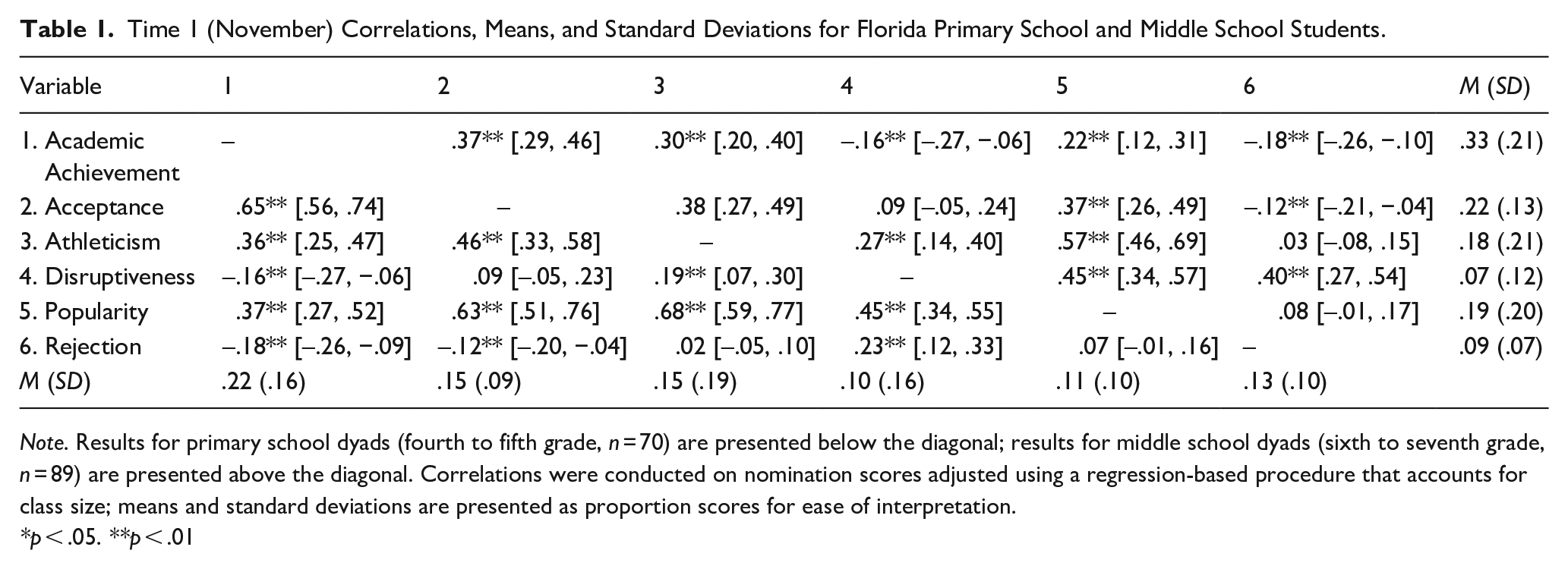
Note. Results for primary school dyads (fourth to fifth grade, n = 70) are presented below the diagonal; results for middle school dyads (sixth to seventh grade, n = 89) are presented above the diagonal. Correlations were conducted on nomination scores adjusted using a regression-based procedure that accounts for class size; means and standard deviations are presented as proportion scores for ease of interpretation.
*p < .05. **p < .01
Time 1 (September) Correlations, Means, and Standard Deviations for Lithuania Primary School and Middle School Students.
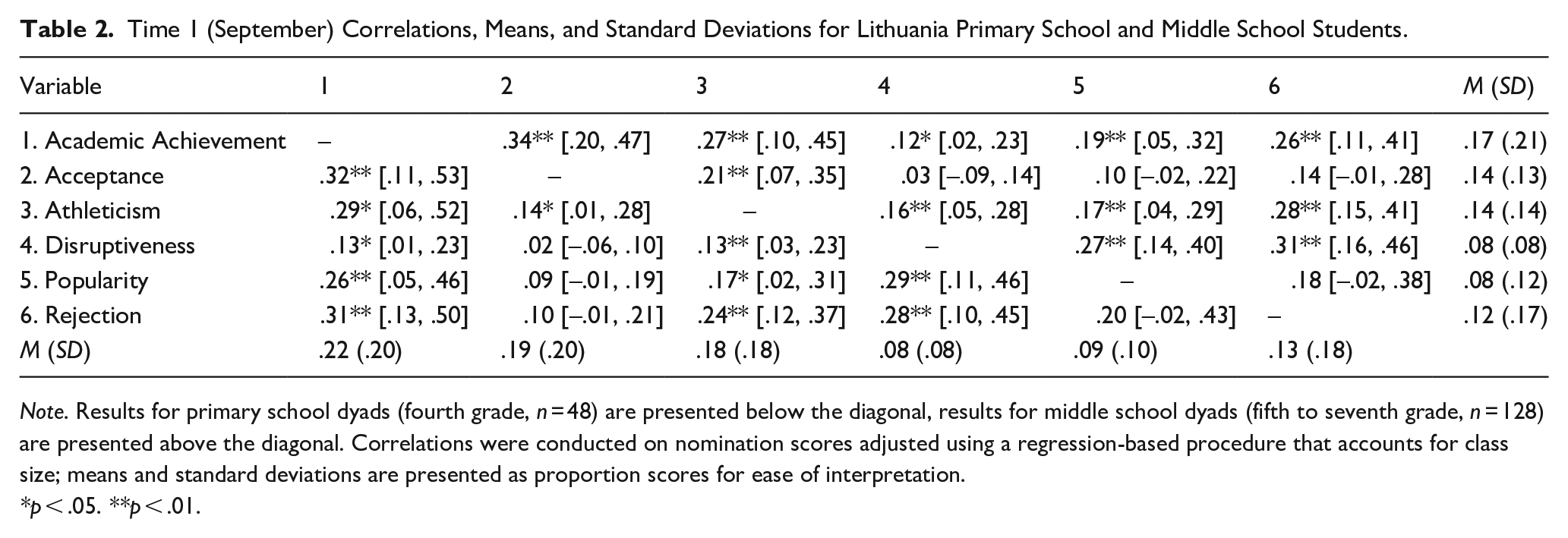
Note. Results for primary school dyads (fourth grade, n = 48) are presented below the diagonal, results for middle school dyads (fifth to seventh grade, n = 128) are presented above the diagonal. Correlations were conducted on nomination scores adjusted using a regression-based procedure that accounts for class size; means and standard deviations are presented as proportion scores for ease of interpretation.
*p < .05. **p < .01.
Florida
Academic achievement was positively correlated with acceptance, athleticism, and popularity, and negatively correlated with disruptiveness and rejection. Acceptance was positively correlated with athleticism and popularity and negatively correlated with rejection. Athleticism was positively correlated with disruptiveness and popularity. Disruptiveness was positively correlated with rejection and popularity.
Separate 2 (Grade: primary school vs. middle school) × 2 (Gender) analyses of variance (ANOVAs) were conducted with Time 1 academic achievement, acceptance, athleticism, disruptiveness, popularity, and rejection as dependent variables. There were statistically significant main effects for grade on academic achievement, acceptance, popularity, and rejection, F(1, 204) = 10.31–14.59, p < .01. Academic achievement, acceptance, and popularity (d = 0.21–0.52) were higher among middle school students than primary school students; rejection (d = 0.57) was higher among primary school students than middle school students. There were also statistically significant main effects for gender on athleticism, disruptiveness, and popularity, F(1, 204) = 6.09–38.67, p < .01. In each case, boys scored higher than girls (d = 0.33–1.17). There were no statistically significant two-way interactions.
Lithuania
Academic achievement and athleticism were positively correlated with acceptance, athleticism, disruptiveness, popularity, and rejection. Disruptiveness was positively correlated with popularity and rejection.
Separate 2 (Grade: primary school vs. middle school) × 2 (Gender) ANOVAs were conducted with Time 1 academic achievement, acceptance, athleticism, disruptiveness, popularity, and rejection as dependent variables. There were statistically significant main effects for gender on disruptiveness, F(1, 259) = 15.30, p < .001. Boys scored higher than girls (d = 0.31). There were no statistically significant main effects or two-way interactions involving grade.
Differences between Primary and Middle School Students in Future-Friend Similarity
To quantify the claim that Florida middle school students have more opportunities to identify similar others as friends than middle school students in Lithuania or primary school students in both Florida and Lithuania, a 2 (Grade: primary school vs. middle school) × 2 (Location: Florida vs. Lithuania) ANOVA was conducted with number of classmates as the dependent variable. There were statistically significant main effects for grade, F(1, 52) = 1,092.33 p < .001 and location F(1, 52) = 902.24, p < .001, which were qualified by a grade × location interaction, F(1, 52) = 939.11, p < .001. Follow-up t-tests contrasted primary schools and middle schools in the average number of classmates, separately by location. Statistically significant differences emerged in Florida (p < .001) but not in Lithuania (p = .051). In Florida, the number of classmates significantly increased from primary school to middle school (d = 17.70, Mprimary = 22.62, Mmiddle = 84.20); in Lithuania, the number of classmates did not significantly differ between primary and middle school (d = 0.90, Mprimary = 23.21, Mmiddle = 25.54). Additional contrasts indicated that there were no significant differences in the average number of primary school classmates between Florida and Lithuania (d = 0.69). But there were significant differences in the average number of middle school classmates between Florida and Lithuania; Florida middle school students had significantly more classmates than Lithuanian middle school students (d = 14.58).
Florida
Figure 1 presents results for partial intraclass correlations (interpreted as r2) between Florida future friends on academic achievement, acceptance, athleticism, disruptiveness, popularity, and rejection, separately for primary school and middle school students. The number of reciprocated future friendships in which each partner was involved was included as a covariate to adjust for unequal participant contributions to the data. Correlations were calculated at Time 1 (November), prior to the start of the new reciprocated friendship. Among primary school future friends, positive statistically significant correlations emerged for athleticism (r = .39, p < .001) and rejection (r = .44, p < .001); academic achievement (r = .22, p = .07), acceptance (r = .03, p = .75), disruptiveness (r = .19, p = .12), and popularity (r = .16, p = .21) did not reach conventional levels of statistical significance. Among middle school future friends, positive statistically significant correlations emerged for each variable: academic achievement (r = .39, p < .001), acceptance (r = .46, p < .001), athleticism (r = .60, p < .001), disruptiveness (r = .24, p = .002), popularity (r = .37, p < .001), and rejection (r = .43, p < .001).
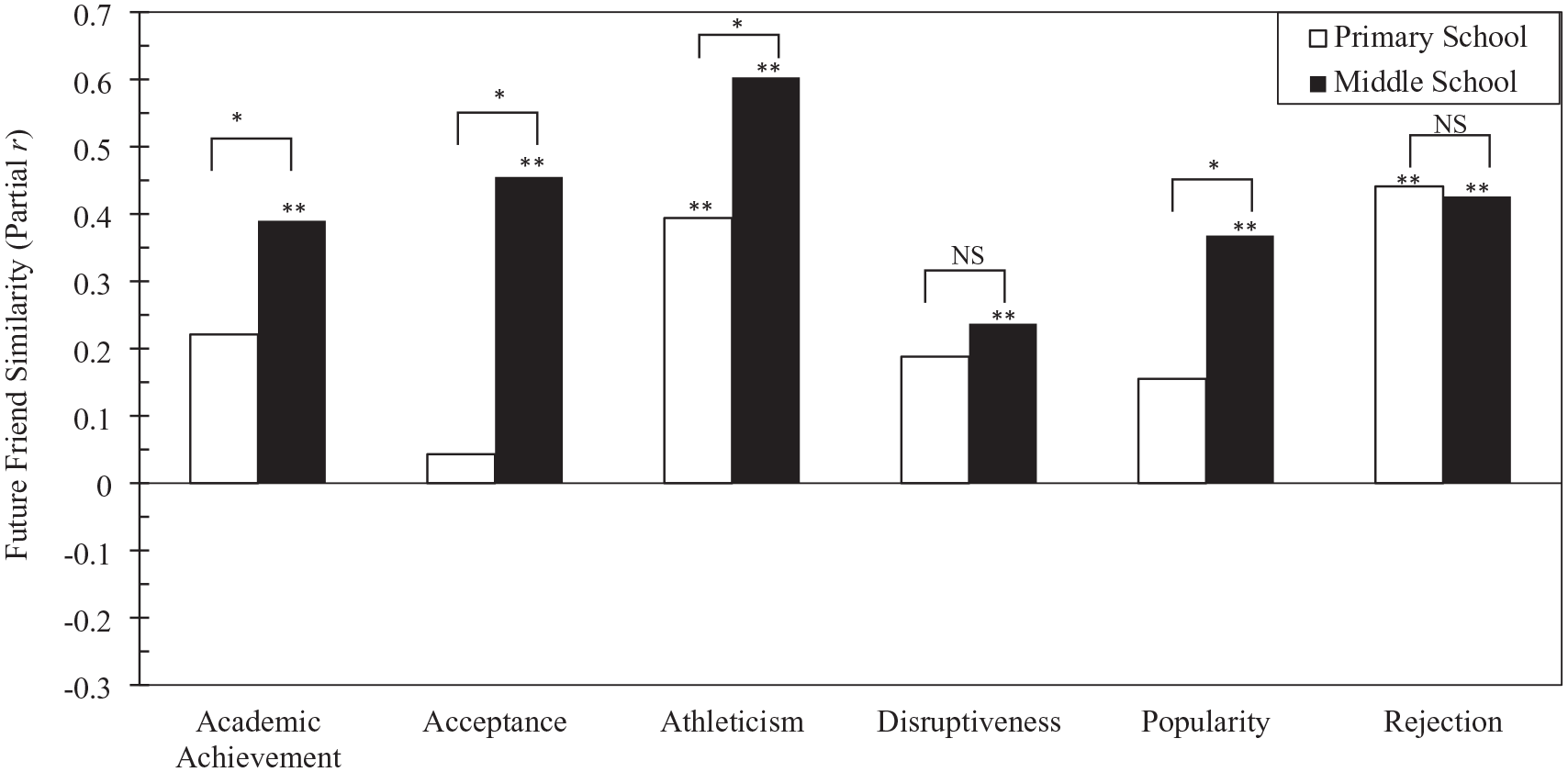
Age Group Differences in Friend Selection Similarity in Florida (Intraclass Partial r): Results from Correlation Contrasts Comparing Primary School Future Friends with Middle School Future Friends.
Confidence interval contrasts indicated that middle school future friends were statistically significantly (p < .05) more similar than primary school future friends on academic achievement, acceptance, athleticism, and popularity. There were no statistically significant differences between primary and middle school future friends on similarity in disruptiveness or rejection.
Lithuania
Figure 2 presents results for partial intraclass correlations (interpreted as r2) between Lithuania future friends on academic achievement, acceptance, athleticism, disruptiveness, popularity, and rejection, separately for primary school and middle school students. Correlations were conducted at Time 1 (September), prior to the start of the new reciprocated friendship. Among primary school future friends, positive statistically significant correlations emerged for acceptance (r = .15, p = .04) only. Results for academic achievement (r = .03, p = .63), athleticism (r = −.02, p = .80), disruptiveness (r = −.02, p = .68), popularity (r = .03, p = .61), and rejection (r = −.06, p = .35) did not reach conventional levels of statistical significance. Among middle school future friends, negative statistically significant correlations emerged for athleticism (r = −.19, p < .001) and popularity (r = −.11, p = 03); academic achievement (r = .06, p = .40), acceptance (r = .02, p = .71), disruptiveness (r = −.01, p = .90), and rejection (r = −.05, p = .30) did not reach conventional levels of statistical significance.
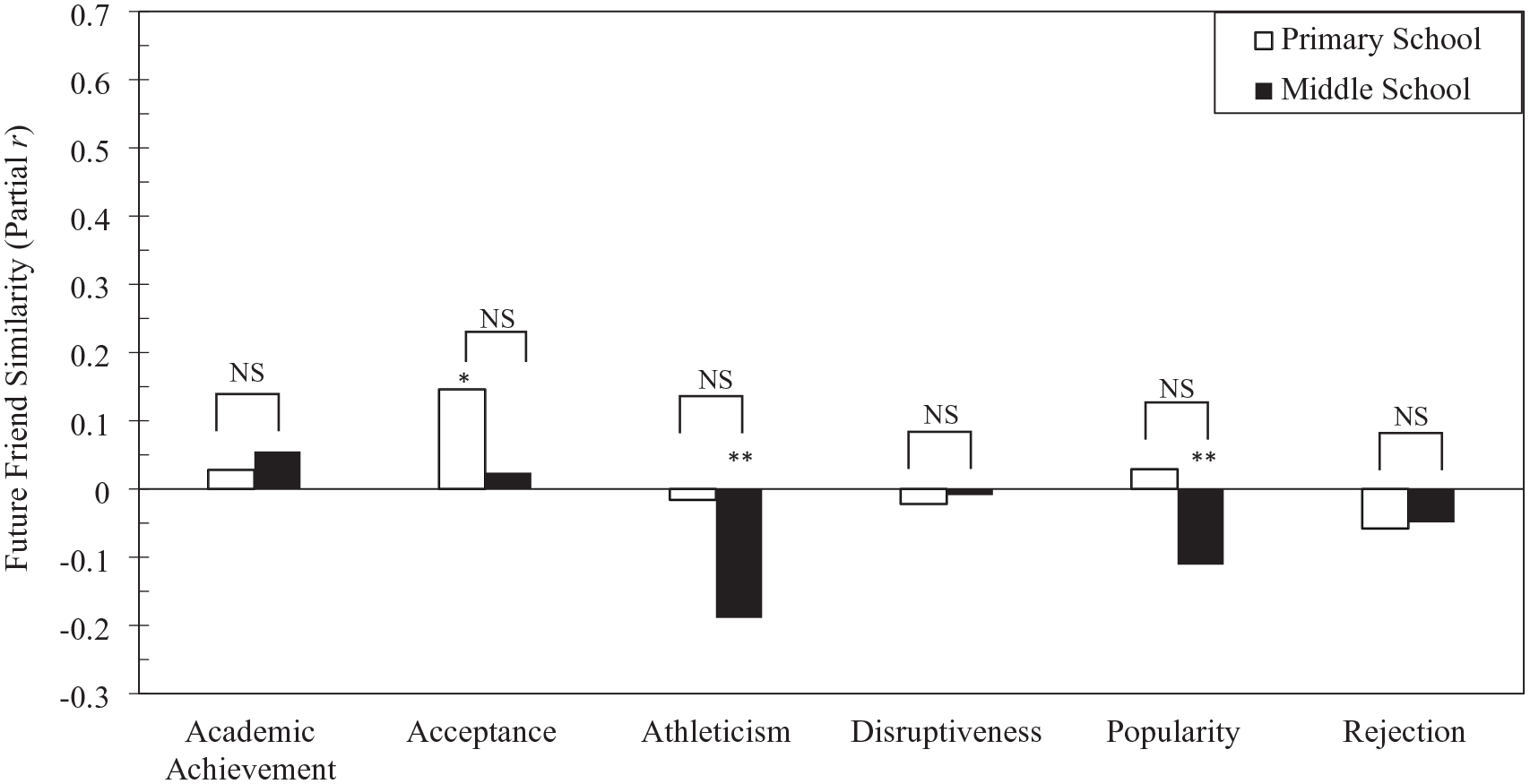
Age Group Differences in Friend Selection Similarity in Lithuania (Intraclass Partial r): Results from Correlation Contrasts Comparing Primary School Future Friends with Middle School Future Friends.
Confidence interval contrasts indicated that there were no statistically significant differences between primary and middle school future friends on similarity in academic achievement, acceptance, athleticism, disruptiveness, popularity, or rejection.
Supplemental Analyses
Supplemental intraclass correlations were calculated on a group of randomly paired study participants to examine the possibility that differences between primary school and middle school future friends are a product of cohort differences in chance agreement. In Florida, there were no statistically significant intraclass correlations between randomly paired participants on any variable (r⩽.01 to .14; p = .29–.61), nor were there any statistically significant differences between the similarity of primary school nonfriends and the similarity of middle school nonfriends (range of differences: z = −0.81 to 0.41, p = .23–.49). In Lithuania, there were no statistically significant differences between primary school nonfriends and middle school nonfriends on any variable (r < .01–.05; p = .24–.95), nor were there any statistically significant differences between the similarity of primary school nonfriends and the similarity of middle school nonfriends (range of differences: z = −0.37 to 1.05, p = .15–.49).
Middle school begins in fifth grade in Lithuania and sixth grade in Florida. To examine the possibility that location differences are a product of age confounds, Lithuania students were categorized into grade groups that paralleled those in Florida (younger = fourth to fifth grade, older = sixth to seventh grade). The same pattern of statistically significant results emerged, with one exception: The negative intraclass correlation coefficient (ICC) for athleticism was statistically significant in the younger sample (r = −.14, p = .01) but not the older sample (r = −.12, p = .09). In the younger sample, there were no significant intraclass correlations on academic achievement (r = .01, p = .89), acceptance (r = .08, p = .16), disruptiveness (r = −.06, p = .23), popularity (r = −.07, p = .10), or rejection (r = −.06, p = 20). In the older sample, there was a negative statistically significant intraclass correlation on popularity (r = −.13, p = .03); there were no statistically significant intraclass correlations on academic achievement (r = .15, p = .08), acceptance (r = .09, p = .35), athleticism (r = −.12, p = .09), disruptiveness (r = −.07, p = .27), or rejection (r = −.02, p = .77). There were no statistically significant differences between fourth and fifth grade future-friend similarity and sixth and seventh grade future-friend similarity in any variable (range of differences: z = −1.27 to −0.52, p = .10–.46).
Discussion
Age group differences emerged on friend selection similarity. As hypothesized, expanded social opportunities were linked to greater selection similarity. Middle school future friends were more similar (on academic achievement, acceptance, athleticism, and popularity) than primary school future friends in Florida, where the former attended classes with a relatively large, rotating group of classmates and the latter attended classes with the same relatively small group of classmates. In contrast, middle school future friends were not more similar than primary school future friends in Lithuania, where students at all grade levels retained the same classmates across the school day. Put simply, increases in future-friend similarity coincided with changes in school structure, which suggests that classroom organization and composition may be responsible for apparent developmental shifts in adolescent friend selection similarity. By extension, heightened selection similarity arising from changes in school structure may account for a substantial portion of the age-related changes previously documented in adolescent friend similarity (e.g., Burk et al., 2012; Richmond et al., 2018).
Middle schools with rotating classes of students afford youth with expanded opportunities to identify similar others as friends. Structural changes in schools coincide with other developmental changes that increase the emphasis on selecting compatible others. Greater cognitive maturity leads to an increasingly sophisticated view of friendships (Bagwell & Bukowski, 2018). Children identify companionship and proximity as the most salient features of friendship, whereas adolescents emphasize the importance of intimacy and trust (Buhrmester & Furman, 1987), which require a shared commitment to more than superficial activities (Shulman et al., 1997). Unlike their younger counterparts, adolescents have both the experience and the cognitive appreciation for the need-based obligations that accompany a close friendship and the behaviors required to maintain a warm, supportive, equitable affiliation (Laursen & Hartup, 2002), a realization that may spur a re-evaluation of the advantages of befriending similar others. Finally, changes in the school structure increase the salience of the peer group and heighten the importance of friends; the selection of similar others reduces the chances of friendship dissolution, minimizing the risk of friendlessness (Hafen et al., 2011).
The findings have important implications for adjustment. We know that similarity promotes affection and feelings of support between friends as well as increases the stability of the relationship (Laursen, 2017). Friend turnover can lead to negative outcomes, such as lower academic achievement (Lessard & Juvonen, 2019) and higher levels of peer victimization (Ehrhardt et al., 2022). We leave it to future scholars to confirm what is here implied, namely that more options for friends are uniformly (and linearly) better for social development because they increase the chances that similar others will be chosen as friends and that friendships with these similar others will be less likely to dissolve, reducing the risk of the turmoil associated with friend turnover. Relatedly, the relative lack of friend options during primary school could also help to explain findings that suggest that friendship instability is greater during these years than during middle school (Poulin & Chan, 2010). Conclusions of this sort, however, require longitudinal findings that tie class size to friend stability within different grades and different types of schools. The safest conclusion is the most straightforward conclusion: Middle school is often a period of transition; changes in school structure can afford greater opportunity to identify similar friends than were available in primary school. Many youth take advantage of these opportunities.
Friend similarity, and increases in it, were not of a uniform magnitude across domains and locations. The complete absence of future-friend similarity in Lithuania was not anticipated and defies a ready explanation. We will refrain from post hoc speculation on this front. In Florida, future-friend similarity in rejection was unchanged from primary school to middle school, as was disruptiveness. One possible interpretation is that youth are increasingly focused on positive attributes in the selection of friends, particularly those that enhance status (Hartup, 1996). There is much we do not understand about default selection processes (children with undesirable attributes can find no other friends other than others with undesirable attributes), but it may also be the case that rejection and disruptiveness are not traits one seeks in friends (or seeks to avoid in friends) but are rather a byproduct of either a lack of friend options or prioritizing other traits in the selection of friends.
Our study is not without limitations. Participants were involved in an unequal number of new friendships. Some were initially nonfriends, whereas others were initially unilateral friends. We addressed the problem of unequal contributions to the data by controlling for the number of each participant’s new friendships. The distribution of dyads that were initially nonfriends and those that were initially unilateral friends did not differ across primary school and middle school future friends, but we could not otherwise rule out the possibility that distinctions between these two future-friend groups were responsible for school-level differences because we lacked the power to restrict our analyses to those who were initially nonfriends. Participants were able to nominate up to seven friends in Florida and up to five friends in Lithuania, but this methodological confound was unlikely to be responsible for differences across locations given that the same results emerged when the data from Florida youth were restricted to their first five nominations. The composition of the data required the use of confidence interval contrasts, which produce more conservative estimates of significant differences than p-values obtained from conventional null hypothesis tests (Cumming & Finch, 2005). As a consequence, our analyses may have underestimated the number of domains in which the similarity of middle school future friends differed from that of primary school future friends. The transition into middle school occurred at different grades in Florida and Lithuania, confounding the age at which the transition began and changes (or the lack thereof) in school structure. These concerns are mitigated by supplemental analyses comparing Lithuanian fourth and fifth graders with sixth and seventh graders, which created parallel grade groups across locations. Finally, caution is warranted in the interpretation of cross-sectional data. Longitudinal data are needed to explicitly tie changes in similarity to changes in the structure of schools.
Several studies indicate that friend similarity increases across the transition into middle school (e.g., Burk et al., 2012). Strong arguments have been made to the effect that increases in friend similarity are a product of increases in susceptibility to peer influence (Laursen & Faur, 2022). Often overlooked is a more benign possibility arising from changes in school structure that middle school friends are, from the outset, more similar than those that arise in primary school and that these similarities are a product of the increased social opportunities afforded by a school structure that offers expanded opportunities to identify consonant friends.
Footnotes
Acknowledgements
The authors are grateful for the assistance and cooperation of the students, faculty, and staff at Palm Pointe Educational Research School and Utena District Schools in Lithuania.
Funding
The author(s) disclosed receipt of the following financial support for the research, authorship, and/or publication of this article: Support for the preparation of this manuscript was supported by a grant to Brett Laursen from the US National Institute of Child Health and Human Development (HD096457) and the European Social Fund (project no. 09.3.3-LMT-K-712-17-0009) under grant agreement with the Research Council of Lithuania (LMTLT).
Ethics Statement
This study was not preregistered. The project was approved by school officials and the university IRB (#135501-16).
