







Abstract
Friendship can buffer the negative effects of peer rejection, but most friendships are not stable throughout an entire school year. The goal of this study was to examine the effects of grade, years in school, gender, same-gender friendships, peer rejection, and previous friendship instability on friendship stability across one school year. The moderating effect of classroom composition change was also examined. Data were collected from students in Grades 1 to 8 (n = 380, 5 to 14 years old) in one school at the beginning, middle, and end of a school year. Path models indicated that older students were more likely to retain their friends throughout the school year. Greater friendship instability and peer rejection at the beginning of the year predicted fewer stable friendships. New students were more likely to be rejected and less likely to have stable friendships in classrooms without a change in composition from the previous year than in those with a change. Changing classroom composition seems to give new students the same opportunities as their established peers.
Introduction
The student composition of a classroom is determined by a school’s organization, which means that students must interact with peers they did not choose. Peer classroom interactions can lead to positive social relationships and the development of friendships, which are important aspects of school life. Positive relationships make a significant contribution to students’ sense of well-being, belonging, and motivation for attending school (Juvonen et al., 2019). Friendships influence children’s behavior and social development (Hartup, 1996) and help them cope with social difficulties, such as peer rejection and victimization (Peters et al., 2011; Tenhunen et al., 2024). Therefore, understanding the factors that contribute to the stability of friendships is of great interest to researchers and practitioners (Granger et al., 2025; Meter & Card, 2016; Poulin & Chan, 2010).
Studies have repeatedly found that individual characteristics such as aggressive behavior can result in students having difficulties making and maintaining friendships (Hartl et al., 2015; Ladd & Troop-Gordon, 2003; Parker & Seal, 1996). A growing body of research also highlights the role played by social dynamics (Kindermann & Gest, 2018). For example, recent studies have found that negative peer experiences can hinder the formation and maintenance of friendships (Ehrhardt et al., 2022; Lessard & Juvonen, 2018).
Related to this, there has been increased interest in understanding how teachers, deliberately or unintentionally, can modify classroom social dynamics (Farmer et al., 2018; Farmer, McAuliffe Lines, et al., 2011; Hoekstra et al., 2023). A deliberate modification is the common practice of changing classroom composition at the normative school transitions from elementary school to middle school and from middle school to secondary school (e.g., in K–8 or K–12 schools in Switzerland and the United States). This practice can affect group dynamics (Temkin et al., 2018) and peer victimization (Farmer, Hamm, et al., 2011; Rambaran et al., 2020). However, there is less information on the impact of classroom composition changes in K–8 or K–12 schools on friendship stability (Temkin et al., 2018).
In this study, we addressed this research gap by investigating whether grade, years enrolled at school, gender, same-gender friendships, peer rejection, and friendship instability in the first half of the school year predicted friendship stability over the course of a school year in a K–12 school. We also considered the moderating role of classroom composition change.
Friendship Stability
Reciprocal friendships emerge early in childhood and play an important role in children’s emotional, cognitive, academic, and behavioral development (Berndt, 2004; Gifford-Smith & Brownell, 2003; Vitaro et al., 2009). The key characteristics of reciprocal relationships are that peers enjoy spending a significant amount of time doing activities together (Berndt, 2004; Monjas et al., 2008) and show a willingness to cooperate with and help each other (Newcomb & Bagwell, 1995).
Stability is an important aspect of social relationships (Poulin & Chan, 2010). It takes time to build close relationships, and they must be maintained to have a lasting impact. However, the stability of relationships varies a great deal in childhood; some last for years, others end quickly (Chan & Poulin, 2007). Studies have shown that 25% to 50% of the reciprocal friendships of 6- to 10-year-olds do not last beyond a school year (Bowker, 2004; Meter & Card, 2016; Poulin & Chan, 2010). It is unclear whether the low stability of these friendships is simply due to the students’ young age. Although some results suggest that stability increases with age (e.g., Poulin & Chan, 2010), most of the studies reported in the meta-analysis by Meter and Card (2016) did not find evidence of a positive association between stability and age.
The age effect could be confounded by the number of years enrolled in a school. Students are more likely to interact and form friendships the longer they attend the same school. However, school populations fluctuate, as new students join and others leave. Therefore, although the correlation between years enrolled and age is high, it is not a perfect correlation. Studies of friendship stability often consider age or grade, but not the number of years a student has been enrolled in the school. This could explain the inconsistent findings on the effect of age on friendship stability.
Gender homophily also plays a role in friendship stability. Homophily influences who people select as friends and is a factor in the maintenance of friendships (McPherson et al., 2001). This is especially true for gender homophily, with same-gender friendships lasting longer than cross-gender ones (Hartl et al., 2015; Poulin & Chan, 2010; Tuma & Hallinan, 1979). Therefore, we also examined whether students’ same-gender friendships influenced their overall friendship stability.
Friendship Instability and Peer Rejection
Social dynamics can influence both friendship stability and instability. Although friendship instability suggests the opposite of stability, there is evidence that they are distinct concepts (Lessard & Juvonen, 2018; Parker & Seal, 1996; Wojslawowicz Bowker et al., 2006). Friendship stability can be measured as the number of reciprocal friendships maintained over time. Chan and Poulin (2007, 2009) conceptualized friendship instability as the number of friendships gained and lost over time. Experiencing friendship instability does not necessarily imply a lack of stable friendships. Rather, the process of forming and dissolving friendships can take place around a core of stable friendships (Wojslawowicz Bowker et al., 2006). However, a high turnover of friends can affect the stability of those core relationships. For example, time spent with new friends can endanger existing friendships. Losing friends can be stressful, which can also take a toll on the remaining friendships (Lessard & Juvonen, 2018). Given these processes, it is important to examine the influence of friendship instability on stable friendships.
Peer rejection is a well-studied aspect of social dynamics. In the context of friendship, researchers have examined the positive association between friendlessness and peer rejection (Ladd & Troop-Gordon, 2003; Salmivalli & Isaacs, 2005) and how friendships protect against the negative effects of rejection (e.g., Peters et al., 2011). A smaller number of studies have examined friendship stability as a predictor of peer rejection and victimization (e.g., Proulx & Poulin, 2013; Wojslawowicz Bowker et al., 2006). More recently, researchers have been interested in how negative peer experiences influence friendship stability. In their longitudinal study of students from the sixth through the eighth grade, Lessard and Juvonen (2018) found a positive association between peer rejection and friendship instability (i.e., losses and gains). Ehrhardt et al. (2022) found that being victimized (e.g., left out, threatened) at the beginning of the school year predicted greater friendship instability, but friendship instability did not predict subsequent victimization, in a sample of ninth graders. These studies suggest that negative peer experiences may predict difficulty maintaining friendships, but we know little about the association between peer rejection and friendship stability in younger students.
Stable Social Structures and Newcomers
Research comparing school configurations has shown that a stable context, as found in K–8 or K–12 schools tends to promote students’ academic achievement and sense of belonging (Anderman, 2002; Schwartz et al., 2011) but might also increase bullying and the popularity of aggressive students (Farmer, Hamm, et al., 2011) as the result of fixed social roles and dominance structures.
Stable structures can be difficult for newcomers. Students who are new to a classroom are generally at greater risk of having problems with peers (Rambaran et al., 2020; Tenhunen et al., 2024). Tenhunen et al. (2024) found that newcomers reported higher levels of peer victimization than established students during their first year in a new classroom and the following year. This may be due to stable structures being more hierarchical and rejected students being more likely to be victimized in more hierarchical classrooms (Martín Babarro et al., 2017).
Another possible explanation for the peer problems new students face is grounded in social identity theory (Tajfel & Turner, 1986), which suggests that in-group favoritism may play a role. In this context, established students (ingroup members) are more likely to be favored over new students (outgroup members). This outgroup effect could be even more pronounced in stable contexts such as classrooms with established roles and structures in K–8 or K–12 schools, but no studies have yet explored this assumption.
Classroom Composition Change
Changing the classroom composition is one strategy that teachers can use to break up established classroom roles and structures (Farmer, Hamm, et al., 2011; Pellegrini & Long, 2002; Rambaran et al., 2020). This is common practice at normative transitions in K–8 or K–12 schools (Temkin et al., 2018). Transitions can have a negative impact on friendship stability (Meter & Card, 2016; Temkin et al., 2018), but changes in classroom composition of a classroom can also break up adverse social structures and the associated negative peer experiences (Farmer, Hamm, et al., 2011; Pellegrini & Long, 2002; Rambaran et al., 2020). Thus, these changes can have both negative and positive effects.
It can be difficult for students to build new, stable friendships after losing friends due to a reshuffling. However, a new classroom composition is also an opportunity to improve one’s position and make new friends (Lorijn et al., 2024). This can be especially beneficial for students who experienced peer victimization in their previous classroom (Tenhunen et al., 2024). Importantly, the outgroup effect is likely to be reduced in a classroom where few students have established friendships, and many are unfamiliar with each other.
Present Study
The goal of this study was to identify predictors of the number of stable reciprocal friendships over one school year in Grades 1 to 8. We used data from a K–12 school where many students remained throughout their school career. This enabled us to disentangle the effect of age on stable friendships from the effect of years enrolled in the school, a confound that may have influenced previous findings on friendship stability (Meter & Card, 2016). In addition, we addressed two research questions.
First, we asked whether grade, years in school, gender, same-gender friendships, peer rejection, and previous friendship instability predicted the number of stable reciprocal friendships. We hypothesized that grade, years in school, and the proportion of same-gender friendships would positively predict the number of stable reciprocal friendships over the course of a school year. By contrast, peer rejection and friendship instability at the beginning of the school year were expected to have a negative effect on the number of stable friendships over one school year.
Second, we asked whether classroom composition change moderated the association between friendship stability and its predictors. Studies on K–12 schools suggest that a stable peer context without transitions might increase the risk of peer rejection (Farmer, Hamm, et al., 2011). Changing the classroom composition is a possible way to break up this stability (Lorijn et al., 2024; Rambaran et al., 2020; Temkin et al., 2018). Therefore, we hypothesized that classroom composition change would reduce the effects of years in school, peer rejection, and friendship instability on the number of stable friendships over the school year.
Method
Participants and Procedure
The study was based on data from a three-wave study of students recruited in a private K–12 school in a metropolis on the northeastern coast of Spain. According to the regional statistical institute, 55% of schools in this metropolis were private or semi-private in the 2017-2018 school year. Most private and semi-private schools are K–12. In 2017, 58% of the student population in the metropolis was enrolled in private schools. Parents in this region are likely to enroll their children in private and semi-private schools, although the cost can be up to 30% of their annual income. This suggests that our sample was relatively homogeneous in terms of socioeconomic status.
The study was approved by the Ethics Committee of the Autonomous University of Barcelona with approval number 3890. Participation was voluntary. The participants and their parents gave written informed consent. Participants were 348 students (including 184 girls) with an age range of 5.9 to 14.0 years, enrolled in 18 classes in Grades 1 to 8 (two to three classes per grade). The student population was 74.1% Spanish, 21.8% Swiss, and 4.1% had other nationalities.
Data were collected during one week at the beginning of the school year in Fall 2017 (t1), the middle of the school year in February 2018 (t2), and the end of the school year in May 2018 (t3). The average class size was 21 (range 19–25 students), and the participation rate per class ranged from 73% to 100% at t1 and 71% to 100% at t2 and t3. Students in Grades 1 and 2 were interviewed individually by trained research assistants who simultaneously recorded the answers. Students in Grades 3 to 8 completed an online survey themselves, in small groups on tablets or with the entire class in the school computer room, after an introduction by the research assistants. Most students had been enrolled in the school since kindergarten; 17.8% were enrolled at a later point.
The school policy was to change classroom composition between kindergarten and Grade 1, Grades 3 and 4, and Grades 6 and 7. Therefore, the composition of the classroom peer network was new in Grades 1, 4, and 7 (seven classes with a composition change; n = 149). Students remained with their classmates in the other years (11 classes without a composition change; n = 231).
Measures
Friendships
Students were asked to name their friends at each of the three measurement points. Friendship nominations were unlimited in number and gender, but were limited to members of the classroom. Consistent with the definition of friendship (Berndt, 2004), only nominations that were reciprocated were used in further analyses.
Proportion of stable friendships. This was the number of reciprocal friendships at the beginning of the school year (t1) that were still present at the end (t3). Proportion scores were computed by dividing this number by the number of participants in the class at t3 minus 1. On average, 60% (SD = .36) of reciprocal friendships at t1 were stable.
Friendship instability score (from t1 to t2). Based on Chan and Poulin (2007, 2009), this was calculated as the sum of reciprocal friendship losses and gains divided by the total number of reciprocal friendships at t1 and t2. Friendship loss was computed as the number of reciprocal friendship nominations at t1 that were no longer reciprocated at t2. Friendship gain was the number of new reciprocal friendship nominations at t2 that were not reciprocated at t1. For each student, a loss score (number lost divided by total across both time points), a gain score (number gained divided by total), and an instability score (sum of the proportions lost and gained) were computed for the period between t1 and t2. For example, if Aida had reciprocal friendships with Barbara and Carla at the beginning of the school year and with Barbara, Dina, and Elena in the middle of the school year, from four friends in total she would have a loss score of 1, a gain score of 2, and an instability score between t1 and t2 of .75 ([lost + gained] / total = 1 + 2 / 4). The friendship instability score varied between 0 and 1, with 0 representing no change in the friendship network and 1 representing complete instability between two measurement points.
Peer Rejection
Students were asked to rate how well they got along with each classmate on a 5-point scale (1 = not well at all to 5 = very well). To compute peer rejection, the number of lowest ratings (1) received from all classmates was counted (Hymel et al., 2004). Because the number of ratings depended on the number of participants, the score was divided by the number of participants in the class minus one. The standardized peer rejection score of each student at t1 was used in the analysis. Given the high participation rate, we can assume that the internal reliability of this variable was high (Marks et al., 2013).
Covariates
Gender and grade were control variables because they affect friendship and rejection (Gifford-Smith & Brownell, 2003; Poulin & Chan, 2010). The proportion of same-gender reciprocal friendships at t1 was also included. The time students have known each other influences their peer experiences. To control for this, the analysis included whether the classroom composition was new at the beginning of the school year (0 = no, 1 = yes) and the number of years students had been enrolled in the school (range, 0–11 years). Because years at school correlated with age, the variable years at school was residualized on age. Residuals were used as a measure of years at school, independent of age, in the analysis.
Analytic Plan
In the first step, descriptive analyses and correlations were calculated using SPSS 29.0.2.0. Missing data ranged from 1% to 18% (see Table 2 for missingness per group) and was primarily due to student non-participation (7.9% at t1, 9.2% at t2, and 8.7% at t3). All students from Grades 1 to 8 were invited to participate. Non-participation (on average, 1.75 students per class) occurred either because parental consent had not been given or because the students declined to participate. Students who had provided informed consent from their parents but were absent at the time of data collection were interviewed later. Because the reciprocal friendship measures (i.e., number, stability, instability) depend on peer participation, they had the highest levels of missingness (10%–18%). Therefore, missingness was considered random and was handled using full information maximum likelihood estimation.
To examine the predictors of friendship stability (Research Question 1), path analyses were performed with the R package lavaan version .6–19 (Rosseel, 2012). Peer rejection at t1 and friendship instability between t1 and t2 were included in the model as predictors of stable friendships from t1 to t3. Grade (1–8), gender (male = 1, female = 0), years enrolled in the school, residualized on age, and proportion of same-gender friendships (0–1) were estimated as predictors of the outcome of stable friendships, as well as of friendship instability between t1 and t2, and peer rejection at t1 (Figure 1).
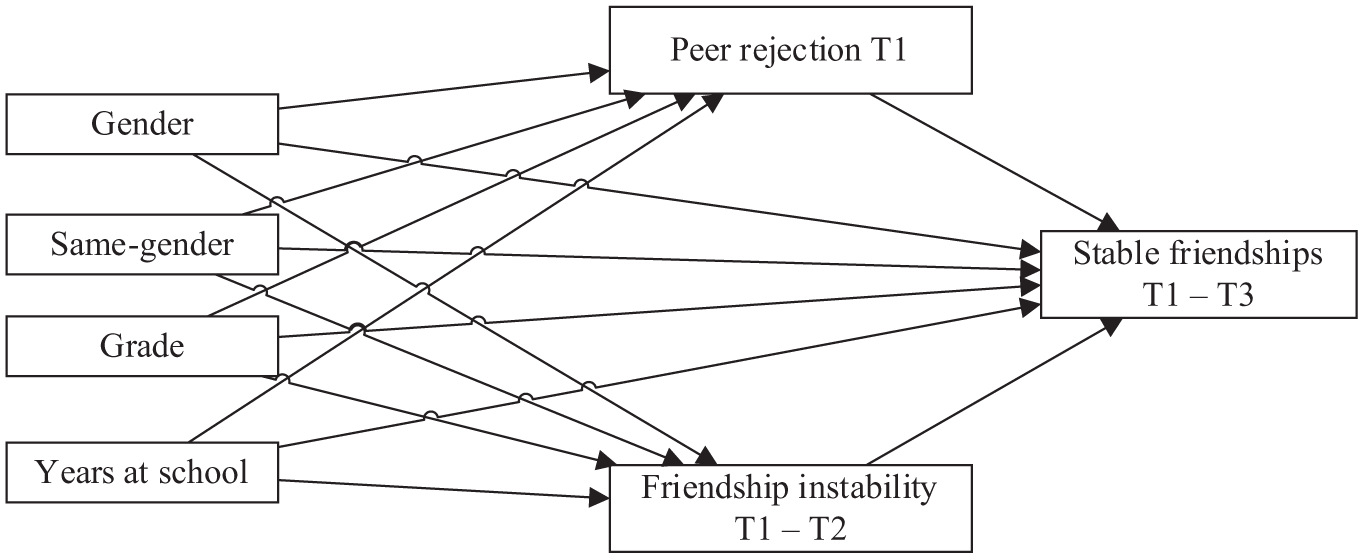
Hypothesized Path Model for Classrooms With and Without Composition Change.
Given the hierarchical structure of the data—students nested in classes—classes were specified as clusters in lavaan using the classroom ID. This approach corrects the standard errors of the estimates for the non-independence of observations within classrooms, addressing the potential influence of clustering without requiring a full multilevel specification (McNeish et al., 2017).
To test the moderation effect of classroom composition change (Research Question 2), the model was also run with the dichotomous variable as a grouping variable (0 = unchanged; 1 = changed) using the multigroup option in lavaan (Rosseel, 2012). Goodness of fit of the path models was evaluated using four indicators. The chi-square index (χ2) should be as small as possible; the comparative fit index (CFI; Bentler, 1990; Hu & Bentler, 1999) should exceed .90 for reasonable fit and .95 for good fit; the root mean square error of approximation (RMSEA; Hu & Bentler, 1999) should be less than .08 for reasonable fit; and the standardized root mean square residual (SRMR) should be less than .10 (Bentler, 1990). To test path differences between the changed and unchanged groups, a constrained model with fixed regressions was specified and compared to constrained models with fixed regressions with the path of interest freed.
Results
Correlations and Descriptive Statistics
Correlations and descriptive statistics are presented in Table 1. Rejection at the beginning of the school year and friendship instability in the first half of the school year were positively correlated with each other, and both correlated negatively with friendship stability over the course of the year. Gender correlated positively with peer rejection at t1 and negatively with stable friendships from t1 to t3, meaning that boys were more likely to be rejected at the beginning of the school year and to have fewer friendships that persisted for the entire school year. Friendship instability, however, was not significantly associated with gender. The proportion of same-gender friendships at the beginning of the school year was positively correlated with rejection at t1 and negatively with stable friendships from t1 to t3. There was no significant correlation between the proportion of same-gender friendships at t1 and the instability of friendships from t1 to t2. Age and years at school correlated positively with each other, negatively with peer rejection and friendship instability, and positively with stable friendships. This means that students in earlier grades were more likely to experience peer rejection and friendship instability. Although a new classroom composition was not significantly correlated with rejection and friendship instability, it correlated negatively with the number of stable friendships.
Bivariate Correlations, Means, Standard Deviations, and Percentages for Main Study Variables.
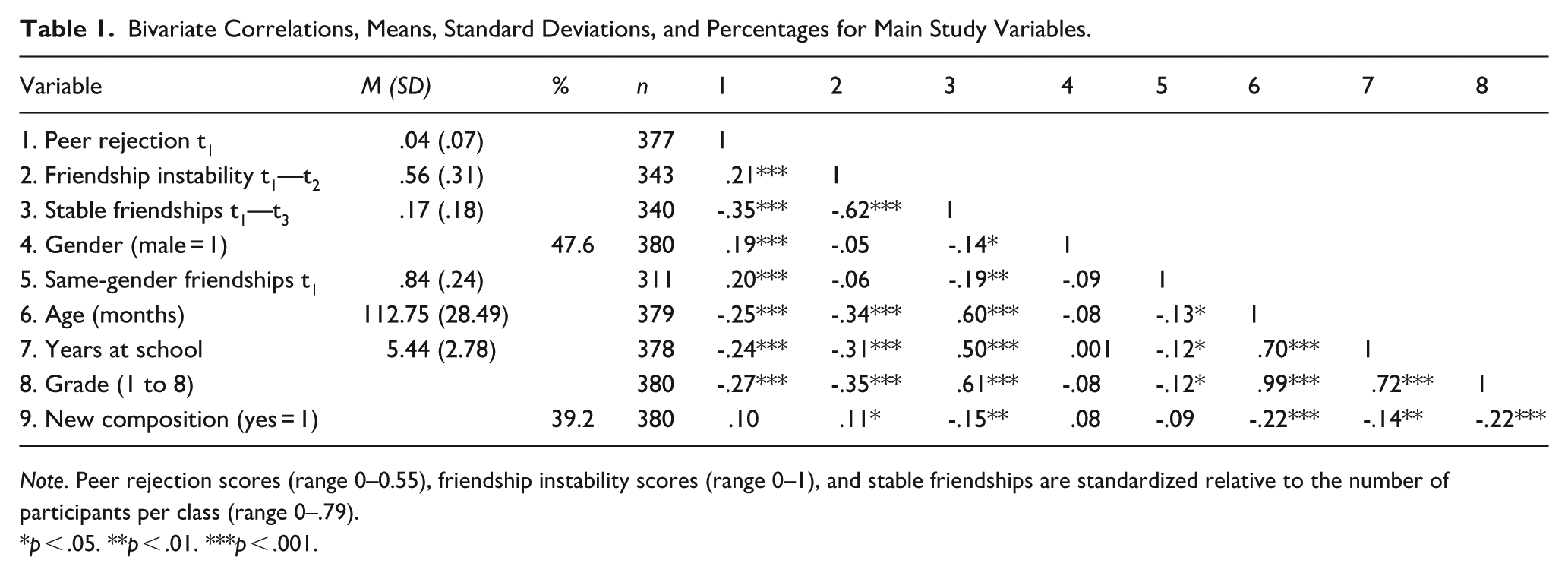
Note. Peer rejection scores (range 0–0.55), friendship instability scores (range 0–1), and stable friendships are standardized relative to the number of participants per class (range 0–.79).
p < .05. **p < .01. ***p < .001.
Comparisons Between Classrooms With and Without Composition Change
The means of the study variables were compared between classrooms with and without a new composition at the beginning of the school year. Descriptive statistics are presented in Table 2. Students in changed classrooms had significantly fewer stable friendships than students in unchanged classrooms, t(338) = 1.4, p = .006. The effect was small, d = .16. There was also an effect for age, t(377) = 3.7, p < .001, d = .39. Students were about one year younger in changed classrooms than in unchanged classrooms. This is a result of the slight imbalance in the design with 7 changed classrooms (149 students) in Grades 1, 4, and 7, and 11 changed classrooms (231 students) in Grades 2 through 8. There were no significant differences in any other study variables, although rejection and friendship instability tended to be higher in changed classrooms than in unchanged classrooms.
Comparison of Main Study Variables Between Classrooms With and Without a Composition Change.
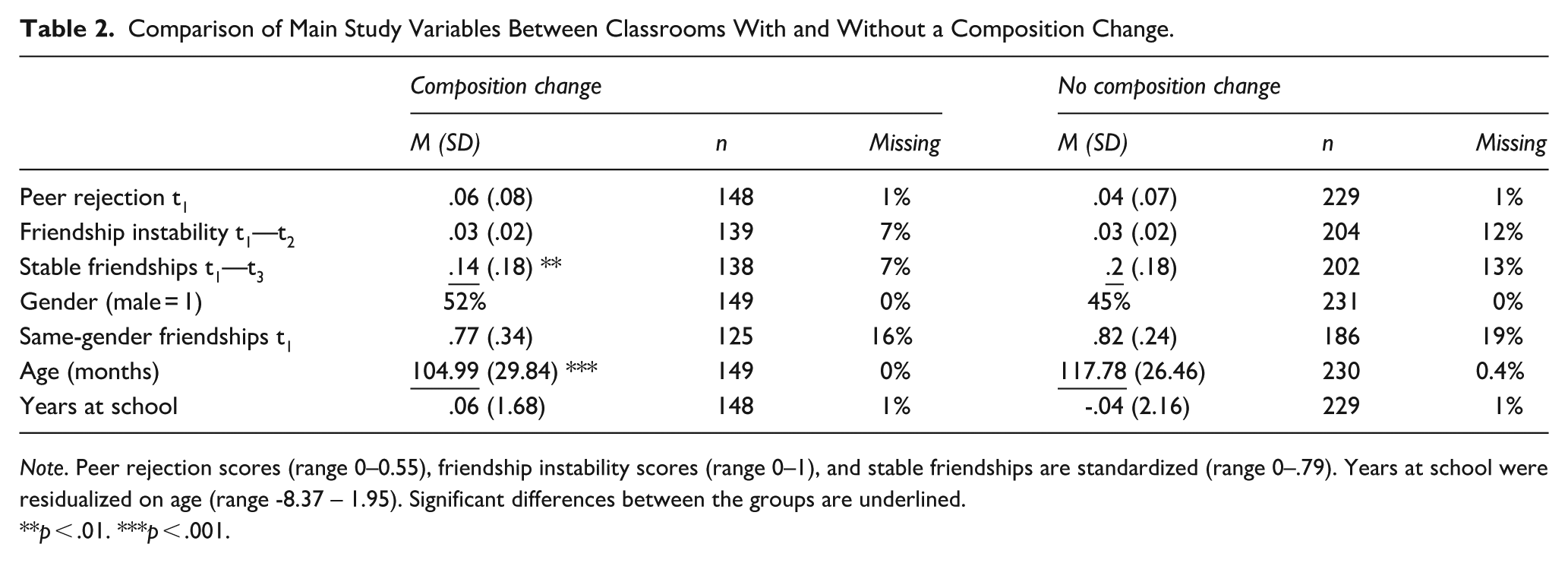
Note. Peer rejection scores (range 0–0.55), friendship instability scores (range 0–1), and stable friendships are standardized (range 0–.79). Years at school were residualized on age (range -8.37 – 1.95). Significant differences between the groups are underlined.
p < .01. ***p < .001.
Model Testing for the Total Sample
The path model of Figure 1 was first tested for the total sample. The results are presented in Table 3. The model fit was excellent, χ2(4) = 6.85, p = .144; CFI = .99; RMSEA = .04; SRMR = .03. Peer rejection at t1 (β = −0.09, p = .004) and friendship instability from t1 to t2 (β = −0.46, p < .001) were significant negative predictors of stable friendships from t1 to t3. The proportion of same-gender friendships at t1 (β = −0.15, p = .013) and being a boy (β = −0.12, p = .004) negatively predicted friendship stability from t1 to t3. Grade was a positive predictor (β = 0.46, p < .001). The number of years in the school did not significantly predict stable friendships (β = 0.07, p = .107).
Results from a Path Model for the Total Sample (All Classes).
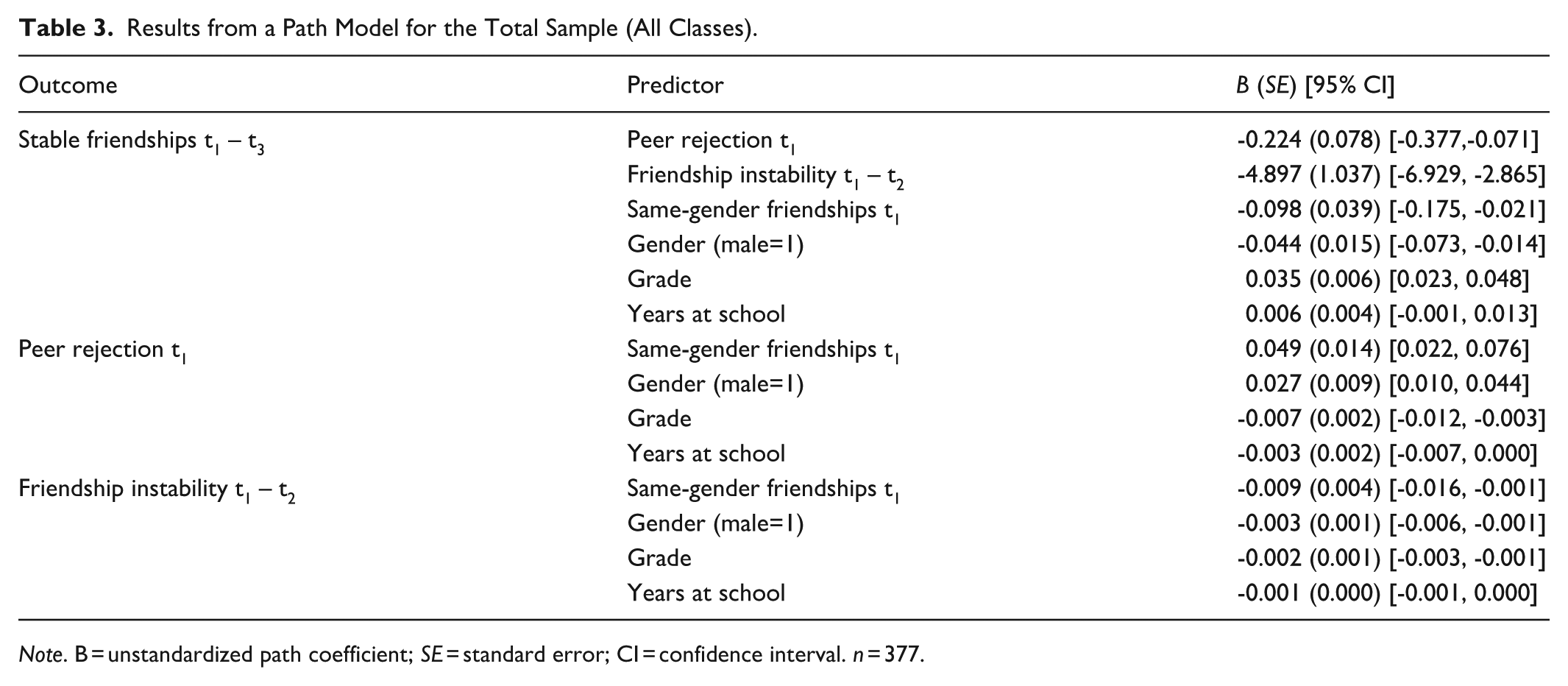
Note. B = unstandardized path coefficient; SE = standard error; CI = confidence interval. n = 377.
Moderation by Classroom Composition Change
To examine the effect of changes in classroom composition on the prediction of friendship stability, a two-group path model was run with classroom composition change as the grouping variable (Figure 2). The overall model fit was excellent, χ2(8) = 15.66, p = .05; CFI = .98; RMSEA = .07; SRMR = .04 (Table 4). To verify the difference of the paths between the groups, a constrained model was specified with fixed regressions, χ2(22) = 28.84, p = .15, CFI = .98, RMSEA = .04, SRMR = .06. This model was compared to constrained models specified with fixed regressions, but each path of interest was freed.
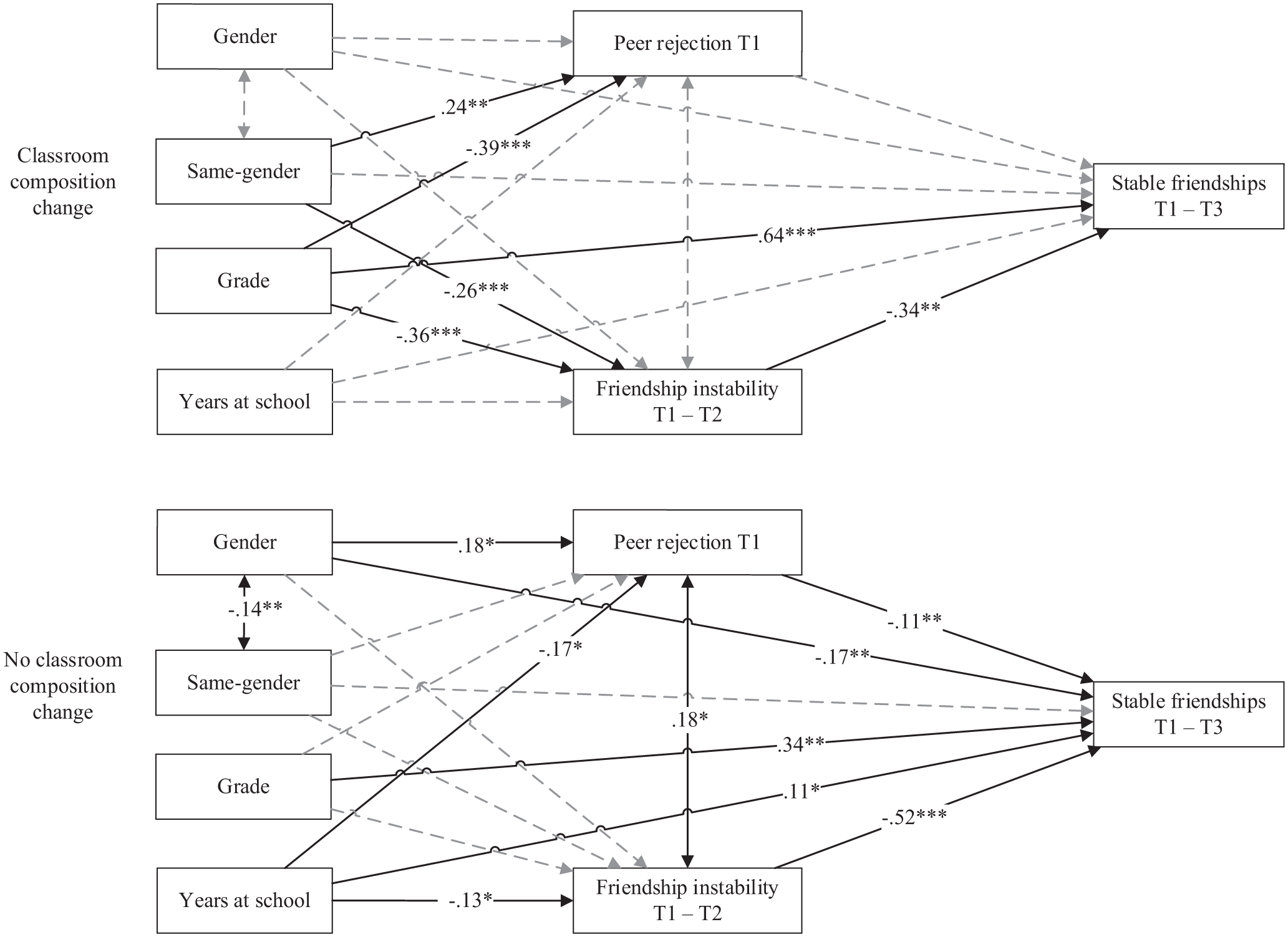
Moderation Model With Significant Standardized Coefficients. Composition Change was added as a Moderator Variable (Composition Change n = 148, No Composition Change n = 229). Dashed Lines Represent Nonsignificant Paths.
Results From a Multigroup Path Model.

Note. B = unstandardized path coefficient; SE = standard error; CI = confidence interval. Classroom composition change n = 148, no classroom composition change n = 229.
The results show that peer rejection was a significant negative predictor of friendship stability in unchanged classrooms (β = −0.11, p = .001), but not in changed classrooms (β = −0.02, p = .802). The constrained model was compared to the model with the path from peer rejection to stable friendships freed, χ2(21) = 40.08, p = .007, CFI = .96, RMSEA = .07, SRMR = .07. The comparison showed that the path did not differ significantly between groups, Δχ2(1) = 0.7, p = .403, ΔCFI = .001.
Friendship instability over the first half of the school year was a significant negative predictor of stable friendships over the school year in both groups (composition change: β = −0.34, p = .007; no composition change: β = −0.52, p < .001). The comparison of the constrained model with the model in which the path from instability to stable friendships was freed, χ2(21) = 45.35, p = .002, CFI = .94, RMSEA = .08, SRMR = .07, showed no significant difference of the path between the groups, Δχ2(1) = 0.42, p = .519, ΔCFI = .007.
The effect of years at school differed between the two groups. In unchanged classrooms, years at school significantly predicted friendship stability over the entire school year (β = 0.11, p = .01), peer rejection at the beginning of the year (β = −0.17, p = .02), and friendship instability in the first half of the year (β = −0.13, p = .012). These paths were not significant in changed classrooms (friendship stability: β = −0.05, p = .32; peer rejection: β = 0.06, p = .14; friendship instability: (β = 0.06, p = .57). The constrained model was compared to a model with the path from years at school to friendship stability freed, χ2(21) = 36.51, p = .02, CFI = .96, RMSEA = .06, SRMR = .07; a model with the path from years at school to peer rejection freed, χ2(21) = 36.8, p = .02, CFI = .96, RMSEA = .06, SRMR = .07; and a model with the path from years at school to friendship instability freed, χ2(21) = 38.52, p = .01, CFI = .96, RMSEA = .07, SRMR = .07. The comparisons revealed that the effects of years at school on stable friendships and peer rejection were significantly stronger in unchanged than in changed classrooms: Δχ2(1) = 8.70, p = .003, ΔCFI = .006, for stable friendships, and Δχ2(1) = 10.88, p < .001, ΔCFI = .005, for peer rejection. The effect of years at school on friendship instability in the first half of the school year did not differ significantly between the groups, Δχ2(1) = 1.84, p = .175, ΔCFI = .001. Figure 3 shows the friendship networks of two classes over the course of the school year—one with and one without composition change—to illustrate the association between years enrolled at school and composition change.
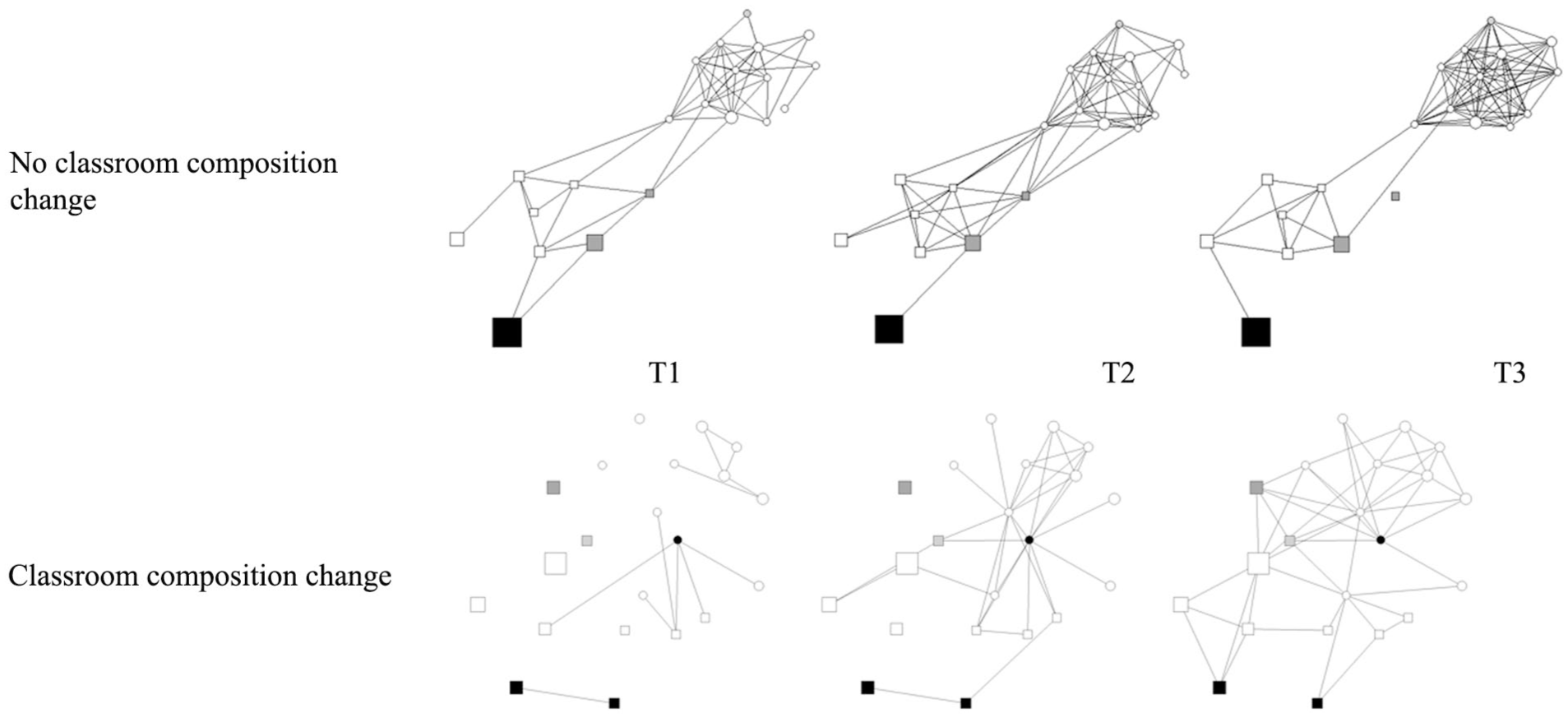
Friendship Networks of Two Classrooms (Classroom Composition Change n = 21, No Classroom Composition Change n = 21). Edges Between Nodes are Reciprocal Friendships. Circles are Girls; Squares are Boys. Node Size Represents Peer Rejection (Smaller = Less Rejection). White and Gray Nodes are More Established Students; Black Nodes are More Recently Enrolled Students.
Grade significantly predicted stable friendships (β = 0.64, p < .001), peer rejection (β = −0.39, p < .001), and friendship instability in the first half of the school year (β = −0.36, p < .001) in changed classrooms. In unchanged classrooms, grade significantly predicted friendship stability (β = 0.34, p = .004), but not peer rejection (β = −0.11, p = .183) or friendship instability (β = −0.19, p = .173).
Comparing the constrained model with the models where the paths between grade and friendship stability and between grade and peer rejection were freed showed that the effect of grade on peer rejection differed significantly between the groups, Δχ2(1) = 5.03, p = .03, ΔCFI = .003. The fit of the model with the path from grade to peer rection freed was χ2(21) = 34.34, p = .03, CFI = .96, RMSEA = .07, SRMR = .06. The effect of grade on friendship stability over the year and friendship instability in the first half of the year did not differ significantly between the groups (friendship stability: Δχ2[1] = 3.18, p = .08, ΔCFI = .005; friendship instability: Δχ2[1] = 0.12, p = .73, ΔCFI = .007). The fit of the models were χ2(21) = 36.8, p = .02, CFI = .96, RMSEA = .06, SRMR = .07, with the path from grade to friendship stability, and χ2(21) = 42.02, p = .004, CFI = .95, RMSEA = .07, SRMR = .07, with the path from grade to friendship instability freed.
The proportion of same-gender friendships did not significantly predict friendship stability in changed classrooms (β = −0.17, p = .06) or unchanged classrooms (β = −0.15, p = .13). A higher proportion of same-gender friendships was significantly related to more peer rejection (β = 0.24, p = .004) and less friendship instability (β = −0.26, p < .001) in changed classrooms. Neither path was significant in unchanged classrooms (peer rejection: β = 0.17, p = .07; friendship instability: β = −0.02, p = .89). The fit of the models in which the path from same-gender friendships to friendship stability, peer rejection, and friendship instability, respectively, was freed, was: χ2(21) = 42.25, p = .004, CFI = .95, RMSEA = .07, SRMR = .07; χ2(21) = 39.33, p = .01, CFI = .96, RMSEA = .07, SRMR = .07; and χ2(21) = 38.39, p = .012, CFI = .96, RMSEA = .07, SRMR = .06. The three effects did not differ significantly between the two groups: same-gender friendships to friendship stability: Δχ2(1) = 0.0005, p = .98, ΔCFI = .007; same-gender friendships to peer rejection: Δχ2(1) = 0.45, p = .50, ΔCFI = .002; same-gender friendships to friendship instability: Δχ2(1) = 1.96, p = .16, ΔCFI = .005.
Being a girl significantly predicted more friendship stability (β = −0.17, p = .002) and less peer rejection (β = 0.18, p = .017) in unchanged classrooms. Gender did not predict friendship stability (β = −0.06, p = .303) or peer rejection (β = 0.19, p = .082) in changed classrooms. Gender did not predict friendship instability in either group (changed: β = −0.13, p = .116; unchanged: β = −0.06, p = .212). A comparison between the constrained and the models with freed paths from gender to friendship stability, χ2(21) = 39.31, p = .01, CFI = .96, RMSEA = .07, SRMR = .07; to peer rejection, χ2(21) = 40.21, p = .01, CFI = .96, RMSEA = .07, SRMR = .07; and to friendship instability, χ2(21) = 39.4, p = .009, CFI = .96, RMSEA = .07, SRMR = .07, showed no significant differences between the two groups (gender to friendship stability: Δχ2[1] = 1.13, p = .29, ΔCFI = .002; gender to peer rejection: Δχ2[1] = 0.32, p = .57, ΔCFI = .003; gender to friendship instability: Δχ2[1] = 0.19, p = .66, ΔCFI = .001).
Discussion
In this study, factors influencing the stability of friendships in first through eighth-grade students in a K–12 school were analyzed, also considering the moderating effect of changes in classroom composition. In line with Poulin and Chan (2010), grade positively predicted friendship stability, although others have found that friendship stability is constant throughout childhood and adolescence (Meter & Card, 2016). We examined friendship stability in the stable context of a K–12 school, including the number of years students were enrolled in the school to control for the confounded effect of the years students knew each other. Therefore, the effect is consistent with the idea that older students have more developed competencies to foster and maintain friendships (Newcomb & Bagwell, 1995).
We also found that students who experienced more rejection and lost and gained more friendships at the beginning of the school year had greater difficulty maintaining their friendships over the year. This suggests that some students not only experience rejection but are also in a precarious position in the classroom peer network. This finding contributes to the growing body of research on negative peer experiences and friendship instability (Ehrhardt et al., 2022; Lessard & Juvonen, 2018). Rejected students may be perceived as less desirable due to their status within the group and may therefore face more difficulties in finding peers who are willing to befriend them. These students might also be less socially skilled (Garrote et al., 2025; Kim & Cillessen, 2023), making it difficult for them not only to interact positively with peers but also to establish and maintain friendships (Poulin & Chan, 2010).
Because classroom context influences friendship stability, we considered whether the classroom composition was new at the beginning of the school year. The results show that students had fewer stable friendships in classrooms with a new composition than in unchanged classrooms. This makes sense because a new classroom composition disrupts established social relationships and resets the social structure (Farmer, Hamm, et al., 2011; Lorijn et al., 2024; Temkin et al., 2018).
As expected, we found a moderating effect of classroom composition change. The most significant finding was the effect of years in school. In classrooms without composition change, students who had been enrolled in the school for fewer years than their classmates were significantly more likely to be rejected and have fewer stable friendships. This was different in newly composed classrooms, where more recently enrolled students did not experience the same negative repercussions of rejection and the inability to make friends. In a newly composed classroom, the social structure has been altered (Farmer, Hamm, et al., 2011; Pellegrini & Long, 2002; Rambaran et al., 2020), and in-groups, out-groups, and the status hierarchy are not yet established.
These findings suggest that changing the composition of a classroom can create new opportunities for students but may also cause temporary instability. This applies to changes in composition at normative transitions (Hardy et al., 2002; Lubbers et al., 2010; Pellegrini & Long, 2002), but the effects may be even more important when classes are regrouped for pedagogical reasons, such as a desire to shift peer dynamics (Rambaran et al., 2020).
Our finding that more recently enrolled students faced social challenges in established classrooms is noteworthy because previous work on newcomers has not addressed the role of classroom composition change. Our finding suggests that a solution for bullying may be to reorganize the classroom (Farmer, Hamm, et al., 2011) rather than moving victims into other established classrooms. Experiencing rejection again may lead victimized students to blame themselves for their exclusion instead of recognizing it as the result of in-group favoritism. School-age students may be unable to make this distinction.
In newly composed classrooms, rejection was more likely in earlier grades than in later grades. This could be due to the higher proportion of same-gender friendships in earlier grades, which was associated with more rejection and less friendship instability in the first half of the school year. Based on identity theory (Tajfel & Turner, 1986), we assume that younger students who are developing their gender identity are more likely to build same-gender friendships. As part of this process, they are likely to reject members of the other gender. Therefore, students with more same-gender friends are more likely to experience rejection by peers outside of their friend group. The same-gender friendships themselves are less likely to dissolve (Hartl et al., 2015; Tuma & Hallinan, 1979).
Limitations and Directions for Further Research
Studying friendship stability in a K–12 school enables age and years enrolled at school to be simultaneously analyzed. This allows for more precise statements about the effect of age on friendship stability. However, as all of the students were enrolled in the same school context and the school was rather small, the results need to be confirmed with larger samples collected in multiple schools.
Many paths were weaker in classrooms with composition change than in classrooms without change; however, the difference between the two groups did not reach statistical significance. Only the effects of years at school and grade differed significantly between the groups. Therefore, some path differences between the groups need careful interpretation.
Classroom composition could be studied in more detail. For example, students could be asked how long they have known each of their classmates. In K–12 schools in particular, it is quite possible to develop cross-classroom friendships, and these can also be stable, as the context of a stable school configuration facilitates it.
Studies have consistently shown that peer rejection and relationships are related to student behavior (García Bacete et al., 2017; Ladd & Troop-Gordon, 2003). Therefore, studying classroom composition and its impact on reducing rejection and promoting friendships is important for children’s social development. In our study, we did not have information on students’ social skills or problem behavior. This information might have explained why some students were rejected and were more likely to lose friends over time.
Conclusion
Our findings contribute to research on the individual factors and aspects of social dynamics that predict friendship stability. Grade, as a proxy for age, was a significant positive predictor after controlling for the years students had been enrolled at the same school. This effect likely reflects more same-gender friendships and greater instability in earlier grades. We also found that changes in classroom composition had a negative influence on friendship stability. This highlights the importance of these factors in any investigation of friendship stability.
Changes in classroom composition reduce the effect of years enrolled in school on peer experiences. In newly composed classrooms, students who enrolled in the school more recently than their classmates were not more likely to face rejection or have fewer stable friendships than their peers. Although it is impractical to change classroom composition every year, these findings highlight the need to support newcomers as they enter established groups and carefully consider whether to place victims of bullying in such settings. Methodologically, it is crucial to consider how long students have been enrolled relative to their classmates when examining peer rejection and the stability of friendships.
Footnotes

Author Contributions
Ariana Garrote: Conceptualization, investigation, formal analysis, writing – original draft. Antonius H.N. Cillessen: writing – review & editing. Daniel Schmerse: writing – review & editing.
Ethical Approval
This study was conducted in accordance with the Declaration of Helsinki and approved by the Ethics Committee of the Autonomous University of Barcelona (Comisión de Ética en la Experimentación Animal y Humana [CEEAH]), with approval number 3890.
Informed Consent
Informed consent was obtained from all individual participants and their parents.
Funding
The authors disclosed receipt of the following financial support for the research, authorship, and/or publication of this article: Early Postdoc.Mobility Grant of the Swiss National Science Foundation (Nr: 174930).
Declaration of Conflicting Interests
The authors declared no potential conflicts of interest with respect to the research, authorship, and/or publication of this article.
Data Availability Statement
Requests to access data should be directed to Ariana Garrote. Email: