







Abstract
This study advanced a rationale for employing a person-centered approach to examine covariations between parenting dimensions and child behaviors, using family-level (triadic) profiles that simultaneously included multiple maternal and paternal parenting dimensions and child behaviors as indicators. Participants included 385 preschool children (Mage = 4.8 years, SD = 0.41, 53% boys) and their parents from Beijing and Dalian, China. Results revealed five family profiles that extend existing research, which commonly separates parenting profiles from child behaviors. The five profiles included (1) joint-parents authoritative with behaviorally competent children, (2) joint-parents intrusive/father coercive with socially withdrawn children, (3) joint-parents coercive and controlling with aggressive children, (4) joint parents uninvolved with behaviorally problematic children, and (5) joint-parents median average with behaviorally thriving children. Findings yielded unique results and demonstrated a new path for studying co-occurring parenting and child behaviors from a more holistic perspective.
Keywords
Introduction
Parenting plays a critical role in shaping children’s socio-behavioral development (Harrist & Bakshi, 2022). Traditional research has largely used stylistic models (e.g., authoritative, authoritarian, and permissive) and linked them to indices of child behavioral adjustment, such as externalizing/internalizing behaviors, social withdrawal, and aggression (Power, 2013). However, recent meta-analyses suggest that these approaches often yield small effects on child behavior (Lei et al., 2018; Pinquart, 2017; Wong et al., 2020). These limitations may stem from a focus on individual parents or isolated behaviors rather than on the complex, dynamic interactions within family systems (Kuppens & Ceulemans, 2019; Ren et al., 2025).
New approaches are needed to capture a more comprehensive view of the bidirectional relationships between parenting and children’s behavior. Since the early 2000s, a typological analysis that allows for a simultaneous examination of multiple variables across multiple individuals has been widely adopted, namely the person-centered approach (Howard & Hoffman, 2018). Such an approach allows researchers to classify parents into different parenting profiles. However, most existing person-centered studies treat parents as a dyadic unit with child behaviors treated as dependent variables. There has long been an argument that parenting is not independent of child characteristics and that parenting is organized around the dynamic interplay between child and parent characteristics (Bell & Chapman, 1986). Given this complex interplay, new ways of analyzing parenting and child behavior are needed in which the basic unit of analysis is the parent–child triad and the primary focus is the co-created patterns of covariation that reside within the family (Preston et al., 2022).
Therefore, the aim of this study was to employ a person-centered approach to examine patterns of co-existence of parenting and child behaviors based on family-level profiles. Specifically, family profiles are constructed by treating five commonly studied child socio-behavioral constructs and multiple maternal and paternal parenting dimensions simultaneously as profile indicators. This approach allows us to detect naturally emerging, co-occurring behaviors within mother–father–child triads that reflect the interconnected, joint behaviors of each family member, rather than treating them as isolated factors that influence one another in pre-specified directions.
Parenting in China
The study of parenting has expanded in the identification of both styles and socialization dimensions originally derived from Western cultures to other cultures over the past several decades (Kuppens & Ceulemans, 2019). Building on this work, authoritative and authoritarian parenting styles and their associated subdimensions have been reliably measured in several Mainland Chinese samples (Ren et al., 2024; Xu et al., 2005). Culturally specific practices such as guilt induction, love withdrawal, and shaming (dimensions of psychological control) are also prominent and differentially linked to child adjustment (Chen et al., 2017; Yu et al., 2019). Another notable practice is intrusive control, characterized by directive, overprotective parenting that restricts autonomy, particularly among mothers (Hastings et al., 2019; Xu et al., 2014).
Importantly, the cultural meaning and outcomes of these parenting practices differ from Western interpretations. Indeed, two key debates exist in the literature regarding the effects of parenting on children’s behavior in China. First, some have posited that more intrusive forms of parenting (e.g., psychological control and intrusive control) would have less impact on children because it is traditionally more normative in China (Fung & Lau, 2012). Second, others question whether some features of parenting deemed more positive in Western contexts (e.g., authoritative and autonomy-granting) would be as beneficial to children in China, given that they are less commonly practiced (Wu et al., 2002) and perhaps less compatible with an interdependent cultural focus. Not surprisingly, prior research reports inconsistent findings regarding these questions, with researchers commonly advancing differing explanations for this ambivalence, such as age differences and varying effects of parenting subdimensions (Yu et al., 2019).
We present another mechanism that may explain inconsistencies in the literature: parenting effects are often examined independently for both mothers and fathers, despite important variations that may occur between parents (van der Storm et al., 2021; Wong et al., 2020; Yaffe, 2023). Indeed, variations between parenting practices and child behaviors have been observed when mothers’ and fathers’ parenting behaviors are considered separately (Russell & Saebel, 1997). Thus, the effects of parenting may be difficult to disentangle when parents are examined separately. Considering parenting actions jointly may provide novel insights into the interplay of parenting and child behaviors. Importantly, Chinese culture often emphasizes different roles for mothers and fathers in fostering children’s characteristics. For instance, traditional approaches to parenting often center around the notion of “strict fathers and warm mothers,” with recent evidence that this notion remains important in shaping family dynamics in contemporary China (Li, 2021). In contrast, contemporary parenting in Chinese families may also follow a pattern of “Tiger Mom Panda Dad,” in which mothers play a harsh, authoritarian, disciplinary parenting role, whereas fathers tend to be easygoing and supportive (Xie & Li, 2019). While less studied, parental congruence in parenting practices has also been reported to be associated with child adjustment (Liu et al., 2026). It is not entirely clear how similarities or disparities in parenting across parents might be linked to children’s social behaviors; therefore, a research approach that examines variations in multiple parenting dimensions simultaneously across mothers and fathers is needed to better understand their joint influence while simultaneously considering children’s socio-behavioral characteristics.
Chinese Parenting and Children’s Social Behaviors
Social withdrawal, aggression, and prosocial behaviors have each been extensively studied in connection with parenting. In prior research, social withdrawal, defined as consistent display of solitary behaviors when interacting with familiar and/or unfamiliar peers (Rubin et al., 2002), has been found problematic in the group- and interdependence-oriented Chinese context (Hart et al., 2000). Furthermore, social withdrawal is often found to be linked to intrusive, psychologically controlling, and authoritarian parenting (Hastings et al., 2019; L. J. Nelson et al., 2006).
Like social withdrawal, links between harsh/controlling parenting practices and children’s aggression, whether physical or relational, have also been extensively revealed in Chinese culture (Chan, 2010; D. A. Nelson et al., 2006; Nelson & Hart, 2018). Conversely, prosocial behaviors (e.g., helping, sharing, and comforting) are generally supported by authoritative parenting, although the effects tend to be modest and variable across age groups (van der Storm et al., 2021; Wong et al., 2022).
Overall, there is evidence that more controlling parenting practices are linked to young children’s withdrawn and aggressive behaviors in China, whereas more authoritative approaches to parenting are linked to prosocial behaviors. However, prior work has limitations. Most notably, researchers commonly overlook co-occurring parenting. Recent advances in research increasingly recognize that examining the joint efforts of both parents, or similarities and/or differences between parents, may reveal culture-specific patterns of co-parenting (Ren et al., 2025) and the unique effects of parenting congruence on child adjustment. More importantly, we argue that compatibility among family members is not limited to maternal and paternal parenting but also extends to their children’s socio-behavioral behaviors, to which they constantly adapt to achieve optimal child-rearing outcomes (Serbin et al., 2015). This triadic compatibility may be particularly salient for families with younger children (e.g., preschoolers), in which stable parenting styles are still emerging, and parents deliberately calibrate their parenting based on how well their children navigate the family and the broader social world (Cherry et al., 2019). Accordingly, this study advances dyadic parenting research by adopting a triadic framework that incorporates young children’s behaviors into family-level parenting profiles.
Child Temperament and Family Dynamics
Beyond parenting and child social behaviors, child temperament also plays an important role in shaping family dynamics (Brown et al., 2022). Temperament, defined as constitutionally based differences in reactivity and regulation (Rothbart & Derryberry, 1981), includes traits such as negative affectivity, surgency, and effortful control. These dimensions have been reliably assessed in Chinese children and are linked to behavioral adjustment (Xu et al., 2009). For example, high negative emotionality and low effortful control are associated with externalizing problems, while behavioral inhibition predicts social anxiety (Balkaya et al., 2018).
Additional research shows that parent and child gender may interact with children’s temperament and parenting behaviors to differentially influence child behavior. For instance, Porter and colleagues (2005) found that Chinese fathers, relative to mothers, viewed their sons as more active and sociable than daughters, while fathers’ and mothers’ authoritarian parenting was associated with lower sociability in daughters but not sons. These findings suggest that attending to children’s characteristics (i.e., temperament and sex) and the interplay between mothers’ and fathers’ parenting behaviors is important for building a more complete view of the multiple factors that co-occur with other child behaviors.
Furthermore, we propose the rationale why child temperament variables should be viewed as predictors rather than indicators of family triadic profiles. Specifically, the family profile indicators are conceptualized to include behavioral displays of practices and adjustment that are malleable and may interact to affect one another during the triadic interactive processes within families. Temperamental variables, on the contrary, are often conceptualized as innate and unmalleable characteristics (Brown et al., 2022) and thus are more likely to be predictors that determine whether certain families fall into specific profiles, rather than indicators that drive the naturally emerging combinations of triadic interactions.
Using Latent Profile Analysis to Study Triadic Family Profiles
Latent profile analysis (LPA) is well-suited to identifying naturally occurring subgroups in multivariate data and offers advantages over regression models, especially in exploring multicollinearity, joint effects, or complex interactions (Bauer & Shanahan, 2007). Most person-centered LPA studies classify parenting behaviors without including child behavior in the profile solution. Although this separate approach has strengths (Asparouhov & Muthén, 2014), directly incorporating child behavior may better capture parent–child interdependence. A recent study by Preston et al. (2022) has demonstrated the feasibility of employing LPA to create profiles to examine family characteristics at the child–mother–father triadic level to predict child health outcomes. Yang et al. (2026) have furthered this idea by jointly examining maternal parenting practices and child behaviors to reveal their co-occurrence. Integrating child behaviors directly into the profile-estimation process may reveal deeper interdependencies between parenting styles and child adjustment, particularly in Chinese families (Rothenberg et al., 2020; Yang et al., 2026).
The Present Study
This study used a person-centered approach to identify triadic family-level profiles that encompass multiple parenting constructs (from both parents) and co-occurring child social behaviors (withdrawal, aggression, prosociality). We also explored how children’s temperament and gender may predict profile membership.
Given the complexity of triadic family interactions, we adopt an exploratory strategy regarding the hypotheses, more typical of person-centered approaches. However, we anticipate several profile patterns may emerge: (1) families with congruent authoritative parenting and more socially oriented children; (2) families with congruent authoritarian and controlling parenting alongside more withdrawn or aggressive children; and (3) culturally normative profiles (e.g., strict fathers and warm mothers) possibly associated with average child adjustment. We further explore whether such profiles, incorporating child behavior, yield stronger effect sizes than found in prior parenting studies.
Method
Participants
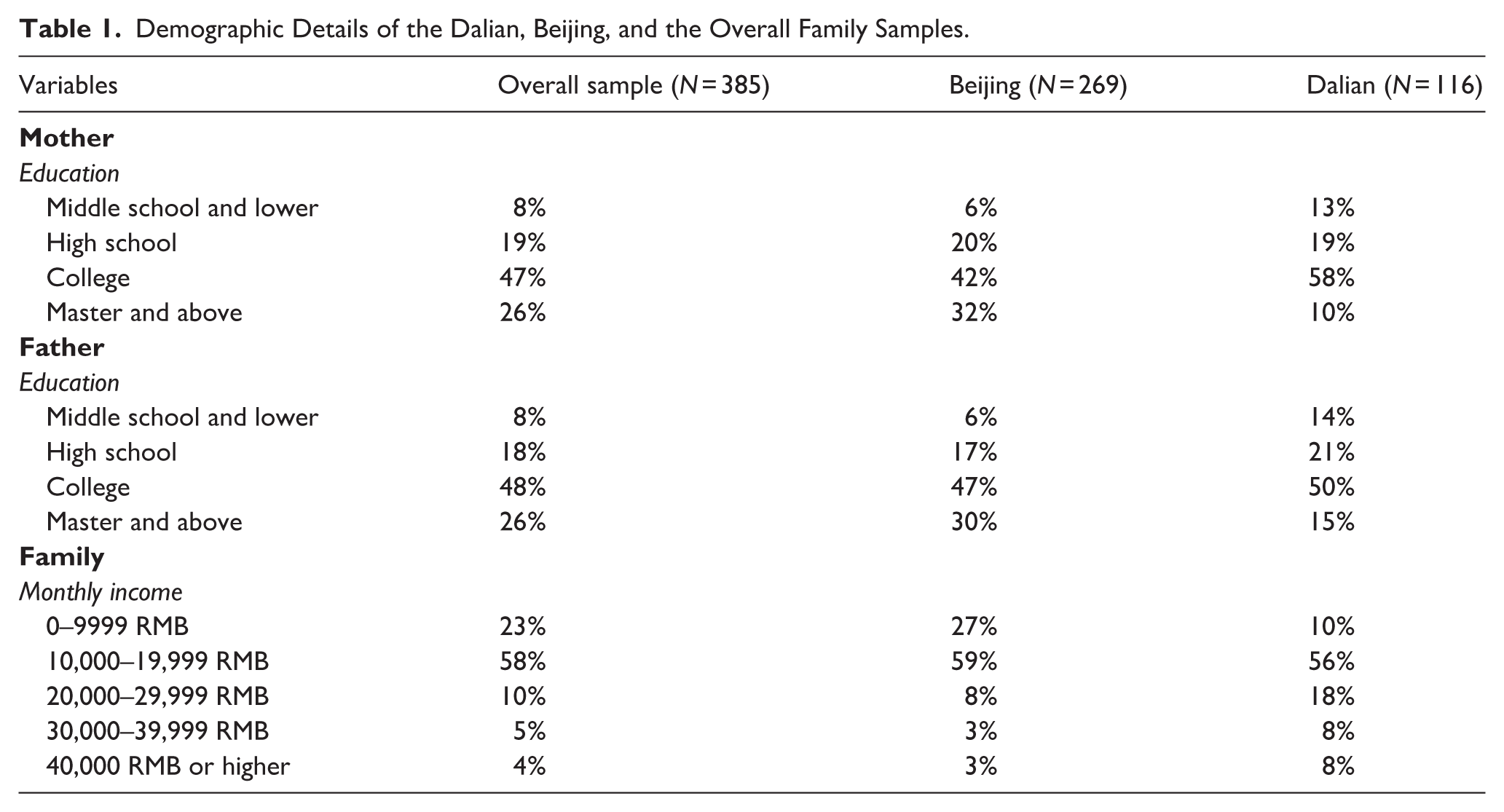
The sample for this study was drawn from a larger cultural comparative research project (Ren et al., 2024) that included several Asian cultures. Mainland Chinese participants for this project included 385 (Mage = 4.8 years, SD = 0.41, range = 3.4–5.8 years, 52.7% boys) children and their parents (mothers: Mage = 34.1 years, SD = 3.45, range = 24.0–44.0; fathers: Mage = 36.1 years, SD = 4.04, range = 26.0–61.0) from two preschools that included kindergarten grades, in Beijing and Dalian, China. These two schools were selected for their convenience and proximity to project collaborators. Among parents, 16.0% of mothers completed high school and 71.8% completed at least some college, while 14.3% fathers completed high school and 73.4% at least some college. Detailed information regarding parental education and family monthly income for Dalian and Beijing subsamples and the overall sample is presented in Table 1. Overall, the majority of the families sampled in this study are typical middle-class families residing in the urban areas of Beijing and Dalian, with parents often having a college or higher degree and a monthly family income between 10,000 and 20,000 RMB.
Demographic Details of the Dalian, Beijing, and the Overall Family Samples.
Procedures
Both parents completed the parenting measures separately. Mothers completed the demographic and child temperament measures. Children’s behaviors were rated by teachers in preschool/kindergarten classes. All the measures were administered in Chinese. Bilingual translators who were fluent in English and Mandarin forward- and back-translated the measures to ensure validity. Institutional Review Boards at each participating university in China and the coordinating university (Brigham Young University) provided oversight and approval of the procedures (IRB No. F110216). Written consent was provided by mothers and fathers for themselves and their children, and children provided assent. Parents and teachers were compensated for their participation in a manner consistent with cultural norms.
Measures
All measures used in this study have been demonstrated to be reliable in the Mainland Chinese sample (L. J. Nelson et al., 2006; Ren et al., 2024; Yang et al., 2026). Reliability information for each scale can be found in Supplemental Tables 1 to 3.
Parenting Styles and Dimensions
A culturally adapted and expanded version of the Parenting Styles and Dimensions Questionnaire (PSDQ; Robinson et al., 1995), which measures subdimensions of authoritative and authoritarian parenting, including added psychological control and intrusive overcontrol dimensions, was used in this study (Ren et al., 2024). Both mothers and fathers separately rated their parenting on a 5-point scale (1 = never to 5 = always). Sample items for the authoritative warmth, regulation, and autonomy subdimensions include, “Am responsive to our child’s feelings and needs,” “Communicate the consequences of bad behavior to our child before he/she misbehaves,” and “Take into account our child’s desires before asking him/her to do something.” Sample authoritarian physical coercion, verbal hostility, and punitive sub-dimension items include the following: “Use physical punishment as a way of disciplining our child,” “Yell or shout when our child misbehaves,” and “Punish by taking away privileges with little if any explanations.”
The psychological control (e.g., shaming: “Tell our child he/she is not as good as other children”) and intrusive overprotection (e.g., “Readily intervene(s) if there is a chance that our child will fail at something”) scales have seven and four items, respectively.
Child Social Behavior
Teachers rated children’s peer group behavior on a 5-point scale (1 = almost never to 5 = almost always) using items from the Teacher Behavior Rating Scale (TBRS; Hart & Robinson, 1996). This included two dimensions of childhood withdrawal, reticence (six items, for example, “Is fearful in approaching other children”) and solitary passive behaviors (four items, for example, “Would rather play alone”). Child physical aggression (e.g., “Hits or kicks or punches other kids”) and relational aggression (e.g., “Whispers mean things about other kids”) were also rated by teachers. Finally, prosocial behavior was measured using six items (e.g., “Shares materials with peers”).
Child Temperament
Child temperament (surgency, negative affect, and effortful control) was measured using the Very Short Form of the Children’s Behavior Questionnaire (Putnam & Rothbart, 2006). The CBQ has been validated across various cultures, including China (Rothbart et al., 2001). Mothers rated children’s temperament items on a 7-point scale (1 = extremely untrue to 7 = extremely true). To help ensure good predictive power, temperament items were retained based on acceptable factor loadings (>.40) and reliabilities (McDonald’s omega >.68).
Statistical Analysis
Data analysis/modeling of this study was carried out in two steps. First, three confirmatory factor analyses (CFA) were conducted, respectively, on (1) authoritative, authoritarian, psychological control, and intrusive/overprotection in both parents; (2) child temperament dimensions (surgency, negative affect, and effortful control); and (3) child social behavior measures. The last CFA was a two-level (child and class) model that partitioned the variances at the child-class level. All the indicators of the factors were specified as categorical. McDonald’s Omega reliabilities of each scale item (ω) are reported based on standardized factor loadings at the child level (McNeish, 2018). The estimated latent factor scores were obtained and used in the subsequent LPA. Factor scores for child behavior constructs at the class level are presented in Supplemental Table 2.
Information Criteria, Entropy, and Smallest Class Proportions of Competing Models.

The second step was to examine interaction patterns of parenting and child behaviors through LPA with targeted covariates. The model was specified such that multiple parenting dimensions (i.e., authoritative, authoritarian, psychological control, and overprotection) of both parents and child social behaviors (i.e., social withdrawal, aggression, and prosocial behavior) served as indicators of latent profiles, while child temperament (surgency, negative affect, and effortful control) served as an independent predictor of classes. Child’s age, sex, father’s education, and data collection sites were used as covariates. Mother’s education was excluded as a covariate since it was highly correlated with fathers’ education (r = .82) and did not differ from fathers’ education with respect to class creation.
The model was estimated with four to six classes and then compared using information criteria, entropy, and likelihood ratio tests (LRT) of k versus k-1 classes. Information criteria include the Akaike, Bayesian, and sample-size-adjusted Bayesian information criteria. Information criteria are referenced for model comparisons and the model with the lowest BIC was retained (Nylund et al., 2007). Analyses were carried out using the latent variable modeling program in Mplus (v8.8). Missing values in a few variables were handled using maximum likelihood estimation in both the CFAs and LPAs.
Results
Measurement Property of Scales
CFA results indicated that latent constructs were measured satisfactorily, with factor loadings ranging from .40 to .87 and reliabilities (ω) ranging from .68 to .91. The overall model fit was good (CFIs > .94, TLIs > .91, RMSEAs < .06). A two-level CFA for the child behaviors measures suggested that all child behavior variables were also measured well, with factor loadings ranging from .49 to .87 and ω > .76 at the child level.
Latent profile analysis
Next, a series of models was fit to four to six classes, respectively. The information criteria, entropy, and smallest class proportions are listed in Table 2. These results suggest that the most optimal model produced five classes with child temperament as class predictors and parenting dimensions and child behaviors as class indicators.
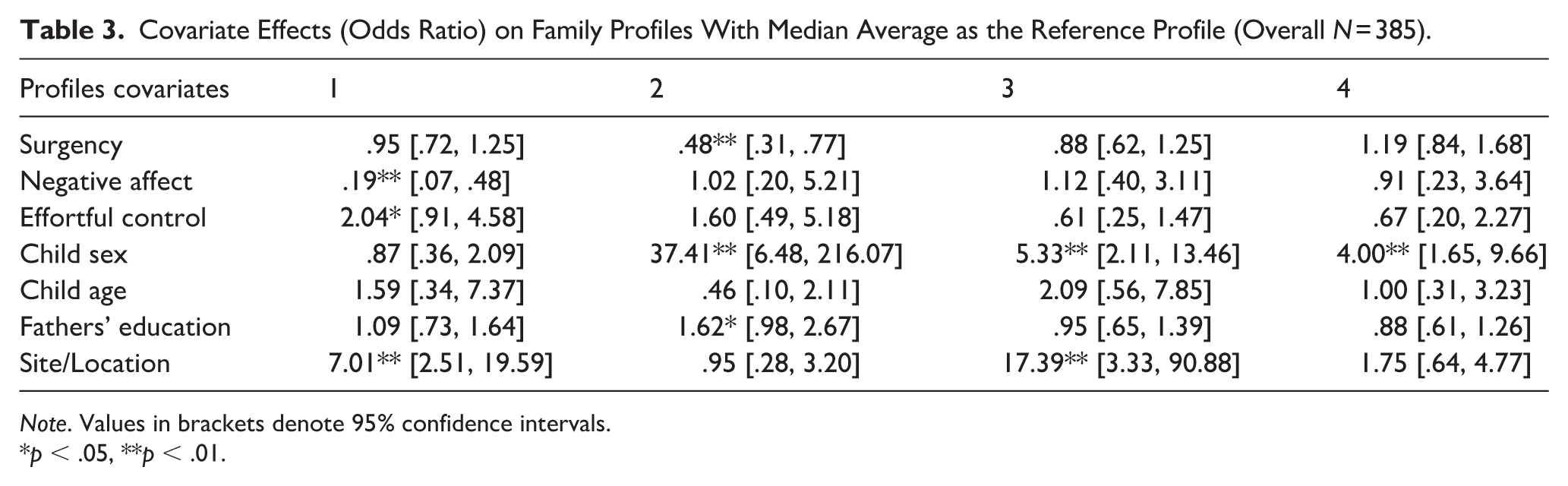
The five latent class profiles of the participants are depicted with bars in Figure 1, with univariate entropy indicating the variable importance in the classification. The proportions and numbers of participants of the five profiles/classes are described below in conjunction with the covariate effects on the latent class variable listed in Table 3. The latent class variable (nominal) served as the dependent variable in the underlying multinomial logistic regression, and Profile 5 served as the reference profile for comparison purposes. Profile 5 comprised parents who were rated as average across all parenting dimensions.
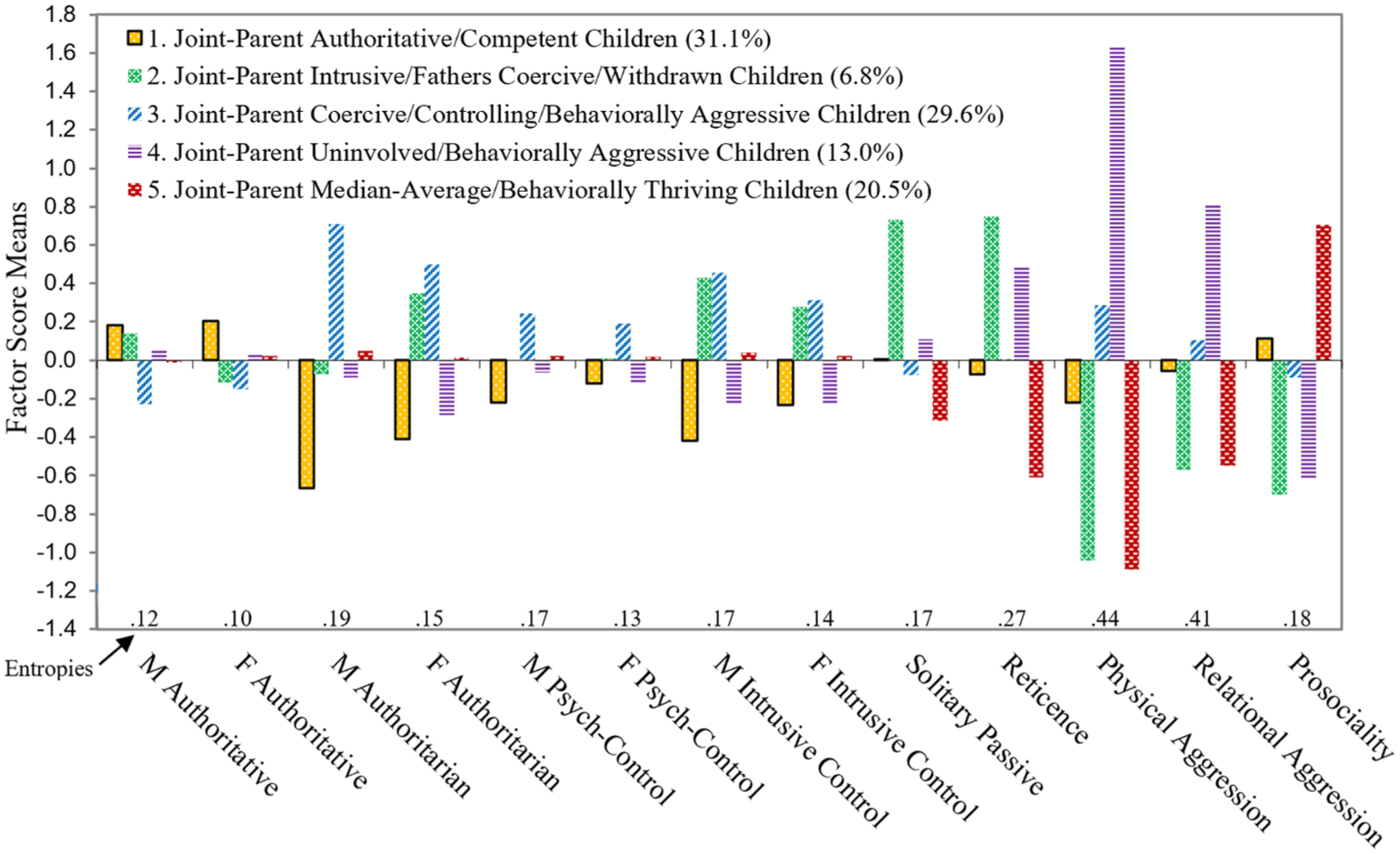
Latent profiles of multiple parenting dimensions for mothers and fathers and child behaviors (overall N = 385). M denotes maternal, and F denotes paternal in horizontal labels.
Covariate Effects (Odds Ratio) on Family Profiles With Median Average as the Reference Profile (Overall N = 385).
Note. Values in brackets denote 95% confidence intervals.
*p < .05, **p < .01.
Family Profiles
Family Profile 1 (31.1%, n = 116) is characterized by authoritative joint parents and behaviorally competent children. Both mothers and fathers had the highest levels of authoritative parenting and the lowest levels of authoritarian and intrusive/overprotective parenting. Fathers had the second lowest level of psychological control, while mothers had the lowest level of psychological control. Children in this profile, relative to all profiles, were the second highest in prosocial behavior and low in physical and relational aggression, and near average for solitary passive withdrawal and reticence (see Figure 1).
Child temperament was a predictor of Profile 1. Children had a 19% lower odds ratio of being classified into Profile 1 than Profile 5 for every unit increase on the latent scale for negative affect. Furthermore, compared with Profile 5, children had 100% higher odds of being in this first profile for every 1-unit increase on the latent scale of effortful control (z = 1.73, p = .04, a one-tailed test). The 95% confidence intervals for the odds ratios indicate a high probability that these effects are significant (see Table 3). No additional covariates were significant.
Family Profile 2 (6.8%, n = 26) is characterized by more intrusive joint parents and more behaviorally withdrawn children. Specifically, Family Profile 2, which included a smaller group of participants, comprised fathers who were higher on the authoritarian dimension, while mothers were slightly below average but were somewhat more authoritative. Both parents were near average in psychological control and the second highest on levels of intrusive/overprotective control (see Figure 1). Children in this class had the highest levels of reticence and passive withdrawal, the lowest levels of prosocial behavior, and were the lowest in relational and second lowest in physical aggression.
Children had 48% higher odds of being classified in Profile 2 for each 1-unit increase on the latent surgency scale, compared with children in Profile 5. In addition, boys had 37.41 times higher odds than girls to be included in this class, and fathers with a 1-unit higher level of education had 62% higher odds of being in this profile relative to Profile 5. No other covariates were significant for this profile.
Family Profile 3 (29.6%, n = 114) is characterized by more coercive joint parents with more behaviorally aggressive children. Specifically, Family Profile 3 comprises parents with the highest levels of authoritarian parenting, psychological control, and intrusive/overprotective control, and the lowest levels of authoritative parenting (see Figure 1). Children in this profile were the second highest in physical and relational aggression, slightly below average in prosocial behavior and solitary passive withdrawal, and near average in reticence. There were no significant child temperament predictors, but boys had 5.33 times higher odds than girls of being classified into Profile 3 compared with Profile 5 (median-average parenting). No other covariates were significant.
Family Profile 4 (13.0%, n = 50) is characterized by more uninvolved joint parents and behaviorally aggressive children. Parents in this profile were near the average in authoritative parenting but were the second lowest in all remaining parenting dimensions (authoritarian, psychological control, and intrusive control; see Figure 1). Children in this class were the highest in both physical and relational aggression, the second highest in reticence, and the lowest in prosocial behavior. There were no significant child temperament predictors, but boys had 4.00 times the odds as girls to be in this class, relative to Profile 5 (median-average parenting). No other covariates were significant.
Family Profile 5 (20.5%, n = 79) includes median-average joint parents and behaviorally thriving children. Both parents in this group are at the median and the statistical average across all parenting levels (see Figure 1). Children in this class had the highest level of prosocial behavior and the lowest levels of physical aggression, the second lowest levels of relational aggression, and the lowest levels of solitary passive withdrawal and reticence. There were no significant child temperament predictors and no additional significant covariates for this profile.
Since data were collected at two sites (Dalian and Beijing), we conducted an additional step to examine potential site effects. Findings reveal that data collection sites did contribute to class identification. Specifically, after holding all other covariate effects constant, the odds of being classified into Profiles 1 and 3 were 7.01 and 17.39 times higher for participants from Dalian than for those from Beijing, respectively, suggesting a potential regional effect.
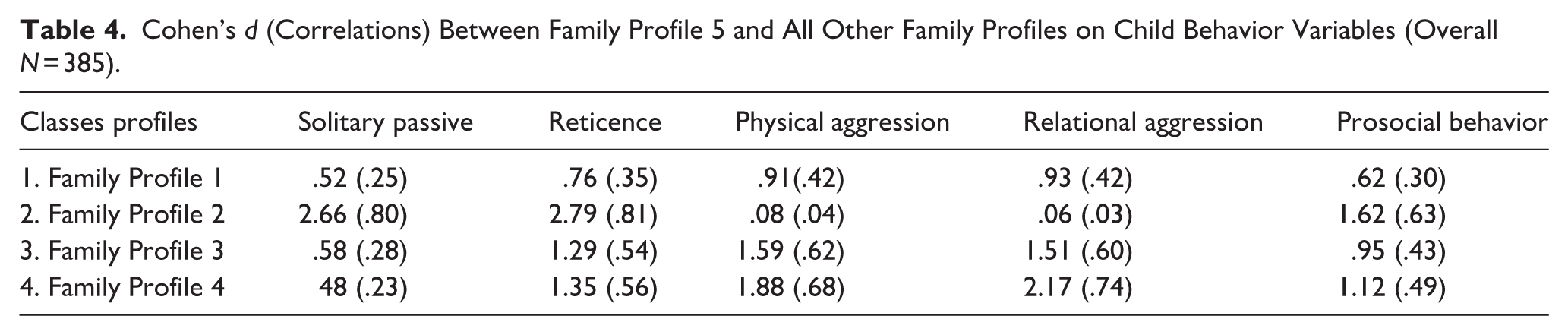
Finally, we estimated effect sizes for the results using Cohen’s d, as multiple parenting dimensions of both parents may also be conceptualized as causes of child behaviors that are moderated by different profiles and their predictors. Effect sizes were based on comparisons of group differences between Family Profiles 1–4 and the average/median group from Profile 5, which served as the control group, across the five child behavioral variables of interest. Consistent with previous approaches, we employed transformed correlations in these analyses. No differences in physical and relational aggression were found between Profiles 2 and 5. All other comparisons suggest that family-level profiles produced medium (≈0.50) to high (⩾0.80) effect sizes for individual child behaviors (see Table 4).
Cohen’s d (Correlations) Between Family Profile 5 and All Other Family Profiles on Child Behavior Variables (Overall N = 385).
Discussion
This study was motivated by a desire to better capture complex parenting patterns when both parents are engaged in parenting efforts that co-occur with child behaviors. This was accomplished by employing a statistical approach that enables the simultaneous exploration of these multiple factors. By more precisely capturing the complexity of family dynamics, we hoped to better approximate the effect sizes of parenting linkages with child behaviors relative to prior research that tends to examine the influence of parenting using single-dimensional approaches (e.g., authoritative parenting only) across individual parents with child behaviors as outcomes rather than indicators of profiles. This novel approach revealed patterns across five profiles that are distinct from those in previous person-centered studies. These five distinct family profiles in mainland China were further shaped by child temperament, sex, and parental education.
Family Profiles
Profile 1: Joint-Parent Authoritative/Competent Children
The first family-level profile included a relatively large proportion of families where both mothers and fathers reported high levels of authoritative parenting and low levels of authoritarian, psychological, and intrusive control. Children in this group demonstrated more competent behavior, such as higher prosocial behavior, lower aggression, and average levels of withdrawal and reticence. These results are consistent with prior research suggesting a shift toward more democratic parenting styles among Chinese families (Hu & Feng, 2022). They also align with a recent cross-cultural meta-analysis showing that authoritative parenting is robustly associated with prosocial behavior across both individualistic and collectivistic cultures (Wong et al., 2020; Wong et al., 2022).
It is possible that warm, less-controlling parenting promotes children’s social development by fostering skills that support peer engagement and prosocial behavior. In turn, more positive child behaviors, such as lower aggression and withdrawal, may elicit greater parental warmth and reduce reliance on coercive parenting. These findings point to potential bidirectional and iterative processes in which authoritative parenting scaffolds children’s emerging social competence, and that competence, in turn, reinforces less punitive parenting strategies. Although these patterns are theoretically compelling, the cross-sectional design of this study limits inferences about directionality. Future longitudinal work could test these reciprocal hypotheses more directly.
This profile was also predicted by child temperament, specifically lower negative emotionality and higher effortful control. These traits are frequently associated with prosocial behavior in children (Fabes et al., 2012; Laible et al., 2014), suggesting that temperament may facilitate or enhance the effectiveness of warm, responsive parenting. Taken together, authoritative parenting and a well-regulated temperament may support the development of social competence through mutually reinforcing processes within the family.
Profile 2: Joint-Parent Intrusive/Fathers Coercive/Withdrawn Children
Profile 2 represented the smallest group and reflected a less congruent pattern of joint parenting. Fathers in this group demonstrated high authoritarian and intrusive control, while mothers reported lower authoritarian and higher authoritative parenting. This configuration loosely aligns with the traditional Chinese pattern of “strict fathers and warm mothers” (Li, 2021), although its rarity suggests it may be less common in contemporary urban families.
Despite variation in parenting style, both parents reported similarly high levels of intrusive control. Children in this group exhibited elevated social withdrawal and lower prosocial behavior, but relatively low levels of physical and relational aggression. These behavioral patterns mirror findings linking controlling parenting, particularly when inconsistent among caregivers, to lower social engagement (cf. Hastings et al., 2019; L. J. Nelson et al., 2006).
This profile was further associated with child temperament, particularly higher surgency among males. Surgency, characterized by elevated energy, approach behavior, and intensity, has been linked to peer difficulties and reduced social competence (Yavuz-Müren et al., 2022). Prior work has shown that surgent boys are more likely to evoke controlling responses, especially from fathers (Porter et al., 2005). In families where self-regulation and modesty are highly valued, these reactive parenting strategies may be an attempt to constrain children’s exuberant tendencies (Dollar & Stifter, 2012).
Interestingly, fathers with higher levels of education were more likely to fit this profile. One possibility is that more educated fathers are particularly attuned to the social risks associated with surgency in collectivist cultural settings that emphasize conformity and group harmony. Their heightened involvement in setting behavioral boundaries, paired with maternal overprotection, may inadvertently reinforce anxious withdrawal in their children (cf. Chen et al., 2020). However, this interpretation remains speculative, particularly given that the surgency measure did not fully capture dimensions such as positive emotionality or activity level.
Profile 3: Joint-Parent Coercive/Controlling/ Behaviorally Aggressive Children
This profile included families in which both mothers and fathers reported the highest levels of authoritarian parenting, psychological control, and intrusiveness, and the lowest levels of authoritative parenting. This profile aligns with the cultural notion of “Tiger Parenting,” which typically emphasizes high control and performance expectations, along with authoritative elements that were not evident for this Chinese sample in this latent class (D. A. Nelson et al., 2006; Kim et al., 2013). However, contrary to prior findings that fit a tiger-mom, panda-dad profile (Xie & Li, 2019), the Profile 3 pattern appears to involve both mothers and fathers.
Children in this group, especially boys, displayed elevated levels of physical and relational aggression, while scoring near the average on prosocial behavior, passive withdrawal, and reticence. These findings suggest that harsh, coercive parenting may be associated with externalizing behaviors, even when children demonstrate average social functioning in other domains. One possible explanation is a bidirectional dynamic in which aggressive child behavior elicits more controlling responses from parents, which in turn intensifies child aggression. Such reactive cycles have been observed in family systems seeking to maintain conformity and group cohesion.
Interestingly, child temperament did not predict membership in this profile. This may indicate that coercive parenting and child aggression co-occur irrespective of children’s dispositional traits. Notably, unlike findings from earlier research (L. J. Nelson et al., 2006), high levels of psychological and intrusive control in this profile were not associated with increased withdrawal or social inhibition. This divergence may reflect distinct dynamics when both parents engage in harsh parenting simultaneously, rather than the dyadic mismatch seen in Profile 2.
It is also possible that parental responses differ based on the child’s behavioral profile. For instance, children in Profile 2 who were more socially withdrawn and less prosocial may have elicited protective or overaccommodating responses from mothers (Xu et al., 2014), while the more assertive, aggressive children in Profile 3 may have prompted both parents to engage in direct, disciplinary control. These distinctions suggest the importance of considering not only just parenting style but also the interplay of child behavior and parental adaptation across family contexts.
Profile 4: Joint-Parent Uninvolved/Behaviorally Aggressive Children
Profile 4 was characterized by mothers and fathers who appeared generally uninvolved. Parents in this group reported average levels of authoritative parenting and low levels of authoritarianism, psychological control, and intrusiveness. In contrast to the modern “Tiger Mom and Panda Dad” model, where one parent is highly controlling and the other permissive (Xie & Li, 2019), these parents seemed more easygoing but also less engaged overall.
Children in this profile, particularly boys, demonstrated the highest levels of physical and relational aggression, second-highest levels of reticence, and the lowest levels of prosocial behavior across all profiles. While low control also appeared in Profile 1, the absence of warmth and structure in Profile 4 may have made this parenting approach more detrimental.
This pattern suggests that a lack of both responsiveness and behavioral regulation may undermine children’s ability to form positive peer relationships. Boys in this group may have been more prone to social disengagement and reactive aggression, possibly due to inconsistent feedback or lack of scaffolding at home (Nelson et al., 2022).
These findings support previous research linking uninvolved or neglectful parenting with higher levels of aggression and withdrawal in children (Kuppens & Ceulemans, 2019). The co-occurrence of minimal parental involvement and elevated child behavior problems highlights the importance of both emotional engagement and behavioral guidance in fostering healthy social development.
Profile 5: Joint-Parent Median Average/Behaviorally Thriving Children
Profile 5 was defined by average scores across all parenting constructs. Children in this group demonstrated the most favorable behavior, including the lowest levels of social withdrawal and aggression and the highest levels of prosocial behavior. This balanced parenting approach aligns with the Confucian Doctrine of Zhong Yong, or the “golden mean,” which emphasizes moderation and the pursuit of appropriate responses to contextual demands. As Ni (2017) notes, Zhong Yong argues that “going too far is as bad as falling short,” a principle that has supported social harmony in Chinese culture for centuries.
This parenting balance, where parents are neither overly permissive nor excessively controlling, may support children’s ability to self-regulate and engage positively with others. Although it is unclear whether parents in this group deliberately sought to moderate their parenting, their children exhibited the most well-adjusted behavioral profiles in the sample. These findings echo Western research suggesting that overly solicitous parenting can hinder social development, whereas moderate parental involvement fosters autonomy and resilience (Kiel et al., 2016).
Children’s adaptive behaviors may also shape parenting. Well-regulated children may elicit fewer directive or coercive responses, reinforcing a cycle of calm, responsive family dynamics. Thus, the profile may reflect a mutually beneficial pattern in which balanced parenting and child competence reinforce one another.
Gender Differences in Profile Membership
Interestingly, boys were more likely to be classified in Profiles 2, 3, and 4. The overall pattern shown in Profiles 2, 3, and 4 suggests that boys are more likely to align with negative behavior in profiles reflecting more uninvolved/neglectful, coercive, and controlling parenting practices. Two explanatory mechanisms may help account for these gender effects. First, Chinese parents traditionally value achievement-oriented socialization goals more for boys than for girls and may be more motivated to use controlling, authoritarian parenting for their sons to match their gender-based socialization goals (Liu, 2006). Second, child gender combined with certain behavioral profiles (e.g., greater surgency as seen in Family Profile 2, or higher aggression in Profiles 3 and 4), may elicit more directive and controlling parenting, particularly for boys. Prior research has likewise highlighted that parenting dyads for mothers and fathers of girls and boys may be organized in differential patterns (Russell & Saebel, 1997). However, this line of research also demonstrates that sex linkages between parents and children are not always consistent (see Eliot, 2021), and our findings warrant replication in different cultural samples.
Effect Sizes of Parenting With Co-Occurring Child Behavior
One key aim of this study was to compare the strength of parenting effects on child behavior across two approaches: (1) traditional, single-dimension models focusing on individual parents, and (2) a holistic, family-level approach that incorporates parenting behaviors from both parents simultaneously. Prior research using single-dimension methods has typically produced modest effect sizes (Cohen’s d = .10–.25; D. A. Nelson et al., 2006; Lei et al., 2018; L. J. Nelson et al., 2006).
Our findings revealed that the family profiles identified through this holistic method differed meaningfully from those produced using conventional stepwise strategies. Although one limitation of this approach is that including child variables in the profiles may complicate causal interpretation, we argue that most potential confounds likely stem from stable child characteristics, such as sex and temperament, rather than behavior per se. This interpretation is supported by the low univariate entropies of child behavior indicators, suggesting they contributed less to profile differentiation.
Overall, effect sizes across profiles were moderate to large (Cohen’s d = .48–2.66), with few exceptions. This suggests that capturing parenting as a family-level construct may provide a more nuanced account of how parenting co-occurs with child behavior. For instance, controlling parenting, particularly within Profiles 2 and 3, was strongly associated with aggression and social withdrawal. These findings align with previous work linking authoritarian parenting to negative social behaviors (Masud et al., 2019; Wu et al., 2002) and extend that research by demonstrating larger effect sizes with integrated family models. A similar pattern was observed with social withdrawal. Compared with univariate approaches, our profiles better accounted for the co-occurrence of parenting practices and withdrawal behaviors (Pinquart, 2017). Notably, the uninvolved Profile 4 incorporated children with the highest levels of child aggression, a combination that is rarely detected in traditional variable- or person-centered analyses.
Finally, the data collection site significantly influenced the profile distribution. For example, participants from northeastern China were more likely to fall into certain classes. While this may reflect sampling variance, it could also suggest underlying regional cultural differences. Some prior descriptions of northeastern Chinese emphasize traits such as extraversion and assertiveness (Swanson, 1989), which may affect both parenting norms and children’s behavioral expression. These results underscore the importance of considering within-culture variation in family dynamics, especially in large, diverse nations like China.
Limitations and Future Directions
Although our approach to measuring parenting was rather comprehensive, adding more parenting behaviors might prove instructive for creating and distinguishing additional family profiles. Thus, future studies may build on and refine additional family profiles using parenting measures not included in this study. Second, the unique profiles identified in this study may not generalize to other samples. Future studies may include larger, more diverse samples across different sociocultural contexts to reveal additional parenting-child profiles in other contexts. We note, for instance, that the current result displays complex interactions that suggest greater nuance when accounting for both parents and children simultaneously. For instance, the highest levels of authoritative parenting in one parent were not associated with the highest levels of prosocial behavior in children, but more moderate levels across both parents were. More work was needed to further tease apart these subtleties within family systems. Finally, this study focused only on child temperamental variables as potential predictors of family-level profiles. Future studies may consider additional focal predictors (e.g., family socioeconomic status, parental cognitions, and normative beliefs about specific parenting practices) and use longitudinal designs to further understand their contributions to family-level profiles.
Conclusion
This study applied a novel person-centered approach to create family-level profiles to explore ways to account for parenting that is organized across different parents along different dimensions and in relation to children’s social behaviors. The findings revealed different family clusters that, in some respects, mirror existing parenting literature in cultural contexts, but also add new insights into how parenting is organized around children’s behaviors and vice versa (Hart, 2007). Child temperament was also found to be an important predictor of some, but not all, family profiles, suggesting that temperament may influence how some parents respond to differing child behaviors within cultural expectations for child behavior. Additional findings suggest that, when examining links between family-level profiles and child characteristics, these profiles tend to yield larger effect sizes than prior research that examines parenting along single dimensions and focuses on individual parents in the absence of children’s behaviors.
Supplemental Material
sj-docx-1-jbd-10.1177_01650254261451142 – Supplemental material for Patterns of Co-Occurring Maternal and Paternal Parenting and Child Behavioral Adjustment Identified in Chinese Families
Supplemental material, sj-docx-1-jbd-10.1177_01650254261451142 for Patterns of Co-Occurring Maternal and Paternal Parenting and Child Behavioral Adjustment Identified in Chinese Families by Chongming Yang, Huiguang Ren, Chris L. Porter, Craig H. Hart, Charissa S. L. Cheah, Larry J. Nelson, David A. Nelson, Wen Gao, Nan Zhou and Liuqing Jiang in International Journal of Behavioral Development
Footnotes
Acknowledgements
The authors would like to thank Christy Leung, the project coordinator, who helped manage the complex multi-site logistics of this study. They would like to thank the parents, children, and teachers who provided the data, and the many student research assistants who devoted countless hours to this project titled “Parents And Children In Families and In Cultures” (PACIFIC).

Funding
The authors disclosed receipt of the following financial support for the research, authorship, and/or publication of this article: This research was supported by Sunrider International, a Marjorie Pay Hinckley Endowed Chair seed money grant, and the Zina Young Williams Card Professorship at Brigham Young University, awarded to Craig H. Hart.
Declaration of Conflicting Interests
The authors declared no potential conflicts of interest with respect to the research, authorship, and/or publication of this article.
Data Availability Statement
The data and code necessary to reproduce the analyses are available upon reasonable request to the corresponding author. The analyses were not preregistered.
Supplemental Material
Supplemental material for this article is available online.
References
Supplementary Material
Please find the following supplemental material available below.
For Open Access articles published under a Creative Commons License, all supplemental material carries the same license as the article it is associated with.
For non-Open Access articles published, all supplemental material carries a non-exclusive license, and permission requests for re-use of supplemental material or any part of supplemental material shall be sent directly to the copyright owner as specified in the copyright notice associated with the article.
