







Abstract
This cross-sectional study used Ogbu’s cultural-ecological theory to assess the structure of opportunity beliefs among Latino youth, and how these beliefs link to academic and behavioral outcomes. A total of 383 Latino high school students (Mage = 15.25) completed surveys assessing opportunity beliefs, academic achievement, delinquent behavior, and gang involvement. A three-factor model (i.e., Opportunity Structure, Oppositional Culture, and Ethnic Barriers) was identified and demonstrated adequate internal consistency. Male students reported higher Oppositional Culture beliefs than female students, and first-generation youth reported higher Opportunity Structure beliefs than second-generation youth. Furthermore, a nonsignificant trend was observed between country of origin and generational status; for Central Americans, first-generation youth reported higher Oppositional Culture beliefs than second-generation youth, whereas no generational differences were found for Mexican-American youth. Opportunity Structure was positively associated with grade point average (GPA) and inversely with gang involvement and delinquency, whereas these associations were reversed for Oppositional Culture. The study provides partial support for Ogbu’s cultural-ecological theory, identifying three factors that capture opportunity beliefs among Latino youth. Findings underscore key demographic factors that may in part shape how Latino youth perceive the Opportunity Structure and how opportunity beliefs relate to academic and behavioral outcomes.
Introduction
Latinos make up the largest ethnic group in the United States (US) and comprise 29% of students enrolled in public schools (National Center for Education Statistics [NCES], 2024a). However, Latino youth experience less academic success and higher dropout than their White peers (Buenrostro, 2018; NCES, 2024b; Seroczynski & Jobst, 2016). Latino youth are also disproportionately affected by gang and criminal justice involvement, accounting for roughly half of all gang members in the US and a large percentage of violent gang-related crime (Castañeda et al., 2015; National Gang Center, 2012; Sickmund et al., 2021). Numerous models have been used to explain these disparities (Arfaniarromo, 2001; Merrin et al., 2020; Orozco, 2008), including those arguing that adults’ negative perceptions and systemic biases create barriers that stand in the way of youth achieving success (Lent, 2020; Redding, 2019; Skinner-Dorkenoo et al., 2023). For instance, the typical Latino student attends an under-resourced and low-performing school, whereas White students are much more likely to attend well-resourced and high-performing schools (Fahle et al., 2020; Goldhaber et al., 2019). Furthermore, Latino youth are both detained in juvenile facilities and transferred to adult criminal court at greater rates than their White peers (Puzzanchera et al., 2025; Ridolfi et al., 2017). Such systemic shortcomings may hinder the educational advancement of Latino youth and further exacerbate opportunity and achievement gaps. Other theories argue that differential responses to the Opportunity Structure are in part responsible for ethnic disparities (Martinez & Welton, 2014; Ogbu, 2003; M. M. Suárez-Orozco, 1996). This study uses Ogbu’s cultural-ecological theory (Ogbu, 1987) to understand the structure of opportunity beliefs among Latino youth, and how these beliefs relate to academic and behavioral outcomes.
Ogbu’s cultural-ecological model attempts to explain ethnic disparities in educational outcomes, with a particular emphasis on voluntary and involuntary minorities (Ogbu, 1987; Ogbu & Simons, 1998). Key elements of this framework are summarized in Figure 1. Voluntary minorities are those from other societies who have willingly settled in the US with expectations to improve their economic, political, or social status (Ogbu & Simons, 1998). According to Ogbu, voluntary minorities typically have a positive dual frame of reference in which they contrast their current circumstances with opportunities available in their place of origin and conclude that they are better off in the US. Although voluntary minorities experience social barriers due to their “foreigner status,” they perceive these as temporary obstacles that can be overcome through education and hard work (Ogbu, 1987, 1992; Ogbu & Simons, 1998). Thus, voluntary minorities and their children tend to adopt adaptation patterns that reflect conventional societal values (e.g., working hard in school) as a way to achieve success (Ogbu, 1991, 1992; Ogbu & Matute-Bianchi, 1986). Ogbu argues that Chinese Americans, Nigerian Americans, and Punjabi Americans are examples of voluntary minorities (Ogbu, 1992; Ogbu & Simons, 1998).
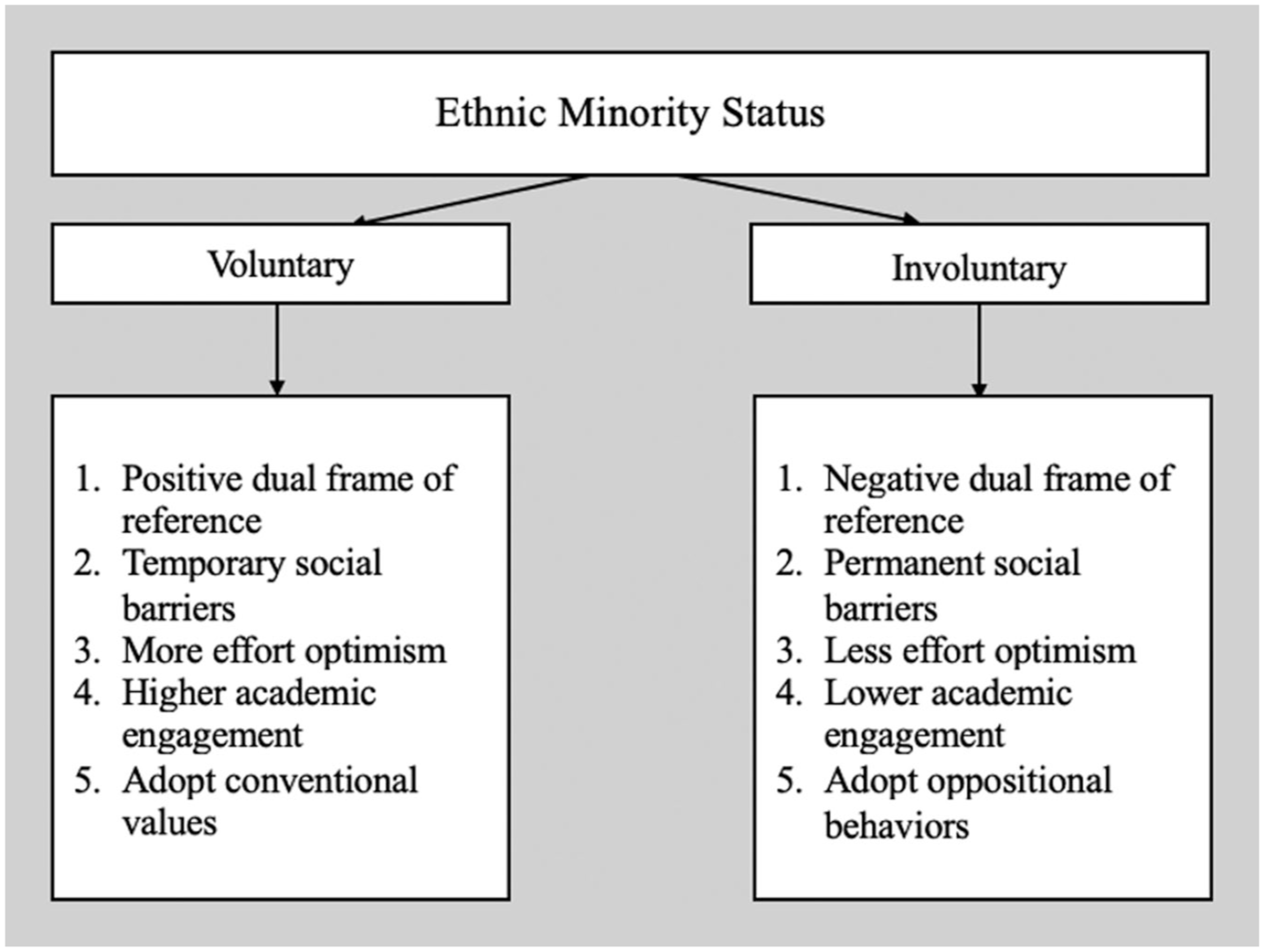
Graphical representation of key domains in Ogbu’s Cultural Ecological Model.
In contrast, involuntary minorities are members of marginalized groups incorporated into American society through enslavement, conquest, or colonization. Ogbu argues that involuntary minorities develop a negative dual frame of reference in that they contrast their less-advantaged circumstances with those of dominant group members (e.g., European Americans in the US) and interpret social barriers as permanent features of US society (Ogbu & Simons, 1998). In response to perceived social barriers, involuntary minorities adopt coping and survival patterns to protect their ethnic group identity. These patterns reflect reduced “effort optimism” (i.e., the belief that hard work can lead to a better life) toward schooling and increased participation in “oppositional cultures” countering mainstream societal norms (e.g., truancy, delinquent behavior; Arfaniarromo, 2001; Fordham & Ogbu, 1986; Ogbu, 2002; Ogbu & Matute-Bianchi, 1986). Ogbu notes that African Americans, Native Americans, and Native Hawaiians are examples of involuntary minorities (Ogbu, 1992).
Much of the research on cultural-ecological theory centers on Black Americans and Asian Americans (Fordham & Ogbu, 1986; Ogbu, 1999, 2002, 2003; Ogbu & Simons, 1994), although there is ambiguity regarding the application of the model to Latino youth. The diverse cultural histories of Latinos in the US complicate their identification as either involuntary or voluntary minorities. On the one hand, some Latinos define their membership in the US through the lens of conquest or colonialism (e.g., Mexican Americans in the southwestern US or Puerto Ricans in the eastern US). For this reason, some scholars argue that many Latinos are best thought of as involuntary minorities (Ogbu & Simons, 1998). On the other hand, a large percentage (70%) of Latinos in the US are either foreign born or have a foreign-born parent, leading some researchers to conclude that Latinos are best thought of as voluntary minorities (M. M. Suárez-Orozco, 1989; U.S. Census Bureau, 2019). Yet a third possibility is that neither label applies; a large percentage of Latino families include migrant workers, violence refugees, and undocumented residents, and these social categories do not fit neatly within Ogbu’s voluntary/involuntary minority framework (Ogbu & Simons, 1998). Unfortunately, no quantitative studies to date have explored how Ogbu’s framework is reflected in the complex identities and immigration histories of US Latinos. Thus, there is a need to better explain existing differences in behavioral outcomes among Latinos in relation to Ogbu’s theory.
Generational status, country-of-origin, and gender are key demographic factors that may in part shape how Latino youth perceive the Opportunity Structure. For example, first-generation Latino students generally hold more positive educational beliefs than their second- and third-generation counterparts, shaped in part by their immigrant parents’ high hopes for upward mobility through education (May & Witherspoon, 2019; C. Suárez-Orozco et al., 2008; C. Suárez-Orozco & Suárez-Orozco, 1995). Similarly, Central Americans have a more optimistic view of Opportunity Structures than Mexican Americans, perhaps due to temporal and motivational differences in immigration experiences (Chinchilla & Hamilton, 2013; Gutiérrez, 2019; M. M. Suárez-Orozco, 1987, 1989). Finally, adolescent Latinas tend to possess more positive attitudes toward schooling relative to their male counterparts (Stanton-Salazar et al., 2001; C. Suárez-Orozco & Suárez-Orozco, 2009). Scholars differ in their explanations for why these demographic disparities exist (Diemer et al., 2014; C. Suárez-Orozco et al., 2018), with some arguing that differential socialization experiences are in part responsible (Chávez-Reyes, 2010; Suárez-Orozco et al., 2006; Telles & Ortiz, 2008).
Current Study
The goal of this study was to test the applicability of Ogbu’s theory among Latino high school students with diverse cultural and immigration histories. Given that no prior studies have explored the factor structure of the Opportunity Beliefs Scale (OBS), our first aim evaluated the factor structure of the OBS (Huey, 2005), a novel measure for assessing core aspects of Ogbu’s theoretical model. Specifically, we hypothesized that exploratory factor analysis (EFA) of the OBS would capture the five core elements of Ogbu’s framework – that is, positive dual frame of reference, temporary social barriers, academic engagement, effort optimism, and conventional values. For our second aim, we assessed for demographic differences in opportunity beliefs. We hypothesized that girls, first-generation youth, and Central American youth would be more likely to report “positive” opportunity beliefs, relative to their demographic counterparts. For our final aim, we assessed whether opportunity beliefs were associated with academic and behavioral outcomes. Specifically, we hypothesized that opportunity beliefs would correlate positively with grade point average (GPA) and negatively with delinquent behavior and gang involvement.
Methods
Participants
Data were derived from a larger cross-sectional survey study of 457 students enrolled in a South Los Angeles Title 1 high school. Included were data from a subset of 392 Latino students identifying as being of Mexican (n = 177; 45.2%), Salvadoran (n = 115; 29.3%), Guatemalan (n = 44; 11.2%), Honduran (n = 8; 2.1%), or “Other” Latino heritage (n = 28; 7.1%). The remaining students (n = 20; 5.1%) identified as Latino but did not identify their heritage. Youth were predominantly female (52.9%) and ranged in age from 13 to 18 years (M = 15.25). The majority of students were in ninth grade (58%), with the remainder being in tenth (8%), eleventh (27%), and twelfth grade (7%). Approximately 76% were born in the US, 22% were born in another country, and 2% did not provide information related to their country of birth. Of those born outside of the US, 39.8% were from Mexico, 33.7% from El Salvador, 19.3% from Guatemala, 4.8% from Honduras, and 2.4% from other countries.
Parental consent and youth assent were completed for all participants. Youth then completed various questionnaires assessing psychological and behavioral adjustment, cultural identification, and demographic information. For this study, we focused on survey items assessing youth demographics, opportunity beliefs, gang involvement, delinquent behavior, and school grades. All questionnaires were administered in English. The institutional review board (IRB: UP-05-00323) at the University of Southern California (USC) approved all procedures.
Measures
Demographics
The demographics survey assessed information regarding participant age, self-identified racial/ethnic background, gender, generational status (i.e., first-, second-, and other-generation immigrants), and country of origin (e.g., Mexico, El Salvador, Guatemala). Based on prior research (Marks et al., 2014; Tilley et al., 2021), generational status was defined by country of birth (i.e., foreign born or US born). Specifically, youth born in a foreign country but living in the US were defined as first generation. Youth born in the US with at least one parent born outside of the US were defined as second generation. Youth born in the US with US-born parents were defined as third generation. 1 For country of origin, youth identifying as Salvadoran, Guatemalan, or Honduran were combined into the “Central American” category (45.2% of youth), and those identifying as Mexican were placed into the “Mexico” category (42.6%).
Opportunity Beliefs
The OBS (Huey, 2005) is a 42-item self-report survey designed to assess youth perceptions of the Opportunity Structure, with items reflecting multiple dimensions of Ogbu’s Cultural Ecological Model. The initial 50 OBS items were developed by the third author (SJH) based on a review of Ogbu’s published work on cultural-ecological theory over a 25-year period (1978–2003). These items were reviewed by two experts in education and psychology with prior knowledge of Ogbu’s theory, who provided recommendations for altering, adding, and deleting items. Through a consensus process, the second author and two experts agreed on a final set of 42 items that were intended to capture five dimensions of Ogbu’s model (Huey, 2005). These dimensions include temporary social barriers (e.g., “If people speak proper English, they can be very successful in this country”), positive dual frame of reference (e.g., “My family is better off in the U.S. than anywhere else”), effort optimism (e.g., “Hard work is the key to success in life”), academic engagement (e.g., “It is important for me to get good grades in school”), and conventional values (e.g., “I think that dealing drugs is wrong”). Participants rated the 42 items on a five-point Likert-type scale (i.e., “not at all true” to “very much true”), with half of the items reverse-scored. Higher scores reflect more positive perceptions about opportunity. Reliability coefficients for the OBS factors are presented in the Results section.
Academic Achievement
Self-reported GPA was obtained from youth. Self-reported GPA is a reliable index of objective grades, with correlations ranging from .80 to .96 (Kuncel et al., 2005; O’Malley et al., 2015; Sticca et al., 2017). The average GPA of students was 2.76 (range = 4.2; SD = .86).
Delinquency
The Self-Report Delinquency Scale (SRDS) is a self-report instrument assessing delinquency over the past 6 months. The SRDS is a valid and reliable instrument (α = .91; Elliot et al., 1985; Elliott & Ageton, 1980). We developed an abbreviated 10-item version of the SRDS using methods recommended by Thornberry and Krohn (2000) and others to ensure that general delinquency as well as its various subdomains (e.g., serious and minor delinquent acts) were adequately represented (Elliot et al., 1985; Huizinga & Elliott, 1986). Youth reported the number of times they engaged in each of the 10 delinquent acts (e.g., “during the last 6 months how many times have you stolen something from a store or something that did not belong to you worth less than 50 dollars?”). Each item was recoded to reflect whether youth committed the delinquent act (Yes = 1; No = 0). The delinquency score was created by combining responses to all 10 items, yielding scores ranging from 0 to 10, with higher scores indicating greater levels of delinquency. The mean delinquency score was 0.82 (SD = 1.75). Prior research has administered abbreviated versions of the SRDS and utilized the same coding approach (Chesin & Jeglic, 2012; Keating et al., 2002). The abbreviated SRDS demonstrated good reliability in the current sample (Kuder-Richardson Formula20 = .84; Kuder & Richardson, 1937).
Gang Involvement
Two items were used to measure youth gang involvement. The first item, derived from the SRDS (Elliot et al., 1985; Huizinga & Elliott, 1986), asked participants to report, “how many times over the past 6 months have you been involved in a gang fight?” Responses were coded as either 0 (i.e., not involved) or 1 (i.e., involved 1 or more times). Research indicates that gang fight involvement is associated with greater exposure to violence and greater likelihood of involvement in gun-related violence (Butters et al., 2011; Durant et al., 1994; Vaughn et al., 2012). The second item, derived from the Eurogang Survey (Medina-Ariza et al., 2009), asked participants to respond no or yes to the question, “are you a member of a street gang or tagger crew?” Prior research shows the Eurogang item corresponds with self-report of gang-involved violence, as well as official police reports of gang membership, demonstrating criterion validity (Curry, 2000; Decker et al., 2014; Esbensen et al., 2001). Responses were coded as either 0 (i.e., no) or 1 (i.e., yes). An index score was created combining responses to both items. Participants scoring 0 were categorized as nongang involved. Participants scoring 1 or 2 were categorized as gang involved. Based on this scoring, 14% of youth were gang involved, and 86.0% were nongang involved. Gang involvement was treated as a binary outcome in all analyses.
Analyses
Preliminary analyses were conducted to identify outliers and violations of normality on participant responses to the OBS. Nine cases were initially removed due to a 100% nonresponse rate. Little’s Missing Completely At Random (MCAR; Little & Rubin, 2002) test was performed to determine the nature of missing data for the remaining cases (i.e., n = 383). Little’s MCAR revealed that data was missing completely at random, and thus, pairwise deletion was used to address the missing data (i.e., 2% of cases).
Two tests were conducted to assess the suitability of the data for EFA. Bartlett’s test of sphericity was performed to verify correlations between items on the OBS. The Kaiser-Meyer-Olkin test, an index of sampling adequacy, was performed to assess whether the sample size was adequate for conducting an EFA (Kaiser, 1974). EFA was preferred over confirmatory factor analysis (CFA) as no prior studies have examined the factor structure of the OBS (Tavakol & Wetzel, 2020; Watkins, 2018). Response categories for the OBS items were ordinal; therefore, polychoric correlations were carried out to obtain possible factor solutions (Holgado-Tello et al., 2010). Principal axis factoring with Oblimin rotation was used to assess model fit for the factor solutions.
Following the EFA, a series of analyses were performed to explore demographic differences in OBS sum scores. First, participants’ responses to items on the OBS were summed within factors to create sum scores (Opportunity Structure, M = 62.18, SD = 11.09; Oppositional Culture, M = 15.18, SD = 5.61; Ethnic Barriers, M = 19.52, SD = 4.75). Higher scores on Opportunity Structure reflect more positive perceptions about opportunity, whereas higher scores on Oppositional Culture and Ethnic Barriers reflect less positive perceptions. Second, a series of one-way analyses of variance (ANOVAs) were conducted to assess for demographic differences (i.e., by gender, generational status, and county-of-origin). Outliers were assessed by inspection of a boxplot. The distributions of the variables were normal, as assessed by Shapiro-Wilks’s normality test (p > .05; Shapiro & Wilk, 1972). There was homogeneity of variances, as assessed by the Levene’s test for equality of variances (p > .05). Third, a two-way ANOVA was performed to determine the interaction effects of country of origin and generational status on each factor score. Bonferroni post hoc tests were carried out for pairwise comparisons.
Finally, a series of linear and binary logistic regressions were conducted to examine the independent relationships between opportunity beliefs and three behavioral outcomes – GPA, delinquency, 2 and gang involvement. Preliminary analyses indicated substantial missing data for GPA (i.e., 33%). Little’s MCAR revealed that data was not missing completely at random. To maximize the use of all available data, we utilized multiple imputation. The alpha level for all tests was set at .05. Effect sizes are reported using partial eta-squared for ANOVAs, Cohen’s f2 for linear regressions, and odds ratio for binary logistic regressions. All analyses were conducted using SPSS 27.0 and R Studio.
Materials and analysis code for this study are available from the corresponding author on reasonable request. This manuscript adheres to the STROBE (Strengthening the Reporting of Observational Studies in Epidemiology) cross-sectional guidelines for reporting cross-sectional studies (von Elm et al., 2007).
Results
Opportunity Beliefs Factor Structure
To address our first aim, we conducted a factor analysis of the OBS. Barlett’s test of sphericity was significant at p < .001, suggesting substantial correlations among items (Bartlett, 1950; Watson, 2017). The Kaiser-Meyer-Olkin statistic was .82, suggesting that the factorability of the items was acceptable to proceed with factor analysis.
For the present study, 9 of the 392 cases were dropped due to missing data, and EFA was conducted with the remaining 383 cases. The participant per variable ratio (8:1) was greater than the minimum generally recommended for conducting an EFA (i.e., 5:1; Howard, 2016; Tabachnick et al., 2007). Multiple factor reduction methods consistent with conventional guidelines in EFA were used in selecting the final model, including visual scree plot inspection (Cattell, 1966), Velicer’s Minimum Average Partial (MAP; Velicer, 1976) test, and parallel analysis (Horn, 1965). Results from the scree plot analysis suggested four factors were sufficient to explain the factor loadings. Results from Velicer’s MAP test indicted that three factors should be retained. A supplemental parallel analysis suggested retaining between three and seven factors. Examination of model fit suggested retaining three factors. The root mean square error of approximation (RMSEA) for the three-factor model was 0.05, and the standardized root mean square residual (SRMR) was .04, suggesting acceptable fit. Although model fit indices are less commonly used for factor retention in EFA, several studies have shown that these fit indices provide accurate results (Barendse et al., 2015; Preacher et al., 2013). Interpretability of the model (Knekta et al., 2019) indicated that three factors provided the most parsimonious interpretation for the factor loadings across all potential models, with the factors accounting for 30% of the variance.
The three factors in the final model were identified as Opportunity Structure, Oppositional Culture, and Ethnic Barriers. Brief descriptions and factor loadings for the items are provided in Table 1. We used a cutoff value of .32, as other experts recommend this criterion when conducting EFA on sample sizes greater than 200 (Costello & Osborne, 2005; Stevens, 2002). Cross-loadings (i.e., items that load .32 or higher on two or more factors; Costello & Osborne, 2005) were observed for one item (i.e., Item 13). Nine items (i.e., 2, 8, 17, 19, 22, 25, 28, 33, and 34) did not fit into the factor structures due to low loadings (<.32) and were removed from subsequent analyses. The remaining items (n = 32) had satisfactory loadings (i.e., .32 or higher) and were placed in one of the identified factors. An Oblimin rotation was used to obtain a simple structure while allowing the three OBS factors to correlate. Discriminate validity was assessed by examining the correlations between the OBS factors (Cheung et al., 2023). Two significant correlations were identified across the three factors. Specifically, Oppositional Culture was significantly correlated with both Opportunity Structure (r = -.135) and Ethnic Barriers (r = .200). Although significant, these correlations were low (rs < .70; Cheung et al., 2023), providing evidence for discriminate validity. Furthermore, construct reliability was assessed using Cronbach’s α. Results suggested adequate internal consistency for the three-factor model (i.e., α > .70; Chan & Idris, 2017). In addition, internal consistency was very good for Opportunity Structure (α = .82) and adequate for Ethnic Barriers and Oppositional Culture (α = .71; α = .73). Thus, construct reliability was deemed to be sufficient for all OBS factors.
Factor Pattern Matrix for Oblimin Rotated Three-Factor Solution for 32 Items on the Opportunity Beliefs Scale.
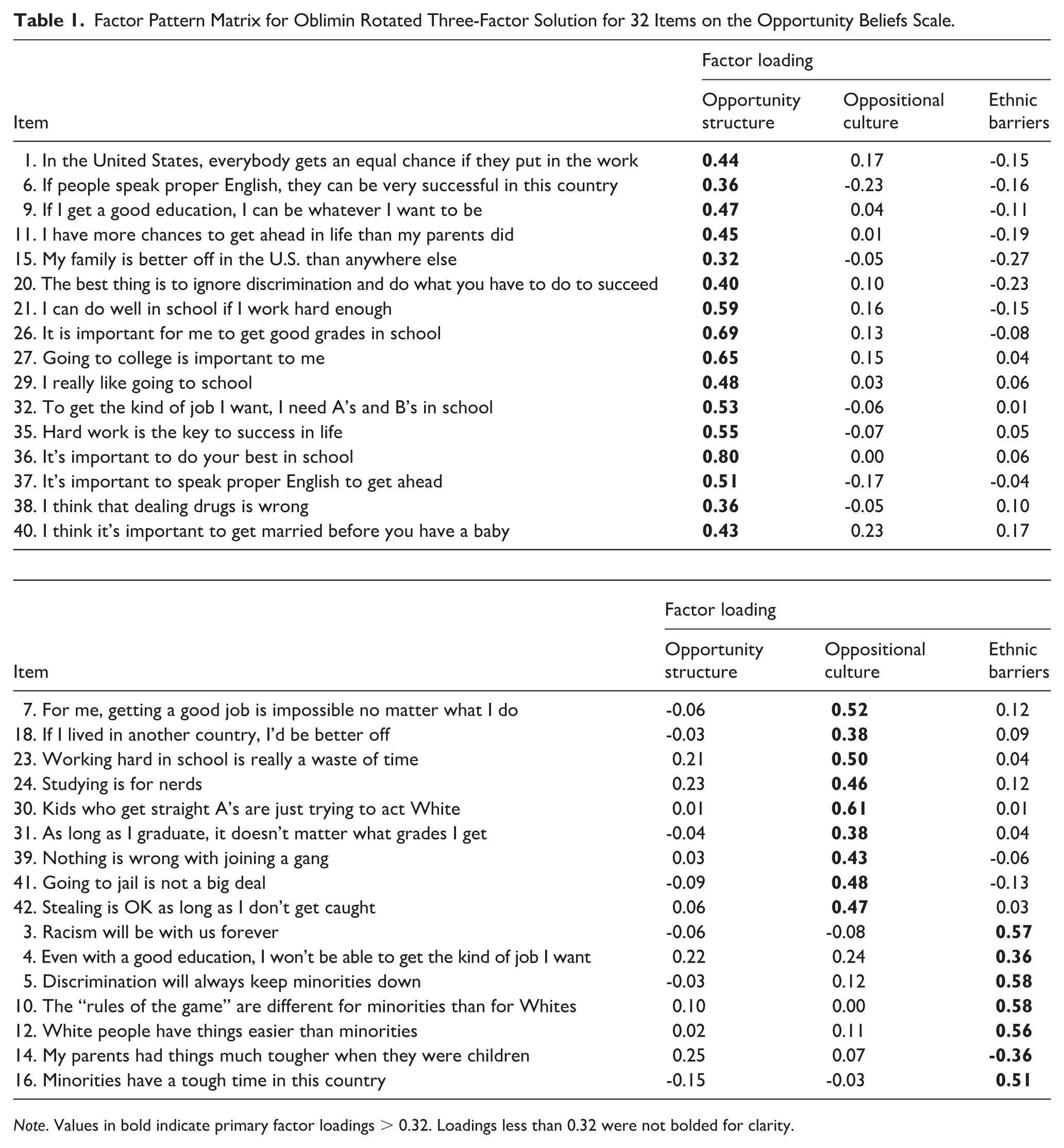
Note. Values in bold indicate primary factor loadings 0.32. Loadings less than 0.32 were not bolded for clarity.
Demographic Differences in Opportunity Beliefs
To address our second aim, we assessed for demographic differences in opportunity beliefs. ANOVAs showed significant effects for gender and generational status. Male students had significantly higher scores than female students on Oppositional Culture, F(1, 362) = 8.76, p = .003, partial η2 = .024, although no significant differences were found for Ethnic Barriers, F(1, 362) = .032, p = .858, partial η2 = .000, or Opportunity Structure, F(1, 363) = 2.58, p = .109, partial η2 = .007. In contrast, first-generation youth had significantly higher scores than second-generation youth on Opportunity Structure, F(1, 381) = 13.9, p ⩽ .001, partial η2 = .035, whereas no significant differences were found for Oppositional Culture, F(1, 380) = 1.21, p = .273, partial η2 = .003 or Ethnic Barriers, F(1, 380) = .233, p = .630, partial η2 = .001.
Additional ANOVAs revealed no significant country of origin (Mexico vs. Central America) differences for Opportunity Structure, F(1, 336) = 2.68, p = .103, partial η2 = .008, Oppositional Culture, F(1, 335) = .757, p = .385, partial η2 = .002, or Ethnic Barriers, F(1, 336) = .049, p = .826, partial η2 = .000. However, a two-way ANOVA showed a nonsignificant trend suggesting a country of origin × generational status effect for Oppositional Culture, F(1, 333) = 3.760, p = .053, partial η2 = .011. Given our unique sample and the exploratory nature of our study, we decided to conduct post hoc analyses to interpret this interesting trend. Pairwise comparisons using the Bonferroni statistic showed that for Central Americans, first-generation youth had higher scores than second-generation youth on Oppositional Culture, p = .032, η2 = .014, whereas no difference was found for Mexican-American youth, p = .477, η2 = .002 (see Figure 2).
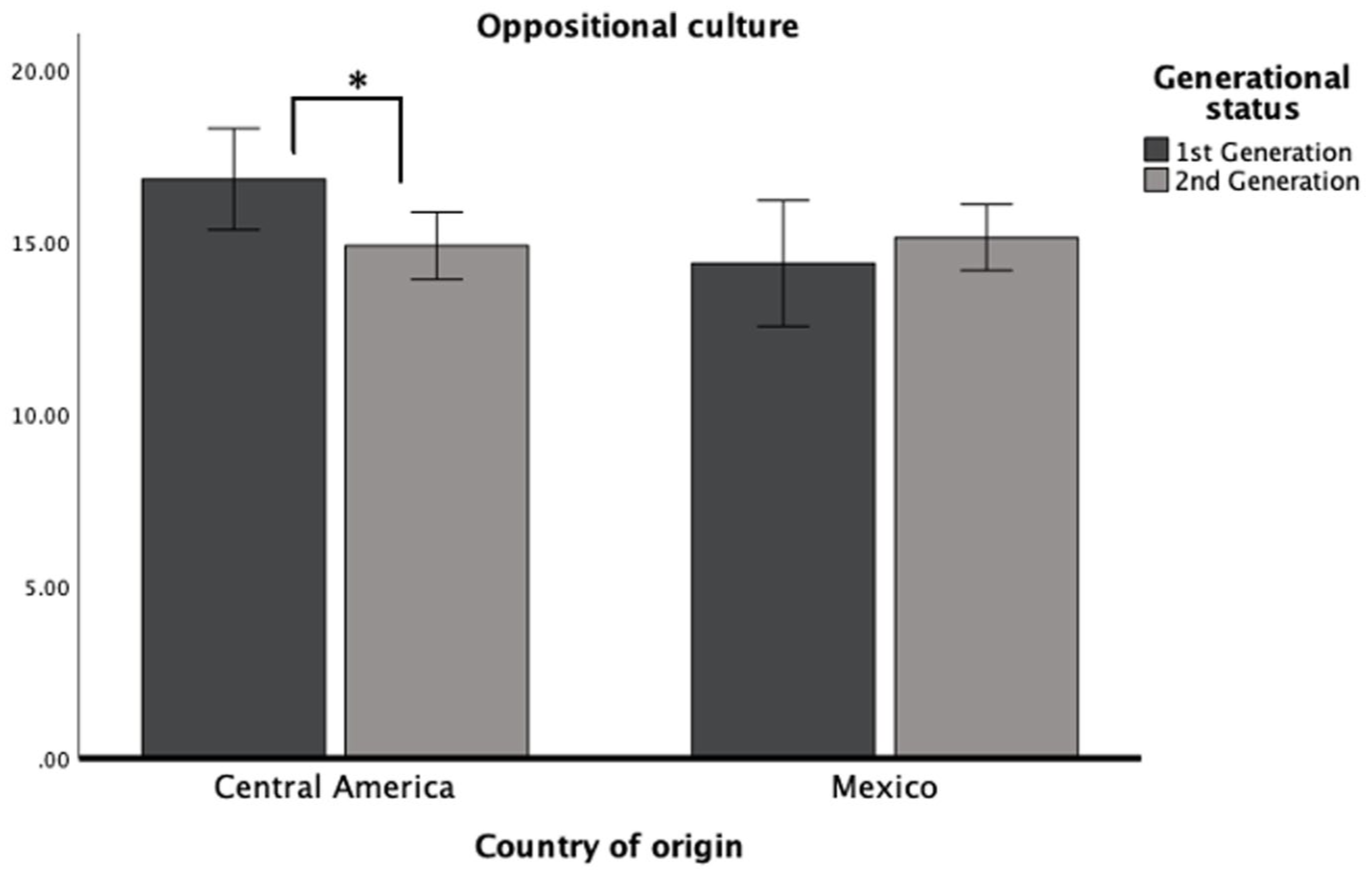
Interaction effect between country of origin and generational status on Oppositional Culture.
Outcome Correlates of Opportunity Beliefs
For our final aim, we used linear and binary logistic regressions to assess whether opportunity beliefs were associated with academic and behavioral outcomes (Table 2). In general, factor sum scores were significantly associated with GPA, F = 33.5, p < .001, R2 = .210, f2 = .266, and delinquency, F = 12.9, p < .001, R2 = .091, f2 = .100. Students with higher scores on Opportunity Structure reported higher GPAs, β = .266, p < .001, whereas this association was reversed for Oppositional Culture, β = -.410, p < .001. Similarly, students with higher scores on Opportunity Structure reported fewer delinquent behaviors, β = -.183, p = .001, whereas this association was reversed for Oppositional Culture, β = .261, p < .001. In contrast, Ethnic Barriers was not significantly associated with GPA, β = -.076, p = .205, or delinquent behaviors, β = .047, p = .448. Measures of effect size indicated a small-to-medium effect of Opportunity Structure and Oppositional Culture on behavioral outcomes.
Results From Linear and Binary Regression Using the Opportunity Belief Scale Factors on Behavioral Outcomes.
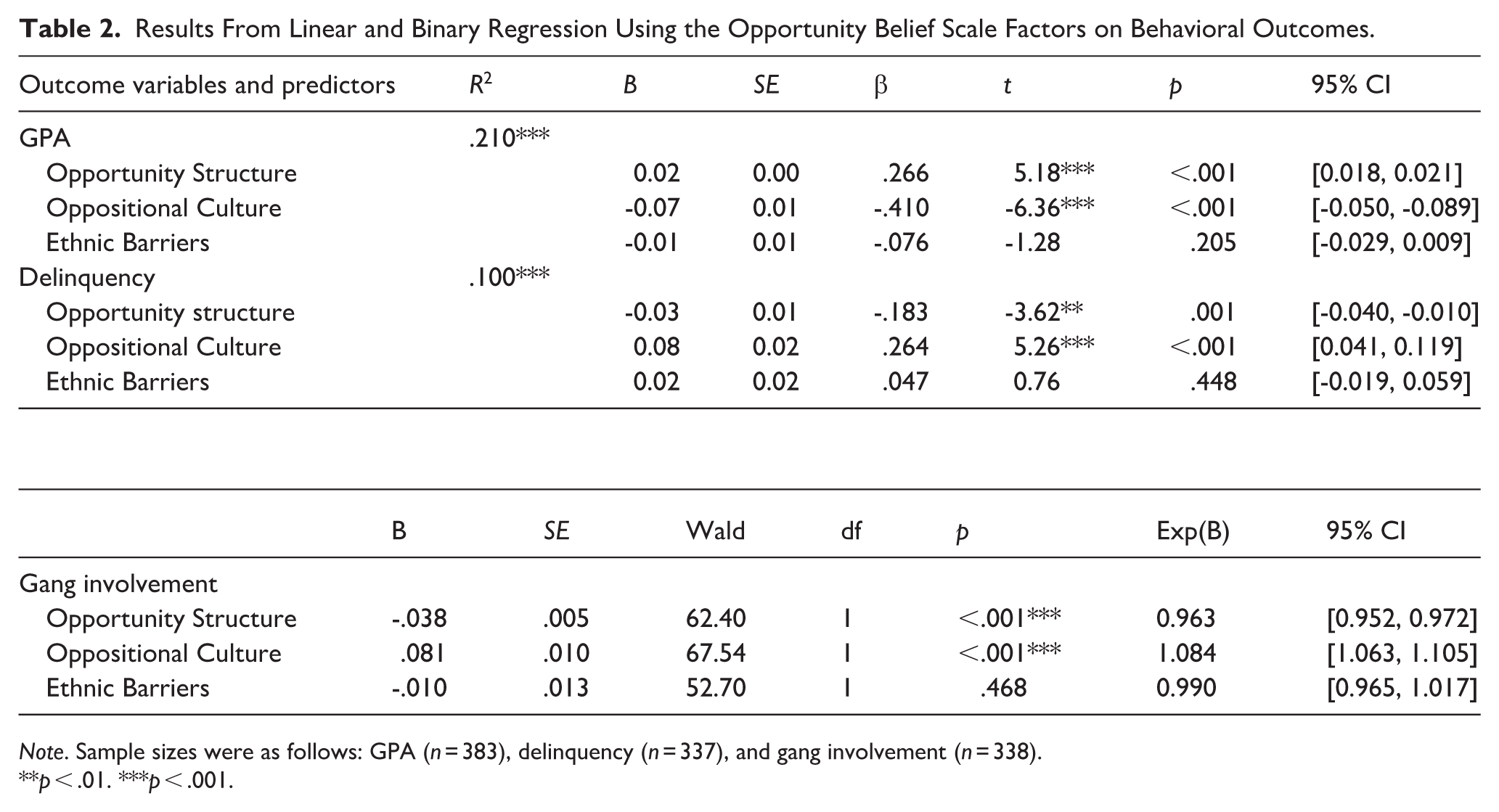
Note. Sample sizes were as follows: GPA (n = 383), delinquency (n = 337), and gang involvement (n = 338).
p < .01. ***p < .001.
Furthermore, we examined the association between opportunity beliefs and gang involvement using binary logistic regression. The overall regression model was statistically significant, X2 (3, N = 338) = 117.95, p < .001, R2 = .095. Evaluation of the sum scores indicated that both Opportunity Structure (β = -.038, p < .001, OR = .96) and Oppositional Culture (β = .081, p < .001, OR = 1.08) were associated with gang involvement, whereas Ethnic Barriers (β = -.008, p = .834, OR = .99) was not (see Table 2). Specifically, higher scores on Opportunity Structure were associated with a lower likelihood of gang involvement, whereas the reverse occurred for Oppositional Culture. Measures of effect size indicated a small-to-medium effect of Opportunity Structure and Oppositional Culture on gang involvement.
Discussion
Latino youth represent the second-largest group of students in the US, yet they continue to underperform academically and remain at greater risk of gang involvement and delinquent behaviors (Durán & Campos, 2020; NCES, 2024). The present study utilized Ogbu’s cultural-ecological theory to understand how these disparities may be partly influenced by differential perceptions of the Opportunity Structure. First, we examined the underlying factor structure of the OBS. Second, we assessed for demographic differences in opportunity beliefs. Finally, we assessed whether opportunity beliefs were associated with academic and behavioral outcomes.
We found preliminary support for the factorial validity of the OBS in relation to Ogbu’s cultural-ecological theory. Rather than the five-factor model, we hypothesized, three factors emerged that were consistent with Ogbu’s paradigm: (a) Opportunity Structure; (b) Oppositional Culture; and (c) Ethnic Barriers. The Opportunity Structure factor reflects beliefs about chances for success (e.g., “if I get a good education, I can be whatever I want to be”). The Oppositional Culture factor captures beliefs that reject the norms of the dominant culture (e.g., “nothing is wrong with joining a gang”), as well as conventional values that minority groups may adopt in the US. The Ethnic Barriers factor reflects barriers to opportunity primarily rooted in ethnic minorities’ experiences with discrimination (e.g., “racism will be with us forever”). Although we expected Academic Achievement (e.g., “it is important for me to get good grades in school”) and Effort Optimism (e.g., “hard work is the key to success in life”) to emerge as separate factors, the relevant items instead loaded heavily on the Opportunity Structure factor. A plausible explanation may be that Latino youth operationalize beliefs about hard work and school achievement as broader perceptions of the Opportunity Structure, rather than distinct concepts. Similarly, the items we theorized as representing dual frame of reference (e.g., “White people have things easier than minorities”) instead loaded primarily on the Ethnic Barriers factor. This pattern could suggest that Latino youth evaluate their circumstances in the US primarily through lived experiences of discrimination rather than with conditions in their countries of origin. Altogether, these results indicate that the three-factor model was the most parsimonious model to explain Latino youths’ opportunity beliefs.
We also found evidence for demographic differences in opportunity beliefs, although not always in the expected directions. As hypothesized, the OBS differentiated between male and female students, with male students reporting higher Oppositional Culture beliefs. These findings are consistent with studies documenting that oppositional identities are more prevalent among male participants than female participants across ethnic groups (Lundy & Firebaugh, 2005; M. M. Suàrez-Orozco, 1987). This gender difference may in part be due to differential socialization and educational experiences, whereby male participants are exposed to contexts that reinforce more oppositional identities (Fordham & Ogbu, 1986; Lundy & Firebaugh, 2005; Qin, 2006; Raffaelli & Ontai, 2004). In addition, consistent with Ogbu’s framework, the OBS differentiated between first- and second-generation youth, with first-generation students having higher scores than second-generation students on Opportunity Structure. Contrary to our predictions, there were no overall differences in opportunity beliefs by country of origin (i.e., Central America and Mexico).
However, when considering both country-of-origin and generational status, we observed a nonsignificant trend suggesting that first-generation Central Americans have higher Oppositional Culture beliefs than second-generation Central Americans, whereas no such trend was observed for Mexican-American youth. Given this unexpected trend, we conducted supplemental analyses examining whether first-generation Central Americans differed from second-generation Central Americans in terms of grades and delinquency. Indeed, we found that first-generation Central Americans reported doing less well academically than second-generation Central Americans, F = 8.03, p < .005. This pattern of results should be interpreted with caution but suggests that Oppositional Culture beliefs may vary in unexpected ways across Latino identities.
Finally, we found that opportunity beliefs are generally associated with important academic and behavioral outcomes in predicted ways. Specifically, opportunity beliefs reflecting Opportunity Structure were positively associated with GPA and inversely related to delinquency. In addition, Oppositional Culture beliefs were inversely related with GPA and positively associated with delinquency. These findings are consistent with previous studies in which lower GPAs and more delinquent behaviors were found to be more prevalent among students with Oppositional Culture beliefs (Beerthuizen et al., 2013; Sheu, 1986). Furthermore, we found that higher scores on Oppositional Culture were associated with a higher likelihood of gang involvement. Researchers have theorized that gang involvement may be a component of oppositional identity and an indirect response to limited opportunity (Arfaniarromo, 2001; Sweeney, 1980). Prior research suggests that systemic societal pressures, including exposure to violence, unstable family environments, and economic disadvantage, may both shape youths’ oppositional beliefs and increase susceptibility to gang involvement (Vigil, 2016, 2019). Supporting Ogbu’s framework, our findings suggest that beliefs reflecting Opportunity Structure and Oppositional Culture may have both academic and behavioral implications for Latino youth.
Strengths and Limitations
Because most prior research on cultural-ecological theory centers on Black and Asian Americans (Fordham & Ogbu, 1986; Ogbu, 1999, 2002; Ogbu & Simons, 1994), one strength of the current study is that we tested the OBS with a diverse sample of Latino adolescents. Furthermore, although prior research tends to focus on one dimension of Ogbu’s framework (e.g., oppositional identity; Mickelson, 2008; Taylor, 2008), this study is the first attempt to conduct a factor analysis of a measure assessing Ogbu’s broader theoretical model.
Another strength is our finding that opportunity beliefs might be shaped in part by the diverse cultural histories and life experiences of Latino youth in ways that generally align with Ogbu’s theory. For example, the fact that first-generation Latino youth reported more positive opportunity beliefs than their second-generation counterparts is consistent with Ogbu’s argument that first-generation youth generally adopt beliefs reflecting conventional societal values (e.g., working hard in school) as a way to achieve success. That said, the trend suggesting that first-generation Central Americans reported higher Oppositional Culture beliefs than second-generation Central Americans was unexpected and could pose a challenge to Ogbu’s framework, as it may not fully account for the diversity of Latino immigrants’ experiences. Mexican-American immigration to Southern California was prolonged, extensive, and typically motivated by economic concerns (Gutiérrez, 2019). In contrast, Central American immigration was more recent and primarily fueled by war, political instability, and economic concerns (Chinchilla & Hamilton, 2013). These temporal and motivational differences in immigration experiences could lead to different opportunities and beliefs systems among first- and second-generation immigrants across these two broad communities.
Notably, we chose not to contrast Latino youth with Asian, Black, or White youth in relation to Ogbu’s framework. Because we focused on within-group variation among Latino subgroups rather than ethnic comparison, our study did not directly inform whether Latino youth collectively fit best as either involuntary or voluntary minorities. However, the findings suggest that key demographic factors may in part shape how Latino youth perceive the Opportunity Structure and, thus, highlight the potential for Ogbu’s framework to be applied to the largest and most diverse ethnic group in the US.
Despite these strengths, several limitations should be acknowledged when interpreting our findings. First, although large, our sample was not sufficient for splitting and performing both an EFA and CFA (see Huynh et al., 2018). Future research should apply CFA on an alternative sample to provide support for the final factor structure. Second, our study combined individuals identifying as Salvadoran, Guatemalan, and Honduran into one “Central American” category. We did this for conceptual reasons (e.g., shared experiences of marginalization in the US relative to Mexican-American youth, similar socio-political migration journeys), but also due to insufficient numbers from each group to analyze separately (Cárdenas, 2018; Gaines et al., 1997; Menjívar, 2006; Zimmerman, 2025). Replication with a much larger sample size of diverse Central American youth that examines within-group distinctions could address this limitation. Third, our study relied on youth self-report measures of academic achievement (i.e., GPA) and behavioral outcomes (i.e., delinquency and gang involvement). Although widely used, self-report measures may introduce shared method variance and bias. Future research can address this limitation by collecting objective measures of academic achievement (e.g., grade reports, official transcripts, and standardized test scores) and behavioral outcomes (e.g., disciplinary school records) from multiple informants (e.g., teachers, parents) to strengthen validity. Finally, our study was limited to a single-site, cross-sectional assessment. Future research should employ multi-site and longitudinal designs to validate the OBS across diverse contexts (e.g., schools, geographic locations) and to determine whether opportunity beliefs shape behavior or, conversely, are shaped by gang involvement and delinquency. Addressing these limitations could further enhance the generalizability of the OBS and clarify the directional relationship between opportunity beliefs and behavioral outcomes.
Conclusion
Despite this study’s limitations, we present an initial effort to examine the construct of opportunity beliefs among Latino youth. A validated instrument capable of measuring the opportunity beliefs of Latino youth may serve as a significant contribution to the fields of education and psychology. These findings provide support for furthering the psychometric development and validation of the OBS instrument and, thus, assist future research on the academic and behavioral trajectories of youth. Future research should address how opportunity beliefs are associated with youths’ academic achievement, as well as likelihood of engaging in oppositional behaviors. One possible approach might involve using the OBS as a screening tool for assessing youth with opportunity beliefs that place them at risk of maladaptive school outcomes.
Footnotes
Acknowledgements
We would like to thank Mark Lai, PhD, for his assistance on this project.

Ethical considerations
The Human Research Protection Program at the University of Southern California approved our study protocol (USC UPIRB #UP-05-00323).
Consent to participate
Written informed consent from parents and assent from youth were obtained prior to study participation.
Consent for publication
Not applicable.
Funding
The authors disclosed receipt of the following financial support for the research, authorship, and/or publication of this article: Data collection was supported by a grant from the American Foundation for Suicide Prevention. Preparation of this article was supported by the American Psychological Association’s Minority Fellowship Program and the National Science Foundation Graduate Research Fellowship (grant number: DGE-1842487).
Declaration of conflicting interest
The authors declared no potential conflicts of interest with respect to the research, authorship, and/or publication of this article.
Data availability
The datasets generated during and/or analyzed during the current study are available from the corresponding author on reasonable request.