







Abstract
Persistent rural–urban disparities and the prevalence of the “left-behind” status have made addressing loneliness among rural adolescents a critical developmental priority. This study examines the longitudinal, sequentially reciprocal relationship between loneliness and the maladaptive emotion regulation strategy of expressive suppression among rural Chinese adolescents. A longitudinal sample of 585 rural adolescents (aged 10–16 years) was recruited for a three-wave study involving data collection over 1 year (T1, baseline; T2, 6-month follow-up; T3, 12-month follow-up). Loneliness and expressive suppression were assessed using the UCLA Loneliness Scale and the Emotion Regulation Questionnaire, respectively. A cross-lagged panel model (CLPM) was employed to analyze the developmental linkages between the two constructs. Across the three assessments, rural adolescents’ loneliness scores were significantly positively correlated with expressive suppression (r = .22–.32, ps < .001); Cross-lagged analysis indicated a time-ordered reciprocal but asymmetric pattern: T1 expressive suppression predicted T2 loneliness (β = .03, p = .024), and T2 loneliness predicted T3 expressive suppression (β = .24, p = .017). Rural adolescents’ loneliness and expressive suppression strategies exhibit a time-ordered reciprocal association, with loneliness exerting a stronger and delayed influence on subsequent expressive suppression.
Introduction
Loneliness is a subjective emotional experience characterized by an individual’s perception that their social relationships are deficient in either quantity or quality, failing to meet their desired needs, thereby resulting in a negative psychological state (Peplau & Perlman, 1982). As a prevalent psychological phenomenon, loneliness is not only closely associated with mental health issues such as depression, anxiety, and low self-esteem (Pascalidis & Bathelt, 2024) but is also regarded as a significant predictor of severe physical and mental health risks, including suicidal ideation and suicidal behavior (Skaug et al., 2024; Swartz, 2019). Given its potential to elicit long-term maladaptive outcomes, investigating the underlying mechanisms of loneliness—particularly risk and vulnerability factors in high-risk populations such as rural adolescents—holds substantial theoretical and practical significance.
Adolescence represents a critical period for socioemotional development, during which individuals navigate increasingly complex social interactions and role transitions, while their emotional regulation abilities are not yet fully mature. This inherent developmental susceptibility renders them more vulnerable to intense feelings of loneliness (Beam & Kim, 2020; Skaug et al., 2024). The issue of loneliness is particularly pronounced among rural adolescents. Constrained by factors such as lagging economic development and scarce educational resources, this demographic is uniquely shaped by large-scale labor migration. The resulting “left-behind” status leads to prolonged parent-child separation, which fundamentally disrupts primary attachment bonds and diminishes the core family’s role as an emotional buffer (Zhuang & Wong, 2017). Indeed, meta-analytic evidence across Chinese samples has confirmed that rural left-behind children experience significantly higher levels of loneliness than their non-left-behind counterparts (He & Hui, 2017), underscoring the structural vulnerability of this demographic. Under these structurally vulnerable conditions, rural adolescents often demonstrate a tendency toward negative attribution and self-deprecation, thereby amplifying their subjective experience of loneliness (Chen et al., 2025; Gao et al., 2022; Y. Zhang & Wang, 2024). Furthermore, such cognitive biases are frequently rooted in the instability of early interpersonal experiences (Wells et al., 2020). Grounded in Attachment Theory (Bowlby, 1969; Ross et al., 2016), the absence of secure early attachment or the development of insecure attachment patterns—such as the avoidant attachment commonly observed among rural left-behind children—can foster negative expectations regarding interpersonal relationships, consequently exacerbating feelings of loneliness (Demirtaş et al., 2025).
Emotion regulation strategies serve a pivotal role in shaping the experience and persistence of loneliness, functioning as either protective or exacerbating factors. Extant cross-sectional research consistently indicates a significant positive association between loneliness and maladaptive emotion regulation strategies, particularly expressive suppression and rumination (Akbulut et al., 2025; Hamid & Dasht Bozorgi, 2025; Van Winkel et al., 2017). Expressive suppression, characterized as a response-focused regulatory strategy, entails the deliberate inhibition of outward emotional expression following emotional arousal (Gross, 1998; Gross & John, 2003). Within the framework of Gross’s Process Model of Emotion Regulation (2015), while expressive suppression may facilitate short-term social harmony and conflict avoidance (Zaehringer et al., 2020), its chronic employment is associated with increased emotional burden, enhanced physiological stress reactivity, and aggravated social isolation, thereby intensifying loneliness (Butler et al., 2003). Rural adolescents, constrained by underdeveloped social support networks and entrenched cultural norms that prioritize collective harmony and emotional restraint, locally conceptualized as “Yin-ren” (forbearance), demonstrate a heightened propensity to utilize expressive suppression (Du et al., 2024a; Huang et al., 2018; Preece et al., 2023). This cultural imperative aligns with the conceptualization of expressive suppression as a socially adaptive strategy in collectivist contexts, where inhibiting personal distress is often prioritized to safeguard interpersonal harmony (Wei et al., 2013). In the socio-cultural context of rural China, the overt expression of negative emotions is often perceived as a threat to interpersonal stability or a sign of psychological weakness. Consequently, to align with these cultural expectations and avoid interpersonal friction, these adolescents may deliberately mask their internal distress. However, this strategy is inherently counterproductive: in the absence of parental emotional guidance, chronic emotional opacity impedes essential social signaling. This prevents them from recruiting external support (Chervonsky & Hunt, 2017), thereby trapping them in a self-perpetuating cycle where “suppressing for harmony” paradoxically sustains and intensifies chronic loneliness (Ford, 2025).
Social Signaling Theory (Keltner & Haidt, 1999) conceptualizes emotional expressions as serving essential signaling functions in interpersonal contexts, specifically facilitating need communication, support acquisition, and bond reinforcement. Individuals experiencing elevated loneliness demonstrate systematic biases in social information processing, characterized by hypervigilance to potential social threats (e.g., cues of rejection) and the formation of negative interpersonal expectations (Cacioppo & Hawkley, 2009; Wells, 2009). A comprehensive meta-analysis (N = 40,641) substantiates that habitual engagement in expressive suppression predicts significantly heightened loneliness levels (Patrichi et al., 2025). Neuroimaging studies provide mechanistic insights: lonely individuals exhibit enhanced neural reactivity to negative social cues in affective processing regions (amygdala and anterior insula), concurrent with reduced functional engagement of the social cognition network (encompassing temporoparietal junction and medial prefrontal cortex). This neural profile manifests behaviorally as constrained emotional expressivity and impaired social bonding capacity (Lieberz et al., 2021). From an evolutionary psychology framework, loneliness represents an adaptive signal designed to motivate social reconnection; however, when expressive suppression chronically disrupts this signaling process, it can precipitate maladaptive outcomes, including persistent social isolation (Baumeister & Leary, 1995; Hawkley & Cacioppo, 2010).
Although extant literature has preliminarily documented the association between loneliness and expressive suppression (Laursen & Hartl, 2013), considerable debate persists regarding their temporal sequencing and underlying dynamic mechanisms. Substantial evidence suggests that loneliness potentiates expressive suppression through heightened fear of social rejection (Butler et al., 2003), whereas alternative models posit that expressive suppression precipitates interpersonal impairments that subsequently exacerbate loneliness (Cacioppo & Hawkley, 2009; Lau et al., 2021). The prevailing research paradigm has predominantly relied on cross-sectional methodologies examining concurrent relationships between loneliness and conditions such as depression or internet addiction, with longitudinal investigations remaining substantially underrepresented (Kirwan et al., 2024). This methodological gap is particularly pronounced in research examining developmental pathways among rural adolescents. Cognitive Discrepancy Theory further elucidates this dynamic by proposing that individuals experiencing elevated loneliness develop systematic negative cognitive biases, manifesting as heightened interpretation of social cues that reinforce defensive regulatory strategies like expressive suppression, thereby establishing a self-perpetuating cycle (Peplau & Perlman, 1982; Qualter et al., 2015). Consequently, there is a pressing methodological need for longitudinal research to delineate the bidirectional pathways in this relationship. Specifically, drawing on Social Self-Preservation Theory, it is anticipated that loneliness may function as a primary engine driving subsequent defensive regulatory shifts. Such research would substantially advance our understanding of psychological adaptation mechanisms in rural adolescents and provide empirical foundations for targeted intervention development.
The Current Study
In summary, a reciprocally reinforcing dynamic relationship likely exists between loneliness and expressive suppression. Existing cross-sectional studies are unable to delineate the temporal sequence: whether loneliness leads to expressive suppression, whether expressive suppression exacerbates loneliness, or whether both form a vicious cycle. Furthermore, research samples have predominantly been limited to urban populations or general adolescent cohorts, neglecting the unique risk factors characteristic of rural adolescents—such as attachment insecurity and deficient social support stemming from left-behind experiences (Chai et al., 2019; X. Zhang & Dong, 2022).
The present study adopts a longitudinal design, recruiting 585 rural adolescents (aged 10–16 years). Participants were assessed at three time points (baseline T1, 6-month follow-up T2, and 12-month follow-up T3) using the Children’s Loneliness Scale (D. F. Wang, 1995; based on Russell, 1996) and the expressive suppression subscale of the Emotion Regulation Questionnaire (Gross & John, 2003). Data were analyzed using cross-lagged panel modeling. Grounded in the Process Model of Emotion Regulation, Cognitive Discrepancy Theory, and Social Signaling Theory, the following hypotheses are proposed:
According to the Social Self-Preservation Theory (Cacioppo & Hawkley, 2009; Hawkley & Cacioppo, 2010), this asymmetry is predicted because chronic loneliness functions as a primary stressor that fundamentally alters adolescents’ social-cognitive processing, leading to a defensive reliance on emotional restraint (i.e., Yin-ren) to navigate perceived social threats. This study aims to provide an empirical foundation for developing targeted interventions for loneliness among rural adolescents and to inform the formulation of tailored mental health strategies.
Method
Participants and Procedure
A cluster sampling approach was employed to recruit an initial sample of 855 rural adolescents from a combined elementary and middle school in a rural region of Western China. The sample comprised 227 students (26.5%) from grades 5 to 6 and 628 students (73.5%) from grades 7 to 9, with ages ranging from 10 to 16 years (mean age = 12.9 years, SD = 1.5). The sample included 438 females (51.2%) and 417 males (48.8%). Data were collected at three time points with approximately 6-month intervals: (1) November 2021 (Time 1, T1); (2) April 2022 (Time 2, T2); and (3) November 2022 (Time 3, T3).
Ninth-grade students did not participate in the T3 assessment due to graduation and other unavoidable factors. The longitudinal sample (i.e., those who completed all three assessment waves) comprised 585 adolescents (retained rate = 68.4%; attrition rate = 31.6%). Independent samples t-tests revealed no significant difference in T1 expressive suppression scores between the attrition group (N = 270) and the longitudinal sample (N = 585), t (638.56) = 1.05, p = .294, Cohen’s d = .09. However, a significant difference emerged in T1 loneliness scores, t(769.91) = 9.71, p < .001, Cohen’s d = .62, with the attrition group (primarily ninth-grade students) reporting significantly higher loneliness scores (M = 1.59, SD = .33) compared to the longitudinal sample (M = 1.31, SD = .52). To account for this selective attrition and maximize statistical power, Full Information Maximum Likelihood (FIML) estimation was employed, which integrates the entire initial sample (N = 855) into the structural models. Following the recommendation of Enders (2010), we included baseline loneliness as a key auxiliary variable (i.e., a predictor of attrition) in our FIML estimation to account for the systematic non-random attrition observed in our sample. By including baseline loneliness—the primary predictor of participant dropout—as a foundational covariate within the structural model, the attrition process is inherently “covered” by the variable that drives it (Graham, 2003). This approach satisfies the Missing At Random (MAR) assumption (Enders, 2010), ensuring that our parameter estimates are more robust and less susceptible to the downward bias typically associated with listwise deletion in longitudinal studies.
The study protocol received approval from the Institutional Review Board of the corresponding author’s institution (IRB Approval No.: H2401). Written informed consent was obtained from all participants and their legal guardians after explaining the study purpose, procedures, confidentiality protections, and the right to withdraw at any time. Data collection was conducted in classroom settings during regular school hours by trained research assistants using group administration procedures. Upon completion, questionnaires were immediately checked for completeness. Participants received small gifts as tokens of appreciation for their time. An anonymous coding system was implemented to match responses across the three waves while maintaining confidentiality.
Measures
Loneliness
Loneliness was assessed using the Chinese version of the UCLA Loneliness Scale for adolescents (Russell, 1996; D. F. Wang, 1995). The scale comprises 20 items rated on a 4-point Likert-type scale (ranging from 1 = Never to 4 = Always), among which 9 items are reverse-scored. After reversing the relevant items, the total score is calculated, with higher scores indicating greater levels of loneliness. Good internal consistency was demonstrated across the three waves, with Cronbach’s alpha coefficients of .89, .84, and .84. Construct validity at the baseline assessment (T1) was supported by Confirmatory Factor Analysis (CFA) results (χ²/df = 1.96, CFI = 0.89, TLI = 0.89, RMSEA = 0.04, SRMR = 0.06).
Expressive Suppression
Expressive suppression was measured using the 4-item subscale from the Chinese adaptation of the Emotion Regulation Questionnaire (L. Wang et al., 2007), based on the original version by Gross and John (2003). Participants responded to items on a 7-point Likert-type scale ranging from 1 = strongly disagree to 7 = strongly agree, with higher total scores indicating a greater tendency to employ expressive suppression strategies. The subscale demonstrated adequate internal consistency across three assessment waves (Cronbach’s α = .73, .80, and .75). Similarly, construct validity at the baseline assessment (T1) was confirmed by Confirmatory Factor Analysis (CFA) results (χ²/df = 2.69, CFI = 0.95, TLI = 0.94, RMSEA = 0.05, SRMR = 0.03).
Statistical Analysis
Preliminary data analyses were performed using SPSS 24.0. These included tests for common method bias, descriptive statistics, correlation analyses to examine concurrent relationships between loneliness and expressive suppression at each time point, and independent samples t-tests to compare baseline characteristics between attrition and retained groups. To systematically evaluate attrition mechanisms, logistic regression was conducted to examine the predictors of attrition (coded as 1 = attrition, 0 = retained). Results indicated that T1 loneliness significantly predicted attrition (OR = 4.69, 95% CI [2.529, 8.696], p < .001). Given that participant dropout was systematically related to observed baseline loneliness, the Missing at Random (MAR) assumption is supported, justifying the use of FIML estimation (Enders, 2010). To explicitly account for this selective attrition, following the recommendation of Enders (2010), we included baseline loneliness (T1) as a foundational covariate in our structural models. By doing so, the attrition process is inherently “covered” by the variable that drives it, allowing FIML to utilize information from the initial sample to adjust for subsequent non-random dropout.
Longitudinal analyses were conducted using Mplus 8.3. Measurement invariance was first tested to ensure structural stability of the constructs across time points. To identify the optimal model, we evaluated a series of hierarchically nested models: (1) a baseline autoregressive model (M1) specifying only stability paths; (2) unidirectional models (M2 and M3) adding cross-lagged paths from loneliness to suppression and vice versa, respectively; and (3) a reciprocal model (M4) including all bidirectional cross-lagged paths. The final model was selected based on a comparison of model fit indices and chi-square difference tests. The model controlled for age and gender as covariates and employed Full Information Maximum Likelihood (FIML) to handle missing data. FIML utilizes all available data points (including cases with partial missingness) for parameter estimation, thereby reducing selection bias and enhancing statistical power (Little & Rubin, 2019). Model fit was evaluated using established criteria: CFI > 0.90, TLI > 0.90, RMSEA < 0.08, and SRMR < 0.08, indicating acceptable fit (Hu & Bentler, 1999). Model comparisons used difference thresholds of ΔCFI < 0.010 and ΔRMSEA < 0.015 to indicate significant deterioration in fit (Cheung & Rensvold, 2002). In addition, sensitivity analyses comparing FIML models with listwise deletion models were conducted to verify result robustness; differences in path coefficients smaller than 10% were considered as evidence of stable and reliable findings (Graham, 2009).
Results
Common Method Variance
Harman’s single-factor test was conducted to assess common method variance. The results extracted 16 common factors, with the first factor accounting for 12.89% of the variance, which is below the critical threshold of 40%. This suggests no serious concerns of common method bias in the present study (Ma & Zhang, 2020).
Descriptive Statistics and Correlation Analysis
Descriptive statistics for all study variables are presented in Table 1. The absolute values of skewness and kurtosis for all variables fell below the recommended thresholds of|2| and|7|, respectively, indicating that the data were normally distributed. Correlation analyses revealed that loneliness and expressive suppression were significantly positively correlated across all three waves of measurement (r = .22 to .32, p < .001).
Descriptive Statistics and Correlation for Model Variables Across Three Waves.
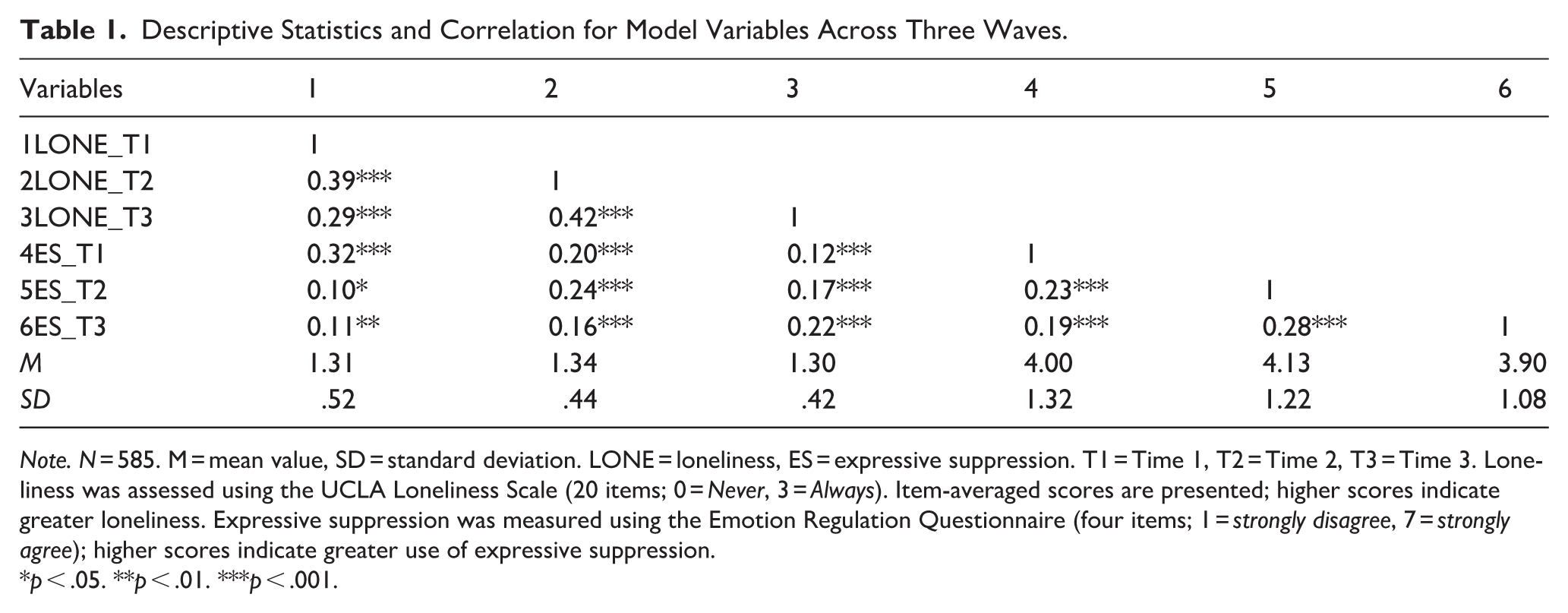
Note. N = 585. M = mean value, SD = standard deviation. LONE = loneliness, ES = expressive suppression. T1 = Time 1, T2 = Time 2, T3 = Time 3. Loneliness was assessed using the UCLA Loneliness Scale (20 items; 0 = Never, 3 = Always). Item-averaged scores are presented; higher scores indicate greater loneliness. Expressive suppression was measured using the Emotion Regulation Questionnaire (four items; 1 = strongly disagree, 7 = strongly agree); higher scores indicate greater use of expressive suppression.
p < .05. **p < .01. ***p < .001.
Measurement Invariance
Building upon the baseline construct validity established in the “Measures” section, we evaluated longitudinal measurement invariance to ensure that the constructs of loneliness and expressive suppression were measured consistently across waves. Rather than relying on independent single-wave assessments, we established a comprehensive longitudinal measurement model that simultaneously incorporated indicators from T1, T2, and T3 into a single-factor structure for each construct. In this baseline configural invariance model (CIM), we allowed the residuals of identical items to correlate across time points to account for longitudinal dependencies. This longitudinal specification ensures that the observed stability is not inflated by item-specific variance. The results of the measurement invariance tests are presented in Table 2. The configural, metric (weak), and scalar (strong) invariance models for both the Loneliness Scale and the Expressive Suppression Scale demonstrated acceptable model fit. Although the chi-square difference tests for model comparisons were significant—a common occurrence in large samples—the changes in more robust fit indices supported the establishment of strong invariance for both scales. Specifically, in the comparison from weak to strong invariance, the ΔCFI for the Loneliness Scale was 0.005, and for the Expressive Suppression Scale, it was 0.009. Both values were below the critical threshold of 0.01 (Cheung & Rensvold, 2002). These results indicate that the measurement structure and factor loadings remained stable across the three waves of data collection, thus satisfying the prerequisite for conducting latent mean comparisons and subsequent longitudinal cross-lagged analyses.
Model Fit Indices of Measurement Invariance.
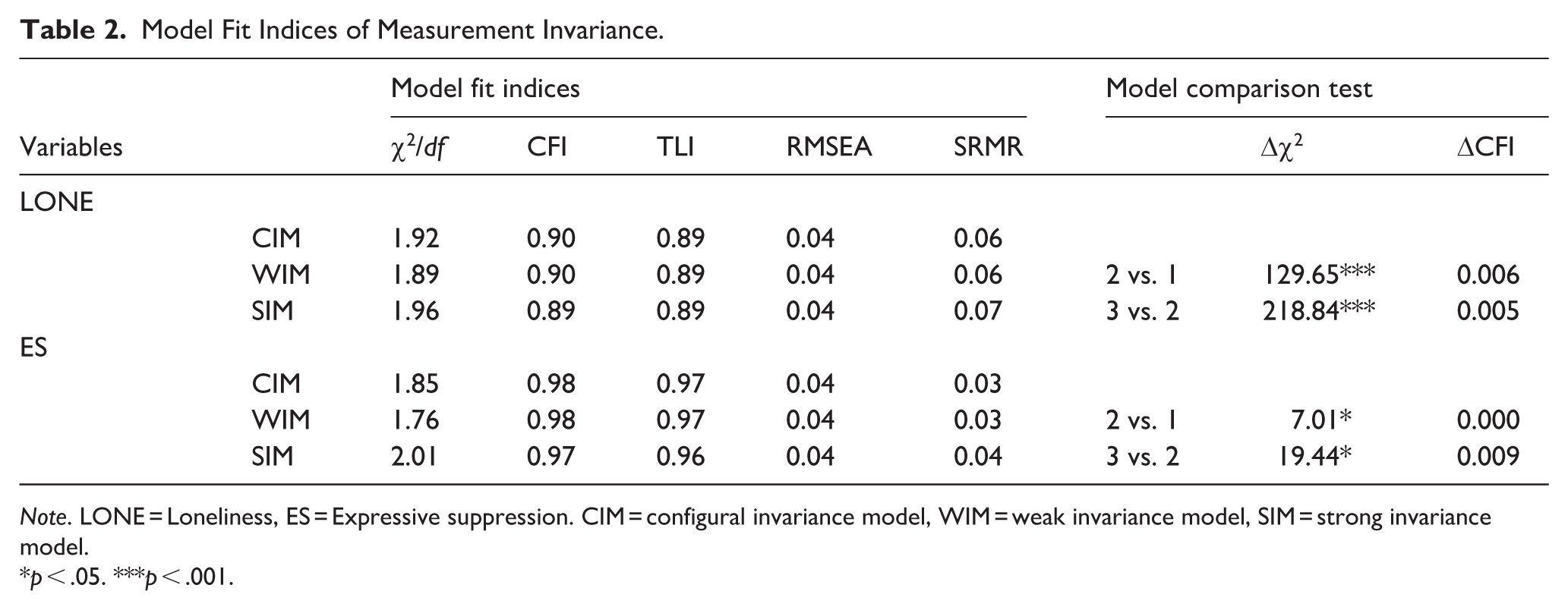
Note. LONE = Loneliness, ES = Expressive suppression. CIM = configural invariance model, WIM = weak invariance model, SIM = strong invariance model.
p < .05. ***p < .001.
Cross-Lagged Panel Model Between Loneliness and Expressive Suppression
To examine the longitudinal relationship between loneliness and expressive suppression, a series of nested cross-lagged panel models was tested. Model 1 served as the baseline model, including only autoregressive paths for both constructs. Model 2 added cross-lagged paths from loneliness to subsequent expressive suppression, while Model 3 incorporated paths from expressive suppression to subsequent loneliness. Model 4, the full cross-lagged model, included bidirectional paths between the constructs. Model comparison results demonstrated that Models 2, 3, and 4 showed significantly better fit than the baseline model. Further comparison revealed that Model 4 yielded the most optimal fit to the data (Table 3) and was therefore selected for the interpretation of longitudinal relationships.
A Comparison of Cross-Lagged Models Between Loneliness and Expressive Suppression.
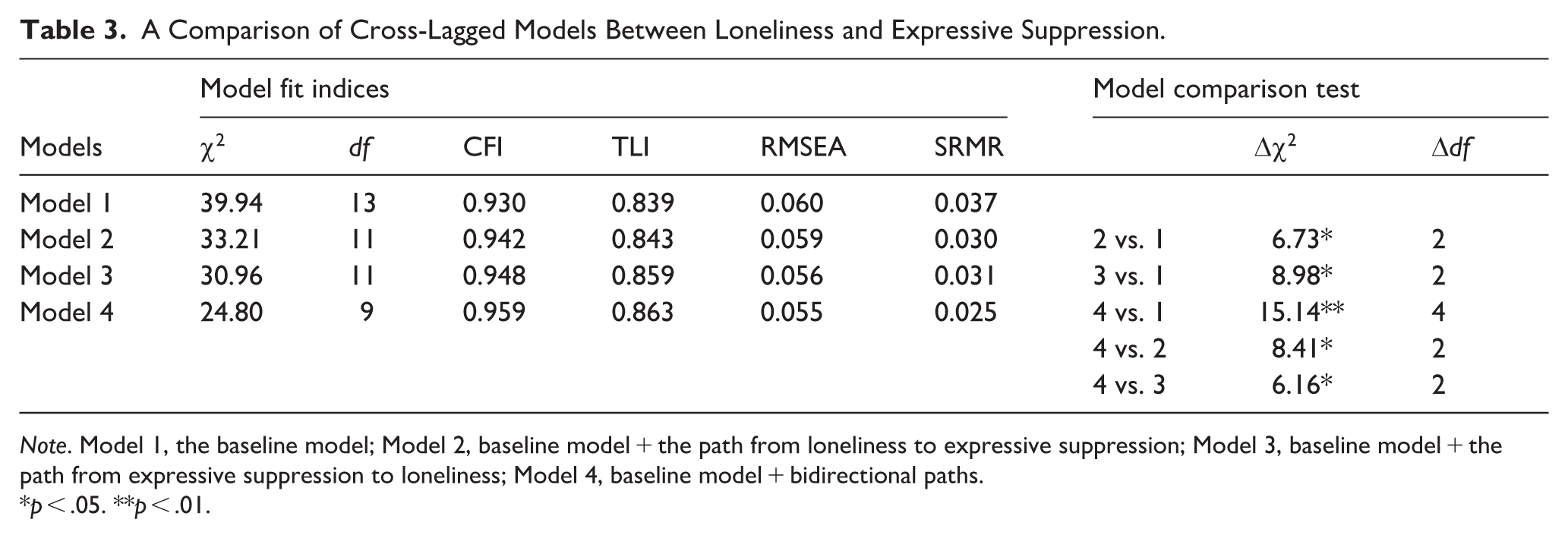
Note. Model 1, the baseline model; Model 2, baseline model + the path from loneliness to expressive suppression; Model 3, baseline model + the path from expressive suppression to loneliness; Model 4, baseline model + bidirectional paths.
p < .05. **p < .01.
A cross-lagged panel model was constructed to systematically examine the longitudinal relationship between loneliness and expressive suppression. The autoregressive path analyses revealed substantial temporal stability for both variables across measurement waves (loneliness: βT1–T2 = .31, p < .001, 95% CI [0.242, 0.380]; βT2–T3 = .38, p < .001, 95% CI [0.303, 0.449]; expressive suppression: βT1–T2 = .21, p < .001, 95% CI [0.132, 0.284]; βT2–T3 = .22, p < .001, 95% CI [0.153, 0.295]). After controlling for the autoregressive effects and synchronous correlations, the model demonstrated a good fit to the data: χ² (9) = 24.80, CFI = 0.96, SRMR = 0.03. The cross-lagged analyses revealed a sequential reciprocal process between loneliness and expressive suppression over the one-year period (Figure 1). Specifically, expressive suppression at T1 significantly predicted subsequent loneliness at T2 (β = .03, p = .024, 95% CI [0.005, 0.055]). Subsequently, loneliness at T2 significantly predicted an increase in expressive suppression at T3 (β = .24, p = .017, 95% CI [0.043, 0.439]). While simultaneous mutual effects were not observed within a single 6-month interval, this temporal chain suggests a dynamic, multi-stage interplay where the two constructs reinforce each other incrementally over time.
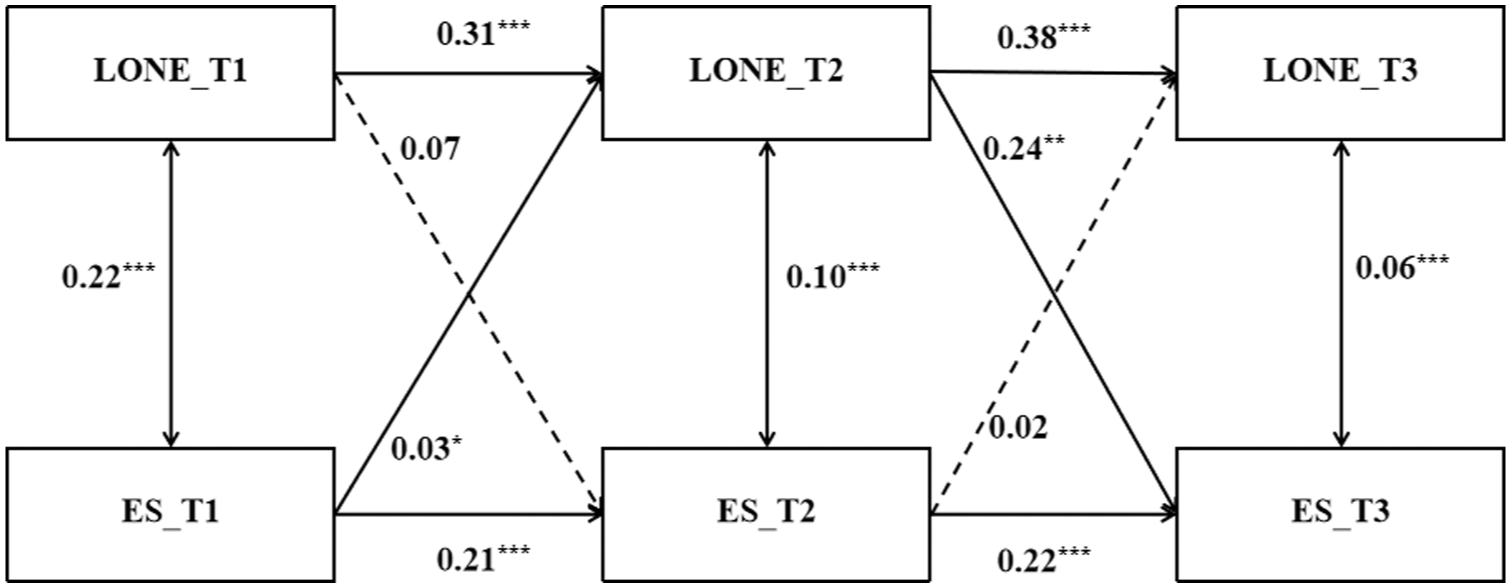
The cross-lagged panel models between loneliness and expressive suppression.
Sensitivity Analysis for Attrition Effects
To evaluate the potential impact of attrition on study findings, a sensitivity analysis was conducted by comparing path coefficients between the Full Information Maximum Likelihood model (N = 855, including all available data) and the listwise deletion model (N = 585, complete cases only). The results demonstrated remarkable consistency between the two models, with all autoregressive and cross-lagged path coefficients showing minimal differences (all < 5%). Specifically, the critical cross-lagged paths exhibited nearly identical estimates: for the path from loneliness T2 to expressive suppression T3, β = .242 (p = .017) in the FIML model versus β = .241 (p = .017) in the listwise deletion model; for the path from expressive suppression T1 to loneliness T2, β = .029 (p = .009) in the FIML model versus β = .030 (p = .024) in the listwise deletion model.
This pattern of results indicates that the FIML estimation effectively corrected for potential selection bias introduced by attrition. The robustness of findings across different missing data handling approaches strengthens confidence in the study conclusions regarding the bidirectional relationship between loneliness and expressive suppression (Graham, 2009).
Discussion
This 1-year longitudinal study, incorporating three waves of data collection and cross-lagged panel modeling, investigated the dynamic relationship between loneliness and expressive suppression. The results indicated that loneliness and expressive suppression were significantly positively correlated at all three time points, with both constructs demonstrating significant temporal stability. This finding aligns with existing cross-sectional research (Hamid & Dasht Bozorgi, 2025; Van Winkel et al., 2017), suggesting that individuals with higher levels of loneliness are more inclined to employ maladaptive emotion regulation strategies such as expressive suppression (Du et al., 2024b; Gross & John, 2003). From a theoretical perspective, these concurrent correlations support Cognitive Discrepancy Theory (Peplau & Perlman, 1982), which posits that loneliness stems from a perceived gap between actual and desired social relationships. This perceived discrepancy fosters negative attributions and social avoidance, thereby reinforcing the use of expressive suppression and initiating a self-perpetuating cycle (Chervonsky & Hunt, 2017; Qualter et al., 2015; Schlechter et al., 2022; Weidman & Kross, 2021). This association appears particularly pronounced among rural adolescents, potentially attributable to limited social support networks and cultural norms emphasizing emotional restraint. These contextual factors may amplify negative interpretations of social setbacks within this population (Cao et al., 2025; Y. Zhang & Wang, 2024). In the unique socio-cultural landscape of rural China, this association is likely deepened by the intersection of family structural changes and traditional values. The prevalence of parental migration often disrupts the primary emotional support system, leaving adolescents more vulnerable to the cognitive discrepancies of loneliness (He & Hui, 2017). Simultaneously, the cultural emphasis on “Yin-ren” (forbearance) and collective harmony frames emotional restraint not merely as a habit, but as a socially adaptive “shield” to avoid interpersonal friction, thereby solidifying the concurrent link between loneliness and suppression (Du et al., 2024b; Wei et al., 2013).
The cross-lagged analyses further elucidated the temporal sequence between these constructs: Loneliness at T2 significantly predicted expressive suppression at T3, whereas loneliness at T1 did not significantly predict expressive suppression at T2. This pattern suggests that the predictive effect of loneliness on expressive suppression demonstrates delayed and cumulative characteristics. According to the evolutionary model of loneliness proposed by Cacioppo and Hawkley (2009), short-term loneliness may only trigger temporary emotional vigilance. However, when loneliness persists into the medium term (T2), it enhances expectations of social rejection and threat vigilance, consequently promoting the development of defensive strategies such as expressive suppression (Gross, 2015). This delayed effect is consistent with the longitudinal findings of Vanhalst et al. (2013), who demonstrated that the impact of loneliness on maladaptive behaviors often emerges gradually over time through cognitive mediation. Within the rural context, this mechanism may be particularly amplified: economic disadvantages and attachment insecurity resulting from left-behind experiences (Demirtaş et al., 2025) exacerbate cognitive biases, leading adolescents to gradually develop beliefs that “emotional expression is ineffective and risky,” thereby reinforcing expressive suppression at later stages (Chen et al., 2025).
Beyond evolutionary and economic factors, this delayed pathway may be deeply rooted in the socio-cultural fabric of rural China, specifically the intertwined concepts of “face” (Mianzi) and emotional restraint. In rural communities, where social networks are dense and interpersonal reputations are highly valued, adolescents are socialized to uphold “face” by maintaining an image of self-reliance and emotional stability. When loneliness begins to persist (T2), the perceived risk of disclosing this vulnerability increases; expressing distress might not only invite social rejection but also result in a “loss of face” for the individual and their family. Consequently, expressive suppression serves as a strategic safeguard to preserve social standing and interpersonal harmony. The delay observed (T2 to T3) reflects the time required for chronic loneliness to shift from a manageable internal state to a perceived threat to one’s social ‘face,’ ultimately mandating more rigid emotional concealment as a protective response. This transition suggests that the shift from internal distress to defensive regulation is not immediate, but rather represents a cumulative consolidation of social-cognitive schemas regarding interpersonal risk. Neuroimaging evidence supports this view, suggesting that hyperactivation in brain regions such as the amygdala among highly lonely individuals may undergo delayed translation into behavioral inhibition (Lieberz et al., 2021). Crucially, this temporal lag suggests that loneliness acts as a “primary engine” for subsequent maladaptive regulation; as the internal distress of loneliness persists, it fundamentally reshapes the individual’s social-cognitive framework, prioritizing emotional safety through suppression over the potential risks of expressive social signaling. These findings highlight the importance of interventions targeting early to mid-stage loneliness, such as cognitive restructuring training, which could effectively prevent the consolidation of expressive suppression patterns and promote socioemotional development in adolescents.
Furthermore, expressive suppression at T1 demonstrated a significant yet modest prediction of loneliness at T2, while its predictive effect from T2 to T3 was not statistically significant, indicating a diminishing influence of this pathway over time. According to Gross’s (2015) Process Model of Emotion Regulation, as a response-focused strategy, expressive suppression may initially impair social connections by restricting emotional displays, thereby contributing to slight increases in loneliness in the short term. However, its long-term impact appears to operate indirectly through mediating variables such as reduced social support rather than maintaining direct effects (Cole & Maxwell, 2003; Srivastava et al., 2009). This diminishing pattern aligns with Social Signaling Theory (Keltner & Haidt, 1999), which posits that initial suppression disrupts emotional communication and reduces social support acquisition, while over time, other contextual factors such as academic pressure or changing peer relationships may become more dominant in shaping loneliness development (X. Zhang & Dong, 2022). Among rural adolescents, cultural emphasis on collective harmony may reinforce initial suppression, though environmental transitions such as graduation may attenuate its sustained impact (Chai et al., 2019). These findings suggest that intervention efforts should focus on addressing the immediate negative consequences of expressive suppression through enhanced emotional expression skills, potentially implemented through school-based psychological group interventions, to prevent its contribution to escalating loneliness.
In summary, the relationship between loneliness and expressive suppression in rural adolescents is characterized by a sequential, asymmetric reciprocal dynamic rather than a simple concurrent association. Our data reveals that this “vicious cycle” unfolds in distinct stages: an initial phase where emotional restraint (T1) gradually erodes social connections (leading to T2 loneliness), followed by a second phase where this established isolation (T2) solidifies into a more rigid defensive strategy (T3 suppression). Notably, the predictive effect of loneliness on subsequent suppression was found to be more robust than the reverse path, underscoring that for rural adolescents, internal psychological distress acts as the “primary engine”—a catalyst that reshapes the social-cognitive framework and compels them to prioritize emotional safety through suppression over expressive social signaling. By framing this as a developmental cascade (Masten & Cicchetti, 2010), we demonstrate that the reinforcement between these constructs is cumulative, with loneliness eventually becoming the dominant force sustaining chronic isolation. This study integrates Cognitive Discrepancy Theory (Peplau & Perlman, 1982), the Process Model of Emotion Regulation (Gross, 2015), and evolutionary perspectives (Baumeister & Leary, 1995) to illuminate the dynamic process through which rural adolescents construct psychological “walls”. In an environment characterized by limited emotional buffers and high expectations for “Yin-ren” (forbearance), persistent loneliness fosters negative cognitive biases that lead to “emotional opacity”, inadvertently severing the social signals needed to recruit support (Cacioppo & Hawkley, 2009; Weidman & Kross, 2021). From a practical perspective, these findings provide temporal guidance for interventions: priority should be given to addressing mid-term loneliness through cognitive-behavioral approaches. Specifically, interventions could employ “social re-appraisal” exercises, where adolescents are guided to identify and challenge catastrophic expectations (e.g., “If I speak up, others will mock me”) in low-stakes social interactions (Hofmann, 2007; Masi et al., 2011). Furthermore, practitioners could implement “safety-first” expressive spaces, such as using anonymous “emotional sharing boxes” followed by facilitated small-group discussions. This structured approach reduces the perceived “loss of face” and social risk of disclosure (Qualter et al., 2015), helping to disrupt the sequential vicious cycle of loneliness and suppression before it becomes a stable trait. By providing these tangible tools to deconstruct cognitive biases, educators can contribute meaningfully to mental health promotion within rural revitalization initiatives.
Several limitations warrant consideration. First, despite using Full Information Maximum Likelihood (FIML) estimation and sensitivity analyses to ensure robustness, the study experienced substantial and systematic non-random attrition. Notably, all ninth-grade students—who reported significantly higher baseline loneliness compared to the retained sample—were lost by T3 due to graduation. This systematic attrition suggests that our findings may be conservative; had these high-loneliness participants remained, the predictive effect of loneliness on expressive suppression might have been even more robust. This implies that the observed developmental cascade from loneliness to suppression may be underestimated in our current model due to the restriction of range in the most vulnerable segment of the sample. Future studies should incorporate online or post-graduation follow-up assessments to mitigate such bias and capture the experiences of the most vulnerable individuals. Second, the reliance on self-report measures introduces potential recall bias; future studies could benefit from incorporating multi-method assessments, including behavioral observations, peer reports, or physiological measures. Third, the exclusive focus on rural adolescents aged 10 to 16 from Western China limits generalizability; subsequent research should examine more diverse populations (e.g., urban comparison groups, different developmental stages) and explore potential moderators (e.g., gender, socioeconomic status) and mediators (e.g., social self-efficacy). Fourth, while the current study utilized wave-based analyses to maintain consistent measurement intervals and statistical power, this approach may obscure age-specific developmental nuances. Although grade-level cohorts were prioritized to ensure ecological validity within the rural Chinese school system, the sensitivity to social rejection and the subsequent reliance on expressive suppression may peak during specific transitions in early adolescence. While our findings clarify the sequential mechanism across the sampled age range, future research employing age-centered alignment or accelerated longitudinal designs would be valuable to identify specific “sensitive periods” where these transactional cycles are most acute. Finally, the 6-month intervals between assessments may have obscured short-term fluctuations; more intensive longitudinal designs (e.g., monthly assessments) could better capture dynamic processes. Furthermore, while the traditional CLPM utilized in this study effectively captures developmental cascades, it does not explicitly partition between-person stability from within-person fluctuations. We recognize that the Random Intercept Cross-Lagged Panel Model (RI-CLPM) is a powerful tool for disentangling these effects. Future research with larger samples and more measurement waves should employ RI-CLPM to determine whether the observed associations are primarily driven by stable individual traits or dynamic intra-individual changes over time.
Footnotes
Acknowledgements
The authors express their sincere gratitude to the participating adolescents, their guardians, and the relevant schools for their support and cooperation throughout the data collection process. The authors also appreciate the valuable assistance from the research team members in data sorting and analysis. In addition, the authors thank the reviewers and editors for their constructive comments on the article.

Ethical Considerations
This study involving human participants was reviewed and approved by the Institutional Ethical Committee for Psychological Research of China Three Gorges University (IRB Approval No.: H2401). All procedures performed in studies involving human participants were in accordance with the ethical standards of the institutional research committee and with the 1964 Helsinki Declaration and its later amendments or comparable ethical standards.
Consent to Participate
Patient consent was not applicable to this study as no patients were involved. Written informed consent was obtained from all individual participants included in the study and their legal guardians/next of kin. Participants and their guardians were fully informed of the study purpose, procedures, potential risks, and the right to withdraw at any time without adverse consequences.
Author Contributions
All authors have read and approved the content of the final published version of the article, agreed to its submission to the International Journal of Behavioral Development, and jointly assume responsibility for the authenticity of research data, the scientificity of methods and the reliability of conclusions.
Funding
The authors disclosed receipt of the following financial support for the research, authorship, and/or publication of this article: This work was funded by the Hubei Provincial Education Science Planning Project in 2024 (Grant No. 2024GA036). No other specific funding was received for this research, authorship, and/or publication of this article.
Declaration of Conflicting Interests
The authors declared no potential conflicts of interest with respect to the research, authorship, and/or publication of this article.
Data Availability Statement
The data that support the findings of this study are available on request from the corresponding author. The data are not publicly available due to privacy or ethical restrictions related to the participating adolescents.