






Abstract
Across cultures, how parents manage children’s problem behaviors shapes the environment for children’s development. Our study addressed the existing lack of cross-cultural comparison on parents’ strategies for addressing young children’s externalizing and internalizing-type behaviors. A total of 104 parents of preschool-aged children from the United States (n = 50, Mage = 36.24) and China (n = 54, Mage = 35.68) participated in a semi-structured interview. Using a series of hypothetical vignettes depicting externalizing and internalizing behaviors in young children, we elicited open-ended responses regarding how parents would enact management in the face of children’s common problem behaviors. Parents’ responses were coded and composited into higher-order categories of parent management strategies. Across both sites, parents endorsed using non-aggressive power assertions most frequently in response to externalizing behaviors, while endorsing providing aid and support most frequently in response to internalizing behaviors. Our findings indicated main site effects on some but not all management strategies, with cross-site differences being more salient for externalizing-type behaviors. These findings enhance our understanding of cultural variations in the customary practices that may be used to manage different types of disruptive and distress-related behaviors in young children.
Introduction
Parental management strategies, commonly defined as deliberate approaches used to guide and influence children’s behaviors, have shown significant links with child outcomes across multiple domains and developmental stages (Lansford, 2022; Sameroff, 2009; Xu et al., 2020). To understand how these specific parenting practices are embedded within a cultural context, the developmental niche framework (Harkness & Super, 1996; Super & Harkness, 1986) provides a useful lens. This framework conceptualizes the child’s developmental experience as mediated by three interrelated subsystems: the physical and social settings of daily life, the culturally regulated customs and practices of child care, and the psychology of the caretaker. Among these, the “customs and practices” component constitutes the enacted behavioral scripts of daily life and socialization. Understanding these is vital as they represent the primary functional mechanism through which cultural values are directly transmitted to the child (Super & Harkness, 1986). The parental management strategies examined in this study are thus conceptualized as a component of the “customs and practices” subsystem.
Relying on vignette-based parent interviews, previous work has identified how significant cross-cultural variations may emerge within parents’ organization and understanding of daily customs and practices, such as family and child routines (Harkness et al., 2011). However, few studies have compared how parents report managing children’s problem behaviors across cultures, especially using methods that allow parents to describe their own, unscripted responses to such behaviors. This represents a significant gap, as understanding these management strategies is essential for developing culturally sensitive interventions that may support more effective parenting practices (X. Chen, 2020; Harkness & Super, 2021). Furthermore, parents’ approaches to managing children’s behaviors may further vary depending on the specific type of problem behaviors, ranging from aggressive/disruptive to anxious/shy behaviors (Lansford, Godwin, Bornstein, et al., 2018). Finally, little work has examined these cross-cultural variations during early childhood, a period of rapid socialization bearing implications for early prevention of maladaptive child outcomes (Olson et al., 2019). Our study addresses these gaps through examining parents’ reports of customary management strategies for externalizing and internalizing behaviors in young children growing up in China and the United States.
Cross-Cultural Variations in Parenting Strategies
Substantial evidence points to the role of parents in influencing children’s outcomes (Bornstein et al., 2018), motivating continuous research efforts within this area. However, reflecting the overarching lack of diversity in global developmental science, most of this work has historically focused on narrow subsets of child populations in the United States, Canada, and Western Europe (Arnett, 2009; Nielsen et al., 2017). To mitigate this potential knowledge bias, recent years have seen an increasing emphasis on understanding parenting practices both within and between different cultural contexts (Lansford, 2022). In particular, cross-cultural work has increased our understanding of global variations in parents’ cognitions and behaviors. For instance, focusing on parents’ attributions regarding caregiving quality, a study across nine countries indicated differences in relation to the importance mothers placed on their own capacities and child characteristics as reasons for parenting successes and failures (Bornstein et al., 2011). Other multi-site studies have further examined cultural correlates of parenting to understand the diverse mechanisms underlying parenting practices (Lansford, Godwin, Al-Hassan, et al., 2018; Lansford, Godwin, Bornstein, et al., 2018).
More relevant to this study are variations in the cultural models that shape specific parenting approaches across sites. For example, Senese and colleagues (2012) found that American mothers self-reported more frequent engagement in social and didactic behaviors than did Italian mothers. These patterns align with a proactive parenting model common in the United States, which emphasizes early investment in children’s sense of well-being and educational attainment (Bornstein et al., 2008). In contrast, Italian mothers tend to view child development as “naturally unfolding,” a perspective that typically results in less adult intervention (New, 1989). Another study showed that Japanese mothers used more anticipatory and directive language during mother–child interactions compared with their European American counterparts (Bornstein et al., 2011). This difference in communicative customs may reflect diverging cultural priorities, with the aim of fostering interdependence underlying Japanese mothers’ behaviors, whereas European American mothers were contingently responsive to their infants with the goal of promoting individual agency. Differences in verbal and nonverbal strategies and play styles have also been observed between German and Indian middle-class families (Keller et al., 2010). The authors proposed that these differences reflected a focus on the cultural model of independence in Germany versus a model of autonomous relatedness in India. Our study extends this line of inquiry by examining how these diverse cultural models manifest as specific management strategies for children’s problem behaviors.
In doing so, it is important to use methods that can capture parents’ ideas about culturally meaningful customs and practices. Such nuances are often not adequately captured by closed-ended methods (e.g., questionnaires). Super and Harkness (1999) suggest that they are better elicited through observations or in-depth semi-structured interviews. Furthermore, existing work on parenting strategies has largely relied on parent-report measures translated from tools originally developed in Western settings, which may consequently lack cultural validity (Olson et al., 2019). This study thus employs a semi-structured interview method that allows parents to provide unscripted responses regarding how they would manage children’s problem behaviors, thereby moving beyond reliance on pre-conceived categorizations of parenting behaviors. This method has been proposed as an effective way of capturing parents’ endorsements of customs and practices depicted in the developmental niche framework (Super & Harkness, 1999).
Parents’ Strategies for Managing Children’s Internalizing and Externalizing Behaviors
Internalizing and externalizing behaviors represent the two major forms of childhood adjustment problems, demonstrating negative predictive effects on children’s social, emotional, and cognitive development (Masten et al., 2005). Externalizing problems often manifest as aggressive, disruptive, or antisocial behaviors, whereas internalizing problems are less overt and encompass anxiety, depression, social withdrawal, and somatic complaints (Achenbach et al., 2016). Our dual focus on both children’s externalizing and internalizing behaviors was motivated by several considerations. First, extensive evidence points to the distinct yet highly intercorrelated nature of these behavior types in terms of their development and presentation (Gilliom & Shaw, 2004). Second, the differential features of such behaviors may evoke differential responses from parents. Previous work has suggested that children’s resistant and negativistic behaviors tend to elicit parents’ negative emotional reactions and coercive discipline (McKee et al., 2008; Olson et al., 2000). Finally, parents’ beliefs about the characteristics of externalizing or internalizing behaviors are influenced by cultural scripts, which subsequently affect their management strategies (Ip et al., 2024). For instance, aligning with the commonly held view by Japanese parents that aggressive-disruptive behaviors reflected age-normative developmental immaturity, such behaviors in preschoolers were met with tolerance and gentle redirection (Olson et al., 2001). Evidence has also indicated cultural variation in parents’ perceptions of children’s shy and withdrawn behaviors. Chinese parents have reported viewing certain forms of shyness, such as subdued behavior, as desirable characteristics, with such characteristics being associated with group compliance and social competence in rural villages (X. Chen et al., 2009). Conversely, parents from Western societies tend to deem such behaviors as maladaptive for children’s positive social experiences (Coplan & Armer, 2007).
By incorporating both externalizing and internalizing behaviors in our study, we may also capture variations within cultures across behavior types, in addition to variations between cultures. Parental responses to either externalizing or internalizing behaviors may depend on culturally informed perceptions of the developmental consequences of each type of behavior. One study found that Turkish mothers of preschool-aged children endorsed attributions for children’s aggressive behaviors that were transitory, social-contextual, and intentional, while attributing socially withdrawn behaviors to internal and persistent factors such as children’s temperament (Bayram Özdemir et al., 2015). Early work has also shown that parents employ different management strategies depending on the type of behavior displayed by their young children. European American parents of preschoolers employed more directive and high-powered strategies, such as forcing appropriate behavior or threat of punishment, to address children’s aggression, but lower-powered strategies, such as gentle persuasion or seeking information, for managing children’s socially withdrawn behaviors (Mills & Rubin, 1990).
Despite increasing recognition of the importance of cross-cultural comparisons in understanding how parents manage different types of children’s problem behaviors, studies utilizing open-ended methods have been limited either to single-site studies (B.-B. Chen & Volling, 2023) or to work focusing on just one aspect of such behaviors (Davidov et al., 2022). A notable exception is a study by Cheah and Rubin (2004) that examined European American and mainland Chinese mothers’ socialization strategies in response to four hypothetical vignettes depicting children’s aggression and withdrawal. The authors reported that both European American and mainland Chinese mothers endorsed more directive strategies, such as the use of threats or forcing of appropriate behaviors, in response to aggression among preschoolers, compared with their responses to socially withdrawn behaviors. However, this study, conducted over two decades ago, may not accurately represent contemporary China, which has undergone substantial societal transformations (Bian et al., 2022). Furthermore, the authors focused solely on aggression and withdrawal behaviors, representing a limited subset of children’s broader externalizing and internalizing profiles. To our knowledge, no recent studies have employed open-ended methods to compare parental strategies for a comprehensive range of both externalizing and internalizing behaviors across two distinct cultural contexts.
Cross-Cultural Differences in Parents’ Management Strategies in the United States and China
Evidence points to fundamental differences in cultural values relating to child-rearing across US and Chinese societies (X. Chen, 2020; Tardif et al., 2009). Accordingly, studies have indicated significant variation in parenting across these two countries, encompassing a range of child-rearing areas such as academic socialization, endorsement of harsh discipline, maternal involvement, and displays of warmth or acceptance (Capobianco & Best, 2020; Olson et al., 2011; Wu et al., 2002). Existing literature on Chinese cultural models of parenting often highlights the emphasis on high parental engagement and control in ensuring children’s positive outcomes, reflected in the Chinese notion of guanjiao (to govern/to teach; Chen-Bouck et al., 2017). Meanwhile, studies with North American parents point to a focus on autonomy-building and scaffolding, in line with Western emphasis on independence and autonomy (Miller et al., 2002). Supporting these perspectives, a recent study by Ip and colleagues (2024) reported salient cultural differences in US and Chinese parents’ attributions of child misbehaviors, a key cognitive element underlying parenting behaviors. According to causal models of parenting pathways (Bornstein et al., 2018), it follows that enacted management strategies would vary in accordance with these diverging cultural beliefs relating to children’s misbehavior. However, little work has elucidated cross-cultural differences in parents’ reports of their management strategies, particularly with a focus on both externalizing and internalizing behaviors. Given that previous work has shown promise of applying identified cultural models about managing children’s behaviors to intervention studies (e.g., establishing a reliable strategy for reducing health risks and developmental delays in Bangladesh; Harkness & Super, 2021), examining parents’ reports on customary practices regarding behavioral management provides a vital foundation for developing culturally sensitive interventions.
Furthermore, historical changes, including urbanization, globalization, and legislative updates, mean that ideas about parenting practices and child development are no longer static or confined to certain cultures (Lansford, 2022), with such changes shaping the developmental contexts in which a child is raised. For example, the ratification of an initiative against the use of corporal punishment contributed to a decline in the endorsement of this form of parental discipline across multiple countries (Global Partnership to End Violence Against Children, 2021). Similarly, research with urban Chinese parents has indicated increasing overlap with parenting strategies traditionally associated with Western-based values, such as child-centeredness, warmth, and autonomy support, prioritizing children’s prosocial assertiveness rather than traditionally emphasized notions of behavioral constraint (Lu & Chang, 2013). Taken together, it is a timely and valuable endeavor to examine how parents’ reports of their management strategies vary across two distinct cultural sites (i.e., the United States and China), which is the focus of this study.
Present Study
This study was guided by three aims. First, we examined how parents’ reports of their management strategies of children’s problem behaviors may differ between parents in the United States and China. We employed an open-ended interview method that allowed parents to freely describe their own customary strategies in response to a series of hypothetical vignettes depicting common problem behaviors in young children. We expected that Chinese parents would endorse strategies that are more focused on behavioral modification to address children’s problem behaviors overall. In line with studies suggesting that Western parents tend to focus on children’s internal states, such as mental processes (Doan & Wang, 2010; McMahon & Bernier, 2017), we expected that US parents would be more likely to endorse strategies involving reasoning and withdrawal of privileges. Based on previous studies that have indicated more salient cultural differences in relation to children’s externalizing behaviors (Barcala-Delgado et al., 2024), we also expected to identify greater variation in parental strategies across cultures in response to externalizing compared with internalizing behaviors.
Second, we questioned how parents’ beliefs might vary across the two types of problem behavior. We expected that parents would respond more assertively to children’s externalizing behaviors than to internalizing behaviors such as anxiety and dysphoria. While the literature on parents’ responses to children’s internalizing behaviors is relatively scarce, we expected that parents might endorse strategies that focus on offering support for children’s displays of emotional distress.
Our third, exploratory aim was to determine whether parents’ strategies for managing children’s problem behaviors would differ depending on child gender. While child gender has been observed to be a significant factor influencing parents’ approaches toward and management of children’s problem behaviors (Lytton & Romney, 1991; Mills & Rubin, 1990), we know little about culturally regulated customs regarding how parents manage problem behaviors depending on child gender. As such, we did not make any hypotheses about the nature of our findings in relation to this aim.
Method
Participants
China. The Chinese sample consisted of 54 parents (47 mothers and 7 fathers; Mage = 35.68, SD = 2.83) of preschool-aged children (Mage = 5.26, SD = .07; 21 boys) recruited from Shanghai through preschools. Regarding educational attainment, 11% of the parents had an associate’s degree or equivalent, 50.9% had a Bachelor’s degree or equivalent, 32.1% had completed a Master’s degree, and 5.7% held a doctorate or equivalent, consistent with a middle-class demographic among urban parents in Shanghai.
United States. The US sample consisted of 50 parents (43 mothers and 7 fathers; Mage = 36.24, SD = 4.59) of preschool-aged children (Mage = 5.31, SD = .20; 36 boys) recruited from Ann Arbor, Michigan, through advertisements. Four percent of the parents had an associate’s degree or equivalent, 16% had a Bachelor’s degree or equivalent, 56% had completed a Master’s degree, and 24% held a doctorate or equivalent, reflecting a middle-class demographic among parents in the recruitment area.
The interview was conducted with the primary caregiver of the child. Parents based in the United States were interviewed in their homes, and Chinese parents were interviewed either in their homes or at the child’s preschool. Parents from both sites were interviewed in their native language by trained research assistants. Families were compensated for their time and involvement in the study. Ethical approvals were obtained from the institutional review board (IRB) of respective institutions, which were the University of Michigan (IRB number: HUM00095522) and East China Normal University (IRB number: HR158-2020). Informed consent was obtained from all participants in the study.
Materials and Procedure
Parent Interview
A semi-structured interview was used to obtain parents’ strategies for managing child misbehavior. This open-ended format has been especially effective in capturing cultural nuances in parents’ practices (Cheah & Rubin, 2004). The interview protocol was adapted from another study comparing maternal ethnotheories about children’s externalizing behaviors in the United States and Japan and was developed by a cross-national team. Specifically, the protocol used in this study was expanded by an updated cross-national team comprising researchers from the United States and China to include internalizing scenarios. For the newly added internalizing scenarios, the research team, in collaboration with our Chinese team, meticulously reviewed all scenarios to ensure they accurately depicted common challenges faced by parents of young children. These internalizing scenarios also encompassed a broad spectrum of severity. In addition, the externalizing scenarios had been pre-tested with a sample of urban-dwelling Chinese parents of young children who were of similar age to this study’s sample (Ip et al., 2024).
Each session began with parents being briefed on the study, followed by obtaining written consent. Parents provided responses to open-ended questions about the causes of and management strategies for child misbehaviors based on a series of 11 hypothetical vignettes depicting common problem behaviors in young children. Six vignettes involved externalizing behaviors (e.g., aggression toward peers, defiance toward parents, rule-breaking, and disruptive behavior in public), for example, “Suppose your child wants a toy that his or her friend is playing with, but the friend is unwilling to share. Your child then hits the friend and grabs the toy.” The remaining five vignettes depicted children’s internalizing behaviors (e.g., shyness, fear, and depression), for example, “Suppose your child is afraid of many things, and no matter how you reassure him or her, the child remains fearful.” The complete list of vignettes is provided in Appendix A. Parents were told: “Now, I’m going to describe some situations involving young children and their parents. I’d like you to imagine that each situation is happening to you. Then tell me what you might say or do in response.” Parents’ responses were recorded and transcribed verbatim. A second research assistant checked each transcript to ensure accuracy of transcription.
Coding System
The coding system was developed by a multi-national team of researchers of native English and Mandarin speakers, described in a previous peer-reviewed paper (Ip et al., 2024). In this study, two new samples of parents were interviewed using a protocol that was expanded to include internalizing scenarios. US parents’ responses (30%) were analyzed by independent raters, who determined whether the older coding system reliably fit the newer data and suggested additions to the coding system as needed. Next, formal reliability trials were conducted with the expanded system, resulting in high reliability estimates (alphas ranged from .86–.94, M = .89). Chinese protocols used for training were translated from English (see “Coding Procedures” section). Subsequently, the remaining protocols were coded in Mandarin. The final system contained 28 codes, which are listed in Appendix B.
Higher-order categories of parental strategies were then constructed based on theoretical support (Barber et al., 2012; Chao, 1994; Smetana, 2017) and comprehensive discussions between all team members. This resulted in eight categories: (1) teaching and modeling (e.g., training in perspective-taking or empathy, or demonstrating the correct behavior); (2) explaining/negotiating (e.g., providing rationale or explanation behind the rule and encouraging compliance while offering child a choice or an incentive); (3) non-aggressive power assertion (e.g., using directives or administration of aversive consequences such as withdrawal of privileges, social or physical); (4) aggressive power assertion (e.g., use of corporal punishment or threats of corporal punishment; verbal aggression); (5) distancing (e.g., strategic or passive non-involvement with child); (6) aid and support (e.g., demonstrating or communicating support to child); (7) support from others (e.g., seeking support in terms of physical support or advice from social connections such as partners, family members, or professionals); and (8) subordination (e.g., giving in to child demands without recourse). A comprehensive list of definitions of lower-order codes and empirical examples, including actual parents’ quotes, is provided in Appendix B.
Coding Procedures
The senior principal investigator of the project led training for the coding for both the US and Chinese research teams. In the United States, inter-rater reliability was computed on 30% of the sample, which ranged from .86 to .94, X = .88. In China, two research assistants who completed this training and passed the reliability test conducted double coding for all Chinese transcripts. Inter-rater reliability ranged from .66 to 1.00 for each coded strategy, X = .88. The US and Chinese teams and all research assistants involved set up regular meetings to resolve disagreements or uncertainties in coding. For each code, a “1” was coded if the strategy was present, and a “0” if it was not. More than one code could be given to an individual response, as parents often described more than one strategy in their responses to the hypothetical vignettes. For example, if a parent’s response was “I would ask my child, ‘Would you be happy if someone hit you and took your toy?’,” they would be assigned a “1” for both requesting reflection and empathy building, and a “0” for all other strategies. Individual codes were summed across all vignettes to produce a total score representing each parent’s report of a particular strategy. To control for differences in participants’ verbosity, proportion scores were calculated by dividing the parents’ total responses by the number of responses provided for each strategy.
Analysis Plan
Our first aim was to examine whether there were statistically significant differences in parent-reported strategies by site. We conducted a multivariate analysis of covariance (MANCOVA) with parents’ strategies as dependent variables while controlling for child gender and parent education. We also report findings from follow-up univariate analyses of covariance (ANCOVA) to understand the main effect of cultural site on parents’ strategies. Our second aim was to examine how parents’ strategies are influenced by the type of problem behavior based on parents’ responses to the externalizing and internalizing vignettes. We conducted repeated-measures MANCOVA while controlling for child gender and parent education, first using the entire sample, then by site. Finally, to address our third, exploratory aim, we conducted MANCOVAs by site with parents’ strategies as a dependent variable, with child gender as a between-subjects factor. Before running analyses, standardized residuals were saved and examined for normality using the Shapiro–Wilk test. Sphericity was assumed due to two levels of within-subject factors for the repeated-measures ANCOVA analyses. We also conducted Levene’s test for equality to examine homogeneity of variance.
Based on prior literature on associations between child gender and parenting practices, we controlled for child gender in analyses for the first two aims. We further included parent education as a covariate for several reasons. Parent education has been closely linked to parenting practices, with variation in education level conferring effects on child outcomes across a range of domains through parenting behaviors, with higher levels of parent educational attainment being linked with increased positive and nurturing parenting behaviors (Davis-Kean et al., 2019; S. Li et al., 2020). More recently, Barnes and colleagues (2025) reported that parent education was associated with parent-driven home learning environment aspects, over and above other factors such as the income-to-needs ratio. As our first two aims were focused on how parents’ strategies differed both across cultures and by behavior type, we controlled for child gender and parent education in the analyses.
Results
Aim 1: Do Parents’ Strategies for Managing Externalizing and Internalizing Behaviors Differ Between Parents in the United States and China?
Overall, the strategies most frequently endorsed by American parents were non-aggressive power assertions, M = .08, SD = .02. In contrast, Chinese parents most frequently mentioned providing aid and support, M = .08, SD = .04. Notably, there was a striking similarity across cultures in relation to the strategy that was endorsed least: both Chinese and US parents endorsed aggressive power assertions least frequently to address children’s problem behaviors. Means and standard deviations for parental strategies by cultural group and type of behavior are presented in Table 1.
Cross-Cultural Comparisons of Parental Strategies for Child Internalizing and Externalizing Behavior.
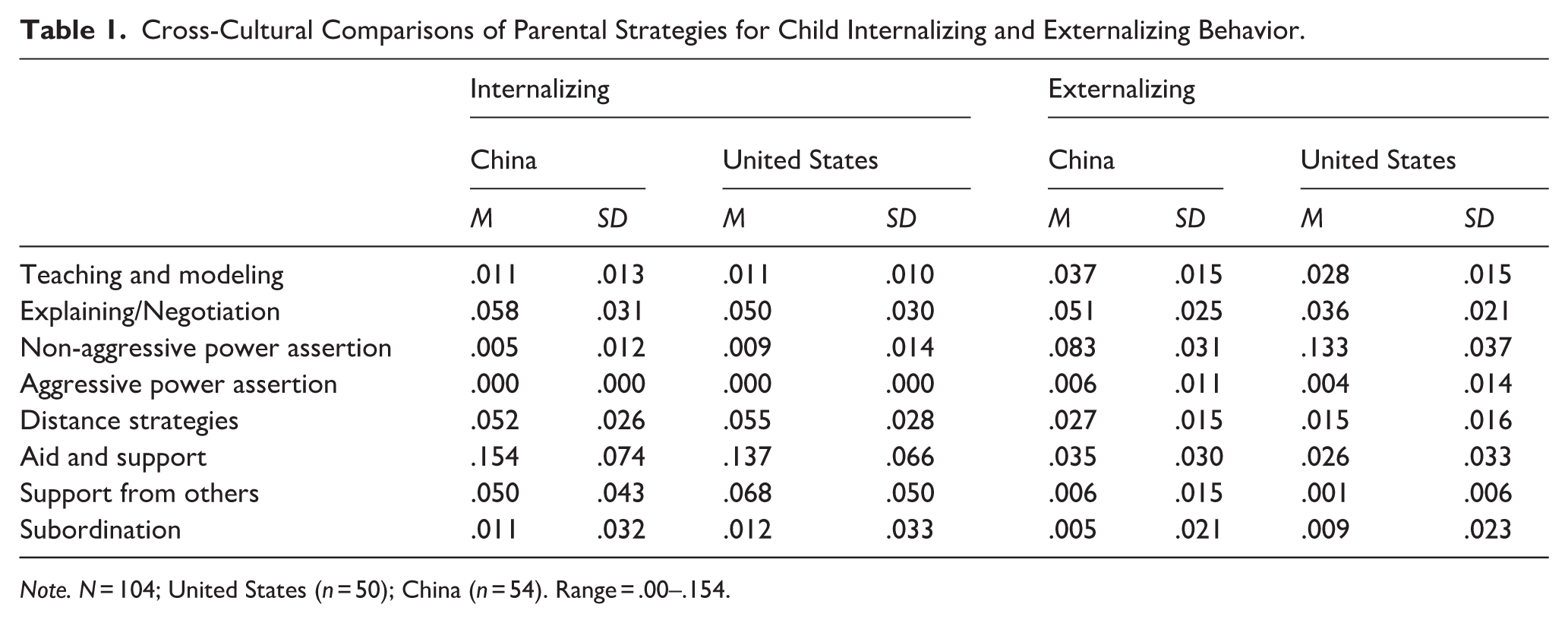
Note. N = 104; United States (n = 50); China (n = 54). Range = .00–.154.
MANCOVA while controlling for child gender and parent education indicated a significant main effect of culture on parents’ strategies for children’s behaviors, Wilks’ λ = .60, F(15, 85) = 3.81, p < .001, partial η2 = .40. Follow-up univariate tests indicated there was a significant main effect of culture on parents’ endorsed strategies only for children’s externalizing behaviors (see Figures 1 and 2). The strategies were teaching and modeling, F(1, 99) = 10.39; p < .01, partial η2 = .08, explaining and negotiating, F(1, 99) = 8.23; p < .001, partial η2 = .31, distancing strategies, F(1, 99) = 7.20; p < .01, partial η2 = .07, and non-aggressive power assertion, F(1, 99) = 45.02; p < .001, partial η2 = .31, and aggressive power assertions. Due to non-normality of the data for aggressive power assertions, a Kruskal–Wallis test was used, which is a non-parametric alternative to the one-way analysis of variance (ANOVA) test, H(1) = 4.56, p = .03.
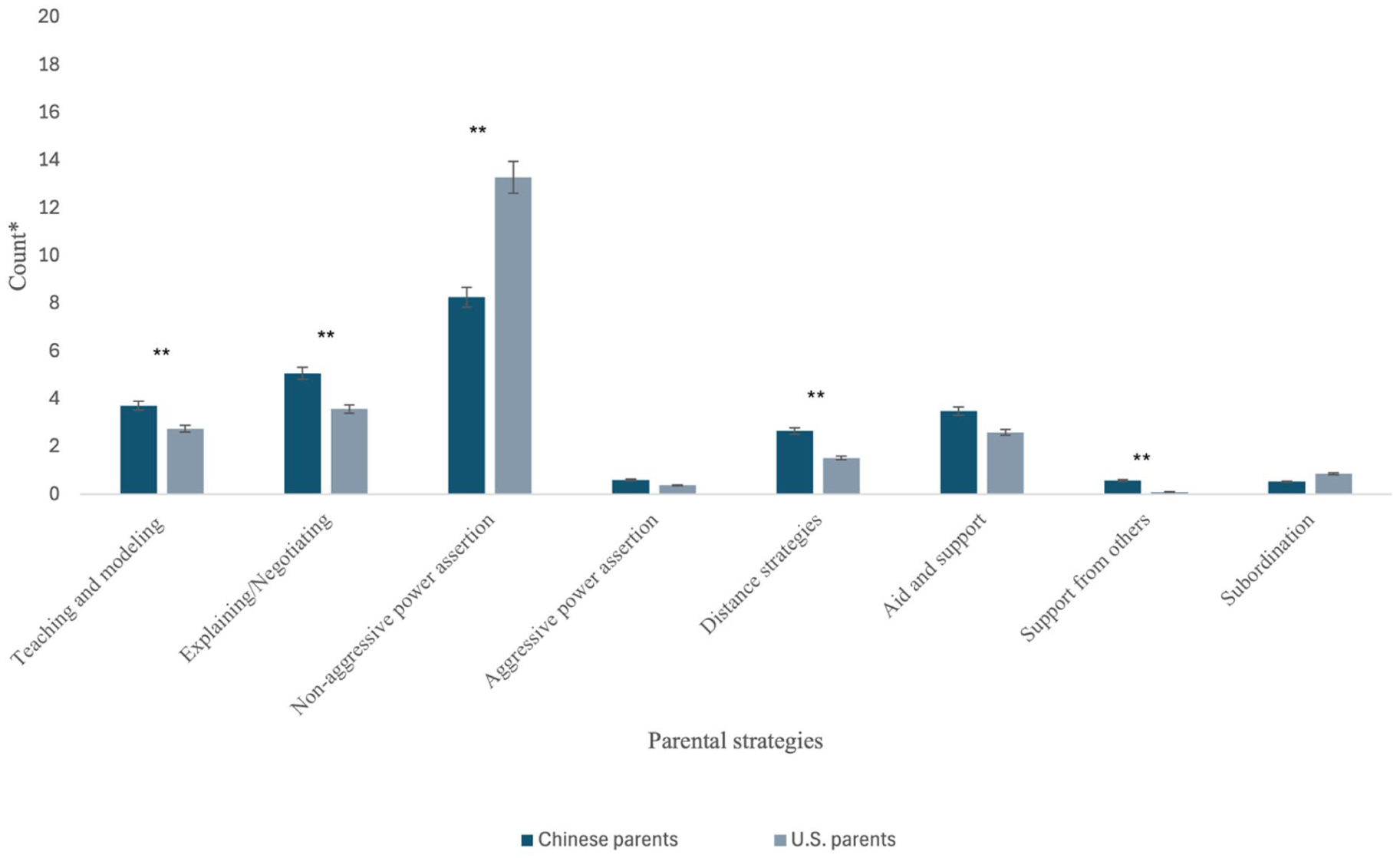
Parental strategies across cultures for externalizing behaviors.
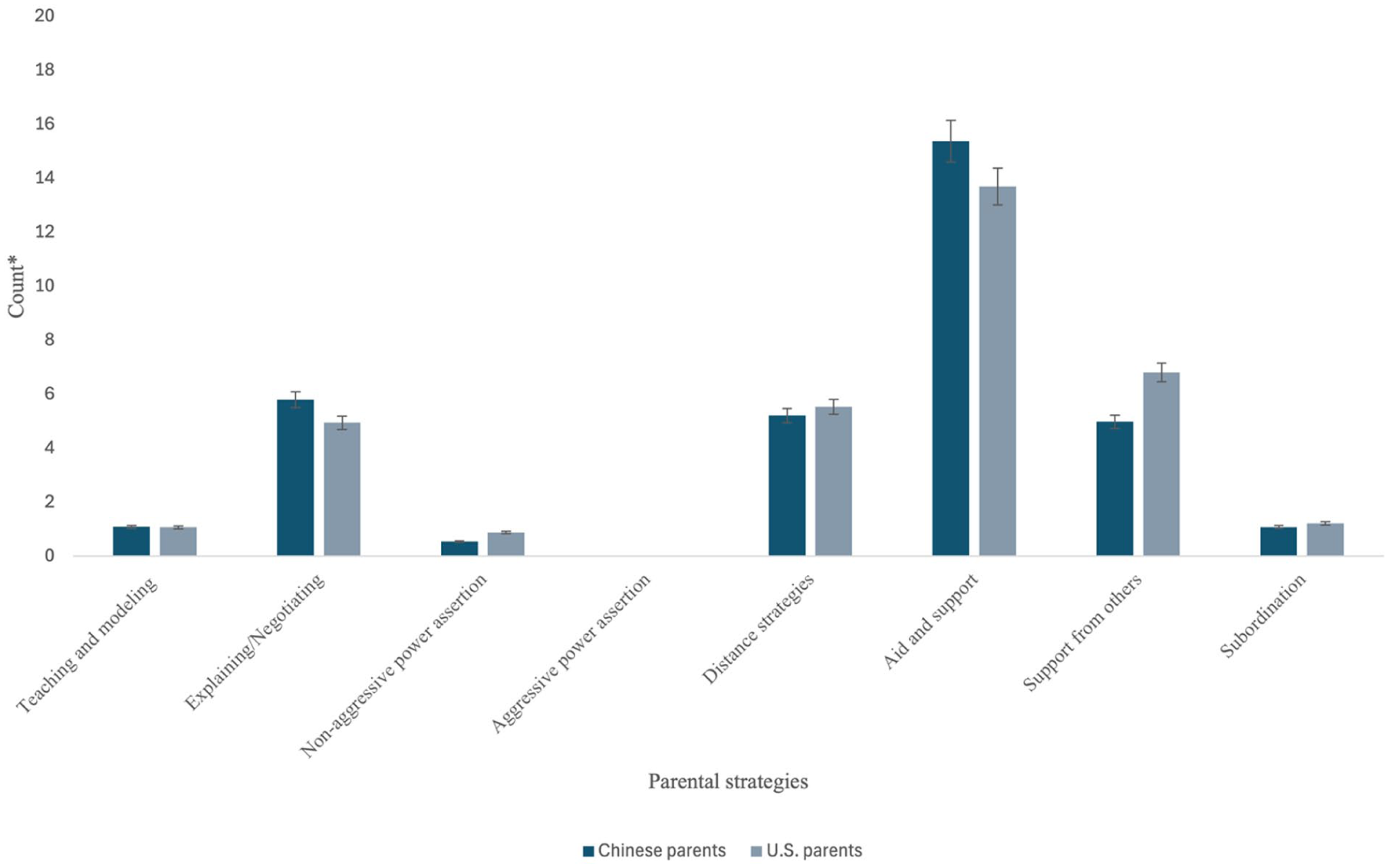
Parental strategies across cultures for internalizing behaviors.
Post hoc pairwise comparisons indicated that compared with US parents, Chinese parents endorsed higher levels of teaching and modeling, t(101) = 3.13, p < .01, explaining and negotiating, t(101) = 3.72, p < .001, distancing strategies, t(101) = 3.68, p < .001, and aggressive power assertions, Z = 2.14, p < .05 to manage children’s externalizing behaviors. Meanwhile, US parents endorsed non-aggressive power assertion strategies more frequently than Chinese parents to address externalizing behaviors, t(101) = 6.58, p < .001.
In summary, we found main effects for culture on parents’ endorsed strategies in relation to children’s externalizing behaviors, with no significant main effect of culture on parents’ endorsed strategies for managing internalizing behaviors. These findings aligned with our expectation that we would identify cultural influences more saliently in relation to parents’ responses to children’s externalizing than internalizing behaviors.
Aim 2: Do Parents’ Management Strategies Differ Between the Two Types of Problem Behaviors (Externalizing vs. Internalizing)?
Using a one-way repeated-measures ANCOVA, we examined how behavior type may relate to parents’ management strategies. There was a main effect of behavior type on the following strategies, in that parents endorsed teaching and modeling and non-aggressive power assertion strategies more frequently for externalizing behaviors: Wilks’ λ = .60, F(1, 100) = 10.84; p = .001, partial η2 = .09; Wilks’ λ = .89, F(1, 100) = 11.44; p = .001, partial η2 = .10. Meanwhile, providing aid and support was endorsed more frequently for internalizing behaviors, Wilks’ λ = .78, F(1, 100) = 29.07; p < .001, partial η2 = .23. There were no main effects of the type of behavior on the following strategies: explaining and negotiating, aggressive power assertion, distancing, support from others, giving in/subordination.
Next, we conducted the same analyses separately by site. Across both sites, non-aggressive power assertion strategies were endorsed significantly more frequently for externalizing behaviors than internalizing, United States: Wilks’ λ = .70, F(1, 47) = 19.72, p < .001, partial η2 = .30 and China: Wilks’ λ = .73, F(1, 50) = 18.09, p < .001, partial η2 = .27. Similarly, aid and support was endorsed for internalizing behaviors significantly more frequently than externalizing behaviors, a pattern also observed across both countries (United States: Wilks’ λ = .57, F(1, 49) = 35.81, p < .001, partial η2 = .43; China: Wilks’ λ = .92, F(1, 50) = 4.29, p < .05, partial η2 = .08). Across both sites, there were no significant main effects of behavior type on parents’ reports of the following strategies: explaining and negotiating, aggressive power assertion, distancing strategies, seeking other support, and subordination.
Aim 3: Do Parents’ Management Strategies Vary Based on Child Gender?
For our final and exploratory aim, we examined how parents’ strategies for managing children’s externalizing and internalizing behaviors differed by child gender. We conducted these analyses separately by site. Notably, across both sites, MANCOVAs while controlling for parent education indicated that there were no significant child gender differences in parents’ strategies for managing externalizing and internalizing behaviors.
Discussion
While there is a wealth of evidence on cultural variations in general parenting behaviors and styles, few studies have obtained parents’ unscripted responses on how they approach children’s externalizing and internalizing behaviors. Our study provides insights into how parents of young children in two distinct cultural settings may converge or differ in their endorsement of specific management strategies. Although Cheah and Rubin (2004) explored similar research questions with US and Chinese parents, the current work provides a contemporary examination of customary practices after two decades and simultaneously expands the kinds of child behaviors investigated.
Our findings revealed main effects for cultural site on some but not all strategies, and that these effects were only significant in relation to children’s externalizing behaviors. We further found that there were some main effects of the type of problem behavior on parents’ strategies for managing externalizing and internalizing behaviors, with cross-cultural similarities identified. We did not find any child gender differences in parents’ strategies for managing externalizing or internalizing behaviors.
Chinese and US Parents Differ in Strategies for Managing Externalizing, but Not Internalizing, Behaviors
Overall, US parents most frequently mentioned non-aggressive power assertions to address children’s problem behaviors, which included rule setting or withdrawal of privileges. In contrast, Chinese parents most frequently mentioned providing aid and support, such as demonstrating support either through parental actions or as directly communicated to the child. Follow-up analyses indicated that significant differences in parents’ endorsement of strategies across cultures were found only in response to vignettes depicting children’s externalizing behaviors. Specifically, compared with their US counterparts, Chinese parents more frequently endorsed teaching and modeling strategies such as providing alternative behaviors or demonstrating the preferable action to address children’s aggressive or disruptive behaviors. For example, when asked what they would do in response to a child hitting a friend, a mother said, “I’d first set an example for him . . . I think I’d first represent him and apologize to the other child.” Another mother stated, “. . . If you don’t step in and address certain behaviors, they will truly come to see those behaviors as natural and correct. That’s what I consider the guidance role of family education.” These findings support our hypotheses regarding the notion of parental responsibility in shaping children’s upbringing in accordance with the cultural model of guanjiao (“to educate/teach/govern”) in traditionally Asian societies. This concept has been supported by other empirical evidence. Contemporary Chinese mothers highlighted modeling behaviors as effective approaches to parenting, while also emphasizing the importance of applying control and authority through suggestion and advice (Chen-Bouck et al., 2017).
We also found that Chinese parents more frequently endorsed explaining and negotiating strategies for externalizing behaviors, such as encouraging compliance while allowing the child an opportunity to refuse, as well as explaining the reasoning behind the rules provided. This may be interpreted as an increase in autonomy support by Chinese parents, adding to studies suggesting that the parent–child relationships in contemporary China are becoming more democratic in nature (X. Li & Xie, 2017; Zhang et al., 2018). When discussing how to approach noncompliance, a Chinese mother said, “I won’t just immediately take everything away; I would give her a bit more time. It’s also a way of solving the problem—a compromise. Both sides compromise a little, right?” Similarly, another mother highlighted telling her child, “You can negotiate; you can’t handle things in such an extreme way.” A father also summarized his responses by saying that “. . . the aim is to have him (referring to his child) resolve the issue himself as much as possible.”
Our findings also showed that Chinese parents more frequently endorsed distancing strategies for approaching children’s externalizing behaviors than US parents, including passive or strategic non-involvement (e.g., not engaging with the child until the child calms down or utilizing distraction as a means of redirecting the child’s behavior). One possible interpretation of this finding is that Chinese parents may engage in such distancing strategies as a response to the growing awareness of the negative impact of harsh disciplinary strategies. Indeed, contemporary Chinese parenting studies have shown an increase in the use of permissive parenting strategies, including “not forcing” children into certain behaviors, due not only to a concern for their children’s well-being, but also their desire to avoid conflictual relationships with their children (Ren & Edwards, 2015; Way et al., 2013). Viewed through these perspectives, it is understandable that distancing strategies may be increasingly common among Chinese parents. While not explicitly described by parents as “distancing,” responses from parents in our study support this interpretation. One parent’s strategy for their child’s refusal to eat dinner was as follows: “I’d leave the food there without forcing it . . . let him think it through . . . let him decide for himself.” Another mother said, “I didn’t want to scold her either, so I just walked away.” Furthermore, a father said, “I’d take him to his room to talk, wait for him to calm down.” It is worth noting that our interpretations add to the existing literature on increasing variability in Chinese parenting practices, warranting further examination.
Compared with their Chinese counterparts, American parents reported using strategies that were best characterized as non-aggressive power assertions to address children’s externalizing behaviors. Such strategies included rule setting and withdrawal of privileges. For example, one mother endorsed removing a toy if her son did not pick it up or letting his daughter know she would not be able to play with the toy again next time (US father). This finding partially confirmed our hypothesis that American parents may tend toward parenting strategies that tune into children’s likes and dislikes, and, therefore, utilize more child-focused means to elicit desirable behaviors (Doan & Wang, 2010). In line with this, US parents in our study reported using non-physical threats that involved removing children from their desired activity to encourage compliance, such as not allowing them to continue watching television. One mother said that her strategy toward her son’s noncompliance was to “kind of make it connected to something else he wants or wants to do.”
Our findings also correspond with existing meta-analytic evidence. Drawing largely upon Western and European American settings, a meta-analysis on parenting strategies in response to children’s conduct problems found that among the most common parenting techniques in intervention/training programs was the use of time-out (87%) and direct commands (77%) (Leijten et al., 2019). Furthermore, intervention programs, including strategies falling under non-violent disciplinary approaches, were associated with stronger parenting program effects on disruptive child behaviors than those that did not. As such, the use of time-out methods, withdrawal of privileges, and directives may continue to be espoused among US parents due to their effectiveness, especially in response to children’s aggression or disruptive behaviors (Leijten et al., 2019).
Notably, both Chinese and US parents endorsed aggressive power assertions least frequently to address children’s problem behaviors. That is, a negligible number of parents reported using harsh or punitive measures involving physical or verbal aggression to respond to children’s externalizing or internalizing behaviors overall. A possible interpretation of this finding is that across sites, there is an increasing awareness of the negative effects of harsh parenting approaches. Within the United States, intervention strategies to reduce parents’ use of physical punishment have been evaluated and proven effective in recent years, with potentially far-reaching effects being conferred through nationwide implementation of such interventions (Gershoff et al., 2017). As an example, research on the nationwide ACT Raising Safe Kids program has shown that compared with parents in control groups, parents who participate in such programs report an increase in the use of positive parenting practices, as well as a decrease in physical punishment, including physical or verbal aggression with their young children (Knox et al., 2013). In a study conducted in mainland China (Way et al., 2013), narratives from 24 Chinese mothers indicated pushback against strict parental control that sometimes involved the use of physical punishment. Notably, mothers expressed the idea that these methods of child-rearing were no longer as relevant. This shift in Chinese parenting ideology and practices is evident across the literature, collectively indicating a decrease in control-oriented parenting within contemporary Chinese societies (Lu & Chang, 2013).
Cross-Site Similarities in Parenting Strategies Emerge by Type of Child Behavior
Overall, whole group analyses showed that parents more frequently endorsed teaching and modeling strategies and non-aggressive power assertion strategies for managing externalizing behaviors compared with internalizing behaviors. In contrast, aid and support strategies were more frequently endorsed for addressing internalizing behaviors than externalizing behaviors.
Site-specific analyses indicated cross-site similarities in parents’ management strategies in two ways. First, non-aggressive power assertion strategies were endorsed significantly more for externalizing behaviors than for internalizing behaviors across both sites. Chinese and US parents similarly reported opting for non-physical punishment, such as the removal of privileges or using directive strategies to address children’s resistant or disruptive behaviors. While these strategies are primarily aimed at ensuring compliance, such as requesting the child to apologize without room for negotiation, they do not involve any form of physical or verbal aggression. As such, our hypothesis that parents would respond more forcefully to children’s externalizing behaviors was only partially met. This was a promising finding. Parental responses that emphasize compliance without coercion may help prevent transactional cycles of mutual coercion, as described in Patterson’s (1982) coercion theory. Negative responses to children’s noncompliant or aggressive behaviors can inadvertently reinforce those behaviors, leading to conduct problems. A lack of reactive aggression on the part of parents may buffer the emergence and development of child conduct problems, which have been linked with consistent coercive interactions within the family (Granic & Patterson, 2006). This is especially important during early childhood, a period when stable developmental competencies and problem behaviors emerge from repeated experiences.
The second cross-site similarity was that parents endorsed aid and support in response to children’s withdrawn, anxious, or dysphoric behaviors, significantly more frequently than in response to children’s aggressive and disruptive behaviors. For example, in response to children demonstrating fear of various situations, a Chinese mother said, “I would be by his side . . . be by his side doing it together with him.” Similarly, some responses by US parents included the following: “I would comfort him . . . and hold him,” and “I would let her hang out with me for a little while and sit on my lap quietly.” In line with our hypothesis, this suggests that there may be cultural similarities in how parents perceive and address internalizing behaviors in young children. Indeed, certain parenting behaviors are considered universally adaptive for child development (Lansford, 2022), which may be more saliently reflected in parents’ responses to the type of behaviors that warrant emotional security, such as inward-facing behaviors denoting emotional distress.
Furthermore, the converging responses for parents across these two distinct cultures in response to children’s internalizing behaviors align with the growing literature on shifts in Chinese parents’ beliefs and strategies surrounding such behaviors. More recently, studies with Chinese families demonstrate increased parental attuning to the internal states of children through engagement in emotion coaching programs (S. Liu & Ren, 2025; Zhu & Dunsmore, 2023). Recent large-scale sociopolitical and economic change in China has been suggested to underlie an increasing adoption of Western values of independence (Bian et al., 2022). Viewed through the developmental niche framework, Chinese parents may be prone to modify child socialization strategies in efforts to ensure their children remain successful in light of changing social requirements, such as by prioritizing socio-emotional well-being due to an awareness of individual differences across children (Ren & Edwards, 2016). Accordingly, data from interviews conducted by J. L. Liu and colleagues (2020) indicated that urban, middle-class Chinese mothers saw internalizing behaviors in children as “situational and modifiable through warm parent–child relationships” (p. 85). Collectively, our findings align with these lines of research, as Chinese parents most frequently endorsed providing aid and support, including the demonstration and explicit communication of support, when addressing children’s internalizing behaviors.
While few cross-cultural studies have simultaneously examined parents’ strategies for managing children’s externalizing and internalizing behaviors, recent work has shown that cultural differences in parents’ beliefs surrounding child-rearing may be more salient in relation to children’s externalizing than internalizing behaviors (Barcala-Delgado et al., 2024). Spanish and American parents differed in terms of their causal attributions for children’s aggressive and disruptive behaviors, but not for anxious or withdrawn behaviors, similar to our findings. We suggest that externalizing behaviors may elicit a more salient reaction from parents simply due to the provocative and overt nature of such behaviors. In line with the concept of the developmental niche (Super & Harkness, 1986), there may be more obvious differences in parenting approaches to children’s actions that are directly in interaction with the physical and social characteristics of the child’s environment. In contrast, internalizing symptoms such as anxiety and dysphoria are expressions of subjective distress that are likely to elicit supportive responses from caregivers.
Parental Strategies Did Not Differ by Child Gender
Parents did not report significantly different strategies for addressing either externalizing or internalizing behaviors in their sons or daughters. As mentioned earlier, findings have been mixed regarding gendered approaches in discipline and parental control. Earlier work demonstrated differences between parenting of boys and girls (Lytton, 1990), but a more recent meta-analysis indicated negligible effects of child gender on parental control (Endendijk et al., 2016). This meta-analysis relied upon data drawn from observational studies of parent–child interactions, and as such, parental responses may have been influenced by the presence of young children.
Although a few studies have utilized a similar semi-structured approach to examine cultural models related to children’s behavioral problems, they primarily focused on parents’ ethnotheories rather than their customary practices. These studies have often yielded contrasting findings regarding gender differences in a cross-cultural context. For example, US mothers with sons were found to be more likely to mention aggression and disruptiveness as undesirable child behaviors compared with mothers of daughters. Meanwhile, Chinese mothers with sons reported negligible concerns about aggression and disruptiveness, citing greater concerns about social insensitivity for sons (Ip et al., 2024). In contrast, a study of Spanish and US parents’ ethnotheories regarding the nature and causes of children’s externalizing and internalizing behaviors found no significant interactions between culture and child gender (Barcala-Delgado et al., 2024).
Limitations and Future Directions
How parents manage children’s problem behaviors represents only one piece of the broader developmental niche. In future studies, we will examine parents’ ethnotheories underlying their endorsed strategies, as well as the specific settings or environmental constraints that may dictate which management strategies are feasible. Future research also needs to unpack other dimensions of customary practices, such as utilizing direct observations to verify whether these endorsed strategies are enacted in real-life contexts. This would extend the scope of our current work, which focused on parents’ verbal endorsements of their own strategies for capturing real-world behaviors. Such research could further benefit from a longitudinal approach, as the cross-sectional nature of our study precluded conclusions regarding how parents’ responses to young children might evolve as children mature.
In addition, mothers in our study formed an overwhelming majority of the sample, preventing analyses by parent gender. Future studies would benefit from recruitment strategies that directly target fathers while ensuring the cultural appropriateness of the recruitment methods across cultural sites (Cabrera et al., 2018). Finally, it is important to note that our findings are based on a sample primarily drawn from highly educated, middle-class families in highly urbanized and developed cities, which may limit the generalizability of our results. Given that specific parenting practices are neither static nor homogeneous within a culture (Lansford, 2022), future work should include a more diverse sample of families across socioeconomic, educational, and ethnic backgrounds.
Conclusion
Despite these limitations, our study provided insight into nuanced cultural differences and similarities in parents’ customary practices regarding how to manage externalizing and internalizing behaviors in young children. The use of thematic categories derived from parents’ unscripted responses revealed interesting patterns in cross-site comparisons that may otherwise not have been captured by closed-ended methods, such as survey-style questionnaires. This method facilitated comparisons across cultures while maintaining nuances in parents’ responses, which is a direct response to recent calls within parenting research for balancing emic approaches grounded in cultural insiders’ perspectives with etic approaches that identify universality in parenting cognitions and behaviors (Lansford, Godwin, Al-Hassan, et al., 2018).
Our study showed differences in parents’ management strategies for children across parents from the United States and China, with these differences being more significant for children’s externalizing than internalizing behaviors. We also showed that there were cross-cultural similarities in the types of management strategies parents most highly endorsed based on the behavior exhibited by children, suggesting potential convergence of parents’ customary practices relating to children’s problem behaviors. Finally, our approach that allowed parents to explain their own approaches to managing children’s problem behaviors will support the development of evidence-based, culturally sensitive interventions, as recognizing and interpreting differences without value judgments is important to address the needs of increasingly globalized and mobile communities (World Economic Forum, 2019).
Footnotes
Appendix A
Appendix B

Ethical Considerations
Ethical approval was obtained from the respective institutions, which were the University of Michigan ethics review committee and the institutional review board of East China Normal University.
Consent to Participate
Informed written consent was obtained from all participants in the study.
Funding
The authors received no financial support for the research, authorship, and/or publication of this article.
Declaration of Conflicting Interests
The authors declared no potential conflicts of interest with respect to the research, authorship, and/or publication of this article.
Data Availability Statement
Data are available upon request to the corresponding author.