







Abstract
Forgiveness involves both outward reconciliation and internal emotional resolution, yet cultures may differ in how tightly these components are coupled. We conducted two preregistered experiments examining how relational closeness and transgressor remorse shape 6- to 8-year-olds’ evaluations of a victim’s decisional and emotional forgiveness in Germany and Japan. In Experiment 1, relational closeness (friend vs. classmate vs. stranger) was manipulated; in Experiment 2, remorse (apology present vs. absent) was manipulated. Following interpersonal transgression vignettes, children predicted the victim’s outward responses (decisional forgiveness) and internal emotions (emotional forgiveness). Remorse robustly increased both components across cultures, whereas relational closeness had minimal effects. Notably, remorse effects on attributed anger were stronger among German than Japanese children. Japanese children more frequently predicted conciliatory outward behavior despite maintaining negative emotional attributions, whereas German children showed tighter coupling between emotional attributions and outward predictions. Pooled analyses suggested that a relationship-focused parenting style is linked to children’s evaluations of emotional, but not decisional, forgiveness. These findings indicate that by middle childhood, children are highly sensitive to remorse when evaluating forgiveness, but culturally shaped scripts govern whether outward reconciliation coincides with internal emotional resolution.
Keywords
Introduction
Forgiveness sustains cooperative relationships by mitigating exploitation and conflict risks (McCullough et al., 2013). Following interpersonal harm, individuals face a critical trade-off: balancing the benefits of restoring mutually beneficial exchange against the costs of retaliation and future exploitation (McCauley et al., 2022). Forgiveness theoretically resolves this trade-off by calibrating responses to cues indicating that renewed interaction will yield net long-term gains. Because adult literature documents cultural variations in forgiveness norms, developmental data are essential to clarify when these expectations emerge and how socialization shapes them. Accordingly, the present research examines how children’s expectations regarding a victim’s decisional and emotional forgiveness following a peer transgression differ across cultural contexts.
Evolutionary Foundations of Forgiveness: The Role of Relationship Value and Exploitation Risk
From an evolutionary perspective, forgiving decisions are driven by two key appraisals: relationship value—the perceived probability of future fitness gains from reestablishing an association with the harm-doer—and exploitation risk—the perceived probability that the harm-doer will impose costs on the self in the future (Burnette et al., 2012). Evolutionary models propose that these factors interact, such that forgiveness is maximized when high relationship value is combined with low exploitation risk (Burnette et al., 2012; McCullough et al., 2013). However, empirical support for the independent contribution of exploitation risk has been mixed: whereas relationship value has emerged as a robust predictor of forgiveness across studies, exploitation risk has yielded weaker and less consistent effects in adult samples (McCullough et al., 2013), with direct experimental support emerging only recently (Forster et al., 2025).
Relational closeness and remorse represent two ecologically important cues within this framework. Closeness correlates with high perceived relationship value (Fehr et al., 2010), since closer ties signal greater future benefits from continued interaction. Remorse, by contrast, serves a dual signaling function: longitudinal research demonstrates that conciliatory gestures not only enhance the perceived worth of the transgressor but also reduce the victim’s fear of recurrent harm (McCullough et al., 2014; Ohtsubo & Higuchi, 2022; Tabak et al., 2012). By indicating changed intentions and greater trustworthiness, remorse addresses both relationship value and exploitation risk simultaneously (Forster et al., 2025).
Developmental Processes of Forgiveness
Children differentiate the outcomes of forgiveness and punishment early in life, perceiving forgiveness as yielding more positive emotional and social consequences than punishment or inaction (McLaughlin et al., 2024; Toda et al., 2024). As children develop, their judgments become increasingly sensitive to mental states. For example, forgiveness for accidental harm increases between ages 5 and 10, while responses to intentional harm remain consistent (Amir et al., 2021). Furthermore, as empathy and self-regulation mature, children increasingly demonstrate forgiveness throughout childhood (van der Wal et al., 2017).
Crucially, children are highly sensitive to cues of relationship value and exploitation risk. Multiple studies demonstrate that young children are more likely to forgive, and expect victims to forgive, remorseful transgressors over unremorseful ones (Oostenbroek & Vaish, 2019), even prioritizing remorse over group membership when these cues conflict (Vaish & Oostenbroek, 2022). By age 6, children integrate both intentions and expressions of remorse into their judgments (McElroy et al., 2023), and older children predict greater forgiveness when the transgressor and victim are friends (van der Wal et al., 2014). Thus, by middle childhood, children increasingly integrate contextual factors such as intent, remorse, and prior relationships into their forgiveness judgments.
Importantly, however, most developmental studies have operationalized forgiveness through behavioral indicators that predominantly capture decisional forgiveness. Whether children at this age also differentiate between outward conciliation and internal emotional resolution remains largely untested.
Decisional and Emotional Forgiveness: Cross-Cultural Contrast
Although forgiveness is an evolutionarily developed psychological mechanism, its specific expressions exhibit substantial cultural variations. Many influential definitions conceptualize a genuine reduction in anger as the core element of forgiveness (Exline et al., 2003). This predominantly internal perspective is considered to reflect Western, individualistic norms valuing personal authenticity, where mere behavioral reconciliation is deemed insufficient if hostility persists. Conversely, collectivistic cultures often emphasize the swift restoration of social harmony, encouraging outward forgiveness even when underlying distress continues (Ho & Fung, 2011; Huang & Enright, 2000; Paz et al., 2008).
This cultural contrast aligns with Worthington and Sandage’s (2016) distinction between decisional and emotional forgiveness. Decisional forgiveness involves an outward, behavioral decision to renounce revenge and restore interaction, whereas emotional forgiveness refers to an internal affective shift away from negative emotions (Hook et al., 2009). In Eastern cultures, individuals frequently choose decisional forgiveness to preserve harmony regardless of their inner state (Ho & Fung, 2011; Joo et al., 2019), whereas Western norms grant individuals more latitude to process negative emotions internally before extending forgiveness.
A parallel cultural distinction emerges regarding the effects of relationship value cues. The link between closeness and forgiveness tends to be weaker in collectivistic cultures, where prioritizing harmony fosters a generalized willingness to forgive, narrowing differences in attitudes toward close versus distant offenders (Karremans et al., 2011). Furthermore, East Asians tend to offer apologies more frequently and perceive them as more credible than North Americans (Park et al., 2005). Emerging cross-cultural developmental evidence suggests that broad structures of children’s forgiveness schemas—including sensitivity to intent and severity—may be relatively consistent across cultures (Vera Cruz et al., 2024). However, that work used explicit conceptual ratings of forgiveness scenarios, leaving open whether children distinguish between the outward behavioral and internal emotional components of forgiveness, and whether cultural divergence in this distinction is already detectable in middle childhood.
Parental Socialization of Forgiveness
Beyond such situational cues, children’s evaluations of forgiveness may also be associated with socialization factors within the home. Self-regulation and conflict-coping capacities central to forgiveness development (Garthe & Guz, 2020) depend on caregiver responsiveness and modeling (Morris et al., 2007). Consistent with this view, Maio et al. (2008) showed longitudinally that parents’ forgiveness orientations predicted children’s forgiveness one year later, and parents may further influence children indirectly through scaffolding of impulse regulation (van der Wal et al., 2017). Whether parental influences relate specifically to children’s evaluations of decisional and emotional forgiveness, however, has not been examined.
The Present Study
Building on this literature, the present research examined 6- to 8-year-old children’s expectations regarding a victim’s responses following a transgression in two cross-cultural experiments conducted in Germany and Japan. These two highly industrialized nations offer a theoretically informative contrast, with prior work documenting differences in person perception and parental socialization consistent with more independent versus interdependent social orientations (Jurkat et al., 2022, 2024; Markus & Kitayama, 1994; Triandis et al., 1990). We targeted 6- to 8-year-olds for two converging reasons. First, cultural divergence in moral judgment becomes increasingly pronounced during this period (Blake et al., 2015; House et al., 2013). Second, the cognitive prerequisites for our task—stable theory of mind (Wellman & Liu, 2004), basic moral reasoning (McLaughlin et al., 2024), and a functional understanding of display rules (Ip et al., 2021)—are generally established by age 6 across cultures, enabling us to interpret cross-cultural differences as culturally shaped expectations rather than disparities in cognitive capacity.
A third-person perspective is well suited to examining children’s culturally shared values and beliefs about forgiveness, as it may elicit normative expectations rather than self-relevant reactions. We therefore examined children’s predictions of both a victim’s decisional forgiveness (verbal and facial responses) and emotional forgiveness (anger, resentment, and revenge desire), investigating the alignment between these two dimensions in each culture. We also examined how parents’ dispositional forgiveness and practices were associated with these evaluations.
We preregistered three hypotheses. H1: Children from both cultures will expect greater decisional and emotional forgiveness when the transgressor is relationally closer (Experiment 1) and when the transgressor is remorseful (Experiment 2). H2: Japanese children will show greater incongruence between their evaluations of decisional and emotional forgiveness than German children, and the effects of relationship value cues will be larger in Germany than in Japan. H3: Parents’ beliefs and practices about forgiveness will relate to their children’s evaluations. Specifically, Japanese parents may prioritize relationship-focused forgiveness, whereas German parents may favor emotional reflection, with corresponding differences in their children’s decisional versus emotional forgiveness evaluations.
Experiment 1
To test the evolutionary prediction that closer relationships facilitate forgiveness evaluations, Experiment 1 manipulated the relational closeness between the victim and the transgressor. We examined how this primary cue influences German and Japanese children’s predictions regarding the victim’s decisional and emotional forgiveness. Children answered questions about the victim’s outward responses, which were designed to capture the victim’s immediate communicative reaction to the transgressor.
Method
This study’s design, hypotheses, and primary analyses for Experiments 1 and 2 were preregistered on the Open Science Framework (OSF), https://osf.io/pdc2g/?view_only=f1ce1dbb6aba43a3a57bf132c2e49550. The stimulus videos, the dataset, and R scripts used in both experiments are also available on the OSF, https://osf.io/eapyr/files/osfstorage.
Participants
Following our preregistered plan, which aimed to recruit 35 children per country per experiment based on previous cross-cultural studies (Chiu Loke et al., 2014; Heyman et al., 2011; Shimizu et al., 2021), we enrolled 85 children: 41 German children (22 females; Mage = 7 years 4.44 months, SD = 10.30 months) and 44 Japanese children (27 females; Mage = 7 years 2.55 months, SD = 10.91 months). All participants were aged 6–8 years and were typically developing. Two additional children were excluded and are not counted above: one Japanese child with comprehension accuracy below 70%, and one German child with more than 30% missing responses. Sensitivity power analyses indicated that the sample afforded adequate sensitivity (80% power) to detect medium-sized effects of Closeness (partial η2 = .06 or larger). Full details are provided in Supplementary Material S1.
Based on parent reports, all German children were German nationals with German as their primary language; six had bilingual backgrounds with another European language. All Japanese children were Japanese nationals whose first language was Japanese. Written informed consent was obtained from the parents of all children. All procedures were approved by the Ethics Committees of Waseda University (No. 2023-216) and the University of Münster (No. 2023-45-AS). The complete content of all vignettes, instructions, questions, and the parental questionnaire is provided in Supplementary Material S2.
Stimuli
Three conditions (friend, classmate, stranger) were set to systematically manipulate the relationship closeness between the transgressor and the victim. Friend and classmate both involve recurring social interactions (high and moderate closeness, respectively), whereas stranger implies minimal future contact. Each vignette consisted of a 1-min video composed of four still images accompanied by pre-recorded narration in the child’s first language (German or Japanese), depicting antisocial behavior by a transgressor toward a victim (e.g., a circle character pushing a triangle off a hill). To maximize cross-cultural comparability and avoid introducing race- or ethnicity-specific appearance cues, all characters were depicted as non-human figures rather than as human children. The relationship factor was introduced at the start of each vignette, both through narration and as on-screen text (e.g., “The Triangle and the Circle were close friends who always played together”). The scripts were first created in Japanese and then translated into German by bilingual researchers. To ensure linguistic and conceptual equivalence, the German version was back-translated into Japanese by a professional translator, and discrepancies were resolved through discussion among the research team. Two vignettes corresponded to each condition, yielding six vignettes. The order was counterbalanced across participants and the assignment of each vignette to its respective condition was systematically varied. Examples of the stimulus videos are available on OSF.
Procedure and Measures
Children were tested individually in a quiet laboratory room. In each country, sessions were administered by experimenters with backgrounds in developmental psychology and prior experience conducting experimental tasks with children. All experimenters received extensive training on the study protocol and administered the task in their native language (German in Germany and Japanese in Japan) using standardized scripts. After a brief rapport-building phase, the experimenter explained that the children would watch six short stories and then answer questions about each. The six videos comprised two trials in each closeness condition, and the testing session lasted approximately 25 to 30 min. After watching each 1-min video on a computer display, children were asked to answer a series of questions. The forgiveness-related questions assessed children’s predictions of the victim’s facial and verbal responses (decisional forgiveness) and felt anger, resentment, and revenge desire (emotional forgiveness), rather than asking directly whether the victim should forgive (cf. Oostenbroek & Vaish, 2019; Vaish & Oostenbroek, 2022). Indexing these components separately allowed us to detect potential decisional–emotional incongruence within the same event and avoided the differing normative connotations of forgive in Japanese (yurusu) and German (vergeben).
Comprehension Question
Following each video, the four still images were displayed, and children were asked to recall the transgressor’s action and the relationship between the transgressor and the victim. If responses were incomplete or incorrect, the experimenter provided clarification. One Japanese child was excluded due to low comprehension accuracy (<70%); among the retained sample, comprehension accuracy was uniformly high (⩾91.4%).
Predictions of the Victim’s Decisional Forgiveness
Children then predicted the victim’s outward responses. To facilitate perspective-taking, children imagined themselves in the victim’s position; all questions were nonetheless framed in the third person (e.g., “What do you think [the victim] said?”), so that responses reflected children’s predictions about the victim’s behavior and emotions. Throughout, [the victim] and [the transgressor] denote the character names from the relevant vignette. They were shown four pictures of the victim’s facial expressions (happy, neutral, sad, or angry; see Figure 2) and asked how they thought the victim would appear (“After this, what do you think [the victim] looked like?”). They were then asked how the victim would respond verbally (“What do you think [the victim] said to [the transgressor]?”), choosing among three statements: “It’s all right,” “It’s not okay at all!,” or “He won’t say anything.” The experimenter read each statement aloud with a tone of voice corresponding to its emotional connotation. Children were then asked to provide justifications for their verbal choice. Although verbal responses are the standard index of decisional forgiveness (Worthington et al., 2007), facial displays directed toward another person also communicate conciliation or rejection (Fridlund, 1994) and are regulated by display rules from early childhood (Ip et al., 2021). We therefore treated both verbal and facial responses as indices of decisional forgiveness.
Predictions of the Victim’s Emotional Forgiveness
Children were then asked three questions about the victim’s internal emotional responses: desire for revenge, anger, and resentment. For each, children selected one of four circles differing in size and darkness (1 = not at all, 2 = not very, 3 = a little, 4 = very). For example, they were asked, “Do you think [the victim] wanted to get back at [the transgressor] someday?” Resentment was explained as “continuing to feel that it’s not okay” to differentiate it from anger. Only for the first scenario, children answered a question to confirm they understood the meaning of each circle. Following the revenge-desire question, children provided justification for their answer. 1
Evaluations of the Transgressor’s Moral Trait
Finally, children evaluated the transgressor’s moral trait (“What kind of person do you think [the transgressor] is?”), first categorizing the transgressor as “nice,” “mean,” or “neither,” and, if applicable, specifying “very” or “a little,” yielding a 5-point scale (1 = very mean to 5 = very nice). This measure was included because global person judgments guide expectations for future trust and cooperation, operating distinctly from momentary emotional responses.
Data Analysis
All analyses were conducted in R (version 4.4.2; R Core Team, 2024). Across all mixed-effects analyses, Culture (Germany vs. Japan), Condition, the Culture × Condition interaction, and vignette ID were included as fixed effects, with participant ID as a random intercept. Full results are provided in the Supplementary Materials (S3–S7).
Children’s categorical predictions of the victim’s decisional forgiveness—verbal responses and facial expressions—were analyzed using multinomial generalized linear mixed models (GLMMs) fitted with the mblogit function in the mclogit package (Elff, 2022). For the verbal-response models, “He won’t say anything” served as the reference category. The happy facial-display category was extremely rare in both experiments (Experiment 1: 8 of 510 responses, 1.57%; Experiment 2: 9 of 320 responses, 2.81%) and was therefore omitted from the facial models; neutral served as the reference category.
Children’s ratings of revenge desire, anger, and resentment (each on a 4-point scale) and their moral-trait evaluations (5-point scale) were analyzed in separate linear mixed-effects models (LMMs) using the lmerTest package, with Satterthwaite’s method for degrees of freedom. For significant main effects and interactions, pairwise comparisons were conducted using the emmeans package with Bonferroni correction.
Children’s open-ended justification responses for the predicted verbal responses and revenge desire were transcribed verbatim and assigned to one of six mutually exclusive categories (Transgressor’s behavior, Victim’s emotion, Relationship, Retaliation, Apology, and Other/No response). Coding definitions and representative examples are provided in Supplementary Material S5-1. When a response contained multiple themes, coders assigned in terms of the dominant theme. Two coders independently coded 100% of the data; inter-coder agreement was high (⩾90.0%). Disagreements were resolved through discussion. Because some justification categories had very low cell frequencies, multinomial GLMMs could not be stably estimated. We therefore analyzed justifications at the trial level using chi-square tests, with Fisher’s exact tests (Monte Carlo simulation, B = 10,000) when expected frequencies in more than 20% of cells fell below 5.
To examine decisional–emotional alignment, separate multinomial GLMMs were fitted for verbal and facial responses, with Culture, Condition, their interaction, vignette type, z-standardized anger, revenge desire, resentment, moral-trait evaluation, and Culture × emotional-predictor interactions as fixed effects. Emotional-predictor slopes indexed alignment, and Culture × emotional-predictor interactions tested cross-cultural variation in alignment; “He won’t say anything” served as the reference for verbal responses and neutral for facial displays.
Results
Predictions of the Victim’s Decisional Forgiveness
The distributions of children’s verbal and facial expression predictions are depicted in the upper panels of Figures 1 and 2, respectively. Multinomial GLMM analyses indicated that neither verbal responses nor facial predictions differed significantly by relational closeness condition, and no significant Culture × Condition interactions were observed (all ps > .10). However, Japanese children were more likely than German children to predict that the victim would display a sad facial expression (b = 1.19, SE = 0.49, p = .015), regardless of condition. Full results are reported in Supplementary Material S3-1.
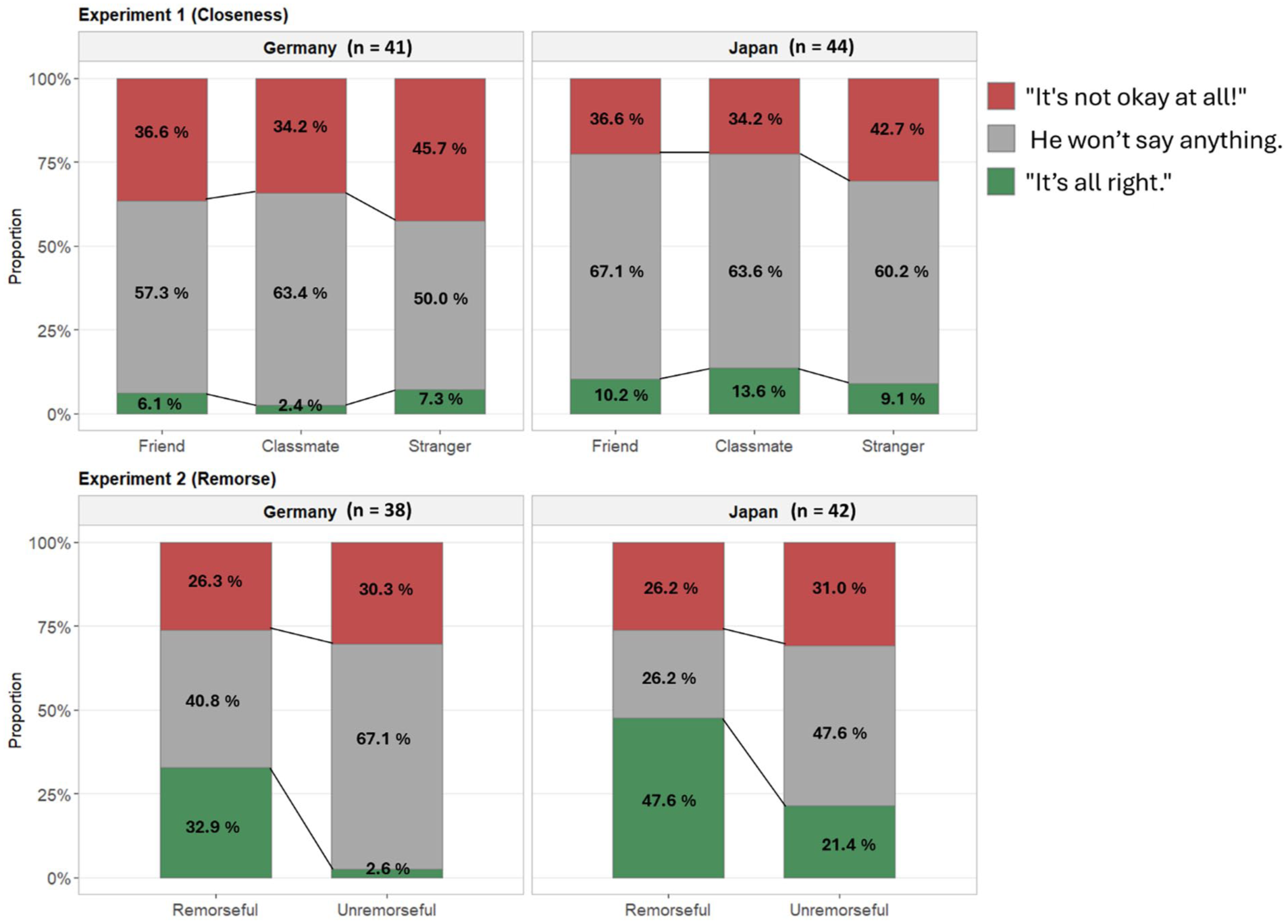
Distribution of children’s verbal response predictions by culture and condition (Experiments 1 and 2).
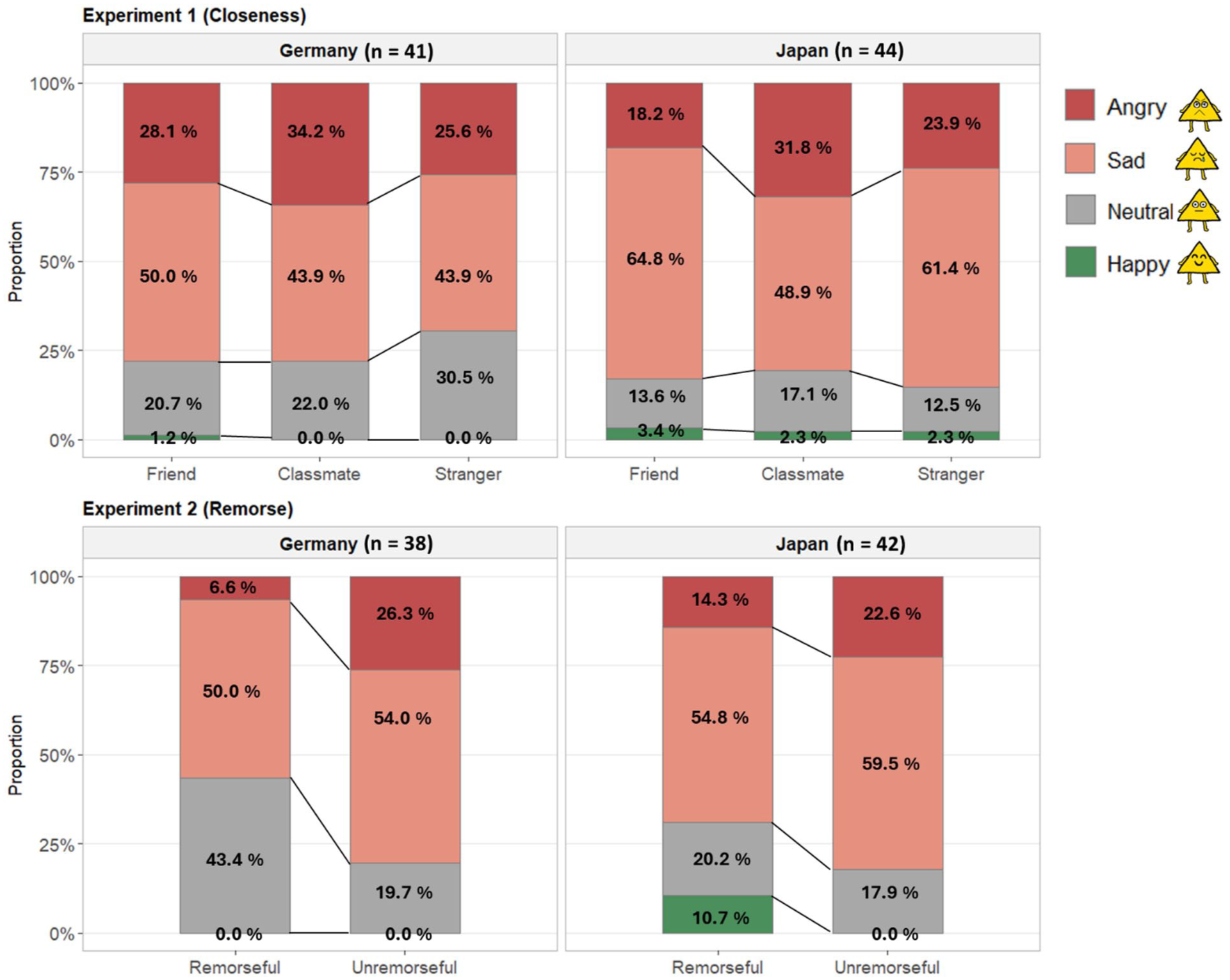
Distribution of children’s facial response predictions by culture and condition (Experiments 1 and 2).
Predictions of the Victim’s Emotional Forgiveness and Evaluations of the Transgressor’s Moral Trait
Table 1 presents means (SDs) of children’s predictions of the victim’s emotional forgiveness and evaluations of the transgressor’s moral trait. A corresponding figure is provided in Supplementary Material S4-1. LMMs indicated that relational closeness did not significantly affect predictions of the victim’s revenge desire, anger, or resentment, though anger showed a trend with slightly lower anger attributed in the friend condition, F(2, 416) = 2.78, p = .063. No cultural differences emerged on any of the three emotional forgiveness indices, all Fs(1, 83) < 1.66, all ps > .20. Children rated the transgressor more positively on moral traits in the friend condition (M = 2.49, SD = 1.00) than in both the stranger (M = 2.04, SD = 0.80) and classmate (M = 2.01, SD = 0.73) conditions, F(2, 416) = 18.86, p < .001; both ps < .001, with no significant difference between the stranger and classmate conditions. German children gave higher moral-trait ratings than Japanese children overall, F(1, 83) = 7.13, p = .009. Full results are reported in Supplementary Material S4-2.
Means (SDs) of the Predictions of Emotional Forgiveness and the Evaluations of Transgressor’s Moral Trait Measures by Culture and Condition (Experiments 1 and 2).
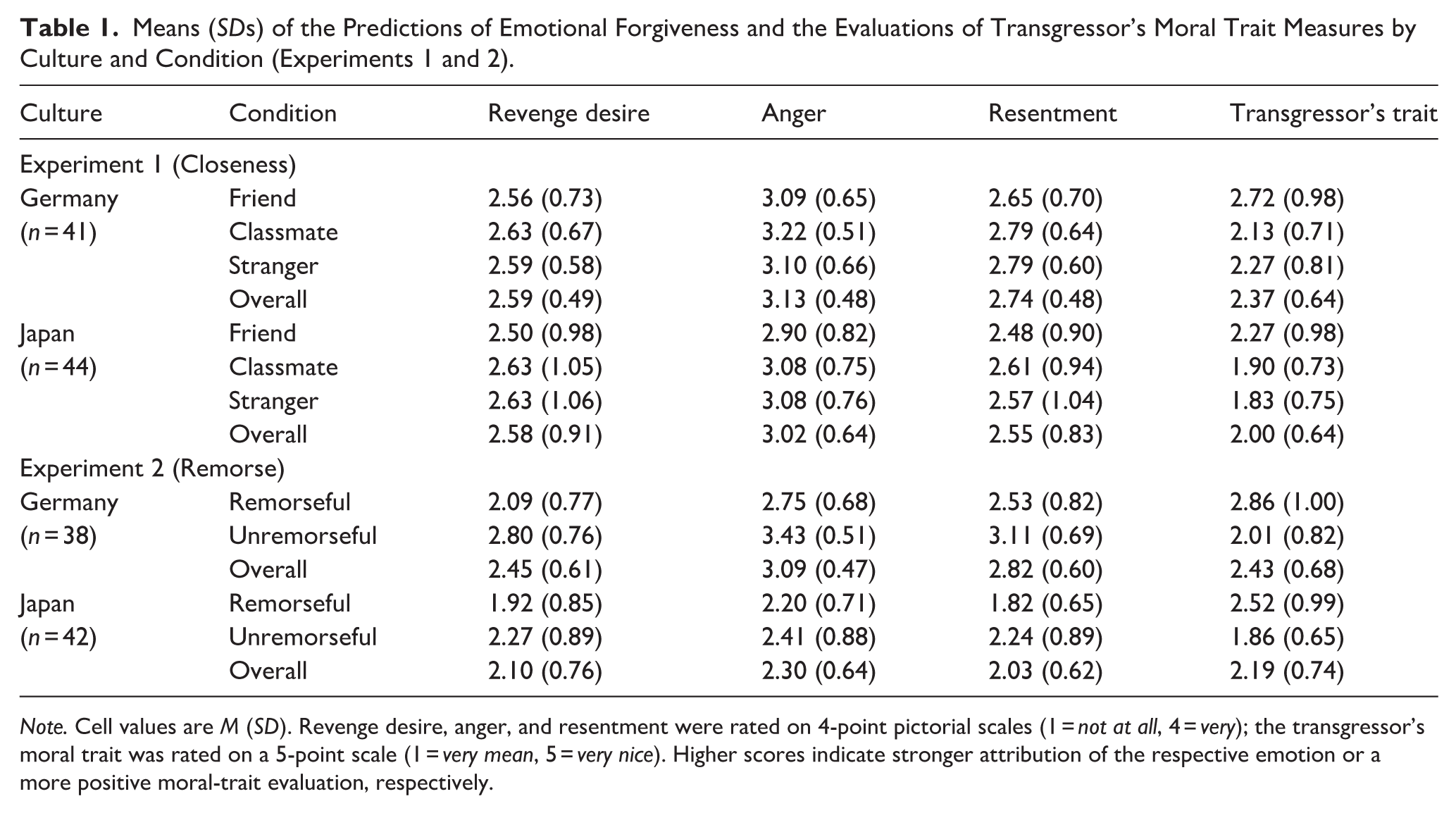
Note. Cell values are M (SD). Revenge desire, anger, and resentment were rated on 4-point pictorial scales (1 = not at all, 4 = very); the transgressor’s moral trait was rated on a 5-point scale (1 = very mean, 5 = very nice). Higher scores indicate stronger attribution of the respective emotion or a more positive moral-trait evaluation, respectively.
Justifications for Verbal Expression and Revenge Desire
Overall, transgressor’s behavior was the most frequently cited justification category for both decisional forgiveness (verbal expression predictions; 47.6%) and emotional forgiveness (revenge desire predictions; 36.7%), followed by victim’s emotion (decisional: 25.5%; emotional: 27.6%) and relationship (decisional: 17.8%; emotional: 19.8%). No significant cultural differences emerged in the distribution of decisional justification categories, χ2(5) = 6.60, p = .253. Emotional justification differed significantly by culture, χ2(5) = 20.72, p < .001, Cramér’s V = .20; German children more frequently provided no response or unclassifiable responses, while Japanese children more frequently cited retaliation as justification. See Supplementary Material S5-2 for details.
The Alignment Between Decisional and Emotional Forgiveness
In the multinomial facial alignment model, revenge desire was positively associated with predictions of both sad (b = 0.46, SE = 0.24, p = .056) and angry (b = 1.03, SE = 0.28, p < .001) expressions relative to neutral. The Culture × revenge interaction was significant for both contrasts (sad: b = −0.67, SE = 0.33, p = .042; angry: b = −0.76, SE = 0.38, p = .047), indicating that the facial–emotional alignment was attenuated in Japan. Lower moral-trait ratings were also associated with sadder facial predictions (b = −0.32, SE = 0.15, p = .030). In the verbal alignment model, no significant associations emerged, nor did culture moderate them (all ps > .13). Full results are reported in Supplementary Material S6-1.
Discussion
Experiment 1 revealed that relational closeness had limited influence on children’s evaluations of the victim’s forgiveness; however, moral-trait evaluations showed that children judged the transgressor more favorably when the victim and transgressor shared a closer relationship. Notably, Japanese children were more likely than German children to predict sad facial expressions regardless of condition, and German children assigned more favorable moral-trait ratings overall, suggesting broad cross-cultural differences in how children represent the emotional and evaluative consequences of interpersonal transgressions.
Critically, the facial alignment analyses revealed a significant cultural difference in the coupling between emotional attributions and decisional predictions: among German children, stronger revenge desire was associated with more negative facial expression predictions, but this association was significantly attenuated among Japanese children. This pattern suggests that Japanese children anticipated a greater divergence between the victim’s emotional state and outward displays, consistent with culturally shaped expectations about emotional expression regulation (Broesch & Carpendale, 2022; Ip et al., 2021). This cultural divergence also provides empirical support for treating the facial measure as an index of outward response rather than a mere proxy for internal affect. Verbal alignment showed no such cultural moderation, possibly reflecting restricted variance in verbal forgiveness responses, as the majority of children across both cultures predicted non-forgiveness verbally.
Experiment 2
Experiment 2 retained the same paradigm but manipulated the transgressor’s remorse (apology present vs. absent). Because apologies theoretically signal relationship value and mitigate exploitation risk, we examined whether this gesture differentially shapes children’s predictions of the victim’s forgiveness across cultures.
Method
The sample in Experiment 2 comprised 38 German children (21 females; Mage = 7 years 4.66 months, SD = 9.44 months) and 42 Japanese children (22 females; Mage = 7 years 4.79 months, SD = 10.90 months). None had participated in Experiment 1. No exclusions were necessary. Sensitivity power analysis indicated that the sample afforded adequate sensitivity (80% power) to detect effects of partial η² = .09 or larger for Remorse. Full details are provided in Supplementary Material S1.
Experiment 2 followed the same procedure, measures, and analytic strategy as Experiment 1 with the following exceptions. The relationship manipulation was replaced by a remorse manipulation: each vignette concluded with the transgressor either apologizing (remorseful condition; e.g., “I made the Triangle fall. I’m sorry”) or not (unremorseful condition; e.g., “I made the Triangle fall”). Two vignettes corresponded to each condition, yielding four vignettes (four trials per child). The comprehension question asked whether an apology occurred rather than the relationship between the characters. The testing session lasted approximately 20 to 25 min.
Results
Predictions of the Victim’s Decisional Forgiveness
Children’s predictions of the victim’s verbal and facial expressions are shown in the lower panels of Figure 1 and Figure 2, respectively. Multinomial GLMM analyses indicated that children were significantly more likely to predict verbal forgiveness (“It’s all right”) in the remorseful than unremorseful condition (b = 2.79, SE = 0.82, p < .001). Japanese children were more likely than German children to predict verbal forgiveness overall (b = 2.22, SE = 0.84, p = .009), regardless of condition. The Culture × Condition interaction was marginally significant (b = −1.72, SE = 0.92, p = .061), suggesting that the effect of remorse on verbal forgiveness predictions was more pronounced among German children, who rarely predicted forgiveness in the unremorseful condition, whereas Japanese children maintained relatively higher rates of verbal forgiveness predictions regardless of condition. For facial predictions, children were significantly more likely to predict an angry facial expression in the unremorseful than remorseful condition (b = −1.98, SE = 0.61, p = .001). No significant main effect of culture or Culture × Condition interaction emerged for facial predictions (all ps > .11). Full results are reported in Supplementary Material S3-2.
Predictions of the Victim’s Emotional Forgiveness and Evaluations of the Transgressor’s Moral Trait
The means (SDs) for the prediction of emotional forgiveness and transgressor’s moral trait are shown in Table 1, and paired boxplots with individual slopes are depicted in Figure 3. LMMs indicated that remorse strongly predicted all four indices (all ps < .001): children attributed lower revenge desire, anger, and resentment of the victim, and rated the transgressor more positively on moral traits, in the remorseful than unremorseful condition. Japanese children attributed lower revenge desire, F(1, 78.1) = 5.28, p = .024, and lower resentment, F(1, 77.7) = 32.78, p < .001, than German children overall. For anger, a significant Culture × Condition interaction emerged, F(1, 234.0) = 7.20, p = .008: remorse substantially reduced attributed anger in German children (p < .001), but the reduction was smaller in Japanese children (p = .058). Moral-trait ratings did not differ significantly by culture (p = .124). Full results are reported in Supplementary Material S4-3.
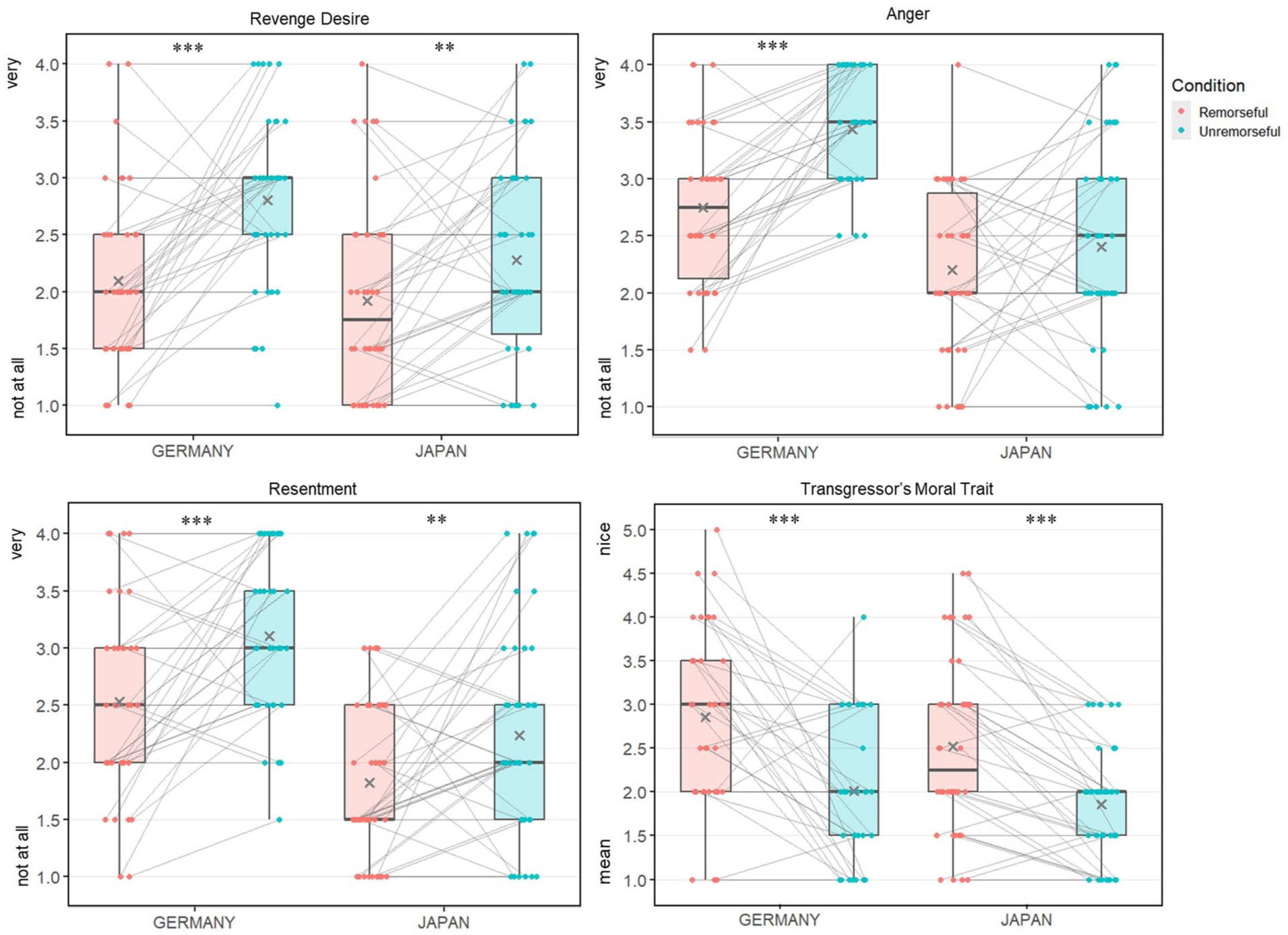
Children’s ratings of revenge desire, anger, resentment, and the transgressor’s moral trait (Experiment 2).
Justifications for Verbal Expression and Revenge Desire
Overall, victim’s emotion (decisional: 33.8%; emotional: 38.4%) and transgressor’s behavior (decisional: 32.8%; emotional: 31.3%) were the two most frequently cited justification categories, followed by apology (decisional: 22.8%; emotional: 17.8%). Cultural differences were significant in the distribution of decisional justification categories (Fisher’s exact test, p = .019); Japanese children more frequently cited retaliation as justification for the victim’s verbal response (11.9%) compared with German children (2.6%). Emotional justification also differed significantly by culture, χ2(5) = 20.07, p = .001, Cramér’s V = .25; German children more frequently cited the transgressor’s behavior, while Japanese children more frequently provided no response or cited retaliation. See Supplementary Material S5-3 for details.
The Alignment Between Decisional and Emotional Forgiveness
In the multinomial facial alignment model, anger attribution was positively associated with predictions of both sad (b = 0.70, SE = 0.34, p = .039) and angry (b = 1.23, SE = 0.51, p = .015) expressions relative to neutral. The Culture × Anger interactions did not reach significance for sad (b = −0.74, SE = 0.48, p = .126) or angry (b = −1.00, SE = 0.67, p = .135) expressions, though both estimates were directionally consistent with Experiment 1. In the verbal alignment model, moral-trait ratings were associated with verbal predictions (forgiveness: b = 0.45, p = .046; non-forgiveness: b = −0.66, p = .003), but culture did not moderate any associations (all ps > .30). Full results are reported in Supplementary Material S6-2.
Discussion
Experiment 2 demonstrated that remorse strongly increased children’s evaluations of forgiveness across both cultures, eliciting more conciliatory outward predictions—both verbal and facial—as well as lower negative emotional attributions and more favorable moral-trait evaluations. However, remorse effects on verbal forgiveness predictions and on attributed anger were both weaker among Japanese than German children. For verbal predictions, this likely reflects a ceiling: Japanese children showed high baseline rates of conciliatory verbal responses, leaving less room for remorse to further increase them. The alignment analyses showed a directionally consistent but non-significant pattern in Experiment 2. Taken together, Experiments 1 and 2 converge on a divergence we elaborate in the General Discussion: Japanese children predict socially harmonious verbal responses while attributing comparable or more negative emotional states to the victim.
Parental Influence on Children’s Evaluations of Forgiveness: A Combined Analysis
By pooling data from Experiments 1 and 2, we conducted an integrated analysis to examine whether parental dispositions and forgiveness-related practices were associated with children’s evaluations of forgiveness over and above the situational effects of closeness and remorse. Because identical parental measures were administered in both experiments, combining the samples increased statistical power and allowed us to assess family-level correlates across a broader range of interpersonal contexts.
Method
The parent-level sample comprised 153 parents of the children who participated in Experiments 1 and 2, including 70 German parents (Ma g e = 41.12, SD = 3.84) and 83 Japanese parents (Ma g e = 40.98, SD = 5.09). Twelve parents (nine in Germany and three in Japan) had two participating siblings. The majority were mothers (Germany: 87.1%; Japan: 96.4%). The parent samples were highly educated, with 72.9% of German and 77.1% of Japanese parents reporting a university degree or higher. Four parents (two in Germany and two in Japan) who did not complete the interview were excluded from analyses involving the parenting-practice variable.
Outcomes—children’s evaluations of the victim’s forgiveness—were summarized at the child level within each experiment. The emotional forgiveness score, which indexed children’s attributions of victims’ internal states, was computed by summing anger, revenge desire, and resentment within each story, averaging across stories, and reverse-coding so that higher scores indicate greater emotional forgiveness (i.e., lower attributed negative affect). Decisional forgiveness was indexed as the proportion of stories in which each child predicted the victim would say “It’s all right” out of the total number of stories in that experiment (six in Experiment 1; four in Experiment 2). Facial expressions were not used as a decisional index because happy—the only unambiguously positive response—was rarely selected (<3% of trials), precluding a meaningful forgiveness dichotomy.
Parents completed the World Values Survey (WVS) “Important Child Qualities” items (World Values Survey Association, 2022), the Forgivingness Questionnaire (Suwartono et al., 2007), and a brief interview about how they would typically respond when their child had been hurt by another child who then apologized. From these, we derived a tolerance-prioritization score from the WVS, three parental forgivingness subscale scores (lasting resentment, sensitivity to circumstances, and willingness to forgive), and a four-category parenting-practice variable (Emotion-focused, Relationship-focused, Norm/morality-focused, and Hands-Off or Minimal Intervention). Detailed item wording, scoring procedures, coding definitions, and reliability information are reported in Supplementary Material S7.
We estimated pooled models including Culture, Experiment, child age (in months), child sex, the three forgivingness subscale scores, the tolerance score, and the parenting-practice category as predictors. Decisional forgiveness was analyzed using a mixed-effects binomial logistic model, and emotional forgiveness using a linear mixed-effects model. Both models included a random intercept for Parent ID to account for nonindependence among siblings (twelve families contributed two children). Models with and without Culture × Parenting Practice and Culture × Tolerance interactions were compared; because these terms did not improve fit, the main-effects models were retained. Details are provided in Supplementary Material S7.
Results
Cultural Differences in Parental Measures
Independent-samples t-tests (df = 151) revealed that Japanese parents reported significantly higher lasting resentment (M = 3.24, SD = 1.10 vs. German M = 1.79, SD = 0.84; t = −9.05, p < .001, d = 1.47), whereas German parents scored higher on sensitivity to circumstances (M = 5.10, SD = 1.34 vs. Japanese M = 4.58, SD = 0.93; t = 2.82, p = .005, d = 0.46). Japanese parents showed a numerically higher willingness to forgive, though this difference was not statistically significant (t = −1.82, p = .070, d = 0.30), and tolerance scores did not differ significantly (t = −1.51, p = .133).
Regarding parental practices, a chi-square test at the parent level (N = 149) indicated a significant cultural difference, χ2(3) = 15.11, p = .002. Relation-focused approaches were predominant in both countries (Germany: 63.2%, Japan: 54.3%), but Japanese parents used emotion-focused strategies more frequently (Germany: 10.3%, Japan: 34.6%) and hands-off strategies less frequently (Germany: 23.5%, Japan: 8.6%) than German parents.
Parental Effects on Children’s Predictions of Decisional and Emotional Forgiveness
For decisional forgiveness, none of the parental measures significantly predicted children’s evaluations (ps > .40). For emotional forgiveness, the overall effect of parenting practice did not reach significance, F(3, 145) = 2.21, p = .089; however, children whose parents used a Relationship-focused approach attributed higher emotional forgiveness to the victim than children whose parents used a Hands-Off or Minimal Intervention approach (the reference category, representing the absence of active parental guidance), b = 0.86, SE = 0.38, t(145) = 2.29, p = .023. No other parenting-practice category differed significantly from the minimal-intervention group. Parental willingness to forgive showed a positive, though not statistically significant, association with children’s evaluations of emotional forgiveness, b = 0.49, SE = 0.26, t(145) = 1.86, p = .065. The remaining forgivingness subscales and Tolerance score were not significant (all ps > .14). Full model results are reported in Supplementary Material S7.
Discussion
The findings highlight notable cultural differences in parental forgiveness-related dispositions and practices. Japanese parents exhibited substantially higher levels of lasting resentment than German parents, yet also showed a trend toward greater willingness to forgive. Because the Willingness to Forgive subscale primarily captures behavioral intentions toward reconciliation (e.g., “I can usually forgive and forget an insult”; see Supplementary Material S7-1 for item wording), this subscale is closer to decisional than emotional forgiveness. The paradox thus dissolves when viewed through the decisional–emotional distinction: Japanese parents may readily endorse outward reconciliation while retaining internal resentment—mirroring the pattern observed in their children’s evaluations. German parents, by contrast, scored higher on sensitivity to circumstances and more frequently employed hands-off approaches, whereas Japanese parents more often used emotion-focused strategies. The greater sensitivity to circumstances among German parents parallels the finding that German children’s forgiveness evaluations were more strongly modulated by situational cues such as remorse, suggesting that context-dependent responding may be a shared feature of German parent–child dyads.
Regarding associations with children’s evaluations, parental measures were unrelated to decisional forgiveness, but a relationship-focused parenting practice was positively associated with emotional forgiveness, suggesting that active guidance toward reconciliation may be reflected in children’s expectations of internal—rather than outward—forgiveness.
General Discussion
Effects of Relational Closeness and Remorse on Children’s Evaluations of Forgiveness
Our first hypothesis predicted that children from both cultures would expect the victim to show greater decisional and emotional forgiveness when the transgressor was relationally closer (Experiment 1) or remorseful (Experiment 2). This hypothesis was partially supported. Remorse robustly increased children’s evaluations of both decisional and emotional forgiveness across cultures, consistent with prior evidence that apologies function as a crucial signal for restoring trust in both adults and children (Oostenbroek & Vaish, 2019; Tabak et al., 2012). In contrast, relational closeness had only limited effects: although children judged a friend transgressor’s moral character more positively, this did not translate into greater predicted decisional or emotional forgiveness of the victim.
The differential impact of remorse versus closeness is interpretable through the evolutionary framework discussed in the Introduction. The dual-cue model of forgiveness (Burnette et al., 2012) posits that forgiveness is maximized when high relationship value is combined with low exploitation risk. Remorse simultaneously signals both—enhanced relational worth and reduced likelihood of future harm (McCullough et al., 2014)—whereas closeness pertains primarily to relationship value alone; an unremorseful close friend may still pose a threat. This asymmetry may explain why remorse, as a more diagnostic cue, exerted a stronger influence on children’s forgiveness evaluations than closeness did.
The near-null closeness effect may also reflect our third-person paradigm, which can attenuate self-relevant motives that drive relational cues in first-person tasks (Vaish & Oostenbroek, 2022). Developmental factors may also contribute: middle-childhood friendships often lack stability (McDonald et al., 2013), leading children to focus on immediate cues over long-term relational ones.
Cultural Differences in the Alignment of Decisional and Emotional Forgiveness
Our second hypothesis predicted that Japanese children would show greater incongruence between their evaluations of decisional and emotional forgiveness than German children, and that the effects of relationship value cues would be larger in Germany than in Japan. This hypothesis received partial support. The incongruence prediction was supported: across both experiments, Japanese children more frequently predicted verbal forgiveness while attributing persistent negative emotions, whereas German children showed tighter coupling between emotional attributions and decisional predictions. In Experiment 1, facial alignment analyses confirmed this pattern, with the link between revenge desire and negative facial predictions significantly attenuated in Japan; in Experiment 2, the same direction did not reach significance, possibly reflecting a weaker effect under remorse or limited interaction sensitivity given the sample size. Regarding cue effects, closeness interactions were non-significant, but remorse reduced attributed anger more strongly among German than Japanese children (p = .008), with verbal forgiveness predictions showing the same direction (p = .061), consistent with the prediction that normative apology expectations in Japan attenuate the differentiating power of remorse (Park et al., 2005).
The observed decisional–emotional dissociation in Japanese children’s evaluations aligns with the theoretical framework outlined in the Introduction, where collectivistic cultures emphasize restoring outward harmony over authentic emotional resolution (Ho & Fung, 2011; Joo et al., 2019; Worthington & Sandage, 2016). In Japan, the distinction between tatemae (public facade) and honne (true feelings) illustrates a cultural logic that allows outward harmony to be expressed independently of internal emotional resolution (Doi, 1973). That 6- to 8-year-old Japanese children already anticipate this dissociation is consistent with evidence that display rule knowledge (Ip et al., 2021) and culturally informed emotion regulation (Broesch & Carpendale, 2022) emerge as early as the preschool years, extending the adult cross-cultural literature (Huang & Enright, 2000; Paz et al., 2008) to a developmental context.
Parental Influences: Divergent Pathways for Children’s Evaluations of Emotional and Decisional Forgiveness
Our third hypothesis predicted that parents’ beliefs and practices about forgiveness would relate to children’s evaluations. As discussed in Section “Discussion,” the cultural patterning of parental dispositions was partially consistent with this prediction, with Japanese parents exhibiting a pattern interpretable through the decisional–emotional distinction: high lasting resentment coexisting with a tendency toward outward reconciliation. Contrary to expectations, however, relationship-focused practices were prevalent in both cultures and did not differ markedly across groups. Notably, Culture × Parenting Practice and Culture × Tolerance interactions did not improve model fit, indicating that the associations between parental factors and children’s evaluations operated similarly across the two cultures. The link was also selective—only a relationship-focused parenting style was associated with children’s emotional, but not decisional, forgiveness evaluations. This suggests that a relationship-focused parenting style—one that emphasizes maintaining and repairing interpersonal connections—may be reflected in how children expect victims to manage their negative emotions, regardless of cultural background. In contrast, evaluations of outward forgiveness decisions remained primarily guided by situational cues such as remorse.
Limitations and Directions for Future Research
The present study provides cross-cultural developmental evidence that children’s evaluations of decisional and emotional forgiveness can diverge along culturally shaped lines, using a preregistered, multi-experiment design with converging measures. Nevertheless, several limitations warrant consideration. First, our cross-cultural comparison is limited to two highly industrialized nations and to children aged 6 to 8 years; broader sampling across diverse cultures and ages would clarify which aspects are universal versus culture- or age-specific. Second, although sensitivity analyses confirmed adequate power for main effects, larger samples would strengthen confidence in the cross-cultural moderation findings. Finally, varying transgression severity and testing costly apologies would further illuminate when children endorse forgiveness.
Conclusion
In sum, by middle childhood, children’s predictions about a victim’s post-transgression responses are highly sensitive to remorse, with relational closeness exerting more limited effects. Japanese children tended to anticipate conciliatory responses despite continuing negative affect, whereas German children showed tighter decisional–emotional alignment. Moreover, parents’ relation-focused practices were associated with children’s expectations of emotional, but not decisional, forgiveness. These results highlight the developmental value of examining decisional and emotional forgiveness as related but separable components of children’s evaluations.
Supplemental Material
sj-pdf-1-jbd-10.1177_01650254261456657 – Supplemental material for Forgiving Without Letting Go: Children’s Evaluations of Decisional and Emotional Forgiveness Across Two Cultural Contexts
Supplemental material, sj-pdf-1-jbd-10.1177_01650254261456657 for Forgiving Without Letting Go: Children’s Evaluations of Decisional and Emotional Forgiveness Across Two Cultural Contexts by Yuki Shimizu, Anneliese Skrobanek, Shuang Wu and Joscha Kärtner in International Journal of Behavioral Development
Footnotes
Ethical Considerations
The studies reported in this article were approved by the institutional review boards at Waseda University (No. 2023-216) and the University of Münster (No. 2023-45-AS).
Consent to Participate
Written informed consent to participate was obtained from all participants and children’s parents.
Consent for Publication
Written informed consent for publication was obtained from all participants and children’s parents.
Funding
The authors disclosed receipt of the following financial support for the research, authorship, and/or publication of this article: This study was supported by a Grant-in-Aid for Japanese Scientific Research KAKENHI to Yuki Shimizu (No. 21H00939) and by a grant from the Deutsche Forschungsgemeinschaft (DFG) awarded to Joscha Kärtner (KA 3451/7-1).
Declaration of Conflicting Interests
The authors declared no potential conflicts of interest with respect to the research, authorship, and/or publication of this article.
Data Availability Statement
This study’s design, hypotheses, and primary analyses for Experiments 1 and 2 were preregistered on the Open Science Framework (OSF) (https://osf.io/pdc2g/?view_only=f1ce1dbb6aba43a3a57bf132c2e49550). The stimulus videos, the dataset, and R scripts used in both experiments are also available on the OSF ( ).
).
Supplemental Material
Supplemental material for this article is available online.
Notes
References
Supplementary Material
Please find the following supplemental material available below.
For Open Access articles published under a Creative Commons License, all supplemental material carries the same license as the article it is associated with.
For non-Open Access articles published, all supplemental material carries a non-exclusive license, and permission requests for re-use of supplemental material or any part of supplemental material shall be sent directly to the copyright owner as specified in the copyright notice associated with the article.
