






Abstract
This study used a five-wave longitudinal design to examine how the type and timing of parental questions during shared discussion of wordless picture books influence children’s emotion labeling. Participants were 323 children (150 girls, ages 2–3 at Wave 1 in 2019) and their primary caregivers, who were assessed annually until ages 6–7. Parent–child interactions were recorded, transcribed, and coded for the frequency of yes/no and open-ended questions during the first conversational turn and children’s subsequent correct emotion labels. An RI-CLPM controlling for conversation length, child age, and gender indicated that start-of-conversation open-ended questions were positively associated with children’s correct emotion labeling, whereas start-of-conversation yes/no questions were negatively associated. Emotion labeling and parental questioning showed stability across waves; however, start-of-conversation question type did not predict children’s labeling longitudinally. Moreover, a reverse longitudinal effect emerged: stronger child emotion labeling predicted decreases in parents’ use of yes/no questions the following year, suggesting that parents adapt their entry prompts as children’s skills improve. Sensitivity analyses showed that parent total question frequency across the full conversation was positively associated with labeling regardless of question type. These findings highlight the role of question type, timing, and caregiver responsiveness in socio-emotional development.
Keywords
Introduction
Parent–child interactions play a crucial role in children’s early socio-emotional development, with parents serving as primary socialization agents. One key mechanism is parent–child emotion-related conversation, including discussions about emotions and shared reading of picture books (Cervantes & Callanan, 1998; Chan et al., 2023; Denham, 2023; Peet et al., 2025). Picture books are a central part of many Western families’ everyday routines, serving as a key context for shared reading, storytelling, and discussions about emotions and social experiences (Britto et al., 2002). During interactions, parents’ use of emotion labels helps children recognize and articulate emotions, thereby supporting emotion understanding, regulation, and social-emotional development (Knothe & Walle, 2023; Price et al., 2022).
Parental questioning style, including open-ended questions and yes/no questions, can significantly influence these interactions (Hoemann et al., 2019; Lyon & Henderson, 2021). Open-ended questions can encourage children to express their emotions more deeply and understand their underlying causes, enhancing emotion understanding (Shiu & Wang, 2024). However, they may be challenging for children to answer. In contrast, yes/no questions are easier to answer and may produce more accurate responses (Mehranirad et al., 2024), but they can limit children’s expressive opportunities and reduce chances for emotion recognition (Lyon & Henderson, 2021).
Although previous research has highlighted the importance of parental questioning practices for children’s emotion understanding, most studies are cross-sectional (Fivush et al., 2000; Gentzler et al., 2005; Laible, 2004; Shiu & Wang, 2024), making it unclear how these associations change over time. Early to middle childhood is a period of rapid development in emotional understanding (Ziv et al., 2014). During this time, children move from providing simple descriptions of basic emotions to understanding the causes and changes of emotions, while also showing improvements in language ability and emotional expression (Bretherton et al., 1986). As children’s abilities continue to develop, the effects of different parental questioning styles may also change. In early childhood, when language skills are not yet fully developed, yes/no questions may provide helpful support (Mehranirad et al., 2024). As children become better able to reflect on and understand emotions more deeply, open-ended questions may become more beneficial (Lyon & Henderson, 2021).
Therefore, a longitudinal design is necessary to examine developmental trajectories, within-child changes, and the stability of behaviors over time. Another gap is that few studies distinguish between parents’ start-of-conversation questions and the total number of questions, or control for key variables such as child age, gender, and conversation length (Leung et al., 2025). Questions asked at the start of the conversation may guide children’s engagement and shape the trajectory of the discussion. To address these gaps, the present study used a five-wave longitudinal design to examine how parents’ conversation-starting questions, defined as the number of yes/no and open-ended questions asked within the first conversational turn of a parent-initiated discussion, may shape children’s subsequent emotion labeling within that interaction and across development.
Theoretical Foundations of Emotion Socialization
Parental emotion socialization through responses to children’s emotions, discussions about emotions, and parents’ own emotional expression and modeling supports the development of children’s emotional experience, expression, regulation, and understanding (Eisenberg et al., 1998; Spinrad et al., 2020). Building on this perspective, the Theory of Constructed Emotion (TCE; Barrett, 2017) proposes that emotions are not fixed responses but are dynamically constructed through experience, language, and social interaction, highlighting the importance of both the type and timing of parental language in shaping children’s emotional understanding. Vygotsky’s (1978) Zone of Proximal Development (ZPD) complements this perspective in that children learn most effectively when parents provide guidance for skills children have not yet mastered independently (Sage, 2022). This adaptive, bidirectional process helps explain why both initial start-of-conversation questions and cumulative parental questions across a conversation may have lasting effects on children’s emotion labeling. Together, these perspectives provide a theoretical foundation for examining how the type and timing of parental questions during emotional conversations may influence the development of children’s emotion labeling over time.
Development and Importance of Emotion Labeling in Children
Emotion labeling, or the ability to identify and accurately describe emotions, is a key milestone in children’s emotional development (Erhart et al., 2019; Taylor et al., 2004). This ability not only affects children’s social adaptation (Sezgin et al., 2023) and mental health (Chen et al., 2021; Havighurst & Kehoe, 2021) but is also closely related to interpersonal skills (Reschke et al., 2017; Voltmer & von Salisch, 2017) and academic performance (Denham, 2003; Izard et al., 2001). Across development, children gradually learn to recognize emotions through cues such as facial expressions, body language, and tone of voice, and develop a corresponding vocabulary system to describe these emotions (Weimer et al., 2012). Specifically, children aged 2–4 can correctly label basic emotions such as “happy,” “angry,” and “sad” (Riddell et al., 2024). By ages 5–6, they can distinguish additional emotions such as “fear,” “surprise,” and “disgust” (Ziv et al., 2014), and by around age 7, they can better understand emotions such as “pride,” “jealousy,” and “worry” (Harris et al., 1981).
Parental modeling of emotions and emotion-related parenting practices play a crucial role in shaping children’s emotion understanding and labeling skills (Erhart et al., 2019; Leyva et al., 2014; Morris et al., 2007). Within this framework, parent–child conversations about emotions represent a key mechanism of both modeling and emotion-related practices. Specifically, parents can model emotional language, explain emotional experiences, and guide children in interpreting emotional situations, thereby providing direct instruction about emotions. Such open emotional communication fosters children’s emotion understanding and supports their ability to express emotions appropriately (Madjar, 2020; Martins et al., 2021). The current study aimed to explore longitudinally how parent–child conversations support children’s ability to recognize and label emotions.
Parent–Child Discussions of Picture Books
Parents can engage in a variety of emotion-related interactions with children, including discussing wordless picture books together (Knothe & Walle, 2023). Furthermore, research on parent–child reading text-based picture books together (Aram & Fine, 2013) and emotion reminiscing discussions (Koh & Wang, 2021), though different from contexts involving wordless picture books, can also provide valuable insight into the emotion socialization process. These interactions can help children understand emotions and improve their emotion-labeling abilities. According to parental emotion socialization theory (Eisenberg et al., 1998) and the Theory of Constructed Emotion (Barrett, 2017), children develop their understanding and labeling of emotions through social interactions and language input from caregivers, which shape how they perceive, categorize, and interpret emotional experiences.
Research shows that when parents and children read wordless picture books, parents often use mental state language and emotion words to help children understand emotions (Schapira & Grazzani, 2025). These books lack textual narratives and provide rich cues about mental states and emotions, prompting children to actively infer the characters’ inner worlds (Knothe & Walle, 2023; Price et al., 2022). This process helps children identify and understand others’ emotions and the relationship between emotions and contexts (Goriot et al., 2024). Observing characters’ relationships and interactions also supports understanding of causal relationships, behavioral intentions, and social significance (Lysaker & Miller, 2013). In addition, freely interpreting the illustrations encourages children to exercise imagination and creative thinking while also promoting vocabulary development (Chaparro-Moreno et al., 2017). During shared discussion in wordless picture books, parents guide children in identifying, labeling, and expressing characters’ emotional responses through storytelling, mental state language, and prompting questions, thereby enhancing children’s emotion labeling abilities, socio-emotional understanding, and sensitivity to others’ mental states (Schapira & Grazzani, 2025). For these reasons, the current study focused on discussions of wordless picture books.
Text-Based Picture Books
Text-based picture books typically include written narratives that guide the storyline and structure parent–child interactions during shared reading (Whitehurst et al., 1988). One widely studied approach in this context is dialogic reading, which promotes interactive exchanges through open-ended questions, recall prompts, and extension prompts (Folsom, 2017). Introducing emotion labels in story contexts helps children distinguish and recognize emotions (Aram & Fine, 2013). Research shows that these interactive strategies increase children’s engagement, promote language development and vocabulary acquisition, and enhance emotion understanding (Pillinger & Vardy, 2022; Towsen et al., 2016). In picture books containing socio-emotional content, open-ended questions are particularly helpful for children to understand emotions, develop socio-emotional skills, and increase the use of emotion-related vocabulary (Bassett et al., 2020; Doyle & Bramwell, 2006; Kogan, 2024; Vargas-García et al., 2020). While research on text-based picture books has demonstrated these benefits, the present study focuses specifically on wordless picture books to examine parental guidance in an open-ended context.
In addition to shared reading, another important context for emotion socialization is when parents engage children in conversations about past emotional experiences using storytelling, questioning, and explaining the causes and consequences of emotions to help children understand emotional complexity (Koh & Wang, 2021; Pavlova et al., 2019). This type of interaction not only provides language models and emotion labels to facilitate emotion labeling and understanding (Laible, 2004) but also supports cognitive development by enhancing children’s memory, perspective-taking, problem-solving skills, and socio-emotional skills by fostering emotion understanding, empathy, and emotion regulation (Laible, 2011; Reese et al., 2007).
Compared to text-based picture books, adult language input during wordless book discussion is generally less complex (Price et al., 2022), but the rich cues about mental states and emotions prompt children to actively observe, understand, and express characters’ emotions without textual guidance, thereby promoting emotion labeling and socio-emotional understanding (Knothe & Walle, 2023). In addition, the openness and exploratory nature of wordless books may allow us to examine more directly the effect of parental guidance on children’s emotional understanding since parents were not prompted to discuss emotions specifically (Goriot et al., 2024).
Parental Questioning Strategies
Shared discussion provides parents with a unique opportunity to help children develop the ability to label and understand emotions (Harkins et al., 1994; Knothe & Walle, 2023; Laible, 2004). Parental questioning may play a critical role in children’s emotion labeling (Hoemann et al., 2019; Lyon & Henderson, 2021). For instance, in parent–child conversations, both open-ended and yes/no questions are commonly used, but they may have different effects on children’s emotional understanding and labeling abilities depending on children’s abilities (Fritzley & Lee, 2003; Shiu & Wang, 2024). Consistent with developmental theories of scaffolding, such as Vygotsky’s Zone of Proximal Development (ZPD), parents may modify their use of different types of start-of-conversation questions based on their child’s developing abilities. For instance, if a child has shown enhanced emotion labeling ability, a parent may choose to use less yes/no questions in future interactions. This possibility highlights the bidirectional nature of parent–child emotional development.
Previous studies have shown that emotion-focused conversations involving open-ended questions can help children recognize, understand, and regulate emotions (Fabes et al., 2001; Garner & Estep, 2001; Gentzler et al., 2005), encourage them to express their feelings, and enhance their emotional understanding (Shiu & Wang, 2024). In addition to supporting emotional expression, open-ended questions allow children to process experiences and voice their own opinions without being led to a particular answer (Brubacher et al., 2019). This approach also enables parents to guide children in expressing their thoughts and feelings, thereby supporting cognitive and socio-emotional development (Wareham & Salmon, 2006). However, in some instances, open-ended questions may also make children feel uncertain or lack confidence when they find them difficult to answer (Brubacher et al., 2019).
By contrast, yes/no questions are usually easier for children to answer and may sometimes elicit more accurate responses (Mehranirad et al., 2024). Yet, research has also found that yes/no or forced-choice questions can negatively affect children’s responses, making them less accurate and limiting the scope of emotion-related discussion (Lyon & Henderson, 2021). Younger children, in particular, tend to answer “yes” even when they do not fully understand the question (Fritzley & Lee, 2003; Peterson & Biggs, 1997; Peterson et al., 1999).
Therefore, given that both open-ended and yes/no questions have advantages and disadvantages, it remains unclear which type of question is more appropriate for engaging children in conversations about emotions. Moreover, many studies on question types have used cross-sectional designs (Gentzler et al., 2005; Laible, 2004; Shiu & Wang, 2024) and have not examined how the effectiveness of these questions unfolds over time within parent–child conversations. Building on existing literature, the present study extends prior work by using a five-wave longitudinal design and examines how parents initiate conversations to address these critical gaps and aims to examine which type of question should be used as the start-of-conversation prompt during parent–child shared discussion of wordless picture books.
Current Study
Grounded in an integrated framework, this study investigates how the type and timing of parental questions during shared book discussion shape children’s emotion-labeling abilities across development. Through parent–child conversations, children gain structured opportunities to develop emotion concepts within culturally and contextually meaningful settings, with parental input and questioning functioning as key mechanisms in this developmental process (Hoemann et al., 2019; Lindquist et al., 2015).
Despite evidence that parental questioning influences children’s emotional understanding, most prior work has been cross-sectional and has not differentiated between open-ended and yes/no questions or examined their timing within interactions (Gentzler et al., 2005; Laible, 2004; Shiu & Wang, 2024). Open-ended questions may foster deeper reflection of emotion concepts but can lower children’s confidence if used in a developmentally inappropriate context (Brubacher et al., 2019; Fritzley & Lee, 2003). By contrast, yes/no questions are easier for children to answer but may restrict children’s reasoning and expression (Fritzley & Lee, 2003; Lyon & Henderson, 2021). As a result, it remains unclear which question type, and when it is used, best supports children’s engagement and emotion labeling.
We conducted a five-wave longitudinal study in which children and their parents were annually recorded discussing a wordless picture book depicting characters expressing various emotions (e.g., joy, anger, fear, sadness, disgust) in diverse contexts. We focused on the frequency and type of parental questions, particularly those asked at the start of the conversation, to examine how they relate to children’s subsequent correct emotion labeling within the conversation. Using a path modeling approach, we tested both cross-sectional and longitudinal associations between parental question type and children’s emotion labeling, while controlling for child age, gender, and conversation length.
Guided by prior research (e.g., Hoemann et al., 2019; Knothe & Walle, 2023), the present study tested the following hypotheses:
Methods
Participants
Data for children and parents were taken from a larger, longitudinal study [name omitted for review] from the 2019, 2020, 2021, 2022, and 2023 waves (hereafter referred to as Waves 1–5, respectively) recruited from the Denver, Colorado greater metropolitan area through a combination of mailers sent via the Office of Health and Vital Records (27.5%), flyers at pediatricians, clinics, parks, and referrals (22.7%), and an external data collection company (49.8%). The larger project began in 2017 with 500 families; 250 families were selected for in-home tasks, of whom 233 completed the picture-book task at Wave 1 of the current study (2019). Subsequent recruitment increased the analytic sample to 323 unique dyads who completed the picture-book task in at least one wave. The wave-by-wave total participation frequencies in the picture-book task and original cohort retention percentage were as follows: Wave 1 (n = 233; 100%), Wave 2 (n = 216; 78.5%), Wave 3 (n = 255; 86.3%), Wave 4 (n = 141; 51.1%), Wave 5 (n = 206; 63.1%).
The final sample consisted of 323 children (150 girls) and their primary caregiver (98% mothers) discussing a wordless emotion picture book at (up to) five-time points in their homes starting when the children were 2–3 years old (MWave 1 = 29.33 months, SD = 3.12) and annually thereafter when the children were 3–4 years old (MWave 2 = 42.15 months, SD = 3.10), 4–5 years old (MWave 3 = 53.76 months, SD = 3.06), 5–6 years old (MWave 4 = 65.57 months, SD = 3.26), and 6–7 years old (MWave 5 = 77.20 months, SD = 2.96). The sample was racially, ethnically, and socioeconomically diverse. Approximately 64.5% of children were White, 22.8% were biracial, 6.9% were Black or African American, 2.8% were Hispanic, 1.4% were American Indian or Native Alaskan, 1.0% were Pacific Islander, and 0.7% were Asian. Approximately 13.7% of primary caregivers completed high school or less, 36.9% completed some college, 29.4% completed a bachelor’s degree, and 20.0% completed a graduate degree. Approximately 13.3% of primary caregivers reported a combined annual household income in 2023 below US$30,000, 20.4% between US$30,000 and US$60,000, 25.5% between US$60,000 and US$100,000, 12.2% between US$100,000 and US$120,000, and 28.6% above US$120,000. The demographic composition (race and gender) remained stable across waves, suggesting that later-entry cohorts did not meaningfully alter sample characteristics. At each wave, the primary caregiver provided informed consent and permitted their child to participate. Families were compensated with a US$200 gift card and an additional US$25 for full participation in all in-home tasks at each wave. In addition, participants completed an online questionnaire and were compensated with US$50 in Visa or Amazon gift cards. All participants were proficient in English.
Procedure
All procedures took place in families’ homes. Parents and children at each wave were recorded discussing a wordless picture book depicting illustrated characters expressing five different emotions (happiness, sadness, anger, disgust, fear) toward a referent (e.g., injured pet, dropped ice cream; see Figure 1), each shown on a different page. All images were validated in prior research as depicting the target emotion (see Reschke et al., 2024). Images were presented in a random order. Character gender (girl, boy) was counterbalanced across participants. During the 2020 wave, all sessions were conducted virtually via Zoom due to the COVID-19 pandemic, with the picture books mailed to the families in advance. At all waves, a camera was positioned to provide a clear view of both parents and children.
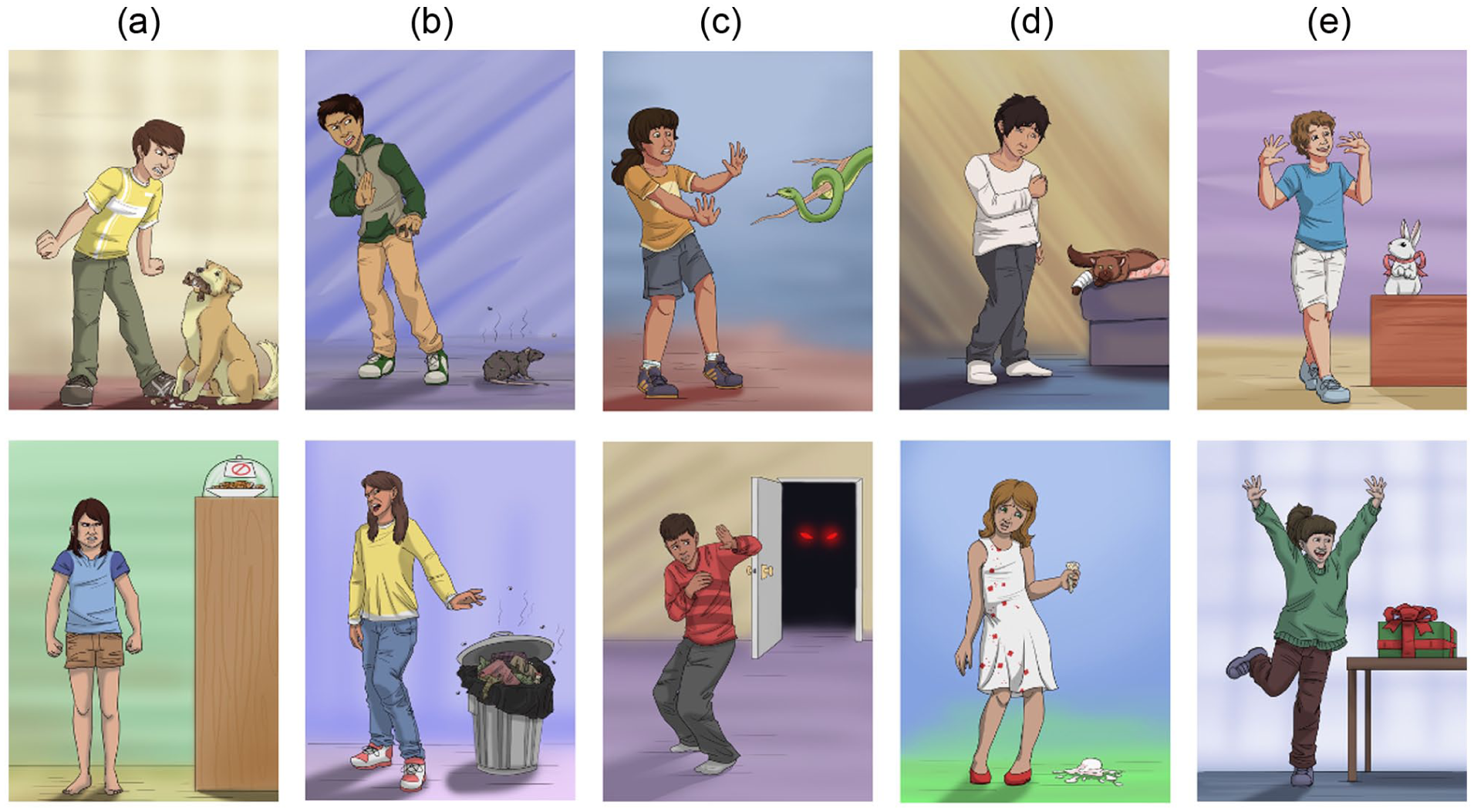
Example stimuli used in the picture-book task. (A) Anger, (B) Disgust, (C) Fear, (D) Sadness, (E) Joy. Images featured male or female characters.
Parents were instructed to describe each image separately as if “telling a story” about that image and to proceed at a natural pace. They were also told that each image was “its own story” and that there was no “connection between pages.” Parents were shown two sample images to become familiar with the picture-book format. While showing participants these sample images, the researcher pointed out that each image depicted a child in a context. No other instruction was given. Importantly, the researcher did not mention emotions or the need to discuss emotions. Pilot testing demonstrated that parents and children rarely spent more than 45 s per page. Thus, for data collection, the researcher was instructed to signal parents to turn a page if they spent more than 45 s on a page. However, this seldom occurred.
Audio data were transcribed verbatim by two trained researchers who independently reviewed each transcription for accuracy, made corrections as needed, and separated transcriptions by page number. Out of 6,631 parent–child page-level interactions across all waves, 85.0% (5,638) featured the parent initiating the conversation (i.e., making the first utterance), and 15.0% (993) featured the child initiating. Given our focus on the effect parents have when starting a conversation, we limited our primary examination to transcriptions where the parent initiated the conversation. We provide a sensitivity analysis examining parents’ questions across the entire conversation to contextualize our results, focusing on how parents initiate conversations.
Coding
Child Emotion Labels
To create an emotion dictionary from which to assign “correct” versus “incorrect” scores to children’s labels of each emotion image, we first processed the transcripts using a word frequency generator, and a trained researcher identified all discrete emotion labels used by participants that corresponded to the emotion images in the study. We cross-referenced this list with other emotion dictionaries used in extant emotion labeling research (Widen & Russell, 2003) to create a dictionary of “correct emotion labels” for each target emotion. Child count frequencies of correct emotion labels were extracted from each transcript for each emotion image by summing only the number of labels corresponding to the emotion depicted on the page. Labels that did not match the target emotion were not counted as correct. For example, if a child said, “she’s mad, angry, and frustrated,” they would receive a score of ‘3’ if the image being discussed depicted anger, but would receive a ‘0’ if the image depicted joy, sadness, fear, or disgust. If a child mentioned both correct and incorrect emotions (e.g., “she’s angry and sad” during the anger story), only the correct target-consistent label (i.e., “angry”) was counted. Thus, scores reflect accuracy in identifying the focal emotion within the story context rather than general emotion vocabulary richness (i.e., emodiversity).
Parent Questions
In the present study, we focused on the first conversational turn of each parent-initiated discussion of a picture-book page. The first conversational turn was defined as the parent’s initial utterance(s) before the child first responded. Within this initial turn, we counted the number of on-task yes/no questions (e.g., “Are they happy?”) and the number of on-task open-ended questions (e.g., “Why do they feel happy?”). Because parents sometimes asked multiple questions within that first turn, yes/no and open-ended questions were modeled as separate continuous predictors (i.e., counts). Off-task questions (e.g., “Do you want a snack after this?”) were discarded. Counts thus reflected the number of on-task yes/no or open-ended questions asked by the parent within the first conversational turn for each page. For each wave and type of question, a trained researcher coded all transcripts, and a secondary coder coded approximately 20% of transcripts. Interrater reliability was assessed using separate two-way random, single measures, consistency and Intraclass Correlation Coefficients (ICCs) for each wave (10 ICCs total). Interrater reliability was acceptable for question type at each wave, with a mean ICC = .90.
Control Variables
Separate parent and child indices of conversation verbosity were calculated by averaging parents’ and children’s total number of words per page across waves. Children’s and parents’ verbosity variables were highly correlated and were thus standardized and combined for modeling to avoid multicollinearity (hereafter conversation length). Child age and gender data were collected in the parent survey.
Data Aggregation
Finally, parent and child variables were averaged across pages within each wave so that each parent–child dyad had scores representing average counts of parent yes/no questions, parent open-ended questions, and child correct emotion labels at each wave.
Analytic Strategy
Descriptives and zero-order correlations between study variables are displayed in Table 1. We specified a random intercept cross-lagged panel model (RI-CLPM) in Mplus 8.9 to examine relations between parents’ start-of-conversation yes/no questions and open-ended questions and children’s subsequent correct emotion labels across waves while controlling for conversation length, child age, and child gender. The RI-CLPM separates stable between-family differences from within-family fluctuations over time (Hamaker et al., 2015). Specifically, random intercept factors were specified for children’s correct emotion labels and for each type of parent question (yes/no and open-ended), capturing time-invariant, between-family variability across waves. After accounting for these stable between-family differences, within-person latent factors were specified to represent wave-specific deviations from each family’s expected level. Thus, cross-lagged paths reflect whether fluctuations in parents’ questioning behavior within a family predict subsequent fluctuations in children’s emotion labeling over time, rather than reflecting stable differences between families.
Descriptives and Zero-Order Correlations Between Study Variables.
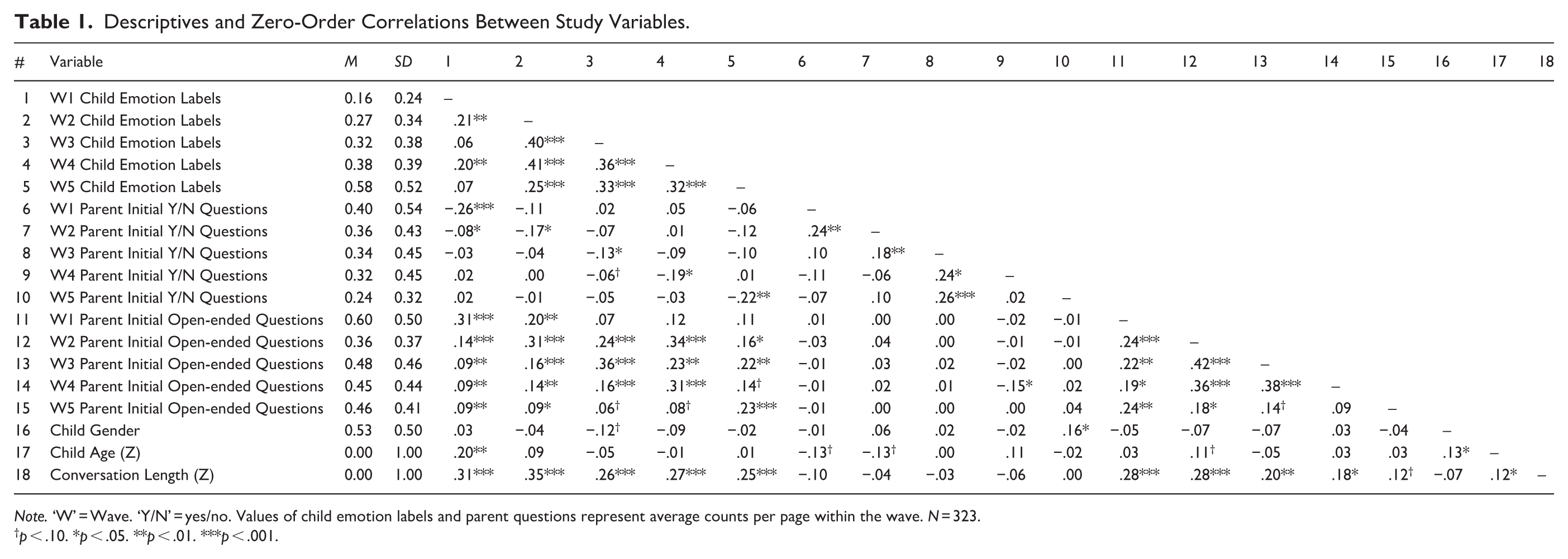
Note. ‘W’ = Wave. ‘Y/N’ = yes/no. Values of child emotion labels and parent questions represent average counts per page within the wave. N = 323.
p < .10. *p < .05. **p < .01. ***p < .001.
Within-person child emotion labeling at each wave was regressed onto parent question variables from the same wave and the prior wave, as well as control variables. First-order autoregressive paths were specified for each construct to account for temporal stability in within-family deviations. Covariances were specified between all time-invariant control variables. This modeling approach allowed us to estimate whether changes in parents’ questioning behavior within a family predicted changes in children’s emotion labeling over time, above and beyond stable between-family differences.
The model was estimated using full information maximum likelihood (FIML) to preserve all available data (Arbuckle, 1996). Model fit was evaluated using the chi-square test of model fit, Comparative Fit Index (CFI), Tucker–Lewis Index (TLI), Root Mean Square Error of Approximation (RMSEA), and Standardized Root Mean Square Residual (SRMR). We conducted a series of nested models with constrained parameters to identify a parsimonious model.
Per a reviewer's suggestion, we examined post hoc whether children’s expressive vocabulary was associated with children’s correct emotion labeling. Expressive vocabulary (MacArthur–Bates CDI; Fenson et al., 2000) was assessed in 2018 (1 year prior to Wave 1) for most participants; a follow-up administration was collected in 2019 for a smaller subset (~33%). We therefore used the 2018 measure for these post hoc correlations. Expressive vocabulary was not significantly correlated with emotion labeling at any time point (all ps > .05), and thus it was not included as a covariate in the final model.
Transparency and Openness
We report how we determined our sample size, all data exclusions, all manipulations, and all measures in the study, and we follow JARS (Kazak, 2018). This study was not preregistered. Data and syntax to reproduce the analyses are available at the Open Science Framework: https://osf.io/7k2mb/?view_only=9e3fc604c8c9495086de129c9771494b. Stimuli are available by contacting the corresponding author. The study was approved by the ethics committee of Brigham Young University, Protocol Title: Project M.E.D.I.A. (F2020-017).
Results
Descriptives and Zero-Order Correlations
Descriptives and zero-order correlations between all study variables are displayed in Table 1. Children’s correct emotion labels at all waves were significantly negatively related to parents’ yes/no questions and significantly positively related to parents’ open-ended questions. There were significant stability effects between all waves for children’s emotion labels and between Waves 1 and 4 for parent yes/no questions and open-ended questions. Regarding control variables, children’s correct emotion labels were significantly positively related to conversation length at all waves and to child age at wave 1.
RI-CLPM Estimation and Invariance Testing
We first estimated an unconstrained random intercept cross-lagged panel model (RI-CLPM) in which all autoregressive, within-wave, and cross-lagged paths were freely estimated across waves. The model demonstrated good fit to the data, χ²(61) = 66.99, p = .28, CFI = .984, RMSEA = .017, and SRMR = .045, indicating that the RI-CLPM provided an adequate representation of the longitudinal relations among child emotion labeling, parent yes/no questions, and parent open-ended questions.
We next estimated a fully constrained structural model in which all autoregressive paths for child emotion labeling, parent yes/no questions, and parent open-ended questions, as well as all cross-lagged paths and within-wave effects, were constrained to equality across waves. Constraining all structural parameters resulted in significantly poorer model fit, χ²(90) = 123.36, p = .011, CFI = .914, RMSEA = .034, and SRMR = .065. A chi-square difference test indicated that the fully constrained model fit significantly worse than the unconstrained model, Δχ²(29) = 56.36, p < .01, indicating that at least some structural relations varied across time.
To identify the source of misfit, we conducted nested model comparisons. These analyses indicated that a primary source of model misfit stemmed from equality constraints imposed on the final autoregressive paths from Wave 4 to Wave 5 for child emotion labeling, parent yes/no questions, and parent open-ended questions as well as the autoregressive path from Wave 1 to Wave 2 for parent open-ended questions. Accordingly, we relaxed the equality constraints for these autoregressive paths while retaining equality constraints on all other autoregressive paths. All cross-lagged effects and within-wave effects remained constrained across waves.
The resulting partially constrained model demonstrated good fit, χ²(86) = 102.96, p = .10, CFI = .956, RMSEA = .025, SRMR = .056, and did not fit significantly worse than the fully unconstrained model, Δχ²(25) = 35.97, p = .07, indicating that freeing these autoregressive paths was sufficient to account for temporal non-invariance. This partially constrained model was retained as the final structural model. Figure 2 shows significant within-person and between-person paths across waves. Standardized coefficients of the RI-CLPM are presented in Table 2 (for full results including control variables, see Supplementary Table 1). Regarding control variables, conversation length was positively related to children’s correct emotion labeling at Waves 1, 2, and 5 and to parents’ open-ended questions at Waves 1, 2, and 3. In addition, parent yes/no questions at Wave 5 were positively associated with child gender, indicating that parents of boys asked more yes/no questions than parents of girls at Wave 5.
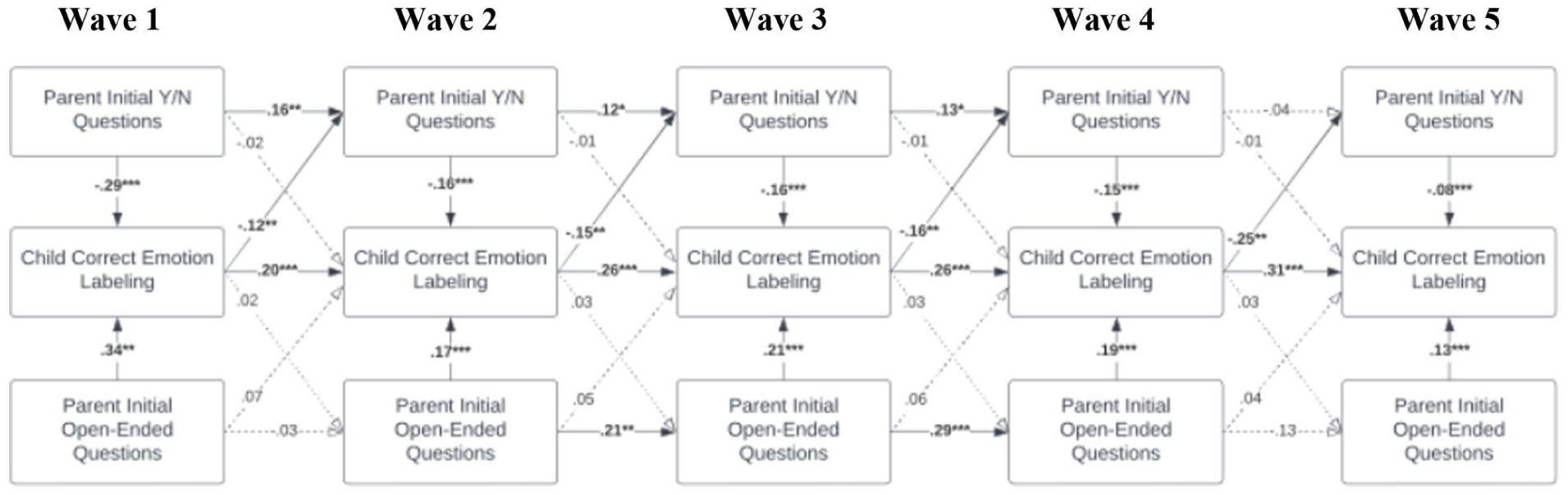
RI-CLPM of children’s correct emotion labels and parents’ ‘initial’ (i.e., start-of-conversation) yes/no questions and open-ended questions, controlling for child gender, age, and conversation length.
Standardized Coefficients From Path Model for Child Correct Emotion Labeling.
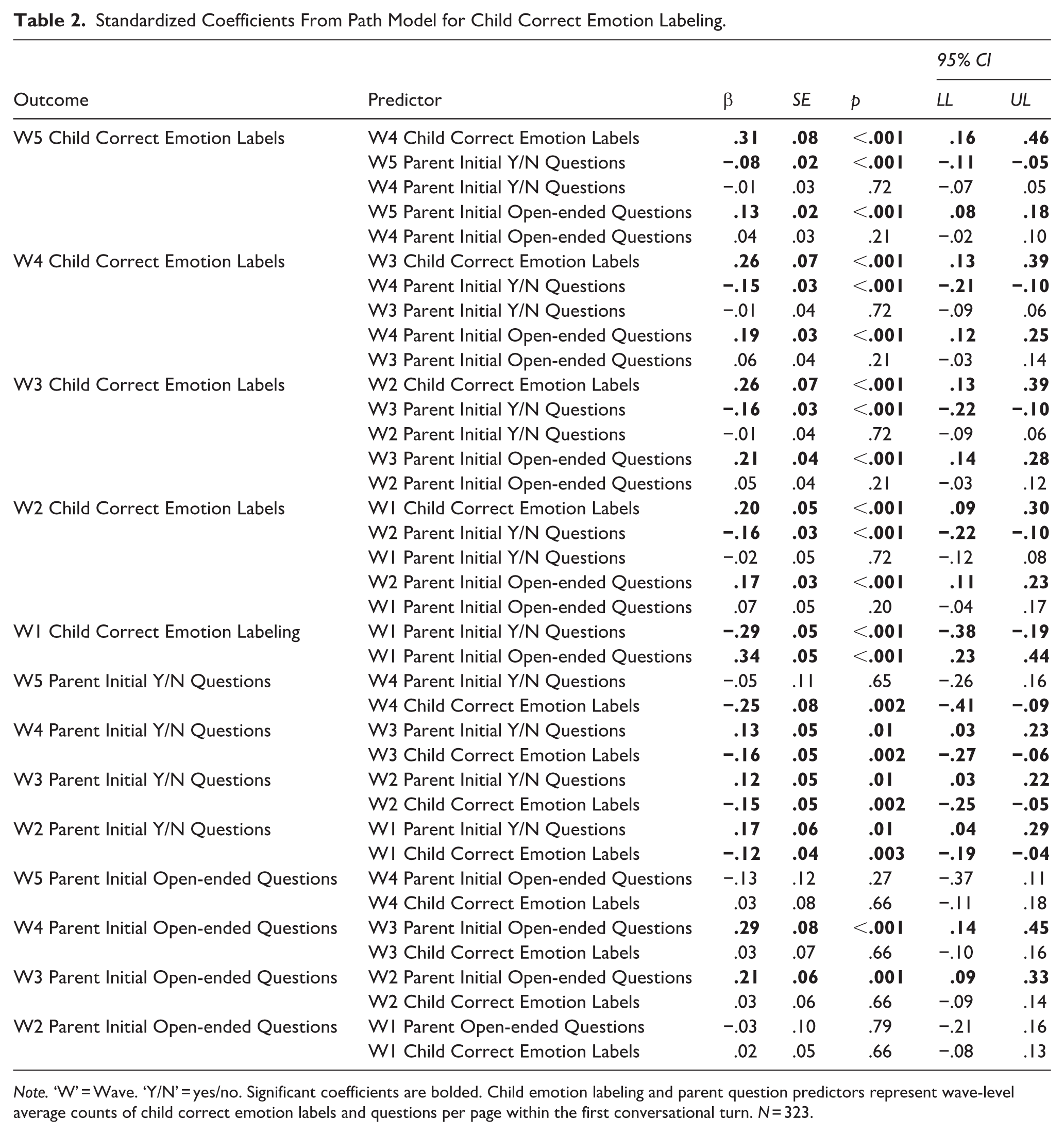
Note. ‘W’ = Wave. ‘Y/N’ = yes/no. Significant coefficients are bolded. Child emotion labeling and parent question predictors represent wave-level average counts of child correct emotion labels and questions per page within the first conversational turn. N = 323.
Parental Predictors of Children’s Correct Emotion Labeling
H1a and H2a: Cross-Sectional Relations
In support of our hypothesis (H1a), parents’ initial open-ended questions were significantly positively related to children’s subsequent correct emotion labels at all waves. Also in support of our predictions (H2a), parents’ initial (i.e., start-of-conversation) yes/no questions were significantly negatively related to children’s subsequent correct emotion labeling at all waves.
Sensitivity Analysis 1: Parent Total-Conversation Questions
We conducted sensitivity analyses examining parent total-conversation questions (Yes/no and open-ended) to examine whether the effect of parent questions depended on the starting point within the conversation (i.e., starting the conversation vs. at any point in the conversation). When attempting to include both parent total-conversation yes/no and open-ended questions simultaneously in a single RI-CLPM, the model exhibited substantial between-person collinearity between the two parent random intercept factors, resulting in estimation instability and poor overall fit. Because total-conversation yes/no questions and open-ended questions were highly correlated at the between-person (random intercept) level, the model was unable to reliably distinguish their stable components within a single framework. We thus estimated two separate RI-CLPMs: one including child emotion labeling and parent total-conversation yes/no questions, and a second including child emotion labeling and parent total-conversation open-ended questions.
Both models were specified identically to the primary RI-CLPM, including random intercepts, within-person autoregressive paths, cross-lagged paths, and time-invariant covariates. Like our results with parent initial open-ended questions, parent total-conversation questions were also positively related to same-wave children’s correct emotion labeling at all waves (all βs ⩾ .39, all ps < .001). However, in contrast to our results with parent initial-conversation yes/no questions that showed consistent negative relations with same-wave child emotion labeling at all waves, parent total-conversation yes/no questions showed consistent positive correlations with same-wave children’s emotion labeling at all waves (all βs ⩾ .28, all ps < .001). These results revealed that the direction of the effect of parent yes/no questions on children’s correct emotion labeling depended entirely on the temporal placement of the questions within the conversation (e.g., start of conversation).
H1b, H2b, and H3: Longitudinal Associations
We found partial support for our predictions regarding stability effects within variables across waves (H3). Specifically, there were significant stability effects for children’s emotion labeling between each wave from Wave 1 to Wave 5. In addition, there were significant stability effects for parent yes/no questions from Wave 1 to 4 and for open-ended questions between Waves 2 and 4.
Finally, there were no between-variable longitudinal relations for either type of parent questions and children’s later emotion labeling (H1b, H2b). However, an unanticipated reverse-direction effect emerged. Children’s correct emotion labeling at each prior wave significantly predicted decreases in parents’ use of initial yes/no questions at each subsequent wave. Thus, while parents’ initial yes/no questions did not prospectively constrain children’s labeling abilities, children’s labeling skills appeared to influence parents’ later use of yes/no questions.
Cohort Effects Check
To evaluate potential cohort effects, we re-estimated the model using only participants enrolled at Wave 1. The pattern and significance of results were substantively unchanged, indicating that findings were not driven by inclusion of later-entry cohorts.
Sensitivity Analysis 2: Parent Initial Correct Emotion Labels
To address the possibility that children’s emotion labeling reflected simple imitation of parents’ emotion words in questions used at the beginning of the conversation, we conducted a sensitivity analysis that incorporated parents’ correct emotion labels included in their start-of-conversation questions during the first conversational turn (e.g., “Is she sad?” when discussing the sad image) as a covariate predicting children’s correct emotion labeling. The RI-CLPM was otherwise specified identically as before. The inclusion of parent initial correct emotion labels did not substantively alter the pattern or statistical significance of the primary cross-lagged associations. Specifically, parents’ use of more open-ended questions than their typical level continued to predict increases in children’s subsequent correct emotion labeling in the conversation, whereas greater use of yes/no questions than typical continued to predict decreases in children’s subsequent correct labeling in the conversation. Thus, these associations were not attributable to children merely echoing parents’ initial emotion word use. Full model results for this sensitivity analysis are presented in Supplementary Table 2.
Discussion
This study examined the impact of parents’ start-of-conversation yes/no questions versus open-ended questions on children’s accurate emotion labeling during shared discussion of wordless picture books using data from five waves of a longitudinal study. Our design was motivated by an integrated framework of parental emotion socialization (Eisenberg et al., 1998), constructivist theories of emotion (Barrett, 2017), and the zone of proximal development (Vygotsky, 1978), and focused on the importance and timing of parental interaction in supporting children’s emotion understanding and labeling through discussions. Overall, results indicated that within-person deviations in parents’ initial open-ended questions were positively associated with children’s concurrent emotion labeling, whereas within-person deviations in parent yes/no questions were negatively associated. However, these associations did not extend longitudinally. Rather, within-person increases in children’s correct emotion labeling predicted within-person decreases in parent yes/no questions 1 year later. Below, we discuss our results in reference to our hypotheses.
Starting a Conversation: The Temporal Dynamics of Open-Ended and Yes/No Questions
By looking at parents’ first conversational turn (i.e., the number of questions they asked before the child first responded), we aimed to see how the initial prompt(s) shape the remainder of the interaction. Initial questions may set the tone for the interaction, guiding children’s responses and shaping the depth and quality of the conversation (Leung et al., 2025). Partially consistent with Hypotheses 1 and 2, cross-sectional analyses from this multi-wave study showed that at each wave parents’ start-of-conversation open-ended questions during shared discussion of wordless picture books were positively associated with children’s correct emotion labels, whereas yes/no questions were negatively associated. This pattern of results held even when accounting for parents’ use of correct emotion labeling in their start-of-conversation questions, highlighting the robustness of these question strategies. These results are largely consistent with prior research, with open-ended questions facilitating deeper emotion discussions, supporting cognitive processing and emotion expression, and encouraging children’s emotion-related vocabulary (Fabes et al., 2001; Garner & Estep, 2001; Shiu & Wang, 2024; Wareham & Salmon, 2006). Including more open-ended questions within the first conversational turn appears to provide scaffolding for children’s understanding of emotional concepts and empathy development (Laible, 2004; van Bergen & Salmon, 2010). In contrast, yes/no questions may constrain expression and limit deeper reflection, reducing children’s active emotion identification (Lyon & Henderson, 2021), particularly given age-related response tendencies (2-to-3-year-olds more likely answer “yes,” 4-to-5 year-olds more likely “no”; Fivush et al., 2000; Fritzley & Lee, 2003; Peterson & Biggs, 1997). These results support frameworks of parental emotion socialization and constructivist emotion theory, highlighting that early parental language use can shape children’s engagement and emotional development.
Contrary to Hypotheses 1 and 2, parents’ questions were not associated with children’s emotion labeling longitudinally. In other words, within-person fluctuations in parents’ earlier questioning strategies did not predict children’s emotion labeling a year later. This suggests that parental question type may function more as a context-specific scaffold within interactions rather than a stable long-term predictor. One explanation is that children’s emotion learning is shaped by multiple contexts (e.g., peers, teachers, media), which may reduce the long-term influence of parent–child conversations. Another possibility is developmental change. As children grow, they rely less on parental scaffolding and more on their own emotional knowledge, weakening earlier associations over time (Vygotsky, 1978). Therefore, other factors may play a more important long-term role in children’s emotion labeling development (Denham, 2019, 2023). Future research should explore these mechanisms.
Finally, consistent with Hypothesis 3, children’s emotion labeling showed significant stability across waves, indicating that once foundational emotion labeling skills develop, they remain relatively consistent over time. Parents’ question-asking patterns were also stable across multiple waves (Wave 1 to Wave 4 for yes/no questions and Wave 2 to Wave 4 for open-ended questions), suggesting consistent interaction styles across several years in early development. Furthermore, children’s correct emotion labeling in prior waves longitudinally predicted decreases in parents’ use of initial yes/no questions across development. Thus, as children’s emotion-labeling abilities and vocabulary grow, parents may adapt their questioning, reflecting responsiveness to their child’s developmental progress. This pattern aligns with Vygotsky’s zone of proximal development (Sage, 2022; Vygotsky, 1978), which emphasizes guided learning in areas children have not yet mastered independently. More research is needed to confirm this possibility.
Although the start-of-conversation question type did not predict children’s emotion labeling 1 year later in the RI-CLPM, sensitivity analyses show that overall question frequency across the conversation relates positively to same-wave labeling. Thus, temporal dynamics—not just initial question type—may play a role in long-term development and deserve further study. Together, these findings suggest that while start-of-conversation question type shapes children’s engagement within interactions, broader conversational dynamics may contribute to long-term developmental processes.
Sensitivity analyses further clarified why this study emphasized start-of-conversation questions. When examining the total number of parents’ questions across an entire interaction, both yes/no and open-ended questions were generally positively associated with children’s correct emotion labeling. This contrasts with the negative effect of start-of-conversation yes/no questions found in the path analyses, highlighting that question timing is critical. Early yes/no questions may constrain children’s responses, whereas later ones can reinforce or clarify understanding. In contrast, open-ended questions consistently supported children’s emotion labeling and understanding, regardless of timing. These findings suggest that while both content and timing matter for yes/no questions, open-ended questions reliably promote emotion development.
Overall, this study deepens our understanding of parent–child emotional interactions and emotion socialization processes. The results suggest that to effectively support children’s socio-emotional development, parents may use open-ended questions at the start of conversations to encourage deeper thinking and richer emotional expression. Strategically using yes/no questions later in the interaction may help reinforce learning and boost children’s confidence in expressing their emotions. A major strength of this study is that findings were stable across in-person and remote (Zoom) data collection waves, suggesting that observed associations reflect robust conversational processes rather than modality-specific effects. Whether these findings generalize to other emotion socialization contexts (e.g., teachers, peers) remains an open question.
Limitations and Future Directions
Although this study provides valuable insights into children’s emotional understanding and development, there are some limitations to consider. While the study’s sample is diverse, it may not be fully representative of all socioeconomic or cultural backgrounds. In addition, most caregivers in the study were mothers, which may limit the generalizability of the findings to other caregivers, such as fathers or grandparents. Some of the data were obtained during the COVID-19 pandemic, and the reliance on Zoom for observations may have affected parent–child interactions. Furthermore, the study’s focus on wordless picture books, while useful in examining emotion understanding, may not fully capture the range of emotional discussions in other media. In addition, the storybooks used in this study may not fully reflect the types of books parents and children typically read together, which could limit the findings. Moreover, variation in habitual shared book practices may influence children’s emotion labeling during picture-book tasks. Future research should incorporate measures of home literacy environment to further contextualize parent–child discussion patterns.
Future research could explore whether patterns in children’s responses to questioning styles vary by specific emotions. Also, future studies could include a wider range of storybooks that more closely reflect typical parent–child reading experiences. Other work could employ experimental designs or in-depth qualitative analyses to explore how children process and respond to different types of parental questions in real time. Furthermore, examining the stability of these patterns across cultural, socioeconomic, and caregiver differences could provide a broader understanding of their effects. Studies could also assess the applicability of these findings beyond U.S. populations, particularly in non-English-speaking contexts where emotional categories and labels may differ (Price et al., 2022). Exploring how questioning techniques influence emotional development in social and academic settings could further highlight their broader impact.
Finally, the present study focused specifically on parents’ initial question type as a conversational entry strategy and did not code other potentially relevant socialization behaviors, such as parental correction of inaccurate labels (Ankowski & Sandhofer, 2006). Future research should examine how corrective feedback and other forms of modeling interact with question type to shape children’s developing emotion knowledge.
Conclusion
This study provides valuable insights into parent–child interactions during picture-book discussion and their potential link to children’s emotional understanding. The current study demonstrated that parents’ initial (i.e., start-of-conversation) use of open-ended questions may help children label emotions more accurately, while using yes/no questions may hinder children’s correct labeling of emotions; the total number of questions and the timing of their use are equally influential. Given that children’s emotion understanding ability is an important predictor of their future social adaptability, peer relationship quality, emotion regulation level, and academic achievement, whether improved emotion labeling in early childhood leads to similar positive outcomes remains a fascinating future direction.
Supplemental Material
sj-docx-1-jbd-10.1177_01650254261458749 – Supplemental material for How to Start a Conversation? A 5-Year Longitudinal Investigation of the Effect of Parent Question Type on Children’s Early Emotion Labeling
Supplemental material, sj-docx-1-jbd-10.1177_01650254261458749 for How to Start a Conversation? A 5-Year Longitudinal Investigation of the Effect of Parent Question Type on Children’s Early Emotion Labeling by Fangyuan M. Broadbent and Peter J. Reschke in International Journal of Behavioral Development
Footnotes
Acknowledgements
We wish to acknowledge the dozens of research assistants for their help with data collection and coding efforts.
Authors’ Note
All authors have reviewed and agreed to their individual contributions.

Funding
The authors received no financial support for the research, authorship, and/or publication of this article.
Declaration of Conflicting Interests
The authors declared no potential conflicts of interest with respect to the research, authorship, and/or publication of this article.
Statement on Preregistration
This study’s design, hypotheses, and plan of analysis were not preregistered.
Supplemental Material
Supplemental material for this article is available online.
References
Supplementary Material
Please find the following supplemental material available below.
For Open Access articles published under a Creative Commons License, all supplemental material carries the same license as the article it is associated with.
For non-Open Access articles published, all supplemental material carries a non-exclusive license, and permission requests for re-use of supplemental material or any part of supplemental material shall be sent directly to the copyright owner as specified in the copyright notice associated with the article.
