






Abstract
This study examines the relation between age, materialism, and theory of mind (ToM) in preschool children, focusing on ToM as a potential mediator of age-related declines in materialism. Using a sample of 219 preschoolers (47% girls) aged 39–87 months (M = 65.30 months, SD = 12.18 months), we assessed materialism in its happiness and success dimensions and measured ToM through established cognitive tasks. Results confirmed that among preschoolers, materialism declines with age, but ToM partially offsets this decline in the success dimension, creating a suppression effect. These findings provide insight into how cognitive development shapes materialistic attitudes in early childhood, highlighting the distinct roles of age and ToM in shaping different dimensions of materialism. Understanding preschoolers’ materialism is important, as early values can influence long-term consumer behavior. This study offers novel insights by demonstrating that, although materialism generally declines with age in preschoolers, emerging ToM abilities can counteract this trend by reinforcing the social significance of possessions. These findings highlight the interplay between age and ToM in shaping distinct dimensions of materialism during the preschool years.
Introduction
Materialism, defined as the value individuals place on possessions as a source of happiness and success (Richins & Dawson, 1992), is not exclusive to adults. Research suggests that preschool children exhibit varying degrees of materialistic tendencies (Dykalska-Bieck et al., 2017; Trzcińska et al., 2024; Watkins et al., 2016). Preschoolers demonstrate an understanding of brand symbolism (McAlister & Cornwell, 2010) and associate material possessions with happiness (Watkins et al., 2016). Recent studies suggest a broader perspective, showing that young children not only link possessions to happiness but also to success, where material goods are associated with social status and recognition (Trzcińska et al., 2023).
Materialism has long been linked to various negative social and clinical consequences (Shrum et al., 2022). However, despite its significance, little is known about its developmental trajectory in early childhood. According to John’s (1999) framework of consumer socialization, preschool-aged children tend to judge the value of possessions based on surface attributes, such as quantity, and focus on acquiring more items regardless of quality. Similarly, Smith et al. (2018) found that 5-year-olds scored higher in the spendthrift direction – meaning they experienced more positive emotions when spending money – than older children. This suggests that younger children may have stronger materialistic tendencies. Chan’s (2003) study of children aged 6 to 13 also found that the youngest children were the most materialistic, as they were more likely to compare their toys with friends to see who had more. According to Chan, older children gain more consumer experience, some of which may be disappointing, leading them to realize that owning more material goods does not always bring happiness. Recent studies support this idea, showing that materialism declines during the preschool years, both in terms of happiness and success (Trzcińska et al., 2023). This decline suggests that as preschool children grow, they rely less on material goods to define their happiness and social status.
Besides age, another factor influencing the development of materialism is the theory of mind (ToM), the ability to understand others’ beliefs, thoughts, and emotions (e.g., Leslie et al., 2004). McAlister and Cornwell (2010) argue that ToM is essential for grasping the social significance of material possessions, such as imagining how others perceive them based on their belongings. This suggests that as ToM develops, children may become more aware of the status and recognition associated with possessions, potentially reinforcing materialistic attitudes. Conversely, Chaplin et al. (2020) found that children with more advanced ToM derive greater happiness from experiences rather than material goods, indicating that ToM could also mitigate materialistic tendencies in the happiness dimension of materialism. However, there is a lack of research examining how the perception of material goods as a marker of success evolves alongside ToM development. The ToM allows children to understand that others may hold different perspectives and that they influence social interactions (Bosacki & Wilde Astington, 1999). Given that materialism in the success dimension involves perceiving possessions as markers of status or appreciation, ToM may play a significant role in shaping materialistic tendencies in this domain.
The theoretical foundations outlined above suggest that the interplay between age, ToM, and materialism requires further empirical exploration. Given previous studies showing that materialism declines with age in preschool children (Trzcińska et al., 2023), we aim to replicate these findings. Thus, we hypothesize that materialism decreases with age in both the happiness (H1a) and success (H1b) dimensions. Although materialism is generally expected to decline with age, ToM may play a mediating role in shaping how children interpret the meaning of material possessions, with its influence differing across materialism dimensions. Since ToM enables children to better understand that material goods can serve as markers of status perceived by others, we propose that in the success dimension, ToM mediates the association between age and materialism, leading to a suppression effect – where the natural decline in materialism with age is partially counteracted by ToM-driven reinforcement of materialistic tendencies (H2a). On the other hand, Chaplin et al. (2020) found that as children grow older and develop ToM, they derive more happiness from experiences rather than material objects. Therefore, in the happiness dimension of materialism, we propose that ToM partially mediates the relation between age and happiness-related materialism (H2b): older children have more advanced ToM, which in turn leads to a lower tendency to associate possessions with happiness.
By linking materialism with ToM, the present study examines early materialistic tendencies within a developmental framework. Rather than treating materialism as a stable characteristic or solely as a product of consumer socialization, this approach focuses on how age-related changes in social cognition shape the meanings children attribute to possessions. Understanding how materialism develops in early childhood is particularly important, as prior research suggests that materialistic tendencies exhibit developmental continuity (Jiang et al., 2021; Kasser et al., 2014). Consequently, early materialistic beliefs may have implications for later behavioral outcomes. For example, materialism has been associated with behaviors such as conspicuous consumption (Kolańska-Stronka & Gorbaniuk, 2022) and increased financial problems, including consumer debt (Watson, 2003). The preschool years, during which both materialistic tendencies and ToM undergo substantial development, provide a particularly informative context for examining how changes in social cognition relate to distinct dimensions of materialism. This perspective allows us to move beyond describing age-related differences and to identify cognitive mechanisms that may differentially shape happiness- and success-related materialistic beliefs.
Method
Participants
To determine the minimum sample size for a mediation model, we conducted a Monte Carlo Power Analysis for Indirect Effects (Schoemann et al., 2017). Assuming correlations of r = .30 between age, ToM, and materialism, with a power of .80, a significance level of .05, and 1,000 replications, the analysis estimated a minimum required sample size of N = 153 participants. While r = .30 is traditionally classified as a medium effect size (Cohen, 1988), it has been considered relatively strong in certain psychological contexts (Funder & Ozer, 2019). The study was approved by the Research Ethics Board at the Faculty of Psychology, University of Warsaw (Opinion No. 21/11/2022) and conducted in public preschools in a major Polish city. A total of 232 children whose parents had previously provided written consent were invited to participate. Each child was tested individually by a trained experimenter in a quiet room within their preschool. Before the study began, the children were informed that participation was anonymous, given details about the procedure, assured of their right to withdraw at any time, and asked to provide verbal consent to participate. One child declined to participate, and two others discontinued during the study. In addition, we excluded 10 children from the final data because their parents did not provide their month and year of birth, making age calculation impossible. Thus, the final sample consisted of 219 children (103 girls and 116 boys, aged 39–87 months, M = 65.30 months, SD = 12.18 months).
Materials and Procedure
Materialism
We assessed children’s materialism using the Pictorial Materialism Test (Trzcińska et al., 2023). The test consists of 32 items, divided into 2 subscales, each containing 16 items: the Happiness Scale, which measures materialism as the belief that possessions lead to happiness, and the Success Scale, which measures materialism as the perception that success is defined by owning material goods. Each item consists of a pair of pictures: one depicting a child with material possessions (e.g., many toys or nice clothes) and the other depicting nonmaterialistic relationships or activities (e.g., a child with many friends or reading with a parent). The pictures are described to the participating child, and the experimenter then asks them to choose the child who appears happier (Happiness Scale, e.g., This girl is playing on the playground, and this girl got a gift. Which girl is happier?) or cooler (Success Scale, e.g., This boy has a lot of toys, and this boy has a lot of friends. Which boy is cooler?). Children could select only one picture per pair. A child received 1 point for choosing the materialistic image and 0 points for selecting the nonmaterialistic one. The total possible score ranged from 0 to 32 points, with higher scores indicating greater materialism. The test demonstrated good internal consistency (KR-20 = 0.80 for the entire scale, 0.68 for the Happiness Scale, and 0.70 for the Success Scale).
Theory of Mind
We assessed ToM using three measures, the same as in Chaplin and Norton (2015): the Sally & Anne false belief task (Baron-Cohen et al., 1985), the Cookie Box misleading container test (Gopnik & Astington, 1988), and the Duck and Lion social test (Nguyen & Frye, 1999). The measures were administered in a rotating order. Each task included a ToM test question (e.g., When your friend sees the box for the first time, will he think there are chocolates or crayons inside?) and two control questions: a reality question (e.g., What is really in the box?) and a memory question (e.g., When you saw the box for the first time, what did you think was inside?). A child received 1 point for a task if all answers were correct, resulting in a total possible score of 0 to 3 points (KR-20 = 0.67). A higher score indicated a greater development of ToM.
Age
We calculated the child’s age by determining the difference between the month and year of the study and the child’s year and month of birth as reported by the parents.
Results
Zero-Order Correlations
Correlations among materialism, age, and ToM, along with the means and standard deviations for all variables, are presented in Table 1. Notably, age and materialism are significantly correlated, whereas ToM is correlated with age but not with materialism. These results confirm H1a and H1b, indicating that materialism declines with age in both the happiness and success dimensions.
Descriptive Statistics and Zero-Order Correlations Between Variables.
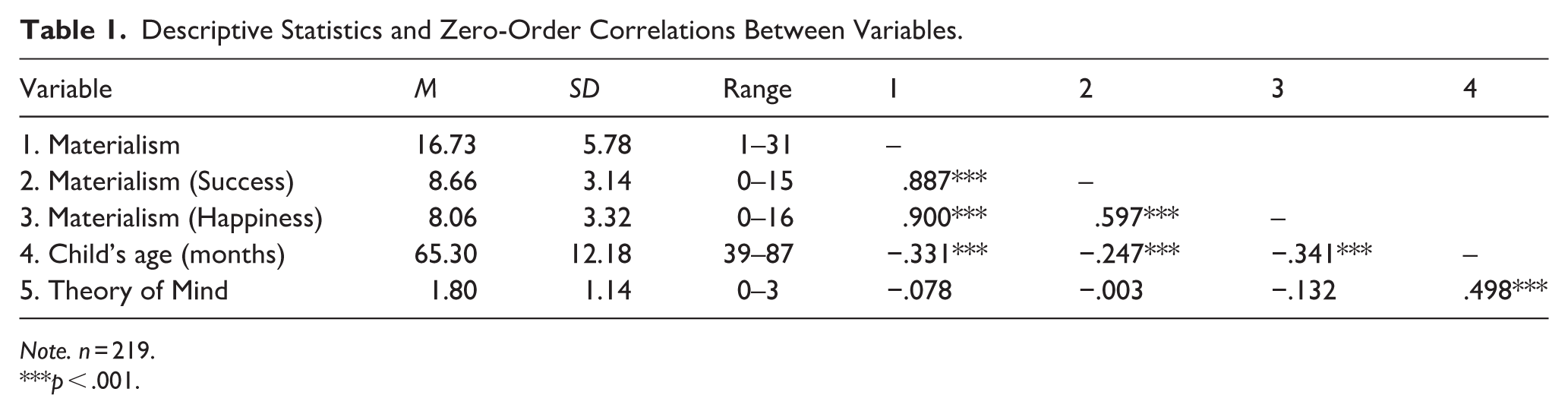
Note. n = 219.
p < .001.
Mediation Analyses
To verify H2a and H2b, which propose that ToM mediates the correlation between age and materialism, we conducted mediation analyses using Model 4 of the PROCESS macro for SPSS (Hayes, 2022) with 5,000 bootstrapped samples. We tested two models, with Success and Happiness as the dependent variables, both using age as the independent variable and ToM as the mediator. Table 2 presents statistics for both mediation analyses. Age (X) had a significant negative effect on Materialism (Success) and Materialism (Happiness; Y), indicating that older children tend to be less materialistic. In contrast, age had a significant positive effect on ToM (M), implying that older children have a more developed ToM. In addition, ToM had a significant positive effect on Materialism (Success) but no significant effect on Materialism (Happiness), suggesting that a more developed ToM is associated only with lower levels of Materialism (Success).
Model Coefficients for Mediation Analysis (Theory of Mind as Mediator).
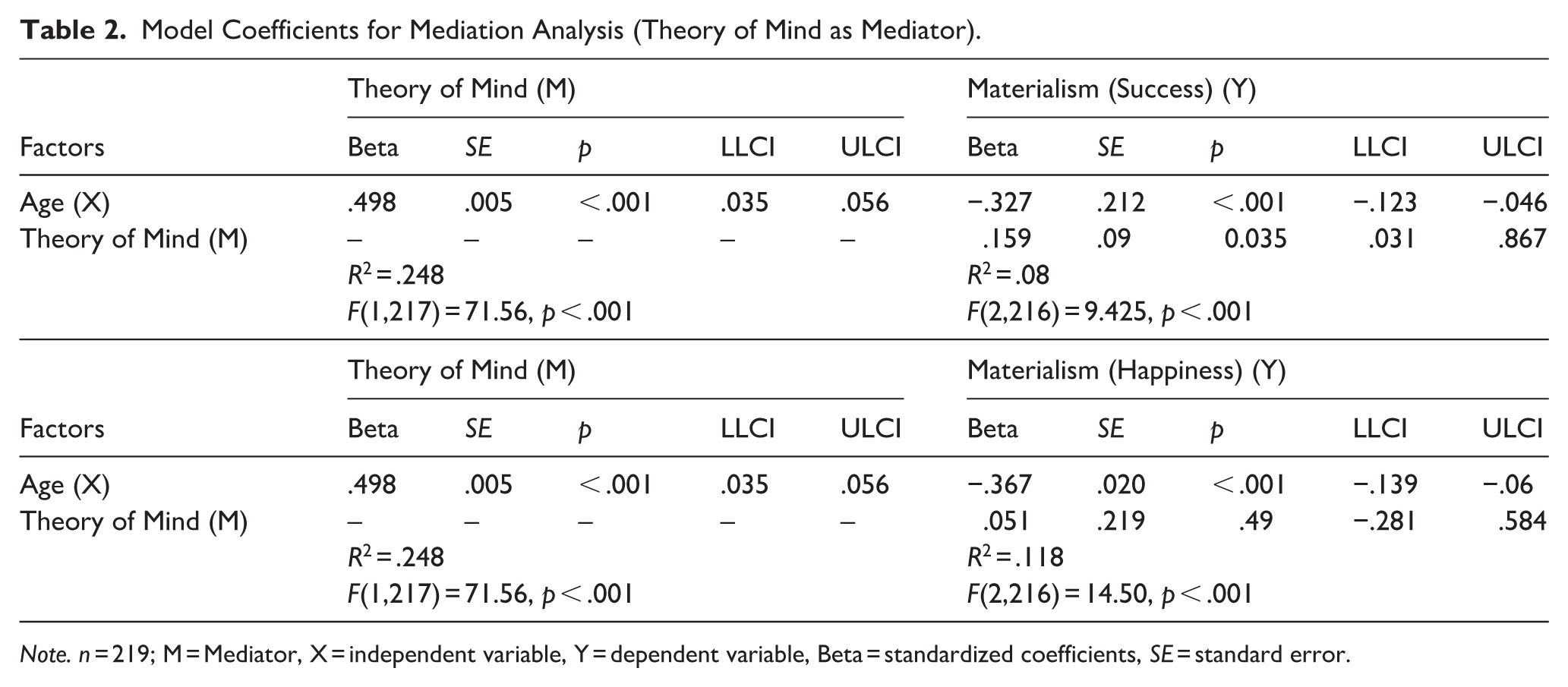
Note. n = 219; M = Mediator, X = independent variable, Y = dependent variable, Beta = standardized coefficients, SE = standard error.
Figure 1 illustrates the mediation model for the Success Scale of materialism. The results indicate that ToM significantly mediated the correlation between age and materialism, understood as possession-defined success (indirect effect = .079, 95% BCCI = [.0096, .1584]). A suppression effect emerged, where the decline in materialism with age was partially offset by ToM, reinforcing materialistic tendencies, confirming H2a.
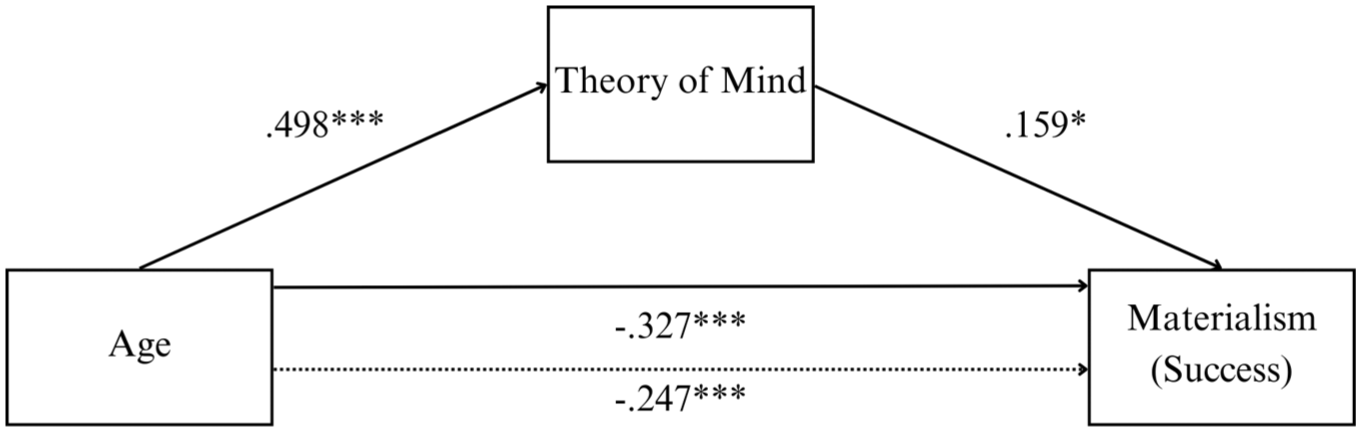
Mediation model of Theory of Mind between age and materialism as possession-defined success.
Figure 2 presents the mediation model for the Happiness Scale of materialism. Here, ToM did not significantly mediate the correlation between age and materialism (indirect effect = .025, 95% BCCI = [−.0466, .1051]), failing to support H2b.
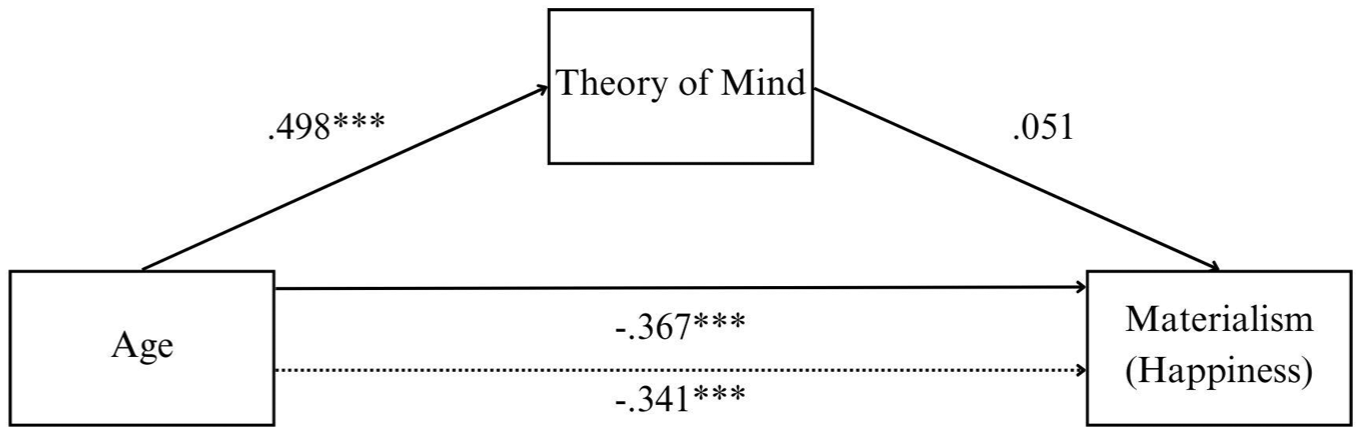
Mediation model of Theory of Mind between age and materialism as possession-defined happiness.
Discussion
The present study examined the relation between age, materialism, and ToM in preschool children, focusing on whether ToM mediates the decline in materialism with age. Our findings confirm that during the preschool period, materialism decreases with age in both the happiness and success dimensions (H1a and H1b). This finding aligns with previous research showing that younger preschoolers display stronger materialistic tendencies than older children: as preschoolers grow, they increasingly rely less on material goods to define happiness and success (Chan, 2003; Trzcińska et al., 2023). This may be because younger preschoolers prioritize surface attributes like quantity over intrinsic value (John, 1999) and derive greater emotional gratification from acquiring possessions (Smith et al., 2018). With age, consumer experience broadens, sometimes leading to disillusionment with material goods. Older children begin to recognize that possessions do not always meet expectations or bring happiness (Chan, 2003).
Our study also confirmed H2a, demonstrating that ToM mediates the relation between age and materialism in the success dimension. This suggests that as children’s ability to understand others’ thoughts and perspectives develops, so does their awareness of the social significance of material goods. The success dimension of materialism reflects the belief that possessions are key to being appreciated and socially valued (Gurel-Atay et al., 2014; Joseph Sirgy et al., 2021; Richins & Dawson, 1992; Trzcińska et al., 2023). Since ToM allows children to recognize that others evaluate people based on their possessions, its development strengthens the association between material goods and status. Consequently, while materialism generally declines with age, ToM reinforces materialistic tendencies related to success, leading to a suppression effect. In contrast, H2b was not supported, as ToM did not significantly mediate the relation between age and materialism as possession-driven happiness. While recognizing that others evaluate people based on their possessions requires ToM – the ability to understand others’ thoughts and perspectives – evaluating one’s own happiness is introspective and does not necessarily depend on ToM development. Chaplin et al. (2020) similarly found that ToM was not a unique predictor of deriving happiness from experiences (rather than material possessions); memory played a more central role. Likewise, in our study, ToM may not have influenced materialism in the happiness dimension because this belief is self-focused rather than shaped by social understanding. While ToM helps children grasp the social value of possessions, it may not determine whether they personally equate material goods with happiness.
Our study confirmed the well-established positive relation between age and ToM, as shown in previous research (Astington & Jenkins, 1995). However, it also revealed a highly significant and innovative finding: although age is positively related to ToM, age reduces materialism, while ToM reinforces it in the success dimension. This is a clear example of a suppression effect, where two related variables have opposing effects on the dependent variable (Cichocka & Bilewicz, 2010; MacKinnon et al., 2000). While age predicts a decline in materialism, ToM partially offsets this decline by strengthening the belief that possessions signal social status. This suggests two developmental pathways to materialism: a direct effect of age, which reduces materialism as children recognize that possessions do not always bring happiness, and an indirect effect through ToM, which enhances awareness of possessions as markers of social recognition. By considering the shared variance between age and ToM, our study isolates their distinct influences on materialism, showing that while age generally reduces materialism, ToM development can reinforce materialistic attitudes related to social status.
This study has several limitations that should be addressed in future research. First, although our hypotheses are strongly theory-driven and the proposed causal order is logically arranged, the cross-sectional design limits our ability to draw causal conclusions about the development of materialism. Longitudinal studies tracking the same children over time would provide a clearer picture of how materialism evolves and how ToM influences this trajectory. Such an approach would enable more proper testing of the mediating process, as statistical mediation in cross-sectional studies does not provide evidence of causality (Fiedler et al., 2011). Second, our study focused exclusively on preschool-aged children, leaving open questions about whether the role of ToM in materialism persists or changes in older age groups. While ToM develops rapidly in early childhood, it continues to refine throughout middle childhood and adolescence (Miller, 2012), potentially affecting materialistic values differently at later stages. Future research should explore whether ToM continues to affect materialism beyond the preschool years. Finally, cultural factors may influence how people perceive possessions as symbols of success or happiness (Clarke & Micken, 2002). Conducting cross-cultural studies would help determine whether the relation between ToM and materialism generalizes across different socioeconomic and cultural contexts.
To conclude, this study provides new insights by demonstrating that materialism decreases with age in preschool children, but ToM partially offsets this decline by reinforcing its social aspect, where material goods are associated with status and recognition. These findings enhance our understanding of how cognitive development shapes materialistic attitudes in early childhood, highlighting the complex interplay between age, ToM, and different dimensions of materialism.
Footnotes

Ethical Considerations
This research was approved by the Research Ethics Board at the Faculty of Psychology, University of Warsaw, Opinion No. 21/11/2022.
Consent to Participate
Participants (children) gave oral consent prior to participating. Written consent was obtained from their legally authorized representatives (parents).
Funding
The authors disclosed receipt of the following financial support for the research, authorship, and/or publication of this article: This research was funded by the National Science Centre, Poland, grant number 2021/41/B/HS4/01515.
Declaration of Conflicting Interests
The authors declared no potential conflicts of interest with respect to the research, authorship, and/or publication of this article.